
Mastering Careers & Skills
Locksmithing: Mastering the Craft · free sample from the book itself
We start where this book starts everywhere: with what the work actually is, stated by the people who measure work for a living. The U.S. Department of Labor's ONET program catalogs this occupation under occupation 49-9094, Locksmiths and Safe Repairers, and defines it in one sentence: locksmiths "repair and open locks, make keys, change locks and safe combinations, and install and repair safes." That sentence is short. The task inventory — the program's catalog of the occupation's actual tasks, each rated for its importance to the occupation — is not short, and we use it in this book as the trade's own table of contents, because it was built by asking the trade what the trade does.
Read the inventory as a map of your working life. At the top of the importance ratings stands cutting new or duplicate keys using impressions or code key machines (importance 94 in the ONET inventory). Close behind it stand inserting new or repaired tumblers into locks to change combinations — the rekeying work of Chapter 5 (90); moving picklocks in cylinders to open door locks without keys — the lawful entry work of Chapter 9 (89); cutting keys using key cutting machines (88); opening safe locks by drilling (86); setting up and maintaining master key systems (83); installing door hardware such as locks and closers (82); keeping records of company locks and keys (79); disassembling mechanical or electrical locking devices and repairing or replacing worn tumblers, springs, and other parts (78); repairing and adjusting safes, vault doors, and vault components (74); installing alarm and electronic access systems (72 — a task this book carries only at the device-level boundary explained in section 1.5, because electronic access systems at system level belong to a neighboring book); installing safes, vault doors, and deposit boxes (65); unlocking cars and other vehicles (57); and reading blueprints and specification manuals to recommend appropriate hardware and electronic locking devices. [Source note: U.S. Department of Labor, Employment and Training Administration, ONET Online, occupation 49-9094.00, Locksmiths and Safe Repairers, task inventory as read for this book — the register.]
Notice what that inventory is telling you. The trade is not one skill. It is bench work (cutting, pinning, repairing), door work (hardware, closers, alignment), vehicle work (unlocking, and the key and programming work the inventory's key tasks imply), safe work, and records work — and the records task, at importance 79, outranks several of the glamorous ones. A locksmith who cannot keep records of locks and keys is missing a core task of the occupation, not an administrative extra. This book's twenty chapters follow that inventory's shape: Part II teaches the mechanical craft, Part III the doors and the commercial accounts, Part IV the modern automotive half, and Part V the safes, the electronic devices, and the working business that carries all of it.
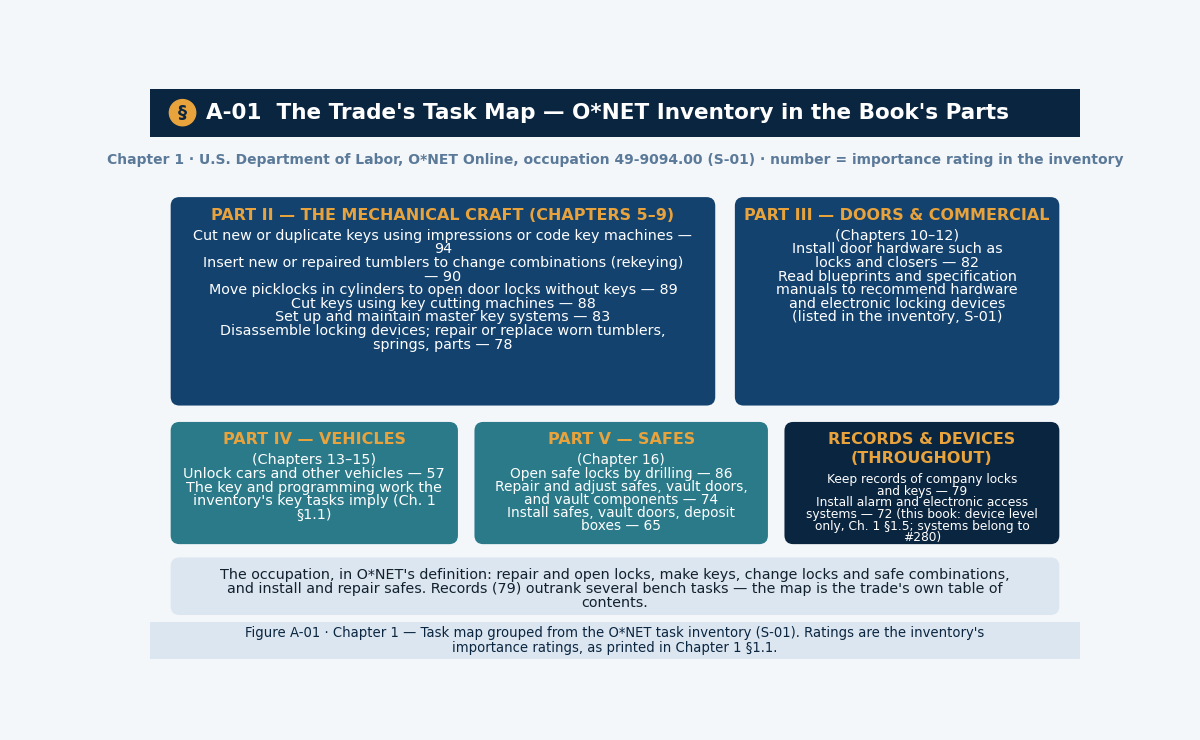
Figure A-01. The trade's task map: the ONET task inventory grouped into the book's parts
A locksmith, for this book's purposes, is a tradesperson who installs, services, rekeys, and opens locking devices, makes and originates keys for them, and keeps the records that make a keying system trustworthy — working for customers who have the right to authorize that work, a foundation Chapter 4 teaches whole before any technique chapter begins. A safe repairer — the occupation's second named half — does the same family of work on safes and vault doors at the depths Chapter 16 teaches, at service level. The federal occupation joins the two because in practice one van carries both, and our specimen business does exactly that.
The same craft is practiced in three shapes, and a reader choosing a life in this trade is choosing among them — or, more honestly, choosing which one to start in.
The first shape is the mobile practice: one van that is itself the workshop, no storefront, work performed at the customer's door, vehicle, or safe. This is the shape this book teaches whole, because it is the shape an owner-operator can open with the capital stack Chapter 20 builds line by line, and because the modern trade's work — lockouts, rekeys, vehicle keys, hardware service — happens where the lock is, not where a counter is. Our specimen, Copperline Locksmith, stands in this shape: a one-van mobile practice run by an owner-technician with one part-time apprentice, working from the van and a small rented storage unit. Section 1.4 introduces it whole.
The second shape is the shop-based practice: a storefront with a bench, a counter, and walk-in key work. The shop trades the van's low overhead for rent, visibility, and a place customers bring locks to. Nothing in this book's craft teaching assumes the van — the bench skills are the same skills — but its business chapters price and organize the mobile shape, and a shop reader substitutes their own rent and counter hours in the worksheets where the van's figures stand.
The third shape is institutional employment: the locksmith on the staff of a hospital, a university, a school district, a large facility, or a government shop, maintaining that institution's keying system as an employee. The voluntary certification landscape in Chapter 4 carries an institutional family of credentials for exactly this shape, which tells you the shape is a career, not a waiting room. An institutional reader uses this book's craft chapters whole and its business chapters as the map of the outside trade they serve from inside.
Whichever shape you stand in, the day itself has a rhythm the next section walks through, because the rhythm — not any single skill — is what a first morning in this trade actually feels like.
A working day in the mobile shape runs in five territories, and we name them now because every later chapter lives in one of them.
The bench is where keys are cut, cylinders are pinned, and locks are repaired — in the mobile shape, a bench built into the van, with the key machines mounted, the blank stock ordered, and task lighting that lets you read a pin stack at midnight. Figure P-01 shows the territory. The door is where residential and commercial work happens: the lockout, the rekey, the deadbolt that will not throw because the door, not the lock, has moved. The vehicle is the modern half's territory: the stranded driver, the add-key job, the all-keys-lost job, each with its own verification discipline. The safe is the quiet territory: combination changes, servicing, and the rare authorized opening, done slowly and documented completely. And the phone is the territory that governs the other four: intake, triage, the quote stated as a total before dispatch, and the records the day leaves behind. Chapter 18 teaches the phone's workflow as the trade's unit of work; the apprentice dialogue at this chapter's end takes place across all five territories in a single morning.
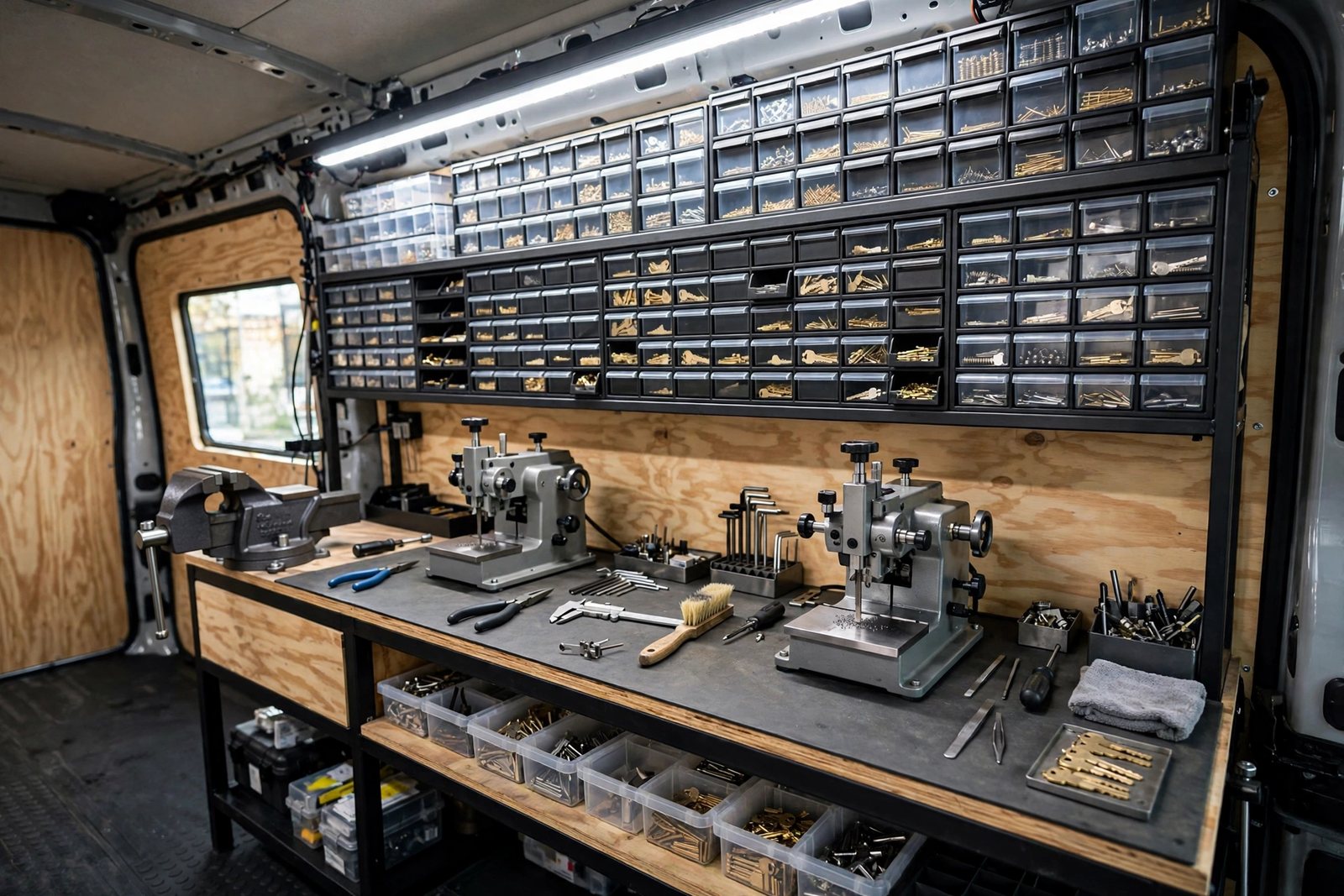
Figure P-01. The mobile workshop van interior: bench, key machines mounted, blank and hardware storage, task lighting — the van-as-workshop, no person
Two honest observations belong here. First, the territories interleave: a morning can hold a house rekey, a vehicle add-key, and a safe combination change, which is why this book refuses to split the mechanical and automotive halves into separate books — the same van, the same call list, and the same customer carry both. Second, the emergency work that dominates the trade's popular image — the midnight lockout — is one territory's one job type. The stabilized month we work in section 1.4 shows a practice whose revenue stands mostly on scheduled residential, commercial, and automotive work, with emergency calls woven through it, and Chapter 20 teaches the emergency-versus-contract mix as a shape to manage deliberately rather than a weather to endure.
One fictional business carries this book's worked arithmetic from this chapter to the capstone, so a number you meet once is the same number, to the cent, everywhere. Copperline Locksmith is fictional, and every figure attached to it is illustrative — teaching figures, chosen to make the arithmetic visible, not presented as typical, average, expected, or recommended. It keeps the registrations and insurance its own (unnamed) jurisdiction requires; this book names no jurisdiction for it, because no jurisdiction's rules are this book's to state.
Worked Example 1 — Reading the specimen's stabilized month. Illustrative figures. Copperline Locksmith's one stabilized teaching month — illustrative, not a forecast and not a typical month — stands as follows. Revenue by line: residential work (lockouts, rekeys, installs) $9,860; commercial work (rekeys, master keying, hardware service) $5,940; automotive work (add-key, all-keys-lost, fobs and remotes) $8,470; safe and specialty service $1,530. The total is built, not asserted: $9,860 + $5,940 = $15,800; $15,800 + $8,470 = $24,270; $24,270 + $1,530 = $25,800. Completed jobs in the month: 118. The average ticket — total revenue divided by completed jobs — is $25,800 ÷ 118 = $218.644…, carried at $218.64. The automotive share of the month is $8,470 ÷ $25,800 = 0.3283…, printed as 32.8% of the month's revenue — the specimen's own share, on the specimen's own numbers. (The trade's industry reporting describes automotive key services at 35–40% of industry revenue; that is a different measurement, of an industry rather than of one van's month, and section 1.6 keeps the two pictures separate.) Against the revenue stand the listed cost lines — parts and inventory consumed $6,192; fuel and vehicle running costs $1,140; insurance $685; phone, dispatch software, listings and advertising $920; programmer subscriptions and token replenishment $410; storage-unit rent $550; payment processing $619; consumables and tool wear $310; licenses and fees $95; accounting and professional fees $240; owner-technician pay $6,800; apprentice wages and employer payroll taxes $2,860 — which sum, line by line, to $20,821. Revenue minus listed lines is $25,800 − $20,821 = $4,979 — and that figure is not profit: income tax, depreciation on the van and machines, major-tool replacement, and any unlisted cost stand outside the table, and this book says so wherever the table stands. What you would substitute from your own practice: every line — the method, which is to build a month from its own lines and refuse to call the remainder profit, is the teaching.
The specimen's opening position is stated here and built line by line in Chapter 20: an opening capital stack — everything spent to open the doors, plus the reserve the discipline requires — of $37,000, made of $31,000 to open the doors and a $6,000 working-capital reserve. The same practice opened in a serviceable vehicle the founder already owns stacks to $37,000 − $14,500 = $22,500, because the $14,500 used-van line is the one line that disappears. Its price list — the daytime service call at $65, the five-cylinder house rekey at $175, the automotive add-key at $185, the all-keys-lost job at $285, the safe combination change at $145 — is Chapter 19's teaching document, derived there from the specimen's own costs. We introduce the specimen whole here so that when a later chapter says "the specimen's price," you already know the practice the price belongs to.
The modern trade is two trades sharing a van. The mechanical trade is the older one: pins, wafers, discs, levers, cuts, and codes — mechanisms you can hold, measure, and repair with hand tools and two machines. The electronic trade is the newer one: transponder keys that negotiate with a vehicle's immobilizer before they turn anything, proximity fobs, keypad and credential locks, electrified hardware, and the programmers and software subscriptions that service them. Copperline Locksmith is automotive-ready from the start — its automotive key programmer stands in its opening stack, not in some later upgrade — because the electronic half is not an add-on to the modern practice; on the specimen's own month it is 32.8% of revenue, and on the industry reporting it is the growing share of the trade.
Worked Example 2 — The two halves inside one week of calls. Illustrative figures — a separate example, not the Copperline Locksmith specimen. A fresh illustrative case: a one-van practice logs 27 completed jobs in one week. Classified by territory, the jobs are: residential rekeys and installs 9; residential lockout entries 4; commercial hardware service 5; automotive add-key and fob jobs 6; automotive lockout entries 2; safe combination changes 1. The classification arithmetic is checkable: 9 + 4 + 5 + 6 + 2 + 1 = 27. The mechanical territories (residential and commercial) hold 9 + 4 + 5 = 18 jobs, or 18 ÷ 27 = 66.7% of the week's count; the vehicle territory holds 6 + 2 = 8 jobs, or 8 ÷ 27 = 29.6%; the safe territory holds 1 job, or 1 ÷ 27 = 3.7%. The three shares sum to 66.7% + 29.6% + 3.7% = 100.0% (component shares rounded to one decimal). The teaching is the classification habit itself: a practice that cannot say, at week's end, which territory its jobs stood in cannot price, stock, or staff any of them deliberately. What you would substitute: your own week's log, classified the same way.
One boundary belongs in this first chapter, because the electronic trade tempts readers across it. This book teaches electronic hardware at device level — the standalone smart lock, the keypad deadbolt, the electrified lockset on one door (Chapter 17). Electronic access, camera, and intrusion systems — networked, multi-door, monitored — are a neighboring book's craft, and Chapter 17 prints that boundary on its face. The ONET inventory's task "installing alarm and electronic access systems" (importance 72) is therefore the one inventory line this book deliberately carries only to its device-level edge; every other line is taught whole.
This book prints the trade's measured record in both of its honest directions, and it starts in this chapter, with dates attached.
Worked Example 3 — Reading the federal wage table without misreading it. Illustrative figures — the figures are the Bureau's published population data, attributed and dated; the reading is the worked example. The Bureau of Labor Statistics' Occupational Employment and Wage Statistics, May 2025, for occupation 49-9094, reports a national employment estimate of 15,040, a mean annual wage of $55,470 ($26.67 an hour), and a median annual wage of $51,320 ($24.68 an hour), with percentiles at the 10th $35,530, the 25th $43,160, the median $51,320, the 75th $64,560, and the 90th $79,400. [Source note: U.S. Bureau of Labor Statistics, Occupational Employment and Wage Statistics, May 2025, occupation 49-9094 — the register.] Read the table the way a tradesperson reads a gauge. The median is the middle employee: half of the occupation's employees earn more than $51,320 and half earn less. The spread from the 10th percentile to the 90th is $79,400 − $35,530 = $43,870 — a wide spread, which is what a trade with apprentices at one end and master technicians and safe specialists at the other looks like in wage data. And the scope line matters most of all: these estimates describe employees only — the survey excludes the self-employed — so the table says nothing, in either direction, about the revenue or the take of a one-van business. It is population data about an occupation, printed as exactly that: never as your earnings, your prospects, or your forecast.
The Bureau's Employment Projections, 2025–35 (released August 27, 2026), project the occupation's total employment to fall from 18,700 to 16,500 — a change of 16,500 − 18,700 = −2,200, or −11.7% — with wage-and-salary employment declining from 15,200 to 12,900 (−15.3%) and self-employment edging from 3,500 to 3,600, even as an average of 1,200 openings a year arise from replacement needs — retirements and exits — in a declining occupation. [Source note: U.S. Bureau of Labor Statistics, Employment Projections, 2025–35, occupation 49-9094 — the register.] A shrinking employed occupation with steady replacement demand is the honest federal picture, and this book does not improve it for you.
The second picture is the trade's own industry reporting, compiled from federal business data: roughly 28,000 U.S. locksmith businesses and an industry revenue in the region of $3 billion, with automotive key services at 35–40% of industry revenue and growing at a double-digit pace while mechanical work is flat. Both pictures are true at once because they measure different things — employees against businesses, wages against revenue — and the distance between them is exactly the distance between having the job and running the practice, which is the distance this book exists to teach. Neither picture is your odds. What the evidence does support is narrower and more useful: the trade's documented killers are teachable things — opening undercapitalized (Chapter 20), buying the programmer before the coverage discipline (Chapter 14), living on emergency calls alone (Chapter 18), and competing on the scammers' terms instead of the legitimate trade's (Chapter 20). We build defenses against all four, in order.
The exchange below is a teaching document: the owner-technician and the part-time apprentice, in the van, on the apprentice's first morning. The apprentice is learning what the job is; the annotations after the exchange name what each line is doing.
Apprentice: So today is mostly lockouts, right? People locked out, we open the door, next call.
Owner: One lockout, at ten. Before it: a five-cylinder rekey across town. After it: an add-key job — a second key for a customer's car, programmed at the curb. This afternoon, a safe combination change, and I pin two cylinders at the bench between calls.
Apprentice: That's five different jobs.
Owner: That's the job. The lockout is the one people picture. The rekey pays steadier, the car work is a third of our month, and the safe work pays for slowness and paperwork. Your first skill isn't any of them — it's the record. Every key we cut, every system we touch, we write down. Lose the record and we've lost the customer's security, not just a note.
Apprentice: And if the ten o'clock lockout can't prove the house is theirs?
Owner: Then we don't open it, and I show you how we decline it kindly and completely. Chapter and verse comes in this book's fourth chapter — before anyone teaches you to open anything, you learn who may ask. Today you watch me verify before I touch the door. Every time. Watch for it.
Line by line: the apprentice's first line states the popular picture of the trade, and the owner's answer corrects it with the day's actual call list — the five territories of section 1.3 in one morning. The owner's "a third of our month" is the specimen's automotive share (32.8%, section 1.4) in conversation's rounding, and it is the specimen's figure, not a trade average. The records line teaches the ONET inventory's records task (importance 79) as a first skill rather than a chore. And the closing exchange plants this book's foundation in the apprentice's first hour: verification before technique, on the first morning, as the trade's normal order — the order Chapter 4 teaches whole and every opening procedure in this book is built on.
Key terms. Locksmith — a tradesperson who installs, services, rekeys, and opens locking devices, makes and originates keys, and keeps the records that make a keying system trustworthy. Task inventory — the ONET program's catalog of an occupation's tasks with importance ratings. Mobile practice — a locksmithing practice that works from a van at the customer's premises, without a storefront. Institutional employment — locksmithing practiced as an employee inside one organization's own shop. Opening capital stack — the full set of opening costs plus the working-capital reserve, stated as one total. Working-capital reserve — cash held back at opening to carry the practice through its early months, not spent on tools. Average ticket — total revenue divided by completed jobs over a period. Device level — electronic hardware taught and serviced as a standalone device on one door, as against a networked system.
Exercise 1. A reader lists their week's completed jobs from their own log: 6 residential rekeys, 3 residential lockout entries, 4 commercial hardware jobs, 5 automotive add-key jobs, 1 safe combination change. Compute the week's total job count, the count and share of jobs in the vehicle territory, and the count and share in the mechanical territories (residential and commercial combined). State each share as a percentage rounded to one decimal.
Exercise 2. Using the Bureau of Labor Statistics' Occupational Employment and Wage Statistics, May 2025, figures printed in section 1.6, compute the dollar spread between the 75th percentile wage and the 25th percentile wage, and the dollar spread between the 90th percentile and the median. Then state, in one sentence each, what the median figure describes and what population the survey excludes.
Exercise 3. A fresh illustrative case: a practice's month shows revenue lines of $7,400 residential, $3,900 commercial, $5,100 automotive, and $900 safe and specialty, across 84 completed jobs. Compute total revenue, the average ticket carried to the cent, and the automotive share of revenue as a percentage rounded to one decimal.
Exercise 4. Authorization frame: a homeowner, identified by name, owns the house at the service address; the homeowner authorized a residential lockout entry by phone and, on arrival, presents identification matching the service address and the name on the call record, which the locksmith verifies before any work begins. The locksmith's daytime price structure for this fresh illustrative case is a $60 call fee plus $35 entry labor. State the total price built from those two lines, and name the verification facts that had to stand before the entry technique was discussed.
Exercise 5. A reader plans to open in the mobile shape and already owns a serviceable vehicle. Using the specimen's opening capital stack from section 1.4, compute the reader's specimen-based stack total if every other line stands unchanged, and name the single line whose removal produces the difference. Then state why that computed total is a teaching figure rather than a prediction of the reader's own opening cost.
Exercise 6. A caller offers a new practice a standing arrangement: the caller will send the practice "all the lockout work it can handle" if the practice quotes a very low price on the phone and settles the real price at the door. Using section 1.6 and the front matter's fences, draft the practice's reply in two or three sentences — declining the arrangement and stating how the practice quotes instead.
Work each exercise on paper first. The explained model answers stand in Chapter 1 — Key.
Feras Alzubi
The Complete Course Series — Google Play Books
This book teaches locksmithing as a trade and a one-van business, whole: what a lock is and how each mechanism family works; how keys are identified, duplicated, cut by code, and originated; rekeying and master keying as designed systems; lawful entry as professional practice, with authorization verification taught as a step in every opening; door hardware whole, specified against the ANSI/BHMA A156 standards family; the modern automotive half at full depth — transponder and immobilizer systems, key and fob programming, add-key work against all-keys-lost work; safes at service level; smart locks and electronic hardware at device level; the service call as a workflow from phone to invoice; pricing and job costing in the trade's own units; and the business build-out — the van as workshop, equipment tiers, inventory, the emergency-versus-contract revenue mix, commercial accounts, and competing honestly against the call-center lead scams that plague this trade. It is a taught course in your own practice, written for aspiring owner-operators, working technicians formalizing a trade learned piecemeal, and lock-shop employees weighing a van of their own, and it assumes no prior knowledge beyond ordinary life as a key user.
© 2026 Feras Alzubi. All rights reserved. No part of this book may be reproduced, distributed, or transmitted in any form or by any means, electronic or mechanical, including photocopying and recording, without the prior written permission of the copyright holder, except for brief quotations in a review or other uses permitted by copyright law.
This book is an original work written for this series. Every explanation, example, exercise, dialogue, worksheet, and figure in it was created for this book; the specimen business, its customers, and all its figures are fictional and illustrative.
This book is not affiliated with, sponsored by, or endorsed by the Associated Locksmiths of America Security Professionals Association (ALOA), the Safe and Vault Technicians Association (SAVTA), the Builders Hardware Manufacturers Association (BHMA), the American National Standards Institute (ANSI), the National Fire Protection Association (NFPA), the U.S. Bureau of Labor Statistics, the U.S. Department of Labor, the Federal Trade Commission, the U.S. Small Business Administration, or the Internal Revenue Service. Organization and agency names appear only to identify the published public guidance, standards structures, and certification programs this book teaches from and describes, which are cited throughout. Certification names (including CRL, CPL, CML, CAL, and CPS) are the marks and program names of their respective bodies; they are named only to describe the certification landscape.
Licensing figures are deliberately absent from this book: locksmith licensing is set state by state (and in places locally), no state's requirements are stated in it, and the current publications of the reader's own licensing authority — where one exists — govern. Federal figures are stamped to their source and date where they stand. Laws, programs, and standards change; the current publication of the responsible authority governs.
Front matter — Title page · Copyright page · Contents · How to Use This Book · What This Book Cannot Give You · The Real Shape of This Trade, Before You Begin · A Note on Sources
Opening — The Ready-to-Run Check (24 items, with explained routing notes)
Part I — The Trade and Its Foundations (before any technique)
Part II — The Mechanical Craft
Part III — Doors, Hardware, and Commercial Work
Part IV — The Modern Automotive Half
Part V — Safes, Electronic Devices, and the Working Business
Capstone — Build Your Locksmithing Practice Plan (12 steps, with worked keys)
Back matter — The Action Paths (Bench-First · Automotive-Ready · Practice) · Cheat Sheets · Glossary · Errata & Updates · References
This book teaches how locksmithing is practiced and how a locksmithing business is run. It is general trade and business education, not personalized business, legal, tax, accounting, licensing, or security advice, and reading it does not create an adviser–client relationship with its author or publisher. It makes no promise about any business's revenue, costs, profit, or survival, and no promise about any reader's earnings or employment (F2), and it recommends no specific product, machine, programmer, tool, or platform (F3). It confers no license and no certification (F7, F8): in a state that licenses locksmiths, the license comes from the state; the voluntary certifications it describes belong to the bodies that award them. Every entry, opening, and programming technique in it is taught for lawful professional use, on work the customer has the right to authorize and the locksmith has verified — that verification is a step in every procedure in this book, and work whose authorization cannot be verified is work this book teaches you to decline (F13). Where your own documents and offices speak — your jurisdiction's licensing rules, your signed agreements, your insurer's terms — those authorities govern (F5). For decisions about your own business, consult a qualified professional who can see the whole of your situation (F12). Every number in every example is illustrative (F4).
The fences behind that paragraph, stated in full, are the book's standing rules:
Two boundaries belong here, where every reader meets them before Chapter 1. First, what this book cannot give you and what the measured record of this trade actually says are printed in full immediately after this section — read them before you begin; they are part of the course, not fine print. Second, the neighboring books: the generic business body is taught in #263, Service Business A–Z, and its companions — #268 Cash-Flow, #269 Pricing/Estimating/Job Costing, #270 Owner Financial Literacy, #271 Tax Literacy, #272 Hiring First Employees, #275 Local Marketing, #276 Sales/Quoting/Closing, and #281 Buying an Existing Business; electronic access, CCTV, and intrusion systems at system level are taught in #280, while this book teaches electronic hardware at device level only; the licensed states' examination layer belongs to #114 Locksmith License Exam; door hardware at breadth-and-triage depth is #490 Handyman Services, and cosmetic vehicle care is #488 Auto Detailing — this book owns the vehicle's locks, keys, and immobilizer, and stops where a key problem becomes a mechanical or module-repair problem, which belongs to the automotive repair books (#332, #49, #266). Going independent as a worker — one person's clients, rates, and taxes — is taught in #469 Freelancing & Self-Employment, and the worker's own money in #466/#472; this book owns a business with equipment, inventory, jobs, and accounts. This book stays with the locksmith's craft and its one-van business throughout, and signposts those neighbors where the line falls.
One fictional business carries this book's worked arithmetic from Chapter 1 to the capstone, so the numbers you meet in one chapter are the same numbers, to the cent, in every other. Copperline Locksmith is fictional, and every figure attached to it is illustrative — teaching figures, chosen to make the arithmetic visible, not presented as typical, average, expected, or recommended. It is a one-van mobile locksmithing practice run by an owner-technician with one part-time apprentice, working from the van and a small rented storage unit, with no storefront. Its service mix is residential and commercial lock work, a full automotive key practice — automotive-ready from the start, its programmer in the opening stack rather than a later upgrade — and safe service at service level. It operates in no named state: it keeps the registrations and insurance its own (unnamed) jurisdiction requires. Its opening capital stack totals $37,000 — $31,000 to open the doors, plus a $6,000 working-capital reserve the book teaches you never to spend on tools; the same practice opened in a serviceable vehicle the founder already owns stacks to $22,500. Its daytime service call is $65; a five-cylinder house rekeys for $175; an add-key job at $185 carries $54 of direct costs and a $131 contribution before labor time and overhead, and an all-keys-lost job at $285 carries $76 and a $209 contribution. In its one stabilized teaching month it takes $25,800 across 118 completed jobs — $9,860 residential, $5,940 commercial, $8,470 automotive, and $1,530 safe and specialty — at an average ticket of $218.64, against $20,821 of listed costs; the $4,979 that remains after those listed lines is not profit, and the book says why wherever the table stands. Chapter 1 introduces the practice whole; Chapter 19 derives its price list and costs its two automotive jobs end to end; Chapter 20 builds its stack line by line and runs its month in full. Where a worked example needs different numbers, the book says so on the spot and labels the example as a separate illustrative case — the Copperline Locksmith figures themselves never move.
Work the specimen's examples with a pencil, then substitute your own figures in the worksheets. The arithmetic method is the teaching; the canon numbers are only there so you can watch it work before you run it on your own practice.
Every chapter teaches, then asks you to do, then explains. Read the chapter and work its three worked examples — worked jobs where the chapter is craft — as you meet them; work its one worked dialogue as a document — the exchange shown, then annotated line by line. Then work the chapter's six scenario exercises on paper. Each exercise gives you a short situation and a task; the explained model answers stand in the chapter's key, so the doing comes before the checking. A model answer works the numbers step by step, explains the reasoning, and states plainly what depends on your own jurisdiction, your own signed agreements, your coverage check, or your authorization record — the parts no book can settle for you. Where an exercise turns on a judgment — accept the all-keys-lost job or refer it, replace the closer or adjust it, take the property-manager account at its offered rate or decline it — the model answer works the specimen's numbers, names what would change the answer, and stops: the decision is yours, and the book's job is to make it an informed one. Four chapters (5, 8, 14, and 19) also carry repair drills: a broken situation — a pin stack built on a misread code, a change key that operates two suites, a key that starts the car but whose remote never learned, an all-keys-lost job priced as an add-key — repaired step by step, with a worked key. Each chapter closes with a one-page cheat sheet in the chapter's own terms, and eight chapters carry a fill-in worksheet at its teaching point: the Key Blank Identification Sheet (Chapter 3), the Licensing Landscape Worksheet (Chapter 4), the Rekey & Pinning Chart (Chapter 5), the Master Keying Plan Sheet (Chapter 8), the Authorization & Verification Record (Chapter 9, re-used at Chapters 12, 13, 14, 15, 16, and 18), the Vehicle Coverage Check Sheet (Chapter 14), the Service-Call Checklist (Chapter 18), and the Job-Costing Sheet (Chapter 19).
Nothing in this apparatus is timed, and nothing in it is passed or failed. An answer that differs from the model answer is information: return to the section the exercise rests on, find the step where your working parted from the model's, and work the exercise again.
Every opening, entry, and programming exercise in this book is set inside a stated authorization frame — the scenario names who owns the property, who authorized the work, and how that was verified, before any technique is discussed. That is not a formality added to the exercises; it is how the trade itself works, and Chapter 4 teaches it whole before any technique chapter begins.
Before Chapter 1, take the Ready-to-Run Check that follows this front matter. It has 24 items in four domains of six — Craft Foundations (mechanisms, keys, and the bench skills — or the honest absence of them), Law & Legitimacy (your jurisdiction, its licensing shape, and the verification habit), Equipment & Capital (machines, programmer, inventory, the van, the reserve), and Business & Calls (pricing, dispatch, accounts, and your own stamina for emergency work, honestly put). The check is this book's own routing tool, built for this book's chapters, and it says so on its face.
Answer each item in plain words about your own situation and plans, then read its explained routing note in the key that follows the check: the note states what the answer usually means, written out in full, and names the chapter or chapters it routes to. The check computes and prints no total score and no readiness verdict. There is no summed score to earn, compare, or improve: the check's whole output is the routing — which chapters speak to which of your answers. A reader who answers every item well has a reading order, not a prediction and not a license. In the capstone, after Chapter 20, you will take the check again and compare your answers item by item and domain by domain — which answers changed, and therefore which chapters now route differently — in words. If an item routes you to a chapter you have already read carefully, the routing is still doing its work: it is telling you where your own figures, your own jurisdiction's answers, or your own coverage discipline, rather than the chapter's teaching, need the next hour.
The back matter prints three route maps through the book. Each path is a printed route — chapters, worksheets, and the points where the check is re-taken — and no path carries any promise about what following it will achieve.
Whichever path you take, finish at the capstone, Build Your Locksmithing Practice Plan: twelve steps, each with a worked key on the Copperline Locksmith specimen, that assemble the book into one plan — the check re-taken and compared, the licensing landscape worksheet as filed for your own jurisdiction, the mechanism-family study record, the equipment tier decision with its stack, the opening inventory pars, the price list built from your own costs, the authorization and verification record set, the service-call checklist as the practice's own, the automotive coverage discipline, the insurance and records set, the first commercial-account approach, the weekly numbers habit, and the first-year calendar with its failure-mode watchpoints.
This book teaches the systems of locksmithing whole: the mechanisms, the machines, the keying mathematics, the vehicle systems, the service call, the price list, the accounts. People who have worked years at this trade hold something else as well, and no book can hand it to you, including this one. It cannot give you touch — the feel, through a tension tool, of a plug that is about to turn and one that is lying to you; that lives in hands that have opened a thousand locks, and it is built on practice locks and patience, not pages. It cannot give you the read of a door — the half-second judgment, walking up, of what this lock, this frame, and this wear pattern are going to do; the book teaches the diagnosis, and the speed of it is yours to earn. It cannot give you your market — the streets, the property managers, the dealerships' overflow, and the neighborhoods are yours to learn in person; this book teaches you how the channels work, not what you will find in yours. It cannot give you capital — the programmer, the machines, and the reserve must come from your own stack. It cannot give you a reputation — in a trade where the customer is frightened, locked out, and watching a stranger defeat their door, trust is the product, and it is earned call by call, in person, over years; Chapter 20 teaches the conduct that earns it, but the earning is yours. And it cannot give you judgment at the threshold — the feel for the call that should not be run, the story that does not hold together, the authorization that is not real; Chapter 4 teaches the verification step and the law around it, and Chapters 9, 12, 13, 14, 15, 16, and 18 drill it, but the moment of decision at a stranger's door at midnight is yours, and this book's whole design is to make sure you arrive at it prepared rather than practiced only in technique. What a book can do — what this one is built to do — is give you the systems that protect you while judgment develops: the checklists, the pinning charts, the coverage discipline, the verification record, the price list. The years at the bench and the door teach those systems by osmosis, expensively. This book teaches them on paper, first.
You will be told — by videos, by course sellers, by the listings of businesses that are not locksmiths at all — that locksmithing is easy money: a fortune in emergency fees, a programmer that pays for itself in a weekend. This book prints the measured record instead, in both of its honest directions. The federal record describes a small, skilled occupation: the U.S. Department of Labor's ONET program catalogs the trade's work (cutting keys by machine and code, rekeying, master key systems, door hardware, safe work, vehicle unlocking) under occupation 49-9094, Locksmiths and Safe Repairers, and the Bureau of Labor Statistics' wage survey (Occupational Employment and Wage Statistics, May 2025) puts the occupation's national median wage at $51,320 a year ($24.68 an hour) — in the low fifty-thousands — with a mean of $55,470, across an employment estimate of 15,040; those estimates describe employees only — the survey excludes the self-employed — not the revenue of a business, and not your prospects. The Bureau's employment projections (2025–35, released August 27, 2026) project total employment to fall from 18,700 to 16,500 (−11.7%), and the occupation's wage-and-salary employment to decline from 15,200 to 12,900 (−15.3%) over the decade, even as 1,200 openings a year arise on average from retirements and exits — a shrinking employed occupation with steady replacement demand is the honest federal picture, and this book does not improve it for you. The trade's own industry reporting, compiled from federal business data, describes roughly 28,000 U.S. locksmith businesses and an industry revenue in the region of $3 billion, with automotive key services at 35–40% of industry revenue and growing at a double-digit pace while mechanical work is flat — the picture of a real, fragmented, owner-operated trade in which most of the work is done by businesses like the one this book teaches. Both pictures are true at once: they measure different things (employees against businesses, wages against revenue), and the distance between them is exactly the distance between having the job and running the practice — which is the distance this book exists to teach. Neither picture is your odds, your income, or your forecast. What the evidence does support is narrower and more useful: the trade's documented killers are teachable things — opening undercapitalized, buying the programmer before the coverage discipline, living on emergency calls alone, and competing on the scammers' terms instead of the legitimate trade's. Those are Chapters 20, 14, 18 and 20, and 20 of this book. (Sources: U.S. Department of Labor, ONET 49-9094.00; U.S. Bureau of Labor Statistics, Occupational Employment and Wage Statistics, May 2025, and Employment Projections, 2025–35, for occupation 49-9094 — the exact dated figures are carried in this book's register, and printed in Chapter 1 with their dates attached; the full May 2025 percentile table — $35,530 / $43,160 / $51,320 / $64,560 / $79,400 — stands in the register; industry shape: the Run the Trade study's compilations, context only.)
Every fact in this book traces to the published guidance of a public authority or professional body, read for this book and cited where it stands; the References in the back matter collect the sources of record for the printed book, in full. The authorities are: the U.S. Department of Labor, Employment and Training Administration, ONET program (the occupation's definition and task inventory for occupation 49-9094.00, Locksmiths and Safe Repairers); the U.S. Bureau of Labor Statistics (Occupational Employment and Wage Statistics and Employment Projections for the same occupation); the Associated Locksmiths of America Security Professionals Association (the voluntary certification program and ladder this book describes as a knowledge layer); the Builders Hardware Manufacturers Association and the American National Standards Institute (the ANSI/BHMA A156 standards family — numbers, titles, and scopes only; the standards' own test tables are never reproduced in this book); the Federal Trade Commission (consumer guidance on hiring a locksmith — the legitimate trade's ethics record); the National Fire Protection Association (NFPA 80 named as structure only, through the fire-door inspector credential structure); the National Automotive Service Task Force (the Vehicle Security Professional Registry structure under the Secure Data Release Model — structure only); and two state licensing authorities, read as structure evidence only and never named in this book — their patterns teach the licensing landscape's shape, and no state's requirement, fee, or process is stated anywhere in it.
Dated figures carry their stamps where they stand, and the stamps are part of the teaching:
Laws, programs, and standards change after any book is written. The errata and updates page in the back matter records this book's verification discipline: a dated figure whose source has moved is updated or cut in a new edition, never left standing as if current — and for anything you are about to sign, file, open, or decide, the current publication of the responsible authority, your own documents, and your own jurisdiction's offices govern.
End of the free sample. The complete book continues from here — the full A-to-Z course in book form, delivered as an EPUB you can read in Apple Books, Google Play Books, ReadEra, Thorium Reader, Adobe Digital Editions, or Send to Kindle.
Buy this ebook — $12.99 Back to the book page
Payments are securely processed by Payhip.