
Mastering Careers & Skills
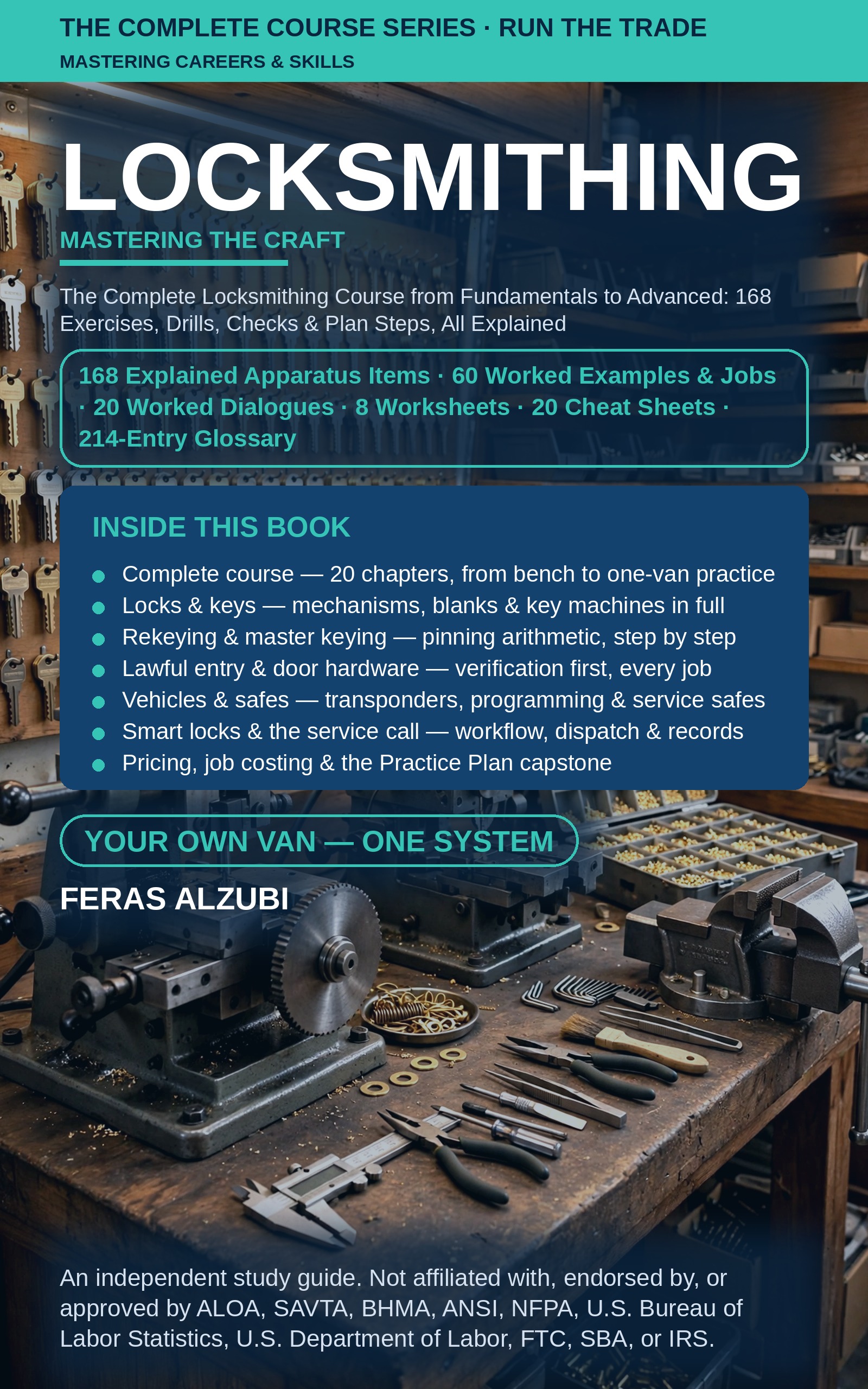
The Complete Locksmithing Course from Fundamentals to Advanced: 168 Exercises, Drills, Checks & Plan Steps, All Explained
Payments are securely processed by Payhip.
Sample opens the free first chapter right here on this site — read it instantly, no download needed.
Locksmithing: Mastering the Craft — The Complete Locksmithing Course from Fundamentals to Advanced: 168 Exercises, Drills, Checks & Plan Steps, All Explained
What this book teaches. The complete course in locksmithing as a trade and a one-van business, taught whole, with no prior knowledge assumed beyond ordinary life as a key user. It opens with the Ready-to-Run Check: 24 checks in four domains, each check carrying an explained routing note that names what the answer usually means and the chapter or chapters it routes to. The check computes no total score; its work is routing, and the reader returns to it in the capstone and compares answers item by item and domain by domain. The 20 chapters stand in five parts. Part I, The Trade and Its Foundations (before any technique): The Trade Whole: What a Locksmith Actually Does; Lock Anatomy and Mechanism Families; Keys, Blanks, and Key Machines; and Law, Licensing, and the Legitimate Trade. Part II, The Mechanical Craft: Cylinder Servicing and Rekeying; Wafer, Disc, Lever, and High-Security Mechanisms; Cutting Keys by Code and Origination; Master Keying Systems; and Lawful Entry: Picking and Bypassing as Professional Practice. Part III, Doors, Hardware, and Commercial Work: Door Hardware: Locksets, Deadbolts, and Mortise Locks; Closers, Exit Devices, Hinges, and the Door as a System; and Commercial Work and Property-Manager Accounts. Part IV, The Modern Automotive Half: Vehicle Locking Systems: Transponders and Immobilizers; Key and Fob Programming: The Add-Key Practice; and All-Keys-Lost and the Automotive Edge Cases. Part V, Safes, Electronic Devices, and the Working Business: Safes and Vaults at Service Level; Smart Locks and Electronic Hardware at Device Level; The Service Call: Workflow, Dispatch, and On-Site Discipline; Pricing and Job Costing in the Trade's Own Units; and Running and Growing the One-Van Practice. Law, licensing, and authorization are taught before any technique chapter, deliberately: every entry, opening, and programming technique in this book is taught for authorized professional work only, inside authorization verification as a job step — the customer's right to authorize the work is verified and recorded before any tool touches a lock or any programmer is connected, and work whose authorization cannot be verified is work the book teaches the reader to decline. One fictional business carries the worked arithmetic from Chapter 1 to the capstone, so the numbers met in one chapter are the same numbers in every other: Copperline Locksmith, a one-van mobile locksmithing practice run by an owner-technician with one part-time apprentice. Copperline Locksmith is fictional and illustrative; every figure attached to it is illustrative, labeled as illustrative where it stands, and presented as a teaching figure only. The book closes with the capstone, Build Your Locksmithing Practice Plan: 12 plan steps, each with a worked key on the specimen business, that assemble the chapters into one plan. The back matter prints three action paths as route maps through the book: the Bench-First Path, the Automotive-Ready Path, and the Practice Path. Licensing is taught as structure and as a working verification method — the shapes of the licensing landscape and the five-step method for verifying the reader's own jurisdiction — not as any jurisdiction's requirements; this book carries no examination apparatus of any kind. Electronic access, CCTV, and intrusion systems at system level belong to another book in this series; this book teaches electronic hardware at device level only.
Who it is for. The aspiring owner-operator, the working technician formalizing a trade learned piecemeal, and the lock-shop employee weighing a van of their own — anyone who wants the whole trade and its one-van business in one place: mechanisms and key machines, rekeying and master keying, lawful entry, door hardware and commercial accounts, the automotive key practice, safes and smart locks at their taught levels, the service call, and pricing and job costing in the trade's own units.
What's inside (every count verified against the actual book):
Read the first chapter free — the sample on this page is Chapter 1 of this book, exactly as it appears in the full edition.
From the Mastering Careers & Skills library — complete A-to-Z professional teaching books for careers, trades, and certifications.
This book teaches how locksmithing is practiced and how a locksmithing business is run. It is general trade and business education, not personalized business, legal, tax, accounting, licensing, or security advice, and reading it does not create an adviser-client relationship with its author or publisher. It teaches categories, systems, tool classes, and mechanics, and it names no key machine, programmer, tool, lock, hardware, vehicle, software platform, supplier, or lead service as a recommendation. It confers no license and no certification: in a state that licenses locksmiths, the license comes from the state, and the voluntary certifications it describes belong to the bodies that award them. It makes no promise about any reader's revenue, profit, wages, employment, demand, or any other outcome, and it predicts no outcome for any reader: where the book works an example to a result, the result belongs to that example's stated numbers only. Every worked example uses illustrative figures, labeled where it stands; the specimen business, Copperline Locksmith, and all figures drawn from it are fictional and illustrative teaching figures, chosen to make the arithmetic visible, and are not presented as typical, average, expected, or recommended. Laws, programs, and standards change; the current publication of the responsible authority governs, and for everything state and local, the reader's own jurisdiction's offices govern. This book is not affiliated with, sponsored by, or endorsed by the Associated Locksmiths of America Security Professionals Association, the Safe and Vault Technicians Association, the Builders Hardware Manufacturers Association, the American National Standards Institute, the National Fire Protection Association, the U.S. Bureau of Labor Statistics, the U.S. Department of Labor, the Federal Trade Commission, the U.S. Small Business Administration, or the Internal Revenue Service. Organization and agency names appear only to identify the published public guidance, standards structures, and certification programs this book teaches from and describes, which are cited throughout.
Refunds: Please read the free sample chapter before you buy. This is a digital ebook, delivered instantly by download. If the file is defective, or you cannot open or download it and we cannot fix the problem, you will receive a full refund — email us within 14 days of purchase. Because the book is delivered instantly as a downloadable file, all other sales are final.
How to read this book (EPUB format): After checkout, download the EPUB file, then open it in any free ebook reader app. On iPhone or iPad: Apple Books — it is already on your device. On Android phones and tablets: Google Play Books (free: https://play.google.com/store/apps/details?id=com.google.android.apps.books) — upload the file in the app — or ReadEra (free). On a Windows or Mac computer: Thorium Reader (free: https://thorium.edrlab.org) or Adobe Digital Editions (free). On Kindle: use Amazon's free Send to Kindle (https://www.amazon.com/sendtokindle) to add the file to your Kindle library.