
Mastering Careers & Skills
Water Distribution Operator · free sample from the book itself
Early on a summer evening, the phones begin to ring in one neighborhood at the high end of a water system. The water still runs. It is clear, and it tastes normal. But showers weaken, upstairs taps slow, and a resident filling a pot notices that the stream is thinner than it was at noon. Nothing has burst where anyone can see it. No alarm has sounded at a treatment works, because the water arriving into this system is finished and good. Somewhere between the point where that good water entered the system and the taps now complaining, the system's balance has shifted — demand has climbed with the evening, a storage tank has given up more water than the day replaced, and the high ground feels the change first.
The person whose craft answers that evening is the water distribution operator: the worker who operates, monitors, maintains, and repairs the network that carries finished drinking water from its entry into a community's pipes to every tap that community depends on. That network is the distribution system — the mains under the streets, the storage tanks and reservoirs, the pumps and valves, the hydrants, the service lines, and the meters, taken together as one working machine. This chapter maps what that operator actually does, what the system actually is, and why the work matters in the plainest terms: when distribution fails, good water made somewhere else never becomes good water at a tap.
This book teaches that craft whole, for two readers who are the same person at two moments: the complete beginner who has never opened a valve box, and the working operator preparing for a graded certification examination. It begins, as the craft itself begins, with the system and the day's work — not with an examination hall.
Start with a distinction that organizes everything that follows. Finished water is water that has already been treated to drinking-water quality before it reaches the distribution system. In the specimen system this book uses for every worked example, finished water arrives at the system's entry points — the defined places where treated water passes into the distribution network — from treatment works outside the distribution system's own fence. The distribution operator does not run those treatment works in this book. Treatment is its own craft, taught whole in the companion volume named later in this chapter. Distribution begins where treatment hands the water over.
That handover creates the distribution promise, in three parts. First, quantity: enough water at the moment it is asked for — morning peak, evening peak, and the rare, enormous demand of a fire. Second, pressure: water moves because pressure pushes it, and arrives usefully only if enough pressure remains at the tap. Third, quality held, not just quality made: water leaving treatment in good condition must still be in good condition after days traveling through mains, resting in tanks, and waiting in the network's far ends. A system can succeed at the first two and fail at the third quietly — which is why distribution is a skilled craft, not merely plumbing at a larger size.
Keep the three parts together in your mind. Nearly every task in this book serves quantity, pressure, or quality held — and the experienced operator is always, consciously or not, asking which of the three a given symptom threatens.
Every number worked in this book belongs to one fictional system, introduced here and used consistently to the last chapter. The Harborview Water Distribution System serves a fictional population of 48,000 people. On its average day — an ordinary day, neither the highest nor the lowest of the year — Harborview delivers 4.8 million gallons. Written in the units this field uses daily, that is 4.8 MGD, meaning 4.8 million gallons per day, which is the same flow stated as about 3,333 gallons per minute, or gpm.
One calculation belongs in this first outline, because it teaches how operators turn raw totals into something they can reason with. Water use per person, stated in gallons per capita per day — gpcd — is the day's volume divided by the people served. For Harborview: 4,800,000 gallons per day ÷ 48,000 people = 100 gpcd. That figure, 100 gpcd, is Harborview's recorded average, stated here as this specimen's own record and as nothing else. It lets an operator ask a human question of a large number: is the system delivering about what its population would explain, or is something — growth, leakage, a stuck process — pulling the total away from the people?
Harborview does not need the same flow at every hour. Its maximum day — its highest-demand day of record — is 7.2 MGD, or 5,000 gpm, which is 1.5 times the average day: 4.8 × 1.5 = 7.2. Its peak hour demand reaches the equivalent of 10.8 MGD, or 7,500 gpm, which is 2.25 times the average: 4.8 × 2.25 = 10.8. Those two multipliers matter because a distribution system is not built or operated for its average. It is operated, every day, in the space between the average and the peak — and storage, the subject of §1.5, is what makes living in that space possible.
Harborview's ground rises, so the system works in two pressure zones — areas of the network held at different pressures because their ground elevations differ. The Harbor Zone is the low ground, fed by gravity from storage. The Summit Zone is the high ground, fed through a booster station that lifts water up to it. Between them stand pressure-reducing valves, which can pass water downward in an emergency at a controlled, lower pressure. Two zones will return throughout this book, because elevation is destiny in distribution: the same water, in the same pipes, behaves differently uphill and down.
Figure 1.1 (Class P) — The Harborview system from the air: the elevated tank, the ground reservoir, the booster station, and the gridded streets the mains run under.
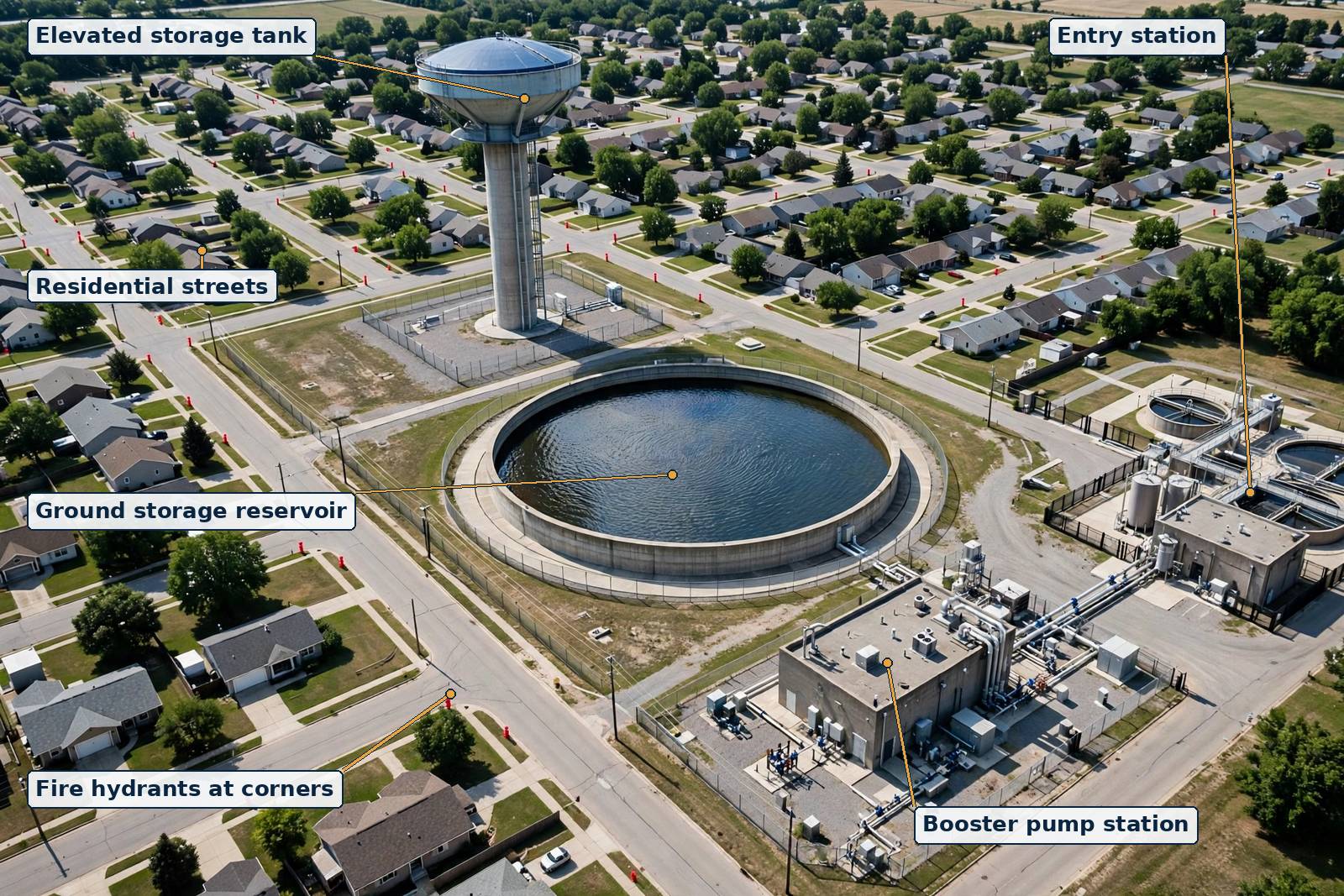
Figure 1.1 — The Harborview system from the air: the elevated tank, the ground reservoir, the booster station, and the gridded streets the mains run under.
Strip away romance and a job is its duty list. The U.S. Bureau of Labor Statistics — BLS — describes the occupation that contains this craft, and this book teaches that list as a working sequence, because in the field the duties arrive intertwined through every week. A necessary honesty note stands here at the first use, and it stands wherever these figures and duties are used in this book: BLS publishes no distribution-only occupation. Its occupation, Water and Wastewater Treatment Plant and System Operators, is a combined water and wastewater occupation covering plant and system operation together. This book prints its figures only as that combined occupation's figures, labeled as such, and never invents a distribution-only split the source does not publish. (Source: BLS, Occupational Outlook Handbook.)
The duties, in the source's own shape, are these. Operators operate or control an entire process or system of machines, often through control boards, to transfer or treat water or wastewater. In distribution terms, that is the system-level duty: watching zones, tanks, and pumps as one machine, not as unrelated parts. Operators add chemicals in the right amounts — in distribution, most characteristically the disinfectant added at booster points to protect water on the long second half of its journey. Operators collect and test samples — the distribution system is sampled where its customers actually receive the water, and the operator's sampling hand is the public-health system's hand. Operators read and record meters, gauges, and test results — a duty so constant it is easy to underrate, until a decision must be made from last month's readings and only a good record can make it. Operators inspect equipment and monitor operating conditions, clean and maintain equipment, tanks, and filter beds — the filter-bed phrase belongs to the plant side of the combined occupation; the distribution share of that duty is tanks, mains, valves, hydrants, and stations kept in working order. Operators keep records of operations. And operators respond to emergencies and follow safety procedures — the pair that closes the list and, on the worst days, becomes the whole of it. (Source: BLS, Occupational Outlook Handbook.)
Hold the shape of that list. Most of its verbs are watch, measure, record, inspect, maintain — the verbs of a person entrusted with a system that must not be allowed to surprise its community. The dramatic duties are real, but the craft's center of gravity is vigilance made routine.
A beginner needs the anatomy early, in plain order, even though Part III teaches each part in its own chapter. Walk with the water.
Water enters at the entry points and meets storage almost at once. Harborview holds finished water in two structures. The Summit elevated tank stands with its water surface, when full, at elevation 320 feet; it is 75 feet in diameter and holds a working capacity of 750,000 gallons. The Harbor ground reservoir is 120 feet in diameter and 24 feet deep, with a computed volume of 2,029,294 gallons — about 2.03 million gallons against its 2.0 million gallon design plate. Together the system stores about 2.78 million gallons: 2.78 ÷ 4.8 = 0.58 of a day of average demand. Storage equalizes the day, holds water ready for fire demand, and stands by for emergencies — three jobs taught fully in Chapter 17.
From storage and the entry points, water travels in mains — the principal pipes under the streets. Branching from them, a service line carries water to one building, through the meter that measures what that customer draws. Valves start, stop, and redirect flow, and isolate a broken section so the rest of the system can keep serving. Hydrants stand on the mains for firefighting first, and serve the operator for testing and flushing. Where ground rises beyond what gravity can serve, pumps in a booster station lift the water: Harborview's Summit booster duty pump delivers 2,500 gpm against 120 feet of lift, whose arithmetic Chapter 18 works in full. Wrapping the anatomy is the system's memory — its maps, valve records, and operating logs, taught in Chapter 10 — without which the buried half of this machine would be guesswork. Notice what is not in the walk: no source, no treatment process. The distribution operator's world begins with finished water, and this book stays inside that world whole.
Two ideas, introduced here in words and taught with full mathematics in Part II, explain most of what a distribution operator watches.
The first is pressure from elevation. Water standing above a point presses down on it, and the relationship is fixed: every foot of height — every foot of head — gives 0.433 pounds per square inch, or psi, of static pressure at the point below. (Source: WPI, Formula/Conversion Table for Water Treatment, Distribution, & Water Laboratory Exams.) So Harborview's Summit service at elevation 140 feet, under the full elevated tank's surface at 320 feet, stands under 320 − 140 = 180 feet of head, and 180 × 0.433 = 77.94 psi, stated as 78 psi. A mid-zone Harborview service under 150 feet of head stands at 150 × 0.433 = 64.95, stated as 65 psi; under 120 feet, 52 psi; under 90 feet, 39 psi. No pump creates those numbers and no opinion changes them: elevation decides, and the operator's job is to know, for any address, roughly what elevation has already decided.
The second idea is water age — the time a gallon spends inside the system between entry and tap. Age is not an abstraction. While water waits and travels, the disinfectant protection it entered with is gradually consumed, and the system's far ends and slow corners hold the oldest water. Storage makes the point with Harborview's own record. The elevated tank exchanges — takes in and gives out — 250,000 gallons on an average day. Its turnover time, the time to exchange a volume equal to what it holds, is 750,000 ÷ 250,000 = 3.0 days. The ground reservoir exchanges 800,000 gallons a day against its computed 2,029,294 gallons: 2,029,294 ÷ 800,000 = 2.54 days. Those are this specimen's operating records, labeled as its own — not rules for any other system. They teach the habit, not a limit: an operator who knows how long water rests in each vessel knows where age is accumulating, and age is where quality is won or lost slowly.
Return now to the evening of §1.1 with these two ideas in hand, and the reasoning an operator actually performs comes into focus. Evening demand climbs toward the peak. The tank that floats over the high zone gives up water faster than the booster replaces it, its surface falls, head over the highest services falls with it, and pressure sags — first and worst at the highest taps, exactly as the phones reported. The operator's response is reasoning before it is wrench work: confirm the tank level and the booster station's state, compare demand against the hour's normal shape, check whether a valve position or a closed section is starving one neighborhood, and read the record afterward so the pattern, if it repeats, is recognized on the second evening instead of the fifth. That loop — sense, compare, decide, adjust, and sense again — is the operator's daily method, and Chapter 36 gives it a chapter of its own.
One set of employment figures belongs in this first map, printed exactly as its source prints it and never as anything else. For the combined occupation Water and Wastewater Treatment Plant and System Operators — combined water and wastewater, plant and system together, as stated in §1.4 — BLS reports a median annual wage of $60,020 per year ($28.86 per hour), May 2025. The lowest 10 percent earned less than $39,110, and the highest 10 percent earned more than $91,060. Employment in the occupation was 128,490. (Source: BLS, Occupational Outlook Handbook; OEWS, May 2025.)
Read a median with discipline: it is the middle of everyone in the whole occupation — veterans and beginners, every employer and every place — not a starting wage, not an offer to any reader, and not a promise. BLS describes the typical entry education for the occupation as a high school diploma or equivalent, with long-term on-the-job training. It projects the occupation's employment to decline about 6 percent from 2025 to 2035, with about 10,000 openings per year, nearly all replacing workers who leave or retire. This book prints that projection in BLS's own framing because an honest map shows the whole road: an occupation can shrink in total while still opening thousands of doors a year to replace the people who built it, and a beginner deciding whether to enter deserves both halves of that sentence. Chapter 2 returns to these figures where doors and training are taught. No other pay figure appears anywhere in this book.
Water work is three crafts, not one, and confusing them is the beginner's most common map error. Drinking-water treatment makes raw source water into finished water. Wastewater treatment takes a community's used water and returns it safely to the environment. Water distribution, this book's craft, carries the finished drinking water from the treatment works to the tap and holds its quality on the way. Each craft has its own graded examinations, its own need-to-know criteria, and its own volume in this family: the treatment crafts are taught whole in Book #79, Drinking-Water Treatment Operator, and Book #118, Wastewater Treatment Operator. Those volumes are signposts and companions, never substitutes: nothing in this book is thinned on the ground that a companion covers it, because the distribution operator is examined on distribution whole.
The relationship runs both ways: distribution depends on treatment for the quality that enters, and reports back what the far ends reveal about that quality after days in the pipes. But when a Summit Zone shower weakens on a summer evening, the answer is a person who knows the tanks, zones, valves, and records of one buried, pressurized, living network — and that person, and that knowledge, are what the remaining thirty-nine chapters build.
Part I finishes the entry map: the doors in (Chapter 2), the graded ladder (Chapter 3), and safety as the first skill (Chapter 4). Part II builds the foundations in dependency order — the system, the water in it, the mathematics, and the documents — because no procedure in this book rests on a principle the book has not taught first. Parts III through V teach the system in the ground, water quality within it, and the craft of maintenance and repair. Part VI teaches the regulatory frame and judgment at system scale, and Part VII teaches the graded examinations and the road beyond them.
One boundary runs through every chapter. Excavation, confined spaces, chlorine handling, work at height, work around pressurized mains, and every other hazardous act are taught here as knowledge and reasoning only — what the qualified operator does, in what order of reasoning, what the readings mean, and what decision each reading gates. The hands are trained in person, under supervision, through the doors Chapter 2 describes. This book prepares the knowledge the examinations test; it grants nothing, satisfies no requirement, and promises no job, certificate, score, or income. Read in order the first time: every term is defined where it first appears, bolded, and gathered again at each chapter's end.
Key terms of this chapter. Water distribution operator — the worker who operates, monitors, maintains, and repairs the network carrying finished water to the tap; Distribution system — the mains, storage, pumps, valves, hydrants, services, and meters taken as one working machine; Finished water — water treated to drinking-water quality before it enters distribution; Entry point — a defined place where treated water passes into the distribution network; Pressure zone — an area of the network held at a pressure set by its ground elevation; Average day — an ordinary demand day, neither the highest nor the lowest of the year; Maximum day — the highest-demand day of record; Peak hour — the highest-demand hour, stated as an equivalent daily rate; gpcd — gallons per capita per day, the day's volume divided by the people served; Head — the height of water above a point, which sets its static pressure; Water age — the time a gallon spends inside the system between entry and tap; Turnover — the time to exchange a volume equal to what a vessel holds; Median — the middle value of a whole set, half above and half below, never a starting figure or a promise.
Tags: FIELD — the field, its doors, and the shared foundations. The key, with every option explained, is in this chapter's key file.
Q1. The distribution operator's craft begins at the point where — A. raw source water is collected for treatment B. finished water enters the distribution system at its entry points C. used water leaves a building for collection D. rainwater runs off into storm drains
Q2. The three parts of the distribution promise taught in §1.2 are — A. speed, silence, and low cost B. taste, color, and advertising C. quantity, pressure, and quality held on the journey to the tap D. volume, billing, and staffing
Q3. Harborview's average water use, from 4,800,000 gallons per day for 48,000 people, is — A. 100 gpcd B. 10 gpcd C. 1,000 gpcd D. 48 gpcd
Q4. Harborview's maximum day of 7.2 MGD is best understood as — A. a figure smaller than its average day B. the lowest demand the system ever sees C. an hourly rate with no daily meaning D. 1.5 times its 4.8 MGD average day
Q5. The elevated tank's turnover, from a 750,000-gallon working capacity exchanging 250,000 gallons per day, is — A. 0.3 days B. 3.0 days C. 30 days D. 7.5 days
Q6. A Summit Zone service under 180 feet of head stands at a static pressure of about — A. 78 psi B. 18 psi C. 180 psi D. 433 psi
Q7. In the BLS account this book uses, the occupation containing this craft is — A. a distribution-only occupation with its own published figures B. an occupation BLS does not describe at all C. the combined water and wastewater occupation of plant and system operators D. an occupation limited to office administrators
Q8. Which duty belongs to the BLS duty list as taught in §1.4? A. Setting the prices customers pay for water B. Collecting and testing samples, and reading and recording meters and gauges C. Selling meters to other utilities D. Designing treatment works for a neighboring system
Q9. Storage in a distribution system does all of the following except — A. treats raw source water into finished water B. equalizes the day by supplying peak hours C. holds water ready for fire demand D. stands by for emergencies, buying time when something upstream stops
Q10. Water age matters to the distribution operator chiefly because — A. old water is always unsafe the moment it enters a main B. while water waits and travels, the disinfectant protection it entered with is gradually consumed C. age increases the water's pressure at the tap D. age is only a billing concept with no quality meaning
Q11. In the evening pressure-sag episode of §1.1 and §1.6, the operator's first work is — A. excavation to expose every main in the neighborhood B. replacing the elevated tank C. raising entry-point treatment doses without evidence D. reasoning from evidence — tank level, booster state, demand shape, and valve positions — before wrench work
Q12. The BLS median of $60,020 per year (May 2025) is printed in this book only as — A. a starting wage for new distribution operators B. a distribution-only figure BLS publishes separately C. the whole combined occupation's median — the middle of everyone in it — not a starting wage, an offer, or a promise D. a guaranteed outcome for readers who finish this book
Q13. Harborview's two pressure zones exist because — A. the system's ground rises, so its high ground and low ground cannot be held usefully at one pressure set by elevation alone B. the system has two separate water sources of different quality C. one zone is for drinking water and one for wastewater D. zones are a billing device with no physical basis
Q14. The companion volumes #79 and #118 stand to this book as — A. substitutes whose coverage lets this book thin its own subject B. examinations the reader must pass before Chapter 2 C. the same book under different titles D. signposts and companions — each teaches its own craft whole, and this book teaches distribution whole
Q15. This book's own standing is stated honestly as — A. a certifying authority whose exercises grant operator certification B. a book that prepares the knowledge the examinations test, and grants nothing and satisfies no requirement C. a substitute for supervised, in-person training of the hands D. a promise of employment for readers who complete it
Feras Alzubi
Exam Prep Series
2026 Edition
Copyright © 2026 Feras Alzubi. All rights reserved.
No part of this book may be reproduced, stored in a retrieval system, or transmitted in any form or by any means — electronic, mechanical, photocopying, recording, or otherwise — without the prior written permission of the author, except for brief quotations in reviews and other uses permitted by copyright law.
Every practice question, explanation, case file, and worked example in this book is original to this book. The practice questions were written against the published need-to-know criteria of Water Professionals International (WPI) for the Water Distribution Operator examinations, Classes I–IV (© 2025), and against the body of water distribution knowledge this book teaches. No actual examination item of WPI, the Association of Boards of Certification (ABC), or any other body is reproduced, recalled, paraphrased, or adapted anywhere in these pages, and no passage of any textbook, manual, or manufacturer's publication is reproduced into usable form.
Not-affiliated disclosure. This book is not affiliated with or endorsed by Water Professionals International (WPI) or the Association of Boards of Certification (ABC). Neither WPI nor ABC wrote, reviewed, approved, or sponsored this book. The names Water Distribution Operator and the class designations Class I, Class II, Class III, and Class IV are named in this book as a statement of fact about the graded examinations this book prepares readers to study for. Certification decisions belong to each reader's own certifying authority alone; this book confers no certification, no eligibility, and no authorization of any kind.
Specimen notice. The system worked throughout this book — the Harborview Water Distribution System — is a fictional specimen system, labeled a specimen on its face at first use in Chapter 1. All specimen facts are fictional and illustrative. No real system, person, or place is depicted, and every machine, tool, and product named is a generic type. All operating figures attached to the specimen are the specimen's own figures — never industry rules, benchmarks, targets, or permit limits.
Front Matter
Part I — The Field and Its Doors
Part II — Foundations: The System, Its Water, and Its Mathematics
Part III — The System in the Ground and Above It
Part IV — Water Quality in the System
Part V — The Working Craft: Maintenance and Repair
Part VI — The Law and the Whole Craft
Part VII — The Examinations and the Road
Back Matter
The headline honesty fence. Operator certification is granted by the reader's certifying authority under its own rules; this book grants nothing and satisfies no requirement — not eligibility, not experience, not any training hour. It prepares the knowledge the examinations test, and it says so wherever the ladder is taught. No book — this one included — confers a certification, eligibility, or the competence the examinations examine. Employers hire, train, and authorize operators task by task; certifying authorities certify them under their own rules; this book teaches the knowledge the craft stands on. The reader's own certifying authority sets their grade requirements — which class they need, what qualifies them to sit for it, and what standard they must meet — and every reader takes those terms from their own authority.
The field in one paragraph. A distribution operator keeps finished water moving: from the entry points where treated water enters the system, through mains, valves, hydrants, storage, and pumps, to the last tap on the last street — holding pressure, protecting quality, finding losses, repairing breaks, and keeping the record that lets the next operator do the same. It is outdoor, physical, system-scale work, done in all weather and at all hours, and its failures are public in a way few trades know: when distribution fails, a whole community feels it the same morning. Chapters 1 and 2 open the field whole — what operators actually do, who employs them, and how the work is shaped day to day.
One craft, four classes. The four examination classes are one ladder over one body of work. The Class I operator and the Class IV operator run the same streets — the same mains, tanks, valves, and sampling points — and the examinations deepen across the same four content areas as the classes rise: components and equipment carry the most weight at Class I, and by Class IV the weight has shifted to water quality and administration. This book is built in the ladder's shape: the field and its foundations first, then the system in the ground and above it, water quality, the working craft of maintenance and repair, the law and the whole craft, and the examination layer gathered whole in Part VII. A reader aiming at any one class studies the craft whole and then gathers the examination pattern in Chapter 39.
The three-book water family. Water distribution is one of three graded examination fields in the water family, and this line gives each examination its own book. Book #79, the drinking-water treatment volume, teaches the treatment of water for drinking. Book #118, the wastewater treatment volume, teaches wastewater treatment whole. This book, #119, teaches water distribution whole — the system that carries finished water from the entry point to the tap — and never fences a distribution topic on the ground that a companion covers it. Treatment is taught here only where it hands water to the system: what arrives at the entry point, what it carries, and what the system owes it. The companions are signposts, never substitutes: each book teaches its own craft whole.
The Course 12 designation, stated plainly. This book is the CareerHarbor Course 12 counterpart for the distribution examination: the recorded designation for Course 12, Water & Wastewater Operator, whose three graded examination fields are seated as three books — #79, #118, and this book. The course itself is designated but not yet built in the teaching lane, and no course crosswalk exists to print; the designation is recorded honestly here, and the printed crosswalks in the back matter are the field map and the examination framework's map.
Not a manual, not system procedure, not professional advice. This book teaches water distribution knowledge and reasoning for education and examination preparation. It is not a system's operating manual, a work procedure, or professional advice, and reading it does not qualify or authorize any reader to perform any regulated or hazardous act. Hands-on skill — valve operation under load, tapping, excavation work, tank work, and every hazardous act — is trained and assessed in person, under supervision, by employers and training programs. Work in real systems belongs under the reader's employer's program and qualification, the equipment manufacturer's own instructions, and the rules of the responsible authority, to which readers are directed for their own work.
This page states the examinations themselves, from their owner's own publications. Every figure on this page prints in its stamped form, with its source stamp on its face. Source for all four panels and for the common mechanics below: Water Professionals International (WPI), Need-to-Know Criteria for Water Distribution Operator, Class I (© 2025), Class II (© 2025), Class III (© 2025), and Class IV (© 2025); and WPI, Formula/Conversion Table for Water Treatment, Distribution, & Water Laboratory Exams (© 2024) — as published by WPI (read 2026-11-14).
What the examinations are. Water Professionals International (WPI) — the body that now publishes the examinations built by the Association of Boards of Certification (ABC) — publishes standardized Water Distribution Operator examinations in four classes, Class I the lowest and Class IV the highest. The examinations test knowledge; certification itself is granted by the certifying authority that adopts the examinations, under that authority's own rules, as the frame at the foot of this page states plainly.
Common mechanics (all four classes). Each examination carries 100 questions in the same four content areas, weighted by class in the panels below. Questions are written at the recall and application levels only; the splits are printed per class in the panels. Calculation questions are counted in the criteria and are printed per class in the panels; calculation items are presented in US Standard units first with Metric units in parentheses, and each is solvable in both. Up to 10 additional unscored pre-test questions may appear on an examination, unidentified and unscored. The WPI formula/conversion table is administered with the examination. Every question is referenced to publications of the CSUS Office of Water Programs, the American Water Works Association, or the Water Environment Federation. All examination questions are WPI's copyrighted property; every practice item in this book is original to this book and is never represented as WPI's.
Content areas (questions per area, of 100). Distribution System Components 35 · Equipment Installation, Operation, Maintenance, and Repair 30 · Water Quality Monitoring, Evaluation, Adjustment, and Laboratory Analysis/Interpretation 15 · Security, Safety, Administrative Procedures, and Public Interactions 20. The four counts sum to 100.
Levels and calculations. Recall 45% / Application 55%. Calculation questions: 9 (Distribution System Components 6 · Equipment Installation, Operation, Maintenance, and Repair 3 · Water Quality Monitoring, Evaluation, Adjustment, and Laboratory Analysis/Interpretation 0 · Security, Safety, Administrative Procedures, and Public Interactions 0).
Content areas (questions per area, of 100). Distribution System Components 32 · Equipment Installation, Operation, Maintenance, and Repair 28 · Water Quality Monitoring, Evaluation, Adjustment, and Laboratory Analysis/Interpretation 20 · Security, Safety, Administrative Procedures, and Public Interactions 20. The four counts sum to 100.
Levels and calculations. Recall 40% / Application 60%. Calculation questions: 11 (Distribution System Components 6 · Equipment Installation, Operation, Maintenance, and Repair 3 · Water Quality Monitoring, Evaluation, Adjustment, and Laboratory Analysis/Interpretation 1 · Security, Safety, Administrative Procedures, and Public Interactions 1).
Content areas (questions per area, of 100). Distribution System Components 23 · Equipment Installation, Operation, Maintenance, and Repair 25 · Water Quality Monitoring, Evaluation, Adjustment, and Laboratory Analysis/Interpretation 25 · Security, Safety, Administrative Procedures, and Public Interactions 27. The four counts sum to 100.
Levels and calculations. Recall 33% / Application 67%. Calculation questions: 12 (Distribution System Components 4 · Equipment Installation, Operation, Maintenance, and Repair 3 · Water Quality Monitoring, Evaluation, Adjustment, and Laboratory Analysis/Interpretation 4 · Security, Safety, Administrative Procedures, and Public Interactions 1).
Content areas (questions per area, of 100). Distribution System Components 23 · Equipment Installation, Operation, Maintenance, and Repair 21 · Water Quality Monitoring, Evaluation, Adjustment, and Laboratory Analysis/Interpretation 30 · Security, Safety, Administrative Procedures, and Public Interactions 26. The four counts sum to 100.
Levels and calculations. Recall 28% / Application 72%. Calculation questions: 16 (Distribution System Components 4 · Equipment Installation, Operation, Maintenance, and Repair 8 · Water Quality Monitoring, Evaluation, Adjustment, and Laboratory Analysis/Interpretation 3 · Security, Safety, Administrative Procedures, and Public Interactions 1).
The unpublished pass mark, stated as unpublished. The criteria publish no passing score for any class, and this book prints none, from any source. The panels above record the absence rather than filling the space: the passing standard for every class is UNPUBLISHED in the need-to-know criteria.
The certifying-authority frame, stated plainly. No passing score, fee, sitting time, eligibility rule, experience requirement, or education requirement for any class appears in the criteria. Grades, eligibility, passing standards, fees, and renewal belong to each certifying authority — the agency or board that adopts the examinations and certifies operators under its own rules. Readers take those terms from their own certifying authority, and this book sends them there wherever the ladder is taught.
A note on the class gradient, so the ladder is read honestly. Class I weights Distribution System Components and Equipment Installation, Operation, Maintenance, and Repair heaviest; by Class IV the weight has shifted to Water Quality Monitoring, Evaluation, Adjustment, and Laboratory Analysis/Interpretation and to Security, Safety, Administrative Procedures, and Public Interactions. The senior operator's examination is a quality-and-judgment examination. Chapter 39 gathers the four panels again and teaches the pattern whole.
The rhythm. This book teaches, then tests. Each of the 40 chapters teaches its body whole — terms defined at first use, foundations before the procedures that rest on them, the specimen system carrying the worked examples — and closes with 15 exercises and skills checks. A separate key explains the correct answer and every wrong option for every item, so a wrong answer teaches as much as a right one. Two case batteries then work whole system problems end to end as reasoning, and eight Strand Repair Sets give focused extra practice by strand.
The instruments. The book carries 820 practice items in four instruments, each disclosed on its face as this book's own design: the Water Distribution Readiness Diagnostic (50 items, front matter), the chapter exercises and skills checks (40 chapters × 15 = 600 items), System Case Battery A and Quality & Records Case Battery B (25 guided case files each, 50 total), and the Strand Repair Sets RS1–RS8 (8 sets × 15 = 120 items). No instrument is any body's examination or a replica of one. The instruments deliberately echo the examinations' published shape — the four content areas and the recall and application levels — because Chapter 39 teaches that shape, and the case batteries add the evidence-reasoning level this book practices: situation, evidence, reasoning chain, conclusion, and why, worked on paper.
Start with the diagnostic. Take the Water Distribution Readiness Diagnostic before Chapter 1. It is this book's own readiness instrument — not any WPI examination, not a replica of one, and not a prediction of its contents — and it has no pass score: nobody passes or fails it. Its 50 items run in four strands matching the examinations' content areas: Distribution System Components, 20 items; Equipment Installation, Operation, Maintenance & Repair, 15 items; Water Quality Monitoring, Evaluation & Laboratory Interpretation, 8 items; Security, Safety, Administration & Public Interactions, 7 items. The strand sizes are this book's own design choice, disclosed as such — they are not derived from any class's published weights, since the four classes weight the areas differently. Score the diagnostic by strand in the Readiness Tracker, never as one combined number, study the chapters your weakest strands point to, and return to the matching Repair Set when a strand needs more work. Read Chapters 1–3 first whatever the tracker shows: the field, the doors, and the ladder frame everything after them. The diagnostic routes each strand on its face: Distribution System Components → Chapters 11–20 and RS2–RS4 · Equipment Installation, Operation, Maintenance & Repair → Chapters 12–16, 28–33 and RS6 · Water Quality Monitoring, Evaluation & Laboratory Interpretation → Chapters 21–27 and RS5 · Security, Safety, Administration & Public Interactions → Chapters 4, 10, 34, 35, 38 and RS7.
One specimen, all the way through. Every worked example works on the same fictional system, the Harborview Water Distribution System, introduced whole in Chapter 1: a system serving a fictional 48,000 people, in two pressure zones, with an elevated tank and a ground reservoir whose numbers never change. When a number appears in two chapters, it is the same number. Learn the specimen once and every later chapter's arithmetic starts familiar — which is the point: on the job, an operator reads one system deeply, not fifty systems shallowly.
Study rhythms and the plans. Read a chapter in one sitting where you can; work its 15 items closed-book in a second sitting; read the key in a third, including the explanations of the options you did not choose. The Study Plans in the back matter lay out 4-week, 8-week, and 12-week paths, with per-class gatherings for the Class I–II candidate and the Class III–IV candidate, each referenced to chapters and Repair Sets.
What this book will not do. It will not certify you, qualify you, or authorize you to perform any act. It will not substitute for your employer's program, your system's procedures, qualified supervision, or the standards themselves. Where a chapter teaches a hazardous subject, it teaches the knowledge and the reasoning — what the readings mean and what decision each reading gates — and states the boundary inside the teaching: the hands are trained in person, under supervision, and the examinations test the knowledge underneath, which is what this book prepares.
End of the free sample. The complete book continues from here — the full A-to-Z course in book form, delivered as an EPUB you can read in Apple Books, Google Play Books, ReadEra, Thorium Reader, Adobe Digital Editions, or Send to Kindle.
Buy this ebook — $11.99 Back to the book page
Payments are securely processed by Payhip.