
Mastering Careers & Skills
Veterinary Technician Exam (VTNE) · free sample from the book itself
1. Key: B — AAVSB owns and administers the VTNE and reports the score; the state or province grants the credential. AAVSB's own words: "we don't license or credential veterinary technicians. Credentials are provided by the state or province in which you practice." Passing the examination and being credentialed are two separate steps by two separate bodies. (§1.3; entry 03 of the source register.) [Orientation / Credential architecture — Ch. 1] · KI - A — Wrong. AAVSB expressly does not license, certify, or register veterinary technicians (entry 2 of the source register). - C — Wrong. A passing score is one criterion the jurisdiction uses; the credential itself is the jurisdiction's act. - D — Wrong. PSI delivers the sitting under contract with AAVSB; it grants no credential.
2. Key: C — 48 states and provinces regulate veterinary technicians. The Handbook publishes the count in that combined form, and adds that state and provincial law dictates scope of practice and license requirements. (§1.3; entry 02 of the source register.) [Orientation / Credential architecture — Ch. 1] · KI - A — Wrong. AAVSB publishes 48 states and provinces combined, not a full 50-state-plus-provinces count. - B — Wrong. 38 understates the published count. - D — Wrong. Regulation is state and provincial, not federal; that is the chapter's architecture point.
3. Key: C — 170 presented = 150 operational (scored) + 20 pilot (unscored), embedded and indistinguishable. The candidate's score is based on the 150 operational questions; the 20 pilot questions are used in constructing future examinations and are not marked any differently from operational questions. (§1.4; entry 02 of the source register, entry 05 of the source register.) [Orientation / The sitting — Ch. 1] · KI - A — Wrong. "200 questions" is the superseded form fenced at watch item 1; no current AAVSB primary publishes it. - B — Wrong. This transposes the real numbers: 170 is the presented total, 150 the scored count, and the pilot count is 20, not 30 (watch item 2). - D — Wrong. There is no optional pilot section; pilot items are embedded in the single sitting.
4. Key: A — Answer it at full effort; pilot items cannot be identified. Pilot questions "are not marked any differently from the operational questions; thus, candidates cannot distinguish a pilot question from an operational question" (entry 2 of the source register). The only workable strategy is to treat all 170 items as scored. (§1.4; entry 02 of the source register.) [Orientation / The sitting — Ch. 1] · KI - B — Wrong. She cannot know the item is a pilot item, and skipping a possibly-scored item forfeits it. - C — Wrong. There is no identifiable set of "the scored items" to finish first. - D — Wrong. Pilot items are calibrated from candidate responses; random guessing is also the wrong effort on an item that may be operational.
5. Key: C — 3 hours (180 minutes), with a brief tutorial before the timed portion begins. "The timed portion of the examination will begin after the computer tutorial" (entry 2 of the source register). (§1.4; entry 02 of the source register.) [Orientation / The sitting — Ch. 1] · KI - A — Wrong. The sitting is 3 hours, not 4, and the tutorial precedes the timed portion rather than forming part of it. - B — Wrong. Break time is not added back; the clock continues during breaks. - D — Wrong. No 2-hour-45-minute form and no scheduled midpoint break exist in AAVSB's publications.
6. Key: B — Breaks are permitted on a running clock, with no communication, materials, or leaving the center. The Handbook permits breaks while stating that test timing continues during any breaks taken. (§1.4; entry 02 of the source register.) [Orientation / The sitting — Ch. 1] · KI - A — Wrong. The clock does not pause; a break is purchased with testing time. - C — Wrong. Breaks are expressly permitted. - D — Wrong. No scheduled midpoint break is published; breaks are candidate-taken and clock-running.
7. Key: D — A scaled score of 425 on the 200–800 scale. That is the passing standard in its only published form: scaled scores ranging from 200 to 800, with a passing scaled score of 425, equivalent for all administrations. (§1.5; entry 02 of the source register.) [Orientation / Scoring — Ch. 1] · KI - A — Wrong. No percentage form is published; AAVSB does not offer scores as percentage correct. - B — Wrong. AAVSB does not offer scores as number correct either; no number-correct threshold is published. - C — Wrong. The 0–100 jurisdiction-variant forms have no AAVSB primary behind them (watch item 6); all jurisdictions accept the reported scaled scores.
8. Key: C — No such conversion is published; the statement invents one. AAVSB does not offer VTNE scores as number correct or percentage correct, and no practice raw score — from any book — converts into a scaled score. Honest practice reporting is a raw count with study guidance. (§1.5; entry 02 of the source register.) [Orientation / Scoring — Ch. 1] · KI - A — Wrong. An "approximate" invented conversion is still an invented conversion; the 425 point is a scaled standard, not a percentage. - B — Wrong. No percentage is high enough to convert; the conversion itself is the fiction. - D — Wrong. AAVSB's own practice tests report domain feedback, not scaled-score equivalents (entry 7 of the source register).
9. Key: A — Animal Care and Nursing, 30 scored items (20%). It is the examination's largest domain by half again; the next tier — Pharmacy and Pharmacology, Surgical Nursing, Anesthesia — carries 20 each. (§1.6; entry 01 of the source register.) [Domain 5 / Outline weights — Ch. 1] · KI - B — Wrong. Pharmacy and Pharmacology carries 20 scored items, not the most. - C — Wrong. Anesthesia carries 20 scored items. - D — Wrong. Surgical Nursing carries 20 scored items.
10. Key: A — Communication and Veterinary Professional Support Services. The March 2023 outline publishes ten domains; nine-domain lists omit Domain 10 (7 scored items, 5%) — client education, professional communication, patient information, and euthanasia-process assistance. (§1.6; entry 01 of the source register, entry 07 of the source register.) [Domain 10 / Outline weights — Ch. 1] · KI - B — Wrong. Dentistry is Domain 3 and appears in nine-domain lists. - C — Wrong. Diagnostic Imaging is Domain 6 and appears in nine-domain lists. - D — Wrong. Pain Management/Analgesia is Domain 9 and appears in nine-domain lists.
11. Key: D — Graduation from an AVMA-CVTEA or CVMA accredited program. AAVSB publishes that pathway as "recognized by all jurisdictions" — a superlative it prints for no other pathway. (§1.7; entry 02 of the source register.) [Orientation / Eligibility pathways — Ch. 1] · KI - A — Wrong. OJT is valid only in select jurisdictions (the Handbook names Montana, Wisconsin, Alaska, and Utah). - B — Wrong. Alternate pathways "vary widely by jurisdiction" (entries 2 and 6 of the source register). - C — Wrong. Passing the VTNE does not retroactively universalize a pathway; eligibility is verified against the jurisdiction's requirements.
12. Key: C — The program director validates eligibility by uploading a roster; she may not test until on an uploaded roster. The mechanics split at January 1, 2025: graduates after that date are validated by roster upload, not by transcript. (§1.7; entry 02 of the source register, entry 06 of the source register.) [Orientation / Eligibility pathways — Ch. 1] · KI - A — Wrong. Direct-from-school transcripts are the mechanics for graduates before 2025. - B — Wrong. A candidate-uploaded diploma is not the published validation route for post-2025 graduates. - D — Wrong. Employers play no verification role in the accredited pathway; PSI delivers the exam and verifies nothing about graduation.
13. Key: D — Montana, Wisconsin, Alaska, and Utah. Those are the jurisdictions the Handbook's pathway table names for OJT licensure on work experience alone. (§1.7; entry 02 of the source register.) [Orientation / Eligibility pathways — Ch. 1] · KI - A — Wrong. None of those four states is named in the Handbook's OJT table. - B — Wrong. OJT is a select-jurisdiction pathway, not a universal one. - C — Wrong. The named OJT jurisdictions are U.S. states; the Canadian provinces appear in the Handbook's retake-approval rule, a different frame.
14. Key: D — Limited transferability: the technician may have to retake the VTNE through a different pathway. AAVSB publishes the warning in those terms for both the OJT and Alternate pathways: some jurisdictions do not recognize them. (§1.7; entry 02 of the source register, entry 06 of the source register.) [Orientation / Eligibility pathways — Ch. 1] · KI - A — Wrong. A passed VTNE does not override a jurisdiction's pathway recognition rules. - B — Wrong. VAULT transfers scores between jurisdictions; it does not convert one pathway into another. - C — Wrong. The receiving jurisdiction's law governs its own credentialing.
15. Key: B — $375. AAVSB's current Applying page publishes the application fee as $375, paid by card or voucher, all sales final and nonrefundable; fees are evaluated annually and subject to change. (§1.8; entry 04 of the source register.) [Orientation / Fees — Ch. 1] · KI - A — Wrong. $365 is the © 2024 Handbook's figure — real, but superseded by the current page; it prints in this book only inside the dated currency note. - C — Wrong. $345 is an older-generation figure circulating in secondary coverage; it is not a current fee. - D — Wrong. $310 likewise belongs to older handbook generations, not to any current AAVSB publication.
16. Key: B — A new application and the full application fee again. The window transfer is a one-time provision per application ($90, requested at least 48 hours ahead); after it is used, moving windows means reapplying at the full fee. (§§1.8–1.9; entry 02 of the source register, entry 04 of the source register.) [Orientation / Fees and windows — Ch. 1] · KI - A — Wrong. The $90 transfer may be used once per application, not repeatedly. - C — Wrong. No program-director letter substitutes for a new application. - D — Wrong. No calendar-year waiting rule is published; the constraint is the new application and fee.
17. Key: B — The March 15 cutoff closed that window to her before her approval completed. Each window's completed-application cutoff falls a month inside the window: the February 15 – April 15 window stopped accepting completed applications on March 15. Approval on March 20 leaves the next windows whose cutoffs she can meet. (§§1.9, 1.11; entry 02 of the source register.) [Orientation / Windows — Ch. 1] · DEC-06 - A — Wrong. No "30 days before opening" scheduling rule exists; the governing date is the mid-window cutoff. - C — Wrong. The window is not restricted by candidate type; it is restricted by its cutoff date. - D — Wrong. PSI scheduling does not close at a window's opening; the application cutoff is the closing mechanism.
18. Key: A — Item 113. The checkpoint is computed from the published sitting: 120 minutes × (170 items ÷ 180 minutes) = 113.3, so an on-pace candidate is near item 113 at two hours. (§1.11; figures entry 02 of the source register.) [Orientation / Pacing — Ch. 1] · DEC-06 - B — Wrong. Item 85 is the 90-minute checkpoint (90 × 170 ÷ 180 = 85). - C — Wrong. Item 100 is the arithmetic of pacing for 150 items, not the 170 presented items the candidate actually faces. - D — Wrong. Item 142 is the 150-minute checkpoint (150 × 170 ÷ 180 ≈ 142).
19. Key: D — Reapply at the full fee, wait a minimum of 31 days, within a five-attempt ceiling. AAVSB permits 5 attempts; a sixth or later attempt requires a letter sent directly to AAVSB from the jurisdiction plus a written statement of preparation, decided by the AAVSB Board of Directors (review up to 45 days). (§1.10; entry 02 of the source register.) [Orientation / Retakes — Ch. 1] · KI - A — Wrong. There is no next-day retake and no half fee; the 31-day floor and full fee both apply. - B — Wrong. Attempts are capped at five absent the Board-review process; "unlimited within five years" is not published. - C — Wrong. A third failure is not a universal bar; the named-jurisdiction rule (Canadian provinces, Indiana, Tennessee, Missouri) requires board approval after 3 attempts — a different mechanism, and Missouri separately accepts no scores for attempts over 4.
20. Key: A — The book teaches examined knowledge, not clinical training. The scope fence (§0.8 of the blueprint) is stated for the reader in §1.14: performance-phrased outline tasks are taught as the knowledge of the task — purpose, sequence, principles, equipment, named errors — and psychomotor skills are learned in an accredited program's laboratories and clinical instruction. (§1.14.) [Orientation / Scope fence — Ch. 1] · KI - B — Wrong. No exercise in a book certifies a clinical skill, and this book never claims otherwise. - C — Wrong. The book teaches no state-specific credentialing requirements; it states the state-level architecture and directs readers to their jurisdiction's board. - D — Wrong. This is an independent study guide, not affiliated with or endorsed by AAVSB.
Part I — Foundations: the Credential, the Profession, the Body, the Patients. This chapter is the credential map: it teaches no clinical content yet, because it teaches the frame every later chapter stands inside. Every examination figure in it is printed in the form the American Association of Veterinary State Boards (AAVSB) itself publishes, and named to its source at the point of use.
Imagine a student in the final semester of a veterinary technology program. She has done everything her instructors asked. She has bought two study guides, worked through hundreds of practice questions, and filled a notebook with the numbers she intends to memorize: how many questions the examination has, what score she must reach, what the examination costs, and how many times a year she can take it.
There is one problem, and it is not effort. Almost every number in her notebook came from websites and older books that describe an examination AAVSB no longer gives. Her notebook says the sitting is longer than it is. It describes the score on a scale AAVSB does not use. It lists a fee from an older edition of the candidate handbook, and it plans her year around fewer testing windows than AAVSB now runs. She has been studying hard — for an examination system that has already changed underneath her study materials.
This chapter exists so that your notebook holds the current numbers, in AAVSB's own published form, before you study a single fact of veterinary content. It gives you the whole road first: what a veterinary technician is, what the Veterinary Technician National Examination (VTNE) is and is not, who may sit for it and by which pathways, how the sitting is shaped and timed, how it is scored, what it costs, when it is offered, what happens after a pass and after a failure, and who actually grants the credential at the end of the road. It also draws two lines this book will hold for twenty chapters: the line between the national examination and the state-granted credential, and the line between learning the knowledge this examination tests and being trained to work on animals — which is your program's job, and which no book can do for you.
A word about how this book handles every number you are about to meet. Every examination figure in this chapter comes from AAVSB's own publications: the 2023 Veterinary Technician National Examination Content Outline (approved by the AAVSB Board of Directors in March 2023), the VTNE Candidate Information Handbook (© 2024), and AAVSB's VTNE overview, Applying, Scheduling, Pathway, and Study pages — each read in full for this book, with the reading recorded in this book's source register. Where a number belongs to this book rather than to AAVSB — a pacing checkpoint, a study suggestion — the text says so plainly. And where older sources disagree with AAVSB's current publications, this chapter names the disagreement directly, in Section 1.12, because you will meet the older numbers everywhere else you look.
A veterinary technician is the credentialed member of the veterinary team who carries out the nursing, laboratory, anesthesia, surgical, dental, imaging, pharmacy, and client-education work of a veterinary practice under the direction of a veterinarian. If you have visited an animal hospital, you have seen the role even if nobody named it for you: the person who took your pet's history and vital signs, drew the blood sample, monitored the anesthesia while the veterinarian operated, took the radiographs, cleaned the teeth, filled the prescription the veterinarian ordered, and explained the home care to you at discharge was, in a practice that staffs the role fully, a veterinary technician.
Hold the simple version first, because Chapter 2 builds the whole team picture on it. The veterinarian diagnoses disease, prescribes treatment, and performs surgery. The veterinary technician works from the veterinarian's orders: assessing and monitoring patients, performing laboratory procedures, assisting in anesthesia and surgery, providing nursing care, and educating clients. The veterinary assistant supports both, working under direction in animal handling, cleaning, and basic care tasks. Around them stand the client-care, management, and animal-care staff who keep a practice running. The technician is the team's clinical engine room — and the role is a credentialed one, which is why an examination stands at its gate.
That last point matters more than beginners usually expect. In most of the United States and Canada, a person may not simply call herself a veterinary technician and do the work. A state or province regulates the title and the scope of practice, and nearly every regulating jurisdiction requires a passing score on one national examination as a condition of granting its credential [per AAVSB's VTNE overview page — entry 3 in the References]. That examination is the VTNE, and this book prepares you for it.
The Veterinary Technician National Examination is owned and administered by the American Association of Veterinary State Boards (AAVSB), a nonprofit association whose members are the state and provincial boards that regulate veterinary practice [per the VTNE Candidate Information Handbook — entry 2 in the References]. AAVSB's own description of the examination's purpose is worth learning in its own terms: the VTNE is "designed and used to evaluate entry-level Veterinary Technicians' competency to practice and be credentialed" [entry 2 of the source register]. Three words in that sentence carry weight. Entry-level: the examination tests what a new technician must know on the first day of credentialed practice, not the mastery of a specialist with twenty years in one service. Competency to practice: the questions are built from what the job actually requires, which is why AAVSB rebuilds the examination's blueprint from a job analysis — a practice analysis study of what technicians do — completed with its examination vendor every five years [entries 1 and 2 of the source register]. To be credentialed: the examination exists to serve the credentialing decision that a jurisdiction makes, a distinction Section 1.3 takes apart carefully.
The examination is prepared under contract between AAVSB and PSI, the testing company that also delivers the sitting at its test centers and by live remote proctoring [entry 2 of the source register]. The VTNE Committee that oversees the examination's development includes representatives of the Association of Veterinary Technician Educators (AVTE), the AVMA Committee on Veterinary Technician Education and Activities (CVTEA), the National Association of Veterinary Technicians in America (NAVTA), the Registered Veterinary Technologists and Technicians of Canada (RVTTC), and veterinarians and veterinary technicians in practice and education [entry 2 of the source register]. Examination items are written by veterinarians and veterinary technicians, validated for content relevance, importance, difficulty, and correctness, reviewed by psychometricians and editors, and held in a secure item bank from which each administration is assembled to the published blueprint [entry 2 of the source register].
One consequence of that construction deserves emphasis now, because it disciplines everything in this book's practice material. The VTNE and its questions are AAVSB's copyrighted property, and the Candidate Agreement every applicant accepts bars sharing "any information whatsoever about any VTNE question," including questions recalled from memory after a sitting [entry 2 of the source register]. Every practice item in this book is therefore original — written fresh to AAVSB's published content outline, in the outline's own task language — and no item here is, or claims to be, a real examination question. When a website offers you "actual VTNE questions," it is offering you material nobody may lawfully sell you, of unverifiable accuracy. This book's provenance is the opposite: the outline is public, the items are ours, and the crosswalk appendix lets you check every item against the outline line it was written to.
AAVSB also publishes its own study apparatus, and this book names it honestly rather than pretending it does not exist: ten published sample questions spanning the ten domain areas, a list of common abbreviations, a reference list, and three online practice tests of 75 questions in 90 minutes each, offered at $50 per attempt with feedback by domain [per AAVSB's Study page — entry 7 in the References]. Chapter 20 returns to those tools and places them inside a complete study plan. A book that hides the examination body's own materials from you is protecting itself, not you.
This is the single most misunderstood fact in the whole VTNE landscape, and the examination expects you to understand it, so learn it in AAVSB's own words: "We own and administer the VTNE, and we provide your score to the state or province in which you'll practice, but we don't license or credential veterinary technicians. Credentials are provided by the state or province in which you practice" [entry 3 of the source register]. The Handbook states the same line from the other side: "The AAVSB does not license, certify, or register Veterinary Technicians" [entry 2 of the source register].
The architecture, stated plainly, has three parts. First, AAVSB runs the examination: it determines eligibility against the requirements of the jurisdiction your score will be sent to, delivers the sitting through PSI, and reports your scaled score. Second, the jurisdiction grants the credential: the state or provincial board receives your official score and decides, under its own law, whether to credential you. Third, the jurisdiction's law governs the practice: "There are currently 48 states and provinces that regulate Veterinary Technicians. State and provincial law dictates the scope of practice and license requirements" [entry 2 of the source register].
Because each jurisdiction titles its credential in its own law, the same profession carries different titles in different places — you will meet certified, licensed, and registered veterinary technicians, all of them credentialed through the same national examination. This book names those titles only as jurisdiction-granted variants, exactly as the architecture produces them. It never assigns a title to a particular state, and it teaches no state-specific requirements — no state's eligibility rule, fee, continuing-education rule, or scope-of-practice list appears anywhere in these chapters. That is not an omission to apologize for; it is the correct shape of a national book. Everything state-level belongs to your jurisdiction's board, and AAVSB maintains a Board and Agency Directory precisely so candidates can reach the authority that will credential them [entry 3 of the source register]. When this book needs you to act on a state-level fact, it will send you to your board — and an examination item that asks what your state requires is an item this book will never write, because AAVSB's national examination does not test one jurisdiction's law against another's.
Exam trap. The trap form of this fact is an item — in a lesser prep book, or in a careless moment of your own note-making — that says "passing the VTNE licenses you as a veterinary technician." It does not. Passing the VTNE gives you a reported scaled score that your jurisdiction accepts as one criterion for credentialing [entries 2 and 3 of the source register]. The license, certificate, or registration itself is the jurisdiction's act. Keep the two steps separate in your mind and a whole family of orientation questions becomes easy.
Here is the sitting, whole, in AAVSB's published form [entries 2 and 5 of the source register]. Learn this table until you can reproduce it from memory; Chapter 20 builds your test-day plan on it.
Worked example — reading the sitting correctly. A candidate tells her study group: "The exam is 170 questions, but only 150 count, so I will pace for 150 and relax on the rest." Name every error. First, she cannot identify "the rest": the 20 pilot items are unmarked and indistinguishable, so there is no subset she can relax on. Second, her pacing unit is wrong: she will see 170 items in 180 minutes whatever she believes about scoring, so her clock must be planned against 170. Third, "only 150 count" misleads her about effort allocation even in principle — pilot items are tomorrow's operational items, and AAVSB calibrates them from real candidate effort. The correct reading: 170 items presented, 150 scored, 20 pilot, all 170 answered at full effort inside 180 minutes. Section 1.11 turns that reading into pacing arithmetic.
AAVSB reports VTNE performance in scaled scores, and the book prints the passing standard in exactly the published form and no other: a scaled score of 425 on the 200–800 scale [entry 2 of the source register]. The Handbook's paragraph deserves to be learned whole: "Performance on the VTNE is reported in terms of scaled scores. VTNE scores are mathematically converted to scaled scores ranging from 200 to 800, with a passing scaled score of 425. Scaled scores are equivalent for all administrations to maintain the same standard from administration to administration. The AAVSB does not offer VTNE scores as number correct or percentage correct. All jurisdictions accept the reported scaled scores" [entry 2 of the source register].
Unpack what that means, because secondary sources mangle every clause of it. A scaled score is a conversion: your raw performance is mathematically transformed onto the 200–800 reporting scale so that the standard — the level of competence the 425 point represents — is the same from one administration to the next even though no two candidates see identical forms. That is what "equivalent for all administrations" buys you: a 425 earned in February means the same thing as a 425 earned in August. It also means the number 425 is a point on a reporting scale, not a count of anything. It is not 425 questions (there are only 150 scored items). It is not a percentage: 425 is not "53 percent" of 800, and it is certainly not the "70 percent" or "75 percent" that older websites attach to this examination — those figures belong to scoring systems AAVSB does not publish, and AAVSB's own sentence closes the door on them: the AAVSB does not offer VTNE scores as number correct or percentage correct [entry 2 of the source register].
Two practical consequences follow, and this book obeys both everywhere. First, no practice score in this book is ever converted into a scaled score, a percentage-of-passing, or a prediction. Your chapter-quiz and practice-test results print as raw counts with study guidance — "below this count on Anesthesia, re-read Chapters 8–9 and work the Anesthesia repair set" — because a raw count on our items is the only honest statement we can make about our items. Any book that tells you "you scored 68 percent, which converts to about a 440" is inventing a conversion AAVSB does not publish. Second, you cannot compute how many questions you "need right." There is no published number-correct threshold, by design. The study implication is liberating rather than frustrating: your job is to maximize competence across all ten domains, not to hunt for a cut line.
What you receive, and when: your pass/fail status appears immediately when you complete the examination. Your candidate score report is available in the MyAAVSB Portal within 3 business days — for your use only, and expressly not valid for licensure. Your official score is transmitted to the jurisdiction you selected within 72 hours [entries 2 and 3 of the source register]. If you later need your score sent to a different jurisdiction — a move, a second credential — that is done through AAVSB's VAULT Transfer Services [entries 2 and 3 of the source register]; the Handbook states the service and that its fee is non-refundable, and publishes no amount, so this book prints none. If you believe your score was misrecorded, a manual rescore may be requested within 48 hours of the examination appointment for a $50 fee, and a rescore may take up to four weeks [entry 2 of the source register]. And one rule surprises candidates: a candidate who has passed may not take the VTNE again unless a state regulatory board requires it [entry 2 of the source register]. The examination is a gate, not a score to improve.
The content outline AAVSB's Board approved in March 2023 organizes the 150 scored items into ten domains — AAVSB calls them Primary Areas of Responsibility — with the scored-item counts and shares below [entry 1 of the source register]. Beneath the domains sit 55 Task Area Statements (what an entry-level technician does, domain by domain) and 50 Knowledge Area Statements (what an entry-level technician knows), the knowledge statements drawn from the five-year job analysis [entries 1 and 2 of the source register]. Every domain's first task statement is the same stem — utilize knowledge of anatomy, physiology, and pathophysiology as it applies to… that domain — which is why Chapter 3's body-systems foundation is load-bearing for the whole book rather than a polite introduction.
Read the shape of the table before the details. Animal Care and Nursing, at 30 scored items, is the examination's largest domain by half again — one scored item in five. Pharmacy and Pharmacology, Surgical Nursing, and Anesthesia form a 20-item tier. Dentistry, Emergency Medicine/Critical Care, and Pain Management/Analgesia sit at 10. Laboratory Procedures carries 14, Diagnostic Imaging 9, and the professional domain — Communication and Veterinary Professional Support Services — 7. Chapter space in this book follows those weights deliberately: the domain chapters are sized to the counts, and the two full practice forms in the back of the book are composed to these exact numbers.
A structural warning belongs here, because it is this examination's most repeated stale fact: older outlines and much of the prep shelf describe nine domains. The missing tenth is Domain 10, Communication and Veterinary Professional Support Services — client education, professional communication, collecting patient information, and assistance with the euthanasia process. Seven scored items is five percent of the examination, and a study plan built on nine domains silently abandons all of them. Section 1.12's currency table returns to this. If any source you own lists nine domains, it predates the March 2023 outline, and every number it gives you deserves re-checking against this chapter.
AAVSB determines eligibility based on the requirements of the jurisdiction your score is sent to, and verifies your selected pathway against those requirements [entries 2 and 6 of the source register]. That sentence is the key to the whole section: there is no single national eligibility rule, because eligibility itself is jurisdiction-referenced. What AAVSB publishes nationally is a frame of three pathways, not all of which every jurisdiction accepts [entries 2 and 6 of the source register].
Pathway 1 — Accredited Program Graduate. Graduation from a program accredited by the AVMA Committee on Veterinary Technician Education and Activities (AVMA-CVTEA) or by the Canadian Veterinary Medical Association (CVMA). AAVSB calls this pathway "recognized by all jurisdictions" [entry 2 of the source register] — the only pathway of the three about which that sentence is published, and this book repeats the superlative only here, because only here does AAVSB print it. The mechanics of proving graduation split at a date you must know: January 1, 2025. Candidates who graduated before 2025 prove eligibility by transcript — the school sends the transcript directly to AAVSB. Candidates graduating after 2025 are validated differently: the program director validates eligibility by uploading a roster to AAVSB, and you may not test until you appear on an uploaded roster [entries 2 and 6 of the source register]. Some programs permit their students to take the VTNE in the last semester of the program; participation varies by program, so the question goes to your school, not to this book [entries 2 and 6 of the source register].
Pathway 2 — On-the-Job Training (OJT). Licensure on work experience alone, without graduation from an accredited program — valid only in select jurisdictions. The Handbook's table names them: Montana, Wisconsin, Alaska, and Utah [entry 2 of the source register]. The mechanics: you download your jurisdiction's OJT form from the MyAAVSB Portal, the supervising veterinarian signs it, you upload it with your application, and AAVSB staff verify it before your application can be completed [entries 2 and 6 of the source register].
Pathway 3 — Alternate Pathway. Graduation from a program that is not AVMA-CVTEA- or CVMA-accredited — the Handbook names graduates of programs accredited by other bodies, including OAVT- and ATSAQ-accredited programs, in this family [entry 2 of the source register]. A transcript verifies the education; where the jurisdiction requires a work-experience component in addition, a work verification form is uploaded with the application. AAVSB's own caution is the honest summary: "alternate pathways vary widely by jurisdiction" [entries 2 and 6 of the source register].
Limited transferability — the warning that must travel with Pathways 2 and 3 wherever they are taught. AAVSB publishes it in plain words: "Taking the VTNE through the OJT or Alternate Pathways may limit where you can practice. Some jurisdictions don't recognize these pathways" [entry 6 of the source register]. A technician credentialed through one of these pathways who later moves may have to retake the VTNE through a different pathway to be credentialed in the new jurisdiction [entries 2 and 6 of the source register]. This is not a reason to avoid a pathway your jurisdiction offers — for many candidates it is the only road in — but it is a fact to weigh before you choose, and it is exactly the kind of consequence a candidate should hear from her study book rather than discover at a state line. This book teaches the pathways in AAVSB's published frame only. It does not convert that frame into any jurisdiction's own eligibility rule, and it never presents OJT or Alternate eligibility as universal.
The application itself is open: you may begin a VTNE application at any time [entry 2 of the source register]. If your eligibility review is incomplete when you reach the review point, your application meets a stopping point until the review completes; once approved, you select from the next two examination windows [entry 2 of the source register]. Your application must carry your legal first and last name exactly as it appears on your government-issued photo ID — a mismatch at check-in means no admission and a forfeited fee [entries 2 and 4 of the source register].
Worked example — choosing the pathway honestly. Two candidates ask whether they can sit. Candidate A graduates next May from an AVMA-CVTEA-accredited program. Her pathway is Pathway 1, recognized by all jurisdictions; because she graduates after January 1, 2025, her program director must upload the roster carrying her name before she can test, and if her program participates, she may test in her last semester. Candidate B has six years of experience as an assistant in a practice in one of the four Handbook-named OJT jurisdictions and no accredited-program graduation. His pathway, if his jurisdiction's own requirements confirm it, is Pathway 2: OJT form from the portal, supervising veterinarian's signature, AAVSB verification. He should also hear the transferability warning now, not later: his credential road runs through OJT, and a future move to a jurisdiction that does not recognize OJT could require retaking the VTNE through another pathway. Same examination, same 425 standard — two different eligibility roads, and the difference is the jurisdiction each score is sent to.
Fees are the most perishable numbers in this chapter — AAVSB states that fees are "evaluated annually by the AAVSB Board of Directors and are subject to change" [entry 2 of the source register] — so this book prints them dated, from the operative page, and Chapter 20's errata discipline applies to them first.
One fee note requires naming, because AAVSB's own publications currently disagree and pretending otherwise would fail you. The © 2024 Handbook prints the application fee as $365 [entry 2 of the source register]; AAVSB's current Applying page publishes $375 [entry 4 of the source register]. This book prints $375 — the later, operative page's figure — and tells you about the $365 rather than hiding it, because you will meet $365 the moment you download the Handbook, exactly as you should. When two of the body's own documents disagree, the dated, current page governs, and the disagreement itself is information. Older figures beneath both — $310, $315, $345 circulate in secondary coverage from older handbook generations — are not current fees in any form and appear nowhere in this book as live numbers.
What this book will not print: program tuition, any state's credentialing fee, VAULT transfer pricing (unstated in AAVSB's publications read for this book), or any "total cost of becoming a technician" figure. Those numbers are either not AAVSB's to publish or not published at all, and a total assembled from invented parts would be a fiction with a dollar sign.
The VTNE is administered four times per year [entry 2 of the source register]. After approval, you test in one of the next two windows — and you must test in the window you applied for, or forfeit the fee [entry 4 of the source register]. The published calendar:
Read the calendar's one subtlety until it is automatic: each cutoff falls inside its own window, a month after the window opens. A completed application by March 15 can still test in the February 15 – April 15 window; an application completed March 16 cannot — that window is closed to it, whatever seats remain. The calendar therefore rewards applying early twice over: early applicants choose between two windows, and late applicants can lose a window they assumed was still open. Chapter 20 works the calendar against real graduation dates as a candidacy timeline; the worked example in Section 1.11 gives you the shape of that reasoning now.
After approval, you schedule with PSI — online, using the candidate ID from your MyAAVSB Portal, or by phone — and choose a PSI test center or live remote proctoring [entry 5 of the source register]. Changing your date, time, or location within your window is done through the PSI portal at least 48 hours ahead. Changing the window itself is the one-time $90 transfer of Section 1.8. Keep the two operations distinct in your notes; confusing them is a common and expensive beginner error.
A candidate who does not pass reapplies and pays the full application fee again — there is no discounted retake [entry 2 of the source register]. The governing constraints, all published:
Teach yourself to see the retake rules as a planning structure, not a footnote. The 31-day floor, the mid-window cutoffs, and the five-attempt ceiling together decide a retaker's calendar before motivation enters the question: which window the next attempt can land in, how much study time the calendar actually grants, and how many attempts remain in reserve. Chapter 20 builds retake timelines on exactly these constraints, and this book's study plans include a retake track keyed to them. Nothing in the structure punishes a retaker who plans; everything in it punishes one who assumes.
The arithmetic of the sitting is simple, and it is this book's arithmetic — computed from AAVSB's published figures, printed here as study guidance, not as an AAVSB rule. 180 minutes ÷ 170 presented items ≈ 1.06 minutes per item — about 64 seconds. Nobody paces by the second; candidates pace by checkpoints. At a steady pace:
Worked example 1 (pacing). A candidate checks the clock at 90 elapsed minutes and is on item 70. Is she on pace? The checkpoint for 90 minutes is item 85 (90 × 170 ÷ 180 = 85). She is 15 items — roughly 16 minutes — behind. The repair is not panic: it is triage. She answers every remaining item (no penalty for guessing makes a blank strictly worse than a guess), marks the two or three items per ten that are consuming minutes, and takes her best answer on long calculation stems after setting up the arithmetic once on scratch paper rather than restarting it. Chapter 20 teaches the full pacing discipline; the checkpoint table above is the part to memorize now.
Worked example 2 (the candidacy calendar). A candidate's eligibility review completes on March 20. Which windows can she choose? Applications select from the next two windows after approval — but the February 15 – April 15 window's completed-application cutoff was March 15, five days before her approval, so that window is closed to her even though it still has three weeks to run. Her real choice is the May 15 – July 15 window and the August 15 – October 15 window. The lesson generalizes: the cutoff, not the window's end date, is the deadline that decides your options — and it falls a month before the window closes.
Worked example 3 (fees). A candidate applies once ($375), transfers her window once ($90), and sits. Total paid to AAVSB: $375 + $90 = $465. If instead she lets the window lapse untested, the $375 is forfeited — nonrefundable — and a new application costs another $375. The transfer fee exists precisely because it is cheaper than the lapse.
The VTNE's published facts have turned over in layers, and superseded forms dominate older prep books and websites — including, candidly, early drafts of this book's own commissioning notes. When a source disagrees with this chapter, this table tells you which form AAVSB currently publishes and which form is stale.
The discipline this table teaches is worth more than any single row: when in doubt, the current primary governs — AAVSB's outline for content, AAVSB's Handbook for policy, AAVSB's current pages for the fee — each dated, each named. This book re-verifies those figures at production and carries an errata page in the back matter for exactly the day one of them moves again.
Veterinarians are licensed through a different examination — the North American Veterinary Licensing Examination (NAVLE) — administered for the veterinary profession, not for technicians. It appears in this book once, here, for one reason: beginners routinely confuse the two examinations' names, bodies, and purposes in their first weeks of research. The VTNE is AAVSB's examination evaluating entry-level veterinary technicians for credentialing by a state or province. The NAVLE belongs to the veterinarian's licensing road. This book prepares you for the VTNE only, and claims credit toward no other body's examination.
This book teaches knowledge for a written examination. It teaches pharmacology as classes, mechanisms, side effects, and the calculations the outline assigns; anesthesia, surgery, dentistry, laboratory work, imaging, nursing, emergency care, and pain management as examined knowledge — each task's purpose, sequence, principles, equipment, and named errors. Wherever the outline phrases a task as a performance — restrain the patient, establish an airway, perform a dental assessment — this book teaches the knowledge of that task that the written examination tests, and says so at the teaching point.
What this book is not: it is not a veterinary technology program and not a substitute for one — the accredited pathway runs through an AVMA-CVTEA/CVMA program, with its classrooms, laboratories, and supervised clinical instruction. It is not clinical training: it never instructs you to perform a procedure on an animal, and none of its exercises is clinical experience, a practicum, or evidence of hands-on competence. Skills such as intubation, venipuncture, radiography, and restraint are learned and assessed in your program's laboratories and clinical rotations, under instructors, on teaching patients — that is where psychomotor skill is built, and a book that pretended otherwise would be lying to you at the exact point where an animal's welfare enters the question. It is also not a drug formulary (dose values in worked examples are givens stated in the problem, never a dosing reference), not a state credentialing guide (Section 1.3), and not AAVSB, PSI, AVMA, or NAVTA — it is an independent study guide, not affiliated with or endorsed by any of them.
The species this book teaches are the species at AAVSB's published scope: "the species covered on the VTNE are those specified by the AVMA Standards of Accreditation in their Veterinary Technology Student Essential and Recommended Skills list" [per AAVSB's Study page — entry 7 in the References]. In practice the outline's tasks center on companion animals — the dog and cat carry the depth — with equine, farm-animal, exotic, avian, and laboratory-animal knowledge at the depth the outline's tasks support. Chapter 4 introduces the patients honestly at exactly that scope.
The twenty chapters follow the road this chapter mapped. Part I (Chapters 1–4) builds the foundations a beginner needs and a candidate may need to repair: this credential map; the veterinary team, the law's shape, and the medical record (Chapter 2); the animal body from zero (Chapter 3); and the language of veterinary medicine and the patients themselves (Chapter 4). Part II (Chapters 5–7) teaches pharmacology whole and then the calculation core as a subject in its own right — because the outline assigns calculation in three places at once, in the pharmacy tasks, in applied mathematics, and in fluid therapy. Parts III–VI (Chapters 8–18) teach the clinical domains at their published weights: anesthesia, surgical nursing, dentistry, laboratory procedures, diagnostic imaging, animal care and nursing, emergency and critical care, and pain management. Part VII (Chapters 19–20) teaches the professional domain whole and then the sitting itself — candidacy calendar, test-day discipline, reading your result, and the credential step after it.
Around the chapters stands the practice architecture: a 50-item diagnostic test in the front matter (take it cold; its domain-by-domain key routes your study), a 20-item quiz at the end of every chapter with full explanations in the answer keys — every right answer explained, every wrong option explained — ten domain repair sets of 25 items each for rebuilding a weak domain, and two full 170-item timed practice examinations composed to the published shape: 150 scored-shape items at the exact domain counts of Section 1.6, plus 20 pilot-position items identified only in the key, so you rehearse the real sitting's arithmetic and not a shortened fiction of it. Two study plans — a two-week intensive and a four-week standard plan, plus a retake track — are printed with the front matter and revisited in Chapter 20.
Use the apparatus in its order. Read a chapter, work its examples with pencil in hand, then take its quiz untimed and read every explanation, including the explanations of options you did not choose — the distractor explanations are where the named errors live, and the examination's wrong answers are built from those same errors. Score yourself in raw counts and follow the quiz's category map to the sections it names. Nothing in your results is converted to a scaled score, by this book's standing rule (Section 1.5), and nothing here guarantees an outcome: this book prepares you for the VTNE, aligned to AAVSB's published outline — the preparation, and the result, are yours.
Figure 1.1 — The credential timeline (Class A diagram, printed at this point in the finished book): Pathway → application → window (with cutoffs) → examination → jurisdiction credential, as one dated line. Every element of the line is a section of this chapter; the figure invents nothing the text has not taught.
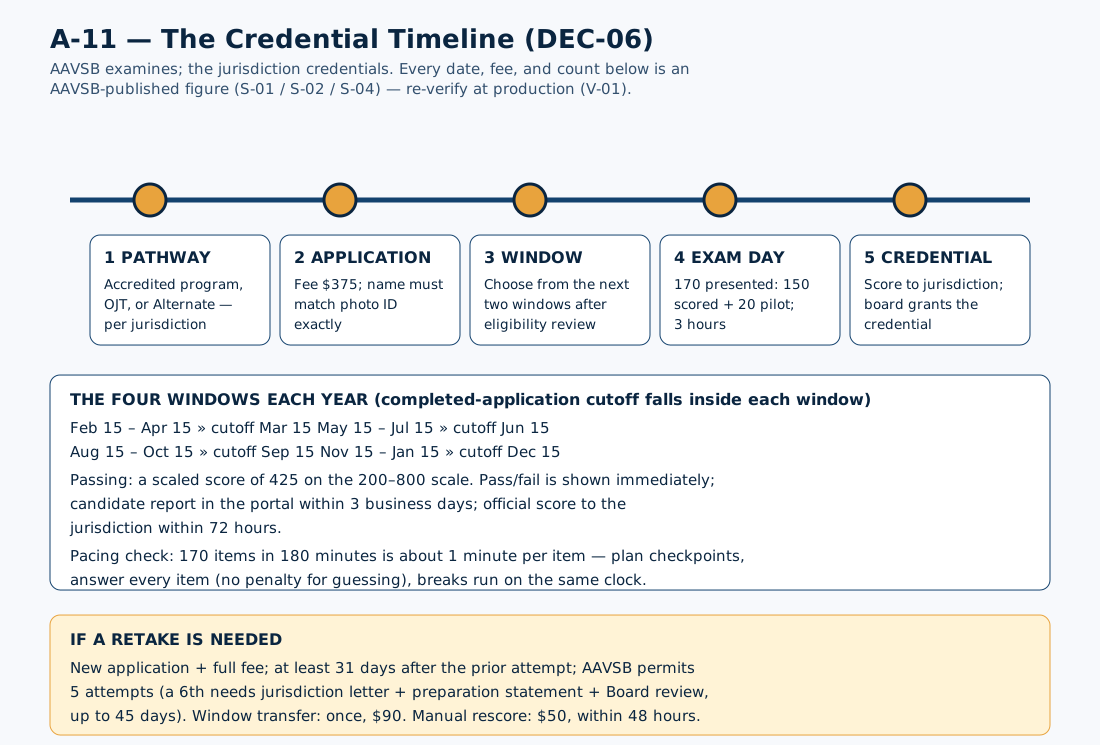 Figure 1.1 — Credential timeline: pathway, application at 375 dollars, exam window, exam day with 170 presented items in 3 hours, and jurisdiction credential, with four windows, passing scaled score 425 on 200 to 800, and retake rules
20 items. Every item is original, written to AAVSB's published outline and Handbook. Tags and the category map follow the quiz; full explanations are in the Chapter 1 Answer Key.
1. Which statement about the credential at the end of the VTNE road is correct?
A. AAVSB licenses veterinary technicians in all jurisdictions
B. AAVSB owns and administers the VTNE and reports the score; the credential is granted by the state or province in which the technician will practice
C. Passing the VTNE is itself a license to practice
D. PSI grants the credential when it delivers the examination
2. How many states and provinces regulate veterinary technicians, in AAVSB's published form?
A. All 50 states and 10 provinces
B. 38 states and provinces
C. 48 states and provinces
D. Regulation is federal, so no state count exists
3. Which statement gives the composition of the VTNE sitting in its published form?
A. 200 questions, all scored
B. 170 scored questions plus 30 pilot questions
C. 170 questions presented: 150 operational (scored) plus 20 pilot (unscored), embedded and indistinguishable from operational items
D. 150 questions presented, with 20 more offered as an optional pilot section
4. A candidate reaches a question she is sure is a pilot item because it looks unusual. What should she do?
A. Answer it with the same effort as every other item — pilot items are unmarked and cannot be distinguished from operational items
B. Skip it — pilot items do not count
C. Mark it and return only if time remains after the scored items
D. Guess randomly — pilot items are excluded from all analysis
5. Which statement about examination time is correct?
A. The examination is 4 hours, and the tutorial is part of the timed portion
B. The examination is 3 hours, and break time is added back at the end
C. The examination is 3 hours (180 minutes); a brief tutorial opens the sitting and the timed portion begins after the tutorial
D. The examination is 2 hours and 45 minutes plus a 15-minute scheduled break
6. Which statement about breaks during the VTNE is correct?
A. Breaks pause the examination clock
B. Breaks are permitted, but the test timing continues during any breaks taken, and the candidate may not communicate, consult materials, or leave the testing center
C. Breaks are not permitted once the timed portion begins
D. One scheduled break of 15 minutes is provided at the midpoint
7. Which statement gives the passing standard in its published form?
A. 70 percent of the scored questions
B. 98 of the 150 scored questions
C. A score of 70 on a 0–100 scale, varying by jurisdiction
D. A scaled score of 425 on the 200–800 scale
8. A practice book tells a candidate her quiz result of 68 percent "converts to about a 440, above the 425 pass mark." What is wrong with that statement?
A. Nothing — the conversion is approximate but valid
B. The percentage is too low to convert
C. AAVSB does not offer VTNE scores as number correct or percentage correct, and no conversion from a practice raw score to a scaled score is published — the statement invents one
D. The conversion applies only to AAVSB's own practice tests
9. Which domain carries the most scored items on the VTNE, and how many?
A. Animal Care and Nursing — 30
B. Pharmacy and Pharmacology — 20
C. Anesthesia — 20
D. Surgical Nursing — 20
10. A study guide lists nine domains for the VTNE. Which domain has it most likely omitted?
A. Communication and Veterinary Professional Support Services
B. Dentistry
C. Diagnostic Imaging
D. Pain Management/Analgesia
11. Which pathway does AAVSB publish as recognized by all jurisdictions?
A. On-the-Job Training
B. The Alternate Pathway
C. Any pathway, once the VTNE is passed
D. Graduation from an AVMA-CVTEA or CVMA accredited program
12. A student graduates from an accredited program in May 2026. How is her eligibility validated?
A. Her school mails her transcript directly to AAVSB
B. She uploads her diploma with her application
C. Her program director validates her eligibility by uploading a roster to AAVSB; she may not test until she appears on an uploaded roster
D. Her employer verifies her graduation to PSI
13. The Handbook names which jurisdictions as those where the On-the-Job Training pathway is valid?
A. Texas, Florida, New York, and California
B. All jurisdictions that regulate veterinary technicians
C. Only the Canadian provinces
D. Montana, Wisconsin, Alaska, and Utah
14. A technician credentialed through the OJT pathway moves to a jurisdiction that does not recognize OJT. Which statement reflects AAVSB's published warning?
A. The credential transfers automatically once the VTNE has been passed
B. A transfer fee paid to VAULT resolves the pathway difference
C. The original jurisdiction's credential overrides the new jurisdiction's rules
D. Taking the VTNE through the OJT or Alternate Pathway may limit where the technician can practice, and the technician may have to retake the VTNE through a different pathway
15. What is the current VTNE application fee, in AAVSB's currently published form?
A. $365
B. $375
C. $345
D. $310
16. A candidate has used her one window transfer and needs to move windows again. What does AAVSB's published policy require?
A. A second transfer at the same $90 fee
B. A new application and the full application fee again
C. A letter from her program director
D. Waiting until the next calendar year
17. A candidate's eligibility review completes on March 20. The February 15 – April 15 window is still running. Why can she not test in it?
A. Windows close to new scheduling 30 days before they open
B. That window's completed-application cutoff was March 15; her real choice is among the next windows whose cutoffs she can meet
C. The February–April window is reserved for first-time candidates only
D. PSI scheduling closes when a window opens
18. At this book's published checkpoints, computed from 170 presented items in 180 minutes, a candidate on a steady pace at 120 elapsed minutes should be near which item?
A. Item 113
B. Item 85
C. Item 100
D. Item 142
19. Which statement about retaking the VTNE is correct?
A. A retake may be scheduled the next day at half the fee
B. A candidate may attempt the VTNE an unlimited number of times within five years
C. After a third failure, no further attempts are permitted in any jurisdiction
D. A candidate reapplies and pays the full fee again, may test a minimum of 31 days after the prior attempt, and AAVSB permits 5 attempts; a sixth requires a jurisdiction letter, a preparation statement, and AAVSB Board of Directors approval
20. Which statement correctly states this book's scope?
A. This book teaches knowledge for a written examination — the examined knowledge of each task — and is not clinical training or a substitute for an accredited program's laboratory and clinical instruction
B. Completing this book's exercises certifies the reader's clinical skills
C. This book teaches each state's credentialing requirements in full
D. This book is published by AAVSB as its official study guide
Google Play Books Exam Prep Series
Feras Alzubi
---
Built on the American Association of Veterinary State Boards' (AAVSB) 2023 Veterinary Technician National Examination Content Outline, approved by the AAVSB Board of Directors in March 2023, and AAVSB's VTNE Candidate Information Handbook (© 2024), as read November 1, 2026 · Confirm the current outline, handbook, fees, windows, and passing standard at aavsb.org before you apply — this examination's published facts have changed within the prep shelf's living memory, and Chapter 1 names each change.
Counts in this book. Every count in this front matter is an as-built count, counted at production from the as-built item files, key entries, and figure files: 1,095 practice items — a 50-item diagnostic, chapter quizzes closing the twenty chapters (455 items as built: Ch. 1 20 · Ch. 2 20 · Ch. 3 20 · Ch. 4 20 · Ch. 5 24 · Ch. 6 25 · Ch. 7 35 · Ch. 8 23 · Ch. 9 23 · Ch. 10 26 · Ch. 11 20 · Ch. 12 21 · Ch. 13 21 · Ch. 14 20 · Ch. 15 25 · Ch. 16 21 · Ch. 17 26 · Ch. 18 25 · Ch. 19 20 · Ch. 20 20), two full timed practice forms of 170 presented items each (340 presented: 300 scored-shape + 40 pilot-position), and ten 25-item domain repair sets (250). Inside that census, 231 items are designated exercises as built (DEC-01 80 · DEC-02 40 · DEC-03 55 · DEC-04 30 · DEC-05 17 · DEC-06 9). The register was designed at 230 designated exercises in 1,040 items; it is reported as built at 231 in 1,095, because the chapter quizzes were built out under the gates (Chapter 7's quiz carries 35 items as built) and two designated families restated as built — DEC-05 at 17 (designed 18) and DEC-06 at 9 (designed 7) — with the supersession recorded in Appendix C.1, never silently. Chapter prose stands at 172,412 words as built. The book carries 36 labeled figures (24 illustrations of the physical subject matter · 12 abstract teaching diagrams) and a 650-term glossary.
---
Veterinary Technician Exam (VTNE) — 2026–2027 Edition.
Copyright © 2026 Feras Alzubi.
All rights reserved. No part of this book may be reproduced or transmitted in any form or by any means without the publisher's prior written permission, except for brief quotations in a review.
Edition bases — the outline-edition statement. Read this page before you rely on any figure in this book.
This edition is built on AAVSB's current published examination documents, in the editions named here. The content outline is the book's content authority; the handbook is its candidacy authority; AAVSB's current web pages, in the roles the References assign them, carry the figures AAVSB updates between handbook editions.
Version: First edition, published November 1, 2026. Production record — November 1, 2026 (the register's currency re-verification production duty 1, performed on the production date, the fee checked first). AAVSB's current Applying page was re-read: it publishes an exam application fee of $375 (or a redeemed voucher), a one-time reschedule to the next window for $90 up to 48 hours before the scheduled exam time, and that all sales are final and nonrefundable — the figures this book prints. The 2023 Content Outline was re-read in its current published PDF: it still carries the footer "Approved by the AAVSB Board of Directors, March 2023" and still publishes 150 scored items across the ten domains at the counts this book prints (20 · 20 · 10 · 14 · 30 · 9 · 20 · 10 · 10 · 7), with 55 Task Area Statements and 50 Knowledge Area Statements. The Applying page directs candidates to the current VTNE Candidate Handbook for the entire VTNE policy — the © 2024 Handbook this edition is built on — and no newer handbook edition is published; the sitting therefore stands as printed (170 presented = 150 operational + 20 pilot, in 3 hours), the passing form stands (a scaled score of 425 on the 200–800 scale), and the four windows stand with the cutoffs this book prints. The window graphic and VAULT were read as far as the pages publish them (production record 2): no VAULT transfer price is published, so no VAULT price prints in this book. No surface required rebasing.
Exam names and trademarks belong to their respective owners and are used in this book only to identify the examination and its published structure. VTNE and Veterinary Technician National Examination are marks of the American Association of Veterinary State Boards (AAVSB).
---
This book is an independent study guide. It is not published by, affiliated with, endorsed by, or approved by the American Association of Veterinary State Boards (AAVSB), and it is likewise not affiliated with or endorsed by PSI, the American Veterinary Medical Association (AVMA), the AVMA Committee on Veterinary Technician Education and Activities (CVTEA), or the National Association of Veterinary Technicians in America (NAVTA). AAVSB alone owns and administers the VTNE and reports scores; the state or provincial board alone grants the credential. Passing any examination also depends on the candidate's own preparation; no book can guarantee a result, and this book makes no pass guarantee of any kind.
Every practice question in this book is original, written to AAVSB's published content outline. No item is an actual examination question, and none is a recalled or reconstructed one. The VTNE and its questions are AAVSB's copyrighted property, and the Candidate Agreement every applicant signs bars sharing any information whatsoever about any VTNE question, including questions recalled from memory. AAVSB's own ten published sample questions may be discussed in this book as AAVSB's published samples, attributed as such; they are never absorbed into this book's item bank, and AAVSB's copyrighted practice tests are never reproduced.
The VTNE is the national examination; the credential itself is granted by the state or province. In AAVSB's own words: "We own and administer the VTNE, and we provide your score to the state or province in which you'll practice, but we don't license or credential veterinary technicians. Credentials are provided by the state or province in which you practice." The Handbook states the same architecture from the other side: "The AAVSB does not license, certify, or register Veterinary Technicians," and "There are currently 48 states and provinces that regulate Veterinary Technicians. State and provincial law dictates the scope of practice and license requirements."
This book therefore states the architecture wherever the credential is taught — on this page, on the Exam Blueprint Page below, and in Chapters 1 and 20. It names the credential titles in circulation (certified, licensed, registered veterinary technician) only as jurisdiction-granted variants in that frame, never assigned to any state, and it teaches no state-specific requirements: no state's eligibility rule, title, fee, continuing-education rule, or scope-of-practice list appears anywhere in this book. For everything state-level, go to your jurisdiction's board; AAVSB maintains a Board and Agency Directory for that purpose.
Every examination figure in this book traces to one of the AAVSB, FDA, or DEA publications named on the Copyright and Version Page, checked on November 1, 2026. The full source register, entry by entry, is printed as the References at the back of this book, and the register's numbered entries (entries 1 through 9) are the authority behind every examination fact printed here. Where secondary materials disagree with those publications — on how many questions are presented, on how many domains the outline publishes, on the fee, on how many windows a year holds — the current AAVSB publications govern, and the superseded forms appear in this book only inside the dated currency notes in Chapters 1 and 20, never as live facts.
The VTNE's published facts have turned over in layers, and superseded forms dominate secondary coverage and older prep books. This book prints the current primary's form of each fact, and names the turnover here so a reader arriving from an older source is not misled:
| Fact | What AAVSB currently publishes — what this book prints | The superseded form still in circulation |
|---|---|---|
| Presented / scored items | 170 presented = 150 scored + 20 pilot (unscored) | "200 questions"; "170 scored + 30 pilot" |
| Domains | 10 domains, including Communication and Veterinary Professional Support Services | Nine-domain lists that omit the tenth domain |
| Application fee | $375 (AAVSB's current Applying page) | "$365" — the figure in AAVSB's own © 2024 Handbook; "$310 / $315 / $345" beneath it |
| Windows per year | 4 windows, with published completed-application cutoffs | "Three windows a year" |
| Passing standard | A scaled score of 425 on the 200–800 scale | "0–100, pass 70 / 75 / 90" jurisdiction variants |
The fee deserves its sentence in full: AAVSB's own publications currently disagree — $365 in the © 2024 Handbook against $375 on the current Applying page — and AAVSB states that fees are evaluated annually and are subject to change. This book prints the later, operative page's figure, dates it here, and re-verifies it at production. If a source you own states any form in the right-hand column as a current fact, study its clinical content if you wish; take none of its candidacy facts.
"Performance on the VTNE is reported in terms of scaled scores. VTNE scores are mathematically converted to scaled scores ranging from 200 to 800, with a passing scaled score of 425. Scaled scores are equivalent for all administrations to maintain the same standard from administration to administration. The AAVSB does not offer VTNE scores as number correct or percentage correct. All jurisdictions accept the reported scaled scores."
This book therefore prints the passing standard in exactly that form — "a scaled score of 425 on the 200–800 scale" — never as a percentage, never as a number-correct, and never as a conversion from a practice raw score. Practice results in this book print as raw counts with study guidance attached to the count, explicitly not as pass predictions and never as scaled-score equivalents.
This book prints fees and windows only in the forms AAVSB currently publishes them, each with its source named at the point of use:
No program tuition, no state credentialing fee, no VAULT transfer price (AAVSB's Handbook names the service and its non-refundability but states no amount, so no amount prints in this book), and no "total cost of credentialing" figure built by adding amounts together is printed in this book. Production re-verification recorded November 1, 2026 (production duties 1 and 2 in the source register): the fee and windows stand as printed above; the Applying page publishes no VAULT transfer price, so none prints.
---
The VTNE — the Veterinary Technician National Examination, owned and administered by the American Association of Veterinary State Boards (AAVSB), designed and used to evaluate entry-level veterinary technicians' competency to practice and be credentialed. Most states and provinces require a passing score for a veterinary technician to be credentialed. AAVSB examines and reports the score; the state or provincial board grants the credential (certified, licensed, or registered veterinary technician, as that jurisdiction titles it). AAVSB does not license, certify, or register veterinary technicians. There are currently 48 states and provinces that regulate veterinary technicians, and state and provincial law dictates scope of practice and license requirements. No state's rule, title assignment, fee, or process is printed in this book; your jurisdiction's board — reachable through AAVSB's Board and Agency Directory — is the authority for everything state-level.
Eligibility — the three published pathways. AAVSB determines eligibility based on the requirements of the jurisdiction your score is sent to, and verifies your selected pathway against those requirements. The application is open — you may begin at any time; if your eligibility review is incomplete you meet a stopping point until review completes, and then you select from the next two examination windows.
Limited transferability — read this before you choose a pathway. Taking the VTNE through the OJT or Alternate Pathway may limit where you can practice. Some jurisdictions do not recognize these pathways, and a technician who moves may have to retake the VTNE through a different pathway. This book states that limit wherever either pathway is taught, and never presents either as universally accepted.
The scope fence, stated for the reader. This book teaches knowledge for a written examination: pharmacology and its calculations; anesthesia machines, monitoring, and protocol knowledge; asepsis, instrument identification and purpose, and the sterile and circulating roles as examined knowledge; dental charting and COHAT knowledge; laboratory methodology; imaging knowledge and safety; handling, nursing, triage, shock, and CPR knowledge; and pain recognition knowledge. It is not clinical training, it instructs no reader to perform a procedure on an animal, and nothing in it is clinical experience or a substitute for an accredited program's laboratory and clinical instruction. Species scope prints in AAVSB's own form, quoted in the Disclosure above.
The sitting, as AAVSB publishes it (AAVSB, 2023 Content Outline; AAVSB, Candidate Information Handbook, © 2024; AAVSB, Applying and Scheduling pages):
| Fact | Published form |
|---|---|
| Presented items | 170 multiple-choice questions, four choices each, one correct or best |
| Scored / pilot | 150 operational (scored) + 20 pilot (unscored), embedded, unmarked, and indistinguishable from operational items; pilot items are used in constructing future examinations |
| Examination time | 3 hours (180 minutes) |
| Tutorial | A brief tutorial opens the sitting; the timed portion begins after the tutorial |
| Breaks | Permitted; the test timing continues during any breaks taken; during a break you may not communicate, consult materials, or leave the testing center |
| Calculator | Provided through the exam platform; handheld calculators are not permitted without approved accommodation |
| Guessing | No penalty for guessing — answer every question |
| Delivery | Computer-based at a PSI test center (United States and Canada) or by live remote proctoring (LRP) |
| Language | English; French on request for candidates residing in Canada |
| Identification | One valid, non-expired government-issued photo ID with signature; the application name must match the ID exactly; arrive 30 minutes early; arrival more than 15 minutes late means no admission and fee forfeiture |
| Materials | Scratch paper and pencil provided at test centers and collected after; LRP candidates use only a mini whiteboard, marker, and eraser |
| Scoring | Scaled scores 200–800; passing scaled score 425; equivalent across administrations; AAVSB does not report number-correct or percentage |
| Score delivery | Pass/fail status shown immediately on completion; the candidate score report appears in the MyAAVSB Portal within 3 business days (candidate use only; not valid for licensure); official scores reach the selected jurisdiction within 72 hours; a different jurisdiction is served through VAULT Transfer Services |
| Examination fee | $375 application fee (card or voucher; nonrefundable) |
| Windows | Four per year — Feb 15–Apr 15 · May 15–Jul 15 · Aug 15–Oct 15 · Nov 15–Jan 15; completed-application cutoffs Mar 15 · Jun 15 · Sep 15 · Dec 15; test in the window applied for or forfeit the fee |
| Rescheduling | Within-window date, time, and location changes through PSI at least 48 hours ahead; a window transfer is allowed once per application for $90 |
| Retakes | New application and full fee; minimum 31 days after the prior attempt; AAVSB permits a candidate to take the VTNE 5 times; a sixth or later attempt requires a letter sent directly to AAVSB from the jurisdiction plus a written statement of preparation, decided by the AAVSB Board of Directors (review can take up to 45 days); all Canadian provinces, Indiana, Tennessee, and Missouri permit 3 attempts before requiring the jurisdiction regulatory board's approval, and Missouri will not accept scores for attempts over 4; a candidate who has passed may not retake unless a state regulatory board requires it |
| Credential | Granted by the state or province, never by AAVSB; 48 states and provinces regulate veterinary technicians |
The content weights, exactly as the outline publishes them (AAVSB, 2023 Content Outline, approved March 2023). The outline's architecture around the domains: 55 Task Area Statements — what an entry-level technician does, domain by domain; every domain's first task is the same stem, utilize knowledge of anatomy, physiology, and pathophysiology as it applies to… — and 50 Knowledge Area Statements drawn from a job analysis (practice analysis) study AAVSB and its exam vendor complete every 5 years. The examination is developed by the VTNE Committee — whose published membership includes a representative of the AVMA Committee on Veterinary Technician Education and Activities (CVTEA) alongside AVTE, NAVTA, RVTTC, and practitioners and educators — with items written by veterinarians and veterinary technicians, validated, psychometrically reviewed, and banked. That construction is why this book writes its items to task statements, at entry-level depth, with the anatomy and physiology stem honored in every domain chapter.
1 — Pharmacy and Pharmacology — 20 — 13%
2 — Surgical Nursing — 20 — 13%
3 — Dentistry — 10 — 7%
4 — Laboratory Procedures — 14 — 9%
5 — Animal Care and Nursing — 30 — 20%
6 — Diagnostic Imaging — 9 — 6%
7 — Anesthesia — 20 — 13%
8 — Emergency Medicine/Critical Care — 10 — 7%
9 — Pain Management/Analgesia — 10 — 7%
10 — Communication and Veterinary Professional Support Services — 7 — 5%
— Total scored — 150
---
Before Chapter 1, answer two questions, because they select everything that follows.
First: which eligibility pathway is yours? An accredited-program student or graduate, a candidate testing through a jurisdiction's OJT pathway, or a candidate testing through an Alternate Pathway. If none of the three pathways on the Exam Blueprint Page is yours yet, this book's foundations part is written for you — but read Chapter 1's pathway teaching, with its limited-transferability warning, before you plan a sitting date, because no amount of study substitutes for a pathway your jurisdiction accepts.
Second: where are you in your preparation? A complete beginner who has never worked in a clinic, a program student whose coursework is under way, or a retaker rebuilding from a domain-level result inside the five-attempt structure. The three reader paths below are keyed to that answer, and the study plans after them are keyed to your time and to the window calendar.
This book is built under a dual-purpose promise: complete knowledge from zero, and the full examination layer on top of it, in the same book. No chapter assumes a program classroom, a skills laboratory, or clinical hours.
Path 1 — From zero. You are a prospective student, a career-changer, or a veterinary assistant considering the credential. Start at Chapter 1 and read Part I (Chapters 1–4) in order: the examination and the credential, the team and the record, the animal body system by system, and the language of veterinary medicine together with the patients themselves. Take the diagnostic after Part I, not before it — a diagnostic taken before the foundations measures unfamiliarity, not readiness — then follow the study plan below that matches your time.
Path 2 — The program student or new graduate, and the OJT or Alternate Pathway candidate. You are enrolled in, or newly graduated from, an accredited program — including the last-semester tester whose program permits it — or you are testing through your jurisdiction's OJT or Alternate Pathway. Take the diagnostic first. Where it routes you into Part I, read those chapters; where it does not, skim Part I for this book's conventions — the scope fence, the currency notes, and the addresses below — and begin at the part your scores point to.
Path 3 — The retaker. You hold a result and a domain-level picture of where it was lost. Read Chapter 20's retake teaching first, then work the retake track in the study plans below before you re-read anything else. Plan inside the published structure from the first day: a new application and the full fee, a minimum of 31 days after the prior attempt, AAVSB's five-attempt permission, and the window cutoffs that decide which windows you can actually choose. A retake spent without a repair cycle is an attempt spent, not a repair made; Chapter 20 and the retake track are built around that arithmetic.
Whichever path you are on: every reader is assumed able to learn a system when it is shown, named, and worked, and no reader is assumed to have performed any clinical task. Where a chapter teaches a task the outline phrases as a performance, it teaches the examined knowledge of that task and says so.
Designed structure, labeled as designed: the book as designed comprises twenty chapters in seven parts, with a prose target of 170,000 words stated in its design — chapter-file prose only, excluding quiz blocks, item banks, figure captions, tables' cell text, and front and back matter. No prose extent is asserted here as an as-built count.
Inside each chapter the architecture is the same, so you can navigate by habit: the content in plain words first, then at examination depth; the physical subject shown in its labeled plate before it is used in prose; worked examples, with designated exercises derived step by step; and a chapter quiz, keyed to the chapter, at the chapter's end. Every term in the glossary at the back of this book is also defined at its first use in the text.
Every practice item in this book carries an address in the item bank: its domain in the outline's published name, its task statement, its knowledge statement or statements, its chapter, and — for designated exercises — its designated family and derivation. An item that cannot name its outline line is not in this book.
Designed figures, labeled as designed: the practice architecture as designed comprises a 50-item diagnostic, a 20-item quiz at the end of each of the twenty chapters (400 quiz items as designed), two full timed practice tests of 170 presented items each (340 presented items as designed, of which 300 are scored-shape and 40 occupy pilot positions — see the forms statement below), and one 25-item repair set for each of the ten published domains (250 repair items as designed) — 1,040 items as designed in total, of which, as designed, 1,000 are scored-shape items and 40 occupy pilot positions, and 230 as designed are designated exercises across the six DEC families (DEC-01 80 · DEC-02 40 · DEC-03 55 · DEC-04 30 · DEC-05 18 · DEC-06 7, as designed). As built, counted at production: 1,095 items — the diagnostic at 50; the chapter quizzes at 455 (Ch. 1 20 · Ch. 2 20 · Ch. 3 20 · Ch. 4 20 · Ch. 5 24 · Ch. 6 25 · Ch. 7 35 · Ch. 8 23 · Ch. 9 23 · Ch. 10 26 · Ch. 11 20 · Ch. 12 21 · Ch. 13 21 · Ch. 14 20 · Ch. 15 25 · Ch. 16 21 · Ch. 17 26 · Ch. 18 25 · Ch. 19 20 · Ch. 20 20); the two full forms at 340 presented (300 scored-shape + 40 pilot-position); the ten repair sets at 250 — with 231 designated exercises as built (DEC-01 80 · DEC-02 40 · DEC-03 55 · DEC-04 30 · DEC-05 17 · DEC-06 9). The as-built counts supersede the designed figures wherever the two differ, and the supersession is recorded in Appendix C.1.
Designed figures, labeled as designed: the figure plan as designed comprises 36 figures — 24 labeled illustrations of the physical subject matter (the anesthesia machine and monitoring set, the surgical instrument population, dental instruments and the dental chart, laboratory equipment, the imaging suite, species-handling artifacts, and anatomy plates) and 12 abstract teaching diagrams (the calculation frames, the anesthesia journey, the capnogram's phases, the heartworm life cycle, the urinalysis workflow, the triage flow, the pain assessment frame, the credential timeline, and the specimen journey, with their companions) — each an original drawing made for this book. No figure reproduces a photograph, a manufacturer's illustration, a drug label, or a clinical or radiographic image, and no item in this book requires recognizing one: imaging items test positioning, safety, quality, and interpretation knowledge in words and in this book's own schematic plates.
As designed, each full form is a 170-item, 3-hour sitting rehearsal: 150 scored-shape items composed at the exact published domain counts — Pharmacy and Pharmacology 20 · Surgical Nursing 20 · Dentistry 10 · Laboratory Procedures 14 · Animal Care and Nursing 30 · Diagnostic Imaging 9 · Anesthesia 20 · Emergency Medicine/Critical Care 10 · Pain Management/Analgesia 10 · Communication and Veterinary Professional Support Services 7 — plus 20 pilot-position items distributed through the form, unmarked in the sitting pages and identified only in the answer key, where the key tells you they were excluded from your score, exactly as AAVSB's pilot items are excluded from the real score. This mirrors the real examination's published structure instead of hiding it: the book teaches you to expect 170 items and to pace for 170.
A form is not a prediction. Its items are original; its result is a raw count of this book's items; and no surface in this book converts that count into a scaled score, a percentage, or a readiness guarantee. Form instructions rehearse the sitting's rules that a book can rehearse: the brief tutorial first (described, since book time is not exam time), breaks that cost time because the clock continues through them, scratch-paper discipline for designated-exercise working, and the platform-calculator standard.
As designed, the diagnostic is a 50-item form composed at the outline's proportions, with its rounding disclosed on its face: Pharmacy and Pharmacology 7 · Surgical Nursing 7 · Dentistry 3 · Laboratory Procedures 5 · Animal Care and Nursing 10 · Diagnostic Imaging 3 · Anesthesia 7 · Emergency Medicine/Critical Care 3 · Pain Management/Analgesia 3 · Communication and Veterinary Professional Support Services 2 — the published proportions (20/20/10/14/30/9/20/10/10/7 of 150) carried to 50 items, with Laboratory Procedures carrying the ancillary round-up and Communication the round-down, disclosed here rather than hidden. It is sat in 60 minutes, with an untimed option stated on its face. Score it by domain — never as a single blended verdict — then route by this table:
| If this domain is weak, re-read | Then work |
|---|---|
| Pharmacy and Pharmacology — Chapters 5–7 | The Pharmacy and Pharmacology repair set |
| Surgical Nursing — Chapter 10 | The Surgical Nursing repair set |
| Dentistry — Chapter 11 | The Dentistry repair set |
| Laboratory Procedures — Chapters 12–13 | The Laboratory Procedures repair set |
| Animal Care and Nursing — Chapters 15–16 | The Animal Care and Nursing repair set |
| Diagnostic Imaging — Chapter 14 | The Diagnostic Imaging repair set |
| Anesthesia — Chapters 8–9 | The Anesthesia repair set |
| Emergency Medicine/Critical Care — Chapter 17 | The Emergency Medicine/Critical Care repair set |
| Pain Management/Analgesia — Chapter 18 | The Pain Management/Analgesia repair set |
| Communication and Veterinary Professional Support Services — Chapter 19 | The Communication and Veterinary Professional Support Services repair set |
The diagnostic as built is the 50-item form printed with this book's exam layer: Pharmacy and Pharmacology 7 · Surgical Nursing 7 · Dentistry 3 · Laboratory Procedures 5 · Animal Care and Nursing 10 · Diagnostic Imaging 3 · Anesthesia 7 · Emergency Medicine/Critical Care 3 · Pain Management/Analgesia 3 · Communication and Veterinary Professional Support Services 2. Thirteen of its items are designated exercises (DEC-01 ×4 · DEC-02 ×2 · DEC-03 ×3 · DEC-04 ×2 · DEC-05 ×1 · DEC-06 ×1). It is sat in about 60 minutes, with an untimed option stated on its face. Its scoring guidance and per-domain result bands are printed with the form, in raw counts only, labeled as this book's guidance.
Keep one page for the whole candidacy, current by domain. A second set of rows on the same page makes it a candidacy ledger — the administrative half of the DEC-06 arithmetic, practiced on your real dates:
| Ledger row | Your entry |
|---|---|
| Eligibility pathway (accredited program / OJT / Alternate), the jurisdiction your score goes to, and how you confirmed that jurisdiction accepts your pathway | |
| Program and accreditor (AVMA-CVTEA or CVMA), and — for post-2025 graduates — your program director's roster confirmation; for pre-2025 graduates, the date your school sent your transcript directly to AAVSB | |
| Application begun in the MyAAVSB Portal, and eligibility review completed (dates) | |
| Window chosen from the next two windows after review, with its completed-application cutoff copied exactly (date) | |
| Application submitted, with the $375 examination fee paid (date and amount, in the published form) | |
| PSI appointment scheduled (date, time, and test center — or live remote proctoring) | |
| Within-window change, if used — made through PSI at least 48 hours ahead (date); or window transfer, if used — the one-time $90 transfer requested at least 48 hours ahead (date) | |
| Sitting date, the government photo ID you will bring (name matching the application exactly), and your 30-minute-early arrival plan | |
| Score outcome — pass/fail as shown at completion, candidate report in the MyAAVSB Portal within 3 business days, official score to your jurisdiction within 72 hours; if the score must go to a different jurisdiction, the VAULT transfer requested (date; no fee is printed in this book because AAVSB's Handbook states none) | |
| If retaking: attempts used, of AAVSB's five (count and dates); the 31-day floor after your last attempt (date); the window cutoff your new application must beat (date); if a sixth attempt is needed, the jurisdiction letter and preparation statement sent and the Board's decision (dates; review can take up to 45 days) | |
| After passing: the credential application made to your state or provincial board (date) — the board grants the credential; AAVSB does not |
This book does not replace its sources, and it tells you what they are:
---
Every plan in this section is this book's guidance — book apparatus, labeled as such wherever a plan is reprinted. Three plans follow, as designed: a 2-week intensive plan and a 4-week standard plan, each day by day and referenced to chapters and tests, and a retake track keyed to the four-window calendar and the 31-day floor. Every content plan ends, by design, at a full timed form: 170 presented items in 3 hours, sat as one sitting, scored as a raw count by domain, pilot-position items excluded as the form's key directs. No plan's completion is a prediction of any examination outcome, and no practice result in any plan converts to one. Administrative tasks — confirming your pathway against your jurisdiction's requirements, entering your window and cutoff dates in the candidacy ledger, scheduling with PSI inside your window — are placed first in every plan, on purpose: with four windows a year and a completed-application cutoff in the middle of each window, an administrative task discovered mid-plan can cost you the window itself; the same task done first costs none. Chapter and component references below are to this book's designed structure: twenty chapters, a 50-item diagnostic, a 20-item quiz per chapter, ten 25-item domain repair sets, and two full 170-item forms, all as designed.
For a program student or new graduate whose coursework is complete and whose sitting is close — or an OJT or Alternate Pathway candidate whose knowledge base is already built. This plan assumes full study days; if your days are working days, use the 4-week standard plan instead — it covers the same ground at half the daily load. Path 1 (from-zero) readers do not start here.
The default plan: for program students in their final term, new graduates, OJT and Alternate Pathway candidates building alongside work, and from-zero readers who have completed Part I. One chapter cluster per day at reading pace, quizzes untimed, repair woven in weekly.
Week 1 — Administration, foundations, and the diagnostic
Week 2 — Pharmacology, the calculation core, and anesthesia
Week 3 — Surgery, dentistry, laboratory, and imaging
Week 4 — Animal care, emergency, pain, the professional domain, repair, and forms
Keyed to the published retake structure: a new application and the full $375 fee each time; the exam may be taken a minimum of 31 days after the prior attempt — including inside the same window, if the new application beats that window's completed-application cutoff; AAVSB permits a candidate to take the VTNE 5 times, and a sixth or later attempt requires a letter sent directly to AAVSB from your jurisdiction, a written statement of what you have done to prepare, and AAVSB Board of Directors approval, which can take up to 45 days; all Canadian provinces, Indiana, Tennessee, and Missouri require the jurisdiction regulatory board's approval after 3 attempts, and Missouri will not accept scores for attempts over 4. This track is a repair cycle, not a re-read: it is paced in phases rather than fixed days, because its length is set by your result and your window, not by the calendar alone — but it is bounded by the 31-day floor, the window cutoffs, and the attempt structure from its first step, and no phase of it ends in a sitting taken "to see how it goes."
---
The cheat sheets bound with this book at production are: the numbers sheet — the examination facts exactly as published (the sitting's shape, the passing standard in its published scaled form, the fees, the four windows and their cutoffs, the retake structure), each dated to its source; the calculation sheet — the six designated families' methods (DEC-01 through DEC-06), and nothing beyond them; the drug-class sheet — the classes by system as Chapters 5–6 teach them, at class level; and the domain-weight sheet — the ten domains at the outline's published counts and shares.
No cheat sheet in this book contains a percentage form of the passing standard, a number-correct form of it, a raw-to-scaled conversion, a pass rate, a state credentialing rule, a VAULT price, a drug dose presented as a reference value, a laboratory reference interval, or any other figure whose production verification is still outstanding. The sheets print the families' methods and the classes at class level only: no drug or fluid value beyond a stem-supplied given, and no laboratory, anesthesia, or monitoring value, prints on any sheet — the fences stand exactly as this page states them.
The four cheat sheets are printed at the back of this book, after the glossary.
---
End of front matter. The glossary, cheat sheets, References, outline crosswalk appendix, remaining appendices, and errata note are printed as the back matter.
End of the free sample. The complete book continues from here — the full A-to-Z course in book form, delivered as an EPUB you can read in Apple Books, Google Play Books, ReadEra, Thorium Reader, Adobe Digital Editions, or Send to Kindle.
Buy this ebook — $11.99 Back to the book page
Payments are securely processed by Payhip.