
Mastering Careers & Skills
Test of English for International Communication (TOEIC) · free sample from the book itself
Q1 — Key: B. Tag: SCORE. Rationale: The test contains 200 multiple-choice questions, 100 in Listening and 100 in Reading. Wrong A: 100 is the count for one section, not the whole test. Wrong C: 150 appears nowhere in the published structure. Wrong D: 54 is the Part 7 question count inside the Reading section, not the test total.
Q2 — Key: D. Tag: SCORE. Rationale: The test has no pass or fail; scores describe levels of performance, and different jobs require different levels. Wrong A: ETS sets no fixed passing score. Wrong B: No midpoint failure rule exists; the scale has no failure line. Wrong C: The two section scores are reported separately and need not match.
Q3 — Key: A. Tag: SCORE. Rationale: Certificates from the Public Testing Program can be used worldwide, which is what presenting a score to employers in other countries requires. Wrong B: The Institutional Program report is valid only inside the organization that ran the session. Wrong C: The adaptive version is a delivery version for candidates from professional organizations, not a worldwide-certificate route. Wrong D: Speaking and Writing are separate tests with separate scores, not the Listening and Reading certificate asked about.
Q4 — Key: C. Tag: SCORE. Rationale: Part 2 Question-Response offers three spoken responses, A–C, and nothing is printed. Wrong A: Part 1 offers four spoken statements about a photograph. Wrong B: Part 3 questions offer four choices each. Wrong D: Part 5 sentences offer four choices each.
Q5 — Key: B. Tag: P5-CONNECTOR. Rationale: "After" correctly links the repainting to the time when the office closes. Wrong A: "Among" shows position inside a group and cannot link two events in time. Wrong C: "Toward" shows direction or approximation, not sequence. Wrong D: "Per" means according to or for each, which does not fit the time relation.
Q6 — Key: C. Tag: P5-GRAMMAR. Rationale: After "must be," the passive form "submitted" is required: registrations are submitted by someone. Wrong A: The base form "submit" cannot follow "be" in this passive structure. Wrong B: "Submits" is a present-tense active form and disagrees with "must be." Wrong D: "Submitting" would need an active meaning the sentence does not have.
Q7 — Key: A. Tag: P5-CONNECTOR. Rationale: "Before" correctly places the check earlier than the possible order. Wrong B: "Despite" introduces a contrast and needs a noun phrase, not this action sequence. Wrong C: "Unless" means if not, which reverses the intended order of actions. Wrong D: "Among" cannot connect two actions in time.
Q8 — Key: C. Tag: P5-GRAMMAR. Rationale: Dates take "on": on Monday, March 2. Wrong A: "In" is used for months and years, not a named date. Wrong B: "At" is used for clock times, not dates. Wrong D: "By to" is not an English preposition combination.
Q9 — Key: B. Tag: P5-GRAMMAR. Rationale: "By email" is the standard phrase for the method of sending. Wrong A: "Through of" is not a grammatical combination. Wrong C: "Between" needs two endpoints or parties, neither present here. Wrong D: "Onto" describes movement to a surface, not a sending method.
Q10 — Key: A. Tag: P5-GRAMMAR. Rationale: "Is due" correctly states that the report must be ready by Friday afternoon. Wrong B: "Due is" reverses the required word order. Wrong C: "Dues" is a plural noun meaning membership fees, not a verb form. Wrong D: "Dued" is not an English word.
Q11 — Key: B. Tag: P7-DETAIL. Rationale: The notice directs visitors to the Parker Lane entrance and deliveries to Parker Lane while the Ellis Street entrance is repaired. Wrong A: Parking fees are never mentioned; the garage is mentioned only to say it stays open. Wrong C: No office space is offered for rent anywhere in the notice. Wrong D: Deliveries continue at Parker Lane; they are redirected, not canceled.
Q12 — Key: C. Tag: P7-DETAIL. Rationale: The notice states the entrance will be closed "for repairs for two weeks." Wrong A: One week understates the stated period. Wrong B: No Friday deadline is given for the entrance closing. Wrong D: One month overstates the stated period.
Q13 — Key: D. Tag: P7-DETAIL. Rationale: Visitors should "sign in at the temporary desk there," where "there" refers to the side entrance on Parker Lane. Wrong A: The main entrance is closed, so its desk cannot be used. Wrong B: The garage office is never mentioned as a sign-in point. Wrong C: Signing in at a host's office is plausible in real life but unstated in the notice.
Q14 — Key: A. Tag: P7-DETAIL. Rationale: The notice states directly that "the Ellis Street parking garage remains open as usual." Wrong B: The entrance, not the garage, is closed for repairs. Wrong C: Deliveries go to Parker Lane, and the garage is not described as delivery-only. Wrong D: The 8 a.m. time belongs to the delivery window, not to the garage.
Q15 — Key: D. Tag: SCORE. Rationale: Part 3 Conversations contains 39 questions: 13 conversations with 3 questions each. Wrong A: Part 1 contains 6 questions. Wrong B: Part 4 contains 30 questions, 10 talks with 3 questions each. Wrong C: Part 2 contains 25 questions with one question each.
This chapter explains what the TOEIC Listening and Reading test is, who uses its scores and why, and how its two sections and seven parts fit together. By the end you will know the shape of the sitting you are preparing for — how many questions there are, how long each section lasts, and what kind of English the test measures — so that every later chapter has a clear place in your preparation.
When you understand the whole test before you study any single part, preparation stops feeling scattered. You will be able to place every exercise in this book on a map, judge what a practice result does and does not tell you, and walk into the test room already familiar with the order, the pacing, and the purpose of everything you hear and read.
TOEIC stands for Test of English for International Communication. The test is a program of ETS, an organization based in the United States that develops and administers educational assessments. The name itself tells you the test's job. It is not a test of English literature, of academic essay writing, or of general knowledge. It measures English as it is used for communication in the workplace — the English of offices, meetings, travel, purchasing, customer service, and the ordinary written and spoken exchanges that hold working life together.
That focus matters for how you study. A candidate who prepares by reading novels or memorizing academic word lists is working hard, but not necessarily in the direction the test points. The TOEIC Listening and Reading test asks a narrower and more practical question: can this person understand English when colleagues, managers, clients, and service staff use it to get work done? Every text and recording in the test is set in that world. An announcement about a changed meeting room, an email about a delivery, a conversation about a schedule, a notice about office hours — these are the test's natural materials, and they are the materials this book teaches you to handle.
ETS publishes that more than 14,000 organizations in more than 160 countries use TOEIC scores. Hold that figure in the form ETS states it. It tells you the scale of the test's reach: employers, companies, and institutions around the world rely on the same measure, which is why a score earned in one country can be understood in another. It does not tell you how many people sit the test in a year, and this book prints no such figure, because no current figure of that kind was verified for this edition. What the reach figure does tell you, as a candidate, is practical: the test you are preparing for is a shared international language for describing workplace English ability, and learning to read your own result clearly — the work of Chapters 2 and 3 — is part of using that language well.
This book prepares you for the TOEIC Listening and Reading test only. That qualification matters, because ETS also offers separate TOEIC Speaking and Writing tests. Those are different tests, with their own tasks and their own scores, and they are described briefly in Chapter 39 so that you can recognize them if an employer asks for them. Nothing in this book's practice material trains those separate tests, and no result in this book predicts a result on them. When someone says simply "TOEIC" in a job advertisement or a company notice, they most often mean the Listening and Reading test — but if the requirement matters to you, confirm which test is meant before you register. Chapter 36 returns to registration and test-day procedure in full.
The Listening and Reading test contains 200 multiple-choice questions in two sections: 100 questions in Listening and 100 questions in Reading. The whole test takes about two hours. There is no separate writing or speaking task inside this test, and there is no interview. Your entire result rests on how you answer those 200 questions, which is good news for preparation: the task is bounded, its shape is published, and every part of it can be practiced.
Figure 1.1 (Class A) — The test at a glance: two sections, seven parts, 200 questions, in about two hours.
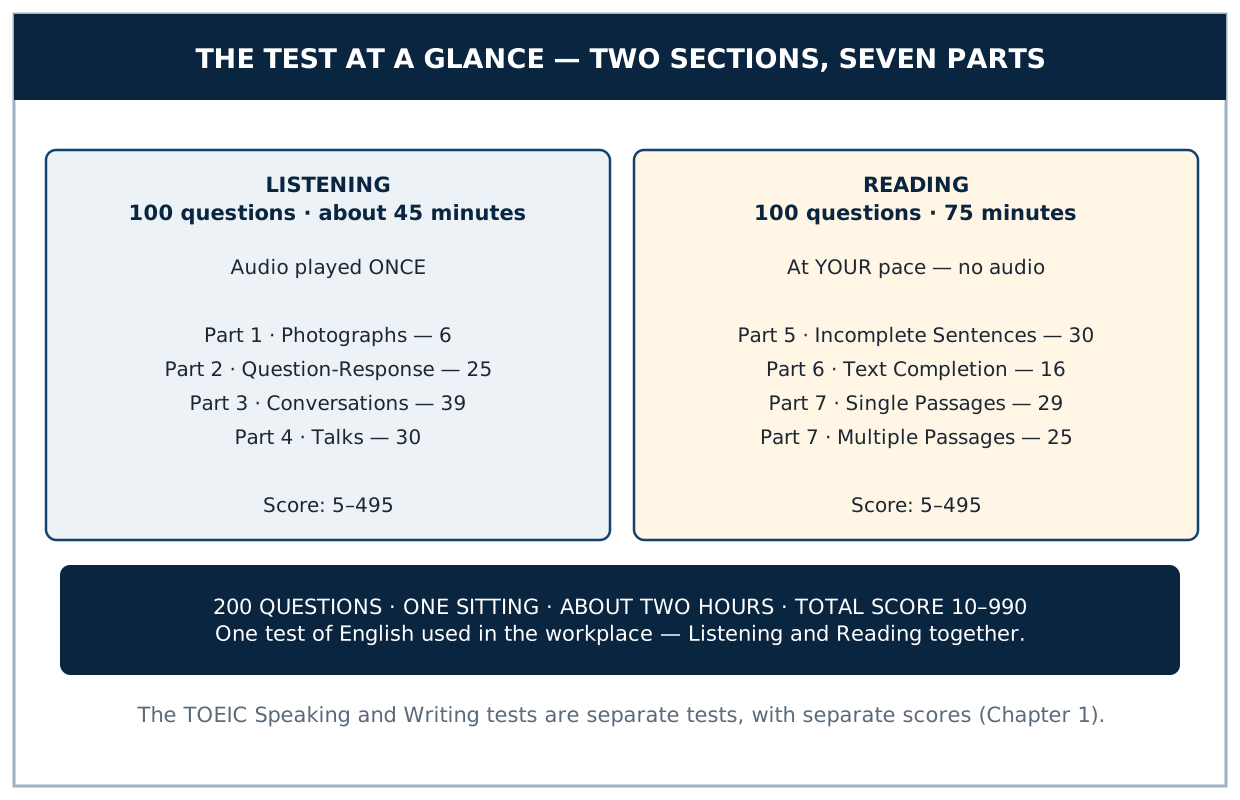
Figure 1.1 — The test at a glance: two sections, seven parts, 200 questions, in about two hours.
The Listening section comes first and takes about 45 minutes. The Reading section follows and takes 75 minutes. The difference in how those two blocks of time behave is one of the most important facts in this chapter, and it shapes the whole method of this book. In Listening, the pace is set for you: recordings are played once, in a fixed order, and you must answer as the test moves forward. In Reading, the pace is yours: you have 75 minutes for 100 questions and you decide how to divide that time among the parts. Chapter 33 teaches both budgets in detail. For now, fix the contrast in memory: Listening is a river you travel at the river's speed; Reading is a road you drive at your own speed, within a firm arrival deadline.
Part 1 is called Photographs and contains 6 questions. For each question you see a photograph and hear four statements about it. The statements are not printed in your test book. You choose the one statement that best describes what the photograph shows. Chapter 5 teaches this part in full, including how this book practices it in print.
Part 2 is called Question-Response and contains 25 questions. For each question you hear a question or a statement, followed by three spoken responses. Nothing for Part 2 is printed in the test book — no question, no responses. You listen and choose the response that fits. Because there are only three choices, Part 2 is the only part of the test with three options; every other part offers four. Chapter 6 teaches the question types and the response each type calls for.
Part 3 is called Conversations and contains 39 questions: 13 conversations with 3 questions each. Here the questions and the answer choices are printed in the test book, and they are also read aloud. You listen to each conversation once and answer its three questions. In some sets, a question directs you to look at a printed graphic — a table, a schedule, or a similar display — and combine what you see with what you hear. Chapter 7 introduces conversation work and Chapter 8 goes deeper into purpose, implication, and what happens next.
Part 4 is called Talks and contains 30 questions: 10 short talks with 3 questions each. A talk might be an announcement, a recorded message, an advertisement, a weather or traffic report, or a short presentation. As in Part 3, the questions and choices are printed and also read aloud, and some sets include a graphic to consult while you listen. Chapter 9 teaches the talk types and their signal phrases.
Add the Listening parts together and check the total for yourself: 6 plus 25 plus 39 plus 30 equals 100. Doing that small addition now is worthwhile, because candidates who know the counts cold make better pacing decisions later. If you lose your place during the Listening section — and many candidates do, once — the counts tell you where you are. Six photographs, then twenty-five short exchanges, then conversations, then talks: the section has a rhythm, and knowing the rhythm in advance is a form of calm.
Part 5 is called Incomplete Sentences and contains 30 questions. Each question is a single sentence with one gap and four choices. You choose the word or phrase that completes the sentence correctly. Most Part 5 questions test grammar or vocabulary in a workplace sentence. Chapter 24 teaches the Part 5 method, and Chapters 10 through 17 teach the grammar and word knowledge the part samples.
Part 6 is called Text Completion and contains 16 questions. The questions live inside complete short workplace texts — an email, a memo, a notice, a letter, or an advertisement — with four gaps in each text. For each gap you choose among four options. Most gaps offer a word or phrase; the published sample material also includes a gap that asks you to choose a whole sentence to complete the text. Do not expect that sentence gap in a fixed position; learn to recognize it wherever it appears. Chapter 25 teaches Part 6 in full.
Part 7 is the largest part and comes in two forms. Single Passages contains 29 questions based on 10 texts, with two to four questions per text. Multiple Passages contains 25 questions based on five sets of two or three related texts, with five questions per set. Together, Part 7 accounts for 54 of the 100 Reading questions — more than half the section. The texts are the ordinary documents of working life: emails, notices, advertisements, articles, forms, schedules, and messages, sometimes paired so that you must connect information across them. Chapters 26, 27, and 28 teach Part 7 method, and Chapter 30 studies the genres themselves.
Check the Reading total as you did for Listening: 30 plus 16 plus 29 plus 25 equals 100. Notice what the totals mean for your study plan. A candidate who loves grammar and spends every evening on Part 5 sentences is preparing for 30 questions. A candidate who also builds reading stamina for Part 7 is preparing for 54 more. Neither part can be ignored — but the counts tell you where the weight of the section lies, and Chapter 4 will show you how to turn counts like these, together with your diagnostic results, into a sensible route through the book.
On a paper-delivered test, you mark your answers on a separate answer sheet with a No. 2 pencil. Pens and mechanical pencils are not used. That small procedural fact deserves a place in Chapter 1 rather than as a surprise in Chapter 36, because answer-sheet discipline — marking one clear answer per question, keeping your place, erasing completely if you change an answer — is a skill, and Chapter 34 practices it directly. If your local test is delivered in a different format, your local ETS Preferred Network office will tell you what applies; registration, dates, and centers are handled by that local office and vary by country.
There is no penalty for wrong answers. An answer left blank earns nothing, and a wrong answer loses nothing beyond the point it never earned. The practical consequence is simple and worth stating on the first day of preparation: answer every question. If time runs short in the Reading section, a considered guess is always better than an empty row, because the guess can earn the point and the blank cannot. Chapter 33 and Chapter 34 turn that principle into end-of-section routines so that you never face the final minutes without a plan.
The Listening audio is played once. That single fact explains the two-pass method this book uses for all listening study. A printed book cannot play audio, so every listening text in this book is a printed transcript, and you study it in two passes. In Pass 1, you work under test conditions: a partner reads the transcript aloud once, or a text-to-speech voice plays it once, and you answer from hearing alone, without looking at the printed words. In Pass 2, you study the transcript closely — checking what you heard, finding the evidence for each answer, and learning the language that decided the question. The method is introduced here, taught fully in Chapter 5 for Part 1 and again in Chapter 32 for listening study as a whole, and used in every listening exercise, battery, and practice test in the book. Never study a transcript first and then pretend the listening was a test; that reverses the skill. Hear first, answer, then study.
Two programs deliver the test, and the distinction can matter after the test. In the Public Testing Program, sessions are open to individual candidates, and the Official Score Certificate you receive can be used worldwide. In the Institutional Program, sessions are run by an organization — for example, a company testing its own staff — and the score report from that program is valid only inside that organization. If you need a score you can present to other employers, confirm before you register that your sitting belongs to the program that gives you the document you need. Official Score Certificates are typically received 7 to 21 days after the test date, and local procedures vary, so treat that range as a planning guide and follow your local office's instructions for your own sitting.
One further version of the test deserves a brief, exact mention. ETS Global states that a one-hour Multistage Adaptive version of the Listening and Reading test exists, reserved for candidates from professional organizations, in which the second unit is selected according to performance on the first. This book teaches the two-hour test described in this chapter. If your organization directs you to the adaptive version, your organization and your local office are your sources for its arrangements; do not assume that part counts or timings from this chapter transfer to it, because this book makes no such claim.
Candidates come to this test from many directions, and recognizing your own direction helps you set an honest goal in Chapter 35. Some candidates are job applicants: an employer asks for a TOEIC score as part of hiring, because the job involves email, meetings, travel, or customers in English. Some are employees: a company measures the English of its staff to place people in roles, to form training groups, or to track progress after a language course. Some are students: an academic institution may use scores to place students into levels or as an exit requirement. Notice the pattern in each case. The score is used by an organization for that organization's own decision. That is why the next section's point — there is no pass or fail — is not a slogan but a description of how the test works.
Companies set their own score standards for their own purposes, and ETS publishes score-use guidelines for organizations. One company may ask for a higher score for a role that negotiates with clients all day than for a role that reads routine internal email, and both decisions can be sensible, because different jobs and tasks require different levels of proficiency. This book therefore never prints a score that any named employer, university, or job "requires." If an employer has given you a target, that target comes from the employer, and you should confirm it with the employer directly. If no one has given you a target, Chapter 35 shows you how to set a personal goal honestly — from your diagnostic, your strands, and the work you actually need English for — without inventing a threshold the test itself does not have.
Consider three fictional candidates who will help you see the range. Amara works in hotel reception and needs to understand guests' requests, announcements, and booking changes; her listening for detail and her everyday workplace vocabulary matter most. Kenji works in purchasing and spends his day reading supplier emails, delivery notices, and invoices; his reading accuracy across connected texts matters most. Lucia is applying for office jobs and has no single employer's target; she needs a balanced, credible result and a clear account of what her score report says. The three candidates sit the same test, hear the same recordings, and read the same texts — but they prepare with different emphases, and Chapter 4's diagnostic-first route exists precisely to find your emphasis rather than assuming it. None of the three "passes" or "fails." Each earns a score that describes performance on that day, and each score report describes strengths and weaker strands in the manner Chapters 2 and 3 teach you to read.
Say it plainly, because much confusion about this test starts here: there is no pass or fail on the TOEIC Listening and Reading test. ETS's own handbook guidance states, in substance, that this is not the kind of test that you pass or fail. Every candidate who completes the test receives scores on the published scales, and those scores describe a level of performance. A lower score is not a failure stamp and a higher score is not a pass stamp; they are different descriptions, useful for different purposes.
Why does this matter for study? Because a pass-or-fail mindset distorts preparation in two directions. It makes some candidates anxious far beyond what the task deserves, as if a single line separated success from disgrace. And it makes other candidates hunt for a magic number — "just tell me the score I need" — instead of building the underlying English that any sensible target requires. Release both distortions now. Your job in this book is to understand more English, more accurately, under the test's conditions, and to let the score follow from the skill. When score goals are discussed — in Chapter 35 and wherever else they arise — they are discussed as goals you or an organization set for a purpose, never as a pass mark set by the test.
The test does not test business knowledge. You do not need to know how accounting works to answer a question set in a finance office, and you do not need engineering training to answer a question set on a factory floor. ETS states that no specialized vocabulary beyond everyday workplace use is required. What the test does require is English: the ability to follow what was said, to find what a text states, to connect information, and to understand the words and grammar of ordinary working communication. If a question is set in a hospital reception area or an airport, every fact you need is in the recording or the text; your task is language comprehension, not professional expertise. That is encouraging news for candidates from every background, and it is also a study instruction: spend your hours on English — listening, reading, vocabulary in context, and grammar in sentences — not on memorizing trade facts.
The settings themselves come from a published list of context domains, and learning the list now will make the vocabulary part of this book (Chapters 18 through 23) feel organized rather than random. The thirteen domains are: Corporate Development; Dining Out; Entertainment; Finance and Budgeting; General Business; Health; Housing and Corporate Property; Manufacturing; Offices; Personnel; Purchasing; Technical Areas; and Travel. Read the list once slowly. You will meet every domain again: in the conversations and talks of Part II, in the vocabulary chapters of Part IV, and in the texts of Part V. A domain is only a setting — a place where English is used — but settings predict vocabulary. Travel texts talk about departures, reservations, and delays; purchasing texts talk about orders, quantities, and deliveries; personnel texts talk about applications, interviews, and training. When you learn words inside their domains, you learn them with the neighbors they actually keep, and retrieval in the test room becomes faster.
Finally, the voices. The Listening section uses a range of English accents, as spoken in the United States, Great Britain, Canada, and Australia. You will not hear only one variety, and you should not train your ear on only one variety. This book is written in American English throughout, because ETS is a United States program and its published materials use American spelling — organize, center, behavior, traveling, program. That is the book's spelling norm, and the Reading section samples American workplace English. But listening preparation must be wider than spelling: the two-pass method lets you hear transcripts read in different voices where you can arrange it, and Chapter 32 discusses accent exposure honestly — what helps, what does not, and why understanding the words matters more than imitating any single accent. Where a listening point turns on a variety difference, this book names the variety explicitly as a teaching point rather than presenting any one variety as the whole of English.
Suppose a friend who has taken the test tells you: "There was a part where nothing was printed and I had to pick one of three answers to a question I only heard." Place that description on the map step by step. First, nothing printed rules out Parts 3 and 4, where questions and choices are printed, and rules out the whole Reading section. Second, three answers rules out Part 1, which offers four spoken statements. What remains is Part 2, Question-Response: 25 questions, a heard question or statement, three spoken responses, nothing printed. The method is the point: section, then print or no print, then number of choices. Use the same three steps whenever a description of the test confuses you — including descriptions in job notices, which are sometimes loose with part names.
Read this short notice, written for this book, and answer the question beneath it. Notice: "The facilities office will close the second-floor meeting rooms on Friday for carpet cleaning. Meetings booked in those rooms should move to the third floor for that day only. The cafeteria and the ground-floor training room are not affected." Question: According to the notice, which rooms are not affected by the closing? Work it as Part 7 will ask you to work: find the sentence that answers the question, do not rely on memory or on what seems likely. The final sentence names the cafeteria and the ground-floor training room as not affected. The second-floor meeting rooms are affected; the third-floor rooms are the alternative, not an unaffected set. That discipline — locate, quote to yourself, then choose — is the whole of detail reading, and Chapter 26 builds it into a habit. Notice also what the question did not ask: it did not ask why the rooms close (carpet cleaning) or when (Friday). Strong candidates answer the question asked, not the question they expected.
Listening — Part: 1 Photographs · Questions: 6 · Choices: 4 spoken statements · Printed in test book?: Photograph only
Listening — Part: 2 Question-Response · Questions: 25 · Choices: 3 spoken responses · Printed in test book?: No
Listening — Part: 3 Conversations · Questions: 39 · Choices: 4 per question · Printed in test book?: Yes, questions and choices
Listening — Part: 4 Talks · Questions: 30 · Choices: 4 per question · Printed in test book?: Yes, questions and choices
Reading — Part: 5 Incomplete Sentences · Questions: 30 · Choices: 4 per sentence · Printed in test book?: Yes
Reading — Part: 6 Text Completion · Questions: 16 · Choices: 4 per gap · Printed in test book?: Yes, texts with gaps
Reading — Part: 7 Single + Multiple · Questions: 54 · Choices: 4 per question · Printed in test book?: Yes, texts and questions
Q1. How many questions does the TOEIC Listening and Reading test contain in total? A) 100 questions B) 200 questions C) 150 questions D) 54 questions
Q2. Which statement about the test result is correct? A) Candidates pass at a fixed score set by ETS. B) Candidates fail if they score below the midpoint of the scale. C) A score is valid only if both sections reach the same level. D) The test has no pass or fail; scores describe levels of performance.
Q3. A candidate wants a score report that can be presented to employers in other countries. Which program should the candidate confirm before registering? A) The Public Testing Program B) The Institutional Program C) The Multistage Adaptive version only D) The Speaking and Writing tests
Q4. Which part offers only three answer choices? A) Part 1 Photographs B) Part 3 Conversations C) Part 2 Question-Response D) Part 5 Incomplete Sentences
Q5. The facilities team will repaint the lobby ______ the office closes for the holiday weekend. A) among B) after C) toward D) per
Q6. All conference registrations must be ______ at least two weeks before the event. A) submit B) submits C) submitted D) submitting
Q7. Ms. Ortiz asked the technician to check the printer ______ ordering a replacement. A) before B) despite C) unless D) among
Q8. The new training schedule will take effect ______ Monday, March 2. A) in B) at C) on D) by to
Q9. Employees who complete the safety course will receive a certificate ______ email. A) through of B) by C) between D) onto
Q10. The manager reminded the team that the quarterly report ______ by Friday afternoon. A) is due B) due is C) dues D) dued
Read the notice below and answer Q11–Q14.
Notice — Harborview Office Center. Starting Monday, the main entrance on Ellis Street will be closed for repairs for two weeks. During that period, all visitors should use the side entrance on Parker Lane and sign in at the temporary desk there. Deliveries should also be directed to Parker Lane between 8 a.m. and 5 p.m. The Ellis Street parking garage remains open as usual.
Q11. What is the purpose of the notice? A) To announce a change in parking fees B) To direct visitors and deliveries during entrance repairs C) To advertise office space for rent D) To cancel deliveries for two weeks
Q12. For how long will the main entrance be closed? A) One week B) Until Friday C) For two weeks D) For one month
Q13. Where should visitors sign in during the repairs? A) At the main entrance desk B) At the parking garage office C) At their host's office D) At the temporary desk on Parker Lane
Q14. What does the notice say about the parking garage? A) It remains open as usual. B) It is closed for repairs. C) It accepts deliveries only. D) It opens at 8 a.m.
Q15. Which Listening part contains 39 questions in sets of three? A) Part 1 Photographs B) Part 4 Talks C) Part 2 Question-Response D) Part 3 Conversations
Feras Alzubi
Exam Prep Series
© 2026 Feras Alzubi. All rights reserved.
No part of this book may be reproduced, stored in a retrieval system, or transmitted in any form or by any means — electronic, mechanical, photocopying, recording, or otherwise — without the prior written permission of the author, except for brief quotations used in a review or in scholarly work.
Originality statement. All teaching text, questions, reading texts, listening transcripts, and explanations in this book are original to this book. They were written for this book to prepare readers for the test described in these pages. No question, text, transcript, or photograph from an actual test appears in this book, and no practice material here is reproduced, adapted, or closely imitated from any published test material. The practice photographs printed in this book are this book's own photographs.
Not-affiliated disclosure. This book is an independent preparation book. It is not published by, affiliated with, or endorsed by ETS, the organization that develops and administers the TOEIC test. TOEIC is a registered trademark of ETS. The name is used in this book nominatively — that is, only to identify the test this book prepares readers for. ETS does not review, approve, or take part in the contents of this book.
Read these statements plainly before you begin, because everything in this book is built on them.
This book prepares you. It confers nothing. This book teaches the English and the test skills that the TOEIC Listening and Reading test measures, and it gives you extensive practice in the test's real shapes. It confers no qualification, no certificate, and no score. Scores are awarded by ETS on the examination itself, and only ETS can award them.
There is no pass or fail. The TOEIC Listening and Reading test is not a test that you pass or fail. ETS reports a score that shows the level of English you demonstrated on the day; different jobs and different tasks call for different levels of proficiency, and the organizations that use scores set their own standards for their own purposes. This book therefore never speaks of a passing score, because there is none.
No score is guaranteed. No book can promise you a score, a score gain, or any particular result, and this book does not. Your result depends on your starting level, the work you do, and your performance on the day. What this book can honestly offer is complete teaching, practice in the test's real formats, and an explanation for every answer, so that the work you do is well directed.
Practice results are reported as number correct — never as a converted score. ETS converts the number of correct answers on a real test into a scaled score by a statistical process, and ETS does not disclose how that conversion works; the conversion is specific to each test form, and raw scores are not reported. Because no honest conversion exists outside ETS, this book reports every practice result — the diagnostic, the batteries, the repair sets, and the two timed practice tests — as a number correct, part by part. Any book or website that converts your practice answers into an estimated TOEIC score is inventing a number. This book will not do that.
A printed book cannot play audio. The listening material in this book is printed as transcripts, and you will use those transcripts in two passes, described in full in the next section. In Pass 1, a partner or a text-to-speech voice reads the transcript aloud once, exactly as the test plays its audio once, and you answer from hearing alone, without looking at the printed words. In Pass 2, you study the printed transcript in annotated form — you check each answer against the words you heard, find the exact line that carries each answer, and learn from every miss. Hear, answer, study: that is the method, and it is printed again wherever listening preparation is introduced in this book.
Work through this book in the order below. Each stage exists because the stage before it tells you what that stage should contain.
Every listening text in this book — in the diagnostic, the chapters, the batteries, the repair sets, and the timed tests — is a printed transcript, and every one is used the same way.
Keep a notebook or a simple table beside this book from the first day. For every question you answer incorrectly, in any part of the book, record four things: the part and question number; the correct answer; the reason you missed it, in your own words; and the chapter or repair set that teaches that point. Review the log weekly. Patterns will appear — the same connector missed three times, the same kind of inference missed in every conversation — and those patterns, not your totals, are the most useful study plan you own. Chapter 34 teaches the error log in full.
This page is the whole test, in this book's own words. Everything stated here is a published fact about the TOEIC Listening and Reading test.
The test contains 200 multiple-choice questions in two sections — a Listening section of 100 questions and a Reading section of 100 questions — and the whole test takes about two hours.
Listening — 100 questions, about 45 minutes. The audio is played once.
Reading — 75 minutes, at your own pace.
In the Reading section the counts add up as 30 + 16 + 29 + 25 = 100. In the Listening section they add up as 6 + 25 + 39 + 30 = 100.
Each section is scored on a scale from 5 to 495. The two section scores are added together to give a total score from 10 to 990. Scores are reported in 5-point steps — a score always ends in 0 or 5. ETS arrives at these scaled scores by converting the number of correct answers through a statistical process; the conversion is not disclosed and is specific to each test form, which is why this book reports practice results as number correct only.
There is no penalty for wrong answers. A blank answer can never be right, so answer every question, even when you must guess.
There is, as stated earlier in this front matter, no pass or fail and no passing score.
A score remains valid for two years: ETS will re-issue and confirm score results for two years after the test, and score reports are not re-issued after that period.
Your score certificate also reports Abilities Measured — the percentage of questions you answered correctly within several skill areas, such as understanding details in short and extended spoken texts, locating information in written texts, making inferences, and understanding vocabulary and grammar in workplace texts. Chapter 3 teaches you to read that part of a score report in full.
The test is set in the everyday world of work. ETS publishes thirteen context domains from which question settings are drawn:
The test does not test business knowledge, and it requires no specialized vocabulary beyond everyday workplace use. Part IV of this book teaches vocabulary domain by domain, following this published list.
The Listening section uses a range of English accents, as spoken in four places: the United States, Great Britain, Canada, and Australia. The teaching text of this book is written in American English, the norm of ETS's own published materials; where a listening point turns on a British, Canadian, or Australian usage, the book names that variety explicitly and teaches it as a point to recognize.
On a paper-delivered test, answers are marked on a separate answer sheet with a No. 2 pencil — no pens and no mechanical pencils. Registration, test dates, test centers, and fees are handled by the local ETS Preferred Network office and vary by country; this book prints no fee figure, and you should confirm all local arrangements with that office. A separate, shorter Multistage Adaptive version of the test also exists, reserved for candidates from professional organizations; this book teaches the two-hour test described on this page. The TOEIC Speaking and Writing tests are separate ETS tests with their own scores; they are named honestly in Chapters 1 and 39, and this book does not cover them.
Front Matter
The Diagnostic
Part I — The Test and Your Score
Part II — Listening Foundations
Part III — The Grammar the Reading Section Samples
Part IV — Workplace Vocabulary by Domain
Part V — Reading the Test's Texts
Part VI — Listening and Reading Together
Part VII — Exam Craft
Part VIII — Review and Reference
The Skills Batteries
The Repair Sets
The Timed Practice Tests
Back Matter
This book is an independent preparation book. It is not published by, affiliated with, or endorsed by ETS. TOEIC is a registered trademark of ETS, used nominatively in this book to identify the test it prepares readers for.
End of the free sample. The complete book continues from here — the full A-to-Z course in book form, delivered as an EPUB you can read in Apple Books, Google Play Books, ReadEra, Thorium Reader, Adobe Digital Editions, or Send to Kindle.
Buy this ebook — $11.99 Back to the book page
Payments are securely processed by Payhip.