
Mastering Careers & Skills
Test of English as a Foreign Language (TOEFL) · free sample from the book itself
Every entry mirrors the production tag of its item in the chapter file. For each multiple-choice unit, the key states the correct answer and why each wrong answer fails.
1. B — B is correct: the notice's job is to inform students of both the extended hours ("open until midnight") and the rules (booking, the silent floor, food and drinks) that apply during exam week. A reverses the hours fact — the library stays open later, not earlier. C invents a persuasion purpose and misreads the fifth-floor rule, which restricts that floor to silent individual study. D takes one detail (booking) and inflates it, and also falsifies it: rooms are booked for two hours at a time, not a whole day. Method note: in daily-life texts, choose the purpose that covers the whole text, not its loudest detail.
2. A — A is correct: "covered drinks are allowed except on the fifth floor" means every floor other than the fifth. B imports the third floor from the study-room sentence, which is about booking, not drinks. C applies the food rule to drinks; the notice separates them ("Food is not permitted anywhere… covered drinks are allowed…"). D states the exception as if it were the rule.
3. D — D is correct: Ana works until 3:00 and the lab starts at 3:30, so the times leave her a workable gap; Bruno's "you should be fine" confirms the inference. A ignores the 3:30 start time. B contradicts Bruno's own messages — he discusses attending and saving a seat. C misreads the room number, which is 204. Method note: a sound inference uses only what the text gives; here the whole inference is two times and one reassurance.
4. C — C is correct: integrated speaking tasks and an independent (standalone opinion) speaking task belonged to the pre-January-2026 format; the updated test's Speaking section contains only Listen and Repeat and Take an Interview (ETS, Updated TOEFL iBT Test Overview). A asserts tasks never change — January 21, 2026 disproves it. B treats a score scale as proof of currency while the task content — what the candidate actually practices — is superseded. D makes popularity a source of truth; it is not one.
5. A — A is correct: Reading → Listening → Writing → Speaking (ETS, Updated TOEFL iBT Test Overview). B moves Writing before Listening. C scrambles the order entirely. D is the pre-2026 order — Speaking and Writing swapped — and is the most dangerous wrong answer here, because it is what older materials teach.
6. D — D is correct: Reading and Listening are the multistage adaptive sections (ETS, Updated TOEFL iBT Test Overview). A, B, and C each pair one genuinely adaptive section with a non-adaptive one, or name two non-adaptive sections; Writing and Speaking are not adaptive in the updated test.
7. B — B is correct: in the Home Edition, headsets and earphones are not allowed; the candidate hears the proctor through a speaker and speaks into a microphone that is not part of a headset (ETS, At Home Testing Requirements). A states the center arrangement backwards — at a center it is the provided stereophones that are used, and nothing is required at home in headset form. C invents a wireless exception that does not exist. D imagines center equipment leaving the center; it does not.
8. C — C is correct: since January 21, 2026, each section and the overall score are reported on the 1–6 scale in half-point increments (ETS, Understanding Your Scores). A describes the pre-2026 scale as if it were the current reporting scale. B invents a failing score; ETS sets no passing or failing scores. D replaces the published averaging rule with a maximum rule ETS does not use.
9. A — A is correct: "There are no passing or failing scores set by the TOEFL Program or ETS. Each institution sets its own score requirements" (ETS, Understanding Your Scores). B, C, and D each hand the decision to a body that does not hold it — ETS as a universal gatekeeper, a government, or the test center — and each would mislead a candidate about whose published page they must actually read.
10. D — May 9 — D is correct, recomputed: six weeks is 42 days. Counting back 42 days from Saturday, June 20: June 20 − 20 days = May 31; May 31 − 22 days = May 9. Submitting by May 9 leaves the full six-week review window, then approval, then registration — which must itself close seven full days before the test. A (June 13) leaves one week, and June 13 is itself the regular registration close date — approval could not precede the June 13 close. B (May 23) allows only four weeks — the optimistic end of ETS's "approximately four to six weeks" (ETS, TOEFL iBT Information Bulletin 2026–2027) — so the plan fails if review takes the published longer time. C (June 6) allows two weeks. Planning rule: always plan against the slow end of a published range.
11. B — B is correct: TOEFL Essentials, the TOEFL Junior/Primary family, and the TOEFL iBT are distinct tests with distinct purposes; this book prepares for the TOEFL iBT only. A collapses two different tests into one. C is false in the present tense: the Paper Edition was discontinued after January 20, 2024. D asserts an interchangeability no institution grants — the institution names the test it wants.
12. C — C is correct: to receive scores, a candidate must answer at least one Reading and one Listening question and respond to at least one Speaking and one Writing task (ETS, TOEFL iBT Information Bulletin 2026–2027). A overstates validity: scores are valid for two years, not five. B is the direct negation of the rule. D is contradicted by ETS's own caution: unofficial scores can change, rarely, after ETS quality checks (ETS, Understanding Your Scores).
13. B — 4.5 — B is correct, recomputed: sum = 4.5 + 5.0 + 4.0 + 5.0 = 18.5; average = 18.5 ÷ 4 = 4.625; the nearest half band is 4.5 (distance 0.125, versus 0.375 to 5.0). A reports the unrounded average, which is never a reported TOEFL score — reported scores move in half-point steps. C rounds in the wrong direction. D copies the lowest section score, which plays no special role in ETS's rule (ETS, Understanding Your Scores).
14. D — 5.5 — D is correct, recomputed: sum = 5.5 + 5.0 + 5.0 + 5.5 = 21.0; average = 21.0 ÷ 4 = 5.25; 5.25 is exactly halfway between 5.0 and 5.5, and ETS's own published worked example rounds an average of 5.25 up to 5.5 (ETS, Understanding Your Scores). A rounds the halfway case down, against ETS's example. B reports the unrounded average. C rounds to a whole band two steps away, a rule that exists nowhere in ETS's scoring.
15. A — 36 seconds — A is correct, recomputed: 30 minutes = 1,800 seconds; 1,800 ÷ 50 items = 36 seconds per item. This is a planning budget — this book's guidance — built from ETS's published "up to" figures (ETS, Updated TOEFL iBT Test Overview); an adaptive sitting may present fewer items, which is why Chapter 9 and Chapter 26 teach pacing by checkpoints rather than by a stopwatch on each item. B divides the minutes by nothing meaningful (30 is the minute count, not a seconds budget). C is the answer for 30 items, not 50. D would require 72 items in the same time.
Chapter 1 census: 15 scored responses, all multiple-choice. Key distribution: A ×4, B ×4, C ×3, D ×4. Designated quantitative units: 4 (Units 10, 13, 14, 15).
This book defines every term the first time it uses it, in plain words, because some readers are meeting this whole world for the first time. The most important definitions in the book are in this chapter.
Keep these definitions open as you read. When a later chapter uses one of these words, it uses it with exactly the meaning given here.
People take the TOEFL iBT for one practical reason: an institution they want to join needs evidence that their English is strong enough for study or work in English. The most common case is a student applying to a university where classes, textbooks, lectures, assignments, and examinations are in English. The university cannot interview every applicant in person, and school grades in English classes mean different things in different countries, so the university asks for a score from a standard test — the same test, with the same rules, taken by applicants everywhere. That is the job the TOEFL iBT does.
Notice what follows from that, because it shapes everything in this book. The test does not measure whether you are intelligent. It does not measure whether you know your subject — a brilliant engineer and a beginning engineer can receive the same TOEFL score. It measures one thing: what you can do in English, across the four skills a student uses every day. You read articles, book chapters, notices, and messages. You listen to lectures, announcements, and conversations. You write emails and discussion posts and, beyond the test, essays and reports. You speak in seminars, in office hours, in group projects, and in daily life on a campus. The updated test's tasks are drawn from exactly those two worlds — academic life and campus life (ETS, Updated TOEFL iBT Test Overview) — and that is why this book teaches both worlds from the first chapter.
It also follows that there is no passing score for the TOEFL iBT itself. ETS states this plainly: there are no passing or failing scores set by the TOEFL program or by ETS; each institution sets its own score requirements (ETS, Understanding Your Scores). Read that sentence again, because a great deal of bad advice in the world contradicts it. A score that is enough for one university's undergraduate program may not be enough for another university's graduate program, and the same university may ask for more from a teaching assistant — a student who teaches — than from a student who only studies. There is no honest sentence of the form "a good TOEFL score is X," and this book will never print one. What this book does instead is teach you, in Chapter 22, a verification method: how to find each of your institutions' current published requirements, how to note the date you found them, and how to read a requirement written in the older score scale against your new band score using ETS's own published comparison table. That method is worth more than any list of universities this book could print, because a printed list would begin to go out of date the day it was published, and because your institutions — not this book's examples — are the ones who will read your score.
One more honest point belongs here, at the start. There is no English-level requirement to register for the TOEFL iBT. Nothing in ETS's published registration rules says you must already be at a particular level before you may book the test; registration is a matter of opening an ETS account and presenting identification whose name exactly matches your registration name (ETS, TOEFL iBT Information Bulletin 2026–2027). Whether you should book the test now, or study first, is a different question — a planning question — and this book's study plans and diagnostic exist to help you answer it for yourself. But no reader of this book is "not allowed" to aim at this test, and no reader is too early to begin learning the English it measures. Part I of this book is written precisely for the reader who is starting from the middle — who can hold a conversation in English, perhaps, but has never written an academic paragraph, never followed a lecture in English, and does not yet know what a band score is. If that is you, you are one of the readers this book was designed for, not an exception to its design.
This is the most important section in Chapter 1, and it may be the most useful section in the book for a reader who has already begun preparing with other materials. The TOEFL iBT changed on January 21, 2026. The test you can book today is not the test described in most TOEFL books, courses, and videos that exist in the world, because most of them were made before that date.
Here is the story in plain words. On May 29, 2025, ETS announced a transformation of the TOEFL iBT: the Reading and Listening sections would become multistage adaptive, scores would be reported on a new 1–6 scale aligned with the CEFR, and scores would be reported faster (ETS, news release, "TOEFL Transformation Announcement," May 29, 2025). Those broader changes took effect on January 21, 2026. ETS's own current score page says so directly, in the past tense, under the heading "What Changed in January 2026": as of January 21, 2026, TOEFL iBT score reports feature the new 1–6 scale (ETS, Understanding Your Scores). The full structure of the updated test — its task types, its times, and its scoring guides — is published by ETS in the Updated TOEFL iBT Test Overview (© 2025, ETS), and the Information Bulletin in force for July 2026 through June 2027 administers the updated test. This book is built against that updated test, and only that test. Its basis line, which you will meet again on the Exam Blueprint pages, is: Built against the Updated TOEFL iBT as published by ETS (Updated TOEFL iBT Test Overview, © 2025 ETS), in effect January 21, 2026.
What did the older test look like, and why does the difference matter so much? Before January 21, 2026, the test had a different set of tasks. Its Reading section used long passages of about 700 words with ten questions each. Its Listening section used lectures of three to five minutes. Its Speaking section had four tasks, most of them integrated tasks — tasks in which you read and listened first and then spoke about what you had read and heard — plus an independent speaking task in which you gave your opinion on a familiar topic. Its Writing section paired an integrated writing task — read, listen, then write — with a discussion task. Its scores ran on the older 0–120 scale. None of those tasks is in the test you can book today. The updated test has no integrated writing task, no integrated speaking tasks, and no independent speaking task. It has no 700-word passage sets and no three-to-five-minute lecture sets. A book, course, or video that drills those tasks is preparing you, with complete sincerity in many cases, for a test that is no longer given. The hours you spend on those drills are hours taken from the tasks that will actually decide your score.
That is why this book teaches you a habit, here at the start, that you should apply to every piece of TOEFL material you ever touch — including, one day, an old copy of this book: check the date before you trust the content. Ask three questions of any TOEFL book, course, video, or practice test. First: When was this made? If it was made before January 2026 and has not been revised since, it describes the older test. Second: Which score scale does it teach? Material that leads with the old 0–120 scale as the current scale — rather than as comparison information for older scores — is material about the older test. Third: Which tasks does it practice? If its practice includes integrated writing, integrated speaking, or a standalone opinion-speaking task presented as a current TOEFL task, it is practicing tasks that no longer exist. Chapter 25, the Transition Chapter, is written for readers in exactly this position: it maps each older task to the updated test, names the preparation that no longer earns anything, and identifies the preparation that still transfers — because a great deal of honest English learning does transfer, and Chapter 25 says which parts. For now, hold the simple rule: the date on the material is part of the material.
There is one more piece of the version story that belongs in this chapter, because readers holding older scores need it immediately. Scores from the older test did not become worthless on January 21, 2026. TOEFL scores are valid for two years from the test date (ETS, Understanding Your Scores; ETS, TOEFL iBT Information Bulletin 2026–2027), so a score earned in, say, March 2025 remains reportable until March 2027. And during the two-year transition period after January 2026, every updated-format score report also carries a comparable overall score on the older scale, computed by ETS as the midpoint of the corresponding range, so that institutions working in either scale can read your result (ETS, Understanding Your Scores). Chapter 22 teaches that whole comparison system as a working skill, using ETS's published tables and nothing else. What Chapter 1 needs you to carry away is only this: the two scales coexist on paper during the transition, but only one test exists to be taken — the updated one — and this book prepares you for that one.
Finally, an older relative should be buried properly. The TOEFL iBT Paper Edition, a paper-based version once offered in a few places, was discontinued after January 20, 2024. It is not an option you can choose today, and this book mentions it only here, so that a reader who finds it described in old material is corrected rather than confused.
Now the updated test itself, in one view. You will spend whole chapters inside each part of what follows; this section is the map, not the territory.
The order of the test is fixed: Reading first, then Listening, then Writing, then Speaking (ETS, Updated TOEFL iBT Test Overview). Notice the order, because older material has it differently: in the updated test, Writing comes before Speaking. The whole test takes under two hours to complete (ETS, Updated TOEFL iBT Test Overview). The section times in the table below are base times: they do not include the time spent reading directions or adjusting the volume of the sound (ETS, Updated TOEFL iBT Test Overview).
ETS publishes the size of each section as an "up to" figure — up to so many items, up to so many minutes — because an adaptive test does not hand every candidate an identical paper. This book prints those figures exactly the way ETS publishes them, and you should be suspicious of any material that converts them into a promise that you personally will receive exactly that many items. Here is the structure (all figures: ETS, Updated TOEFL iBT Test Overview):
| Section | Task types | Items | Base time |
|---|---|---|---|
| Reading (multistage adaptive) | Complete the Words · Read in Daily Life · Read an Academic Passage | Up to 50 | Up to 30 minutes |
| Listening (multistage adaptive) | Listen and Choose a Response · Listen to a Conversation · Listen to an Announcement · Listen to an Academic Talk | Up to 47 | Up to 29 minutes |
| Writing | Build a Sentence · Write an Email · Write for an Academic Discussion | Up to 12 | Up to 23 minutes |
| Speaking | Listen and Repeat · Take an Interview | Up to 11 | Up to 8 minutes |
| Whole test | 13 task types | Up to 120 | Under 2 hours |
Figure A-01 — Test-structure map.
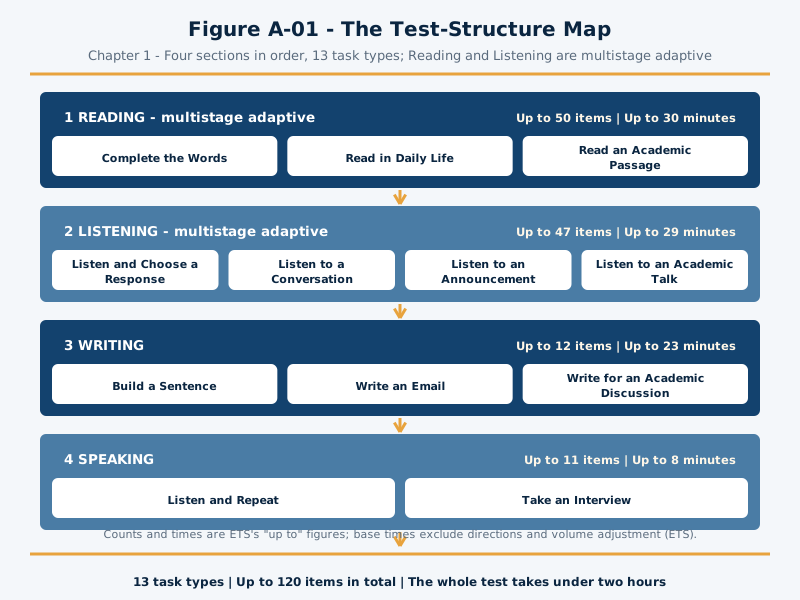
the four sections in test order (Reading, Listening, Writing, Speaking), their task types, and ETS's "up to" items and base times for each section, with Reading and Listening marked multistage adaptive
Read the table slowly; it contains the whole shape of your preparation. Four sections. Thirteen task types. Notice how different the sections' weights feel. Reading and Listening together carry up to 97 of the 120 items: this is, by count, mostly a test of understanding — of taking English in, quickly and accurately, in both its written and its spoken form. Writing carries few items but two of them are extended pieces of writing produced against short clocks. Speaking is the shortest section of all — up to eight minutes — which surprises many readers until they meet its tasks in Part V and discover how much English eight minutes of speaking actually contains.
Now meet the thirteen task types by name, in one short paragraph each. You do not need to master anything in this section. You need to be able to recognize each name when later chapters use it, and to have a first picture of what the task asks. Every task is then taught in full, in its own chapter, with the same internal map: what ETS asks, what it measures, a named method, a fully worked example, the ways candidates lose score on it, and timed practice.
Reading — three task types.
Complete the Words. You read a short academic paragraph of about 70 to 100 words. The first sentence is complete. After that, in every second word, the second half of the word is missing, and you supply the missing letters. Each text has 10 words with missing letters. This task examines something deep: whether you process written English for meaning and form at the same time — whether the grammar and vocabulary of a sentence live in your reading, not just in your memory of rules. Chapter 6 teaches it; Chapter 2 builds the grammar it rests on.
Read in Daily Life. You read a short, real-world text — a notice, a poster, a menu, an advertisement, a schedule, a form, a receipt, an email, a short news item, a social media post, or a chain of text messages — of about 15 to 150 words, and answer two or three multiple-choice questions. These texts do not behave like essays: their information hides in layouts, abbreviations, and incomplete sentences, and Chapter 7 teaches you to read them the way they are actually written.
Read an Academic Passage. You read a passage of about 200 words on an academic subject and answer five questions. ETS names six subject areas for these passages: history; art and music; business and economics; life science; physical science; and social science. The passage is written so that background knowledge is not required — everything you need is in the text — and Chapters 8 and 9 teach the question families it carries, from detail and vocabulary to inference and structure.
Listening — four task types. In every listening task, the voices you hear may come from four accent regions ETS names: North America, the United Kingdom, Australia, and New Zealand (ETS, Updated TOEFL iBT Test Overview). Chapter 13 teaches you how to build exposure to all four without caricature and without panic.
Listen and Choose a Response. You hear a short question or statement — you do not see it written — and you choose the most appropriate of four written responses. The skill is not only hearing the words; it is hearing what is meant, including the implied meaning a short remark carries in real conversation. Chapter 10 teaches it.
Listen to a Conversation. You hear a short conversation between two speakers on a campus-life topic — dining, housing, courses, services, travel, health, and the rest of daily life — and answer two questions. Chapter 11 teaches you to track who wants what, turn by turn.
Listen to an Announcement. You hear a short announcement of about 40 to 85 words — about a schedule, directions, a rule, or a student's achievement — and answer questions on it. Short does not mean easy: everything in an announcement is information, and Chapter 11 teaches the skeleton to listen for.
Listen to an Academic Talk. You hear a talk of about 100 to 250 words on one of the same six academic subject areas as the reading passages, and answer four questions. This is the lecture in miniature: a main idea, supporting ideas, and an organization you must hear as it passes, because spoken words do not wait. Chapter 12 teaches it, on top of the signpost and note-taking system of Chapter 4.
Writing — three task types.
Build a Sentence. You see one complete sentence, and beside it a second sentence whose words and phrases are in the wrong order. The two sentences form an exchange between two speakers. You move the words and phrases to build a grammatical sentence that is an appropriate reply to the first sentence. This task measures your command of English sentence structure directly — which is why Chapter 2's grammar and Chapter 14's method matter so much. Chapter 14 teaches it.
Write an Email. You are given a situation in an academic or social setting and a purpose for an email — for example, to make a recommendation, to extend an invitation, or to propose a solution to a problem — and you write the email in 7 minutes. It is scored from 0 to 5 under ETS's published scoring guide (ETS, Updated TOEFL iBT Test Overview). Seven minutes is very short, and Chapter 15 is built around that clock.
Write for an Academic Discussion. A professor has posted a question for an online class discussion, and two students have already posted their views. You write your own post: you state your opinion and support it, in 10 minutes. An effective response contains at least 100 words, and the task is scored from 0 to 5 (ETS, Updated TOEFL iBT Test Overview). Notice the name this book always uses: this is a discussion post, not an essay. The updated test has no essay task, and this book never renames this task as one. The essay-length writing you will practice in Part I is there as skill-building — because posts and emails are built from paragraphs — not because a hidden essay is waiting for you in the test. Chapter 16 teaches the discussion task.
Speaking — two task types.
Listen and Repeat. Inside a scenario set in an academic or campus-life place, you hear seven sentences, one at a time. The sentences grow progressively longer and more complex. For each sentence you have a maximum of 8 to 12 seconds to repeat it, and your repetition must be accurate and clearly intelligible. The task is scored from 0 to 5 (ETS, Updated TOEFL iBT Test Overview). It sounds simple and is not: it measures whether your ear, your memory for heard language, and your mouth work together. Chapter 18 teaches the chunking method that makes it learnable.
Take an Interview. You take part in a simulated conversation with a recorded interviewer — in a situation such as applying for a scholarship or joining a research study. The interviewer asks four questions, and you have 45 seconds to answer each. The early questions ask about facts and your own experience; the later questions ask for your opinion, supported with reasons (ETS, Updated TOEFL iBT Test Overview). The task is scored from 0 to 5. Chapters 19 and 20 teach the two question families, and give you a physical shape for a 45-second answer that you can feel in your body before test day.
That is the whole test. Thirteen named tasks, every one of them taught in this book in its own chapter, practiced in this book's chapter sets, skill sets, and two full practice tests. When you finish this chapter, test yourself informally: can you name the four sections in order? Can you say which two sections are adaptive? Can you name at least one task type in each section? If you can, the map is in place, and everything else in the book is detail added to a frame you already hold.
Chapter 22 teaches scoring in full. This section gives you the one page you need now, so that words like "band" in the next twenty-one chapters mean something concrete.
Every score on an updated TOEFL iBT report is on the 1–6 scale, in half-point steps. You receive four section scores — Reading, Listening, Writing, Speaking — and one overall score. The overall score is the average of your four section scores, rounded to the nearest half band (ETS, Understanding Your Scores). ETS's own worked example is the clearest way to feel the rule: if the average of your section scores is 5.25, your overall score is 5.5 — because 5.25 sits exactly halfway between 5.0 and 5.5, and ETS's example rounds that halfway case up to 5.5. Try the rule once yourself, now, with invented numbers: suppose your sections were Reading 4.5, Listening 5.0, Writing 4.0, and Speaking 5.0. The sum is 18.5; divided by four, the average is 4.625; the nearest half band to 4.625 is 4.5, because 4.625 is closer to 4.5 (a distance of 0.125) than to 5.0 (a distance of 0.375). Your overall score would be 4.5. That little piece of arithmetic — adding four bands, dividing by four, and rounding to the nearest half — is the first quantitative family this book practices, and it appears in this chapter's practice set with its work shown in the key. In Chapter 22 you will meet the harder cases, including exactly-halfway averages, always worked by ETS's published rule and ETS's published example.
The bands are aligned with the CEFR, uniformly — the same alignment for every section and for the overall score (ETS, Updated TOEFL iBT Test Overview). In outline: a band of 6 aligns with C2; 5 to 5.5 with C1; 4 to 4.5 with B2; 3 to 3.5 with B1; 2 to 2.5 with A2; and 1 to 1.5 with A1. This alignment is useful to you in one specific way. If you have learned English in a system that uses CEFR levels — many schools and textbooks do — the alignment gives you a rough sense of where your English stands in the test's terms before you ever take a practice test. It is a sense, not a certificate: this book never certifies your CEFR level, and the starting levels named in this book's study plans are this book's guidance estimates from this book's own diagnostic, labeled as such wherever they appear.
Your report carries one more thing worth knowing now. Alongside the scores from the test date you choose, the report shows MyBest scores: your highest score in each section across all your valid TOEFL iBT sittings of the last two years, with a MyBest overall score that is the average of those highest section scores (ETS, Updated TOEFL iBT Test Overview; ETS, TOEFL iBT Information Bulletin 2026–2027). Whether an institution accepts MyBest scores is the institution's decision, not ETS's and not yours to assume (ETS, Understanding Your Scores) — which is one more reason the verification method of Chapter 22 matters. And three small score facts belong in every candidate's head from the start. First, to receive scores at all, you must answer at least one Reading question and one Listening question and respond to at least one Writing task and one Speaking task (ETS, TOEFL iBT Information Bulletin 2026–2027). A completely blank section is not a low score; it is no score. Second, at the end of the test you see unofficial Reading and Listening scores on the screen; they are unofficial because ETS quality checks follow, and a change, while rare, is possible (ETS, Understanding Your Scores). Third, official scores are posted to your ETS account approximately three days after the test (ETS, TOEFL iBT Information Bulletin 2026–2027), and scores remain valid for two years from the test date. At the end of the test you also choose whether to report or cancel your scores; canceled scores bring no refund, and they can be reinstated within 60 days for a fee (ETS, Understanding Your Scores). Chapter 22 walks through each of those decisions slowly. Chapter 1's job is only to make sure none of them surprises you.
Because the verification method matters from the first week of preparation, work one small example now. Imagine a reader — call her Maya — applying to two graduate programs. Each program's website has an admissions page. On the first program's page, Maya finds a sentence of the form: "International applicants must demonstrate English proficiency." A test is named; a score is named; a date — the page's own "last updated" line or the admissions cycle it belongs to — is visible. Maya writes down four things in her study journal: the institution, the program, the score exactly as stated, and the date she found it. On the second program's page she finds a score stated in the older scale, in a document that appears to predate January 2026. Maya does not panic, and she does not guess a conversion from the internet. She writes down what the page says, notes that it is stated in the older scale, and flags it for two actions: she will read it against ETS's published comparison table — the only conversion this book teaches, in Chapter 22 — and she will confirm with the program, in writing, whether the stated requirement is current, because a page that predates a change of scale may predate a change of requirement as well. Three lessons live inside this small story. First, a requirement is a fact about an institution and a program, never about the test in general. Second, a requirement has a date, and during the transition years the date can matter as much as the number. Third, the candidate's job is not to memorize anyone's threshold; it is to maintain a short, dated, written list of her own institutions' thresholds and to aim her preparation at the highest of them. That list — four lines long, in Maya's case — is the true target of her whole study plan, and no book can write it for her. What a book can do, and this one does in Chapter 22, is teach her to read every score statement she meets, in either scale, without error and without being misled.
Notice, too, what Maya did not do. She did not search for a table of "the best universities and their TOEFL scores," because such tables mix programs, mix years, and mix scales, and a wrong line in one could misdirect a year of her life. She did not ask a forum what score is "good," because the forum does not know her programs. And she did not treat the absence of a stated score on one page as permission to assume a low one; she treated it as a question to put to the institution. Verification is slower than guessing on the day you do it, and faster than guessing on every day after.
The updated TOEFL iBT is one test with two doors. You may take it at a test center, on a computer provided there, under the administration of the center's staff (ETS, TOEFL iBT Information Bulletin 2026–2027). Or you may take the Home Edition: the same test, on your own computer at home, monitored throughout the session by a live human proctor, with identity verification assisted by technology (ETS, news release, May 29, 2025; ETS, TOEFL iBT Information Bulletin 2026–2027). Chapters 23 and 24 teach each regime as a complete, rehearsed sequence. This section gives you the contrast that matters most, early, because it decides real purchases and real room arrangements — and because the two regimes are opposites at exactly the point where candidates most often confuse them.
The sound arrangement is the opposite in the two rooms. At a test center, you listen through the center's provided headphones — test-center headphones worldwide are being replaced with custom "stereophones" developed with Koss (ETS, news release, May 29, 2025). You bring no audio equipment of your own. At home, headsets and earphones are not allowed at all. The Home Edition requires a speaker to hear the proctor and a microphone that is not part of a headset (ETS, At Home Testing Requirements for the TOEFL iBT Test). A candidate who buys a fine headset "for the TOEFL at home" has bought exactly the thing the home test forbids. This book states the contrast every time the two regimes appear together, and its figures show the two rooms separately, because confusing them on test day is an unforced, expensive error.
The home regime is strict in other ways that Chapter 24 teaches as a setup project to complete days before the test: a desktop or laptop computer only, with one monitor and one keyboard; a camera that can move to show the proctor a 360-degree view of the room; a charged smartphone or tablet serving as a second camera; a private room with the doors closed and any transparent walls or large windows covered; a clear desk and a standard chair; your ears and face visible throughout; and notes taken only on a small whiteboard, or on a single sheet of paper inside a transparent protector, with an erasable marker — erased on camera at the end. If you do not meet the Home Edition requirements on test day, you will not be able to take the test, and you will receive neither a refund nor a free reschedule (ETS, At Home Testing Requirements for the TOEFL iBT Test). At a center, the parallel disciplines are different in detail — you arrive at least 30 minutes early, you bring no personal items into the testing room beyond your identification, and the scratch paper and pencils are provided to you, must be returned entire at the end, and may not be used before the test, between sections, or during breaks (ETS, TOEFL iBT Information Bulletin 2026–2027). In neither regime are there scheduled breaks.
Which door should you choose? This book does not choose for you, because the honest answer depends on facts only you hold: whether your home and equipment can meet the home requirements, whether a test center is reachable for you, and — easy to forget — whether your institutions accept the Home Edition. TOEFL iBT is widely accepted, but acceptance, including acceptance of the home version, is each institution's decision, and the time to confirm it is before you book, not after you score. Chapters 23 and 24 end with checklists for making exactly that decision and then executing the choice without surprises.
The name TOEFL sits on a family of different tests, and ETS administers several of them. This book prepares you for the TOEFL iBT only. Three neighbors deserve one sentence each — no more, because their formats are different subjects and this book does not teach them. TOEFL Essentials is a different, shorter ETS test with a different format; a score from it is not a TOEFL iBT score. The TOEFL iBT Paper Edition was discontinued after January 20, 2024, as Section 1.2 recorded. The TOEFL Junior and TOEFL Primary tests are ETS assessments for younger learners in school settings, not for university admission. And IELTS — the other large international English test many readers ask about — is a different examination owned and run by different organizations; it is the subject of a separate book in this series, and nothing about its format is imported here. If an institution's page asks you for one of these other tests by name, that is the test that institution wants; do not substitute a TOEFL iBT score on the assumption that all English tests are interchangeable, and do not let any book — including this one — sell you preparation for a test your institution did not ask for.
If you have a disability or a health-related need, ETS offers testing accommodations for candidates who meet its requirements — but the sequence is unforgiving, and it is the reason this fact is printed in Chapter 1 instead of waiting for Chapter 23. Accommodations must be approved before you register for the test, and ETS's review of documentation takes approximately four to six weeks once your request and complete paperwork have been received (ETS, TOEFL iBT Information Bulletin 2026–2027). A reader who discovers this in the week they hoped to book has lost more than a month through no fault of their own. So: if accommodations may apply to you, your first step is not a study plan; it is the accommodations request, started now, in parallel with your study. This chapter's practice set contains a planning item on exactly this clock, worked in the key, because the arithmetic of "four to six weeks before approval, approval before registration, registration closing seven full days before the test" decides real calendars. Chapter 23 returns to accommodations inside the full test-day sequence.
An ebook cannot play you a lecture or hear you speak. This book teaches listening and speaking through printed transcripts, annotated model answers, and method: you will read every listening text as a transcript after you have worked with it as a listening exercise, study what strong spoken answers look like on the page and why they score, and record your own practice answers on your phone — timed, out loud, every time — to build the fluency the test measures. That is honest preparation for the knowledge and the method. The listening itself, and the speaking itself, you must practice with real sound and your real voice; no book can do those repetitions for you.
That paragraph is printed in this book's front matter, again at the head of the Listening part, again at the head of the Speaking part, and again in the final chapter — by design, not by accident. It is the boundary of what any book can honestly promise you, and a book that hides that boundary is selling you something it cannot deliver. What a book can do, this book does systematically. Every listening text in these pages is handled in two passes: first under listening conditions — a partner reads the script aloud, or a text-to-speech voice on your phone or computer reads it, while you listen and answer without reading — and then as an annotated transcript that you study, with every answer's evidence marked and every wrong answer's failure named. That three-step rhythm — Hear → Answer → Study — is introduced as a method in Chapter 4 and enforced in every listening chapter after it. Speaking is handled with the same honesty: every speaking task in this book prints its prompt, its timing, a model answer written out as a transcript with annotations showing what makes it score, and a recording assignment — Plan → Record → Review — for your phone, with a checklist for judging your own recording. Your phone is, for this book's purposes, a piece of test equipment. Keep it charged, learn its voice recorder now, and be ready to use it from Chapter 5 onward.
This book was built for three readers at once, and this section tells each of them how to move through it.
The intermediate learner — roughly, a reader who can manage everyday conversation but is meeting academic English for the first time — should read the book in order, from this chapter to the end, at a pace that allows the practice sets to be done properly rather than quickly. Part I is your foundation and is not optional for you: the grammar system of Chapter 2, the vocabulary method of Chapter 3, the discourse and note-taking system of Chapter 4, and the sentence-to-paragraph construction of Chapter 5 are the ground on which every task chapter stands. The study plans in the front matter include an eight-week skills plan and a twelve-week plan written for exactly your starting point; their labels for starting level are this book's guidance estimates from this book's diagnostic, and they are labeled that way wherever they appear.
The advanced learner — a reader whose English is already strong, who reads academic text and follows lectures without great difficulty — may move quickly through Part I, but should not skip it entirely: read Chapter 1 for the version story and the map, work Chapter 4 for the note-taking system and the listening method, and use the other Part I chapters as a diagnostic — where a practice set surprises you, that chapter deserves your time. Your center of gravity is Parts II through V, the task chapters, and Part VI's scoring and test-day teaching.
The booked candidate — a reader with a test date — should start from the diagnostic and the two full practice tests, use the task chapters to repair whatever the tests expose, and read Chapters 22 through 24 and 26 in the final two weeks, as a rehearsal. If your test date is close, Chapter 26's final-week plan is written for you.
Whichever reader you are, three habits govern the whole book. First, do the practice where it stands: each chapter's set is printed at the chapter's end because it tests that chapter's teaching while the teaching is fresh, and its key — in the separate key file for this chapter — explains not only the right answer but why each wrong answer fails. Second, keep a word log from Chapter 3 onward: a notebook, physical or digital, in which every new academic word you meet is written with its family, its meaning in your own words, and a sentence of your own. Third, check dates — on materials, on institutions' requirements, and on your own score's validity — as a reflex. The TOEFL world rewards the candidate who verifies. This book's job, across twenty-six chapters, a diagnostic, and two full practice tests, is to make you that candidate: one who knows exactly which test they are taking, exactly what each of its thirteen tasks asks, and exactly what their own English still needs. Chapter 2 begins that work at the level where the updated test itself begins — inside the sentence.
Registration sounds like paperwork, and it is — but it is paperwork with clocks attached, and the clocks are part of the test. This section states the registration sequence once, plainly, so that later chapters can build on it. Full treatment, including the complete identification rules, is in Chapters 23 and 24.
You register through an ETS account, which you create on the TOEFL website. The name you register with must exactly match the name on the identification you will present on test day — the same spelling, in the same order (ETS, TOEFL iBT Information Bulletin 2026–2027). This single rule causes more preventable disasters than any other in the program, because names are easy to type carelessly and hard to change later. If your identification spells your family name with a letter your keyboard does not have, or if you use a shortened form of your given name with friends, stop: the identification document governs. Register with the name as it stands on that document, letter for letter, and then protect that registration name — you will type it the same way every time the program asks.
Two registration deadlines then govern your calendar (ETS, TOEFL iBT Information Bulletin 2026–2027). Regular online registration closes seven full days before the test date. After that point you may still register for a time — but an express fee applies; this book prints no fee amounts, because ETS states that the test fee varies by location, and the standing instruction of this book is the honest one: a fee applies; confirm the current amount for your location on the TOEFL website. Express online registration closes two days before the test date. ETS's own example fixes the shape of the rule: for a Saturday test, the last express registration day is Thursday. Count in full days, not in hours and not in optimism. A candidate who decides on Wednesday to take Saturday's test has already missed every lawful door to that sitting.
If life changes after you register, a second pair of clocks governs. You may reschedule or cancel at least four full days before the test date — for a Saturday test, the deadline is Tuesday (ETS, TOEFL iBT Information Bulletin 2026–2027). Canceling by that deadline refunds 50 percent of the original test fee automatically, with a different schedule applying to tests taken in Korea. Missing the deadline means no refund. And if you take the test and want another attempt, the retake rule is generous in one direction and strict in the other: there is no limit on the number of times you may take the test, but you may not take it more than once in any three-day period — even if you canceled the earlier scores — and if you already hold an appointment, you cannot register for another date within three days of it (ETS, TOEFL iBT Information Bulletin 2026–2027). Chapter 26 builds retake planning on these rules; for now, note their shape. The program does not ration your attempts. It rations their spacing.
One free benefit should be claimed deliberately rather than by accident: your test fee includes up to four free official score reports to institutions you designate through your ETS account (ETS, Understanding Your Scores; ETS, TOEFL iBT Information Bulletin 2026–2027). Decide your recipients early — before test week, while you can think calmly — and confirm the designation cutoff inside your own ETS account, because the act of designating is yours and the deadline for it is enforced by the account, not by this book. Additional score reports beyond the four can be ordered for a fee per institution; confirm the current amount on the TOEFL website when you need it. The planning moral of this whole section is the one Chapter 26 will repeat as strategy: work backward from the test date. Registration closes a week before; changes close four days before; accommodation approval must precede all of it by four to six weeks; and your institutions' application deadlines sit beyond the test date at a distance your score-posting time — approximately three days — and any retake's three-day spacing must fit inside. A calendar built backward, on paper, in Chapter 1 week, is worth more than a week of vocabulary learned in a panic in test week.
You now hold the map of the test. Here is the map of the book, because knowing where a thing is taught is a study skill in itself.
Part I (Chapters 1–5) is the foundation you are standing in: this chapter's map of the test; Chapter 2's grammar system; Chapter 3's academic vocabulary method; Chapter 4's reading and listening foundations — main ideas, signposts, and note-taking; and Chapter 5's writing and speaking foundations, from the single sentence up to the shape of a spoken answer. Part II (Chapters 6–9) teaches Reading task by task and then the adaptive Reading section as a whole. Part III (Chapters 10–13) teaches Listening the same way, under the Hear → Answer → Study discipline of Section 1.8. Part IV (Chapters 14–17) teaches Writing: sentence-building, the email, the discussion post, and the section as a whole. Part V (Chapters 18–21) teaches Speaking: repetition, the two interview question families, and the section as a whole. Part VI (Chapters 22–26) completes the world around the test: scoring in full; test day at a center; test day at home; the Transition Chapter for readers who began before January 2026; and a final chapter on timing, strategy, and the last weeks.
Around the chapters stands the exam layer. Before the chapters, in the front matter, sits a diagnostic: fifty practice units across all four skills and all thirteen task types, with a results tracker that routes your weak task types to their chapters and gives you a starting-band estimate — this book's guidance, from this book's diagnostic, labeled as such. Each chapter ends with a practice set like the one that follows this section: fifteen units, with a full key that explains every wrong answer as well as the right one. After the chapters stand four skill-focused sets of thirty units each, for targeted repair, and two full practice tests, each a complete sitting of up to 120 units in the real section order. The full tests' Reading and Listening sections are printed in the book's own adaptive simulation: a first module everyone takes, then a second module in a Lower or an Upper version, with a routing rule printed on the test's face and labeled — here and everywhere — as this book's simulation design. ETS publishes the multistage principle and nothing more about its mechanism; this book invents the rest of its simulation openly and never dresses its own design in ETS's authority. That labeling discipline runs through everything: where a figure, a pacing target, a readiness line, or a study plan comes from this book rather than from ETS, the text says so at the point of use. Learn to notice those labels. They are how you will always know — in this book and, by habit, everywhere else — exactly whose claim you are relying on.
A last word on how to work, before the practice set. Read actively: a pencil or its digital equivalent in hand, the word log of Chapter 3 waiting, and the practice sets treated as closed-book sittings, not as reading. Answer first; check the key second; and when the key's explanation disagrees with your instinct, believe the explanation provisionally and re-read the teaching it points to. That loop — attempt, verdict, re-read — is the entire engine of this book. Everything in the next twenty-five chapters is fuel for it.
Fifteen units. Units 1–3 are Read in Daily Life items on original texts written for this book. Units 4–15 are test-world knowledge items. Answers and full explanations are in the Chapter 1 key.
Text for Units 1–2 — Library notice (original)
Library — Exam Week Hours During exam week (May 11–15), the main library will stay open until midnight. The third-floor study rooms can be booked for two hours at a time at the front desk. Please note: group study is not allowed on the fifth floor, which is a silent floor at all times. Food is not permitted anywhere in the library; covered drinks are allowed except on the fifth floor.
1. What is the main purpose of this notice?
A. To announce that the library will close early during exam week B. To inform students of library hours and rules during exam week C. To persuade students to study on the fifth floor D. To explain how to book a study room for a whole day
2. According to the notice, where may a student drink from a covered cup?
A. On any floor except the fifth floor B. Only on the third floor C. Nowhere in the library D. On the fifth floor only
Text for Unit 3 — Message chain (original)
Ana: Did you get the email about the chemistry lab? Bruno: Yes — it moved to Thursday. Same time, Room 204. Ana: Thursday? I work at the café until 3. Bruno: Lab starts at 3:30, so you should be fine. I saved you a seat next to me last time, remember? Ana: You are a lifesaver. See you there — I'll bring the lab notes from Tuesday.
3. What can be inferred from the message chain?
A. Ana will miss the chemistry lab because of her job. B. Bruno no longer attends the chemistry lab. C. The chemistry lab meets in Room 302. D. Ana expects to arrive at the lab on time.
4. A student owns a TOEFL preparation book published in 2024 that practices integrated speaking tasks and a standalone opinion-speaking task as current TOEFL tasks. Which statement is correct?
A. The book is current, because speaking tasks never change. B. The book is current if its score scale is the 1–6 scale. C. The book describes the pre-January-2026 test; those speaking tasks are not in the test that can be booked today. D. The book is current if it was a bestseller.
5. What is the order of the sections in the updated TOEFL iBT?
A. Reading, Listening, Writing, Speaking B. Reading, Writing, Listening, Speaking C. Listening, Reading, Speaking, Writing D. Reading, Listening, Speaking, Writing
6. Which two sections of the updated test are multistage adaptive?
A. Writing and Speaking B. Reading and Writing C. Listening and Speaking D. Reading and Listening
7. A candidate plans to take the Home Edition using a headset with a built-in microphone. Which statement is correct?
A. A headset is required at home and provided at a test center. B. Headsets and earphones are not allowed in the Home Edition; the candidate uses a speaker and a non-headset microphone. C. A headset is allowed at home only if it is wireless. D. The center's stereophones may be taken home for the Home Edition.
8. Which statement about TOEFL iBT scores is correct?
A. Each section is scored from 0 to 30 and the total from 0 to 120. B. A score of 4 is a failing score set by ETS. C. Each section and the overall score are reported on a 1–6 scale in half-point steps. D. The overall score is the highest of the four section scores.
9. Who sets the TOEFL score a candidate needs for admission?
A. Each institution sets its own score requirements; ETS sets no passing score. B. ETS sets one passing score for all universities. C. The candidate's government sets the requirement. D. The test center sets the requirement on test day.
10. A candidate hopes to take the test on Saturday, June 20, and needs testing accommodations. Allowing the full six weeks for ETS's documentation review, and remembering that approval must come before registration, by what date should the candidate have submitted complete accommodation paperwork at the latest to keep the June 20 plan safe?
A. June 13 B. May 23 C. June 6 D. May 9
11. Which statement about the tests named TOEFL is correct?
A. TOEFL Essentials and TOEFL iBT are two names for the same test. B. TOEFL Essentials, the TOEFL Junior tests, and the TOEFL iBT are distinct tests; this book prepares for the TOEFL iBT only. C. The TOEFL iBT Paper Edition can still be booked as an alternative format. D. A TOEFL iBT score may be substituted for any other TOEFL-family score.
12. Which statement about receiving scores is correct?
A. Scores are valid for five years from the test date. B. A candidate who leaves one section completely blank still receives scores. C. To receive scores, a candidate must answer at least one Reading and one Listening question and respond to at least one Writing and one Speaking task. D. Unofficial scores shown at the end of the test can never change.
13. A candidate's section scores are Reading 4.5, Listening 5.0, Writing 4.0, Speaking 5.0. Using ETS's rule — the overall score is the average of the four section scores, rounded to the nearest half band — what is the overall score?
A. 4.625 B. 4.5 C. 5.0 D. 4.0
14. A candidate's section scores are Reading 5.5, Listening 5.0, Writing 5.0, Speaking 5.5. Using ETS's rule, what is the overall score?
A. 5.0 B. 5.25 C. 6.0 D. 5.5
15. ETS publishes the Reading section as up to 50 items in up to 30 minutes of base time. As a planning budget (this book's guidance), how many seconds per item does that base time allow?
A. 36 seconds B. 30 seconds C. 60 seconds D. 25 seconds
End of Chapter 1 practice set — 15 units. Check every answer in the Chapter 1 key before you move to Chapter 2, and note in your study journal any unit whose explanation surprises you: surprise is information about what to re-read.
© 2026 Feras Alzubi
All rights reserved.
From the Mastering Careers & Skills library.
Built against the Updated TOEFL iBT as published by ETS (Updated TOEFL iBT Test Overview, © 2025 ETS), in effect January 21, 2026; 2026–2027 Edition.
This book is an independent study guide. It is not published by, affiliated with, endorsed by, or approved by ETS, and ETS did not participate in its creation. TOEFL, TOEFL iBT, and MyBest are trademarks and registered trademarks of ETS; exam names and trademarks belong to their respective owners. The test's format, rules, fees, and score policies are set by ETS and change over time — always confirm the current format, the fee for your location, and your institutions' score requirements with ETS and your institutions before you book. Passing any exam also depends on the candidate's own preparation; no book can guarantee a score or an admission, and this book — an ebook, with no audio — teaches listening and speaking through transcripts, models, and method, as its front matter states plainly.
Four consequences of those sentences are stated here at the front, not buried at the back.
First, this book teaches one test, in one version, and names that basis wherever the test's content is claimed. The test is the TOEFL iBT. The version is the updated TOEFL iBT in effect since January 21, 2026 — the only TOEFL iBT a reader can book today. ETS announced the transformation on May 29, 2025, and the updated test took effect on January 21, 2026: Reading and Listening became multistage adaptive, the section order became Reading → Listening → Writing → Speaking, new task types replaced several old ones, and scores began to be reported on a new 1–6 scale aligned to the CEFR (ETS, "TOEFL Transformation Announcement," May 29, 2025; ETS, Updated TOEFL iBT Test Overview, © 2025 ETS; ETS, Understanding Your Scores). The test that was given before January 21, 2026 — with its 700-word reading passages, its integrated writing and speaking tasks, and its 0–120 score scale as the headline scale — is no longer given. It appears in this book in exactly two places, both dated and labeled: in Chapter 22, where ETS's own published concordance makes the old scale part of what a current score report still shows during the transition, and in Chapter 25, the Transition Chapter, written for readers holding pre-2026 scores or pre-2026 preparation materials. No task type from the old format is taught as current content anywhere in this book, practiced in any test or set, or called the current exam. If you own an older TOEFL book, course, or video series, check its date before you trust it: material that drills the integrated writing task, the integrated or independent speaking tasks, or long lecture sets with six questions is preparing you for a test that no longer exists. Chapter 1 teaches that date-check habit in full, and Chapter 25 maps each old task to what replaced it.
Second, ETS sets no passing score, and this book invents none. In ETS's own published words, there are no passing or failing scores set by the TOEFL Program or ETS; each institution sets its own score requirements (ETS, Understanding Your Scores). You will therefore find no "good score," no universal target band, and no table of named universities' cutoffs anywhere in this book. What you will find, in Chapter 22, is a verification method: how to find each of your institutions' current published requirements, how to read a requirement stated on the old 0–120 scale as a band (and a band as its comparable 0–120 score) using only the concordance ETS itself publishes, and how to confirm acceptance — including acceptance of the Home Edition — with the institution before you book. A score goal is yours and your institutions' to set. This book's job is to make sure the number you aim at is the real one.
Third, almost every number in this book carries its source in words where it appears, and the numbers ETS publishes as "up to" are printed as "up to." ETS publishes the updated test's item counts and times as maximum figures for an adaptive test — up to 50 Reading items, up to 30 minutes of Reading base time, and so on (ETS, Updated TOEFL iBT Test Overview) — and ETS itself noted that item numbers could change with optimization. This book prints those figures exactly that way and never converts them into a promise that every candidate receives that many items or minutes. Where a figure is this book's own invention — a study plan's pace, a practice test's routing rule, a starting-band estimate from the diagnostic, a pacing budget — it is labeled this book's guidance or this book's design at every appearance. No blanket note substitutes for the label at the point of use. One related discipline: no ETS fee amount is printed in this book, because the TOEFL iBT test fee varies by location (ETS, TOEFL iBT Information Bulletin 2026–2027) and fee figures change. The single exception stands on the Exam Blueprint pages below, where one fee figure read directly from ETS is printed with its source named in words and its date. Every other fee is printed as what it honestly is: a fee applies — confirm the current amount for your location on the TOEFL website.
Fourth, an honest word about the medium, printed here because it governs half of this test. TOEFL iBT is a heard and spoken test as much as a read and written one, and this is a printed book with no audio. That boundary is real, and this book works inside it openly rather than pretending it away: print teaches a heard and spoken test through printed transcripts studied after listening work, annotated model answers that show what strong spoken and written responses look like and why they score, and a method — taught as procedures in How to Use This Book below and spent in every Listening and Speaking chapter — that puts a practice partner's voice or a text-to-speech voice in your ears and your own phone in front of you as a recorder, timed, out loud, every time. The full statement of that boundary is printed word for word in How to Use This Book, again at the head of Part III, again at the head of Part V, and again in Chapter 26. It is not fine print. It is the honest shape of preparation in this medium.
This book does not promise that you will reach any band, gain admission anywhere, or receive any visa or placement outcome. It teaches academic English from foundations — sentences, vocabulary, paragraphs, and discourse first, for the reader who may never have written an academic paragraph in English — then teaches the complete updated test: all four sections and all 13 task types ETS names, the full scoring system, both ways of sitting the test, and the program rules around it, and it drills you with original practice at the updated test's true shape, including a print simulation of its adaptive Reading and Listening design, labeled as this book's simulation wherever it appears. That is what a study book can honestly do.
Provenance note. Every passage, lecture, conversation, announcement, talk, prompt, sentence set, interview, and practice item in this book is original, written for this book against the updated TOEFL iBT's published task types, mechanics, and scoring criteria as published by ETS in the Updated TOEFL iBT Test Overview (© 2025 ETS). No ETS sample task, passage, talk, prompt, or scoring-guide text is reproduced or closely paraphrased anywhere in this book, and no item is copied, recalled, paraphrased, or adapted from a live TOEFL administration, another prep book, a course, or a question bank. What this book uses from ETS, and says it uses, is ETS's published facts: the task-type names, the task mechanics, the counts and times, and the scoring criteria, taught in this book's own words with their sources named. They are not the exam's questions, and no page of this book claims "real TOEFL questions."
Two scales, one transition — a word you will need from the first page. Scores from the updated test are reported on the 1–6 scale. For a two-year transition period after January 2026, each updated-format score report also carries a comparable overall score on the old 0–120 scale, so institutions and candidates can read across (ETS, Understanding Your Scores). Scores from tests taken before January 21, 2026 remain valid for two years from their test dates. This book therefore teaches both scales — the 1–6 scale as the living system, in Chapter 22 in full, and the 0–120 scale as the transition language ETS's own concordance defines — and it never mixes their tables: the per-section ranges and the overall thresholds are different tables, and Chapter 22 teaches the distinction explicitly.
The author's name. The copyright holder's name appears on this page, on the cover, and in the store metadata, and nowhere else inside this book. The book stands on its sources, which are named wherever they are used and listed in full in the References.
Copyright © 2026 Feras Alzubi. All rights reserved. No part of this book may be reproduced, distributed, or transmitted in any form or by any means without the prior written permission of the copyright holder, except as permitted by law.
Everything on these pages traces to ETS's own publications as read on October 30, 2026: the Updated TOEFL iBT Test Overview (© 2025 ETS); the ETS newsroom release "TOEFL Transformation Announcement" (May 29, 2025); ETS's Understanding Your Scores page; the 2026–2027 TOEFL iBT Information Bulletin (policies in effect July 2026 through June 2027); and ETS's At Home Testing Requirements page. Each figure carries its source in words. Where a figure could not be verified from such a source, these pages print no figure at all — and say so, because the silence is itself information.
The TOEFL iBT measures the four language skills — reading, listening, writing, and speaking — through tasks drawn from both academic and campus life contexts, for learners across a wide range of abilities (ETS, Updated TOEFL iBT Test Overview). There is no eligibility bar, prerequisite course, or English-level requirement to register in anything ETS publishes: registration is by ETS account, with an ID whose name exactly matches the registration name (ETS, TOEFL iBT Information Bulletin 2026–2027). Your starting level is a study-plan question, answered by this book's diagnostic — it is not an entry rule for the test.
Sections are taken in this order: Reading → Listening → Writing → Speaking (ETS, Updated TOEFL iBT Test Overview). Reading and Listening are multistage adaptive: performance on the first part of the section is used to select the content of the second part, so that difficulty matches the test taker's ability (ETS, Updated TOEFL iBT Test Overview). ETS publishes that principle and nothing further about the mechanism — no module sizes, routing thresholds, or scoring algorithm — and this book prints nothing further as fact. The routing rule in this book's practice tests is this book's simulation design, labeled as such on every test face and in Chapter 26.
| Section | Task types (ETS's names) | Items | Base time |
|---|---|---|---|
| Reading (multistage adaptive) | Complete the Words · Read in Daily Life · Read an Academic Passage | Up to 50 | Up to 30 minutes |
| Listening (multistage adaptive) | Listen and Choose a Response · Listen to a Conversation · Listen to an Announcement · Listen to an Academic Talk | Up to 47 | Up to 29 minutes |
| Writing | Build a Sentence · Write an Email · Write for an Academic Discussion | Up to 12 | Up to 23 minutes |
| Speaking | Listen and Repeat · Take an Interview | Up to 11 | Up to 8 minutes |
(Source for every row: ETS, Updated TOEFL iBT Test Overview. Counts and times are ETS's "up to" figures; base times exclude directions and volume adjustment. The whole test takes under two hours to complete — ETS, Updated TOEFL iBT Test Overview.)
| Task type | The task, as ETS publishes it |
|---|---|
| Complete the Words (Reading) | A 70–100-word academic paragraph. The first sentence is intact; in the rest, the second half of every second word is deleted, and you supply the missing letters — 10 missing-letter words per text. |
| Read in Daily Life (Reading) | Everyday texts of 15–150 words — a poster, notice, advertisement, menu, news article, social media post or web page, form, schedule, invoice, email, receipt, or text-message chain — each followed by 2–3 multiple-choice questions. |
| Read an Academic Passage (Reading) | A passage of about 200 words, followed by 5 questions. Topics come from six subject areas ETS names: history; art and music; business and economics; life science; physical science; social science. Background knowledge is not required. |
| Listen and Choose a Response (Listening) | You hear a short question or statement — heard only, not written on screen — and choose the most appropriate of four written responses. |
| Listen to a Conversation (Listening) | A short conversation between two speakers, followed by 2 questions. |
| Listen to an Announcement (Listening) | A short academic-related announcement of about 40–85 words — schedules, directions, rules, or student achievements — followed by questions. |
| Listen to an Academic Talk (Listening) | A short talk of about 100–250 words on the same subject areas as the academic reading passages, followed by 4 questions. Listening speakers use accents from four regions ETS names: North America, the United Kingdom, Australia, and New Zealand. |
| Build a Sentence (Writing) | You see one intact sentence, then a second sentence with its words and phrases in the wrong order. You reorder them to form a grammatical sentence that works as a reply in the exchange. |
| Write an Email (Writing) | A scenario in an academic or social setting with a designated communicative purpose — for example, making a recommendation, extending an invitation, or proposing a solution. You have 7 minutes. The task is scored 0–5. |
| Write for an Academic Discussion (Writing) | A professor's post frames an online class discussion and two students have posted. You state and support your own position in 10 minutes. An effective response contains at least 100 words. The task is scored 0–5. |
| Listen and Repeat (Speaking) | Within a scenario in an academic or campus life setting, you repeat 7 sentences that grow progressively longer and more complex. You have 8–12 seconds to repeat each sentence. The task is scored 0–5. |
| Take an Interview (Speaking) | A simulated conversation with a prerecorded interviewer: 4 questions, 45 seconds to answer each. Early questions ask about factual information and personal experience; later questions ask for opinions you support with reasons. The task is scored 0–5. |
(Source for every row: ETS, Updated TOEFL iBT Test Overview. ETS does not publish a per-type item distribution for the Writing section beyond the section total of up to 12 and the two timed tasks above; the distribution used in this book's practice tests is this book's design, disclosed on each test's face. For Speaking, ETS's published distribution checks exactly: 7 repeat sentences + 4 interview questions = the section's up to 11 items.)
What the updated test does not contain — stated once here and taught in Chapters 1 and 25: no integrated writing task, no integrated speaking tasks, no independent speaking task, no 700-word reading passages with 10-question sets, and no lectures of 3–5 minutes with 6-question sets. Those belonged to the format given before January 21, 2026.
The concordance — ETS's published comparison table for tests taken before January 21, 2026 (ETS, Understanding Your Scores; the same table appears in the Updated TOEFL iBT Test Overview). Read it in words: for each 1–6 score, the table gives the legacy 0–30 range that score corresponds to in each section, and the legacy overall total (0–120) that score corresponds to at minimum. The section ranges and the overall thresholds are separate columns of one ETS table, not interchangeable conversions — Chapter 22 teaches them as a tool, cell by cell.
| 1–6 score | Legacy 0–30 ranges — Reading / Listening / Speaking / Writing | Legacy overall total (0–120) |
|---|---|---|
| 6 | 29–30 / 28–30 / 28–30 / 29–30 | 114+ |
| 5.5 | 27–28 / 26–27 / 27 / 27–28 | 107+ |
| 5 | 24–26 / 22–25 / 25–26 / 24–26 | 95+ |
| 4.5 | 22–23 / 20–21 / 23–24 / 21–23 | 86+ |
| 4 | 18–21 / 17–19 / 20–22 / 17–20 | 72+ |
| 3.5 | 12–17 / 13–16 / 18–19 / 15–16 | 58+ |
| 3 | 6–11 / 9–12 / 16–17 / 13–14 | 44+ |
| 2.5 | 4–5 / 6–8 / 13–15 / 11–12 | 34+ |
| 2 | 3 / 4–5 / 10–12 / 7–10 | 24+ |
| 1.5 | 2 / 2–3 / 5–9 / 3–6 | 12+ |
| 1 | 0–1 / 0–1 / 0–4 / 0–2 | 0+ |
ETS's printed note to this table: total scores are the sum of the section scores, and can be obtained with different section score combinations.
The transition comparable score. For a two-year transition period after January 2026, an updated-format score report also carries a comparable overall score on the 0–120 scale, representing the midpoint of the corresponding total range (ETS, Understanding Your Scores). You never have to convert by hand — ETS prints the comparable score for you. This book's own worked arithmetic on ETS's table, labeled as such: band 4.5's total range is 86–94, and its midpoint is 90 — the comparable score a 4.5 report carries. Chapter 22 works the full table this way.
Score mechanics (ETS, Understanding Your Scores; ETS, TOEFL iBT Information Bulletin 2026–2027): at the end of the test you see unofficial Reading and Listening scores, which can change — rarely — after ETS quality checks; official scores post to your ETS account approximately 3 days after the test; scores are valid for 2 years and cannot be reported after that; at the end of the test you choose to report or cancel all scores (canceled scores bring no refund and can be reinstated within 60 days, for a fee); a review of Speaking and/or Writing scores may be requested within 30 days, for a fee, and not after scores have been sent; responses are scored centrally by ETS, never at the test center. The test fee includes up to four free official score reports to recipients you designate through your ETS account — designate recipients early, and confirm the designation cutoff in your own ETS account, because the ETS sources read for this book state that cutoff differently and this book prints neither version as fact.
The updated TOEFL iBT is the same test at a test center and in the Home Edition. Its apparatus rules are opposites in the two rooms, and confusing them can end a sitting. Learn the contrast here; Chapters 23 and 24 teach each regime in full.
| Rule | At a test center | In the Home Edition |
|---|---|---|
| Audio | You use the center's provided headphones — custom "stereophones" developed with Koss are replacing test-center headphones worldwide (ETS, "TOEFL Transformation Announcement") | Headsets and earphones are not allowed. You use a speaker and a microphone that is not part of a headset (ETS, At Home Testing Requirements) |
| Monitoring | Test-center administration and security checks (ETS, TOEFL iBT Information Bulletin 2026–2027) | A live human proctor monitors you throughout, with AI-assisted identity verification (ETS, "TOEFL Transformation Announcement"; ETS, TOEFL iBT Information Bulletin 2026–2027) |
| Note-taking | The center provides scratch paper and pencils; all paper is returned entire at the end, and no scratch paper may be used before the test, between sections, or during breaks (ETS, TOEFL iBT Information Bulletin 2026–2027) | Your own small desktop whiteboard with an erasable marker, or one sheet of paper inside a transparent sheet protector with an erasable marker — erased on camera at the end (ETS, At Home Testing Requirements) |
| Breaks | There are no scheduled breaks; unscheduled breaks are monitored (ETS, TOEFL iBT Information Bulletin 2026–2027) | There are no scheduled breaks, and unscheduled breaks are not allowed (ETS, TOEFL iBT Information Bulletin 2026–2027) |
| Room and equipment | Arrive at least 30 minutes early; no personal items in the testing room beyond your ID (ETS, TOEFL iBT Information Bulletin 2026–2027) | Desktop or laptop only, one monitor, one keyboard, Windows 11 or higher or Mac OS X 10.13 or higher; a movable camera for a 360-degree room view; a charged smartphone or tablet as second camera; the TOEFL Test App's Equipment Check passed; a private room, doors closed, transparent walls covered, desk clear, standard chair, ears and face visible (ETS, At Home Testing Requirements) |
| Cost of failing the rules | Late check-in means no test and no refund (ETS, TOEFL iBT Information Bulletin 2026–2027) | If you do not meet the requirements on test day, you cannot take the test, and you receive no refund and no free reschedule (ETS, At Home Testing Requirements) |
The TOEFL iBT Paper Edition is not part of this table: it was discontinued after January 20, 2024, and is named once, in Chapter 1, only so a reader holding old information is corrected. It is not an option you can book.
Every rule below is ETS's, from the 2026–2027 TOEFL iBT Information Bulletin unless another ETS source is named in its row.
| Rule | What ETS publishes |
|---|---|
| Registration | Create an ETS account at ets.org/toefl. The registration name must exactly match the name on the ID you present. Regular online registration closes 7 full days before the test date; an express fee then applies (a fee applies — confirm the current amount for your location on the TOEFL website); express online registration closes 2 days before the test date. |
| Retakes | There is no limit on the number of attempts, but you cannot take the test more than once in any 3-day period — even if you canceled the earlier scores — and if you already hold an appointment, you cannot register for another date within 3 days of it. |
| Reschedule and cancel | Reschedule or cancel at least 4 full days before the test date (for a Saturday test, the deadline is Tuesday). Canceling by that deadline refunds 50% of the original test fee automatically (a separate schedule applies for tests taken in Korea). Missing the deadline means no refund. |
| Identification | Bring an original, physical, government-issued, unexpired ID showing your full name (exactly matching your registration), your date of birth, a recent photograph, and a signature. Primary documents include a passport, a U.S. Passport Card (with supplemental ID), a driver's license, a state or province ID card, and a national ID card for testing in your country of citizenship or permanent residence. Chapter 23 prints the Bulletin's full acceptable and unacceptable lists as a warning table, the rules for candidates age 15 and younger, and the route for candidates who cannot meet the standard requirements — including contacting the ETS Office of Testing Integrity at least 7 days before registering. Home Edition candidates may also need mobile-app identity verification at least 48 hours before the test, where that applies. |
| Accommodations | Testing accommodations are available for candidates with disabilities or health-related needs who meet ETS requirements. Approval must come before you register, and documentation review takes approximately four to six weeks. Treat that review time as part of your application calendar from the first week — Chapter 1 and Chapter 23 restate it as a planning fact. |
| Free score reports | The test fee includes up to four free official score reports to recipients designated through your ETS account. Designate early; confirm the cutoff in your account (see Scoring at a glance, above). |
| Additional score reports | Additional reports can be ordered through your ETS account for US$25 per institution/agency (ETS, Understanding Your Scores, as read October 30, 2026). This is the only ETS fee figure printed in this book; every other fee in these pages is printed as a fee that applies, with the current amount to be confirmed for your location on the TOEFL website. |
| Acceptance | TOEFL iBT is widely accepted. This book prints no institution count, center count, or acceptance percentage, because the ETS sources read for this book give differing figures. Confirm acceptance — including Home Edition acceptance — with your own institutions before you book. |
An ebook cannot play you a lecture or hear you speak. This book teaches listening and speaking through printed transcripts, annotated model answers, and method: you will read every listening text as a transcript after you have worked with it as a listening exercise, study what strong spoken answers look like on the page and why they score, and record your own practice answers on your phone — timed, out loud, every time — to build the fluency the test measures. That is honest preparation for the knowledge and the method. The listening itself, and the speaking itself, you must practice with real sound and your real voice; no book can do those repetitions for you.
That statement is this book's contract for the two skills print cannot carry. Everything below is the machinery that keeps it.
Each of the 13 task types is taught in the same internal architecture, so once you have learned one task's map you already know every task's map: the task in plain words — what ETS asks, with its published mechanics — then what it measures, in ETS's published purpose restated in this book's words; then the method, a named, repeatable procedure; then a fully worked original example; then the failure catalogue, the specific ways candidates lose score on that task; then timed practice. Review chapters follow the same teach-then-test rhythm at chapter scale: the idea in plain words, why it exists, the full teaching with its source named, a worked example, a task to do yourself, and a chapter practice set with a full key — for selected-response items, the right answer and why each wrong answer fails; for work you produce, an annotated model answer and a criteria checklist you score your own attempt against (this book's guidance).
Every listening worked example and practice set in this book runs under listening conditions first, in three visible steps, without exception:
A listening example that printed its transcript before its questions, or a key without transcript evidence, would fail this book's own standard. You will not find one.
Every speaking task in this book prints its prompt, its real timing, a model answer written out as a transcript with annotations showing what makes it score — under ETS's published criteria, restated in this book's words — and a recording assignment. Work each one the same way:
If you are the intermediate learner — you can hold a conversation in English, roughly at CEFR B1 in this book's guidance terms, but you may never have written an academic paragraph, never heard a lecture in English, and you do not yet know what a band score is — read in order from Chapter 1 and do not skip Part I. It builds the sentence system, the academic vocabulary, the discourse map, and the writing and speaking foundations from zero, because the updated test itself examines exactly that span: foundational tasks like Complete the Words and Listen and Repeat stand in the same test as academic passages and talks. The 12-week and 8-week study plans in the back matter are written for you.
If you are the advanced learner — your English is roughly B2 to C1 and what you need is the updated test itself: its tasks, its timing, its scoring — move at reading speed through Part I, stopping where a chapter's quizzes expose a gap, and live in Parts II through VI. Do not skip Chapter 1's version map or Chapter 22's scoring system: the test you may have prepared for before January 2026 is not the test you will sit. The 4-week plan in the back matter is written for you.
If you are the booked candidate — your test date exists — take the diagnostic first, score it by skill and by task type, and let your weakest task types set your order through their chapters; then work the skill-focused sets, sit both full practice tests under timed conditions, and finish with Chapters 23 or 24 (your delivery mode), Chapter 22 (your scores), and Chapter 26 (your final weeks). The 2-week plan in the back matter is written for you — with its honest condition printed on its face: it is a test-familiarity plan for a reader whose English is already at or above the band their institutions require, not a language-learning plan. No plan in this book implies a band gain the time named cannot support.
Whichever path is yours: take the diagnostic before you study. It follows this front matter, is composed across all four skills and all 13 task types in miniature (this book's design), and is worked under a sitting discipline of no more than 60 minutes (this book's guidance). Its listening parts are worked by the Hear → Answer → Study method above and its speaking parts are recorded on your phone, like everything else in this book. Score it with its key and record the results in its tracker: the tracker reports your performance by skill and by task type, assigns you a starting-band estimate — this book's guidance, derived from this book's diagnostic; it is not an ETS score and it certifies nothing about your CEFR level — and routes each weak task type to the chapter that teaches it and the study plan that fits your starting point and your calendar. The diagnostic measures your starting point. It does not measure readiness, and no result on it predicts a test outcome.
Two label habits run through the whole book, and your time is well spent learning them once. First, every fact about the test or the program carries its source in words at the point of use — "up to 50 items in up to 30 minutes of base time (ETS, Updated TOEFL iBT Test Overview)" — and the References in the back matter are where each of those named sources resolves in full. Second, everything this book invents for your preparation — diagnostic starting-band estimates, practice-test routing rules and readiness lines, study plans, pacing targets beyond ETS's published times — carries the words this book's guidance or this book's design where it appears. ETS's published standards are never dressed up as this book's inventions, and this book's inventions never wear ETS's authority.
Every practice unit in this book — in the diagnostic, in every chapter's practice set, in the skill-focused sets, and in both full practice tests — was written to test two named things: one of ETS's 13 task types, and one teaching concept from the chapter that owns it. The Outline Crosswalk appendix in the back matter maps the book's practice against both of the book's completeness floors: the 13 task types ETS publishes, and the field knowledge map the foundations are built from. Its headnote explains exactly how its unit-by-unit rows are produced. If you want to verify that this book leaves no task type untaught and unpracticed, that appendix is where the proof is organized.
Wherever a chapter teaches a physical setup — the test-center workstation, the Home Edition room and desk, the note-taking kits, the identity documents, a score report's parts — a labeled figure stands at that teaching point, drawn as a recognizable schematic of the real thing, so a reader who has never entered a test center or sat a proctored home test can recognize the setup and reproduce it. Interface figures are original schematics of the element types ETS describes — directions, a timer, a volume control, a recording indicator, sentence-building tiles — never reproductions of ETS's actual screens. Abstract diagrams — structure maps, architectures, timing maps, the score-scale graphic — are additional apparatus; they never substitute for the picture of a physical thing the text teaches.
The free sample of this book is Chapter 1 plus the diagnostic, so a buyer can judge the teaching quality, learn the version map every TOEFL reader now needs, and see their own starting point — scored by skill and by task type, with the chapters each weakness points to — before paying.
Edition line. This edition is built against the Updated TOEFL iBT as published by ETS (Updated TOEFL iBT Test Overview, © 2025 ETS), in effect January 21, 2026. Confirm the current format on ETS's website before your test day: formats, rules, and fees change, and ETS's current pages — not any book, including this one — are your sitting's constitution. The errata and basis page in the back matter states this edition's currency discipline in full.
End of the free sample. The complete book continues from here — the full A-to-Z course in book form, delivered as an EPUB you can read in Apple Books, Google Play Books, ReadEra, Thorium Reader, Adobe Digital Editions, or Send to Kindle.
Buy this ebook — $11.99 Back to the book page
Payments are securely processed by Payhip.