
Mastering Careers & Skills
Securities Essentials Exam (SIE) · free sample from the book itself
Exam Prep Series
Feras Alzubi
Published by Feras Alzubi
Copyright © 2026 Feras Alzubi. All rights reserved. No part of this book may be reproduced or transmitted in any form without the publisher's written permission, except for brief quotations in reviews.
This Google Play Books edition carries no ISBN; it is identified by its store listing.
Edition and outline basis. This edition is built against the Securities Industry Essentials (SIE) Examination — Content Outline, © 2025, published by the Financial Industry Regulatory Authority (FINRA). That outline is the coverage basis for this book: it publishes four sections and eleven numbered subsections, and this book's chapters, practice apparatus, and outline crosswalk (Appendix A) are mapped to it at section-and-subsection grain. Exam facts in this edition — the sitting's shape, the fee, the passing score, the enrollment and validity rules, and the retake waiting periods — were verified against FINRA's published documents on November 1, 2026, as recorded in the References. Because exam bodies revise outlines, fees, and rules, a reader should confirm any fact they will act on against FINRA's current published pages at the time they enroll. Changes that take effect after this edition's verification date are listed, with their dates, on the Errata and Currency page in the back matter.
What this version is. A complete study guide at essentials depth: it teaches the securities industry's basic knowledge from the ground up — industry terminology, securities products, the structure and function of the markets, regulatory agencies and their functions, and regulated and prohibited practices — and then prepares the reader for the examination that tests that knowledge. Essentials depth is this book's scope throughout. Material that belongs to the deeper, sponsored qualification examinations that follow the SIE in a registered person's path is not taught here, and this book is not a substitute for any of those examinations' own study materials.
Provenance note. Every practice question in this book is original, written for this book against the published content outline named above and the primary sources listed in the References. No question is an actual examination question; the examination's questions are FINRA's confidential property, and none is reproduced, recalled, or reconstructed here. The content outline itself is FINRA's document: it is cited and mapped in this book, never reproduced. Rule text, the options disclosure document, and other publishers' documents are paraphrased and cited, not reprinted, beyond short factual phrases.
This book is an independent study aid. It is not affiliated with, endorsed by, or sponsored by FINRA, the Financial Industry Regulatory Authority, or any regulator, exchange, or self-regulatory organization. FINRA®, Securities Industry Essentials® (SIE®), and the Series designations refer to examinations and registrations administered by FINRA.
This book is not published by FINRA, and FINRA did not participate in its creation. Exam names and trademarks belong to their respective owners and are used in this book only to identify the examination the book prepares for. Passing any examination also depends on the candidate's own preparation; no book can guarantee a result.
No advice. This book teaches regulatory and product knowledge as examination subject matter. It is not investment, tax, or legal advice to any reader, and it recommends no security, product, strategy, or course of action to any reader outside the rules scenarios it presents for study.
The facts below are FINRA's published facts for the Securities Industry Essentials (SIE) Examination, verified November 1, 2026. The source for each line is named in the References (S-01…S-09).
with four answer choices, plus 5 additional unidentified pretest items that are randomly distributed and do not contribute to the score.
times include an additional 30 minutes for the tutorial that precedes the exam and the post-exam survey.
equated: FINRA places candidate scores on a common scale with statistical adjustments for slight differences in difficulty between item sets, so every candidate is held to the same passing standard. The published score is therefore not a raw count of correct answers, and this book never converts it into one.
testing session. There is no penalty for guessing, and the outline's own counsel is to attempt every item.
test-delivery vendor, at a test center or online.
FINRA's published fee schedule for 2026. Each retake is a new enrollment and the fee is paid again.
| Section (published name) | Share | Scored items |
|---|---|---|
| 1. Knowledge of Capital Markets | 16% | 12 |
| 2. Understanding Products and Their Risks | 44% | 33 |
| 3. Understanding Trading, Customer Accounts and Prohibited Activities | 31% | 23 |
| 4. Overview of Regulatory Framework | 9% | 7 |
| Total | 100% | 75 |
Section 2 — products and their risks — is nearly half the sitting. This book's practice apparatus is built to exactly these counts, and the outline crosswalk in Appendix A maps every one of the outline's eleven subsections to the chapters that teach it.
a firm is not required. U.S. citizenship is not required. A candidate may enroll on their own: create an account, enroll and pay (by credit card or ACH, or by redeeming a voucher), and schedule the exam. A firm may also enroll a candidate, by a Form U4 filing or direct enrollment. Either route opens a 120-day testing window; an enrollment not used inside its window expires and the candidate must re-enroll.
registration with a FINRA member firm or to engage in securities business. The SIE has no registration category of its own, and passing it does not place the passer in BrokerCheck. The SIE is a co-requisite: it is the required companion examination for the representative-level qualification examinations (including the Series 6, 7, 22, 52, 57, 79, 82, 86/87, and 99), each of which does require association with a member firm. A pass must be converted into an approved registration within four years or its validity expires. In plain terms: the SIE licenses nothing by itself.** It is a bankable first half of a license — and, in the meantime, a way to show a prospective employer verified basic industry knowledge.
examination for agents (the NASAA Series 63). That state layer is a separate requirement with its own outline; it is named here so the path is not understated, and it is not taught in this book.
FINRA has changed several facts about this exam since older study material was printed. If another book or website disagrees with this page, check the date on its facts:
The fee in FINRA's published schedule for 2026 is $100, and the published schedule holds it at that amount through 2029.
more pretest items and a higher total. The current outline (© 2025) presents 80 items in total: 75 scored plus 5 pretest.
teaches a two-day standard settlement cycle. The standard cycle has been one business day after the trade date (T+1) since that date.
change on January 19, 2027. Both dated regimes are printed, with their dates, in Chapter 14 and on the Errata and Currency page. Never rely on a waiting period stated without its dates.
Production note (November 1, 2026). This page was re-checked at production against this book's verified register of FINRA sources (the References, S-01 through S-09, read November 1, 2026); no figure on it differs. On the production date, the retake regime in force is 30 / 30 / 180 days (in force until January 18, 2027); the 15 / 15 / 60-day regime follows from January 19, 2027. Test-day mechanics not stated in the primaries read for this edition — a calculator provision, identification and check-in detail, rescheduling charges — are not stated in this book.
This book is written for two readers at once, and it serves both with the same chapters.
The beginner path. If you have never seen a quote, an options chain, or an account statement, start at Chapter 1 and read in order. Part I builds the frame from zero: what the exam is, who regulates the industry, who the market's participants are, how markets and offerings work, and how the economy sits around them. Every term is defined where it first appears, and the industry's paper — the application, the statement, the confirmation, the ticket — is shown as labeled figures at the points where the text teaches it, so you can recognize the real artifacts when the exam describes them. Do not skip Part I to reach the products sooner: the exam's later sections assume this frame.
The candidate path. If you already work around the industry, or your testing window is already open, take the diagnostic first (see below), read your section scores, and let them set your order: study your weakest section's chapters first, at full depth, then complete the remaining parts in order. Essentials depth is still the discipline — the goal is reliable recognition and application of what the outline assigns, not deeper material borrowed from other examinations.
The rhythm of every chapter is teach, then test: the idea in plain words, the rule or mechanism in full with its source named, a worked example or scenario, and a chapter quiz with rationales that explain the correct answer and why each other choice fails.
The practice apparatus (as designed). The apparatus is built to this book's design, and the built counts are restated at production in the note that follows the list:
studying, scored by section and routed to chapters and a study plan. Its section composition follows FINRA's proportions at that size (designed: 6 / 18 / 12 / 4 across Sections 1–4), with the rounding disclosed on the diagnostic's own page.
quizzes), each item rationaled.
items — 75 scored-shape items at FINRA's exact section counts of 12 / 33 / 23 / 7, plus 5 pretest-position items identified as unscored in the answer section — in 1 hour 45 minutes), with full rationales.
section, for the work after a practice test: score by section, repair the weak section, then take the second form.
Built counts (as built). The book as built carries 580 practice items exactly as designed — Diagnostic 40, chapter quizzes 14 × 20 = 280, two practice tests of 80 presented items each, and four repair sets of 25. Designated exercises as built: 86 of 580, by family — CALC-01 18, CALC-02 21, CALC-03 14, CALC-04 14, CALC-05 19. These are the verified built counts, adopted in place of the plan figures (16 / 20 / 16 / 14 / 12 = 78). Figures: 20 plates (A-01–A-11 and P-01–P-09). The subtitle's count of 580 practice questions is verified against this built census.
How practice scores are reported. Each practice test's answer section reports your count, breaks it down by section, and sets it beside FINRA's published standard in FINRA's own terms: the passing score is 70 on an equated 0-to-100 scale. Because FINRA equates scores across item sets, a practice count is guidance for where to study next — it is not a conversion, a prediction, or a promise about the real sitting. This book publishes no pass rate for the SIE, because FINRA publishes none in the sources read for this edition.
The calculation method index. The book's designated calculation families, and where each method is taught:
| Family | What it covers | Taught in |
|---|---|---|
| CALC-01 | Bond yield direction and the price–yield relationship — current yield, premium/discount direction, basis-point arithmetic | Chapters 5 and 9 |
| CALC-02 | Equity and packaged-product arithmetic — net asset value, offering price and sales charge, breakpoints, split effects, dividend arithmetic | Chapters 4, 7, and 9 |
| CALC-03 | Options at essentials depth — in/out of the money, intrinsic and time value, basic position outcomes and break-evens | Chapter 6 |
| CALC-04 | Account arithmetic at concept level — margin-account equity as a concept read from a statement, realized vs. unrealized results, total return | Chapter 10 |
| CALC-05 | Settlement, calendar, and candidacy arithmetic — T+1 dates, dividend dates, pacing, the 120-day window, the four-year validity clock, dated retake waits, the $100 fee | Chapters 9 and 14, and the diagnostic |
Every calculation in this book is solvable with four-function arithmetic and the method its chapter teaches. The stem of every calculation item supplies the figures it needs; what you memorize is the relationship and the method, never an unstated number.
Record each sitting as you complete it. The tracker is a shell: enter your own counts; compare sections, not just totals.
Component: Diagnostic · Section 1: / 6 · Section 2: / 18 · Section 3: / 12 · Section 4: / 4
Component: Chapter quizzes 1–14 · Section 1: — · Section 2: — · Section 3: — · Section 4: — · Next step (chapter / repair set): each chapter quiz is scored out of 20 — record each quiz's count in your study log as you complete it
Component: Practice Test 1 (scored-shape items) · Section 1: / 12 · Section 2: / 33 · Section 3: / 23 · Section 4: / 7
Component: Repair sets used · Section 1: / 25 · Section 2: / 25 · Section 3: / 25 · Section 4: / 25
Component: Practice Test 2 (scored-shape items) · Section 1: / 12 · Section 2: / 33 · Section 3: / 23 · Section 4: / 7
The diagnostic appears next in this book, immediately after this orientation; its answer key and section routing follow it, and the study plans follow the key. No diagnostic item reappears in any quiz, form, or repair set.
By the end of this chapter you will be able to:
If you have never worked in finance, never opened a brokerage account, and never heard the word securities used as a noun, this chapter was written for you first. Every term is defined where it is first used. Nothing in this chapter assumes an employer, a college course, or a background in investing.
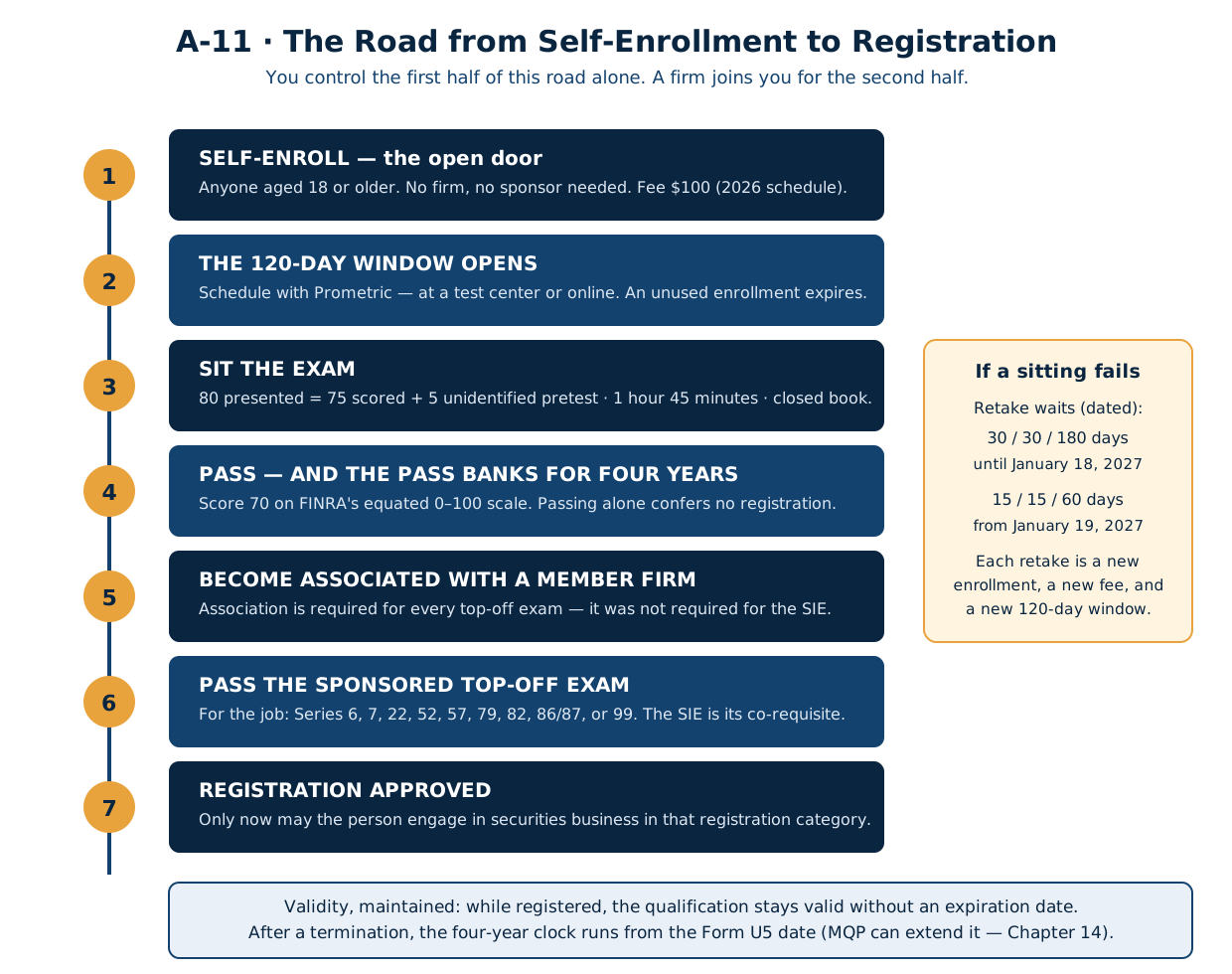 Figure A-11 — The candidacy timeline. The candidacy arc first drawn in Chapter 1 — self-enrollment, the 120-day window, the sitting, the four-year bank, association, the sponsored top-off, and registration — is the calendar this chapter works, step by step, in Sections 14.1 through 14.6.
The word securities is the industry's collective name for investment instruments — stocks, bonds, options, shares of investment funds, and the other products this book will teach one family at a time. A security is, in plain terms, a tradable piece of a financial claim: a share of ownership in a company, a loan to a company or a government that can be bought and sold, or a contract whose value depends on something else's price. People who buy and sell securities for customers, and firms that arrange those transactions, work under a dense set of rules. Those rules exist for a simple reason a beginner should keep in view through the whole book: customers hand this industry their savings, and the rules are how the industry is made answerable for what it does with them.
The Securities Industry Essentials Examination, universally shortened to the SIE, is an introductory examination administered by FINRA — the Financial Industry Regulatory Authority. FINRA is the self-regulatory organization that, under the oversight of the U.S. Securities and Exchange Commission (the SEC), writes and enforces rules for broker-dealer firms and their associated persons and administers the qualification examinations those persons must pass. Chapter 2 will take FINRA, the SEC, and every other regulator apart slowly. For this chapter, hold one sentence: FINRA runs this exam, and FINRA publishes the facts about it that this chapter teaches.
FINRA describes the SIE, in its own framing, as an introductory-level exam for prospective securities industry professionals. It assesses a candidate's knowledge of basic securities industry information: the types of products and their risks; the structure of the securities industry markets; regulatory agencies and their functions; and prohibited practices. Read that list again, because it is the whole book in miniature. Products and their risks. Markets and how they are structured. Regulators and what they do. Practices that are prohibited. A candidate who can talk accurately about those four things, at the basic level this exam sets, is the candidate the SIE was designed to certify as ready for the next step — and the careful wording of that last phrase matters, as Section 1.6 will show.
The exam was introduced on October 1, 2018, as part of a restructuring of FINRA's qualification program. Before that restructuring, a person generally encountered industry-knowledge testing only after a firm had hired and sponsored them, inside the specific representative exam for their job. The restructuring separated the common core — the knowledge every representative path shares — into its own stand-alone exam, the SIE, and left the job-specific remainder as a smaller companion exam for each registration, universally called a top-off exam. That design decision is the reason this book exists in the form it does, and the reason the SIE's eligibility rules, taught in Section 1.3, look so different from every other exam in the family.
FINRA's content outline — the official document that lists what the exam may test, cited throughout this book as the outline — says something about its own level that every candidate should understand before studying. Much of the content, the outline explains, is based on common securities industry knowledge and general concepts: for example, the basic characteristics of investment products, such as the relationship between the price and yield of a bond, or the rights of a common stockholder. Some knowledge, by contrast, is based on specific rules and regulations: for example, the reporting requirements for a Suspicious Activity Report, or the filing requirements that attach to Form U4, the industry's registration application form.
This book teaches to exactly that level, and calls it essentials depth. Essentials depth does not mean superficial. It means the book spends its pages on what an introductory candidate is actually asked: recognizing products and telling them apart reliably, understanding how markets and accounts work, knowing which regulator does what, identifying prohibited conduct, and performing the small set of basic calculations the outline names. It also means the book does not spend its pages pretending the SIE asks what it does not. The job-specific representative exams go deeper — into suitability practice with real customers, into margin computation, into municipal bond analysis — because their outlines assign that depth. Those subjects appear in this book only at the level the SIE outline assigns them, and Chapter 1 will not be the last place that boundary is stated. A book that trained you far past this exam in some places would leave you undertrained for it in others, because study time is finite and the exam's own proportions, given in Section 1.2, are not negotiable.
This book is also written for two readers at once, and it is worth naming both now. The first is the candidate: a person with a test date, or a test window, working toward a passing score. The second is the complete beginner: a person who wants to understand the securities industry itself — what a stockholder owns, what a bond is, who watches the markets — whether or not an exam date is yet in view. The chapters serve the beginner first and the candidate throughout: every subject is taught from zero, in plain language, and then connected to how the exam tests it. If you are already industry-experienced, skim the plain-language openings and live in the worked examples, the tables, and the quizzes. If you are new, read in order. The foundations in Chapters 1 through 3 are load-bearing for everything after them.
Examinations attract folklore. Candidates repeat numbers they heard from a coworker, read on a forum, or found in a book printed for an earlier version of the rules. For this exam, folklore is a real hazard, because FINRA has changed several of its published facts in recent years — Section 1.9 is devoted to that turnover. The defense is simple and this book applies it everywhere: learn the sitting in the form FINRA currently publishes it, with each fact dated or sourced, and treat any conflicting number you meet elsewhere as a claim to check, not a fact to absorb.
Here is the sitting, whole, in its current published form.
Items. The exam consists of 75 scored multiple-choice items, each with four answer choices. In addition, each candidate's exam includes 5 additional, unidentified pretest items that do not contribute to the candidate's score. The pretest items are randomly distributed throughout the exam. The total a candidate actually answers is therefore 80 items presented: 75 scored plus 5 pretest. A pretest item is a question FINRA is trying out for possible future use; it is being evaluated itself, which is why it is unscored, and it is unidentified, which means you cannot tell it from a scored item while you are sitting. The only sound strategy follows directly: answer every item as if it counts, because from your chair, any of them might.
Time. Candidates are allowed 1 hour and 45 minutes to complete the SIE exam. Your appointment includes an additional 30 minutes beyond the examination time for a tutorial before the exam and a post-exam survey after it — so the appointment on your calendar is longer than the clock that governs your answers. The tutorial is provided before the exam begins and shows you how the computer-based test works; it is not part of your 1 hour and 45 minutes of answering time, and using it fully costs you nothing on the exam clock.
Passing score. FINRA publishes the passing score as 70, on a scale of 0 to 100. Section 1.8 explains the word that must always travel with that number — equated — and why this book never converts it into a count of items you must answer correctly. For now, fix the published form: the passing score is 70, the scale runs from 0 to 100, and the score you receive is placed on that common scale by the statistical process Section 1.8 describes.
Fee. The examination fee is $100 per enrollment — per attempt — under FINRA's published fee schedule for 2026, a schedule that holds the SIE fee at $100 through 2029. Enrollment and what the fee does and does not cover are taught in Section 1.4. Any other fee figure you have seen for this exam belongs to an earlier schedule; Section 1.9 names those figures and their dates so you can place them when you meet them. FINRA's Qualification Exams index prints the same row — 1 hour 45 minutes, 75 questions, $100 — in its published exam table.
Book and guessing rules. The exam is closed book: candidates are not permitted to bring reference materials to the testing session. And there is no penalty for guessing: an unanswered item can never help you, while a guessed item sometimes can, so FINRA's own counsel in the outline is that candidates should attempt to answer all items. That counsel will shape this book's pacing plan in Chapter 14 — an SIE answer sheet should never be handed in with blanks on it.
Delivery. The exam is administered by computer through Prometric, FINRA's test-delivery vendor. A candidate may test at a Prometric test center or online; both are published options for this exam. FINRA publishes immediate notice of pass or fail status, and a candidate who fails receives performance feedback — Chapter 14 teaches how to use that feedback, and the waiting periods that then apply, with their dates.
Content proportions. FINRA publishes not only the exam's four sections but each section's share of the 75 scored items, as both a percentage and an item count. Learn this table; the whole architecture of this book — its chapter space, its quizzes, and its two full practice forms — is built on it.
| Section (FINRA's published name) | Share | Scored items |
|---|---|---|
| 1. Knowledge of Capital Markets | 16% | 12 |
| 2. Understanding Products and Their Risks | 44% | 33 |
| 3. Understanding Trading, Customer Accounts and Prohibited Activities | 31% | 23 |
| 4. Overview of Regulatory Framework | 9% | 7 |
| Total | 100% | 75 |
Read the proportions as a study instruction. Nearly half of your scored exam — 33 of 75 items — is products and their risks. That is why Part II of this book, Chapters 4 through 8, is its largest part. Trading, customer accounts, and prohibited activities supply almost a third more. Capital markets knowledge — regulators, market structure, the economy, offerings — supplies about one item in six. The regulatory framework supplies about one item in eleven, which does not make it optional: seven items is a large margin in an exam scored to a published standard of 70, and its material — registration, conduct, reportable events — is also the material a new industry entrant most needs to have right in real life. No section is small enough to skip, and the table tells you exactly how not-small each one is.
One more structural fact belongs here. The outline organizes its four sections into 11 numbered subsections: Section 1 has four (1.1 through 1.4), Section 2 has two (2.1 and 2.2), Section 3 has three (3.1 through 3.3), and Section 4 has two (4.1 and 4.2). This book's appendix crosswalk maps every subsection to the chapters that teach it, and every quiz item in this book is tagged to a section and subsection, so that your practice results always tell you which part of FINRA's map needs work — never just a bare total.
Most professional qualification exams are doors that open from the inside: an employer hires you, sponsors you, and only then may you sit. The SIE was deliberately built the other way around, and understanding that design is understanding the exam itself.
The SIE is open to anyone aged 18 or older. FINRA's own words name the intended population directly: the exam is open to anyone 18 or older, including students and prospective candidates interested in demonstrating basic industry knowledge to prospective employers. Association with a firm is not required to take the SIE. Sit with each half of that, because candidates routinely disbelieve one or the other.
You do not need a job in the industry. You do not need an offer, an internship, a sponsoring firm, or a firm's permission. You do not need to be a finance major, or a college student at all. A high-school graduate who has just turned 18, a mid-career worker considering a change, a college sophomore banking a credential before recruiting season, and a formerly registered person returning without SIE credit all stand in the same published position: eligible to enroll themselves, on their own timetable, today. United States citizenship is likewise not required to take the SIE — another point FINRA states expressly in its candidate questions and answers, and another frequent piece of folklore corrected.
Enrollment does require identifying information that must be given accurately — FINRA's enrollment process requires a Social Security number or, if the candidate has none, the substitute identifier FINRA's published guidance names — and the information you enroll with must match the information later filed for you if you go on to register, or your results may not carry into your industry record properly. Chapter 14 returns to the enrollment mechanics as test-day preparation. The teaching point for Chapter 1 is narrower: the accuracy requirement is an administrative requirement, not an eligibility barrier. Nothing in it asks who employs you.
Why did FINRA build an exam this way? The outline and the exam page together give the answer, and it is worth learning in FINRA's own terms because the exam's benefits, as FINRA names them, are all consequences of the open door. A student can distinguish themselves for internships or jobs by arriving with industry knowledge already demonstrated. A career-changer can jumpstart career goals and test their own aptitude for the material before asking an employer to invest in them. A passer gains increased marketability — a verified, standardized signal that an employer does not have to take on faith, because FINRA administered it. And every candidate, pass or fail, receives an immediate result, with performance feedback on a failure. Notice what kind of benefits these are: they are signaling and sequencing benefits. The SIE lets a candidate move the knowledge half of qualification forward in time, before the employment half exists. That is the exam's reason to exist, and it is why this book's first reader — addressed throughout — is so often a person studying before they have an employer, on a clock they set themselves.
FINRA also names, on the same exam page, a practical route worth knowing exists: veterans who qualify for the GI Bill may be able to receive reimbursement for the cost of taking the SIE, through the Department of Veterans Affairs route the page links to. This book states the existence of that route and nothing more — eligibility for a federal benefit is the VA's determination, not a prep book's promise, and no reader should plan around reimbursement this book has not verified for them.
Each person below asks: may I enroll for the SIE? Work each answer from the published rule, not from intuition about how licensing usually works.
If any of those answers surprised you, the surprise is the lesson: intuitions imported from other licensing systems — sponsorship first, citizenship assumed, students excluded — are exactly the misconceptions the SIE's design rejects, and exactly the kind the exam's own candidacy items test.
An eligible candidate becomes a scheduled candidate by enrolling. FINRA publishes two enrollment routes, and a complete beginner should be able to tell them apart, because which route you are on determines whose clock and whose paperwork you are watching.
The self-enrollment route is the route this book's typical reader takes. In FINRA's published sequence, the candidate (1) creates an account, (2) enrolls for the SIE, paying the $100 fee by credit card or ACH, or redeeming a voucher, and (3) schedules the exam, choosing to test at a Prometric test center or online. FINRA's name for the system through which individuals submit enrollment requests is TESS — the Test Enrollment Services System. You will meet the acronym in FINRA's own materials; Chapter 1 is the place to fix what it stands for and whose route it is: the individual's.
The firm route exists because firms routinely enroll their own associated persons. An organization with access to the industry's Central Registration Depository — CRD, the system that holds registration records — may request enrollment through a Form U4 filing in CRD on the individual's behalf, through a direct enrollment upload, or through vouchers. Form U4, the Uniform Application for Securities Industry Registration or Transfer, will recur throughout this book: it is the application form through which a person applies for registration once a firm is in the picture (Chapter 13 teaches it as an artifact). Here its role is narrower: one of the doors through which an enrollment can be created.
Whichever route creates it, a processed enrollment establishes a 120-day testing window. The window generally begins on the next calendar day after the enrollment is processed — or, where a waiting period applies to a retaker, after that waiting period — and the candidate may schedule an appointment with Prometric at any time during the window. Three consequences follow, and each is testable in both senses of the word.
First, the window is a deadline, not a suggestion. If an individual does not take the examination during the 120-day period, the enrollment expires, and the individual must re-enroll to take the examination — a new enrollment, with the fee paid again. A candidate who enrolls in a burst of motivation and then lets four months of life intervene has not banked anything except a lesson. Chapter 14's study plans are therefore built backward from windows: the standard six-week plan exists precisely so that a self-directed reader can enroll with a plan already in motion rather than enroll and improvise.
Second, each attempt is its own enrollment. There is no discounted retake tier in FINRA's published schedule for this exam. A retake is a new enrollment, inside a new 120-day window, at the full $100 fee, after any waiting period that applies — the dated waiting-period regimes are Chapter 14's subject, stated there with their effective dates, and Chapter 1 deliberately does not print them undated, because an undated waiting period for this exam is a wrong waiting period for someone.
Third, the fee buys the enrollment, not the outcome. The $100 is FINRA's examination fee per enrollment. This book prints no other candidacy dollar figure as a fact about the path — not firm charges, not state fees, not course prices — because FINRA's published schedule is the record this book stands on, and the schedule's SIE row is the one number a candidate needs from Chapter 1. When Chapter 1 does name other exams' fees, in the path discussion that follows, it names them as FINRA's published rows for those exams, never summed into a supposed total cost of becoming licensed. No such total exists in any primary this book relies on, and any source that offers you one has assembled it from pieces it has not shown you.
The single most useful technical word in this chapter is co-requisite: an examination requirement that must be satisfied alongside another, as a companion condition. Learn the architecture in both directions, because candidates confuse the directions constantly.
In the first direction, the SIE itself has no co-requisite. FINRA's published co-requisites table gives the SIE's row in one word: None. There is no second exam you must pass before, with, or after the SIE in order for the SIE itself to count as passed. You enroll, you sit, you pass, and the pass is banked — Section 1.7 teaches for how long. No companion stands in your way in this direction.
In the second direction, the SIE is the co-requisite for nearly every representative registration. The same published table names the SIE as the required companion to the representative-level qualification exams: Series 6 (Investment Company Representative), Series 7 (General Securities Representative), Series 22 (Direct Participation Programs Representative), Series 52 (Municipal Securities Representative), Series 57 (Securities Trader), Series 79 (Investment Banking Representative), Series 82 (Private Securities Offerings Representative), Series 86 and 87 (Research Analyst, a two-part examination), and Series 99 (Operations Professional) — with principal-level combinations built on those representative exams carrying the SIE with them as well. Each of those exams is a top-off: it tops off the common core the SIE certifies with the knowledge specific to one registration's work. The SIE page's own "after you pass" list names the same family from the candidate's side: the next step is becoming associated with a FINRA member firm and taking one of the qualification exams appropriate to the business you will do.
Now the asymmetry that gives this chapter its shape. Every top-off exam requires what the SIE does not: association with a member firm. An individual must be associated with a member firm to take a qualification exam. The SIE's open door and the top-offs' sponsored door are two halves of one deliberate design: the common core can be banked by anyone, anywhere, on their own timetable; the job-specific half is taken from inside a job, sponsored by the firm that will stand behind the registration. A candidate may pass the two halves in either order — an associated candidate may even take the SIE and a qualification exam on the same day, in separate sessions — and the order in which the passes are earned does not matter, provided both are passed and the registration that follows is approved. If such a candidate passed the top-off and failed the SIE on the same day, the top-off result still counts; what remains is to pass the SIE. The architecture is patient about sequence. It is not patient, as the next section shows, about what a half-finished architecture confers.
Hold the picture whole, because Chapter 14 will ask you to plan with it. Think of registration as a bridge with two spans. The SIE is the first span, and unusually, you are allowed to build it before anyone has promised to meet you on the other side. The top-off is the second span, and it can only be built from the far shore — from inside a firm. A bridge with one span is a real structure, and it has real value: it shortens everything that comes after, and everyone can see it from the road. But no traffic crosses on one span, and the next section states what that means in the rules' own terms.
Everything in Section 1.3 is true, and this section is equally true, and a candidate who holds only the first has understood the exam dangerously wrong. This book therefore teaches the limit with the same prominence as the openness, here and everywhere the exam is described — in the front matter, in Chapter 14, and in any summary of what this book prepares you for.
Passing the SIE alone does not qualify an individual for registration with a FINRA member firm, or to engage in securities business. That is FINRA's sentence, and it is the most important sentence in this chapter. Its consequences unpack one at a time.
The SIE has no registration category. Registration categories — General Securities Representative, Investment Company Representative, and the rest — attach to the top-off exams and the registrations they support. There is no category a person holds by virtue of the SIE, and therefore no title it confers. The phrases "SIE license" and "licensed by the SIE" describe nothing that exists; where this book uses them at all, it is inside a correction of the error, never as a description of a reader or a passer.
A passer does not appear in BrokerCheck on the strength of the SIE. BrokerCheck is FINRA's public lookup for registered persons and firms, and a passer searching for their own name after a successful sitting will not find an entry created by the SIE alone — FINRA states this expressly, and stating it here saves real candidates a real moment of panic.
No representative functions may be performed on an SIE pass. Soliciting business, recommending securities, accepting orders, handling customer funds or securities — the functions of a registered person — may not be performed until a registration has actually been approved, with all regulators and state commissions whose approval the role requires. The sequence is unforgiving and worth memorizing as a sequence: pass the SIE, become associated with a firm, pass the appropriate top-off, and have the registration approved — only then do the functions open. A passer who begins acting registered on the strength of enthusiasm and an SIE score has not gotten a head start; they have committed exactly the kind of unregistered-activity violation Chapter 12 teaches, and firms treat it accordingly.
There is also a state layer, and Chapter 1 names it exactly once. Most states additionally require the NASAA Series 63 — a separate, state-law examination — for agents who will act in those states. That is a different exam, under a different authority, testing state law; it is outside this book's content, and it is named here for one reason only: so that no reader mistakes an SIE pass, or even the eventual federal registration, for the whole credential path. Where a state requirement applies, it applies in addition, and the firm that sponsors a registration is the authority on which state pieces its people need. FINRA's Qualification Exam FAQ states the state layer in the same terms.
Why insist on the limit at this length in an introductory chapter? Because the open door is genuinely good news, and good news is the kind that gets oversold — by prep sellers, by social media, and by a candidate's own hopes. The accurate statement is strong enough without overselling: the SIE is a bankable, standardized, employer-legible demonstration of industry knowledge, earned on your own timetable, that completes the common-core half of nearly every representative registration and remains valid for the period the next section teaches. That is a real asset. It is not a license, and a book that let you believe otherwise would be setting you up to misrepresent yourself to the first employer you showed it to — the opposite of the marketability FINRA names as the exam's benefit.
A pass that waited indefinitely would need no planning. An SIE pass does not wait indefinitely, and the clock is the last load-bearing fact of the candidacy frame.
An SIE pass must be converted into an approved registration within four years, or the exam's validity expires. FINRA publishes the result of passing as valid for four years; its exam-validity rules state the mechanic precisely: after passing, the individual must obtain approved status in a corresponding registration category within four years of the exam date to maintain validity. Four years is generous — it is plainly designed for the student who passes as a sophomore and registers after graduation, with room to spare — but it is a clock, not a shelf with no back wall. A pass banked and then left while a candidate spends five years in another field is a pass that must be earned again.
Two companion rules, stated here at orientation depth and worked fully in Chapter 14, complete the picture. While a person is registered, validity continues — the SIE credit does not expire out from under a working registered person; it remains valid without an expiration date for as long as the registration it supports is maintained. After a registration is terminated — recorded on Form U5, the termination form Chapter 13 teaches — the same four-year clock runs from the termination date. And FINRA's Maintaining Qualifications Program, the MQP, can extend a terminated qualification's validity for eligible enrollees, up to five years beyond the termination date. Treat those three sentences as the map legend; Chapter 14 is the map, with dated worked examples, including the continuing-education condition that can start a validity countdown for a person who lets required education lapse.
The planning consequence belongs in Chapter 1, because it affects readers who have not enrolled yet. The four-year bank rewards sequencing, not just earliness. A candidate who passes at 18 with no industry contact and no plan may spend the asset before it buys anything. A candidate who passes in the year or two before they will realistically seek association spends the same effort for an asset that is fresh at exactly the moment an employer values it. Neither candidate is more virtuous; one of them read the clock first. You are now a candidate who has read the clock first.
Figure A-11 draws this chapter's whole arc as one line: self-enroll (anyone 18 or older; fee $100 on the 2026 schedule) → the 120-day window opens → sit the exam (80 presented = 75 scored + 5 pretest; 1 hour 45 minutes; closed book) → pass, and the pass banks for four years (score 70 on FINRA's equated 0–100 scale; passing alone confers no registration) → become associated with a member firm → pass the sponsored top-off exam → registration approved. Keep the line in view: every later chapter hangs on one of its steps, and Chapter 14 works each step against real dates.
Return to the published passing score — 70 on a scale of 0 to 100 — and add the discipline that makes it intelligible.
FINRA places all candidate test scores on a common scale using a statistical adjustment process known as equating. Equating exists because no two candidates receive identical sets of items: different sittings draw different questions, and different sets of questions differ slightly in difficulty. Statistical adjustments account for those slight variations, so that every candidate is held to the same passing standard regardless of which set of exam items they received. Your reported score is therefore a scaled score — your performance, expressed on the common 0-to-100 scale against the common standard — not a raw percentage of the particular items that happened to be in front of you.
Two rules for your own talk about scores follow, and this book obeys both everywhere, including in its practice materials.
First, never convert the passing score into a raw item count. The conversion that circulates — multiplying 70% by 75 items and announcing that a candidate needs a particular number correct — treats an equated scale as if it were a raw percentage of one fixed item set. It is not, and the number it produces is not a FINRA fact; it is arithmetic performed on a misunderstanding. This book does not print it as a passing rule, does not grade its practice forms by it, and asks you not to carry it into the testing center. What FINRA publishes is the standard: 70 on the equated scale. Your preparation target is correspondingly honest — command of the outline's material across all four sections, with practice performance reported, in Chapter 14's and the answer sections' terms, as a count on a particular practice form compared with the published standard as guidance, never as a conversion or a prediction.
Second, no pass rate for this exam is published in the FINRA sources this book relies on, and none will be quoted to you. Figures of that kind circulate on the prep shelf without a primary behind them. A pass rate you cannot trace to the exam body's own publication is not information; it is atmosphere — it can frighten you or flatter you, and it cannot do either honestly. This book makes no pass guarantee, offers no probability, and reports no rate. What it offers instead is coverage: every subsection of the outline taught, 580 practice items written to the outline at the published shape, and a study architecture that shows you, section by section, where your own performance stands. That is the part of the outcome that is yours to control, and it is the only part any honest book can sell you.
The SIE has run since 2018, and FINRA has changed the ground under it several times since 2024. Each change left the previous fact standing in thousands of printed books, saved PDFs, forum posts, and course recordings, where it still circulates as if current. A candidate who studied first from older material will very likely meet the superseded forms before meeting this book. This section names each turnover once, with dates, so that when you meet the old form you recognize it as an old form. Chapter 14 revisits this table at the point where its facts become planning decisions.
The habit this section is really teaching outlasts each individual fact: date every load-bearing number you are handed, and check the ones you will act on against the exam body's current publication. Fees change on schedules. Counts change with outline editions. Cycles change by rule amendment. The candidate who learns the current form and knows it is current — and knows what it replaced — is immune to the most common way honest students are misled: by a book that was right when it was printed.
Figure A-11's timeline prints only the current forms — the $100 fee, the 80-item presentation, the equated 70 — which is what makes it a fair summary of this section: a timeline drawn from older material would carry the superseded figures onto the page.
Section 1.8 refused one kind of arithmetic — converting scores. This section performs the other kind, the calendar, pacing, and fee arithmetic the outline's frame genuinely supports. In this book, items and examples whose key is a computed quantity are called designated exercises; Chapter 1's belong to the settlement, calendar, and candidacy family, and each one supplies every value it needs in its own statement. Work each example before reading its solution.
The exam presents 80 items in 1 hour and 45 minutes. A candidate wants two checkpoints: how many minutes per item, on average, and how many items should be complete at the halfway point of the clock if pace is even?
Convert the time: 1 hour 45 minutes is 105 minutes. Average time per presented item: 105 ÷ 80 = 1.3125 minutes — about 1 minute 19 seconds per item. At an even pace, half the clock (52.5 minutes) corresponds to half the items: 40 items complete at the halfway checkpoint, with 40 remaining. The pretest items do not change the arithmetic — you cannot identify them, so the plan must budget for all 80 — and the no-penalty-for-guessing rule sets the endgame: the final minutes belong to returning to marked items and ensuring nothing is blank, never to leaving an item unanswered in hopes of a better one later. Chapter 14 builds the full pacing plan on this skeleton; the skeleton itself — 105 minutes, 80 items, checkpoints at quarters — is worth fixing now.
(a) An enrollment is processed on Monday, March 2, of a non-leap year, and no waiting period applies. The 120-day window begins the next calendar day. On what date does the window's 120th day fall? (b) The candidate passes on April 18 of the same year. By what date must an approved registration be obtained for the pass to remain valid?
(a) The window begins March 3 as day 1. Count forward: March contributes 29 window days (March 3–31), bringing the count to 29; April adds 30, to 59; May adds 31, to 90; June adds 30, to 120. The 120th day is June 30. An appointment must fall on or before that date; an unused enrollment expires after it. (b) Validity runs four years from the exam date: the pass of April 18 must be converted into an approved registration within four years of that April 18 — by the corresponding date four years later. Both computations use only published quantities — 120 days, four years — and dates stated in the example. That is the shape of every candidacy computation in this book.
A candidate enrolls, lets the window expire unused, re-enrolls, sits, fails, waits out the applicable waiting period, and enrolls a third time. Using only the published per-enrollment fee, what has the candidate paid FINRA in examination fees?
Each enrollment is a separate enrollment at $100: the expired enrollment, the failed attempt, and the retake enrollment are three enrollments. 3 × $100 = $300. Notice what the computation does not do: it does not add travel, materials, state charges, or any other figure, because none of those is a published FINRA examination fee, and this book's fee arithmetic runs on the register-cleared amount only. The example's real teaching point is the first one: the expired window was the most expensive item in the story — $100 spent on nothing but elapsed time — and it was entirely avoidable by enrolling with a study plan already running.
The next chapter opens the first content section of the outline: the regulators, agencies, and market participants who populate the industry this exam certifies knowledge of. Chapter 1 gave you FINRA in one paragraph. Chapter 2 gives you the whole map.
20 items. Four choices each. Answers and full rationales are in the separate key file (the Chapter 1 answer key). Tags in the key record the outline section for every item; items whose key is computed are designated by family.
Q1. How many items does an SIE candidate actually answer in the sitting, and how are they composed? A. 80 items: 75 scored and 5 unidentified pretest items B. 75 items, all scored C. 75 items: 70 scored and 5 unidentified pretest items D. 80 items, all scored, of which the best 75 count
Q2. What is the published examination time for the SIE, separate from the tutorial and survey? A. 1 hour B. 1 hour and 45 minutes C. 1 hour and 30 minutes D. 2 hours and 15 minutes
Q3. FINRA publishes the SIE passing score as: A. 70 on an equated scale of 0 to 100 B. A stated number of items correct out of 75 C. The same standard published for the General Securities Representative Examination D. A percentile rank against other candidates in the same month
Q4. Under FINRA's published schedule for 2026, the SIE examination fee per enrollment is: A. The amount charged at the exam's 2018 launch B. The amount charged during 2024 and 2025 C. Waived for students who self-enroll D. $100
Q5. Which statement about eligibility to take the SIE is correct? A. A candidate must be associated with a member firm before enrolling B. A candidate must be sponsored by a member firm but need not be employed by it C. Only students and current industry employees may take the SIE D. Anyone aged 18 or older may take the SIE, and association with a firm is not required
Q6. A 20-year-old who is not a U.S. citizen wishes to take the SIE. Under the published frame: A. Citizenship is required, so the candidate is ineligible B. The candidate may take the SIE only through a firm's sponsorship C. The candidate must first pass a state-law examination D. Citizenship is not required, so the candidate may take the SIE if otherwise eligible
Q7. In FINRA's co-requisites table, the co-requisite listed for the SIE itself is: A. Series 7 B. Series 63 C. None D. Any one representative-level exam chosen by the candidate
Q8. Which examination is a top-off for which the SIE serves as co-requisite? A. The SIE itself B. A state-law examination administered by NASAA C. No examination; the SIE is a complete qualification by itself D. The General Securities Representative Examination (Series 7)
Q9. What distinguishes the enrollment condition for a top-off exam from that for the SIE? A. Top-off exams may be taken only online B. Top-off exams require association with a member firm; the SIE does not C. Top-off exams have no testing window D. Top-off exams require U.S. citizenship; the SIE does not
Q10. A candidate passes the SIE and immediately begins recommending securities to customers of a firm that has offered her a job, before any registration is approved. Which statement is correct? A. This is permitted because she has passed a FINRA exam B. Passing the SIE alone does not qualify her for registration or to engage in securities business, so the activity is not permitted on that basis C. This is permitted if the firm supervises her recommendations D. This is permitted for 120 days after passing
Q11. After passing the SIE alone, a candidate searches BrokerCheck for his name. Consistent with FINRA's published frame, he should expect: A. An entry in a registration category created by the SIE B. No BrokerCheck entry created by the SIE alone, because the SIE has no registration category C. An entry marked "SIE licensed" D. An entry that expires after 120 days
Q12. A processed SIE enrollment establishes a testing window of: A. 30 days B. 90 days C. Four years D. 120 days
Q13. A candidate enrolls for the SIE but does not take the exam during the testing window. What happens under the published frame? A. The window extends automatically for another 120 days B. The enrollment expires and the individual must re-enroll to take the examination C. The fee is converted into a voucher for a top-off exam D. The candidate is treated as having failed the exam
Q14. The self-enrollment route for the SIE runs through FINRA's system known as: A. CRD, by Form U4 only B. BrokerCheck C. TESS, the Test Enrollment Services System D. Prometric's proprietary enrollment system, with no FINRA account
Q15. The SIE is delivered at a test center or online by FINRA's test-delivery vendor, which is: A. Prometric B. FINRA itself, through CRD C. The SEC D. NASAA
Q16. Regarding guessing on the SIE, the outline's counsel follows from which rule? A. Wrong answers are penalized more than blanks, so blanks are safer B. Pretest items are identified, so guesses should be saved for them C. There is no penalty for guessing, so candidates should attempt to answer all items D. Guessing is permitted only in the final 30 minutes
Q17. [Designated — CALC-05] The exam presents 80 items in 105 minutes. At an even pace, how many items should a candidate have completed when 52.5 minutes have elapsed? A. 35 items B. 45 items C. 40 items D. 52 items
Q18. [Designated — CALC-05] A candidate pays the published per-enrollment fee for an initial enrollment, allows it to expire unused, re-enrolls and sits once, and later enrolls once more for a retake. At $100 per enrollment, total examination fees paid are: A. $300 B. $100 C. $200 D. $400
Q19. [Designated — CALC-05] A candidate passes the SIE on June 10, 2026, and obtains no registration. By which date must an approved registration be obtained for the pass to remain valid, under the published four-year validity rule? A. June 10, 2027 B. June 10, 2028 C. June 10, 2030 D. June 10, 2029
Q20. Which statement about the exam's four sections is correct as FINRA publishes them? A. Understanding Products and Their Risks carries 33 of the 75 scored items, the largest share B. Products and their risks is the smallest section C. All four sections carry equal item counts D. Knowledge of Capital Markets carries 33 of the 75 scored items
Scoring note: counts on this quiz are practice counts only. FINRA publishes the SIE passing score as 70 on an equated 0–100 scale; no count on this chapter quiz converts into a predicted examination result.
Q1. A — §1 (exam structure). The sitting presents 80 items: 75 scored plus 5 additional, unidentified pretest items that do not contribute to the score, randomly distributed.
Sources: FINRA SIE Content Outline © 2025 (S-01); FINRA's SIE exam page (S-02); the Fee Adjustment Schedule (S-03); Regulatory Notice 26-18 (S-05); the Exam Credit and Validity page (S-06); the SIE FAQ (S-07); the Co-requisites table (S-09).
Q2. B — §1 (exam structure). Candidates are allowed 1 hour and 45 minutes; the appointment adds 30 minutes for the tutorial and post-exam survey, which are not examination time.
Q3. A — §1 (scoring). FINRA publishes the passing score as 70 on a scale of 0 to 100, with scores equated onto a common scale.
Q4. D — §1 (fee). The published fee for 2026 is $100 per enrollment, held at $100 through 2029 in FINRA's schedule.
Q5. D — §1 (eligibility). The SIE is open to anyone aged 18 or older, including students and prospective candidates; association with a firm is not required.
Q6. D — §1 (eligibility). U.S. citizenship is not required to take the SIE.
Q7. C — §1 (co-requisites). FINRA's co-requisites table lists the SIE's own co-requisite as None.
Q8. D — §1 (co-requisites). The Series 7, General Securities Representative Examination, is one of the representative exams for which the SIE is the required co-requisite (with Series 6, 22, 52, 57, 79, 82, 86/87, and 99).
Q9. B — §1 (co-requisites). An individual must be associated with a member firm to take a qualification (top-off) exam; no association is required for the SIE.
Q10. B — §1 (registration limit). Passing the SIE alone does not qualify an individual for registration or to engage in securities business; representative functions require an approved registration (SIE plus top-off plus firm association).
Q11. B — §1 (registration limit). The SIE does not have a registration category, and a passer does not appear in BrokerCheck on the strength of the SIE alone.
Q12. D — §1 (enrollment). A processed enrollment establishes a 120-day testing window, beginning the next calendar day (or after any applicable waiting period).
Q13. B — §1 (enrollment). If the individual does not take the examination during the 120-day period, the enrollment expires and the individual must re-enroll.
Q14. C — §1 (enrollment). Individuals submit SIE enrollment requests through TESS, FINRA's Test Enrollment Services System.
Q15. A — §1 (delivery). Prometric is FINRA's test-delivery vendor for the exam, at a test center or online.
Q16. C — §1 (exam rules). There is no penalty for guessing, and candidates should attempt to answer all items — including the unidentified pretest items, which cannot be identified in the sitting.
Q17. C — Designated CALC-05. 105 minutes ÷ 80 items is the average pace; at half the clock (52.5 minutes), an even pace completes half the items: 80 ÷ 2 = 40 items.
Q18. A — Designated CALC-05. Three enrollments (initial, re-enrollment after expiration, retake enrollment) × $100 per enrollment = $300. Each enrollment, including a retake, is a new enrollment at the full published fee.
Q19. C — Designated CALC-05. Validity runs four years from the exam date: June 10, 2026 + 4 years = June 10, 2030 — an approved registration must be obtained within that four-year period.
Q20. A — §1 (section weights). FINRA publishes Understanding Products and Their Risks at 44%, 33 of the 75 scored items — the largest section.
End of the free sample. The complete book continues from here — the full A-to-Z course in book form, delivered as an EPUB you can read in Apple Books, Google Play Books, ReadEra, Thorium Reader, Adobe Digital Editions, or Send to Kindle.
Buy this ebook — $9.99 Back to the book page
Payments are securely processed by Payhip.