
Mastering Careers & Skills
Human Resources Certificate (SHRM-CP) — the Judge-approved exact title (OPF / title page / cover); no divergence. · free sample from the book itself
---
Google Play Books Exam Prep Series
2026–2027 Edition · Built on SHRM's 2026 Certification Handbook and the 2026 SHRM BASK's published structure · Confirm the current window and fees at SHRM before applying.
Built on SHRM's 2026 Certification Handbook and the published structure of the 2026 SHRM Body of Applied Skills and Knowledge (SHRM BASK); law content checked against EEOC, U.S. Department of Labor, OSHA, and NLRB publications on October 31, 2026.
Feras Alzubi
Published October 31, 2026.
Extent: 26 chapters of review prose (203,867 words), the complete practice layer of 886 questions with worked keys, a glossary, four quick-reference cheat sheets, two crosswalk appendices, and references.
Counts in this book. The practice census is exact, and it is this book's own: 886 practice questions — a 48-question diagnostic, a 15-question quiz closing each of the 26 chapters, two full 134-question timed tests, and six 30-question content-area sets. Inside that census, 115 items are designated calculations in four families — FLSA pay arithmetic (25), workforce metrics (39), benefits and total-rewards cost (24), and FTE, eligibility and coverage arithmetic (27) — each one computed from values its question supplies, by a method the chapters teach. Judgment items are counted separately and are never designated calculations.
---
Human Resources Certificate (SHRM-CP) — 2026–2027 Edition
© 2026 Feras Alzubi. All rights reserved.
Google Play Books edition. No ISBN has been assigned to this edition, and no other edition identifier is asserted.
All practice questions, worked examples, scenarios, and figures in this book are original work, written from the published exam structure named below, from the public law and agency publications behind the law chapters, and from scenarios invented for this book. No SHRM examination question, and no item from any SHRM preparation product, is reproduced or paraphrased in this book, and no text of the SHRM BASK — its definitions, key concepts, or proficiency indicators — is reproduced, excerpted, or paraphrased item by item anywhere in this book.
This book prepares you for one credential, in one published version:
- Credential: SHRM Certified Professional (SHRM-CP) — SHRM's certification for HR professionals who engage in HR work at the operational level (SHRM, 2026 SHRM Certification Handbook). - Handbook basis: SHRM, 2026 SHRM Certification Handbook (2026 edition; PDF created May 13, 2026, modified May 21, 2026) — read in full for this book: eligibility, selecting a certification, the testing schedule, the complete fee table, the application and Candidate Agreement apparatus, Exam Composition with its allocation chart and testing-time breakdown, results and score information, retaking, earning the certification, and recertification. - Framework basis: SHRM, 2026 SHRM Body of Applied Skills and Knowledge (SHRM BASK) — used at published-structure depth only: the framework chapters and the complete table of contents, which publish the names of the knowledge domains, functional areas, competency clusters, and competencies this book's crosswalk maps. The BASK's body text was deliberately not mined for this book; see the F-Rule on the Disclosure and Provenance page. - Certification-page basis: SHRM's certification pages as read on October 31, 2026 — Eligibility Criteria — SHRM Certification; Exam Options and Fees — SHRM Certification (including SHRM's published pass rates by window); SHRM Recertification; and the SHRM Certification landing page. - Law basis: the enforcing agencies' own publications, each read on October 31, 2026 — the EEOC's Federal Laws Prohibiting Job Discrimination: Questions and Answers; the U.S. Department of Labor Wage and Hour Division's Fact Sheet #23 (overtime pay), Fact Sheet #28 (the Family and Medical Leave Act), its earnings-thresholds page for the FLSA exemptions, and its FLSA overview page; OSHA's Employer Responsibilities; the NLRB's Frequently Asked Questions; and the Department of Labor Employee Benefits Security Administration's FAQs on COBRA Continuation Health Coverage for Workers. Every one of these is listed, with its URL and what this book takes from it, in the References at the back of the book. - Currency stamp: examination figures, fees, eligibility, and legal thresholds in this edition were checked on October 31, 2026. Figures that rulemaking can change print with their date and their agency named — with one stated exception: the FLSA salary levels are not printed as numbers anywhere in this book; they are taken from the Wage and Hour Division's current earnings-thresholds page at the time of use, as Chapter 17 teaches. Confirm the current testing window and fees on SHRM's site before you apply.
First edition (2026–2027 Edition), published October 31, 2026. No earlier printing of this edition exists.
---
This book is an independent study guide. It is not published by, affiliated with, endorsed by, or approved by the Society for Human Resource Management (SHRM), and SHRM did not participate in its creation. Exam names and trademarks belong to their respective owners. Passing any exam also depends on the candidate's own preparation; no book can guarantee a result.
SHRM, SHRM-CP, SHRM-SCP, and SHRM BASK are marks of the Society for Human Resource Management, used in this book only to identify the exam, the credential, and their published structure. No SHRM artwork and no SHRM document design is reproduced in this book; every figure is an original drawing made for this book.
This book prepares you for the SHRM-CP exam, whose content framework is the SHRM Body of Applied Skills and Knowledge (SHRM BASK) — SHRM's own professional framework, published by SHRM and available from SHRM. This book teaches the human resources field the framework names — its law, its practice, and its judgment — in the book's own words and from public and agency sources. It does not reproduce the BASK's text, definitions, or proficiency indicators, and it is not a substitute for reading SHRM's published exam information.
In practice, that means everything taught here comes from three sources, and from nothing else: the exam structure the handbook itself publishes for candidates (the item counts and types, the timing, the allocation, and the names of the domains, functional areas, clusters, and competencies — names are facts); the underlying HR subject matter itself, from the statutes and the enforcing agencies' own publications and from public sources on HR practice, expounded in this book's own words; and original workplace scenarios written for this book.
Every practice item in this book is original, written for this book from the published exam structure and the subject matter the chapters teach. The real exam's questions are confidential — SHRM's Candidate Agreement makes exam content confidential and bars reconstructing or sharing it — so no legitimate source of real exam questions exists, and none is used here. SHRM's official sample questions inform this book's teaching about the exam's style only; no sample item is reproduced or paraphrased as a practice item.
Candidates for the SHRM-CP certification are not required to hold an HR title and do not need a degree or previous HR experience to apply. A basic working knowledge of HR practices and principles (or a degree from an Academically Aligned program) is recommended. SHRM membership is not required, and you do not need to be employed when you apply. (SHRM, 2026 SHRM Certification Handbook; SHRM, Eligibility Criteria — SHRM Certification.) Earlier editions of SHRM's handbook gated the credential behind a table trading degree level against years of HR experience; the current handbook contains no such table, and Chapter 1 notes that history only so that a reader holding an older preparation book understands why the books disagree. This book never treats that superseded table as a current requirement.
The exam's situational judgment items present a realistic work scenario and several possible actions, and credit only the best possible or most effective course of action, although more than one strategy may be effective (SHRM, 2026 SHRM Certification Handbook). The real exam's judgment items are SHRM's own, built on SHRM's framework. This book prepares for them honestly: every situational judgment item here is keyed from content this book itself teaches — a statute or agency rule with its citation, a practice principle stated in the item's home chapter, or a taught metric or procedure — and every explanation shows that derivation, naming the taught basis and weighing each option against it. No explanation in this book rests on "SHRM prefers" or on an unnamed professional consensus. What transfers to the real sitting is the law, the metrics, the procedures, and the discipline of weighing options against them.
Every examination figure in this book comes from SHRM's published 2026 Certification Handbook or SHRM's certification pages, checked on October 31, 2026. Every legal rule is cited to the statute's enforcing agency. SHRM publishes its exam structure openly for candidates; this book is an independent preparation built on that published structure and on the public law and practice of the HR field — not a SHRM product, and not a reproduction of the SHRM BASK.
Nothing in this book converts the exam's passing standard into a percentage or a raw count, because SHRM publishes no such conversion; nothing in this book states or implies a salary, a job outcome, or a probability that any individual reader will pass. Where SHRM's own published pass rate for a completed testing window is printed, it is printed with SHRM's name and that window attached, as SHRM's statistic and no one else's.
---
The test on one page. Every figure below is footnoted to its source; all figures were checked on October 31, 2026, and fees and windows should be confirmed on SHRM's site before applying.
- Exam: SHRM Certified Professional (SHRM-CP) — one required exam, at the operational level: implementing HR policies, supporting day-to-day HR functions, and serving as an HR point of contact for staff and stakeholders.¹ - Questions: 134 multiple-choice questions — 80 stand-alone knowledge questions and 54 situational judgment items. Of the 134, 24 are unscored field-test items mixed invisibly into the sitting; 110 of the 134 questions are scored (derived from the handbook's two published figures).¹ - Item types: HR-Specific Knowledge items on the knowledge domains (50 percent of the exam); Foundational Knowledge items on the behavioral competency clusters (10 percent); Situational Judgment items (40 percent).¹ - Time: two independently timed sections of up to 110 minutes each — 3 hours 40 minutes of testing inside a 4-hour appointment that also includes a confidentiality reminder, a tutorial, and a survey. Unused time in the first section does not carry over, and a finished section cannot be re-entered.¹ - Passing: results are reported as scaled scores. The range of possible scores is 120 to 200; all candidates who pass the exam receive the maximum score of 200. The passing standard is set using the Modified Angoff method against a predetermined standard, and performance is not compared to other candidates. A score of 200 denotes meeting that standard; it does not mean answering every question correctly. SHRM publishes no percentage standard, no raw-count standard, and no per-area passing minimum, and this book converts the standard into none of those.¹ - Eligibility: no HR title, degree, or previous HR experience is required to apply; a basic working knowledge of HR practices and principles (or a degree from an Academically Aligned program) is recommended. Membership and current employment are not required.¹ ² - Windows: testing is offered twice a year. In the 2026 cycle, the first window's testing ran May 1 – July 15, 2026, and the second window's testing runs December 1, 2026 – February 15, 2027, with application periods — early-bird and standard — ahead of each; confirm the current cycle's dates on SHRM's site.¹ - Fees: early bird $350 for SHRM members / $450 for nonmembers; standard $399 / $499. All rates include a nonrefundable $50 application fee, and standard rates include a $49 standard deadline fee. (Student and military rates are lower and are printed in Chapter 1 from the same table.) Fees are as published in the 2026 handbook; confirm current fees on SHRM's exam-options-and-fees page before applying.¹ - Retakes: an unsuccessful candidate may test again in a future window only — testing for the same exam in the same window is prohibited — by applying as a new candidate and paying the full fee. There is no limit on the number of attempts.¹ - Delivery and results: the exam is delivered by computer in Prometric test centers, scheduled after SHRM issues an Authorization to Test letter. A preliminary pass / did not pass decision is given at the testing center; official results follow in about two to three weeks through the SHRM Certification Portal, with a score-and-feedback report showing standing by competency cluster and knowledge domain.¹ - Keeping the credential: certification runs on a three-year cycle. Holders recertify by earning 60 Professional Development Credits (PDCs) across SHRM's three published categories — Advance Your Education (no maximum), Advance Your Organization (maximum 30), Advance Your Profession (maximum 30) — or by retaking the exam in the cycle's last year.¹ ³ - SHRM's published pass rate: 69 percent of SHRM-CP examinees passed in the May – July 2026 window (SHRM, Exam Options and Fees — Exam Statistics). That is SHRM's global rate for that window: not a first-attempt rate, not a rate for this book's readers, and not a probability for any individual. - Content areas and their published shares: Leadership cluster, 19 percent · Business cluster, 17.5 percent · Interpersonal cluster, 13.5 percent · People domain, 19 percent · Organization domain, 18 percent · Workplace domain, 13 percent.¹
¹ SHRM, 2026 SHRM Certification Handbook — Exam Composition, testing-time breakdown, fee table, eligibility, testing schedule, score information, retaking, and recertification passages. ² SHRM, Eligibility Criteria — SHRM Certification (shrm.org). ³ SHRM, SHRM Recertification (shrm.org) — cycle dates, the grace period, and the recertification processing fees are taught in Chapter 26.
---
SHRM's own eligibility text opens this exam to a wide pool — working HR generalists and assistants, enrolled students, and people pursuing a career in human resource management who have not held an HR job yet. This book is built for all of them, in one arc. It assumes no HR job and no HR coursework at the start, and it ends at the real exam's shape.
Path 1 — From zero. You are a student, a career switcher, or a new hire with no HR background. Start at Chapter 1 and read in order. Part I builds the workplace, the vocabulary, and the employment life cycle before any rule depends on them, and Parts II–IV teach each area of HR work as a station on that life cycle: plan, attract, hire, onboard, pay and protect, develop, engage and retain, separate well. Take the diagnostic when you reach it, but treat its first result as a starting map, not a verdict. Use either study plan below stretched over the reading order it names, and sit your first full timed test only after Part V.
Path 2 — Working generalist. You do HR work now and need the law and the numbers made exact. Take the diagnostic first and let its per-area scores route you: most working readers go straight to the chapters their scores flag — for many, the law chapters in Part IV and the metrics teaching in Chapters 12 and 23 — then read Part V in full, because the exam's judgment half tests practiced judgment, not daily habit. Keep the cheat sheets beside your desk copy; every number on them carries its source.
Path 3 — Booked candidate. Your window is chosen and your test date is set (or about to be). Work the exam layer as a system: diagnostic, targeted chapter repair, the content-area sets for your weakest areas, then both full timed tests sat under the book's timing discipline, with Chapter 25 before the first and Chapter 26 after the second. The study plans below are written for you; the administrative tasks sit in the first week of each, because a missed early-bird period or a late scheduling decision is the one failure no amount of reading repairs.
The review layer is designed as 26 chapters in six parts (designed structure, this book's design):
- Part I — Foundations from Zero (Chapters 1–3): the credential and its honest map; HR from zero and the employment life cycle; the HR workplace — its rooms, files, and systems. - Part II — People Domain (Chapters 4–9): HR Strategy; Talent Acquisition; Employee Engagement and Retention; Learning and Development; Total Rewards in two chapters — pay mechanics, then benefits, leave benefits, and COBRA. - Part III — Organization Domain (Chapters 10–14): Structure of the HR Function; Organizational Effectiveness and Development; Workforce Management; Employee and Labor Relations; Technology Management. - Part IV — Workplace Domain (Chapters 15–20): the three U.S. employment-law chapters (equal employment opportunity; disability, leave, and military service; wages, hours, and the FLSA); Managing a Global Workforce; Risk Management and workplace safety; Corporate Social Responsibility. - Part V — The Competency Clusters in Practice (Chapters 21–24): leadership and ethical practice; inclusive mindset, relationship management, and communication; business acumen, consultation, and analytical aptitude; and the situational judgment method itself. - Part VI — The Exam Layer (Chapters 25–26): reading the exam — its two item types and two timed sections; and exam mastery, retakes, and keeping the credential.
Chapter space and exam weight deliberately diverge in two places, and the book says so rather than hiding it: the Workplace domain carries a smaller share of the exam than its six chapters suggest, because its U.S. Employment Law and Regulations area is where a working generalist's risk concentrates and where this book's legal accuracy is earned; the competency clusters carry half the exam and are served by four chapters plus the judgment practice woven through the whole practice layer. Item counts, by contrast, follow the published allocation.
Every practice item in this book carries a triple address, printed with its explanation:
- A content address — the knowledge domain and functional area, or the competency cluster and competency, in the names SHRM publishes: for example, Workplace / U.S. Employment Law and Regulations, or Leadership / Ethical Practice. The crosswalk appendixes at the back of the book are built from these addresses, so you can verify for yourself that every published area is taught and tested. - A chapter address — the chapter that teaches the item's content, so a missed item routes straight back to its teaching. - An item class — KI (HR-Specific Knowledge item), FKI (Foundational Knowledge item), or JUDG (situational judgment item). Items whose answer must be computed from values the question itself supplies carry a calculation family instead of a plain KI tag: CALC-01 FLSA pay arithmetic · CALC-02 workforce metrics · CALC-03 benefits and total-rewards cost · CALC-04 FTE, eligibility, and coverage arithmetic. Judgment items are never counted as calculations, and calculations are never dressed as judgment: the two skills are tested differently because they fail differently.
Two standing labels keep the book honest about whose guidance is whose. Exam facts and legal figures print with their source named at the point of use — SHRM's handbook, or the enforcing agency. Guidance this book itself invents — the metric formulas, the pacing discipline, the readiness lines, and the study plans below — is labeled this book's guidance at every appearance. The book's inventions never wear SHRM's or an agency's authority, and SHRM's published standard is never dressed as the book's invention.
The diagnostic test is a 48-item sitting of at most 60 minutes (the sitting limit is this book's guidance), proportioned to the published content shares and scored by content area, not only in total. Score it area by area, mark each area on the tracker below, and let the weakest areas set your reading order inside whichever path you are on. Retake nothing to chase a number: the diagnostic's job is routing, and the area sets and full tests do the measuring afterward.
Leadership cluster — [reader entry] — 21–22 (and 24) — [reader entry] — [reader entry]
Business cluster — [reader entry] — 23 (and 24) — [reader entry] — [reader entry]
Interpersonal cluster — [reader entry] — 22 (and 24) — [reader entry] — [reader entry]
People domain — [reader entry] — 4–9 — [reader entry] — [reader entry]
Organization domain — [reader entry] — 10–14 — [reader entry] — [reader entry]
Workplace domain — [reader entry] — 15–20 — [reader entry] — [reader entry]
Progress tracker (reader-kept): for each chapter, record the chapter quiz result beside the chapter number — Chapters 1–26 — and for each full test and area set, the date sat and the per-area results. The tracker is this book's apparatus; SHRM's own feedback report after a real sitting reports standing by cluster and domain at the same grain.
The full practice tests are built at the published shape — 134 items in two timed sections of 110 minutes each, in the handbook's published proportions on both cuts (content and item type) — as this book builds them Print can reproduce the real sitting's counts, proportions, pacing, and both item types, and these tests do exactly that. Print cannot reproduce the test-center room, the no-return lock on a finished section, or the 24 unscored field-test items hidden among the scored ones — so every practice item in this book is scored for you, every test's face says so, and Chapter 25 teaches the remaining gaps as named rehearsals. On the real exam, you cannot identify the field-test items; pace as if every item counts, because 110 of the 134 do.
A practice result is a raw count of this book's items, reported by content area. No practice result converts to a scaled score, and no percentage on this book's items is a passing standard — SHRM publishes none. Treat a full-test result as readiness evidence only when it meets this book's readiness line:
The practice tests state the readiness line on their own faces, in this book's terms: on Practice Test 1 and Practice Test 2 alike, 107 or more of this test's 134 items correct — 80 percent of this book's items — with no content area left near empty, is this book's readiness evidence. (The real exam reports a scaled score against a standard set by the testing program; this book's line governs practice only.)
The book's figures are 20 in number: labeled illustrations of the HR workplace itself — the interview room, the personnel-file system, the generalist's desk, the timekeeping and payroll artifacts, the safety-walk kit, the onboarding and open-enrollment stations, and the training room — at the teaching points where those places are taught, plus diagrams of the field's processes, flows, and timelines. No figure reproduces an agency form, a vendor screen, or any SHRM artwork; documents are drawn as generic labeled artifacts.
The cheat sheets collect only what may safely be carried in one page each: the numbers sheet (only the registered numbers, each with its citation and, where rulemaking can change it, its date), the life-cycle sheet, the law-clocks sheet, and the metrics sheet (the book's formulas, each with one worked miniature). No cheat sheet contains a passing percentage, a BASK definition, or an unregistered threshold.
The back matter carries the glossary (the field's vocabulary, defined in this book's own words), the References, the errata page, and two crosswalk appendixes that map the published framework's names and this book's field knowledge map to the chapters that teach them.
This book teaches from public sources, and it points you back to them. Read SHRM's published BASK itself — it is SHRM's document, available from SHRM, and it is the framework the exam is built on; this book's job is to teach you the field it names, not to stand between you and it. Read the agencies' own guides for the law you will administer at work: the EEOC's, the Department of Labor's, OSHA's, and the NLRB's publications are listed in the References, and they are written for employers and employees, not only for lawyers.
---
Both plans are this book's guidance (a design rule of this book): SHRM publishes the exam's windows, fees, and rules; the pacing below is this book's apparatus. Each plan ends at a full timed test, and each places the administrative tasks — window selection, application inside the early-bird period, the Authorization to Test letter, and scheduling — in its first week, ahead of the reading they protect. Chapter and item counts referenced below are the book's designed structure ; if production amendments change any of them, the plan's sequence — foundations, domains, clusters, exam layer, timed tests — is what to preserve.
For a booked candidate, or a working generalist whose daily work already covers much of Parts II–III. Plan on one chapter block and one practice block a day; protect the two full-test sittings whole.
Week 1 — Administration first, then the field
- Day 1 — Administration and orientation. Choose your testing window; submit the application inside the early-bird period if it is open (fees are lower, and the standard period adds a deadline fee — see the Exam Blueprint page, and confirm current fees at SHRM); note that the Authorization to Test letter follows the application, and schedule with Prometric once it arrives. Then read Chapters 1–2 and take the diagnostic; score it by area and mark the tracker. - Day 2 — Foundations and People I. Chapter 3; Chapters 4–5. Chapter quizzes as you finish each chapter. - Day 3 — People II. Chapters 6–7; review every missed quiz item against its chapter address before moving on. - Day 4 — People III and Organization I. Chapters 8–9 (work every benefits and COBRA calculation by hand — CALC-03 lives here); Chapter 10. - Day 5 — Organization II. Chapters 11–12 (learn the workforce-metric and FTE formulas from the chapters before the items use them — CALC-02 and CALC-04 begin here); Chapter 13. - Day 6 — Organization III and Workplace I. Chapter 14; Chapter 15 (the EEOC charge machine and its clocks); begin Chapter 16. - Day 7 — Weak-area repair, first pass. Finish Chapter 16. Work the content-area sets for your two weakest diagnostic areas; re-read the flagged chapter sections, not the whole chapters.
Week 2 — Law depth, judgment, and the timed tests
- Day 8 — Workplace II. Chapter 17 in full (overtime mechanics and the exemption tests, with the salary-level screen taught as Chapter 17 teaches it — the current level checked on the Wage and Hour Division's page at the time of use, no level printed in the chapter — CALC-01's home); Chapter 18. - Day 9 — Workplace III. Chapters 19–20. Numbers-sheet review: every figure aloud with its source. - Day 10 — Competency clusters I. Chapters 21–22. For every judgment item in the quizzes, say the taught basis out loud before reading the explanation — that derivation habit is the skill Part V is building. - Day 11 — Competency clusters II and the method. Chapter 23 (the metrics discipline in full); Chapter 24 (the situational judgment method, worked slowly). - Day 12 — Exam craft and Full Practice Test 1. Read Chapter 25 in the morning. In one uninterrupted sitting, take Full Practice Test 1 under the two-section timing: 110 minutes, a break, 110 minutes, no returning to the first section. Score by content area the same day. - Day 13 — Repair. Chapter 26's repair method applied to Test 1's profile: the weakest area's set, the flagged sections re-read, the law-clocks and metrics sheets reworked. Confirm your test-day logistics against Chapter 25's checklist (identification, center, timing). - Day 14 — Full Practice Test 2 and closeout. Full Practice Test 2 under the same discipline. Score by area; compare the two tests' profiles rather than their totals. Spend what remains of the day only on the cheat sheets and on any single area both tests flagged. Then stop: the plan ends at the test because the plan's last job is a rested candidate.
For a reader starting from zero, or any reader whose study time comes in ordinary workday pieces. The sequence is the intensive plan unfolded: foundations before domains, domains before clusters, the exam layer last, and a full timed test closing each of the final two weeks.
Week 1 — Administration, foundations, and the diagnostic
- Administration, exactly as in Plan A's Day 1: window chosen, application submitted inside the early-bird period if open, Authorization to Test letter awaited and the Prometric scheduling step noted. Do not let these tasks drift past this week in either plan. - Read Chapters 1–3 (Part I) in order, one chapter per sitting, quiz after each. Take the diagnostic at the week's end; score by area; mark the tracker. From-zero readers: expect the diagnostic to route you back into Part I vocabulary — that is it working, not failing.
Week 2 — The People and Organization domains
- Chapters 4–9 (Part II), in order. Work the Total Rewards calculations by hand as they come (CALC-03 in Chapters 8–9). At the week's midpoint, work the People content-area set and repair against its addresses. - Chapters 10–12 (Part III, first half). Learn the metric and FTE formulas in Chapter 12 from the chapter's own teaching before attempting its items. End the week by routing your quiz results to the tracker: the areas these chapters serve are the ones Week 3's sets will test.
Week 3 — Law, the remaining Organization chapters, and the clusters
- Chapters 13–14 to close Part III, then Part IV in order: Chapters 15–17 across the week's first half (the law core — read these at the week's freshest hours), Chapters 18–20 to close it. Work the Workplace area set and repair by address. - Chapters 21–23 (the competency clusters in practice). Derive every judgment item's key from its taught basis before reading explanations. - Close the week with Full Practice Test 1, sat in one sitting under the two-section timing, scored by content area the same day.
Week 4 — The method, repair, and the final test
- Chapter 24 (the situational judgment method) and Chapter 25 (reading the exam) at the week's start — after a full test, their teaching lands on experience instead of anticipation. - Repair days: Chapter 26's method applied to Test 1's profile — area sets for the two weakest areas, flagged sections re-read, cheat sheets reworked (numbers, law clocks, metrics, life cycle). - Midweek: the Leadership, Business, and Interpersonal area sets — the judgment half's targeted practice. - Final day: Full Practice Test 2, under the same two-section discipline, scored by area and compared with Test 1 by profile. Close with the cheat sheets only, and confirm test-day logistics against Chapter 25.
If your window is further away than either plan, do not stretch a plan by reading chapters twice. Finish the standard plan, keep the tracker, and spend the remaining weeks cycling the area sets and re-reading only the sections your scores flag — then re-sit one full test in the final week. Readiness is an area profile with no area left near empty, not a date on a calendar — and it is this book's guidance, not SHRM's standard, which prints only in the form the Exam Blueprint page gives it.
---
End of front matter.
This chapter serves the whole book. It names the exam this book prepares you for — the SHRM Certified Professional, called the SHRM-CP — and the documents that govern it: the 2026 SHRM Certification Handbook, published by the Society for Human Resource Management (SHRM), and the published structure of the 2026 SHRM Body of Applied Skills and Knowledge, called the SHRM BASK. Every exam figure in this chapter comes from that handbook or from SHRM's certification pages, checked on October 31, 2026. Every statement about employment law in later chapters will come from the statute's own enforcing agency. Chapter 1 teaches you to expect that discipline, because a preparation book that cannot show where its numbers came from is asking for trust it has not earned.
Imagine three people opening this book on the same evening. The first is Maya, a payroll clerk at a growing dental practice group in Ohio. She answers employees' questions about schedules and leave all day, although her job title says nothing about human resources, and she wonders whether a credential is even open to someone like her. The second is Daniel, a recent graduate who studied psychology, has never held an HR job, and keeps finding older preparation books that tell him he needs years of experience before he may even apply. The third is Priya, a warehouse supervisor who was recently promoted into a generalist role at a regional distribution company. She hires, she coaches, she handles the paperwork after an injury, and she wants a credential that matches the work she already does at the operational level. SHRM designed the SHRM-CP for all three of these readers, and this book takes that design seriously. It assumes no HR title, no HR degree, and no previous HR job. It defines every term before it depends on that term, and it never apologizes for starting at zero, because SHRM's own eligibility rule starts there too.
Here is the honest map, stated before anything else, because this book's first promise is that it will never oversell the credential it prepares you for. The SHRM-CP certifies that a person engages in HR work at the operational level: implementing HR policies, supporting day-to-day HR functions, and serving as an HR point of contact for staff and stakeholders. That sentence, from the 2026 SHRM Certification Handbook, is the whole scope. This book prepares you for the exam SHRM actually gives, and it teaches the HR field honestly around that exam. It does not make you a strategic executive, it does not certify that you can direct an entire HR operation, and it never claims the credential does. SHRM maintains a second, senior credential, the SHRM-SCP, for strategic-level work, and Chapter 1 will show you the difference plainly so you can choose the right level and describe your own credential accurately afterward. A reader who finishes this book should be able to run the daily work of an HR generalist with sound judgment, explain why a lawful and fair process matters, read a workforce number without being fooled by it, and sit an exam that tests both knowledge and judgment. That is a real and valuable thing. Confusing it with strategic certification would be a disservice to you, to employers, and to the people whose working lives HR touches.
One more honesty rule belongs at the front. This book teaches the human resources field that SHRM's framework names — its law, its practice, and its judgment — in this book's own words and from public and agency sources. It does not reproduce the BASK's text, definitions, or proficiency indicators, and it is not a substitute for reading SHRM's published exam information. That is not legal decoration. It is the working method of every chapter that follows: names of domains, functional areas, and competencies are published facts and are printed as SHRM publishes them; the teaching underneath those names is built here, from statutes, agency publications, and original workplace examples invented for this book. When you want SHRM's own framework language, SHRM publishes the BASK itself, and this book will direct you to it by name rather than copying it.
Begin with the plainest possible statement of the idea, because the exam rewards readers who can recognize an idea when it is wearing workplace clothes. A certification is a claim, tested under controlled conditions, that a person meets a defined standard in a defined body of material. Three parts of that sentence matter, and each part protects you from a different misunderstanding. Defined body: for this exam, SHRM publishes the structure of its content framework openly — three knowledge domains holding fourteen functional areas, and eight behavioral competencies grouped in three clusters — so the target is not secret and preparation is not guesswork, even though the framework's detailed text is SHRM's own professional literature. Tested: you sit a timed, computer-based examination at a Prometric test center, and no course purchase, membership, or promise substitutes for answering its questions. Standard: SHRM sets the passing standard in advance, by a published method, against a level of competence SHRM describes as the level that can reasonably be expected of early to midcareer HR professionals, and your performance is measured against that standard rather than against the other people in the room.
Picture it at work. A clinic manager posts a generalist job and writes that a SHRM-CP is preferred. She is not asking the new hire to redesign the clinic system. She is buying confidence that the hire can take a leave request, a hiring requisition, a supervisor's discipline draft, and a benefits question on the same morning, handle each one through a lawful and documented process, and know when a situation needs to be escalated. That is the labor-market meaning of an operational credential, and it matches the exam's design: broad, practical, and judgment-heavy.
Work the idea through slowly. First, what problem existed before the credential was available? Employers had titles and interviews, but no common, independently tested signal that a generalist's knowledge covered the whole field rather than only the corner of it one employer happened to use. Second, what exactly does the credential change? It gives the holder a portable, dated claim that a neutral body tested both knowledge and behavioral competence against a published frame. Third, who still carries work afterward? Everyone. The credential does not do a single day of HR work; the holder does, and the holder must keep the credential current through recertification, which this chapter introduces and Chapter 26 teaches in full.
A distinction the exam loves to test follows directly. A certificate is not a degree, not a license to practice, and not a guarantee of employment or pay, and this book makes no salary, placement, or outcome claims of any kind. It is also not a participation award. SHRM publishes its pass rates after each testing window, and in the May to July 2026 window, 69 percent of SHRM-CP examinees passed — SHRM's own published global figure, printed here with its window attached, as this book will always print it. Roughly three candidates in ten did not pass that window. That is not printed to frighten you. It is printed because a credential that everyone passed automatically would certify nothing, and because honest preparation begins with respecting the standard.
Certifications also expire, on purpose. The SHRM-CP runs on a three-year cycle, after which the holder recertifies by earning professional development credits or by retaking the exam in the cycle's final year. A credential that never expired would slowly stop meaning anything in a field where statutes are amended, agency rules are revised, and workplace practice changes. Hold the simple picture for now: a certificate is a dated, tested claim about a defined body of knowledge and competence, and its value comes precisely from the fact that it must be earned, can lapse, and describes only what it describes.
The exam's shape is simple enough to hold in one paragraph, and Chapter 1 puts it on the table so nothing later surprises you. As the 2026 SHRM Certification Handbook publishes it, the SHRM-CP exam contains 134 multiple-choice questions: 80 stand-alone knowledge questions and 54 situational judgment items. Of those 134 questions, 24 are unscored field-test items, mixed invisibly among the scored questions so candidates cannot distinguish them; 110 of the 134 questions are therefore scored, a count this book derives openly from SHRM's two published figures rather than dressing up as a third published figure. Testing time is 3 hours and 40 minutes — 220 minutes — delivered as two sections of up to 110 minutes each. The sections are independently timed. Unused minutes from the first section do not carry into the second, and once you finish a section you cannot return to it. Around the testing itself sits a short appointment frame: a confidentiality reminder, a tutorial, and a closing survey, bringing the whole appointment to about four hours at a Prometric test center.
Each piece of that shape changes how a wise candidate behaves. Because the sections cannot be re-entered, a candidate who rushes the first section to bank time gains nothing; the minutes vanish. Because field-test items cannot be identified, a question that feels oddly hard or strangely worded deserves your best answer and a measured amount of time, not a spiral of worry; it may be unscored, or it may be a scored question on a topic you underprepared, and the correct behavior is identical either way. Because the exam is computer-delivered at a test center, preparation in this book rehearses content, proportion, pacing, and judgment — the things print can honestly rehearse — and Chapter 25 names the parts print cannot reproduce, including the room itself and the section lock, and teaches rehearsals for each.
Picture it at work. Tomas, an HR assistant at a home-health agency, sits the exam after preparing with a book that never mentioned the two-section lock. He races through the first section in seventy minutes, planning to return to three flagged questions with his spare time, and discovers at the section boundary that there is no return and no transfer. Nothing about his knowledge failed him; his map of the sitting did. This book prints the map in Chapter 1 precisely so that no reader meets a program rule for the first time in the testing room.
A related discipline concerns guessing and completeness. SHRM's handbook describes knowledge questions plainly: a candidate receives credit for selecting the correct answer, and otherwise receives no credit. There is no published penalty structure that would make a thoughtful best choice worse than silence, and the judgment items, described in the next section, award credit only for the best action. The operational lesson this book draws, labeled as this book's guidance, is to answer every question: an unanswered question can earn nothing, while a reasoned choice can. Chapter 25 builds full pacing discipline on this foundation, including how to use the arithmetic of the sitting — 134 questions across 220 minutes — without turning that arithmetic into a superstition.
Results follow a published rhythm worth knowing before you book. A preliminary pass or did-not-pass decision is given at the testing center. Official results follow in about two to three weeks through the SHRM Certification Portal, with a score and feedback report that shows your standing by competency cluster and by knowledge domain. Notice what that report is and is not. It is diagnostic information at the same grain this book's practice apparatus uses — cluster and domain — so a disappointing result can be turned into a repair plan, which Chapter 26 teaches. It is not a set of separate pass marks, because SHRM publishes none, as the scoring section below explains.
The handbook publishes two item types, and the difference between them is the single most useful thing a candidate can understand early. Knowledge items ask what you know. Some cover the HR knowledge domains — HR-specific knowledge, 50 percent of the exam by the handbook's item-type chart — and some cover the behavioral competency clusters at a foundational level — foundational knowledge items, 10 percent. A knowledge item might ask which federal law supplies a rule, which step comes first in a process, or what a stated metric means. There is a correct answer, and preparation is largely a matter of learning the field accurately enough to recognize it.
Situational judgment items, 40 percent of the exam, ask what you would do. Each presents a realistic work scenario and several possible actions. Here the handbook's own words carry the method, and this book quotes their substance carefully: more than one strategy may be effective, but the examinee receives credit only for choosing the best possible or most effective course of action. Read that twice. A judgment item is not asking for an action that could work. It is asking you to weigh several workable actions against the law, the facts given, the people affected, and the record the action creates, and to select the one that serves all of those best. Candidates who prepare only by memorizing definitions often find this half of the exam strangely resistant, because judgment cannot be memorized. It can, however, be practiced — if the practice is honest.
That honesty has a name in this book, stated here and enforced in every practice set: the Honest-Prep Rule. Every situational judgment item in this book is keyed from content the book itself teaches — a statute or agency rule with its source named, a practice principle stated in the item's home chapter, or a taught procedure or metric — and its explanation shows the derivation. The taught basis is named, each option is weighed against it, and the key is the option that basis supports best. No explanation in this book rests on a claim about what SHRM prefers, because an independent book cannot verify such a claim and a candidate cannot derive an answer from it. The real exam's judgment items are SHRM's own, built on SHRM's framework. What transfers from this book is not a guess at SHRM's keys. What transfers is the law, the procedures, the metrics, and the discipline of weighing options against them. Chapter 24 teaches that method as a workshop, including its limit, and Part V practices it on cases long before you reach the full timed tests.
Picture the difference in one small scene. A supervisor at a small manufacturing company, call it Brightline Fabrication, asks HR to sit in on a meeting because an employee has asked coworkers to sign a petition about break schedules. A knowledge question about this scene asks what federal law protects concerted activity about working conditions, and the answer is a statute you will learn in Chapter 13. A judgment question about the same scene offers four first steps: warn the employee, ignore the petition, listen and document what employees are raising while taking no action against protected discussion, or promise a schedule change on the spot. Only one of those actions survives being weighed against the law, the facts, and the record. This book teaches you to do that weighing in the open, step by step, until it becomes a habit rather than a trick.
One more consequence follows for how you read the rest of the book. Chapters will often teach a rule inside a workplace situation first, then name and formalize the rule. That order is deliberate. It mirrors the exam, which will rarely hand you a naked definition and will usually dress the same idea in a supervisor's request, a Friday-afternoon leave form, or a payroll register that does not add up. If you learn each rule attached to the problem it solves, recognition on exam day is faster and more reliable than recall alone.
SHRM publishes the passing standard in exactly one form, and this book prints it in that form and no other. Results are reported as scaled scores. The range of possible scores is 120 to 200, and all candidates who pass the exam receive the maximum score of 200. The passing standard is set using the Modified Angoff method, against a predetermined standard — the competency level that can reasonably be expected of early to midcareer HR professionals — and a candidate's performance is not compared to other candidates. If everyone who sat a window met the standard, everyone would pass.
Each clause prevents a common error, and the errors matter because candidates waste anxiety and money on invented targets. Because 200 is the score every passer receives, 200 does not mean a perfect paper; it means the standard was met, by SHRM's design. Because the score is scaled, it cannot be converted into a percentage of questions or a raw count, and this book never converts it — not in a chapter, not on a cheat sheet, and not in a practice result. Because the standard is whole-exam and compensatory in structure, no per-domain or per-cluster passing minimum is published, and none should be inferred from the feedback report's area standings, which are diagnostic rather than gates. Because the method is criterion-based rather than norm-based, another candidate's strength does not raise your bar; the predetermined standard is the bar.
This book's practice results therefore speak a deliberately plainer language. A practice test in this book reports how many of this book's questions you answered correctly, overall and by content area, and any readiness line this book suggests is labeled as this book's guidance at every appearance. That is honest, useful information. Dressing it up as an equivalent scaled score would be a fabrication, and fabrications in preparation books eventually cost candidates real decisions — booking too early, booking too late, or misreading a weak domain as a failed gate. Chapter 25 returns to this discipline when it teaches pacing and readiness, and Chapter 26 builds the repair method for readers whose first sitting does not go as hoped, inside SHRM's published retake rules.
A distinction worth fixing now: SHRM does publish a pass rate, unlike some credentialing bodies, and the distinction is between a population statistic and a personal standard. The 69 percent figure for the May to July 2026 window describes that window's examinees as a group. It is not a first-attempt rate, it is not a rate for readers of any book, and it is not a probability that you personally will pass. This book prints it attributed and window-dated, for exactly one purpose: to size the standard honestly. Preparation is how an individual candidate moves from the population the statistic describes to the standard the handbook defines.
Eligibility is where older books mislead beginners most, so this book prints the current rule exactly as SHRM publishes it and then explains the disagreement you will meet on the shelf. For the SHRM-CP, the 2026 SHRM Certification Handbook states that the credential is for individuals who perform general HR or HR-related duties, or who are pursuing a career in human resource management. Candidates are not required to hold an HR title and do not need a degree or previous HR experience to apply. A basic working knowledge of HR practices and principles is recommended — or, as SHRM's eligibility page adds, a degree from an Academically Aligned program — but a recommendation is not a requirement. SHRM membership is not required. Current employment is not required. A student, a career switcher, a supervisor who does HR work inside another title, and a working generalist are all inside the door SHRM describes.
Sit with what that openness means for your study plan. It does not mean the exam is easy, and the published pass rate says plainly that it is not. It means SHRM places the gate at the examination itself rather than at the application. The exam is designed to assess competency at the operational level, and SHRM's recommended basic working knowledge is exactly what Parts I through IV of this book build for a reader who does not yet have it. If you have never worked in HR, your task is larger in one respect — the workplace itself must be built for you, which is why Chapters 2 and 3 exist — and identical in every other respect: same standard, same two item types, same published content frame.
Now the history note, printed as history and never as a requirement. Earlier editions of SHRM's handbook gated this credential behind a table that traded degree level against years of HR experience: an HR-related degree with fewer years, an unrelated degree with more, no degree with the most. That table appears nowhere in the 2026 handbook, and the current eligibility text contradicts it. If you own an older preparation book, borrowed notes, or a website summary that prints such a table as what you need, you are reading a superseded rule. Do not let it talk you out of applying, and do not let its presence in another book shake your confidence in this one; check the current handbook, as this book did on October 31, 2026, and let the current document govern. The same caution applies to fee figures in circulation on preparation sites, several of which disagree with each other and with the handbook's current table. Program facts change on SHRM's schedule. The authoritative page at the moment you act — not any book, including this one — is the final check before you apply and pay.
One experience standard does survive in the current program, and printing it correctly matters because it belongs to the other credential. Applicants for the SHRM-SCP must show at least three years performing strategic-level HR or HR-related duties, demonstrating at least 1,000 hours per calendar year devoted to strategic-level work, or three years holding the SHRM-CP while working in or transitioning to a strategic role. That is the senior credential's gate. It is never this book's gate, and no chapter will advise you that you are ineligible for the SHRM-CP, or unready as a matter of SHRM's rules, on any experience basis. Readiness guidance in this book — when to book, how to read a practice profile — is this book's own labeled guidance, built on your practice results, and it carries no SHRM authority. The distinction between SHRM's rules and this book's advice is maintained on every page where either appears.
Because both credentials share a testing structure, beginners sometimes choose by ambition rather than by fit, and pay for the mismatch. The handbook's contrast is functional. The SHRM-CP assesses work at the operational level: implementing policies, supporting day-to-day functions, and serving as a point of contact. The SHRM-SCP assesses work at the strategic level: developing HR policies and strategies, directing an integrated HR operation, and aligning HR strategy with organizational goals. The questions in this book's world are the ones a generalist answers on Tuesday: Is this leave covered, and what paperwork proves it? Is this interview process defensible, and where is that written down? What does this turnover figure actually say, and what should we try first? The senior exam's questions assume a practitioner who sets the direction those daily decisions serve.
Apply the contrast to the three readers from this chapter's opening. Maya, the payroll clerk who fields HR questions daily, is doing operational work under another title; the SHRM-CP matches her present duties and her next role. Priya, newly promoted to generalist, implements policy and advises supervisors; the SHRM-CP matches hers as well. Daniel, the graduate, is pursuing a career in HR; SHRM's eligibility text names him directly, and the operational credential is the entry the program designs for that pursuit. A director who spends her year building the workforce strategy a generalist team then executes, and who meets the senior credential's three-year strategic standard, is the SHRM-SCP's reader — and she is not this book's reader, although Chapter 26 sketches the road onward for holders who later grow into that scope.
Level choice also controls which of SHRM's published proficiency material a candidate is directed to. The handbook points SHRM-CP candidates to the proficiency set that applies to all HR professionals; the advanced set belongs to the senior grain. This book teaches at the all-professionals, operational grain throughout. A draft topic that belongs to directing an enterprise strategy rather than operating an HR function well is out of this book's scope even when it is interesting, and the exam traps built on level confusion — answers that sound impressive because they are strategic, offered to a question about an operational duty — are flagged wherever they naturally arise. On the operational exam, the impressive-sounding answer that skips the required notice, the documented step, or the employee in front of you is usually the wrong answer wearing a suit.
SHRM tests in two windows per year. In the 2026 cycle the handbook publishes a first window with testing from May 1 to July 15, 2026, and a second window with testing from December 1, 2026 to February 15, 2027, each with an early-bird application period followed by a standard application period, closing at 11:59 p.m. Eastern Time. The practical meaning matters more than the calendar trivia: applications, not just sittings, have deadlines, and the cheaper fee belongs to the earlier deadline. A candidate who chooses a window before beginning serious study, works backward from its application close, and schedules promptly after SHRM issues the Authorization to Test letter will never lose a season to an administrative surprise. Chapter 26 places those tasks inside complete study plans.
Fees print here from the handbook's 2026 table, with their basis on their face, and with the standing instruction to confirm current fees on SHRM's exam options and fees page before applying. The early-bird fee is $350 for a SHRM member and $450 for a nonmember. The standard fee is $399 for a member and $499 for a nonmember. All rates include a nonrefundable $50 application fee, and standard rates include a $49 standard deadline fee, as the handbook states them. The handbook also publishes reduced student and military rows and additional fees for transfers, rescheduling, and results review; those figures live on this book's Exam Blueprint page and in Chapter 26, where they are used, rather than crowding this map. Two cautions complete the fee picture honestly. First, no preparation-course price or membership price is registered as a fact in this book, and none prints; whether membership pays for itself is arithmetic you can do with SHRM's current published prices at the moment you apply. Second, a fee is paid per attempt, which leads directly to the retake rules.
If a sitting does not pass, SHRM's rules are strict in one place and generous in another, and both halves shape honest planning. Retesting in the same window is prohibited; an unsuccessful candidate reapplies as a new candidate in a future window and remits the full examination fee again. There is no limit on the number of times a candidate may reapply and test. Read those sentences as a system. The future-window rule means a failed attempt costs a season as well as a fee, which is why this book's readiness guidance counsels booking when practice evidence supports it rather than booking to find out. The no-limit rule means a failed attempt is data, not a verdict on a career: the feedback report's cluster and domain standings tell you where the repair belongs, and Chapter 26 turns that profile into a plan. Transfers to the next window and rescheduling inside published deadlines carry their own fees and clocks, taught where they are used; the governing habit is to read SHRM's current terms before acting on any of them.
Keeping the credential is part of the map because candidates should know the whole road before paying for the first mile. Certification runs on a three-year cycle that begins the day you pass and ends on the last day of your birth month in the third year, followed by a short grace period with a late fee. Holders recertify by earning 60 professional development credits across SHRM's published categories — education activities without a maximum, and organizational and professional contribution categories each capped at 30 — or by retaking the exam in the cycle's last year. Chapter 26 teaches the mechanics in full. For now, notice the design: the credential expects a working professional to keep learning the field, which is one more reason this book teaches the field and not only the test. Knowledge that only serves a sitting decays by design; knowledge that runs a leave process, a fair interview, and an honest dashboard keeps earning its keep between sittings and across cycles.
The exam's content frame is published at the level of names and proportions, and that level is genuinely useful to a candidate, so this book prints it exactly and teaches you to use it as a study map. SHRM's framework, the 2026 BASK, contains one technical competency, HR Expertise, whose work is grouped into three knowledge domains divided into fourteen functional areas. The People domain, 19 percent of the exam, holds HR Strategy; Talent Acquisition; Employee Engagement and Retention; Learning and Development; and Total Rewards. The Organization domain, 18 percent, holds Structure of the HR Function; Organizational Effectiveness and Development; Workforce Management; Employee and Labor Relations; and Technology Management. The Workplace domain, 13 percent, holds Managing a Global Workforce; Risk Management; Corporate Social Responsibility; and U.S. Employment Law and Regulations. Parts II, III, and IV of this book teach those domains in that published order, one functional area at a time, from the public law and practice underneath each name.
Figure 1.1 — The Published Framework Map — Names Only. 2026 SHRM BASK structure as published — SHRM's names as facts, none of SHRM's text: three knowledge domains with their 14 functional areas, three competency clusters with their 8 competencies, and HR Expertise, the technical competency, on one plate. The map is this section drawn: use it as the study map for everything that follows, and note what it deliberately does not contain — no definition and no proficiency indicator appears on it, because those are SHRM's text (the F-Rule, this book's design, stated on the Disclosure page).
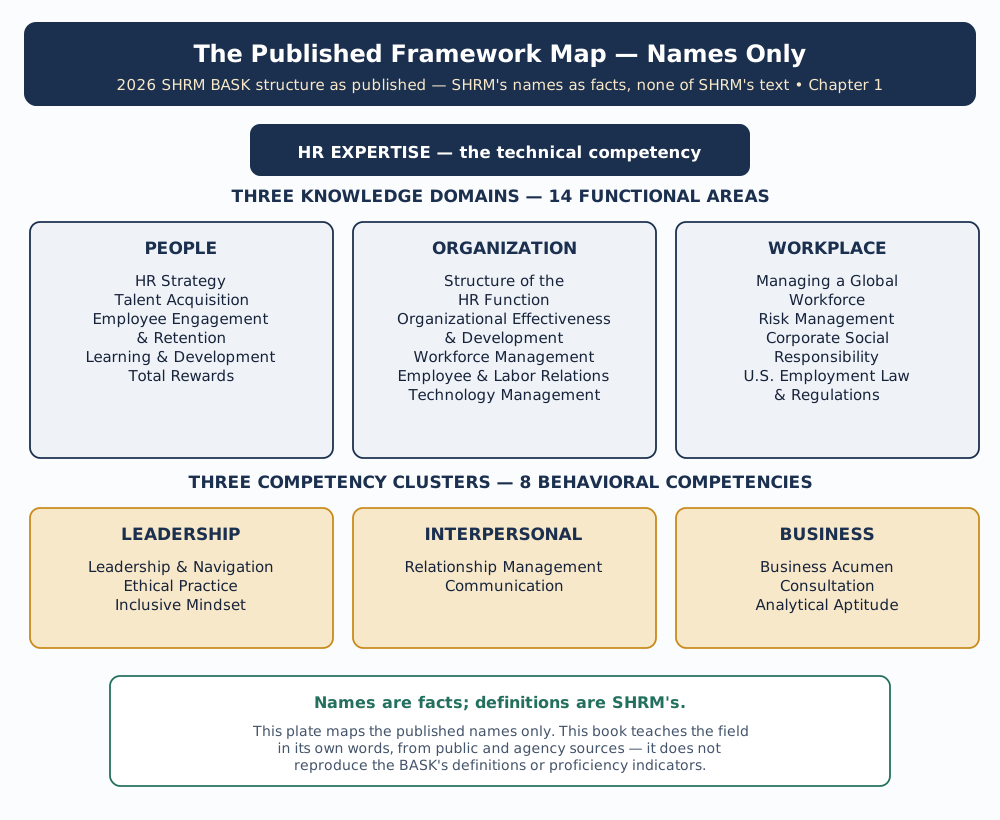 Figure 1.1 — Published framework map, names only
Alongside the domains sit eight behavioral competencies in three clusters, and together the clusters carry the other half of the exam. The Leadership cluster, 19 percent, holds Leadership and Navigation; Ethical Practice; and Inclusive Mindset. The Business cluster, 17.5 percent, holds Business Acumen; Consultation; and Analytical Aptitude. The Interpersonal cluster, 13.5 percent, holds Relationship Management and Communication. The handbook's allocation chart thus cuts the exam two ways at once: by content — clusters 50 percent, domains 50 percent — and by item type — HR-specific knowledge 50 percent, foundational knowledge 10 percent, situational judgment 40 percent. Reading the two cuts together is the key to the whole preparation strategy. The domains carry most of the knowledge questions. The clusters carry the foundational questions and dominate the judgment questions. A study plan that only memorizes domain facts prepares for half the sitting; a plan that only practices scenarios without learning the law starves judgment of the very material judgment runs on. This book is built in both halves for that reason, and Part V teaches the competencies as practice — leading an initiative, handling a conflict, advising a manager, reading a metric — in this book's own words.
Two edition facts protect you from the shelf's older material. First, the 2026 edition of the framework combined two earlier competencies, Inclusion and Diversity and Global Mindset, into the single competency now named Inclusive Mindset, and expanded material on artificial intelligence in HR practice throughout. Materials that teach nine behavioral competencies, or name superseded competencies such as Global and Cultural Effectiveness or Critical Evaluation as current, describe an earlier edition — the framework was also formerly called the Body of Competency and Knowledge — and should be read as dated history, however confident their tone. Second, a counting caution from SHRM's own pages: a stray passage in current SHRM documents still says nine in one place, while the framework's structure, its table of contents, and its 2026 revision note establish eight. This book prints eight, names them as the published structure names them, and mentions the leftover only so a careful reader who spots it elsewhere understands it. Chapter 25 teaches you to aim study at the current structure, and this book's crosswalk appendix maps every published name to the chapters that teach it and the items that test it, so coverage is shown rather than asserted.
A final orientation point keeps the frame in proportion. The allocation percentages describe the exam, not the importance of topics at work and not the chapter space in this book. The Workplace domain is 13 percent of the exam and receives six chapters here, because its employment-law area is where a working generalist's legal risk concentrates and where every number must be checked against its agency. The competency clusters are 50 percent of the exam and are served by four dedicated chapters plus judgment practice woven through every earlier part, because judgment is a habit formed across cases, not a topic exhausted in one place. Item counts, by contrast, follow the published allocation strictly in this book's full practice tests. Chapter space serves the beginner's teaching load; item counts serve the exam. The divergence is printed rather than hidden, here and wherever it recurs.
A word about confidentiality, because every candidate eventually meets a website promising real exam questions, and Chapter 1 is the right place to disarm it. SHRM's Candidate Agreement, printed in the handbook, makes exam content confidential and copyrighted and bars reconstructing or sharing it. That is why no legitimate source can sell you the actual questions, and why this book contains none: every item here is original, written from the published exam structure, the field's public sources, and scenarios invented for this book. SHRM's own published sample questions exist to show candidates the form of the items, and this book's format teaching in Chapter 25 is informed by that published form at the level of style only; no sample item is reproduced or paraphrased as practice here.
The confidentiality rule is not only a legal boundary; it is a study advantage in disguise. Material sold as leaked questions teaches recognition of particular wording. The next sitting's wording is different by design, field-test items rotate, and judgment items turn on facts that change from scenario to scenario. A candidate who learned the underlying leave rule, investigation procedure, or metric can answer a question she has never seen, on facts she has never seen, because she owns the basis rather than the sentence. That is the derivation discipline of the Honest-Prep Rule applied to your whole preparation: learn the basis, practice weighing options against it, and treat any product that promises the questions themselves as having told you, in its promise, that it cannot deliver the skill the exam measures.
The same realism applies to this book's full practice tests. They imitate the sitting's shape faithfully — 134 items, two timed sections of 110 minutes, both published item types at their published proportions, content at the published allocation on both cuts — and they state their composition on their face. They do not imitate the sitting's concealment: every practice item is scored for you, because a rehearsal that hid a fifth of its feedback would waste the feedback you paid for. Chapter 25 teaches the field-test fact as exam craft instead: you cannot identify the unscored items in the real sitting, so pacing must assume every item counts — because 110 of them do.
The book is built for three readers at once, and each has a path. The reader starting from zero — Daniel's path — reads Part I slowly and in order, because everything later assumes its ground: what HR is, the employment life cycle that organizes the whole field, and the rooms, files, and systems where the work physically happens. The working generalist — Priya's path — can move quickly through Part I, checking each chapter quiz to confirm the ground is solid, and should expect Parts II through IV to read as her own week with the reasoning made explicit and the law made exact. The booked candidate — the reader with a window already chosen — starts with the diagnostic test in the front matter, lets its per-area results route her to the weakest parts first, and reserves the final stretch for the two full timed tests taken under honest timed conditions. Maya, whose title hides her HR work, will usually find the generalist path fits after Part I confirms the vocabulary she already half-knows from practice.
Every path uses the same furniture, so learn it once. A chapter opens with a workplace situation, teaches from zero in plain words, works examples in the open with every calculation shown step by step, and flags the confusions the exam exploits. Each chapter closes with a fifteen-question quiz and a domain map that tells you exactly where to re-read if a tagged group of items went wrong. Every practice item carries a triple address: its content address in the published domain, area, cluster, or competency names; its chapter; and its item class — knowledge, foundational knowledge, or situational judgment — with designated calculation items carrying their calculation family instead of a plain knowledge tag. The answer keys explain every option: why the key is right, with the computation itself for a calculation item and the named derivation for a judgment item, and why each wrong option fails. Reading keys for items you answered correctly is not wasted time; separating neighboring ideas is most of what this exam measures.
One promise about tone closes the map. This book will define every term it uses, show every calculation it asserts, name the source of every exam or legal figure it prints, label its own formulas and guidance as its own, refuse numbers the register does not carry, teach pay law through the Fair Labor Standards Act's mechanics of hours, rates, and overtime when Chapter 17 reaches them, and tell you plainly when the honest answer is that a figure belongs to an agency page you should re-check at the moment you act. A preparation book earns trust the same way an HR professional does: by being right about small, checkable things, consistently, in ways you can verify. Chapter 1 has given you several checkable claims already — the item count, the timing, the eligibility sentence, the fee table's basis, the pass rate with its window. Check them against SHRM's handbook. Then read on.
Worked example 1 — placing a borrowed book. A coworker lends Priya a preparation book whose contents page promises an eligibility table: a bachelor's degree in an HR field plus two years of experience, an unrelated degree plus more, no degree plus the most. Using this chapter, Priya can place that book without reading further. The 2026 handbook publishes no such table and states that no degree or previous HR experience is required to apply. The borrowed book's table is the superseded tier system, printed as history in this chapter and as a current gate nowhere in this book. Its explanations of leave or hiring may still be useful, but wherever it states who may sit, what the credential costs, or how the framework is structured, the current handbook governs.
Worked example 2 — reading the allocation as a study budget. Suppose, purely as this book's own study-planning device, a candidate has forty hours for content review after a first full reading. Applying the handbook's published content shares as a rough budget gives about eight hours to the Leadership cluster, seven to Business, between five and six to Interpersonal, about eight to the People domain, seven to Organization, and about five to Workplace. The arithmetic is ordinary multiplication, shown so the method is visible: 40 × 0.19 = 7.6; 40 × 0.175 = 7.0; 40 × 0.135 = 5.4; 40 × 0.19 = 7.6; 40 × 0.18 = 7.2; 40 × 0.13 = 5.2; and the parts sum to 40.0, which checks. The shares are SHRM's; the hour budget is this book's guidance, labeled as such, and your diagnostic results should bend it toward your weakest area rather than treating it as a law.
Worked example 3 — a claim audit. A video promises that most candidates fail this exam because they lack HR experience, and offers an expensive course restricted to experienced practitioners. This chapter gives you the audit in three questions. Where is eligibility published? In SHRM's handbook, which requires no previous HR experience. Where is the pass rate published? By SHRM, per window — 69 percent passed in May to July 2026 — which contradicts the claim that most candidates fail, and says nothing about experience as the dividing line, a breakdown SHRM does not publish in the sources this book is built on. What does the seller gain from the claim? A restricted, premium market. Learning to ask where a figure is published is the cheapest professional skill this chapter teaches, and it transfers to every vendor claim, dashboard, and consultant proposal you will evaluate in HR work itself.
Chapter 1 in one paragraph: the SHRM-CP is SHRM's operational-level credential for people who perform general HR duties or are pursuing a career in HR, tested in one examination of 134 multiple-choice questions — 80 knowledge and 54 situational judgment, with 24 unscored field-test items hidden among them, 110 scored — in two independently timed sections of up to 110 minutes each at a Prometric test center. Results are scaled scores from 120 to 200, every passer receives 200, the standard is set by the Modified Angoff method against a predetermined level, and no percentage, raw-count, or per-area passing standard is published. Anyone may apply: no HR title, degree, or previous HR experience is required, basic working knowledge is recommended, and membership and employment are not required; the abolished degree-and-experience tiers survive only as history. The early-bird fee is $350 member and $450 nonmember, the standard fee $399 and $499, from the 2026 handbook, to be confirmed on SHRM's site before applying; retakes occur only in a future window at the full fee, without limit; the credential runs on a three-year cycle recertified by 60 professional development credits or a final-year retest. The content frame is the 2026 BASK's published structure: three knowledge domains with fourteen functional areas carrying 50 percent, and three competency clusters with eight competencies carrying 50 percent; SHRM published a 69 percent pass rate for the May to July 2026 window. This book teaches that field in its own words, under the F-Rule and the Honest-Prep Rule, and reproduces no BASK text and no exam question.
Before moving on, confirm the furniture: you know where the quiz key lives, you know every item carries a triple address, and you know the domain map at the quiz's close routes you back to the sections a missed tag points to. Chapter 2 now goes beneath the credential to the work itself, and builds, from a first day in a small company's office upward, what human resources is and the life cycle that organizes it. Nothing in Chapter 2 assumes you have ever worked in HR. That is by design, and so is everything that follows.
Answer all fifteen questions before checking the key in the companion key file. Every item is original, written from the published exam structure in the 2026 SHRM Certification Handbook.
1. [Orientation | Ch. 1 | KI] Which statement describes the SHRM-CP as SHRM publishes it?
A. A strategic-level credential for directing an entire HR operation B. An operational-level credential for implementing policies, supporting day-to-day HR functions, and serving as an HR point of contact C. A license required before anyone may work in HR D. A degree program offered by SHRM
2. [Orientation | Ch. 1 | KI] How many questions does the SHRM-CP exam contain, and how are they divided?
A. 134 questions: 80 knowledge and 54 situational judgment, with 24 unscored field-test items among the 134 B. 134 questions: 100 knowledge and 34 situational judgment C. 110 questions, all scored, with no field-test items D. 200 questions: 100 knowledge and 100 situational judgment
3. [Orientation | Ch. 1 | KI] How is testing time structured?
A. One section of 220 minutes that may be revisited freely B. Two sections of up to 110 minutes each, independently timed, with no return to a finished section and no carryover of unused time C. Four sections of 55 minutes each D. An untimed tutorial followed by 110 minutes total
4. [Orientation | Ch. 1 | KI] Which statement about the passing standard is correct in SHRM's published form?
A. A candidate must answer 70 percent of questions correctly B. A candidate must reach a minimum score in every domain C. Results are scaled scores from 120 to 200, every passer receives 200, and the standard is set by the Modified Angoff method against a predetermined standard D. Candidates are ranked against each other and the top group passes
5. [Orientation | Ch. 1 | KI] A score of 200 on the SHRM-CP means:
A. The candidate answered every question correctly B. The candidate scored in the top percentile of the window C. The candidate passed every domain separately D. The candidate met the predetermined passing standard, as every passer does
6. [Orientation | Ch. 1 | KI] Which statement states current SHRM-CP eligibility correctly?
A. A candidate must hold an HR title and an HR degree B. A candidate must show two years of HR experience C. No HR title, degree, or previous HR experience is required to apply; basic working knowledge is recommended D. SHRM membership and current employment are required
7. [Orientation | Ch. 1 | KI] An older book prints a table trading degree level against years of HR experience as the SHRM-CP requirement. That table is:
A. The current rule in the 2026 handbook B. A superseded system from earlier editions, appearing in this book only as dated history C. The SHRM-SCP's current eligibility standard D. A requirement SHRM enforces only for students
8. [Orientation | Ch. 1 | KI] The SHRM-SCP's published experience standard is:
A. No experience of any kind B. One year in any job C. At least three years performing strategic-level HR duties, demonstrating at least 1,000 hours per calendar year of strategic-level work, or three years holding the SHRM-CP in or transitioning to a strategic role D. The same open eligibility as the SHRM-CP with a harder exam only
9. [Orientation | Ch. 1 | KI] What are the handbook's 2026 early-bird and standard SHRM-CP fees?
A. Fees set by each Prometric test center B. Early bird $150 member / $250 nonmember for all candidates C. A single flat fee with no member difference D. Early bird $350 member / $450 nonmember; standard $399 member / $499 nonmember, with all rates including a $50 application fee
10. [Orientation | Ch. 1 | KI] A candidate does not pass. Under SHRM's published retake rules, the candidate:
A. May retest in the same window at half fee B. Must wait five years before applying again C. May reapply as a new candidate in a future window, pay the full fee, and faces no limit on attempts D. May retake only the domain sections scored lowest
11. [Orientation | Ch. 1 | KI] How is the credential kept current?
A. On a three-year cycle, by earning 60 professional development credits or retaking the exam in the cycle's last year B. It never expires once earned C. By renewing SHRM membership annually D. By passing a short annual quiz
12. [Orientation | Ch. 1 | KI] Which grouping matches the 2026 framework's published structure?
A. Eight behavioral competencies in three clusters, with Inclusion and Diversity and Global Mindset combined into Inclusive Mindset in 2026 B. Nine behavioral competencies, including separate Inclusion and Diversity and Global Mindset competencies C. Fourteen behavioral competencies and eight functional areas D. Three competencies, one per knowledge domain
13. [Orientation | Ch. 1 | JUDG] Maya, a payroll clerk who answers HR questions daily but holds no HR title, asks whether she should wait until she has two years in an HR-titled job before applying for the SHRM-CP. Based on the eligibility principle taught in this chapter, the best advice is:
A. Wait two years, because the degree-and-experience tiers still govern applications B. Choose the SHRM-SCP instead, because its standard matches clerical experience C. Apply only after joining SHRM, because membership is an eligibility requirement D. Apply when her preparation supports it, because no HR title or previous HR experience is required; build the recommended basic working knowledge through study
14. [Orientation | Ch. 1 | JUDG] During the first exam section, Tomas finishes with 35 minutes unused and three questions he flagged. Based on the section-timing principle taught in this chapter, the best use of those minutes before he submits the section is:
A. Submit immediately, because unused time carries into the second section B. Submit immediately, because flagged questions can be revisited in the second section C. Spend the remaining section time reviewing the flagged questions, because unused time does not carry over and a finished section cannot be re-entered D. Leave the flagged questions blank, because an unanswered field-test question cannot hurt the score
15. [Orientation | Ch. 1 | JUDG] A study product promises actual SHRM-CP questions from a recent window. Based on the confidentiality and originality principle taught in this chapter, the best response is:
A. Decline it, because exam content is confidential under the Candidate Agreement and legitimate preparation uses original items built on the published structure and the field's public sources B. Buy it, because published sample questions and actual questions are the same thing C. Buy it only if the seller also guarantees a passing result D. Use it for the judgment items only, because knowledge items are the confidential ones
All fifteen items are tagged Orientation (the chapter's governing address, drawn from the 2026 SHRM Certification Handbook). Designated register for this quiz: KI ×12 (items 1–12) · JUDG ×3 (items 13–15) · CALC ×0 — Chapter 1 carries no designated calculation, because its computation is program arithmetic shown in the worked examples, not a the register definition family. If you missed items 2–5, re-read the sections on the exam's shape and the passing standard. If you missed items 6–8, re-read the eligibility and level-choice sections. If you missed items 9–11, re-read the windows, fees, retakes, and recertification section. If you missed the JUDG items, re-read the sections each key names: eligibility is an open door with a recommendation; section time never carries and never returns; exam content is confidential and all practice here is original.
Designated items in this chapter: KI ×12 · JUDG ×3 · CALC 0 (no designated-calculation family is assigned to Chapter 1; the register's families are housed in later chapters as the register assigns them). Every wrong option is explained. JUDG keys are derived from principles taught in this chapter, named in each entry (Honest-Prep Rule).
1. Answer: B. [Orientation | Ch. 1 | KI] The handbook describes the SHRM-CP as assessing work at the operational level: implementing policies, supporting day-to-day functions, and serving as a point of contact. - A is wrong: Directing an integrated HR operation and setting strategy is the SHRM-SCP's strategic scope. - C is wrong: The SHRM-CP is a voluntary certification, not a license to practice. - D is wrong: It is an examination credential, not a degree program.
2. Answer: A. [Orientation | Ch. 1 | KI] 134 questions = 80 knowledge + 54 situational judgment (SHRM Certification Handbook, 2026); 24 of the 134 are unscored field-test items, so 110 are scored (derived from SHRM's two published figures). - B is wrong: The published split is 80/54, not 100/34. - C is wrong: 110 is the derived scored count, not the total, and field-test items exist. - D is wrong: No 200-question form is published.
3. Answer: B. [Orientation | Ch. 1 | KI] Two independently timed sections of up to 110 minutes each (220 minutes total); unused time does not carry and a finished section cannot be re-entered. - A is wrong: There is no single revisitable 220-minute section. - C is wrong: The handbook publishes two sections, not four. - D is wrong: 110 minutes is one section's limit, not the total.
4. Answer: C. [Orientation | Ch. 1 | KI] Scaled scores 120–200, passers receive 200, Modified Angoff against a predetermined standard, no norm comparison. - A is wrong: No percentage standard is published; converting the scale to a percentage is the the fence error. - B is wrong: No per-domain minimum is published. - D is wrong: Performance is not compared to other candidates.
5. Answer: D. [Orientation | Ch. 1 | KI] By SHRM's design every passer receives 200; it denotes meeting the standard. - A is wrong: 200 does not mean a perfect paper. - B is wrong: Scoring is criterion-based, not percentile-based. - C is wrong: There are no separate domain passes to accumulate.
6. Answer: C. [Orientation | Ch. 1 | KI] The handbook and eligibility page state no HR title, degree, or previous HR experience is required; basic working knowledge is recommended. - A is wrong: Neither a title nor a degree is required. - B is wrong: No years-of-experience requirement exists for the SHRM-CP in the current handbook. - D is wrong: Membership and employment are expressly not required.
7. Answer: B. [Orientation | Ch. 1 | KI] The tier table is from earlier editions; it appears nowhere in the 2026 handbook and is printed in this book only as dated history. - A is wrong: The current handbook contradicts the table. - C is wrong: The SHRM-SCP standard is the three-year strategic standard of item 8, not a degree-tier table. - D is wrong: No such student-only tier enforcement is published.
8. Answer: C. [Orientation | Ch. 1 | KI] The SHRM-SCP standard as published : three years of strategic-level duties at 1,000+ hours per calendar year, or three years holding the SHRM-CP in/transitioning to a strategic role. - A is wrong: The senior credential does carry an experience standard. - B is wrong: The standard is strategic HR work specifically, at the stated hours. - D is wrong: The two levels differ in both eligibility standard and assessed scope.
9. Answer: D. [Orientation | Ch. 1 | KI] Early bird $350/$450; standard $399/$499; all rates include the nonrefundable $50 application fee (standard rates also include a $49 standard deadline fee). Confirm current fees on SHRM's site before applying. - A is wrong: Fees are SHRM's published table, not test-center pricing. - B is wrong: $150/$250 is the student early-bird row, not the general row. - C is wrong: The handbook publishes member and nonmember rates.
10. Answer: C. [Orientation | Ch. 1 | KI] Same-window retesting is prohibited; reapply in a future window at the full fee; no limit on attempts. - A is wrong: Same-window retesting is prohibited and the fee is full, not half. - B is wrong: No five-year bar is published. - D is wrong: The exam is retaken whole; domains are not separately retaken.
11. Answer: A. [Orientation | Ch. 1 | KI] Three-year cycle; 60 PDCs (Advance Your Education, no maximum; Advance Your Organization and Advance Your Profession, maximum 30 each) or retake the exam in the cycle's last year. - B is wrong: The credential expires on its cycle. - C is wrong: Membership is not the recertification mechanism and is not required. - D is wrong: No annual quiz is published.
12. Answer: A. [Orientation | Ch. 1 | KI] The 2026 structure publishes eight behavioral competencies in three clusters; the 2026 revision combined Inclusion & Diversity and Global Mindset into Inclusive Mindset. - B is wrong: Nine, with those two separate, is the pre-2026 structure. - C is wrong: The counts are reversed — 14 functional areas, 8 competencies. - D is wrong: There are three clusters and three domains, not one competency per domain.
13. Answer: D. [Orientation | Ch. 1 | JUDG] Taught basis (this chapter, eligibility section): SHRM-CP eligibility requires no HR title or previous HR experience; basic working knowledge is recommended, not required. Weighing the options against that basis: D applies the rule to Maya's facts and addresses the recommendation through preparation. A applies the abolished tiers. B misassigns the level; the SCP's strategic standard does not match clerical experience and is not the open door described. C invents a membership requirement the handbook excludes.
14. Answer: C. [Orientation | Ch. 1 | JUDG] Taught basis (this chapter, exam-shape section): the two sections are independently timed; unused minutes do not carry over and a finished section cannot be re-entered, so section time has value only inside its own section. C uses the remaining minutes on the only work they can still serve. A and B rest on carryover and return rights the handbook does not publish. D fails twice: field-test items cannot be identified, and an unanswered question can earn no credit.
15. Answer: A. [Orientation | Ch. 1 | JUDG] Taught basis (this chapter, confidentiality section): the Candidate Agreement makes exam content confidential and copyrighted; legitimate preparation — including every item in this book — is original, built on the published structure and public sources. A follows that basis. B confuses SHRM's published sample questions, which show form, with actual scored items. C adds a pass guarantee, which no seller can honestly make and this book never makes. D invents a distinction; confidentiality covers the exam's content, not one item type only.
Chapter 1 census: 15 items, all Orientation. Key distribution: A ×4 (items 2, 11, 12, 15), B ×3 (items 1, 3, 7), C ×5 (items 4, 6, 8, 10, 14), D ×3 (items 5, 9, 13) — no letter above 40%, every letter present. Designated: KI ×12, JUDG ×3, CALC ×0.
End of the free sample. The complete book continues from here — the full A-to-Z course in book form, delivered as an EPUB you can read in Apple Books, Google Play Books, ReadEra, Thorium Reader, Adobe Digital Editions, or Send to Kindle.
Buy this ebook — $11.99 Back to the book page
Payments are securely processed by Payhip.