
Mastering Careers & Skills
ServSafe Food Protection Manager Certification Exam · free sample from the book itself
You do not need any food-service experience to read this chapter. Every term is defined the first time it appears, and nothing in this chapter assumes you have stood in a commercial kitchen, taken a delivery, or washed a dish anywhere except at home.
Start with the plainest possible picture. A food establishment is any place that prepares, serves, or sells food to the public or to a group of people who depend on it — a restaurant, a school cafeteria, a hospital kitchen, a nursing-home dining room, a grocery deli, a caterer, or a food truck. A home kitchen, where you cook for your own household, is not a food establishment in this sense. The difference matters because strangers eat the food an establishment serves. They cannot see how it was stored, who handled it, or whether the cook was ill. Rules exist because the guest has to trust what they cannot check.
Food safety is the set of practices that keeps food from making people sick. A foodborne illness — an illness people get from something they ate or drank — is what food safety exists to prevent. Chapter 2 teaches foodborne illness itself, from zero. This chapter answers three earlier questions:
Two fences you meet first — read them before anything else
Fence 1: This book is not a course. Some states, counties, and cities require a set number of training hours in addition to passing the exam. This book satisfies no jurisdiction's training-hour requirement. It teaches you the field and prepares you for the exam; it does not replace a required course. (Source: ServSafe Food Protection Manager Certification Examinee Handbook, "Meeting Regulatory Requirements"; ServSafe product page for the ServSafe Manager Book and Exam Answer Sheet, 9th Edition, which notes that ServSafe classroom training is accepted in all 50 states for regulatory requirements up to 16 hours.)
Fence 2: The exam's basis is not your local code. The exam is built on the FDA Food Code explained in Section 1.5. Your own establishment follows the code your state, county, or city has adopted, which may be a different edition and may have local changes. Passing the exam does not excuse you from learning your local rules, and your local rules do not change what the exam expects. Both statements stay true for the whole book.
A food handler is any worker who touches food, food-contact surfaces (the parts of equipment and utensils that touch food), or packaged food as part of the job — cooks, prep workers, dishwashers, servers who plate food, and many others. Most failures happen at handler level: unwashed hands, a sick worker on shift, raw chicken stored above salad.
The person in charge, shortened everywhere in food safety to PIC, is the person present at the establishment who is responsible for how food is handled during that shift. The PIC is not a job title on a business card. It is a role someone fills whenever the establishment is operating. On a Tuesday morning the PIC might be the general manager. On a Sunday night it might be the senior shift lead. Whoever it is, the PIC is the person an inspector speaks to, the person who decides whether a sick worker goes home, and the person who decides whether a doubtful delivery is accepted or turned away.
Notice what that means for a beginner: food safety is not left to individual conscience. At every operating hour, one named role carries it.
A Certified Food Protection Manager, shortened to CFPM, is a person who has passed an accredited food protection manager examination — the kind of exam this book prepares you for — and who therefore holds a recognized certificate. Many jurisdictions require an establishment to have a CFPM, and many require the PIC to be a CFPM or to be able to show the knowledge a CFPM has. The exact requirement that binds you is your local rule (Fence 2 above), but the pattern is national: regulators want at least one person in the operation who can prove, by examination, that they know how food becomes unsafe and how to stop it.
Remember the distinction, because the exam tests it:
One person can hold all three descriptions at once. They are still three different ideas.
Beginners often picture the manager tasting soup and greeting guests. The food-safety part of the job is less visible and more repetitive — and that repetition is the point. A manager's food-safety day, in plain order, looks like this:
Before service. Check that no ill worker is scheduled to handle food, check refrigerator temperatures, and check that yesterday's cooked food was cooled and stored correctly. Receiving and storing (Chapter 9). Meet deliveries, check temperatures and condition, reject what fails, and put food away in the right place and order. Preparation and cooking (Chapters 10–11). Watch thawing, preparation, and cooking, and make sure thermometers are used and required temperatures reached. Holding and service (Chapter 12). Keep hot food hot and cold food cold while it waits, and protect displayed food. Cleaning (Chapter 13). Make sure cleaning and sanitizing happen, with the right chemicals at the right strength. People, all day (Chapters 7, 8, and 15). Train new workers, correct mistakes kindly and immediately, and send ill workers home even when the shift is short-staffed. Records and readiness (Chapters 15–16). Keep the logs, tags, and procedures an inspector will ask for, and walk the operation the way an inspector would.
Notice: almost nothing on that list is cooking skill. A brilliant cook who stores raw poultry above ready-to-eat food, lets a vomiting worker stay on shift, and never checks a temperature is a dangerous manager. This exam tests the modest cook who controls those things.
Managers describe a food item's life in an establishment as the flow of food: the path food takes from the moment the operation buys it to the moment a guest eats it. This book uses that path as its spine, so learn the nine steps now. You will meet them in every later chapter.
Not every dish uses every step. A salad is never cooked or reheated. A soup cooked in the morning, cooled, and served the next day uses all nine. The steps are a map, not a recipe: at each step, something specific can go wrong, and at each step the manager has a specific control. Chapters 9 through 12 teach the flow in four blocks — purchasing, receiving, and storage (Chapter 9); preparation (Chapter 10); cooking (Chapter 11); and holding, cooling, reheating, and service (Chapter 12).
Figure 1.2 — The Flow of Food, End to End
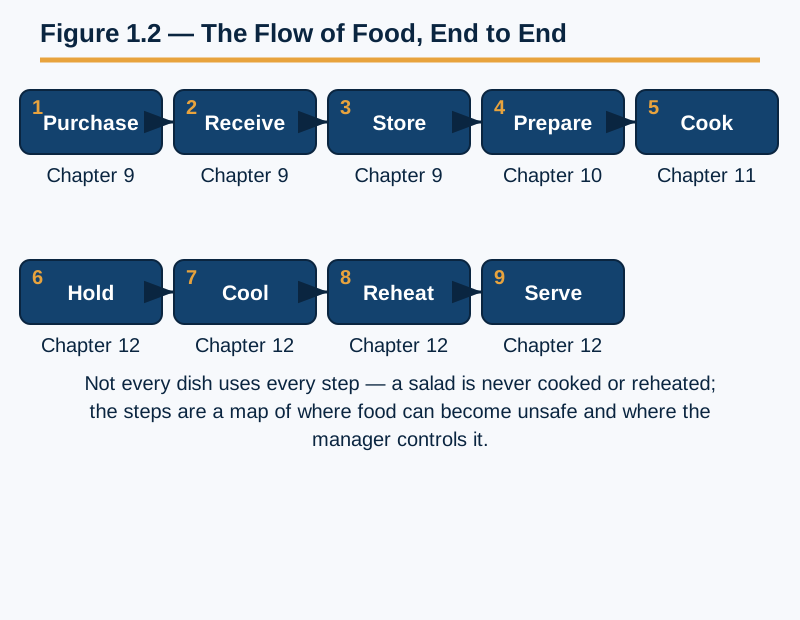
Do — walk one dish through the flow. Pick the simplest dish you can think of, for example a grilled chicken sandwich. Say the nine steps aloud and name what happens to the chicken at each one: bought from a supplier; checked at the door; stored cold; portioned; grilled; held hot briefly; not cooled or reheated if it is served at once; served. Then do the same for a pot of soup made today and served tomorrow, and notice where Cool and Reheat appear. If you can do that for two dishes, you already understand the structure of Chapters 9 through 12.
The credential at the center of this book is the ServSafe Food Protection Manager Certification, earned by passing the ServSafe Food Protection Manager Certification Examination. ServSafe is a program of the National Restaurant Association Educational Foundation, and the exam is administered by the National Restaurant Association through National Restaurant Association Solutions, LLC. The long names matter practically: when you register, pay, or check a result, make sure you are dealing with the real program, not a look-alike seller.
Not-affiliated notice, in plain words. This book is an independent study guide. It is not published by, affiliated with, endorsed by, or approved by the National Restaurant Association, the National Restaurant Association Educational Foundation, or ServSafe, and none of them participated in its creation. Exam names and trademarks belong to their respective owners. The full disclosure also appears in this book's front matter.
Passing this exam earns the certification described above, and that certification is the credential that satisfies the CFPM requirement used by the FDA Food Code and adopted by state and local regulators. In plain words: regulators wrote "the manager must be certified" into their rules, and this is one of the accredited exams that counts as certified.
The exam is accredited: an outside body has checked that it meets a published standard for competence testing. This exam is accredited by the ANSI National Accreditation Board (ANAB), under the Conference for Food Protection standard. Accreditation is why a health department in one state accepts a certificate earned through a national exam. (Source: ServSafe product page for the ServSafe Manager Online Course and Exam, Online Proctor; Pearson VUE / National Restaurant Association testing page.)
Almost every temperature, time, and rule in this book traces to one document, so meet it now.
The FDA Food Code is a model set of food-safety rules published by the U.S. Food and Drug Administration, shortened to FDA. A model code is not a law by itself. It is a complete, expert-written rulebook that states, counties, and cities adopt — sometimes word for word, sometimes with changes — as their own law. Think of it as the master template from which most local food rules are copied.
The exam's regulatory basis is the 2022 FDA Food Code, as updated by the Supplement to the 2022 Food Code, published November 4, 2024. ServSafe's current materials state that they are updated to reflect that Supplement. (Source: FDA, Food Code 2022; FDA Constituent Update, "FDA Releases Supplement to the 2022 Food Code," November 4, 2024; ServSafe product pages for the current Manager materials.)
Three consequences follow:
A basis disclosure. On September 17, 2026, the FDA issued the 2026 edition of the Food Code. As of October 28, 2026, the ServSafe Food Protection Manager Certification Examination and its current course materials remain based on the 2022 FDA Food Code as updated by the Supplement to the 2022 Food Code, and that remains this book's exam basis. If the Association announces a change of basis, it will be recorded on this book's errata and updates page. 3. The reason is taught with the rule. A number memorized without its reason is forgotten under exam pressure and ignored under kitchen pressure.
ServSafe does not publish a weighted content outline for this exam. That sentence deserves its own paragraph because so many study products invent one.
A weighted content outline would say, for example, "20 percent of the exam covers hygiene and 15 percent covers cooking." ServSafe publishes no such domains and no such percentages for candidates. Its product pages refer to an internal content blueprint but do not publish it. Therefore this book prints no domain percentages, and any product that shows you precise ServSafe domain weights is showing you its own guess dressed as a fact.
The research route for every Food Code figure in this book runs through FDA's Food Code landing page (FDA, FDA Food Code, general page) to the edition-specific 2022 Code text the References list as entry 6; no rule in this book is cited to the general page itself. Instead, this book's content rests on the two things ServSafe itself points to: its published topic list — providing safe food; forms of contamination; the safe food handler and personal hygiene; the flow of food; time and temperature control; food safety management systems, Active Managerial Control, and the seven HACCP principles; food defense; allergen awareness and cross-contact; cleaning and sanitizing; safe facilities, equipment, and pest management; training hourly employees; and regulatory inspections — and the FDA Food Code the exam is built on. The study areas used to score this book's diagnostic and practice tests are this book's own study design, labeled as such wherever they appear. They are not ServSafe's weights.
This section is the exam in plain words. Every figure in it comes from the exam body's own handbook or product pages or from its test-delivery partner, and the source is named on the page so you can verify it. A condensed version of this section also appears on this book's Exam Blueprint page in the front matter.
Remember the numbers — the exam at a glance
- 90 questions in total.
- 80 scored questions + 10 pilot questions.
- 75 percent or better to pass — that is 60 of the 80 scored questions.
- 2 hours to take the exam.
- Certificate valid for 5 years.
(Sources: ServSafe Food Protection Manager Certification Examinee Handbook, "ServSafe Examination Overview"; Pearson VUE / National Restaurant Association testing page; ServSafe product page for the ServSafe Manager Online Course and Exam, Online Proctor.)
The exam presents 90 multiple-choice questions. A multiple-choice question gives you a stem (the question or unfinished statement) and a set of options, exactly one of which is the credited answer. You should answer all 90 questions. (Source: ServSafe Food Protection Manager Certification Examinee Handbook, "ServSafe Examination Overview.")
Of those 90, 80 are scored questions and 10 are pilot questions. A pilot question is a trial question being tested for a future exam. Pilot questions do not count toward your score and are not identified during the sitting — deliberately. Treat every question as if it counts, because you cannot know which ten do not. (Source: Pearson VUE / National Restaurant Association testing page.)
A passing score is 75 percent or better. With 80 scored questions, 75 percent is 60 correct scored questions. (Sources: ServSafe Food Protection Manager Certification Examinee Handbook, "ServSafe Examination Overview"; Pearson VUE / National Restaurant Association testing page.)
Exam trap — the 70 percent claim. The 70 percent figure is not a rumor from secondary websites: ServSafe's own Online Proctoring FAQ states a passing score of 70 percent, sometimes written out as "56 of 80" — 70 percent of the 80 scored questions. Against it, the Association's own Examinee Handbook states 75 percent or better, and its test-delivery partner, Pearson VUE, states 75. The exam program's own pages therefore disagree with each other. This book teaches 75 percent — here, in the front matter, in Chapter 17, and in every practice-test header — because the Handbook and the test-delivery partner are the authorities for the score report. If you plan your studying around 70 percent, you are planning to fall four scored questions short of the taught bar.
You have 2 hours to take the exam. If you take the online-proctored version, you should allot 2.5 total hours for launching and taking it; the launch process does not count against your 2 hours. The Handbook notes that candidates finish in approximately 1½ hours on average — an average, not a target. Some careful candidates use most of their time and do well; speed is not scored. (Sources: ServSafe product page for the ServSafe Manager Online Course and Exam, Online Proctor; ServSafe, ServSafe Manager Exam Online Proctor Exam Instructions; ServSafe Food Protection Manager Certification Examinee Handbook.)
Certification is valid for 5 years. You must still check your state and local law and your employer's standards, because the recertification requirement that actually binds you is set there, and a local period may be shorter. Renewal means recertification: retaking and passing the exam before your applicable validity period runs out, under your jurisdiction's own rules. There is no shorter renewal quiz and no paperwork-only renewal described in the Handbook. (Sources: ServSafe product page for the ServSafe Manager Online Course and Exam, Online Proctor; ServSafe Food Protection Manager Certification Examinee Handbook, "Renewing Your Certification" and "Meeting Regulatory Requirements.")
Two prices were verified on ServSafe's own product pages for this edition, and only those two print as prices:
Online scheduling carries two add-on fees. Scheduling more than 72 hours ahead includes proctoring at no extra charge. Scheduling 24 to 72 hours ahead — called Take It Soon — adds $8.00. Scheduling under 24 hours ahead — Take It Now — adds $12.00. A no-show or a cancellation under 24 hours ahead incurs a rescheduling fee. (Source: ServSafe, ServSafe Manager Exam Online Proctor Exam Instructions.)
You may see an "exam-only" price quoted on other websites. Prices for an exam-only access code conflict across secondary sources, and no ServSafe catalog page stating an exam-only price was retrieved for this book, so no exam-only price is printed here. Silence beats a guessed number. What is certain, and what Section 1.7 covers, is that a retake requires buying another exam access code.
No education or experience prerequisite published by ServSafe to sit the exam itself was found in the Handbook or product pages read for this book. A total beginner may register. That is different from saying no other requirement can apply to you: some jurisdictions require training hours in addition to passing (Fence 1), and your employer may require experience or a handler card first. The requirement that binds you is your own state and local rule. (Source: ServSafe Food Protection Manager Certification Examinee Handbook, "Meeting Regulatory Requirements.")
A proctor is an authorized person who verifies your identity, starts your exam under the required conditions, and watches that the rules are followed. Every sitting of this exam is proctored. There is no unproctored, take-it-alone-at-home version. You have three delivery modes; choose by what is available to you and by the rules you can actually meet.
You take the exam on your own computer while a live proctor watches through your webcam and microphone, using a service called ProctorU and a locked-down program called the Guardian browser. You must show a government- or school-issued photo ID. The exam runs on a PC or Mac only — a Chromebook, tablet, or phone is not supported. If your only computer is a Chromebook, this mode is closed to you no matter how ready you are, so check your equipment before you pay. (Source: ServSafe, ServSafe Manager Exam Online Proctor Exam Instructions; ServSafe product page, product code SSMCT7XONLPROC.)
Results for this mode work as follows: you receive a pass/fail notification at the end of the session, official results arrive by email and appear in your ServSafe account under SCORES, and on passing you can print your certificate immediately from the account under CERTIFICATES. (Source: ServSafe, ServSafe Manager Exam Online Proctor Exam Instructions.)
Exam languages for the online-proctored exam are English, Spanish, French Canadian, and Chinese-Simplified. (Source: ServSafe product page, product code SSMCT7XONLPROC.)
You travel to a test center run by Pearson VUE, the Association's test-delivery partner, and take the exam on the center's computer under the center's proctors. You schedule as a National Restaurant Association client and you need an NRA ID. Cancellation or rescheduling less than 24 hours ahead is not permitted, and a no-show forfeits fees. (Source: Pearson VUE / National Restaurant Association testing page.)
The Pearson VUE page lists the exam in English, Spanish, and Chinese. Notice that this language list is shorter than the online list. Print the language list per delivery mode, never merged — if you need French Canadian, the test-center list as published does not offer it. (Source: Pearson VUE / National Restaurant Association testing page.)
You take a printed examination booklet in a class or proctored session administered by a Registered ServSafe Proctor. Only registered instructors and proctors may order examination booklets, so this mode reaches you through a class or an organized session, not by mail order to your home. (Source: ServSafe Food Protection Manager Certification Examinee Handbook, Print-Based and Online Examination sections; ServSafe product page, product code ESX9.)
Print booklets are offered in English, Spanish, Chinese, Korean, Japanese, French Canadian, and Large Print — the widest language list of the three modes, and the only one that lists Large Print. For print sittings, scores post to ServSafe.com roughly 3 to 4 business days after the Association receives the answer sheet, typically about 10 days end to end; scores are never given by phone or email. Compare that with the online mode's end-of-session notification before you choose: the wait is part of the mode. (Sources: ServSafe product page, product code ESX9; ServSafe Food Protection Manager Certification Examinee Handbook.)
Figure 1.1 — One Certificate, Three Sittings
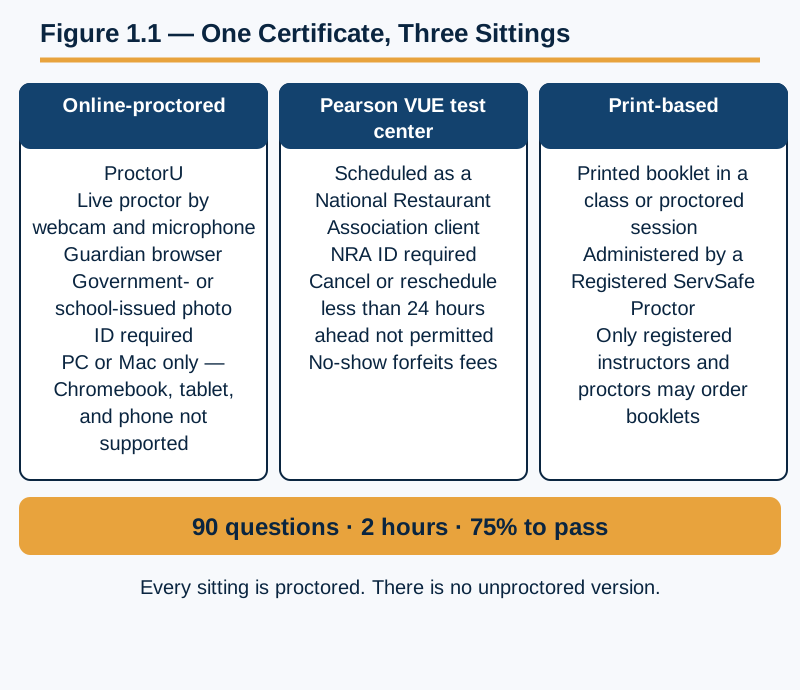
Do — choose your sitting on paper. Before you register, answer in writing: (1) What computer do I actually have? (2) What photo ID do I actually hold? (3) Which languages do I need, and which modes offer them? (4) How soon do I need my result? Working through those four questions prevents the most preventable failure in the process — paying for a mode you cannot use.
Read this section now, while it costs you nothing, so that a bad day later is an inconvenience and not a surprise.
(Sources: ServSafe product pages, product codes SSMCT7XONLPROC and ESX9, "Retesting policy" and "Failed exams"; ServSafe, ServSafe Manager Exam Online Proctor Exam Instructions, retesting policy — the wording is identical in all three.)
Worked example — count a retake timeline. A candidate fails on March 3 and again on March 20: two attempts within a 30-day period, which the rules allow. A third attempt is now required, so the candidate must wait at least 60 days from the last attempt — from March 20 — and may not exceed four attempts in 12 months in any case. Count first, book second.
Treat this section as a fallback, not a plan. Your plan is to prepare once, properly, and arrive knowing the field — not to budget attempts.
Passing proves, on the day you sat it, that you knew the material at or above the 75 percent bar. Be equally clear about its edges:
Part I (Chapters 1–4) builds the foundations from zero. Part II (Chapters 5–13) teaches the core knowledge at working depth. Part III (Chapters 14–16) teaches the judgment layer. Part IV (Chapter 17) is the exam layer, followed by timed practice tests in the real 90-question, 2-hour, 75 percent format. One habit starts now: when a chapter gives you a number, it names the Food Code section it comes from. A number with no address is an opinion.
1. Which statement best describes the person in charge (PIC)? A. The owner of the establishment, whether present or not B. The person present who is responsible for how food is handled during that shift C. The health inspector assigned to the establishment D. Any food handler who has worked at the establishment the longest
2. A candidate reads on a prep website that the passing score is 70 percent, written as "56 of 80." What should the candidate rely on? A. 70 percent, because several websites repeat it B. Whichever figure appears in the newest blog post C. 75 percent only if the candidate's employer also requires it D. 75 percent, because the Examinee Handbook and the test-delivery partner state it
3. How many questions does the exam present, and how are they divided? A. 90 questions — 80 scored and 10 pilot B. 80 questions — 70 scored and 10 pilot C. 100 questions — 90 scored and 10 pilot D. 90 questions, all of which count toward the score
4. What does passing the exam earn? A. A food handler card valid in every state B. A license to operate a food establishment C. The ServSafe Food Protection Manager Certification, satisfying the CFPM requirement D. Exemption from local health inspections for five years
5. A candidate's only computer is a Chromebook. Which sitting is available on that fact alone? A. The online-proctored exam, because Chromebooks are the preferred device B. Not the online-proctored exam, which supports PC and Mac only C. Any mode, because device rules are recommendations D. The online-proctored exam, if the candidate uses a phone hotspot
6. What is the FDA Food Code? A. A model code that states, counties, and cities adopt as their own law B. A federal law that inspectors enforce directly in every kitchen C. A ServSafe textbook sold with the exam answer sheet D. A list of recipes approved for commercial service
7. A manager passed the exam four years ago. Which statement about renewal is correct? A. Renewal is a short online quiz with no proctor B. The certificate renews automatically when the employer files a form C. There is no renewal; the certificate is permanent after five years D. Recertification means retaking and passing the exam before the applicable validity period runs out
8. Which price was verified on a ServSafe product page for the online course plus the online-proctored exam? A. $75.99 B. $99.00 C. $179.00 D. $36.00
9. A candidate has failed twice, on March 3 and March 20. When may a third attempt occur? A. Only after waiting at least 60 days from the last attempt B. The next day, because two attempts remain in the year C. After 30 days from the first attempt D. Immediately, if a new access code is purchased
10. Why does this book print no domain percentages for the exam? A. The percentages exist but are sold only with the coursebook B. ServSafe publishes no weighted content outline for candidates C. Percentages are printed only in the practice tests D. The Food Code forbids publishing exam weights
11. In the flow of food, which step comes immediately after Receive? A. Prepare B. Cook C. Purchase D. Store
12. A jurisdiction requires 12 hours of approved training in addition to passing the exam. What does this book do about that requirement? A. It satisfies the 12 hours if the reader finishes every chapter B. It waives the requirement for certificate holders C. It satisfies nothing — the reader must still complete the required training D. It converts to training hours when the diagnostic is passed
13. Which statement about pilot questions is correct? A. They are marked with a symbol so candidates can skip them B. They do not count toward the score and are not identified during the sitting C. They count double when answered correctly D. They appear only on the print-based exam
14. A candidate schedules an online exam 48 hours ahead. Which scheduling charge applies? A. No charge of any kind is possible for online scheduling B. A $12.00 Take It Now charge C. An $8.00 Take It Soon charge D. A $75.99 answer-sheet charge
15. An establishment's city enforces a food code edition that differs from the exam's basis. What should the manager do? A. Run the establishment by the locally adopted code and answer the exam from the exam's basis B. Run the establishment by the exam's basis, because the exam is newer C. Follow whichever rule is less strict in each case D. Ask the proctor which code the establishment should follow
1. B. The PIC is the person present who is responsible for food handling during that shift; the role can fall to a shift lead when the manager is away. Strongest distractor — A: an owner who is not present cannot make the shift's accept/reject and send-home decisions, and ownership is not the definition.
2. D. The Examinee Handbook states a passing score of 75 percent or better, and the Pearson VUE / National Restaurant Association page independently states 75; this book teaches 75 percent on that authority. (ServSafe's own Online Proctoring FAQ states 70 percent — a genuine disagreement inside the exam program's own pages, disclosed in Section 1.6 — but the Handbook and the test-delivery partner govern the score report.) Strongest distractor — A: the 70 percent figure traces to ServSafe's own FAQ, not to repetition across prep websites, and "56 of 80" is the arithmetic of 70 percent, not of the taught 75 percent bar.
3. A. The exam presents 90 multiple-choice questions: 80 scored plus 10 pilot (Source: Examinee Handbook; Pearson VUE / National Restaurant Association page). Strongest distractor — D: it gets the total right but erases the pilot split, which is exactly the detail that explains why every question must be treated as if it counts.
4. C. Passing earns the ServSafe Food Protection Manager Certification, the credential that satisfies the Certified Food Protection Manager requirement. Strongest distractor — B: operating permission comes from the local regulatory authority, not from an exam certificate; the certificate proves a person's knowledge, it does not license a premises.
5. B. The online-proctored exam supports PC and Mac only; Chromebook, tablet, and phone are not supported. Strongest distractor — A: it states the opposite of the published equipment rule, and no workaround in the other options changes a device requirement.
6. A. The Food Code is a model code published by the FDA and adopted — sometimes with changes — by states, counties, and cities as their law. Strongest distractor — B: it is the most common beginner misunderstanding; the FDA does not inspect your kitchen under the Code directly — your local authority does, under its adopted version.
7. D. Renewal is recertification: retaking and passing the exam before the applicable validity period (5 years nationally, subject to local rules) runs out. Strongest distractor — A: no shorter renewal quiz is described in the Handbook; inventing an easier renewal is exactly the kind of claim this book refuses to print unverified.
8. C. $179.00 is the verified price of the online course plus online-proctored exam bundle (Source: ServSafe product page SSMCT7XONLPROC). Strongest distractor — A: $75.99 is also a real verified price, but it buys the Manager Book plus one exam answer sheet — the item tests matching the price to the product, not recognizing a number.
9. A. Two attempts within 30 days are allowed; when three or more attempts are required, the candidate must wait at least 60 days from the last attempt, and may not exceed four attempts in 12 months. Strongest distractor — D: buying another access code is required for a retake, but payment does not cancel a waiting rule.
10. B. ServSafe refers to an internal content blueprint but publishes no domains or weights for candidates, so this book prints none and labels its own study areas as its own design. Strongest distractor — A: it invents a purchasable secret; the finding is that no weighted outline is published, not that it is hidden behind a paywall.
11. D. The flow runs purchase → receive → store → prepare → cook → hold → cool → reheat → serve. Strongest distractor — A: preparation feels like the natural next act, but food must be stored correctly first — putting a delivery away in the wrong place or at the wrong temperature is a failure that happens before any preparation begins.
12. C. This book is not a course and satisfies no jurisdiction's training-hour mandate; the reader must still complete the required training. Strongest distractor — A: reading a study guide, however completely, is not approved training hours — Fence 1, printed in Section 1.1 precisely for this situation.
13. B. Pilot questions are trial questions for future exams; they do not count toward the score and are deliberately unidentified. Strongest distractor — A: if pilots were marked, candidates would skip them and the exam body would learn nothing about them; the unmarked design is the point.
14. C. Scheduling 24 to 72 hours ahead is Take It Soon, at +$8.00. Strongest distractor — B: the $12.00 Take It Now charge applies under 24 hours ahead; 48 hours falls in the 24–72-hour band, so the item is a timeline-reading test.
15. A. The two-code rule: the establishment obeys its locally adopted code, and exam answers come from the exam's basis (FDA Food Code 2022 plus the 2024 Supplement). Strongest distractor — B: it reverses the rule; an exam's basis has no authority over an operating kitchen, and following it against local law would put the establishment in violation.
© 2026 Feras Alzubi
All rights reserved.
Mastering Careers & Skills
2026–2027 Edition
© 2026 Feras Alzubi. All rights reserved.
No part of this book may be reproduced, distributed, or transmitted in any form or by any means without the prior written permission of the copyright holder, except as permitted by law.
This edition was built against the FDA Food Code 2022, as updated by the Supplement to the 2022 Food Code (November 4, 2024), and against the exam facts published by the National Restaurant Association, ServSafe, and Pearson VUE as verified on October 28, 2026. Food codes, exam fees, and testing rules change. If a figure in this book conflicts with a current official source, the official source controls. Corrections are issued in a new edition and listed on this book's errata and updates page.
This book is an independent study resource. It is not affiliated with or endorsed by the National Restaurant Association, ServSafe, Pearson VUE, or the FDA. It is not published by, affiliated with, endorsed by, or approved by the National Restaurant Association, the National Restaurant Association Educational Foundation, or ServSafe, and none of them participated in its creation. Exam names and trademarks belong to their respective owners. Passing any exam also depends on the candidate's own preparation; no book can guarantee a result.
Provenance note. This book is an original work, written for this book. Every practice question in this book is original. Questions were written fresh for this book against the published outline named in this book — ServSafe's published topic list — and the FDA Food Code the exam is built on. They are not any exam body's actual, recalled, paraphrased, or adapted items, and they were not copied or adapted from any other prep book, course, or question bank.
Two fences to meet before Chapter 1.
This book serves two readers at once, in one binding. Find your path below. Both paths use the same chapters, the same diagnostic, and the same timed practice tests. They differ in where you start and how fast you move.
You have never worked in a commercial kitchen, or you have worked in one without ever being shown why the rules are what they are. That is the reader Part I was written for.
You work in food service now — perhaps already as a person in charge — and you need the credential. Your risk is different from the beginner's: not missing foundations, but carrying shop habits that the Food Code states differently, and losing points on exact numbers.
Every chapter teaches, then tests, in the same order: Simplify (the idea in plain words) → Explain (why the rule exists) → Detail (the full rule, with its source) → Show (a labeled diagram at the teaching point) → Do (a worked task or scenario) → Check (a 15-question quiz and a one-page summary). If a chapter feels slow at the Simplify step, stay with it anyway; the Detail step assumes it.
This book ships exactly two study plans, printed in full at the back of the book, day by day and referenced to chapters and tests:
There is no shorter crash plan in this book. A one-week plan for a reader starting from zero would contradict what this book is for.
One rule chooses between the two plans. It is printed here exactly as it is printed at the head of the Study Plans section and in Chapter 17:
The study-plan rule: Take the diagnostic before Chapter 1, while it is still cold. Then follow exactly one plan — the 4-week Standard Plan if you are new to food service or scored below 75 percent on the diagnostic, the 2-week Intensive Plan only if you already work as a person in charge and scored 75 percent or better. Never run both plans at once, and always finish with a timed practice test you have not seen before.
Every figure on this page is taken from a primary source named on the page. Verification date for the figures on this page: October 28, 2026.
The exam. The official name is the ServSafe® Food Protection Manager Certification Examination. It is administered by the National Restaurant Association through National Restaurant Association Solutions, LLC, under the ServSafe® program of the National Restaurant Association Educational Foundation. Passing it earns the ServSafe Food Protection Manager Certification, the credential that satisfies the Certified Food Protection Manager (CFPM) requirement used by the FDA Food Code and adopted by state and local regulators.
| Fact | Verified value |
|---|---|
| Questions presented | 90 multiple-choice questions |
| How those 90 divide | 80 scored questions + 10 pilot questions |
| Passing score | 75 percent or better |
| What 75 percent means | 60 of the 80 scored questions correct |
| Time allowed | 2 hours to take the exam |
| Accreditation | ANAB-accredited, under the Conference for Food Protection (CFP) standard |
| Certificate validity | 5 years |
| Online course + exam bundle | $179.00 |
| Manager Book (9th Edition) + exam answer sheet | $75.99 |
| Regulatory basis | FDA Food Code 2022 + Supplement to the 2022 Food Code (November 4, 2024) |
(Sources: ServSafe Food Protection Manager Certification Examinee Handbook, "ServSafe Examination Overview"; Pearson VUE / NRA page, "ServSafe Food Protection Manager Certification"; ServSafe product pages SSMCT7XONLPROC and ESX9; FDA, Supplement to the 2022 Food Code, November 4, 2024.)
A basis disclosure. On September 17, 2026, the FDA issued the 2026 edition of the Food Code. As of October 28, 2026, the ServSafe Food Protection Manager Certification Examination and its current course materials remain based on the 2022 FDA Food Code as updated by the Supplement to the 2022 Food Code, and that remains this book's exam basis. If the Association announces a change of basis, it will be recorded on this book's errata and updates page.
Read the scored/pilot split carefully, because it changes how you sit the exam. You will see 90 questions. Ten of them are pilot questions being tried out for future exams. They do not count toward your score, and they are not identified — there is no way to tell a pilot question from a scored question in the room. Answer all 90 questions. The 75 percent bar applies to the 80 scored questions: 60 correct scored answers is a pass. (Source: Pearson VUE / NRA page — "The exam consists of 80 questions and 10 pilot questions" and a passing score of 75; Examinee Handbook — "A passing score is 75 percent or better.") One conflict must be named plainly. ServSafe's own Online Proctoring FAQ states a passing score of 70 percent, while the Examinee Handbook states 75 percent or better and the Pearson VUE / National Restaurant Association page states 75. This book teaches 75 percent — the Handbook and the test-delivery partner are the authorities for the score report — but if you meet the 70 percent figure on ServSafe's own site, you have found a genuine disagreement inside the exam program's own pages, not a rumor. This book teaches 75 percent everywhere — here, in Chapter 1, in Chapter 17, and in every practice-test header.
How you can sit the exam. All sittings are proctored. There are three delivery modes:
Average completion is approximately 1½ hours, inside the 2 hours allowed. (Source: Examinee Handbook.)
Results. In an online-proctored sitting you receive a pass/fail notification at the end of the session, with official results by email and in your ServSafe account; on passing, the certificate can be printed from the account. For print sittings, scores post to ServSafe.com roughly 3–4 business days after the Association receives the answer sheet — typically about 10 days end to end — and scores are never given by phone or email. (Sources: ServSafe, Online Proctor Exam Instructions; Examinee Handbook.)
If you do not pass. You may take the exam twice within a 30-day period. If three or more attempts are required, you must wait at least 60 days from the last attempt. No more than four attempts are allowed in a 12-month period. A failed candidate must purchase another exam access code to test again. Recertification, when your certificate's validity runs out, means retaking and passing the exam, under the rules of your own jurisdiction. (Sources: ServSafe product pages SSMCT7XONLPROC and ESX9; ServSafe, Online Proctor Exam Instructions; Examinee Handbook, "Renewing Your Certification.")
Eligibility. No education or experience prerequisite to sit the exam itself is published in the Handbook or product pages. The binding requirement is your own state or local rule, which may add training hours on top of passing. ServSafe classroom training is accepted in all 50 states for regulatory requirements up to 16 hours. (Sources: Examinee Handbook, "Meeting Regulatory Requirements"; product page ESX9.) This page prints no exam-only access-code price, because no ServSafe catalog page stating one was retrieved and verified for this edition; the two verified prices are the two in the table above.
ServSafe does not publish a weighted content outline for this exam, so this book prints no domain percentages. Its chapter map follows ServSafe's published topic list and the FDA Food Code the exam is built on. The study areas in the diagnostic and practice tests are this book's own study design, labeled as such — not ServSafe's weights.
ServSafe's product pages refer to an internal "content blueprint," but they publish no domains and no weights for candidates, and neither does the Examinee Handbook or the Pearson VUE / NRA page. Any list of domain percentages for this exam that you meet elsewhere did not come from ServSafe. Do not study to it.
The diagnostic and the timed practice tests score your work in seven study areas. These areas and their proportions are this book's own study design. ServSafe publishes no domain weights for this exam.
The book's chapter map itself follows two published bases, and the printed crosswalk appendix at the back of the book names the basis for every row so you can verify completeness yourself: ServSafe's published topic list (providing safe food; forms of contamination; the safe food handler and personal hygiene; the flow of food; time and temperature control; food safety management systems, Active Managerial Control, and the seven HACCP principles; food defense; allergen awareness and cross-contact; cleaning and sanitizing; safe facilities, equipment, and pest management; training hourly employees; and regulatory inspections), and the structure of the FDA Food Code 2022 — Chapter 1, Purpose and Definitions; Chapter 2, Management and Personnel; Chapter 3, Food; Chapter 4, Equipment, Utensils, and Linens; Chapter 5, Water, Plumbing, and Waste; Chapter 6, Physical Facilities; Chapter 7, Poisonous or Toxic Materials; and Chapter 8, Compliance and Enforcement — together with its annex material on HACCP and food defense.
Take the diagnostic test that follows this front matter — before Chapter 1, while it is still cold. Score it by study area using the tracker in its answer key. Then open Chapter 1 and follow the one plan the study-plan rule above assigns you.
End of the free sample. The complete book continues from here — the full A-to-Z course in book form, delivered as an EPUB you can read in Apple Books, Google Play Books, ReadEra, Thorium Reader, Adobe Digital Editions, or Send to Kindle.
Buy this ebook — $11.99 Back to the book page
Payments are securely processed by Payhip.