
Mastering Careers & Skills
Stock Broker License Exam (Series 7) · free sample from the book itself
Google Play Books Exam Prep Series
Feras Alzubi
Edition note — the counts in this book. Everything this book claims about its own contents was counted from the finished book, not from its plan: 810 practice items (a 50-item diagnostic, twenty 20-item chapter quizzes, two 130-item timed practice exams presented at the published shape, and four 25-item function repair sets), 213 designated calculation exercises among them, 26 labeled figures, and a 700-term glossary. Where a design figure differs from the finished book, the design figure is labeled “as designed” and the finished count stands beside it; the full reconciliation is Appendix C. Title note: the series roadmap carries this book under the plain name Stock Broker License Exam (Series 7). The published title names the examination in FINRA's own words — Series 7 — General Securities Representative Exam — because that is the name a candidate searches for and the name on the content outline. "Stock broker" is the vernacular gloss, not the credential's name, and it appears in this book only as that gloss. The subtitle above is this edition's approved subtitle, confirmed at the publishing gate; the owner sets the final price at upload.
Stock Broker License Exam (Series 7) — 2026–2027 Edition.
Copyright © 2026 Feras Alzubi.
All rights reserved. No part of this book may be reproduced or transmitted in any form or by any means without the publisher's prior written permission, except for brief quotations in a review.
Edition bases — the outline statement. Read this page before you rely on any figure in this book.
This edition is built on FINRA's current published documents, in the forms named here, under one currency ruling that governs the whole book: the newest primary controls, every moved fact prints dated, and the book names the turnover where a candidate is most likely to be misled. FINRA has changed the ground under this examination three times since 2024 — in the fee schedule, in the settlement cycle's rule frame, and in the margin rule — and older FINRA documents, older prep books, and the current outline do not all agree with each other. Where they disagree, this book follows the document named for that fact below, and the Currency Note on the Exam Blueprint page names each superseded form so a reader who studied from older material can see exactly what changed.
Verification date for this edition's bases: November 1, 2026. At production, the currency re-verification recorded in the back matter re-reads FINRA's then-current outline, exam index, and fee schedule before upload. The production re-verification recorded as V-01 in this book's source register was performed on the production date, November 1, 2026: FINRA's Qualification Exams index and Series 7 exam page were re-read in full and confirmed this edition's bases without change — the © 2025 outline's four functions at 9 / 11 / 91 / 14 of 125 scored items, 3 hours 45 minutes, the Series 7 fee at $395 and the SIE at $100 on the published schedule, sponsorship eligibility as Chapter 1 states it, and the retake transition of January 19, 2027 as both regimes are printed in this book. Its dated result is appended to the register and printed in the Errata and Currency Note at the back of this book.
The tax-year lock, stated here once and obeyed throughout: tax structure — character, holding periods, netting, wash sales, basis mechanics, and the municipal exemption frame — is taught from Internal Revenue Service primaries without a lock. Tax rates and dollar thresholds, where this book prints them at all, print only with their tax year stated in the same sentence or table note, as read for taxable years beginning in 2025. No undated rate or threshold is a fact in this book.
This book is an independent study aid. It is not affiliated with, endorsed by, or sponsored by FINRA, the Financial Industry Regulatory Authority, or any regulator, exchange, or self-regulatory organization. FINRA®, Securities Industry Essentials® (SIE®), and Series 7 refer to examinations and registrations administered by FINRA.
The same discipline applies to every other name in this book. FINRA and SIE marks are used nominatively — to name the examinations and registrations this book prepares a reader for — and no use of any regulator's, exchange's, self-regulatory organization's, or firm's name in this book states or implies affiliation, endorsement, or sponsorship. No figure, plate, document, or screen drawn in this book is a real firm's document, screen, or branding; every plate is an original drawing made for this book, with every field and value invented for teaching.
A claim a reader could act on — a fee, a window, a requirement percentage, a tax mechanic, a waiting period — always traces to a numbered source in the References in the back matter, cited in short form at the point of use in the chapters that carry load-bearing claims. The outline's own rule citations are recorded in the crosswalk appendix as what they are: FINRA's published coverage frame, the examination's map. They are not a list of sources this build read. This build's read sources are the register entries rendered in the References, plus the production verification records as they are performed and appended there.
The Series 7 — the General Securities Representative Qualification Examination (GS) — is, in FINRA's published words, an examination "designed to assess the competency of entry-level General Securities Representatives." A candidate who passes both the Series 7 and its co-requisite, the SIE, and whose registration is approved, is registered as a General Securities Representative. This page prints the examination exactly as FINRA currently publishes it; Chapter 1 teaches every line of it, and Chapter 20 works its calendar end to end.
Sponsorship is the gate — read this before you plan. Candidates must be associated with and sponsored by a FINRA member firm or other applicable self-regulatory organization (SRO) member firm to be eligible to take FINRA representative-level qualification exams. Enrollment runs through the firm: the firm files Form U4 in the Central Registration Depository (CRD) on the candidate's behalf, and the processed enrollment establishes a 120-day testing window. No one simply signs up for the Series 7 on their own. There is no self-enrollment route for this examination, and this book is not one.
The SIE is the co-requisite — and it is open. Registration as a General Securities Representative requires passing both the Series 7 and the Securities Industry Essentials (SIE) examination. The SIE is the mirror image of the Series 7's gate: it is open to anyone aged 18 or older, and association with a firm is not required to take it. A candidate may therefore bank the SIE before they have a firm; they may not sit the Series 7 before they have one. Passing the SIE alone does not qualify an individual for registration with a FINRA member firm or to engage in securities business.
Passing is not registering. No representative functions — no solicitation — may be performed until the registration is approved with all regulators and state commissions. A Series 7 pass must be converted into an approved General Securities Representative registration within two years, and an SIE pass within four years, or the examination's validity expires.
The sitting, as FINRA publishes it (FINRA, Series 7 Content Outline, © 2025; FINRA Series 7 and SIE pages; FINRA Fee Adjustment Schedule; FINRA Regulatory Notice 26-18; FINRA exam-validity pages; FINRA Qualification Exams index — full citations in the References):
| Fact | Published form |
|---|---|
| Presented items | 130 = 125 scored multiple-choice items + 5 additional unidentified pretest items, randomly distributed and not contributing to the score |
| Item form | Multiple choice, four answer choices per item |
| Examination time | 3 hours 45 minutes; the appointment includes an additional 30 minutes for the tutorial and the post-exam survey |
| Tutorial | A tutorial on how to take the exam is provided before the exam |
| Passing score | 72, on FINRA's equated scale — see the scoring note below |
| Scoring process | Scores are equated: all candidate test scores are placed on a common scale using a statistical adjustment process known as equating, so every candidate is held to the same passing standard regardless of which set of exam items they received |
| Guessing | No penalty for guessing — candidates should attempt to answer all items |
| Materials | Closed book — no reference materials are permitted in the testing session |
| Delivery | Computer-based, via Prometric, FINRA's test-delivery vendor |
| Examination fee | $395 per enrollment (per attempt), FINRA's published schedule for 2026 |
| Eligibility | Associated with and sponsored by a FINRA member firm (or other applicable SRO member firm); the firm files Form U4 in CRD |
| Testing window | 120 days from the processed enrollment, beginning the next calendar day (or after any applicable waiting period); an enrollment not used inside its window expires, and the candidate must re-enroll and pay the fee again |
| Co-requisite | SIE — 75 items · 1 hour 45 minutes · passing score 70 · $100 (2026) · open at age 18 or older, no firm required · valid 4 years |
| Retake waits | 30 calendar days after the first and second failed attempts and 180 calendar days after the third and any subsequent failed attempt within a two-year period — in force until January 18, 2027 — shortening to 15 / 15 / 60 days from January 19, 2027. Each retake is a new enrollment, a new fee, and a new 120-day window. A wait attaches only to the examination failed |
| Pass validity | Series 7: 2 years to an approved registration; SIE: 4 years; while registered, validity continues without an expiration date; after a Form U5 termination the same clocks run from the termination date; the Maintaining Qualifications Program (MQP) can extend a terminated qualification up to 5 years for eligible enrollees |
| Permitted activities | A person registered as a General Securities Representative is qualified for the solicitation, purchase and/or sale of all securities products, including corporate securities, municipal fund securities, options, direct participation programs, investment company products, and variable contracts — with the municipal limit below |
| Municipal limit | A registration obtained on or after November 7, 2011 covers municipal sales to and purchases from customers only; structuring municipal underwritings or broader municipal activities requires the Municipal Securities Representative (Series 52) examination |
| State layer | State registration is separate from the federal qualification; most states require the NASAA Series 63 for agents. State law is named here so no reader mistakes the federal qualification for the whole license; it is not taught in this book |
The functions, exactly as the outline publishes them. FINRA publishes percentages and item counts for this examination:
#: F1 · Function (exact published name): Seeks Business for the Broker-Dealer from Customers and Potential Customers · Share: 7% · Items in the 125-item scored exam: 9
#: F2 · Function (exact published name): Opens Accounts After Obtaining and Evaluating Customers' Financial Profile and Investment Objectives · Share: 9% · Items in the 125-item scored exam: 11
#: F3 · Function (exact published name): Provides Customers with Information About Investments, Makes Recommendations, Transfers Assets and Maintains Appropriate Records · Share: 73% · Items in the 125-item scored exam: 91
#: F4 · Function (exact published name): Obtains and Verifies Customers' Purchase and Sales Instructions and Agreements; Processes, Completes, and Confirms Transactions · Share: 11% · Items in the 125-item scored exam: 14
Function (exact published name): Total · Share: 100% · Items in the 125-item scored exam: 125
The outline organizes the four functions into 14 numbered tasks (Function 1: tasks 1.1–1.2 · Function 2: tasks 2.1–2.4 · Function 3: tasks 3.1–3.4 · Function 4: tasks 4.1–4.4), each carrying a knowledge list and the rule citations that name that knowledge's sources. Function 3 is the examination in miniature: at 91 of 125 scored items it is nearly three-quarters of the sitting, and its task 3.2 — the product knowledge core — is the largest single knowledge list in the outline. A Series 7 book is, in the main, a products-and-recommendations book with an accounts frame in front of it and a processing frame behind it, and this book's practice architecture is built on that proportion exactly, as the How to Use section states.
FINRA publishes the passing score as 72 on an equated scale. Equating places every candidate's test scores on a common scale so that the same passing standard applies regardless of which set of items a candidate received. This book therefore never converts 72 into a raw count of items, and no practice result in this book is converted into a predicted examination result. A practice form's score is reported in this book as a count, broken down by function, with guidance stated against the published standard in FINRA's terms: at or above the published passing score on this form's items is guidance, not a conversion and not a prediction.
The Series 7 has run since 1974 and was restructured in 2018, and the ground under it has moved again since 2024. A candidate who studied from an older prep book will meet each superseded form below before they meet this book. Every form in the right-hand column is wrong as a live fact today, and none of them prints anywhere in this book as a live fact.
| Fact | Current published form (this book prints) | Superseded form (do not rely on it) |
|---|---|---|
| Examination fee | $395 (2026 schedule, held through 2029 on the published schedule) | $300 (the 2024–2025 fee); older fees beneath it |
| Presented items | 130 = 125 scored + 5 pretest (© 2025 outline) | 135 = 125 scored + 10 pretest (an earlier outline generation) |
| Whole form | 125 scored · 3 hours 45 minutes · passing score 72 · four functions | 260 items / 250 scored, two parts, six hours, a 70% pass mark, seven functions (the pre-October 2018 examination) |
| SIE fee | $100 (2026) | $80 (2024–2025); $60 in older material |
| Retake waits | 30 / 30 / 180 days until January 18, 2027, then 15 / 15 / 60 days from January 19, 2027 | Either regime stated without its dates |
| Day-trading margin | Intraday margin under FINRA Rule 4210 as amended in 2026 | The deleted pattern day trader framework, with its former minimum-equity and buying-power figures |
| Settlement | T+1 as the standard cycle since May 28, 2024 (amended Exchange Act Rule 15c6-1) | T+2 as the standard cycle (pre-2024 material); T+3 beneath it |
| Outline edition | © 2025 Content Outline — 4 functions / 14 tasks | Any earlier outline's function map or task list |
Chapter 1 teaches this table in full, and Chapter 20 revisits it before the sitting. The Errata and Currency page in the back matter carries the dated transitions a reader must re-verify at use time — the January 19, 2027 retake change first.
The only dollar figures in this book's candidacy story are the two examination fees: $395 for each Series 7 enrollment (each attempt, including each retake) and $100 for each SIE attempt, both as FINRA publishes them for 2026. No discounted retake tier is published for FINRA qualification exams in any primary read for this edition, and none is printed. Whether a candidate or their firm actually pays the $395 is a firm-policy matter, and this book does not state it either way. Firm-side filing and registration fees, state fees, fingerprinting charges, and course prices never print in this book as facts, and no total-cost figure summed from them prints anywhere.
This book serves two readers at once, and the honest first step is knowing which one you are today.
Chapter 1 teaches all three before any product content appears, and every plan in this book is built inside them:
As designed, the book carries twenty chapters in six parts, with a chapter prose target stated as designed and restated, as built, in Appendix C. The parts follow the examination's own logic — foundations first, the customer frame next, products at the center, then credit, tax, and conduct, then trading and processing, then the sitting:
Beginner path, as designed: read Parts I–VI in order, taking each chapter's quiz as you finish the chapter, and do not skip Part I — the regulatory frame it builds is the vocabulary every later chapter uses. Sponsored-candidate path, as designed: take the diagnostic first, read Chapter 1 and Chapter 20's calendar sections immediately so your window is planned before content study begins, then work the parts in order at your plan's pace, using function-level diagnostic results to weight extra time toward Function 3 without abandoning the frame chapters. Retaker path: Chapter 20 first, then the repair route below.
As designed, the book carries 26 figures: 14 Class P plates — the artifacts of the trade drawn as this book's own recognizable, labeled plates (the order ticket; the trade confirmation; the customer account statement; the margin account statement; the options chain display; the quote montage screen; the new account form; the official statement cover; the prospectus / red herring plate; the options disclosure document cover plate; the mutual fund confirmation with breakpoint schedule; the ACATS transfer form; the syndicate tombstone-style plate; and the municipal confirmation) — and 12 Class A diagrams of relationships (four single-position and combined equity-option payoff diagrams in Chapter 13; spread and straddle payoffs in Chapter 14; the long and short margin account diagrams in Chapter 15; the bond price–yield diagram and yield-ordering ladder in Chapter 12; yield curve shapes in Chapter 8; the market-structure flow in Chapters 2 and 18; and the candidacy timeline in Chapters 1 and 20). A candidate who has never seen an options chain or a confirmation cannot answer the outline's items about their components — the outline names those components outright — so the plates are core teaching apparatus, not decoration. Every payoff diagram is drawn from its chapter's own stated hypothetical figures and labeled as such; every number in a worked example is a stated hypothetical, labeled as such.
This examination's quantitative surface is heavy, and this book names it exactly rather than letting "some math questions" stand. As designed, designated exercises are the items whose key is a number, a computed quantity, or a quantity-derived choice, organized in six families. Every designated item is solvable with four-function arithmetic and the methods its chapter teaches; no item's design depends on any test-day calculator provision, in either direction. No chapter in this book states a test-day calculator rule in either direction: the production verification records found no calculator provision stated in the FINRA primaries this edition rests on (record V-06), and every designated exercise in this book is solvable with four-function arithmetic and the methods its chapter teaches, so no item's design depends on one.
| Family | What it computes | Method taught in |
|---|---|---|
| CALC-01 — Options position economics | Maximum gain, maximum loss, and break-even points for single-leg, covered, and protective positions; debit and credit spreads; straddles and combinations; exercise, assignment, and expiration outcomes at a stated price | Chapters 13–14 (worked whole in Chapter 14) |
| CALC-02 — Margin account mathematics | Equity in long and short accounts; Regulation T initial requirements; loan value and excess equity; the special memorandum account (SMA) — balance, buying power, and the effect of each event class the outline lists; maintenance, and whether a call exists and what meets it | Chapter 15 |
| CALC-03 — Bond and municipal mathematics | Current yield and the yield-ordering relationships; yield to maturity approximation by the taught average method; taxable equivalent yield; accrued interest (30/360 and actual/actual); conversion parity; value of a basis point; premium amortization and discount accretion direction | Chapters 8, 9, and 12 (consolidated in Chapter 12) |
| CALC-04 — Equity, fund, and statement arithmetic | The ratio families; earnings per share, price–earnings, and dividend payout; mutual fund net asset value, offering price, and sales-charge application at a stated schedule; rights and warrants relationships at stated prices | Chapters 7, 10, and 12 (consolidated in Chapter 12) |
| CALC-05 — Tax computation on securities transactions | Realized gain and loss and its character; netting; wash sale identification, disallowed amount, and adjusted basis; cost basis per share after dividends, splits, rights, and conversions; option tax outcomes at the outline's grain | Chapter 16 |
| CALC-06 — Order, quote, and candidacy arithmetic | Bid–ask spread in points and percentage; settlement-date determination under T+1 across a stated calendar; ex-dividend reasoning at the T+1 rule's grain; examination pacing; the candidacy calendar (the 120-day window, both retake regimes composed into dated examples, and fee arithmetic on the published $395 / $100 figures only) | Chapters 18–20; candidacy calendar in Chapters 1 and 20 |
Memorized content in every family is the relationships and the method, never an unpublished number. Any price, premium, strike, par value, coupon, date, bracket, schedule, or balance an item needs is printed in its stem or in a book table the stem names — the taught apparatus itself (the payoff method, the margin identities and the requirement percentages the register records, the day-count conventions, the yield-ordering relationships, and the wash-sale and basis mechanics) is the single recorded exception class, because the chapters teach it as content.
As designed, the designated-exercise census is 132 of the book's 810 items (as designed): CALC-01, 34 · CALC-02, 26 · CALC-03, 24 · CALC-04, 20 · CALC-05, 18 · CALC-06, 10. Options and margin dominate because the outline names their computation in the most words. The census is a plan, labeled as designed. As built, the designated census is 213 of the book's 810 items — CALC-01, 42 · CALC-02, 28 · CALC-03, 44 · CALC-04, 48 · CALC-05, 28 · CALC-06, 23 — counted at production from the item bank's tags (an item is designated when its CALC family sits in tag position in the item and its key). Appendix C states the as-built index, and the as-built counts govern wherever they differ from the design figures above.
As designed, the book's practice architecture is:
| Component | As designed | Shape |
|---|---|---|
| Diagnostic | 50 items | Function-proportioned to FINRA's counts (composed 4 / 5 / 36 / 5 — FINRA's exact proportions at 50 items, with the rounding disclosed on the diagnostic's own page); untimed; fully rationaled; routes the reader to chapters and to a study plan |
| Chapter quizzes | 20 items per chapter × 20 chapters = 400 items | One rationaled quiz per chapter, at that chapter's outline tasks |
| Full timed practice tests | 2 forms × 130 presented = 260 items | The published shape exactly, as designed: 125 scored-shape items at FINRA's exact function counts (9 / 11 / 91 / 14) plus 5 pretest-position items, keyed in the answer section as unscored and placed at varied positions; 3 hours 45 minutes stated on the form; full rationales for all items on the form |
| Function repair sets | 4 sets × 25 items = 100 items | One rationaled set per function; the post-form remediation path |
| Total, as designed | 810 items | 800 scored-shape items + 10 pretest-position items, as designed |
Pretest-position items are real, rationaled items on outline content. The examination's own pretest items are unscored because they are being tried out, and the book says so on the form's face; the only pretest skill that exists is the sitting skill — ignore position, answer everything, because there is no penalty for guessing. No item appears in both a chapter quiz and a full form, and no diagnostic item reappears anywhere, as designed. Every item in this book is original, written to the outline, with a rationale that works the correct answer and names why each other choice fails — for calculation items, the full arithmetic, line by line; for rule items, the governing rule or mechanism by name.
A form is not a prediction. Each form's answer section reports your count, breaks it by function against the form's 9 / 11 / 91 / 14, states the published standard in FINRA's terms — FINRA publishes the passing score as 72 on an equated scale; FINRA equates scores across item sets, so this form's count is guidance, not a conversion — and then routes you, by function, to the repair sets and chapters. No form in this book prints a percentage-of-passing figure or a readiness verdict, and no result in this book is a pass guarantee of any kind.
Take the diagnostic before you study, untimed, answering every item. Score it by function, not only in total: the diagnostic's composition (4 / 5 / 36 / 5, as designed) means its Function 3 block carries most of the information and its small Function 1 and Function 4 blocks carry direction rather than precision — a miss in a small block is a chapter assignment, not a percentage to brood over. Route as follows, as designed: a weak function sends you to that function's chapters first within your plan's order and to its repair set after your first full form; a weak calculation family sends you to that family's method chapter (the CALC index above) before you take timed work in it; and a diagnostic taken before sponsorship sends a prospective candidate to Chapter 1's candidacy architecture before any date is planned. Retake the diagnostic only as a routing check after a full repair cycle, never as a score to chase — its items do not reappear, and memorizing them teaches nothing the examination tests.
The tracker is a working table, kept by hand as you go. Copy its shape into a notebook or a notes file; do not study without it, because every plan below routes by the numbers it holds.
Sitting: Diagnostic (50, as designed) · Total (as a count): / 50 · F1: / 4 · F2: / 5 · F3: / 36 · F4: / 5
Sitting: Chapter quizzes (20 each, as designed) · Total (as a count): / 20 per chapter · F1: — · F2: — · F3: — · F4: —
Sitting: Full Form 1 (125 scored-shape, as designed) · Total (as a count): / 125 · F1: / 9 · F2: / 11 · F3: / 91 · F4: / 14
Sitting: Repair sets (25 each, as designed) · Total (as a count): / 25 per function
Sitting: Full Form 2 (125 scored-shape, as designed) · Total (as a count): / 125 · F1: / 9 · F2: / 11 · F3: / 91 · F4: / 14
Every total is a count of this book's items. No column converts a count into an examination prediction, and the tracker deliberately has no such column.
This book teaches the outline's frame in its own words; it is not a substitute for the primary documents a registrant works under. For candidacy facts, trust FINRA's Series 7 page for eligibility and permitted activities, FINRA's SIE page for the co-requisite, FINRA's fee schedule for fees, and FINRA's exam-validity pages for the clocks after a pass — each cited in full in the References. For the examination's coverage, the authority is FINRA's Series 7 Content Outline itself, mapped in the crosswalk appendix. If any figure in this book and any current FINRA page ever disagree at the time you use it, FINRA's current page governs your candidacy, and the Errata and Currency page in the back matter tells you which dated transitions to re-verify first.
Part I — Foundations: The License, the Markets, and the Regulators. This chapter teaches no product yet. It teaches the frame every later chapter stands inside: what this qualification is, who grants it, who may sit for it, what the sitting actually looks like, and which older facts about it are no longer true. Every examination figure in this chapter is printed in the form FINRA currently publishes, dated where FINRA dates it.
Imagine two people who both want the same job. Both want to work for a broker-dealer — a firm that buys and sells securities for customers — helping customers open accounts, explaining investments, taking orders, and, once they are properly registered, making recommendations that the rules allow. Both are intelligent. Both are willing to study for months. And both open a notebook on the first day and write down what they believe the road looks like.
The first person's notebook says this: Find a test date online. Pay the fee myself. Pass one exam. Start work. Almost every line in that notebook is wrong, and the errors are not small details. They would send this person looking for an enrollment button that does not exist, budgeting a fee from a schedule that expired, and planning to perform work the law does not permit until a registration — not merely an exam pass — has been approved.
The second person's notebook says something less tidy and much more useful: I cannot enroll myself in this exam at all. A firm must sponsor me. My firm files a form for me, and that filing opens a window of 120 days in which I must sit. There are really two exams, not one, and the other one works in exactly the opposite way — anyone old enough may take it, with no firm at all, and I can pass it first and bank it. Passing is not the same as being registered. And some of the numbers I will find in older books — the fee, the number of extra questions, the settlement cycle, the day-trading rule — describe an exam and a market that have already changed.
This chapter exists to make your notebook the second one. It gives you the whole road before you study any of the content the road leads to: what a General Securities Representative is, who FINRA is and why its rules govern this exam, the sponsorship gate and the form that opens it, the Securities Industry Essentials exam that works as this exam's co-requisite, the sitting itself exactly as FINRA publishes it — 125 scored questions, 5 additional pretest questions, 130 questions presented in total, 3 hours and 45 minutes, a published passing score of 72 on an equated scale, and a fee of $395 under FINRA's 2026 schedule — what a person who earns this registration is permitted to do and where that permission stops, the separate state layer that sits beside the federal qualification, the table of superseded facts that older books and websites still circulate, and, plainly stated, what this book can and cannot do for you.
A word about how to read the numbers. Where a fact can change — a fee, a waiting period, a rule — this book prints the fact with its date and its source close by, so that you can check it again on the day you act on it. Where FINRA publishes a fact in a particular form, this book keeps that form. You will see that discipline matters most with the passing score. FINRA publishes the passing score as 72, and it also publishes that scores are equated — placed on a common scale by a statistical adjustment — so that every candidate is held to the same standard no matter which set of questions that candidate received. This book therefore prints 72 exactly as FINRA prints it: as the published passing score on FINRA's equated scale. It never turns that number into a count of questions you must get right on a particular form, because an equated scale is not a raw count, and pretending otherwise would be inventing a fact FINRA does not publish. The same discipline governs practice scores later in the book. A practice result is reported as a count of this book's questions answered correctly, compared with the published standard as guidance — never as a prediction of your result on the real, equated exam.
Start with the name, because the name is precise. The examination is the General Securities Representative Qualification Examination, shortened in FINRA's own materials to the Series 7 exam and to the registration abbreviation GS. A person who holds the registration is a General Securities Representative. In ordinary conversation people call this person a stock broker, and that everyday phrase is how many readers find this book. The credential's own name, however, is broader than stocks, and that breadth is the first real fact about it.
FINRA describes the exam's purpose in a single sentence that this book will return to many times: the exam is designed to assess the competency of entry-level General Securities Representatives. Three words in that description do heavy work. Competency means the exam tests whether you know the rules, the products, the accounts, and the procedures well enough to do the job under supervision and within the rules — it does not test whether you can predict markets, and no part of it rewards a talent for guessing which security will rise. Entry-level sets the depth of the whole book: you are learning what a representative must know on the first day of registered work, not what a supervisor, a portfolio manager, or a tax practitioner must know. Representative names the role: a person who represents a firm to its customers, which is why so much of the exam — far more than beginners expect — is about customers, accounts, communications, records, and the handling of orders, and not only about products.
The breadth appears in FINRA's own list of what the registration covers. A candidate who passes the Series 7 and completes registration is qualified, in FINRA's published words, for the solicitation, purchase, and/or sale of all securities products, including corporate securities, municipal fund securities, options, direct participation programs, investment company products, and variable contracts. Unpack that list slowly, because Chapter 7 through Chapter 14 are built from it. Corporate securities include the stocks and bonds companies issue. Investment company products include mutual funds and similar packaged products. Variable contracts include variable annuities and variable life insurance, products that combine insurance features with securities accounts. Options are contracts based on other securities. Direct participation programs are investment programs — often organized as partnerships — in which the investor participates directly in the program's income, gains, losses, and tax results. Municipal fund securities are a particular category connected with municipal finance, such as interests in college savings plans. Government securities and municipal securities themselves also sit inside the representative's working world, and later chapters teach them in full.
There is one published limit inside that broad permission, and this book prints it every time it states the scope, so that no reader over-reads it. A General Securities Representative registration obtained on or after November 7, 2011 covers municipal securities sales to and purchases from customers. It does not, by itself, qualify the holder to structure municipal underwritings or to perform the broader range of municipal activities. That wider municipal work belongs to a different registration — the Municipal Securities Representative registration, earned through the Series 52 exam. You do not need the Series 52 to use this book, and this book does not teach it. You do need to know where your own registration stops, because knowing the boundary of your authority is itself part of the competency this exam tests.
Hold one more distinction from this first section, because confusion about it causes real harm outside exam rooms. Passing an exam is not the same thing as being registered. An exam is a test event. A registration is a legal status, approved through the firm's filings and the regulators' processes, that permits a person to perform the functions of a representative. Section 1.3 will build the sequence in full. For now, fix the order in your mind: association with a firm comes first, sponsorship and enrollment come next, the exams are taken inside that structure, and only an approved registration — after every applicable requirement is met — permits a person to solicit business as a representative. A person who has passed an exam but whose registration has not been approved may not simply begin soliciting customers. FINRA states that discipline plainly in its candidate materials, and this book states it the same way wherever the path is described.
A beginner reasonably asks: who writes this exam, and why does that organization get to decide what a representative must know? The answer begins with a distinction between a government regulator and a self-regulatory organization.
The Securities and Exchange Commission (SEC) is the federal agency charged with administering the federal securities laws. It oversees the securities markets, the exchanges, and the other regulators in the frame, and it writes rules under statutes such as the Securities Act of 1933, which governs the offering and sale of new securities, and the Securities Exchange Act of 1934, which governs trading, broker-dealers, and market conduct. When later chapters cite an SEC rule — for example, the rule that sets the standard settlement cycle, or Regulation Best Interest, the SEC's standard for recommendations to retail customers — that rule comes from this layer of the frame.
FINRA, the Financial Industry Regulatory Authority, is different in kind. FINRA is a self-regulatory organization, or SRO: a non-governmental organization to which the securities laws give authority to write and enforce rules for its member firms and their associated persons, subject to SEC oversight. Broker-dealers that do business with the public in the United States are, with narrow exceptions, FINRA member firms, and the people associated with those firms work under FINRA's rules every day. FINRA operates the registration and examination system this book is about, maintains the Central Registration Depository in which registration filings are made, writes the conduct rules representatives follow — rules on communications, suitability, supervision, margin, records, and many other subjects — and runs the forum in which most disputes between customers and firms are resolved. When this book says "FINRA publishes," "FINRA requires," or "a FINRA rule," it is speaking about this organization. Chapter 2 maps FINRA's rulebook in more detail; Chapter 1 only needs you to place FINRA correctly: not a government agency, not a private prep company, and not your employer — the industry's self-regulator, operating under the SEC's oversight, and the owner of this examination.
Three other organizations belong in the frame from the start, and each will grow in later chapters. The Municipal Securities Rulemaking Board (MSRB) writes rules for municipal securities dealers and municipal advisors, again subject to SEC oversight; its rules — cited with a "G" prefix, such as G-15 on confirmations and G-19 on suitability for municipal securities — govern the municipal parts of a representative's work. The Options Clearing Corporation (OCC) issues and guarantees standardized options contracts in the United States and, with the options exchanges, publishes the options disclosure document that Chapter 4 and Chapter 13 will discuss. The Board of Governors of the Federal Reserve System — the Federal Reserve — issues Regulation T, the rule that governs how much credit a broker-dealer may initially extend to a customer buying securities, which is the foundation of the margin material in Chapter 15. Stock exchanges and other trading venues, the tax authorities whose Internal Revenue Code sections the outline names, and the state regulators described in Section 1.7 complete the frame. You do not need to master any of these organizations in this chapter. You need to be able to answer, for any rule you later meet, a simple sorting question: whose rule is this? The exam asks that question constantly, in disguise.
Finally, a boundary about this book itself. This book is an independent study aid. It is not affiliated with, endorsed by, or sponsored by FINRA or by any other regulator, exchange, or self-regulatory organization, and it is not a firm's compliance training. It teaches, in its own words, the knowledge FINRA's published content outline assigns to this exam. FINRA's outline is the coverage map — cited and followed throughout — but the outline is FINRA's document, and this book does not reproduce it. That distinction protects you as well as the publisher: what you are studying is an explanation built for learning, checked against the primary sources, not a copy of an official document presented as one.
Here is the fact that reorganizes a beginner's plans more than any other in this chapter: you cannot enroll yourself in the Series 7 exam. FINRA publishes the eligibility rule without qualification. Candidates must be associated with and sponsored by a FINRA member firm — or by another applicable SRO member firm — to be eligible to take FINRA representative-level qualification exams. Association means you have a real relationship with the firm as a prospective associated person; sponsorship means the firm stands behind your candidacy and files for you. There is no self-enrollment route, no public registration page on which an individual may simply pay and pick a date, and no provision by which a book, a course, or any other third party can enroll you. Any source that describes the Series 7 as an exam you "sign up for" on your own is either describing the SIE — which does work that way, as the next section explains — or is simply wrong about this exam.
The mechanism is a form. The sponsoring firm files Form U4 — the Uniform Application for Securities Industry Registration or Transfer — in the Central Registration Depository (CRD), FINRA's electronic registration system, on the candidate's behalf. Form U4 is the industry's standard registration application: it identifies the individual, the firm, the registrations requested, and background information the regulators require. You will meet Form U4 again in Chapter 19, because events in a registered person's career — including certain complaints and disputes — are reported through the U4 system, and amendments to it carry deadlines. For now, hold its candidacy function: the firm's U4 filing is what requests your exam enrollment. Without the firm, there is no filing; without the filing, there is no enrollment; without the enrollment, there is no exam appointment.
Once the enrollment request is processed, the system establishes a 120-day testing window. FINRA publishes the mechanics precisely: unless the candidate is subject to a waiting period (Section 1.10 and Chapter 20 explain the retake waits), the window begins on the next calendar day after the enrollment is processed, and the candidate may schedule an appointment with Prometric — FINRA's test-delivery vendor — at any time during the window. Two consequences follow, and both belong in your notebook. First, the clock is real. A 120-day window is generous measured in weeks — it is roughly four months, and the study plans in this book's front matter are built around it — but it is not open-ended, and it starts whether or not you feel ready. A sponsored candidate studies on a schedule set partly by a date the firm created, which is why the sponsored study plans in this book are more compressed than the plan for someone studying ahead of sponsorship. Second, the window can be wasted. FINRA states the consequence plainly: if an individual does not take the examination during the 120-day window, the enrollment expires and the individual must re-enroll to take the examination — a new enrollment, with the examination fee paid again. An expired window is not an extension, a pause, or a credit toward the next attempt.
Figure A-12 draws the whole candidacy arc this chapter teaches, as one timeline: the SIE banked, association with a firm, the firm's Form U4 filing, the 120-day window this section has just built, the sitting itself, registration approval, and the validity clocks that run after a pass — and Chapter 20 works that same arc again as a dated plan.
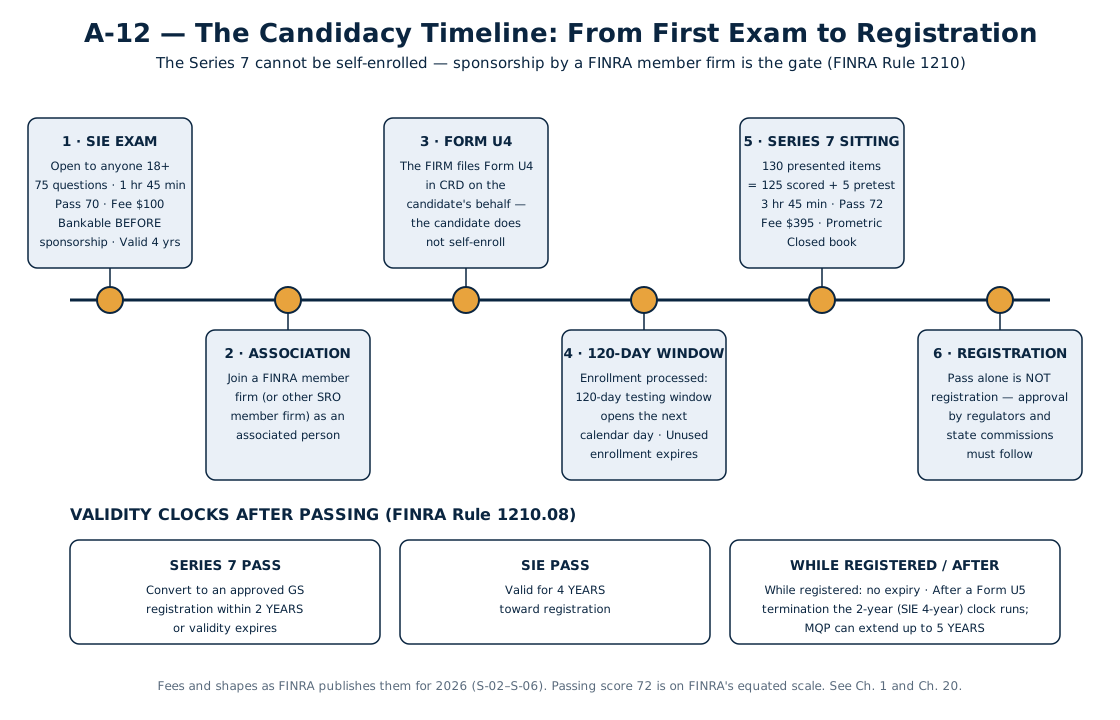 Figure A-12 — Candidacy timeline: SIE banked, association, Form U4, 120-day window, Series 7 sitting, registration approval, with validity clocks
Worked example — placing a window on a calendar (a designated calculation, family CALC-06). Suppose a firm's Form U4 filing for a candidate is processed on Monday, March 2, 2026, and no waiting period applies. The window begins on the next calendar day, Tuesday, March 3, 2026, and runs for 120 days. Counting March 3 as day 1: March contributes 29 window days (March 3 through March 31), April contributes 30 (59 in total), May contributes 31 (90 in total), and June contributes 30 more, reaching day 120 on June 30, 2026. The candidate must sit on or before June 30. Notice what the method is and is not. It is ordinary calendar counting from a stated start, using the actual lengths of the months involved — the only arithmetic this family of questions ever requires. It is not a rule that windows end on a fixed weekday, or that business days are counted instead of calendar days; FINRA publishes the window in calendar terms, and the example counts calendar days. In the chapter quiz you will place windows yourself from stated processing dates, and in Chapter 20 you will compose windows with retake waiting periods, where the dates matter even more.
What does sponsorship mean practically for the three kinds of reader this book serves? For the reader who is already hired or in training at a firm, it means your firm's licensing or compliance staff are part of your exam process: they file, they can see the window, and their internal deadlines may be shorter than FINRA's. Ask them, early, exactly when your window opens and what your firm expects if you need to reschedule inside it. For the reader who is seeking a position, it means the Series 7 itself cannot be your first credential move, because the move is not available to you yet — but the next section describes the one that is. For the reader whose firm is considering sponsoring them in the future, it means study done now is not wasted: the knowledge in this book does not expire when a study season ends, even though an enrollment window, once opened, does. Study ahead if you can; enroll when a firm files.
One more honesty belongs in this section. Whether the candidate or the firm actually hands over the examination fee is a matter of each firm's own policy and practice. FINRA publishes the fee; FINRA does not publish who pays it in any given workplace, and this book does not state a rule where none is published. What the book states is the amount, in Section 1.6, and the fact that each enrollment — a first attempt, a retake, or a re-enrollment after an expired window — is a separate enrollment at that fee.
Registration as a General Securities Representative requires passing two examinations: the Series 7 and the Securities Industry Essentials (SIE) exam. FINRA's rules state the pair as the requirement, and FINRA's Series 7 page calls the SIE a co-requisite: neither exam substitutes for the other, and passing only one of the two, by itself, completes nothing. A candidate may take the two in either order, and that freedom — combined with the SIE's very different eligibility rule — is what makes the pair workable.
The SIE is the mirror image of the Series 7's gate. FINRA publishes that the SIE is open to anyone aged 18 or older, including students and prospective candidates; association with a firm is not required to take it. An individual enrolls directly — FINRA describes a self-enrollment route through its test enrollment system, with scheduling at a Prometric test center or online — or, if the person is already associated with a firm, the firm may enroll them through the same CRD machinery used for other exams. The sitting, as FINRA currently publishes it, is 75 questions, multiple choice, in 1 hour and 45 minutes, with a passing score of 70, at a cost of $100 under the 2026 fee schedule. Keep its passing score separate from the Series 7's in your notebook: the SIE's published passing score is 70; the Series 7's is 72. Older material that gives the Series 7 a 70 percent pass mark is usually blending these two exams, or remembering the pre-2018 Series 7 described in the currency table — one more reason this book prints each exam's figures only inside that exam's own frame.
What does the SIE cover? At the level this book needs — because this book is a Series 7 book, not an SIE course — the SIE is a general-knowledge foundation exam: capital markets, products and their risks, trading and customer accounts and prohibited activities, and an overview of the regulatory framework. Its published section weights are FINRA's SIE facts, useful to a reader planning SIE study elsewhere, but the SIE's content is not this book's content, and no question in this book is an SIE question. The line matters in both directions. A reader who has passed the SIE will find this book's early chapters easier, because the vocabulary will not be new — but will still find the Series 7 far deeper, particularly in products, options, margin, and municipal securities, because depth is exactly what a representative-level exam adds to a general-knowledge foundation. A reader who has not taken the SIE should not wait to begin this book: the foundations chapters are written for a complete beginner, assuming no SIE, no finance degree, and no trading account.
The SIE fact with the longest reach is its validity clock. FINRA publishes that SIE results are valid for four years. A person may therefore pass the SIE today, spend the following seasons finishing school, seeking a position, or working in an unregistered role, and still have that pass count when a firm finally sponsors the Series 7 — provided the four years have not run out before an approved registration is obtained. FINRA adds the sentence that keeps this honest, and this book repeats it: passing the SIE alone does not qualify an individual for registration with a FINRA member firm or to engage in the securities business. The SIE is a bankable exam result. It is not a license, not a registration, and not permission to perform any representative function.
Put the two exams' architecture side by side and the system's logic becomes visible. The SIE is open because it certifies foundation knowledge and grants no authority; anyone may prove foundation knowledge. The Series 7 is gated because it is one of the two steps toward an actual registration, under a firm that will supervise the work; the industry does not examine unsponsored strangers for a license a firm must stand behind. Once you see that logic, the eligibility rules stop being trivia to memorize and become what the exam itself treats them as: the structure of entry into registered work.
Now the sitting itself, in FINRA's current published form, with nothing added and nothing remembered from older forms. The outline states the structure exactly: the exam consists of 125 multiple-choice items, and each item consists of four answer choices. Then comes the sentence beginners most often miss: each candidate's exam includes 5 additional, unidentified pretest items that do not contribute toward the candidate's score. The pretest items are randomly distributed throughout the exam. Therefore, in the outline's own arithmetic, each candidate's exam consists of a total of 130 items — 125 scored and 5 unscored.
Understand what a pretest item is, because the right understanding changes how you sit. Testing organizations develop new questions continuously, and before a new question may count against real candidates, it must be tried out on real sittings to gather evidence about whether it behaves fairly and measures what it should. Those tryout questions are the pretest items. They are unidentified — nothing on the screen marks them — so from the candidate's chair, a pretest item looks exactly like a scored item, may sit at any position, and may be easier or harder than the items around it. The only rational response is the one FINRA itself counsels: answer every item as if it counts, because you cannot know which five do not. A candidate who meets a baffling question at item 40 and decides it "must be a pretest" has made a guess about the exam's construction that the exam deliberately makes unguessable — and if the item was scored, the shrug costs exactly as much as any other unanswered or carelessly answered item. There is, in short, exactly one pretest skill: ignoring the pretest's existence while you work.
The time is 3 hours and 45 minutes — 225 minutes — for the examination itself. Your appointment includes 30 additional minutes beyond the examination time for the tutorial provided before the exam and the post-exam survey, so the block of time you will spend at the test center is longer than the testing time, and Chapter 20 builds your test-day plan on both numbers. The tutorial matters more than it looks: it teaches the computer interface — how to move between items, mark an item for review, and see your progress — before the clock that counts has started, and a candidate who treats it as dead time to click through is spending a free asset. The exam is closed book: candidates are not permitted to bring reference materials into the testing session. Everything the exam expects you to use — the rules, the relationships, the calculation methods — must be in your knowledge when you sit down, which is precisely what this book's calculation chapters are designed to build. (Details that FINRA's candidate publications in this book's source record do not state — such as a test-day calculator provision and identification and check-in mechanics — are not taught in this book until a primary record for them exists. No calculation in this book requires anything beyond four-function arithmetic and the methods the chapters teach, so nothing in your preparation depends on that open point.)
Scoring has three published features. First, the passing score is 72, as FINRA publishes it for this exam. Second, scores are equated: all candidate test scores are placed on a common scale using a statistical adjustment process known as equating, and every candidate is held to the same passing standard regardless of which set of exam items they received. Equating exists because different candidates receive different sets of items, and no two sets are perfectly identical in difficulty; the adjustment keeps the standard — the level of competency required — constant across sets. This is why, as the opening of this chapter said, the book never converts 72 into a number of correct answers on a particular set of items: on an equated scale, the same standard can correspond to slightly different raw results on different item sets, and FINRA publishes the standard, not a raw-count formula. Third, there is no penalty for guessing. The outline's counsel follows directly: candidates should attempt to answer all items. An item left blank earns exactly what a wrong answer earns, and a guessed answer earns more than a blank one whenever the guess is better than chance — which, after eliminating even one implausible choice, it usually is. Chapter 20 turns these three features into a pacing and review plan; Chapter 1 asks only that you record them correctly.
Worked example — pacing arithmetic (a designated calculation, family CALC-06). You have 225 minutes and 130 presented items. Dividing 225 by 130 gives about 1.73 minutes per item — roughly 1 minute and 44 seconds. No candidate should work to a per-item stopwatch; items vary enormously, and a long scenario item legitimately costs three minutes while a vocabulary item costs twenty seconds. The division's real use is checkpoints. At the halfway mark of your time — about 112 minutes in — a candidate pacing evenly would be near item 65. At 56 minutes in — one quarter of the time — near item 32 or 33. A candidate who reaches the time halfway mark at item 45 is not in a mystery; the arithmetic says they are about 20 items behind an even pace and must change something — work faster on recall items, mark and move past sink items, and protect the final review minutes. Chapter 20 works this checkpoint method in full, including what to do when the arithmetic delivers bad news early enough to act on. In the quiz you will compute a checkpoint yourself.
FINRA's outline organizes the exam into four functions — four statements of what a General Securities Representative actually does — and publishes both a percentage weight and an item count for each. This book prints them exactly as published, because they are the single most useful study-planning fact in the chapter: they tell you where the sitting lives.
Function: F1 · Published name: Seeks Business for the Broker-Dealer from Customers and Potential Customers · Share: 7% · Scored items: 9
Function: F2 · Published name: Opens Accounts After Obtaining and Evaluating Customers' Financial Profile and Investment Objectives · Share: 9% · Scored items: 11
Function: F3 · Published name: Provides Customers with Information About Investments, Makes Recommendations, Transfers Assets and Maintains Appropriate Records · Share: 73% · Scored items: 91
Function: F4 · Published name: Obtains and Verifies Customers' Purchase and Sales Instructions and Agreements; Processes, Completes, and Confirms Transactions · Share: 11% · Scored items: 14
Published name: Total · Share: 100% · Scored items: 125
Read the table as a job description, because that is what it is. Function 1 (9 items) is the search for business conducted lawfully: contacting customers and prospects, developing communications and advertising and getting them approved, describing products and services, and — in its second task — the whole primary-market story of how new securities are brought to market, which Chapter 3 teaches. Function 2 (11 items) is the opening of accounts: account types and registrations, the documents and information a firm must obtain, the customer investment profile, and the supervisory approvals that stand behind a new account. Function 4 (14 items) is the processing of business: quotes, orders, execution, settlement, confirmations, error and complaint handling, and margin. And Function 3 (91 items) is everything in the middle: informing customers about investments and strategies, knowing the products themselves in depth, making recommendations that meet the applicable standards, disclosing risks and costs, communicating about accounts, and transferring assets.
Sit with the proportion until it shapes your calendar. Function 3 is 73 percent of the scored exam — nearly three quarters of the sitting — and within it, the product-knowledge task is the largest single knowledge list in the outline. A Series 7 book is therefore, in the main, a products-and-recommendations book, with an accounts frame in front of it and a processing frame behind it — and that is exactly the shape of the book you are holding: Chapters 7 through 14 teach the products, Chapter 17 teaches analysis and recommendation-building, and Chapters 12 through 16 teach the calculations the product and account material requires. But resist the lazy conclusion that the other 27 percent is minor. Thirty-four scored items — Functions 1, 2, and 4 together — is more than a quarter of the exam, concentrated in rules and procedures that are highly learnable: communications approvals, account documentation, order types, settlement, margin mechanics. Candidates lose sittings on those frames more often than they expect, precisely because the product chapters felt more interesting. The practice architecture enforces the balance for you: this book's two full practice forms are assembled to FINRA's exact counts — 9, 11, 91, and 14 — and their scoring guidance reports your result function by function, so a weakness in a small function is visible rather than averaged away.
Beneath the functions, the outline numbers 14 tasks — two under Function 1, and four under each of Functions 2, 3, and 4 — each carrying a list of the knowledge a representative needs for that task and citations to the rules that knowledge comes from: FINRA rules, SEC rules, exchange rules, MSRB rules, sections of the Internal Revenue Code, ERISA, and Regulation T. This book's appendix crosswalk maps every one of the 14 tasks to the chapters that teach it. You do not need to memorize the task numbers. You do need the habit the outline models: every topic in this field hangs under a job function, is governed by identifiable rules, and can be traced to a source. When a later chapter names the rules behind a topic in its opening pages, it is following the outline's own architecture.
Money now, in the only amounts this book prints as candidacy facts — the two examination fees, each tied to its published schedule.
The Series 7 examination fee is $395 per enrollment, under FINRA's published Fee Adjustment Schedule for 2026 (the schedule adopted in FINRA's rule filing SR-FINRA-2024-019, approved in January 2025). FINRA's own examinations table prints the same $395, and the published schedule holds the fee at $395 through 2029. The SIE examination fee is $100 per attempt on the same schedule. Each enrollment is paid separately: a retake is a new enrollment at the full fee, a re-enrollment after an expired window is a new enrollment at the full fee, and FINRA publishes no discounted retake tier for its qualification exams. A candidate who sits the SIE once and the Series 7 once therefore faces published examination fees of $100 plus $395, or $495 in total — a designated calculation of family CALC-06, and the only fee arithmetic this book performs. Firm-side charges that appear in FINRA's wider fee schedule, state registration fees, fingerprinting charges, and the prices of any course or other book are not examination fees, are not uniform, and never print in this book as candidacy facts.
The fee is also this chapter's clearest lesson in datedness, so learn the lesson here where the stakes are a number you can check. The $395 figure is not what the Series 7 always cost. On FINRA's own schedule, the fee for 2024 and 2025 was $300; the proportional fee adjustment raised it effective January 1, 2026. A prep book printed in 2024, a website written in 2025, and a video recorded before the change will all tell you $300 — accurately for their moment, wrongly for yours. That is why every fee in this book carries its schedule year, and why Section 1.9 collects the superseded forms in one table. When a fact has a date, a careful candidate checks the date before checking the number.
Chapter 20 teaches this material in full, with worked calendars. Chapter 1 gives you the architecture, because a candidate plans better when the consequences of each outcome are visible from the start.
After a pass, the clock runs toward registration. A Series 7 pass must be converted into an approved General Securities Representative registration within two years of the exam date, or the exam's validity expires. The SIE pass has the matching rule with a longer fuse: four years to an approved registration. While a person remains registered, the qualification stays valid without an expiration date — the clocks matter at the edges of a career: between passing and registering, and after a registration ends. When a registration is terminated — reported by the firm on Form U5 — the same two-year clock for the Series 7 (and four-year clock for the SIE) runs from the termination date, within which the person must become registered again or the qualification lapses. FINRA's Maintaining Qualifications Program (MQP) offers eligible individuals a way to extend a terminated qualification's validity up to five years beyond termination, by meeting the program's conditions, which include continuing education. And continuing education is not decorative: a registered person who fails to complete required continuing education becomes CE-inactive, and that inactivity itself starts the validity countdown. The lesson for a new candidate is simple and worth writing down: the exam is not the finish line of a qualification — it is the start of a status that must be converted, maintained, and kept current.
Approval is its own step, and work waits for it. Even with both exams passed, a person performs no representative functions — no soliciting, no recommending, no taking of orders as a representative — until the registration is approved with all applicable regulators and state commissions. This is the discipline of Section 1.1 in operational form, and firms build their training sequences around it: study, administrative, and support work may precede approval, but registered activity follows it, never precedes it.
The state layer. The Series 7 and the SIE are FINRA qualification exams — part of the federal and SRO layer of registration. Most states additionally require an agent-level state-law examination, most commonly the NASAA Series 63, before an agent may act for a broker-dealer in that state. That is a separate requirement, run by a different organization, testing state securities law — and it is outside this book's content. This book names it here, once and plainly, so that no reader mistakes the FINRA qualification for the whole of being licensed to work in their state, and then returns to its own subject. Your firm's licensing staff will tell you exactly which state examinations and registrations your position requires.
After a failure, a dated wait — in two regimes. A candidate who fails may retake the exam, but not immediately, and the waiting period depends on how many times the candidate has failed and — unusually — on the calendar year, because FINRA has adopted an amendment that shortens the waits partway through this book's working life. Under the regime in force until January 18, 2027, the wait is 30 calendar days after the first failed attempt, 30 calendar days after the second, and 180 calendar days after the third and any subsequent failed attempt within a two-year period. From January 19, 2027, under Regulatory Notice 26-18, the waits shorten to 15, 15, and 60 days respectively. Attempts more than two years old drop out of the count. A wait attaches only to the exam that was failed: failing the SIE imposes no Series 7 wait, and failing the Series 7 imposes no SIE wait. Each retake is a fresh enrollment by the sponsoring firm, inside a fresh 120-day window, at the full $395 fee. This book prints both regimes with their dates everywhere the waits are stated, and never prints either regime as an undated rule — because a candidate who fails in December 2026 and a candidate who fails in February 2027 genuinely live under different clocks, and a book that hid that would mislead one of them. Chapter 20 works the calendar both ways, day by day.
Notice the design of the whole system as this section reveals it. Every stage has a clock: 120 days to sit, two years to convert a pass, four years for the SIE, 30 or 180 days to wait after a failure, five years at the outer edge of the MQP. Candidates who thrive in this system are not necessarily the fastest learners; they are the people who put the clocks in the notebook on day one and plan backwards from them. That is a habit this book will keep reinforcing, and it is the real subject of the opening scenario: the second notebook was not better because its writer was cleverer, but because its facts were current and its dates were in it.
The Series 7 has been given, in changing forms, since 1974, and FINRA restructured it fundamentally in 2018. A large shelf of books, courses, videos, and websites therefore describes — accurately, for their dates — examinations and market rules that no longer exist in those forms. Three of the changes in the table below happened recently enough that even conscientious recent material may carry the older form. This table is the book's defense, and it appears again in Chapter 20: every moved fact, in its current published form, beside the superseded form you are most likely to meet first elsewhere. No superseded form in the right-hand column is a live fact anywhere in this book; each appears only here and in Chapter 20's revisit, labeled as what it is — history.
| Fact | Current published form (this book prints) | Superseded form (history only) |
|---|---|---|
| Series 7 fee | $395 — 2026 schedule, held through 2029 | $300, the 2024–2025 fee; still older schedules printed less |
| Presented items | 130 = 125 scored + 5 pretest | 135 = 125 scored + 10 pretest, from an earlier outline generation |
| Whole form | 125 scored · 3 hours 45 minutes · passing score 72 · four functions | 260 items with 250 scored, two parts, six hours, a 70% standard, seven functions — the pre-October 2018 exam |
| SIE fee | $100 — 2026 schedule | $80 in 2024–2025 material; $60 in older material |
| Retake waits | 30 / 30 / 180 days until January 18, 2027, then 15 / 15 / 60 days from January 19, 2027 | Either regime stated without its dates |
| Day-trading margin | Intraday margin under FINRA Rule 4210 as amended in 2026 | The deleted pattern day trader framework, including its $25,000 minimum — Chapter 15 teaches the current rule |
| Settlement | T+1 — the standard cycle since May 28, 2024 | T+2 as the standard cycle, in pre-2024 material; T+3 beneath it |
| Outline edition | © 2025 Content Outline — 4 functions, 14 tasks | Any earlier outline's function map or task list |
Two study rules follow from the table. First, when a source disagrees with this book on a load-bearing fact, check the source's date before you check its confidence: a confident 2024 video about the fee is simply a 2024 video. Second, treat any undated statement of a datable fact — a wait, a fee, a settlement cycle — as unfinished: the fact may be right, but the statement has not shown you the one thing you need to trust it. The errata and currency page in this book's back matter lists the transitions a reader should re-verify at the time of use, with the January 19, 2027 retake change first, precisely because the habit of re-verification outlasts any single edition.
End the chapter with the fences, stated as plainly as the facts.
This book cannot sponsor you, enroll you, or register you. No book can. If you are not yet associated with a firm, this book's job for you is preparation — real, usable preparation, starting with the SIE-banking strategy of Section 1.4 — and its honesty about the gate is part of that preparation, not a discouragement from it. This book is not the SIE: it teaches the SIE's architecture as candidacy facts and teaches Series 7 content at Series 7 depth; it contains no SIE course and no SIE questions. It is not a state-law book: the Series 63 layer is named, not taught. It is not a principal's book: supervision is taught at the grain a representative needs — what approvals exist, what a supervisor reviews, what must be escalated — not at the depth of the supervisory exams. It contains no recalled or reconstructed exam questions: FINRA's examination questions are its confidential property, and every question in this book is original, written to the published outline. And it gives no investment, tax, or legal advice — not in its chapters and not in its worked scenarios. Suitability, recommendations, strategies, and tax treatment appear throughout this book as the regulatory knowledge the exam tests: what the rules require of a representative, stated in the rules' terms, about hypothetical customers inside scenarios. A scenario's correct answer is always the rule-conformant representative action — never a suggestion that you, the reader, should buy, sell, or hold anything. Keep that fence in view especially in Chapters 6, 16, and 17, where the material comes closest to real-world decisions.
What the book can do is teach the field whole, from zero, in the order a beginner can actually learn it. Part I (Chapters 1–3) builds the frame: this license, the markets, the regulators, and the primary market where securities are born. Part II (Chapters 4–6) builds the customer: communications, accounts, the investment profile, and suitability. Part III (Chapters 7–14) teaches the products and their mathematics — the 73 percent. Part IV (Chapters 15–17) teaches credit, tax, and analysis. Part V (Chapters 18–19) teaches trading and processing. Part VI (Chapter 20) returns to the sitting itself, now as a plan rather than a description. Every chapter ends with a 20-item quiz, and every quiz has a full answer key in its companion key file: the correct answer, a teaching explanation, and — for every wrong option — the specific reason it fails. Questions whose answers are computed rather than recalled are flagged as designated items and named to their calculation family; in this chapter, three quiz items are designated items of family CALC-06 (order, quote, and candidacy arithmetic), computed from the published figures of this chapter and nothing else. Beyond the chapters, the front matter carries a 50-item diagnostic that routes you to chapters by function, and the back of the book carries two full timed practice forms at the published shape — 130 presented items each, assembled to the exact function counts — plus a repair set for each function. Practice results throughout are raw counts with study guidance, stated against FINRA's published standard as guidance only, and never converted into a prediction of your equated result.
Choose your pace by your situation, using the study plans in the front matter. If no window is open yet, the standard plan spreads the book across about ten weeks and lets the calculation chapters breathe. If your firm has opened a window, the sponsored intensive plan is built for the working reality of studying inside 120 days while training. If you are retaking, the retake track is keyed to the waiting regime that actually applies to your dates — read Section 1.8 again before you choose. Whichever track is yours, the order is the book's order, and the notebook is the chapter's notebook: sponsorship first, both exams, every figure dated, and the clocks on the page from day one.
General Securities Representative (GS) — the registration this exam leads to. FINRA — the Financial Industry Regulatory Authority, the self-regulatory organization that owns the exam. SRO — self-regulatory organization. SIE — the Securities Industry Essentials exam, the Series 7's co-requisite. Form U4 — the registration application the sponsoring firm files in CRD. CRD — the Central Registration Depository. Testing window — the 120 days from a processed enrollment in which the candidate must sit. Pretest item — an unidentified, unscored tryout question; 5 appear in each sitting. Equating — the statistical adjustment placing all scores on a common scale. Prometric — FINRA's test-delivery vendor. MSRB — the Municipal Securities Rulemaking Board. OCC — the Options Clearing Corporation. Regulation T — the Federal Reserve's rule on initial credit for securities purchases. MQP — the Maintaining Qualifications Program, which can extend a terminated qualification's validity up to five years.
1. What is the correct description of the Series 7 examination? A. A state-law exam administered by NASAA for broker-dealer agents B. FINRA's General Securities Representative Qualification Examination, designed to assess the competency of entry-level General Securities Representatives C. An open enrollment exam that any individual may schedule directly to become registered D. A supervisory exam qualifying holders to manage a broker-dealer's branch offices
2. Which statement correctly states the Series 7 eligibility rule? A. Any person aged 18 or older may enroll, as association with a firm is not required B. A candidate must hold a college degree in finance before a firm may file for them C. Candidates must be associated with and sponsored by a FINRA member firm or other applicable SRO member firm; the firm enrolls the candidate D. A candidate may self-enroll if they first pass the SIE with a score above its passing score
3. How does enrollment for the Series 7 occur? A. The candidate creates an account in FINRA's test enrollment system and pays by card B. The sponsoring firm files Form U4 in CRD on the candidate's behalf, and the processed enrollment establishes a 120-day testing window C. The candidate's prep-course provider submits the enrollment as part of the course fee D. The candidate files Form U5 in CRD, which opens the testing window
4. A candidate's enrollment is processed but the candidate never schedules or sits during the window. What happens? A. The window pauses and resumes when the candidate is ready B. The window extends automatically by 30 days once C. The fee is credited in full toward any later enrollment D. The enrollment expires and the candidate must re-enroll, paying the examination fee again
5. Which statement about the SIE is correct? A. It is open to anyone aged 18 or older, association with a firm is not required, and passing it alone does not qualify an individual for registration B. It requires sponsorship by a FINRA member firm before a candidate may sit C. Passing it qualifies an individual to solicit securities business under a firm's supervision D. It is a co-requisite that a candidate must pass after the Series 7, in that order
6. What is the SIE sitting, as FINRA currently publishes it? A. 125 questions in 3 hours and 45 minutes, passing score 72, cost $395 B. 100 questions in 2 hours, passing score 72, cost $80 C. 75 questions in 1 hour and 45 minutes, passing score 70, cost $100 D. 75 questions in 1 hour and 45 minutes, passing score 72, cost $100
7. A candidate passes the SIE in March 2026 and is not yet associated with a firm. By when must that pass be converted into an approved registration before its validity expires? A. Within two years of the exam date B. Within four years of the exam date C. Within 120 days of the exam date D. It never expires once passed
8. What is presented to a Series 7 candidate in the sitting? A. 125 items, all of them scored B. 135 items: 125 scored and 10 unidentified pretest items C. 250 scored items presented in two parts D. 130 items: 125 scored and 5 unidentified pretest items randomly distributed, none of them marked
9. A candidate has 225 minutes for 130 presented items and wants a three-quarter checkpoint. At 168 minutes elapsed (three quarters of the time), at about which item should an evenly pacing candidate be? (CALC-06, designated) A. About item 65 B. About item 98 C. About item 130 D. About item 87
10. A firm's U4 filing for a candidate is processed on Friday, May 1, 2026, with no waiting period applicable. When does the 120-day testing window begin, and what is the last day of the window counting the beginning day as day 1? (CALC-06, designated) A. Begins May 1, 2026; last day August 28, 2026 B. Begins May 4, 2026; last day August 31, 2026 C. Begins May 2, 2026; last day August 29, 2026 D. Begins May 2, 2026; last day September 29, 2026
11. Which statement about the Series 7 passing score is correct? A. FINRA publishes the passing score as 72 on an equated scale, so every candidate is held to the same passing standard regardless of which set of items they received B. A candidate must answer a fixed published number of the 125 items correctly, and FINRA publishes that number C. The passing score is 70, the same as the SIE's D. Scores are reported as the percentage of presented items, including pretest items, answered correctly
12. A candidate is unsure of an item's answer with ten items remaining and five minutes left. What does the exam's published scoring counsel? A. Leave uncertain items blank, because wrong answers are penalized beyond a blank B. Answer every item; there is no penalty for guessing, and candidates should attempt to answer all items C. Answer only items in Function 3, which carries the most weight D. Spend the remaining time identifying which items are pretest items and skip those
13. What are the Series 7 examination fee and the SIE fee under FINRA's 2026 schedule? A. Series 7 $300 and SIE $80 B. Series 7 $395 and SIE $100 C. Series 7 $395 and SIE $80 D. Series 7 $300 and SIE $100
14. A candidate sits the SIE once and the Series 7 once, paying both examination fees. What is the total of the published examination fees? (CALC-06, designated) A. $380 B. $475 C. $495 D. $790
15. How are the 125 scored items distributed across FINRA's four published functions? A. F1 9, F2 11, F3 91, F4 14 B. F1 31, F2 31, F3 32, F4 31 C. F1 14, F2 91, F3 11, F4 9 D. F1 9, F2 14, F3 11, F4 91
16. Which statement correctly states the scope of a GS registration obtained in 2020? A. It qualifies the holder for the solicitation, purchase, and sale of all securities products, including municipal sales to and purchases from customers; structuring municipal underwritings requires the Series 52 registration B. It qualifies the holder for all securities and municipal activities, including structuring municipal underwritings C. It qualifies the holder only for corporate securities and mutual funds D. It qualifies the holder to supervise other representatives and approve their communications
17. A candidate has passed both the SIE and the Series 7, but the registration has not yet been approved. What may the candidate do? A. Solicit customers, provided a registered supervisor reviews each recommendation the same day B. Take orders from customers the candidate already knows personally C. Perform no representative functions — no solicitation — until the registration is approved with all applicable regulators and state commissions D. Make recommendations but not accept orders until approval
18. Under the retake regime in force until January 18, 2027, what are the waiting periods after a first, second, and third failed attempt within two years? A. 15, 15, and 60 days B. 30, 30, and 180 days C. 30, 60, and 90 days D. No wait, 30 days, and 180 days
19. Which statement about the state layer is correct? A. The Series 7 satisfies all state requirements for agents in every state B. Most states additionally require a state-law exam for agents, most commonly the NASAA Series 63 — a separate requirement outside this book's content C. States may not impose any requirement beyond the FINRA qualification D. The Series 63 is a FINRA exam that forms part of the Series 7 sitting
20. Which statement correctly bounds this book? A. Completing this book enrolls the reader with FINRA and guarantees a sitting date inside 120 days B. This book's questions are drawn from actual Series 7 sittings so readers can rehearse real items C. This book is an independent study aid, not affiliated with FINRA; its items are original and written to FINRA's published outline, and it teaches suitability and tax topics as regulatory knowledge, never as advice to the reader D. This book's practice scores predict a reader's result on the equated real exam
Tags: [Function / Topic — Ch. 1] · Designated items marked CALC-06 per this book's designated-exercise register; all other items KI. All items original. Sources: FINRA Series 7 Content Outline © 2025 (S-01); FINRA Series 7 exam page (S-02); FINRA SIE exam page (S-03); FINRA Fee Adjustment Schedule, SR-FINRA-2024-019 (S-04); FINRA Regulatory Notice 26-18 (S-05); FINRA Exam Credit and Validity / FAQ (S-06); FINRA Qualification Exams index (S-16).
1. Key: B — FINRA's General Securities Representative exam for entry-level representatives. The outline states the exam assesses the competency of entry-level General Securities Representatives. (§1.1; S-01, S-02.) [F-frame / The qualification — Ch. 1] · KI
2. Key: C — Association and sponsorship by a member firm are required. FINRA publishes that candidates must be associated with and sponsored by a FINRA member firm or other applicable SRO member firm to take representative-level exams. (§1.3; S-02.) [F-frame / Sponsorship — Ch. 1] · KI
3. Key: B — The firm files Form U4 in CRD; the processed enrollment establishes a 120-day window. (§1.3; S-05.) [F-frame / Enrollment — Ch. 1] · KI
4. Key: D — The enrollment expires; the candidate must re-enroll and pay the fee again. FINRA states that an individual who does not take the exam in the 120-day window must re-enroll. (§1.3; S-05.) [F-frame / Testing window — Ch. 1] · KI
5. Key: A — The SIE is open at 18+, needs no firm, and alone qualifies no one. FINRA publishes all three parts of that statement together. (§1.4; S-03.) [F-frame / SIE — Ch. 1] · KI
6. Key: C — SIE: 75 questions, 1 hour 45 minutes, passing score 70, cost $100. (§1.4; S-03, S-04, S-16.) [F-frame / SIE sitting — Ch. 1] · KI
7. Key: B — Four years for the SIE. A pass must be converted into an approved registration within four years (SIE) — the Series 7's period is two years. (§§1.4, 1.8; S-06.) [F-frame / Validity — Ch. 1] · KI
8. Key: D — 130 presented: 125 scored plus 5 unidentified pretest items. The outline states the pretest items are randomly distributed and do not contribute to the score. (§1.5; S-01.) [F-frame / The sitting — Ch. 1] · KI
9. Key: B — About item 98. Three quarters of 130 presented items is 0.75 × 130 = 97.5, so an evenly pacing candidate at 168 minutes (0.75 × 225) is at about item 98. (§1.5; S-01.) [F-frame / Pacing — Ch. 1] · CALC-06 (designated)
10. Key: C — Begins May 2, 2026; last day August 29, 2026. The window begins the next calendar day after processing (May 2). Counting May 2 as day 1: May 2–31 = 30 days, June = 30 (60), July = 31 (91), and day 120 falls on August 29. (§1.3; S-05.) [F-frame / Testing window — Ch. 1] · CALC-06 (designated)
11. Key: A — 72 on FINRA's equated scale, the same standard for every item set. FINRA places all scores on a common scale through equating so every candidate is held to the same passing standard regardless of the items received. (§1.5; S-01, S-02.) [F-frame / Scoring — Ch. 1] · KI
12. Key: B — Answer all items; there is no penalty for guessing. The outline counsels candidates to attempt to answer all items. (§1.5; S-01.) [F-frame / Scoring — Ch. 1] · KI
13. Key: B — Series 7 $395; SIE $100 (2026 schedule). FINRA's Fee Adjustment Schedule (SR-FINRA-2024-019) sets both figures for 2026 and holds the Series 7 fee through 2029. (§1.7; S-04, S-16.) [F-frame / Fees — Ch. 1] · KI
14. Key: C — $495. $100 (SIE) + $395 (Series 7) = $495 in published examination fees for one attempt at each. (§1.7; S-04.) [F-frame / Fees — Ch. 1] · CALC-06 (designated)
15. Key: A — F1 9, F2 11, F3 91, F4 14. FINRA publishes both the percentages (7/9/73/11) and these item counts, totaling 125. (§1.6; S-01, S-02.) [F1–F4 / Function weights — Ch. 1] · KI
16. Key: A — All securities products, with the municipal limit as stated. FINRA's permitted-activities statement includes municipal sales to and purchases from customers for post-November 7, 2011 registrations; broader municipal work, including structuring underwritings, requires the Series 52. (§1.1; S-02.) [F-frame / Permitted activities — Ch. 1] · KI
17. Key: C — No representative functions until registration is approved. Passing both exams does not itself register the candidate; solicitation waits for approval with all applicable regulators and state commissions. (§§1.1, 1.8; S-06.) [F-frame / Registration approval — Ch. 1] · KI
18. Key: B — 30, 30, and 180 days under the regime in force until January 18, 2027. (§1.8; S-05.) [F-frame / Retakes — Ch. 1] · KI
19. Key: B — Most states additionally require a state-law exam, most commonly the NASAA Series 63. That layer is separate from the FINRA qualification and outside this book's content. (§1.8; S-06.) [F-frame / State layer — Ch. 1] · KI
20. Key: C — An independent, original-item study aid that teaches topics as regulatory knowledge, never advice. (§1.10; S-01.) [F-frame / Book fences — Ch. 1] · KI
End of the free sample. The complete book continues from here — the full A-to-Z course in book form, delivered as an EPUB you can read in Apple Books, Google Play Books, ReadEra, Thorium Reader, Adobe Digital Editions, or Send to Kindle.
Buy this ebook — $11.99 Back to the book page
Payments are securely processed by Payhip.