
Mastering Careers & Skills
College Admission Test (SAT) · free sample from the book itself
Q1. Key: A. The full test carries 98 questions (54 Reading and Writing + 44 Math) and 134 minutes of testing (64 + 70), with the 10-minute break outside that count (Source: College Board, 2026-27 SAT Weekend Student Guide). B is wrong because 144 minutes folds the 10-minute break into testing time. C is wrong because 108 questions adds questions the published form does not carry. D is wrong because it states only the Reading and Writing section, not the full test. [Tag: FND-1 · Test structure — sections, modules and clocks]
Q2. Key: C. The sections run in a fixed order — Reading and Writing first (Modules 1 and 2), then the break, then Math (Modules 1 and 2) — and each section's two modules run consecutively (Source: College Board, 2026-27 SAT Weekend Student Guide). A is wrong because it reverses the section order. B is wrong because it interleaves the sections, which the published form never does. D is wrong because each module is separately timed under its own clock. [Tag: FND-1 · Test structure — section and module order]
Q3. Key: B. Multistage adaptive means each section has two modules and Module 1 performance sets the difficulty of Module 2 in that same section (Source: College Board, 2026-27 SAT Weekend Student Guide). A is wrong because adaptation happens at module level, not question by question. C is wrong because students never choose their routing. D is wrong because the test's length and clocks are fixed; speed does not lengthen it. [Tag: FND-1 · Test structure — multistage adaptation]
Q4. Key: B. Each real Math module carries 20 operational questions and 2 pretest questions, for 22 in the module and 44 in the section (Source: College Board, Math Specifications – SAT Suite). A is wrong because it denies the pretest items College Board publishes. C is wrong because it invents a 4-item pretest count found in no specification. D is wrong because 25 operational + 2 pretest is the Reading and Writing module's split, not Math's. [Tag: FND-1 · Test structure — operational and pretest questions]
Q5. Key: D. Pretest questions cannot be told apart from operational ones, so the only sound conduct is best work on every question (Source: College Board, 2026-27 SAT Weekend Student Guide). A is wrong because an unusual feel proves nothing about a question's status, and skipping scored questions costs real performance. B is wrong because College Board publishes no rule that pretest items are always hard. C is wrong because time spent sorting suspected pretest items is time stolen from questions that certainly count. [Tag: FND-1 · Test conduct — pretest discipline]
Q6. Key: B. Inside a module a student may move back and forth and review until time expires (Source: College Board, "What to Expect on Test Day"). A is wrong because a module cannot be left early to bank time in the next module; each module is separately timed. C is wrong because once a module is left it cannot be re-entered. D is wrong because the only scheduled break is the one between the sections. [Tag: FND-1 · Test conduct — in-module review]
Q7. Key: B. The four Reading and Writing domains are Craft and Structure, Information and Ideas, Standard English Conventions, and Expression of Ideas (Source: College Board, Reading and Writing Specifications – SAT Suite). A is wrong because those are the four Math domains. C is wrong because it lists skills that live inside domains, not the domains themselves. D is wrong because those are the four passage subject areas, not content domains. [Tag: FND-1 · Content domains — Reading and Writing]
Q8. Key: C. Words in Context, Text Structure and Purpose, and Cross-Text Connections are the testing points of Craft and Structure (Source: College Board, Reading and Writing Specifications – SAT Suite). A is wrong because Information and Ideas holds Central Ideas and Details, Command of Evidence, and Inferences. B is wrong because Expression of Ideas holds Transitions and Rhetorical Synthesis. D is wrong because Standard English Conventions holds Boundaries and Form, Structure, and Sense. [Tag: FND-1 · Craft and Structure — domain membership]
Q9. Key: A. Boundaries and Form, Structure, and Sense are the two testing points of Standard English Conventions (Source: College Board, Reading and Writing Specifications – SAT Suite). B is wrong because Craft and Structure tests vocabulary, structure and cross-text skills, not sentence correctness. C is wrong because Information and Ideas tests what a text says and supports, not how its sentences are built. D is wrong because Expression of Ideas tests transitions and synthesis for a rhetorical goal. [Tag: FND-1 · Standard English Conventions — domain membership]
Q10. Key: D. About 25% of Math questions use the student-produced response format, in which the student produces the answer (Source: College Board, "Student-Produced Responses"). A is wrong because it understates the published share by more than half. B is wrong because it doubles the published share. C is wrong because about 75% is the multiple-choice share, not the SPR share. [Tag: FND-1 · Math format — multiple-choice and SPR shares]
Q11. Key: A. Each section scores 200 to 800 and the total is their sum, 400 to 1600 (Source: College Board, Understanding Scores for Students and Families — SAT Weekend, Fall 2026). B is wrong because it halves every published range. C is wrong because no section starts at 400 and no total starts at 800. D is wrong because a total cannot start at 200 when each of its two sections starts at 200. [Tag: FND-1 · Scoring — section and total scales]
Q12. Key: B. College Board publishes that scores depend on whether questions are answered right or wrong, the difficulty level of the questions, and the probability the answer pattern suggests guessing (Source: College Board, 2026-27 SAT Weekend Student Guide). A is wrong because it omits difficulty and guessing probability, both part of the published model. C is wrong because speed is not a published scoring factor. D is wrong because pretest questions do not count toward the score at all, so finding them cannot enter scoring. [Tag: FND-1 · Scoring — published scoring model]
Q13. Key: C. College Board defines its benchmarks as predicting a 75% likelihood of earning a C or higher in related first-semester, credit-bearing college courses, with at-or-above meaning on track (Source: College Board, Understanding Scores for Students and Families — SAT Weekend, Fall 2026). A is wrong because colleges set their own policies; a benchmark is not any college's requirement. B is wrong because the test has no passing score — College Board publishes no pass mark. D is wrong because a benchmark is a readiness definition, not an average of admitted students. [Tag: FND-1 · Scoring — benchmarks in their published definition]
Q14. Key: C. The embedded calculator is available for the entire Math section with a graphing/scientific toggle, an approved handheld in the generic non-CAS class is the alternative, and no calculator is used during Reading and Writing (Source: College Board, SAT Suite of Assessments Calculator Policy). A is wrong because calculator use is barred during Reading and Writing. B is wrong because it erases the embedded calculator College Board provides. D is wrong because CAS calculators are prohibited, cleared memory or not. [Tag: FND-1 · Calculator policy — availability and class]
Q15. Key: B. A student who needs a borrowed device must register and request at least 30 days before the test date; the loan is free of charge and availability is not guaranteed (Source: College Board, 2026-27 SAT Weekend Student Guide). A is wrong because no check-in handout is published; the request runs ahead of test day. C is wrong because the test is never taken on a mobile phone. D is wrong because the request is the student's own, made at registration, not a school's test-day act. [Tag: FND-1 · Test-day readiness — device borrowing]
Q16. Key: A. All Weekend deadlines expire at 11:59 p.m. Eastern Time (Source: College Board, "SAT Suite Test Dates and Deadlines"). B is wrong because the deadline is set in Eastern Time for every student, not localized. C is wrong because it moves the deadline almost seven hours earlier than published. D is wrong because Pacific Time plays no part in the published rule. [Tag: FND-1 · Registration — deadline pattern]
Q17. Key: D. The single scheduled break lasts 10 minutes, sits between the sections, the device is left open, and ID is kept on the person and checked on re-entry (Source: College Board, "What to Expect on Test Day"). A is wrong because phones stay put away during breaks as well, and accessing one can bring dismissal. B is wrong because the break is 10 minutes and an unscheduled break loses testing time rather than stopping the clock. C is wrong because no module may be previewed or entered before its time. [Tag: FND-1 · Test conduct — the break]
Q18. Key: B. This book scores its tests by raw counts and domain trackers only — items correct and accuracy per domain, compared across the diagnostic and Tests 1 to 3 — and never converts practice performance to the official scale, because a printed nonadaptive form cannot be equated to it. A is wrong because no conversion table exists anywhere in this book. C is wrong because readers are never ranked against each other. D is wrong because an estimated range is still a conversion claim, and the book makes none. [Tag: FND-1 · Print-medium method — domain scoring]
Q19. Key: A. The label is honest because the real test adapts at module level inside its application and no printed form can reproduce that adaptation; the book's tests hold the published counts, proportions and clocks as fixed forms instead. B is wrong because the book's tests contain no pretest items — all 98 are explained practice. C is wrong because the book's tests use exactly the published section and module counts. D is wrong because adaptation is a published, central feature of the real test. [Tag: FND-1 · Print-medium method — nonadaptive simulations]
Q20. Key: B. The photo must be uploaded at least five days before the test (Source: College Board, 2026-27 SAT Weekend Student Guide). A is wrong because test day is far past the published deadline. C is wrong because 30 days is the device-borrowing request lead time, a different rule. D is wrong because seven weeks is the accommodations request lead time, also a different rule. [Tag: FND-1 · Registration — photo and setup deadlines]
Simplify first. The SAT is College Board's college admission test: a single examination, taken in one sitting, that measures the reading, writing and mathematics knowledge and skills that matter most for college and career readiness (Source: College Board, 2026-27 SAT Weekend Student Guide). A section is one of the test's two large parts. A module is one of the two separately timed halves inside each section. A content domain is one of the eight published areas of knowledge the test measures — four in each section. Those four words — test, section, module, domain — organize everything in this book, so learn them now and the rest of the chapter will read easily.
The test has two sections, always in the same order: first Reading and Writing, then Math (Source: College Board, 2026-27 SAT Weekend Student Guide). Reading and Writing carries 54 questions in 64 minutes. Math carries 44 questions in 70 minutes. That is 98 questions and 134 minutes — 2 hours 14 minutes — of testing, with one 10-minute break between the sections (Source: College Board, "What to Expect on Test Day"). Each section is divided into two equal-length, separately timed modules: Reading and Writing Modules 1 and 2 run 32 minutes each, and Math Modules 1 and 2 run 35 minutes each (Source: College Board, Reading and Writing Specifications – SAT Suite; Source: College Board, Math Specifications – SAT Suite).
The SAT is one test inside the SAT Suite of Assessments, College Board's integrated system of tests that measure the same skills and knowledge in grade-appropriate ways on a common score scale, so the same section score represents the same achievement level on any Suite test (Source: College Board, Understanding Scores for Students and Families — SAT Weekend, Fall 2026). The SAT itself serves grades 11–12. This book prepares you for the SAT only. It is not a book for any other Suite test, it teaches no other test's rules or scales, and the front matter's Exam Blueprint page carries the full Suite map. What matters for your studying is simpler: the skills this book teaches — reading short academic texts with discipline, controlling the English sentence, and working with algebra and data — are the skills the test measures, and every chapter after this one builds one of them.
Meet the three readers who will study alongside you. Maya is in the foundation band: her diagnostic showed that sentence boundaries and one-variable equations are her constraint, so she works the foundations chapters in full before she rushes to craft. Devon is in the middle band: he is a strong reader, and pacing and Advanced Math are his risk. Sofia is in the high band: she is near her personal goal, and Module 1 discipline and data-inference items are her margin. None of them is given a target score in this book, because a personal goal is something a reader chooses from their own evidence and each college's own current published policy — it is never a number a book assigns. You will meet all three again, in their errors and their repairs, and their progress will be reported the way this book reports yours: in items, accuracy by domain, and pacing — never in scale points. Section 1.5 explains why.
One more framing fact before the details. The current test is the digital SAT: you take it in College Board's testing application on an approved device — never a mobile phone — at a test center on a published Weekend date, after registering online through My SAT with a free College Board account (Source: College Board, 2026-27 SAT Weekend Student Guide). There is no paper version of the standard Weekend test for you to choose between, and no separate essay section in Weekend testing. Everything in this chapter — the clocks, the tools, the room, the rules — describes that one digital Weekend sitting.
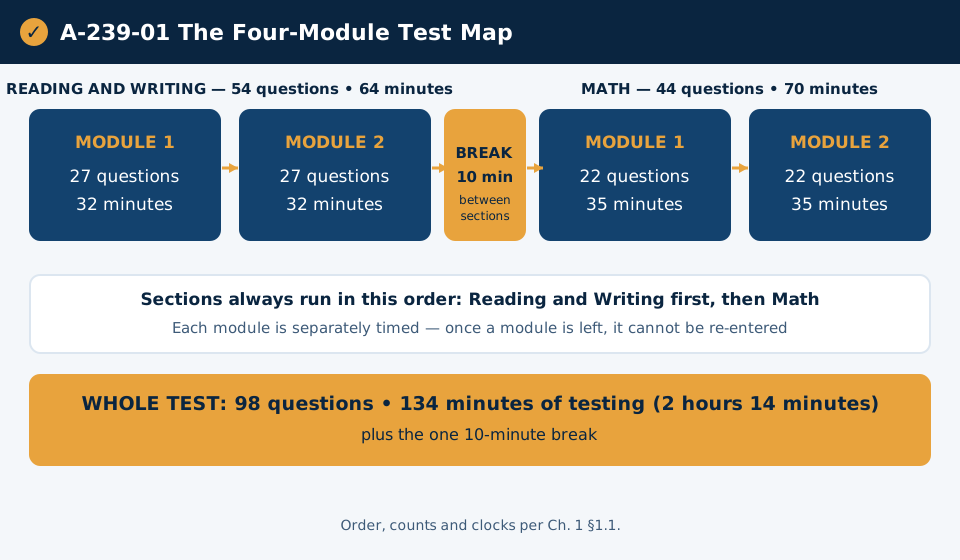
Figure A-239-01. The four-module test map: Reading and Writing Modules 1 and 2, the 10-minute break, then Math Modules 1 and 2 — 98 questions and 134 minutes of testing in the order the sitting runs them.
The test is multistage adaptive: each section is divided into two modules, and how you perform in Module 1 of a section sets the difficulty of Module 2 in that section (Source: College Board, 2026-27 SAT Weekend Student Guide). Read that sentence carefully, because it is the whole of what College Board publishes about routing, and this book teaches no more than it publishes. There is no published threshold — no number of correct answers that guarantees one route or the other — and this book prints none. What the published principle supports is conduct, and conduct is what you can control: accuracy in Module 1 matters because it sets the difficulty you are scored on next, so Module 1 deserves your steadiest work, your full attention, and a review pass before the module closes. A harder Module 2 is the published sign that the routing worked in your favor; an easier-feeling Module 2 is not a disaster to mourn mid-test, because mourning costs the questions still in front of you. Chapter 26 (EX-2) turns this principle into a full protection routine.
Inside a module, you may move back and forth and review until time expires; once you leave a module, you cannot return to it (Source: College Board, "What to Expect on Test Day"). That single rule shapes honest practice. In this book's timed tests you will rehearse exactly that discipline: finish a module, check it with the time that remains inside it, submit it, and let it go. The testing application supports that work with published tools, named here as College Board names them and taught as conduct in Chapter 26: mark for review, which flags a question to revisit before the module closes; a testing timer, which you may hide and which alerts you at five minutes remaining, after which it cannot be hidden; a line reader; highlights and notes on non-math questions; an option eliminator, which lets you cross out choices you have ruled out; a question menu; and, for Math, a reference sheet of common formulas (Source: College Board, 2026-27 SAT Weekend Student Guide). This book never draws or describes the application's screens; you will learn the real screens, free, in College Board's own test preview and practice tests, which the Exam Blueprint page names.
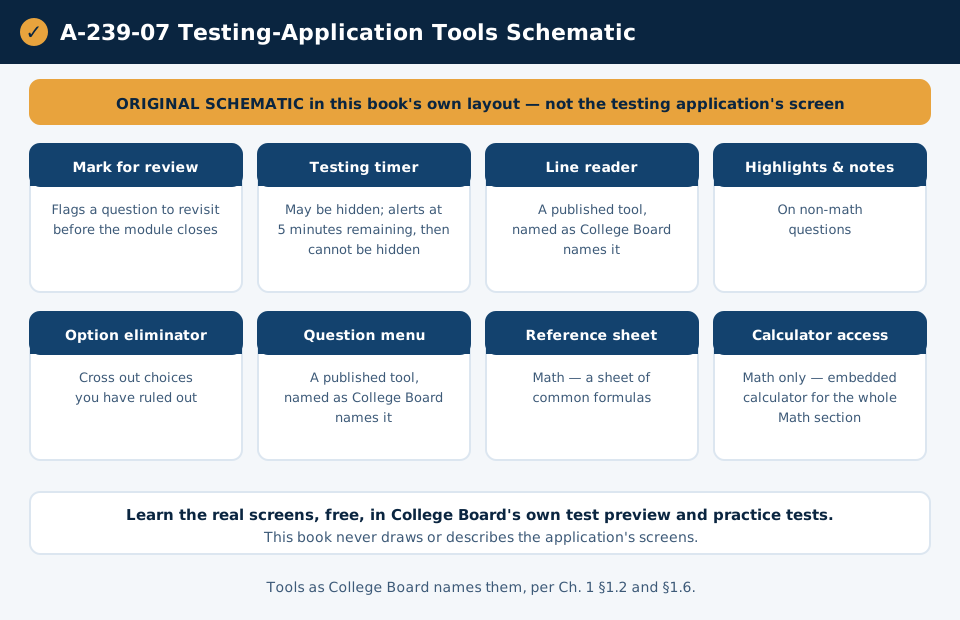
Figure A-239-07. Testing-application tools schematic: the published tools as labeled cards in this book's own layout. It is an original schematic, not the testing application's screen, and it draws no calculator interface.
Now the questions that do not count. In each real Reading and Writing module, 25 questions are operational — they count toward your score — and 2 are pretest questions, which do not count toward your score (Source: College Board, Reading and Writing Specifications – SAT Suite). In each real Math module, 20 questions are operational and 2 are pretest (Source: College Board, Math Specifications – SAT Suite). Pretest questions cannot be told apart from operational ones. That fact supports exactly one conduct rule, and Maya learns it early because she was tempted to break it: never hunt for pretest items on the real test. A question that feels odd, easy or hard is still a question to answer with your best work, because you cannot know which kind it is, and time spent guessing at a question's status is time stolen from questions that certainly count. This book's own tests contain no pretest items at all — every item in them is your practice and is explained — and Chapter 1.5 returns to that difference, because it is part of this book's honesty about what print can and cannot do.
Questions inside each module are arranged with similar skills grouped, and within a group they run from easier to harder, as College Board publishes the form (Source: College Board, 2026-27 SAT Weekend Student Guide). That arrangement is a pacing gift if you use it calmly: early questions in a group are the ones to bank accurately and efficiently, and the hardest questions sit late, where you should expect them and budget for them rather than being surprised by them.
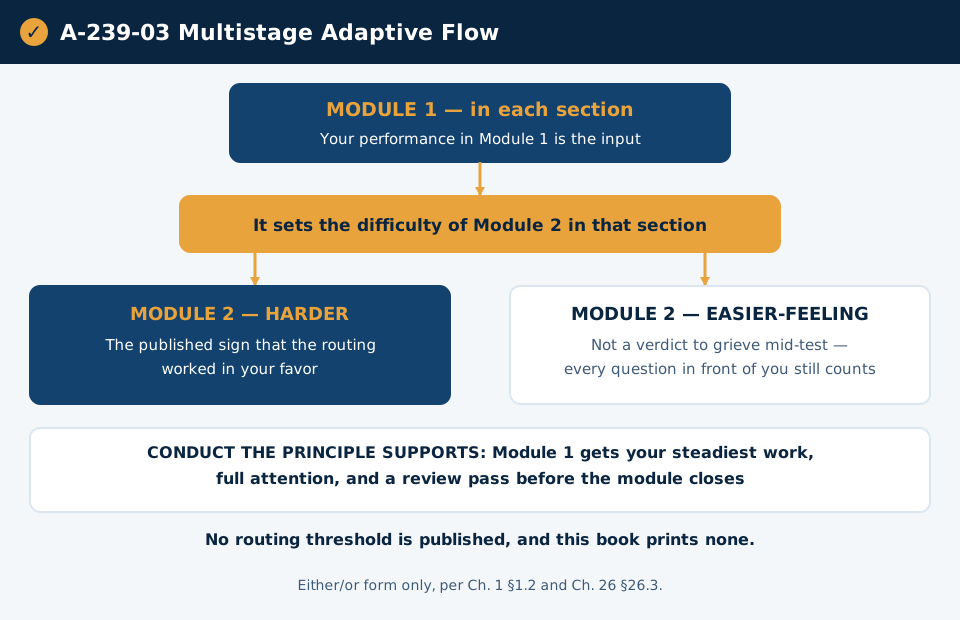
Figure A-239-03. Multistage adaptive flow: Module 1 performance routes Module 2 difficulty — harder is the published sign the routing worked in your favor; easier-feeling is no verdict. No threshold is shown, because none is published.
Your score report will describe your performance across eight content domains, four per section (Source: College Board, Understanding Scores for Students and Families — SAT Weekend, Fall 2026). This book is organized on the same map, so learn the names now; every chapter quiz, diagnostic tracker and repair set in this book speaks this language.
In Reading and Writing, the four domains are these. Craft and Structure (about 28% of the section) covers Words in Context, Text Structure and Purpose, and Cross-Text Connections. Information and Ideas (about 26%) covers Central Ideas and Details, Command of Evidence in its textual and quantitative forms, and Inferences. Standard English Conventions (about 26%) covers Boundaries and Form, Structure, and Sense. Expression of Ideas (about 20%) covers Transitions and Rhetorical Synthesis (Source: College Board, Reading and Writing Specifications – SAT Suite). The passages themselves are short — 25 to 150 words per stimulus text or pair of texts — each passage carries a single question, some questions come with an informational graphic such as a table or graph, and the passages represent four subject areas: literature, history/social studies, the humanities and science (Source: College Board, "The SAT Reading and Writing Section"; Source: College Board, 2026-27 SAT Weekend Student Guide). Chapters 8 to 15 teach these domains one skill family at a time, and Chapters 2 to 4 build the reading and sentence foundations underneath them.
In Math, the four domains are these. Algebra (about 35% of the section) covers linear equations in one variable, linear equations in two variables, linear functions, systems of two linear equations in two variables, and linear inequalities in one or two variables. Advanced Math (about 35%) covers equivalent expressions, nonlinear equations in one variable and systems of equations in two variables, and nonlinear functions. Problem-Solving and Data Analysis (about 15%) covers ratios, rates, proportional relationships and units; percentages; one-variable data; two-variable data; probability and conditional probability; inference from sample statistics and margin of error; and evaluating statistical claims. Geometry and Trigonometry (about 15%) covers area and volume; lines, angles and triangles; right triangles and trigonometry; and circles (Source: College Board, Math Specifications – SAT Suite). Math questions come in two formats: about 75% are four-option multiple-choice questions, and about 25% are student-produced response questions, in which you produce the answer yourself instead of choosing it (Source: College Board, "Student-Produced Responses"). About 30% of Math questions are set in context — science, social studies or real-world scenarios (Source: College Board, 2026-27 SAT Weekend Student Guide). Chapters 16 to 24 teach the Math domains, and Chapters 5 to 7 build the quantitative, algebra and data foundations underneath them.
Notice what the map gives you as a student. A weak result is never just "I am bad at Math." It is a domain, and usually a skill inside a domain — Maya's one-variable equations sit inside Algebra; Sofia's data-inference margin sits inside Problem-Solving and Data Analysis — and a named skill can be taught, drilled and repaired. That is why this book scores everything by domain and why your diagnostic, taken before Chapter 2, reports eight domain results instead of one blur.
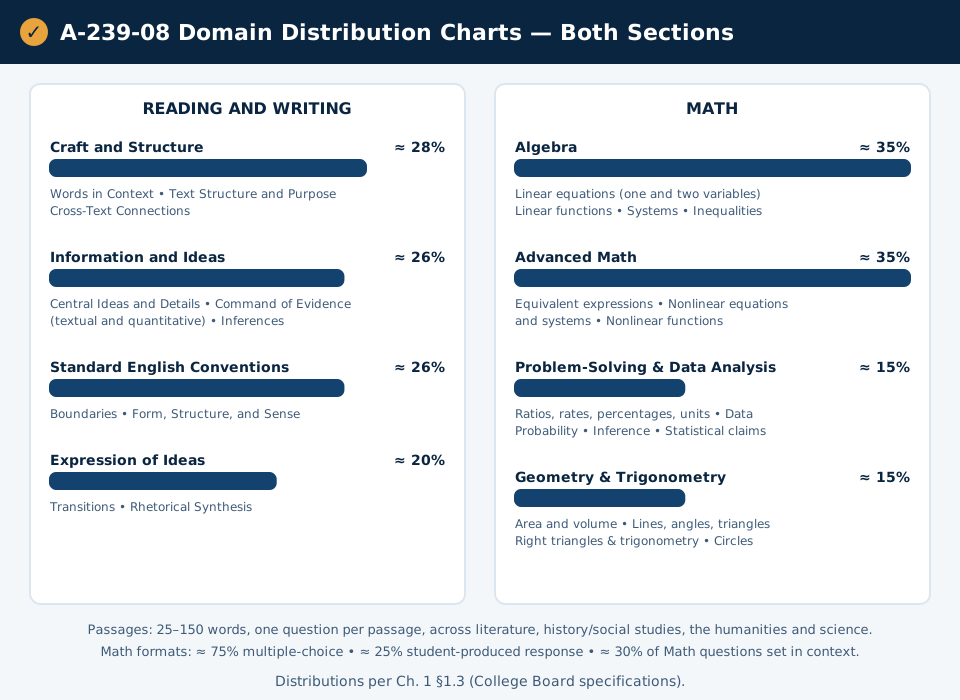
Figure A-239-08. Domain distribution charts, both sections: the eight published domains at their published shares, with the skill families each domain carries.
You receive two section scores, each from 200 to 800 — one for Reading and Writing, one for Math — and a total score that is their sum, from 400 to 1600 (Source: College Board, Understanding Scores for Students and Families — SAT Weekend, Fall 2026). Scoring reflects whether questions are answered right or wrong, the difficulty level of the questions, and the probability that the answer pattern suggests guessing — the model College Board publishes, stated here in College Board's published terms and no stronger (Source: College Board, 2026-27 SAT Weekend Student Guide). Two practical consequences follow. First, because difficulty is part of the model, the adaptive design of Section 1.2 is not decoration: the questions you earn in Module 2 are part of how your performance is measured. Second, College Board's own advice is that for most students it is better to guess than to leave a question blank, especially after eliminating one or two wrong answers — so the conduct rule in every module of this book is simple: no question is left blank. Devon, whose risk is pacing, practices this rule hardest: a question he must leave is a question he first narrows and guesses, in seconds, rather than abandoning.
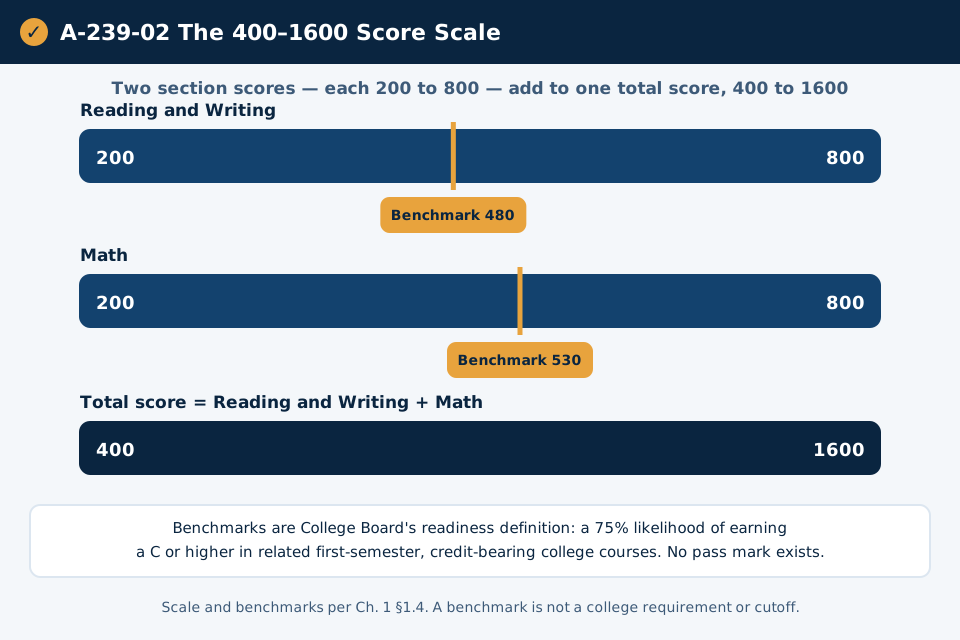
Figure A-239-02. The 400–1600 score scale: the two 200–800 section scores that sum to the total, with the College and Career Readiness Benchmarks (480 and 530) marked in College Board's readiness definition only.
Your score report shows more than the three numbers. It shows percentiles — where your performance stands relative to a comparison group, displayed on the report itself — and a Knowledge and Skills display: your performance across the eight content domains, with each domain's approximate question count and share of its section (Source: College Board, Understanding Scores for Students and Families — SAT Weekend, Fall 2026). Chapter 25 (EX-1) teaches you to read that report field by field and to turn it into a study plan. For now, hold the shape of it: the report is a map in the same eight-domain language as this book, which is deliberate — the diagnostic you take in this book speaks that language from day one, so the real report will already be familiar when it arrives.
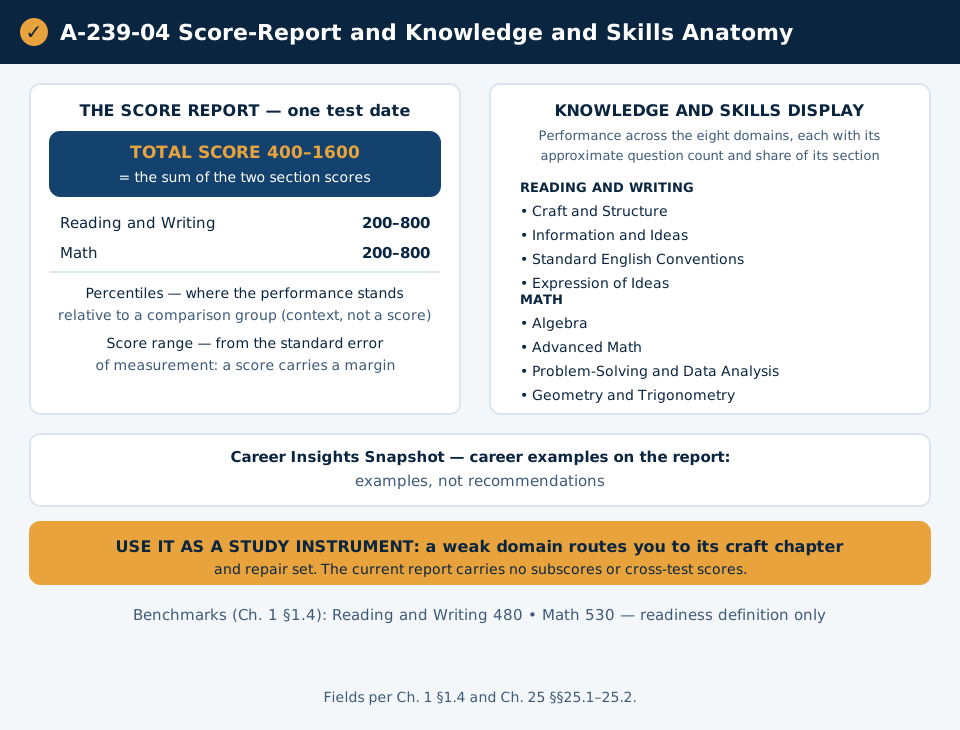
Figure A-239-04. Score-report and Knowledge and Skills anatomy: the report's headline scores, percentiles and score range on the left; the eight-domain Knowledge and Skills display — the study instrument — on the right.
One threshold statement is cleared to print in this book, and it prints only in College Board's own definition. College Board publishes College and Career Readiness Benchmarks — Reading and Writing 480 and Math 530 — defined as predicting a 75% likelihood of earning a C or higher in related first-semester, credit-bearing college courses, with students at or above a benchmark considered on track for college readiness (Source: College Board, Understanding Scores for Students and Families — SAT Weekend, Fall 2026). A benchmark is a readiness definition published by the test's owner. It is not a requirement any college sets, not a cutoff for admission, and not a target this book assigns you — and there is no pass mark for this test: College Board publishes none. Colleges set their own admissions and score-use policies, change them, and decide acceptance. Your personal goal is one you choose — from your own diagnostic and practice evidence and from each college's own current published policy, checked by you — and you aim with margin, because policies change. Any sentence anywhere that tells you a particular score will obtain an admission, a scholarship or any other outcome is a sentence this book does not contain, because no book can truthfully contain it.
This book is print (or an ebook read on a screen), and print has honest limits. Your real test adapts: how you do in Module 1 of each section sets the difficulty of Module 2. No printed test can do that. This book's three timed tests therefore hold the published shape — the same section and module counts, the same item counts, the same domain proportions and the same module clocks — as fixed, nonadaptive forms, labeled as nonadaptive simulations on their faces. What transfers from them is real: the knowledge, the pacing and the module discipline. The adaptation itself is taught as conduct in Chapter 26 and rehearsed for real, free, in College Board's own practice tests in its testing application, which the Exam Blueprint page names. Each timed test in this book is followed by a short routing reflection page: you record your Module 1 accuracy in each section and what it would have routed you to, in the published either/or terms — harder or easier — and nothing more precise, because nothing more precise is published.
For the same reason, this book never converts your practice performance into a score. There is no table here — and no honest table could exist — that turns your result on a printed, nonadaptive form into a point on the 400 to 1600 scale. You score this book's tests by raw counts and domain trackers only: items correct and accuracy in each of the eight domains, compared across the diagnostic and Tests 1 to 3, with growth stated in items and accuracy, never in scale points. Sofia's progress, late in this book, is stated exactly that way — more items correct in her margin domains, at steadier pacing — because that is the evidence a printed book can honestly give. If you want an official-scale rehearsal score before test day, College Board's own scored practice tests are that rehearsal, and this book says so here, in Chapter 25, and on every timed test's introduction.
Student-produced response items carry the same honesty. On the real test you type your answer into the application. In this book you write it on the item's answer line, in exactly the form the item's directions state, and check it against the key's full worked solution and its account of the common wrong entries. Chapter 26 and the SPR Workshop train that entry discipline: the form of an answer — a fraction written as a fraction or its decimal equivalent where the item allows both, a negative sign included for a negative answer, no symbol or word entered unless the item's directions call for it — should never be what costs you an item whose mathematics you know.
Process is part of readiness, and it is taught here once, from College Board's published rules, so that no deadline or device problem ever taxes the score your knowledge has earned. You register online at My SAT with a free College Board account, and you upload a photo at least five days before the test (Source: College Board, 2026-27 SAT Weekend Student Guide). In the days before the test you complete exam setup in the testing application, which generates your admission ticket; without the ticket, you may be turned away. Each Weekend date carries a registration deadline and then a combined deadline for changes, regular cancellation and late registration, and all Weekend deadlines expire at 11:59 p.m. Eastern Time (Source: College Board, "SAT Suite Test Dates and Deadlines"). Learn the pattern, not a memorized calendar: find your date's registration deadline first, then its combined changes deadline, and put both in your own calendar the day you register. The full season table is not reprinted in this book because it expires; check your own date on College Board's current calendar.
Three readiness routes deserve naming now. If you need to borrow a testing device, College Board lends devices by request: you must register and request at least 30 days before the test date, the loan is free of charge, and availability is not guaranteed — so a student who needs a device requests it early, not hopefully (Source: College Board, 2026-27 SAT Weekend Student Guide). If you need accommodations — testing adjustments approved for your documented needs — the request goes through your school with a lead time of at least seven weeks before the test date, and approved accommodations generally carry to later College Board tests (Source: College Board, 2026-27 SAT Weekend Student Guide). If you are income-eligible, a fee waiver changes the economics of the whole process: one waiver covers two free registrations and unlimited score sends, and the front matter's stamped fee table — the only place any fee figure prints in this book — carries the details (Source: College Board, 2026-27 SAT Weekend Student Guide). Fees themselves never appear in this chapter or any chapter; the stamped table in the front matter is their only home, and you confirm current figures in My SAT before you pay.
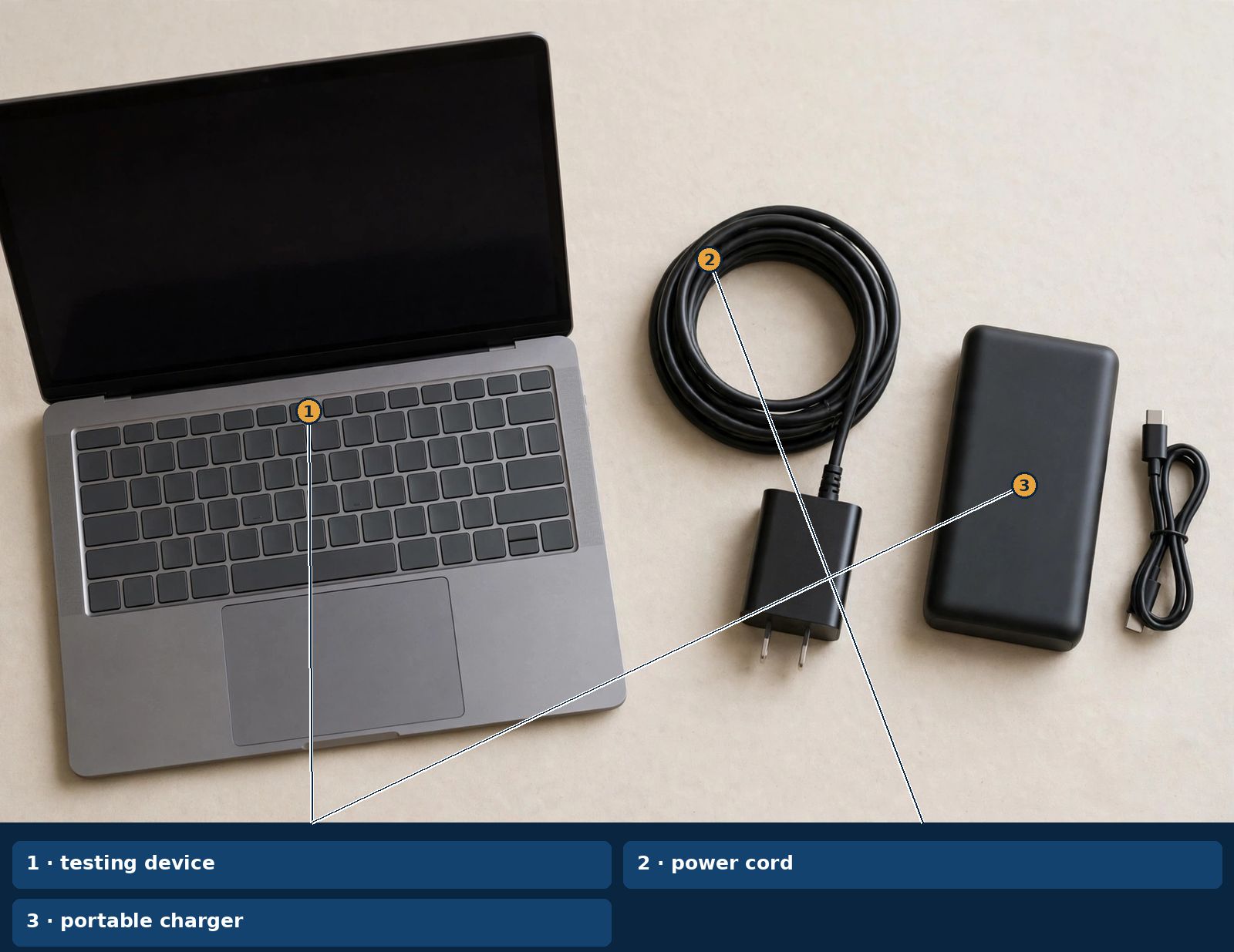
Figure P-239-04. Device-readiness ensemble.
The calculator rules are short enough to memorize whole. An embedded calculator is available for the entire Math section, with a graphing/scientific toggle at any point, and you may instead use an approved handheld calculator in the generic non-CAS class — non-CAS means the calculator does not perform computer algebra: it computes and graphs, but it does not manipulate symbols for you (Source: College Board, SAT Suite of Assessments Calculator Policy). Calculators are not required, and College Board recommends a familiar approved calculator if you bring one. No calculator is used during Reading and Writing; a handheld stays under the desk during those modules. College Board's own judgment advice, which this book follows in every worked solution, is to work by hand first where by-hand work is faster or safer, and to reach for the calculator where it genuinely earns its time — Chapter 26 teaches that judgment as craft, and every Math chapter's worked examples show both routes where the choice is instructive. This book never names a calculator model and never draws the embedded calculator's screen; the skill is the mathematics, not a device's buttons.
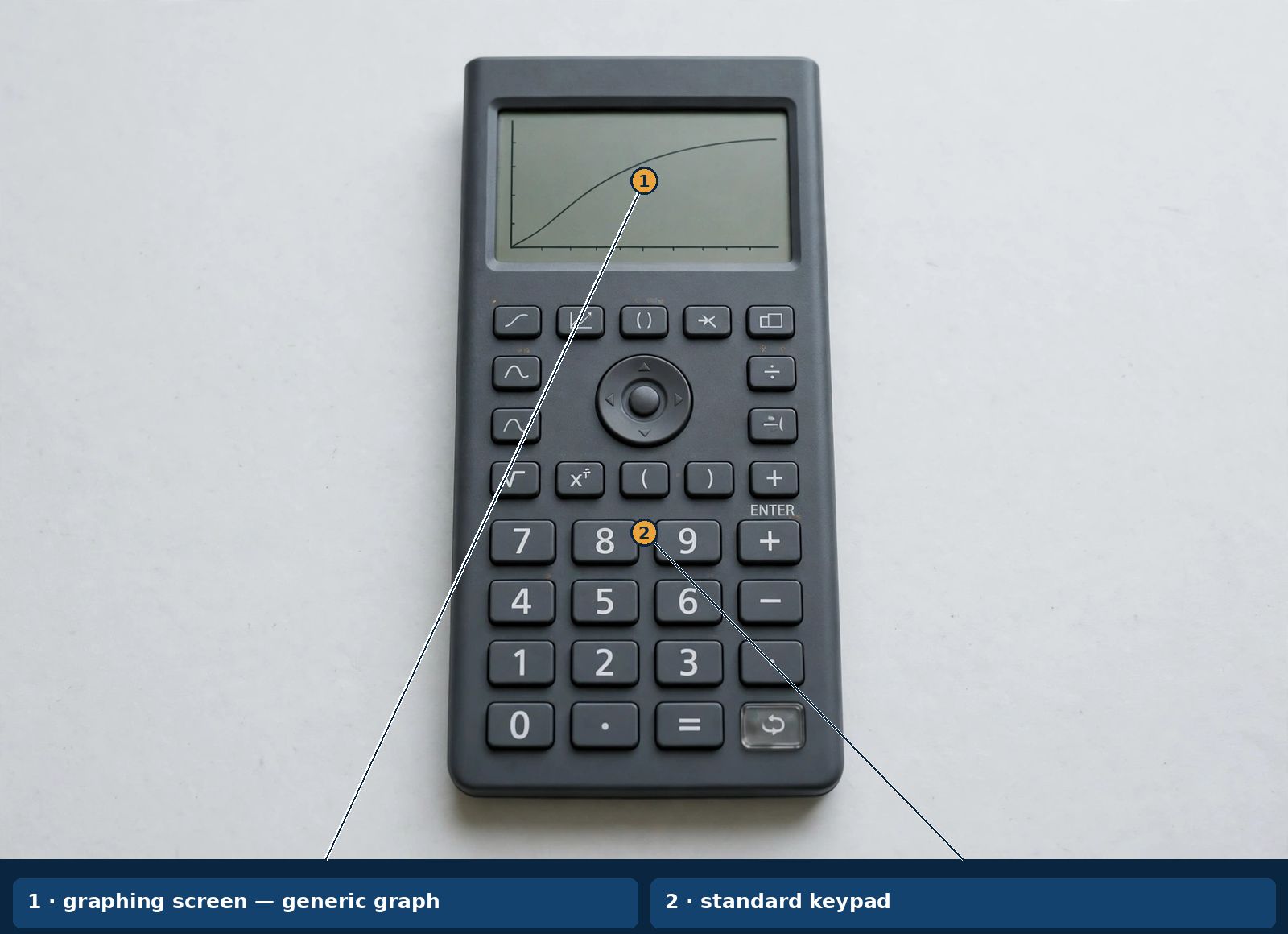
Figure P-239-02. Approved handheld calculator class.
Test day has a published shape, and knowing it removes surprises that cost attention. Students check in from about 7:45 a.m., doors close at 8 a.m., and testing starts between about 8:15 and 8:30 a.m., with standard-time testing ending at about 10:45 to 11 a.m.; students borrowing a device arrive earlier, at about 7:15 a.m. (Source: College Board, "What to Expect on Test Day"). Bring a valid physical photo ID, your admission ticket, your College Board username and password, and your fully charged acceptable testing device with the application downloaded and exam setup complete, plus a pen or pencil for scratch work (Source: College Board, 2026-27 SAT Weekend Student Guide). Your device must connect to Wi-Fi and hold charge for roughly three hours; a power cord or portable charger is sensible to bring, and an outlet is not guaranteed (Source: College Board, 2026-27 SAT Weekend Student Guide; Source: College Board, "What to Expect on Test Day"). Scratch paper is provided and is collected by the proctor at dismissal.
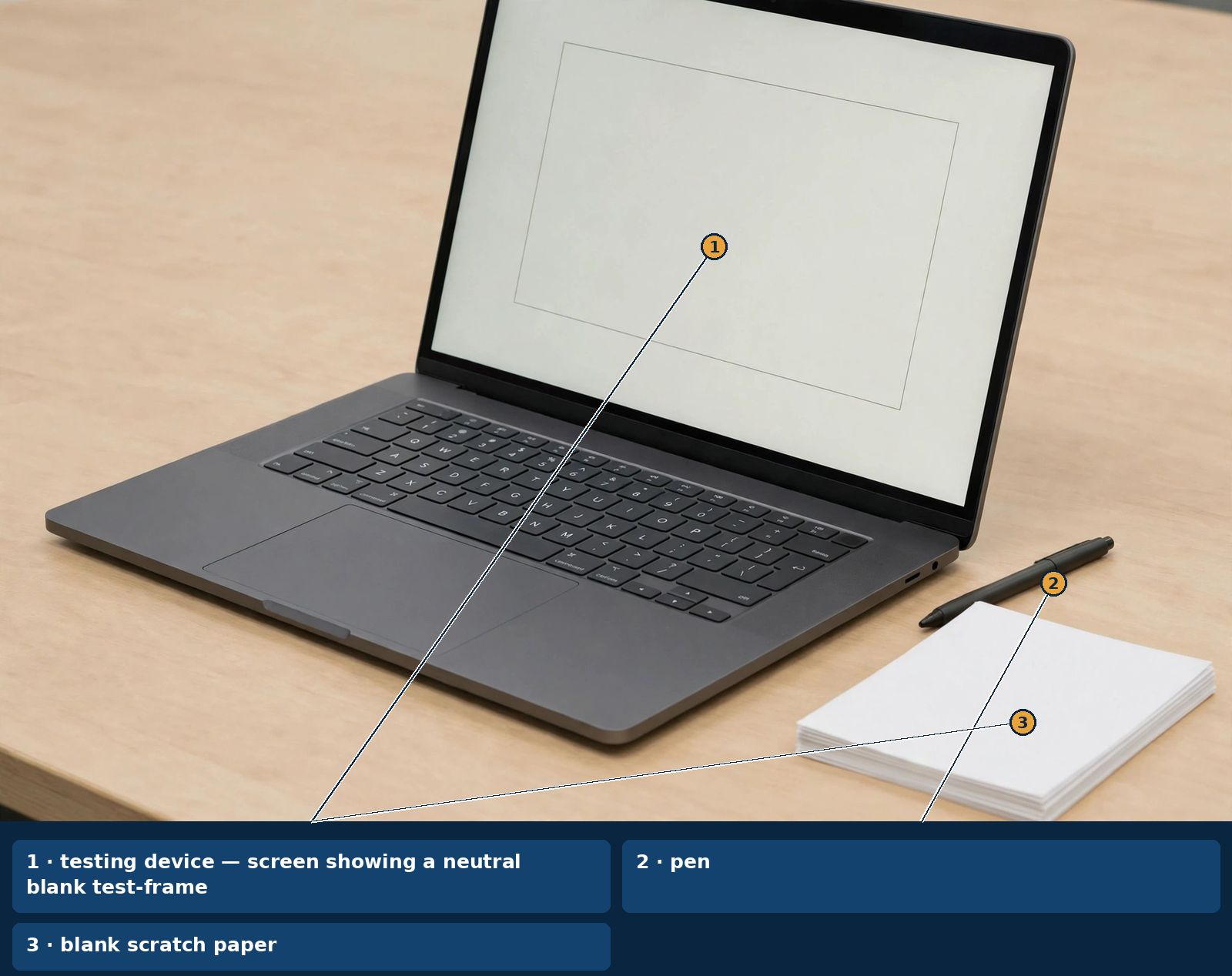
Figure P-239-01. Testing-desk ensemble.
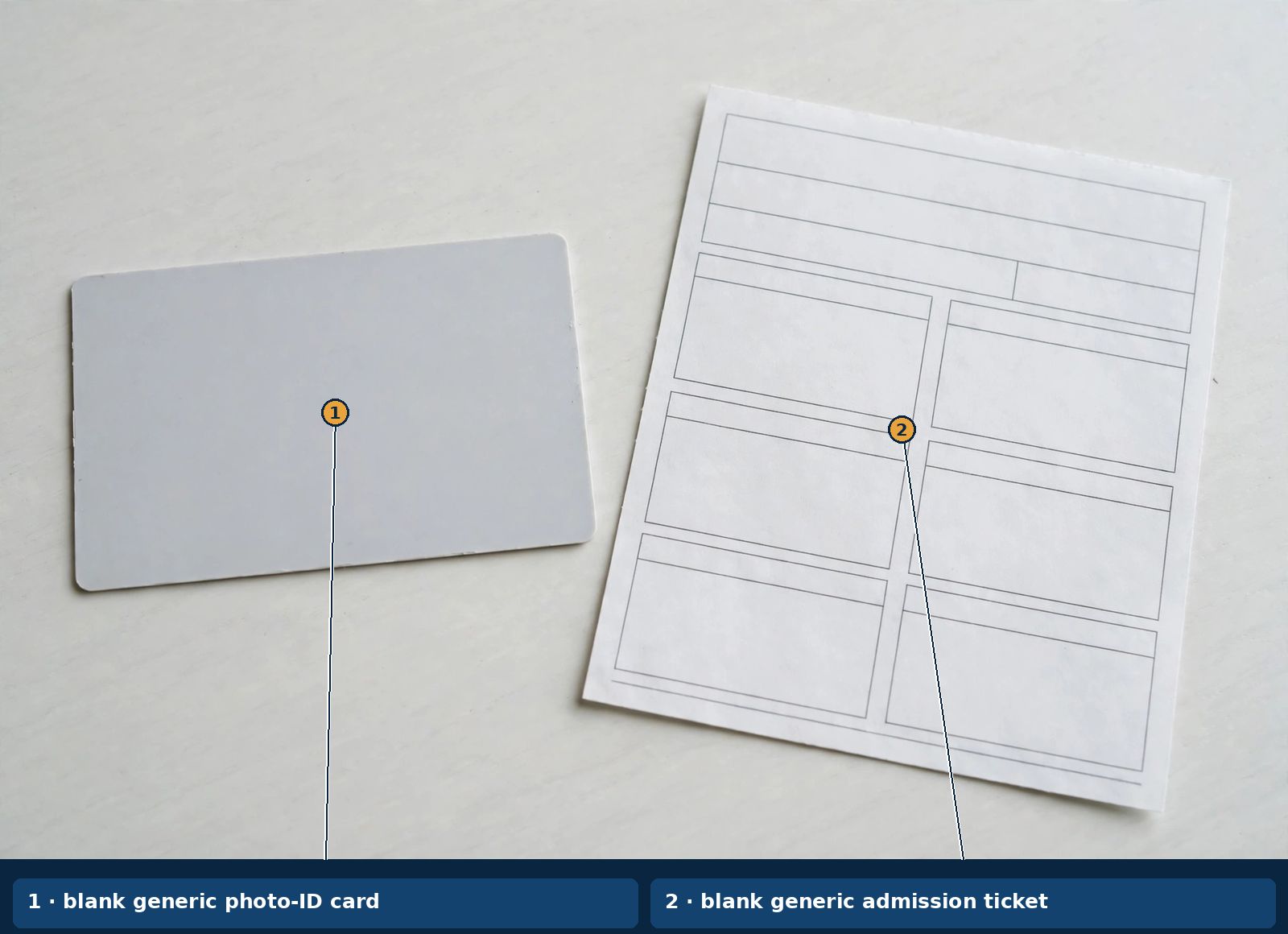
Figure P-239-03. Check-in ensemble.
The application tells you when to break. There is one scheduled 10-minute break, between the sections (Source: College Board, "What to Expect on Test Day"). On the break you leave your device open, keep your ID on your person — it is checked on re-entry — and eat or drink only what you brought, kept under your desk during testing and used only on breaks. A calculator remains on the desk during breaks. An unscheduled break is permitted, but the testing clock does not stop for it: testing time is lost. Phones and other electronics are collected or put away, including during breaks, and accessing one, or a device making noise, can bring dismissal and possible score cancellation. Leaving before dismissal subjects your scores to cancellation, and using a calculator or a device to share information or remove test content brings dismissal and score cancellation (Source: College Board, 2026-27 SAT Weekend Student Guide; Source: College Board, "What to Expect on Test Day"). These are not scare lines; they are the published conduct frame inside which your preparation gets to count. One accommodation item needs its own sentence so it is never mistaken for standard kit: approved wired, non-Bluetooth, non-recording headphones are permitted only for students approved for assistive technology (Source: College Board, 2026-27 SAT Weekend Student Guide).
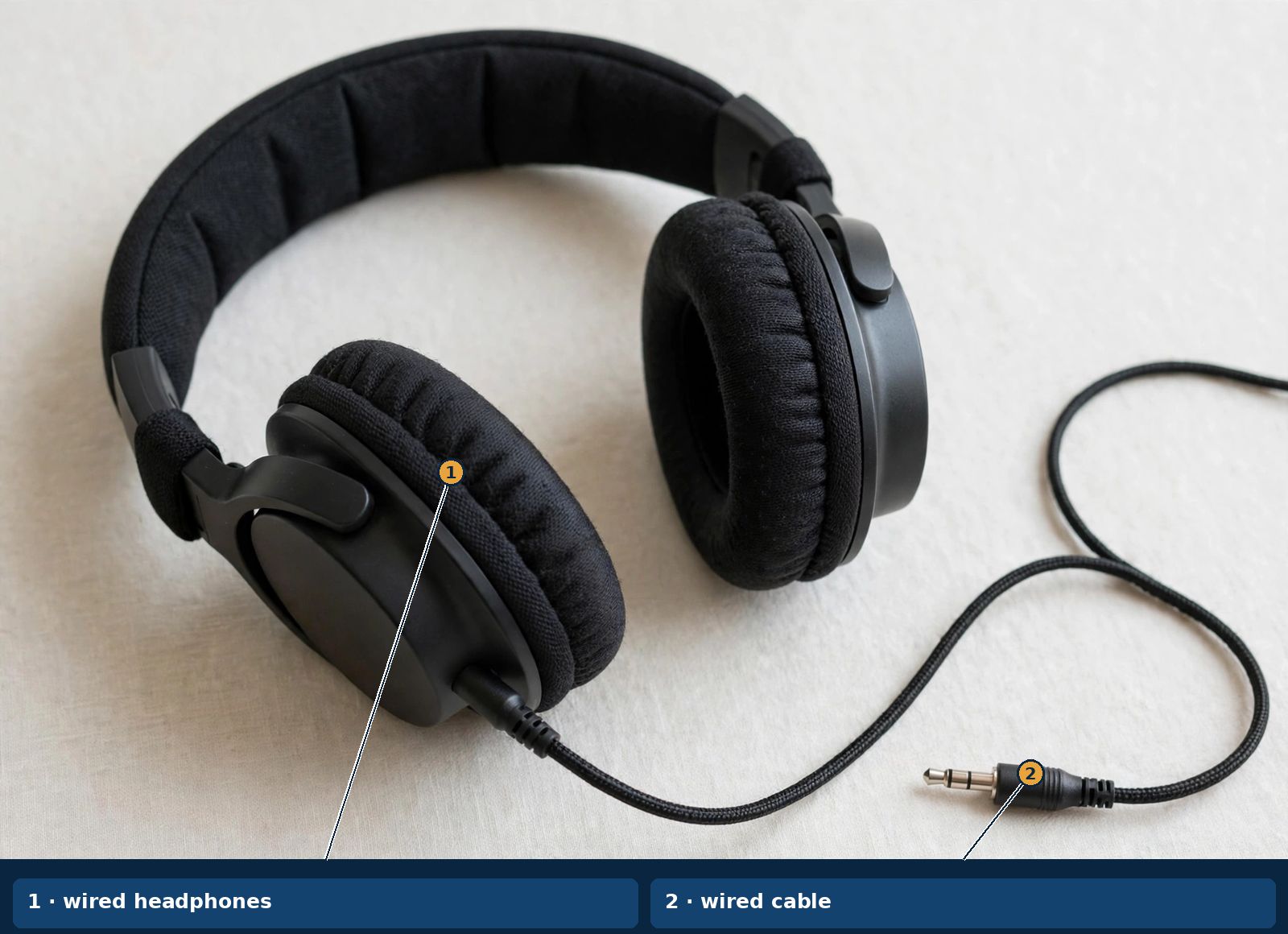
Figure P-239-05. Wired headphones — an accommodation item only: approved wired, non-Bluetooth, non-recording headphones are permitted only for students approved for assistive technology. Never standard kit.
Worked example — reading a test-day plan the way this chapter teaches. Suppose your registration is complete, your photo is uploaded, and exam setup is done on the Wednesday before your Saturday test. Walk the plan as a checklist in this chapter's order. Instrument: two sections, four modules, the break between sections — you will rehearse that shape in this book's Test 3 under full test-day conduct. Readiness: ticket generated, ID located, device charged and able to hold charge, pen packed, arrival planned for check-in rather than for the doors closing. Conduct: phone silenced and ready to be put away for the whole morning, including breaks; snack placed where it will sit under the desk. Score protection: no question left blank in any module, Module 1 given a review pass before it closes, and no minute spent hunting for pretest items. Nothing in that plan requires talent. It requires only that the process was learned before it was needed, which is what this chapter is for.
Key terms. SAT — College Board's college admission test, taken in one digital sitting. Section — one of the test's two parts, Reading and Writing, then Math. Module — one of the two separately timed halves inside a section. Content domain — one of the eight published knowledge areas the test measures. Multistage adaptive — the design in which Module 1 performance sets Module 2 difficulty within a section. Operational question — a question that counts toward the score. Pretest question — an unscored question mixed into a real module, indistinguishable from operational questions. Student-produced response (SPR) — a Math question format in which you produce the answer rather than choose it. Section score — a 200 to 800 score for one section. Total score — the sum of the two section scores, 400 to 1600. Benchmark — College Board's readiness reference point, defined by a 75% likelihood of earning a C or higher in related first-semester, credit-bearing college courses. Non-CAS — the calculator class that computes and graphs without performing symbolic algebra. Admission ticket — the document generated by exam setup, required for entry.
Q1. How many questions and how much testing time does the full test carry, not counting the break? A. 98 questions, 134 minutes B. 98 questions, 144 minutes C. 108 questions, 134 minutes D. 54 questions, 64 minutes
Q2. In what order do the sections and modules run? A. Math Modules 1–2, then Reading and Writing Modules 1–2 B. Reading and Writing Module 1, Math Module 1, Reading and Writing Module 2, Math Module 2 C. Reading and Writing Modules 1–2, the break, then Math Modules 1–2 D. All four modules run together under one clock
Q3. What does multistage adaptive mean on this test? A. Every question changes difficulty based on the previous question B. Module 1 performance in a section sets the difficulty of Module 2 in that section C. Students choose their Module 2 difficulty D. The test lengthens when a student answers quickly
Q4. In one real Math module, how many questions are operational and how many are pretest? A. 22 operational, 0 pretest B. 20 operational, 2 pretest C. 18 operational, 4 pretest D. 25 operational, 2 pretest
Q5. What is the correct conduct toward pretest questions? A. Skip any question that feels unusual, since it is probably pretest B. Answer the easiest-looking questions first because pretest items are always hard C. Mark suspected pretest items and return to them last D. Answer every question with your best work, because pretest items cannot be told apart
Q6. A student finishes Reading and Writing Module 1 with three minutes left. What may the student still do? A. Move ahead into Module 2 early B. Review and change answers inside Module 1 until time expires C. Return to Module 1 after starting Module 2 D. Use the three minutes as extra break time
Q7. Which set lists the four Reading and Writing domains? A. Algebra, Advanced Math, Problem-Solving and Data Analysis, Geometry and Trigonometry B. Craft and Structure, Information and Ideas, Standard English Conventions, Expression of Ideas C. Central Ideas, Evidence, Inferences, Transitions D. Literature, History, Humanities, Science
Q8. Words in Context, Text Structure and Purpose, and Cross-Text Connections belong to which domain? A. Information and Ideas B. Expression of Ideas C. Craft and Structure D. Standard English Conventions
Q9. Boundaries and Form, Structure, and Sense belong to which domain? A. Standard English Conventions B. Craft and Structure C. Information and Ideas D. Expression of Ideas
Q10. About what share of Math questions are student-produced response questions? A. About 10% B. About 50% C. About 75% D. About 25%
Q11. What are the section score and total score ranges? A. Sections 200–800; total 400–1600 B. Sections 100–400; total 200–800 C. Sections 400–800; total 800–1600 D. Sections 200–800; total 200–1600
Q12. According to College Board's published scoring description, scores reflect which factors? A. Right or wrong answers only B. Right or wrong answers, question difficulty, and the probability the pattern suggests guessing C. Speed and right or wrong answers D. Right or wrong answers and the number of pretest items found
Q13. What does a College and Career Readiness Benchmark mean, in College Board's definition? A. The score a college requires for admission B. The passing score for the test C. A 75% likelihood of earning a C or higher in related first-semester, credit-bearing college courses D. The average score of admitted students
Q14. Which statement about calculator use is correct? A. A calculator may be used in every section B. Only a handheld calculator may be used in Math C. The embedded calculator is available for the entire Math section, and no calculator is used during Reading and Writing D. A CAS calculator is permitted if its memory is cleared
Q15. A student needs to borrow a testing device. What does College Board publish? A. Devices are handed out at check-in on request B. The student must register and request at least 30 days before the test date; the loan is free and availability is not guaranteed C. A mobile phone may be borrowed instead D. Device loans require a school to submit the request on test day
Q16. When do all Weekend deadlines expire? A. At 11:59 p.m. Eastern Time B. At midnight in the student's own time zone C. At 5 p.m. Eastern Time D. At 11:59 p.m. Pacific Time
Q17. What happens during the one scheduled break? A. Students may use phones in the hallway B. The break lasts 20 minutes and the clock stops for extra restroom trips C. Students may open Math Module 1 to preview it D. The break lasts 10 minutes, sits between the sections, and the device is left open with ID kept on the person
Q18. How does this book score its own timed tests? A. By converting raw performance to the 400–1600 scale B. By raw counts and domain trackers only — items correct and accuracy per domain C. By percentiles against other readers D. By estimating the student's real score within a range
Q19. Why does this book label its timed tests as nonadaptive simulations? A. Because print cannot adapt the way the real test adapts at module level B. Because the book's tests contain pretest items C. Because the book's tests use different section counts D. Because adaptation is not part of the real test
Q20. A student's photo upload is due when, at the latest, under College Board's published rule? A. At check-in on test day B. At least five days before the test C. At least 30 days before the test D. At least seven weeks before the test
Feras Alzubi
2026 Edition — built against the digital SAT in its current form as College Board publishes it: the 2026–27 Weekend administration, two sections in four separately timed modules, multistage adaptive, as set out in College Board's 2026-27 SAT Weekend Student Guide and College Board's published Reading and Writing and Math specifications for the SAT Suite.
An independent study book for one examination: the digital SAT, taken in a single sitting of 2 hours 14 minutes of testing plus one 10-minute break, in two sections — Reading and Writing, then Math — scored from 400 to 1600.
© 2026 Feras Alzubi. All rights reserved.
No part of this book may be reproduced, distributed, or transmitted in any form or by any means — electronic, mechanical, photocopying, recording, or otherwise — without the prior written permission of the copyright holder, except as permitted by law and except for brief quotations in reviews and the buyer's own study notes.
This is an original work, written for this book. Every passage, data set, problem, and worked example in it was written fresh for this book. The practice questions are original, written against College Board's published test format named in this book, and are not College Board's actual, recalled, paraphrased, or adapted items; no item is copied or adapted from any other preparation book, course, app, or question bank, and College Board's published materials were read as the format authority only and are never reproduced or used as item content.
This book is an independent study guide. It is not published by, affiliated with, endorsed by, or approved by College Board, and College Board did not participate in its creation. SAT, Bluebook, BigFuture and Score Choice are trademarks of College Board. Exam names and trademarks belong to their respective owners. Achieving any particular score also depends on the candidate's own preparation; no book can guarantee a result.
The three candidate personas in this book — Maya, Devon, and Sofia — and the fictional settings its items return to (a branch library and its archive room, a river-basin field station, a neighborhood transit workshop, a school greenhouse and garden program, a small-town historical society museum, and a coastal weather station) are fictional and original to this book. No real person, college, or organization appears as a character inside any item.
The practice questions in this book are original, written for this book against the published outline of the digital SAT as College Board publishes it — the two-section, four-module, multistage adaptive format of the 2026–27 Weekend Student Guide and College Board's published section specifications, with its eight content domains and their published distributions. They are not College Board's questions: no actual, recalled, paraphrased, or adapted examination item appears anywhere in this book, and no item derives from College Board's practice tests, question bank, study guide, or any other source. Every item is tagged to the chapter and the domain and skill it serves, and every answer is explained — why the key is right and why each wrong option, or each common wrong entry, falls short.
This page states the test exactly as College Board publishes it. Every figure on it traces to a College Board source named at the point of use. Where College Board publishes no figure, this page prints none.
The SAT is College Board's college admission test for students in grades 11–12, taken on a published Weekend test date at a test center, or through a school administration of the same test (Source: College Board, 2026-27 SAT Weekend Student Guide; Source: College Board, Understanding Scores for Students and Families — SAT Weekend, Fall 2026). You register online through My SAT with a free College Board account (Source: College Board, 2026-27 SAT Weekend Student Guide).
The test has two sections, always in the same order, each divided into two equal-length, separately timed modules. It is multistage adaptive: how you do in Module 1 of a section sets the difficulty of Module 2 in that section (Source: College Board, 2026-27 SAT Weekend Student Guide).
That is 98 questions and 134 minutes of testing, with one 10-minute break between the sections (Source: College Board, "What to Expect on Test Day"). Inside a module you may move back and forth and review until time expires; once you leave a module, you cannot return to it (Source: College Board, "What to Expect on Test Day"). The test is taken in College Board's testing application on an approved device — never a mobile phone — with published tools that include mark for review, a hideable testing timer, a line reader, a Math reference sheet of common formulas, highlights and notes on non-math questions, and an option eliminator (Source: College Board, 2026-27 SAT Weekend Student Guide). An embedded calculator is available for the entire Math section, with a graphing/scientific toggle at any point; you may instead use an approved handheld calculator in the generic non-CAS class College Board's policy allows, and no calculator is used during Reading and Writing (Source: College Board, 2026-27 SAT Weekend Student Guide; Source: College Board, SAT Suite of Assessments Calculator Policy).
Each section tests four content domains. The shares below are College Board's published distributions, and the counts in parentheses are College Board's published ranges for the operational questions in a full test (Source: College Board, 2026-27 SAT Weekend Student Guide; Source: College Board, Reading and Writing Specifications – SAT Suite; Source: College Board, Math Specifications – SAT Suite).
Reading and Writing
Passages represent literature, history/social studies, the humanities and science. Each passage — 25 to 150 words per stimulus text or pair of texts — carries a single question, and some questions are accompanied by an informational graphic (Source: College Board, "The SAT Reading and Writing Section"; Source: College Board, 2026-27 SAT Weekend Student Guide).
Math
Math questions take two forms: about 75% are four-option multiple-choice questions and about 25% are student-produced response questions, in which you produce the answer yourself (Source: College Board, "Student-Produced Responses"). About 30% of Math questions are set in context — science, social studies or real-world scenarios (Source: College Board, 2026-27 SAT Weekend Student Guide).
You receive two section scores, each from 200 to 800 — Reading and Writing, and Math — and a total score that is their sum, from 400 to 1600 (Source: College Board, Understanding Scores for Students and Families — SAT Weekend, Fall 2026). Scoring reflects whether questions are answered right or wrong, the difficulty level of the questions, and the probability the answer pattern suggests guessing; College Board's own advice is that for most students it is better to guess than to leave a question blank, especially after eliminating one or two wrong answers (Source: College Board, 2026-27 SAT Weekend Student Guide). Your score report shows percentiles and a Knowledge and Skills display of your performance across the eight content domains — the display this book's trackers mirror, in this book's own practice terms (Source: College Board, Understanding Scores for Students and Families — SAT Weekend, Fall 2026).
There is no pass mark. College Board publishes no passing score for this test, and no score in this book is presented as one. The only threshold figures College Board itself publishes are its College and Career Readiness Benchmarks — Reading and Writing 480; Math 530 — defined by College Board as predicting a 75% likelihood of earning a C or higher in related first-semester, credit-bearing college courses, with students at or above a benchmark considered on track for college readiness (Source: College Board, Understanding Scores for Students and Families — SAT Weekend, Fall 2026). A benchmark is College Board's readiness definition. It is not a requirement, a cutoff, or a target any college sets: colleges set their own admissions and score-use policies, change them, and decide acceptance, and your personal goal is one you choose from your own evidence and each college's own current published policy, checked by you.
Registration is online at My SAT: you upload a photo at least five days before the test, and exam setup in the testing application in the days before the test generates your admission ticket, without which you may be turned away. A borrowed testing device, if you need one, is requested at least 30 days before the test date, free of charge, with availability not guaranteed. Accommodations are requested through your school with a lead time of at least seven weeks before the test date. Income-eligible students may qualify for a fee waiver — one waiver covers two registrations and unlimited score sends (Source: College Board, 2026-27 SAT Weekend Student Guide; Source: College Board, "SAT Suite Test Dates and Deadlines"). Each Weekend date carries a registration deadline and then a combined deadline for changes, regular cancellation and late registration, and all Weekend deadlines expire at 11:59 p.m. Eastern Time (Source: College Board, "SAT Suite Test Dates and Deadlines"). Chapter 1 teaches the deadline pattern and works one date end to end; check your own date on College Board's current calendar before you rely on it.
On test day, bring a valid physical photo ID, your admission ticket, your College Board username and password, and your fully charged testing device with the application downloaded and exam setup complete, plus a pen or pencil for scratch work (Source: College Board, 2026-27 SAT Weekend Student Guide; Source: College Board, "What to Expect on Test Day").
Sending scores. Each registration includes up to four free score sends, which you may designate at registration, before the test, or within 9 days after the test date, and change until that deadline; after it, each additional send is a paid order that cannot be canceled once placed. For paid sends of scores you have already received, College Board's score-choice mechanism lets you choose which scores to send by test date; some colleges and scholarship programs require all scores; and that choice mechanism does not apply to the four free sends — if you do not use it on a paid send, all of your scores will be sent to the colleges you choose (Source: College Board, 2026-27 SAT Weekend Student Guide). Check each college's own current policy before you choose recipients. You may also register for a later Weekend date through My SAT, subject to the same deadlines and the fee table below. Two different cancellations are taught apart in Chapter 25, because they are different acts: canceling a registration (governed by the deadlines and the fee table below) and canceling a score — which a Weekend student may do no later than 11:59 p.m. Eastern Time one week after the test date, through My SAT, and which, once submitted, cannot be reinstated or reported (Source: College Board, 2026-27 SAT Weekend Student Guide).
Fees through June 2027 — College Board, read November 2026; confirm the current figures in My SAT before you pay (Source: College Board, "SAT Test Fees"; Source: College Board, "International Fees").
| Item | Fee |
|---|---|
| Registration | $68 |
| Late registration | $38 |
| Change test center | $34 (changing the test date requires canceling and registering anew) |
| Cancel | $34, for canceling a registration by the change deadline |
| Late cancel | $44, for canceling after the change deadline, by Thursday 11:59 p.m. Eastern Time before test day |
| Waitlist | $0 (preregistration and payment required) |
| Additional score reports | $15 per report (the first 4 are free if ordered by 9 days after the test date) |
| Rush reports | $31 |
| Scores by phone | $15 per call |
| Archived scores | $35 |
| Score verification | $55 (a fee waiver is available) |
| International fee | $43, added to the registration fee for testing outside the United States |
| Test center fee (international) | $24, at select locations only |
No fee amount appears anywhere else in this book, in any chapter, item, or example. Fee waivers change several lines: the cancel fees and the late registration fee are free with a fee waiver, and unused waiver benefits are returned when a registration is canceled (Source: College Board, "SAT Test Fees"; Source: College Board, "International Fees").
The SAT is one test inside the SAT Suite of Assessments, an integrated system measuring the same skills and knowledge in grade-appropriate ways on a common score scale, so the same section score represents the same achievement level on any Suite test and growth across tests is directly readable. The SAT serves grades 11–12; PSAT/NMSQT and PSAT 10 serve grades 10–11, and PSAT 8/9 serves grades 8–9 (Source: College Board, Understanding Scores for Students and Families — SAT Weekend, Fall 2026). The foundations and domain craft taught in this book are the same skills the Suite measures. This book is the SAT book: it does not prepare you for any other Suite test, it teaches no other Suite test's rules, scales or qualifying functions, and a reader preparing for a PSAT test is directed to that test's own entry in this catalog (Book #244) and to College Board's pages for that test.
SAT School Day also exists: the same SAT, given by schools in published in-school windows, for which students do not self-register (Source: College Board, "SAT Suite Test Dates and Deadlines"). This book's spine is the Weekend administration described above; if your school gives the test, your school's own instructions govern your sitting. College Board's BigFuture program is its college and career planning program, named here as a signpost only; your score report also carries a snapshot of career examples, which College Board presents as examples, not recommendations (Source: College Board, Understanding Scores for Students and Families — SAT Weekend, Fall 2026).
College Board, the test's owner, publishes its own preparation materials: free full-length adaptive practice tests and a test preview in Bluebook, its testing application, with results reviewed in My Practice; Official SAT Prep on Khan Academy; free SAT Bootcamps through Schoolhouse.world, built on official practice content; the Student Question Bank; Question of the Day; downloadable paper-based practice tests, which College Board recommends only for students who will test with paper-based accommodations; and The Official SAT Study Guide (Source: College Board, 2026-27 SAT Weekend Student Guide). They are named here, in this one place, so you know what is official and free. None of them is a content source for this book. Chapter 1 states the one use this book recommends by name: College Board's own scored practice tests in its testing application are the official scored rehearsal for a reader who wants an official-scale practice score before test day, because this book — as the next section says plainly — cannot adapt and cannot score you on the official scale.
This book is an independent study guide. It is not published by, affiliated with, endorsed by, or approved by College Board, and College Board did not participate in its creation. SAT, Bluebook, BigFuture and Score Choice are trademarks of College Board. Exam names and trademarks belong to their respective owners. Achieving any particular score also depends on the candidate's own preparation; no book can guarantee a result.
Every chapter in this book runs the same rhythm: simplify → explain → detail → show → do → check. A chapter opens with the idea in plain words, explains why it exists, gives the full rule with its source, shows a worked example analyzed step by step, gives you work to do, and closes with a 20-item chapter quiz whose key explains the right answer and every wrong answer. Worked examples always come before items. Nothing is tested before it is taught, and no term is used before it is defined — the first use of every technical term is bolded and defined in place, and each chapter closes by collecting its terms in a Key terms paragraph; the Glossary in the back matter gathers them all.
The book is built in the test's own order. First the foundations (Chapters 1–7, FND-1 to FND-7): the instrument and its scoring, then reading academic texts, words in context, the English sentence, quantitative literacy, algebra readiness, and data and figures. Then one craft chapter — or, where a domain's skills divide, a small group of chapters — for each of the eight published content domains, in the order the test meets you: Reading and Writing (Chapters 8–15, RW-1 to RW-8), then Math (Chapters 16–24, M-1 to M-9). Then score literacy and full-test craft (Chapters 25–26, EX-1 and EX-2). Around the chapters sits the apparatus: a 49-item diagnostic, three full timed practice tests of 98 items each, a 12-item repair set for every content domain, and two skills workshops of 12 tasks each.
A counting convention, stated once: one item is one scored task as the test presents it — one multiple-choice question, or one student-produced response problem. A Reading and Writing passage carrying one question counts once, exactly as the test presents it. On that convention the book carries 983 practice questions: the diagnostic's 49, the chapter quizzes' 520 (26 chapters × 20), the timed tests' 294 (3 × 98), the repair sets' 96 (8 × 12), and the workshops' 24 tasks (2 × 12). Worked examples inside chapter prose are teaching, not counted items; nothing is counted twice.
Your real test adapts: how you do in Module 1 of each section sets the difficulty of Module 2. No printed test can do that. This book's timed tests hold the published shape — the same counts, proportions and clocks — so what transfers is the knowledge, the pacing and the module discipline; the adaptation itself is taught in Chapter 26 (EX-2) and rehearsed for real, free, in College Board's own practice tests in its testing application.
Three consequences follow, and this book states all three openly rather than dressing a limitation as a feature:
Work inside that honesty and the method is strong: the forms hold the published shape exactly, the keys explain every option, and the one skill print cannot rehearse — the adaptation itself — is taught as conduct in Chapter 26 and pointed to its free official rehearsal.
Before you study anything, take the Diagnostic that follows this front matter, cold: a Reading and Writing module (27 items, 32 minutes) and a Math module (22 items, 35 minutes), taken as two sittings of under an hour each, before Chapter 2. Do not prepare for it; its job is to measure the candidate you are today, not the candidate you hope to be.
Score it with the Diagnostic Key, by domain, not only in total, and complete its domain trackers. The trackers convert each domain result into a study priority and route you through the book: a foundation-band result routes you foundations-first, through Chapters 1–7 in full before the craft chapters; a higher-band result routes you craft-first, with foundations by referral to the exact sections your errors point to. Keep the trackers. After each section's chapters, the repair set for a domain is your re-diagnostic checkpoint for that domain, and after a real sitting, Chapter 25 (EX-1) teaches you to run the same routing from your real score report's Knowledge and Skills display.
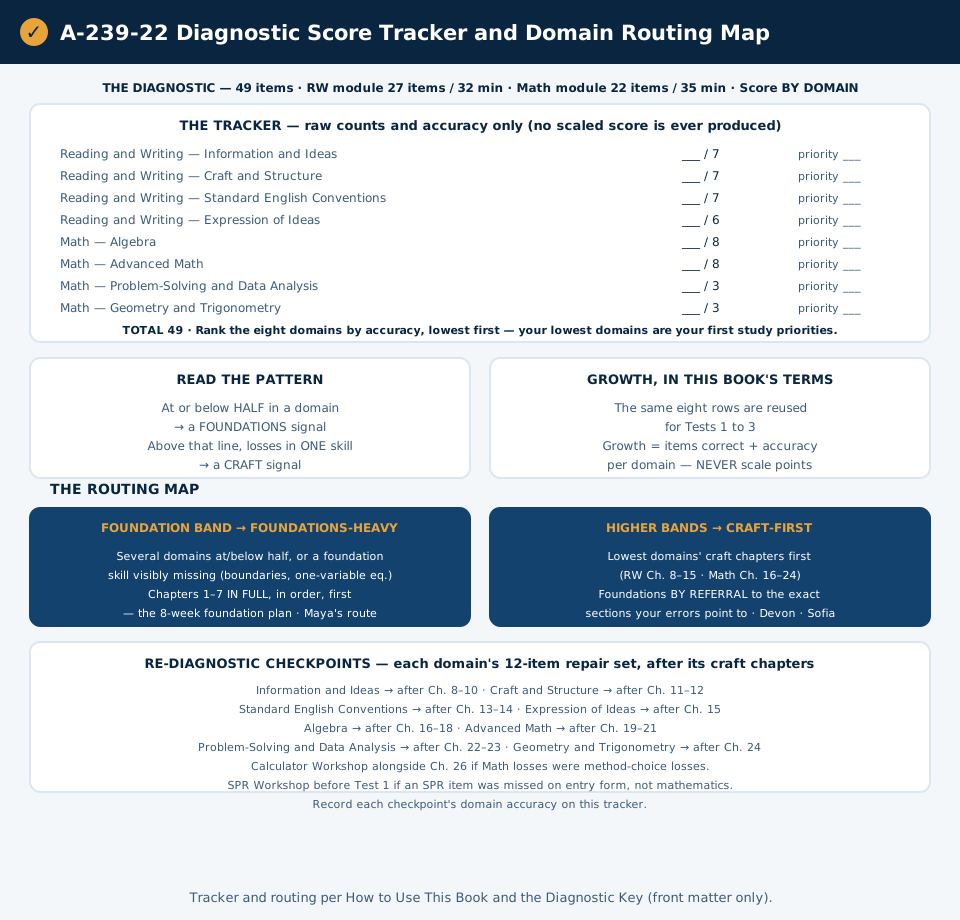
Figure A-239-22. Diagnostic score tracker and domain routing map: score the Diagnostic by domain on the eight-row tracker, rank your priorities lowest-first, and let the pattern route you — foundations-heavy or craft-first — with each domain's repair set as its re-diagnostic checkpoint.
Three named routes run through the same book; all three are set out day by day in the back matter, all three are chosen by the diagnostic rather than by the calendar alone, and all three end with Chapter 26's test-week checklist and an official College Board practice sitting as the final scored rehearsal. Test dates are your own, chosen against College Board's current calendar — the plans are written backward from your test date, never from a printed date. No plan promises any outcome; each is a route through teaching, not a forecast of a score.
Choose honestly: a candidate whose foundations are the constraint gains nothing by sprinting the craft chapters, and a candidate near their personal goal wastes weeks relearning ground they own.
Three fictional candidates recur through the foundations and craft chapters, placed by diagnostic band and situation only — no target institution and no target score is named for any of them: Maya (foundation band; sentence boundaries and one-variable equations are her constraint), Devon (middle band; a strong reader, with pacing and Advanced Math as his risk), and Sofia (high band; near her personal goal, with Module 1 discipline and data-inference items as her margin). Their errors and progress are this book's teaching material, reported in items, accuracy and pacing — never in scale points; when a persona's route matches your diagnostic, follow it. The items themselves return to a small set of fictional settings — a branch library and its archive room, a river-basin field station, a neighborhood transit workshop and its bus routes, a school greenhouse and garden program, a small-town historical society museum, and a coastal weather station — so contexts cohere from chapter to chapter without touching any real institution.
End of the free sample. The complete book continues from here — the full A-to-Z course in book form, delivered as an EPUB you can read in Apple Books, Google Play Books, ReadEra, Thorium Reader, Adobe Digital Editions, or Send to Kindle.
Buy this ebook — $11.99 Back to the book page
Payments are securely processed by Payhip.