
Mastering Careers & Skills
Salon & Barbershop: Mastering the Craft · free sample from the book itself
One licensed room with eight chairs can be three completely different businesses, depending on who employs whom, who sets the price, and who carries the cost when a chair sits empty. This chapter teaches that founding fork — booth rent, commission, and the salon suite — as a legal and economic distinction, not a matter of taste. It introduces the specimen, Marigold & Main, in its commission form, then prices the same room two other ways so the difference can be seen in numbers.
Begin with one question: who is the owner's customer?
In a booth-rent shop, the professional is the owner's customer. The owner — a landlord inside a licensed establishment — rents a station to a licensed professional who runs an independent business there. The guest pays the professional, not the shop. The professional sets the price, chooses the hours, books the guests, buys the product used at the station, and keeps the service revenue after paying rent and carrying the costs of that business. The owner's revenue is rent; the owner's work is the landlord's work: premises, agreement, and rent collection.
In a commission shop, the guest is the owner's customer. The shop employs the professionals, sets the prices on the service ladder, sets the hours and schedules, buys the product, owns the booking system, and collects every dollar of service revenue at its own front desk. It then pays each professional a commission — a percentage of the service revenue that professional produced. The owner's revenue rises and falls with what guests buy; the owner's work is the employer's work: hiring, scheduling, standards, and filling chairs.
In a salon suite, the professional is a tenant, and the landlord may own no shop at all. A suite is a small, single-occupancy rented room — one chair, a mirror, cabinetry, and a door that closes — inside a building of similar rooms, with no shared salon floor. The tenant sets prices, hours, product, and booking, keeps the service revenue, pays rent, and carries the costs of an independent business, much as a booth renter does. The difference is the premises: the tenant rents an enclosed room from a property business whose product is the room, its utilities, its common areas, and its address.
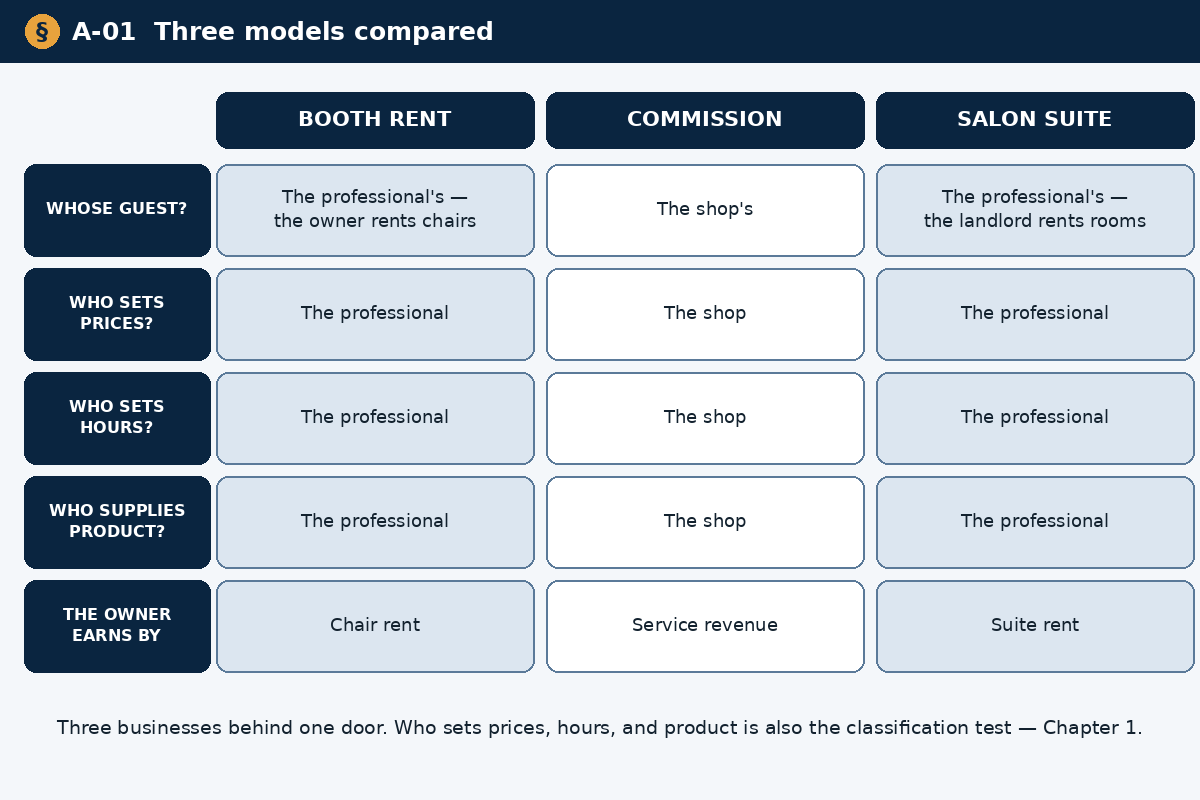
Figure A-01. The three models compared
Hold the three side by side and the fork stops being vocabulary. Model in this book means the legal and economic arrangement that decides who the customer is, who controls the work, and who carries each cost. The chairs can be identical in all three; the businesses are not. Nor is one model the grown-up version of another: booth rent is not a failed commission shop, and a suite is not a small salon. Each is a complete business with its own revenue line, cost lines, and daily act — the landlord act and the employer act, taught separately in Chapter 9. Confusing them is expensive, and it can also change a worker's legal classification.
Read a model by following four decisions around the room: price, hours, product, and booking.
Under booth rent, the renter decides all four for the renter's own business: the prices at that station, the hours worked within the establishment's lawful opening arrangements, the product purchased, and the renter's own appointment book, phone number, and business name. The owner's control is over the premises: the rent, the written agreement, and house rules that protect the license and the shared space. The further the owner reaches into the renter's prices, schedule, and guests, the less the arrangement resembles rent.
Under commission, the shop decides all four. It publishes the price ladder, posts the hours, staffs the schedules, buys the backbar and color stock, and runs one book at one front desk. The operating frame around each service is the shop's: what the service is called, what it costs, how much time it is given, and how the next visit is booked. In exchange, the shop carries product cost, booking and payment systems, marketing, laundry, insurance, and the empty-chair risk.
Under a suite, the tenant decides all four inside the rented room, as a booth renter does, and the landlord's decisions are property decisions: rent, lease term, what the rent includes, common-area standards, and access.
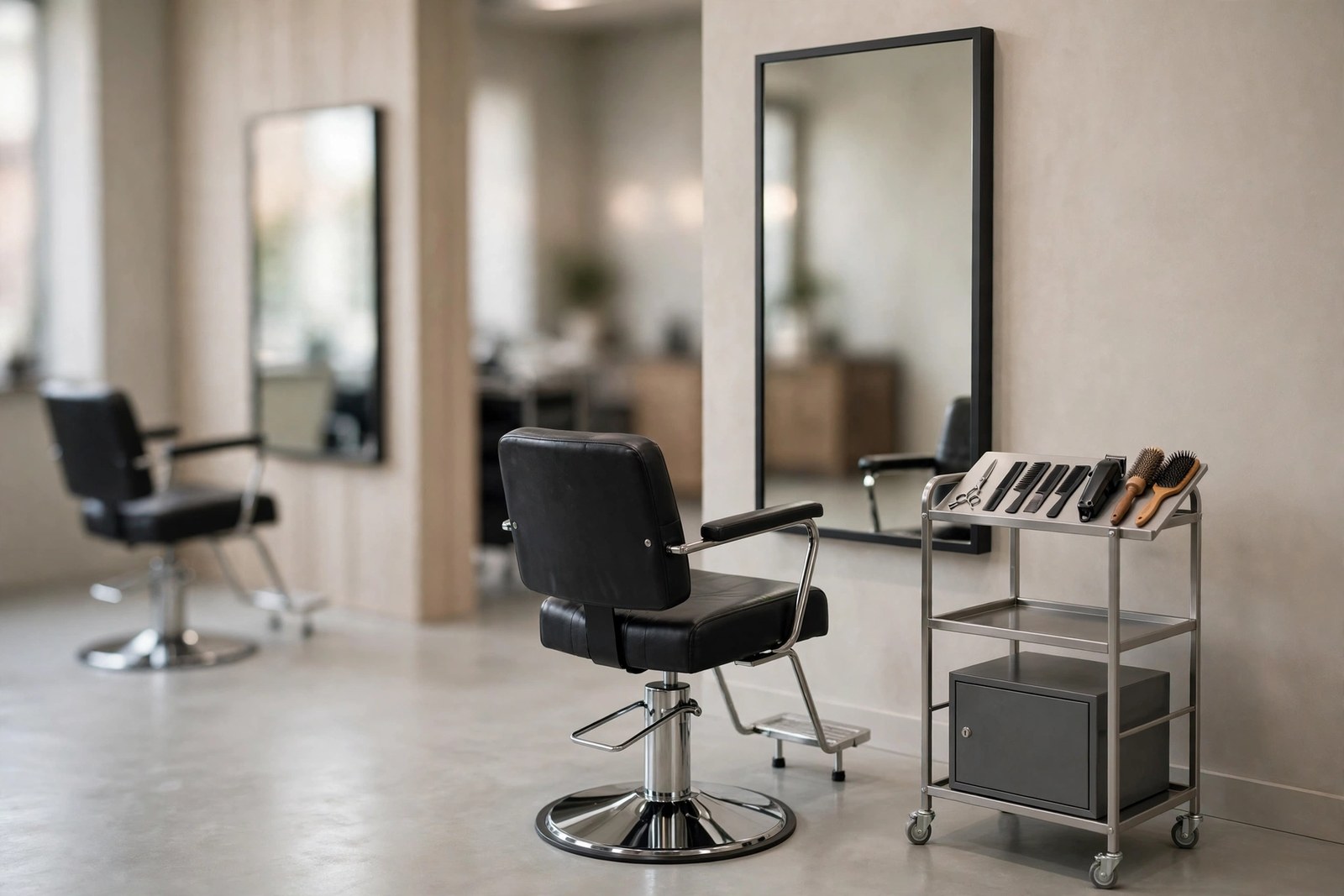
Figure P-04. A booth-rent station with the professional's own kit
Notice that product is not a minor item here: who buys it is evidence of who runs the business at that chair. Classification is built out of exactly these ordinary facts.
The fork has a legal spine, taken from the Internal Revenue Service's own industry publication: Publication 4902, "Tax Tips for the Cosmetology & Barber Industry," revised February 2011. Addressed to three figures — the shop owner, the employee, and the booth renter — its central instruction is that the owner must decide whether workers are employees or booth renters operating their own independent businesses. That decision is made not by the label in a signed agreement but by the facts of control.
The publication's test is the right to control: an employee works at the control and direction of another, and the owner need not exercise control all the time — holding the right is enough. Its questions ask who sets hours, prices, and appointments, who buys supplies, and who carries insurance and advertising.
Publication 4902 (Rev. 2011) then lists five indications that a worker is an independent contractor — a booth renter:
The publication states the converse as plainly: if these factors are not present, the worker is likely an employee. Read the list as an operating audit: each indication is a daily fact that can be pointed to — a key on a ring, a schedule the professional wrote, a product invoice in the professional's name, a separate business line, a price list the professional set. A shop that calls a professional a renter while the shop sets the hours, supplies the product, books the guests under the shop's number, and fixes the prices has kept the word and surrendered every fact underneath it. Fix the principle: the model you claim is the model your arrangements prove. Chapter 9 works this fault line as management discipline.
The same publication states the duties that follow each classification. An employer withholds income, Social Security, and Medicare taxes, pays the employer's share and federal unemployment tax, reports on the quarterly and annual federal forms the publication names, and furnishes the employee's annual wage statement by January 31. A booth renter reports all income, including tips, on Schedule C, reports Social Security and Medicare taxes on Schedule SE, makes quarterly estimated payments, and issues Form 1099-MISC for business rent of $600 or more paid to a non-corporate landlord, as Publication 4902 (Rev. 2011) states it. One rule covers both sides: all tips are income, subject to federal income tax. The IRS also runs a tip-reporting program designed for this industry, named in the publication as TRAC. Tax mechanics beyond this structure belong to the Service Business books of this series.
Self-employment is not the exception in this trade. The U.S. Bureau of Labor Statistics, in its Occupational Outlook Handbook entry for barbers, hairstylists, and cosmetologists (2025–35 edition data), reports that 80 percent of barbers and 48 percent of hairdressers, hairstylists, and cosmetologists are self-employed workers — population facts about the trade as BLS counted it in 2025, never any reader's prospects. BLS states the structure underneath those figures in the same entry: all states require barbers, hairstylists, and cosmetologists to be licensed, through graduation from a state-approved barber or cosmetology program and an examination, with qualifications varying by state; and some professionals lease booth space from a salon owner.
One licensing fact deserves emphasis before Chapter 4: there is no national salon license. Practitioner licensing is state-administered in every state, and the establishment carries its own license under its own state board's system, so the booth renter still works inside a licensed establishment and the commission owner answers for both the place and the employment relationship. Your own state board's rules govern in your shop.
This book carries one fictional shop end to end, so every system can be checked against the same room and month. Marigold & Main Salon and Barbershop leases 1,600 square feet on a shopping street, fitted with eight chairs — five styling stations and three barber chairs — and two backwash (shampoo) units. It opens Tuesday to Saturday; its teaching month is four full weeks: 20 service days.
Marigold & Main is a commission shop. Its team is an owner-operator who manages the shop and works a part-time chair, four commissioned professionals — stylists and barbers — and a front-desk team of two part-time hosts. The shop sets the ladder: a salon haircut is priced at $58.00 with a product cost of $2.10 and a 60-minute time block; a barber cut is $34.00, product cost $0.90, 40 minutes; a single-process color service is $78.00, product cost $9.40, 90 minutes. A service in this book is always that kind of unit — a price, a product cost, a time block, a chair, a qualified professional — never a procedure.
In its stabilized teaching month the specimen serves 900 services to 780 guests for $50,440.00 in service revenue, plus $3,150.00 in retail, for total revenue of $53,590.00. For this chapter, one labor split is enough to feel the commission form from inside: the four commissioned professionals produce $41,240.00 of the service revenue; the owner produces $9,200.00 from the part-time chair and takes no commission on it. Worked Example 1.1 turns that split into the shop's commission line.
Step 1: separate the produced revenue by who produced it. Total service revenue is $50,440.00. The owner produced $9,200.00; the four commissioned professionals therefore produced $50,440.00 − $9,200.00 = $41,240.00.
Step 2: apply the specimen's commission rate to the commissioned production only. The rate is 45 percent: $41,240.00 × 0.45 = $18,558.00. That is the shop's commission line for the month.
Step 3: read what did not happen. No commission is computed on the owner's $9,200.00, because the owner is not the shop's employee at that chair. Nor is $18,558.00 the whole labor cost: front-desk wages of $3,040.00, the owner-operator salary of $4,800.00, and payroll taxes and benefits bring total labor to $29,433.77 in the full month worked in Chapter 3, where commissions are classified as a variable cost because they rise and fall with produced revenue.
Now hold the room still and change only the model. Both alternatives here are labeled example figures — counterfactuals on the specimen's premises, not the canon month and not market data.
The booth-rent counterfactual. Suppose the same eight chairs are rented instead of staffed.
Step 1: rental revenue. Eight chairs at $1,150 per chair per month: 8 × $1,150.00 = $9,200.00 a month — about $265 a week per chair.
Step 2: the landlord's lines for the same premises. Lease $6,400.00; utilities $660.00; insurance $355.00; common-area supplies $165.00; licenses $95.00; software $60.00; accounting $295.00; marketing $180.00; maintenance $300.00; contingency $200.00. Add them in order: $6,400.00 + $660.00 = $7,060.00; + $355.00 = $7,415.00; + $165.00 = $7,580.00; + $95.00 = $7,675.00; + $60.00 = $7,735.00; + $295.00 = $8,030.00; + $180.00 = $8,210.00; + $300.00 = $8,510.00; + $200.00 = $8,710.00.
Step 3: the remainder. $9,200.00 − $8,710.00 = $490.00 for the month — before the owner earns anything from their own chair. Read the teaching exactly as printed: at this rent and this lease, the landlord act alone nearly breaks even, which is why booth-rent owners usually work a chair themselves, and why the rent line, not the chair count, is the landlord's whole business. One vacant chair removes $1,150.00 of revenue and almost none of the $8,710.00 of cost; the $490.00 does not survive it.
The suite counterfactual. Now shrink the premises to one room, and change sides.
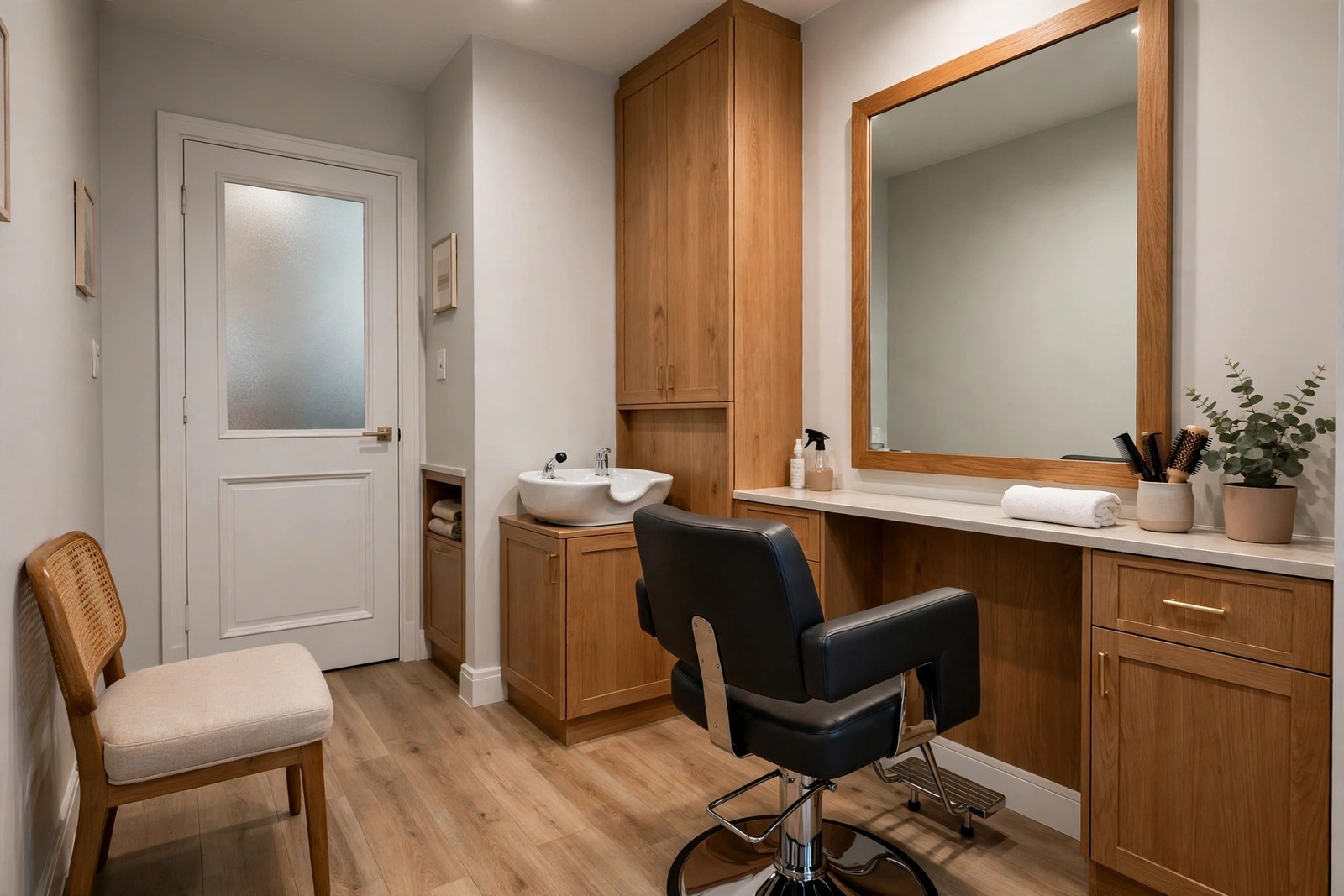
Figure P-05. A single-occupancy salon suite interior
Step 1: convert the rent honestly. The example suite rents at $325.00 a week. Annual rent: $325.00 × 52 = $16,900.00. Monthly rent: $16,900.00 ÷ 12 = $1,408.33 a month.
Step 2: compare like with like. A booth at the counterfactual's rent costs $1,150.00 a month inside a shared shop. The suite costs $1,408.33 — $1,408.33 − $1,150.00 = $258.33 more each month — for an enclosed room of one's own, and the tenant still carries their own product, insurance, booking, and laundry costs on top of either rent.
Step 3: state what the conversion protects against. Budgeting the suite as "four weeks at $325" gives $1,300.00 and understates the true line by $1,408.33 − $1,300.00 = $108.33, twelve times a year. Chapter 19 works this counterfactual against the specimen's chair economics; here the discipline is the point: weekly rents convert at 52 over 12, never at four weeks.
Three businesses, one room, three remainders that mean different things. The commission shop's month — revenue $53,590.00, total costs $46,564.88, remainder $7,025.12, printed everywhere with its label that the remainder after the listed lines is not profit — belongs to an employer carrying product, payroll, and the empty-chair risk. The booth landlord's $490.00 belongs to a premises business whose professionals carry those risks themselves, and the suite tenant's arithmetic to one professional buying a room and keeping every service dollar after rent and the costs of independence. No figure ranks the models; together they show what a model is: an allocation of revenue, cost, control, and risk that the five indications can read at a glance.
An owner preparing to rent a station talks with a professional considering the chair. Read for how each indication from Publication 4902 becomes a concrete arrangement — or fails to.
Owner: The station is $1,150 a month, and the room, the backwash units, and the common areas come with it. Before dates, let us be clear about what renting here means.
Professional: Good — my first question is the price list. At my last shop the owner set one list for everyone and called us renters anyway.
Owner: Then they kept the word and gave up the fact. Here, you determine the prices at your station. You set your own hours inside the building's access arrangements, you buy your own product, and your guests book on your own number, under your own business name. You hold a key.
Professional: And what do you control?
Owner: The premises: the rent, the written agreement, the house rules that protect the establishment license and the shared space, and the common areas.
Professional: What do I file, on my side?
Owner: That is your accountant's ground, but the structure is plain: you run your own business — your income, including tips, is reported on your side, with estimated payments through the year. My job is a clean premises arrangement, in writing, that matches how we work.
Professional: Then write it the way you just said it. If the paper and the practice match, I can price the chair.
Complete this canvas before signing anything, with your own findings and your own jurisdiction's answers.
WS-1 — Model & Concept Canvas
| Field | Your entry |
|---|---|
| Concept in one sentence (offer, guest, occasion) | ______________________ |
| Model chosen (booth rent / commission / suite tenancy) | ______________________ |
| Who is the owner's customer under this model? | ______________________ |
| Who sets prices? (name the person or business) | ______________________ |
| Who sets hours and schedules? | ______________________ |
| Who buys the product used at the chair? | ______________________ |
| Who owns the booking — whose number and business name? | ______________________ |
| Revenue line(s) of the business (rent / service revenue / both) | ______________________ |
| Cost lines the owner carries | ______________________ |
| Cost lines the professional carries | ______________________ |
| The five IRS indications, checked against the actual arrangement | ______________________ |
| Establishment license: which board, and what have you verified? | ______________________ |
| The figure that would make you stop (your own walk-away test) | ______________________ |
A canvas whose control rows contradict each other — prices set by the owner, independence claimed for the professional — names the arrangement to redesign, or honestly reclassify, before anyone signs.
Feras Alzubi
The Complete Course Series
© 2026 Feras Alzubi. All rights reserved.
This book is an original work. No part of it was copied from, adapted from, or generated from the text of any other book, course, examination, or proprietary training material.
This book is not affiliated with, sponsored by, or endorsed by the U.S. Bureau of Labor Statistics, the California Board of Barbering and Cosmetology, the Internal Revenue Service, the U.S. Department of Labor, the U.S. Occupational Safety and Health Administration, the Centers for Disease Control and Prevention, the Federal Trade Commission, the U.S. Small Business Administration, or any state licensing board.
This book teaches the business of opening and running a salon and barbershop — the three staffing models and the law that separates them, the two-license system, the site and the lease, the build-out, the opening capital, booking and the no-show system, chair math, pricing, sanitation and inspection discipline, the service day, the weekly numbers, and growth — as one connected operation, carried end to end on one fictional shop. It teaches owning and running the room. It does not teach the craft itself: no service in this book is taught as a procedure to learn. A service appears here as an operating unit — a priced line with a time block, a product cost, a chair, and a professional qualified to perform it. Read the book in order the first time: each chapter uses the models, the licenses, and the numbers of the chapters before it. After that first pass, the book works as a reference — the cheat sheet at the end of every chapter, and the collected worksheets and cheat sheets in the back matter, are built for the desk and the front desk, not the armchair.
The apparatus does the teaching, and every item is explained. The count is 168. Scenario exercises (120, six at the end of each chapter) put a concrete situation in front of you and ask for the owner's move; the key at the back of each chapter explains the method, the computation where there is one, and the considerations — it teaches how to think, and it never certifies a decision as right for your shop. Repair drills (12, three each in Chapters 3, 9, 13, and 16) hand you a broken artifact or a broken practice — a capital stack that does not sum, a month that hides a line, a landlord who schedules like an employer, an unlabeled disinfectant container, a week counted wrong — and ask you to find the fault; the key explains the fault and the repair. The Open-or-Not Check (24 checks, next in this front matter) routes you before you begin: four domains, six checks each, every answer explained, pointing you at the chapters your answers say you need first. It gives no total score and no readiness verdict, because readiness is not a number. The Opening Plan capstone (12 plan steps) assembles the whole book into the specimen's opening plan, from model lock to the first full week. Inside every chapter you will also find three worked examples, with the arithmetic shown step by step where there is arithmetic, and one worked dialogue — an owner in conversation with a professional, a landlord, an inspector, a supplier, or a tradesperson, working a real operating question through to its operating answer. Eight worksheets are set inside the chapters that use them and collected again in the back matter: the Model & Concept Canvas (Chapter 1), the License Investigation Worksheet (Chapter 4), the Lease Clause Checklist (Chapter 5), the Floor Plan & Station Plan (Chapter 6), the Capital Stack Sheet (Chapter 8), the Chair Math Sheet (Chapter 11), the Pricing Ladder Worksheet (Chapter 12), and the Weekly Numbers Sheet (Chapter 16).
Three study plans. Choose the pace that fits the decision in front of you, and keep the order — the book is built to be read in sequence whichever pace you take. The self-paced plan (about 16 weeks) takes one chapter a week for the first twelve weeks, with its exercises and worksheet done in the same week, then gives the final eight chapters and the capstone two weeks each in rotation until the Opening Plan is drafted whole: this is the plan for a reader deciding whether to open at all. The intensive plan (about 8 weeks) takes two to three chapters a week, exercises included, with the diagnostic taken first and taken again at the end so the routing change is visible: this is the plan for a reader with a site, a lease decision, or a purchase already in view. The pre-opening sprint is for a reader who has already committed: work the diagnostic first, then Chapters 3 through 8 and 13 without pause — the numbers, the two-license system, sequencing, build-out, stock, capital, and sanitation — then the capstone, and read the remaining chapters in order while the shop is being fitted, finishing before the first full week the specimen's plan ends on. On any plan, do the exercises in writing. An answer reasoned through on paper is the training; an answer nodded at is not.
The specimen. Marigold & Main Salon and Barbershop is a fictional combined shop: 1,600 square feet leased on a shopping street, fitted with eight chairs — five styling stations and three barber chairs — and two backwash (shampoo) units. Its model is a commission salon: an owner-operator who manages the shop and works a part-time chair, four commissioned professionals (stylists and barbers), and a front-desk team of two part-time hosts. The shop opens Tuesday to Saturday; the canon month the whole book computes on is four full weeks — 20 service days. In that stabilized teaching month the shop performs 900 services for 780 guests, takes $50,440.00 in service revenue and $3,150.00 in retail, for $53,590.00 in total revenue. Its booked chair time is 860 of 1,440 available chair-hours — 59.7 percent booked — its revenue per chair is $6,305.00 a month, and 71 percent of its guests book their next visit before leaving. Its total costs in the canon month are $46,564.88, leaving a remainder of $7,025.12, 13.1 percent of revenue. Wherever that word stands in this book it carries its label: the remainder after the listed lines is NOT profit. Debt service on the $160,000 opening stack, depreciation, income tax, and a chair-and-equipment replacement reserve stand outside the table, and the owner-operator's pay is the salary line inside labor, not the remainder. Its opening capital stack totals $160,000, and it breaks even at 586 guests of the canon month's 780. A booth-rent counterfactual on the same room and a suite counterfactual are worked beside it as labeled example figures, not as the canon month. Wherever Marigold & Main's numbers stand in this book, they are the specimen's own, labeled as the specimen's. Yours will differ; the method — choose your model, build your own stack, run your break-even and your chair math on your own figures — is the part that transfers.
One book, deliberately. A salon and barbershop is one licensed place, opened once and run daily: one room, one establishment license, one set of chairs, one book of appointments, one team working under one of three staffing models, one specimen shop carried end to end. The three models — booth rent, commission, and suite — are taught as one decision inside this book (Chapter 1), because the operating body they share — the establishment license, the site and lease, the build-out, sanitation law, booking, chair math, and the weekly numbers — is the same body, and the models differ in who employs whom and who carries which cost, which Chapters 1 and 9 teach as the fork. The barbershop rides inside this one book at full depth (Chapter 2 and throughout), as its rhythm differs from the salon's while its business does not. Splitting the models, or the barbershop, into separate books would halve each and duplicate the shared body — so the whole operation is here, in the order an owner meets it.
The fences. Twelve fences govern everything in this book. They are printed here in full because they are part of the teaching.
What this book cannot give you. Your establishment license, or anyone's approval of your shop. Your board's fees, forms, training hours, or sanitation text. A craft education in cutting, coloring, or shaving (F8). Practitioner exam preparation (F7). A credential of any kind. A prediction about your shop. A substitute for your state board, your attorney, your accountant, or your insurer.
A note on sources. Each family of facts in this book is taken from the one public body that owns it, from that body's own published material, and from nowhere else. The trade's structure and the survival figures come from the U.S. Bureau of Labor Statistics. Sanitation law in detail is taught from one named model: the California Board of Barbering and Cosmetology's published regulations, printed only inside passages labeled as the California model. Worker classification and the tip structure come from the Internal Revenue Service's own industry publication, Publication 4902. The federal wage floor comes from the U.S. Department of Labor. Workplace chemical and sharps duties come from the Occupational Safety and Health Administration. Hand-hygiene guidance comes from the Centers for Disease Control and Prevention. The franchise document is taught from the Federal Trade Commission's Franchise Rule. Business-plan structure and the reminder that licenses and permits vary by industry, state, and location come from the U.S. Small Business Administration. Where a body's publication is dated, the date prints with it, and the body's own current publications govern over anything printed here.
The survival figures, printed once and plainly. The U.S. Bureau of Labor Statistics follows business establishments over time (Business Employment Dynamics, Table 7, published January 2024). Salons and barbershops sit inside the sector BLS publishes as Other services (except public administration); BLS publishes no salon-only table. Of that sector's establishments born in the year ended March 2013, 82.5% were still operating after one year, 56.9% after five years, and 39.6% after ten years. An establishment is one location, not a company, and a location that closed was not necessarily a business that failed — owners retire, move, and merge. Those are facts about a population of other people's establishments. They are not your odds, and Chapter 18 teaches what to do with them: build a shop whose break-even you can state, at a volume you can defend, with a reserve that survives a thin month.
The California model. Wherever this book teaches sanitation law in detail, it teaches from one named model: the California Board of Barbering and Cosmetology's published health-and-safety regulations (Title 16, California Code of Regulations, Article 12) and its establishment self-inspection checklist. Those passages are labeled as the California model where they stand. California's rules are one state's rules. The reader's own state board's rules govern in the reader's shop — the book teaches the structure every state's system shares, the California model as the worked example, and the method for establishing the reader's own rules. No state's license fee, training-hour requirement, or examination detail appears anywhere in this book.
Front matter — How to Use This Book · The Open-or-Not Check and its key
Part I — Choose the Business — 1. Three Businesses Behind One Door: Booth Rent, Commission, and the Suite · 2. The Barbershop Form: Walk-Ins, Appointments, and the Hybrid Book · 3. The Numbers Before Signing · 4. The Two-License System: The Practitioner License and the Establishment License
Part II — Open the Shop — 5. Approval Before Fit-Out: The Sequencing Rule · 6. Build-Out: Stations, Backwash Plumbing, and the Hidden Costs · 7. Equipment and Opening Stock Systems · 8. The Opening Capital Stack
Part III — Run the Shop — 9. Two Management Acts: The Landlord Act and the Employer Act · 10. Booking, Reception, and the No-Show System · 11. Chair Math: Revenue per Chair and the Rebooking Rate · 12. Pricing Ladders: Cuts, Color, and Chemical Services · 13. Sanitation and Inspection Discipline · 14. The Service Day: Flow, Walk-Ins, and the Front Desk · 15. Retail Shelf Discipline · 16. The Weekly Numbers
Part IV — Survive and Grow — 17. Marketing a Shop That Fills Chairs · 18. Failure Modes and the Honest Curve · 19. Growth: The Second Chair Block, the Second Shop, and the Ladder · 20. Buying an Existing Salon and the Franchise Question
Capstone — The Opening Plan (12 steps) and its key
Back matter — References and further reading · Action paths · The worksheets collected · The cheat sheets collected · Glossary · Errata and corrections · Coverage statement
End of the free sample. The complete book continues from here — the full A-to-Z course in book form, delivered as an EPUB you can read in Apple Books, Google Play Books, ReadEra, Thorium Reader, Adobe Digital Editions, or Send to Kindle.
Buy this ebook — $12.99 Back to the book page
Payments are securely processed by Payhip.