
Mastering Careers & Skills
Restaurant: Mastering the Craft · free sample from the book itself
We begin where ownership begins: with a place. When we open a restaurant, we do not open a menu, a cuisine, or a set of recipes. We open premises — a leased room with a kitchen behind it, seats in front of it, a door guests walk through, and a pass where plates leave the kitchen and enter the room. The guest does not buy our intentions. The guest buys a seated meal, in that room, at that hour, served by that system. If the room, the kitchen, and the service do not work together, no dish, however good, repairs the evening. That is the first idea of this book, and every later chapter stands on it: the place is the product — the customer comes to premises we operate, and the craft we are learning is operating the venue itself.
That sentence separates this book from its neighbors, and it helps to say the separation plainly at the start. This book does not teach cooking as a profession; a dish appears here as a costed plate and as a ticket in a production rhythm, and the cooking craft itself belongs to another book in this series. This book does not teach generic small-business operations as a general subject; entity mechanics, bookkeeping method, and hiring law as general subjects belong to their own books. What this book teaches, whole, is one specific business: the restaurant as a place we choose, open, and run. Premises, staff, stock, and a lease — those four words name the reader's act throughout. We are owners of a specific place, and we will read every system in this book from the owner's chair in our own dining room.
Think of the restaurant, then, as a system: an organized whole in which each part changes what the other parts can do. A system, as we use the word here, is not a machine we buy once. It is a set of flows that run every service, whether we have designed them or not. There are five flows, and we will trace them again and again in this book.
The first flow is guests: people arrive, are seated, order, eat, pay, and leave, and the shape of that flow — how many, at what hours, in what party sizes, expecting what pace — decides almost everything else. The second flow is food: ingredients arrive at a back door, are stored, prepared, cooked, plated, and carried to a table, and what is not sold becomes waste or, worse, a safety risk if it is held wrongly. The third flow is money: money leaves before it arrives — rent, payroll, and supplier invoices run on their own calendars — and money arrives one check at a time, across the counter and through the card reader, day by day. The fourth flow is information: reservations, tickets, counts, invoices, and schedules carry what we know about the other flows, and when the information flow fails, we learn about a problem from a guest instead of from our own paper. The fifth flow is waste: trimmings, spoilage, breakage, remade plates, and empty seats in a prime hour are all the same kind of fact — capacity or material we paid for that never became a served meal.
Hold those five flows in mind and a restaurant stops looking like a collection of separate jobs. A menu is not only a list of dishes; it is a decision about the food flow and the information flow, because every dish we add asks for ingredients to store, preparation to schedule, and a ticket the kitchen must fire in time with the rest of the table's plates. A lease is not only a rent figure; it is a decision about the money flow for five years at a time. A schedule is not only a roster; it is a decision about whether the guest flow meets a prepared room or an unprepared one. We will make each of those decisions in its own chapter. In this chapter we make the first one: what kind of place ours will be.
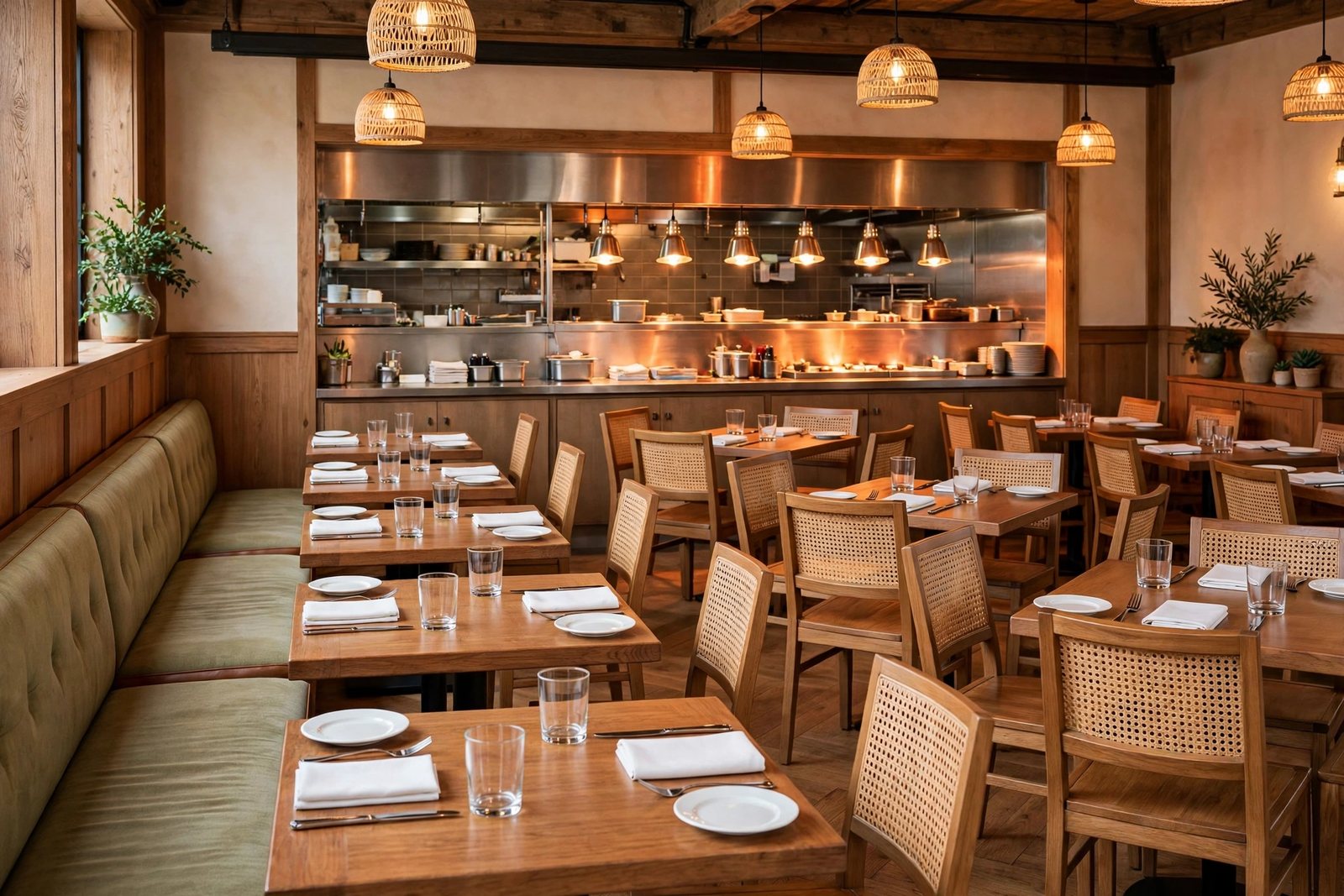
Figure P-01. The dining room of a 48-seat neighborhood restaurant
Look at the dining room in Figure P-01 before we go further. Forty-eight seats, set tables, a mix of banquette and loose seating, and the pass visible at the rear. Nothing in that room is decoration alone. The distance from the pass to the farthest table is a service decision. The mix of two-seat and four-seat tables is a party-size decision. The banquette is a capacity decision — it seats more guests in the same wall length, and it cannot be rearranged when a party of six arrives. When we learn to read a room this way, as a set of decisions already made in furniture and distance, we have learned the habit this whole book practices: read the place first, and the numbers second, because the numbers will only ever describe the place we actually built.
Illustrative figures.
We stand in our own dining room on a Friday and read one hour of service as five flows, using round illustrative figures stated here for this example only. Suppose that between 7 p.m. and 8 p.m. we seat 36 guests. That is the guest flow: 36 arrivals, in parties we can count at the door.
The food flow behind those 36 guests: if our menu's main dishes each carry one protein portion, the kitchen must have at least 36 portions ready to fire in that hour, plus the portions already committed to the tables seated before 7 p.m. The information flow is the ticket rail: each party's order arrives as one ticket, and the kitchen fires dishes by ticket, not by plate, so a four-top's four dishes finish together. The money flow for that hour, at an illustrative $32.00 average check, is:
36 guests × $32.00 per guest = $1,152.00 of sales in the hour.
The waste flow is what we count afterward: portions prepared and not fired, a remade plate, bread cut and not served. None of those items appears in the $1,152.00, but every one of them was paid for out of the food and labor that hour consumed.
What would we substitute from our own place? Our own party counts at the door, our own average check, and our own closing count of prepared-but-unfired portions. The method — name all five flows for the same hour, and refuse to read any one of them alone — is the part that transfers.
Notice what the example did not do. It did not say that 36 guests in an hour is a good hour, a typical hour, or an hour any reader should expect. It read a stated hour, on stated figures, as a system. That discipline — results belong to the numbers they were computed from — governs every worked example in this book.
A format is the shape of the exchange between guest and place: how the guest orders, where the guest pays, who carries the food, where the guest eats it, and what kitchen system must stand behind that promise. Formats are often talked about as styles. For an owner, a format is better understood as an operating contract. Each format promises the guest a different combination of speed, service, price position, and room — and each promise obliges a different kitchen, a different staffing shape, and a different use of seats.
At one end of the spectrum stands full service: guests are seated by a host, a server takes the order at the table, food is delivered course by course, and the check is presented and settled at the table. The specimen restaurant in this book, Marigold Table, is a full-service place, and most of this book's systems are drawn in that form first because it is the form in which every flow is visible at once. Full service sells time and attention as part of the meal. Its costs follow from that promise: more front-of-house labor per cover, longer table occupancy, and a dining room that is itself part of what the guest is paying for.
Next stands fast casual: guests order and pay at a counter, food is made to order behind or beside that counter, and guests carry their food to a table or receive it by number or name call. The server's table work disappears, and in its place stands a counter line that must move at the pace of the queue. The kitchen system changes with it: dishes must be designed for a short, visible production line, because the guest is watching the clock from the moment of payment in a way a seated guest, settled with a drink, is not.
The café form orders and pays at a counter as well, but its center of gravity is different: beverages and a lighter food attach, long dwell time at small tables, and dayparts that stretch from early morning through the afternoon. This book teaches the café inside the spectrum — its format decisions, its food attach, and the way its kitchen differs from a dinner kitchen. The coffee shop as its own place, with the espresso bar as its own production system, is a separate book in this series, and we do not teach the bar here. What belongs in this chapter is the café as a format choice a restaurant owner weighs: smaller kitchen, counter service, and a room designed for guests who stay.
Counter and hybrid forms fill the middle of the spectrum, and most real places live there rather than at the poles. A counter-service lunch that adds table delivery at dinner, a full-service room with a takeout window, a bar counter that serves the full menu — each hybrid borrows a service model for one daypart or one channel and another model for the rest. A hybrid is not indecision when it is designed; it is indecision only when each borrowed piece was added without asking what kitchen and staffing system it requires. Chapter 13 returns to second lines — delivery and catering — as decisions of exactly this kind, costed from our own signed terms. The rule for this chapter is simpler: every service model we promise, for any hour of the week, must have a kitchen and a roster that can keep the promise in that hour.
At the far end stand the ghost and dark formats: a kitchen with no dining room, selling only through delivery channels, sometimes under more than one menu name. We teach this format as a form — what premises it uses, how its staffing and channel structure differ, and which of this book's systems change shape inside it — and we stop there. Its economics depend on contracts and premises arrangements that are the reader's own documents to read, and no figures for those arrangements stand in this book. What does transfer, whole, is the system discipline: a kitchen with no room still runs the five flows, still costs every plate, still practices food safety daily, and still lives or dies on its weekly numbers. What does not transfer is the guest flow's visibility — we never see the guest, so our information flow must carry, alone, what a dining room tells an owner for free.
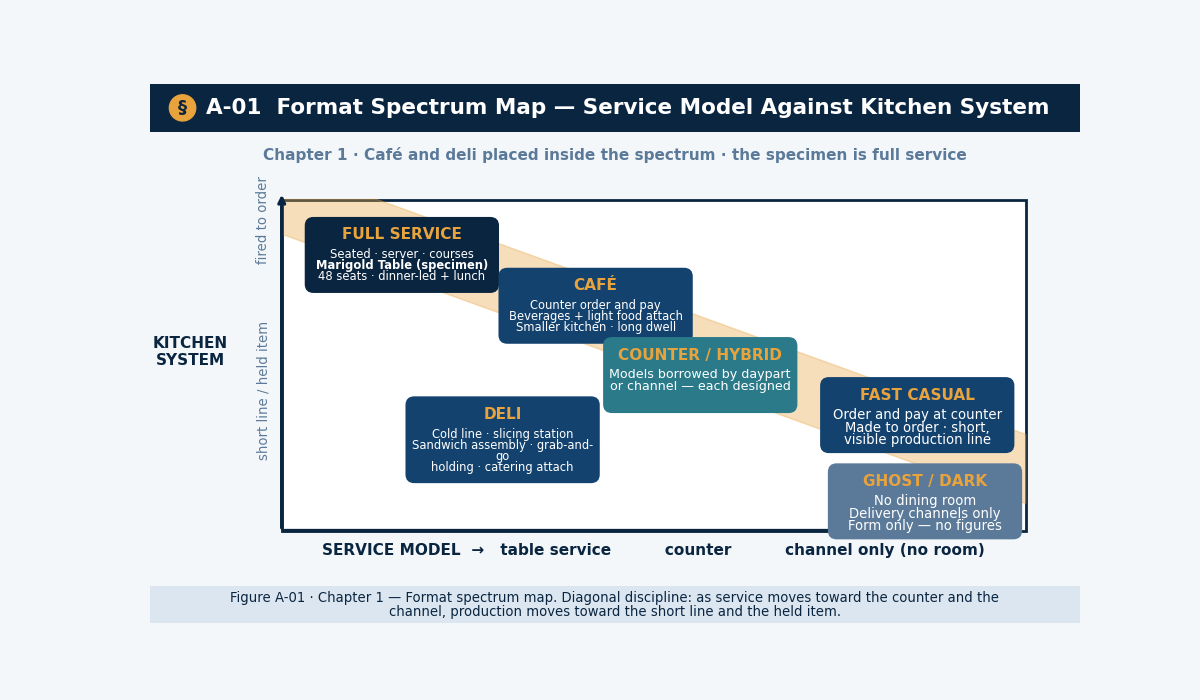
Figure A-01. Format spectrum map
Figure A-01 maps the spectrum as this book uses it: service model on one axis, kitchen system on the other, with the café and the deli placed inside the spectrum rather than beside it. The map's teaching point is the diagonal discipline it makes visible. As service moves toward the counter and the channel, production must move toward the short line and the held item; as service moves toward the table, production can afford the fired-to-order plate, because the seated guest's evening carries the waiting time inside it. Trouble in a new restaurant very often begins as a map error: a menu written for the fired-to-order end, promised through a counter that needs the short-line end. We catch that error on paper, in this chapter, for the price of a worksheet. In a leased room, the same error costs a build-out.
Before we leave the spectrum, one more distinction matters, because it decides what kind of owner we are preparing to be. A format is not a cuisine, and a cuisine is not a concept. Italian food can be served full-service, fast-casual, at a deli counter, or from a dark kitchen. Each of those is a different business that happens to share a pantry. When we say we are "opening an Italian place," we have named a pantry and nothing else — no service model, no price position, no daypart, no guest. Section 1.4 turns that sentence into a decision. First, the two formats this book carries at full part-depth inside the spectrum deserve their own section, because their operations genuinely differ from the dinner-led full-service form.
The deli is a restaurant format, not a separate species of business, and it is taught at full part-depth in this book wherever its operations differ from the full-service form. A deli's production center is a cold line: a refrigerated preparation line where sandwiches and composed cold dishes are built to order without passing through the hot line at all. Beside the cold line stands the slicing station — the slicer, the scale, and the portion discipline that makes sliced-to-order service possible — because in a deli the portion is very often weighed in front of the guest, and the scale is both a production tool and a costing instrument. The Recipe Cost Sheet in Chapter 2 and the portioning figure in that chapter belong to the deli as much as to the dinner kitchen.
A deli's holding problem is also its own. Grab-and-go holding — prepared sandwiches, salads, and packaged items held refrigerated for self-service — puts time-and-temperature discipline at the front counter instead of only in the kitchen, and Chapter 11's daily practice applies there in full: what is held, at what temperature, for how long, marked with what date, is an operating system, not a display choice. And a deli's natural second line is catering attach: the same cold line that builds a lunch sandwich builds a platter, so delis meet catering demand earlier and more often than dinner houses do. Chapter 13 costs that attach as a decision, from our own terms and our own labor, when we get there. For this chapter, the format lesson is the shape: cold production, weighed portions, front-counter holding, and a platter business waiting inside the lunch line.
The café's differing operations are quieter but just as real. Its kitchen is usually a finishing kitchen — assembly, baking-off, and short hot items rather than a full fired line — and its production peak is morning and midday rather than evening. Its room carries guests who stay longer per dollar spent, which makes seat time, rather than seat turns, the number to read honestly. Its food attach — the pastry, the soup, the sandwich beside the beverage — is where its food cost lives, and that attach is costed exactly as Chapter 2 costs any plate. An owner choosing the café form is choosing those facts, whether or not they are stated. Our work in this chapter is to state them before a lease states them for us.
Neither the deli nor the café receives its own specimen in this book, and that is deliberate. One specimen, worked whole, teaches the systems; the formats are taught as variations in the systems' shape. When a later chapter reaches a point where the deli's cold line or the café's counter genuinely changes the operation — production in Chapter 12, holding in Chapter 11, catering in Chapter 13 — the variation is taught at that point, inside the system it changes.
Illustrative figures.
We read Marigold Table's own teaching month — the specimen's figures, stated in the front matter and used across this book — as a seat-and-daypart problem. The specimen has 48 seats. In its stabilized teaching month it serves 2,250 covers over 30 days.
Step 1: covers per day. 2,250 covers ÷ 30 days = 75 covers per day.
Step 2: covers per seat per day, which is the seat-turn reading for the whole day. 75 covers per day ÷ 48 seats = 1.5625, about 1.6 covers per seat per day.
Step 3: read the figure against the dayparts. Marigold Table is dinner-led, with a lunch service. The 75 covers are not spread evenly across the day, and no honest reading treats them as if they were. If, on stated illustrative figures for this reading, lunch carries 25 of the 75 covers and dinner carries 50, then dinner alone turns the room:
50 dinner covers ÷ 48 seats = about 1.04 covers per seat across the dinner service —
which tells us the dinner room, in this specimen month, fills roughly once over the whole evening rather than turning table after table. That reading changes staffing and pacing decisions: a room that fills once is staffed and prepped differently from a room that turns twice.
What would we substitute from our own place? Our own seat count, our own counted covers by daypart — counted, not remembered — and our own service length. The arithmetic is three divisions. The honesty is in counting covers by daypart instead of dividing a monthly total by an imagined even day.
A concept is the set of choices that, taken together, tell a guest what this place is, tell a kitchen what it must produce, and tell an owner what the place will cost to run. A concept is not a name, a logo, or a favorite dish. It is five choices, and the discipline of this section is that all five must agree with one another and with the format chosen from the spectrum. A concept whose five choices disagree is not yet a concept; it is five wishes sharing a lease.
The first choice is cuisine — the pantry and the plate vocabulary: what ingredients we buy, what skills the kitchen must hold, what equipment the line must carry. Cuisine decides the supplier map before we have met a supplier, and it decides which dishes can share preparation and which stand alone.
The second choice is the service model, which is the format decision of Section 1.2 restated as part of the concept: full service, counter, café, deli, or a designed hybrid, by daypart. Service model and cuisine must fit each other on the map in Figure A-01 — a cuisine whose dishes need firing to order in small batches does not fit a service model that promises a three-minute counter line, and discovering that on paper is this chapter's whole job.
The third choice is price position: where our check sits in the guest's own comparison set — the everyday place, the occasion place, the splurge. Price position is a position, not a number; the numbers are built in Chapter 2, plate by plate, from plate costs and food-cost targets. But the position must be chosen here, because it disciplines everything downstream: a menu priced for an occasion cannot be built from everyday portions, and an everyday room cannot carry occasion staffing.
The fourth choice is dayparts: the meal periods we will serve — lunch, dinner, the hours between, the early morning — stated as a decision, with closed hours stated just as plainly. Every daypart we add adds a staffing shape, a preparation cycle, and a holding problem; every daypart we refuse protects the ones we keep. Marigold Table's choice — dinner-led, with lunch — is stated on its face, and its specimen month is read by daypart, as Worked example 2 showed, precisely because a daypart decision hidden inside a monthly total teaches nothing.
The fifth choice is the guest and the return reason: who, specifically, this place is for — named as people in a neighborhood with occasions in their week, not as a demographic label — and why that guest comes back a second time. The return reason is the concept's engine. A first visit can be bought with novelty and a new sign on the street. A second visit is earned by the system: the dish that is always right, the room that fits the occasion, the price that feels fair for what arrived. When we write the return reason down, we are writing the specification the rest of this book builds to — the menu in Chapter 2, the room in Chapter 7, the service system in Chapter 13 all exist to deliver that sentence, nightly.
Two published disciplines stand behind this section's method, and they are worth naming where they stand. The U.S. Small Business Administration's business-planning guidance puts market research before commitment: we learn who is on our street and what they already buy before we sign anything that assumes an answer. The Administration's starting-a-business sequence puts the plan before the funding request and the location choice after the plan — an order this book follows exactly: concept and numbers first (Chapters 1 to 3), site and lease after (Chapters 4 and 5). Those are structures, not promises; what our own research finds on our own street is ours to find, in person, as the front matter's residue statement says plainly.
Illustrative figures — the specimen's figures, where figures appear.
The exchange below is a teaching document for a conversation every intending owner has: a partner, a spouse, a co-owner asking, honestly, what exactly we think we are opening. The dialogue models the discipline of answering with the five choices, in order, without drifting into a favorite dish.
Partner: Before we talk about money — what is this place, exactly? In one minute.
Owner: It is a 48-seat neighborhood restaurant, full service, dinner-led with a lunch service. Seasonal American menu, fourteen dishes, and a small bar program. No delivery at open.
Partner: Why will anyone come back? There are four places within six blocks.
Owner: Because we are the weeknight place for this neighborhood — the room where a Tuesday dinner feels taken care of, at an everyday price position, with a menu that changes with the season so the regular's fourth visit is not the first visit repeated.
Partner: And what are we not doing?
Owner: We are not doing delivery at open, not doing a long menu, and not doing a white-tablecloth occasion room. Each of those is a different system, and we are building one system well.
Now the annotation, line by line, because the dialogue teaches in its structure. The partner's first question asks for the concept, and the owner's first answer gives format, seat count, dayparts, menu size, and the bar program — choices two and four, with the place's scale — before naming any dish. That order is the lesson: place and system first, pantry second. The second exchange carries the fifth choice whole: a named guest (the neighborhood), a named occasion (the weeknight dinner), and a return reason that is a system property (a seasonal menu inside a cared-for room), not a claim about talent. The third exchange is the one new owners skip, and it is the most valuable: the owner states what the place is not, and names each refusal as a system — delivery, menu length, and occasion form are each operating commitments, not marketing adjectives. A concept that cannot state its refusals has not yet been decided; it has only been described.
When we practice this conversation for our own place, we keep the same skeleton: format and scale; guest, occasion, and return reason; refusals. If any of the three answers takes longer than the questioner will patiently hear, the concept is not yet clear enough to cost — and costing it is Chapter 2's work, which needs a clear concept the way a kitchen needs a written recipe.
Every worked number in this book belongs to one fictional restaurant, introduced here whole so that no later chapter has to pause and invent it. Marigold Table is fictional, and every figure attached to it is illustrative — teaching figures, chosen to make the arithmetic visible, never presented as typical, average, expected, or recommended. We work its lease, its menu, its stack, and its month the way we will work our own: on paper, in the open, one system at a time.
The place: a 48-seat full-service neighborhood restaurant, dinner-led with a lunch service, opening in a second-generation restaurant space of 2,400 square feet — a prior restaurant's shell, with its hood, grease interceptor, and gas and water rough-ins already in place. Second-generation space, as we use the term throughout this book, means premises built for a prior restaurant and leased again as a restaurant; Chapter 4 teaches what that shell gives us and what it can hide, and Chapter 5 reads its lease clause by clause. The concept: a seasonal American menu of 14 dishes and a small bar program, with no delivery at open — delivery and catering are evaluated later, as second lines, in Chapter 13.
The figures that will recur, stated once here and never moved: base rent $4,800 a month on a five-year term with one five-year renewal option, and a security deposit of $9,600; an opening capital stack of $385,000, of which $295,000 opens the doors and $90,000 stands as the working-capital reserve; and one stabilized teaching month with $72,000 of sales — $54,000 of food sales and $18,000 of beverage sales — across 2,250 covers at a $32.00 average check, the mean amount a guest spends, computed as sales divided by covers. Chapter 2 costs three of its dishes. Chapter 9 builds its stack line by line. Chapter 18 runs its month in full. Where a worked example in any chapter needs different numbers, the example declares a fresh case on its face and labels it as a separate example, not the Marigold Table specimen. The specimen's figures themselves never change to fit an argument.
Illustrative figures.
We take a draft concept sentence of the kind owners write first — "a cozy Italian place with great pasta and a lively bar" — and we read it against the five choices of Section 1.4, one by one.
Cuisine: named, in outline — Italian, with pasta at the center. That much the sentence carries. Service model: absent. Full service, counter, and deli-counter Italian are three different businesses; the sentence chooses none of them. Price position: absent. "Cozy" and "lively" are room words, not positions; the guest cannot tell whether this is an everyday check or an occasion check, and neither can the owner who must cost the menu. Dayparts: absent. Lunch, dinner, or both is unstated, so no staffing shape follows. Guest and return reason: absent. No guest is named, and "great pasta" is a quality claim, not a return reason — every competitor on the street claims the same sentence.
State the reading plainly, with no grade attached: one choice of five is present, four are missing, and the sentence therefore cannot yet be costed, sited, or staffed. The repair is not better adjectives. The repair is four decisions, written down. A repaired sentence, in this book's form, reads the way the owner's answer in the worked dialogue reads: format and scale first, then cuisine inside it, then position, dayparts, guest, and return reason, then refusals.
What would we substitute from our own place? Our own draft sentence — the one we actually say when people ask — read against the same five choices. Most owners find, as this example finds, that the sentence they have been carrying is a cuisine and a mood. The worksheet below exists to finish it.
Illustrative figures — the specimen's entries are printed in brackets as a worked specimen of the form; write your own entries in the blank column in your notebook or on a copy of this page.
Complete each row in one or two sentences. A row that will not fill is a decision not yet made, and it routes you back to the section named in that row.
| Canvas row | Marigold Table (specimen) | Your place |
|---|---|---|
| Format and scale (§1.2) | Full service; 48 seats; 2,400 sq ft, second-generation space | |
| Cuisine (§1.4) | Seasonal American; 14 dishes; small bar program | |
| Service model by daypart (§1.4) | Table service at lunch and dinner; no delivery at open | |
| Price position (§1.4) | Everyday neighborhood position (checks built in Chapter 2) | |
| Dayparts served, and refused (§1.4) | Lunch and dinner; closed between services and one day a week | |
| Guest, named (§1.4) | Neighbors cooking less on weeknights; families on weekends | |
| Return reason (§1.4) | A cared-for weeknight room; a menu that changes with the season | |
| Refusals (§1.4) | No delivery at open; no long menu; no occasion-room form | |
| Five-flow check (§1.1) | Guests, food, money, information, and waste each named for a Friday service |
A decided concept is still only a decision. It becomes a business on paper in the next two chapters, in a fixed order: Chapter 2 costs the menu to the plate, because a concept whose dishes cannot carry their costs is a concept we revise at the table rather than at the signing table; Chapter 3 then reads those costs as percentages of sales, builds the break-even method, and asks the capital question whole, before any site is chosen. That order — concept, menu, numbers, site, lease — is the Small Business Administration's planning order applied to a restaurant, and this book never reverses it. A site we fall in love with before its menu is costed will bend the concept to fit the room. A menu costed first bends nothing; it simply tells us what kind of room we can afford to look for.
Carry one habit out of this chapter. Every time we describe our place — to a partner, a lender, a landlord, a future chef — we describe it in the concept's order: place and format, cuisine inside it, position, dayparts, guest and return reason, refusals. The habit sounds like presentation. It is actually discipline: a description that must name the system cannot quietly promise a dish the system cannot produce.
Key terms. Place is the product: the principle that the guest buys a seated meal in an operated venue, so the venue's systems are the business. System: the organized whole of five flows — guests, food, money, information, and waste — that runs every service. Format: the shape of the exchange between guest and place — ordering, payment, carrying, and seating — together with the kitchen system that shape obliges. Full service: table service from seating through settlement at the table. Fast casual: counter ordering and payment with food made to order and carried or called. Cold line: a refrigerated preparation line for dishes built without the hot line, central to deli production. Grab-and-go holding: refrigerated holding of prepared, packaged items for self-service, governed by the same time-and-temperature discipline as any held food. Catering attach: a catering line built on an existing production line, as the deli's platter work builds on its cold line. Concept: the five agreeing choices — cuisine, service model, price position, dayparts, and guest with return reason — that define a place. Daypart: a meal period served, such as lunch or dinner, with its own staffing and preparation shape. Return reason: the system property that earns a guest's second visit. Second-generation space: premises built for a prior restaurant and leased again as a restaurant, with core restaurant infrastructure already in place. Average check: total sales divided by covers over the same period.
Exercise 1. A friend describes a planned place as "a fun Mexican spot with amazing tacos and margaritas, somewhere busy." Your task: read the sentence against the five choices in Section 1.4. Write down which choices the sentence actually makes, which it leaves open, and one sentence the owner could write to close each open choice.
Exercise 2. Your own draft place has 32 seats and, on figures you state in your answer, you count 64 covers on a full Saturday across lunch and dinner. Your task: compute covers per day, covers per seat for the day, and — stating your own lunch and dinner split — covers per seat for dinner alone. Show each division, and write one sentence on what the dinner figure changes about staffing or pacing.
Exercise 3. A hybrid place near you serves counter-service lunch and full-service dinner from one kitchen. Your task: using the spectrum map in Section 1.2, name one promise each service model makes, one kitchen demand each promise creates, and one point in the day where the two models hand off to each other. Answer for the place described, in a short table of no more than three columns.
Exercise 4. An intending owner plans a dark-format kitchen: no dining room, delivery only, two menu names from one line. Your task: trace the five flows of Section 1.1 for that kitchen. For each flow, write what carries it when there is no dining room, and name the one flow you judge most exposed by the missing room, with your reason.
Exercise 5. A deli concept is described as follows: sliced-to-order sandwiches at a counter, a refrigerated grab-and-go case, and platters on order for offices nearby; closed evenings. Your task: name the production center, the portioning instrument, the holding discipline, and the second line this format carries inside it, citing the part of Section 1.3 each answer rests on — then name one full-service habit that would fail if it were copied unchanged into this deli.
Exercise 6. Using your completed Concept Canvas, a partner asks you the three questions from the worked dialogue. Your task: write your three answers — format and scale; guest, occasion, and return reason; refusals — each in no more than three sentences, in the dialogue's order. Then underline, in your own answers, any sentence that promises a dish or a quality your stated system cannot yet produce, and rewrite that sentence as a system property.
The explained model answers for Exercises 1–6 stand in Chapter 1 — Key. Work each exercise on paper before reading its model answer.
Feras Alzubi
The Complete Course Series — Google Play Books
This book teaches opening and running a restaurant as a place and a business, whole: choosing the concept and the format on real margins; costing the menu to the plate before anything is signed; reading a site, a traffic pattern, and a lease as documents; sequencing licenses, permits, and inspections; laying out kitchen and dining room as one workflow; specifying the equipment systems the craft runs on; building the opening capital stack with working-capital discipline; running the kitchen as a production system and the dining room as a service system; practicing food safety daily as an operating system; hiring, training, scheduling, and paying people with the federal mechanics understood; running the supplier and inventory system whole; keeping the weekly numbers — prime cost, break-even, cash flow — as a discipline; executing the opening sequence; running the first year as a calendar; and facing the failure modes honestly, with the real survival record printed. It is a taught course in your own restaurant, written for first-time owners, intending owners, and working owner-operators, and it assumes no prior knowledge beyond ordinary life as a restaurant guest.
© 2026 Feras Alzubi. All rights reserved. No part of this book may be reproduced, distributed, or transmitted in any form or by any means, electronic or mechanical, including photocopying and recording, without the prior written permission of the copyright holder, except for brief quotations in a review or other uses permitted by copyright law.
This book is an original work written for this series. Every explanation, example, exercise, dialogue, worksheet, and figure in it was created for this book; the specimen restaurant, its lease, its staff, and all its figures are fictional and illustrative.
This book is not affiliated with, sponsored by, or endorsed by the U.S. Food and Drug Administration, the U.S. Bureau of Labor Statistics, the Internal Revenue Service, the U.S. Department of Labor, the Occupational Safety and Health Administration, the U.S. Small Business Administration, the U.S. Department of Agriculture, the Centers for Disease Control and Prevention, the Federal Trade Commission, or the National Restaurant Association. Agency and association names appear only to identify the published public guidance this book teaches from, which is cited throughout. ServSafe is a mark of the National Restaurant Association Educational Foundation; it is named only to identify the certification landscape described in Chapter 6.
Federal and model-code figures are stamped to their source and date where they stand (food-safety standard: FDA Food Code 2022; federal wage figures: the FLSA floor as published by the Department of Labor; tax mechanics: the IRS publications named with them). Laws, codes, and limits change; the current publications of the responsible authority — and, for everything state and local, your own jurisdiction's offices — govern.
Front matter — Title page · Copyright page · Contents · How to Use This Book · What This Book Cannot Give You · The Real Numbers, Before You Begin · A Note on Sources
Opening — The Open-or-Not Check (24 items, with explained routing notes)
Part I — Choose (before anything is signed)
Part II — Open (the paper and the build)
Part III — Run: The Kitchen and the Room
Part IV — Run: People, Suppliers, and the Weekly Numbers
Part V — Open (the act) and Grow
Capstone — Build Your Opening & First-Year Plan (12 steps, with worked keys)
Back matter — The Action Paths (Pre-Signing · Opening · First-Year) · Cheat Sheets · Glossary · Errata & Updates · References
This book teaches how a restaurant is opened and run. It is general business education, not personalized business, legal, tax, accounting, licensing, or financial advice, and reading it does not create an adviser–client relationship with its author or publisher. It makes no promise about any restaurant's revenue, costs, profit, or survival (F2), and it recommends no specific product, vendor, supplier, platform, lender, or franchise (F3). Where your own documents and offices speak — your lease, your signed supplier and platform agreements, your jurisdiction's adopted health code, your state labor agency's rules — those authorities govern (F5). For decisions about your own restaurant, consult a qualified professional who can see the whole of your situation (F12). Every number in every example is illustrative (F4).
The fences behind that paragraph, stated in full, are the book's standing rules:
Two boundaries belong here, where every reader meets them before Chapter 1. First, what this book cannot give you and what the measured survival record actually says are printed in full immediately after this section — read them before you begin; they are part of the course, not fine print. Second, the neighboring books: the generic business body is taught in #263, Service Business A–Z, and its companions — #268 Cash-Flow, #269 Pricing/Estimating/Job Costing, #270 Owner Financial Literacy, #271 Tax Literacy, #272 Hiring First Employees, #275 Local Marketing, #276 Sales/Quoting/Closing, and #281 Buying an Existing Business; the examinations behind the ServSafe Food Protection Manager certification and food-handler cards are taught in #3 and #144; the cooking and baking crafts are taught in #316 and #368; the coffee shop as its own place is #493 and the food truck as a mobile premises is #495 — this book stays with the fixed-premises restaurant throughout, and signposts those neighbors where the line falls.
One fictional restaurant carries this book's worked arithmetic from Chapter 1 to the capstone, so the numbers you meet in one chapter are the same numbers, to the cent, in every other. Marigold Table is fictional, and every figure attached to it is illustrative — teaching figures, chosen to make the arithmetic visible, not presented as typical, average, expected, or recommended. It is a 48-seat full-service neighborhood restaurant — dinner-led, with a lunch service — opening in a second-generation restaurant space of 2,400 square feet: a prior restaurant's shell, with its hood, grease interceptor, and gas and water rough-ins already in place. Its concept is a seasonal American menu of 14 dishes and a small bar program, with no delivery at open. Its lease runs at $4,800 a month for five years, with one five-year renewal option. Its opening capital stack totals $385,000 — $295,000 to open the doors, plus a $90,000 working-capital reserve the book teaches you never to spend on build-out. In its one stabilized teaching month it sells $72,000 — $54,000 of food and $18,000 of beverage, across 2,250 covers at a $32.00 average check — carries $20,160 of cost of goods sold and $23,760 of total labor, for a prime cost of $43,920, and is staffed by 20 employees plus its working owner. Chapter 1 introduces the place whole; Chapter 2 costs three of its dishes step by step; Chapter 9 builds its stack line by line; Chapter 18 runs its month in full. Where a worked example needs different numbers, the book says so on the spot and labels the example as a separate illustrative case — the Marigold Table figures themselves never move.
Work the specimen's examples with a pencil, then substitute your own figures in the worksheets. The arithmetic method is the teaching; the canon numbers are only there so you can watch it work before you run it on your own place.
Every chapter teaches, then asks you to do, then explains. Read the chapter and work its three worked examples as you meet them; work its one worked dialogue as a document — the exchange shown, then annotated line by line. Then work the chapter's six scenario exercises on paper. Each exercise gives you a short situation and a task; the explained model answers stand in the chapter's key, so the doing comes before the checking. A model answer works the numbers step by step, explains the reasoning, and states plainly what depends on your own lease, your own signed agreements, your jurisdiction's adopted code, or your own state rule — the parts no book can settle for you. Where an exercise turns on a judgment — sign the lease or walk, take the delivery platform or refuse it — the model answer works the specimen's numbers, names what would change the answer, and stops: the decision is yours, and the book's job is to make it an informed one. Four chapters (3, 11, 16, and 18) also carry repair drills: a broken situation — an under-reserved capital stack, a cooling failure found at close, a deposit that missed its date, a prime cost built on an estimated count — repaired step by step, with a worked key. Each chapter closes with a one-page cheat sheet in the chapter's own terms, and eight chapters carry a fill-in worksheet at its teaching point: the Concept Canvas (Chapter 1), the Recipe Cost Sheet (Chapter 2), the Break-Even Worksheet (Chapter 3), the Lease Clause Checklist (Chapter 5), the Permit Sequence Tracker (Chapter 6), the Equipment Census & Sizing Sheet (Chapter 8), the Par & Order Sheet (Chapter 17), and the Weekly Prime-Cost Sheet (Chapter 18).
Nothing in this apparatus is timed, and nothing in it is passed or failed. An answer that differs from the model answer is information: return to the section the exercise rests on, find the step where your working parted from the model's, and work the exercise again.
Before Chapter 1, take the Open-or-Not Check that follows this front matter. It has 24 items in four domains of six — Concept (is there a restaurant here yet, or only a dish and a dream?), Capital (the money before signing), Place & Paper (site, lease, licenses, inspections), and Operations (the daily systems and your own stamina for them, honestly put). The check is this book's own routing tool, built for this book's chapters, and it says so on its face.
Answer each item in plain words about your own situation and plans, then read its explained routing note in the key that follows the check: the note states what the answer usually means, written out in full, and names the chapter or chapters it routes to. The check computes and prints no total score and no readiness verdict. There is no summed score to earn, compare, or improve: the check's whole output is the routing — which chapters speak to which of your answers. A reader who answers every item well has a reading order, not a prediction. In the capstone, after Chapter 20, you will take the check again and compare your answers item by item and domain by domain — which answers changed, and therefore which chapters now route differently — in words. If an item routes you to a chapter you have already read carefully, the routing is still doing its work: it is telling you where your own figures, your own lease, or your own jurisdiction's answers, rather than the chapter's teaching, need the next hour.
The back matter prints three route maps through the book. Each path is a printed route — chapters, worksheets, and the points where the check is re-taken — and no path carries any promise about what following it will achieve. The rule printed on the first path's face belongs to all three: nothing on any path signs anything for you.
Whichever path you take, finish at the capstone, Build Your Opening & First-Year Plan: twelve steps, each with a worked key on the Marigold Table specimen, that assemble the book into one plan — the check re-taken and compared, the concept canvas, the costed menu, the capital stack with its reserve, the site-and-lease decision record, the permit sequence tracker as filed, the equipment census, the staffing model and first roster, the food-safety policy set, the supplier map with second sources, the opening sequence calendar, the weekly numbers ritual, and the first-year calendar with its failure-mode watchpoints.
This book teaches the systems of a restaurant whole: the concept decision, the lease, the permits, the equipment, the suppliers, the staff system, the daily numbers. People who have worked years inside restaurants hold something else as well, and no book can hand it to you, including this one. It cannot give you palate — the judgment, built plate by plate, of what your food should taste like when it is right. It cannot give you the room — the feel for a dining room in its bad moment, and the calm that steadies it. It cannot give you your market — the street, the neighborhood, and the guests are yours to learn in person; this book teaches you how to read them, not what you will find. It cannot give you capital — the money, and the discipline to protect its reserve, must come from your own stack. It cannot give you the trust of regulars or of a team — that is earned across a counter and a pass, over months. It cannot give you supplier-relationship capital — the standing with the people who supply you, earned delivery by delivery and call by call, that decides whose shorted case is made good and whose price is held when the market moves; Chapter 10 teaches the supplier system, but the relationship itself is accumulated in person, over time. And it cannot give you stamina — the 5 a.m. delivery and the midnight close are the shape of this trade, and only you know whether that shape fits your life. What a book can do — what this one is built to do — is give you the systems that protect you while judgment develops: the checklists, the pars, the cost sheets, the opening and closing routines, the weekly numbers. The years of floor time teach those systems by osmosis, expensively. This book teaches them on paper, first.
You will be told — by guides, by videos, by people selling courses — that 90% of restaurants fail in their first year. That figure has no source. It appears in marketing copy (it stands, unsourced, in the copy of a well-known shelf guide to starting a restaurant) and it is not true in any federal data. Here is what the measured record says. The U.S. Bureau of Labor Statistics follows every new private-sector establishment — a single business location with employees — from the year it opens. For accommodation and food services, the sector that contains restaurants (the Bureau publishes no restaurant-only table), of the establishments that opened in the year ended March 2013: 82.5% were still operating one year later — about 17 or 18 in every 100 had closed; 55.3% were still operating five years later — about 45 in every 100 had closed; and 38.2% were still operating ten years later. Across all industries the shape is similar: about half of new employer establishments are still operating at five years. Read the curve honestly, in both directions. A restaurant is not a coin-flip doomed in its first year — and nearly half of a cohort is gone by year five, which is a serious number that deserves a serious book. The Bureau's table records that an establishment stopped reporting employment; it does not record why, and a closure is not always a failure — owners sell, retire, and move. These figures describe a population. They are not your odds, and this book never treats them as such. What the evidence does support is narrower and more useful: the documented killers of new restaurants are teachable things — opening undercapitalized, signing the wrong lease in the wrong place, and running without knowing your prime cost. Those are Chapters 9, 4 and 5, and 18 of this book. (Source: U.S. Bureau of Labor Statistics, Business Employment Dynamics, establishment survival by industry, 2013 cohort, as published in The Economics Daily, January 12, 2024; methodology and the all-industry averages:.)
Every fact in this book traces to the published guidance of a public authority, read for this book and cited where it stands; the References in the back matter collect the sources of record for the printed book, in full. The authorities are: the U.S. Food and Drug Administration (the FDA Food Code 2022 — the model food-safety standard this book teaches from — and the FDA Food Code 2022's major-food-allergen provisions); the U.S. Bureau of Labor Statistics (establishment survival by industry, and the Business Employment Dynamics methodology behind the survival figures); the U.S. Small Business Administration (business planning, the funding request, and the sequence of starting a business); the Centers for Disease Control and Prevention (sick-worker guidance, foodborne-illness outbreak contributing factors, and ill-worker policy findings at retail food establishments); the Occupational Safety and Health Administration (worker safety in restaurants, by station); the U.S. Department of Labor, Wage and Hour Division (the Fair Labor Standards Act federal wage floor, the Fair Labor Standards Act tip-credit mechanics, and the current tip-credit guidance position); the Internal Revenue Service (tip withholding and reporting, employment-tax deposits and reporting, and depreciation mechanics); the U.S. Department of Agriculture, Food Safety and Inspection Service (safe food handling at the receiving and storage boundary); and the Federal Trade Commission (the Franchise Rule and the Franchise Disclosure Document structure).
Dated figures carry their stamps where they stand, and the stamps are part of the teaching:
Laws, codes, and limits change after any book is written. The errata and updates page in the back matter records this book's verification discipline: a dated figure whose source has moved is updated or cut in a new edition, never left standing as if current — and for anything you are about to sign, file, serve, or decide, the current publication of the responsible authority, your own documents, and your own jurisdiction's offices govern.
End of the free sample. The complete book continues from here — the full A-to-Z course in book form, delivered as an EPUB you can read in Apple Books, Google Play Books, ReadEra, Thorium Reader, Adobe Digital Editions, or Send to Kindle.
Buy this ebook — $12.99 Back to the book page
Payments are securely processed by Payhip.