
Mastering Careers & Skills
Real Estate Salesperson Exam · free sample from the book itself
This book assumes nothing. If you have never bought, sold, rented, or studied property, you are in the right place. We build from the ground — literally — because every rule in the chapters ahead sits on a few simple objects. Learn the objects first, and the rules will make sense when they arrive.
Land is the starting object. Land means the surface of the earth, everything down to the center of the earth, and the air above the surface up to a practical height. Land is not just dirt. A piece of land includes the soil, the rocks under it, and the space above it.
Real estate is land plus the permanent things people add to it. A house built on land, a fence set in concrete, a road, a barn — these additions are called improvements, meaning anything artificial and lasting that has been added to the land to make it more useful. So: land alone is land; land plus improvements is real estate.
Real property is a slightly bigger idea. Real property is the land, the improvements, and the legal rights that go with owning them — the right to use the land, to keep others off it, to sell it, and to give it away. When people say someone "owns real property," they mean the physical thing and the bundle of legal rights together. Chapter 2 takes that bundle of rights apart stick by stick.
Personal property is everything else — movable things that are not attached to land: a chair, a car, a refrigerator that simply plugs in, money, a contract right. Personal property is also called chattel. The line between real and personal property matters enormously in a sale, because real property normally passes to the buyer with the land, while personal property does not unless the contract says so. Chapter 2 teaches that line in full, including the in-between case: a fixture is an item that started as personal property but became part of the real property by being attached to it — a built-in bookshelf, for example, or a furnace. Hold those five words — land, real estate, real property, personal property, fixture — and you already have the vocabulary this whole field stands on.
A parcel is one defined piece of land: one lot, one farm, one tract with its own boundaries. When a seller sells and a buyer buys, what changes hands is a parcel, described so exactly that anyone can find its edges. Describing parcels exactly is a skill of its own, and it is Chapter 2's second half.
Exam trap — three words, three meanings. Land is the raw earth and what is naturally on and under it. Real estate is land plus permanent improvements. Real property is real estate plus the ownership rights. A question that swaps one of these words for another is testing whether you keep them separate.
Strip away every form and fee, and a sale is a simple story: one party owns a parcel, another party wants it, they agree on a price and terms, money and financing are arranged, the value is checked, and ownership is formally transferred and recorded. Here is that story as six stages, in the order they happen. Read the stages now; every later chapter is one of these stages opened up and examined.
Now place the people on the stages where each one enters, because a beginner's most common confusion is not what happens — it is who does what.
Figure 1.1 — Anatomy of a Sale
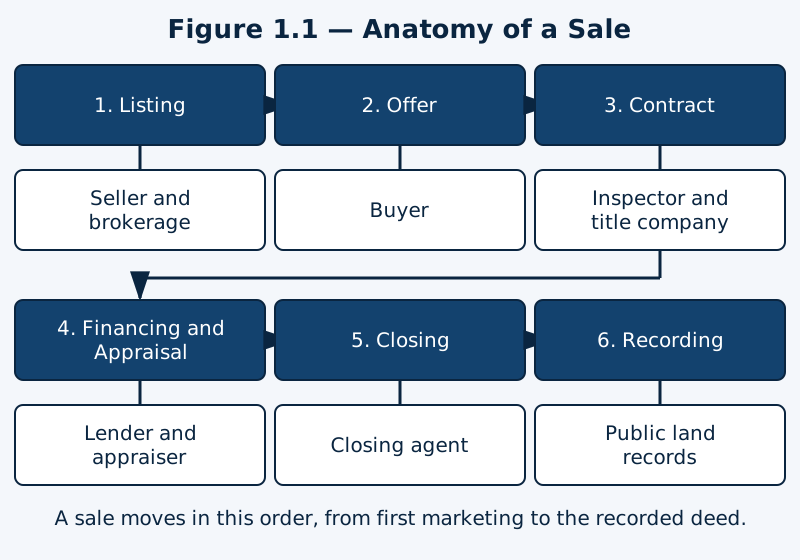
Figure 1.1 — Anatomy of a Sale. The six stages run left to right: listing, offer, contract, financing and appraisal, closing, recording. Under each stage stands the person who enters the transaction there: seller and brokerage at listing; buyer at offer; inspector and title company between contract and closing; lender and appraiser at financing and appraisal; closing agent at closing; the county land records at recording.
Because the exam — and the work — returns to these roles constantly, fix each one with a plain definition now.
A licensee is anyone who holds a real estate license from their state. There are two main working levels. A salesperson is licensed to perform real estate services — showing property, negotiating, preparing contracts under supervision — only while affiliated with and supervised by a broker. A broker is licensed to run a brokerage, to represent parties in the broker's own right, to supervise salespersons, and to be responsible for the brokerage's work. The beginner's rule is short: a salesperson works for a broker; a broker is responsible for the business.
An appraiser values property. Appraisers are separately licensed or certified, follow their own professional standards, and must be independent of the deal — their job is a supported opinion of value, not helping a sale close.
A lender supplies borrowed money secured by the parcel. A loan secured by real property is a mortgage loan, and the parcel stands behind the promise to repay — if the borrower does not pay, the lender has rights against the property itself. Chapter 11 opens that machinery.
A title company answers one question: is the seller's ownership clean? It searches the recorded history of the parcel, reports claims it finds, and insures against covered risks that the search missed.
An inspector examines condition, not value and not title: roof, structure, systems, and visible defects, reported to whoever hired the inspector.
A property manager operates rentals for owners, as noted above — the field's ongoing-operations job, as opposed to the transaction jobs around a sale.
Notice what this cast list already teaches: no single person does the whole transaction. The licensee markets and negotiates; the appraiser values; the lender funds; the title company verifies ownership; the inspector verifies condition; the closing agent settles the money. Exam questions love to hand one person's job to another person and ask what is wrong. When you meet a scenario, ask first: whose job is this?
A license is official permission from a government authority to do work that unlicensed people may not do. Real estate is licensed work because the public is handing strangers very large sums of money and the deeds to their homes; the license is the state's way of setting a floor for knowledge and answerability.
Hold this fact firmly, because everything in this book's exam framing hangs on it: real estate licenses are issued by states, and only by states. Each state has its own licensing authority — usually called a real estate commission or a division of real estate — and its own license law. There is no national real estate license. No federal body licenses salespersons, and no license from any source lets a person practice in every state.
The national-only fence, stated in full, here in Chapter 1. This book teaches the national portion of the licensing exam (Section 1.5 explains what that means). It does not teach your state's portion, it is not pre-license education and satisfies no state's education-hour requirement, and it does not state your state's fees, seat time, pass mark, application process, or retake rules — because those are set by your state and differ from state to state. Where a national topic has a state setting, this book teaches the national principle, marks the exact point where your state's law takes over, and stops. Your state candidate handbook is the authority for everything on your side of that fence.
Almost every state tests salesperson candidates with a licensing exam in two portions:
Two testing companies administer the national portion for the states that use their services: Pearson VUE and PSI Services LLC. Neither vendor issues a license; each administers the exam under contract, and the state licenses. (Source: Pearson VUE, Real Estate — National/General Content Outlines, publication 092901, effective April 1, 2025; PSI Services LLC, Licensing Information Bulletin — Iowa Real Estate Commission, effective December 8, 2025, and Real Estate Salesperson and Broker Candidate Information Bulletin — Ohio, dated July 1, 2026.)
Here is what both vendors agree on, verified from their own publications:
And here is what the vendors' publications honestly do not agree on — because these things are not national at all:
Remember the number — 80. Eighty scored items, under both vendors. The unscored items on top of the 80 (5 pretest at Pearson VUE; 5–10 experimental at PSI) never change the scored count, and because you cannot identify them in the sitting, the only sound strategy is to answer every item as if it counts.
Before the diagram, hold the whole picture in one sentence: one licensing exam, in two portions — a national portion of 80 scored items (plus 5 unscored pretest items at Pearson VUE, or 5 to 10 unscored experimental questions at PSI), which this book teaches, beside a state portion, which is fenced out of this book and belongs to your state handbook — and two vendors, Pearson VUE and PSI, administering the national side under contract to the states that license you.
Figure 1.2 — One Exam, Two Portions, Two Vendors
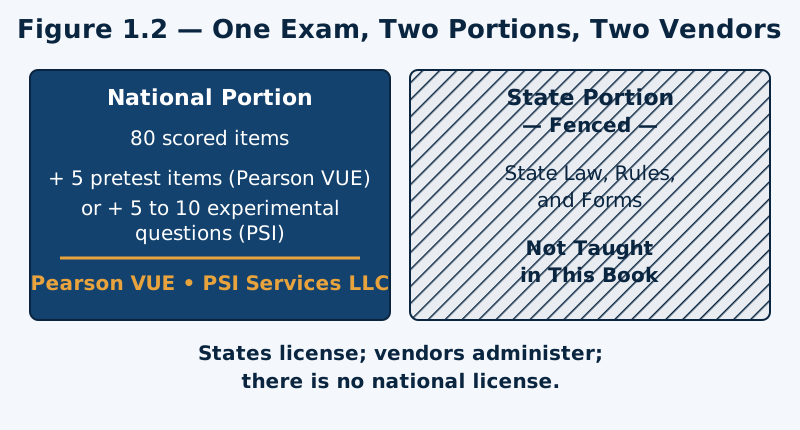
Figure 1.2 — One Exam, Two Portions, Two Vendors. The licensing exam divides into the national portion — 80 scored items, plus 5 pretest items at Pearson VUE or 5 to 10 experimental questions at PSI, administered by Pearson VUE or PSI under contract to the states — and the state portion, shown hatched and fenced: state law, rules, and forms, taught by your state handbook, not by this book.
Pearson VUE files the 80 scored items in eight content areas, with exact counts: Real Property Characteristics, Legal Descriptions, and Property Use, 11; Forms of Ownership, Transfer, and Recording of Title, 9; Property Value and Appraisal, 11; Real Estate Contracts and Agency, 16; Real Estate Practice, 10; Property Disclosures and Environmental Issues, 9; Financing and Settlement, 7; and Real Estate Math Calculations, 7 — a total of 80. PSI files the same body of knowledge in eleven areas with percentage weights: Property Ownership, 10 percent; Land Use Controls, 5 percent; Valuation, 8 percent; Financing, 10 percent; Contracts, 19 percent; Agency, 13 percent; Property Disclosures, 7 percent; Property Management, 3 percent; Transfer of Title, 6 percent; Practice of Real Estate, 12 percent; and Real Estate Calculations, 7 percent — a total of 100 percent. (Sources: Pearson VUE, publication 092901; PSI Services LLC, Iowa and Ohio bulletins.)
Two orientation facts fall out of those tables, and both shape this book:
Every item on the real exam is also classified by what it asks your mind to do: knowledge (recall a definition or rule), application (use a rule on stated facts), or analysis (weigh a situation and choose the best course). This book trains all three: definitions first, then worked examples, then scenarios — the same ladder the exam climbs.
This chapter's quiz tests orientation and vocabulary only: the objects of the field, the stages of a sale, the cast, and the exam's shape. Nothing in it tests a rule before the book teaches it — every later quiz follows the same promise.
From here, Part I finishes the foundations: Chapter 2 defines real and personal property in full, teaches the three systems for describing land, and takes the bundle of rights apart. Chapter 3 teaches the ways people own property and hold title together. Only after those objects are solid does the book turn to the rules that govern them. If the diagnostic test sent you here, that routing was deliberate: a national-portion candidate who cannot yet say what land, a fixture, or a deed is cannot yet profit from the law about them.
1. Which statement correctly defines real property?
A. Land alone, before any improvements are added to it B. Land plus permanent improvements plus the legal rights of ownership C. Any movable item used in connection with a building D. The physical buildings on land, excluding the land itself
2. A plug-in refrigerator that simply plugs into a wall outlet in a home is best classified, before any contract term changes it, as:
A. Personal property B. A fixture C. Real estate D. An improvement
3. At which stage of a sale is the deed filed in the public land records?
A. Listing B. Offer C. Closing D. Recording
4. A salesperson may perform real estate services only while:
A. Employed directly by the state licensing authority B. Owning at least part of the brokerage C. Affiliated with and supervised by a broker D. Also holding an appraiser's certification
5. Who is responsible for running the brokerage and supervising its salespersons?
A. The broker B. The title company C. The closing agent D. The senior salesperson
6. An appraiser's job in a financed sale is to:
A. Negotiate the price between buyer and seller B. Provide an independent, supported opinion of the property's value C. Verify that the seller's ownership record is clean D. Inspect the roof and mechanical systems for defects
7. Verifying that the seller's ownership is clean and insuring against covered defects in that record is the work of the:
A. Lender B. Inspector C. Title company D. Appraiser
8. Which statement about the licensing exam is correct?
A. A single national exam, issued by a federal authority, licenses salespersons in all states B. The state portion covers principles that are the same in every state C. Pearson VUE and PSI each issue their own national license D. Each state licenses salespersons, and the exam is generally taken in a national portion and a state portion
9. How many scored items make up the national portion under both vendors' published outlines?
A. 85 B. 80 C. 90 D. 100
10. In a Pearson VUE sitting, the 5 pretest items are:
A. Not counted toward the score and indistinguishable from scored items B. Counted toward the score only if the candidate passes C. Extra credit added after scoring D. Identified on screen so candidates can skip them
11. In a PSI sitting, experimental questions:
A. Number exactly 5 and are identified in advance B. Replace scored items for candidates who request them C. Are not scored, but they do count against examination time D. Are scored separately by the candidate's state commission
12. Which statement about time and passing standards is accurate?
A. Both vendors publish one national seat time and one national pass mark B. Pearson VUE's national outline publishes a universal pass mark of 70 percent C. A candidate's fee, time, and pass mark are printed in this book for every state D. PSI bulletins publish 120 minutes and 56 of 80 (70 percent) for the salesperson national portion, while Pearson VUE's national outline publishes neither a time nor a pass standard
13. This book does NOT provide:
A. The reader's state portion, state education hours, or state fee and retake rules B. A crosswalk to both vendors' published content outlines C. Coverage pitched at a reader starting from zero D. Instruction in the national portion's principles and mathematics
14. Under both vendors' outlines, the largest combined block of the national portion is:
A. Financing and settlement B. Contracts and agency C. Property disclosures and environmental issues D. Real estate math calculations
15. A parcel, as the term is used in this book, is:
A. A package of personal property sold with a house B. The set of legal rights that go with ownership C. One defined piece of land with its own boundaries D. A loan secured by real property
1. B. Real property is the complete package: land, plus the permanent improvements on it, plus the legal rights of ownership. Strongest distractor — A names real estate without the rights and without improvements; it is the definition of land alone, one step short. C describes personal property, and D omits the land itself.
2. A. A refrigerator that merely plugs in is movable and unattached, so it is personal property (chattel) unless a contract provides otherwise; Chapter 2 teaches the attachment tests in full. Strongest distractor — B: a fixture must have become part of the real property by attachment; plugging in is use, not attachment. C and D both require permanence the item does not have.
3. D. Recording is the final stage: the deed is filed in the public land records, giving the world notice of the new owner. Strongest distractor — C: the deed is signed and delivered at closing, but delivery is not recording; the filing itself is the separate, later act. A and B happen before any deed exists.
4. C. A salesperson is licensed to act only under a broker's affiliation and supervision; that supervision is what makes the brokerage responsible for the salesperson's work. Strongest distractor — A: the state licenses and regulates, but it does not employ salespersons or supervise their transactions. B confuses ownership with licensure, and D names a different license entirely.
5. A. The broker runs the brokerage and supervises its salespersons. Strongest distractor — D: seniority gives a salesperson experience, not legal responsibility for the business; supervision is the broker's role by definition. B and C name outside service providers who never supervise licensees.
6. B. The appraiser's product is an independent, supported opinion of value, ordered in a financed sale so the lender can judge the parcel as security for the loan. Strongest distractor — D is the home inspector's job — condition, not value. A is the licensees' work, and C is the title company's.
7. C. The title company searches the ownership record and issues title insurance against covered defects. Strongest distractor — A: the lender relies on the title work and often requires a lender's policy, but the lender does not perform the search or issue the insurance. B examines physical condition; D opines on value.
8. D. States license salespersons under their own law, and the exam is generally given in two portions: a national portion of shared principles and a state portion of that state's law. Strongest distractor — A states the exact misconception this chapter fences out: no federal authority and no national license exist. C reverses the vendors' role — they administer, states license — and B describes the national portion, not the state portion.
9. B. Both vendors publish 80 scored items for the salesperson national portion. (Source: Pearson VUE, publication 092901; PSI Services LLC, Iowa and Ohio bulletins.) Strongest distractor — A (85) is the presented total in a Pearson sitting (80 scored + 5 pretest); pretest items are not scored items. C (90) is the top of PSI's presented range, and D appears in neither outline.
10. A. Pearson VUE's 5 pretest items do not count toward the score and cannot be distinguished from scored items, which is why candidates should answer all items. (Source: Pearson VUE, publication 092901.) Strongest distractor — D fails on the second half of the rule: the items are expressly indistinguishable, so there is nothing on screen to identify or skip. B and C invent scoring treatments the outline does not contain.
11. C. PSI's bulletins state that 5 to 10 experimental questions may be administered, are not scored, but count against examination time. (Source: PSI Services LLC, Iowa and Ohio bulletins, "Experimental Questions.") Strongest distractor — A gets the count wrong twice: the range is 5 to 10, not exactly 5, and the questions are not identified in advance. B and D describe procedures no bulletin publishes.
12. D. PSI's bulletins publish 120 minutes and a passing score of 56 of 80 (70 percent) for the salesperson national portion; Pearson VUE's national outline publishes neither a time nor a pass standard, because both are set by the states. Strongest distractor — B attaches PSI's attributed figure to the wrong vendor and calls it universal — precisely the error the fence exists to prevent. A asserts a single national standard that does not exist, and C claims state-by-state facts no national book can state.
13. A. The book's fence: the state portion, pre-license education hours, and state-set fees, seat time, pass marks, and retake rules belong to the reader's state handbook. Strongest distractor — D is something the book does provide — the national portion, principles and math included, is its entire subject. B and C are likewise provided: the dual crosswalk and the from-zero teaching design.
14. B. Contracts and agency: Pearson VUE's Area IV carries 16 of 80 items, and PSI's Contracts (19 percent) plus Agency (13 percent) total 32 percent — the largest block in both filing systems. Strongest distractor — D: math is a named domain in both outlines but a small one (7 items; 7 percent). A carries 7 items under Pearson VUE, and C carries 9 — neither approaches the contracts-and-agency block.
15. C. A parcel is one defined piece of land with its own boundaries — the unit that is listed, described, and transferred. Strongest distractor — B defines the rights side of real property, not the land unit. A confuses the parcel with chattels sold alongside it, and D defines a mortgage loan.
2026–2027 Edition
This book covers the national portion only. There is no national real estate license, and there is no single national real estate exam. Every state licenses real estate salespersons itself, under its own law, and every state tests its own law in a separate state portion of its licensing exam. This book teaches the national portion — the principles, law, contracts, finance, appraisal, agency, federal fair-housing law, and math that are the same in every state. It does not cover your state's portion, your state's law, or your state's licensing mechanics. That fence is stated again in Chapter 1, on the face of every timed practice test in this book, and in both study plans. It is not a footnote. Read it before you rely on anything else in these pages.
Copyright © 2026 Feras Alzubi. All rights reserved.
No part of this book may be reproduced, stored in a retrieval system, or transmitted in any form or by any means — electronic, mechanical, photocopying, recording, or otherwise — without the prior written permission of the copyright holder, except for brief quotations in reviews and other uses permitted by copyright law.
This edition was built against two published vendor outlines: Pearson VUE's National/General Exam Content Outline for Salespersons, publication 092901 (09/2025), effective April 1, 2025, and the national content outline published by PSI Services LLC in its state candidate bulletins, verified in the Iowa bulletin effective December 8, 2025, and the Ohio bulletin dated July 1, 2026. Exam facts in this book were verified on October 28, 2026. Vendor outlines, state rules, fees, and requirements change. If a figure in this book conflicts with a current official source — your state candidate handbook above all — the official source controls. Corrections are issued in a new edition and listed on this book's errata and updates page.
The author's name. The copyright holder's name appears on this copyright page, on the cover, and in the store metadata, and nowhere else inside this book. The book stands on its sources, which are cited in the text at the point of use and listed in full in the References.
This book is an independent study resource. It is not published by, affiliated with, endorsed by, or approved by Pearson VUE, PSI Services LLC, the National Association of REALTORS®, or any state real estate commission, licensing authority, or other state regulator, and none of them participated in its creation. Exam names, vendor names, and trademarks belong to their respective owners. Passing any exam also depends on the candidate's own preparation; no book can guarantee a result.
Provenance note. Every practice question in this book is original. The book contains 590 explained practice questions — a 50-question diagnostic, 15-question quizzes at the end of each of the 19 chapters, and three timed practice tests of 85 questions each. Every question was written fresh for this book against the two published vendor outlines named above. No question is an actual, recalled, paraphrased, or adapted exam item, and none was copied from another prep book, course, or question bank. Every question is explained in its answer key: why the correct answer is correct and why each other option is wrong. Every calculation question is worked digit for digit, for the correct answer and for the wrong answers alike.
Every figure on this page comes from a primary source named on the page. Verification date for the figures on this page: October 28, 2026.
Almost every state structures its salesperson licensing exam the same way: a national portion, covering the knowledge that is the same everywhere, and a state portion, covering that state's own license law, rules, forms, and process. The state issues the license. The vendors — Pearson VUE and PSI — only administer the exam under contract to the state. Neither vendor licenses anyone.
Both vendors publish the content outline for the national portion, and this book is built against both outlines. They describe the same body of knowledge. They file it differently, and on some facts they do not say the same thing — because on those facts there is no national answer to give. This page presents each vendor's facts separately, exactly as its own publications state them. Where the vendors differ, the difference is printed, not averaged away.
(Source: Pearson VUE, Real Estate — National/General Content Outlines, publication 092901 (09/2025), "National/General Exam Content Outline for Salespersons," effective April 1, 2025.)
| Fact | Pearson VUE, as published |
|---|---|
| Scored questions | 80 scored questions |
| Unscored questions | 5 pretest questions, not counted toward the score and not identified to the candidate |
| Questions presented | 85 (80 scored + 5 pretest) |
| Time allowed | Not published in the national outline — set by each state in its candidate handbook, and it varies by state |
| Passing score | Not published in the national outline — set by each state |
| Exam fee | No national fee exists — set state by state |
The 80 scored questions are divided among eight content areas, in exact counts published by Pearson VUE:
| Pearson VUE content area | Scored questions |
|---|---|
| I. Real Property Characteristics, Legal Descriptions, and Property Use | 11 |
| II. Forms of Ownership, Transfer, and Recording of Title | 9 |
| III. Property Value and Appraisal | 11 |
| IV. Real Estate Contracts and Agency | 16 |
| V. Real Estate Practice | 10 |
| VI. Property Disclosures and Environmental Issues | 9 |
| VII. Financing and Settlement | 7 |
| VIII. Real Estate Math Calculations | 7 |
Contracts and agency — Area IV, at 16 of 80 questions — is the largest single block on the Pearson VUE outline. Chapter space in this book follows that weight.
Pearson VUE's outline also publishes two math rules this book follows exactly: candidates must memorize 43,560 square feet per acre and 5,280 feet per mile, because those figures are not supplied at the test center; and a proration question on the real exam specifies whether it uses a 360-day or a 365-day year and who owns the day of closing. Every proration question in this book does the same. (Source: Pearson VUE, publication 092901, "Notes on Math Calculations.")
(Sources: PSI Services LLC, Licensing Information Bulletin — Iowa Real Estate Commission, effective December 8, 2025; and PSI, Real Estate Salesperson and Broker Candidate Information Bulletin — Ohio, © 2026 PSI, dated July 1, 2026. The two bulletins, for two different states, publish identical national content — the evidence that PSI's national outline is standardized across its state bulletins.)
| Fact | PSI, as published in the bulletins |
|---|---|
| Scored questions | 80 questions (80 points) |
| Unscored questions | 5 to 10 experimental questions may be administered; they are not scored, but they count against your examination time |
| Questions presented | 85 to 90 (80 scored + 5 to 10 experimental) |
| Time allowed | 120 minutes for the national portion |
| Passing score | 56 of 80 (70 percent) |
| Exam fee | State-set and published per bulletin — the two bulletins above do not even agree with each other (see below) |
PSI files the same knowledge in eleven areas, weighted in percentages rather than exact counts:
| PSI content area | Share | Questions out of 80 (computed) |
|---|---|---|
| I. Property Ownership | 10% | about 8 |
| II. Land Use Controls | 5% | about 4 |
| III. Valuation | 8% | about 6 |
| IV. Financing | 10% | about 8 |
| V. Contracts | 19% | about 15 |
| VI. Agency | 13% | about 10 |
| VII. Property Disclosures | 7% | about 6 |
| VIII. Property Management | 3% | about 2 |
| IX. Transfer of Title | 6% | about 5 |
| X. Practice of Real Estate | 12% | about 10 |
| XI. Real Estate Calculations | 7% | about 6 |
The item equivalents are computed from PSI's published percentages and rounded; PSI itself publishes the percentages, not the counts. Note the agreement underneath the different filing systems: contracts and agency together are also the largest block on PSI's outline (Contracts 19% plus Agency 13%).
Fees prove the point this whole page is making. PSI's Iowa bulletin publishes a salesperson examination fee of $95, covering both portions. PSI's Ohio bulletin publishes $46.00 for the national portion taken alone and $66.00 for the state and national portions taken at the same sitting. Both figures are real, both are current, and neither is a national fee — because no national fee exists. The same is true of time and passing scores wherever the vendors' publications differ: PSI's bulletins publish 120 minutes and 56 of 80 (70 percent) for the salesperson national portion; Pearson VUE's national outline publishes neither a time nor a passing score, and its state handbooks set both, state by state. Your state's passing score, your sitting time, your fee, and your retake rules are the ones printed in your own state candidate handbook — and only those. No figure in this book overrides your handbook, and no pass rate or candidate-volume figure is printed anywhere in this book, because neither vendor publishes a national one.
Each of the three timed practice tests at the back of this book presents 85 questions: 80 scored questions distributed exactly by Pearson VUE's published counts (11 / 9 / 11 / 16 / 10 / 9 / 7 / 7), plus 5 pretest-style questions that are identified only in the answer key — mirroring how unscored questions behave in a real sitting, where you cannot tell them from scored ones.
Two choices in that design need their reasons stated:
Every timed test is scored under this framing, printed identically in the front matter, Chapter 19, the study plans, and each test's own header:
Score this test on the 80 scored questions only. The 5 pretest-style questions do not count, just as pretest and experimental questions do not count on the real national portion. PSI bulletins publish 56 of 80 (70 percent) as the passing score for the national portion; Pearson VUE's national outline publishes no passing score. Your state's passing score governs your real exam — confirm it in your state candidate handbook before exam day.
This book serves two readers at once, in one binding. Find your path below. Both paths use the same diagnostic, the same 19 chapters, and the same timed practice tests. They differ in where you start and how fast you move.
You have never sold, bought, or studied real estate, and words like escrow, encumbrance, and amortization are new. That is the reader Part I was written for.
You have completed — or are completing — your state's pre-license education, and the exam date is the fixed point. Your risk is different from the beginner's: not missing foundations, but carrying half-remembered rules that the outlines state more precisely, and losing questions on math setups and on the distinctions the exam loves — quitclaim against warranty, assignment against novation, steering against blockbusting.
Every chapter teaches, then tests, in the same order: Simplify (the idea in plain words) → Explain (why the rule exists) → Detail (the full rule, with its source where the rule rests on law or a published figure) → Show (a labeled diagram at the teaching point) → Do (a worked example or scenario) → Check (a 15-question quiz and a one-page summary). If a chapter feels slow at the Simplify step, stay with it anyway; the Detail step assumes it.
This book ships exactly two study plans, printed in full at the back of the book, day by day and referenced to chapters and tests:
Both plans also schedule the work this book cannot do for you: a named day to read your state candidate handbook in full, record your own pass mark, fees, exam time, and retake rules from the handbook itself, and study your state portion separately. That is the national-only fence turned into a task.
One rule chooses between the two plans. It is printed here exactly as it is printed at the head of the Study Plans section and in Chapter 19:
The study-plan rule: Take the diagnostic before Chapter 1, while it is still cold. Then follow exactly one plan — the 4-week Standard Plan if your diagnostic total is below 60 percent or any one content area is below 50 percent, the 2-week Intensive Plan only if you scored 60 percent or better in every content area. Never run both plans at once, and always finish with a timed practice test you have not seen before.
The free sample of this book is Chapter 1 and the diagnostic test that follows this front matter. Take the diagnostic now, score it by area in the answer key, and let the tracker — not a guess — set your starting point.
End of the free sample. The complete book continues from here — the full A-to-Z course in book form, delivered as an EPUB you can read in Apple Books, Google Play Books, ReadEra, Thorium Reader, Adobe Digital Editions, or Send to Kindle.
Buy this ebook — $11.99 Back to the book page
Payments are securely processed by Payhip.