
Mastering Careers & Skills
Registered Behavior Technician (RBT): Mastering the Craft · free sample from the book itself
Google Play Books Exam Prep Series
Built on the Behavior Analyst Certification Board's (BACB) published examination architecture for the Registered Behavior Technician (RBT) credential, as the BACB publishes that architecture for candidates: the examination's size, time, content allocation, eligibility requirements with their clocks, fees, and retake rules, each stated in this front matter in the form the BACB publishes it and each traceable to the source register recorded in the References at the back of this book. Confirm every candidacy fact — fees, dates, eligibility, and any requirement of your own state — at bacb.com before you apply, because the BACB revises its publications and the current publication always governs over any book, including this one.
About this book's counts — as-built counts, measured from the finished files at production: this book carries 126,780 tokens of chapter prose across its 18 chapters; 720 explained practice questions (360 in the 18 chapter quizzes, 40 in the diagnostic, 170 in the two full practice forms — 85 in each — and 150 in the six repair sets); 29 labeled figures (15 plates of physical subject matter and 14 analytical diagrams); and a glossary of 302 entries. The cover and store description carry only these as-built figures. Examination facts are a different kind of statement: an examination fact prints only in the form its source publishes it, with its source named.
Registered Behavior Technician (RBT): Mastering the Craft. 2026 Edition — for RBT sittings on or after January 1, 2026. The edition bases below are fixed for this edition and change only in a new, re-based edition.
Copyright © 2026 Feras Alzubi.
All rights reserved. No part of this book may be reproduced or transmitted in any form or by any means without the publisher's prior written permission, except for brief quotations in a review.
Edition bases — read this page before you rely on any figure in this book.
This edition rests on the BACB's candidate-facing publications for the RBT credential, in the editions recorded in this book's source register and printed in reader form as the References at the back of this book. The framework this edition is built to is the framework in force for examinations since January 1, 2026: the RBT Test Content Outline (3rd ed.) as the examination's basis, the RBT 2026 40-Hour Training Requirements and Curriculum Outline as the training standard, the RBT Initial Competency Assessment Packet effective January 1, 2026 as the assessment standard, and the RBT Ethics Code (2.0) as the ethics authority. Three currency rules govern the whole book:
Marks. BACB®, RBT®, BCBA®, and BCaBA® are trademarks of the Behavior Analyst Certification Board. Examination and credential names and trademarks belong to their respective owners and are used in this book only to identify the credential, the examination, and their published structure. This book never uses any mark as the publisher's or any writer's credential, and no use of a mark in this book implies endorsement by its owner.
Every load-bearing fact in this book — every examination figure, eligibility rule, fee, deadline, and ethics standard the argument rests on — carries a short citation key in the text, in the form (S-nn): the letter S, a hyphen, and a two-digit number, as in (S-01). Production reads made for this book carry the same kind of key in the form (P-nn).
Keep the key in mind as you read: when this book states a number about the examination — its questions, its minutes, its fees, its waiting periods — the (S-nn) beside it is the book's promise that the number was read, not remembered. One number this book will never state is a passing score, and the Exam Blueprint Page below explains why, in the BACB's own published posture.
This book is an independent study guide. It is not published by, affiliated with, endorsed by, or approved by the Behavior Analyst Certification Board (BACB), and the BACB did not participate in its creation. The BACB alone sets the RBT requirements, develops and administers the RBT examination (through its testing contractor, Pearson VUE), and awards the RBT credential. The BACB's handbook states the position in terms this book repeats rather than softens: "The BACB cannot endorse specific study guides or other preparation materials, and the purchase of any study materials does not guarantee that you will pass the examination" (S-01). Passing the examination also depends on the candidate's own preparation; no book can guarantee a result, and this book makes no pass guarantee of any kind — no promise of a pass, a credential, a job, or an income appears anywhere in this book, its cover, or its store description.
Every practice question in this book is original, written to the examination's published content frame. No item is an actual examination question, and none is a recalled, reconstructed, or paraphrased one. The examination's content is confidential and copyright-protected, and candidates sit under the BACB's Examination Terms and Conditions (S-01); this book neither solicits nor prints real items, and material from question-dump sites is never a source for its content, its keys, or its "representative" items. The handbook's three retired sample questions are the BACB's own published material: this book learns from the families they evidence — a rate calculation, a confidentiality scenario, differential-reinforcement identification — and their text, numbers, and keys never appear here.
This book teaches procedures as knowledge — never as treatment instruction. That sentence is a fence, and it binds every chapter:
The RBT Test Content Outline (3rd ed.), the RBT Task List (2nd ed.), the RBT Ethics Code (2.0), the 2026 training curriculum outline, and the competency assessment packets are the BACB's documents. None of them is reproduced in this book — not as an appendix, not as a chapter, and not in paraphrase close enough to substitute for it. This book teaches the field in its own words and its own order, at the grain the BACB's published architecture makes public: content-area titles, task counts, the task names the BACB's own newsletter and curriculum documents establish, and the Ethics Code's section and standard numbering as navigation. Ethics standards are taught as concepts in this book's prose; a standard's number appears so you can find it in the BACB's document, never as quoted text. The reader who wants the BACB's own wording should read the BACB's own publications; the References name them, and no page of this book stands in for them.
Chapter 1 of this book puts a direct question and answers it in full: if you could buy only one book to prepare for this examination, should it be this one? The short form of that answer belongs here, where this book's promises are made, and Chapter 1 prints the answer in full: this book is the single self-contained study text for the RBT examination's knowledge and method under the framework in force since January 1, 2026; it does not replace the 40-hour training, the Initial Competency Assessment, or any other eligibility component, none of which any book can supply; and it does not authorize practice, which exists only under a qualified supervisor inside the BACB's system. All three parts of that answer are this book's position, and none of them is softened anywhere in it.
The RBT examination is the BACB's certification examination for Registered Behavior Technicians. It assesses knowledge of the RBT Test Content Outline (3rd ed.) at entry-level behavior technician level (S-01). One fact governs everything on this page and in this book: the framework in force for examinations since January 1, 2026 is the 3rd-edition framework, and the transition notice below states its boundary in full.
Every time this book describes the sitting, it describes it whole, as here:
| Fact | Published form |
|---|---|
| Questions presented | 85 multiple-choice questions — 75 scored + 10 unscored, interspersed and not identified; each question has 4 options and 1 correct answer (S-01) |
| Time | 90 minutes, all-inclusive — the clock covers reviewing the Terms and Conditions, the exam navigation tutorial, the load-time prompt, the examination itself, and any review (S-01) |
| Weighting | All questions equally weighted; the result is based on overall performance, not on performance in each content area (S-01) |
| Delivery | Computer-based testing in person at authorized Pearson VUE testing centers — the United States; Australia until January 1, 2027; Canada except Quebec and Ontario; and qualifying US military bases. The candidate schedules through their own Pearson VUE account. No remote delivery is offered (S-01) |
| Language | English only; check-in is conducted in English only, with no translators except as part of an approved accommodation (S-01) |
| Calculator | No calculator is provided and none may be brought — calculators are prohibited in the testing room; all arithmetic is hand arithmetic (S-01) |
| Breaks | Unscheduled, taken on the candidate's own time — the clock never stops; the candidate may not leave the building or access phones, devices, or notes during a break (S-01) |
| Result | Pass/fail, received at the testing center; the candidate retrieves the report from their Pearson VUE account ("View Score Reports"); the BACB cannot view or download it (S-01) |
| Authorization | One year from the day the application is approved to sit (S-01) |
Treat every question in front of you as a question that counts, because the 10 unscored questions are not identified: from the candidate's seat, that is the only usable rule, and this book's practice discipline is built on it.
The Test Content Outline (3rd ed.) consists of 43 tasks in six content areas, and the BACB publishes the scored-question allocation by area (S-01; corroborated exactly by the BACB's own blueprint crosswalk, S-02):
Content area (TCO 3rd ed.): A. Data Collection and Graphing · Tasks: 8 · Scored questions: 13 · Published %: 17%
Content area (TCO 3rd ed.): B. Behavior Assessment · Tasks: 3 · Scored questions: 8 · Published %: 11%
Content area (TCO 3rd ed.): C. Behavior Acquisition · Tasks: 11 · Scored questions: 19 · Published %: 25%
Content area (TCO 3rd ed.): D. Behavior Reduction · Tasks: 7 · Scored questions: 14 · Published %: 19%
Content area (TCO 3rd ed.): E. Documentation and Reporting · Tasks: 4 · Scored questions: 10 · Published %: 13%
Content area (TCO 3rd ed.): F. Ethics · Tasks: 10 · Scored questions: 11 · Published %: 15%
Content area (TCO 3rd ed.): Total · Tasks: 43 · Scored questions: 75 · Published %: 100%
The percentages are the BACB's own rounded published values. This book's diagnostic, practice forms, and repair sets are composed at this content-area grain — the grain the BACB publishes — and at no finer grain: the BACB's primaries as read publish no per-task question distribution, and this book invents none.
The examination is pass/fail. The passing standard is set by the modified Angoff method — criterion-referenced — by a panel of BACB-certified subject-matter experts, approved by the BACB Board of Directors, and reset when examination content changes significantly, as it did with the new Test Content Outline (S-01).
The BACB publishes no numeric passing score — no number, no percentage, no scaled value — in any publication read for this book. Therefore:
This examination changed its basis on a fixed date, and this book is written inside that fact (S-01, S-02, S-07):
The boundary rule is plain: a reader who sat on or before December 31, 2025 sat the 2nd-edition examination, which is history and is not this book's subject. A reader sitting on or after January 1, 2026 sits the examination described on this page. This is the 2026 Edition — for RBT sittings on or after January 1, 2026 — and it is never described, in this book or on its store page, as preparation for a pre-2026 sitting or under any other edition of the outline.
Eligibility for the RBT examination is a system of five requirements, each with its own clock and its own direction; compressing two clocks into one sentence loses candidates their windows, so this page prints each clock with the event it runs from (S-01, S-04, S-05):
Application steps (S-01): (1) Create the BACB portal account — full legal name exactly as on the government ID, a personal email, one account only; a BACB ID is assigned. (2) Complete the attestation form, the 40-hour training, and the Initial Competency Assessment. (3) Submit the RBT Certification Application in the portal, uploading the attestation form, the training certificate, and the completed assessment (PDF or JPEG). The application carries disclosure questions (health or substance-use impairment; specified investigations and discipline) — a "yes" requires an Ethics Self-Reporting Statement and holds the application; a Prior History Review is available before applying. Applications stay active 90 days — miss the window and the candidate reapplies, pays again, and meets the requirements then current. (4) Pay (credit card online, or check by mail). (5) Allow two weeks for processing, in order received. Approved → the scheduling email. Not approved → feedback and Action Items in the portal.
This book satisfies no part of any requirement on this page. Appendix A at the back of this book prints the eligibility architecture as a map, component by component, with the same statement attached to each component.
Fees are the BACB's and Pearson VUE's to revise; confirm the current figures at bacb.com before you pay. The table below is the complete set of candidacy and maintenance amounts this book prints (S-01):
| Fee | Amount | Note |
|---|---|---|
| 2026 Certification Application Processing Fee | $65 | To the BACB, at application |
| Examination appointment | $45 | To Pearson VUE, at every scheduling, plus applicable tax |
| Cancel/reschedule, 31 or more days out | $0 | Pearson VUE |
| Cancel/reschedule, 30 days–5 days out | $27 | Pearson VUE |
| Cancel/reschedule, 5 days–48 hours out | $32 | Pearson VUE |
| Cancel/reschedule, within 48 hours | Not possible; no refund | |
| Late arrival (more than 30 minutes) / no-show | Turned away / fee forfeited; a new appointment may be scheduled within 24 hours of a missed one, paying the $45 again | |
| Retake application | No fee currently | BACB portal |
| 2-year Recertification Application (from January 1, 2026) | $50 | To the BACB |
| Recertification late fee | $50 | |
| Insufficient funds / returned check | $45 | |
| Voluntary Inactive Application | $25 | |
| Return from Inactive | $25 | |
| Active Duty / Reserve Status | $0 | |
| Written certification verification | $25 per verification | To the BACB |
All BACB fees are nonrefundable and nontransferable, in US currency, with no cash accepted. Veterans qualifying under the GI Bill may claim reimbursement of BACB certification examination fees from the VA, pass or fail (S-01). Pre-2026 figures — a $50 application fee, a $35 annual renewal — are history and never print in this book as current. No other candidacy amount prints in this book: no training price and no provider fee, because trainings are third-party, the BACB provides none, and a candidate's own training cost varies by provider and is never estimated here; and no "total cost of certification" sum, because no such sum can be built from registered figures alone.
A candidate who does not pass works inside a fixed architecture (S-01): a maximum of 8 total attempts within the 12 months following initial application approval; a 7-day wait after each attempt; the Retake Application appears in the portal within 48 hours of a failed attempt, and the authorization email follows within 48 hours of submitting it; no fee is currently charged for the retake application itself — the $45 Pearson VUE appointment fee is charged at every appointment. A candidate who exhausts 8 attempts with time left in the window waits for the window to end, then reapplies. This book's repair sets — one 25-item set per content area, each aimed at that area's characteristic failures — are the retake architecture's working tool: the 7-day wait between attempts is study time with a named target, and the retake plan below is built on exactly that.
Passing is the middle of the credential's life, not the end of its requirements, and Chapter 16 teaches this system at working depth (S-01). Its frame, stated here so no reader mistakes the examination for the whole credential:
BACB certification is not a state license. If your state separately regulates behavior technicians or behavior-analytic practice, that regulation is your state regulator's to state — its registry, its requirements, its fees, its deadlines — and you should work from that regulator's own publications. No state's rule is taught anywhere in this book.
The handbook's own preparation guidance is one paragraph, and this book prints its substance rather than competing with it (S-01): prepare by reviewing the RBT Test Content Outline (3rd ed.) and the materials gathered from your 40-hour training and Competency Assessment — and the BACB cannot endorse specific study guides or other preparation materials, and the purchase of any study materials does not guarantee that you will pass the examination. Read the BACB's documents themselves for the BACB's wording. This book is a study instrument built in the space that guidance leaves open: it is not the outline, not the training, and not the assessment, and it is never described as any of those.
Before Chapter 1, answer two questions, because they select everything that follows.
First: where do you stand on eligibility? The requirements on the Exam Blueprint Page — the checks and attestation, the 40-hour training, the Initial Competency Assessment — are performed outside this book, on their own clocks. This book serves three standings: a candidate in a first candidacy, working the requirements and the study in parallel; a candidate who is already trained — training and assessment complete or nearly so — and needs examination preparation whole; and a retaker, rebuilding inside the 8-attempt, 12-month architecture. If you have not yet begun the eligibility components, read Chapter 1's candidacy teaching first: it states plainly what the path requires and on what clocks, and this book's study plans are written to run alongside a real candidacy, never instead of one.
Second: where are you in your preparation? The answer is measured, not felt — by this book's diagnostic, scored by content area. The three reader paths below are keyed to your standing, and the three study plans after them are keyed to your path and your time. Every path shares one rule: this book states no target score for any reader, on any instrument, at any point — because the BACB publishes no passing number any target could rest on. The only metric in this book is the raw count by content area, tracked across instruments.
Path 1 — First candidacy. You are meeting the eligibility requirements for the first time — the training ahead of you or under way, the competency assessment after it, the application after that — and the examination at the end of the sequence. Your order of operations matters more than your speed: the eligibility clocks on the Exam Blueprint Page (the checks within 180 days before paying; the attestation within 90 days before paying; the training inside 5 to 180 days; the assessment after the training and within 90 days before applying; the application active 90 days; the authorization year from approval) are the candidacy's skeleton, and Chapter 1 teaches them whole before any field content. Study this book in its own order — foundations first, because the outline's areas assume a world the outline never teaches — and take the diagnostic after Chapter 1 and the foundations part, not before them: a diagnostic taken before the teaching measures unfamiliarity, not readiness. The 4-week plan below is built for you, and it places the administrative tasks first, on purpose.
Path 2 — Already trained; examination preparation is the remaining work. Your 40-hour training is complete and your Initial Competency Assessment is complete or scheduled; what stands between you and the credential is the written examination. Your training taught the field in a provider's order; this book's job for you is the whole field in one voice, organized the way the published content frame organizes it, at examination depth. Take the diagnostic first — before re-reading anything — score it by content area, and let it build your repair list: trained candidates characteristically lose sittings in the areas their training touched lightly and their workplace does not exercise — the calculation and graph families of Area A, the punishment and secondary-effects teaching of Area D, the self-report clocks of Area F — not in the procedures they perform daily. Work the parts your diagnostic marks weak at full depth and the parts it marks sound at review depth, then sit both full timed forms under real conditions before your date. The 2-week plan below is built for you.
Path 3 — The retaker. You hold a result, an attempt count, and a position inside the 12-month window. Read Chapter 18's retake teaching first, and work the architecture before you study anything: attempts used of 8, the 7-day wait after your last attempt, the Retake Application's 48-hour appearance in the portal, the $45 appointment fee at every scheduling. Then rebuild by content area, not by re-reading the book front to back: re-take the diagnostic, score it by area, and let its routing — not the memory of the sitting, which cannot identify which items were scored and which were not — set the repair list. This book's six repair sets, one per content area, are your working tools, and the retake plan below is built on them. Treat every remaining attempt as the resource it is: an attempt entered without a repair cycle is an attempt spent, not a repair made.
Whichever path you are on: every reader is assumed able to learn the field when it is shown, named, and worked, and no reader is assumed to have performed any procedure from this book — because no reader should. The knowledge fence on the Disclosure page governs every path equally.
The book comprises 18 chapters in five parts. Part I builds the candidacy and the foundations — the examination and the credential whole, what behavior is, the consequence principles every later area stands on, and the technician's role inside the supervisor's system — before the first examination area opens. Parts II through IV follow the examination's own published architecture at space proportional to its published weights: Data Collection, Graphing, and Assessment Assistance (Areas A and B); Teaching and Reduction (Areas C and D); and the Professional System (Areas E and F). Part V closes the book with a synthesis chapter that follows one fictional session through every system, and the exam layer: the sitting taught whole as craft, handing off to the diagnostic, the two full forms, and the repair sets.
Inside each teaching chapter the architecture is the same, so you can navigate by habit: an opening frame stating the chapter's question and its content area; the concept taught at three depths — a plain-language core, the working explanation, the full detail; at least one worked artifact — a scored session record, a graph read line by line, a note rewritten from subjective to objective, a plan component annotated; unscored micro-practice inside the prose, with answers in place; a 20-question chapter quiz with a full rationale for every option, right and wrong; a common-error box retiring the chapter's characteristic confusions; and a key-numbers strip repeating every registered number the chapter used. The physical subject matter of the field — the boards, sheets, counters, timers, and arrays a technician's hands actually touch — is shown in a labeled plate at its teaching point, before it is reasoned about in prose. Every term in the glossary at the back of this book is also defined at its first use in the text.
The diagnostic sits after Chapter 1: a 40-question, 45-minute form composed across the published areas in proportion to their scored counts — A 7 · B 4 · C 10 · D 8 · E 5 · F 6. Sit it in one timed sitting, under the conditions stated on its face. Score it by content area — never as a single blended verdict and never as a pass prediction — then route by its table: each area's result points to the part that teaches it and to that area's repair set. A weak Area A result routes to Part II at full depth; a weak Area F result routes to Chapters 15–16 and repair set F, which are never to be skipped on the reasoning that ethics is "common sense": Area F carries 11 of the 75 scored questions, and its duties are specific, clocked, and examinable.
Every practice instrument in this book reports the same way: a raw count, broken out by content area, with study guidance attached to the counts. Each full form reports two counts, stated separately and never blended: the 75-shape subset that mirrors the published scored allocation (A 13 · B 8 · C 19 · D 14 · E 10 · F 11), and the full 85 you sat. Track your counts by area across the diagnostic, the quizzes, the repair sets, and the two forms; the movement of an area's count, form to form, is the information. No instrument in this book converts a count into a passing judgment, a percentage of a standard, or a pass prediction, because the BACB publishes no number any such conversion could rest on — see the passing-standard section of the Exam Blueprint Page. One honesty note about the forms, printed on each form's cover as well: in the real sitting, 10 of the 85 items are unscored and unidentified. This book contains no truly unscored items — all 85 in each form are keyed and fully explained, because a study book that withheld 10 rationales would be withholding teaching. The 10 extra items are distributed across areas roughly in proportion to the published allocation and are not identified to you, preserving the sitting's uncertainty honestly. A form is a rehearsal and a measuring instrument for study. It is not the examination, and it is not a verdict.
Keep one page for the whole candidacy, current by content area. A second set of rows on the same page makes it a candidacy ledger — the administrative half of candidacy, practiced on your real dates:
| Ledger row | Your entry |
|---|---|
| Eligibility standing: age 18 and high school–level education (or equivalent), as the attestation will confirm | |
| Criminal background check and abuse registry check: completed and passed (dates) — each no more than 180 days before paying | |
| Attestation form: signed by the Attesting Certificant (date) — no more than 90 days before paying | |
| 40-hour training: provider, start and end dates (inside 5–180 days), certificate received (date) — this book is not the training and appears nowhere in this row | |
| Initial Competency Assessment: completed after the training (date) — no more than 90 days before applying; Responsible Assessor named | |
| BACB portal account: created, legal name exactly as on the government ID; BACB ID recorded | |
| Application: submitted (date) and its 90-day active window; fee paid ($65); processing allowed two weeks; approval (date) | |
| Authorization year: begins on approval (date) and ends (date); attempts used of 8, with dates | |
| Appointment: scheduled with Pearson VUE (date, time, center); $45 appointment fee paid; ID confirmed against the portal name | |
| Accommodations, if any: Request Form and professional documentation uploaded with the application (date); review typically 10–14 days | |
| Practice record: diagnostic, each form (75-shape subset and full 85, recorded separately), and each repair set, each recorded as raw counts by content area, with dates | |
| Result received at the testing center (pass/fail) and, if retaking: the 7-day wait end date, the Retake Application submitted (date), the repair cycle completed before the next registration | |
| After passing: certificate letter received; certification number and expiration date recorded; status INACTIVE until a supervisor/coordinator lists you as a supervisee (date activated) | |
| After activation: supervisor/coordinator of record for every client; the monthly 5% supervision ledger begun; the recertification date and its layer (2026 last-assessment cohort, or the 12-PDU biennial cycle from 2027) recorded |
This book does not replace its sources, and it tells you what they are:
Every plan in this section is this book's guidance — book apparatus, labeled as such wherever a plan is reprinted. Three plans follow, keyed to the three reader paths: a 4-week first-candidacy plan, a 2-week trained-candidate plan, and a retake plan built on the 7-day wait. Each is day-by-day against this book's chapters, quizzes, diagnostic, repair sets, and forms. Every plan ends at a full timed form — 85 questions in 90 minutes, sat as one sitting, with the no-calculator discipline and the treat-every-question-as-scored rule the real sitting rewards. No plan states a target score, and none converts a practice result into one: the only metric in every plan is the raw count by content area, tracked across instruments. No plan's completion is a prediction of any examination outcome. Administrative tasks — the eligibility clocks, the application, the authorization window, and the appointment — are placed first in the plans that carry them, on purpose: a candidacy runs on fixed clocks, and an administrative task discovered mid-plan can cost a window that study cannot buy back; the same task done first costs none. Chapter references below are to this book's 18 chapters in their five parts; "quiz" means the chapter's 20-question quiz, explanations read in full; "repair set" means one of the book's six 25-question sets, one per content area.
For the Path 1 reader: eligibility under way in parallel, the field learned whole in this book's order, the examination at the end. The plan assumes the training's own schedule runs beside it — the training is the provider's program, on its own 5-to-180-day clock, and nothing in this plan is a substitute for a day of it. Study days assume a substantial study block; a candidate studying in short daily sessions should run each "day" across two calendar days and protect the plan's order rather than its calendar.
Week 1 — Candidacy, foundations, diagnostic.
Week 2 — Data and assessment assistance (Part II).
Week 3 — Teaching and reduction (Part III).
Week 4 — The professional system, synthesis, and the forms.
For the Path 2 reader: training complete, assessment complete or scheduled, the examination the remaining work. This plan is diagnostic-first: it does not re-teach the book in order; it finds the weak areas and repairs them at full depth, then proves the repair on both forms. A candidate whose diagnostic shows a foundations gap — consequence principles or measurement systems unsound — should drop to Plan 1's order for those chapters rather than compress them here.
Keyed to the retake architecture on the Exam Blueprint Page, and entered only after its arithmetic is worked: attempts used of 8 inside the 12 months from initial approval; the 7-day wait after the last attempt; the Retake Application in the portal within 48 hours of the failed attempt, its authorization within 48 hours of submitting; the $45 appointment fee at the new scheduling. Work that arithmetic on your own dates first — it decides when Day 1 can be — and enter it in the ledger before you study anything. This plan is diagnostic-first and repair-set-led: it does not re-read the book; it repairs the areas the evidence names. Its ten study days are the minimum shape; a candidate whose window allows more time should repeat the Day 3–Day 6 cycle for a second weak area rather than sit earlier.
This book is corrected in the open, through one standing channel:
End of front matter.
This chapter answers the question every candidate actually arrives with: what exactly am I trying to earn, what exactly must I do to be allowed to try, and what exactly happens in the room where the decision is made? Most preparation failures are not knowledge failures. They are candidacy failures — a check completed outside its window, an assessment taken before the training it must follow, an application left to expire, an identification card whose name does not match a portal account, an examination date booked outside an authorization year. Chapter 1 exists so that none of those failures happens to you. It teaches the credential whole, the eligibility system whole with every clock attached to the event it runs from, the examination whole as the Behavior Analyst Certification Board (BACB) publishes it, and this book's own honest position inside that system.
Content frame. This chapter is orientation to all six content areas of the RBT Test Content Outline (3rd ed.) — A. Data Collection and Graphing, B. Behavior Assessment, C. Behavior Acquisition, D. Behavior Reduction, E. Documentation and Reporting, and F. Ethics — because the candidacy facts taught here govern access to the examination that samples all six. Nothing in this chapter is itself sampled as field content; everything in it is the frame the field content is examined inside.
What you will be able to do with this knowledge. When you finish this chapter you will be able to state what a Registered Behavior Technician (RBT) is and is not, lay out your own candidacy as a dated sequence with no step out of order, name every fee you will pay and to whom, describe the sitting whole without omitting any part of it, explain why no honest source can quote you a passing score, and state precisely what this book can and cannot do for you.
Source note. Every candidacy, fee, timing, and examination fact in this chapter rests on the BACB's RBT Handbook (2026) (S-01), corroborated where the transition is concerned by the BACB's December 2023 newsletter (S-02) and its 2026 transition guidance (S-07). Where a number appears, its register source is named beside it.
An RBT is a paraprofessional certified in behavior analysis who assists in delivering behavior-analytic services and practices under the direction and close supervision of an RBT Supervisor and/or an RBT Requirements Coordinator, who are responsible for all work the RBT performs (S-01). Read that sentence slowly, because the whole book is inside it. The RBT is not an independent practitioner. The RBT does not design the programs they deliver, does not choose the procedures inside them, and does not practice at all without a qualified supervisor standing in that relationship. What the RBT does — measure behavior carefully, implement written plans faithfully, document what happened objectively, report what matters promptly, and behave ethically inside a defined role — is skilled, examinable, and consequential work. It is also, by design, supervised work. The examination you are preparing for certifies knowledge for that role, at entry level, and the credential that follows the examination stays alive only inside the supervision system this chapter introduces and Chapter 16 teaches at working depth.
The BACB is the credentialing body. It sets the requirements, develops the examination, contracts with Pearson VUE to deliver it, maintains the registry of certificants, and enforces the ethics code its certificants agree to follow. The RBT credential is one member of a credential family the BACB maintains, and Chapter 1 names the family only to map the profession around you: the RBT works under certificants holding the BACB's analyst-level credentials, and the two supervisory titles you will meet throughout this book — RBT Supervisor and RBT Requirements Coordinator — are defined by which of those credentials the supervisor holds, a distinction Chapter 4 teaches in full. You do not need the analyst credentials' content to pass this examination, and this book teaches none of it. You need the map, because the examination's ethics and documentation areas test whether you know who is responsible for what — and the answer, at every point, runs through the supervisor.
Three negations matter as much as the definition. First, BACB certification is not a state license. Some jurisdictions separately regulate behavior technicians or behavior-analytic practice, with their own registries, requirements, fees, and deadlines. This book prints no state's rule, because no state's rule is the BACB's to state or this book's to teach. If your state separately regulates this work, that regulation is your state regulator's to state, and you should work from that regulator's own publications. Second, the credential is not employment. Passing the examination does not hire you, place you, or set your pay, and this book prints no salary, employment, or certificant-count figure anywhere, as a matter of design. Third, the credential is not active the moment it is earned. Certification begins inactive after a candidate passes, and becomes active only when an RBT Supervisor or RBT Requirements Coordinator lists the RBT as a supervisee in their BACB portal account (S-01). An RBT with no qualified supervisor on record may not practice, bill, or represent themselves as an active RBT. That single fact — inactive until supervised — is the credential's structure stated as a status, and it will return in every part of this book.
Eligibility is where candidates most often hurt themselves, and they hurt themselves in a predictable way: they learn the five requirements as a list and lose the clocks attached to them. The requirements are a system. Each component has a window, each window runs from a named event, and the windows interlock — the assessment must follow the training, the application must follow both, the payment anchors two of the checks, and the authorization year runs from approval. Learn the system and the list takes care of itself.
Age and education. The applicant must be at least 18 years old when the application is submitted, and must hold at least a high school–level education or the equivalent when applying (S-01). These are the two requirements with no clock beyond the application itself, and they are confirmed by attestation, which is why the attestation exists.
The two checks. A criminal background check and an abuse registry check must each be completed and passed no more than 180 days before paying for the application (S-01). Note the direction and the anchor: the clock runs backward from paying, not from submitting, not from approval, and not from the examination date. The checks must be comparable to those required for home health aides, child care professionals, and teachers in the community where services will be provided. The BACB does not require fingerprinting, though a state or an organization may differ. Where no abuse registry exists or its information is unavailable, "Unavailable" is indicated on the attestation form rather than the requirement being waived in silence. A candidate who completes beautiful checks eleven months before paying has not met this requirement; a candidate who completes them five months before paying has. The arithmetic is unforgiving and entirely knowable in advance, which is why this book's candidacy ledger asks you to write the payment date first and count backward from it.
The attestation. An Attesting Certificant confirms the applicant's age, education, and both passed checks on the RBT Certification Application Attestation form, signed and completed no more than 90 days before paying for the application (S-01). The attestation is a second clock, shorter than the checks' clock, anchored to the same event. In an audit, the Attesting Certificant may have to produce the supporting documentation — the attestation is a certificant staking their own standing on the facts, not a formality.
The 40-hour training — which this book is not. Eligibility requires a 40-hour training meeting the RBT 2026 40-Hour Training Requirements and Curriculum Outline (S-04): 54 topics in 8 sections, with per-section minimums totaling 38 allocated hours plus 2 discretionary hours that may be added to any section. The training must be completed in no less than 5 days and no more than 180 days, start and end dates counting in the total. It is delivered by a Responsible Trainer — a BCaBA, BCBA, or BCBA-D who has completed the 8-hour supervision training — who may delegate delivery to Assistant Trainers holding RBT certification or higher. It is offered by employers, universities, or online programs, and it must include behavioral skills training components: modeling, rehearsal, feedback, and their kin. Assigned readings do not count toward the training's hours (S-04). The BACB provides no training, issues no training certificates, and recommends no program (S-01). Hold this paragraph next to the book in your hands and the distinction is plain: a study book is not a delivered training, contains no behavioral skills training overseen by a Responsible Trainer, and issues no BACB-form certificate. This book confers no training hours, and no chapter, quiz, or practice form in it counts toward the 40 hours in whole or in part. Chapter 1 states that here, the front matter states it at length, and the closing answer of this chapter states it a third time, because a candidate who mistakes a study guide for a training has lost months, not minutes.
The Initial Competency Assessment — which this book is not. After the training, the applicant must demonstrate competence in a performance assessment: the RBT Initial Competency Assessment Packet effective January 1, 2026 (S-05) names 19 tasks across measurement (tasks 1–3), assessment (tasks 4–5), skill acquisition and behavior reduction (tasks 6–14, three of which must be demonstrated with a client), and professionalism (tasks 15–19). Each task is assessed by the type the packet specifies — With a Client, Role-Play, or Interview. The assessment must be completed after the 40-hour training and no more than 90 days before submitting the application. It is overseen and signed by a Responsible Assessor — a BCaBA or BCBA who has completed the 8-hour supervision training — who may delegate to Assistant Assessors holding active RBT-or-higher certification whose proficiency has been shown by direct observation. Assessor, assistants, and applicant must all be employed by, or contractually related to, the same organization providing services to the client involved. This is a demonstration judged by a qualified observer. A book cannot administer it, a quiz cannot demonstrate it, and this book claims none of it. What this book can do — and does, in Chapters 5 through 16 — is teach the knowledge beneath the assessed tasks, so that the candidate who is observed performing them understands what they are performing and why. Knowledge and demonstrated competence are different instruments measuring different things, and the BACB requires both, from their proper sources.
Conflicts barred at every step. The Attesting Certificant, the training provider, and the assessing certificant may each not be related to, subordinate to, or employed by the applicant (S-01, S-04, S-05). Fees the applicant pays for training or assessment services do not create "employment" for this rule — paying your trainer does not disqualify them; being their employee, relative, or subordinate does. The rule protects the attestation's meaning: the person confirming your facts must have no interest that bends the confirmation.
Residency. Applications are accepted under BACB jurisdiction: residents of the United States and Canada — with the published exceptions that Ontario residents can no longer apply for RBT or BCaBA certification and examinations are no longer delivered in Quebec or Ontario — and Australia until January 1, 2027, after which Australian residents may no longer apply, though existing certificants may maintain certification and may reside in any country (S-01).
With the components complete or in motion, the application itself runs in five steps (S-01). First, create the BACB portal account: full legal name exactly as it appears on your government-issued identification, a personal email address, one account only; a BACB ID is assigned. The exactness of the name is not pedantry — the same name must match at the testing center door, and a mismatch there forfeits the sitting and its fees. Second, complete the three paper components: the attestation form, the 40-hour training, and the Initial Competency Assessment, in that dependency order. Third, submit the RBT Certification Application in the portal, uploading the attestation form, the training certificate, and the completed assessment as PDF or JPEG. The application carries disclosure questions — health or substance-use conditions that could impair safe and competent work, and specified investigations and disciplinary actions. A "yes" answer requires an Ethics Self-Reporting Statement and places the application on hold; a candidate unsure whether a prior matter affects eligibility may request a Prior History Review before applying. Applications stay active 90 days: a candidate who lets the window lapse reapplies, pays again, and meets the requirements then current. Fourth, pay — by credit card online or check by mail. Fifth, allow two weeks for processing, in the order applications are received. An approved application produces the scheduling email; a application that is not approved produces feedback and Action Items in the portal, which are the candidate's repair list, stated by the body itself.
Figure A-13 — The certification pathway. Caption: A single horizontal timeline. Reading left to right: the two checks (each within 180 days before paying) and the attestation (within 90 days before paying); the 40-hour training band (5 to 180 days); the Initial Competency Assessment (after the training, within 90 days before applying); the application box with its 90-day active window; the approval point, from which the one-year authorization runs; the examination; the inactive-to-active step, gated on a supervisor listing the RBT as a supervisee; and the two-year recertification cycle with 12 professional development units. Each clock is drawn as a bracket anchored to the event it runs from. — Read the figure as the chapter in one line: nothing on it is optional, nothing on it runs backward, and the book you are holding appears nowhere on it, because the book is preparation for one box — the examination — and the figure is the whole road.
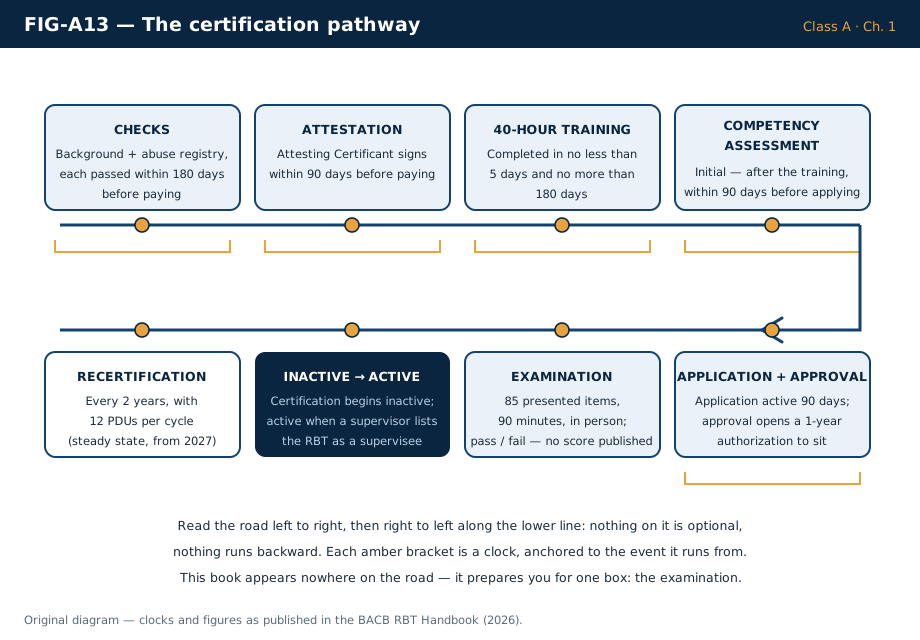 Figure A-13 — The certification pathway
Fees are the BACB's and Pearson VUE's to revise, and you should confirm the current figures at bacb.com before you pay; the table in this book's front matter is the complete set this book prints, and this section teaches you how to read it (S-01). The 2026 Certification Application Processing Fee is $65, paid to the BACB at application. Hold that figure firmly against the preparation shelf's memory: the pre-2026 application fee was $50, and any source still quoting $50 as the current application fee is quoting history. The examination appointment fee is $45, paid to Pearson VUE at every scheduling — first sitting and every retake alike — plus applicable tax. Around those two anchors sit the movement fees: canceling or rescheduling 31 or more days out costs $0; 30 days to 5 days out, $27; 5 days to 48 hours out, $32; inside 48 hours, canceling or rescheduling is not possible and no refund issues. Arriving more than 30 minutes late or failing to appear forfeits the appointment fee, and a new appointment may be scheduled within 24 hours of a missed one, paying the $45 again. The retake application itself currently carries no fee — the $45 appointment fee is the retake's cost at scheduling. Beyond the candidacy, the maintenance fees print once here and are taught in Chapter 16: the two-year Recertification Application is $50, the recertification late fee is $50, an insufficient-funds or returned-check fee is $45, Voluntary Inactive status costs $25 to enter and $25 to return from, Active Duty or Reserve status costs $0, and a written certification verification costs $25 per verification. All BACB fees are nonrefundable and nontransferable, payable in US currency, with no cash accepted. Veterans who qualify under the GI Bill may claim reimbursement of BACB certification examination fees from the Department of Veterans Affairs, pass or fail (S-01).
Two fee fences protect you from the shelf's arithmetic. This book prints no training price and no provider fee, because trainings are third-party offerings the BACB neither provides nor prices, and a candidate's training cost varies by provider. And it prints no "total cost of certification" sum, because no honest sum can be built from the registered figures alone — any total you are quoted elsewhere has silently priced your training for you. What this book gives you is every fee the BACB and Pearson VUE publish, named with its payee, and the discipline of confirming them at the source before you pay.
Every time this book describes the sitting, it describes it whole, and this is the whole description (S-01). The examination assesses knowledge of the RBT Test Content Outline (3rd ed.) at entry-level behavior technician level. It presents 85 multiple-choice questions: 75 scored and 10 unscored, interspersed and not identified; each question has four options and one correct answer. The time is 90 minutes, all-inclusive: the clock covers reviewing the Terms and Conditions, the exam navigation tutorial, the load-time prompt, the examination itself, and any review you do at the end. All questions are equally weighted, and the result is based on overall performance, not on performance in each content area — there is no per-area hurdle to clear, which is a fact about the scoring, not a license to neglect an area, since overall performance is built from all six. Delivery is computer-based testing in person at authorized Pearson VUE testing centers — the United States; Australia until January 1, 2027; Canada except Quebec and Ontario; and qualifying US military bases — scheduled by the candidate through their own Pearson VUE account. No remote delivery is offered. The examination is offered in English only, and check-in is conducted in English only, with no translators except as part of an approved accommodation. No calculator is provided and none may be brought; every calculation on this examination is hand arithmetic, a fact Chapter 18 turns into a method. Once an application is approved, the candidate has one year from the day of approval to sit.
The content frame is published, and this book's entire practice apparatus is built on it. The outline consists of 43 tasks in six content areas, with scored-question counts the BACB publishes: Data Collection and Graphing, 13; Behavior Assessment, 8; Behavior Acquisition, 19; Behavior Reduction, 14; Documentation and Reporting, 10; Ethics, 11 — 75 scored questions in total, with the BACB's own rounded percentages printed on the Exam Blueprint Page in the front matter (S-01; the December 2023 newsletter's blueprint crosswalk corroborates the counts exactly, S-02). Behavior Acquisition is the largest area and Ethics is larger than its reputation; a preparation that treats ethics as common sense is misallocating against the published frame by eleven questions. This book composes its diagnostic, its chapter quizzes, its repair sets, and its two full forms at this content-area grain — the grain the BACB publishes — and at no finer grain, because the BACB's primaries as read publish no per-task question distribution and this book invents none.
The passing standard, stated precisely. The examination is pass/fail. Its passing standard is set by the modified Angoff method — criterion-referenced — by a panel of BACB-certified subject-matter experts, approved by the BACB Board of Directors, and reset when examination content changes significantly, as it did when the new outline took effect (S-01). Criterion-referenced means the standard is a judgment about what an entry-level technician must know, set against the content, not a curve set against other candidates: your result does not depend on who else sat that month. And here is the sentence the preparation shelf routinely gets wrong, stated as plainly as this book can state it: the BACB publishes no numeric passing score — no number, no percentage, no scaled value — in any publication read for this book. Therefore this book prints no passing score, no percentage target, no number-correct goal, and no score conversion anywhere — not in this chapter, not on a scoring page, not in a study plan. Any book or website that quotes you a number for the RBT passing standard is stating something the BACB's candidate publications do not publish. Your practice results in this book are reported as raw counts by content area, with study guidance attached to the counts, because a raw count on this book's original items is the only honest metric available: it describes your standing on these items, area by area, and its movement across instruments is the information.
Examination day. Arrive about 30 minutes early. Check-in, in English only, includes identification verification, agreement to the Testing Center rules, palm vein scanning, and a digital photograph. Bring one form of valid identification: government-issued, original — no photocopy and no digital copy — bearing a signature and a recognizable photo, current, with the name exactly matching the BACB portal account; the BACB's examples are an international travel passport, a driver's license, a military ID, a national, state, or province identification card, and an alien registration card. A name discrepancy means no admission, and all fees are forfeited. Nothing enters the examination area except the identification and the locker key. Prohibited in the testing room are phones, watches, cameras, recording or transmitting devices, notes, reference materials, scratch paper, calculators, rulers, food and beverage, and guests; the center provides secure storage, a dry-erase board, and earplugs on request, with noise-canceling headphones at some centers, and staff monitoring is continuous. Breaks are unscheduled and taken on your own time — the clock never stops — and during a break you may not leave the building or access phones, devices, or notes, though food, drink, and medication may be accessed. Agreement to the Terms and Conditions is required before starting, its review time sits inside the 90 minutes, and the examination's content is confidential and copyright-protected: the misconduct list — impersonation, copying or sharing content, advance access, prohibited items — carries stated consequences (S-01). The result, pass or fail, is received at the testing center; you retrieve the report afterward from your Pearson VUE account under "View Score Reports," and the BACB cannot view or download your report for you.
Accommodations, appeals, and after passing. Accommodations are available for a current disability as defined by the ADA or a comparable law, requested on the BACB Examination Accommodation Request Form with documentation from a qualified professional, uploaded with the application; review typically takes 10–14 days (S-01). Appeals run on their own clocks: examination-condition irregularities within 7 days of the appointment, application denials within 30 days, compassionate appeals within 6 months — while content, editions, results, fees, deadlines, and delivery modality may not be appealed. After a pass, the BACB emails within about a week; the certificate letter arrives by email within about 24 hours carrying the certification number and expiration date; the registry listing appears within about 24 hours; and the certification stands inactive until a supervisor or coordinator lists you as a supervisee. No physical certificate is issued (S-01).
Retakes, as a published architecture. A candidate who does not pass works inside fixed rules (S-01): a maximum of 8 total attempts within the 12 months following initial application approval; a 7-day wait after each attempt; the Retake Application appearing in the portal within 48 hours of a failed attempt, with the authorization email following within 48 hours of submitting it; no fee currently charged for the retake application itself, with the $45 appointment fee charged at every appointment. A candidate who exhausts 8 attempts with time remaining in the window waits for the window to end, then reapplies. Treat this architecture as a budget, not a threat: eight attempts is a generous allowance that careless spending can still exhaust, and the 7-day wait is study time with a named target — which is why this book's repair sets, one per content area, exist, and why Chapter 18 teaches the retake as a method rather than an misfortune.
This examination changed its basis on a fixed date, and a candidate preparing now must know which side of the date every fact they meet belongs to (S-01, S-02, S-07). From January 1, 2026, the RBT examination is based on the RBT Test Content Outline (3rd ed.) — the 43 tasks and six areas of Section 1.6. The RBT Task List (2nd ed.), with 37 tasks under the former area titles, governed examinations through December 31, 2025 and is superseded; it appears in this book only inside dated transition material and the back matter's history column, never as current content. Candidates test under the edition in effect: if a new edition takes effect during an active authorization, the candidate tests under the new edition, and exceptions are not granted. An application approved before January 1, 2026 keeps its 12-month authorization, up to 8 attempts, without new training — but the examination that candidate sits from January 1, 2026 is the 3rd-edition examination. Applicants applying on or after January 1, 2026 meet the 2026 eligibility requirements taught in Section 1.3 — the training under the 2026 curriculum outline, the assessment on the packet effective January 1, 2026, and the 2026 application fee. There is no bridge course: a candidate whose earlier training cannot support a timely application completes the full current training and the current assessment after it (S-07).
Two transition traps deserve naming. The first is the ethics code: the transition did not change it. The ethics authority in force is the RBT Ethics Code (2.0), effective January 1, 2022; no successor has been announced in any BACB publication read for this book, and any source describing a new "2026 ethics code" is describing something the BACB has not published. This book's ethics chapters are built to (2.0). The second trap is maintenance: certificants recertifying in 2026 meet the then-current requirements, including the Recertification Competency Assessment one last time, and their two-year cycle then begins; from January 1, 2027 the steady state is biennial recertification with 12 professional development units and no competency assessment. Chapter 16 teaches both layers with their dates; Chapter 1's duty is only to keep you from carrying a pre-2026 rule — an annual renewal, a $35 renewal fee, a $50 application fee — into a 2026 candidacy as if it were current. History is labeled history everywhere in this book, and anything unlabeled is current as read.
Candidates who think of the examination as the credential's finish line misread the credential. Passing starts a maintained status with monthly, annual-rhythm, and event-driven obligations, and Chapter 16 teaches that system at working depth. Chapter 1 prints its frame, so that no reader mistakes the examination for the whole commitment they are applying for (S-01).
Supervision, monthly, per organization. An active RBT practices under close, ongoing supervision amounting to at least 5% of the hours spent providing behavior-analytic services in each calendar month, and the requirement is met at each organization separately — the handbook's own example is that 3% at one organization plus 2% at another does not comply, because percentages do not travel between employers. The structure requires at least two face-to-face, real-time contacts per month, never by phone or email, with video-conference permitted; the supervisor must observe the RBT providing services in at least one monthly meeting; at least one contact must be individual; and a group contact is capped at 2–10 RBTs. An RBT Supervisor holds BCBA or BCaBA certification; an RBT Requirements Coordinator holds BCBA certification; both are trained on the Supervisor Training Curriculum Outline (2.0); there is only one coordinator per RBT per organization; and the RBT must have a supervisor or coordinator for every client. Both parties retain supervision documentation for at least 7 years, the BACB audits current and former certificants, and substantial supervision noncompliance carries immediate termination of certification or eligibility with a six-month reapplication bar. Supervision and professional development are separate requirements — one event cannot count as both — a distinction that matters from 2027, when development units enter the recertification system.
Ethics and self-reporting, continuously. The certificant adheres to the RBT Ethics Code (2.0) — the four core principles and 29 standards Chapters 15 and 16 teach — keeps portal information current within 30 days of a change, and self-reports critical events within 30 days of becoming aware of them: ethics violations, specified health and substance-use events, specified investigations, and specified agreements and actions, including billing or quality repayment orders with penalties over $2,500 and public-health-and-safety fines over $750 (S-01, S-03). The handbook adds a worker-classification note this book repeats at its grain: because an RBT is not an independent practitioner, in the United States an RBT would almost never qualify as an independent contractor — a sentence worth meeting in Chapter 1, before a first job offer tests it, and cashed in Chapter 16.
Recertification, in two dated layers. Certificants who recertify in 2026 meet the then-current requirements, including the Recertification Competency Assessment one last time, pay the $50 recertification fee, and their two-year cycle then begins; miss the date and certification goes inactive, with a 30-day reinstatement window carrying the $50 late fee, after which failure to recertify means expiration and re-entry through current eligibility, a new application, and a new examination. From January 1, 2027, the steady state is recertification every two years with 12 hours of professional development units per cycle and no competency assessment — units earned within the cycle they count toward, with no carry-over and no repeating activity counting, from three sources: the RBT's own organization's in-service training, Authorized Continuing Education (ACE) Provider events, and accredited-university didactic behavior-analytic courses passed with a C or higher or a "pass." Inactive status completes the frame: voluntary inactive for up to 2 years at $25 to enter and $25 to return, with return requiring a Reentry Competency Assessment completed no more than 45 days before requesting reactivation, and an active-duty or reserve pause of up to 2 years at $0. An inactive RBT may not practice, bill, or represent themselves as active — the same sentence that governed the morning after the examination, governing every pause in the credential's life.
None of this is examination content at Chapter 1's depth, and none of it is optional knowledge for a certificant. It is printed here because candidacy is a decision, and a decision made without the maintenance frame is made on half the facts.
Consider a fictional candidate, Dana, whose dates show the system working — and nearly failing — as systems do. Dana completes both checks on March 2 and has the attestation signed on March 20. Dana's training runs April 6 to May 15 — inside its 5-to-180-day window — and the Initial Competency Assessment follows on May 27, after the training, as it must. Dana submits the application and pays on June 1. Now check the clocks against the payment anchor. The checks, completed March 2, sit 91 days before paying — inside 180. The attestation, signed March 20, sits 73 days before paying — inside 90. The assessment, May 27, sits inside 90 days before applying. Dana's application is approved on June 12, inside the two-week processing allowance, and the authorization year runs from June 12 — not from the training, not from the payment, not from the examination Dana hopes to book in August. Every clock held, because Dana anchored each one to its own event.
Now move one date. Suppose Dana delays and pays on September 25 instead. The attestation of March 20 is now 189 days old — outside its 90-day window — and the checks of March 2 are 207 days old, outside theirs. Nothing about Dana's training or assessment saves the application; the paper components anchored to paying have expired, and Dana must refresh the checks and the attestation before paying. That is the whole lesson of this chapter's eligibility teaching in one miniature: the requirements are easy, the clocks are the candidacy, and a candidate who tracks dates on one ledger page — as this book's study tracker invites you to do — never learns this lesson at the portal.
At the exam. Chapter 1's facts appear on the examination itself only at frame grain — the ethics area tests the supervision and status structures, and the documentation area presumes them — but they decide whether you sit at all, and the retake architecture decides how a bad day is recovered. Candidates lose credentials to clocks more often than to questions. Sit the sitting whole: 85 presented, 75 scored, 10 unscored and unidentified, 90 all-inclusive minutes, no calculator, pass/fail with no published number. Any preparation material that describes the sitting in fewer parts than that is describing a different, easier examination that does not exist.
The front matter promises that this chapter prints, in full and unsoftened, the direct answer to the only buying question that matters. Here it is.
What would a learner still need another source for? For the examination itself: nothing. This book teaches the whole of what the RBT examination examines — the field's foundations from zero, measurement and graphing with the arithmetic worked by hand, assessment assistance, the teaching and reduction procedures as knowledge, documentation, and the ethics and supervision system — and it examines the reader back with a diagnostic, a quiz in every chapter, repair sets for every content area, and two full practice examinations in the real examination's published shape, every item explained. A candidate who works this book through has no second study book to buy.
For eligibility, this book is deliberately not a source at all, and no study book can be. This book is not the 40-hour training and gives you none of its hours; it is not the Initial Competency Assessment and demonstrates none of its competencies; it completes no eligibility requirement, and reading it changes nothing about your application. The training must come from a qualified Responsible Trainer under the BACB's 2026 training requirements; the competency assessment must be performed and judged by a qualified assessor; the checks and the attestation are completed with the people the BACB's rules name. This chapter has laid out that whole path with its fees and its clocks so you can walk it — the walking is yours, with the BACB's documents, listed in the References at the back of this book, as the authority.
And for practice: this book authorizes nothing. An RBT practices only under the direction and close supervision of an RBT Supervisor and/or RBT Requirements Coordinator, who are responsible for the work — your certification is inactive until a supervisor stands in that relationship with you, and the plans you will implement are your supervisor's to design. What this book gives you is the knowledge the examination certifies and the working understanding to be worth supervising well.
All three parts of that answer are this book's position. None of them is softened anywhere in it — not on the cover, not in the store description, and not in the completion language of any chapter, which speaks of examination readiness only, because examination readiness is the only thing a book can honestly confer.
85 presented questions (75 scored + 10 unscored) · 90 all-inclusive minutes · 43 tasks, 6 areas (13/8/19/14/10/11 scored) · 18 years, high school–level education · checks within 180 days before paying · attestation within 90 days before paying · training 40 hours in 5–180 days (54 topics; 38 + 2 hours) · assessment 19 tasks, after training, within 90 days before applying · application active 90 days · processing two weeks · application fee $65 · appointment fee $45 at every scheduling · reschedule $0 / $27 / $32 by window · authorization 1 year from approval · 8 attempts, 7-day wait, retake application within 48 hours · accommodations review 10–14 days · appeals 7 days / 30 days / 6 months · supervision 5% monthly, 2 contacts (Chapter 16) · recertification $50, 2-year cycle, 12 PDUs from 2027 (Chapter 16) · records 7 years.
Later chapters assume, without re-teaching: the RBT's supervised paraprofessional definition and the supervisor's responsibility for the RBT's work; certification's inactive start; the eligibility system's five components with their clocks and anchors; the sitting described whole (85/75/10, 90 all-inclusive minutes, in-person Pearson VUE, English only, no calculator); the published content allocation (43 tasks; 13/8/19/14/10/11); the modified-Angoff criterion-referenced pass/fail standard with no published numeric score; the 2026 framework boundary (Test Content Outline 3rd ed. from January 1, 2026; Ethics Code (2.0) unchanged by the transition); and this book's position — self-contained for examination knowledge, no part of any eligibility component, no authorization to practice.
Answer all 20 before consulting the key (the Chapter 1 answer key). Report your result as a raw count; no count in this book is converted into a pass prediction.
Q1. Which statement best states what an RBT is, as the BACB defines the credential? A. An independent practitioner who designs and delivers behavior-analytic services B. A paraprofessional who assists in delivering behavior-analytic services under the direction and close supervision of an RBT Supervisor and/or RBT Requirements Coordinator C. A trainee license that converts to independent practice after the first recertification D. A state-issued license to provide behavior-analytic services
Q2. A candidate passes the examination on Monday. No supervisor has yet listed the candidate as a supervisee. The candidate's certification status is: A. Active, because passing activates it B. Active for a 30-day grace period C. Inactive, until a supervisor or coordinator lists the RBT as a supervisee D. Provisional, until the first recertification
Q3. The criminal background check and the abuse registry check must each be completed and passed no more than how long before which event? A. 90 days before submitting the application B. 180 days before paying for the application C. 180 days before the examination appointment D. 90 days before approval of the application
Q4. The attestation form must be signed and completed no more than how long before paying for the application? A. 180 days B. 30 days C. 90 days D. 45 days
Q5. Which statement about the 40-hour training is correct? A. The training must be completed in no less than 5 days and no more than 180 days, under the 2026 curriculum outline B. Assigned readings count toward the training's hours C. The BACB provides the training and issues its certificate D. This study book, completed in full, satisfies 10 of the 40 hours
Q6. The Initial Competency Assessment must be completed: A. Before the 40-hour training, to qualify for it B. After the 40-hour training and no more than 90 days before applying C. Within the same 90 days as the examination sitting D. At any point within the authorization year
Q7. How many tasks does the Initial Competency Assessment packet name, and how are three of the skill acquisition and behavior reduction tasks (6–14) required to be demonstrated? A. 19 tasks; three of tasks 6–14 with a client B. 43 tasks; three of tasks 6–14 with a client C. 19 tasks; three of tasks 6–14 by interview only D. 12 tasks; all by role-play
Q8. Who may serve as the Responsible Trainer for the 40-hour training? A. Any active RBT with two years of experience B. A BCaBA, BCBA, or BCBA-D who has completed the 8-hour supervision training C. The applicant's Attesting Certificant in all cases D. A Pearson VUE testing administrator
Q9. The 2026 Certification Application Processing Fee, and the examination appointment fee, are: A. $50 to the BACB; $45 to Pearson VUE, first sitting only B. $50 to the BACB; $35 to Pearson VUE at every scheduling C. $65 to Pearson VUE; $45 to the BACB at every scheduling D. $65 to the BACB; $45 to Pearson VUE at every scheduling
Q10. An application, once submitted, stays active for: A. 30 days B. One year C. 90 days D. 180 days
Q11. The examination, described whole, presents: A. 85 questions — 75 scored and 10 unscored — in 90 all-inclusive minutes B. 75 questions, all scored, in 90 minutes C. 85 questions, all scored, in 120 minutes D. 100 questions — 75 scored and 25 unscored — in 90 minutes
Q12. The 90 minutes of the examination include all of the following EXCEPT: A. Reviewing the Terms and Conditions B. The exam navigation tutorial C. The examination itself and any review D. Travel time to the testing center
Q13. Which statement about the passing standard is correct? A. Candidates must reach a published percentage of correct answers B. The standard is norm-referenced against other candidates in the same month C. The standard is set by the modified Angoff method, is criterion-referenced, and the BACB publishes no numeric passing score D. The passing score is a scaled value printed on the candidate's report
Q14. In the published content allocation, which area carries the most scored questions, and how many? A. Ethics, 11 B. Behavior Reduction, 14 C. Data Collection and Graphing, 13 D. Behavior Acquisition, 19
Q15. On examination day, which identification outcome is correct? A. A photocopy of a driver's license is acceptable if the original is at home B. One government-issued, original ID whose name exactly matches the BACB portal account is required; a mismatch means no admission C. Two forms of ID are required, one of which may be a school ID D. A digital ID on a phone is acceptable at all centers
Q16. During an unscheduled break in the examination: A. The clock pauses while the candidate is out of the room B. The candidate may check a phone kept in the locker C. The clock keeps running, and the candidate may not leave the building or access phones, devices, or notes D. The candidate may review notes in the lobby
Q17. A candidate who does not pass may attempt the examination again under which published architecture? A. Unlimited attempts within the authorization year, no waiting period B. One retake only, within 48 hours of the failed attempt C. A maximum of 3 attempts, with a 30-day wait after each attempt D. A maximum of 8 total attempts within the 12 months from initial approval, with a 7-day wait after each attempt
Q18. Which statement about the 2026 transition is correct? A. Candidates approved before January 1, 2026 continue to test under the Task List (2nd ed.) for their whole authorization B. A new RBT Ethics Code took effect on January 1, 2026 with the new outline C. From January 1, 2026 every candidate tests under the Test Content Outline (3rd ed.), and the RBT Ethics Code (2.0) remains the ethics authority D. A short bridge course converts pre-2026 training into 2026 training
Q19. A preparation website offers this book's reader a "total cost of certification" figure that includes an estimated training price. Under this book's fee discipline, that figure is: A. Not printable from registered figures, because training prices are third-party and are never estimated in this book B. Acceptable if labeled an estimate C. Required in Chapter 1 for completeness D. Acceptable if the BACB's fees inside it are correct
Q20. Which statement is this book's position, stated without softening? A. Completing this book satisfies the 40-hour training for candidates who also pass its quizzes B. Completing this book demonstrates the competencies of the Initial Competency Assessment C. This book is the single self-contained study text for the examination's knowledge; it supplies no eligibility component and authorizes no practice, which exists only under a qualified supervisor D. Completing this book qualifies the reader to practice under supervision before passing the examination
Every item: keyed answer, why the key is right, why each wrong option is wrong, and the repair pointer. Report practice results as raw counts by area; no count converts to a pass prediction.
Q1 — Key: B. Why right: the BACB defines the RBT as a paraprofessional assisting in delivering behavior-analytic services under the direction and close supervision of an RBT Supervisor and/or RBT Requirements Coordinator, who are responsible for the RBT's work (S-01). Why wrong: A states independent practice and design authority the credential never confers. C invents a conversion to independence that no BACB publication describes. D confuses BACB certification with a state license. Repair: §1.1–1.2.
Q2 — Key: C. Why right: certification begins inactive after passing and activates only when a supervisor/coordinator lists the RBT as a supervisee (S-01). Why wrong: A reverses the rule — passing alone does not activate. B invents a grace period. D invents a provisional status tied to recertification. Repair: §1.2.
Q3 — Key: B. Why right: both checks must be completed and passed no more than 180 days before paying for the application (S-01). Why wrong: A pairs the wrong clock (90 days) with the wrong anchor (submitting). C keeps 180 days but anchors to the examination, which anchors nothing in eligibility. D pairs 90 days with approval. Repair: §1.3.
Q4 — Key: C. Why right: the attestation form is signed/completed no more than 90 days before paying (S-01). Why wrong: A is the checks' 180-day clock, transferred to the wrong component. B (30 days) belongs to later maintenance self-reporting, not candidacy. D (45 days) belongs to recertification/reentry assessment windows. Repair: §1.3.
Q5 — Key: A. Why right: the training runs no less than 5 and no more than 180 days under the 2026 curriculum outline, delivered by qualified trainers (S-04). Why wrong: B reverses S-04 — readings do not count toward the hours. C reverses S-01 — the BACB provides no training and no certificates. D violates this book's fence — this book satisfies no training hours. Repair: §1.3.
Q6 — Key: B. Why right: the assessment follows the training and sits no more than 90 days before applying (S-05). Why wrong: A reverses the dependency — the training comes first. C anchors the assessment to the sitting, a clock that does not exist. D places it inside the authorization year, which begins only after approval of an application the assessment must precede. Repair: §1.3.
Q7 — Key: A. Why right: the packet names 19 tasks; three of tasks 6–14 must be demonstrated with a client (S-05). Why wrong: B substitutes the outline's 43 tasks for the assessment's 19. C gets the count but replaces the with-a-client requirement with interview-only, the weakest type. D invents both a 12-task count and an all-role-play rule. Repair: §1.3.
Q8 — Key: B. Why right: the Responsible Trainer is a BCaBA/BCBA/BCBA-D who has completed the 8-hour supervision training (S-04); RBTs may serve only as Assistant Trainers. Why wrong: A promotes an RBT past the assistant role. C confuses the attestation role with the trainer role — different people, different rules. D names the testing contractor, which delivers examinations, not training. Repair: §1.3.
Q9 — Key: D. Why right: the 2026 application fee is $65 to the BACB, and the $45 Pearson VUE appointment fee is charged at every scheduling (S-01). Why wrong: A carries the pre-2026 $50 history figure and limits the appointment fee to the first sitting. B pairs two retired figures ($50 application, $35 renewal-era appointment memory). C swaps the payees. Repair: §1.5.
Q10 — Key: C. Why right: applications stay active 90 days; miss the window and the candidate reapplies and pays again (S-01). Why wrong: A understates the window. B states the authorization year, a different clock that starts at approval. D states the checks' window, anchored to paying. Repair: §1.4.
Q11 — Key: A. Why right: 85 presented = 75 scored + 10 unscored, in 90 all-inclusive minutes (S-01). Why wrong: B drops the 10 unscored items. C makes all 85 scored and adds 30 minutes. D inflates both the presented count and the unscored count. Repair: §1.6.
Q12 — Key: D. Why right: the 90 minutes cover the Terms and Conditions review, the tutorial, the load-time prompt, the examination, and review — all inside the room; travel is the candidate's own affair before arrival (S-01). Why wrong: A, B, and C each name a component the handbook explicitly places inside the clock. Repair: §1.6.
Q13 — Key: C. Why right: modified Angoff, criterion-referenced, panel-set and Board-approved, with no numeric score published (S-01). Why wrong: A invents the published percentage the BACB does not publish. B states norm-referencing, the opposite of the criterion-referenced method. D invents a printed scaled value (register C-04). Repair: §1.6.
Q14 — Key: D. Why right: Behavior Acquisition carries 19 of the 75 scored questions, the largest allocation (S-01). Why wrong: A, B, and C each name a real area with its real count — but none is the largest; each is a plausible under-reading of the published table. Repair: §1.6.
Q15 — Key: B. Why right: one valid, government-issued, original ID with signature and photo, name exactly matching the portal account; a mismatch means no admission and forfeited fees (S-01). Why wrong: A accepts a photocopy, which the handbook bars. C doubles the requirement and adds a non-qualifying document. D accepts a digital copy, which the handbook bars. Repair: §1.6.
Q16 — Key: C. Why right: breaks are unscheduled, on the candidate's own time, the clock running, with no building exit and no access to phones, devices, or notes (S-01). Why wrong: A invents a paused clock. B and D each permit exactly the access the break rules prohibit. Repair: §1.6.
Q17 — Key: D. Why right: maximum 8 total attempts in the 12 months from initial approval, 7-day wait after each attempt, retake application in the portal within 48 hours, $45 at every appointment (S-01). Why wrong: A removes both the cap and the wait. B confuses the retake application's 48-hour appearance with the retake itself and shrinks the allowance to one. C invents a 3-attempt cap and a 30-day wait. Repair: §1.6.
Q18 — Key: C. Why right: from January 1, 2026 all candidates test under the TCO (3rd ed.) — approvals keep their windows, not their edition — and the Ethics Code (2.0) remains in force (S-01, S-02, S-07). Why wrong: A states the grandfathering error the edition rule forbids. B invents a 2026 ethics code that no BACB publication announces. D invents the bridge course the transition guidance explicitly denies. Repair: §1.7.
Q19 — Key: A. Why right: this book prints only registered fees; training prices are third-party, unregistered, and never estimated, so no total built on one can print. Why wrong: B treats a label as a cure for an unregistered input. C reverses the fence — completeness is defined by the register, not by arithmetic. D lets correct components launder an invented total. Repair: §1.5.
Q20 — Key: C. Why right: the §11.8 answer in full — self-contained for examination knowledge; no eligibility component supplied; no practice authorized; practice exists only under a qualified supervisor. Why wrong: A violates for the training. B violates for the assessment — quizzes demonstrate no competency. D authorizes pre-examination practice, which neither the book nor the credential permits. Repair: §1.11.
End of the free sample. The complete book continues from here — the full A-to-Z course in book form, delivered as an EPUB you can read in Apple Books, Google Play Books, ReadEra, Thorium Reader, Adobe Digital Editions, or Send to Kindle.
Buy this ebook — $9.99 Back to the book page
Payments are securely processed by Payhip.