
Mastering Careers & Skills
Pearson Test of English (PTE) Academic · free sample from the book itself
Q1. Key: B. The published order is Part 1 Speaking & Writing, Part 2 Reading, Part 3 Listening, always in that sequence. A is wrong: Reading never opens the test. C is wrong: Listening is the final part, not the first. D is wrong: Reading, not Listening, is the middle part. [Tag: FND-1 · Test format — part order]
Q2. Key: A. Part 2, Reading, runs 23–30 minutes with 5 question types. B is wrong: 31–39 minutes and 8 types describe Part 3, Listening. C is wrong: 76–84 minutes and 9 types describe Part 1. D is wrong: it pairs Part 2's timing with Part 3's type count. [Tag: FND-1 · Reading — part timing]
Q3. Key: D. The current post-August-2025 test has 22 scored question types. A is wrong: 20 was the superseded pre-August-2025 count, which never prints as current. B is wrong: 9 is Part 1's type count only. C is wrong: 65 is the floor of the 65–75 question total, not a type count. [Tag: FND-1 · Test format — type count]
Q4. Key: C. The Personal Introduction is unscored, allows 25 seconds to prepare and 30 seconds to record, and can be recorded once only. A is wrong: it contributes nothing to any score. B is wrong: re-recording is not permitted. D is wrong: it opens Part 1, not Part 3. [Tag: FND-1 · Speaking — Personal Introduction]
Q5. Key: A. Pearson publishes that the overall score is computed from performance across the whole test and is not an average of the communicative skills. B is wrong: the mean is exactly the model Pearson excludes. C is wrong: no lowest-skill rule is published. D is wrong: scoring is AI-based with human expert review of content on named types, not a single reviewer's decision. [Tag: FND-1 · Scoring — overall score]
Q6. Key: B. Integrated items contribute to both skills they assess; scores are based on all test items. A is wrong: the listening contribution is not discarded. C is wrong: integrated items feed their skill scores, not the overall alone. D is wrong: integrated items are scored items, not exclusions. [Tag: FND-1 · Scoring — integrated skills]
Q7. Key: C. Describe Image, Retell Lecture and Summarize Written Text are among the seven types whose content receives human expert review. A is wrong: Read Aloud, Repeat Sentence and Answer Short Question are not in the human-reviewed content set. B is wrong: those three objective types are not human-reviewed for content. D is wrong: Highlight Incorrect Words, Write from Dictation and Reading Fill in the Blanks are not in the set. [Tag: FND-1 · Scoring — human review]
Q8. Key: D. Pronunciation and Oral Fluency are scored by AI only. A is wrong: human experts do not score these traits. B is wrong: the second-human rule resolves content disagreements, not these traits. C is wrong: test centers administer the test; they do not score it. [Tag: FND-1 · Scoring — Pronunciation and Oral Fluency traits]
Q9. Key: B. The Skills Profile is private to the test taker in myPTE and shows eight areas with performance bars and personalized recommendations. A is wrong: it is never shared with institutions. C is wrong: the Score Report Code verifies the Score Report, not the private Profile. D is wrong: PTE Academic is scored 10–90, not pass/fail. [Tag: FND-1 · Scoring — Skills Profile]
Q10. Key: C. Form is the trait that rates whether a response meets the task's shape rules. A is wrong: Content rates coverage of the task and stimulus, not shape. B is wrong: Vocabulary rates word choice. D is wrong: Pronunciation rates the clarity of spoken sounds. [Tag: FND-1 · Scoring — Form trait]
Q11. Key: A. Negative marking applies to Reading Multiple Choice Multiple Answers, Listening Multiple Choice Multiple Answers and Highlight Incorrect Words, with deductions floored at zero for the item. B is wrong: none of those production types deducts marks. C is wrong: single-answer multiple-choice types are correct/incorrect, not negatively marked. D is wrong: the two summary types are partial-credit production tasks. [Tag: FND-1 · Scoring — negative marking]
Q12. Key: D. Summarize Written Text requires one single complete sentence of 5–75 words. A is wrong: two sentences breach the one-sentence form rule. B is wrong: 200–300 words is the Write Essay band. C is wrong: 50–70 words is the Summarize Spoken Text band. [Tag: FND-1 · Speaking & Writing — Summarize Written Text form]
Q13. Key: A. Write Essay earns full form credit at 200–300 words, with reduced credit at 120–199 or 301–380 and zero form credit outside those bands. B is wrong: that is the Summarize Written Text sentence rule. C is wrong: that is the Summarize Spoken Text band. D is wrong: above 380 words earns zero form credit, not full credit. [Tag: FND-1 · Speaking & Writing — Write Essay form]
Q14. Key: B. Pearson publishes no static fee table; the fee varies by country and appears through the price finder and the booking flow. A is wrong: no worldwide table exists. C is wrong: this book prints the mechanism only, never a fee figure. D is wrong: the fee varies by country, so centers in different countries do not share one fee. [Tag: FND-1 · Process — fee mechanism]
Q15. Key: D. Rescheduling is free when more than 14 full calendar days remain, and one appointment may be rescheduled at most six times. A is wrong: both a time condition and a cap apply. B is wrong: rescheduling is possible inside the published window. C is wrong: the 50% figure belongs to the cancellation ladder, not to rescheduling. [Tag: FND-1 · Process — rescheduling]
Q16. Key: A. Ten days out falls in the 13–8 day band, which carries a 50% refund. B is wrong: full refunds require 14 or more days. C is wrong: no refund applies only at fewer than 7 days. D is wrong: the published ladder pays refunds in money terms, not a full-fee voucher. [Tag: FND-1 · Process — cancellation ladder]
Q17. Key: C. The rule is a valid, non-expired passport, original only, with name, date of birth, citizenship and gender exactly matching the booking. A is wrong: photocopies are never accepted and "any photo ID" understates the passport rule. B is wrong: a driving license is not the published requirement, though alternatives may be possible in some countries under Pearson's acceptable-ID guidance. D is wrong: the confirmation email is not identification. [Tag: FND-1 · Process — identification]
Q18. Key: D. There are no scheduled breaks; an unscheduled break may be requested, but the clock keeps running, with no locker access, talking or leaving the building. A is wrong: the scheduled break belongs to the superseded format and never prints as current. B is wrong: leaving the building during a break is prohibited. C is wrong: locker access is expressly barred during an unscheduled break. [Tag: FND-1 · Test day — break rule]
Q19. Key: B. Pearson provides an erasable whiteboard and two pens for notes and planning. A is wrong: loose paper and pencil are not the issued materials. C is wrong: no dictionary is provided. D is wrong: the test runs on the assigned center computer, not a personal laptop. [Tag: FND-1 · Test day — workstation materials]
Q20. Key: A. Rooms hold up to 15 test takers, and Part 1 speaking happens with everyone speaking at once, which is why headphones are recommended throughout. B is wrong: the room is shared, not single-occupancy. C is wrong: the room is small and Part 1 is not silent. D is wrong: the parts run in the same published order for the sitting. [Tag: FND-1 · Test day — room conditions]
Q21. Key: D. Retesting requires the previous score to have been received, allows one booking at a time, and is capped at 12 tests in a 12-month window. A is wrong: retesting before scores arrive is barred. B is wrong: simultaneous bookings are barred. C is wrong: the 12-in-12-months cap is published. [Tag: FND-1 · Process — retake rules]
Q22. Key: C. The paid rescore covers spoken and open-ended written responses only, the score can move up or down, and Pearson publishes that it is unlikely to change. A is wrong: multiple-choice items are outside rescore scope. B is wrong: a decrease is expressly possible. D is wrong: rescoring is a paid service, not a free unlimited one. [Tag: FND-1 · Process — rescore]
Q23. Key: B. UKVI is the same test content, format and scoring, taken at a UKVI-approved center as a Secure English Language Test, its report additionally bearing the SELT Unique Reference Number auto-shared with the UK Government. A is wrong: different content is the claim the same-test fact excludes. C is wrong: speaking-and-listening only describes PTE Home, a different test. D is wrong: pass–fail also describes PTE Home; UKVI is scored 10–90 like Academic. [Tag: FND-1 · Variants — PTE Academic UKVI]
Q24. Key: C. Typical ranges print only as Pearson's published typical examples; the reader's binding target is their own institution's current published requirement, checked directly. A is wrong: no named institution's requirement prints anywhere in this book. B is wrong: Pearson sets no pass mark at all. D is wrong: no score in this book is ever said to guarantee admission — that is the no-guarantee fence. [Tag: FND-1 · Scoring — score-claim discipline]
Foundations — the instrument and its scoring (FD-1), and test-day conduct and process literacy (FD-10). Read this chapter before every other chapter: every scoring panel in this book assumes it.
Simplify first. PTE Academic — the Pearson Test of English Academic — is a computer-based test of academic English that you take at a test center, in a single sitting of around two hours. It cannot be taken at home. It tests the English you need for study: listening, reading, speaking and writing, in that test's own three-part order (Source: Pearson, PTE Academic main test page). A test center is a supervised testing room run under Pearson's rules, where every candidate sits at an assigned computer and is recorded throughout.
Explain why the shape matters. Because the test is computer-delivered and timed by the machine, your preparation has two halves that can never be separated: the English itself, and your conduct inside a fixed, unforgiving format. A candidate with strong English who has never rehearsed the format loses marks to the clock, to the microphone, and to surprise. A candidate with weaker English who knows exactly what each item asks can convert everything they do know into score. This book builds both halves, in that order: foundations first, then the craft of every item type, then full timed sittings.
Now the detail. The test has three parts, always in the same order. Part 1, Speaking & Writing, runs 76–84 minutes and holds nine question types. Part 2, Reading, runs 23–30 minutes and holds five question types. Part 3, Listening, runs 31–39 minutes and holds eight question types (Source: Pearson, PTE Academic test format hub and part pages; Source: Pearson, PTE Academic & PTE Academic UKVI Score Guide — Test Taker, July 2025). Across the three parts there are 22 scored question types and 65–75 questions in a full test, inside a maximum sitting of 2 hours 15 minutes (Source: Pearson, PTE Academic & PTE Academic UKVI Score Guide — Test Taker, July 2025). Part 1 opens with the Personal Introduction, which is unscored: you have 25 seconds to read the prompt and prepare, and 30 seconds to record, and you may record only once; it exists so you can settle into the room and the equipment (Source: Pearson, PTE Academic test format — Speaking & Writing part page).
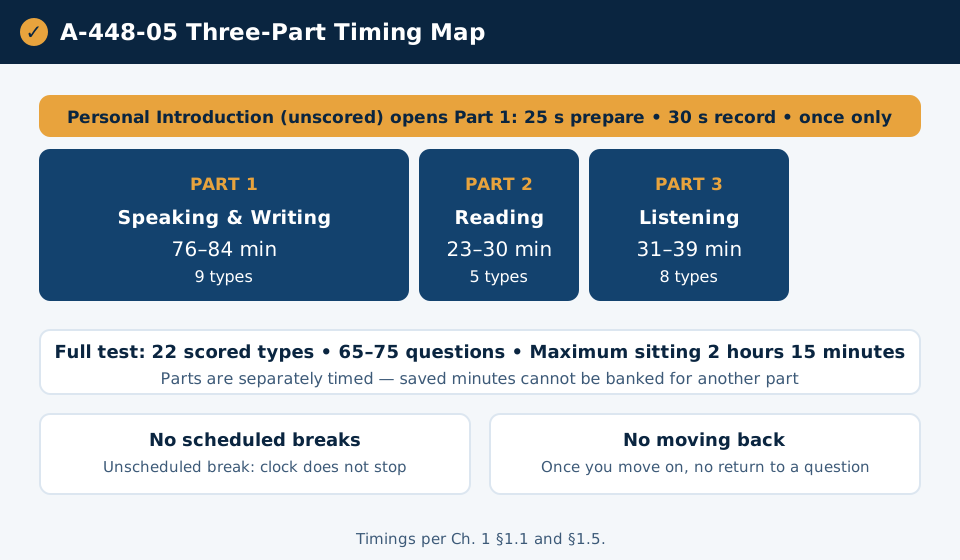
Figure A-448-05. Three-part timing map: the test in order, with each part's published minutes and type count, and the two absolute rules — no scheduled breaks, no moving back.
Show the test meeting a real candidate. Ngozi Eze, this book's professional-registration-band persona, sat a practice diagnostic before she opened any craft chapter. Her English was already strong. What surprised her was not the language: it was that Part 1 gave her no pause between speaking into a headset and writing against a word count, and that when she finished a reading item early she could not bank the saved minutes for listening. The parts are separately timed, and inside the test there is no moving back to a previous question once you have moved on (Source: Pearson, PTE Academic & PTE Academic UKVI Test Taker Handbook, July 2025). Ngozi's lesson is this chapter's lesson: the format is a subject, and it is learned like one.
What this test is not matters as much. PTE is a family name, not one test, and this book prepares you for exactly one member of the family. PTE Academic UKVI is the same test content, format and scoring as PTE Academic; its differences are administrative only: it is a Secure English Language Test taken at a UKVI-approved center, its score report additionally bears the SELT Unique Reference Number (URN) — the reference number that identifies a Secure English Language Test result — which is auto-shared with the UK Government, and its registration carries minor process differences for UK Home Office compliance (Source: Pearson, PTE Academic main test page; Source: Pearson, SELT tests page). Pearson directs candidates to UKVI for UK work visas requiring a four-skills test and for study below degree level or outside a Higher Education Institution, and to Academic for degree-level-and-above study at a Higher Education Institution (Source: Pearson, PTE Academic main test page). Because the test is the same test, every chapter, item and timed test in this book serves a UKVI candidate's test identically. Two other family members are different tests and are outside this book. PTE Core is a different test of general English — everyday, workplace and community English, not academic English — accepted by Immigration, Refugees and Citizenship Canada for Canadian economic immigration routes; Pearson states explicitly that study in Canada requires PTE Academic instead, so PTE Core must never be substituted for Academic or Academic for it (Source: Pearson, PTE Core page). PTE Home is a different test again: a Secure English Language Test of speaking and listening only, pass–fail, at CEFR levels A1, A2 and B1, for UK family, settlement, citizenship and specified limited work-visa routes (Source: Pearson, SELT tests page). This book teaches neither test, and nothing in it should be read as preparation for either; Pearson's own pages for each are the signpost.
Do this now. Write down, in your own words, the three parts in order, the minutes each part is given, and the number of question types in each. If any number is missing, reread this section before you continue — the timing map above is the skeleton every later chapter hangs on.
Simplify. Every score in this test is a number from 10 to 90 on the Global Scale of English (GSE) — Pearson's 10–90 scoring scale for English proficiency. You receive an overall score and four communicative skills scores: Listening, Reading, Speaking and Writing. A communicative skill is one of the four ways you use English in the test, and each is scored from the items that assess it (Source: Pearson, PTE Academic & PTE Academic UKVI Score Guide — Test Taker, July 2025).
Explain the first surprise: the overall score is not an average of the four communicative skills scores (Source: Pearson, PTE Academic & PTE Academic UKVI Score Guide — Test Taker, July 2025). It is computed from your performance across the whole test. This matters practically: you cannot repair a weak skill by arithmetic, and a strength in one skill does not drag the overall score up by a fixed fraction. The second surprise is integration: many items assess two skills at once — a listening item you answer in writing feeds both your Listening and your Writing scores — so scores based on all test items, with integrated items contributing to both assessed skills, are the published model (Source: Pearson, PTE Academic scoring page). Chapter by chapter, this book's scoring panels tell you exactly which skills each of the 22 types feeds.
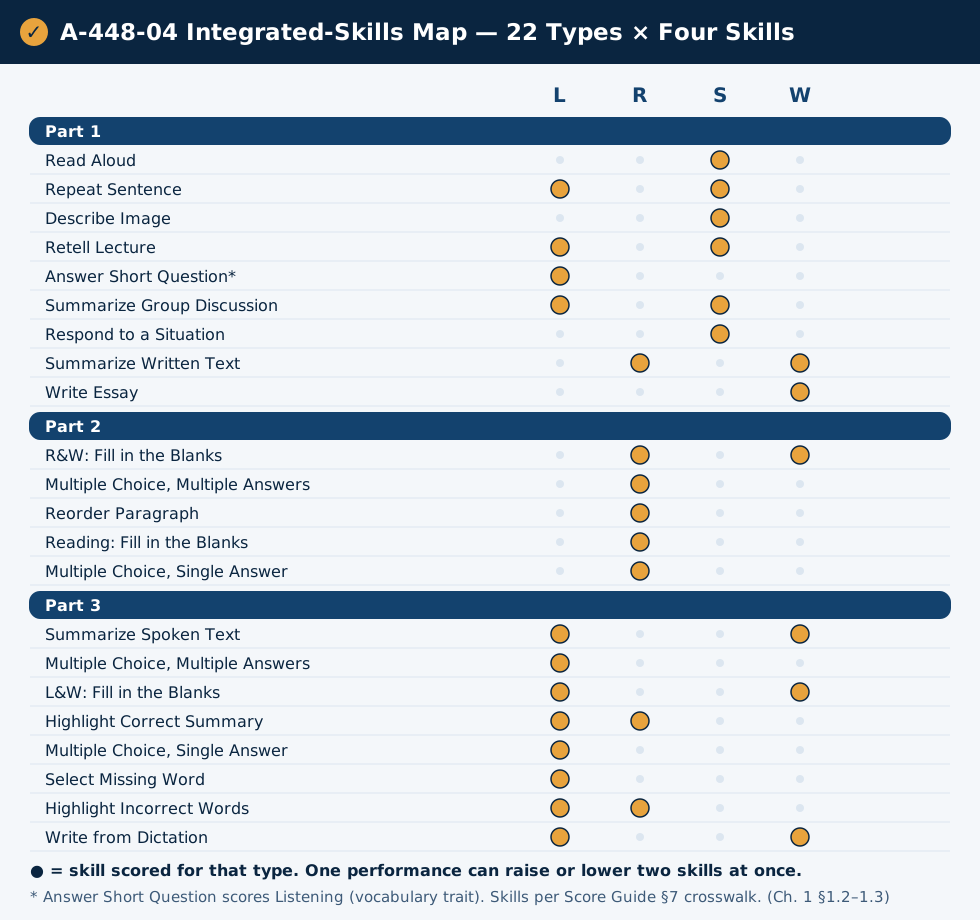
Figure A-448-04. Integrated-skills map: all 22 question types across the four communicative skills. A dot marks each skill a type scores; integrated types carry dots in two columns.
Detail: how a response becomes a number. Every item type is scored by artificial intelligence (AI) scoring — computer scoring trained on human-scored performances — combined with human expertise. For seven item types, a human expert additionally reviews the content of your response: Describe Image, Retell Lecture, Respond to a Situation, Summarize Group Discussion, Summarize Written Text, Write Essay and Summarize Spoken Text. Write Essay is also human-reviewed for two further traits, named in section 1.3. If the human expert and the AI disagree, a second human expert resolves the disagreement. Pronunciation and Oral Fluency — two speaking traits defined in section 1.3 — are scored by AI only, and human scorers also examine anomalies, responses the machine flags as unusual (Source: Pearson, PTE Academic & PTE Academic UKVI Score Guide — Test Taker, July 2025). One consequence follows, and this book repeats it until it is reflex: because content on those seven types is read by a human being, a fluent-sounding response that says nothing true about the stimulus is exposed. Generation beats recitation everywhere in this test; Pearson publishes that memorized or templated speaking content can score zero for content (Source: Pearson, Test Tips — Speaking, V6, January 2026).
Your report carries more than the five numbers. Held privately in your myPTE account — Pearson's candidate account system, where you book, receive results and share scores — is the Skills Profile: a personal diagnostic showing performance bars and personalized recommendations across eight areas: Open response speaking and writing; Reproducing spoken and written language; Extended writing; Short writing; Extended speaking; Short speaking; Multiple-skills comprehension; and Single-skill comprehension (Source: Pearson, PTE Academic & PTE Academic UKVI Score Guide — Test Taker, July 2025). The Skills Profile is private to you and is never shared with institutions (Source: Pearson, PTE Academic scoring page). EX-1 teaches you to turn it into a study route after a real sitting.
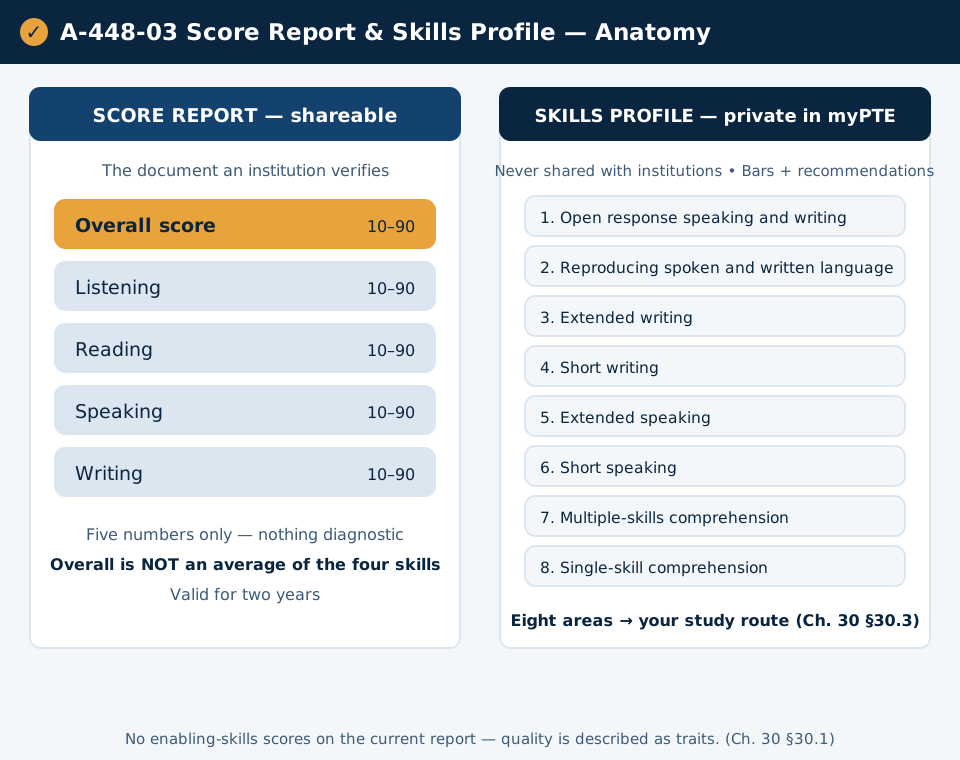
Figure A-448-03. Score-report and Skills Profile anatomy: the shareable report's five numbers on the left; the private Skills Profile's eight areas — the study-route instrument — on the right.
Two fences belong here, because candidates meet them first in score talk. Pearson sets no pass mark for this test: governments and institutions decide which tests they accept and what scores they require, and requirements change (Source: Pearson, PTE Academic & PTE Academic UKVI Score Guide — Test Taker, July 2025; Source: Pearson, PTE Academic scoring page). So this book never tells you "the score you need" for any named university, visa or body — no such table exists in these pages, and any book that prints one is printing a guess with a date problem. What Pearson itself publishes, in Pearson's own framing, is a set of typical examples of the ranges institutions set: foundation courses 36–50, undergraduate 51–60, postgraduate 57–67 (Source: Pearson, PTE Academic & PTE Academic UKVI Score Guide — Test Taker, July 2025). Read those as typical examples, never as requirements. Your target is set by one document only: your institution's current published requirement, which you check yourself, at the time you book, and aim above with margin. Pearson also publishes how the 10–90 scale aligns to the Common European Framework of Reference (CEFR) — the European scale of language proficiency levels from A1 to C2: 85–90 aligns to C2; 76–84 to C1; 59–75 to B2; 43–58 to B1; 30–42 to A2; 10–29 to A1 (Source: Pearson, PTE Academic scoring page).
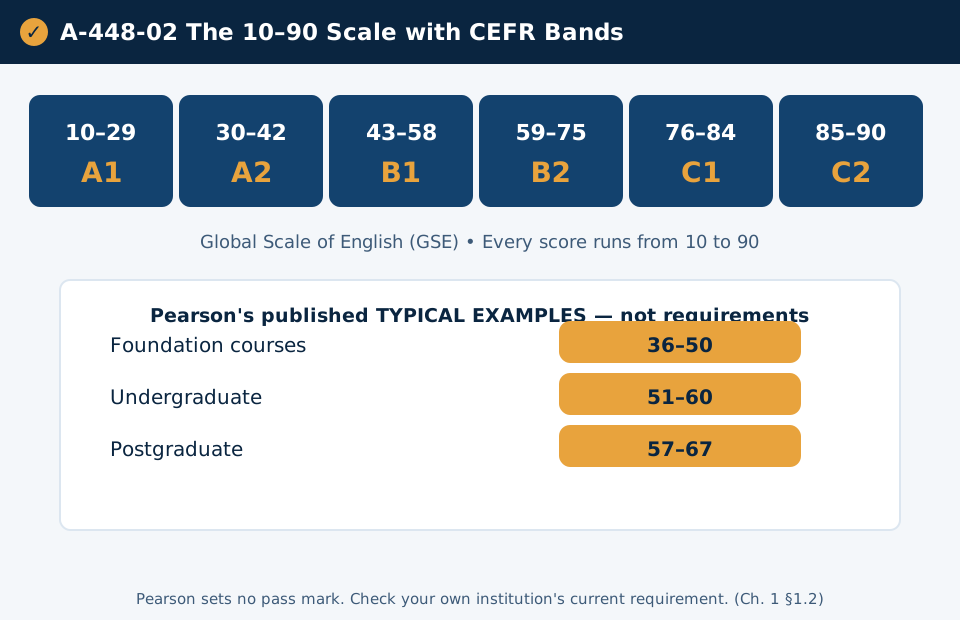
Figure A-448-02. The 10–90 Global Scale of English with its CEFR bands, and Pearson's published typical examples of the ranges institutions set — typical examples, never requirements.
Show the bands meeting the personas. Kenji Sato, in the foundation-course band, is working toward the territory Pearson's typical examples associate with foundation study; his constraint is listening and spelling, so his route in this book runs FND-6 and FND-5 before any listening craft chapter. Leila Haddad, in the postgraduate band, reads at the top of the scale's middle; her cap is essay structure, a trait problem, not a knowledge problem — which is why the next section, the trait model, is the most important section in this chapter for her.
Simplify. A trait is a single named quality of a response that the scoring system rates separately — the sharpness of your pronunciation, the fit of your content, the correctness of your grammar. Every item type in this test is scored on a published set of traits, and the craft chapters exist to train them one by one. The traits are: Content (does the response cover what the task asked, with the stimulus's own material?); Form (does the response meet the task's shape rules — its length band, its one-sentence rule where one applies?); Development, Structure and Coherence (is the response organized so a reader can follow its build?); Grammar (are the sentence structures correct?); General Linguistic Range (how wide and precise is the language you can deploy?); Vocabulary (are the words right for academic English and for the stimulus?); Pronunciation (are your sounds clear enough to be understood without effort?); and Oral Fluency (does your speech flow at a natural pace, in phrases, without stalls and restarts?) (Source: Pearson, PTE Academic & PTE Academic UKVI Score Guide — Test Taker, July 2025). Read that list again slowly: it is the whole marking scheme of this book in one paragraph.
Detail on the two scales candidates ask about most. Pronunciation and Oral Fluency each carry a published 0–5 descriptor scale — a set of written descriptions of what performance at each level sounds like (Source: Pearson, PTE Academic & PTE Academic UKVI Score Guide — Test Taker, July 2025). FND-2 teaches pronunciation as behaviors drawn from that scale's logic — intelligibility over accent — and FND-3 does the same for fluency: speak in thought groups, keep a steady pace, never trade accuracy for speed. The other traits have no 0–5 scale of their own in the published guide; do not let any source tell you otherwise.
Detail on mechanics, because mechanics lose marks silently. Most item types award partial credit — a partial-credit item gives some marks for a partly correct response. Some award marks only for a fully correct answer: those are correct/incorrect items. Three types carry negative marking — marks are deducted for wrong selections, down to a floor of zero for the item: Multiple Choice, Multiple Answers in Reading; Multiple Choice, Multiple Answers in Listening; and Highlight Incorrect Words (Source: Pearson, PTE Academic & PTE Academic UKVI Score Guide — Test Taker, July 2025). Negative marking changes strategy, and RD-2, LS-2 and LS-7 each teach the discipline it demands: select only what you can evidence. Form limits can zero a response outright. Two examples govern whole chapters later: a Summarize Written Text response must be one single complete sentence of 5–75 words; a Write Essay response earns full form credit at 200–300 words, reduced credit at 120–199 or 301–380 words, and zero form credit below 120 or above 380 words (Source: Pearson, PTE Academic & PTE Academic UKVI Score Guide — Test Taker, July 2025). SW-8 and SW-9 are built around those sentences; learn them now.
One more mechanic belongs in this foundation, because candidates misread it as generosity: integrated items mean a single performance can raise or lower two skill scores at once. The integrated-skills map (Figure A-448-04) shows the pattern in full — Summarize Written Text feeds Reading and Writing together; the listening-and-writing types feed Listening and Writing; Retell Lecture and Repeat Sentence feed Listening and Speaking. Study time spent on an integrated type is therefore never spent on one skill, and a weakness in an integrated type is never a one-skill problem. The diagnostic's routing in this book is built on exactly that arithmetic.
Show a trait diagnosis. Tomás Rivera, in the undergraduate band, speaks fast and confidently; in his diagnostic his Oral Fluency behaviors were strong and his Grammar and Vocabulary traits lagged — fluency outrunning accuracy, in this book's shorthand for him. The trait model tells Tomás exactly what to train: not "more English," but controlled sentences and precise words at the pace he already owns. That is what a trait diagnosis is for, and every craft chapter's scoring panel hands you the same instrument for its type.
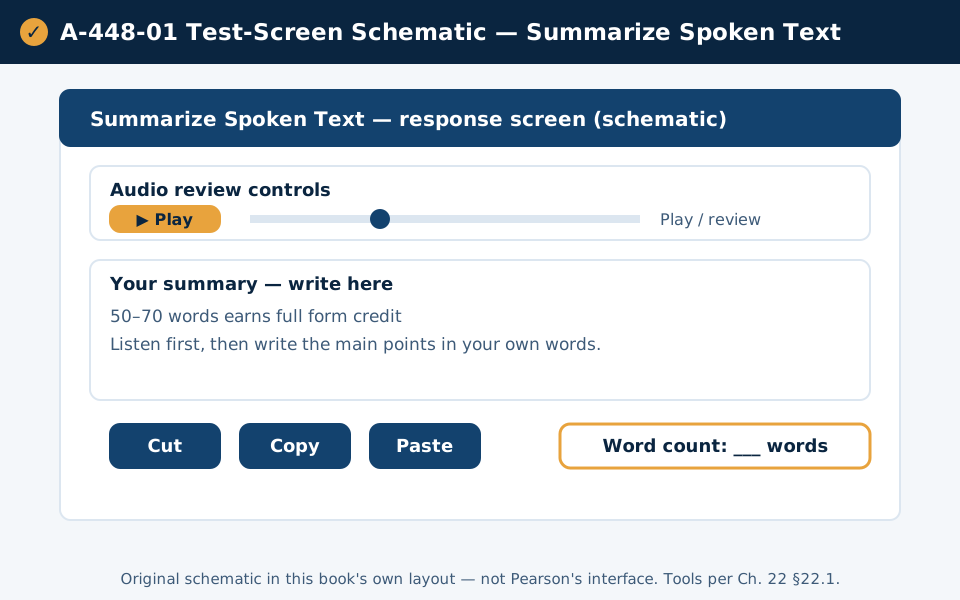
Figure A-448-01. Test-screen schematic: the Summarize Spoken Text response screen, drawn as an original schematic in this book's own layout — audio review controls, the response box, Cut, Copy and Paste buttons, and the word count. It is not Pearson's interface.
Do this now. Take any practice response you have already produced — a paragraph, a recorded sentence — and rate it against the eight traits in one line each. You are not scoring yourself; you are learning to see responses the way the scoring model sees them. That habit, repeated across 22 craft chapters, is the engine of this book.
Simplify. You book PTE Academic through a myPTE account, after finding a seat at a test center; the details you book with must exactly match your identification document — name, date of birth, citizenship and gender (Source: Pearson, PTE Academic & PTE Academic UKVI Test Taker Handbook, July 2025). The test is taken at 500+ test centers around the world and is accepted by 4,000+ universities and colleges (Source: Pearson, PTE Academic main test page; Source: Pearson, Test centres and fees page).
Detail: the identity rule is absolute. You must provide a valid, non-expired passport to take PTE Academic or PTE Academic UKVI; only the original document is accepted, never a photocopy; in some countries an alternative form of identification may be possible under Pearson's acceptable-ID guidance (Source: Pearson, PTE Academic & PTE Academic UKVI Test Taker Handbook, July 2025). If the name on your booking differs from the name on your passport — a shortened name, a different spelling, a swapped order — you have a booking problem, not a test-day negotiation. Check the match when you book, not when you arrive.
Detail: the money mechanism, stated exactly as Pearson publishes it and no further. Pearson publishes no static fee table. The test fee varies by country and is shown only through Pearson's price finder and inside the myPTE booking flow (Source: Pearson, Test centres and fees page). This book therefore prints no numeric test fee anywhere — not here, not in any example — because any printed figure would be wrong for most readers and stale for the rest. What Pearson does publish as rules, this book prints as rules, with no amount attached. Rescheduling is free when more than 14 full calendar days remain before your appointment; you may reschedule a single appointment at most six times; at 14 days or fewer, rescheduling is impossible and you cancel and rebook instead. Cancellation refunds follow a ladder: a full refund at 14 or more days before the test, 50% at 13–8 days, and none at fewer than 7 days (Source: Pearson, PTE Academic & PTE Academic UKVI Test Taker Handbook, July 2025; Source: Pearson, PTE Academic scoring page). Payment at booking is by credit or debit card, and, depending on country, Google Pay or Apple Pay; a voucher covers the test fee only, never a rescheduling fee, and voucher payments are non-refundable (Source: Pearson, PTE Academic & PTE Academic UKVI Test Taker Handbook, July 2025). If you need accommodations — adjustments to the test conditions for a documented need — you request them before booking, about six weeks ahead (Source: Pearson, PTE Academic & PTE Academic UKVI Test Taker Handbook, July 2025).
Show the mechanism deciding a real choice. A candidate who books first and checks an institution's deadline later discovers the deadline falls three days after the sitting; scores typically arrive in time — but the candidate who books after checking keeps the reschedule ladder in reserve instead of spending it. Process literacy is not bureaucracy; it is marks protected before the test begins. EX-1 returns to the rules that follow the test itself — validity, sharing, rescoring and retakes — with the same primary-source discipline.
Simplify. Arrive at least 30 minutes early. Late arrival is turned away and the fee is lost (Source: Pearson, PTE Academic & PTE Academic UKVI Test Taker Handbook, July 2025). At check-in, the Test Administrator checks your identification and takes your palm-vein scan — a scan of the vein pattern in your palm, used as biometric identity proof — together with your photograph and signature; the center records by CCTV and audio/video throughout (Source: Pearson, PTE Academic & PTE Academic UKVI Test Taker Handbook, July 2025).
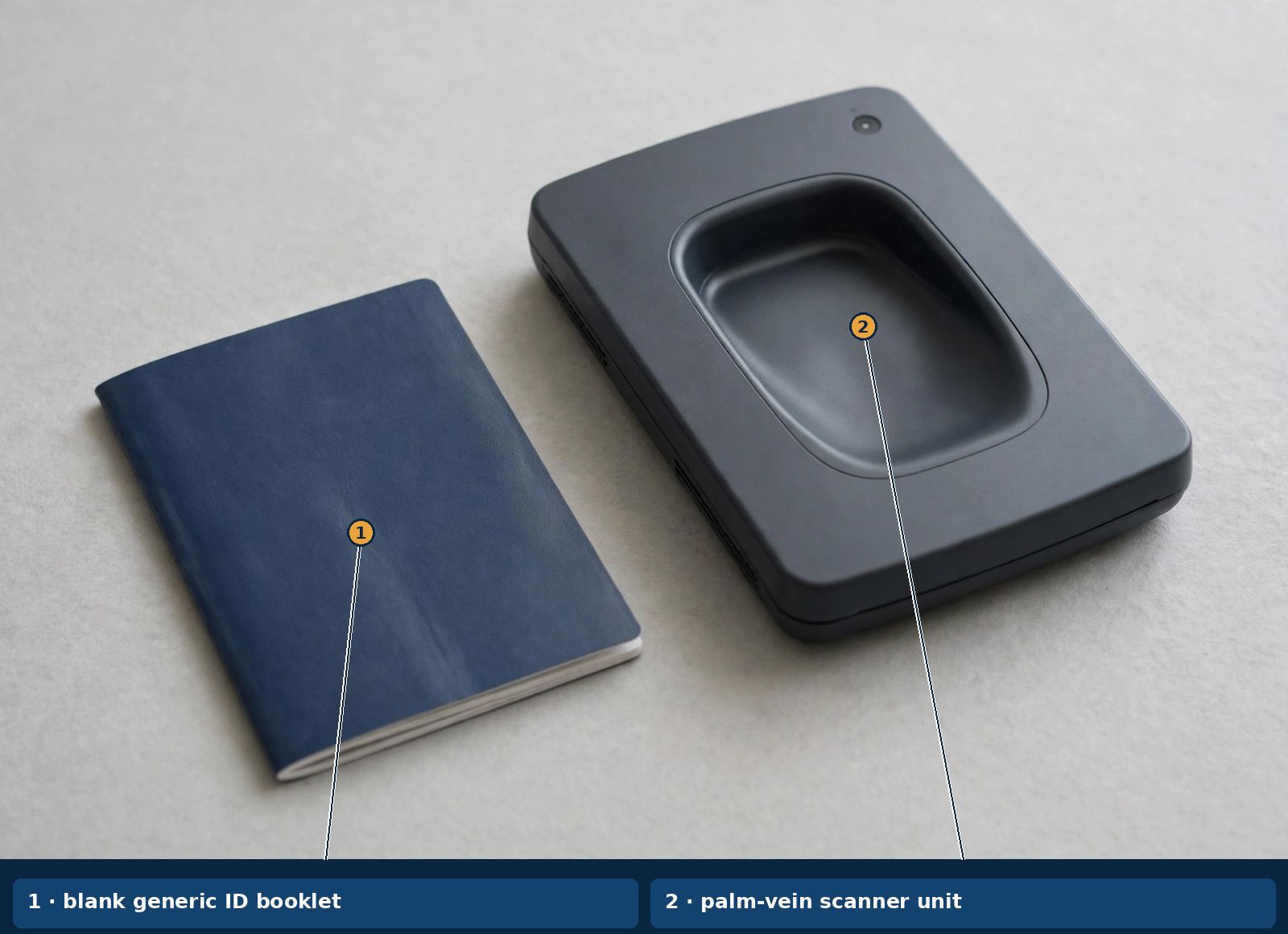
Figure P-448-04. Check-in ensemble: blank generic ID booklet beside a palm-vein scanner unit.
Detail: your workstation. You are assigned a computer with headphones with a built-in microphone, and you complete an equipment check before the test starts; raise any equipment problem then, not during a scored item (Source: Pearson, PTE Academic & PTE Academic UKVI Test Taker Handbook, July 2025). You are given an erasable whiteboard and two pens for notes and planning — Pearson's own term is erasable whiteboard — and you write nothing on it before the test starts (Source: Pearson, PTE Academic & PTE Academic UKVI Test Taker Handbook, July 2025). FND-6 teaches you to lay out that whiteboard for once-only listening; it is the only paper-like tool you will ever have in this test, so its discipline is worth a chapter's attention.
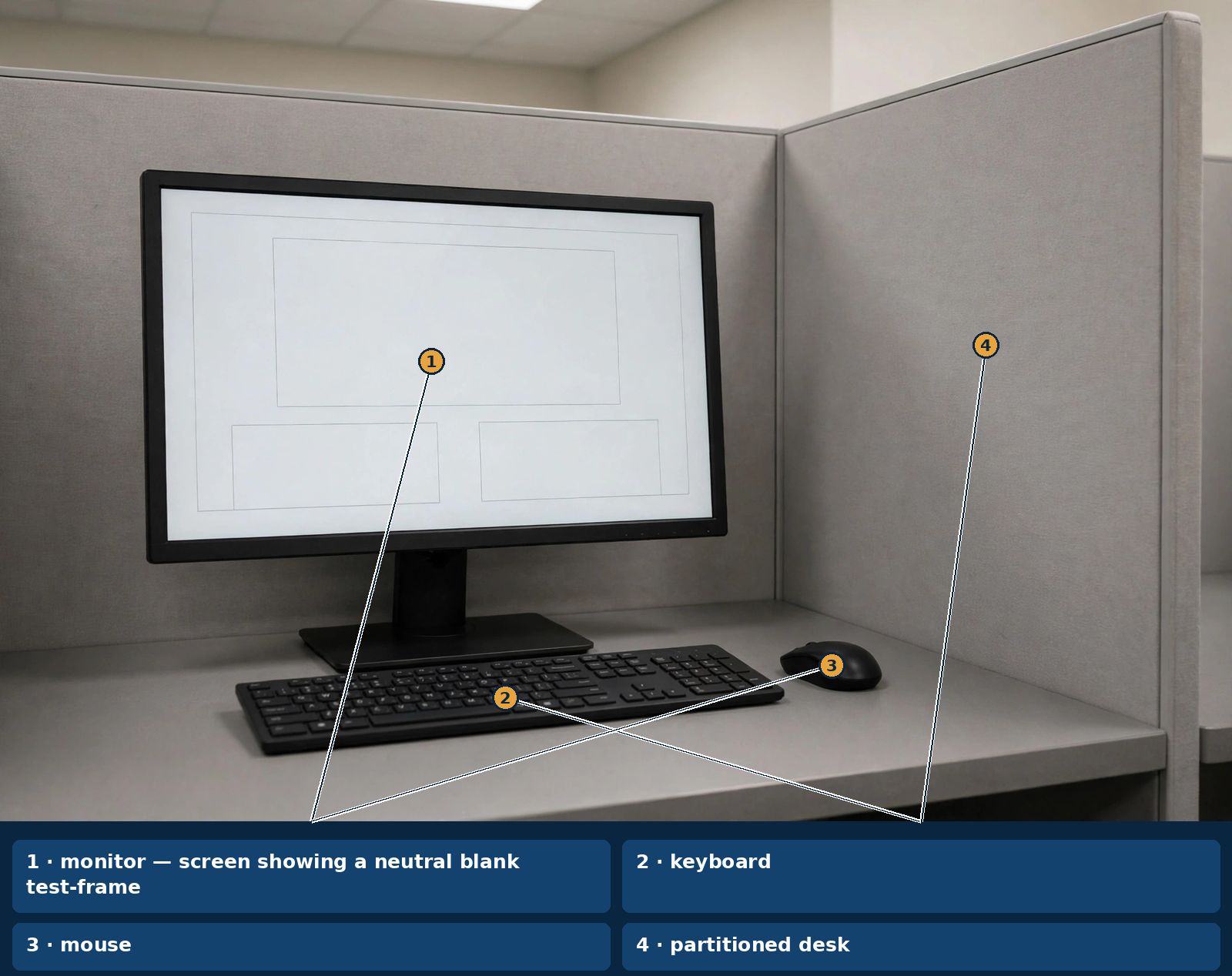
Figure P-448-01. Test-center workstation: monitor, keyboard and mouse on a partitioned desk.
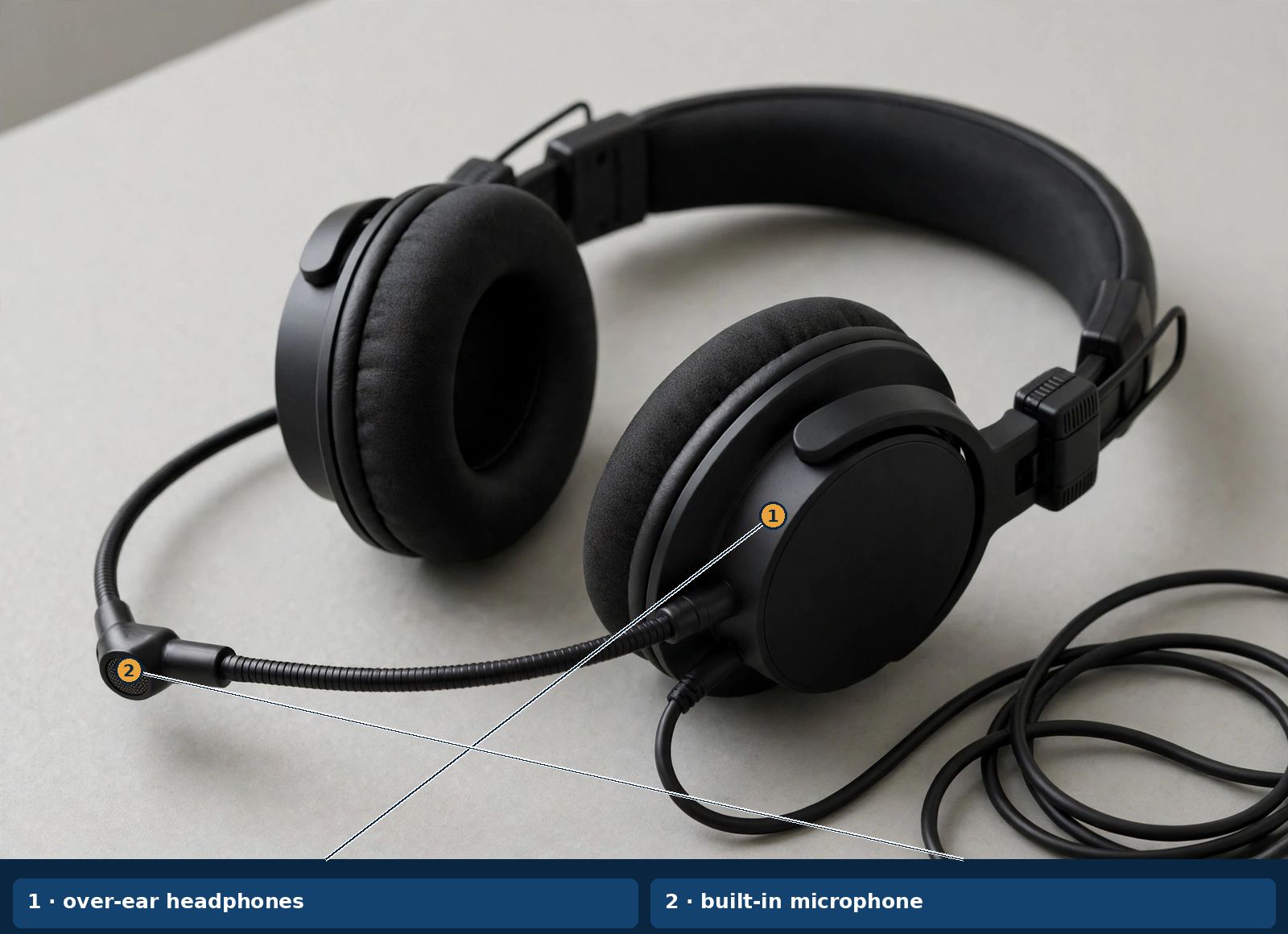
Figure P-448-02. Issued headset ensemble: over-ear headphones with built-in microphone.
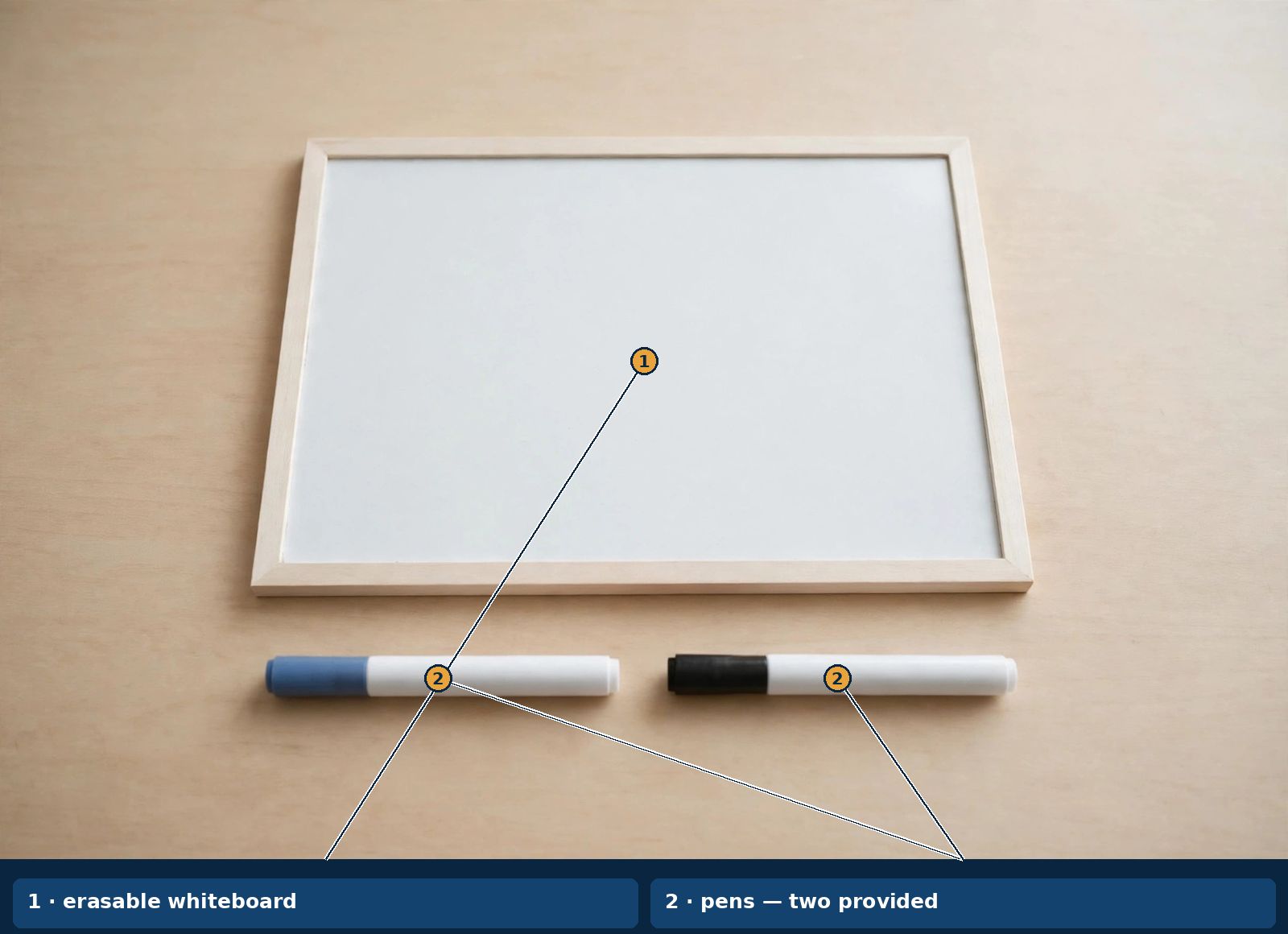
Figure P-448-03. Erasable whiteboard and two pens ensemble.
Detail: the room. Test rooms hold up to 15 test takers, and during Part 1 everyone speaks at once; Pearson recommends wearing your headphones throughout (Source: Pearson, PTE Academic main test page). Candidates consistently name this as the test's strangest sensation — describing an image while a stranger two seats away retells a lecture. It is trainable: EX-2 rehearses speaking against background voices until the room stops being an event and becomes a condition.
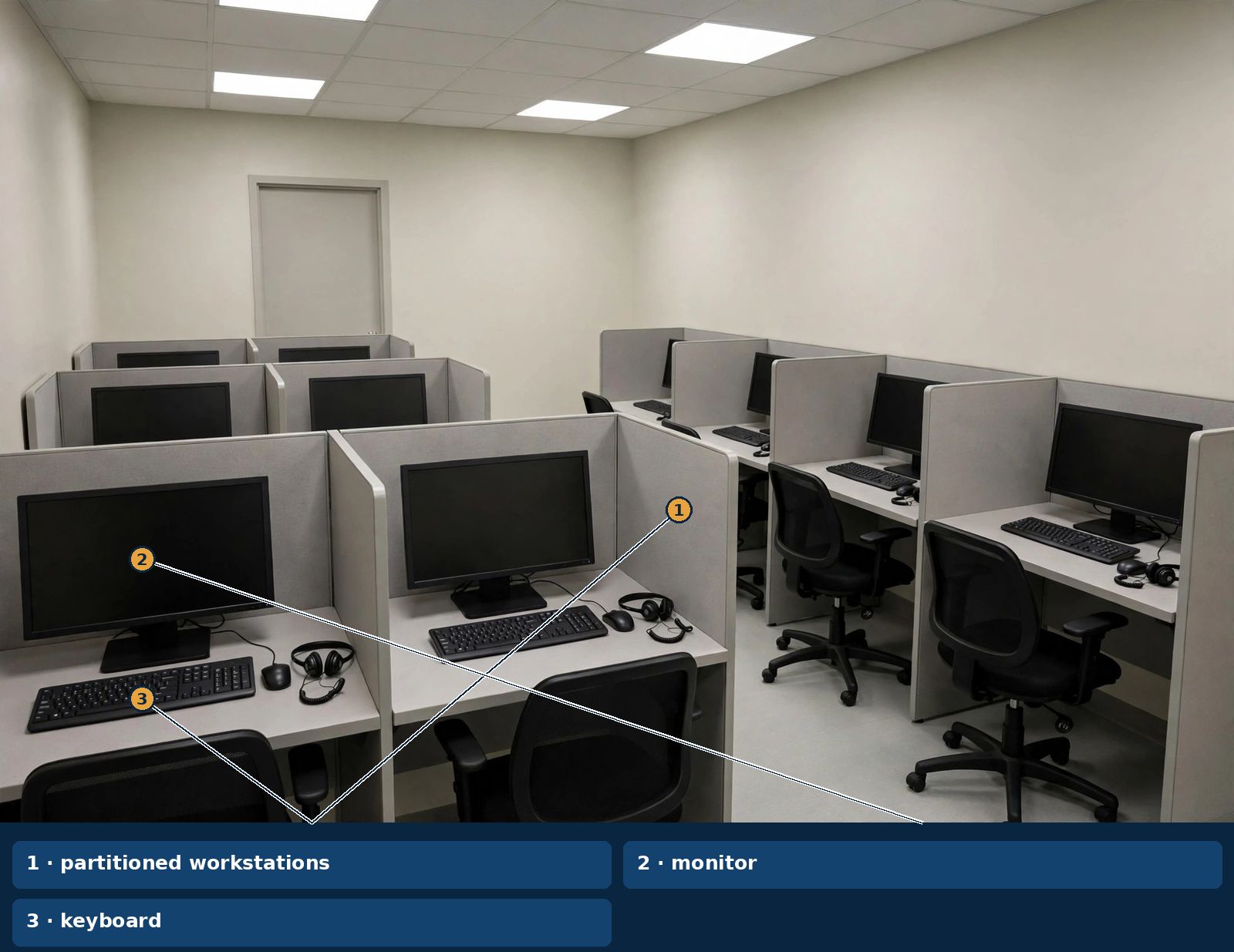
Figure P-448-05. Test-room ensemble: rows of partitioned workstations, no people.
Detail: the clock and the break rule, because both are absolute. There are no scheduled breaks in this test. You may request an unscheduled break, but the test clock does not stop while you are away, and during it you have no locker access, no talking and no leaving the building (Source: Pearson, PTE Academic & PTE Academic UKVI Test Taker Handbook, July 2025). You may not leave before the test finishes, and — the rule from section 1.1, repeated because it governs every pacing decision in this book — you cannot move back to a previous question. Plan your sitting as one unbroken performance of around two hours, because that is what it is.
Show the rules protecting a candidate. Kenji's first full rehearsal failed on conduct, not English: he spent four unplanned minutes re-reading a finished item's screen in his head during the next item. The no-going-back rule, learned in advance, converts that regret into a procedure — answer, release, advance — which EX-2 drills under timed conditions. Test-day knowledge is score knowledge.
Simplify. Results are usually available within two days (48 hours), and may take up to five business days (Source: Pearson, PTE Academic & PTE Academic UKVI Test Taker Handbook, July 2025; Source: Pearson, PTE Academic main test page). Your Score Report — the official document carrying your overall and communicative skills scores — is valid for two years, and scores are to be assigned to institutions within two years of the test date (Source: Pearson, PTE Academic & PTE Academic UKVI Test Taker Handbook, July 2025).
Detail: sharing. You share scores free and without limit through myPTE — at most seven recipients at one time — or by giving an institution your Score Report Code, the code an institution uses to verify your result electronically; institutions verify electronically and do not accept paper or PDF reports (Source: Pearson, PTE Academic & PTE Academic UKVI Test Taker Handbook, July 2025). If you tick the boxes at booking, your scores are shared automatically with Australia's Department of Home Affairs and Immigration New Zealand; UKVI reports are auto-shared with the UK Government (Source: Pearson, PTE Academic & PTE Academic UKVI Test Taker Handbook, July 2025). One attributed exception belongs in your planning notes: Pearson states that Australia's Department of Home Affairs will accept scores assigned up to three years after the test date (Source: Pearson, PTE Academic & PTE Academic UKVI Test Taker Handbook, July 2025) — an exception published by Pearson about that department's practice, printed here in exactly that attributed form. And because requirements change: Pearson notes that the Department of Home Affairs introduced new requirements for some subclasses from 7 August 2025, and directs candidates to the Department's own page for the current figures (Source: Pearson, PTE Updates 2025). This book prints the pointer and no figures, by design.
Detail: the rescore and the retake, the two decisions candidates make in the worst week. A paid rescore is available for spoken and open-ended written responses only; the score can move up or down, and Pearson publishes that it is unlikely to change (Source: Pearson, PTE Academic & PTE Academic UKVI Test Taker Handbook, July 2025). This book prints no rescore fee amount, because none is verified in its source register; myPTE shows the current figure. Retesting is governed by three rules: you may retest only after your previous score has been received; you hold one test booking at a time; and you may take at most 12 tests in a 12-month window, booking up to six months ahead (Source: Pearson, PTE Academic & PTE Academic UKVI Test Taker Handbook, July 2025). EX-1 builds the decision procedure — read the Skills Profile first, repair the trait, then rebook — so a retake is a plan and not a reaction.
Check yourself before the quiz. You should now be able to state the three parts and their timings; explain why the overall score is not an average; name the eight traits; name the three negatively marked types; state the identity rule, the break rule and the retake rules; and explain why this book prints no fee and no institution's required score. The quiz checks exactly that, through test-format items — and the chapters that follow assume it.
Key terms. PTE Academic; test center; Personal Introduction; Global Scale of English (GSE); overall score; communicative skill; integrated item; myPTE; Skills Profile; trait; Content; Form; Development, Structure and Coherence; Grammar; General Linguistic Range; Vocabulary; Pronunciation; Oral Fluency; descriptor scale; partial credit; correct/incorrect item; negative marking; form limit; SELT Unique Reference Number (URN); palm-vein scan; erasable whiteboard; unscheduled break; Score Report; Score Report Code; rescore.
Q1. In which order do the three parts of PTE Academic occur? A. Reading, then Speaking & Writing, then Listening B. Speaking & Writing, then Reading, then Listening C. Listening, then Reading, then Speaking & Writing D. Speaking & Writing, then Listening, then Reading
Q2. What is the published timing and type count of Part 2? A. 23–30 minutes, 5 question types B. 31–39 minutes, 8 question types C. 76–84 minutes, 9 question types D. 23–30 minutes, 8 question types
Q3. How many scored question types does the current test contain? A. 20 B. 9 C. 65 D. 22
Q4. Which statement about the Personal Introduction is correct? A. It is scored and counts toward the overall score B. It allows unlimited re-recording C. It is unscored, with 25 seconds to prepare and 30 seconds to record, once only D. It opens Part 3
Q5. The overall score is best described as: A. A score computed from performance across the whole test, not an average of the four skill scores B. The mean of Listening, Reading, Speaking and Writing C. The lowest of the four skill scores D. Decided by the human reviewer alone
Q6. A response is read aloud from a passage and also scored for listening comprehension of its content words. Under the published model, such an integrated item: A. Feeds only the Speaking score B. Contributes to both assessed skills C. Feeds only the overall score, not any skill D. Is excluded from scoring
Q7. Which set lists item types whose content receives human expert review? A. Read Aloud, Repeat Sentence, Answer Short Question B. Multiple Choice Single Answer, Reorder Paragraph, Select Missing Word C. Describe Image, Retell Lecture, Summarize Written Text D. Highlight Incorrect Words, Write from Dictation, Reading Fill in the Blanks
Q8. Pronunciation and Oral Fluency are scored: A. By human experts only B. By a second human expert in every case C. By the candidate's test center D. By AI only
Q9. The Skills Profile is: A. Sent to every institution the candidate applies to B. Private to the test taker in myPTE, with eight areas and personalized recommendations C. Part of the printed Score Report shared by code D. A pass/fail certificate
Q10. Which trait concerns whether a response meets the task's shape rules, such as a length band or a one-sentence rule? A. Content B. Vocabulary C. Form D. Pronunciation
Q11. Which types carry negative marking? A. Reading Multiple Choice Multiple Answers, Listening Multiple Choice Multiple Answers, Highlight Incorrect Words B. Read Aloud, Describe Image, Write Essay C. Every multiple-choice type in the test D. Summarize Written Text and Summarize Spoken Text
Q12. A Summarize Written Text response earns its form standing only if it is: A. Two sentences of any length B. Between 200 and 300 words C. Exactly 50–70 words D. One single complete sentence of 5–75 words
Q13. For Write Essay, full form credit requires: A. 200–300 words B. 5–75 words in one sentence C. 50–70 words D. At least 400 words
Q14. Which statement about test fees is correct? A. Pearson publishes one worldwide fee in a static table B. The fee varies by country and is shown through the price finder and the myPTE booking flow C. The fee is printed in this book's Exam Blueprint chapter D. Fees are the same at every test center
Q15. Rescheduling a single appointment is: A. Unlimited and always free B. Impossible under all circumstances C. Charged at 50% at all times D. Free beyond 14 full calendar days, and capped at six reschedules
Q16. Cancellation 10 days before the test carries, under the published ladder: A. A 50% refund B. A full refund C. No refund D. A voucher for the full fee
Q17. The identification rule for test day is: A. Any photo ID, including a photocopy B. A driving license from any country C. A valid, non-expired passport, the original only, exactly matching the booking details D. The myPTE confirmation email alone
Q18. Which statement about breaks is correct? A. A scheduled 10-minute break stops the clock B. Candidates may leave the building on a break C. Lockers may be accessed during an unscheduled break D. There are no scheduled breaks; an unscheduled break may be requested but the clock does not stop
Q19. On arrival at the workstation, a candidate is given: A. Blank paper and a pencil B. An erasable whiteboard and two pens C. A printed dictionary D. A personal laptop connection
Q20. Test rooms for this test hold: A. Up to 15 test takers, with everyone speaking at once during Part 1 B. One candidate per room C. Up to 50 test takers in silence D. Candidates who all start and finish different parts
Q21. Retesting is permitted: A. Before the previous score is received B. With several bookings held at once C. Without any annual limit D. Only after the previous score is received, one booking at a time, at most 12 tests in 12 months
Q22. A paid rescore: A. Covers every item type including multiple choice B. Can only raise a score C. Is available for spoken and open-ended written responses, and the score can move either way D. Is free and unlimited
Q23. PTE Academic UKVI differs from PTE Academic in that: A. Its test content is entirely different B. It is the same test content, format and scoring, taken at a UKVI-approved center, with a report bearing the SELT URN C. It tests speaking and listening only D. It is scored pass–fail
Q24. Which statement follows this book's score-claim discipline? A. A named university's required score is printed in FND-1 B. Pearson sets a pass mark of 60 C. Typical ranges such as undergraduate 51–60 are Pearson's published typical examples, and the reader checks their own institution's current requirement D. Reaching the typical range guarantees admission
Feras Alzubi
2026 Edition — built against the PTE Academic format as published by Pearson in its post-7-August-2025 form, under the PTE Academic & PTE Academic UKVI Score Guide — Test Taker, July 2025 edition, and the PTE Academic & PTE Academic UKVI Test Taker Handbook, July 2025 edition.
An independent study book for one examination: PTE Academic, taken at a test center in a single sitting of around two hours, in three parts, across 22 scored question types, scored from 10 to 90.
© 2026 Feras Alzubi. All rights reserved.
No part of this book may be reproduced, distributed, or transmitted in any form or by any means — electronic, mechanical, photocopying, recording, or otherwise — without the prior written permission of the copyright holder, except as permitted by law and except for brief quotations in reviews and the buyer's own study notes.
This is an original work, written for this book. Every passage, lecture script, conversation, discussion, prompt, and sample response in it was written fresh for this book. The practice questions are original, written against Pearson's published test format named in this book, and are not Pearson's actual, recalled, paraphrased, or adapted items; no item is copied or adapted from any other preparation book, course, app, or question bank, and Pearson's published sample responses were read for scoring calibration only and are never reproduced or used as model answers.
This book is an independent study guide. It is not published by, affiliated with, endorsed by, or approved by Pearson, and Pearson did not participate in its creation. PTE and Pearson PTE are trademarks of Pearson, their owner, used in this book only to name the examination this book prepares candidates for. Passing any exam also depends on the candidate's own preparation; no book can guarantee a result.
The four candidate personas in this book — Kenji Sato, Tomás Rivera, Leila Haddad, and Ngozi Eze — and the Millbrook University stimulus world are fictional and original to this book. No real person, university, employer, or government body appears as a character inside any item.
The practice questions in this book are original, written for this book against the published outline of PTE Academic as Pearson publishes it — the three-part, 22-type format in force for tests taken after 7 August 2025, as set out in Pearson's PTE Academic & PTE Academic UKVI Score Guide — Test Taker, July 2025 edition, and Pearson's published test-format pages. They are not Pearson's questions: no actual, recalled, paraphrased, or adapted examination item appears anywhere in this book, and no item derives from Pearson's Official Guide, Question Bank, Scored Practice Tests, or any other source. Every item is tagged to the chapter and the item type it serves, and every answer is explained — why the key is right and why each wrong option, or each weaker response, falls short.
This page states the test exactly as Pearson publishes it. Every figure on it traces to a Pearson source named at the point of use. Where Pearson publishes no figure, this page prints none.
PTE Academic is a computer-based test of academic English that you take at a test center; it cannot be taken at home. It runs in a single sitting of around two hours, with a published maximum of 2 hours 15 minutes, at 500+ test centers worldwide, and it is accepted by 4,000+ universities and colleges (Source: Pearson, PTE Academic main test page; Source: Pearson, PTE Academic & PTE Academic UKVI Score Guide — Test Taker, July 2025; Source: Pearson, Test centres and fees page). The test has three parts, always in the same order, with 22 scored question types and 65–75 questions in a full test (Source: Pearson, PTE Academic & PTE Academic UKVI Score Guide — Test Taker, July 2025).
The parts are separately timed, the per-part timings do not always total the same, and unscored items may be added for research and security (Source: Pearson, PTE Academic & PTE Academic UKVI Score Guide — Test Taker, July 2025). Inside the test there is no moving back to a previous question (Source: Pearson, PTE Academic & PTE Academic UKVI Test Taker Handbook, July 2025).
Part 1 opens with the Personal Introduction, which is unscored: you have 25 seconds to read the prompt and prepare, and 30 seconds to record, and you may record only once; it exists so you can settle into the room and the equipment (Source: Pearson, PTE Academic test format — Speaking & Writing part page). It is rehearsed at the head of every timed test in this book and is never counted in any item total.
There are no scheduled breaks in this test. An unscheduled break may be requested, but the test clock does not stop during it, and during it you have no locker access, no talking, and no leaving the building (Source: Pearson, PTE Academic & PTE Academic UKVI Test Taker Handbook, July 2025).
Counts are the published range of items of each type in a full test (Source: Pearson, PTE Academic & PTE Academic UKVI Score Guide — Test Taker, July 2025).
Part 1 — Speaking & Writing
Cleared per-type delivery facts taught in the craft chapters: a Read Aloud prompt runs up to 60 words, with 30–40 seconds to prepare and 30–40 seconds to read; Describe Image allows 25 seconds to study the image and 40 seconds to speak; for Retell Lecture the microphone opens 10 seconds after the audio ends and you have 40 seconds to respond (Source: Pearson, Test Tips — Speaking, V6, January 2026).
Part 2 — Reading
Part 3 — Listening
Listening clips in the real test play once, and automatically (Source: Pearson, PTE Academic test format — Listening part page). The per-type ranges above do not all occur at once in a real test; this book's timed tests fix each type at or near its published minimum so each test totals 65 items, at Pearson's published test floor.
Every score is a number from 10 to 90 on the Global Scale of English (GSE). You receive an overall score and four communicative skills scores — Listening, Reading, Speaking, and Writing — and the overall score is not an average of the four communicative skills scores; integrated items contribute to both skills they assess (Source: Pearson, PTE Academic & PTE Academic UKVI Score Guide — Test Taker, July 2025; Source: Pearson, PTE Academic scoring page). Held privately in your myPTE account, and never shared with institutions, is the Skills Profile: performance bars and personalized recommendations across eight areas — Open response speaking and writing; Reproducing spoken and written language; Extended writing; Short writing; Extended speaking; Short speaking; Multiple-skills comprehension; and Single-skill comprehension (Source: Pearson, PTE Academic & PTE Academic UKVI Score Guide — Test Taker, July 2025; Source: Pearson, PTE Academic scoring page).
Every item type is scored by AI, combined with human expertise: a human expert reviews the content of Describe Image, Retell Lecture, Respond to a Situation, Summarize Group Discussion, Summarize Written Text, Write Essay, and Summarize Spoken Text, with a second human expert resolving disagreement; Pronunciation and Oral Fluency — each carrying a published 0–5 descriptor scale — are scored by AI only (Source: Pearson, PTE Academic & PTE Academic UKVI Score Guide — Test Taker, July 2025). Pearson publishes that memorized or templated speaking content can score zero for content (Source: Pearson, Test Tips — Speaking, V6, January 2026); this book therefore teaches generation, never recitation.
There is no pass mark. Pearson sets no pass mark for PTE Academic: governments and institutions decide which tests they accept and what scores they require, and requirements change (Source: Pearson, PTE Academic & PTE Academic UKVI Score Guide — Test Taker, July 2025; Source: Pearson, PTE Academic scoring page). This book accordingly prints no institution's or government's required score, anywhere. What Pearson itself publishes, in Pearson's own framing, is a set of typical examples of the ranges institutions set — foundation courses 36–50, undergraduate 51–60, postgraduate 57–67 — printed here as typical examples, never as requirements (Source: Pearson, PTE Academic & PTE Academic UKVI Score Guide — Test Taker, July 2025). Pearson also publishes the alignment of the scale to the Common European Framework of Reference (CEFR): 85–90 C2; 76–84 C1; 59–75 B2; 43–58 B1; 30–42 A2; 10–29 A1 (Source: Pearson, PTE Academic scoring page). Your target is your own institution's current published requirement, which you check yourself and aim above with margin. One attributed pointer belongs here: Pearson notes that Australia's Department of Home Affairs introduced new requirements for some subclasses from 7 August 2025 and directs candidates to the Department's own page for the current figures (Source: Pearson, PTE Updates 2025). This book prints that pointer and no figures.
Results are typically available within 48 hours, and may take up to five business days (Source: Pearson, PTE Academic main test page; Source: Pearson, PTE Academic & PTE Academic UKVI Test Taker Handbook, July 2025).
You book through a myPTE account after finding a seat; the details you book with must exactly match your identification — name, date of birth, citizenship, and gender — and you must provide a valid, non-expired passport, the original document only, though an alternative form of identification may be possible in some countries under Pearson's acceptable-ID guidance. Arrive at least 30 minutes early; late arrival is turned away and the fee is lost. At check-in the Test Administrator checks your identification and takes your palm-vein scan, photograph, and signature (Source: Pearson, PTE Academic & PTE Academic UKVI Test Taker Handbook, July 2025).
The fee. Pearson publishes no static fee table. The fee is set by the country of the test center and is shown only through Pearson's price finder and inside the myPTE booking flow; Pearson sets the fee by country at booking, and you check your own fee in Pearson's price finder before you book (Source: Pearson, Test centres and fees page). No numeric test fee appears anywhere in this book. The money rules Pearson does publish print as rules, with no amount attached: rescheduling is free when more than 14 full calendar days remain, a single appointment may be rescheduled at most six times, and at 14 days or fewer rescheduling is impossible — you cancel and rebook instead; cancellation refunds are full at 14 or more days, 50% at 13–8 days, and none at fewer than 7 days (Source: Pearson, PTE Academic & PTE Academic UKVI Test Taker Handbook, July 2025).
Validity and sharing. Your Score Report is valid for two years, and scores are to be assigned to institutions within two years of the test date. You share scores free and without limit through myPTE — at most seven recipients at one time — or by a Score Report Code; institutions verify electronically and do not accept paper or PDF reports (Source: Pearson, PTE Academic & PTE Academic UKVI Test Taker Handbook, July 2025). One attributed exception: Pearson states that Australia's Department of Home Affairs will accept scores assigned up to three years after the test date — Pearson's published statement about that department's practice, printed in that attributed form (Source: Pearson, PTE Academic & PTE Academic UKVI Test Taker Handbook, July 2025).
Retake and rescore. You may retest only after your previous score has been received, you hold one test booking at a time, you may take at most 12 tests in a 12-month window, and you may book up to six months ahead. A paid rescore is available for spoken and open-ended written responses only; the score can move up or down, and Pearson publishes that it is unlikely to change. No rescore fee amount is printed in this book, because none is verified in its sources; myPTE shows the current figure (Source: Pearson, PTE Academic & PTE Academic UKVI Test Taker Handbook, July 2025).
PTE Academic UKVI is the same test. It has the same test content, format, and scoring as PTE Academic; the differences are administrative only — it is a Secure English Language Test taken at a UKVI-approved center, its score report additionally bears the SELT Unique Reference Number (URN), which is auto-shared with the UK Government, and its registration carries minor process differences for UK Home Office compliance. Pearson directs candidates to UKVI for UK work visas requiring a four-skills test and for study below degree level or outside a Higher Education Institution, and to Academic for degree-level-and-above study at a Higher Education Institution (Source: Pearson, PTE Academic main test page; Source: Pearson, PTE Academic & PTE Academic UKVI Score Guide — Test Taker, July 2025; Source: Pearson, SELT tests page). Because the test is the same test, every chapter, item, and timed test in this book serves a UKVI candidate's test identically.
PTE Core is a different test. It is a test of general English — everyday, workplace, and community English, not academic English — for Canadian immigration routes, and Pearson states explicitly that study in Canada requires PTE Academic instead; the two must never be substituted for each other (Source: Pearson, PTE Core page). This book does not prepare you for PTE Core; Pearson's PTE Core pages are the signpost.
PTE Home is a different test. It is a Secure English Language Test of speaking and listening only, pass–fail, at CEFR levels A1, A2, and B1, for UK family, settlement, citizenship, and specified limited work-visa routes (Source: Pearson, SELT tests page). This book does not prepare you for PTE Home; Pearson's SELT pages are the signpost.
Pearson, the test's owner, publishes its own preparation products: the Official Guide to PTE Academic, the Scored Practice Tests, the Question Bank, Official AI Practice, the Expert Self-Study Course, and free Smart Prep in myPTE with Guided Practice Tests (Source: Pearson, Prepare for PTE Academic page; Source: Pearson, Official Guide to PTE Academic page). They are named here, in this one place, so you know what is official. None of them is a content source for this book. Chapter 1 (FND-1) states the one use this book recommends by name: Pearson's Scored Practice Tests are the official scored rehearsal for a reader who wants the real scoring engine's verdict before test day, because this book — as the next section says plainly — cannot hear you and cannot score you as the real engine does.
This is an independent study book. It is not affiliated with, endorsed by, or published by Pearson; PTE and Pearson PTE are Pearson's marks, used only to name the examination this book prepares candidates for.
Every chapter in this book runs the same rhythm: simplify → explain → detail → show → do → check. A chapter opens with the idea in plain words, explains why it exists, gives the full rule with its source, shows a worked example analyzed line by line, gives you work to do, and closes with a 24-item chapter quiz whose key explains the right answer and every wrong answer. Worked examples always come before items. Nothing is tested before it is taught, and no term is used before it is defined — the first use of every technical term is bolded and defined in place, and each chapter closes by collecting its terms in a Key terms paragraph; the Glossary in the back matter gathers them all.
The book is built in the test's own order. First the foundations (Chapters 1–7, FND-1 to FND-7): the instrument and its scoring, then pronunciation, oral fluency, grammar, vocabulary and spelling, listening, and reading and writing construction. Then one craft chapter for each of the 22 scored item types, in the order the test presents them: Speaking & Writing (Chapters 8–16, SW-1 to SW-9), Reading (Chapters 17–21, RD-1 to RD-5), and Listening (Chapters 22–29, LS-1 to LS-8). Then score literacy and full-test craft (Chapters 30–31, EX-1 and EX-2). Around the chapters sits the apparatus: a 48-item diagnostic, eight full timed practice tests of 65 items each, a 12-item repair set for every item type, and a response workshop of 12 prompts for each of the eight open-response types.
A counting convention, stated once: one item is one scored task as Pearson counts it — one spoken response, one written response, one multiple-choice question, one reorder task, or one fill-in-the-blanks passage, whose blanks are sub-parts of that one item. The Personal Introduction is unscored and never counted. On that convention the book carries 1,672 practice questions: the diagnostic's 48, the chapter quizzes' 744 (31 chapters × 24), the timed tests' 520 (8 × 65), the repair sets' 264 (22 × 12), and the workshops' 96 prompts (8 × 12). Worked examples inside chapter prose are teaching, not counted items; nothing is counted twice.
Before you study anything, take the Diagnostic Test in this front matter, cold, in one sitting of about 60 minutes: 48 items — 20 in Part 1 form, 12 in Part 2 form, and 16 in Part 3 form — covering every one of the 22 item types at least once. Do not prepare for it; its job is to measure the candidate you are today, not the candidate you hope to be.
Score it with the Diagnostic Key, by communicative skill and by item type, and complete the two trackers in the key. The trackers convert each result into a study priority and point to the exact chapters that reteach that ground; the routing table sends you through the book in the order your result needs — a foundation-band result routes you foundations-first, a higher-band result routes you craft-first with foundations by referral. Keep the trackers. After you finish each part's chapters, re-check yourself with that part's repair sets — they are the book's re-diagnostic checkpoints — and after a real sitting, Chapter 30 (EX-1) teaches you to run the same routing from your real Score Report and Skills Profile.
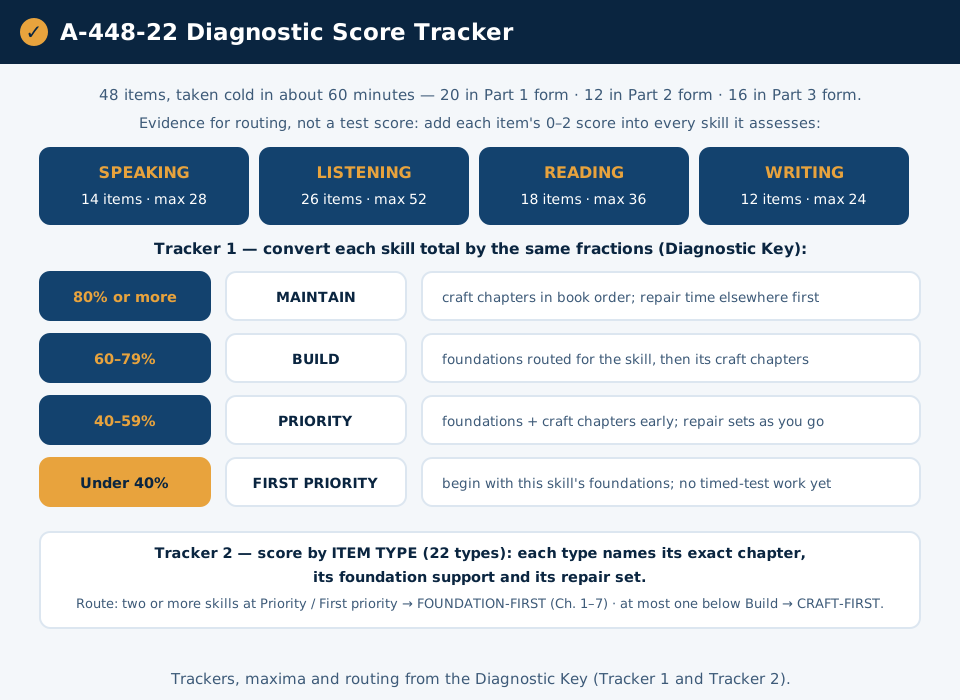
Figure A-448-22. Diagnostic score tracker: the 48-item diagnostic scored by skill against Tracker 1's maxima and priority bands, then by item type in Tracker 2, which names each type's chapter and repair set.
Two named routes run through the same book; both are set out day by day in the back matter.
Choose by the diagnostic, not by the calendar alone: a candidate whose foundations are the constraint gains nothing by sprinting the craft chapters, and a candidate near their target wastes weeks relearning ground they own. Neither plan promises any outcome; each is a route through teaching, not a forecast of a score.
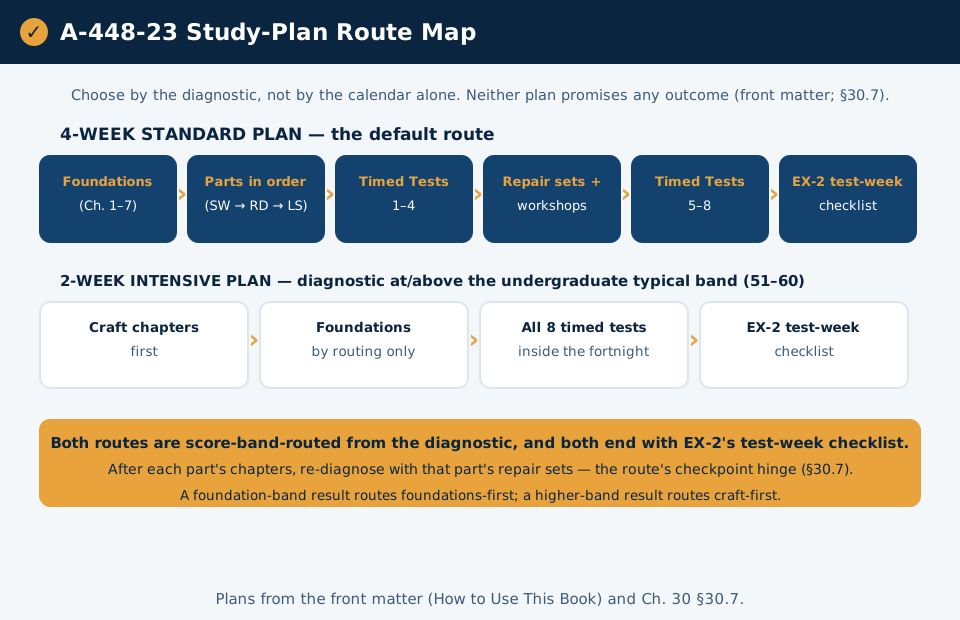
Figure A-448-23. Study-plan route map: the 4-week standard route and the 2-week intensive route through the same book, both routed by the diagnostic and both closing with EX-2's test-week checklist.
A book cannot play audio and cannot hear you, and this book never pretends otherwise. Its method for the spoken and heard halves of the test is designed, and it is the same in every chapter, test, repair set, and workshop:
Work inside that honesty and the method is strong: the scripts are written to the test's published forms, the checklists are built from the published traits, and the model responses are scored in the open, trait by trait, so you can see exactly where marks are earned and lost.
Four fictional candidates recur through the foundations and craft chapters, placed by Pearson's published typical bands only — no target institution and no target score is named for any of them: Kenji Sato (foundation-course band; listening and spelling are his constraint), Tomás Rivera (undergraduate band; fluency outruns accuracy), Leila Haddad (postgraduate band; a strong reader whose essay structure caps her writing), and Ngozi Eze (professional-registration band; near target, with pacing and the two new types — Summarize Group Discussion and Respond to a Situation — as her risk). Their errors and progress are this book's teaching material; when a persona's route matches your diagnostic, follow it. The items themselves live in one fictional stimulus world, Millbrook University — its library, seminars, laboratories, accommodation office, and student services — so contexts cohere from chapter to chapter without touching any real institution.
End of the free sample. The complete book continues from here — the full A-to-Z course in book form, delivered as an EPUB you can read in Apple Books, Google Play Books, ReadEra, Thorium Reader, Adobe Digital Editions, or Send to Kindle.
Buy this ebook — $11.99 Back to the book page
Payments are securely processed by Payhip.