
Mastering Careers & Skills
Pharmacy Technician Certification Exam (PTCE) · free sample from the book itself
What this chapter does. By the end of it you will be able to explain, in plain words, what a pharmacy is and what happens inside one, name the main places pharmacy technicians work and how the work differs among them, describe who does what on the pharmacy team, and explain why a pharmacist — not a technician — carries the final responsibility for every medication that leaves the pharmacy. No prior knowledge is assumed. Every term is defined when you first meet it.
This chapter teaches exam and field knowledge only. It is not clinical advice, it gives no guidance about any real person's medicines, and it does not train hands-on pharmacy skills. Pharmacy technicians work under a licensed pharmacist's supervision. Questions about your own medicines go to your pharmacist.
Start with the simplest true sentence in this book: a pharmacy is a licensed place where prescribed medicines are prepared, checked, and handed to patients under a pharmacist's supervision.
Unpack that sentence, because every word in it is load-bearing.
Picture the room. A patient walks up to a counter. Behind that counter are shelves of stock bottles, a work counter where counting happens, a computer system that holds each patient's record, a locked cabinet for the medicines the law controls most tightly, and — at a raised checking station — the pharmacist, who will verify every finished prescription before it is handed over. Nothing about that room is decoration. Each part exists because a medicine can help or hurt depending on whether the right drug, in the right strength, reaches the right patient with the right directions.
Figure 1.1 — Inside a Pharmacy: The Rooms and the Counter
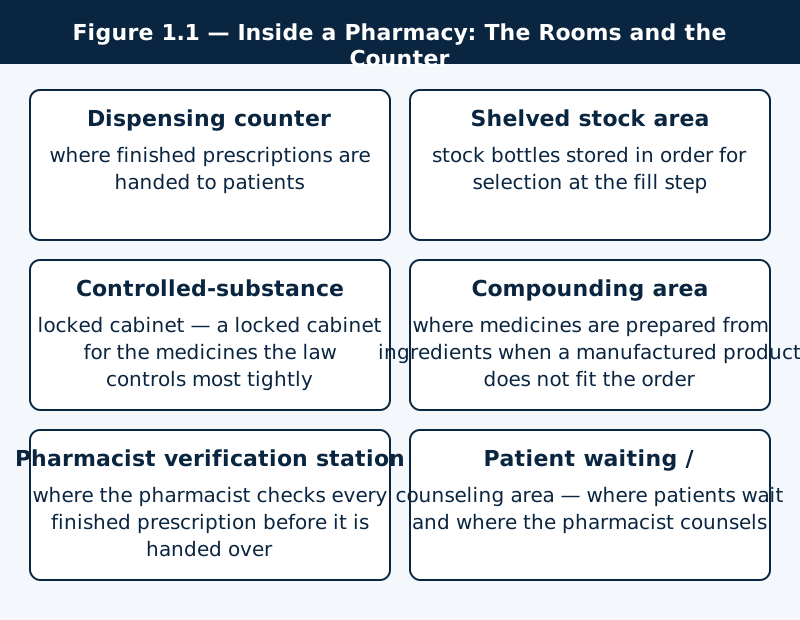
Medicines are unusually unforgiving products. A shirt in the wrong size is an annoyance. A medicine in the wrong strength, or the right medicine handed to the wrong patient, can injure or kill. Pharmacy work is therefore built as a chain of preparation and checking in which no single person both prepares a prescription and gives it final approval alone.
That chain defines the two central jobs in this book:
Dispensing is the whole act of preparing and handing a prescribed medicine to a patient or the patient's agent, ending in the pharmacist's verification. Counseling is the pharmacist's conversation with the patient about how to use a medicine safely and what to expect from it. Counseling is the pharmacist's legal role. A technician who is asked a clinical question — "Is this safe with my other medicine?" "Should I stop taking this?" — does not answer it. The technician brings in the pharmacist. You will meet this line again in nearly every chapter, because the exam tests it from every angle: knowing where your role ends is itself a professional skill.
Other people work in and around a pharmacy, and a beginner should be able to place each one:
Exam trap — "technician" does not mean " junior pharmacist." Any scenario in which a technician makes a clinical judgment, clears a safety flag on their own, or counsels a patient on whether a drug is right for them has crossed the supervision line. On this exam, the correct answer in those scenarios is almost always the one that routes the question to the pharmacist.
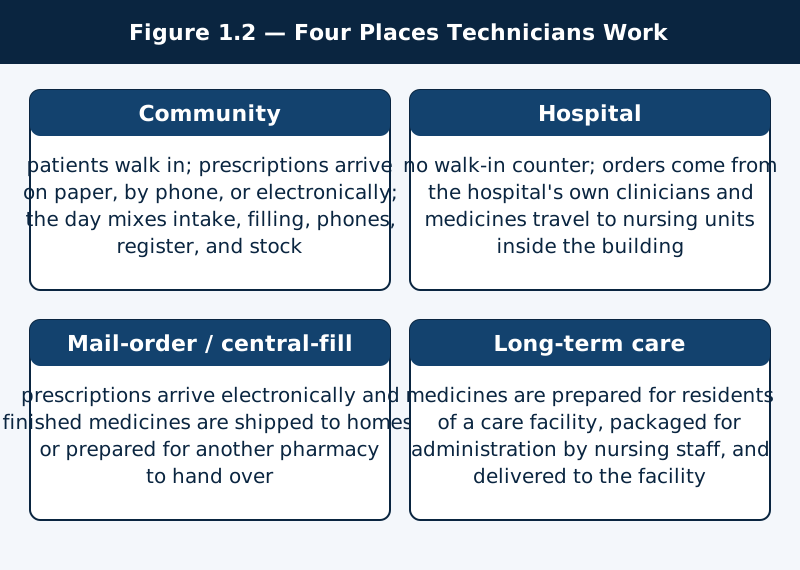
The chain — prepare, check, hand over — is the same everywhere. What changes is who the patient is, how the order arrives, and how the finished medicine travels. Four settings cover most technician jobs.
Community pharmacy. Also called a retail pharmacy, this is the pharmacy inside a drugstore, a grocery store, or an independent shop, serving patients who walk in. Prescriptions arrive on paper, by phone, or electronically; patients wait or return; and the technician's day mixes intake, filling, phones, register work, and stock. This is the setting most beginners picture, and the setting this book uses as its default example.
Hospital pharmacy. Also called an inpatient pharmacy, this pharmacy sits inside a hospital and serves patients who are admitted. There is no walk-in counter; orders come from the hospital's own clinicians, medicines travel to nursing units inside the building, and much of the work runs around the clock. Chapter 2 shows the hospital version of the prescription flow, including the record the nursing team works from.
Mail-order and central-fill pharmacy. In a mail-order pharmacy, prescriptions arrive electronically or by transfer and finished medicines are shipped to patients' homes, often as longer-term supplies of medicines taken every day. A central-fill pharmacy prepares prescriptions on behalf of other pharmacies, which then hand them to their own patients. The work is high-volume and system-driven, with the same pharmacist verification before anything ships or transfers.
Long-term care pharmacy. A long-term care facility is a residence — such as a nursing home — where patients live and receive ongoing care. Its pharmacy prepares medicines for those residents, commonly packaged so that nursing staff can administer the right dose at the right time, and delivers them to the facility rather than to a walk-in patient.
Two more settings deserve a first mention. A compounding pharmacy prepares customized medicines from ingredients when a manufactured product does not fit an order — Chapter 24 teaches that work as knowledge. A specialty pharmacy handles medicines for complex conditions that need extra handling, paperwork, and patient support. You do not need depth on either yet; you need to recognize that "pharmacy" names a family of workplaces, not one room.
Figure 1.2 — Four Places Technicians Work
A beginner often squeezes three separate facts into one blurry idea called "getting certified." Separate them now; Chapter 28 returns to each in exam detail.
First, the credential. Passing the national exam in this book's title earns the Certified Pharmacy Technician (CPhT) credential from the Pharmacy Technician Certification Board (PTCB).
Second, certification is not permission to work. PTCB certification is not state licensure or registration, and it does not by itself authorize anyone to work. The legal scope of practice for pharmacy technicians — what a technician in a given state may and may not do — is defined by that state's Board of Pharmacy, the state body that regulates pharmacy practice. (Source: PTCB, Credentialing Guidelines and Requirements (Candidate Guidebook), CPhT Scope; candidate attestation.)
Third, this book is a course and study guide — not a credentialing shortcut. Studying it does not complete a PTCB-Recognized Education/Training Program and does not satisfy the exam's education eligibility pathway. Chapter 28 states the eligibility pathways in full, with their sources.
Remember the line — national test, state permission. The exam is national. Permission to work is state-level. Any answer choice that has PTCB itself licensing technicians to work in a state has merged two systems that this book keeps apart. (Source: PTCB, Credentialing Guidelines and Requirements (Candidate Guidebook), CPhT Scope.)
Follow a single technician through the first hour of a community pharmacy shift, and notice how often the supervision line appears.
She signs in and checks the filling queue — the system's list of prescriptions waiting to be prepared. She takes a paper prescription from a patient at the counter, confirms the patient's name and date of birth, and notices the prescriber's directions are unclear: one word could be read two ways. She does not guess. She flags the order for the pharmacist, who will clarify it with the prescriber's office. Next she enters a clean electronic order, selects the stock bottle the system names, counts the quantity on a counting tray, and applies the label. The finished vial goes to the verification station — not to the patient. The pharmacist compares the vial, the label, and the original order, and only then is the prescription ready for hand-off. At the counter, the patient asks whether the new medicine is safe with the one she already takes. The technician's answer is short and correct: "That is a question for the pharmacist — let me bring her over."
Every later chapter is a zoom into one part of that hour: how the order flowed (Chapter 2), the language it was written in (Chapter 3), what the medicine looked like (Chapter 4), what the label said (Chapter 5), the math underneath it (Chapters 6–7), and the rules that govern each step (Parts II–III).
Before you move on, do three things.
1. [Domain: Orientation — The Pharmacy and Its Team] A pharmacy is best defined as:
2. [Domain: Orientation — The Pharmacy and Its Team] Who carries the legal responsibility for a finished prescription that is dispensed to a patient?
3. [Domain: Orientation — The Pharmacy and Its Team] At the verification station shown in Figure 1.1, the pharmacist's job is to:
4. [Domain: Orientation — The Pharmacy and Its Team] A patient asks the technician whether a new medicine is safe to take with a medicine she already takes. The technician should:
5. [Domain: Orientation — Settings of Practice] Which setting has no walk-in patient counter, because its patients are admitted to the building it serves?
6. [Domain: Orientation — Settings of Practice] A pharmacy prepares medicines for residents of a nursing home, packaged so nursing staff can give the right dose at the right time, and delivers them to the facility. This is:
7. [Domain: Orientation — Settings of Practice] In a central-fill pharmacy, the finished prescription is:
8. [Domain: Orientation — Certification and State Law] Which statement about PTCB certification is correct?
9. [Domain: Orientation — Certification and State Law] The legal scope of practice for pharmacy technicians in a state is defined by:
10. [Domain: Orientation — The Pharmacy and Its Team] Which task belongs squarely on the technician's side of the supervision line?
11. [Domain: Orientation — The Pharmacy and Its Team] Dispensing means:
12. [Domain: Orientation — Settings of Practice] A mail-order pharmacy differs from a community pharmacy chiefly in that the finished medicine is:
13. [Domain: Orientation — The Pharmacy and Its Team] A technician cannot read one word of a prescriber's directions with certainty. The correct action is to:
14. [Domain: Orientation — The Pharmacy and Its Team] An agent picking up a prescription is:
15. [Domain: Orientation — This Book and the Credential] Which statement about this book is correct?
1 [Domain: Orientation — The Pharmacy and Its Team] — Key: B. A pharmacy is a licensed place where prescribed medicines are prepared, checked, and handed to patients under a pharmacist's supervision. A is wrong because selling health products does not make a store a licensed pharmacy. C describes a warehouse, which neither dispenses to patients nor works under the dispensing chain this chapter teaches. D describes a clinic, where prescribers — not the pharmacy team — examine patients.
2 [Domain: Orientation — The Pharmacy and Its Team] — Key: D. The pharmacist verifies the finished prescription and carries the legal responsibility for what is dispensed. A is wrong because the technician prepares the work under supervision but does not carry that final responsibility. B is wrong because picking up a prescription transfers no professional responsibility to the patient. C is wrong because register work is a front-counter task, not verification.
3 [Domain: Orientation — The Pharmacy and Its Team] — Key: D. The verification station is where the pharmacist checks every finished prescription before hand-off (Figure 1.1). B is stock work, done in the shelved stock area. C is intake, done at the dispensing counter. A describes mail-order delivery, not the verification station's job in any setting.
4 [Domain: Orientation — The Pharmacy and Its Team] — Key: C. Whether a drug combination is safe is a clinical question, and counseling is the pharmacist's legal role; the technician recognizes the question and brings in the pharmacist. A and B both answer a clinical question from the technician's side of the line. D is wrong twice over: it answers clinically, and it directs a change to a patient's therapy.
5 [Domain: Orientation — Settings of Practice] — Key: B. A hospital (inpatient) pharmacy serves admitted patients inside the building, so it has no walk-in counter. A is wrong because a community pharmacy is defined by walk-in patients. C ships to homes rather than serving a building's admitted patients. D serves residents of a separate care facility, not patients admitted to its own building.
6 [Domain: Orientation — Settings of Practice] — Key: A. Preparing medicines for residents of a long-term care facility, packaged for administration by nursing staff, is the long-term care pharmacy's defining work (Figure 1.2). B prepares for another pharmacy, not for a facility's residents. C is defined by preparing customized medicines from ingredients. D serves walk-in patients.
7 [Domain: Orientation — Settings of Practice] — Key: C. Central-fill means one pharmacy prepares prescriptions on behalf of another pharmacy, which hands them to its own patients — with pharmacist verification before transfer. A describes a community counter. B invents a patient-verification step that exists in no setting. D is wrong because verification is never skipped; the supervision chain applies in every setting.
8 [Domain: Orientation — Certification and State Law] — Key: A. PTCB certification is a national credential, and it does not itself authorize anyone to work. C merges certification with state licensure, which this chapter keeps separate. B states the authorization the credential expressly does not give. D is wrong because the State Board of Pharmacy continues to regulate practice in its state. (Source: PTCB, Credentialing Guidelines and Requirements (Candidate Guidebook), CPhT Scope.)
9 [Domain: Orientation — Certification and State Law] — Key: D. Individual State Boards of Pharmacy define the legal scope of practice for pharmacy technicians. B is wrong because PTCB certifies nationally; it does not define any state's scope. C and A name people with no authority to define a legal scope of practice. (Source: PTCB, Credentialing Guidelines and Requirements (Candidate Guidebook), CPhT Scope; candidate attestation.)
10 [Domain: Orientation — The Pharmacy and Its Team] — Key: D. Counting and labeling a medication for the pharmacist to verify is core technician work. A is a clinical judgment, which belongs to the pharmacist. C is counseling, the pharmacist's legal role. B is wrong because a safety flag is resolved by the pharmacist, never ignored by the technician.
11 [Domain: Orientation — The Pharmacy and Its Team] — Key: B. Dispensing is the whole act of preparing and handing a prescribed medicine to a patient or the patient's agent, ending in the pharmacist's verification. A is prescribing, which only a prescriber does. D is stock handling, one step that feeds dispensing but is not dispensing itself. C is counseling, which sits inside the pharmacist's role, not inside the definition of dispensing.
12 [Domain: Orientation — Settings of Practice] — Key: A. The mail-order difference is delivery: finished medicines are shipped to patients' homes. C is wrong because pharmacist verification precedes shipping, as in every setting. B describes compounding, not mail order. D describes the hospital setting.
13 [Domain: Orientation — The Pharmacy and Its Team] — Key: C. An order that cannot be read with certainty is flagged for the pharmacist to clarify; a technician never guesses at an order. A is the guessing this rule exists to prevent. B is wrong because the patient is not the source for what the prescriber ordered. D still fills an unread order, at a quantity the technician invented.
14 [Domain: Orientation — The Pharmacy and Its Team] — Key: C. An agent is a person, such as a family member, whom the patient sends to pick up a prescription — which is why dispensing is defined as handing the medicine to the patient or the patient's agent. B, A, and D each rename a different member of the pharmacy team or the prescriber, none of whom is acting as the patient's agent in this sense.
15 [Domain: Orientation — This Book and the Credential] — Key: A. This book is a course and study guide, and it is expressly not a PTCB-Recognized Education/Training Program. D is wrong because the credential comes from passing PTCB's exam, not from finishing a book. B states the recognized-program status the book's front matter expressly disclaims. C is wrong because permission to work is state-level and no book grants it.
Next: Chapter 2 — How a Prescription Flows: From Prescriber to Patient.
© 2026 Feras Alzubi
All rights reserved.
Mastering Careers & Skills
Google Play Books Exam-Prep Line
2026–2027 Edition
This book prepares you for the Pharmacy Technician Certification Examination® (PTCE®), administered by the Pharmacy Technician Certification Board (PTCB). Passing the PTCE earns the Certified Pharmacy Technician (CPhT) credential.
© 2026 Feras Alzubi. All rights reserved.
No part of this book may be reproduced, distributed, or transmitted in any form or by any means without the prior written permission of the copyright holder, except as permitted by law.
Edition: 2026–2027 Edition. Built against the PTCB PTCE Content Outline, v1.4, effective January 6, 2026, and the PTCB Credentialing Guidelines and Requirements (Candidate Guidebook), last updated February 24, 2025, as checked on October 28, 2026. Exam rules, fees, and federal requirements can change. Check the current outline and guidebook on PTCB's site before you schedule your test.
This book is an independent study guide. It is not published by, affiliated with, endorsed by, or approved by the Pharmacy Technician Certification Board (PTCB), and PTCB did not participate in its creation. PTCB does not endorse, recommend, or sponsor any review course, manual, or book for its exams — this one included. Exam names and trademarks belong to their respective owners. Passing any exam also depends on the candidate's own preparation; no book can guarantee a result.
PTCE®, PTCB®, and CPhT® are used here only to identify the exam and the credential this book prepares you for. No PTCB logos are used in this book.
The practice questions in this book are original. They were written fresh for this book, against the published PTCE content outline — the PTCE Content Outline, v1.4, effective January 6, 2026, published by PTCB — and against the primary sources behind that outline: the FDA-approved drug labels, the statutes and regulations, and the PTCB publications listed in the References section.
They are not the exam's questions. They are not actual, recalled, paraphrased, or adapted exam items, and they were not copied or adapted from any other prep book, course, or question bank.
Every question explains why the correct answer is correct and why each wrong answer is wrong, with a source note where the answer rests on law, a controlled-substance schedule, or a label fact.
Learn this page cold. Every figure below comes from PTCB's own publications, checked on October 28, 2026, and the source for each figure is named on the same line.
Remember the number — 80 and 10. You will answer 90 questions, but only 80 count. You cannot tell which ten are the unscored ones, so treat every question as scored.
Exam trap — the pass mark is not a percentage. The PTCE reports a scaled score. 1,400 is the passing point on a 1,000–1,600 scale; it is not a percentage of questions you must get right, and it cannot be converted into one.
No pass rate and no candidate volume are printed on this page or anywhere in this book. Neither figure was verified from a primary PTCB source for this edition, so neither is stated.
The weights sum to 100%. (Source: PTCB, PTCE Content Outline, v1.4.)
PTCB's own prep tools are its PTCE Practice Bank™ and Pre-PTCE™, and PTCB also publishes a PTCE Reference List and a CPhT Knowledge Reference. PTCB does not endorse, recommend, or sponsor any review course, manual, or book — this book included. (Source: Guidebook, Preparing for the PTCE.)
One change matters if you have seen older study material: the current outline removed nonsterile-compounding content and alligations from the exam, removed the standalone narrow therapeutic index knowledge area, and added a Drug Supply Chain Security Act (DSCSA) knowledge area. This book teaches compounding and alligation as field knowledge for practice, clearly labeled as beyond the current outline — never as examinable outline content. (Source: PTCB, 2024 Job Analysis Study and PTCE Updates, published September 19, 2024, updated October 14, 2026.)
This book was written for two readers at once. The total beginner — someone who has never stood behind a pharmacy counter — reads Parts I through IV in order: Part I builds the field from zero, Part II teaches the core knowledge, Part III adds the judgment layer, and Part IV is the exam layer. The exam candidate who already works in a pharmacy starts with the diagnostic test, then follows the chapters it points to — without skipping the Part I figures, because the workflow, label, and dosage-form diagrams are the pictures every later chapter assumes you have seen.
Take the Diagnostic Test printed after this front matter first, cold, and in one sitting of no more than 60 minutes. Do not look anything up. The diagnostic has 50 items: Medications 18, Patient Safety and Quality Assurance 12, Order Entry and Processing 11, and Federal Requirements 9 — the official domain weights applied to 50 items and rounded, as the test's own notes disclose.
Then score it by domain, not only in total, using the Score-by-Topic Tracker printed with the test. The tracker converts each domain score into a study priority: Priority 1 means you scored under 60% in that domain; Priority 2 and above mean you scored 60% or better in that domain.
The plan-choice rule — stated once, used everywhere in this book. Choose the 4-week standard plan if your diagnostic total is under 30 out of 50, or if any domain is Priority 1 (under 60% in that domain). Choose the 2-week intensive plan only if every domain is Priority 2 or above and your total is 35 out of 50 or higher. If you do not meet both 2-week conditions, the 4-week standard plan is your plan. The diagnostic tracker and both study plans in the back matter repeat this exact rule in these exact terms.
Beginners should expect a low cold score. That is the diagnostic doing its job: it routes you to Part I first, where the field itself is taught before any exam framing appears.
Every teaching chapter follows the same rhythm, so you always know where you are:
Three kinds of apparatus recur. "Exam trap" boxes name a known confusion before the test can use it against you. "Remember the number" boxes hold testable figures, each with its source. And every term is defined at first use, in the text, and again in the Glossary.
The free sample of this book is Chapter 1 plus the diagnostic test, so a reader can judge the teaching and see their own score by topic before buying.
Start one notebook page, or one phone note, for every wrong answer — on the diagnostic, on chapter quizzes, and on practice tests. Write three things: the topic, why you chose what you chose, and the rule that makes the correct answer correct. Most candidates do not miss points at random. They miss the same two or three ideas repeatedly, and an error log finds them while there is still time to fix them.
This book prepares you for the PTCE, the national test. Passing the test earns the CPhT credential; it does not by itself license or register you to work, and this book does not satisfy Pathway 1. Confirm your eligibility pathway with PTCB and your state's requirements with your State Board of Pharmacy before you apply.
Next: Chapter 1 — What a Pharmacy Is — and Who Works There. Then take the Diagnostic Test, cold.
End of the free sample. The complete book continues from here — the full A-to-Z course in book form, delivered as an EPUB you can read in Apple Books, Google Play Books, ReadEra, Thorium Reader, Adobe Digital Editions, or Send to Kindle.
Buy this ebook — $11.99 Back to the book page
Payments are securely processed by Payhip.