
Mastering Careers & Skills
Private Pilot Knowledge Test (FAA PAR) · free sample from the book itself
1. Key: A — 60 questions, 2.0 hours, 70 percent, age 15. The Matrix publishes PAR as 60 questions with a 2.0-hour allotted time, a passing score of 70, and a minimum test age of 15; the correction sheet corroborates the time. See Chapter 1, §1.2. [Frame / The sitting as published — Ch. 1] · Frame (S-02, S-03) · KI
2. Key: C — The correction sheet and Matrix control: 2.0 hours since April 24, 2023. Where FAA documents conflict, the newest testing-specific document controls the testing fact; S-03 exists to correct the ACS table's time, and S-02 prints the same 2.0. See Chapter 1, §§1.2, 1.10. [Frame / Currency ruling — Ch. 1] · Frame (S-02, S-03) · KI
3. Key: D — Validation questions: unscored, uncounted, inside the time. The Matrix's general rule is stated whole in the key answer: not scored, not for or against the score, excluded from the listed question count, with answering time inside the allotted time. See Chapter 1, §1.2. [Frame / The sitting as published — Ch. 1] · Frame (S-02) · KI
4. Key: B — Knowledge element 2 of Task C, Area I. The ACS's own worked example decodes PA.I.C.K2 as PA (Private Pilot — Airplane), Area I, Task C, Knowledge element 2. See Chapter 1, §1.3. [Frame / ACS architecture — Ch. 1] · PA.I.C.K2 (illustrative code) · KI
5. Key: A — The written test samples K; the practical test samples K, R, and S. The ACS integrates knowledge, risk management, and skill; the knowledge test samples the knowledge elements, and the practical test samples all three together. See Chapter 1, §1.3. [Frame / ACS architecture — Ch. 1] · ACS Concept (S-01) · KI
6. Key: D — No published PAR weights; the book's proportions are its own. No per-area counts or percentages appear in S-01, S-02, or S-03; the book labels its study-cluster composition as its own wherever it prints. See Chapter 1, §§1.3, 1.12. [Frame / Published weights — Ch. 1] · Frame (S-01, S-02) · KI
7. Key: B — She may sit at 16; the certificate waits for 17 and the rest of Gate 2. Gate 1 is age 15 plus endorsement, identification, and FTN; Gate 2 adds age 17, English, the knowledge pass, flight training, experience, and the practical test under § 61.103. See Chapter 1, §§1.4–1.5. [Cluster A / The two gates — Ch. 1] · PA.I.A.K1 · KI
8. Key: C — Holding a student pilot certificate is a Gate 2 item, not Gate 1. Section 61.103(j) lists holding a student, sport, or recreational pilot certificate among certificate eligibility requirements; Gate 1 requires authorization, identification, and an FTN. See Chapter 1, §§1.4–1.5. [Cluster A / The two gates — Ch. 1] · PA.I.A.K1 · KI
9. Key: D — A current residential address. Section 61.35(a)(3) requires that where the permanent mailing address is a post office box, the applicant provide a current residential address. See Chapter 1, §1.4. [Cluster A / Identification — Ch. 1] · Frame (§ 61.35) · KI
10. Key: B — Study support only; no endorsement, no requirement satisfied. The endorsement is an authorized instructor's act after conducting training or reviewing a home-study course (or a pilot school's graduation certificate); a prep book is preparation added to that training. See Chapter 1, §1.6. [Cluster A / The training fence — Ch. 1] · PA.I.A.K1 · KI
11. Key: A — Expired at the end of October 2028; retest before the practical test. October 2026 plus 24 calendar months reaches the end of October 2028 under S-08's plain form and § 61.39(a)(1)'s window; a November 2028 practical test falls outside it. See Chapter 1, §1.7 (worked example). [Frame / Validity calendar — Ch. 1] · CALC-05
12. Key: C — The bridge works: March 2026 + 24 months reaches the end of March 2028. Section 61.35(a)(3) requires the date of birth to show the applicant will meet the certificate's age before the report expires; 15 plus the report's 24-month life reaches 17 inside the window. See Chapter 1, §§1.4, 1.7. [Frame / The age bridge — Ch. 1] · CALC-05
13. Key: B — Score plus ACS codes; the applicant keeps the original. The Companion Guide states the center issues the printed AKTR documenting the score and listing a code for any question answered incorrectly, and that the applicant should retain the original. See Chapter 1, §1.7. [Frame / The AKTR — Ch. 1] · Frame (S-04) · KI
14. Key: A — The evaluator assesses the deficiencies; the endorsement certifies them repaired. Section 61.39(a)(6)(iii) requires the practical-test endorsement to certify satisfactory knowledge of the areas deficient on the knowledge test, and the evaluator reviews the AKTR. See Chapter 1, §1.7. [Frame / The AKTR at the practical test — Ch. 1] · Frame (§ 61.39) · KI
15. Key: D — Failed AKTR plus retraining endorsement; no published wait. Section 61.49(a) conditions reapplying on necessary training from an authorized instructor who determined the applicant proficient, plus that instructor's endorsement; the Matrix publishes the failed-AKTR presentation in the same form. See Chapter 1, §1.8. [Frame / Retesting — Ch. 1] · Frame (§ 61.49) · KI
16. Key: C — No PAR waiting period is published. Neither § 61.49, nor the Matrix's Recreational & Private Pilot page, nor the Companion Guide states a waiting period for PAR retesting; waiting-period notes in the Matrix belong to other test families. See Chapter 1, §§1.8, 1.10. [Frame / Retesting — Ch. 1] · Frame (S-02, S-05) · KI
17. Key: D — $175.00 plus tax, PSI's published price, confirmed at booking. PSI publishes the $175.00 voucher price for FAA airman knowledge testing; the book prints it with PSI's attribution and the confirm-at-scheduling instruction, and each attempt, including retests, is a paid attempt. See Chapter 1, §1.9. [Frame / The fee — Ch. 1] · Frame (S-07) · KI
18. Key: B — FTN, PSI account, test and center, time slot, pay. The Companion Guide publishes registration in exactly this five-step order, with an automated email confirmation after payment. See Chapter 1, §1.9. [Frame / Registration — Ch. 1] · Frame (S-04) · KI
19. Key: C — The supplement and the Companion Guide's aids set. Acceptable aids include the proctor-provided supplement book, calculators within the memory-erasure rules, and scales, straightedges, protractors, plotters, and navigation computers; the proctor makes the final determination. See Chapter 1, §1.9; taught whole in Chapter 18. [Frame / Acceptable aids — Ch. 1] · Frame (S-04) · KI
20. Key: A — Those are the UAG facts; PAR's differ on all three points. The Matrix's own pages separate the tests: PAR requires an endorsement, sets age 15, and publishes no retest wait, while the part 107 UAG test requires no endorsement, sets age 14, and carries a 14-day wait. See Chapter 1, §1.11. [Frame / The Part 107 separation — Ch. 1] · Frame (S-02) · KI
Part I — Foundations: the Certificate, the Airplane, the Sky (from zero). This chapter is the frame chapter: it teaches no aerodynamics and no weather yet, because it teaches the certificate, the test, and the road between them — the frame every later chapter stands inside. Every examination figure in it is printed in the form the Federal Aviation Administration (FAA) itself currently publishes, and named to its source at the point of use.
Imagine a student pilot in the first month of training. She has done everything a careful person would do. She has bought two study guides, watched a shelf of videos, and filled the first page of a notebook with the numbers she intends to plan around: how many questions her written test has, how long she will have to answer them, what score passes, what the test costs, how young a person may sit it, and what she must do if she fails it the first time.
There is one problem, and it is not effort. Almost every number in her notebook came from sources that describe a test the FAA no longer gives in that form. Her notebook allows her two and a half hours, because an older table — including a table printed inside the FAA's own current standards document — still says so. It tells her that if she fails, she must wait thirty days before trying again, because some other test's rule says so and a website copied it across. It tells her the report she receives will list codes from a coding system the FAA retired years ago. And it prices the test from a page that never says whose price it is. She has been studying hard — inside a frame that has already changed underneath her study materials.
This chapter exists so that your notebook holds the current numbers, in the FAA's own published form, before you study a single fact of flight. It gives you the whole road first: what a private pilot certificate is and who the FAA is in this story, what the knowledge test called PAR is and how it is shaped, who may sit it and on what authorization, what it costs and whose fee that is, how long a pass stays useful, what happens after a pass and after a failure, and where this book itself fits — and does not fit — on that road. It also draws two lines this book will hold for eighteen chapters: the line between the knowledge test's small gate and the certificate's larger one, and the line between this certificate and the separate certificate for flying small drones, whose test is constantly confused with this one.
A word about how this book handles every number you are about to meet. Every examination figure in this chapter comes from the FAA's own publications and from the one vendor the FAA contracts to deliver the test: the Private Pilot for Airplane Category Airman Certification Standards, FAA-S-ACS-6C, which this book calls the ACS; the FAA Airman Knowledge Testing Matrix, revised September 25, 2026; the FAA's one-page correction sheet of correct allotted times for ACS knowledge tests; the Airman Certification Standards Companion Guide for Pilots, FAA-G-ACS-2; the text of Title 14 of the Code of Federal Regulations, part 61, which this book cites by section number, as in § 61.103; and, for the single fee figure, the published page of PSI Services LLC, the FAA's contracted testing vendor. Where a number belongs to this book rather than to the FAA — a pacing checkpoint, an arithmetic illustration — the text says so plainly and shows the arithmetic. And where the FAA's own documents disagree with each other, because an older table still circulates inside a newer document, this chapter follows the newest testing-specific document and names the disagreement directly, in Section 1.10, because you will meet the older forms everywhere else you look.
Begin at the very beginning, with the object at the end of the road. A pilot certificate is a credential the FAA issues to a person who has met published requirements — knowledge, training, experience, and demonstrated skill — for flying an aircraft in a stated role. It is not a diploma and it is not a driver's-license-style permit that a state issues. It is a federal credential, granted under part 61 of the aviation regulations, and it names both a category of aircraft — airplane, in this book — and, inside the category, a class, such as single-engine land. The certificate this book leads toward is the private pilot certificate, airplane category: the first full pilot certificate most pilots earn, the one that authorizes its holder to act as pilot in command of an airplane carrying passengers for pleasure and personal business, under the privileges and limitations Chapter 3 teaches in detail.
The FAA is the granting body, but the FAA does not personally teach or test most applicants. Around the certificate stands a small cast of roles, and a beginner does well to learn them as people with distinct jobs. An authorized instructor — a certificated flight instructor or ground instructor — gives the training and signs the endorsements that say, in effect, this person has been trained and is prepared. A testing vendor, PSI Services LLC, delivers the written examination — properly called the knowledge test — at testing centers under contract to the FAA. An evaluator, most often a designated pilot examiner, conducts the final practical test, the oral-and-flight examination pilots call the checkride. And the applicant — you — assembles the record that connects them: endorsements, test reports, logged training, and experience. This book is about exactly one gate in that system, the knowledge test, and about the knowledge that gate examines.
Hold the distinction that organizes the whole chapter. Certification is a path with several gates, and the knowledge test is only the first formal one. Before it stands training; after it stand more training, aeronautical experience, and the practical test. A candidate who understands the path can place every requirement correctly. A candidate who confuses the gates — who believes, for example, that passing the written test makes her a pilot, or that she must already be old enough for the certificate before she may sit the written test — will misread nearly every rule she meets. Sections 1.4 and 1.5 therefore teach the two gates separately and then side by side.
The examination this book prepares you for has a code and a name, and both are worth learning exactly. The code is PAR, and the name is Private Pilot Airplane [per the FAA Airman Knowledge Testing Matrix — S-02]. When you schedule, when your instructor endorses you, and when your report prints, it is PAR that appears. The test is a single computer-based sitting at a PSI testing center. Its published shape is short enough to memorize, and you should:
The test presents 60 questions. Each question is multiple-choice with a single correct response, and the questions are independent of one another — a correct response to one question does not depend upon, or influence, the correct response to another [per the ACS Companion Guide — S-04]. The allotted time is 2.0 hours — 120 minutes [per the FAA Airman Knowledge Testing Matrix — S-02, and the FAA's correction sheet of correct allotted times — S-03]. The passing score is 70 percent [per the ACS — S-01; the Matrix — S-02]. The minimum age to take this test is 15 [per the Matrix — S-02]. The test is delivered by PSI Services LLC, the FAA's contracted testing vendor, at FAA-approved knowledge testing centers, and it is scheduled through PSI after the applicant obtains an FAA Tracking Number, called an FTN, through the FAA's IACRA system [per the Matrix — S-02; the Companion Guide — S-04].
Three of those facts repay a slower look, because each is commonly mis-stated.
First, the time. Two hours is the current, corrected figure, effective April 24, 2023. The ACS document itself, in an appendix table, still prints 2.5 hours for PAR, and the FAA has published a correction stating plainly that the allotted times printed in the corresponding ACS are incorrect for a listed set of tests, PAR among them, and that the correct allotted time is 2.0 hours [per the correction sheet — S-03]. The current Testing Matrix prints the same 2.0 [per the Matrix — S-02]. This book prints 2.0 hours everywhere, and Section 1.10 returns to the disagreement, because a reader who finds 2.5 hours in the FAA's own standards document deserves an explanation rather than a contradiction.
Second, the question count. Sixty is the published number of questions, and the Matrix adds a general rule that applies across its tests: any test may include validation questions — questions used to gather data about question quality — which are not scored, do not count for or against the score, are not included in the listed number of questions, and whose answering time is included in the allotted time [per the Matrix — S-02]. Read that rule carefully, because it is narrower than the internet's version of it. The FAA does not publish a fixed number of validation questions for PAR, and this book invents none. What you can plan on is the published form: 60 scored questions inside 2.0 hours, with the possibility that additional unscored questions appear inside the same time. Chapter 18 teaches pacing against exactly that reality.
Third, the passing score. The FAA publishes a percentage for this test — 70 percent — and the regulation explains why the figure comes from the FAA rather than from the regulation's own text: an applicant must have proper identification and an endorsement, and "the Administrator shall specify the minimum passing grade" for the knowledge test [per 14 CFR § 61.35 — S-05]. At 60 questions, 70 percent is 42 correct answers. That last step — 42 — is this book's arithmetic on the FAA's published form, printed as arithmetic, not as a separate FAA threshold. It is also the one honest comparison this book ever makes with your practice results: a count on one of this book's practice forms can be set beside the published 70 percent form as study evidence. It is never a prediction of your test report, and no page of this book guarantees a pass.
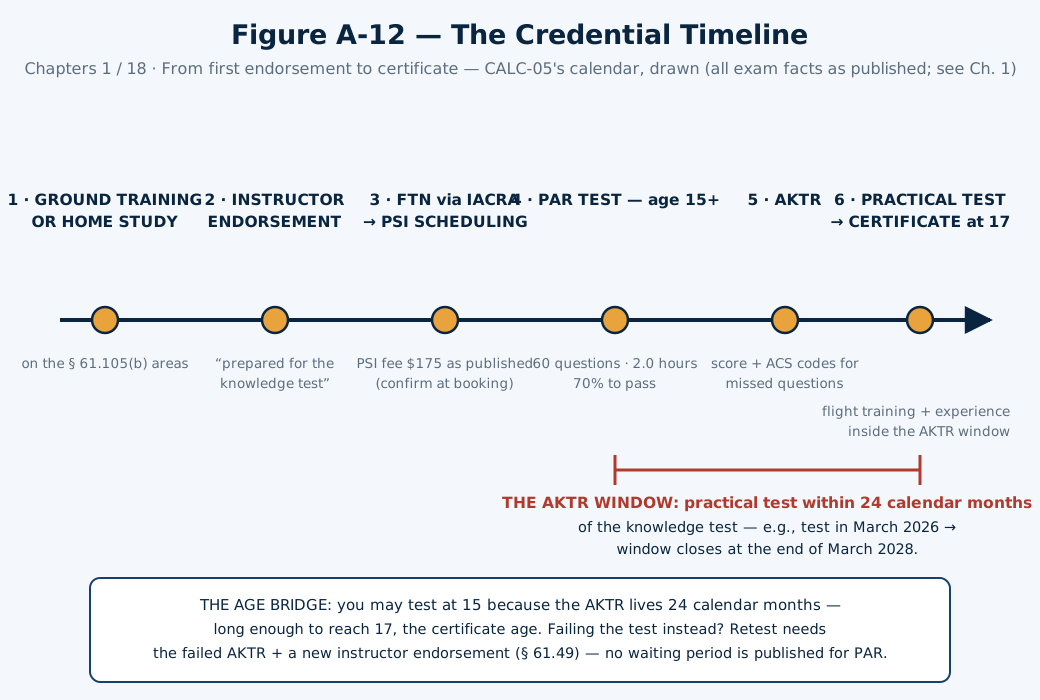
Figure A-12 — The credential timeline. Endorsement → FTN and PSI scheduling → PAR (60 questions, 2.0 hours, 70 percent) → the test report and its 24-calendar-month life → flight training and experience → the practical test → the certificate at 17. This timeline is drawn in full in this chapter's figure plate and reprised in Chapter 18.
A knowledge test cannot ask just anything. For PAR, the content standard is the Airman Certification Standards document for the private pilot, airplane category: FAA-S-ACS-6C, published November 2023 and effective May 31, 2024 [per the ACS — S-01]. Understanding its architecture is not bureaucratic trivia; it is the single most useful study skill in this book, because the same document organizes your training, your written test, and your checkride — and because the report you receive after the written test speaks in its codes.
The ACS is organized as twelve Areas of Operation, numbered with Roman numerals: I. Preflight Preparation; II. Preflight Procedures; III. Airport and Seaplane Base Operations; IV. Takeoffs, Landings, and Go-Arounds; V. Performance Maneuvers and Ground Reference Maneuvers; VI. Navigation; VII. Slow Flight and Stalls; VIII. Basic Instrument Maneuvers; IX. Emergency Operations; X. Multiengine Operations; XI. Night Operations; and XII. Postflight Procedures [per the ACS — S-01]. Each Area is divided into Tasks, lettered A, B, C, and so on. And each Task carries coded elements of three kinds: Knowledge elements, marked K; Risk Management elements, marked R; and Skill elements, marked S.
The coding scheme is best learned from the ACS's own worked example. The code PA.I.C.K2 reads, piece by piece: PA, the applicable ACS — Private Pilot, Airplane; I, the Area of Operation; C, the Task; and K2, Knowledge element 2 within that Task [per the ACS — S-01]. Every knowledge element in the standard has such a code, and this book cites them constantly — in its teaching, in every quiz key, and in its crosswalk appendix — because the code is the address of a piece of knowledge. When a later chapter says that weather products live at Task PA.I.C, or that airspace lives at Task PA.I.E, it is giving you the address the FAA itself will use to tell you, after your test, exactly what you missed.
That last point deserves emphasis. The knowledge test samples the ACS's knowledge elements — the K elements. The practical test samples knowledge, risk management, and skill together, with the evaluator assessing you in the airplane and in conversation [per the ACS — S-01; the Companion Guide — S-04]. This division is also this book's depth fence, and it is stated here so no reader mistakes the book's purpose: this book teaches the knowledge elements, at knowledge depth — what a rule requires, what a chart symbol means, what a stated calculation yields, what a system does. It does not teach you to fly maneuvers, and no chapter of it substitutes for a lesson in an airplane. Where a Task's skill or risk elements matter to understanding its knowledge, the book teaches the knowledge and judgment that underlie them, and says that is what it is doing.
One more property of the ACS protects you from a shelf of misleading books: the FAA publishes no percentage weights and no per-area question counts for PAR. No table in the ACS, the Matrix, or the correction sheet says that weather is worth some percent of your test or that airspace will supply some number of your sixty questions [per the ACS — S-01; the Matrix — S-02, absence recorded in the register]. Any source that presents a percentage breakdown as the FAA's PAR blueprint is presenting its own composition — or another test's — as the FAA's. This book does compose its practice tests to study proportions, because a practice form must be composed somehow; those proportions are this book's, derived from a census of the ACS's knowledge elements, and they are labeled as this book's composition wherever they appear. The FAA's silence on weights is itself a study instruction: the test draws from the ACS as a whole, so this book teaches it as a whole.
Behind the ACS stands the regulation that names the knowledge areas the test examines. Section 61.105(b) lists thirteen aeronautical knowledge areas for the private pilot: applicable regulations; accident reporting; use of the Aeronautical Information Manual and advisory circulars; use of aeronautical charts for visual navigation; radio communication procedures; recognition of critical weather and the use of weather reports and forecasts; safe and efficient operation, including collision avoidance and wake turbulence; effects of density altitude; weight and balance computations; principles of aerodynamics, powerplants, and systems; stall awareness and spins; aeronautical decision making; and preflight action [per 14 CFR § 61.105(b) — S-05]. The ACS and the regulation are two views of one territory — the regulation names the areas, the ACS codes the elements — and this book's crosswalk appendix maps every element both ways, so that a code from your test report can be traced to a chapter, and a chapter back to the standard.
The knowledge test has its own, smaller gate — smaller, deliberately, than the certificate's. Learn its four parts exactly, because three of the commonest beginner errors are failures to keep this gate separate from the next section's.
Age 15. The minimum age to take PAR is 15 [per the Matrix — S-02; the correction sheet — S-03]. That is two years younger than the certificate's age, and the regulation states the logic that makes the gap sensible: the date of birth on the applicant's identification must show that the applicant meets or will meet the age requirements for the certificate sought before the expiration date of the knowledge test report [per 14 CFR § 61.35(a)(3) — S-05]. A pass lives for 24 calendar months (Section 1.7), so a 15-year-old's report can still be alive on the far side of a 17th birthday. The test gate is set early on purpose: a student may bank the written examination while flight training proceeds.
An instructor endorsement. PAR is not a walk-in test. Before sitting it, an applicant must present one of the Matrix's published forms of authorization: a certificate of graduation issued by an FAA certificated pilot school, or a written statement or logbook endorsement from an authorized ground or flight instructor certifying that the applicant completed an applicable ground training or home study course and is prepared for the knowledge test [per the Matrix — S-02]. The underlying regulation says the same thing from the instructor's side: the endorsing instructor conducted the training, or reviewed the person's home study, on the aeronautical knowledge areas of § 61.105(b), and certified that the person is prepared for the required knowledge test [per 14 CFR § 61.103(d) — S-05]. Section 1.6 is devoted to what this endorsement is — and to the sentence in this book that matters most to a reader studying alone: this book is not that training, and finishing it earns no endorsement.
Proper identification. At application, the applicant presents proper identification containing a photograph, a signature, and a date of birth; and if the permanent mailing address is a post office box, the applicant must also provide a current residential address [per 14 CFR § 61.35(a)(3) — S-05]. The Matrix publishes detailed identification tables for different applicant situations [per the Matrix — S-02]; the three contents — photo, signature, date of birth — are the core every candidate should expect to be checked against.
An FTN. The applicant obtains an FAA Tracking Number by creating a profile in IACRA, the FAA's Integrated Airman Certification and Rating Application system, prior to taking the test; the FTN is printed on the test report [per the Matrix — S-02; the Companion Guide — S-04]. The FTN is the thread that ties the candidate's records together across IACRA, PSI, and the later practical test application, which is why a name correction is made in IACRA and then appears in PSI when the applicant logs back in [per the Companion Guide — S-04].
Notice what Gate 1 does not contain. It contains no flight experience, no medical certificate, no English-language examination of its own, and no requirement to hold any pilot certificate yet. Those belong to Gate 2. It also contains no exception that makes the endorsement optional: for PAR, the endorsement or the pilot-school graduation certificate is required, full stop. Hold that fact; Section 1.11 will show you a neighboring test for which no endorsement is required, and why importing its rule into PAR is an error with a name.
The certificate's gate is the full one, and it is taught here as frame — the map that shows where the knowledge test sits — not as exam content to be drilled. To be eligible for a private pilot certificate, a person must, in the regulation's own order [per 14 CFR § 61.103 — S-05]: be at least 17 years of age for an airplane rating; be able to read, speak, write, and understand the English language; receive the knowledge-test endorsement described in Section 1.4; pass the required knowledge test on the § 61.105(b) areas; receive flight training and a practical-test endorsement from an authorized instructor; meet the aeronautical experience requirements of part 61; pass a practical test on the areas of operation; comply with the sections of part 61 that apply to the category and class rating sought; and hold a U.S. student pilot, sport pilot, or recreational pilot certificate.
Read the list as a sequence and the knowledge test's place in it becomes obvious. It is item four of nine: early enough to bank, impossible to mistake for the finish line. The knowledge test certifies one thing — that on one day, at a testing center, the applicant answered at least 70 percent of a sample of the ACS's knowledge elements correctly. The practical test, the experience requirements, and the flight-training endorsements certify different things, in an airplane, later. A student who passes PAR in March has cleared a real and necessary gate, and has also — this book will keep saying it — cleared only that gate.
Two parts of Gate 2 get whole teaching later because the knowledge test itself examines their foundations. Medical certification — the classes of medical certificate, what each permits, how long each lasts, what temporarily disqualifies, and the alternative called BasicMed under part 68 — is ACS Task PA.I.A knowledge, taught in Chapter 3. Aeronautical experience is named here only as a requirement that exists; the experience rules are flight-training law administered by your instructor and the regulation, not knowledge-test content, and this book teaches them only at this frame depth.
Worked example — the two gates applied. Consider two applicants. The first is 16 years old. She has completed a ground training course with an authorized instructor, who has endorsed her logbook certifying she is prepared for the knowledge test. She has an IACRA profile and an FTN, and government photo identification showing her photograph, signature, and date of birth. May she sit PAR? Yes — every element of Gate 1 is met: she is over 15, endorsed, identified, and registered. May she receive the private pilot certificate next month? No — Gate 2's age is 17, and its flight training, experience, and practical test all still stand ahead of her. Her plan is nevertheless sound, and it is the plan the age rule was designed for: bank the pass now, train through the year, and take the practical test after her 17th birthday, while her report is still inside its 24-calendar-month life. The second applicant is 18 and has flown for a year with an instructor, but has never received a knowledge-test endorsement and proposes to schedule PAR on the strength of his flight experience alone. He may not sit: flight experience is not among Gate 1's authorization forms, and the endorsement he lacks is not optional. Same test, two different mistakes — one confuses the certificate's age with the test's, the other confuses flight training with test authorization. The two-gate table is the cure for both.
Because the endorsement is the gate most likely to be misunderstood by a reader studying with a book, it gets a section of its own, and plain language.
An endorsement is an act of an authorized instructor, not a property of a book, a course completion screen, or a practice-test score. The regulation contemplates three honest routes to it. An authorized instructor may conduct ground training on the § 61.105(b) areas and then endorse. An applicant may complete a home-study course, which an authorized instructor then reviews, before endorsing on the strength of that review. Or an FAA certificated pilot school may issue its certificate of graduation, which the Matrix accepts as authorization in the endorsement's place [per the Matrix — S-02; 14 CFR §§ 61.103(d), 61.105(a) — S-05]. In every route, a qualified human being stands behind the statement this person is prepared — that is what the endorsement certifies, and it is why no printed or digital product can issue one by existing.
So, in so many words: this book is study support for the knowledge test. It is not the ground training or the home-study course an endorsement certifies, it issues no endorsement, completing it certifies nothing, and reading it satisfies no part of Gate 2 — no training, experience, or eligibility requirement of any kind. That sentence is not legal throat-clearing; it is a study instruction. Used honestly, this book is the preparation a candidate adds to real training — the explanation, the worked examples, the drills, and the practice forms that make the training stick and the test familiar. Used as a substitute for training, it would fail the reader twice: once at the testing center's door, where no authorization would exist, and once at the practical test, where an evaluator examines a pilot, not a reader. Your instructor is not a formality this book routes around. Your instructor is the person whose signature opens Gate 1.
The companion conduct rule belongs in this chapter too. Cheating and unauthorized conduct on an airman knowledge test are governed by § 61.37, which the Companion Guide directs applicants to review [per the Companion Guide — S-04]. This book's position follows from its fencing: every practice item in it is original, written to the ACS's published knowledge elements; the FAA's question bank is not published, and this book neither solicits nor prints real test questions, recalled questions, or material gathered from candidates after their sittings. A candidate who meets a seller offering the actual bank is meeting § 61.37's subject matter, not a shortcut.
When the sitting ends, the testing center issues a printed Airman Knowledge Test Report — the AKTR. It documents the applicant's score and lists a code for any question answered incorrectly — for PAR, an ACS code, of exactly the PA.I.C.K2 form Section 1.3 taught [per the Companion Guide — S-04; the Matrix — S-02]. The applicant retains the original AKTR [per the Companion Guide — S-04]. If a duplicate is needed for a test taken on or after January 13, 2020, it is printed from the PSI website [per the Companion Guide — S-04].
The AKTR is not a souvenir. It has a job at the far end of the path, and a lifespan. The lifespan first: a satisfactorily completed knowledge test counts toward the practical test only inside its validity window — the applicant must have passed the required knowledge test within the 24-calendar-month period preceding the month the applicant completes the practical test [per 14 CFR § 61.39(a)(1) — S-05]. The FAA's candidate page states the same rule in plain form: a satisfactorily completed knowledge test expires 24 calendar months after the month it was taken, and if a practical test is not satisfactorily completed during that period, another knowledge test must be taken [per the FAA's Recreational Pilot and Private Pilot Knowledge Tests page — S-08]. The AKTR must also be presented at the time of application for the practical test [per 14 CFR § 61.39(a)(2) — S-05] — paper, or its record, travels with the applicant to the checkride.
And the job: at the practical test, the evaluator reviews the AKTR and assesses the noted areas of deficiency — the missed ACS codes become part of the oral examination [per the Companion Guide — S-04]. The practical-test endorsement itself must certify that the applicant has demonstrated satisfactory knowledge of the subject areas in which the applicant was deficient on the knowledge test [per 14 CFR § 61.39(a)(6)(iii) — S-05]. This is why this book prints an ACS code in every quiz key and trains you to repair by code: the habit the AKTR will demand of you after the real test is the habit the practice layer rehearses before it. A missed code is not a verdict; it is a study assignment with an address.
Worked example — the validity calendar. Suppose a candidate passes PAR in October 2026. Under the plain form of the rule, the pass expires 24 calendar months after October 2026 — that is, at the end of October 2028. A practical test completed in October 2028 is inside the window; a practical test that slips to November 2028 is outside it, and the candidate must take the knowledge test again before the practical test can proceed. Now place the age bridge on the same calendar. A candidate who sits PAR on her 15th birthday in March 2026 turns 17 in March 2028; her report, expiring at the end of March 2028 under the same count, is still alive in the month she first becomes eligible for the certificate. That is § 61.35(a)(3)'s design made visible: test at 15, certificated at 17, one report spanning the gap — but spanning it with almost no slack, which is why a young candidate's instructor watches this calendar closely. Chapter 18 works this calendar again, against a full training timeline, as designated candidacy arithmetic.
An expired pass, finally, is not a failure, and the distinction matters to the returning candidates this book also serves. Expiration simply closes the window; retesting on an expired pass follows the Matrix's ordinary authorization forms. Failure is a different event with a different rule, and it is next.
Most candidates pass; some do not, and the rule for those who do not is short, specific, and widely misreported. Learn it in the FAA's published form.
An applicant who fails a knowledge test may reapply only after receiving two things: the necessary training from an authorized instructor who has determined that the applicant is proficient to pass the test, and an endorsement from an authorized instructor who gave the applicant that additional training [per 14 CFR § 61.49(a) — S-05]. The Matrix's page for this test family publishes the sitting-level form of the same rule: the applicant submits the failed AKTR — whether still valid or expired — and presents the endorsement, which may take the form of a signed written statement, a signed logbook notation, or the completed Authorized Instructor's Statement portion of the failed AKTR itself; the proctor scans the AKTR and destroys the failed original after electronic capture [per the Matrix — S-02]. The Companion Guide agrees [per the Companion Guide — S-04].
And now the fact this chapter most needs you to carry away: no waiting period is published for retesting PAR. Not thirty days, not fourteen, not any. The retest gate is training plus endorsement, not a calendar. Section 1.10 shows where the waiting-period figures come from — they are real rules, for other tests — because you will certainly meet them in other books and forums, stated as if they were yours. For PAR they are not. A candidate who fails on Monday, receives genuine additional training from an authorized instructor who determines her proficient, and holds that instructor's endorsement, satisfies § 61.49's gate; the remaining constraint is practical, not regulatory — scheduling and paying for a new sitting. Each retest is a new paid attempt at the fee of Section 1.9. No source read for this book publishes a limit on the number of attempts, and this book prints none.
The study consequence follows directly. Because retesting runs on demonstrated proficiency in the deficient areas, a failed AKTR is a diagnostic instrument before it is anything else: its ACS codes name the elements to retrain, and the retraining the endorsement certifies is training in those elements. This book's repair machinery — chapter quizzes keyed by ACS code, cluster repair sets in the exam layer — is built to exactly that grain, so that a reader rebuilding after a failure and a reader preparing for a first attempt are using the same addresses.
The Companion Guide publishes registration as five steps, and they are worth learning as a sequence [per the Companion Guide — S-04]. Step 1: obtain an FTN through IACRA. Step 2: create an account with PSI — IACRA and PSI share data verifying the FTN and the name, and name corrections are made in IACRA and appear in PSI on the next login. Step 3: select the test — PAR — and a testing center. Step 4: select an available time slot. Step 5: pay; an automated email confirmation follows. Special accommodations are requested through the PSI registration process under the Americans with Disabilities Act, and PSI's accommodations team may request medical documentation [per the Companion Guide — S-04].
The fee, stated with its owner named, as this book always states it: the knowledge test costs $175.00 per attempt, plus applicable tax — PSI's published price, published by PSI Services LLC for its FAA testing program, read for this book on November 1, 2026 [per PSI's FAA testing-programs page — S-07]. Two disciplines attach to that figure. First, attribution: the fee is PSI's, charged by the FAA's contracted vendor for delivering the test; it is not set in part 61, and no FAA document read for this book publishes a PAR-specific dollar figure — the Testing Matrix publishes no fees at all. Any source that calls $175 the FAA's fee has already blurred a fact. Second, currency: because the fee is a vendor's price, confirm the amount in the PSI scheduling system when you book; if PSI's published price has changed by then, the changed price is the fact, and this book's errata page carries the update channel. No other money figure prints in this book as an exam fact — not flight-school prices, not instructor rates, not aircraft rental, not medical examination fees, not examiner fees, and never a total cost of becoming a private pilot. Those numbers belong to schools and markets, vary by place and month, and are none of the knowledge test's business.
Test day itself is Chapter 18's whole subject; the outline belongs here so the frame is complete. At the center you present the identification of Section 1.4, and your authorization — endorsement or graduation certificate — is scanned by the proctor [per the Companion Guide — S-04]. Before the test begins, the center offers a practice or tutorial session on the test software — selecting an answer, marking a question for later review, monitoring the time remaining — and PSI also provides sample tests for registered users on its website [per the Companion Guide — S-04]. During the sitting you work from the proctor-provided testing supplement, the Airman Knowledge Testing Supplement for Sport Pilot, Recreational Pilot, Remote Pilot, and Private Pilot, FAA-CT-8080-2H, and from an approved set of candidate aids — aviation-oriented or simple arithmetic calculators under memory-erasure rules, scales, straightedges, protractors, plotters, and navigation computers of the E6B class [per the Companion Guide — S-04]. That aids list is not trivia: it sets this book's calculation discipline. Every computation this book designates is solvable by the methods the chapters teach, using an E6B-class navigation computer, a plotter, and a basic calculator — because those are the tools the real sitting allows. Chapter 18 teaches the acceptable and unacceptable aids in full, including what may never come through the door: written materials of your own, dictionaries, and calculators whose memory cannot be erased [per the Companion Guide — S-04].
Worked example — pacing the sitting. The published totals are 60 scored questions in 120 minutes: a steady pace of exactly 2 minutes per question. On that pace, question 15 falls at 30 elapsed minutes, question 30 at 60, question 45 at 90, and the final question at 120. A candidate who reaches question 30 with 75 minutes elapsed is 15 minutes behind the steady pace and must recover a quarter-minute per question over the second half — or, better, use the software's mark-for-review discipline the tutorial teaches: answer what is known, mark what is slow, and spend recovered time where it buys points. These checkpoints are this book's arithmetic on the published totals, offered as a working tool; Chapter 18 builds the full pacing plan, including how possible unscored validation questions inside the same 120 minutes argue for holding the steady pace rather than banking on spare time at the end.
Return now to the student of the opening scenario, whose notebook held the wrong numbers — because several of her wrong numbers came from respectable places, including the FAA itself. This book's signature discipline, stated once here and applied on every page, is: where the FAA's documents conflict, the newest testing-specific document controls the testing fact; the ACS controls content; part 61 controls eligibility and retest law; and the Companion Guide controls test-day procedure. The disagreements a PAR candidate is most likely to meet are these.
Testing time. Current form: 2.0 hours, effective April 24, 2023 [per the correction sheet — S-03; the Matrix — S-02]. Superseded form: 2.5 hours, still printed in the knowledge test table of the current ACS's own Appendix 1 [per the ACS — S-01, recorded as superseded] and in every pre-2023 source. If you open FAA-S-ACS-6C and find 2.5, you have found the one stale cell the correction sheet exists to correct.
Report codes. Current form: ACS codes on the AKTR for questions answered incorrectly [per the Matrix — S-02; the Companion Guide — S-04]. Superseded form: Learning Statement Codes — LSCs, also called PLT codes — the pre-ACS coding system, still described on the FAA's own older candidate guidance page, dated 2020, which this book uses only where it agrees with the current Matrix and part 61 [per the FAA's candidate page — S-08, recorded as dated guidance]. A book or video that teaches you to read an LSC is teaching you to read a report you will not receive.
Retest gate. Current form: failed AKTR plus an instructor endorsement after additional training, with no published waiting period [per 14 CFR § 61.49 — S-05; the Matrix — S-02]. Foreign forms: a 30-day wait, which exists in the Matrix's retest texts for certain other test families, and a 14-day wait, which belongs to the drone test of Section 1.11. Neither is PAR's rule, and neither prints in this book as one.
Content spine. Current form: FAA-S-ACS-6C (November 2023, effective May 31, 2024) [per the ACS — S-01]. Superseded forms: the earlier ACS edition, FAA-S-ACS-6B with its change, and the retired Practical Test Standards, FAA-S-8081-14B. Study material organized to the old standards teaches an old map of the same sky — recognizable, and wrong in the details the test examines.
The lesson generalizes, and it is the most transferable one in this chapter: in aviation, as in the cockpit, the most recent authoritative word on a specific question beats a more general document that happens to be older on that point — and a careful candidate dates every fact she plans around. This book dates its load-bearing facts to its verification pass and re-verifies the testing facts at production; its errata page is where a future correction would land.
One confusion is so common, and so consequential, that the blueprint of this book fences it by name. There is another FAA knowledge test, delivered by the same vendor, from the same supplement booklet, at the same passing percentage, for a completely different certificate: the test for a remote pilot certificate under 14 CFR part 107, which authorizes operating a small unmanned aircraft — a drone. Its test code is UAG. This book is not about that test, that certificate, or that part of the regulations, and no content is shared between the two books of this series that treat them. The two tests are separated here, once, in a table, so that facts you meet elsewhere can be sorted on sight.
PAR — this book: a private pilot certificate (airplane) under part 61; content standard FAA-S-ACS-6C; 60 questions, 2.0 hours, minimum age 15 to test; an instructor endorsement or pilot-school graduation certificate is required to sit; retesting after failure requires the failed AKTR plus an instructor endorsement, with no published waiting period; a passing report counts toward a practical test for 24 calendar months; and the FAA publishes no content weights for it. The drone test, by contrast — stated here only so you can recognize and set aside its facts: a remote pilot certificate under part 107, a different standards document, a younger minimum test age, no instructor endorsement required, a 14-calendar-day retest wait with no endorsement, and published percentage weights in its own vendor bulletin. Every one of those contrasting facts belongs to the other test. If a website, a video, or a well-meaning friend states the drone test's age, its no-endorsement rule, its waiting period, or its weights as facts about PAR, the statement is wrong for PAR however accurate it is for drones — and Gate 1 of Section 1.4 is where the error would first cost you a turned-away trip to a testing center.
The shared supplement booklet deserves its sentence, because it is the coincidence that fuels the confusion: FAA-CT-8080-2H serves the sport pilot, recreational pilot, remote pilot, and private pilot tests [per the Matrix — S-02]. Sharing a booklet of figures no more merges the tests than sharing a building merges the offices in it. Chapter 18 teaches you to use the supplement's private-pilot figures — and to expect figures in it that belong to the other tests. Likewise, other pilot knowledge tests — recreational, sport, commercial, instrument, flight instructor — are separate tests with separate codes and separate standards documents; this book prepares for PAR only, and claims credit toward no other test.
The frame is now complete enough to show the building. Part I finishes the foundations a complete beginner needs: Chapter 2 introduces the airplane itself as a physical object, part by labeled part; Chapter 3 teaches the qualification and airworthiness rules this chapter framed; and Chapter 4 orients you in the sky as a place — airports, airspace, and the chart that maps them. Parts II and III build the knowledge core: how flight works, the operating rules, the airspace system whole, the airplane's systems and instruments, and weather in theory and in the FAA's published products. Part IV teaches the calculation core as a subject in its own right — weight and balance, performance, and navigation numbers — and then plans a cross-country flight end to end. Part V covers navigation, airports, communications, emergencies, and human factors, with one bounded chapter for the night, seaplane, and multiengine knowledge that belongs to the other class ratings. Part VI integrates everything in one worked flight and then, in Chapter 18, returns to this chapter's territory at working depth: scheduling, test day, reading your AKTR by its codes, and the road after the test.
The exam layer runs underneath the chapters the whole way. Each chapter closes with a twenty-question quiz whose key prints an explanation and an ACS code for every item — the repair habit of Section 1.7, rehearsed eighteen times before the real report demands it. A diagnostic test in the front matter and two full 60-question timed forms in the exam layer rehearse the sitting at its published shape, and repair sets organized by study cluster let you rebuild a weak area the way § 61.49's retraining endorsement expects: by element, by code, until the deficiency is gone. None of it predicts your score, and none of it is the training your endorsement certifies. It is preparation — thorough, current, and fenced — for a test whose shape you now know exactly: PAR; 60 questions; 2.0 hours; 70 percent; age 15 to sit, with an endorsement; a report that lives 24 calendar months; and a retest rule with no waiting period and no shortcuts. Write those numbers in your notebook. They are the current ones.
Twenty items, untimed. Every item is original and written to the chapter's ACS lines and published sources. The key (Chapter 1 — Answer Key) prints an explanation, the governing source, and the item's ACS code or frame tag for every item; designated calculation items are marked (CALC).
1. Which statement gives the PAR knowledge test in its current published form?
A. 60 questions, 2.0 hours, passing score 70 percent, minimum age 15 to test
B. 60 questions, 2.5 hours, passing score 70 percent, minimum age 16 to test
C. 65 questions, 2.0 hours, passing score 70 percent, minimum age 15 to test
D. 60 questions, 2.0 hours, passing score 60 percent, minimum age 15 to test
2. A candidate's study guide, printed in 2021, allows 2.5 hours for PAR. Which statement is correct?
A. The guide is correct, because the figure appears in the ACS
B. Either time may be chosen by the testing center
C. The guide and the ACS appendix table are both superseded on this point: the FAA's correction sheet and the current Testing Matrix publish 2.0 hours, effective April 24, 2023
D. The time is 2.5 hours for first attempts and 2.0 hours for retests
3. Which statement about validation questions on PAR is correct?
A. PAR includes exactly five validation questions, which are scored separately
B. Validation questions count toward the 60 published questions
C. Validation questions are identified to the candidate during the sitting
D. Any test in the Matrix may include validation questions; they are not scored, do not count for or against the score, are not included in the listed number of questions, and their answering time is included in the allotted time
4. In the ACS code PA.I.C.K2, what does the element K2 identify?
A. The second skill element of Area C
B. The second knowledge element of Task C in Area of Operation I of the Private Pilot — Airplane ACS
C. A question number in the FAA's published question bank
D. A Learning Statement Code for a missed question
5. Which statement describes the relationship between the knowledge test and the ACS?
A. The knowledge test samples the ACS's knowledge elements; the practical test samples knowledge, risk management, and skill together
B. The knowledge test samples the ACS's skill elements in an airplane
C. The ACS publishes percentage weights that determine each area's share of the knowledge test
D. The practical test samples knowledge elements only
6. Which set of documents and facts correctly states what the FAA publishes about PAR content weights?
A. The ACS publishes per-area question counts in its appendix
B. The Testing Matrix publishes percentage weights for PAR
C. The Companion Guide publishes weights for PAR but not for other tests
D. No FAA source read for this book publishes percentage weights or per-area question counts for PAR; this book's practice proportions are labeled as this book's composition
7. A 16-year-old holds an instructor's logbook endorsement certifying she completed ground training and is prepared for the knowledge test, has an FTN, and presents government photo identification with photograph, signature, and date of birth. Which statement is correct?
A. She may sit PAR, and she may also receive the private pilot certificate immediately on passing
B. She may sit PAR; the certificate itself requires her to be at least 17 and to meet the remaining part 61 requirements
C. She may not sit PAR until she is 17
D. She may sit PAR only if she also holds a medical certificate, because Gate 1 requires one
8. Which of the following is NOT one of Gate 1's requirements to sit PAR?
A. Presenting a certificate of graduation from an FAA certificated pilot school, or an instructor's written statement or logbook endorsement
B. Proper identification containing photograph, signature, and date of birth
C. Holding a U.S. student pilot certificate
D. Having an FTN obtained through IACRA before the test
9. An applicant's permanent mailing address is a post office box. Under § 61.35, what must the applicant also provide at application?
A. An employer's address
B. A flight school's address, in all cases
C. Nothing further; a post office box is sufficient
D. A current residential address
10. Which statement correctly describes this book's relationship to the knowledge-test endorsement?
A. Completing this book satisfies the home-study course requirement and earns the endorsement
B. This book is study support only: it is not the ground training or home-study course an endorsement certifies, it issues no endorsement, and completing it satisfies no eligibility requirement
C. Completing this book earns a partial endorsement that an instructor completes
D. An instructor endorsement is not required for PAR if the applicant has completed a prep book
11. A candidate passes PAR in October 2026. Her practical test is first available in November 2028. Which statement is correct? (CALC-05, designated)
A. The pass has expired: a satisfactorily completed knowledge test expires 24 calendar months after the month it was taken, so this pass expired at the end of October 2028, and another knowledge test must be taken before the practical test
B. The pass remains valid, because a pass is valid for 36 calendar months
C. The pass remains valid because expiration applies only after a failure
D. The pass can be extended once by an instructor endorsement
12. A candidate tests on her 15th birthday in March 2026 and plans her practical test for the month she turns 17, March 2028. Which reading of the calendar is correct? (CALC-05, designated)
A. The plan cannot work, because the report expires before she turns 17
B. The plan works only if she retests at 16
C. The plan works on the published calendar: the report lives 24 calendar months after the month it was taken, reaching the end of March 2028, the month she turns 17 — the age bridge § 61.35(a)(3) is designed around
D. The plan cannot work, because the minimum age to test is 17
13. Which statement about the AKTR is correct?
A. It lists Learning Statement Codes for questions answered incorrectly
B. It documents the score and lists an ACS code for any question answered incorrectly; the applicant retains the original
C. It is retained by the testing center and never shown to the applicant
D. It certifies the applicant for the practical test without further endorsement of any kind
14. At the practical test, what happens with the AKTR's codes?
A. The evaluator reviews the AKTR and assesses the noted deficiencies, and the practical-test endorsement must certify the applicant has demonstrated satisfactory knowledge of the subject areas in which the applicant was deficient on the knowledge test
B. Nothing; the AKTR is not part of the practical test
C. The evaluator re-administers the knowledge test in full
D. The codes are converted to Learning Statement Codes for the practical test
15. A candidate fails PAR. Under § 61.49 and the Matrix, what must she present to retest?
A. Only the failed AKTR, after a 30-day waiting period
B. Only a new endorsement, after a 14-day waiting period
C. A pilot-school graduation certificate in all cases
D. The failed AKTR and an endorsement from an authorized instructor who gave her additional training and determined her proficient to pass; no waiting period is published for PAR
16. Which statement about the PAR retest waiting period is correct?
A. PAR requires a 30-day wait, as do all FAA knowledge tests
B. PAR requires a 14-day wait
C. No waiting period is published for PAR; the 30-day and 14-day figures belong to other test families
D. The waiting period is set by each testing center
17. Which statement about the test fee is correct in this book's published form?
A. The FAA sets the fee at $175.00 in part 61
B. The fee is included in the price of this book
C. Retests are free within 24 calendar months
D. The fee is $175.00 per attempt, plus applicable tax — PSI's published price, to be confirmed in the PSI scheduling system at booking
18. Which sequence gives the Companion Guide's published registration steps in order?
A. Pay; obtain an FTN; select a center; create a PSI account; select a time slot
B. Obtain an FTN through IACRA; create an account with PSI; select the test and testing center; select an available time slot; pay
C. Create a PSI account; obtain an FTN; pay; select the test; select a center
D. Obtain an FTN; pay; create a PSI account; select a time slot; select the test
19. During the PAR sitting, which set of candidate aids is acceptable under the Companion Guide?
A. The candidate's own handwritten notes, a dictionary, and a calculator with non-erasable memory
B. Any booklet or manual of test-aid instructions
C. The proctor-provided testing supplement, aviation-oriented or simple arithmetic calculators under the memory rules, scales, straightedges, protractors, plotters, and navigation computers
D. Electronic devices storing pre-written test-related information
20. A website states that for "the pilot knowledge test," no instructor endorsement is required, the minimum test age is 14, and retesting requires a 14-day wait. Which statement is correct?
A. All three statements describe the separate part 107 remote pilot (UAG) test, not PAR: PAR requires an endorsement, sets its minimum test age at 15, and publishes no retest waiting period
B. All three statements are correct for PAR
C. The statements are correct for PAR except the age
D. The statements describe the recreational pilot test, which shares PAR's rules in full
Exam Prep Series · Google Play Books
Feras Alzubi
Exam Prep Series
Private Pilot Knowledge Test (FAA PAR) Exam Prep Series
Copyright © 2026 Feras Alzubi. All rights reserved.
No part of this book may be reproduced or transmitted in any form or by any means without the prior written permission of the publisher, except for brief quotations used in a review.
Original work. This book is an original work, written for this book. Every practice question in it is original, written against the Federal Aviation Administration's published standard named below (FAA-S-ACS-6C); no question is an actual, recalled, paraphrased, or adapted FAA examination item.
Edition and version: 2026–2027 Edition, Version 1.0. First edition, published November 1, 2026.
Basis of this edition — read this before you study. This book is built to the Federal Aviation Administration's (FAA) current published standard for the Private Pilot Airplane knowledge test (test code PAR):
Certification Standards*, FAA-S-ACS-6C (November 2023; effective May 31, 2024). This edition supersedes FAA-S-ACS-6B Change 1 and the retired Practical Test Standards (FAA-S-8081-14B). Every chapter in this book is composed to the knowledge elements of FAA-S-ACS-6C, coded in the form PA.[Area of Operation].[Task].K[element].
minimum age to test, authorization, and retest form) are stated as published in the FAA Airman Knowledge Testing Matrix (revised September 25, 2026), as corrected for allotted time by the FAA's ACS Knowledge Test Table: Correct Allotted Times (updated October 2024), and as described in the Airman Certification Standards Companion Guide for Pilots, FAA-G-ACS-2 (November 2023, with Changes 1 and 2, December 2024).
stated from the current text of 14 CFR part 61, §§ 61.35, 61.39, 61.49, 61.103, and 61.105.
against the sources above on November 1, 2026 Production re-verification performed November 1, 2026 — the Testing Matrix (September 25, 2026 revision), PSI's published fee, the ACS and Companion Guide, part 61, the AIM, and the handbook editions were re-read or re-verified as the Errata Note in the back matter records; no figure in this edition required rebasing..
A currency warning that matters. The FAA's own publications for this one test do not all agree with each other. The knowledge test table in Appendix 1 of FAA-S-ACS-6C still prints an allotted time of 2.5 hours. The FAA has published a correction: PAR's correct allotted time is 2.0 hours, effective April 24, 2023, and the current Testing Matrix prints the same figure. This book prints 2.0 hours everywhere. Chapter 1 and Chapter 18 each carry a short note naming the older forms you may meet in other books — including the retired Learning Statement Code system for test reports — so you are not misled by them. Where the FAA's documents conflict, this book follows the newest testing-specific document for testing facts, the ACS for content, and part 61 for law.
Not affiliated — please read. This book is an independent study publication. It is not affiliated with, sponsored by, or endorsed by the Federal Aviation Administration (FAA) or by PSI Services LLC (PSI). The FAA is the United States government agency that sets the certification standards and specifies the passing grade for this test. PSI Services LLC is the FAA's contracted testing vendor; it delivers the test at its testing centers and publishes the test fee. "FAA," "PSI," and all related names and marks belong to their respective owners. No statement in this book is a statement by the FAA or by PSI.
What this book is — and what it is not.
Pilot Airplane knowledge test under 14 CFR part 61. It is not a book about drones or remote pilot certification, and it does not prepare you for the Unmanned Aircraft General — Small (UAG) test under 14 CFR part 107, or for any other FAA knowledge test. Those tests have their own standards, rules, and study materials.
training, it is not ground training, and it is not a home-study course within the meaning of 14 CFR §§ 61.103(d) and 61.105(a). Reading this book, completing its quizzes, or finishing its practice tests does not satisfy any ground-training, home-study, flight-training, or aeronautical experience requirement, and no page of this book is an instructor endorsement**. An endorsement certifying that you are prepared for the knowledge test can only be given by an authorized instructor (or, as an alternative form of authorization, by an FAA certificated pilot school issuing a certificate of graduation), as Chapter 1 explains.
own words**. It does not reproduce the text of the ACS, the Pilot's Handbook of Aeronautical Knowledge, the testing supplement, or any FAA chart or figure. The FAA's own publications are free from the FAA, and Chapter 1 points you to them. Study this book alongside them, not instead of them.
knowledge test or any other test. Your result depends on your own preparation and performance on the day. Practice scores in this book are preparation evidence, not predictions.
Safety note. This book teaches knowledge for a written test, at the depth the ACS assigns to knowledge. Nothing in it is instruction in how to fly an airplane, and nothing in it substitutes for training with an authorized instructor in an actual airplane.
This book is written for four readers at once:
1. The complete beginner who has never sat in a small airplane.
Chapters 1–4 assume nothing: the certificate, the airplane, the airport, the airspace, and the chart are each taught from zero before any exam layer is placed on them.
2. The student pilot working through ground study toward the
instructor endorsement that authorizes a first attempt at PAR.
3. The returning candidate whose earlier study stalled, or whose
passing test report has expired inside its validity window (see "Two gates, one calendar" below).
4. The retaker rebuilding after a failed attempt, working from the
codes printed on the failed Airman Knowledge Test Report (AKTR).
By design, the book is built as follows. Each figure below is a design figure for this book — it describes how this book was composed, not a fact published by the FAA:
Aerodynamics, Systems, and Instruments (Chapters 5–8); Weather (Chapters 9–10); Performance, Planning, and the Calculation Core (Chapters 11–12); Navigation, Airports, and Operations (Chapters 13–16); and Integration and the Exam Layer (Chapters 17–18). As built for this edition: 18 chapters, 152,599 words of prose (the verified extent of the chapter files), plus the quizzes, answer keys, and back matter.
end of every chapter, two full timed practice tests in the published shape of the real test, and repair sets organized by study cluster. As built for this edition: 650 practice items — the 50-item diagnostic below (Clusters A 10 · B 8 · C 10 · D 10 · E 7 · F 5), a 20-item quiz at the end of every chapter (360), two full 60-item timed practice tests (120), and six 20-item repair sets, one per cluster (120). Of the 650, 108 are designated calculation items** in the book's five CALC families (CALC-01 ×23 · CALC-02 ×25 · CALC-03 ×41 · CALC-04 ×13 · CALC-05 ×6), each keyed with its full derivation.
labeled photographic images of the physical subjects themselves — the airplane, its controls and instruments, the airport environment, the chart and the weather documents as documents, and the navigation computer — and abstract teaching diagrams (aerodynamics, weather systems, airspace geometry, calculation frames). As built for this edition: 32 labeled teaching figures — 20 plates of the physical subjects themselves (Class P) and 12 analytic diagrams (Class A) — each placed at its teaching point with its caption. Every chart excerpt, airport diagram, performance chart, and weather document in this book is an original construction for a fictional place and a fictional training airplane. No FAA chart, testing-supplement figure, handbook figure, or manufacturer's chart is reproduced. That is deliberate: the real test's figures are the FAA's current ones, so this book teaches you to read the system — legend, symbology, geometry — on material you have never seen, rather than to remember a picture.
Keep these two gates separate from the first day you study. Confusing them is the most common beginner error this book exists to prevent.
Gate 1 — to sit the knowledge test (PAR). You must be at least 15 years old at testing; hold an authorization in one of the published forms (a certificate of graduation issued by an FAA certificated pilot school, or a written statement or logbook endorsement from an authorized ground or flight instructor certifying that you completed an applicable ground training or home study course and are prepared for the knowledge test); present proper identification (photograph, signature, and date of birth; if your mailing address is a post office box, you must also provide a current residential address); and hold an FAA Tracking Number (FTN), obtained by creating a profile in IACRA before you test.
Gate 2 — to hold the private pilot certificate. This is the larger gate, taught in this book as frame only: at least 17 years of age for an airplane rating; able to read, speak, write, and understand English; the knowledge-test endorsement and a pass on the knowledge test; flight training and a practical-test endorsement; the aeronautical experience the regulations require; a pass on the practical test (the checkride); and hold a U.S. student pilot, sport pilot, or recreational pilot certificate. Medical certification is taught in Chapter 3 at the knowledge depth the ACS assigns.
This book prepares you for Gate 1's test. It does not provide the training Gate 1's authorization certifies, and it satisfies no part of Gate 2.
The calendar. A passing knowledge test counts toward the practical test only if the practical test is completed within the 24-calendar-month period preceding the month you complete it — in plain terms, a satisfactorily completed knowledge test expires 24 calendar months after the month it was taken. That is why a 15-year-old may lawfully test: the report lives long enough to reach a 17th birthday. Chapter 18 works this calendar with dated examples, including what to do if your report expires and what a retest after failure requires — additional training from an authorized instructor and that instructor's endorsement, presented with your failed AKTR. No waiting period for a PAR retest is published in the regulation or the Testing Matrix. Waiting periods you may read about elsewhere belong to other tests; Chapter 18 names them so you can recognize them as not yours.
The test, in the FAA's current published form:
| Fact | Published form |
|---|---|
| Test code and name | PAR — Private Pilot Airplane |
| Questions | 60 multiple-choice questions, each with a single correct response; questions are independent of one another |
| Validation questions | A sitting may include additional validation questions. They are not scored, do not count for or against your score, are not included in the 60, and the time to answer them is included in the allotted time. No number of validation questions for PAR is published. |
| Allotted time | 2.0 hours (120 minutes), effective April 24, 2023 |
| Passing score | 70% as published by the FAA. At 60 questions, 70% is 42 correct — that last figure is this book's arithmetic on the published form, not a separate FAA threshold. |
| Minimum age to test | 15 (the certificate itself requires 17 for an airplane rating) |
| Delivery | Computer-based, at PSI testing centers; PSI is the FAA's contracted testing vendor |
| Registration | Obtain an FTN through IACRA → create a PSI account → select the test (PAR) and a testing center → select a time slot → pay |
| Authorization | Pilot-school graduation certificate, or instructor written statement / logbook endorsement (prepared for the test) |
| Identification | Government-issued photo identification with photograph, signature, and date of birth (plus a current residential address if your mailing address is a post office box) |
| Testing supplement | Airman Knowledge Testing Supplement for Sport Pilot, Recreational Pilot, Remote Pilot, and Private Pilot, FAA-CT-8080-2H (2018), provided by the proctor. The booklet is shared by several tests; Chapter 18 teaches you to use its private pilot figures. |
| Acceptable aids | The supplement; aviation-oriented or simple arithmetic calculators (within the published memory-erasure rules); scales, straightedges, protractors, plotters, and navigation computers (the E6B class); blank log sheets. The proctor makes the final determination on aids. |
| Fee | $175.00 per attempt (plus applicable tax) — PSI's published price, as read on November 1, 2026. The fee is PSI's; it is not set in the regulations and no FAA document publishes a PAR-specific dollar figure. Confirm the amount in the PSI scheduling system when you book. The figure was re-verified at production on November 1, 2026 against PSI's published price (PSI's program page publishes $175.00 per voucher, plus applicable tax); the individual scheduling flow requires an FTN login, so the published catalogue price is the figure of record — confirm the amount in the PSI scheduling system when you book. |
| Your result | A printed Airman Knowledge Test Report (AKTR) at the center, showing your score and an ACS code for each question answered incorrectly. Keep the original: you must present it when you apply for the practical test, and your evaluator will review the noted deficiencies there. |
| Validity of a pass | Counts toward the practical test within 24 calendar months (see "Two gates, one calendar" above) |
| Retest after failure | Present your failed AKTR plus an endorsement from the authorized instructor who gave you the additional training and determined you proficient. No waiting period is published for PAR. Each retest is a new paid attempt. |
The FAA publishes no percentage weights and no per-area question counts for PAR. No weighting table exists in the ACS, the Testing Matrix, or the FAA's corrected-times sheet. The only percentage the FAA publishes for this test is the passing score, 70%.
The practice forms in this book are therefore composed to this book's own study clusters, derived from a census of the ACS's knowledge elements and the aeronautical knowledge areas of 14 CFR § 61.105(b). Wherever these proportions appear in this book, they are labeled as this book's composition. They are a study design — a way to make sure no part of the standard is left unpracticed — and they are not the FAA's blueprint, because the FAA has not published one. Any source, including any other book, that presents a percentage distribution as "the FAA's PAR blueprint" is presenting something the FAA does not publish.
The clusters, as designed for this book's 60-question forms:
| Cluster | Basis in the standard | Share of this book's forms (this book's composition) |
|---|---|---|
| A. Regulations, Qualifications & Airworthiness | ACS Area I, Tasks A–B; § 61.105(b)(1)–(3) | 20% |
| B. Airspace, Airports & Communications | ACS Area I, Task E and Areas II–III; § 61.105(b)(4)–(5) in part | 15% |
| C. Weather Theory & Weather Products | ACS Area I, Task C; § 61.105(b)(6) | 20% |
| D. Aerodynamics, Systems & Performance | ACS Area I, Tasks F–G and the knowledge elements of Areas V, VII–VIII; § 61.105(b)(7)–(10) | 20% |
| E. Navigation & Flight Planning | ACS Area I, Task D and Area VI; § 61.105(b)(4), (13) | 15% |
| F. Human Factors, ADM & Operations/Emergencies | ACS Area I, Task H and the knowledge elements of Areas IV, IX, XI–XII; § 61.105(b)(11)–(12) | 10% |
One convention to know before you start: the chapter quizzes are four-option teaching items, written to teach; the diagnostic, the two practice tests, and the repair sets follow the FAA's three-option shape, so the sittings rehearse the real form.
1. Start with the diagnostic test (next section of this front
matter). Take it under its stated conditions, then score it by cluster using its key. The key prints, for every item, the correct answer, an explanation, a chapter pointer, and the item's ACS code. That last feature is the book's central repair habit: a missed practice item is repaired the same way a missed code on a real AKTR is repaired — look the code up, relearn that element, and retest it.
2. Follow a study plan (next after the diagnostic). The 2-week
intensive plan and the 4-week standard plan below are the book's two designed routes; a retake track and an expired-report track follow them. Work the chapters in order inside whichever plan you choose — the order is the teaching design, not an accident of binding.
3. Do every chapter quiz before moving on, and repair by code and
by cluster, not by rereading at random. Scoring guidance is printed with each component in raw counts, with a study action attached to each band. A practice count is preparation evidence. It is not a prediction of your AKTR score, and it converts to nothing beyond the guidance printed with it.
4. Rehearse the calculation core as a subject. Chapter 11 teaches
the book's designated calculation families as one method core — weight and balance; performance and density altitude; navigation computations (the wind triangle and the time, speed, distance, and fuel set); maneuvering numbers; and candidacy and session arithmetic. Every calculation item in this book is solvable by the methods the chapters teach, using the tools the real sitting allows: an E6B-class navigation computer, a plotter, and a basic calculator. Practice with those tools in your hands, not with a phone app the test center will not admit.
5. Finish with the two timed forms, taken as sittings: timed at
2.0 hours, in one sitting each, with the supplement-and-aids rules of Chapter 18 observed. Then repair what the forms expose, by code and by cluster, before you schedule the real test.
6. Read Chapter 18 before you book, and again in the week of your
test. It carries the candidacy calendar, the test-center reality, and how to read your AKTR when you receive it — pass or fail.
The diagnostic follows immediately, and its answer key — with the explanation, chapter pointer, and ACS code for every item, and the score-by-cluster routing into the study plans — follows the test.
End of the free sample. The complete book continues from here — the full A-to-Z course in book form, delivered as an EPUB you can read in Apple Books, Google Play Books, ReadEra, Thorium Reader, Adobe Digital Editions, or Send to Kindle.
Buy this ebook — $9.99 Back to the book page
Payments are securely processed by Payhip.