
Mastering Careers & Skills
PRINCE2 Project Management Foundation & Practitioner · free sample from the book itself
Q1 — Key: B. Tag: Key concepts Rationale: Repetitive permanent work with no defined end is business as usual, managed for steadiness rather than change. Wrong A: Importance alone does not make work a project; vital routine work remains routine. Wrong C: Operational risk exists in routine work too and does not create a temporary project organization. Wrong D: A budget review does not convert permanent operations into a project or vice versa. Q2 — Key: D. Tag: Key concepts Rationale: A project is a temporary organization created to deliver agreed products under an agreed business case. Wrong A: Difficulty and expense describe scale, not the defining structure of a project. Wrong B: A permanent team improving routines is operational improvement within business as usual. Wrong C: Senior leadership does not define a project; temporary purpose and agreed products do. Q3 — Key: A. Tag: Key concepts Rationale: An installed, tested, signed-for system is a delivered product, which is an output. Wrong B: An outcome is the changed way of working the system enables, not the system itself. Wrong C: A benefit is a measurable improvement flowing from an outcome, not the product delivered. Wrong D: A dis-benefit is a measurable worsening caused by the change, not a delivered system. Q4 — Key: C. Tag: Key concepts Rationale: Moving from printed lists to system-directed routes is a change in working behavior, which is an outcome. Wrong A: The output was the system and line themselves, not the behavior change they enable. Wrong B: A tolerance is an agreed margin on a performance target, not a behavior change. Wrong D: A benefit is the measurable improvement that follows, such as reduced error cost, not the behavior itself. Q5 — Key: B. Tag: Key concepts Rationale: A measurable improvement from an outcome is a benefit that must be forecast in the justification, owned, and measured after delivery. Wrong A: The team delivers outputs; reduced returns cost is a consequence, not a product it hands over. Wrong C: Benefits harvested during operations still belong in the project justification and must not be ignored. Wrong D: Reduced returns cost is an improvement, not a worsening, so it is not a dis-benefit. Q6 — Key: A. Tag: Key concepts Rationale: A measurable worsening caused by the change is a dis-benefit and must be counted honestly against the benefits. Wrong B: Hiding a dis-benefit makes the justification incomplete and decisions predictably wrong. Wrong C: Lost flexibility is a consequence of the change, not a product the project delivers. Wrong D: Dis-benefits are part of honest justification and cannot be ignored. Q7 — Key: D. Tag: Key concepts Rationale: A team that disbands at delivery shows temporariness, the defining time-bound nature of a project. Wrong A: Uniqueness concerns how the work differs from previous work, not the team's lifespan. Wrong B: Cross-functional working concerns the range of skills and interests involved. Wrong C: Uncertainty concerns what cannot be fully known in advance, not the end of the team. Q8 — Key: C. Tag: Key concepts Rationale: Needing several functions plus a supplier shows cross-functional working, which is why a project needs its own decision structure. Wrong A: Temporariness concerns the defined start and end, not the spread of contributors. Wrong B: Routine repetition describes business as usual, the opposite pattern. Wrong D: Business as usual is permanent operational work, not a multi-party delivery arrangement. Q9 — Key: A. Tag: Key concepts Rationale: The seven targets are benefits, time, cost, quality, scope, risk, and sustainability, with sustainability included in version 7. Wrong B: Time, cost, and quality alone omit benefits, scope, risk, and sustainability. Wrong C: Sustainability is a full target in the current edition, not an optional extra. Wrong D: Outputs and outcomes are not performance targets; the list confuses the delivery chain with the control dimensions. Q10 — Key: B. Tag: Key concepts Rationale: Tolerances are agreed margins on the targets within which work proceeds without escalation to the level above. Wrong A: Reporting continues inside tolerance; tolerances define when escalation is required, not whether reporting happens. Wrong C: Tolerances do not guarantee success; they define the boundary for decisions. Wrong D: Tolerances apply across the performance targets, not to cost alone. Q11 — Key: D. Tag: Key concepts Rationale: Benefits are the reason the project exists, so vanished forecast benefits require the justification to be re-examined even if time and cost are met. Wrong A: Meeting time and cost while losing the benefits is accurate spending without value, not success. Wrong B: A material change in forecast benefits triggers review now, not silence until closure. Wrong C: Continuing unchanged protects the original plan at the expense of the justification that authorized it. Q12 — Key: C. Tag: Key concepts Rationale: Separation gives project work and routine work their own justification, plan, and decision-maker so neither starves or blames the other. Wrong A: Separation protects routine work during change; it does not exempt routine work from ever changing. Wrong B: Separation strengthens decision-making by giving the project its own decisions, not by avoiding them. Wrong D: Operating budgets still need review; separation is about management fit, not budget exemption. Q13 — Key: A. Tag: Key concepts Rationale: A temporary, cross-functional change with its own justification and end date sits at the project end of the spectrum. Wrong B: A permanent daily routine under a standing procedure sits at the business-as-usual end. Wrong C: A routine weekly check is operational work, not a project. Wrong D: Ongoing maintenance under an operating budget is business as usual. Q14 — Key: D. Tag: Key concepts Rationale: Low-reach, low-risk project-like work deserves proportionate light discipline: purpose, simple plan, and closing review. Wrong A: A full multi-stage project organization would cost more management than this small trial warrants. Wrong B: Even light work needs a purpose, a plan, and a review; informality is not the absence of discipline. Wrong C: A time-limited trial is not permanent routine work and should not be absorbed as such. Q15 — Key: B. Tag: Key concepts Rationale: Project products span functions and interests no single operational manager owns, so a dedicated decision structure is needed. Wrong A: Operational managers may understand projects well; the issue is span of authority and interests, not competence. Wrong C: Projects use procedures extensively; they do not avoid routine procedures as a matter of principle. Wrong D: Business as usual is managed; the claim that it has no managers is false.
This chapter teaches the most basic distinction in the whole discipline: the difference between a project and the ordinary work of keeping an organization running. Without that distinction, every later idea in this book — justification, roles, stages, tolerances, products — has nowhere to stand.
By the time you finish this chapter you will be able to look at any piece of work in front of you and judge, with reasons, whether it is a project, whether it is business as usual, or whether it is a mixture that needs to be separated before it can be managed well.
This book is about PRINCE2 — PRojects IN Controlled Environments — a method for managing projects, and about the two examinations that test whether you can use it. Before the method can mean anything, the word project itself has to mean something precise. In everyday speech the word is used loosely. People call a home repair a project, a marketing campaign a project, and a year of routine maintenance a project. That looseness is harmless at a kitchen table. It is expensive inside an organization, because the label decides how work is funded, who decides, how progress is judged, and when the work is allowed to stop.
A project, as this book will use the term, is a temporary organization created to deliver one or more agreed products according to an agreed business case. Every word in that sentence does work. Temporary means the organization is stood up for this purpose and stood down when the purpose is met; it is not a permanent department. Created means someone deliberately decided to bring it into being — projects do not simply happen. Agreed products means the things to be delivered are described and accepted in advance, not discovered at the end. Agreed business case means there is a stated reason, in terms of value to the organization, that justifies spending money and attention in the first place, and that reason can be revisited as facts change.
Business as usual — often shortened to BAU — is everything else an organization does to keep itself alive: processing orders, answering customers, maintaining equipment, paying staff, filing returns, and repeating those activities tomorrow. BAU is not lesser work. Without BAU there is no organization to sponsor a project at all. The point is not that projects matter more. The point is that the two kinds of work succeed and fail in different ways, and managing one with the habits of the other is a reliable way to waste both.
Consider the difference in how success is judged. BAU succeeds by being steady: the same quality today as yesterday, at a predictable cost, with no surprises. A project succeeds by being different: at the end, something exists or works in a way it did not at the start. BAU is managed toward stability. A project is managed toward change. If you manage a project for stability, you will resist every necessary adjustment and deliver exactly what was first imagined, whether or not it is still wanted. If you manage BAU for novelty, you will destabilize the very routines your customers depend on. The first skill of project management is therefore not planning or scheduling. It is recognition — seeing which kind of work you are actually holding.
It helps to look closely at what BAU really is, because most project trouble begins when project work hides inside BAU budgets and BAU habits. BAU work is repetitive by design. Its procedures can be written down, taught, and improved gradually. Its demand is broadly predictable: more in busy seasons, less in quiet ones, but rarely zero and rarely ten times the norm without warning. Its staff belong to permanent teams with permanent managers, and its funding comes from an operating budget that renews each year. Its risks are mostly known risks, handled by standing procedures. When BAU fails, it usually fails by drifting — quality slips a little, backlogs grow a little — and the correction is to restore the standard.
Project work inverts almost every one of those properties. Demand is created by a decision, not by the calendar. The team is assembled for the work and may never have worked together before. Funding is released for a defined purpose and can be withdrawn if the purpose stops making sense. Procedures cannot fully be written in advance, because part of the work is discovering what the right product actually is. When a project fails, it rarely drifts; it delivers the wrong thing, or the right thing too late to matter, or the right thing at a cost that destroys the value it was meant to create.
Most real organizations contain hybrids, and hybrids are where judgment earns its keep. A help desk is BAU. Replacing the help desk system is a project. A warehouse picking operation is BAU. Automating that picking operation is a project. A finance team's month-end close is BAU. Redesigning the chart of accounts so the close works differently is a project. In each pair, the second item temporarily borrows people from the first, changes the first, and then hands the changed way of working back to the first. If the two are not separated on paper — separate justification, separate plan, separate decision-maker — the project part will be starved whenever BAU gets busy, which is always, and the BAU part will be blamed for disruption the project caused. Separation is not bureaucracy. It is how both kinds of work get protected.
Figure 1.1 (Class A) — Project versus business-as-usual spectrum, from routine operations through hybrid work to a temporary project organization.
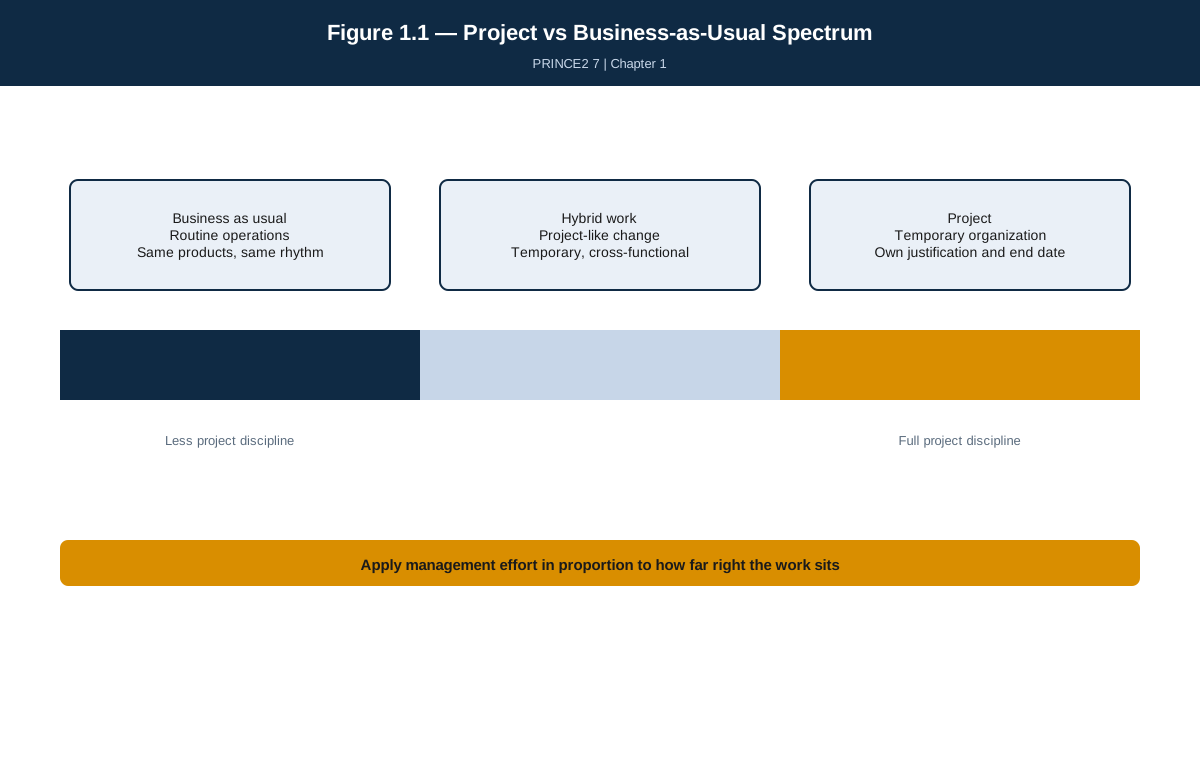
Figure 1.1 — Project versus business-as-usual spectrum, from routine operations through hybrid work to a temporary project organization.
Read the spectrum in Figure 1.1 from left to right. At the left, work is fully routine: same products, same team, same rhythm. Moving right, work gains novelty, a defined end, and a cross-functional team. At the far right sits a full project: a temporary organization with its own justification and its own end date. Few pieces of work sit exactly at either pole. Your job as a project thinker is to place work honestly on the spectrum and then apply management effort in proportion to how far right it sits. A small, low-risk change near the middle may need only a light version of project discipline. A large, expensive, irreversible change at the far right needs the full discipline this book teaches.
Four words carry the whole logic of why projects exist, and confusing them is the single most common reasoning error in project work. They form a chain, and each link must be examined separately.
An output is a product the project delivers. It is tangible or at least verifiable: a system installed, a building fitted out, a process documented, a team trained. Outputs are what the project team directly controls and what acceptance checks directly test. If you can point to it, test it, and sign for it, it is likely an output.
An outcome is the change in the way people work or behave that the output makes possible. A new warehouse system is an output. Pickers following a system-directed route instead of a paper list is an outcome. Outcomes do not happen automatically when outputs are delivered. They require people to adopt, learn, and sustain a different way of working, which is why projects that end at delivery so often disappoint: the output arrived, but the outcome never did.
A benefit is a measurable improvement that flows from an outcome and that the organization values. Faster picking that reduces labor cost is a benefit. Fewer picking errors that reduce returns and refunds is a benefit. Benefits are usually expressed in money, time, quality, or risk reduced, and they usually arrive after the project has closed, during BAU. That timing matters: the project spends the money, but BAU harvests much of the value, so someone must own each benefit after the project team has disbanded, and someone must measure whether it actually arrived.
A dis-benefit is a measurable worsening that the change also causes and that must be counted honestly against the benefits. Automation may reduce picking errors while also reducing scheduling flexibility for part-time staff. A new system may speed up one team while slowing another during its first months. Dis-benefits are not failures or embarrassments; they are part of the price of change. A justification that lists benefits and hides dis-benefits is not optimistic — it is incomplete, and decisions made from it will be wrong in a predictable direction.
Keep the chain in order: outputs enable outcomes, outcomes produce benefits and dis-benefits, and the net of benefits over dis-benefits and costs is what justifies the project. Whenever you hear a project described only by its outputs — "we are delivering a new system" — ask the next two questions: what will people do differently because of it, and what measurable good (and what measurable harm) will follow? If no one can answer, the project has a shopping list, not a justification.
A regional food distributor decides to automate picking in its central distribution center. Work through the chain step by step.
Step 1 — Name the outputs. The project will deliver an automated picking line installed and tested, a warehouse management system configured and live, a revised warehouse layout in use, and a workforce trained on the new way of working. Each of these can be inspected and accepted. They are outputs.
Step 2 — Name the outcomes. Once those outputs are in use, pickers work to system-directed tasks rather than printed lists, supervisors manage by exception reports rather than by walking the floor, and replenishment is triggered by system data rather than by visual checks. These are changes in behavior. Notice that none of them is guaranteed by Step 1: the system can be live while staff quietly keep using paper. That gap is exactly why outcomes are named separately.
Step 3 — Name the benefits. System-directed picking reduces picking errors, which reduces returns handling and refunds. It also reduces the labor hours needed for a given order volume. Both improvements can be measured in money per year, and both belong in the business case as forecast benefits.
Step 4 — Name the dis-benefits. During transition, throughput will dip while staff learn the new routes. Some experienced pickers' local knowledge — which aisle floods, which supplier's cartons split — becomes less valuable, and morale may suffer if that loss is handled badly. Overtime flexibility may fall because the automated line needs a minimum crew pattern. Each of these is real, measurable in principle, and belongs in the same honest calculation as the benefits.
Step 5 — State the justification test. The project is justified only if the forecast benefits, net of dis-benefits and project costs, remain worthwhile — and that test must be reapplied as forecasts change, not applied once and forgotten. You will meet this test again as the first principle of the method in Chapter 6 and as the business case practice in Chapter 14. For now, hold the chain itself: output, outcome, benefit, dis-benefit. Every examination question about justification is, underneath, a question about whether you can keep these four apart.
If the chain above explains why projects exist, the characteristics below explain how to recognize one. No single characteristic is decisive on its own; together they form a pattern, and the more of them are present in strength, the more the work needs project management rather than operational management.
First, a project is temporary. It has a start that someone authorized and an end that is defined in advance, even if the exact end date moves. Temporariness shapes everything: the team will disband, the funding will stop, and the products must therefore be handed over to a permanent owner who will use and maintain them. Work with no conceivable end is not a project, however novel it felt at the start; it has become BAU and should be funded and managed as BAU.
Second, a project is unique in at least some material respect. No two projects are identical, because the combination of products, people, constraints, and context never repeats exactly. Uniqueness is a matter of degree — building the tenth similar store is less unique than building the first — but even highly repeatable projects differ in site, team, suppliers, and timing. Uniqueness is why yesterday's plan cannot simply be photocopied, and why learning from previous projects, rather than copying them blindly, is a discipline in its own right.
Third, a project is cross-functional. Its products usually require skills and authority from several parts of the organization, and often from outside suppliers as well. That is why a project needs its own decision structure: no single operational manager owns all the interests involved. The user who will live with the product, the business that pays for it, and the supplier who builds it see the same project through different eyes, and a good method keeps all three views represented. Chapter 2 previews those three interests; Chapters 11 and 12 develop them fully.
Fourth, a project involves uncertainty beyond the uncertainty of routine work. Estimates are genuinely estimates. Requirements clarify as products take shape. Suppliers slip, technologies disappoint, and stakeholders change their minds as they see early results. Uncertainty is not a sign of bad planning; it is a property of doing something new. The management response is not to pretend certainty, but to plan in stages, to keep tolerances explicit, and to revisit justification as uncertainty resolves.
Fifth, a project delivers change, and change is resisted for rational as well as emotional reasons. People whose work will change want to know why, what support they will get, and what happens to skills they have spent years building. A project that treats adoption as an afterthought will deliver outputs into an organization that quietly routes around them. That is why this book treats people as a central element of the method rather than as a soft extra — a position Chapter 5 explains and Part Three develops.
Sixth, a project is constrained. Time, money, quality expectations, and scope cannot all expand at once. Every project lives inside trade-offs, and honest project management makes those trade-offs visible early, when they are still cheap to address, instead of discovering them at the deadline, when they are not. The next section gives those constraints their method names.
Apply the characteristics to three pieces of work at the same distributor. Judge each one, giving reasons rather than labels alone.
Case A — The nightly order-picking operation. It runs every night, with a permanent team, a standing procedure, and an operating budget. It has no defined end and no new product to deliver. Judgment: this is business as usual. It should be managed for steadiness and efficiency. Calling it a project would add decision layers without adding value.
Case B — Installing the automated picking line and warehouse management system, revising the layout, and training the workforce, over a defined period with a defined budget and a stated expectation of reduced errors and labor cost. It is temporary, materially unique for this organization, cross-functional (operations, information technology, the automation supplier, human resources), uncertain (supplier delivery and staff adoption cannot be fully known in advance), and it changes how dozens of people work. Judgment: this is a project in the full sense, and it needs full project discipline — its own justification, its own decision-makers, its own staged plan.
Case C — A supervisor's plan to trial a slightly different shift pattern for one month to see whether errors fall. It is temporary and involves a small change, but it sits inside one team's authority, uses existing products, carries low cost and low risk, and needs no cross-functional decision structure. Judgment: this is project-like work near the middle of the spectrum in Figure 1.1. It deserves light discipline — a clear purpose, a simple plan, a review at the end — but standing up a full project organization for it would cost more management than the change is worth.
The lesson generalizes. The question is never "project: yes or no?" as a matter of pride. The question is "how much project discipline does this work need, given its novelty, cost, risk, and reach?" That judgment — proportionate, honest, revisited — is the habit the rest of this book builds.
A project does not have one measure of success. It has several, and they pull against each other. PRINCE2 7 names seven performance targets that must be managed together: benefits, time, cost, quality, scope, risk, and sustainability. Sustainability is the newest of the seven, added in version 7, reflecting that a project's long-term environmental and social effects are now treated as a performance dimension to be managed deliberately, not as an afterthought. You will meet these targets in every part of this book; this chapter introduces each one plainly.
Benefits ask: is the improvement still worth having, and is it still forecast to arrive? Benefits are the reason the project exists, so this target sits first. A project that hits its date and budget while its expected benefits evaporate has not succeeded; it has merely spent accurately.
Time asks: will the products arrive when they are needed? Time matters because value is time-sensitive — a system delivered after the peak season it was bought for may be worth a fraction of its forecast. Time is managed through plans and stages, and through honest forecasting rather than hopeful reporting.
Cost asks: will the products be delivered within the money authorized, including the cost of change and of putting things right? Cost control is not cheapness. It is the discipline of knowing, at any moment, what has been spent, what is committed, and what the final bill is now forecast to be.
Quality asks: are the products fit for their purpose? A product that arrives on time but fails acceptance, or passes acceptance but fails in use, has missed this target. Quality is therefore planned from the user's expectations and acceptance criteria, not inspected in as a desperate final step.
Scope asks: is the project delivering what was agreed — no less, but also no more? Scope grows quietly, one reasonable-sounding addition at a time, until time, cost, and risk have all been consumed by work nobody formally approved. Controlling scope means every addition is a visible decision with visible consequences.
Risk asks: what uncertainty surrounds the project, and is the exposure acceptable? Risk is managed as a target in its own right because a project can hit time, cost, and scope on paper while carrying an unexamined threat that wipes out its benefits. Chapter 20 and Chapter 21 teach risk as a full practice; here, simply note that risk is not bad luck to be endured but a dimension to be assessed and responded to deliberately.
Sustainability asks: what are the project's longer-term effects beyond its immediate products — on resources, on the environment, on the communities and workforce it touches — and are those effects acceptable and, where possible, positive? Treating sustainability as a target means it gets tolerances, attention, and trade-off decisions like the other six, rather than a paragraph of good intentions.
Each target is controlled through tolerances: agreed margins within which the person managing the work may act without escalating, and beyond which the decision must go to the level above. Tolerances turn the seven targets from aspirations into a working control system, and they recur throughout this book — at project level, at stage level, and at work-package level. For now, fix the list of seven and the idea of a margin around each. If you remember nothing else from this chapter under examination pressure, remember that there are seven targets, that sustainability is one of them in the current edition, and that benefits — not time, not cost — are why the project exists at all.
A final warning before the summary. Do not confuse the targets with the products. Products are what the project makes. Targets are the dimensions along which the making is judged. A plan that lists products without addressing time, cost, quality, scope, risk, benefits, and sustainability is a wish list. A report that covers time and cost but is silent on benefits and risk is telling half the story — usually the comfortable half. The method you are about to learn exists, in large part, to stop that selective telling.
A project is a temporary organization created to deliver agreed products under an agreed business case; business as usual is the permanent, repetitive work of running the organization, and the two must be separated so each can be managed for what it is. Outputs are the products delivered, outcomes are the changed ways of working those products enable, benefits are the measurable improvements that follow, and dis-benefits are the measurable worsenings that must be counted honestly against them. Projects are recognizable by being temporary, unique in some material respect, cross-functional, uncertain, change-bearing, and constrained. PRINCE2 7 manages seven performance targets — benefits, time, cost, quality, scope, risk, and sustainability — each controlled through agreed tolerances, with benefits as the reason the project exists.
Q1. A distributor's nightly picking operation runs with a permanent team, a standing procedure, and no defined end. How should this work be classified? A. As a project, because it is important to the business B. As business as usual, because it is repetitive permanent work with no defined end C. As a project, because it carries operational risk D. As business as usual only until its budget is reviewed
Q2. Which statement best defines a project? A. Any work that is difficult or expensive B. A permanent team improving its routine procedures C. Any work led by a senior manager D. A temporary organization created to deliver agreed products under an agreed business case
Q3. A project delivers a warehouse management system that is installed, tested, and signed for. In the output–outcome–benefit chain, the system itself is best described as what? A. An output B. An outcome C. A benefit D. A dis-benefit
Q4. Pickers stop using printed lists and instead follow system-directed routes. What does this change in working behavior represent? A. An output B. A tolerance C. An outcome D. A benefit
Q5. Reduced returns handling worth a measurable sum each year follows from fewer picking errors. How should this improvement be treated in the justification? A. As an output of the project team B. As a benefit to be forecast, owned, and later measured C. As business as usual, and therefore ignored D. As a dis-benefit, because it changes staff work
Q6. Automation reduces errors but also reduces overtime flexibility for part-time staff in a measurable way. How should this effect be handled? A. Recorded honestly as a dis-benefit counted against the benefits B. Hidden so the justification looks stronger C. Treated as an output of the project D. Ignored, because dis-benefits are not part of justification
Q7. Which characteristic is most directly shown by a project team that will disband when delivery ends? A. Uniqueness B. Cross-functional working C. Uncertainty D. Temporariness
Q8. A project needs operations, information technology, and an outside supplier to deliver its products. Which characteristic does this best illustrate? A. Temporariness B. Routine repetition C. Cross-functional working D. Business as usual
Q9. Which list correctly gives the seven performance targets in PRINCE2 7? A. Benefits, time, cost, quality, scope, risk, and sustainability B. Time, cost, and quality only C. Benefits, time, cost, quality, scope, and risk, with sustainability as an optional extra D. Outputs, outcomes, benefits, time, cost, quality, and scope
Q10. What is the role of tolerances in relation to the performance targets? A. They replace the need to report progress B. They set agreed margins within which work may proceed without escalation C. They guarantee that targets will be met D. They apply only to cost
Q11. A project is on time and on budget, but its forecast benefits have disappeared. What is the correct judgment? A. The project has succeeded, because time and cost were met B. The project needs no further review until closure C. The project should continue unchanged to protect the plan D. The project's justification must be re-examined, because benefits are its reason for existing
Q12. Why must project work hidden inside an operating budget be separated from business as usual? A. So that routine work can avoid all change B. So that projects can avoid decision-making C. So that each kind of work gets its own justification, plan, and decision-maker and neither starves the other D. So that the operating budget never needs review
Q13. Which work sits nearest the project end of the spectrum in Figure 1.1? A. A temporary, cross-functional change with its own justification and end date B. A permanent team's daily routine under a standing procedure C. A supervisor's routine weekly check D. Ongoing maintenance under an annual operating budget
Q14. A small trial of a new shift pattern sits within one team's authority, uses existing products, and carries low cost and low risk. What management response is proportionate? A. A full project organization with multiple stages B. No purpose, plan, or review at all C. Treating it as permanent business as usual D. Light discipline: a clear purpose, a simple plan, and a review at the end
Q15. Why does a project need its own decision structure rather than relying on one operational manager? A. Because operational managers never understand projects B. Because its products usually span several functions and interests that no single operational manager owns C. Because projects must avoid all routine procedures D. Because business as usual has no managers
Feras Alzubi
Exam Prep Series
© 2026 Feras Alzubi. All rights reserved.
No part of this book may be reproduced, stored in a retrieval system, or transmitted in any form or by any means — electronic, mechanical, photocopying, recording, or otherwise — without the prior written permission of the author, except for brief quotations in reviews and other fair use permitted by law.
Trademark acknowledgment. PRINCE2 is a registered trademark of PeopleCert. The PRINCE2 name is used in this book in a nominative sense only, to identify the method and the examinations that this study aid prepares the reader for. All other trademarks, service marks, and product names mentioned in this book are the property of their respective owners, and their use does not imply endorsement.
Not-affiliated disclosure. This book is an independent study aid. It is not affiliated with, sponsored by, authorized by, or endorsed by PeopleCert, and it is not an official PeopleCert publication. PeopleCert did not participate in the writing, review, or production of this book. The official manual for the method is published separately by PeopleCert. Candidates should confirm current examination details, entry requirements, and booking arrangements with PeopleCert or with an accredited training provider before booking, because examination arrangements are set by PeopleCert and may change.
About the teaching in this book. This book teaches the method in its own words, from the published syllabus structure and the publisher's public descriptions of the method. It does not reproduce the official manual, official sample papers, or any proprietary examination material. Every practice question in this book is original to this book. Examination facts printed in this book are stated as published at the time of writing; where the book states a syllabus weighting, it attributes that weighting to the published syllabus.
Examination fees are set at booking and vary by region and provider. This book prints no fee figures. Nothing in this book guarantees an examination result. Study, practice, and honest self-assessment — not any book — determine how a candidate performs on the day.
First published 2026.
Contents placeholder — the full contents list, with chapter and part page references, is inserted at production from the final manuscript.
This book prepares you for two examinations that belong to one method. Foundation tests whether you can recall and explain the method accurately. Practitioner tests whether you can apply the method to a project scenario and analyze what should happen next. They are two sittings, not two subjects: Practitioner builds directly on Foundation and examines the same principles, practices, and processes at a higher level. This book therefore teaches the method once, whole and in depth, and then trains you separately for each sitting's craft.
Read this section before you open Chapter 1. It explains the campaign, maps every part of the practice apparatus, and shows you how the diagnostic test at the front of the book routes your study so that your time goes where your gaps are.
Most readers will work in one of two campaigns.
Foundation only, first. If you need Foundation now — for a role, for a job application, or as your first structured pass through the method — work Parts One through Five for the teaching, use Part Seven for Foundation technique and timing, and prove readiness on Battery A and on the Foundation papers inside the two timed tests before you book. You can return later for Practitioner without relearning the method: the teaching chapters are written to serve both levels.
The two-sitting campaign. If your goal is Practitioner, do not treat Foundation as a hurdle to rush. Sit Foundation first, then continue through Part Six, which carries the specimen project under pressure, and Part Eight, which trains scenario judgment, before you prove readiness on Battery B and on the Practitioner papers inside the two timed tests. The back matter carries two study plans — a Foundation-only plan and a twelve-week two-sitting campaign plan — that sequence the chapters, batteries, and timed tests week by week. Follow the plan that matches your goal, and let your diagnostic and battery scores, not the calendar alone, decide when you move on.
Whichever campaign you choose, keep the two crafts distinct in your mind. In Foundation, the question is: what does the method say? In Practitioner, the question is: given this situation, what does the method require here, and why? Chapters 37 and 39 teach those two crafts separately, and the batteries and timed tests keep the two papers separate for the same reason.
Teaching alone does not prepare you for an objective-testing examination. You need volume, variety, and honest feedback. This book carries 1,160 practice questions, every one of them keyed with a full explanation that teaches the point and explains why each wrong option is wrong.
| Component | Items | What it does |
|---|---|---|
| Diagnostic test | 50 | Taken first, closed book. Strand-scored across the eight parts so you can see, before you study, where you are strong and where you are not. Routes your study order. |
| Chapter exercises | 600 | Fifteen questions at the end of each of the forty chapters. Taken open book, right after studying the chapter, to lock in the teaching while it is fresh. |
| Battery A — Foundation sitting | 60 | A full Foundation-shape paper under timed, closed-book conditions, in syllabus proportions. Your first full proof of Foundation readiness. |
| Battery B — Practitioner sitting | 70 marks | A full Practitioner-shape paper against one continuous scenario, under timed conditions. Your first full proof of Practitioner readiness. |
| Repair sets | 120 | Six sets of twenty, each aimed at one recurring error class: confusing a principle with a practice; misplacing a process activity; confusing product ownership and approval; misjudging tolerances and escalation; falling for sixth-edition names presented as current; and applying the right rule in the wrong context. Use the sets that match the mistakes your keys reveal. |
| Timed Test 1 | 130 | A fresh Foundation paper and a fresh Practitioner paper, taken under full examination conditions. |
| Timed Test 2 | 130 | A second fresh pair of papers, with a new Practitioner scenario, for final confirmation before booking. |
| Total | 1,160 |
A note on the Practitioner shape in this book: the live Practitioner paper presents questions and sub-questions totaling seventy marks against one scenario booklet. This book's Practitioner papers present seventy one-mark items in the same objective-testing forms — standard scenario items, matching sets, and assertion/reason items — against one scenario, so that every mark can be separately keyed and explained. The timing, the pass mark, the scenario discipline, and the syllabus proportions match the live paper as published; only the packaging of marks into items differs, and it differs so that your feedback is more precise.
Every key in this book does three jobs. It confirms the correct answer. It explains the reasoning in terms of the method, so a lucky guess does not masquerade as knowledge. And it names the specific misconception behind each wrong option, so you can recognize that trap when you meet it again in different wording. Read the keys even for questions you answered correctly — especially for questions you answered correctly by guessing.
Take the diagnostic test immediately after this section, before you study anything. Sit it closed book, in one sitting, and do not look anything up. A diagnostic taken after studying measures your studying; a diagnostic taken before studying measures your starting point, which is what routing needs.
When you finish, score yourself twice. First, score the paper as a whole to gauge your overall starting point. Second — and this matters more — score by strand. The diagnostic key groups the fifty questions by part, from Part One through Part Eight, and tells you what a low score in each strand means and where to go. A strong total can hide a weak strand, and a weak strand is exactly where an examination paper will find you, because both live papers examine across the whole syllabus.
Then route your study as follows:
One specimen project runs through this book so that the method is always visible on a real-shaped project rather than in the abstract: Project Meridian, in which Meridian Fresh Foods, a regional food distributor, automates its central distribution center. You will meet Meridian in the practice chapters, work it end to end in Part Six, and meet its extension as the Battery B scenario. Learn the method on Meridian, and you will be able to recognize it on any project the examination puts in front of you.
A final word on editions. This book teaches the current edition of the method throughout: practices, not themes; the issues practice, not a change theme; organizing, not organization; seven performance targets including sustainability; nine management approaches; and the current pass marks. Where an older edition's wording still circulates and still traps candidates, the book flags it explicitly as an edition trap. If you have studied an earlier edition before, treat those flags as essential reading, not as footnotes.
PRINCE2 expands as PRojects IN Controlled Environments; the "2" marks the second version of the PRINCE method, first published in that form in 1996. The current edition is PRINCE2 7, published in 2023. The examinations are the PRINCE2 Project Management Foundation (Version 7) and the PRINCE2 Project Management Practitioner (Version 7), owned and administered by PeopleCert. Chapter 4 teaches both examinations in full; this panel is the reference summary to return to throughout your study.
| Foundation (Version 7) | Practitioner (Version 7) | |
|---|---|---|
| Format | Multiple choice. 60 questions, one mark per question. No negative marking. | Objective testing based on a scenario. Questions and sub-questions worth 70 marks in total, against one scenario, with additional information supplied for sections of the paper. |
| Question forms | Standard, missing word, and list items; negative items are used exceptionally. | Standard scenario multiple choice, matching items, and assertion/reason items. Every principle, practice, and process is examined. |
| Assessment level | Recall and understanding. | Apply and analyze: the candidate must use the method on the scenario and judge between plausible courses of action. |
| Time allowed | 60 minutes, closed book. | 150 minutes (2.5 hours), open book — the official PRINCE2 7 book is the permitted material. |
| Pass mark | 60% — 36 marks out of 60. | 60% — 42 marks out of 70. |
| Prerequisites | None. The Foundation examination has no prerequisites and is positioned for candidates at any career stage. | One qualifying credential is required — see the prerequisite list below. Foundation (Version 7) heads that list. |
| Languages | Published in 14 languages. | Published in 14 languages. |
| Extra time | Candidates sitting in a language that is not their native or working language may be awarded 25% additional time — 75 minutes at Foundation. | The same additional-time provision applies under the published examination rules. |
| Results | PeopleCert publishes official results within two business days of the examination. | PeopleCert publishes official results within two business days of the examination. |
| Renewal | Subject to PeopleCert's renewal program: renewal every three years, evidenced by 60 continuing professional development points logged through PeopleCert's scheme, or by passing another examination in the same product suite before the renewal date. | Subject to the same PeopleCert renewal program: renewal every three years, evidenced by 60 continuing professional development points logged through PeopleCert's scheme, or by passing another examination in the same product suite before the renewal date. |
Edition warning. The pass marks above are the current Version 7 marks. The sixth edition used lower pass marks, and older pages still in circulation mix the two editions. If any source you consult states a different pass mark for the current examinations, treat that source as out of date.
The syllabus weights the papers as follows. Study time should follow the same proportions: the practices dominate both papers, so they dominate this book — Part Four is the longest part, and the diagnostic, batteries, and timed tests all follow the same weighting.
Foundation — 60 questions. The syllabus weights the paper as: key concepts 3% (2 questions); principles 8% (5 questions); people 14% (8 questions); practices 60% (36 questions); processes 15% (9 questions).
Practitioner — 70 marks. The syllabus weights the paper as: principles 10% (7 marks); people 9% (6 marks); practices 51% (36 marks); processes 30% (21 marks).
| Syllabus area | Foundation (of 60 questions) | Practitioner (of 70 marks) |
|---|---|---|
| Key concepts | 3% — 2 questions | Examined within the areas below |
| Principles | 8% — 5 questions | 10% — 7 marks |
| People | 14% — 8 questions | 9% — 6 marks |
| Practices | 60% — 36 questions | 51% — 36 marks |
| Processes | 15% — 9 questions | 30% — 21 marks |
Entry to the Practitioner examination requires one of the following, as published by PeopleCert:
Foundation itself has no prerequisites. A candidate who holds one of the other listed credentials may enter Practitioner directly under PeopleCert's rules, but this book's advice is unchanged: learn the Foundation material first, because Practitioner examines the same method and assumes it. Chapter 40 sets out the two-sitting campaign in full, including how a candidate entering with a different credential should sequence the work.
End of the free sample. The complete book continues from here — the full A-to-Z course in book form, delivered as an EPUB you can read in Apple Books, Google Play Books, ReadEra, Thorium Reader, Adobe Digital Editions, or Send to Kindle.
Buy this ebook — $11.99 Back to the book page
Payments are securely processed by Payhip.