
Mastering Careers & Skills
Praxis Core and Principles of Learning and Teaching (PLT) · free sample from the book itself
This book assumes nothing. If the word "Praxis" is new to you, you are in the right place. If you have already been told to "take the Praxis," this chapter is still where you start, because that instruction, by itself, does not yet name a test you can register for.
Praxis is not the name of one exam. It is the name of a family of teacher tests published by ETS — the testing organization that builds and administers them. A test, in this book, means one named examination with its own code number, its own questions, its own time limit, and its own score report. Candidates do not register for "Praxis" in general. They register for a specific test, identified by its test code — a four-digit number such as 5713 — because a state or a preparation program has required that specific test.
That one fact explains the shape of this whole book, so hold it firmly from the first page: people search, register, and prepare by test code. A book that said "Praxis" on the cover and then taught only part of the family, without saying which part, would mislead every reader whose test it left out. This book therefore names its coverage exactly, fences out what it does not cover exactly, and repeats both statements wherever a reader might reasonably look for them — starting here, in the first chapter a buyer samples.
Exam trap — a family name is not a test name. If a requirement, an advisor, or a job posting says only "Praxis," it is incomplete as an instruction. Ask: which test, by name and code? Until you have a code, you do not yet know what to study, what to book, or what score anyone will expect.
The Praxis family, as ETS publishes it, has these branches:
This book covers two layers, completely, and nothing else:
Everything else in the family is fenced out of this book: all subject-area tests, the Elementary Education content tests, the specialty tests, and ParaPro (1755). Section 1.8 states the fences in full. They are not gaps in this book's coverage of its declared scope; they are different tests, requiring different preparation.
Here, in words, is the picture Figure 1.1 draws. The family splits into the two covered layers — Core and PLT, drawn solid — beside the fenced branches — Subject Assessments, Elementary Education content tests, specialty tests, and ParaPro — drawn hatched. If your required test is in a hatched branch, this book does not prepare you for it, and no chapter in it should be mistaken for that preparation.
Figure 1.1 — The Praxis Family Map
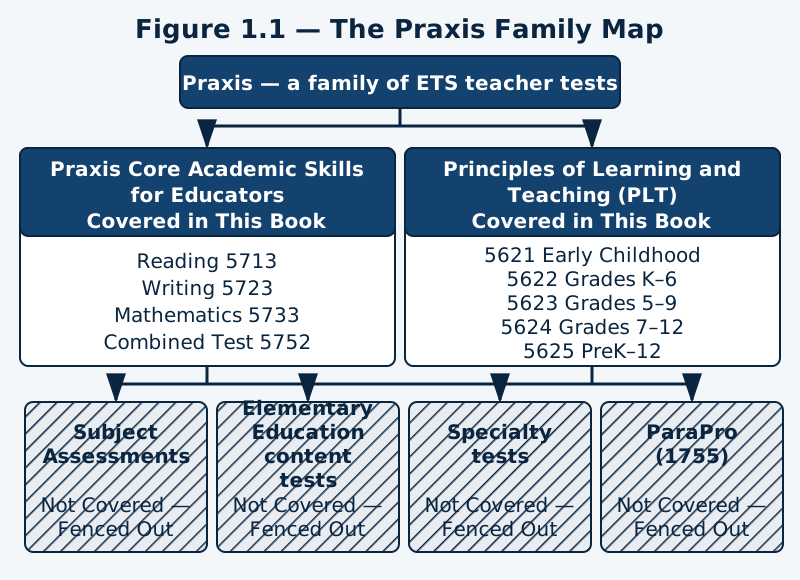
Figure 1.1 — The Praxis Family Map. The Praxis family as a tree. Two branches are solid and labeled "Covered in This Book": Praxis Core Academic Skills for Educators (Reading 5713, Writing 5723, Mathematics 5733, Combined Test 5752) and Principles of Learning and Teaching (5621, 5622, 5623, 5624, 5625). Four branches are hatched and labeled "Not Covered — Fenced Out": Subject Assessments, Elementary Education content tests, specialty tests, and ParaPro (1755).
A license is official permission from a government authority to do work that unlicensed people may not do. For teachers, the licensing authority is a state — its education agency or licensing body. States license; ETS tests. ETS builds the tests, administers them, scores them, and reports the scores. ETS does not issue teaching licenses, does not decide who must take which test, and — as the next sections show in ETS's own published terms — does not set the score a candidate must earn.
Why does the split matter to you on page one? Because almost every practical question a candidate asks has an owner, and the two owners answer different questions:
A preparation program — also called an educator-preparation program — is the college, university, or approved provider program that prepares candidates for teaching and may recommend them for a license. Some requirements come from the state, some from the program, and a candidate can owe duties to both. This book teaches the ETS side completely and teaches you, in Section 1.7, exactly how to look up the state side. It never guesses the state side for you.
Selected-response questions — the format most Praxis questions use — present a question or statement with answer choices, and the candidate selects the correct choice or choices. An essay, also called a constructed-response question in its general form, requires the candidate to produce a written response rather than select one. A constructed-response question is any question scored on a response the candidate constructs — an essay, or a written answer to a case. Keep those three terms; every format statement in this book is built from them.
The three Core tests, exactly as ETS publishes them, are:
| Fact | Core Reading (5713), as ETS publishes it |
|---|---|
| Format | 56 selected-response questions, based on passages and brief statements |
| Time | 85 minutes |
| Fact | Core Writing (5723), as ETS publishes it |
|---|---|
| Format | 40 selected-response questions + 2 essays, in three separately timed sections |
| Time | 100 minutes (40 + 30 + 30) |
| Fact | Core Mathematics (5733), as ETS publishes it |
|---|---|
| Format | 56 questions: selected-response (select one; select one or more) and numeric-entry; on-screen four-function calculator provided |
| Time | 90 minutes |
(Source: ETS, Praxis Study Companions for tests 5713, 5723, and 5733, "Test at a Glance" tables, checked October 29, 2026.)
Three details in that table deserve a beginner's full attention.
First, Writing is three separately timed sections, not one 100-minute pool. The selected-response section is timed on its own, and each essay has its own 30-minute section. Time left over in one section does not move to another. Chapter 24 builds your pacing on exactly that structure.
Second, Mathematics includes question types beyond select-one. A numeric-entry question gives you no choices: you type an integer or a decimal into one box, or a fraction into two boxes. A select-one-or-more question shows square boxes and may or may not tell you how many choices to select. Chapter 24 teaches the method for each type, and Chapters 12–15 practice them.
Third, the only calculator is the one on the screen. For Core Mathematics, ETS provides an on-screen four-function calculator — addition, subtraction, multiplication, division. (Source: ETS, Praxis Study Companion: Core Academic Skills for Educators: Mathematics (5733), "On-Screen Four-Function Calculator" section, checked October 29, 2026.) This book therefore teaches four-function fluency only. It teaches no square-root key, memory key, or other calculator strategy, because the published policy provides no such key to use.
The Combined Test (5752) is not a fourth test with new questions. It is one registration and one sitting that contains the three tests above, so a candidate can schedule and take all three Core subtests in the same session; each test is still scored and reported separately. (Source: ETS, Praxis test page for the Core Combined Test, 5752, checked October 29, 2026.) Its total sitting length is 275 minutes — computed as 85 + 100 + 90 from the three published section times; ETS's 5752 page states the same-session structure, and this book labels the 275-minute total as computed wherever it uses it, never as a figure ETS published as a total.
What each Core test contains. ETS publishes content categories for each test, and this book's crosswalk appendix maps every category to the chapters that teach it. In outline:
Fees. Fees as published by ETS in the 2026–27 Praxis Information Bulletin and on ETS test pages, checked October 29, 2026: each Core test taken separately is $90; the Combined Test (5752) is $150. The Bulletin adds a 3 percent online service fee on online transactions and lists ancillary fees — additional score reports at $50 each, telephone registration at $35, a date or center change at $40, and score review at $65 for tests containing constructed-response questions only. Fees are orientation facts with a date on them, not permanent facts: re-check the current Bulletin before you budget. (Source: ETS, The Praxis Tests Information Bulletin, 2026–27, fee schedule, checked October 29, 2026; ETS test pages for 5713 and 5752, checked October 29, 2026.)
One quiet rule that applies to every test in this book: a test may contain questions that do not count toward your score — unscored questions mixed in with scored ones — and candidates cannot identify them. ETS's counts for Writing (5723) and Mathematics (5733) expressly include both scored and unscored questions, and category totals may vary by form with the number of unscored questions. (Source: ETS, Praxis Study Companions for 5723 and 5733, checked October 29, 2026.) The only sound response is the one Chapter 24 repeats: answer every question as if it counts, because you cannot know which ones do not.
Because Chapter 11 is built entirely on this distinction, learn the two essay tasks by their real names now.
The first is the Argumentative essay: you take a clear position on an issue and support it with reasons and examples drawn from your experience, observation, or reading.
The second is the Informative/Explanatory essay — ETS's sample-task heading calls it the source-based essay. You are given two provided sources, and your job is to extract and synthesize — synthesize means combine into a coherent whole — important information and concerns from both sources, and to cite the sources, meaning to identify in your writing which source a piece of information came from. It is not a summary of one source, and it is not an argument for your own position; Chapter 11 teaches the difference as two separate jobs with two separate planning templates.
On the Writing score report, selected-response points are reported separately from essay points. (Source: ETS, Praxis Study Companion: Core Academic Skills for Educators: Writing (5723), checked October 29, 2026.) A candidate can therefore see, after the fact, which of the two kinds of work needs the restudy — and this book's score-by-category tracker teaches you to read your practice results the same way before the real test ever happens.
The four grade-band tests test the same pedagogy core through questions and cases focused on a stated span of schooling:
| Fact | PLT: Early Childhood (5621), as ETS publishes it |
|---|---|
| Format | 70 selected-response + 4 constructed-response (on two case histories) |
| Time | 2 hours |
| Fact | PLT: Grades K–6 (5622), as ETS publishes it |
|---|---|
| Format | 70 selected-response + 4 constructed-response (on two case histories) |
| Time | 2 hours |
| Fact | PLT: Grades 5–9 (5623), as ETS publishes it |
|---|---|
| Format | 70 selected-response + 4 constructed-response (on two case histories) |
| Time | 2 hours |
| Fact | PLT: Grades 7–12 (5624), as ETS publishes it |
|---|---|
| Format | 70 selected-response + 4 constructed-response (on two case histories) |
| Time | 2 hours |
| Fact | PLT: PreK–12 (5625), as ETS publishes it |
|---|---|
| Format | 100 selected-response; no constructed-response section |
| Time | 120 minutes (2 hours) |
(Source: ETS, Praxis Study Companions for tests 5621, 5622, 5623, 5624, and 5625, "Test at a Glance" tables — each companion opened and read individually — checked October 29, 2026; ETS test page for 5625, checked October 29, 2026.)
A case history is a short written account of a classroom situation — the setting, the learners, the instruction that took place, and the evidence of what students did or learned — followed by constructed-response questions about it. Chapter 5 introduces the case history as an object; Chapter 25 teaches the full method for answering from one.
Fees as published by ETS in the 2026–27 Praxis Information Bulletin and on ETS test pages, checked October 29, 2026: each PLT test is $156 — the Bulletin publishes $156 for a test containing constructed-response items, and ETS's 5625 test page publishes $156.00 for that test directly. (Source: ETS, The Praxis Tests Information Bulletin, 2026–27, fee schedule; ETS test page for 5625, checked October 29, 2026.)
The band tests share one published structure. For each of 5621, 5622, 5623, and 5624, ETS publishes the identical content categories, counts, and percentages: I. Students as Learners — 21 selected-response, 22.5 percent; II. Instructional Process — 21 selected-response, 22.5 percent; III. Assessment — 14 selected-response, 15 percent; IV. Professional Development, Leadership, and Community — 14 selected-response, 15 percent; V. Analysis of Instructional Scenarios — 4 constructed-response, 25 percent. The four constructed-response questions are drawn from categories I–IV: Students as Learners 1–2, Instructional Process 1–2, Assessment 0–1, and Professional Development, Leadership, and Community 0–1. (Source: ETS, Praxis Study Companions for 5621, 5622, 5623, and 5624, checked October 29, 2026.)
The PreK–12 test (5625) has its own published structure — it is not a band test with more questions. ETS publishes four categories for it: I. Students as Learners — 31 questions, 31 percent; II. Instructional Process — 30 questions, 30 percent; III. Assessment — 20 questions, 20 percent; IV. Professional Development, Leadership, and Community — 19 questions, 19 percent. There is no fifth category, because there is no constructed-response section: scenario analysis is folded into the selected-response items themselves. (Source: ETS, Praxis Study Companion: Principles of Learning and Teaching: PreK–12 (5625), checked October 29, 2026.) Chapter 25 gives 5625 its own method treatment, and this book provides separate practice forms in its exact shape.
What "band difference" actually means — the only band difference this book may claim. Each band companion states, in substance, that each test includes questions that apply specifically to the stated grade range of the test as well as some that are universal to all grade levels. (Source: ETS, Praxis Study Companions for 5621, 5622, 5623, and 5624, checked October 29, 2026.) That is the documented difference: the grade-band focus of the questions and case scenarios. ETS publishes no different weights, no different counts, no different times, and no different category structures by band — so this book prints none. It teaches the shared categories once, at full depth, in Chapters 16–22; it works its scenarios across all four bands; and at the point of teaching it flags where the professionally correct judgment turns on the child's developmental band. Any book — or any sentence in this book — claiming a band-specific weight, count, time, or category structure beyond what ETS publishes would be inventing a difference ETS does not document.
Pacing guidance for the band format. The PLT Study Companions for Grades K–6 (5622) and Grades 5–9 (5623) state, in substance, that about 70 minutes is expected on the selected-response section and about 50 minutes on the constructed-response section, and that the sections are not independently timed. (Source: ETS, Praxis Study Companions for 5622 and 5623, checked October 29, 2026.) This book presents that split as ETS guidance for the band format — attributed to the companions that print it — not as a per-band rule and not as two separate clocks. Chapter 25 builds pacing on exactly those terms.
All five PLT tests are designed to reflect the InTASC Model Core Teaching Standards and assess a beginning educator's knowledge of human development, learning processes, instructional processes, diverse learners, educational psychology, and professional issues. The companions also note that references to theories are based on their original versions — a rule this book follows for every theorist attribution in Chapters 16–20. (Source: ETS, Praxis Study Companions for 5621–5625, checked October 29, 2026.)
A raw score is the count of points earned before any conversion. On most Praxis tests, each selected-response question answered correctly is worth one raw point, scored by computer; the raw score is the number answered correctly. Raw scores are then converted to scaled scores — scores on a common reporting scale — that carry the same meaning across different forms of the same test and adjust for the difficulty of the form administered. No raw-to-scaled formula is published, and this book prints none. One caution ETS states plainly: identical scaled scores on different tests do not have the same meaning — a score on Reading and the same number on Mathematics are not the same achievement wearing two labels. (Source: ETS, Understanding Your Praxis Scores, 2023–24 edition as retrieved, checked October 29, 2026.)
The possible score range is 100–200 for each covered test — 5713, 5723, 5733, 5621, 5622, 5623, 5624, and 5625 are each listed on the 100–200 range. (Source: ETS, Understanding Your Praxis Scores, 2023–24 edition, Summary Statistics, checked October 29, 2026.) Read that sentence with care: 100–200 is score-range mechanics — the scale the report uses. It is not a standard to meet, and it says nothing about what score you need.
Constructed responses are scored by people, under a system built so no score rests on one reader. In ETS's published general mechanics, constructed responses are scored by education professionals in the content area who are carefully trained and supervised; two scorers rate independently, and if their ratings differ by more than a specified amount, a third scorer resolves the difference. (Source: ETS, Understanding Your Praxis Scores, 2023–24 edition; ETS, The Praxis Tests Information Bulletin, 2026–27, "How Constructed-Response Tests Are Scored," checked October 29, 2026.)
For the Core Writing essays specifically, ETS publishes more: each essay is scored on a six-point holistic scale — holistic means one overall judgment of quality rather than separate points per trait — by at least one trained human reader and e-rater, ETS's software scoring system built from thousands of previously scored essays; if the human and e-rater scores agree, they are added as the final essay score. The holistic judgment rests on overall quality: insight and central idea, clarity, consistency of point of view, cohesiveness, strength and logic of support, rhetorical force, diction and syntax, and correctness of mechanics and usage — plus, for the Informative/Explanatory essay, synthesis of and citation to the provided sources. (Source: ETS, Praxis Study Companion: Core Academic Skills for Educators: Writing (5723); ETS, Understanding Your Praxis Scores, checked October 29, 2026.) Chapter 11 teaches to those published features and to no others.
For PLT case responses, ETS publishes a General Scoring Guide with three score points. Score 2 — thorough understanding of the relevant aspects of the case; responds appropriately to all parts of the question; strong explanation well supported by relevant evidence; strong knowledge of relevant pedagogical concepts, theories, facts, procedures, or methodologies. Score 1 — basic understanding; responds appropriately to one portion of the question; weak explanation supported by relevant evidence; some knowledge. Score 0 — misunderstanding of the case; fails to respond appropriately; not supported by relevant evidence; little knowledge. No credit is given for a blank or off-topic response. The directions state that responses are evaluated against professionally accepted principles and practices, and that examinees are not expected to cite specific theories or texts. (Source: ETS, Praxis Study Companion: Principles of Learning and Teaching: Grades K–6 (5622), General Scoring Guide and sample section, checked October 29, 2026.) Every PLT rubric in this book is modeled on that guide and labeled as modeled on it.
For mixed-format tests, ETS states that selected-response and constructed-response results are either simply added to the raw score or first multiplied by scoring weights that can differ by question, before conversion to the scaled score — and ETS does not publish which method, or any weights, for the PLT tests in the sources this book relies on. (Source: ETS, Understanding Your Praxis Scores, 2023–24 edition, checked October 29, 2026.) This book therefore prints no combination formula and no selected-response/constructed-response point split for PLT beyond the published percentage table in Section 1.6. A prep source that shows you such a formula is showing you something ETS has not published.
Your score report shows: your score and whether you passed — judged against the requirement of the state or agency recipients you identified; the range of possible scores; the raw points you earned versus the raw points available in each content category; the range of the middle 50 percent of scores; and your highest score on each test taken in the past 10 years. (Source: ETS, Praxis Study Companions; ETS, Understanding Your Praxis Scores, checked October 29, 2026.)
Read that list as a study tool, not just a verdict. The category raw points are the report's built-in restudy map: they show, strand by strand and category by category, where your points were lost. This book's diagnostic tracker and practice-test scoring guides deliberately mirror that design — every practice result in this book is reported by content category, so the habit of reading a result as a restudy plan is trained long before a real report arrives.
In the passage Figure 1.2 illustrates, a schematic score report strip carries four labeled elements, in this order: the scaled score, shown inside the possible range 100–200; the category raw points earned versus available, shown category by category; the middle-50-percent band, the range in which the middle half of scores fell; and a label stating what the strip does not show — the score you needed, which is set by your state or agency, not by ETS and not by this strip. Each element is labeled with what it does say, and the strip as a whole is labeled with what it does not say.
Figure 1.2 — One Score Report, Read
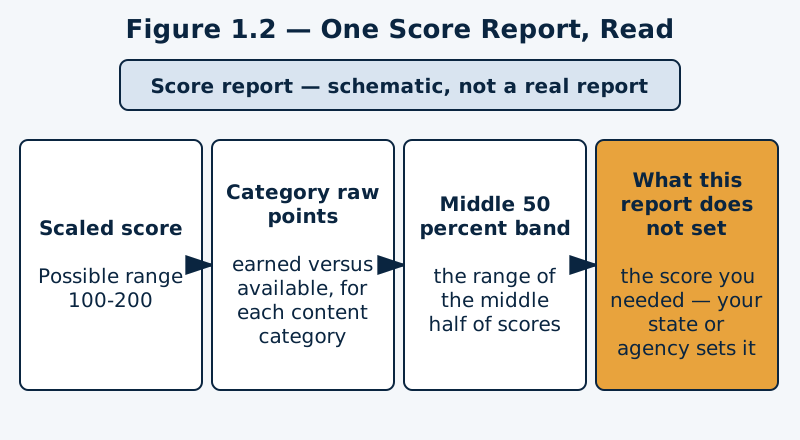
Figure 1.2 — One Score Report, Read. A schematic score report strip with four labeled elements: (1) scaled score, shown within the possible range 100–200; (2) category raw points earned versus available, shown for each content category; (3) the middle-50-percent band; (4) a closing label: "What this report does not set: the score you needed — your state or agency sets it."
Tests with only selected-response questions may offer an unofficial score at the end of the session. Tests containing constructed-response questions or essays do not, because those responses must be rated. If no unofficial score is offered on a selected-response-only test, ETS states that further analysis is required; it does not indicate a problem and does not delay official reporting. (Source: ETS, The Praxis Tests Information Bulletin, 2026–27, checked October 29, 2026.)
Official availability, as the Bulletin publishes it: Core Reading (5713) and Core Mathematics (5733) scores are available within 7 calendar days after the test day; Core Writing (5723) scores are available 20 business days after the test day. Reports remain available in the online account for 10 years. (Source: ETS, The Praxis Tests Information Bulletin, 2026–27, checked October 29, 2026.) For the PLT tests, the Bulletin sections this book relies on give no test-specific day count; official dates vary by test and ETS publishes reporting dates on its Getting Scores page. This book therefore prints no day count for any PLT test — only the verified general rule that tests with constructed responses report later than selected-response-only tests, because the responses must be rated.
You may name up to 4 free score recipients at registration; additional score reports cost $50 each, as published in the 2026–27 Bulletin, checked October 29, 2026. In states with automatic reporting, a copy of your scores also goes to that state's education department — the book names the mechanism here and never presents any state's list as your rule, because whether it applies to you is part of your own lookup in Section 1.9.
Retakes. A test must be retaken on a date at least 28 days after the previous test date. The rule applies even if the earlier scores were canceled. Violating it cancels the retest scores without refund, even if the violation is identified after the scores were reported. (Source: ETS, The Praxis Tests Information Bulletin, 2026–27, "Test Retake Policy," checked October 29, 2026.) Both study plans in this book are built so that a needed retake fits inside the 28-day rule rather than colliding with it.
Tests are computer-delivered, at a test center or at home with online proctoring, per ETS test pages and the Bulletin. One orientation rule worth learning before registration day: the name on your identification must match your registration exactly. (Source: ETS, The Praxis Tests Information Bulletin, 2026–27, checked October 29, 2026.)
Remember the numbers — with their sources attached. Scaled-score range 100–200 for each covered test (ETS, Understanding Your Praxis Scores). Retake interval at least 28 days (ETS, 2026–27 Bulletin). Free recipients at registration 4 (ETS, 2026–27 Bulletin). A number without its source and date is a rumor; this book does not print rumors.
ETS states the rule itself, in three independent publications this book relies on: "ETS does not set passing scores for the tests. The Praxis program user states, institutions, and associations set their own passing scores" (2026–27 Information Bulletin, "Uses of Scores"); "ETS does not set passing scores for the Praxis tests. Each state or agency sets its own passing score" (Understanding Your Praxis Scores); and "Each state or agency that uses the Praxis tests sets its own requirements for which test or tests you must take" (PLT Study Companions).
Follow that rule to its conclusion, because it controls this entire book:
Score each section separately, by content category. This book prints no passing score, because none exists nationally: your state (and sometimes your program) sets the score you must earn on each test. Confirm your state's required scores on ETS's state-requirements pages before you judge your readiness.
A fence, in this book, is a boundary stated in words: on one side, content this book teaches completely; on the other side, content it deliberately does not teach, with the reason and the rightful owner named. There are four fences. Learn them now, because they recur — on the title page, on the face of every practice test, in both study plans, and in the printed crosswalk's Declared block.
Fence 1 — Subject-area tests are out of scope. All Subject Assessments, all Elementary Education content tests, and all specialty tests are not covered: not their content knowledge, not their formats, not their preparation. They are never taught in this book — not even inside PLT scenarios, where a classroom case may stage subject teaching (a lesson being taught, a piece of student work) but no correct answer ever depends on subject knowledge. If your requirement includes a subject-area test, this book covers your Core and PLT preparation only, and you need a separate, test-specific preparation for the subject test itself.
Fence 2 — Your state's and your program's territory is out of scope. Which tests your state or program requires, what alternatives or waivers it accepts, every passing score, state content standards presented as your rule, state special-education and reporting procedures, and state licensure mechanics are set by their owners and change by their owners' actions. This book teaches the ETS-published mechanics completely, teaches the lookup completely (Section 1.9), schedules the lookup as a named task in both study plans — and stops at the fence. A national book that printed your state's figures would be printing facts it cannot keep current for fifty different owners.
Fence 3 — ParaPro and every other ETS test are out of scope. ParaPro (1755) serves a different candidate — the paraprofessional — with a different test. It is named here so that no reader mistakes this book for its preparation, and so that no sentence in this book about "the Praxis score range" is ever read as covering it: this book's 100–200 range statement names the eight covered tests, every time.
Fence 4 — Preparation-program coursework is out of scope. Earning course credit, meeting a program's entry or exit requirements, and field-experience rules belong to each program. This book is a study guide. Working through it — even working through all of it, well — satisfies no program requirement, and it never claims otherwise.
The fences are not fine print. They appear in the first chapter because a reader who is in the wrong book should learn it in the free sample, not after the last chapter. If a fence excludes the test you must take, the honest conclusion is that you need additional preparation for that test — not that this book's covered chapters secretly substitute for it.
Everything on your side of Fence 2 can be found, and finding it is a skill this book teaches rather than a chore it mentions. Do this lookup in your first week of study — both study plans schedule it as a named first-week task — and record what you find on your score-by-strand-and-category tracker, where the study plans tell you to keep it. Re-check it before you register, because its owners can change it.
Step 1 — Name your licensure goal in one sentence. Write down the license or program milestone you are working toward and the state that will issue it — for example, admission to, or completion of, an educator-preparation program in your state. Every later step answers to that sentence. If you are considering more than one state, run the lookup once per state; requirements do not transfer between them by assumption.
Step 2 — Start at ETS's state-requirements pages. ETS publishes pages collecting, state by state, the tests each state or agency requires. Find your state on those pages and note, for each required test: its full name, its test code, and the required score your state publishes there. Confirm each code letter by letter against the test name — codes are how you will register, and a transposed digit registers you for a different test.
Step 3 — Confirm at your state licensing agency. Go to your state education agency's or licensing body's own requirements page and confirm the same list there: which tests, which scores, and any additional requirements that are not tests at all. The state agency is the authority for your license; if the two sources ever disagreed, the agency's current published requirement is the one that governs you, and the disagreement itself is worth a direct question to the agency.
Step 4 — Confirm with your preparation program, if you have one. Programs can require tests for entry, for progression, or for exit, and can set their own required scores within the state's framework. Ask the program — in writing, where you can — which Praxis tests it requires of you and by when. A state list alone does not answer a program question.
Step 5 — Record, date, and file the result. On your tracker, record for each required test: name, code, required score, the source you took it from, and the date you checked it. That dated record is what your practice-test scoring guides will point you back to when they say "compare this result with your state's published requirement" — they mean this record, in your hand, not a number in this book.
Step 6 — Re-check before you register. Before paying a registration fee, repeat Steps 2–4 quickly and confirm nothing has changed: same tests, same codes, same required scores. Then register by code, name up to four free score recipients while registration lets you do it at no charge, and keep the confirmation with your tracker record.
Notice what the lookup never asks you to do: trust a prep book, a forum post, or a classmate's memory for a figure your license depends on. The principle prints in this book; the figures live with their owners, and now you know how to go and get them.
This book serves two readers at once, and its structure is the mechanism.
The total beginner — an adult considering teaching, or newly admitted to a preparation program, whose school skills may be years behind them: fractions half-remembered, essay writing never really learned, and no pedagogy vocabulary at all. For this reader, Part I teaches from zero: how reading works (Chapter 2), how writing works (Chapter 3), how numbers work (Chapter 4), and how learning works (Chapter 5) — before any exam-shaped content appears.
The exam candidate — the same person weeks later, or a stronger entrant arriving with skills intact: registered, or about to register, for one or more of the eight covered tests or sittings, needing full-depth coverage of every ETS category, honest scoring mechanics, and timed practice in the real formats.
The two tracks interleave inside every teaching chapter rather than splitting into two books. Each teaching chapter runs three visible movements: a Foundations movement written for the total beginner, a Core movement at full ETS depth, and an Exam movement showing how the content appears on the named test, with its traps and its timing. A beginner reads straight through. A candidate whose diagnostic is strong in a strand may enter that strand's chapters at the Core movement — the diagnostic tracker tells you, strand by strand and category by category, which movement to enter at. Neither reader is ever served a shortened version: the beginner gets the whole field, the candidate gets the whole exam, and both are reading the same complete course at different depths and speeds.
Immediately after this chapter comes the diagnostic test, taken cold — before studying — with its score-by-strand-and-category tracker. The rule that governs your route through the book is printed there, in How to Use This Book, at the head of the study plans, and in Chapter 24, in identical words. Take the diagnostic first, while it can still tell you the truth about where you are starting from.
This chapter's quiz tests orientation and mechanics only: the family map, the two covered layers and their published formats, the scoring mechanics, and the fences. Nothing in it tests a skill before the book teaches it — every later quiz keeps the same promise.
From here, take the diagnostic test. Then Part I builds the foundations one skill family at a time: Chapter 2 teaches how reading works, from a single sentence to a whole passage, so that the Core Reading chapters have something solid to stand on.
1. What does the name "Praxis" refer to?
A. A family of ETS teacher tests, taken by specific test code B. The pedagogy test required of every teaching candidate in every state C. A single national teaching license issued by ETS D. The combined sitting that contains the three Core tests
2. A candidate is told by an advisor to "take the Praxis." What is the correct next step?
A. Ask which specific test, by name and test code, is required B. Register for the Combined Test, since it contains the most tests C. Register for a Subject Assessment, since it is the most advanced test D. Ask ETS to set the score the candidate must earn
3. Which pair of layers does this book cover completely?
A. Praxis Core and all Subject Assessments B. The PLT tests and ParaPro (1755) C. Elementary Education content tests and specialty tests D. Praxis Core and the PLT shared pedagogy core
4. Who issues a teaching license?
A. ETS, when it reports a candidate's scores B. The candidate's state licensing authority C. The testing center where the candidate sat for the test D. The preparation program, acting for ETS
5. Core Writing (5723) is timed as:
A. Two separately timed sections of 50 minutes each B. One 100-minute pool the candidate divides freely among all three parts C. Three separately timed sections: 40 minutes of selected-response, then 30 minutes for each of the two essays D. A single 100-minute essay section following an untimed selected-response section
6. In Core Mathematics (5733), the calculator ETS provides is:
A. A scientific calculator with a square-root key, provided on screen B. The candidate's own approved handheld calculator C. An on-screen four-function calculator D. No calculator is provided at any point in the test
7. The Combined Test (5752) is best described as:
A. A fourth Core test with its own new set of questions B. One registration and sitting containing the three Core tests, each still scored and reported separately C. A sitting that combines one Core test with one PLT test D. The only way the Core tests may be taken
8. For the four PLT grade-band tests (5621–5624), ETS publishes:
A. A different set of content categories for each grade band B. Different question counts and times that decrease as the grade band rises C. Percentages that shift from Students as Learners toward Assessment in the higher bands D. Identical content categories, counts, and percentages for all four bands
9. PLT: PreK–12 (5625) differs from the grade-band tests in that it has:
A. 70 selected-response questions and six constructed-response questions B. 100 selected-response questions and no constructed-response section C. The same format as the band tests, with a PreK–12 label added D. Two essays in place of its selected-response section
10. The only band difference between 5621, 5622, 5623, and 5624 that ETS documents is:
A. The scoring weights assigned to each content category B. The grade-band focus of the questions and case scenarios C. The number of case histories on each test D. The time allowed, which is shortest for Early Childhood
11. A scaled score on a Praxis test is best described as:
A. The raw number of questions answered correctly, printed without conversion B. A score the candidate's state converts from the raw score after reporting C. A ranking that places the candidate inside the middle 50 percent D. A conversion of the raw score that adjusts for the difficulty of the form administered, reported on the 100–200 range published for each covered test
12. Under ETS's published General Scoring Guide, a PLT case response earns a score of 2 when it:
A. Restates the case history accurately in the candidate's own words B. Cites the specific theories and texts the case illustrates C. Responds appropriately to all parts of the question, with a strong explanation well supported by relevant evidence D. Answers one portion of the question with some relevant evidence
13. Which statement about passing scores is correct?
A. States, institutions, and associations set their own passing scores; ETS does not set them, and there is no national passing score B. ETS sets one national passing score for each Praxis test C. This book prints the passing score most states use, labeled as typical D. A candidate's preparation program sets the passing score for ETS
14. A candidate who must retake a test may sit for it again:
A. At least 28 days after the previous test date; violating the rule cancels the retest scores without refund B. Seven calendar days after the previous test date, matching the score-reporting window C. The next day, provided the first scores were canceled D. Only after the official scores from the first sitting have been reported
15. The state-requirements lookup in this chapter directs the reader to obtain required tests and required scores from:
A. This book's Exam Blueprint page, which prints them for every state B. A prep forum's summary of what most candidates were required to earn C. The candidate's classmates, whose requirements are presumed identical D. ETS's state-requirements pages, confirmed at the state licensing agency and, where one applies, the preparation program
1. A. Praxis is ETS's family of teacher tests; candidates register for a specific test by its four-digit code. C is wrong because ETS tests and reports scores — states license, and no ETS-issued national license exists. B is wrong twice over: no single test is required of every candidate in every state, because states set requirements. D names only the 5752 sitting, one member of the family, not the family itself.
2. A. A test can only be registered for, studied for, and scored by name and code, so the incomplete instruction "take the Praxis" must be resolved to a specific test first. B guesses at the largest sitting, which may contain tests the candidate does not need and omit the one they do. C guesses at a fenced test family this book does not cover. D assigns score-setting to ETS, which ETS's own publications state it does not do.
3. D. The book's declared scope is Praxis Core, complete, plus the shared pedagogy core of the five PLT tests. A adds all Subject Assessments, which Fence 1 excludes. B adds ParaPro (1755), excluded by Fence 3. C names two more fenced branches — Elementary Education content tests and specialty tests — and omits both covered layers.
4. B. Licenses are issued by states through their licensing authorities; that is the "states license" half of the chapter's governing split. A reverses ETS's role — ETS administers and scores tests and reports scores; it does not license. C confuses the place of administration with the authority to license. D misstates the program's role: a program may prepare and recommend a candidate, but the license itself is the state's.
5. C. Writing (5723) runs 100 minutes as three separately timed sections — 40 minutes of selected-response and 30 minutes for each essay — and leftover time does not transfer between sections. (Source: ETS, Praxis Study Companion: Core Academic Skills for Educators: Writing (5723), checked October 29, 2026.) B describes a single pooled clock the test does not use. A invents a two-section, 50-plus-50 structure found in no ETS publication. D makes the selected-response section untimed and merges the essays, contradicting both published facts.
6. C. ETS provides an on-screen four-function calculator for Core Mathematics. (Source: ETS, Praxis Study Companion: Core Academic Skills for Educators: Mathematics (5733), checked October 29, 2026.) A adds a square-root key and a "scientific" label the published policy does not provide — which is why this book teaches no such key strategy. B substitutes a candidate-supplied handheld device for the published on-screen provision. D denies a provision ETS expressly publishes.
7. B. The Combined Test (5752) is one registration and sitting containing Reading, Writing, and Mathematics, with each test scored and reported separately; its 275-minute total is computed as 85 + 100 + 90. (Source: ETS, Praxis test page for 5752, checked October 29, 2026.) A invents a fourth question set that does not exist. C mixes families — no PLT test is part of 5752. D is false because each Core test may also be taken separately, at $90 each as published.
8. D. Each band's own Study Companion publishes the same categories, the same counts (21, 21, 14, 14 selected-response plus 4 constructed-response), and the same percentages (22.5, 22.5, 15, 15, 25). (Source: ETS, Praxis Study Companions for 5621, 5622, 5623, and 5624, checked October 29, 2026.) A, B, and C each invent a by-band difference — in categories, in counts and times, and in percentages respectively — that no companion publishes; printing any of them is the overclaim this chapter fences against.
9. B. Test 5625 carries 100 selected-response questions in 120 minutes and has no constructed-response section; its four published categories run 31, 30, 20, and 19 questions. (Source: ETS, Praxis Study Companion: Principles of Learning and Teaching: PreK–12 (5625), checked October 29, 2026.) A keeps the band tests' 70 selected-response count and invents six constructed-response questions. C denies the real format difference the item tests. D replaces selected-response with essays, a format no PLT test uses.
10. B. The companions state that each band test includes questions applying specifically to its stated grade range alongside questions universal to all grade levels — a difference of focus in the questions and scenarios. A claims differing scoring weights, which ETS does not publish by band. C is false because each band test carries two case histories. D invents a time difference; each band test is published at 2 hours.
11. D. Raw scores are converted to scaled scores that adjust for the difficulty of the form administered, and each covered test's possible range is published as 100–200. (Source: ETS, Understanding Your Praxis Scores, 2023–24 edition, checked October 29, 2026.) A describes the raw score itself, before conversion. B moves the conversion to the state; ETS performs it, and the state instead sets the passing score the converted score is judged against. C describes the middle-50-percent band, a separate element printed on the report, not the scaled score.
12. C. Score 2 requires thorough understanding, an appropriate response to all parts of the question, and a strong explanation well supported by relevant evidence. (Source: ETS, Praxis Study Companion: Principles of Learning and Teaching: Grades K–6 (5622), General Scoring Guide, checked October 29, 2026.) A describes restatement without the explanation and evidence the top score requires. B demands theory citation that the published directions expressly do not expect. D states the published description of score 1 — one portion answered, with some evidence — not score 2.
13. A. ETS states in its Bulletin, in Understanding Your Praxis Scores, and in the PLT companions that it does not set passing scores; states, institutions, and associations set their own. B asserts the national score ETS disclaims. C describes exactly the "typical score" practice this book prohibits — a state choice dressed as a national fact. D narrows the score-setters wrongly: a program may be among the institutions that set requirements for its own candidates, but it does not set "the" passing score for ETS or for a state.
14. A. The retake date must be at least 28 days after the previous test date, the rule applies even if scores were canceled, and violating it cancels the retest scores without refund. (Source: ETS, The Praxis Tests Information Bulletin, 2026–27, "Test Retake Policy," checked October 29, 2026.) B borrows the 7-calendar-day figure from Core Reading and Mathematics score availability — a reporting window, not a retake interval. C is the precise violation the canceled-scores clause closes. D adds a reporting precondition the policy does not state; the 28 days run from the previous test date.
15. D. The lookup runs from ETS's state-requirements pages to confirmation at the state licensing agency — the authority for the license — and, where one applies, to the preparation program, with the results recorded and dated on the tracker. A claims this book prints state-by-state figures, which Fence 2 expressly excludes. B relies on a secondary summary; secondary sources never carry a load-bearing figure in this book. C presumes identical requirements across candidates, which the state-and-program ownership of requirements makes unsafe.
2026–2027 Edition
This book covers two things, completely — and nothing else. It teaches Praxis Core Academic Skills for Educators in full: Reading (5713), Writing (5723), and Mathematics (5733), taken separately or as the Combined Test (5752). It also teaches the shared pedagogy core of the Principles of Learning and Teaching (PLT) tests: Early Childhood (5621), Grades K–6 (5622), Grades 5–9 (5623), Grades 7–12 (5624), and PreK–12 (5625). It does not cover any subject-area Praxis test — no Subject Assessments, no Elementary Education content tests, no specialty tests — and it does not cover the ParaPro test (1755). It also does not tell you which tests your state or your program requires, or what score you must earn: states and institutions set those, and this book prints no passing score for any test, anywhere. That fence is stated again in Chapter 1, on the face of every practice test in this book, and in both study plans. Read it before you rely on anything else in these pages.
Copyright © 2026 Feras Alzubi. All rights reserved.
No part of this book may be reproduced, stored in a retrieval system, or transmitted in any form or by any means — electronic, mechanical, photocopying, recording, or otherwise — without the prior written permission of the copyright holder, except for brief quotations in reviews and other uses permitted by copyright law.
This edition was built against ETS's published Study Companions for tests 5713, 5723, 5733, 5621, 5622, 5623, 5624, and 5625; ETS's test pages for those tests; the Praxis Tests Information Bulletin, 2026–27; and ETS's Understanding Your Praxis Scores. Exam facts in this book were verified on October 29, 2026. ETS publications, fees, and rules change. If a figure in this book conflicts with a current official source — ETS's current publications and your state licensing agency's requirements above all — the official source controls. Corrections are issued in a new edition and listed on this book's errata and updates page.
The author's name. The copyright holder's name appears on this copyright page, on the cover, and in the store metadata, and nowhere else inside this book. The book stands on its sources, which are cited in the text at the point of use and listed in full in the References.
This book is an independent study guide. It is not published by, affiliated with, endorsed by, or approved by ETS, and ETS did not participate in its creation. Exam names and trademarks belong to their respective owners. Passing any exam also depends on the candidate's own preparation; no book can guarantee a result.
Provenance note. Every practice question in this book is original. The book contains 1,231 practice tasks — 1,228 in its scored sets (a diagnostic of 50 selected-response questions and 4 constructed-response tasks, 15-question quizzes at the end of each of Chapters 1–24, a constructed-response check in Chapter 25, and seven full timed practice tests — three Praxis Core sittings, two PLT grade-band forms, and two PLT PreK–12 forms), plus three chapter practice tasks with full worked models that sit outside the scored sets: two essay practice tasks in Chapter 11 and one case-response task in Chapter 23 (Section 23.4). Every question was written fresh for this book against the ETS Study Companions named above. No question is an actual, recalled, paraphrased, or adapted exam item, and none was copied from another prep book, course, or question bank. Every selected-response question is explained in its answer key: why the correct answer is correct and why each other option is wrong. Every mathematics question is worked digit for digit, for the correct answer and for the wrong answers alike. Every constructed-response task carries a rubric with defined score points, a full-credit sample response, and a partial-credit sample response with commentary.
Every figure on this page comes from an ETS primary source named on the page. Verification date for the figures on this page: October 29, 2026.
ETS publishes many teacher tests under the Praxis name. Candidates register, and prepare, for a specific test identified by a four-digit code — the code their state and their educator-preparation program require. This book covers the eight codes named on its title page. Two facts govern everything else on this page:
(Sources: ETS, Praxis Study Companions for 5713, 5723, and 5733, "Test at a Glance" tables and content sections; ETS test pages for 5713 and 5752; ETS, 2026–27 Praxis Information Bulletin, fee schedule.)
| Fact | Reading (5713), as ETS publishes it |
|---|---|
| Questions | 56 selected-response questions, based on passages and brief statements |
| Time | 85 minutes |
| Fee | $90 |
| Fact | Writing (5723), as ETS publishes it |
|---|---|
| Questions | 40 selected-response questions + 2 essays, in three separately timed sections |
| Time | 100 minutes (40 minutes selected-response + 30 minutes + 30 minutes for the essays) |
| Fee | $90 |
| Fact | Mathematics (5733), as ETS publishes it |
|---|---|
| Questions | 56 questions: selected-response (select one; select one or more) and numeric-entry; an on-screen four-function calculator is provided |
| Time | 90 minutes |
| Fee | $90 |
| Fact | Combined Test (5752), as ETS publishes it |
|---|---|
| What it is | One registration and sitting containing the three Core tests above; each test is scored and reported separately |
| Time | 275 minutes total — computed (85 + 100 + 90); ETS's 5752 page states the same-session structure, not a total-minutes figure |
| Fee | $150 |
Fees as published by ETS in the 2026–27 Praxis Information Bulletin and on ETS test pages, checked October 29, 2026. The Bulletin adds a 3 percent online service fee on online transactions and publishes ancillary fees — additional score reports $50 each, telephone registration $35, date or center change $40, and score review $65 (for tests containing constructed-response questions only) — always with the same attribution (Source: ETS, 2026–27 Praxis Information Bulletin, fee schedule).
What each Core test contains. Reading (5713): I. Key Ideas and Details — 17–22 questions, about 35 percent · II. Craft, Structure, and Language Skills — 14–19 questions, about 30 percent · III. Integration of Knowledge and Ideas — 17–22 questions, about 35 percent. No Reading question requires knowledge from outside the passage. Writing (5723): I. Text Types, Purposes, and Production — about 60 percent (6–12 selected-response questions plus both essays) · II. Language and Research Skills for Writing — about 40 percent (28–34 selected-response questions). The selected-response section has four parts — usage, sentence correction, revision in context, and research skills — and ETS states that examinees are not required to know formal grammatical terminology. The two essays are an Argumentative essay and an Informative/Explanatory essay, the second built on two provided sources that the writer must synthesize and cite. Mathematics (5733): I. Number and Quantity — 20 questions, about 36 percent · II. Data Interpretation and Representation, Statistics, and Probability — 18 questions, about 32 percent · III. Algebra and Geometry — 18 questions, about 32 percent. ETS's published counts for 5723 and 5733 include both scored and unscored (pretest) questions, and category totals may vary by form; all three Core tests may contain questions that do not count toward your score, and you cannot identify them. (Source: ETS, Praxis Study Companions for 5713, 5723, and 5733.)
(Sources: ETS, Praxis Study Companions for 5621, 5622, 5623, 5624, and 5625, each test's own "Test at a Glance" table; ETS test page for 5625; ETS, 2026–27 Praxis Information Bulletin, fee schedule.)
| Fact | PLT grade-band tests (5621, 5622, 5623, 5624), as ETS publishes them |
|---|---|
| Questions | 70 selected-response + 4 constructed-response questions, the constructed-response questions based on two case histories |
| Time | 2 hours |
| Fee | $156 each |
| Fact | PLT: PreK–12 (5625), as ETS publishes it |
|---|---|
| Questions | 100 selected-response questions; no constructed-response section |
| Time | 120 minutes (2 hours) |
| Fee | $156 |
Fees as published by ETS in the 2026–27 Praxis Information Bulletin and on ETS test pages, checked October 29, 2026. The $156 figure for the grade-band tests is the Bulletin's published fee for a test containing constructed-response items; the 5625 fee of $156.00 is published on ETS's 5625 test page.
The shared core is genuinely shared. ETS publishes the same content categories, the same item counts, and the same percentages for all four grade-band tests: I. Students as Learners — 21 selected-response, 22.5 percent · II. Instructional Process — 21 selected-response, 22.5 percent · III. Assessment — 14 selected-response, 15 percent · IV. Professional Development, Leadership, and Community — 14 selected-response, 15 percent · V. Analysis of Instructional Scenarios — 4 constructed-response, 25 percent, drawn from Categories I–IV. This book teaches that core once, at full depth. The one band difference ETS documents is that each test includes questions applying specifically to its stated grade range, alongside questions universal to all grade levels — so every PLT chapter works its scenarios across the bands and flags where a scenario's correct professional judgment turns on the child's developmental band. This book never prints different weights, counts, times, or category structures by band, because ETS publishes none. The 5625 test is not a band test with more questions: it has a different format (100 selected-response, no constructed response) and its own published weights — I. Students as Learners 31 questions, 31 percent · II. Instructional Process 30 questions, 30 percent · III. Assessment 20 questions, 20 percent · IV. Professional Development, Leadership, and Community 19 questions, 19 percent — with scenario analysis folded into the selected-response items themselves. The PLT Study Companions for Grades K–6 (5622) and Grades 5–9 (5623) give pacing guidance of about 70 minutes on the selected-response section and about 50 minutes on the constructed-response section, and state that the sections are not independently timed; this book presents that guidance as ETS guidance for the band format, attributed to the Companions that print it. (Source: ETS, Praxis Study Companions for 5621–5625.)
(Sources: ETS, Understanding Your Praxis Scores, 2023–24 edition as retrieved; ETS, 2026–27 Praxis Information Bulletin, "Scores & Score Reports," "Test Retake Policy," and "How Constructed-Response Tests Are Scored"; ETS, Praxis Study Companions.)
The seven timed practice tests at the back of this book mirror the real formats, section by section:
Every timed test carries the same scoring framing, printed on its face:
Score each section separately, by content category. This book prints no passing score, because none exists nationally: your state (and sometimes your program) sets the score you must earn on each test. Confirm your state's required scores on ETS's state-requirements pages before you judge your readiness.
This book serves two readers at once, in one binding. Find your path below. Both paths use the same Chapter 1, the same diagnostic, the same 25 chapters, and the same timed practice tests. They differ in where you start inside each chapter and how fast you move.
Every teaching chapter runs the same three movements, inside the series rhythm — Simplify → Explain → Detail → Show → Do → Check: a Foundations movement written for the total beginner, a Core movement at full ETS depth, and an Exam movement showing how the content appears on the named test, with its traps and its timing. A beginner reads straight through. A candidate with a strong diagnostic may enter at the Core movement — the diagnostic tracker tells you, strand by strand and category by category, which movement to start from.
You may be considering teaching, or newly admitted to an educator-preparation program, with school skills years behind you: fractions half-remembered, essay writing never really learned, and no pedagogy vocabulary at all. Part I was written for you.
You are registered — or about to register — for one or more of the eight covered tests, and the test date is the fixed point. Your risk is different from the beginner's: not missing foundations, but carrying half-remembered skills the tests measure more precisely, and losing questions on distinctions the tests love — accommodation against modification, formative against summative, a statement one passage makes against a claim both passages support.
This book ships exactly two study plans, printed in full at the back of the book, day by day and referenced to chapters and tests. Each day is tagged Core, PLT, or Both, so a candidate sitting only one layer follows one track inside the same two plans:
Both plans also schedule, as a named first-week task, the work this book cannot do for you: the state-requirements lookup — pull your state's required tests and required scores from ETS's state-requirements pages and your state licensing agency, record them on your tracker, and re-check them before you register.
One rule chooses between the two plans. It is printed here exactly as it is printed at the head of the Study Plans section, in Chapter 24, and in the store description:
The study-plan rule: Take the diagnostic after Chapter 1, while it is still cold. Then follow exactly one plan — the 4-week Standard Plan if your diagnostic total is below 60 percent or any one strand or category is below 50 percent, the 2-week Intensive Plan only if you scored 60 percent or better in every strand and category. Never run both plans at once, and always finish with a timed practice test you have not seen before.
Front matter and orientation. This front matter, then Chapter 1 and the diagnostic test with its score-by-strand-and-category tracker. The free sample of this book is Chapter 1 and the diagnostic test.
Part I — Foundations (from zero).
Part II — Core knowledge: Praxis Core, complete.
Part III — Core knowledge: the PLT shared core.
Part IV — Advanced material and the exam layer.
Back matter. Seven full timed practice tests (three Praxis Core sittings, two PLT grade-band forms, two PLT PreK–12 forms) → the two study plans → cheat sheets → glossary → errata and updates page → References → the printed outline crosswalk appendix, in which every ETS category of every covered test is mapped to the chapters that teach it and the scope fence is declared in print.
Now read Chapter 1 — then take the diagnostic while it is still cold, score it by strand and category in the answer key, and let the tracker, not a guess, set your starting point.
End of the free sample. The complete book continues from here — the full A-to-Z course in book form, delivered as an EPUB you can read in Apple Books, Google Play Books, ReadEra, Thorium Reader, Adobe Digital Editions, or Send to Kindle.
Buy this ebook — $11.99 Back to the book page
Payments are securely processed by Payhip.