
Mastering Careers & Skills
Project Management Professional (PMP)® · free sample from the book itself
1. B. The definition taught in §1.1: temporary, unique context, value-creating. A is the size-equals-project misconception — a large, expensive operational effort is still operations. C is the any-managed-work misconception — managed routine work is still routine work. D states the definition of operations, the opposite pole.
2. D. Ongoing, repeating, no intended end: operations (§1.1). A is the importance-equals-project misconception — criticality does not change the classification. B is the many-parts-equals-program misconception — shifts are not related projects. C is true of almost all work and classifies nothing; consuming a budget does not make work a portfolio component in itself, and the stem describes continuous service delivery.
3. A. Uniqueness lives in the combination of context — site, crew, conditions, buyer — and the effort ends (§1.2). B is the industry-convention misconception — classification follows the definition, not the sector. C repeats the size misconception. D is the classification-by-contrast misconception — the firm's other work does not determine this work's nature.
4. C. Benefits are the measurable gains the project exists to produce (§1.3). A confuses benefits with documentation — the paperwork-as-purpose misconception. B confuses benefits with features of the output — the output-equals-benefit misconception; features matter only through the gains they produce. D takes one possible benefit type (labor savings) as the whole class — the single-benefit-type misconception; benefits also include revenue, compliance, quality, and risk reduction.
5. B. Unrelated efforts grouped by shared funding and strategic choice form a portfolio (§1.4). A is the count-equals-program misconception — a program requires relatedness and a coordination benefit, and the stem expressly says the efforts are unrelated. C mislabels funded initiatives as operations. D is the single-approval-equals-single-project misconception — one approving authority does not merge distinct efforts into one project.
6. A. The sponsor wants the outcome, owns the business case, funds and champions the project (§1.6). B is the central sponsor/project-manager boundary error — the project manager leads delivery of an authorized project; the business case is not theirs to own. C confuses receiving the outcome with championing and funding it. D assigns a project-level duty to the portfolio level — the wrong-level-of-the-family misconception (§1.4).
7. D. Accountability for leading delivery — planning, coordinating, communicating, closing (§1.6). A is the manager-as-best-technician misconception — the project manager ensures the technical work is done well; personally performing its hardest parts is not the accountability. B and C are sponsor acts reassigned to the project manager, the boundary error of the chapter's exam trap.
8. C. The stakeholder definition is deliberately wide: anyone who can affect, be affected by, or perceive themselves affected (§1.6). Parents qualify on the second and third grounds. A, B, and D each commit the only-the-obvious-party misconception — restricting the net to one group (vendor, operators, sponsor) when the definition expressly includes affected outsiders such as parents.
9. A. A project formally exists when authorized, recorded in its charter (§1.5). B is the activity-equals-authorization misconception — meetings can happen around an idea that is not yet a project. C reverses the sequence — the charter precedes and enables the detailed plan. D places existence at the first output, long after authorization must have happened for resources to be committed lawfully.
10. D. Temporary = definite end, not brevity; and the result is meant to outlast the effort (§1.2). A accepts both halves of the colleague's error. B concedes the permanence error — a lasting result is normal and expected. C concedes the duration error — a nine-year effort with a definite end is temporary in the defining sense.
11. B. A defined end (opening day), a unique context (new site, new staff), and a value purpose: a project (§§1.1–1.3). A is the familiarity-equals-operations misconception — knowing the trade does not make a one-off creation operational; the continuing daily baking, not the opening, is the operations in the stem. C is the many-departments-equals-program misconception — departments are not related projects. D repeats the funding-approval misconception: owner approval authorizes a project; it does not create a portfolio.
12. C. All three acts — business-case sign-off, funding release, formal acceptance — belong to the sponsor (§1.6, exam trap). A is the closeness-qualifies misconception — familiarity with the work confers no authority for the sponsor's acts. B accepts the most consequential act (acceptance) while declining lesser ones — the boundary is by role, not by sensitivity. D applies that same sensitivity test in the other direction and fails the same way.
13. D. Related projects coordinated for a combined benefit and to manage their interdependencies: a program (§1.4). A is the count misconception again — three projects form a program only when related and coordinated. B mistakes a coordination problem for routine work. C is the merge-by-default misconception — coordination does not dissolve three projects into one; their separate objectives and managers remain.
14. A. Judged by value — delivered worth against effort and expense, in the hands of those served — output without benefit is not success (§1.3). B is the iron-triangle-is-everything misconception — schedule, budget, and specification measure delivery discipline, not worth. C is the value-at-handover-only misconception — the stem's six-month evidence is exactly the evidence value judgment uses. D invents a deferral rule that would make value unjudgeable in principle.
15. B. She is affected and perceives herself affected — a stakeholder under §1.6's definition — and the stem's lesson is the missed identification and engagement, the subject of Chapters 9–10. A is the opponent-equals-exclusion misconception — excluding an affected party from communication deepens, rather than solves, the engagement failure. C overstates one party's role — acceptance authority sits with the customer or sponsor as defined for the project, not with every affected user. D is the employee-equals-team misconception — team membership means assigned to do the project's work; employment alone does not confer it.
For the reader who has never seen a project managed on purpose. Nothing in this chapter assumes anything. By its end you will be able to say what a project is, tell it apart from the ongoing work around it, explain why an organization would start one, name everyone in the room, and walk a project from an idea to a handover — twice, in two different styles of working that the rest of this book will unpack.
Start with a kitchen. A family decides its kitchen is too small for the way they now cook, gather, and work. They save money, hire a designer, choose cabinets, endure six weeks of dust and takeout dinners, and end with a room that did not exist before. Then it is over. The crew leaves. The family goes back to the ongoing business of living in the house — cooking, cleaning, paying bills — which is not a project at all, because it never ends and it repeats.
That contrast is the whole foundation of this field, so hold it firmly:
A project is a temporary initiative, undertaken in a specific, unique context, to create value. Every word in that sentence earns its place, and each one gets a section below. For now, the plain version: a project has a beginning, an end, and a purpose — to bring something new into being. The July 2026 Examination Content Outline frames a project in exactly this sense — temporary, in a unique context, undertaken to create value — and this book uses that framing throughout. (Source: PMI, PMP® Examination Content Outline — July 2026.)
The opposite of a project is operations: the ongoing, repeating work that keeps an organization running after — and before, and during — its projects. A bakery's daily bread production is operations. Designing and opening the bakery's second location is a project. Answering customer support tickets is operations. Replacing the support-ticket system is a project. Operations continue; projects conclude. Confusing the two is the first error a beginner makes and, later, a surprisingly common examination error, because examination scenarios often hide a project inside operational clothing — a "new," a "first time," a "one-off" buried in a paragraph about routine work.
Two clarifications prevent two classic misunderstandings.
Temporary describes a project's shape, not its speed. A project is temporary because it has a definite beginning and a definite end — the point at which its objectives are met, or at which it is stopped because they cannot be met or are no longer needed. A project can last three weeks or nine years. A nine-year bridge program of work still ends; a three-week software fix still ends. What neither does is roll on indefinitely, repeating itself. If the work has no intended end, it is not a project, however impressive it is. Temporary also does not mean the result is temporary: the bridge, the kitchen, the new billing system are meant to last far longer than the projects that created them. The effort ends; the outcome stays.
Unique describes a project's context, not a claim that nothing like it has ever happened. A builder may construct the same house design forty times, and each construction is still a project: a different site, different weather, different soil, a different crew mix, a different customer making decisions. The combination is never repeated exactly, and that is enough. Uniqueness is why projects cannot be run purely by routine — each one contains something that must be figured out, which is why projects need managing in the first place. If the work were fully routine, a procedure manual would be sufficient and nobody would need the profession this book teaches.
Exam trap — "temporary = brief." If an option describes a long effort as "not a project because it lasts for years," the option is wrong. Duration is not the test. A definite end and a value-creating purpose are the test.
Organizations do not start projects for entertainment. A project begins because someone identifies a need — a problem to solve, an opportunity to seize, a rule to comply with, a demand to meet. A clinic's patients wait too long. A retailer's rivals deliver faster. A law changes and records must be kept a new way. A warehouse's roof leaks onto the inventory. Needs arrive dressed as complaints, ambitions, obligations, and emergencies, and the first skill of the field is recognizing a need clearly enough to write it down in one honest sentence.
The written-down reasoning is the business case: the document — sometimes a page, sometimes a thick analysis — that states the need, the options considered, what the chosen option is expected to cost, what it is expected to return, and the risks of doing it and of not doing it. The business case answers the question every project must keep answering for its entire life: is this worth doing? It is written before the project is authorized, it is owned by the person who wants the outcome (you will meet the sponsor in §1.6), and it is not a ceremonial hurdle. Projects get re-judged against their business case when conditions change, and projects whose case collapses are — in healthy organizations — stopped, because continuing to spend on a purpose that no longer exists is waste, however well the work itself is going.
What the business case promises are benefits: the measurable gains the project exists to produce. Reduced waiting times. Fewer billing errors. A second location's revenue. Compliance achieved and fines avoided. Benefits are stated, wherever possible, in numbers, because "better" cannot be checked and "a 20 percent reduction in average wait" can. Notice, though, that a project usually delivers an output — a built thing — while the benefit arrives afterward, when someone uses the thing. The project delivers a new appointment system; the benefit — shorter waits — shows up in the months after go-live, in operations. That gap between output and benefit matters enormously later in this book (Chapter 15 is built on it), and it is why a project can finish its work correctly and still fail its purpose.
Underneath all of this sits the word the July 2026 outline puts at the center: value. Value is what the delivered outcome is worth to the people it is delivered for — worth, in the outline's current framing, that was worth the effort and expense it cost. (Source: PMI, PMP® Examination Content Outline — July 2026; the reframed definition of project success is taught in full in Chapter 3, §3.7.) A project that hits its dates, spends exactly its budget, and produces a system nobody uses has delivered no value. A project that slips two weeks and produces the thing that transforms a clinic's waiting room has delivered a great deal. Keep those two pictures side by side; the modern examination tests relentlessly in the gap between them.
Make it concrete. A regional dental practice has three offices. Patients at the largest office wait, on average, 34 minutes past their appointment times, and the practice is losing patients to a rival that advertises on-time appointments. That is the need, in one sentence. The practice owner considers three options: hire another hygienist (operations — more capacity in the existing system), extend opening hours (operations again — the same system, run longer), or redesign how appointments are scheduled and rooms are turned over, office by office, with new scheduling software and retrained front-desk staff (a project — temporary, unique to this practice's rooms and habits, creating a new way of working). The business case compares the three, costs the project at an estimated figure, and promises the benefit: average wait at or below 10 minutes within six months of the final office going live, with patient retention recovered as the financial return. An executive signs it. Only then — §1.5's point — is there a project.
Notice what the example teaches. The same need can be answered operationally or by a project; choosing a project is a decision, not a reflex. The benefit is measurable and time-bound. And the project's success will ultimately be judged not by whether the software installed on schedule, but by whether the waits actually fell — value, not output.
A single project rarely lives alone. Organizations group related work, and the groupings have precise names, because the examination tests the differences and because a project manager who cannot place their project inside its family will misunderstand half the decisions made above them.
A program is a group of related projects (and sometimes ongoing operational work) managed together because coordinating them produces benefits that managing them separately would not. The dental practice's scheduling redesign, a simultaneous redesign of its referral process, and a new patient-records system might form a patient experience program: each project stands alone, but coordinated, they stop tripping over the same front-desk staff and the same patients. The person who runs a program is a program manager, whose concern is the combined benefit and the dependencies between the projects — the shared staff, the sequencing, the conflicts.
A portfolio is different in kind: a collection of projects, programs, and sometimes operations, grouped not because they are related to each other but because they compete for the same money, people, and attention, and someone must choose among them. The practice's portfolio might contain the patient experience program, a roof replacement, and an expansion into a fourth office — unrelated pieces of work, one budget. Portfolio management is the discipline of choosing: funding what best serves the organization's strategy, pausing what no longer does, and balancing risk across the whole set. The test that separates the two ideas is one sentence long: programs group work that is related; portfolios group work that is funded together. A portfolio component need not resemble its neighbors. A program's components must.
Operations, from §1.1, completes the set: the ongoing work that portfolios sometimes include and that projects eventually hand their results to.
Figure 1.1 — Project, program, portfolio, operations.
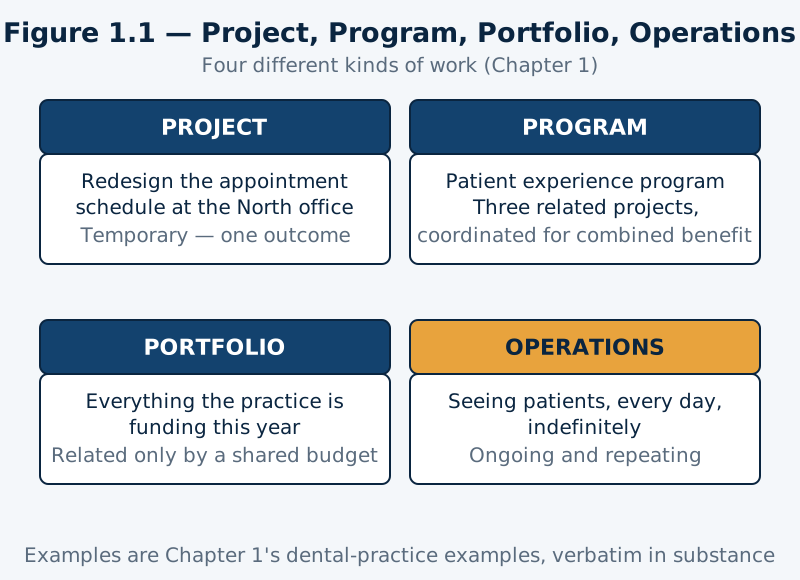
Four labeled panels. Project: "Redesign the appointment schedule at the North office" — temporary, one outcome. Program: "Patient experience program" — three related projects coordinated for a combined benefit. Portfolio: "Everything the practice is funding this year" — the program, a roof replacement, and a fourth-office expansion, related only by a shared budget. Operations: "Seeing patients, every day, indefinitely" — ongoing and repeating.
Where does authority sit in this family? Broadly: portfolio decisions decide which work exists; program decisions coordinate related work; project decisions deliver one outcome. A project manager does not choose the portfolio, and a portfolio board does not schedule a project's Tuesday. Much of the friction in real project life — and many examination scenarios — comes from a decision being pushed to the wrong level of this family. Chapter 2 picks the story up from inside the organization; Chapter 23 returns to it as governance.
An idea, however good, is not a project. A project begins formally when it is authorized — approved by someone with the standing to approve it, in a document that says so. That document is the project charter, and Chapter 5 takes it apart piece by piece; here you need only its role. The charter names the project, states its purpose and objectives in summary, names the project manager and grants them their authority, and records who authorized it. Before the charter, people are exploring an idea. After it, money may be spent, people assigned, and commitments made in the project's name. The charter is brief on purpose: it is a birth certificate, not a biography. The detailed plan comes later, and confusing the two — expecting the charter to contain the full plan — is another beginner error the examination is fond of.
Authorization matters for a second reason: it is the first appearance of a pattern that runs through the entire book. Projects move by decisions recorded by people with the authority to make them — to start, to change the plan, to accept the result, to close. The paper trail of Chapter 5 is simply that pattern, written down.
Five roles appear in nearly every project, and the beginner's job is to know what each one does all day — not their job title, their work.
The sponsor. The sponsor is the person (occasionally a small group) who wants the outcome, provides or secures the resources — above all, the funding — and champions the project inside the organization. The sponsor owns the business case. The sponsor authorizes the project by signing the charter, removes organizational obstacles that are above the project manager's pay grade, and makes the decisions that are the sponsor's to make: major changes, go/no-go judgments at major checkpoints, and final acceptance that the project has delivered what was promised. In the dental example, the practice owner is the sponsor. A sponsor is not a distant signature: an absent sponsor is one of the most reliable predictors of a troubled project, because decisions queue up with nobody empowered to make them.
The project manager. The project manager is the person accountable for leading the team to deliver the project's objectives — for planning the work, coordinating the people, watching for trouble, communicating honestly, and bringing the project to its end. Note the shape of that accountability: the project manager is accountable for the project, not for personally performing its technical work. A project manager of the scheduling redesign does not configure every screen of the new software; they make sure the person who does has what they need, that the work hangs together, and that the sponsor hears the truth about progress. How much formal authority a project manager has depends heavily on the organization's structure — Chapter 2's central topic — but the accountability is constant. This is the role the PMP® certifies, and the role from whose chair most of this book, and most of the examination, is written.
The project team. The team is the people who do the project's work: the analysts, designers, builders, testers, trainers — whatever the particular project needs. Team members are typically assigned from the organization's departments (Chapter 2's structures decide how easily) or brought in from outside. The team is not an audience for the project manager's plan; modern practice — and the current examination, emphatically — treats the team as the experts on how the work should be done, with the project manager creating the conditions for them to do it well. Chapters 4 and 7 develop that idea in full.
The customer. The customer is the person or organization that will use, receive, or pay for the project's result. Sometimes the customer is outside the organization (a client who commissioned a building); sometimes inside (the front-desk staff who will live in the new scheduling system are, in a real sense, its customers). The customer's acceptance is the project's final test: deliverables are formally accepted by the customer or the sponsor acting for them, and a project whose result is refused has not finished, however complete its paperwork looks.
Stakeholders. A stakeholder is anyone who can affect the project, be affected by it, or perceive themselves to be affected by it — a deliberately wide net. The dental redesign's stakeholders include the owner (sponsor), the front-desk staff (team and customers at once — roles overlap in real life), the dentists whose appointment books change, the patients, the software vendor, the landlord whose consent the office refit needs, and the staff member who loved the old system and fears the new one. Stakeholders can help a project or quietly strangle it, and the discipline of identifying them early, understanding what each needs, and engaging them deliberately occupies Chapters 9 and 10 in full. For now, one habit: when you hear of a project, ask who else cares about this, and what happens to them? You have just done stakeholder identification in its simplest form.
Two overlaps are worth stating plainly because beginners trip on them. One person can hold several roles — the owner above is sponsor and a stakeholder and, on her own appointments, an affected party. And the project manager is also a stakeholder in their own project. Roles describe hats, not separate species of people.
Exam trap — sponsor versus project manager. If an option has the project manager approving the business case, funding the project, or accepting the final result on the organization's behalf, suspect it. Those are the sponsor's acts. The project manager recommends, plans, leads, reports, and escalates; the sponsor authorizes, funds, champions, and accepts. The examination returns to this boundary constantly.
Every project, whatever its field, travels the same broad road: someone conceives it, someone authorizes it, the work is planned, the work is done, someone watches the doing against the plan, and the result is handed over and the project closed. Professionals name those stretches in various ways — initiation, planning, execution or delivery, monitoring and controlling alongside the work, and closing — and Chapter 5 walks the road properly with its documents. Here, walk it twice in story form, because the same road told in two styles is the seed of Chapters 3 and 4.
The predictive telling. The dental practice decides everything important up front. Analysts study the current scheduling, design the new process in detail, select the software, write a full plan — scope, schedule, cost, training, rollout office by office — and get it approved. Then the plan is executed: software configured, staff trained, Office 1 goes live on the planned date, then Office 2, then Office 3. Throughout, progress is measured against the plan, and any change to the approved plan goes through a formal change decision before it is adopted. At the end, the sponsor reviews the result against the objectives, accepts it, the project closes, and the new way of working passes into daily operations. This style — plan thoroughly, then execute the plan — is called predictive, and it suits work whose shape is well understood in advance.
The adaptive telling. Now imagine the practice is less sure what "good scheduling" looks like for its patients. Instead of designing everything first, a small team delivers a working piece of the new system every two weeks: first the online booking page for one office, shown to real patients, adjusted from their feedback; then reminder messages; then room-turnover alerts. Each delivered piece is usable, and what is learned from each piece reshapes what gets built next. The destination is still shorter waits, but the route is discovered as they go. This style — deliver in small, feedback-tested increments — belongs to the adaptive, or agile, family, and it suits work where the right answer emerges from trying things. Chapter 3 maps the whole spectrum between these two tellings, and Chapter 4 shows the adaptive style's daily mechanics.
Neither telling is a fairy tale about the other. Both projects have sponsors, charters in some form, teams, stakeholders, and an end. Both must watch cost, risk, and quality. They differ in when decisions are made: up front, on the basis of analysis — or progressively, on the basis of delivered evidence. Nearly every project you will ever meet lives somewhere between the two tellings, which is why hybrid approaches — blends — are the examination's home ground as much as either pole. Approximately 40% of examination items are predictive in orientation and the remaining approximately 60% are divided between adaptive/agile and hybrid approaches, spread through all three domains. (Source: PMI, PMP® Examination Content Outline — July 2026.)
Task 1 — Sort the work. Take any organization you know — a workplace, a school, a place of worship, a sports club. List ten pieces of work it does. Mark each P (project) or O (operations). For every P, write its intended end in five words or fewer. If you cannot write an end, it is probably operations in disguise.
Task 2 — Name the family. For one of your projects from Task 1, ask: is it related to other projects such that coordinating them together would help (a program)? What larger set of funded work does it compete with (its portfolio)? Write one sentence each.
Task 3 — Cast the room. For the same project, name the sponsor, the project manager, the team, the customer, and five stakeholders — including at least one stakeholder who might oppose the project, and what they stand to lose. That last name is the one beginners forget and examinations reward.
This chapter has deliberately taught the field before the examination, and it ends by naming what the rest of the book serves. The work described above — leading temporary, value-creating initiatives inside organizations — is a profession, and its best-known credential is the Project Management Professional (PMP)®, awarded by the Project Management Institute. This book is built against the PMP® Examination Content Outline — July 2026; the PMBOK® Guide — Eighth Edition is the current background guide. The front matter's Exam Blueprint page carries the verified facts — domains weighted People 33%, Process 41%, Business Environment 26%; 180 items in 240 minutes; the eligibility paths; the fees — each with its source, and Chapter 27 teaches the examination itself in full. Nothing more about the examination is needed until you have the field under you. From here to Chapter 27, the subject is the work itself.
Fifteen questions. Foundations level: recognition, vocabulary, and first use — with scenario items at the end, in the book's voice. The answer key is in the companion key file, ch-01-projects-from-zero-key.md, with an explanation for the key and for every distractor.
1. Which statement best defines a project, in the sense this book teaches?
A. Any large or expensive piece of work an organization undertakes B. A temporary initiative in a unique context, undertaken to create value C. Any work performed by a team under a manager's direction D. A repeating activity that keeps an organization running
2. A hospital's emergency department treats patients every day, around the clock, with no intended end. This work is best classified as:
A. A project, because lives depend on its quality B. A program, because many shifts contribute to it C. A portfolio component, because it consumes a budget D. Operations, because it is ongoing and repeating
3. A construction firm builds the same house design for the fortieth time, on a new site, with a partly new crew, for a new buyer. Why is this still a project?
A. Its context — site, crew, conditions, and buyer — is a unique combination, and the effort has a definite end B. Construction work is classified as project work by industry convention C. The house is expensive, and expensive work is project work D. The firm's other work is operations, so this must be the project
4. In a business case, the benefits of a proposed project are best described as:
A. The documents the project will produce for its files B. The features built into the project's main deliverable C. The measurable gains the project exists to produce D. The salaries saved by automating a manual process only
5. A city funds, from one budget, a bridge repair, a library digitization effort, and a fleet electrification program — three unrelated efforts chosen against each other for funding. Managed together as a set for investment decisions, they form a:
A. A program, because there is more than one project B. A portfolio, because they are grouped by shared funding and strategic choice, not by relatedness C. Operations, because a city runs them continuously D. A single project, because one authority approved them
6. Who owns the business case and champions the project inside the organization?
A. The sponsor B. The project manager C. The customer D. The portfolio manager
7. A project manager's core accountability is best stated as:
A. Personally performing the project's most difficult technical work B. Approving the business case and funding the project C. Accepting the final deliverable on the organization's behalf D. Leading the team to deliver the project's objectives — planning, coordinating, communicating, and bringing the project to its end
8. Which person or group is a stakeholder in a project to replace a school's enrollment system?
A. Only the vendor selling the new system B. Only the staff who will operate the system daily C. Parents, whose children's records move to the new system and who perceive themselves affected by it D. Only the sponsor who funded the replacement
9. When does a project formally come into existence?
A. When it is authorized and recorded in its charter B. When the team holds its first working meeting C. When the detailed project plan is finished D. When the first deliverable is produced
10. A project lasts nine years and produces infrastructure meant to serve for fifty. A colleague says it cannot be a project because "projects are brief and their results temporary." The colleague is:
A. Correct — duration and permanence are the deciding tests B. Correct about the result, wrong about the duration C. Correct about the duration, wrong about the result D. Wrong on both counts — temporary describes the effort's definite end, not its length, and the result is meant to outlast the project
11. Scenario. A bakery's owners approve funding to design and open a second location across town: new lease, new fit-out, new staff hired and trained, opening day in seven months. The daily baking at the existing shop continues unchanged. The second-location effort is:
A. Operations, because the bakery already knows how to bake B. A project, because it is temporary, unique in its context, and undertaken to create value C. A program, because it involves several departments D. A portfolio, because the owners approved its funding
12. Scenario. A sponsor asks the project manager to sign off the business case, release the project's funding, and formally accept the finished system at the end, "since you know it best." The best response is to:
A. Accept all three — closeness to the work qualifies the project manager B. Accept the acceptance only, and delegate the rest to the team C. Decline all three as sponsor's acts — the project manager recommends, plans, leads, and reports; the sponsor authorizes, funds, champions, and accepts D. Decline the funding release only, as the most sensitive act
13. Scenario. Three hospital projects — a new appointment system, a redesigned referral process, and a records upgrade — share the same front-desk staff and keep colliding. Managing them together specifically to capture the combined benefit and resolve their dependencies would make them:
A. A portfolio, because three projects always form a portfolio B. Operations, because the collisions are routine C. A single project with three workstreams, automatically D. A program, because related projects are being coordinated for a benefit none captures alone
14. Scenario. A project installs its new appointment system on the planned date, spends exactly its budget, and meets every stated specification. Six months later, waiting times are unchanged and staff have quietly returned to the old booking book. Judged by value, the project:
A. Has not succeeded — it delivered its output but not value worth the effort and expense to those it served B. Has succeeded — schedule, budget, and specification are the complete test C. Has succeeded, because value is judged only at the moment of handover D. Cannot be judged until the system is replaced
15. Scenario. A front-desk employee at the dental practice says of the scheduling redesign: "Nobody asked me, nobody told me, and the new system makes my mornings harder." Project language for this person, and the lesson, is:
A. An opponent, to be excluded from project communications B. A stakeholder — affected by the project and perceiving herself affected — whose early identification and engagement the project missed C. A customer, whose acceptance alone decides the project D. A team member, because all employees are team members
Copyright © 2026 Feras Alzubi. All rights reserved.
No part of this book may be reproduced, distributed, or transmitted in any form or by any means without the prior written permission of the copyright holder, except as permitted by law.
Originality statement. This is an original work, written for this book. Every practice question in this book is original. The questions were written fresh for this book, against PMI's published PMP® Examination Content Outline — July 2026, and are taught from concepts stated in this book's own words. They are not PMI's questions, they are not copied or adapted from any other preparation book, course, or question bank, and no real examination item — actual, recalled, paraphrased, or otherwise — appears anywhere in this book.
Not-affiliated disclosure. This book is an independent study guide. It is not published by, affiliated with, endorsed by, or approved by the Project Management Institute, and the Project Management Institute did not participate in its creation.
The author's name. The copyright holder's name appears on this page and in the store metadata, and nowhere else inside this book. The book stands on its sources, which are named wherever they are used and listed in full in the References.
This book is an independent study guide. It is not published by, affiliated with, endorsed by, or approved by the Project Management Institute, and the Project Management Institute did not participate in its creation. Exam names and trademarks belong to their respective owners. Passing any exam also depends on the candidate's own preparation; no book can guarantee a result.
Those sentences matter, and two of their consequences are stated here at the front, not buried at the back.
First, this book does not promise that you will pass, earn a credential, get a job, or earn any particular income. It teaches the whole field of project management from the beginning, teaches the whole published examination outline at depth, and drills you with original practice questions whose answers are explained in full. That is what a study book can honestly do, and it is what this one does.
Second, this book is preparation, not eligibility. The PMP® requires 35 hours of commercial project management training aligned to the examination outline, completed before the certification is granted — and the Project Management Institute states expressly that books and practice exams alone will not be accepted as eligible commercial training. (Source: PMI, PMP® Examination Content Outline — July 2026, "Commercial Training Requirements.") Reading this book, however carefully, satisfies none of those 35 hours. Chapter 27 explains what does count, and how the rest of the application works. A study book that let you discover that rule after the examination would have failed you; this one prints it on its first pages.
Provenance note. Every practice question in this book is original. The questions were written fresh for this book, against PMI's published PMP® Examination Content Outline — July 2026, and are taught from concepts stated in this book's own words. They are not PMI's questions, they are not copied or adapted from any other preparation book, course, or question bank, and no real examination item — recalled, paraphrased, or otherwise — appears anywhere in this book. Where a question turns on an examination fact or a formula, its explanation names the source that fact or formula comes from.
A note on the marks. "PMI," "PMP," "PMBOK," "CAPM," "PMI-ACP," and "PgMP" are marks of the Project Management Institute, Inc. They are used in this book nominatively only — to name the credential and the body that awards it. This book never claims Authorized Training Partner status, and no part of it is PMI-endorsed preparation material.
Everything on this page was checked against PMI primary sources on October 29, 2026. Each figure carries its source on the page, in the way the whole book carries its sources. Where a figure could not be verified from a PMI primary source, this page prints no figure at all — and says so, because the silence is itself information.
The credential. The Project Management Professional (PMP)® is awarded by the Project Management Institute (PMI). This book is built against the PMP® Examination Content Outline — July 2026; the PMBOK® Guide — Eighth Edition is the current background guide. The updated examination built on that outline has been in force since July 9, 2026. (Source: PMI, PMP® Examination Content Outline — July 2026.)
What the examination is built from. The outline comes from PMI's global job task analysis, developed with Alpine Testing Solutions. The examination is not written according to any single text — the outline states that expressly, and states that PMI does not endorse specific preparation materials. (Source: PMI, PMP® Examination Content Outline — July 2026, Introduction and Resources.) That is why this book's alignment claim is worded the way it is: built against the ECO — July 2026; PMBOK® Guide — Eighth Edition is the current background guide. It never claims to be built against the PMBOK® Guide itself.
The three domains and their weights. (Source: PMI, PMP® Examination Content Outline — July 2026, Exam Content Outline table.)
| Domain | Weight |
|---|---|
| People | 33% |
| Process | 41% |
| Business Environment | 26% |
The outline organizes the work into 26 tasks — People 8, Process 10, Business Environment 8 — and every examination includes questions on all tasks in each domain. (Source: PMI, PMP® Examination Content Outline — July 2026.)
Approach mix. Approximately 40% of items are predictive; the remaining approximately 60% are divided between adaptive/agile and hybrid approaches, spread through all three domains and never isolated to one domain or task. Exact counts may vary by form. The outline gives no finer split between agile and hybrid, and this book invents none. (Source: PMI, PMP® Examination Content Outline — July 2026, Exam Content Outline note.)
Items and time. The examination has 180 questions: 170 scored and 10 pretest (unscored), placed randomly. You cannot tell a pretest item from a scored one, and you should answer every item as if it counted — because the ones that count are indistinguishable from the ones that do not. The center-based examination allows 240 minutes. The optional tutorial before the examination and the survey after it sit outside those 240 minutes. (Source: PMI, PMP® Examination Content Outline — July 2026, "PMP Certification Exam Information"; corroborated on PMI's PMP® certification page, checked October 29, 2026.)
Breaks — and the rule that catches people. There are two 10-minute breaks: the first after the case-study section, the second approximately midway through the independent-question portion. Once a section is reviewed and its break starts, you cannot return to that section's questions. (Source: PMI, PMP® Examination Content Outline — July 2026.) Chapter 27 turns that rule into a working break discipline; learn it before examination day, not during the first break.
Question types. The July 2026 outline lists eight types: Case or Scenario and Graphic-Based (both new in this outline); Multiple-Choice Single Response and Multiple Response; and — in computer-based testing only — Enhanced Matching, Point and Click (hotspot), Matching, and Pull-Down List. The examination also includes drag-and-drop forms and practicum hands-on testing that may include tools, data, and case-study questions. Fill-in-the-blank, which appeared on the retired examination, is not in the July 2026 list. (Source: PMI, PMP® Examination Content Outline — July 2026, "PMP Certification Exam Question Types.") A printed book cannot reproduce a drag-and-drop or a hotspot. Chapter 27 describes those formats in words, and this book's practice apparatus uses the honest print equivalents: case sets, multiple-response items, and data-table items for the Graphic-Based type. It never fakes an interactive format in print.
Delivery. In person at a Pearson VUE test center (computer-based testing; paper-based testing in limited regions), or online proctored. (Source: PMI, PMP® Examination Content Outline — July 2026, "Taking the PMP Certification Exam.")
Scoring — stated honestly. PMI does not publish a passing score. Each scored question is worth one point, and subject-matter experts determine how many correct answers passing requires. Your result report shows an overall result and a per-domain result in four rating categories: Above Target (exceeds the minimum requirements), Target (meets them), Below Target (slightly below; does not meet them), and Needs Improvement (far below; does not meet them). (Source: PMI, Sample Exam Result Report; PMI, PMP® Examination Content Outline — July 2026, scoring-model note.) No percentage in circulation — in any book, course, forum, or video — is PMI's passing score, because PMI does not publish one. Where this book gives readiness bands for its own practice tests, those bands are this book's own study guidance, not a PMI standard, and they are labeled that way in the same paragraph every time they appear.
Eligibility — education and experience. All qualifying experience must be non-overlapping months leading and directing projects, in a professional setting, accrued within the last 10 years before applying. Four paths, by education:
Experience is recorded project by project but counted in months, and overlapping months count once. Experience need not be paid, but school projects, academic research, personal events, and home-improvement projects do not qualify, and routine operational or administrative work does not count. Applications may be audited. (Source: PMI, PMP® Examination Content Outline — July 2026, "PMP Certification Eligibility Requirements.")
Eligibility — training. 35 hours of commercial project management training aligned to the outline, completed before the certification is granted. Qualifying sources include PMI Authorized Training Partners, China Registered Education Providers, GAC programs, accredited higher-education courses, employer or company programs, training companies or consultants, and self-paced on-demand courses with an end-of-course assessment. One hour of classroom instruction equals one training hour, and only the project-management portion of a mixed course counts. An active CAPM® holder's training requirement is waived, and GAC coursework can count toward the 35 hours. And, repeated because it governs this book: books and practice exams alone will not be accepted. (Source: PMI, PMP® Examination Content Outline — July 2026, "Commercial Training Requirements" and "Credit for Prior Learning Paths.") One further dated note: PMI's PMP® page, checked October 29, 2026, states that from December 1, 2026, live classes are eligible only if delivered by an Authorized Training Partner, a China Registered Education Provider, or an eligible accredited higher-education program (including GAC programs). The July 2026 outline itself does not state that tightening. Confirm the current rule in your application. (Source: PMI, PMP® page, as read October 29, 2026 — a program-page statement, not an outline requirement.)
Fee. PMI member $405.00 · non-member $655.00 (USD), as stated on PMI's PMP® certification page, checked October 29, 2026. Confirm the fee in your application before you pay; fees can change, and the application is the controlling statement at the moment you pay. If you meet a different figure in another source — including other PMI pages quoting promotional bundle arithmetic — the certification page is the fee's home, and this book prints only its figures.
Retakes. Up to 3 attempts within the 1-year eligibility period. After a third failure, you wait 1 year from the date of the last exam before reapplying. If the eligibility year expires without a pass — even with attempts unused — you reapply with no waiting period. (Source: PMI, PMP® Examination Content Outline — July 2026, "Retaking the PMP Certification Exam.") The re-examination fee amount is not printed in this book: no PMI primary source stating it was verified for this edition, so you confirm the current amount in PMI's fee schedule when you need it. The policy above is verified; the amount is deliberately absent.
After certification. Maintain the PMP® by earning 60 Professional Development Units (PDUs) every 3 years and paying the certification renewal fee. (Source: PMI, PMP® Examination Content Outline — July 2026, "Continuing Certification Requirements (CCR) Program.") The renewal fee amount is likewise not printed here, for the same reason as the re-examination fee: confirm it in PMI's current fee schedule at renewal time.
What success means now. The July 2026 outline aligns with PMI's thought-leadership work on maximizing project success: success is reframed from schedule, budget, and scope alone to delivered value that was worth the effort and expense, judged with stakeholders. (Source: PMI, PMP® Examination Content Outline — July 2026.) Chapter 3 teaches that definition where the word value is first defined, and the whole book is organized around it: a project that finishes on time and delivers nothing worth having has not succeeded.
Remember the numbers — with their sources. 33 / 41 / 26 (domain weights). 26 tasks. 180 items, 170 scored, 10 pretest. 240 minutes. Two 10-minute breaks, no return. 60 / 48 / 36 / 24 months. 10 years. 35 training hours. $405 / $655. 3 attempts in 1 year. 60 PDUs every 3 years. Every one of those figures traces to the PMI sources named on this page, checked October 29, 2026. One number is missing on purpose: there is no passing-score figure, because PMI does not publish a passing score.
This book serves two readers at the same time, and both of them may be you.
If you are a total beginner, you have never managed a project on purpose, and some of the words on the page above — portfolio, pretest, predictive — are new. That is expected, and the book is ordered for you. Part I (Chapters 1–5) teaches the foundations from zero: what a project is, who the people are, how organizations shape the work, the ways a project can be run, what the agile ways of working actually look like day to day, and the paper trail every project leaves. Every term is defined the first time it is used. Do not skip Part I to "get to the exam material." The later chapters assume exactly what Part I teaches, and the examination's scenarios assume it too.
If you are an experienced project manager preparing for the credential, Part I will move faster for you. Use it as a precision check: the examination uses the field's words — project, program, sponsor, baseline, tailoring — in their precise senses, which are sometimes narrower than workplace usage. Chapters 6 onward assume the foundations and build the working discipline on top of them, task by task, and Part III builds the judgment layer: governance, compliance, change, risk, and the integrated scenarios the examination favors.
Every review chapter follows the same rhythm:
Two things about the quizzes deserve emphasis. First, a wrong answer in this book is never random: each distractor is a named, common error — a neighboring concept confused with the one tested, a rule applied in the wrong approach, a step taken out of order. Reading the key teaches even when you answered correctly. Second, foundations quizzes (Chapters 1–5) test recognition, vocabulary, and first use, and each still ends with scenario items in the book's voice; core and advanced quizzes test application and judgment. Nothing is tested before the chapter that teaches it has taught it at working depth.
Figure FM.1 — The Study Loop.
Diagnostic test (taken cold) → score by domain in the tracker → chapters and chapter quizzes in order → Practice Test 1, timed → targeted restudy of the chapters your misses point to → Practice Test 2, timed → examination day. A caption rule printed under the loop reads: the routing rules in the tracker and the study plans are this book's own study guidance, not a PMI standard. PMI does not publish a passing score.
The diagnostic test stands in the front matter of the full book, immediately after this section, and both study plans begin with it. It contains 50 original questions — People 18, Process 19, Business Environment 13 — the outline's weights of 33 / 41 / 26 applied to 50 and rounded, moved by one item because the communication-channels question belongs to the People domain's communications task, with the rounding and the move disclosed in the test's own notes. It is taken cold, in no more than 60 minutes, before you study, and it is scored by domain, not only in total: the Score-by-Domain Tracker converts each domain result into a study priority and points to the exact chapters that teach that domain's tasks.
The tracker's routing rules — and every readiness band in this book — are this book's own study guidance, not a PMI standard. PMI does not publish a passing score, and no score in this book, diagnostic or practice, is a prediction of your examination result in either direction. A low diagnostic score costs you nothing today and buys you an honest map. The same gaps discovered on examination day are the expensive version.
The back matter carries both plans day by day, referenced to chapters and tests.
The standard plan (about four weeks). Diagnostic first, cold. Then the chapters in order — Part I without skipping, whatever your background — taking each chapter quiz before moving on and re-reading any section a missed question points back to. In the final week, take Practice Test 1 and Practice Test 2 on separate days, under real timing (180 items, 240 minutes, with the two breaks taken where the real examination places them), review every missed item against the chapter it maps to, and re-read Chapter 27 the day before you test.
The intensive plan (about two weeks). Diagnostic first, cold, and let it triage you. Experienced readers may move through Part I at double pace only where the diagnostic shows the foundations are already theirs; the saved time goes to the chapters the diagnostic flags. Every chapter quiz is still taken — the quizzes are where wrong understandings surface while they are still cheap to fix. Finish with both practice tests, timed, on separate days.
In both plans, treat the practice tests as rehearsals of the whole event, not as question banks: same timing, same breaks, same no-return discipline at each break. The examination's format is part of what is being trained.
Front matter — this page; the Exam Blueprint page; How to Use This Book; the diagnostic test and the Score-by-Domain Tracker. The free sample of this book is Chapter 1 plus the diagnostic test, so a buyer can judge the teaching and see their own score by domain before paying.
Part I — Foundations (from zero)
Part II — Core knowledge
Part III — Advanced material
Part IV — Exam layer
Back matter — two full timed practice tests (180 items each, 240 minutes, with full answer keys); the 2-week intensive and 4-week standard study plans; cheat sheets (domain-and-task map; formulas, each with a worked mini-example; numbers; ways-of-working distinctions; a retired-figures trap box); glossary; errata and updates page; References; and the printed outline crosswalk appendix, so you can verify for yourself that every task and enabler in the outline has a home chapter.
Every examination fact, fee, deadline, and count in this book traces to a PMI primary source — the July 2026 Examination Content Outline or PMI's own certification pages — and the source is named where the fact is used. Facts that could not be verified from such a source are not printed as facts. You will therefore not find in this book: a passing score or pass percentage (PMI does not publish a passing score); a pass rate or candidate volume; a re-examination fee amount or a CCR renewal fee amount (the policies are taught in Chapter 27; the amounts were not verified from a PMI primary source for this edition, so you confirm them in PMI's current fee schedule); the enumerated names of the PMBOK® Guide — Eighth Edition's six core principles as a list (the count of six is verified from PMI's own PMBOK® Guide page, and the principles are taught as concepts in this book's own words — the name list itself was not read in a PMI primary document for this edition, so it is not printed as a list); salary figures or earnings claims of any kind; or any promise about jobs or income.
Silence, in those places, is deliberate. A study book that guesses at numbers teaches you to guess — and guessing, on an examination built from scenarios with exactly one defensible answer, is the habit this book exists to replace.
End of the free sample. The complete book continues from here — the full A-to-Z course in book form, delivered as an EPUB you can read in Apple Books, Google Play Books, ReadEra, Thorium Reader, Adobe Digital Editions, or Send to Kindle.
Buy this ebook — $11.99 Back to the book page
Payments are securely processed by Payhip.