
Mastering Careers & Skills
Journeyman & Master Plumber License Exam · free sample from the book itself
1-1. Key: B. Licensing is state-run and exams are built on the state's adopted model code — IPC or UPC (§1.1, §1.3). - A is wrong: there is no federal plumber exam; the federal government does not license plumbers. - C is wrong: the NEC is the electrical code; it contains no plumbing exam content. - D is wrong: vendors administer exams, but the content basis is the adopted code, not a vendor's private code. - Study next: the same structure is worked as a procedure in Chapter 29.
1-2. Key: C. The ICC — publisher of the I-Code family — publishes the International Plumbing Code (§1.3). - A is wrong: IAPMO publishes the other code, the UPC — the book's most basic pairing, tested from both directions. - B is wrong: ASME publishes mechanical and pressure-equipment standards, not the IPC. - D is wrong: the NFPA publishes fire codes and the NEC; not the IPC.
1-3. Key: A. The UPC is IAPMO's ANSI-accredited American National Standard (§1.3). - B is wrong: it is a model code adopted by jurisdictions, not a federal regulation. - C is wrong: California bases its state code on the UPC, but the UPC itself is national in scope. - D is wrong: the UPC is an independent code, not part of the IPC.
1-4. Key: D. The qualitative split — IPC majority, UPC minority concentrated in the West, state codes based on models, some local choice — is the verified picture (§1.3). - A is wrong: no exact state count is printed in this book; no authoritative adoption census was verified (the fence). - B is wrong: the river is not the boundary — Texas municipalities appear on IAPMO's UPC list, and UPC states sit on both sides of it. - C is wrong: adoption is a state (sometimes local) act, not federal law.
1-5. Key: A. 100 scored items, 240 minutes, 70% (70 correct), compensatory (PSI, Colorado bulletin; §1.5). - B is wrong: those are the Colorado Master item count and time, with NITC's pass line mixed in — three facts from three different rows. - C is wrong: 150 minutes and 75% are NITC's time and pass line. - D is wrong: no verified exam in this book has 50 items.
1-6. Key: C. Colorado provides the IPC/IRC and forbids writing, highlighting, underlining, and indexing (§1.5, §1.6). - A is wrong: a personal, marked copy describes the NITC regime. - B is wrong: the books are present — they are the center's copies. - D is wrong: marking is expressly prohibited; "freely marked" reverses the rule.
1-7. Key: B. Formulas are not provided and may not be brought in; the bulletin directs candidates to review theory and formulas (§1.5). - A is wrong: no formula sheet exists in this regime — which is why Chapter 5 is load-bearing for Colorado candidates. - C is wrong: proctors do not supply formulas. - D is wrong: the provided books are standard code copies; they contain no added formula insert.
1-8. Key: B. Tables 702.1, 610.3, 610.4, and 610.10 are provided with Washington's otherwise closed-book exam (L&I Form F627-008-000; §1.5). - A is wrong: the exam is closed book; the whole UPC is not provided. - C is wrong: Table 703.2 is precisely the table withheld — the single most strategic fact about this exam (Chapter 19). - D is wrong: personal notes are not permitted.
1-9. Key: D. Washington adds a waste-and-vent sizing exercise (UPC Ch. 7) and a water-piping sizing exercise (UPC Ch. 6), each worked from a supplied drawing (§1.5). - A is wrong: if your jurisdiction includes a practical (hands-on) examination, no book can rehearse it for you — this book teaches the knowledge and methods the practical is built on; and no practical component is part of Washington's published format here. - B is wrong: no oral interview appears in the application. - C is wrong: no essay appears in the application. Study next: the exercise format is rehearsed in Chapter 30 and Practice Test 2.
1-10. Key: A. NITC: own 2021 UPC, open book, 100 items, 150 minutes, 75% (NITC bulletin; §1.5). - B is wrong: closed book with those numbers matches no verified exam; 240 minutes is Colorado's time. - C is wrong: 120 items and 270 minutes are Colorado's Master figures, and NITC's pass line is 75%, not 70%. - D is wrong: NITC is a national certification, not a state license; it does not itself license anyone to work in any state.
1-11. Key: D. Sizing Fuel Piping is one of NITC's four 25% quarters — the evidence for teaching shared fuel-gas sizing basics (§1.5). - A is wrong: General Knowledge is a quarter too, but it justifies no specialty chapter. - B is wrong: water sizing justifies Chapter 9, not the fuel-gas chapter. - C is wrong: DWV sizing justifies Chapters 18–19. Study next: Chapter 24 teaches the basics; state gas-fitter endorsements remain fenced there.
1-12. Key: B. The transition is Colorado-only and dated: 2024 IPC/IRC from November 1, 2026; 2021 books on request until February 1, 2027 (PSI bulletin; §1.7). - A is wrong: no other state's date was verified; transitions are jurisdiction-specific. - C is wrong: the IPC continues — in a new edition, in one state's exams. - D is wrong: the board sets the edition by test date; candidates do not choose.
1-13. Key: B. 70% of 120 = 0.70 × 120 = 84 correct (PSI bulletin; §1.5). Designated calculation — Percentage and estimating math family (percent-of-quantity method, Chapter 5). - A is wrong: 70 is the percent copied into the count seat — and it is the Journeyworker number (70% of 100), the trap this item was built around. - C is wrong: 90 is 75% of 120 — NITC's pass line applied to Colorado's count. - D is wrong: 120 is the whole exam; a 70% line cannot require all of it.
1-14. Key: D. Verified state figures print only in the dated, per-row-sourced State Variation Table (§1.8; full version in Chapter 29). - A is wrong: the book prints no national averages of state facts, because state facts are not averages-able — each belongs to one state. - B is wrong: the glossary defines terms; it carries no licensing figures. - C is wrong: verified figures do print — Colorado's $78/$73 and Washington's $202.10 are in §1.8 — but only under the table's discipline (the fence).
1-15. Key: C. The fence sentence, verbatim (§1.2): a book teaches the knowledge and methods; the performance is learned in the trade. - A is wrong: written quizzes cannot rehearse a hands-on performance, and this book never claims they do. - B is wrong: no waiver of any licensing requirement is available through any book. - D is wrong: no such nationwide abolition exists or was verified; the claim invents a dated national fact — exactly the species of statement this book fences.
What this chapter does. This chapter is the front door of the book, and it assumes nothing — not that you have held a wrench, not that you know what a code is, not that you know which exam you will take. By the end you will be able to describe what plumbers actually do all day; explain how plumbing licenses are structured (and why this book prints almost no state licensing numbers); name the two model codes every state exam is built on and the organizations that publish them; find — yourself, from your own board's publications — your state's code, edition, exam format, fee, and book rules; and read the three real exam outlines this book verified, so that everything later in the book has a frame to hang on. One warning before we start: this chapter contains the book's whole honesty apparatus in miniature. Where a fact is verified, it is printed with its source. Where a fact belongs to your state, this chapter teaches you to go and get it. Learn to tell those two kinds of sentence apart and you have learned the most transferable skill in the book.
Simplify. Plumbing is the trade that moves water into a building, makes it available — hot and cold, at usable pressure — where people need it, and then takes it away again, safely, together with everything the building's occupants send down with it. Every job in the trade is a variation on those three movements: supply, use, and disposal. If you remember nothing else from this section, remember the loop: water arrives under pressure, is used at fixtures, and leaves by gravity. The two halves of the system obey different physics — supply is pressurized, drainage is not — and nearly every rule in both plumbing codes exists to manage one of those two facts or the dangerous places where the two halves could meet.
Explain — a walk through one house. Clean water reaches the building from a public water main in the street through a pipe called the service line. A meter measures how much the building uses, and a main shutoff valve lets the whole building's supply be stopped at one point. From there, distribution piping branches to every fixture — a fixture being any device that uses water and discharges to drainage: the water closet (the code's name for what everyone else calls the toilet), lavatory (the bathroom sink — in plumbing, "lavatory" is the fixture and the room is a bathroom), bathtub, shower, kitchen sink, dishwasher, clothes washer, and the water heater that serves the hot side of most of them.
What goes down a fixture's drain enters the DWV system — drainage, waste, and vent — the book's most-used abbreviation and the subject of its largest part. Drainage piping carries water and waste away by gravity, which is why drainage pipes run downhill at a code-set slope and why they are larger than supply pipes: nothing pushes their contents. Each fixture drains through a trap, a fitting whose bend holds a plug of water — the trap seal — that blocks the air in the drainage system (sewer gas, carrying everything from bad smells to genuinely harmful gases and pathogens) from rising into the room. Behind the traps, a network of vent pipes keeps air pressure in the drainage system near atmospheric, so that flowing water cannot siphon or blow those seals away; the vents end above the roof. The building's lowest drain collects everything and hands it to the building sewer, which runs to the public sewer or to an onsite disposal system. In many buildings a plumber's world also touches storm drainage (rain water, handled separately from sanitary drainage), fuel gas piping, water treatment, medical and industrial specialties this book fences off in Chapter 25, and the pumps that lift water or waste where gravity cannot do the job.
Detail — the kinds of work. The trade divides, roughly, into:
All three kinds are the same knowledge wearing different clothes: the systems, the materials, the code rules, and the mathematics in this book. That is why this book can teach the field and the exam in one course: the exam, in every verified outline, samples the field.
Simplify. A plumbing license is a state-issued permission to do plumbing work, granted after the state is satisfied — usually by examination plus verified experience — that the holder knows the work and its code. Licensing exists because bad plumbing is not a private misfortune: a cross-connection can contaminate a neighborhood's drinking water, and a failed trap seal spreads one building's sewer gas into its rooms. The license is the public's evidence, and the exam is the state's way of checking knowledge it cannot watch you use.
Detail — the tier structure. Names and details vary by state, and this book prints the structure, never a state's specifics:
Exam trap — tier names are not portable. The tier structure above is nearly universal; the tier names, the experience hours each tier demands, whether education can substitute for hours, exam fees, renewal cycles, and reciprocity between states are all set state by state. A book (or a website, or a well-meaning coworker) that states one state's hours or fees as if they were everyone's is wrong for most readers. This book's fence is absolute: fees, experience hours, education requirements, license tiers and names, renewal cycles, reciprocity, and eligibility rules are never stated as general facts and never invented per state. They appear only in the dated State Variation Table (§1.8 below, and in full in Chapter 29), built from states' own publications with the source and date printed on every row. Everything else you need about your own license is in your board's candidate bulletin — and finding it there is a taught skill (§1.4), not homework we are dodging.
Two more structural facts belong here. First, some jurisdictions add a practical component to licensing. If your jurisdiction includes a practical (hands-on) examination, no book can rehearse it for you — this book teaches the knowledge and methods the practical is built on; the performance itself is learned in the trade. Second, the written exam is not the whole license: experience verification, application, fees, and sometimes background or insurance requirements stand around it. The bulletin lists them all; the exam is simply the part a book can prepare you for, so it is the part this book is about.
Simplify. A model code is a complete plumbing code written by a national standards organization, published for governments to adopt. A state (or, in some places, a city or county) adopts a model code — sometimes exactly as published, sometimes with its own amendments — and that adopted text becomes the law plumbers in that jurisdiction are examined on and held to. Think of the model code as the master document and each state's adopted code as that state's official copy of it, possibly with pages changed. Your exam tests your state's copy — which is why this book teaches the model text and, relentlessly, teaches you to check your state's amendments against it.
Detail — the two publishers.
Both codes are republished on three-year cycles (2018, 2021, 2024, and so on), so every code value has not only a code name but an edition — and the edition is part of the value's identity. A trap-arm length quoted without its code and edition is not a fact; it is half of two different facts. This is why this book labels every edition-dependent value at the point where it appears: 2021 IPC or 2021 UPC, with the chapter, section, or table named. Those labels are not decoration. On a dual-code exam — and on a job where the neighboring state uses the other code — the label is the difference between right and wrong.
Explain — the adoption shape. Which code governs where? The honest, verified shape is qualitative: the IPC is in use in a majority of states. The UPC is used in a minority of states, concentrated in the West — IAPMO's ANSI listing names UPC states including Alaska, Montana, Nevada, South Dakota, New Mexico, Hawaii, and Washington, and Iowa adopted the 2021 UPC. Several states publish their own codes based on one of the models: California, Minnesota, and North Dakota build on the UPC, and Oregon's code is based on the 2021 UPC. In some places the choice is local: Texas home-rule municipalities choose their own code, and IAPMO names Los Angeles, Houston, Minneapolis, Seattle, and Portland as UPC municipalities.
Notice what this book does not print: an exact count of IPC states versus UPC states. Publisher claims about adoption exist — the ICC's own filings have put the IPC's reach at a stated number of states, dated to its filing — but a publisher's claim is not a census, and no authoritative adoption map was verified for this book. The count, in any case, would not help you. The only adoption fact that can affect your score is your own jurisdiction's, and the next section turns getting it into a procedure.
Show — the maps of the two codes. Navigation is a tested skill in this book (Chapter 30 drills it), and it starts with knowing each code's chapter order cold. The two codes organize the same craft differently, and their chapter maps are worth meeting now, side by side.
Figure A-17 — IPC Chapter Map.
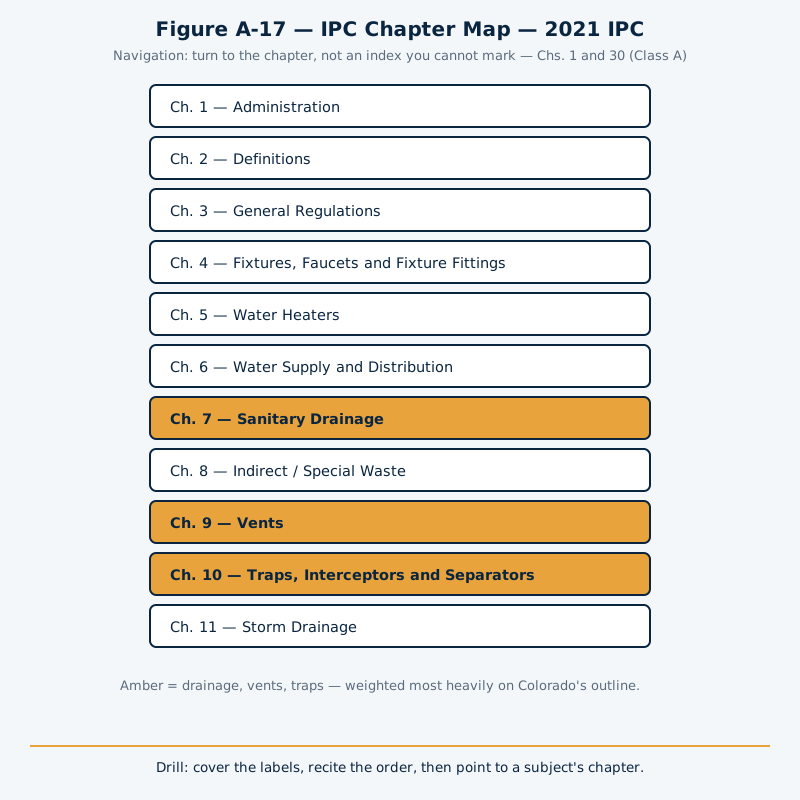
The 2021 IPC's chapter order as a navigation map: administration, definitions, general regulations, fixtures, water heaters, water supply, sanitary drainage, indirect waste, vents, traps and interceptors, and storm drainage. Learn the order and a provided, unmarkable exam copy becomes searchable by memory — you turn to the chapter, not to an index you cannot mark.
Figure A-18 — UPC Chapter Map.
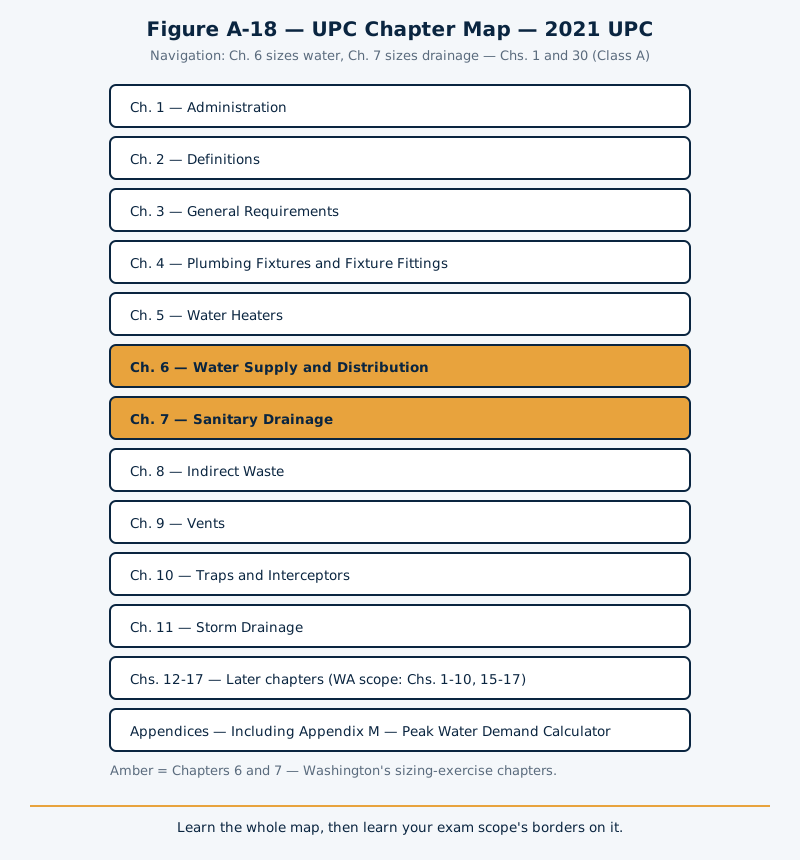
The 2021 UPC's chapter order as a navigation map: administration, definitions, general requirements, fixtures, water heaters, water supply and distribution (Chapter 6 — the sizing-exercise chapter on Washington's exam), drainage (Chapter 7), indirect waste, vents, traps and interceptors, and storm drainage, with the later chapters and appendices — including Appendix M, the Peak Water Demand Calculator — noted. Washington's exam draws its questions from Chapters 1–10 and 15–17 plus state amendments.
Do. Here is the exact procedure this book will ask you to repeat in Chapter 29. Run it once now, in draft, so the rest of the book is aimed at the right exam.
Exam trap — secondary summaries. Exam-prep sites summarize state exams, and their summaries conflict with each other and go stale silently. For two states whose names circulate in such summaries, this book's researchers found only secondary sources with conflicting formats, and so — per this book's rules — prints no format for them at all. Treat every secondary summary you meet the same way: a lead for finding the bulletin, never a substitute for it.
Detail. Everything about exam formats in this book rests on three primary documents, read in full on October 30, 2026: the PSI candidate bulletin for the Colorado State Plumbing Board; the Washington Department of Labor & Industries plumber exam application (Form F627-008-000); and the NITC candidate bulletin for its Journey Level Plumber certification. All three exams ask 100 scored questions. Everything else varies — study the table in the front matter's Exam Blueprint pages until the differences are familiar, because the differences are what "exam format" means when there is no national exam.
Colorado Journeyworker (PSI bulletin). 100 scored items in 240 minutes, plus up to 10 non-scored items with 30 additional minutes allowed for them. Passing is 70% — 70 correct — with compensatory scoring, meaning the score is a single total across all topics: strength in drainage can offset weakness in water heaters, because no section must be passed separately. The references are the 2021 IPC and 2021 IRC. The published content outline — Sanitary Drainage 20, Vents 18, Water Supply 15, Storm Drainage 10, Fixtures and Equipment 8, Water Heaters 7, General Regulations 5, Traps/Interceptors/Separators 5, Indirect and Special Waste 5, Isometric Analysis 5, Residential Fire Sprinklers 2 — is a map of the exam's mind: drainage and vents together are 38 of 100, and this book's Part IV is sized to match. The book regime is the strictest of the three (§1.6), and formulas are not provided and may not be brought in — the bulletin directs candidates to review theory and formulas, which in plain terms means Chapter 5 of this book is not optional for a Colorado candidate. Colorado's Master exam, in the same bulletin, asks 120 scored items in 270 minutes at the same 70% line — 84 correct. Master-specific requirements beyond that verified contrast are fenced (they are state facts, and this book does not print state facts it has not verified from the state's own publication).
Washington Journey Level (L&I application). A closed-book exam in three parts: 100 questions of technical and general trade knowledge drawn from UPC Chapters 1–10, 15, 16, and 17 and Washington's state amendments; a waste-and-vent sizing exercise (UPC Chapter 7), in which a building drawing is supplied and the candidate supplies fixture units and pipe sizes; and a water-piping sizing exercise (UPC Chapter 6), in the same format. Four UPC tables are provided with the exam — Tables 702.1, 610.3, 610.4, and 610.10 — and Table 703.2 is not provided, a withholding so pointed that Chapter 19 of this book is built around it. PSI administers the exam; the Department determines eligibility; the passing standard is set by the Department and is not stated in the application, and no total exam time is stated in the application either — this book prints neither, and a Washington candidate takes both from the Department and the scheduling confirmation. Washington's specialty exams also draw on state law (RCW/WAC) — state content this book fences rather than teaches (§1.2's rule, applied).
NITC Journey Level (NITC bulletin). A national certification — a credential, not a state license — built on the 2021 UPC: open book (the candidate's own 2021 UPC), 100 multiple-choice questions, 150 minutes, passing at 75% — 75 correct. The content is weighted in four equal quarters: General Knowledge of the UPC; Sizing Drainage, Waste, and Vent Systems; Sizing Water Supply and Distribution; and Sizing Fuel Piping, 25% each. Read that last quarter twice. A verified national outline weights fuel-piping sizing as heavily as water sizing; that weighting is the entire reason Chapter 24 of this book teaches shared fuel-gas sizing basics, while state gas-fitter endorsements — which are separate credentials with their own rules — stay fenced, named as existing and never specified.
Remember the numbers (with their labels). Colorado: 100 items · 240 min · 70% · provided, unmarkable IPC/IRC · no formulas provided. Washington: 100 questions + 2 sizing exercises · closed book · 4 named tables provided, 703.2 withheld · time and pass line not stated in the application. NITC: 100 items · 150 min · 75% · your own 2021 UPC. Every number in that box is a dated fact from a named bulletin — and the box is also this book's confession that three exams are a sample, not a census. Your exam is the fourth column, and §1.4 is how you fill it in.
Explain. Candidates say "open book" as if it were a single condition. In the verified landscape it is three different examinations of three different skills, and preparing for the wrong one is a quiet way to lose a passing score.
Regime 1 — provided, unmarkable book (Colorado). The code is in the room, but it is the center's clean copy: you may not write in it, highlight it, underline it, or index it, and nothing else — no notes, no formulas, no personal copy — is allowed. In this regime, lookup speed is navigation speed: knowing that trap arms live in the traps chapter, that vent sizing is a table keyed by load and developed length, that the fixtures chapter carries the minimum-facilities table. You cannot mark the map, so you must memorize the map. Chapters 6 and 30 train exactly that, and the chapter-map figures in §1.3 are your first drill: cover the labels and recite the order.
Regime 2 — your own book (NITC). Your prepared 2021 UPC is the tool. Tabbing pays. Highlighting pays. A book you have studied in — with the sizing tables findable in seconds — is worth real items. But the regime has a trap of its own: 150 minutes for 100 items is 90 seconds an item, and a candidate who looks up everything runs out of day. The winning skill is triage: answer from knowledge what you know, mark and return to what needs the book, and reserve lookups for values and tables, not concepts. Chapter 30 rehearses that triage explicitly.
Regime 3 — closed book, named tables provided (Washington). No book at all — but four tables are handed to you, and the two sizing exercises are worked from a drawing. Core values must be known cold: the rules, the structures, the methods. And notice the asymmetry Washington builds in: Table 703.2 — the combined table that sizes drains and vents together — is the one table withheld. Everything 703.2 does must therefore be fluent knowledge, practiced until its lookups are unnecessary. This book's vent-sizing chapter teaches the UPC route as a fluency, with drills, for exactly this reason; and Practice Test 2 carries a Washington-format sizing-exercise section so the format itself is rehearsed, not imagined.
The common core. Under all three regimes, the same foundation decides most items: the principles of the craft (why traps seal, why vents equalize, why slope is sized), the calculation methods (Chapter 5), and the divergences between the codes (because exam writers test the seams). Regimes change how you retrieve; they do not change what there is to know.
Detail — this book's basis. This book teaches the 2021 IPC and the 2021 UPC, and labels every edition-dependent value with its code and edition where it appears. The basis is evidence: Colorado examines on the 2021 IPC; NITC examines on the 2021 UPC; Washington and Iowa adopted the 2021 UPC. A newer edition of each code exists in the world; this book teaches no other edition's values as content, because the verified exams do not examine on them — yet.
Show — the worked example. "Yet" has a date on it, and the date is the lesson. Colorado's bulletin announces:
Starting November 1, 2026, Colorado's exams update to the 2024 IPC/IRC. The 2021 books remain available on request until February 1, 2027.
Read that notice the way Chapter 29 will teach you to read every bulletin. (1) It is dated: before November 1, 2026, the 2021 basis governs; on and after it, the 2024 basis governs. (2) It is jurisdiction-specific: it changes Colorado's exams and no one else's. A candidate in a UPC state who "updated" their studying because of Colorado's notice would be studying away from their own exam. (3) It contains a transition window: the 2021 books remain available on request for three months — a detail that matters only if you ask, and candidates who never read the notice never ask. (4) It arrived in the bulletin, the document §1.4 told you to extract your eight facts from. No blog announced it to this book; the board did, in the primary source. That is the whole method: editions are facts with dates and jurisdictions attached, and the bulletin is where they live.
Do. If you have not yet run §1.4's procedure, run step 4 now: find your exam's current bulletin and look, specifically, for a transition or edition notice. If one exists, write its dates on your fact sheet. If none exists, write "no transition announced — [bulletin date]" instead. Either way, the entry on your sheet is a verified fact about your exam, which is more than any summary site can give you.
Explain. This is the only place in the book where state licensing figures print, and its rules are the point: every row was taken from that state's own publication, read on the date shown; rows are added only when a primary state source has been opened and registered; and the table is a demonstration of shape — what kind of facts live in bulletins — not a directory. The full version, with the method for extending it to your own state, is Chapter 29's subject.
| Fact | Value | Source (read October 30, 2026) |
|---|---|---|
| Colorado Journeyworker exam fee | $78 | PSI Candidate Information Bulletin, Colorado State Plumbing Board |
| Colorado Journeyworker retest fee | $73 | PSI Candidate Information Bulletin, Colorado State Plumbing Board |
| Washington Journey Level exam fee | $202.10 per exam | Washington Dept. of Labor & Industries, Form F627-008-000 |
Read the table's silences as carefully as its rows. There is no row for any state's experience hours, because no state's experience requirement was verified from its own publication for this book — so the book prints none, for any state, including the two above. There is no row for Washington's exam time or passing score, because Washington's application does not state them. A variation table that printed only what it could prove, and left the rest visibly empty, is this book's accuracy policy in one glance: silence beats a guessed number, every time.
Explain. The architecture is Part I (foundations, Chapters 1–6), Part II (water supply, 7–11), Part III (fixtures, 12–13), Part IV (drainage, waste, and vent, 14–20), Part V (special systems, 21–25), and Part VI (craft and exam mastery, 26–30) — the order a beginner can build in, which is also, not coincidentally, roughly the order the trade itself is learned: the job, safety, tools, materials, mathematics, drawings; then the systems from the street inward and the fixtures outward; then the drainage half, which is where codes and exams concentrate; then the specialties; then testing, diagnosis, business, your state's verification, and exam craft.
Every chapter follows the same rhythm: Simplify → Explain → Detail → Show → Do → Check. The Check is the chapter quiz — 15 items, each tagged in the production record with the concept it tests and its code route, and each explained in its key, right answer and every wrong answer. Take the quiz before moving on; a missed item names the section to re-read, and the key tells you which one. The diagnostic you took in the front matter routes you into this structure; the practice tests at the back rehearse the two verified regimes whole. One last piece of apparatus: Divergence Boxes. When the two codes genuinely differ, a labeled box teaches both rules together, under the divergence's register number (D-1 through D-8). The eight divergences are: D-1 drainage fixture-unit systems (Ch. 18); D-2 trap-arm lengths (Ch. 15); D-3 air admittance valves (Ch. 17); D-4 wet-venting shape (Ch. 17); D-5 vent sizing method (Ch. 19); D-6 cleanouts — a convergence with different triggers (Ch. 20); D-7 water-supply sizing methods (Ch. 9); D-8 drainage slope structure (Ch. 14). Learn them as pairs-with-labels, and the largest single source of dual-code exam errors is disarmed before it can fire.
Explain. Section 1.1 named the trade's three kinds of work. Naming is not knowing, so walk each one at working speed — what the plumber's hands actually do, in what order, and where this book's chapters ride along.
Show — a rough-in day (new construction). The morning starts with the drawings, not the pipe: the crew lays out the day's DWV run from the plan and the isometric (Chapter 6), snaps chalk lines for the stack's path, and checks the layout against the framing before a hole is drilled — because a hole in the wrong joist is forever, and a line on the floor is free. Material is staged by the list the takeoff produced. The work itself is measurement turned into pipe: a horizontal branch is set to its slope with a level (Chapter 5's fall arithmetic, performed with a shim and a vial), fittings are dry-fitted and sighted before a single joint is made (Chapter 4's sequences), hangers go in at the drawing's spacing, and every penetration is protected where the pipe passes through wood or masonry. Before lunch the run is tested (Chapter 26's discipline arrives early: what will be covered is proven first), and the inspector's visit — the day's real deadline — finds a system that can be read like the drawing it came from. The beginner's lesson: rough-in is mostly reading and measuring, punctuated by joining. The pipe is the punctuation.
Show — a finish day. Finish (trim-out) work inverts the proportions: little pipe, much judgment. Water closets are set on flanges proven at rough-in, lavatories are hung and trapped, faucets and valves are connected through their stops, and every fixture is then tested as a user — filled, flushed, drained, watched (Chapter 12's §12.23 sequence is a finish day written as rules). The finish plumber's enemies are cosmetic and final: scratched chrome, a closet that rocks, a trap installed to reach a misaligned stub-out. Speed here is not a virtue the customer can see; correctness is the only visible thing.
Show — a service day. The service plumber's morning is a list of strangers' failures, ordered by the dispatcher and re-ordered by judgment in the truck: the no-water call outranks the dripping faucet; the sewage backup outranks both. Each call runs the same loop Chapter 27 formalizes — listen, look, isolate, test, repair, prove — with Chapter 13's mechanisms under most of the lids. The day's arithmetic is Chapter 28's: flat-rate or time-and-materials, parts from the truck's stock, and the callback as the only true failure metric. The beginner's lesson: service work is diagnosis with tools attached, and the tools are the smaller half of it.
Show — a remodel day. The remodel plumber works in two buildings at once: the one on the drawings and the older one hiding inside the walls. The morning's first hour is archaeology — opening a ceiling to find the cast-iron stack the plan calls plastic, discovering a drum trap (§15.3's legacy), tracing a supply that tees where no tee should be. Only then does the planned work begin, and it begins with tie-ins: the new branch joined to the old system by the transition joints Chapter 4 teaches, at the hours when the building's water can actually be off. The beginner's lesson: in remodeling, finding out what is true is a billable, schedulable phase of the work, not a delay before it.
Explain. Section 1.4 gave the bulletin procedure as six steps. Procedures are easy to nod at and hard to run, so run it here — slowly, on the structure every verified bulletin in this book shares — and watch where each of the eight facts lives in a real bulletin document. Work this section with your own bulletin open beside it, if you have downloaded it; if not, work it as a rehearsal and repeat it on the genuine document tonight.
Detail — the walk. A candidate bulletin is not written as a story; it is written as a filing cabinet, and the walk is learning the drawers. The eligibility drawer comes early: who may sit for the exam, what experience or education the jurisdiction wants proven, and what documentation proves it. Read it for your tier only — journeyman or master — and note every document it demands, because gathering paperwork is the schedule's longest pole and it starts today, not in the week you feel ready. The application drawer carries the mechanics: how to apply, what it costs, what happens next. The two verified fees in §1.8's table were found in exactly this drawer of their bulletins — Colorado's $78 fee and $73 retest fee in the PSI bulletin, Washington's $202.10 in the L&I application itself — which is the whole pattern: fees live in primary documents, stated once, and a candidate who has read the drawer owns the number while a candidate who read a summary owns a rumor about it. The exam-content drawer carries the outline — Colorado's is the eleven-line weighting of §1.5 — and the references list: which code, which edition, which companion code. This drawer is your study plan's skeleton: a topic weighted at 20 items earns roughly twenty percent of your sizing-and-drainage study, and a topic weighted at 2 earns its awareness paragraph and no more. The rules-of-the-room drawer carries the book regime, the identification and check-in requirements, what may not be brought, and what the proctor may do — the drawer candidates skip, and the drawer whose surprises (an unmarkable book, formulas not provided) are ruinous to meet at the door. The scoring drawer carries the pass line and the scoring model — Colorado's compensatory 70% means a weak topic is a debt the strong topics can pay; a sectional pass requirement, where a bulletin states one, would mean the opposite, and the two models demand opposite study strategies. The after-the-exam drawer carries score reporting, retest rules and fees, and license issuance — read it now for one reason: the retest fee and waiting rules are part of an honest study budget, and knowing them converts a failed attempt from a catastrophe into a priced event.
Do — the extraction, performed. Take the eight-fact sheet of §1.4 and fill it from the drawers, in the bulletin's own words where words matter: code and edition exactly as the references drawer states them; book regime quoted, not paraphrased, because the difference between "provided" and "your own" is one word long; time and pass line as numbers with their drawers noted beside them. Then do the thing almost no candidate does: read the bulletin a second time, hunting for the sentence you would least like to meet on exam day — the transition notice (§1.7), the withheld table (§1.5's Washington lesson), the formula rule. Every bulletin in this book's research contained at least one such sentence. Your eight-fact sheet is finished when it contains yours.
Explain. Section 1.3 defined the model code. This section slows the machine down, because a candidate who understands how the text in front of them was produced reads its labels — and its silences — more accurately.
Detail — the publishing half. Both publishers build their codes by a consensus process: changes are proposed, debated in committee and in public, voted, and the surviving text is published as the next edition on the three-year cycle §1.3 named. The UPC's process carries ANSI accreditation as an American National Standard — a status about process discipline: balanced committees, public review, appeals. The ICC's I-Code family is produced through its own governmental-consensus process with the same practical shape. Three consequences matter to a candidate. First, an edition is a snapshot with a birthday: the 2021 texts this book teaches were fixed at their publication and do not drift — what changes between your study and your exam is never the 2021 book itself, only which book your jurisdiction has adopted. Second, errata and interpretations exist: publishers correct printing errors and answer interpretation questions between editions, and a careful candidate's board — not a forum — is the authority on whether any erratum touches an examined value. Third, the next edition is not a rumor to study: 2024 texts exist in the world, but fences them out of this book's content because no verified exam in this book's research examines on them except through the dated Colorado transition — which is printed as a transition, with its dates, and not one 2024 value with it.
Detail — the adoption half. A model code has no force anywhere until a government adopts it. Adoption is a legal act — an ordinance or rulemaking (Iowa's adoption of the 2021 UPC arrived as rulemaking ARC 5626C; Washington's as its State Building Code Council rulemaking) — and it typically does four things: names the code and edition, sets the effective date (Washington's 2021 UPC implementation date was July 1, 2023, — adoption and effect are different dates, and the gap between them is when a trade changes its habits), publishes the jurisdiction's amendments (the pages changed, §1.3's metaphor made literal), and names the enforcing authority, the AHJ of this chapter's vocabulary. Exam bulletins then adopt the adopted code — usually one step behind the field's effective date, which is why an exam can lawfully examine on an edition the newest local work has already left: the bulletin, not the job site, is the exam's constitution (§1.11's walk is how you discover which). The beginner's consolidated picture: publisher writes → jurisdiction adopts, dates, and amends → board examines on the adopted text → bulletin tells you which text that is. Every fence in this book through — is a guardrail on one of those four arrows.
Explain. Section 1.2 taught the tiers as structure. Structure becomes clearer when it is walked through as responsibility — who answers for what, at each level, on an ordinary job.
Detail. The apprentice works under supervision and owns tasks: carry, cut, clean, assemble what is laid out, and — the part the title understates — watch how a journeyman reads a situation before touching it. The apprentice's errors are caught by the supervision the tier is defined by, which is why the tier exists: it is the license structure's admission that plumbing is learned on real systems that punish mistakes. The journeyman owns systems within a job: given the drawings and the materials, the journeyman installs, tests, and certifies-by-craft a working system, answers the inspector's questions about it, and supervises apprentices' hands on it. When this book says its center of gravity is the journeyman exam, this is the competence it means — not facts about plumbing, but plumbing, performed to code, at production speed. The master owns jobs and their paper: the design decisions the drawings leave open, the permit, the estimate's promise, the crew's composition, and the legal responsibility when a system fails inspection or, worse, in service. The contractor tier owns the business itself: contracts, insurance, employees, and the public's recourse. Exam translation: journeyman outlines sample the middle tier's whole world — which is why Colorado's outline ranges from drainage sizing to isometric reading to a 2-item sprinkler-awareness line, and why NITC's quarters weight sizing at three-quarters of the exam. A candidate preparing for a knowledge test with a trivia strategy is preparing for the wrong instrument: the exam is a journeyman's week, compressed into items.
Detail — why experience requirements exist beside the exam. The two gates — verified experience and written examination — test different halves of the tier. The exam can sample whether you know a trap arm's limits; it cannot watch you discover, at 7 a.m. in a crawl space, that the existing trap arm violates them and plan the lawful repair. Jurisdictions therefore gate the license with both, in proportions that are state facts this book does not print. The candidate's practical move is §1.11's: the eligibility drawer of your bulletin states your jurisdiction's proportions, and the honest candidate audits their own documented hours against it early — experience paperwork, like the exam itself, punishes those who meet it last.
Show. End the chapter's teaching the way the trade begins every job — with two concrete cases, differing only in the variable this chapter exists to teach.
Candidate A sits for a provided-book IPC exam on Colorado's model: 100 items, 240 minutes, 70% compensatory, the code provided and unmarkable, formulas not provided. Her study week is therefore weighted toward unaided skills: Chapter 5's formulas derived until they are reflexive (nothing in the room will supply them), the IPC's chapter map recited until a lookup is a turn, not a search (§1.3's figures are her drill), and sizing methods practiced whole — because a provided book rewards the candidate who needs it only for values, never for methods. Her pacing arithmetic is Chapter 5's percent family wearing a watch: 240 minutes over 100 items is 2.4 minutes per item, and she rehearses at that tempo with a clean, untabbed practice copy, because rehearsing with her own tabbed book would train a skill her regime forbids.
Candidate B sits for a closed-book UPC exam on Washington's model: 100 questions plus two sizing exercises, four tables provided, Table 703.2 withheld. His study week weights fluency: the provided tables (702.1, 610.3, 610.4, 610.10) practiced until their use is a motion, and — the asymmetry §1.6 named — the withheld table's work practiced until it is knowledge: vent sizing by the UPC route (Chapter 19) drilled from excerpts until the method no longer needs the page. His sizing exercises are rehearsed as Washington presents them — drawing first, fixture units built up in writing, sizes selected and defended line by line (Practice Test 2's exercise section is built for exactly this rehearsal). Notice what the two weeks share: the whole of Parts II through IV, identically. The regimes changed the retrieval training layered on top of the knowledge; they did not change the knowledge. That is the chapter's whole argument in two calendars — and it is why a candidate who has not yet run §1.11's walk cannot yet plan a sensible week: the plan's shape is in the bulletin, and the bulletin is a half-hour's reading away.
Detail — this book's guidance for the undecided middle. Some readers will not know their regime when they begin studying — a bulletin not yet published, a test date not yet chosen. This book's guidance: study the knowledge core first and whole (it is regime-proof), and defer regime-specific drilling — tabbing, tempo rehearsal, fluency sets — until the bulletin is in hand. The error to avoid is rehearsing one regime's habits so deeply that another regime's room feels like a rule change; the knowledge was never the variable, and treating retrieval as the last layer keeps it that way.
Show. The beginner's most useful exercise in this chapter is a slow walk in which nothing is named until it is met. Take one mouthful of water and one flush, and follow them through an ordinary building; every pipe, device, and rule in the rest of this book lives somewhere on this route.
The water begins in the street, in a water main owned by the utility, under pressure day and night. Your building's share leaves through the service line (Chapter 7) — the first pipe that is the building's problem — passes the meter, which is where custody changes and billing begins, and reaches the main shutoff, the single point where the building can be made safe from its own supply. Already, three exam ideas have appeared in work clothes: pressure is the supply side's engine (Chapter 5 prices it by the foot of height), custody points are legal as well as physical, and every system in this book begins at a valve someone must be able to find in the dark. Inside, distribution (Chapter 8) splits the water: the cold side runs directly to every fixture; the hot side detours through the water heater (Chapter 11) and back out as the hot distribution, losing pressure to elevation and friction on every foot of the way (Chapter 9 exists to size this network so the losses stay affordable). At the fixture (Chapters 12 and 13) the water does its visible work — a drink, a wash, a flush — through a fitting a person touches, under flow and temperature rules written for that touch.
Then the physics changes hands. The used water leaves through the fixture's trap (Chapter 15), whose standing plug of water is the border between the building's air and the drainage system's air, and enters the DWV network (Chapters 14 through 20): branches sized by drainage fixture units (Chapter 18), sloped by the graduated rules of the codes (Chapter 14), protected by vents (Chapters 16, 17, and 19) that keep the traps' seals from being siphoned or blown by the very flows they serve. The building drain collects the whole house at its lowest point; the building sewer carries it across the yard — the trench of Chapter 2, dug under the excavation rules — to the public sewer or an onsite system (Chapter 25 marks where the plumber's ordinary work ends). Rain takes a separate road the whole way (Chapter 22's storm system never mixes with this one), fuel gas arrives on a third network with its own sizing logic (Chapter 24), and the pumps of Chapter 23 exist for the buildings where this gravity story runs uphill.
Detail — why the walk is the syllabus. Notice the walk's order: street, supply, fixture, drain, sewer. The book's parts follow it — Part II is the walk's first half, Part III its middle, Part IV its second half — and the codes' outlines weight it the same way Colorado's does: drainage and vents, the gravity half where nothing pushes and everything must be persuaded, carry 38 of 100 items because the gravity half is where the craft's judgment concentrates. A beginner who can narrate this walk unaided — naming each element as the water meets it, and saying which force moves the water in that element — owns the map every later chapter is a district of. Do the walk aloud once now; the diagnostic at the front of this book is, in large part, this walk with questions planted along it.
Explain. Section 1.2 said licensing exists because bad plumbing is not a private misfortune. Three failure shapes — told here as illustrations, the standard teaching cases of the trade — show what "not private" means in practice, and each one is a part of this book in disguise.
The contaminated tap. A supply system and a hazard meet at a cross-connection: a hose left in a chemical bucket, a boiler feed without protection, an irrigation line tied in carelessly. While pressures behave, nothing happens — the hazard simply waits at the border. The day a main breaks down the street or a pump station stumbles, supply pressure falls, and the border inverts: the hazard is drawn into the drinking water and distributed, under restored pressure, to every tap downstream — including taps in other buildings. No one poisoned a well; one unprotected connection and one pressure event did it together. Chapter 10 is this failure's whole engineering answer, and it is why backflow rules are written with an absolutism beginners sometimes find surprising: the failure they prevent is invisible, delayed, and communal.
The empty trap. A floor drain in a little-used mechanical room dries out over a summer — evaporation takes its seal a fraction at a time, exactly as Chapter 15 will teach — and the building acquires a mysterious sewer odor that no cleaning dispels, worst on the days the wind loads the vent terminals. Nobody is poisoned here either; the failure is slower and ruder: sewer gas, with its pathogens and its methane, taking the open road the trap was built to close. Multiply it — a vent terminal blocked, a trap arm too long for its code, a seal siphoned by a badly vented neighbor fixture — and the drainage system's air is negotiating with the building's air at a dozen borders at once. Chapters 15 through 17 are this failure's answer, and their fussiness about lengths and connections is the memory of buildings that smelled.
The silent flood. A supply connector fails at 3 a.m. in an empty building, or a water heater's relief valve — disabled by a well-meaning plug after it dripped — lets a runaway heater build pressure it was never meant to hold. Water under pressure does not stop being supplied when it escapes; it runs until someone closes the shutoff of §1.15's walk, and a heater without its relief path is a pressure vessel negotiating with its own seams. Chapter 11's safety apparatus and Chapter 26's testing discipline are this failure's answers. The pattern across all three cases is the license's logic: each failure is silent in its setup, sudden or creeping in its arrival, and borne by people who never hired the plumber — neighbors, tenants, the next shift, the public. A trade whose errors behave that way gets licensed, examined, and inspected. The chapters ahead are simply those three sentences, expanded into a craft.
Explain. A licensing exam is not a pile of questions; it is a measuring instrument built to a published blueprint — Colorado's outline (§1.5) is the literal example — and a candidate who understands the instrument studies differently from one who merely fears it.
Detail — the anatomy of an item. Each item pairs a stem — a question or an incomplete statement carrying every fact the answer needs — with a set of options, one of which is the keyed answer and the rest of which are distractors: wrong answers engineered to be attractive to a specific misunderstanding. Distractors are not random; in trade exams they are typically the neighboring rule (the other code's value, wearing no label), the near-miss number (the threshold one step off), the reversed pair (shoring offered where shielding is asked), or the true-but-irrelevant statement. This book's keys explain every wrong answer for exactly this reason: naming the misunderstanding a distractor was built for disarms its whole family, not just its instance. The reading discipline that follows — and that Chapter 30 drills to a tempo — is: read the stem for its jurisdiction words (which code, which edition, which fixture, private or public), compute or recall before reading the options (so the distractors meet a formed answer, not a blank one), and only then match. Candidates who read options first are letting the instrument choose which misunderstanding to offer them.
Show — compensatory scoring, computed. Colorado's model scores compensatorily: one total, no sectional floors. Run the arithmetic on its outline. Drainage and vents carry 20 + 18 = 38 of the 100 items. A candidate who has mastered Part IV of this book at, say, 30 of those 38 needs 70 − 30 = 40 more correct from the remaining 62 items — about 65% on the rest of the paper — to pass. Reverse the portrait: a candidate weak in Part IV, earning 19 of 38, needs 51 of the remaining 62 — about 82% — a demand few all-round performances meet. That asymmetry, computed from the published outline before a page is studied, is why this book's parts are sized as they are and why §1.11's walk told you to weight study time by the outline's weights rather than by your comfort. Two warnings ride on the arithmetic. First, it is Colorado's model, printed with its label: a regime with sectional requirements would invert the strategy, and your bulletin's scoring drawer (§1.11) is where your own model lives. Second, compensatory arithmetic is a floor-plan, not a permission to skip topics: the 2-item topics (Colorado's sprinkler line) are the cheapest items on the paper for the candidate who spent one awareness hour on them, and the arithmetic above quietly assumed the rest of the paper at honest strength. The instrument rewards breadth with pockets of depth — which is, not coincidentally, the shape of a working journeyman.
Recap. Plumbing moves water in, makes it usable, and takes it away; licenses certify that the person doing that work knows the code that governs it; the codes are two — IPC and UPC — published by ICC and IAPMO, adopted state by state in editions that change on announced dates; exams are state instruments built on those codes, of which this book verified three in full and invented none; and your eight facts, from your own bulletin, aim everything else in this book at your actual test. Chapter 2 keeps you alive while you learn the rest.
Vocabulary. AHJ — authority having jurisdiction; the body that enforces the code where the work is. candidate bulletin — the testing body's official document carrying an exam's format, rules, fees, and references. compensatory scoring — a single total score across all topics; no section must be passed separately. DWV — drainage, waste, and vent: the non-pressurized half of a plumbing system. fixture — a device that uses water and discharges to drainage (water closet, lavatory, bathtub, sink). journeyman / journeyworker — the licensed tier qualified to install and repair plumbing, typically under a master's or contractor's license. master plumber — the tier typically carrying design, supervision, and contracting responsibility. model code — a complete code published by a standards body for adoption by governments. trap seal — the water held in a trap that blocks sewer gas. variation table — this book's dated, per-row-sourced table of state licensing facts.
Sources for this chapter. Exam formats, outlines, fees, book regimes, and the edition transition: PSI Candidate Information Bulletin, Colorado State Plumbing Board (© 2026); Washington Dept. of Labor & Industries, Form F627-008-000 (10-2026); NITC Candidate Information Bulletin, Journey Level Plumber (Exhibit #3, Rev. 02-11-26). Adoption shape and UPC municipalities: IAPMO, Uniform Plumbing Code page; Iowa Plumbing and Mechanical Systems Board, ARC 5626C (2021 UPC adoption). All read October 30, 2026 (see References).
Fifteen items. The answer key with full explanations follows this chapter's quiz in the companion key file.
1-1. State journeyman plumber exams in the United States are built on:
A. A single national exam written by the federal government B. One of two model codes — the IPC or the UPC — as adopted by the candidate's state C. The NEC, which covers plumbing in its later chapters D. Each exam vendor's own private code
1-2. The International Plumbing Code is published by:
A. IAPMO B. ASME C. The International Code Council (ICC) D. The NFPA
1-3. The Uniform Plumbing Code is published by IAPMO and is distinguished by being:
A. An ANSI-accredited American National Standard B. A federal regulation C. Published only for California D. A chapter of the IPC
1-4. The verified adoption picture, as this book prints it, is:
A. Exactly 37 states use the IPC and 13 use the UPC B. Every state uses the UPC west of the Mississippi and the IPC east of it C. Adoption is by federal law and uniform nationwide D. The IPC is in use in a majority of states; the UPC in a minority concentrated in the West, with some states publishing their own codes based on a model and some choices made locally
1-5. Colorado's Journeyworker exam consists of:
A. 100 scored items, 240 minutes, 70% to pass B. 120 scored items, 270 minutes, 75% to pass C. 100 scored items, 150 minutes, 75% to pass D. 50 scored items, 120 minutes, 70% to pass
1-6. On Colorado's exam, the code books are:
A. The candidate's own, tabbed and highlighted B. Not allowed in the room C. Provided at the center, and may not be written in, highlighted, underlined, or indexed D. Provided, and may be freely marked
1-7. On Colorado's exam, formulas are:
A. Provided on a formula sheet B. Not provided and may not be brought in — candidates are directed to review theory and formulas beforehand C. Available on request from the proctor D. Printed on the inside cover of the provided code book
1-8. Washington's Journey Level exam is closed book, except that the following are provided:
A. The entire 2021 UPC B. UPC Tables 702.1, 610.3, 610.4, and 610.10 C. UPC Table 703.2 only D. The candidate's own notes
1-9. Beyond its 100 questions, Washington's exam includes:
A. A practical pipe-threading exercise B. An oral interview C. A take-home essay D. Two sizing exercises — waste-and-vent (UPC Ch. 7) and water piping (UPC Ch. 6) — worked from a supplied building drawing
1-10. The NITC Journey Level certification is:
A. Open book with the candidate's own 2021 UPC, 100 items, 150 minutes, 75% to pass B. Closed book, 100 items, 240 minutes, 70% C. Open book, 120 items, 270 minutes, 70% D. A state license valid in all 50 states
1-11. NITC weights its exam in four equal quarters. The quarter that justifies this book's fuel-gas chapter is:
A. General Knowledge of the UPC B. Sizing Water Supply and Distribution C. Sizing Drainage, Waste, and Vent Systems D. Sizing Fuel Piping — 25% of the exam
1-12. Colorado's announced transition states that starting November 1, 2026:
A. All states move to the 2024 codes B. Colorado's exams update to the 2024 IPC/IRC, with the 2021 books available on request until February 1, 2027 C. The IPC is discontinued D. Candidates may pick either edition at the door
1-13. Colorado's Master exam asks 120 scored items at a 70% passing line. The number of correct answers needed to pass is:
A. 70 B. 84 C. 90 D. 120
1-14. State licensing figures (fees, hours, tiers) appear in this book only:
A. In Chapter 1's introduction, as national averages B. In the glossary C. Nowhere — the book omits even verified state figures D. In a dated State Variation Table, per-row sourced from states' own publications
1-15. If your jurisdiction includes a practical (hands-on) examination:
A. This book's quizzes rehearse it fully B. It may be waived for readers of this book C. No book can rehearse it for you — this book teaches the knowledge and methods the practical is built on; the performance itself is learned in the trade D. It is being abolished nationwide in 2027
© 2026 Feras Alzubi
All rights reserved.
Mastering Careers & Skills
This book is an independent study guide. It is not affiliated with, endorsed by, or sponsored by the International Code Council (ICC), IAPMO, PSI, NITC, or any state or local licensing board. International Plumbing Code and IPC are marks of the International Code Council; Uniform Plumbing Code and UPC are marks of IAPMO. Licensing requirements are set by your state or local board and change over time — always confirm your exam's code, edition, and rules in your board's current candidate bulletin.
Four consequences of those sentences are stated here at the front, not buried at the back.
First, there is no national plumber license exam. Journeyman and master plumber licensing in the United States is run by states — and in some states by counties or cities acting under state authority. What states share is not an exam but a foundation: their written exams are built on one of two model plumbing codes, the International Plumbing Code (IPC), published by the International Code Council, or the Uniform Plumbing Code (UPC), published by IAPMO as an ANSI-accredited American National Standard. This book therefore teaches the shared core of both codes, side by side, and teaches you — as a skill, in Chapter 1 and again in Chapter 29 — how to find which code, and which edition of it, your own state examines on. A book that taught one code as if it were everyone's code would mislead roughly half its readers; a book that blended the two codes into one "typical" code would mislead all of them. Where the two codes differ, this book says so, in a labeled Divergence Box, and teaches both rules. Where they agree, it says that too.
Second, this book does not promise that you will pass any exam, earn a license, get work, or earn any particular income. It teaches plumbing from zero — the trade, its tools, its materials, its mathematics — then teaches the full IPC and UPC core at depth, and drills you with 710 original practice questions whose answers are explained in full: a 50-item diagnostic, a quiz at the end of every one of the 30 review chapters (15 items in Chapters 1–29; Chapter 30 closes with a 25-item drill set), and two full 100-item practice tests modeled on real, named exam formats. That is what a study book can honestly do, and it is what this one does. You will find no pass rate for any exam anywhere in this book, and no score in this book is ever converted into a prediction about a real exam. What your practice results give you is a map of what you know and what you do not know yet, topic by topic and code by code. The map is the product.
Third, the facts this book cannot print are as deliberate as the facts it can. License fees, experience-hour requirements, license tier names, renewal cycles, and eligibility rules are set state by state and change over time. This book never states them as general facts and never invents a number for a state. The only state licensing figures printed anywhere in this book appear in a dated State Variation Table (Chapter 1, and in full in Chapter 29), where every row names the state publication it came from and the date it was read. Everything else about your state's process must come from your state board's current candidate bulletin — and Chapters 1 and 29 teach you, step by step, how to read that bulletin for exactly the facts you need.
Fourth, your adopted edition governs — on your exam and in the field. This book's teaching basis is the 2021 IPC and the 2021 UPC, because those are the editions the verified exams in these pages examine on. Every value in this book that depends on a code or an edition carries its label where it appears — for example, "2021 IPC Table 909.1" or "2021 UPC §708.1" — never in a blanket note you are expected to remember. Editions change: one verified exam in this book has already announced a move to a newer edition, on a named date, and that announcement is printed in Chapter 1 as a dated fact and as a worked example of why checking your edition is a candidate skill, not a formality.
Provenance note. Every practice question in this book is original. The questions were written fresh for this book, against the published candidate information bulletins and content outlines of the examinations named on the Exam Blueprint pages that follow, and against the 2021 IPC and 2021 UPC themselves. They are not any exam body's questions; no real exam item is reproduced, paraphrased, or adapted anywhere in this book, and no page of either code's text or tables is reproduced either. This book teaches principles, methods, procedures, and lookup craft in its own words. Individual values that exam preparation legitimately teaches — a fixture's drainage fixture unit value, a maximum trap-arm length — are stated as facts with their code and table named, never as copied table layouts. And under a rule this book applies to itself throughout: any practice item whose answer depends on a code-table value either prints that value in the question itself or tests the lookup method — where the value lives and how it is used — rather than a number you were never shown.
Copyright © 2026 Feras Alzubi. All rights reserved. No part of this book may be reproduced, distributed, or transmitted in any form or by any means without the prior written permission of the copyright holder, except as permitted by law.
The author's name. The copyright holder's name appears on this page and in the store metadata, and nowhere else inside this book. The book stands on its sources, which are named wherever they are used and listed in full in the References.
Everything on these pages was checked against primary sources: the candidate bulletins and applications published by the testing bodies and boards themselves, read on October 30, 2026. Each figure carries its source. Where a figure could not be verified from such a source, these pages print no figure at all — and say so, because the silence is itself information.
There is no single "typical" plumber exam, and this book will not invent one. Three real examinations were read in full for this book. All three ask 100 scored questions. Nearly everything else about them differs — and the differences are the lesson.
| Colorado Journeyworker | Washington Journey Level | NITC Journey Level | |
|---|---|---|---|
| Code basis | 2021 IPC (with the 2021 IRC) | 2021 UPC, Chapters 1–10 and 15–17, plus state amendments | 2021 UPC |
| Scored items | 100 (plus up to 10 non-scored) | 100 questions, plus two sizing exercises | 100 multiple-choice questions |
| Time | 240 minutes (plus 30 for the non-scored items) | Not stated in the application — see the note below | 150 minutes (2½ hours) |
| Passing line | 70% — 70 correct, compensatory scoring | Set by the Department of Labor & Industries; not stated in the application | 75% — 75 correct |
| Book regime | The IPC and IRC are provided at the test center; you may not write in, highlight, underline, or index them; nothing else is allowed; formulas are not provided | Closed book; four UPC tables are provided: Tables 702.1, 610.3, 610.4, and 610.10. Table 703.2 is not provided | Open book — your own copy of the 2021 UPC |
| Fee | $78; retest $73 | $202.10 per exam | See the variation note below |
(Sources: PSI Services, Candidate Information Bulletin, Colorado State Plumbing Board, © 2026; Washington State Department of Labor & Industries, Plumber Exam Application, Form F627-008-000, 10-2026; National Inspection Testing and Certification Corporation (NITC), Candidate Information Bulletin, Journey Level Plumber, Exhibit #3, Rev. 02-11-26 — all read October 30, 2026.)
About the Washington time. Washington's application does not state a total exam time, so this book prints none. If you are a Washington candidate, the time limit is a fact to take from your scheduling confirmation and the testing vendor — not from any study book, including this one.
About fees generally. The two fees in the table above are dated facts about two states, printed because they were verified from those states' own publications. They are not national figures, and no other state's fee is printed anywhere in this book. Your fee is in your board's bulletin.
Colorado publishes a content outline, and its weights tell you where the exam's center of gravity sits: Sanitary Drainage 20 items · Vents 18 · Water Supply 15 · Storm Drainage 10 · Fixtures and Equipment 8 · Water Heaters 7 · General Regulations 5 · Traps, Interceptors, and Separators 5 · Indirect and Special Waste 5 · Isometric Analysis 5 · Residential Fire Sprinklers 2 — 100 items in all. Drainage and venting together are 38 of the 100. This book's chapter space follows that gravity: Part IV, on drainage, waste, and venting, is the largest part of the book. (Source: PSI, Colorado bulletin, as above.)
NITC weights its national journey-level certification in four equal quarters: 25% General Knowledge of the UPC · 25% Sizing Drainage, Waste, and Vent Systems · 25% Sizing Water Supply and Distribution · 25% Sizing Fuel Piping. The fuel-piping quarter is why this book teaches shared fuel-gas sizing basics (Chapter 24) even though gas-fitting endorsements themselves are state matters this book does not specify. (Source: NITC bulletin, as above.)
Washington examines sizing as exercises, not only as questions. Beyond its 100 questions, the candidate is given a building drawing and must supply fixture units and pipe sizes for a waste-and-vent system (UPC Chapter 7) and for a water-piping system (UPC Chapter 6) — closed book, with only the four tables named above provided. That format cannot be crammed the night before; it is a fluency. Chapter 30 rehearses the method, and Practice Test 2 carries a separately scored sizing-exercise section in the same format. (Source: Washington L&I application, as above.)
Master-level contrast, stated once. Colorado's Master Plumber exam, in the same bulletin, asks 120 scored items in 270 minutes with the same 70% passing line (84 correct). Master-specific requirements beyond that verified contrast — and beyond the shared business and law basics of Chapter 28 — are state matters, and this book fences them rather than guessing at them. (Source: PSI, Colorado bulletin, as above.)
"Open book" sounds like one thing. In the verified landscape it is three, and each rewards a different preparation:
One more mechanic decides scores in every regime: Colorado provides no formulas and allows none to be brought in. Calculation fluency — slope, offsets, pressure and head, fixture-unit sizing — is not a chapter of this book; it is a load-bearing wall. Chapter 5 builds it as method, and the calculation register runs through the diagnostic, every chapter quiz, and both practice tests.
The IPC is in use in a majority of states. The UPC is used in a minority of states, concentrated in the West; IAPMO's ANSI listing names UPC states including Alaska, Montana, Nevada, South Dakota, New Mexico, Hawaii, and Washington, and Iowa adopted the 2021 UPC. Several states publish their own codes based on one of the models — California, Minnesota, and North Dakota on the UPC, for example, and Oregon on the 2021 UPC — and in some places the choice is local: Texas home-rule municipalities choose their own code, and IAPMO names Los Angeles, Houston, Minneapolis, Seattle, and Portland as UPC municipalities. This book prints no exact count of IPC states versus UPC states, because no authoritative adoption census was verified for it — publisher claims exist, dated and attributed, and a study book does not print a publisher's claim as a census. What you need is not the count. What you need is your own state's answer, and Chapter 1 teaches you to get it from your board. (Sources: IAPMO, Uniform Plumbing Code page; Iowa Plumbing and Mechanical Systems Board, ARC 5626C — read October 30, 2026.)
Teaching basis: the 2021 IPC and the 2021 UPC, labeled at every appearance of an edition-dependent value. The basis is evidence, not habit: Colorado examines on the 2021 IPC, NITC on the 2021 UPC, and Washington and Iowa adopted the 2021 UPC.
And editions move. Colorado's bulletin announces: starting November 1, 2026, Colorado's exams update to the 2024 IPC and IRC; the 2021 books remain available on request until February 1, 2027. That is printed here — and worked through in Chapter 1 — as a dated, Colorado-only fact. No 2024-edition values are taught as content anywhere in this book. If your state has announced a similar transition, your bulletin, not this book, carries its dates. (Source: PSI, Colorado bulletin, as above.)
Some jurisdictions include a hands-on, practical component alongside the written exam. Wherever this book mentions practical examinations, it prints this sentence, and it applies everywhere: If your jurisdiction includes a practical (hands-on) examination, no book can rehearse it for you — this book teaches the knowledge and methods the practical is built on; the performance itself is learned in the trade.
The free sample of this book is Chapter 1 plus the diagnostic test, so a buyer can judge the teaching quality and see their own starting point — scored by part and by code route — before paying. If you are reading the sample: the diagnostic's instructions, its answer key, and its results tracker are complete in the front matter, and the summary of how to use this book, below, is enough to take the diagnostic honestly and read its tracker. The full book then teaches every topic the tracker points to.
This book serves two readers at the same time, and both of them may be you.
If you have never worked in the trade, you are the reader Part I was built for. Start at Chapter 1 and read in order. Part I assumes nothing: it explains what plumbers actually do, how licensing is structured, what the two codes are, how to stay alive and uninjured around the work (Chapter 2), what every tool in the kit is and does (Chapter 3), what pipes are made of and how they are joined (Chapter 4), the trade mathematics every later chapter spends (Chapter 5), and how to read the drawings the work is planned on (Chapter 6). No chapter uses a term before it defines it, and every physical thing the text names is shown in a labeled figure at the point where it is taught. Do not skip Part I to "get to the exam material." The exam material assumes exactly what Part I teaches — and so does the trade.
If you are already in the trade and testing soon, take the diagnostic first, cold, in one sitting of no more than 60 minutes. Score it with its key and fill in its results tracker, which reports your score by part and by code route — IPC-route items, UPC-route items, and shared items scored separately, because a strong shared score can hide a weak route score, and it is the route score that predicts trouble on your exam. Then study the chapters the tracker names, in order, taking each chapter's 15-item quiz before moving on. Finish with the two practice tests, on separate days, each in one timed sitting under its declared book regime. Chapter 29 — finding your state's bulletin, edition, and amendments — is not optional reading for candidates; do it before you study numbers, not after.
Most chapters teach one subject under both codes. Read them this way:
Every code- or edition-dependent value in this book carries its label where it appears. The labels look like this:
Front matter — this note; the Exam Blueprint pages; How to Use This Book; the Diagnostic Test (50 items) with its answer key and results tracker.
Part I — Foundations from Zero
Part II — Water Supply and Distribution
Part III — Fixtures
Part IV — Drainage, Waste, and Vent
Part V — Special Systems
Part VI — Craft and Exam Mastery
Back matter — two full timed practice tests (Practice Test 1 on the Colorado/IPC model: 100 items, 240 minutes, provided unmarkable code book, with a five-item isometric-analysis block; Practice Test 2 on the NITC/UPC model: 100 items, 150 minutes, your own 2021 UPC, plus a separately scored sizing-exercise section in the Washington format), each with a full answer key; the 2-week intensive and 4-week standard study plans, each in IPC-route and UPC-route variants; dual-code cheat sheets; a glossary of 150 or more terms; the errata and updates page; the References; and the Assessment Crosswalk appendix — every assessment item in the book mapped to its chapter, concept, code route, and calculation family where applicable, checked against both the verified exam outlines and this book's field knowledge map, so you can verify for yourself that everything has a home chapter.
Every examination fact in this book traces to a primary source named on the Exam Blueprint pages and listed in the References: the PSI candidate bulletin for Colorado, the Washington Department of Labor & Industries application, and the NITC candidate bulletin. Every code value traces to the 2021 IPC or the 2021 UPC as published or hosted by the code's own publisher or a state adoption of it, named at the point of use. Safety rules trace to OSHA's excavation standard, 29 CFR 1926 Subpart P. No fact in this book is carried by a prep-company blog, a course seller, or an aggregator site.
Facts that could not be verified from such a source are not printed as facts. You will therefore not find in this book: any state's fee, experience hours, license tiers, or renewal rules stated as general facts, or any state's figures at all outside the dated State Variation Table; any exact count of IPC versus UPC states; any other state's exam format asserted as fact, including formats that circulate in secondary sources for states whose primary bulletins were not read for this book; any total exam time for Washington; any code value from an edition other than the 2021 IPC or 2021 UPC taught as content; any pass rate for any exam; any salary or employment figure; or any promise about passing, licensing, or income.
Silence, in those places, is deliberate. A study book that guesses at numbers teaches you to guess — and guessing, on exams built from a code you are expected to navigate and calculations you are expected to run, is the habit this book exists to replace.
End of the free sample. The complete book continues from here — the full A-to-Z course in book form, delivered as an EPUB you can read in Apple Books, Google Play Books, ReadEra, Thorium Reader, Adobe Digital Editions, or Send to Kindle.
Buy this ebook — $11.99 Back to the book page
Payments are securely processed by Payhip.