
Mastering Careers & Skills
Personal Finance for Working People: Mastering the Craft · free sample from the book itself
Every budget, debt plan, and savings step in this book starts in the same place: the money that actually arrives. That money is documented, line by line, on your pay statement — the record your employer gives you for one pay period, showing what you earned, what was taken out, and what was left for you. Learning to read that document fluently is the first skill of this course, because every later chapter spends, assigns, or protects the figure at the bottom of it. When we misread the statement, we build plans on money we do not have, or we overlook money we are already directing well.
Three terms organize the whole document, and we will use them in every chapter. Gross pay is the full amount you earned in the period, before anything is taken out. A deduction is any amount subtracted from gross pay before the remainder reaches you — some deductions are required by law, some are set by your employer's plan, and some are amounts you elected yourself. Net pay is what remains after every deduction: gross pay minus total deductions. Net pay is sometimes called take-home pay, and it is the only pay figure a household budget can honestly spend, because it is the only one that arrives.
Our specimen household gives us a real-shaped statement to learn on. Alex Rivera is salaried at $58,000 a year and is paid biweekly — every two weeks, which means 26 pay periods in a year. Sam Rivera's income is variable, part-time work plus gig work, and this book teaches it at its average of $2,150.00 net per month; Sam's pay has its own pattern, and Chapter 2 takes up the timing problem variable income creates. This chapter stays with Alex's statement, because a salaried statement shows every standard line in one place. The figures are illustrative figures — teaching figures, chosen to make the arithmetic visible — and they are the same figures, to the cent, in every chapter of this book.
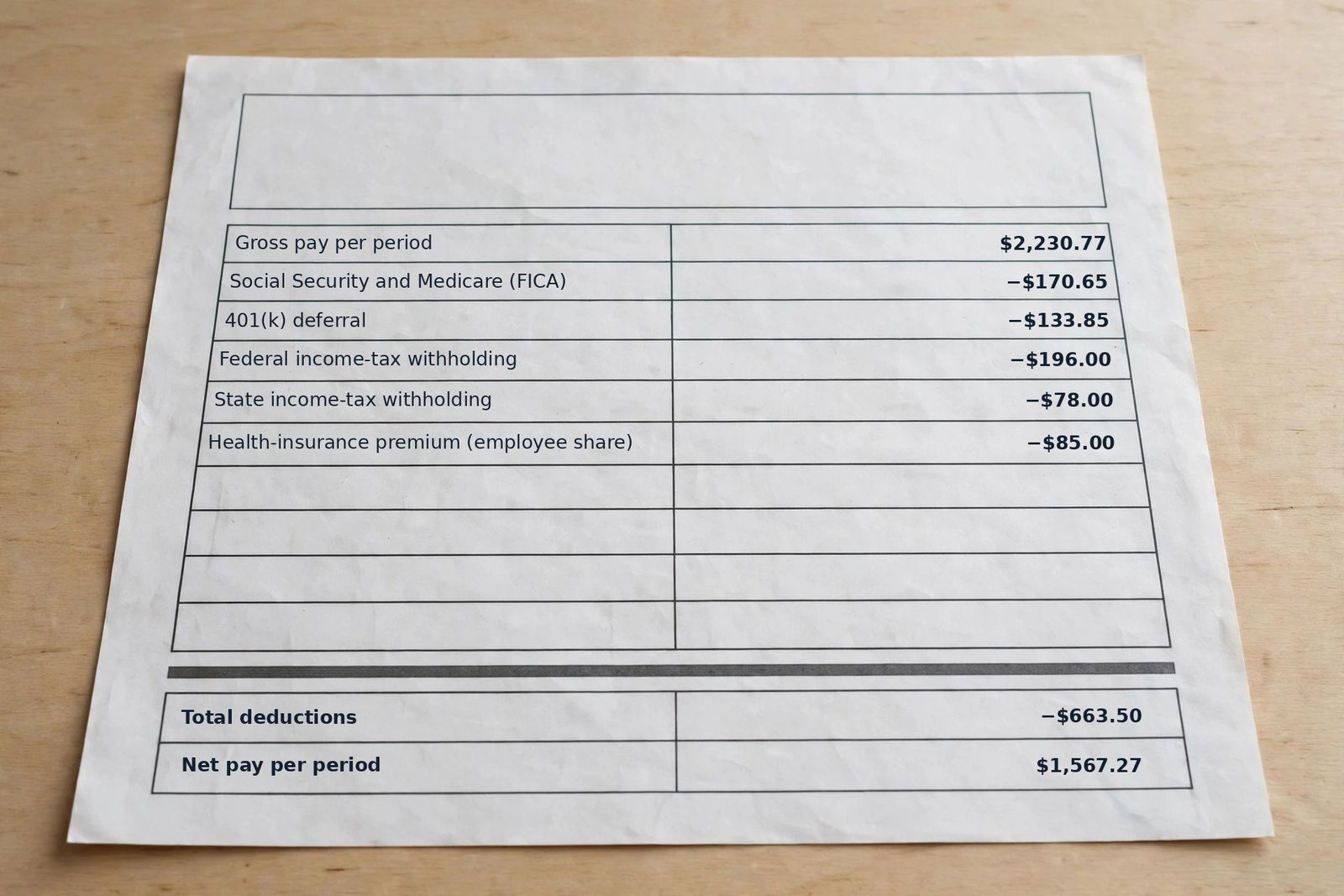
Figure P-02. Illustrative figures. A blank pay-statement specimen, annotated at the callouts with the canon figures this chapter decodes line by line. The specimen carries no real name, account number, or institution identity.
Here is the statement we will decode, exactly as it stands for the whole book:
| Line | Amount |
|---|---|
| Gross pay per period | $2,230.77 |
| Social Security and Medicare (FICA) | −$170.65 |
| 401(k) deferral | −$133.85 |
| Federal income-tax withholding | −$196.00 |
| State income-tax withholding | −$78.00 |
| Health-insurance premium (employee share) | −$85.00 |
| Total deductions | −$663.50 |
| Net pay per period | $1,567.27 |
Read the shape before the numbers. One line arrives at the top, five lines leave in the middle, and one line remains at the bottom. The rest of this chapter walks those lines in order — what each one is, how its amount is produced, what part of it you can influence and what part you cannot, and how to verify each line against documents you already hold. By the end of the chapter you will decode your own statement with the Pay-Statement Decoder worksheet at §1.6, using the same steps in the same order.
One habit matters more than any single line: never budget from gross pay, and never budget from salary. A salary is an annual earning rate. Gross pay is a period's earnings before deductions. Neither one is spendable. The spendable figure is net pay, converted honestly to the period your budget uses — and Worked Example 2 shows why that conversion is not simply "multiply by two."
Gross pay is the top line, and for a salaried worker it is produced by a single division. Alex's salary is $58,000 per year across 26 biweekly periods:
$58,000 ÷ 26 = $2,230.77 per period
The exact quotient is $2,230.7692…, and the statement carries it rounded to the cent as $2,230.77. That rounding is stated here, as it will be wherever this book rounds: the displayed figure is the rounded figure, and the exact figure stands beside it when the difference could matter. Across 26 periods, the rounded line rebuilds the salary almost exactly: $2,230.77 × 26 = $58,000.02 — two cents of rounding accumulated across a year of statements, which is why payroll systems true up final periods and why your own year-end documents, not any single statement, are the record of the year.
Hourly workers reach the same top line by multiplication instead of division: hours worked in the period, at each rate that applies, summed. Overtime hours, shift differentials, tips reported through payroll, and bonuses all enter gross pay the same way — they are earnings first, and only then subject to the deductions below. The teaching point is identical for every pay pattern: gross pay is everything earned in the period, stated before any subtraction, and it is a starting point for arithmetic, never a spending figure.
Know your own pay frequency before you convert anything, because the divisor is the frequency. Employers pay weekly (52 periods), biweekly (26 periods), semimonthly — twice a month, on set dates such as the 1st and the 15th (24 periods) — or monthly (12 periods). The two middle patterns are the ones workers confuse, and the confusion is expensive: the same $58,000 salary is $2,230.77 per period biweekly but $58,000 ÷ 24 = $2,416.67 per period semimonthly. A semimonthly worker really does receive two equal deposits in every month; a biweekly worker receives two deposits in ten months and three in two months, which is why this book converts biweekly pay with the × 26 ÷ 12 method and treats the result as an average to be managed, not a monthly fact. When you fill in the Decoder at §1.6, the first entry is your frequency and your periods per year; every later conversion on the sheet inherits from those two numbers.
Most statements also carry a year-to-date column beside the current-period column: the running totals of gross, each deduction, and net since January 1. Read it twice a year at least. The year-to-date column is how you confirm that an election you made — a deferral change, a new premium — actually took effect when you intended, and it is the column your year-end wage statement will summarize. A mid-year decoding that uses only the current period can be perfectly arithmetical and still miss that the first four months of the year ran under different elections. The current period tells you what your pay is doing now; the year-to-date column tells you what it has done, and the two together are the whole document.
Two workers can share a salary and reach different gross pay in a given period — one worked overtime, one took unpaid leave, one started mid-period — and two workers with identical gross pay can still take home very different net pay, because everything below the top line is personal. That is §1.4's subject. First, the one deduction whose rate is the same for every employee in the country.
The first deduction on Alex's statement is labeled Social Security and Medicare, and together these are the payroll taxes most workers meet under the name FICA — the Federal Insurance Contributions Act taxes that fund Social Security and Medicare. Unlike income-tax withholding, which §1.4 shows is an estimate settled later, FICA is charged at fixed percentages of wages. The Internal Revenue Service publishes the employee rates, and they are the rates this book teaches from: the employee Social Security rate is 6.2% of wages and the employee Medicare rate is 1.45% of wages — a combined employee rate of 7.65%.
Source note: employee Social Security and Medicare withholding rates, Internal Revenue Service, Topic No. 751, "Social Security and Medicare Withholding Rates." Form W-4 does not address FICA, because Social Security and Medicare taxes are fixed percentages of wages (Internal Revenue Service, Tax Withholding Estimator guidance).
On Alex's statement the line is one combined figure, and we can verify it exactly:
$2,230.77 × 7.65% = $2,230.77 × 0.0765 = $170.65
Worked in parts, the same line is $2,230.77 × 6.2% = $138.31 for Social Security and $2,230.77 × 1.45% = $32.35 for Medicare (rounded from $32.346…). The two separately rounded parts sum to $170.66 — one cent above the combined line's $170.65, because rounding each part to the cent is not the same operation as rounding the combined computation once. The statement carries the combined computation, $170.65, and this book does the same wherever the line is used. Notice what the base is: the percentage runs on gross pay, the full $2,230.77 — it is not reduced by the retirement deferral on the next line. That ordering is a common source of confusion when workers check a statement by hand and find the FICA line larger than they expected. The deferral reduces a different tax's base, not this one.
Because the rate is fixed, the FICA line is the most predictable line on the statement: it moves only when gross pay moves. An overtime period raises it, an unpaid-leave period lowers it, and a raise raises it in exact proportion. When you decode your own statement with the worksheet at §1.6, this is the line to verify first, because it is the line you can recompute to the cent from two published rates and your own gross pay. If your recomputation and your statement disagree by more than rounding, the document to consult is your employer's payroll office — the statement is their document, and a genuine error there is theirs to correct.
Worked Example 1 — Decoding the canon statement, line by line. Illustrative figures.
We work Alex's statement from top to bottom, verifying each line and then the whole.
The statement verifies: the deductions sum to the stated total, and gross minus that total is the stated net. On your own statement, substitute your own gross, your own deferral percentage, and your own read-off lines at Steps 1, 3, and 4; Steps 2, 5, and 6 run exactly as shown.
Below FICA, Alex's statement carries three different kinds of line, and telling them apart is the real decoding skill.
The 401(k) deferral — $133.85, which is 6% of gross pay ($2,230.77 × 0.06 = $133.85) — is an elected line: an amount Alex chose to send from pay into the workplace retirement plan. A deferral is pay you direct into the plan before it reaches you, at a percentage or a flat amount you set within your plan's rules. Chapter 10 teaches the plan itself — the match, vesting, and fees — and the governing document there is your own plan's Summary Plan Description. For this chapter, the statement-level facts are enough: the line is voluntary in amount, it is computed here as a percentage of gross pay, and every dollar on it is a dollar of net pay you have already assigned before the money arrives. That is not a loss; it is the budget working early. But it does mean a worker who raises a deferral will see net pay fall, and a worker who compares statements with a colleague in the same job will find this line is one reason the bottom lines differ.
The health-insurance premium — $85.00, the employee share — is a plan line: the portion of the premium for Alex's elected coverage that the employer deducts from pay. Premiums differ by the coverage a worker elects, which is a second reason two statements at the same salary diverge. Chapter 14 teaches health coverage as a document to read; here, simply note that the line is the price of a choice made at enrollment, collected through payroll.
The two withholding lines — federal $196.00 and state $78.00 on the specimen — are estimates, and understanding that changes how you treat them. Withholding is income tax collected from each paycheck in advance, against the final tax you will compute when you file. The amount withheld is driven by the information on your Form W-4, the form you give your employer stating your filing status and the adjustments you claim. Withholding is therefore not a bill and not a verdict: it is a running prepayment. If too much is withheld across the year, the settlement returns the excess as a refund; if too little, the settlement collects the difference. Neither outcome is a windfall or a failure — both are the same tax, timed differently — and Chapter 12 teaches the full accounting. The statement-level skill is narrower: read the withholding lines as adjustable estimates, not as fixed charges like FICA.
The Internal Revenue Service provides the tool for adjusting them: the Tax Withholding Estimator on IRS.gov, which works from your most recent pay statements, your filing status, your income, and your adjustments, deductions, and credits, and produces the entries for a completed new Form W-4. The Service's standing guidance is to check withholding every January, and after any major life change — a marriage, a new child, a second job in the household, a spouse starting or stopping work. The second-job case deserves emphasis, because it is the Rivera household's own shape and the most commonly missed: each employer's payroll system withholds as if its wages were the household's only wages, so two moderate incomes, each withheld correctly in isolation, can combine into a household under-withheld in total — and the reverse, two incomes withheld as if each stood alone at higher rates, can over-withhold. Neither statement is wrong; the estimate each payroll system makes is simply blind to the other. The estimator exists precisely to see the whole household picture at once, which no single pay statement can do, and running it when a household's second income starts, stops, or changes size is the difference between discovering the combined picture in January, when it is adjustable, and discovering it at filing, when it is merely payable or refundable. This book teaches you to run the estimator on your own figures; it never computes your withholding for you, because the right entries depend on your full filing picture, which only you and, where you choose one, your tax professional can see. The state withholding line follows the same logic in your own state's system: this book prints no state rates or forms, because those are your state's to publish, and your state's own guidance governs that line.
Source note: Tax Withholding Estimator method and the January withholding check, Internal Revenue Service, Tax Withholding Estimator and its published guidance.
One more distinction completes the section. Some deductions are taken before income tax is computed — the retirement deferral on a traditional plan is the specimen's example — and some are taken after. Payroll language calls these pre-tax and post-tax deductions. The statement order usually shows the pre-tax lines first, and the practical consequence is the one we saw at §1.3 in reverse: a pre-tax deferral lowers the wages your income-tax withholding is figured on, but it does not lower the gross wages your FICA is figured on. When your own statement's withholding looks lower than a colleague's at the same salary, an elected pre-tax deferral is one of the first places to look.
Worked Example 2 — From one period to a month and a year, honestly. Illustrative figures.
Budgets usually run monthly; Alex is paid biweekly. Converting between the two without error is a core skill, because the naive conversion — "two paychecks a month" — understates a biweekly income by a full period a year: 26 periods is 13 pairs, not 12 months of pairs.
A rounding note, stated plainly because this book always states it: FICA computed once on the year's gross would be $58,000 × 0.0765 = $4,437.00, while the per-period line summed across the year is $4,436.90 — a ten-cent difference created by rounding each period's line to the cent ($170.6539… carried as $170.65). The deferral shows the mirror image: $58,000 × 0.06 = $3,480.00 computed once, $3,480.10 summed by periods. Neither is an error; both are what rounding to the cent, twenty-six times, does. On your own figures, substitute your own net per period at the first step and run the same four computations.
We can now answer the question every new worker asks in the first month: how can two people earn the same salary and deposit different amounts? Walk the lines. FICA is the same for both — same gross, same fixed rates. Everything else can differ. One elects a 6% deferral and the other elects 3%: on Alex's gross, that single choice is $133.85 against $66.92 per period ($2,230.77 × 0.03 = $66.92), a difference of $66.93 every two weeks — $145.02 a month by the conversion of Worked Example 2 ($66.93 × 26 ÷ 12 = $145.02, rounded from $145.015). One elects family health coverage and the other is covered through a spouse's plan and elects none: the entire premium line differs. One has a second job in the household and has set Form W-4 to withhold at a higher effective rate; the other's withholding reflects a single income and several adjustments. One works in a state with an income tax and the other does not — this book names no state's rules, but the existence of the line itself varies, and where it exists its size is set by that state's published system. Add garnishments, union dues, parking, or a charitable election where a statement carries them, and the bottom lines of two "same-salary" workers can sit hundreds of dollars apart per period, with neither statement wrong.
The lesson is not that comparison is useless; it is that comparison has to run line by line, not bottom line to bottom line. When your own net pay surprises you — lower than you expected on a new job, changed after open enrollment, different after a raise — the diagnosis is always on the statement, in exactly one or two lines. A raise, for instance, raises gross pay and then raises every percentage-driven line with it: FICA rises by 7.65% of the increase, a percentage deferral rises by its percentage of the increase, and withholding usually rises as well. A worker who expects the full raise in the deposit will think money vanished. It did not vanish; it was distributed by the same rules as every other period, and §1.6's worksheet exists so you can trace that distribution yourself, for any period, in about ten minutes.
Worked Example 3 — An hourly statement, decoded the same way. Illustrative figures — a separate example, not the Rivera household.
A part-time hourly worker — call this the fresh case — works 80 hours in a biweekly period at $21.50 per hour, defers 4% of gross to a workplace plan, and has the withholding and premium lines shown. Every figure the case uses is stated here:
The steps are Alex's steps, unchanged: multiply or divide to gross, verify FICA from the published rates, read the elected and estimated lines off the document, sum, subtract. On your own statement, substitute your hours, your rate, and your lines; if your hours vary period to period, decode two or three recent statements and work from the range you actually see, not from the best period you remember.
The worksheet below is this chapter's fill-in tool. Work it once with this chapter open, once more with the chapter closed, and then once each January alongside the withholding check §1.4 described, and once after any change — a raise, a new election, a new job, a change in household work. Each row names the line, where its amount comes from, and the space for your figure and Alex's, side by side, so the canon stays visible while you work your own.
Worksheet — Pay-Statement Decoder. Illustrative figures (the Rivera column). Leave the "Yours" column to your own statement.
| Line | Rivera | Yours |
|---|---|---|
| Gross pay per period | $2,230.77 | |
| FICA — Social Security (6.2% of gross) | $138.31 | |
| FICA — Medicare (1.45% of gross) | $32.35 | |
| Retirement deferral (your % of gross) | $133.85 | |
| Federal withholding (read from statement) | $196.00 | |
| State withholding (read from statement) | $78.00 | |
| Health premium, employee share | $85.00 | |
| Any other deduction (name it) | $0.00 | |
| Total deductions (sum the lines) | $663.50 | |
| Net pay (gross − total deductions) | $1,567.27 | |
| Net, monthly equivalent (net × pays ÷ 12) | $3,395.75 |
Two checks close the worksheet. First, the sum check: your deductions column must add to your total before you subtract — most statement confusion is an addition slip, not a payroll mystery. Second, the FICA check: your two FICA rows, computed from your own gross at 6.2% and 1.45%, must match your statement's FICA line to within a cent of rounding — on the Rivera column they sum to $170.66 against the statement's combined $170.65, the one-cent artifact of rounding the parts separately that §1.3 explains, and the total-deductions row therefore carries the combined line, as the statement does. If either check fails, rework the arithmetic once; if it still fails, take the statement and your worksheet to your payroll office and ask them to walk the line with you — that is a routine question, and payroll offices answer it routinely.
Keep the decoded statement. A filed run of statements — paper in a folder or files in one named place, the records habit Chapter 18 builds into a system — is the household's evidence for everything later chapters ask: the withholding check needs recent statements, a pay dispute needs the period's own document, and the annual review needs the year's shape. Decoding is a ten-minute skill; keeping the decoded documents is what turns the skill into a record you can stand on. From here, the question stops being "what did I earn?" and becomes "when does it arrive, and what must it meet when it lands?" — which is Chapter 2's whole subject.
Key terms. Pay statement: the per-period record of earnings, deductions, and net pay. Gross pay: earnings in the period before any deduction. Deduction: an amount subtracted from gross pay. Net pay: gross pay minus total deductions; the amount that arrives. FICA: the Social Security and Medicare payroll taxes, charged to the employee at 6.2% and 1.45% of wages. Deferral: pay you direct into a workplace retirement plan before it reaches you. Withholding: income tax prepaid from each paycheck against the final tax computed at filing, driven by Form W-4. Pre-tax / post-tax: whether a deduction is taken before or after income tax is figured. Monthly equivalent: a per-period figure converted at periods-per-year ÷ 12, an average — not a promise about any single month.
Answers to the exercises below are in the key for this chapter, as explained model answers.
Exercise 1. Alex's statement shows gross pay of $2,230.77 and the five deduction lines of this chapter. A coworker glances at it and says the net "should be about $1,600, give or take." Work the statement yourself: sum the deductions, subtract from gross, and state the exact net pay and how far the coworker's estimate sits from it.
Exercise 2. A fresh illustrative case: a salaried worker earns $46,800 a year, paid biweekly over 26 periods, with no retirement deferral and no health premium deducted. Federal withholding on the statement is $148.00 and state withholding is $59.00. Compute gross pay per period, the FICA line at 7.65%, total deductions, and net pay per period.
Exercise 3. Sam's variable income is taught in this book at its average, $2,150.00 net per month, and Alex's net monthly equivalent is $3,395.75. Compute the household's net per month. Then compute what actually arrives in a month in which Alex is paid twice and Sam receives exactly the average, and state the difference between the two figures and what causes it.
Exercise 4. A worker on Alex's salary tells a friend, "My raise was $2,600 a year, so my deposit should go up by $100 a pay period." Using Alex's statement structure — FICA at 7.65% and a 6% deferral, both computed on gross — compute the gross increase per period, the increase in the FICA line, the increase in the deferral line, and the largest possible increase in net pay before any change in withholding. State why the actual increase will be smaller than $100.
Exercise 5. Your own statement (use your most recent one) shows a FICA line that does not match your hand computation. Describe, in order, the verification you perform using this chapter's method — including the exact rates, the base the rates run on, and the rounding allowance — and state where you take the statement if the mismatch survives your verification, and what document governs a disagreement about a plan line such as a deferral percentage.
Exercise 6. A fresh illustrative case: a worker's biweekly statement shows gross pay of $1,940.00, a deferral of 5% of gross, federal withholding of $171.00, state withholding of $66.00, and a health premium of $74.00. Compute the FICA line, the deferral line, total deductions, net pay, and the net monthly equivalent. Then state which lines you could recompute from published rates or the worker's own elections, and which lines you could only read from the statement.
Feras Alzubi
The Complete Course Series — Google Play Books
This book teaches personal finance as a working household's system, end to end: reading a pay statement, building a cash-flow budget that survives real pay timing, using bank accounts without leaking fees, understanding credit reports and scores as published mechanics, facing every common consumer debt with its true cost computed, building a safety net, capturing retirement benefits at work and beyond it, paying taxes as a worker with the mechanics understood, knowing what Social Security is building, meeting insurance as documents to read, making the housing and transport decisions with total costs visible, starting investing at foundation level, keeping money workable inside a partnership or family, holding the basic estate documents every adult worker should know exist, and running the whole system on an annual review. It is a taught course in the reader's own money, written for working people — employees first, including hourly, salaried, and mixed-income households — and it assumes no prior knowledge beyond ordinary working life.
© 2026 Feras Alzubi. All rights reserved. No part of this book may be reproduced, distributed, or transmitted in any form or by any means, electronic or mechanical, including photocopying and recording, without the prior written permission of the copyright holder, except for brief quotations in a review or other uses permitted by copyright law.
This book is an original work written for this series. Every explanation, example, worksheet, and figure in it was created for this book; the specimen household and all worked figures are fictional and illustrative.
This book is not affiliated with, sponsored by, or endorsed by the Consumer Financial Protection Bureau, the Internal Revenue Service, the Social Security Administration, the U.S. Department of Labor, the Federal Trade Commission, the Federal Deposit Insurance Corporation, the National Credit Union Administration, the U.S. Securities and Exchange Commission, the U.S. Department of Education, the Centers for Medicare & Medicaid Services, the U.S. Department of Health and Human Services, or the National Association of Insurance Commissioners. Agency and institution names appear only to identify the published public guidance this book teaches from, which is cited throughout.
Federal figures are stamped to their source and year where they stand (tax figures: tax year 2026; retirement-plan limits: year 2026). Laws, limits, and programs change; the current publications of the responsible agency govern.
Front matter — Title page · Copyright page · Contents · How to Use This Book · A Note on Sources
Opening — The Money-Health Check (24 items, with explained routing notes)
Part I — Know Your Money
Part II — Banking, Credit, and Debt
Part III — The Safety Net
Part IV — Retirement and Taxes as a Worker
Part V — Protection and the Big Decisions
Part VI — Household and the Long View
Capstone — Build Your One-Year Money Plan (12 steps, with worked keys)
Back matter — The Action Paths (30-Day Starter · 90-Day System · Annual) · Cheat Sheets · Glossary · Errata & Updates · References
This book teaches how personal money systems work. It is general education, not personalized financial, tax, investment, insurance, or legal advice, and reading it does not create an adviser–client relationship with its author or publisher. It makes no promise about any reader's income, returns, savings, debts, credit, or retirement, and it recommends no specific product, account, fund, or provider. Where your own documents speak — your plan's Summary Plan Description, your policies, your account agreements, your state's law — those documents govern. For decisions about your own situation, consult a qualified professional who can see the whole of it. Every number in every example is illustrative.
The fences behind that paragraph, stated in full, are the book's standing rules:
Two boundaries belong here, where every reader meets them before Chapter 1. First, the neighboring books: the money of a business you run is taught in this series' business books (#268–#272, #275, #276, #281), and the profession of coaching other people's money is taught in #352, Money Coaching: Mastering the Craft — this book stays with your own household throughout, and signposts those neighbors where the line falls. Second, investing:
The #472 boundary line: "#466 teaches investing only to the foundation a working household needs in order to use its own accounts safely — what investing is, that all investments involve risk, diversification, asset allocation, and how the investment menus inside workplace plans and IRAs work at the description level. Security selection, portfolio construction, fund-by-fund comparison, withdrawal strategy, and retirement-income planning are not taught here: they belong to #472, Investing & Retirement, and #466 signposts them and stops."
That line prints again at the head of Chapter 16, where it does its work.
One fictional household carries this book's worked arithmetic from Chapter 1 to the capstone, so the numbers you meet in one chapter are the same numbers, to the cent, in every other. Alex Rivera and Sam Rivera are fictional, and every figure attached to them is illustrative — teaching figures, chosen to make the arithmetic visible, not presented as typical, average, or recommended. Alex is salaried; Sam's income is variable (part-time plus gig work) and is taught at its average. Their opening position, in brief: Alex's biweekly pay statement nets $1,567.27 per period — $3,395.75 as a monthly equivalent — and with Sam's average the household nets $5,545.75 per month; the household opens with $43,750 of non-mortgage debt carried at $704 per month in payments, $3,919 per month of essential expenses, and $612 in a savings account. Among the debts is an auto loan of $16,400 at 8.9%: its exact required payment over its 60 remaining months is $339.64, and the household's stated payment is $342 per month, the rounded payment that covers it. Chapter 1 decodes the pay statement line by line; Chapter 6 opens the debt table in full. Where a worked example needs different numbers, the book says so on the spot and labels the example as a separate illustrative case — the Rivera figures themselves never move.
Work the household's examples with a pencil, then substitute your own figures in the worksheets. The arithmetic method is the teaching; the canon numbers are only there so you can watch it work before you run it on your own.
Every chapter teaches, then asks you to do, then explains. Read the chapter and work its three worked examples as you meet them; then work the chapter's six scenario exercises on paper. Each exercise gives you a short situation and a task; the explained model answers stand together in a key section after the chapters, so the doing comes before the checking. A model answer works the numbers step by step, explains the reasoning, and states plainly what depends on your own plan document, policy, account agreement, or state rule — the parts no book can settle for you. Four chapters (2, 5, 7, and 9) also carry repair drills: a broken situation — a week whose cash does not meet its bills, an error on a credit report, a payoff plan built on a wrong input, a compromised account — repaired step by step, with a worked key. Each chapter closes with a one-page cheat sheet in the chapter's own terms, and six chapters carry a fill-in worksheet at its teaching point: the Pay-Statement Decoder (Chapter 1), the Weekly Cash-Flow Sheet (Chapter 2), the Budget Build Worksheet (Chapter 3), the Debt Table (Chapter 7), and the Net-Worth Statement and Annual Review Checklist (Chapter 18).
Nothing in this apparatus is timed, and nothing in it is passed or failed. An answer that differs from the model answer is information: return to the section the exercise rests on, find the step where your working parted from the model's, and work the exercise again.
Before Chapter 1, take the Money-Health Check that follows this front matter. It has 24 items in four domains of six — Control (day-to-day money), Shock capacity (the safety net), On track (debts, retirement, taxes), and Freedom (choices and household systems). The domains mirror the four elements of financial well-being as the Consumer Financial Protection Bureau defines them; the Bureau also publishes its own validated scale for that framework — the Bureau's 10-question Financial Well-Being Scale — which is a different instrument, credited here as the framework's source. This book's check is its own routing tool, built for this book's chapters, and it says so on its face.
Answer each item in plain words about your own situation, then read its explained routing note in the key that follows the check: the note states what the answer usually means, in full, and names the chapter or chapters it routes to. The check computes and prints no total score. There is no summed score to earn, compare, or improve: the check's whole output is the routing — which chapters speak to which of your answers. In the capstone, after Chapter 18, you will take the check again and compare your answers item by item and domain by domain — which answers changed, and therefore which chapters now route differently — in words. If an item routes you to a chapter you have already read carefully, the routing is still doing its work: it is telling you where your own figures, rather than the chapter's teaching, need the next hour.
The back matter prints three route maps through the book. Each path is a printed route — chapters, worksheets, and the points where the check is re-taken — and no path carries any promise about what following it will achieve.
Whichever path you take, finish at the capstone, Build Your One-Year Money Plan: twelve steps, each with a worked key on the Rivera household, that assemble the book into one plan — the check re-taken and compared, the year's targets set from your own figures, and the payoff plan, safety-net build, match capture, and withholding check sequenced across four quarters, closing with the annual-review date set.
Every fact in this book traces to the published guidance of a public authority, read for this book and cited where it stands; the References in the back matter collect every source this book teaches from, in full — the sources of record for the printed book. The authorities are: the Consumer Financial Protection Bureau (cash-flow budgeting, emergency-fund guidance, credit reports and scores, disputes, debt-payoff methods, checking accounts and overdraft, mortgage cost guidance, and the four elements of financial well-being); the Internal Revenue Service (payroll-tax rates, the Tax Withholding Estimator, Individual Retirement Arrangements, and the 2026 limits and tax-year 2026 figures); the Social Security Administration (credits, full retirement age, and claiming mechanics); the U.S. Department of Labor, Employee Benefits Security Administration (retirement-plan guidance, the Summary Plan Description, vesting, and plan fees); the Federal Deposit Insurance Corporation and the National Credit Union Administration (deposit and share insurance); the Federal Trade Commission (free credit reports, freezes and fraud alerts, and identity-theft recovery); the U.S. Securities and Exchange Commission's Investor.gov (investing foundations); Federal Student Aid at StudentAid.gov (student-loan repayment); HealthCare.gov, published by the Centers for Medicare & Medicaid Services and the U.S. Department of Health and Human Services (health-coverage vocabulary); and the National Association of Insurance Commissioners (insurance categories and document guidance).
Dated figures carry their stamps where they stand, and the stamps are part of the teaching:
Laws, limits, and programs change after any book is written. The errata and updates page in the back matter records this book's verification discipline: a dated figure whose source has moved is updated or cut in a new edition, never left standing as if current — and for anything you are about to file, claim, sign, or choose, the current publication of the responsible agency, and your own documents, govern.
End of the free sample. The complete book continues from here — the full A-to-Z course in book form, delivered as an EPUB you can read in Apple Books, Google Play Books, ReadEra, Thorium Reader, Adobe Digital Editions, or Send to Kindle.
Buy this ebook — $12.99 Back to the book page
Payments are securely processed by Payhip.