
Mastering Careers & Skills
Paramedic Exam (NREMT) · free sample from the book itself
Every option is explained. Key balance for this quiz: A ×5 · B ×5 · C ×5 · D ×5 (each letter 25%, inside the 20–30% band; longest run of one letter: 1). Primary tags: OPS ×17 · CJ ×3. Cross tags: TEI-X ×1 (Q11, Build List print form). Scoring reminder: the real examination is dichotomous — full credit or none (S-01).
Q1 — Key: B [OPS]. A. Wrong — certification and licensure are distinct doors; treating them as one credential is the conflation NREMT expressly warns against. B. Correct — "Successfully obtaining National Registry certification does not grant you the right to practice. You must obtain a state-issued license in order to legally practice as a paramedic" (S-06). C. Wrong — working under a medical director belongs to local credentialing; it does not replace state licensure. D. Wrong — there is no national license to activate; licensure is issued by a state (S-06).
Q2 — Key: D [OPS]. A. Wrong — education is Door one (learning in an accredited program); it confers no practice authority. B. Wrong — certification verifies entry-level competency nationally; it is not system-specific. C. Wrong — licensure makes practice lawful in the state, but not yet authorized in a particular agency's system. D. Correct — credentialing by the agency and its medical director is the door after which the Standards describe the clinician as "job-ready" (S-15).
Q3 — Key: A [OPS]. A. Correct — this is Requirement 1 of the Requirements list as currently published (S-05). B. Wrong — the current published Requirements list states no minimum age; age prerequisites, where they exist, live in program admission or state licensure rules, not in this list (V-01 fence). C. Wrong — the current published list states no separate standalone CPR-BLS credential requirement; importing one from another level's handbook is the error this chapter fences (S-05). D. Wrong twice — completion must be in a CAAHEP-accredited program (or one holding a CoAEMSP Letter of Review), and within the past two years (S-05).
Q4 — Key: C [OPS]. A. Wrong — a 2024 starter is after both dated thresholds, so both overlays are in play. B. Wrong — this understates it: the portfolio (post–August 1, 2016 starters) applies, but so does the later matrix. C. Correct — candidates after January 1, 2023 must meet the CoAEMSP Recommended SMC Matrix, in addition to the portfolio requirement that already applied to post-2016 starters; the Program Director verifies both (S-05, S-08). D. Wrong — the NREMT ALS psychomotor examination was discontinued; last administered June 30, 2024 (S-09).
Q5 — Key: B [OPS]. A. Wrong — candidates do not self-verify completion or competency records. B. Correct — the Program Director must verify successful completion (and, where applicable, portfolio/SMC completion) through the National Registry website (S-05). C. Wrong — the state acts at licensure; verification of program completion to NREMT is the Program Director's act. D. Wrong — test-center staff administer the sitting; they verify nothing about eligibility.
Q6 — Key: A [OPS]. A. Correct — one CAT examination, 110–150 items, 3.5 hours, administered starting July 1, 2024 (S-01, S-04). B. Wrong — that is the superseded pre-July-2024 model, named in this chapter once as predecessor and never taught as current (S-09). C. Wrong — CAT varies item number and difficulty by candidate; there is no single fixed form. D. Wrong — the test plan and handbook name Pearson VUE testing-center delivery; no remote route is named for this examination (V-13 fence).
Q7 — Key: D [CJ]. A. Wrong — rising difficulty carries no failure verdict; abandoning effort on that inference manufactures the failure feared. B. Wrong — no pass is "recorded" mid-sitting that a candidate can know; the determination is made under the CAT stopping rule (S-01). C. Wrong — nothing about targeted difficulty is grounds to abandon a sitting; the reschedule contract does not cover mid-exam inference (S-04). D. Correct — after an initial set, items are targeted at or above estimated ability; administration ends at the minimum items with 95% confidence or at maximum items/time. Difficulty is the engine working, not a result (S-01).
Q8 — Key: C [OPS]. A. Wrong — the examination does contain unscored content. B. Wrong on both counts — the number is 20, and pilot items are not labeled. C. Correct — 20 pilot items, unidentified, not affecting the score (S-01, S-03, S-04). D. Wrong — pilot items are interleaved and indistinguishable, which is precisely why candidates are taught to treat every item as scored.
Q9 — Key: A [OPS]. A. Correct — every item is scored dichotomously: full credit or none; a mixed multiple-response selection earns no credit (S-01). B. Wrong — partial credit does not exist in this scoring model. C. Wrong — finding one correct option does not rescue an incorrect second selection. D. Wrong — scoring is by the examination engine against the key, not by proctor discretion.
Q10 — Key: B [CJ]. A. Wrong — Medical / Obstetrics / Gynecology is the largest content domain at 24–28%, but not the largest domain overall. B. Correct — Clinical Judgment, 34–38%, is the largest published weight (S-01, S-02). C. Wrong — Cardiology & Resuscitation is published at 10–14%. D. Wrong — EMS Operations is published at 8–12%.
Q11 — Key: C [CJ · TEI-X — Build List print form]. Correct order: Recognize cues (1) → Analyze cues (2) → Define hypothesis (3) → Generate solutions (4) → Take action (5) → Evaluation (6) (S-01). A. Wrong — action cannot precede cue recognition, and evaluation belongs at the end of the cycle before it re-enters. B. Wrong — it takes action second, before analysis and hypothesis; acting before a hypothesis exists is the field error this cycle exists to prevent. C. Correct — the six steps in the published order, re-cycled through each setting of the response (S-01). D. Wrong — it opens with hypothesis before any cue has been recognized, inverting the cycle's logic.
Q12 — Key: D [OPS]. A. Wrong — no percentage-correct is reported; passing candidates receive no score detail at all (S-04). B. Wrong — no raw item counts and no raw cut score are published or reported (V-03 fence). C. Wrong — the report is neither a grade nor a ranking. D. Correct — an unsuccessful candidate's report shows a scaled score on a 100–1500 scale with the passing point indicated by 950, plus performance feedback compared to the passing standard (S-04, S-03).
Q13 — Key: B [OPS]. A. Wrong — 950 is not 95% and converts to no percentage; the scaled ruler is not a percent ruler (S-04, §0.3 discipline). B. Correct — it is the passing point indicated on the scaled-score report; the book prints it only in that frame and never converts it to a percentage, an item count, or a practice target. C. Wrong — the figure is a scale point, not an item tally. D. Wrong — pilot items number 20 and are unrelated to the scaled-score point.
Q14 — Key: A [OPS]. A. Correct — a standard-setting study: SME panel data collected under a trained psychometrician, a recommended cut score to the Board of Directors with impact data, Board approval, uniform application, review at each new specification (S-01). B. Wrong — no fixed published percentage exists in the test plan (V-03). C. Wrong — the standard is uniform for all candidates; it is not curved per session (S-04). D. Wrong — Program Directors verify eligibility; they do not set the examination standard.
Q15 — Key: D [OPS]. A. Wrong — no such waiting period is published; the published wait between attempts is 15 days (S-04). B. Wrong — a full new program is not the published remedy; the course-validity clock is also not reset by remediation (S-07). C. Wrong — no Board interview is part of the published retesting pathway. D. Correct — after three failures, remedial education is required before attempt four: the 30-credit NCCP National Component, a state- or CAPCE-approved refresher, or 30 credits through any state-approved program (S-04).
Q16 — Key: C [OPS]. A. Wrong on both counts — reapplication is prompt and attempts are capped. B. Wrong on both counts — a wait exists and the cap is higher. C. Correct — reapply as soon as results post; 15-day wait from the last examination date; six chances in total (S-04). D. Wrong — no fee variation removes the wait; each attempt carries the standard $175 application fee (S-02, S-07).
Q17 — Key: A [OPS]. A. Correct — the discontinuation notice's own FAQ: a state psychomotor requirement is a state licensure matter; beginning July 1, 2024 it is not a requirement for National Certification — check the State EMS Office for state requirements (S-09). B. Wrong — a state rule cannot recreate an NREMT examination NREMT discontinued. C. Wrong — the state requirement is additional to, not a substitute for, the Certification Examination. D. Wrong — states regulate EMS within their borders and may set licensure requirements beyond national certification (S-15, S-06).
Q18 — Key: C [OPS]. A. Wrong — cost was not the stated rationale. B. Wrong — the portfolio/SMC record is built through observed practice across settings, not an online exercise. C. Correct — skills are "captured over a longer period, in various settings, and with multiple and differing evaluators," judged stronger evidence than the one-event examination (S-09). D. Wrong — verification is by the Program Director, not the candidate (S-05).
Q19 — Key: B [OPS — book's own teaching dates; rule from S-08]. A. Wrong — the two-year March 31 dating applies to the January 1–June 30 completion band. B. Correct — completion July 1–December 31 → expiration March 31 three years out (S-08). (September Year 1 → March 31, Year 4.) C. Wrong — no September-30 dating rule is published. D. Wrong — the published dating anchor is March 31, not December 31.
Q20 — Key: D [OPS]. A. Wrong — print cannot adapt; this book claims no algorithm reproduction and reports no pseudo-scaled score (X-12 fence). B. Wrong — NREMT does not recommend any particular preparation materials (S-04); this book claims no endorsement. C. Wrong — no pass guarantee is made anywhere in this book (X-01 fence). D. Correct — the forms present the examination's maximum presented length (150 items, 3.5 hours) to rehearse endurance and pacing, and report domain performance only (Blueprint §4.4 face honesty).
Terminal level, the four doors (education / certification / licensure / credentialing), the July 2024 examination, and why certification is not licensure.
Version line (read this first, and expect it on every examination fact in this book): This book prepares you for the Paramedic Certification Examination administered since July 1, 2024, built on the 2019 National EMS Practice Analysis and the 2021 Practice Analysis Addendum (Source S-01, S-02). Clinical content is keyed to the 2021 National EMS Education Standards and the 2019 National EMS Scope of Practice Model, with 2021 updates (S-15), and resuscitation content to the 2025 AHA Guidelines for CPR and Emergency Cardiovascular Care (S-16). If any other book, video, or well-meaning colleague describes a different examination, check its date before you check its content. An out-of-date map of the right territory will still get you lost.
The tones drop before the address is finished. Your unit is sent to a residence for a person reported to be "not acting right." On the way, dispatch adds fragments: a family member called, the patient is confused, there is a history you will need to draw out rather than be handed. You arrive to a crowded front room, a frightened spouse trying to tell three stories at once, a patient who cannot give you a straight history, a pill organizer open on the counter, a dog underfoot, and a clock you cannot see but can feel. Nothing about the first minute is tidy. Your partner starts the hands-on assessment. Someone has to run the room as well as the patient: quiet the noise without silencing the witnesses, decide what information matters, form a working explanation that can survive new evidence, choose an intervention, give a clear order or a clear report, and keep re-deciding as the patient answers your treatment — or refuses to.
That composite minute — invented for this page, but assembled from the ordinary furniture of real calls — is the job this book is about. Notice what it did not require. It did not begin with a dramatic procedure. It began with noticing, sorting, deciding, communicating, and leading, in an uncontrolled place, with incomplete information. Hold that picture, because the modern Paramedic examination was rebuilt around exactly it. The examination's largest single domain is not a body system at all. It is Clinical Judgment — the disciplined movement from cues to a hypothesis to a plan to an action to a fresh look at what the action produced (S-01). Everything else in this book — the anatomy, the pharmacology, the rhythms, the operations — is taught as the material that judgment works on. A paramedic who knows facts but cannot run that cycle in a noisy front room is not yet safe. A paramedic who runs the cycle well but knows thin facts is not yet safe either. The credential demands both, and this opening chapter maps the whole system that certifies the combination: what a paramedic is, how a person lawfully becomes one, what the examination actually is in its current form, and where this study book's authority begins and ends.
Read this chapter actively. Later chapters assume you can say, without notes, which door you are standing in front of at any point in your career — student, candidate, certificant, licensee, credentialed clinician — because confusing those doors is the single most common way intelligent students waste money, miss deadlines, or misrepresent themselves. The chapter therefore moves in a deliberate order. First, the profession itself: a definition in the Scope of Practice Model's own words, and the ladder of levels beneath it. Second, the four doors — education, certification, licensure, credentialing — kept rigorously separate. Third, eligibility exactly as the National Registry of Emergency Medical Technicians (NREMT) currently publishes it, including two honest fences about what that published list does not say. Fourth, the examination in full: its shape, its computer-adaptive engine, its item types, its fee, its scheduling mechanics, its passing-standard discipline, and its retesting rules. Fifth, the skills question — why there is no longer an NREMT psychomotor examination for paramedics, what replaced it, and what that means for how a book like this one may and may not help you. The chapter closes with the recertification horizon, this book's number discipline, and a worked walk through one candidate's timeline, so the system stops being a diagram and becomes a calendar.
Definitions in this field are not decoration. Scope, education, examination content, and legal authority all hang from them, so this book begins with the definition carried in the National EMS Scope of Practice Model, as reproduced in the 2021 National EMS Education Standards (S-15). Learn it closely; the rest of the chapter is commentary on it:
"The paramedic is a health professional whose primary focus is to respond to, assess and triage emergent, urgent and non-urgent requests for medical care; apply basic and advanced knowledge and skills necessary to determine patient physiologic, psychological, and psychosocial needs; administer medications, interpret and use diagnostic findings to implement treatment; provide complex patient care; and facilitate referrals and/or access to a higher level of care when the needs of the patient exceed the capability level of the paramedic." (S-15)
Unpack it phrase by phrase, because each phrase does work on the examination.
"A health professional." Not a technician who executes a fixed list of tricks, and not a pair of hands rented by a protocol. Professional status carries duties that the examination tests directly under EMS Operations: leadership and professionalism, communication and documentation, and preservation of medical and legal standards (S-01). When a later chapter asks you to protect a patient's dignity on a crowded scene, or to write a report that another clinician can safely act on, it is cashing this opening phrase.
"Respond to, assess and triage emergent, urgent and non-urgent requests." The request stream is mixed by design. Some calls are life threats. Many are urgent but stable. Some are neither, and still deserve a competent assessment and a correct disposition — including referral rather than transport when that is what the patient needs and what local protocol and medical direction authorize. Triage here means sorting by need and risk, not deciding who "deserves" care. The paramedic who treats every low-acuity call as beneath the profession will eventually miss the low-acuity presentation that was masking a serious disease. The examination's scenario sets punish that shortcut repeatedly: the obvious chief complaint is a cue, not a conclusion.
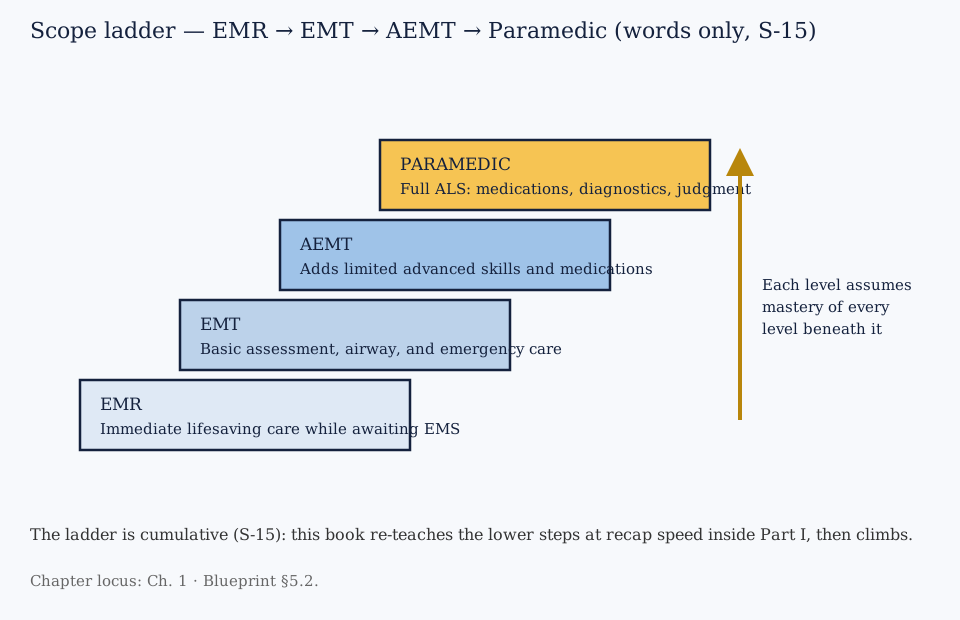
"Apply basic and advanced knowledge and skills." Both words matter. Basic is not an insult and it is not optional: airway positioning, ventilation, hemorrhage control, and clear communication remain the ground on which advanced practice stands, and the Standards assume — in their own words — that each educational level holds "mastery of the previously stated competencies" (S-15). That sentence is this book's warrant for re-teaching the EMT foundation inside this cover, in this book's own words, in Part I. It is also a warning: the examination may test an advanced intervention and still expect you to notice that a basic one was skipped.
"Determine patient physiologic, psychological, and psychosocial needs." The assessment is three-dimensional. A patient is a body with failing physiology, a mind experiencing fear, confusion, intoxication, or despair, and a person embedded in a household, a budget, a language, and a set of beliefs that will shape what care is accepted and what happens after you leave. The Standards' 2021 revisions deliberately strengthened public health, behavioral and psychiatric content, and cultural humility (S-15) — not as soft additions, but because field outcomes turn on them. Chapter 2 takes up the working habits; Chapter 23 and Chapter 26 take up the clinical depth.
"Administer medications, interpret and use diagnostic findings to implement treatment." This clause is the level's defining expansion over EMT practice. Administering medications at paramedic depth means understanding action, indication, contraindication, side effects, route, and interaction — and calculating and cross-checking every administration as a method, never reciting a dose from memory as if memory were authority. Interpreting diagnostic findings means exactly what Chapter 8 develops: knowing what a monitor actually measures, how that measurement can mislead, and how to verify it against the patient in front of you. Note the verb order. Interpret and use — findings that do not change a decision are trivia; the examination rewards findings that change management.
"Provide complex patient care." Complexity is the normal case at this level: multiple problems at once, treatments that interact, a patient who improves in one direction while worsening in another. The judgment cycle in Chapters 9 and 10 exists because complex care cannot be run from a single memorized pathway. Pathways help — this book teaches their structures faithfully — but the paramedic's work is to notice when the patient has left the pathway.
"Facilitate referrals and/or access to a higher level of care when the needs of the patient exceed the capability level of the paramedic." The definition ends with humility written into the job description. Recognizing the edge of your capability — and moving the patient across it promptly, to the right destination, with a report that lets the receiving team start ahead — is paramedic practice, not an admission of failure. Destination decisions, discussed throughout Parts VI and VII, test this clause again and again.
One further sentence from the Standards deserves its own paragraph because students routinely miss it: paramedics "often serve as a patient-care team member in hospital or other health-care settings and in community settings, and help educate patients and the public" (S-15). The ambulance is the emblematic workplace, not the only one. This book keeps its center of gravity on field practice and the examination, and it labels wider settings honestly when it mentions them — awareness of a setting is not a claim that entry-level paramedic scope includes every expanded role practiced in it. That labeling habit is the scope discipline of this book, and it will recur: content above entry-level paramedic scope is never presented as paramedic practice merely because someone, somewhere, with additional credentialing, does it.
A03
Every reader of this book arrives by the same doorway: you already hold a credential at the EMT level or higher. That is not this book's preference; it is the first line of NREMT's current published Requirements for paramedic candidates (S-05), and Section 1.5 prints the full list. The ladder matters for three practical reasons.
First, the examination presumes the lower rungs. The test plan samples Airway, Cardiology, Trauma, Medical, and Operations content at paramedic depth (S-01), and paramedic depth is defined by the Paramedic column of the Education Standards — whose characteristic verbs are integrates and formulates, a deliberate step beyond describe-and-perform (S-15). An item may therefore hand you a scene in which the EMT-level tasks are simply expected to be already running while the tested decision is the ALS judgment layered on top: which finding reorders your priorities, which intervention comes first and why, what you will do if the first intervention fails. If your BLS foundation has gone rusty during a long program, Part I of this book is the repair — written fresh for this volume, at recap speed first and then at depth, because no reader should need a second book to stand on this one's floor.
Second, the levels are legally distinct. The Scope of Practice Model describes four licensure levels, and states license clinicians at levels; a skill that is ordinary at one level may be outside another level's authorized scope in the same state. The Model itself is guidance to states for developing scope-of-practice law — it does not itself grant anyone legal authority, because each state regulates EMS within its borders (S-15). Keep that sentence. Students who treat a national model as if it were their personal license make two opposite errors: attempting what their state and medical director have not authorized, and hesitating over what they are authorized and expected to do. Chapter 34 gives you a blank-by-design state checklist precisely so that the state layer is filled from your State EMS Office — the deciding authority — and never guessed from a study book.
Third, your classmates are your comparison set, and it is an experienced one. The EMT examination serves an entry-level pool, many testing before field experience. The paramedic pool is a post-experience, in-program pool: credentialed EMTs inside accredited ALS programs (S-05, S-08). That is why the examination can presume clinical exposure and test judgment across linked scenario sets rather than isolated recall alone. Prepare accordingly: a study method that worked for a first credential — flashcards over definitions, recognition over reasoning — is necessary but nowhere near sufficient here. From Chapter 9 onward this book trains the harder skill explicitly, but it is seeded from this page: whenever you meet a fact in these chapters, ask what decision it could change. Facts that change decisions are the examination's currency.
A note on names, because the field is careless with them and the examination is not. Paramedic in this book always means the fourth licensure level and, in examination contexts, the candidate for the Paramedic Certification Examination. Certification always means NREMT's verification of competency. Licensure always means a state's legal permission to practice. Credentialing always means a local agency's and medical director's authorization to practice there, in that system. The next section builds the whole career doorway out of those four words. When casual speech blurs them — "getting my license" for sitting an examination, "being certified" for being hired — translate silently and precisely. On the examination, and later in depositions and credentialing files, the precise word is the correct answer.
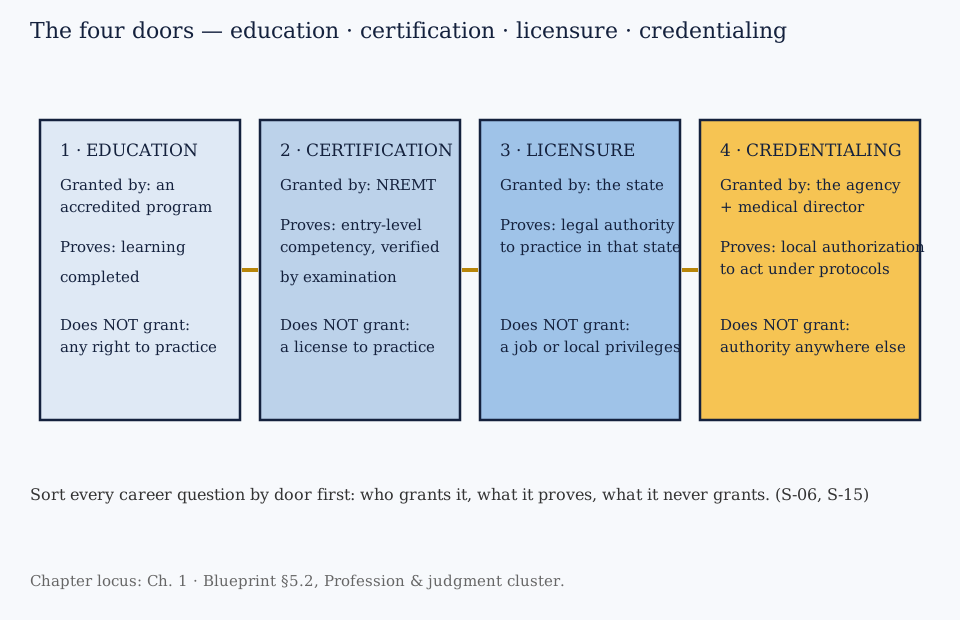
The Standards frame professional entry as four distinct domains, and this book teaches them as four doors in a fixed order (S-15). You must pass through them in sequence. No door substitutes for another, and standing in front of the wrong door with the right paperwork is the classic beginner's delay.
Door one: education — learning. Education is the accredited program: the classroom, laboratory, clinical, and field education that builds the competencies the Standards describe. NREMT does not establish education-program curricular content and does not accredit or approve education programs (S-06) — accreditation belongs to the Commission on Accreditation of Allied Health Education Programs (CAAHEP), acting through the Committee on Accreditation of Educational Programs for the Emergency Medical Services Professions (CoAEMSP), whose "Letter of Review" marks a program seeking accreditation (S-05, S-08). The accreditation requirement itself is dated: since January 1, 2013, initial paramedic applicants must have completed education from an accredited program or one seeking accreditation under CAAHEP sponsorship (S-08). Your program's job is to teach the whole field — which is why this book, mirroring the dual purpose of a good program, teaches the whole field and not only the test. A program that taught only likely examination items would leave you dangerous in exactly the places the examination — and, more importantly, the next patient — probes deepest.
Door two: certification — competency verification. Certification is NREMT's independent verification that you have demonstrated entry-level competency: in most states, National Registry certification is the competency-verification step (S-15). For paramedics today, that verification has two program-and-Registry components working together: your Program Director verifies your program completion — including, where the dated overlays apply to you, your psychomotor competency portfolio and your Student Minimum Competency record — and you pass the single Certification Examination (S-05). Section 1.7 gives the examination its full treatment. What certification is, conceptually, deserves emphasis: it is a portable, national statement that on the evidence examined, you met an entry-level standard. It is not a job, not a permission slip for any particular ambulance, and — the next door — not a license.
Door three: licensure — the state's legal authority. Licensure is granted by a state, and only a state license makes practice lawful. NREMT states the boundary in one sentence that this book will not improve on, so it prints it verbatim: "Successfully obtaining National Registry certification does not grant you the right to practice. You must obtain a state-issued license in order to legally practice as a paramedic" (S-06). In many states, National Registry certification is one of the requirements for the state license — a component, not the whole (S-06). Everything else about licensure — application steps, fees, background-check rules, any state-required skills verification, renewal rules — belongs to your State EMS Office. This book teaches the national certification whole and refuses to guess state facts: no state licensure specific appears in these pages without that state's own registered source behind it, and Chapter 34's checklist stays blank by design so you complete it from the authority that will actually decide your application. Whenever you catch yourself asking "what does the book say my state requires?" — stop. That question has exactly one safe address, and it is not a book.
Door four: credentialing — local authorization to practice in a system. Even licensed, you do not practice everywhere at once. Credentialing is the local act by which an agency and its medical director authorize you to practice in that system, under those protocols, with that equipment and formulary. The Standards' framing is crisp: a clinician is "entry-level" after the first three doors and "job-ready" after credentialing (S-15). Credentialing is where protocols stop being other agencies' documents and become your orders; where the medication cross-check culture of Chapter 5 becomes a named partner and a named medical director; where orientation, field evaluation, and continuing competency verification live. Active recertification status later depends on this same local layer — skills-competency verification validated, at paramedic level, by the agency's Medical Director (S-14) — a fact Chapter 34 develops. For now, fix the sequence in memory with a scene: the new graduate with a fresh certificate who reports for a first shift is certified and, once the state acts, licensed — and still does not touch a patient as the paramedic of record until the system credentials them to do so. That is not bureaucracy. That is the system insisting that competence be re-verified in the exact context where it will be exercised.
Two confusions die here, permanently. First: no book opens any door. This book prepares you for Door two's examination and teaches you the knowledge Doors one, three, and four will expect — it does not satisfy, replace, or certifiably simulate any part of your accredited program, your portfolio, your competency matrix, your clinical or field experience, or any state verification. That is not modesty; it is the book's hands-on honesty fence, stated in full in Section 1.9, and no sentence anywhere in this volume softens it. Second: order matters for deadlines. Education has a shelf life for certification purposes — initial courses are valid two years from the month and year of completion (S-07) — so the doors are not merely sequential but timed. Section 1.10 works a timeline in full.
A01
Eligibility is a place where second-hand summaries do real harm, because handbooks change and summaries do not. This book therefore prints the Requirements as NREMT's Paramedic Candidate Handbook currently publishes them (S-05), and fences everything else. As currently published, the list has three requirements:
Requirement 2 carries two dated competency overlays, and you should determine which apply to you by your program start date, not your graduation date. All candidates who started their paramedic education programs after August 1, 2016 are required to complete a psychomotor competency portfolio. Candidates after January 1, 2023 are additionally required to meet the CoAEMSP Recommended Student Minimum Competency (SMC) Matrix. In both cases the Program Director verifies completion through the National Registry website (S-05, S-08). What the portfolio and the matrix are — documented skills progression and competency evidence accumulated over time, in varied settings, with multiple evaluators — is developed in Section 1.8. What their exact per-skill counts are is your program's document, not this book's: no matrix count appears in the handbook pages behind this chapter, so no count prints here. Ask your program for its matrix; do not accept a number for it from any study source, including this one.
Now the fences, stated as plainly as the requirements. The current published list states no minimum-age requirement and no separate CPR-BLS credential requirement (S-05, S-08). Older handbooks, other levels' handbooks, school catalogues, and forum posts commonly list such items, which is exactly why this book refuses to import them: a requirement printed in the wrong document is a rumor with good formatting. Two honest consequences follow. First, do not conclude that age or CPR prerequisites therefore exist nowhere — program admission and state licensure commonly impose their own prerequisites, and those live where they belong, with your program and your State EMS Office. Second, production of this book re-verifies the handbook's Requirements page at drafting, and you should re-verify it yourself at application: the operative list is always the list in force on the day you apply, on NREMT's own page. The same discipline covers the Code of Conduct duties that accompany candidacy — provide truthful information, represent your certification status accurately, protect examination security, and notify NREMT within 30 days of changes affecting eligibility, including licensure disciplinary actions (S-05). Examination security is not fine print. The handbook prohibits disclosing or discussing examination information, posting questions anywhere, and — in language every candidate should read once slowly — "reconstructing examination content using your memory or the memory of others" (S-04). This book honors that prohibition structurally: every practice item in it is original, written from the published test plan and the Standards, and no NREMT sample item is reproduced, paraphrased, or cloned anywhere in it. Study with people, by all means. Reconstruct the examination with them, never.
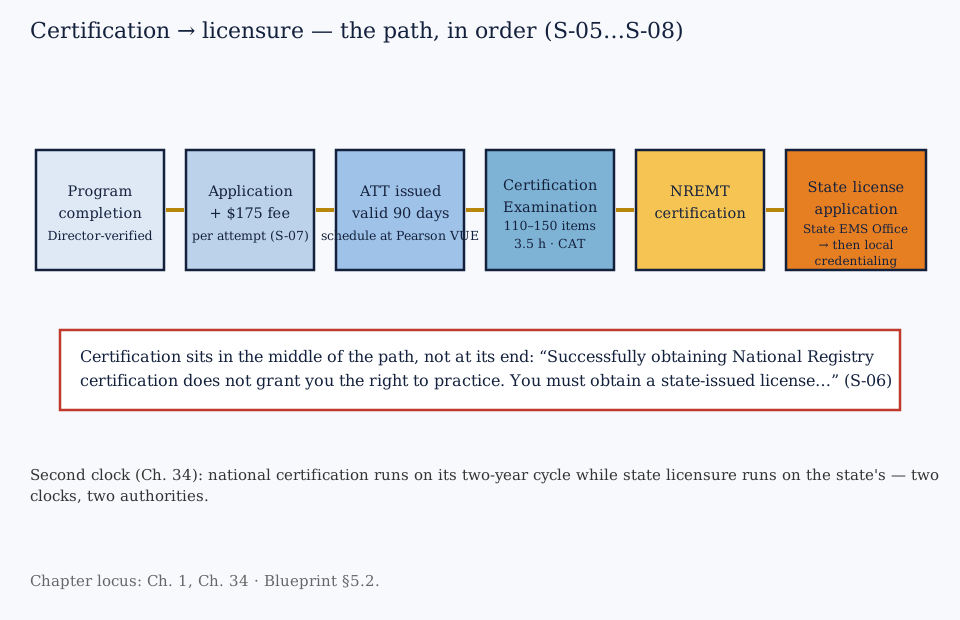
Eligibility also has a clock, and students discover it too late. Your initial course is valid two years from the month/year of completion — a course completed at any point in January of one year is valid until January 31 two years later — and remedial education taken after examination failures does not extend that date (S-07). Your Authorization to Test, once issued, is valid 90 days, and an authorization bought within 90 days of course expiration itself expires at the end of the course-expiration month (S-07). Read those two sentences as a scheduling instruction: apply early enough that verification, scheduling, a possible retest's mandatory wait, and life's ordinary disruptions all fit inside windows you can see on a calendar now — not windows you will wish for later. Section 1.10 shows the arithmetic on a worked example.
The certification process, as the handbook lays it out (S-06, S-07), runs in four broad steps. Step one: begin an education program — EMT-level credential first, then a CAAHEP-accredited program or a program holding a CoAEMSP Letter of Review; your State EMS Office can help you find programs. Step two: once enrolled, create your National Registry account; candidates needing testing accommodations should note the handbook's guidance to request them at least four weeks before program completion (S-06) — accommodations are arranged through NREMT's process, not negotiated at the test center door. Step three: submit your application and payment about four weeks before completing your program; on completion, your Program Director approves and verifies. Step four: with application, payment, and Program Director verification in place, your Authorization to Test (ATT) is typically issued within 1–2 business days and is valid 90 days; you schedule through your National Registry account into a Pearson VUE testing center (S-04, S-06).
The fee is verified and singular: the Paramedic application fee is $175, charged for each examination attempt (S-02, S-07). "Per attempt" is the operative phrase for budgeting: a retest is a new application and a new fee, which is one more reason — beyond pride and the two-year course clock — to sit the examination prepared rather than to treat a first sitting as a paid reconnaissance. Refund terms are as published in the Certification Process guidance: refunds are available within 90 days of payment for the stated reasons (S-07); read the current page at application rather than relying on any summary, this one included.
Scheduling carries its own small contract, and candidates forfeit fees by ignoring it. You may reschedule or cancel at least one business day (24 hours) ahead; a $30 fee applies, plus a call-center fee if the change is made by telephone; failure to appear forfeits the fee (S-04). Treat your appointment the way your future service will treat a shift: immovable except through the published procedure, arranged early. Two further mechanics belong in your planning file now, even though Chapter 36 rehearses them at examination-mastery depth. Rescoring may be requested within 30 days of the examination date for a $150 fee, and only the items identified in the request are reviewed (S-04) — a narrow remedy for a suspected scoring irregularity, not a general second opinion. And results are posted to your National Registry account — not available at the test center and not given by phone — generally within three business days when all requirements are met (S-03, S-04). One handbook page says one to two business days; the About-the-Examination guidance and the general Examinations Content page both say three, so this book plans you on three and tells you why: plan on the slower published figure and be pleasantly surprised, never the reverse. During those days, your account may show status language inherited from an older era — including a "skills competency pending" formulation (S-07). Read such strings as account language about the program-verified competency requirement of Section 1.8, not as evidence of a separate NREMT skills examination waiting for you. There is none. The next sections prove it.
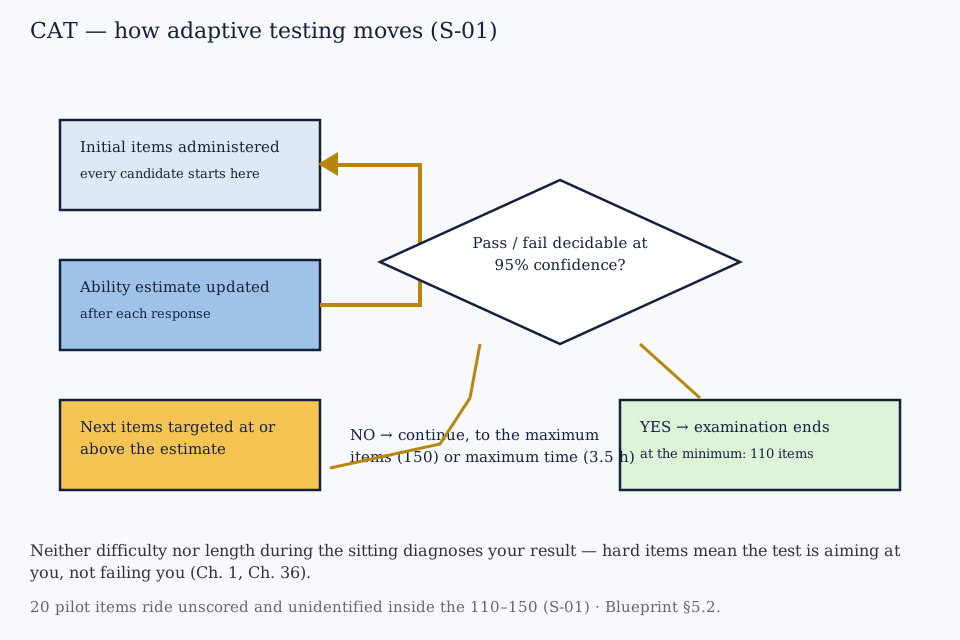
Say the current model in one breath, because most legacy material gets at least one element of it wrong: the Paramedic Certification Examination is one examination, delivered by Computerized Adaptive Testing (CAT) at Pearson VUE testing centers, presenting 110 to 150 items in 3.5 hours, of which 20 items are unscored pilot items you cannot identify, with every scored item dichotomous — full credit or none (S-01, S-04). It has been administered in this form starting July 1, 2024 (S-01, S-02). There is no remote-proctoring route named for this examination in the test plan or handbook text behind this book: plan for a testing center, a non-disclosure agreement of 5 minutes and a tutorial of 10 minutes before the clock that counts (S-04), and an examination that ends when its stopping rule is satisfied — not when you feel finished.
How CAT works, at the depth a candidate needs. After an initial set of items, the engine targets subsequent items at or above your estimated ability; administration ends when a pass/fail determination can be made at the minimum number of items with 95% confidence, or continues to the maximum number of items or the maximum time (S-01). Three study consequences follow, and Chapter 36 builds your full strategy on them. First, difficulty is not diagnostic during the sitting: hard items may mean the engine believes you are doing well, so the disciplined candidate refuses to narrate the sitting while sitting it. Second, length is not diagnostic either: stopping at the minimum and running to the maximum are both ordinary administrations under the same passing standard, which is the same for all candidates — the pass/fail question, in the handbook's framing, is whether the candidate has or has not yet reached the level of entry-level competency (S-04). Third, you cannot rehearse adaptation in print: this book's full forms therefore present the maximum length — 150 items in 3.5 hours — and say so on their faces, rehearsing endurance, pacing, and domain spread while claiming no equivalence with the real engine's algorithm, pool, or scoring. Any product that promises to simulate the CAT itself is promising what print cannot deliver; this book promises rehearsal in the examination's published shape, and keeps the promise narrow on purpose.
What the examination samples. Content is determined by the 2019 National EMS Practice Analysis with the 2021 Practice Analysis Addendum (S-01, S-02). Each of the five content domains is sampled across Assessment, Pathophysiology, and Management — a three-lens rule worth internalizing, because it predicts item anatomy: the same condition may be tested as recognition (what do you find?), mechanism (why is it happening?), or action (what do you do, in what order, and what do you watch next?). The six domains and their published weights are:
| Domain | Published weight (S-01, S-02) |
|---|---|
| Airway, Respiration & Ventilation | 8–12% |
| Cardiology & Resuscitation | 10–14% |
| Trauma | 6–10% |
| Medical / Obstetrics / Gynecology | 24–28% |
| EMS Operations | 8–12% |
| Clinical Judgment | 34–38% |
Read the table the way a psychometrician wrote it. The five content ranges are independent tolerances — they do not sum to one hundred at their midpoints, and they are not meant to. This book's practice sets use a disclosed, in-range allocation that does sum to one hundred — Airway 10, Cardiology 12, Trauma 8, Medical 26, Operations 10, Clinical Judgment 34 — labeled everywhere as this book's apparatus, never as an NREMT-published allocation. Pediatric patient-care items are integrated throughout the examination's content (S-01); no separate pediatric percentage is published for this examination, so none is printed in this book, and any source that offers you one is offering an invention. Finally, Clinical Judgment — added through the 2021 Addendum as the centerpiece of the ALS Assessment Redesign — additionally samples communication and leadership, and each step of the processing information cycle: (a) recognize cues, (b) analyze cues, (c) define hypothesis, (d) generate solutions, (e) take action, (f) evaluation, re-entered as you move through each setting of the response (S-01). Memorize the six steps now. Chapters 9 and 10 will make you fluent; every scenario set in this book walks them in order.
How items look. The published item types are: Multiple-Choice (one correct of four); Multiple-Response (select two or three correct of five or six); Build List (order the options as instructed); Drag-and-Drop (position options into categories or classifications); Options Box (classify options presented in a table); Graphical items (answer from information in graphical form — charts, ECG rhythm strips, images, pictures; graphics may appear within any item type); and Scenario-Based sets (multiple questions on a scenario or reading passage, in any of the above types) (S-01). Technology Enhanced Items — the Build List, Drag-and-Drop, and Options Box family — have been in the AEMT and Paramedic examinations since 2023, and in the ALS examinations they run throughout the EMS scenarios: En Route, Scene, and Post Scene (S-02). A tutorial at the start of the examination teaches each item type and remains available through Help during the sitting (S-02) — use it even if the formats feel familiar, because the tutorial minutes are not examination minutes and fluency bought there is free. Two scoring facts discipline your practice habits. Every item is scored dichotomously: a multiple-response item with one option wrong earns exactly what a wholly wrong item earns — nothing (S-01) — so this book's keys score the same way and say so. And the 20 pilot items are tomorrow's scored items being tried out: written by trained subject-matter experts, referenced to industry-standard sources, and piloted unscored before they ever count (S-01). You cannot identify them, they do not affect your score, and the correct professional response to a strange item mid-sitting is the same as to any other: answer it as well as the evidence allows and move on.
How passing is decided — three statements, and no fourth. This book's passing-standard discipline is strict, because the internet's version is inventive. First: NREMT sets the standard through a standard-setting study — a trained psychometrician facilitates data collection from a representative panel of nationally based EMS subject-matter experts; the panel's work produces a recommended cut score presented to the National Registry Board of Directors with impact data; once the Board approves it, the standard is uniformly applied and reviewed each time new examination specifications are implemented (S-01). Second: candidates who pass receive no score detail; a candidate who does not pass receives a report showing a scaled score on a 100–1500 scale, with the passing point indicated by 950 (S-04). That 950 is a point on a scaled-score ruler shown on unsuccessful candidates' reports. It is not a percentage of items correct, not a count of items, and not a target that any practice test in this book — or anywhere — can legitimately aim you at. This book never converts it, and its practice tests never report a pseudo-scaled score. Third: unsuccessful candidates receive performance feedback compared to the passing standard (S-03) — domain-level guidance about where performance fell short. This book's repair architecture mirrors that shape on purpose: the diagnostic and the full forms report domain performance and item-level explanations only, and route you to the matching chapters and the matching domain repair set. That is the honest print analogue of the feedback NREMT actually gives, and it is more useful than a fabricated number would be.
If you do not pass — the retesting rules, complete. You may reapply as soon as results post, with a 15-day wait from your last examination date; you have six chances to pass; after three failures, remedial education is required before the fourth attempt, satisfied by (1) the Paramedic 30-credit National Component of the National Continued Competency Program model, (2) a state- or CAPCE-approved Paramedic refresher course, or (3) the 30 credits through any state-approved education program, including online education where CAPCE- or state-approved (S-04). Each attempt carries the $175 application fee (S-02, S-07), and — repeat Section 1.5's warning in this context — remedial education does not extend your two-year course-validity date (S-07). Chapter 36 turns these rules into a calm 15-day repair loop: read the domain feedback, study the weak domains at chapter depth, rehearse with the matching repair set, and re-sit as a better-prepared candidate rather than a more anxious one. Candidates fail this examination and go on to excellent careers; what the rules punish is not failure but drift — waiting without a plan while the course clock and the ATT clock run.
A24
Name the predecessor once, as history, and then leave it there: before July 1, 2024, paramedic certification involved a separate NREMT-administered ALS psychomotor (skills) examination alongside a cognitive examination. That model is superseded. The ALS psychomotor examinations for AEMT and Paramedic were discontinued with the launch of the new Certification Examinations; the last day the ALS psychomotor examination was administered was June 30, 2024 (S-09). A candidate who had passed only one part of the old model by that date is required to take the new Paramedic Certification Examination; a candidate who had passed both parts before July 1, 2024 keeps a valid certification and renews on the normal two-year cycle (S-02). If your study shelf, your program's older handouts, or a mentor's war stories describe stations, examiners, and a skills weekend as a National Registry requirement for paramedics today, they are describing the predecessor. Honor the experience; do not plan by it.
What replaced the one-event skills examination is, in NREMT's own reasoning, stronger evidence: with the introduction of Student Minimum Competency requirements, skills competency is established by documented skills progression over time — captured over a longer period, in various settings, and with multiple and differing evaluators — which NREMT judges stronger evidence of competency than a single-event examination, aligned with the National Commission for Certifying Agencies (NCCA), the Registry's accreditation body, and modern testing practice (S-09). Concretely, the current model has two interlocking program-side records, both verified by your Program Director (Section 1.5): the psychomotor competency portfolio, required for candidates who started programs after August 1, 2016, and the CoAEMSP Recommended SMC Matrix, required after January 1, 2023 (S-05, S-08). Your program teaches, observes, documents, and verifies; the Registry verifies the verification and examines knowledge and judgment. That division of labor is the system working as designed — hands are proven where hands can be watched, over time, on real and simulated patients, by evaluators who know your trajectory.
One separation survives the change and catches candidates out: a state may still require a psychomotor examination for state licensure. The discontinuation notice answers that question in its own FAQ — beginning July 1, 2024, a psychomotor examination is no longer a requirement for National Certification; check with your State EMS Office to determine state requirements (S-09). Keep the two sentences in different boxes in your mind. "NREMT no longer examines skills" is true. "Therefore no one examines skills" is false twice over — your program examined them continuously, and your state may examine them again for licensure. Chapter 34's checklist gives that state question its own line, to be answered from the State EMS Office and nowhere else.
You are entitled to know exactly what you bought, in the publisher's plain language rather than in marketing fog. This book does two jobs, and its structure serves both at once. Job one: teach the whole field from zero. Part I rebuilds the foundations — profession, safety and law, the body, failure, pharmacology principles, and medication mathematics — assuming nothing beyond general schooling and an EMT credential that may be fresher in some corners than others. Parts III through VII then teach the content domains at full paramedic depth, and Part VIII closes operations and examination mastery. Job two: master this examination. The item program — a 50-item diagnostic, a 20-item quiz closing each of Chapters 1 through 34, two full 150-item forms in the examination's published shape, six 30-item domain repair sets, twelve linked scenario clusters, and a labeled adaptive-style ladder — rehearses every published item type, including the TEI print forms and graphical items keyed to this book's own drawn exhibits. A single dual crosswalk in the front matter maps every chapter twice: to the test plan's domains and to the Education Standards' sections. Neither job pads the other: foundations chapters are labeled as field foundations, examination apparatus is labeled as apparatus, and the small amount of beyond-the-examination material — community paramedicine and critical-care transport awareness, career orientation — is labeled beyond entry-level scope wherever it appears.
NREMT's own preparation guidance is brief and this book follows it visibly: study your program's textbook and education materials, and "review the current American Heart Association's Guidelines for Cardiopulmonary Resuscitation and Emergency Cardiovascular Care and the National EMS Education Standards" (S-04). NREMT does not recommend any particular examination preparation materials (S-04) — including this book, which claims no NREMT recommendation, endorsement, or affiliation anywhere, and asks you to distrust any product that implies one. Exhibition of independence is not a disclaimer ritual here; it is the same security-and-honesty posture the handbook demands of candidates (S-04, S-05), applied by an author to a book.
Four fences govern every page that follows, and you should hold the book to them. First, the hands-on fence: this book prepares examination readiness and knowledge about skills — indications, sequences, equipment, verification, documentation, complications. It does not teach hands, does not satisfy or replace any part of your accredited program, portfolio, SMC record, clinical or field experience, or any state skills verification, and does not simulate any skill to a certifiable standard. When a chapter describes how an advanced airway is confirmed, it is teaching you to know — so the examination can test the knowing, and so your program's watched practice has a knowledgeable mind attached to it. Second, the number fence, stated fully in Section 1.11: no vital-sign range, drug dose, threshold, or ALS parameter appears in this book as doctrine unless a named primary source behind it has actually been read and registered; doses are taught as method, class, and cross-check, and every calculation runs on stem-supplied or book-labeled teaching numbers. Third, the outcomes fence: this book publishes no pass rates, no salaries, no employment figures, and no promise — of passing, of a score, of certification, of licensure, of a job, of income — anywhere, including its cover and listing. A book that respected you would not sell you statistics it cannot verify or outcomes it cannot deliver. Fourth, the certification fence: nothing in these pages blurs certification into licensure. If any sentence in any study product — this one included — ever reads as though passing an examination is the right to practice, the sentence is wrong and Section 1.4's verbatim NREMT sentence is the correction.
Worked examples in this book follow a standing pattern — given, method, steps, answer, sanity check — whether the subject is a medication calculation (Chapters 5 and 6) or, here, certification logistics. All dates in this example are this book's own constructed teaching dates; the rules applied to them are the registered ones cited at each step.
Given. A candidate completes an accredited paramedic program in May of Year 1 (the teaching date). She applies and pays about four weeks before completion, as the handbook's process describes (S-06). Her Program Director verifies completion, her portfolio, and her SMC record (S-05).
Method. Lay every dated rule on one timeline: course validity (two years from the month/year of completion, S-07); ATT validity (90 days, S-04, S-06); results (generally within three business days, S-04); retesting (15-day wait, six chances, remedial education after three failures, S-04); initial expiration dating (completion January 1–June 30 → March 31 two years out; July 1–December 31 → March 31 three years out, S-08).
Steps. (1) Course completed May, Year 1 → course valid until May 31, Year 3 (two years from the month/year of completion). (2) ATT issued on verification, typically within 1–2 business days, valid 90 days → she schedules her first sitting well inside that window rather than at its edge. (3) She sits the examination, pays attention to nothing but the items, and receives results in her account within three business days. (4) If the report is unsuccessful, it shows a scaled score with the passing point indicated by 950 and domain feedback against the standard (S-04, S-03) → she reapplies when results post, observes the 15-day wait, repairs the weak domains (Chapter 36's loop), and re-sits — each new attempt at $175, all attempts comfortably inside the May, Year 3 course-validity wall, with the remedial-education gate waiting only beyond a third failure. (5) On passing and completing certification, her initial expiration falls on March 31, Year 3 — because a May completion sits in the January 1–June 30 band, the March 31 two years out (S-08) — and her two-year recertification cycles run from that dating.
Answer. Every window fits on one page of a calendar, with slack — because she applied before completion, scheduled inside the ATT window, and treated a possible retest as a planned branch rather than an emergency.
Sanity check. Where could this timeline break? Three places, all visible in advance: applying late, so verification and ATT issuance crowd the course clock; scheduling at the ATT's edge, so a single illness becomes a forfeited fee under the 24-hour / $30 reschedule rule (S-04); and drifting after an unsuccessful attempt, so the 15-day waits accumulate against a course-validity date that remedial education cannot move (S-07). The cross-check that catches all three is the paramedic's own habit applied to paperwork: write the dates down, re-verify them against the primary pages at application, and never let a deadline be something you remember approximately.
A23
Close the chapter with the rule that protects you in every later chapter, because paramedic study material is saturated with numbers and they are not all the same kind of thing. This book sorts every number into three zones, and labels them as it goes. Zone A — teachable apparatus: measurement and method (how to measure, acquire, read, and verify), structures the source register actually publishes — the examination's own figures in this chapter, the Glasgow Coma Scale's component structure (E1–4, V1–5, M1–6, total 3–15; taught in full in Chapter 20 from S-17), the recertification credit structure of Section 1.12 — and calculation method: formulas, conversions, and cross-checks worked on book-original numbers. Zone B — fenced clinical values: every vital-sign normal range, every drug dose, concentration, drip rate, or energy stated as a fact about a medication or a patient. A Zone B value prints in this book only when a named primary source for that specific value stands behind it in the register — or when it arrives the way it arrives on a real call, inside an order: a practice item's stem supplies the ordered amount, the concentration on hand, and the patient's weight, exactly as medical direction supplies them, and the tested skill is the method that turns order into administration. Zone C — the book's own teaching numbers: the numerals inside worked examples (a teaching patient's stated weight, a stated concentration, a stated cylinder factor) are constructed to demonstrate method — given, method, steps, answer, sanity check — and every calculation chapter closes with the standing reminder that on a real call the order, the protocol, and the cross-check govern, never a study book's page.
Why so strict? Because the alternative — a confident table of ranges and doses absorbed from an unregistered source and recalled under stress — is how a study habit becomes a field error. Your program, your protocols, and your medical director are the authorities for the numbers you will actually administer by; this book's authority is method, structure, and judgment. When a later chapter declines to print a range and instead teaches you to trend against the patient's own baseline and report the change, that is the discipline working, not a gap in the book. Hold every other study source to the same standard, and ask of any number it prints the question this chapter has taught you to ask of everything: which door, which source, which date?
Certification is a cycle, not a trophy, and one paragraph of horizon now will save confusion later. Paramedics recertify on a two-year cycle ending March 31 under the National Continued Competency Program (NCCP), whose 2025 Model began April 1, 2025 for paramedics (S-12, S-13). The model requires 60 total credits — National 30, Local/State 15, Individual 15 (S-10–S-12) — with the National Component distributed Airway 6, Cardiology 7, Trauma 5, Medical 8, Operations 4, and 10% pediatric content within the National Component — three of its thirty credits (S-11). Education must be state-EMS-Office-approved or CAPCE-accredited and directly related to EMS patient care, with no online-education limits since 2022 and a published list of excluded categories (S-12). Recertification by examination is the other published route — and means the current Certification Examination (S-02, S-07). Chapter 34 teaches the whole architecture, including the October 1 application opening, the April 1 recertification-by-examination opening, the March 25 deadline, and the April reinstatement window with its $50 fee (S-13) — and it fences, as this chapter does, the one figure this book's register did not read on an NREMT page in full: the renewal fee amount, which therefore appears nowhere in this edition. For now, carry away only the shape: the credential you are studying for will ask you, every two years, to prove continued competency in the same six-domain shape in which you first proved entry-level competency. Learn the domains as a professional home, not as a hurdle, and recertification becomes filing evidence of a life you are already living.
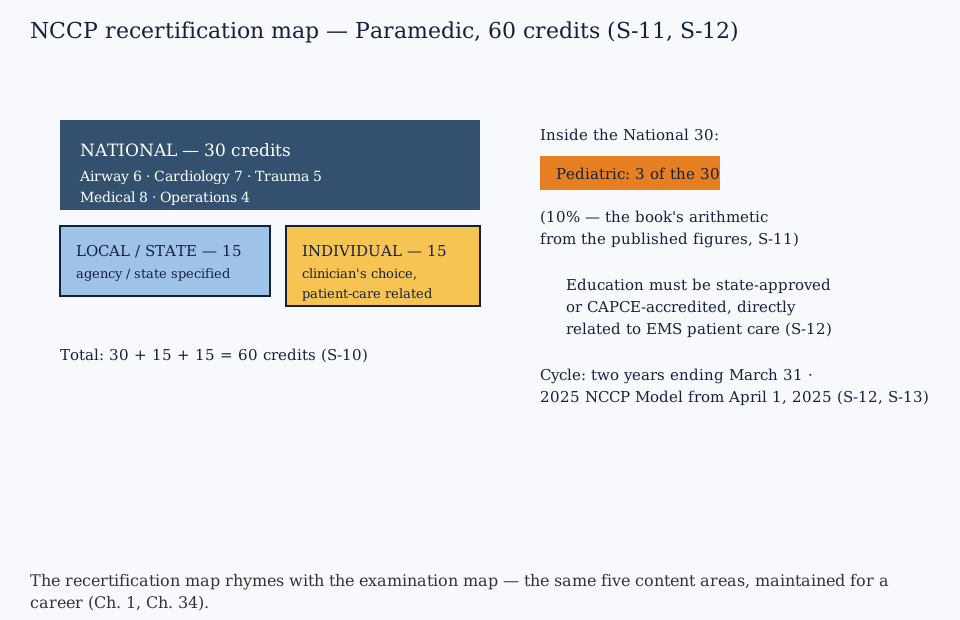
A22
A paramedic is a health professional who responds to, assesses, and triages the full mix of requests; applies basic and advanced knowledge; determines physiologic, psychological, and psychosocial needs; administers medications and uses diagnostic findings to implement treatment; provides complex care; and moves the patient to a higher level of care when need exceeds capability (S-15). Entry runs through four doors in order — education in an accredited program, certification by NREMT verification, licensure by the state alone, credentialing by the local agency and medical director (S-15, S-06). Eligibility, as currently published, is an EMT-level credential or higher, completion of a CAAHEP-accredited (or Letter of Review) program within two years with Program Director verification — portfolio for post–August 1, 2016 starters, SMC Matrix for post–January 1, 2023 candidates — and passage of the Certification Examination (S-05). That examination, since July 1, 2024, is a single CAT of 110–150 items in 3.5 hours at Pearson VUE centers, with 20 unidentified pilot items, dichotomous scoring, six domains weighted as published — Clinical Judgment largest at 34–38% on the six-step processing information cycle — a $175 fee per attempt, a 90-day ATT, results generally within three business days, a standard set by expert study and reported to unsuccessful candidates as a scaled score with the passing point indicated by 950, six attempts with a 15-day wait and remedial education after three failures (S-01, S-02, S-04, S-07). There is no NREMT psychomotor examination; skills competency is program-built and Program-Director-verified, and any remaining skills examination is a state licensure question for the State EMS Office (S-09). Certification is not licensure (S-06). And this book — original in every item, fenced in every number, silent on outcomes it cannot promise — prepares you for the examination at the center of that system, and teaches you the field around it. Chapter 2 puts you to work inside it: safely, lawfully, ethically, and on paper.
Twenty items, original to this book, testing this chapter only. Keys and full explanations — every option — are in `ch-01-key.md`. Tags: one primary domain tag per item; a cross tag (TEI-X) appears only where the item is printed in a TEI form.
Q1. A newly certified paramedic tells a friend, "Now that I'm certified, I can start working as a paramedic anywhere." Which correction is accurate? [OPS] A. Correct — certification and licensure are the same credential under different names. B. Incorrect — certification does not grant the right to practice; a state-issued license is also required. C. Correct, provided the paramedic works only under a medical director. D. Incorrect only because a national license must be activated first.
Q2. In the four-door sequence, which door makes a clinician "job-ready" in a particular system? [OPS] A. Education B. Certification C. Licensure D. Credentialing
Q3. Which statement matches the Requirements list as currently published for paramedic candidates? [OPS] A. Hold a current National Registry certification or state license at the EMT level or higher. B. Be at least a stated minimum age published in the Requirements list. C. Hold a standalone CPR credential listed as a separate numbered requirement. D. Complete any paramedic program, accredited or not, within five years.
Q4. A candidate started a paramedic program in March 2024. Which competency overlay applies on that start date? [OPS] A. Neither the portfolio nor the SMC Matrix. B. The psychomotor competency portfolio only. C. The CoAEMSP Recommended SMC Matrix (in addition to the portfolio requirement for post-2016 starters). D. A National Registry psychomotor examination.
Q5. Who verifies a candidate's program completion, portfolio, and SMC fulfillment to NREMT? [OPS] A. The candidate, by self-attestation. B. The Program Director, through the National Registry website. C. The State EMS Office, at licensure. D. The Pearson VUE test-center administrator.
Q6. Which examination description is current? [OPS] A. A single CAT examination of 110–150 items in 3.5 hours, administered since July 1, 2024. B. A cognitive examination plus a separate NREMT psychomotor examination. C. A fixed-form examination of the same 150 items for every candidate. D. A remotely proctored examination taken from home.
Q7. During a CAT sitting, items grow noticeably harder. What should the candidate conclude? [CJ] A. Failure is now certain, so remaining effort should be conserved. B. The engine has already recorded a pass, so remaining items are practice. C. The sitting should be abandoned and rescheduled. D. Nothing diagnostic — items are targeted at or above estimated ability, and difficulty alone does not reveal the result.
Q8. How many unscored pilot items does the Paramedic Certification Examination contain, and how are they presented? [OPS] A. None; every presented item is scored. B. 10, clearly labeled as pilot items. C. 20, unidentified to the candidate. D. 20, presented as a separate final section.
Q9. A multiple-response item asks for two correct options of five. The candidate selects one correct and one incorrect option. What score does the item earn? [OPS] A. No credit — scoring is dichotomous, full credit or none. B. Half credit for the one correct selection. C. Full credit, because at least one correct option was found. D. Credit is determined by the test-center proctor.
Q10. Which domain carries the largest published weight on the current examination? [CJ] A. Medical / Obstetrics / Gynecology B. Clinical Judgment, at 34–38%. C. Cardiology & Resuscitation D. EMS Operations
Q11. Which sequence correctly orders the processing information cycle? [CJ — TEI-X: Build List print form] Write 1–6 beside the steps as printed in the key task: the key lists the correct order. A. Take action → recognize cues → evaluate → define hypothesis → analyze cues → generate solutions. B. Recognize cues → take action → analyze cues → generate solutions → define hypothesis → evaluation. C. Recognize cues → analyze cues → define hypothesis → generate solutions → take action → evaluation. D. Define hypothesis → recognize cues → take action → analyze cues → evaluation → generate solutions.
Q12. A candidate does not pass. Which description of the score report is accurate? [OPS] A. A percentage of items correct, by domain. B. A raw count of items missed, with the raw cut score. C. A letter grade and class rank. D. A scaled score on a 100–1500 scale with the passing point indicated by 950, plus performance feedback compared to the passing standard.
Q13. What does the figure 950 convert to? [OPS] A. 95% of items correct. B. Nothing — it is a scaled-score passing point and converts to no percentage or item count. C. 950 items answered correctly across attempts. D. The minimum number of pilot items to answer.
Q14. The passing standard itself is set by which process? [OPS] A. A standard-setting study whose recommended cut score goes to the Board of Directors for approval, then is uniformly applied. B. A fixed percentage written into the test plan. C. A curve based on each testing day's candidate group. D. The Program Directors of accredited programs, voting annually.
Q15. A candidate has failed three times. What must happen before a fourth attempt? [OPS] A. A five-year waiting period. B. A new paramedic program, completed in full. C. A personal interview with the Board. D. Remedial education: the 30-credit NCCP National Component, a state- or CAPCE-approved refresher, or 30 credits through a state-approved program.
Q16. Which retesting facts are correct? [OPS] A. Reapply after one year; unlimited attempts. B. No waiting period; three attempts maximum. C. Reapply when results post; 15-day wait; six chances in total. D. Reapply when results post; no wait if the fee is doubled.
Q17. A state requires a psychomotor examination for licensure. How does that interact with National Certification since July 1, 2024? [OPS] A. It is a state licensure requirement only; no psychomotor examination is required for National Certification. B. It restores the NREMT psychomotor examination for that state's candidates. C. It exempts that state's candidates from the Certification Examination. D. It is prohibited, because states may not add requirements.
Q18. Why did NREMT judge the SMC/portfolio model stronger evidence of skills competency than the discontinued one-event examination? [OPS] A. It is cheaper to administer. B. It is completed entirely online. C. It documents skills progression over a longer period, in various settings, with multiple and differing evaluators. D. It is verified by the candidate rather than the program.
Q19. A program completed in September of Year 1: under the initial expiration dating rule, the new certificant's expiration falls on — [OPS] A. March 31, two years out. B. March 31, three years out. C. September 30 of the following year. D. December 31, two years out.
Q20. Which statement about this book's practice forms is honest? [OPS] A. They reproduce the CAT's algorithm and predict a scaled score. B. They are endorsed and recommended by NREMT. C. Passing them guarantees passing the examination. D. They present the examination's maximum length for endurance and pacing rehearsal and report domain performance only.
The Complete Paramedic Course — 1,360 Practice Questions, Diagnostic & 2 Full Timed Practice Tests, Every Answer Explained
Feras Alzubi
Google Play Books Exam Prep Series
Built on the Paramedic Certification Examination administered since July 1, 2024 (2019 National EMS Practice Analysis + 2021 Practice Analysis Addendum) — six domains including Clinical Judgment; no separate NREMT psychomotor examination.
© 2026 Feras Alzubi. All rights reserved.
Originality statement. Every word, practice item, worked example, figure, and rhythm strip in this book is original work written for this volume. No item in this book is an actual, recalled, paraphrased, or adapted National Registry of Emergency Medical Technicians (NREMT) examination item, and no NREMT sample item — from the Test Plan's Appendix A, the Clinical Judgment Sample Packet, or any interactive sample — is reproduced or adapted anywhere in these pages. NREMT's published documents (the examination Test Plan, the Paramedic Candidate Handbook, the NCCP model, and the Recertification Guide) were read as the factual sources for the examination's structure and rules and are cited throughout; NREMT's sample items were read for format and difficulty calibration only.
Independence. This book is an independent study work. It is not published, endorsed, recommended, or approved by NREMT, and it claims no such relationship: NREMT states that it does not recommend any particular examination preparation materials, and this book asks to be judged on its sources and its teaching, not on any authority it does not hold. This book is likewise fully independent of this series' EMT volume: it shares with that book no text, no items, no figures, and no strips — the BLS foundations a paramedic candidate needs are re-taught inside this cover, in this book's own words, because the National EMS Education Standards themselves assume each level holds "mastery of the previously stated competencies."
No guarantee. This book makes no promise of passing, of any score, of certification, of licensure, of employment, or of income — on this page or anywhere else in it. It prepares you for the Certification Examination; certification is NREMT's act, licensure is your state's act, and skills competency is your accredited program's act, verified by your Program Director. No sentence in this book should be read as blurring those three acts into one another.
Clinical boundary. This book teaches knowledge about skills — indications, sequences, equipment, verification, documentation, complications — and examination readiness. It does not teach hands, does not satisfy or replace any part of an accredited Paramedic program, a psychomotor competency portfolio, a Student Minimum Competency requirement, clinical or field experience, or any state skills verification, and it certifies nothing. Medication content is taught at the level of action, indication, contraindication, side effects, and route, with all calculation taught as method on this book's own teaching numbers: on a real call, the order, your protocol, and the cross-check govern — never a study book's page.
Front matter — How to use this book · The examination at a glance · The dual crosswalk (Test Plan → chapters; Education Standards → chapters) · The Number Discipline in one page · The hands-on honesty statement · The Diagnostic: instructions
Part I — The Profession & Foundations From Zero
Part II — Assessment & Clinical Judgment
Part III — Airway, Respiration & Ventilation
Part IV — Cardiology & Resuscitation
Part V — Pharmacology in Practice
Part VI — Medicine, Obstetrics & Gynecology
Part VII — Trauma & Shock
Part VIII — Operations, the Credential Shell & Exam Mastery
Practice apparatus — The Diagnostic (50 items) · Full Form 1 (150 items) · Full Form 2 (150 items) · Domain Repair Sets (6 × 30 items) · Scenario Judgment Sets (12 clusters × 5 items) · The CAT Ladder (90 items) · Chapter quizzes (Chapters 1–34, 20 items each; Chapters 35–36 carry none by design)
Back matter — Answer keys with full explanations · State Checklist Worksheet · Recertification Planner · Glossary · References · Index
This book was written for two readers who are often the same person in different months, and it serves them by two different paths. Find yours; the paths rejoin at Part VIII.
Reader one: the beginner from zero. You hold an EMT-level credential (the examination requires it — see Chapter 1), but your foundations feel distant, or your route to this program was long, or you simply learn whole fields best from the ground. Your path is the book in order. Part I re-teaches the field from zero inside this cover — the profession, the body, how systems fail, pharmacology's principles, and the mathematics engine — in two registers, recap then ALS depth, assuming nothing beyond general schooling and your EMT floor. Do not skip to the clinical parts: the examination's judgment items are built on the foundations' reasoning, and Chapters 9–10 will ask for Chapter 4's language by name. Take the Diagnostic first anyway (§FM-8): even a from-zero reader benefits from knowing, on day one, what the destination's shape is.
Reader two: the candidate. Your program is complete or completing; the sitting is the horizon. Your path starts with the Diagnostic, whose domain report routes you: weak domains to their Parts first, at chapter depth; strong domains verified rather than re-read, through their chapter quizzes and repair sets. Then the rehearsal sequence of Chapter 36: the scenario bank worked in Chapter 35's debrief rhythm, the CAT Ladder, one Full Form whole and timed, repair, and — held in reserve — the second form. Chapter 36's six-week rehearsal calendar (§36.4A) is written for you; Chapter 34 is read before you sit, not after you pass, because its checklists have deadlines in them that begin at eligibility, not at celebration.
Both readers, three standing rules. (1) The keys are teaching. Every answer key in this book explains the right answer and each wrong option; a quiz taken without reading its key's explanations is half taken. (2) The numbers have sources, and the sources are printed. When a figure matters — an examination length, a credit distribution, a fee — the text cites the register entry it came from (S-01, S-11, and their kin), and §FM-7 teaches you the discipline behind those citations. (3) Nothing here outranks the authorities. Where this book and your program, your protocol, your State EMS Office, or NREMT's current pages disagree, the authority wins and the book's Errata block (§FM-9) wants to hear about it at the next printing.
Every figure below is primary-sourced to the register entry cited; the full framework is Chapter 1's §§1.5–1.8 and Chapter 36's §36.1.
| Feature | As published | Source |
|---|---|---|
| Examination | Paramedic Certification Examination — one examination | S-01, S-02 |
| In force | Administered starting July 1, 2024 | S-01 |
| Basis | 2019 National EMS Practice Analysis + 2021 Practice Analysis Addendum | S-01, S-02 |
| Format | CAT — items targeted at/above estimated ability; ends at minimum items at 95% confidence, or maximum items/time | S-01 |
| Length | 110–150 items | S-01, S-04 |
| Time | 3.5 hours (after a 5-minute non-disclosure agreement and 10-minute tutorial) | S-01, S-04 |
| Unscored content | 20 pilot items, unidentified | S-01, S-03, S-04 |
| Scoring | Every item dichotomous — full credit or none | S-01 |
| Delivery | Pearson VUE testing centers (no remote route is named for this examination in the sources behind this book) | S-01, S-04 |
| Item types | Multiple-Choice (1 of 4) · Multiple-Response (2–3 of 5–6) · Build List · Drag-and-Drop · Options Box · Graphical (charts, ECG rhythm strips, images) · Scenario-Based linked sets (En Route → Scene → Post Scene) | S-01, S-02 |
| Application/exam fee | $175 per attempt | S-02, S-07 |
| Authorization to Test | Typically 1–2 business days after application + payment + Program Director verification; valid 90 days | S-04, S-06 |
| Reschedule/cancel | ≥1 business day (24 h) ahead; $30 fee; no-show forfeits the fee | S-04 |
| Results | Posted to your National Registry account — not at the center, not by phone — generally within three business days | S-03, S-04 |
| Passing standard | Set by a standard-setting study → recommended cut score → Board approval; uniform; reviewed at each new specification | S-01 |
| Score reporting | Passing: no detail. Not passing: scaled score 100–1500, passing point indicated by 950, plus domain feedback vs the standard | S-04, S-03 |
| Retesting | Reapply when results post; 15-day wait; six chances; after three failures, remedial education (30-credit NCCP National Component, state/CAPCE-approved refresher, or 30 credits via any state-approved program) before attempt four | S-04 |
| Rescoring | Request within 30 days; $150; only identified items reviewed | S-04 |
| Psychomotor examination | Discontinued — last administered June 30, 2024; skills competency via the program's portfolio + SMC, verified by the Program Director | S-09, S-05 |
The six domains and their published weights (S-01, S-02): Airway, Respiration & Ventilation 8–12% · Cardiology & Resuscitation 10–14% · Trauma 6–10% · Medical / Obstetrics / Gynecology 24–28% · EMS Operations 8–12% · Clinical Judgment 34–38%. Pediatric items are integrated throughout; no pediatric percentage is published, and none is printed in this book. This book's practice sets use a disclosed, in-range allocation that sums to exactly 100 — Airway 10 · Cardiology 12 · Trauma 8 · Medical 26 · Operations 10 · Clinical Judgment 34 — labeled everywhere as this book's apparatus, never as an NREMT-published allocation.
Eligibility, as currently published (S-05): (1) hold a current National Registry certification or state license at the EMT level or higher; (2) successfully complete a CAAHEP-accredited Paramedic program (or a program holding a CoAEMSP "Letter of Review") within the past two years, verified by the Program Director — with the psychomotor competency portfolio required of candidates who started programs after August 1, 2016, and the CoAEMSP Recommended SMC Matrix required of candidates after January 1, 2023; (3) pass the Certification Examination. The current published list states no minimum-age and no separate CPR-BLS credential requirement; program admission and state licensure commonly impose their own prerequisites — Chapter 1, §1.5, teaches the fence, and Chapter 34 builds your state checklist.
Every chapter is mapped twice: (a) from the Test Plan's domains (S-01) and (b) from the Education Standards' sections (S-15). A chapter may serve the field map without being an examination-weight chapter — foundations are labeled as foundations, and neither map is padded by pretending to be the other.
(a) Test Plan domains → chapters
| Domain (published weight) | Chapters carrying it |
|---|---|
| Airway, Respiration & Ventilation (8–12%) | 11, 12, 13 — supported by 8 (devices and verification), 25 (pediatric airway) |
| Cardiology & Resuscitation (10–14%) | 14, 15, 16, 17 — supported by 8, 27 |
| Trauma (6–10%) | 28, 29, 30 — with 27 (shock, the perfusion substrate) |
| Medical / Obstetrics / Gynecology (24–28%) | 20, 21, 22, 23, 24, 25, 26 |
| EMS Operations (8–12%) | 2, 31, 32, 33, 34 |
| Clinical Judgment (34–38%) | 7, 9, 10, 35 — and integrated, by design, in every clinical chapter's worked examples and in the Scenario Judgment Sets |
(b) Education Standards sections (S-15) → chapters
| Standards section | Chapters |
|---|---|
| Preparatory | 1, 2, 31, 32, 33, 34 |
| Anatomy & Physiology | 3 |
| Medical Terminology | 3 (taught as a system) + the Glossary |
| Pathophysiology | 4 |
| Life Span Development | 25, 26 (with 3) |
| Public Health | 33 (with 2) |
| Pharmacology | 5, 6, 18, 19 |
| Airway Management, Respiration & Artificial Ventilation | 11, 12, 13 |
| Assessment | 7, 8 |
| Medicine | 20, 21, 22, 23, 24, 25, 26 |
| Shock & Resuscitation | 17, 27 |
| Trauma | 28, 29, 30 |
| Special Patient Populations | 24, 25, 26 |
| EMS Operations | 31, 32 |
| Clinical Behavior / Judgment | 9, 10, 35 |
This book prints thousands of numbers. They come from exactly three places, and the text tells you which, every time it matters.
Doctrine numbers are facts published by the authority that owns them — NREMT's examination figures, the NCCP's credit structure, the Glasgow Coma Scale's published component structure (E1–4 · V1–5 · M1–6), the 2025 AHA Guidelines' published headline changes. They print with their source, and they are the only numbers in this book you are asked to know as numbers. Order numbers are numbers a stem, a scenario, or a worked example gives you — the ordered amount, the stated concentration, the patient's stated weight, the monitor's stated reading — exactly as medical direction gives them on a call. Items in this book that turn on a calculation supply these in the stem; you are examined on method, never on recalling a dose. Teaching numbers are this book's own constructed figures inside worked examples, labeled as the book's own: they exist to make a method visible — given → method → steps → answer → sanity check — and they claim nothing about any real patient, drug, or protocol.
What this book therefore does not print, anywhere: a vital-sign "normal range" table, or any medication dose stated as a free-standing national fact. Ranges and doses exist in real practice as protocol, formulary, and order — and this book teaches medications completely at the level the Standards set for knowledge: action, indication, contraindication, side effects, route, and calculation method — while every dose you will ever give arrives the way every dose in this book arrives: stated, checked, and cross-checked at the moment of use. If you finish this book unable to recite a dose from a page, and able to compute, verify, and question any dose you are handed, the discipline has done its work.
Since July 1, 2024 there is no NREMT-administered psychomotor examination for Paramedic (S-09). Skills competency is established inside your accredited program — the psychomotor competency portfolio and the CoAEMSP Recommended Student Minimum Competency (SMC) Matrix, both verified by your Program Director (S-05, S-08) — and a state may additionally require a psychomotor examination for state licensure, which is that state's requirement, checked with your State EMS Office (S-09). This book prepares examination readiness for the Certification Examination and knowledge about skills. It does not teach hands, does not simulate any station to a certifiable standard, and does not substitute for any program, portfolio, SMC, clinical, field, or state requirement — and no marketing copy for this book may soften that sentence. Your hands were your program's to build and verify. This book's work is everything the examination can ask about what your hands know.
Take the Diagnostic before you study, in one sitting, closed-book, in no more than 60 minutes: 50 items, composed at the book's practice allocation — Airway 5 · Cardiology 6 · Trauma 4 · Medical 13 · Operations 5 · Clinical Judgment 17. Score it from its key and record the report in its own terms: domain performance and item-level explanations only. This book's practice apparatus never reports a scaled score, a percentage-of-the-real-exam, or a pass prediction, because the real examination reports passing candidates no score at all and unsuccessful candidates a scaled score that converts to none of those things — the Diagnostic's honesty is deliberate, and Chapter 36, §36.10, explains it in full. Route yourself by the profile: a weak domain sends you to that domain's Part first, at chapter depth, and then to its Domain Repair Set; a strong domain is verified through its chapter quizzes rather than re-read. Re-take the Diagnostic after repair — it is the book's before-and-after instrument, and its second sitting, honestly scored, is the cheapest evidence you will ever own about whether the repair worked.
A note on every practice form's face. The Full Forms present 150 items in 3.5 hours — the examination's maximum presented length and its published time — composed as 130 scored-form items plus 20 designated pilot-rehearsal items, interleaved and unlabeled in the sitting and identified only in the key, exactly as the real sitting hides its 20 pilots. Print cannot adapt: the real CAT targets items at your ability and may stop at 110 items; the forms fix the maximum length so that you rehearse endurance, pacing, and the full domain spread. The CAT Ladder is labeled book apparatus rehearsing the experience of adaptive difficulty over its own stock; it reproduces nothing of NREMT's algorithm, pool, or stopping rule. Every set's face says this. Believe the faces.
Currency verification (executed). Verified by the production pass (PRODUCTION-54) on November 3, 2026, at nremt.org and the canonical sources named in the References. Documents re-read in full: (1) the Paramedic Certification Examination Test Plan (July 1, 2024 — 2019 National EMS Practice Analysis + 2021 Practice Analysis Addendum); (2) the Paramedic Candidate Handbook — About the Examination, Candidate Responsibilities (Requirements), and Certification Process; (3) the Paramedic Recertification page and the NCCP 2025 Model — National EMS Certifications document (stamp "Updated 12.25"); (4) the EMS Recertification Guide — Important Dates & Time Periods and Active/Inactive Status; (5) the ALS psychomotor discontinuation notice (October 4, 2023); (6) the American Heart Association's 2025 Guidelines release and Guideline Highlights (October 22, 2025). Changes found: none — no change. The examination's shape (CAT, 110–150 items, 3.5 hours, 20 unidentified pilot items, 95%-confidence stop, dichotomous scoring, Pearson VUE testing centers), the six domain weights (Clinical Judgment 34–38%), the fees (examination $175 per attempt; rescoring $150; reschedule/cancel $30; reinstatement $50), the eligibility Requirements as published (including the August 1, 2016 portfolio overlay and the January 1, 2023 SMC overlay, both Program-Director-verified, and the two-year course clock), the psychomotor posture (discontinued — last administered June 30, 2024; skills competency via the program's portfolio and SMC), and the NCCP 2025 Model terms (60 credits — National 30: Airway 6 · Cardiology 7 · Trauma 5 · Medical 8 · Operations 4, with 10% pediatric content in the National Component · Local/State 15 · Individual 15) all stand exactly as this book prints them. The recertification (renewal) fee was not stated on any NREMT page read in full in this verification, so it remains unprinted in this book (V-08), exactly as drafted. NREMT's October 27, 2025 notice that it is aligning future examination items to the 2025 AHA Guidelines announces no change to this examination's shape, domains, or fees; the July 1, 2024 Test Plan remains in force, and this book already teaches the 2025 Guidelines.
Errata at first printing: none known. Examination and recertification facts in this book are dated facts about dated documents — the July 1, 2024 examination, the 2025 NCCP Model, the 2025 AHA Guidelines — verified as recorded above. If any authority named here publishes a successor document, the successor governs your candidacy from its effective date, whether or not a later printing of this book has yet recorded it.
The Complete Paramedic Course — 1,360 Practice Questions, Diagnostic & 2 Full Timed Practice Tests, Every Answer Explained
Feras Alzubi
Google Play Books Exam Prep Series
End of the free sample. The complete book continues from here — the full A-to-Z course in book form, delivered as an EPUB you can read in Apple Books, Google Play Books, ReadEra, Thorium Reader, Adobe Digital Editions, or Send to Kindle.
Buy this ebook — $9.99 Back to the book page
Payments are securely processed by Payhip.