
Mastering Careers & Skills
Paralegal Certificate (NALA CP) · free sample from the book itself
Feras Alzubi
Exam Prep Series
2026 Edition
© 2026 Feras Alzubi. All rights reserved.
No part of this book may be reproduced, stored in a retrieval system, or transmitted in any form or by any means — electronic, mechanical, photocopying, recording, or otherwise — without the prior written permission of the author, except for brief quotations in reviews and other uses permitted by copyright law.
Every practice question, explanation, case file, and worked example in this book is original to this book. The practice questions are this book's own, written against NALA's published examination specifications; they are not NALA's items, and no examination item of the National Association of Legal Assistants (NALA) is reproduced, recalled, paraphrased, or adapted anywhere in these pages. No passage of any textbook, manual, rule commentary, or other publication is reproduced into usable form. The examination specifications, ethics canons, model rules, and classification duties named in this book are the published frameworks of the bodies that issued them, named and cited as frameworks; the teaching built on them is this book's own.
Not-affiliated disclosure. This book is an independent study guide. It is not published by, affiliated with, endorsed by, or approved by the National Association of Legal Assistants (NALA). NALA did not write, review, approve, or sponsor this book. The name Paralegal Certificate (NALA CP) is used in this book as a statement of fact about the Certified Paralegal credential and its examinations, which are NALA's. Certification decisions belong to NALA alone. This book confers no credential, no eligibility, and no authorization of any kind, and it satisfies no requirement of NALA or of any other body — not eligibility, not education, not experience, and not any continuing education hour.
Not legal advice. This book teaches knowledge and method for education and examination preparation. It is not legal advice, it creates no attorney-client relationship, and it authorizes no one to practice law. Nothing in these pages is advice about any real person's matter, and no worked document in this book is a document for use in a real matter. Paralegal work is delegated work, prepared for a supervising attorney's review; advice, fee-setting, and representation are the attorney's alone. For any real matter, the reader's own jurisdiction's rules govern, and a licensed attorney is the person to consult.
Specimen notice. Calloway & Bright LLP and all specimen matters worked in this book — including the Herrera litigation file, the Okafor Estate, the Northbeam contract dispute, the Alvarez Purchase, the Marsh Matter, and the Osei Matter — are fictional, labeled as specimens at first use. All specimen facts are fictional and illustrative. No real firm, client, person, or matter is depicted. Figures attached to a specimen are that specimen's own, labeled as theirs — never market rates, benchmarks, guidelines, or any person's pay.
The Certified Paralegal credential is examined by two examinations, taken in order: the Knowledge Exam first, and then — only after the Knowledge Exam is passed — the Skills Exam. Both examinations are NALA's. The Certified Paralegal Program is accredited by the National Commission for Certifying Agencies (NCCA), first accredited in 2014, for a five-year period expiring in 2029. The examinations are based on federal rules and procedures, and the specifications below rest on NALA's job analysis work, whose latest release came in January 2023 from the 2022 Job Task Analysis Survey. Every figure on this page is primary-sourced on its face: each panel carries its source stamp, and no figure appears here from any secondary summary. (Source: NALA, About the CP Exam; NALA, Certified Paralegal Program FAQs.)
The shape the two examinations share. The Knowledge Exam is administered year-round and runs 3 hours. It carries 120 multiple-choice questions — 100 scored and 20 pre-test questions used for statistical analysis. The Skills Exam is administered in February, April, July, and October and runs 2 hours. It is one written essay, graded on four abilities: identifying which facts are relevant and stating them concisely and accurately; identifying the main issue and any secondary issues; identifying the relevant legal authority and applying it to the facts; and drawing persuasive logical conclusions. (Source: NALA, About the CP Exam.)
| Subtopic | Taught in |
|---|---|
| Sources of Law | Chapter 2 |
| Judicial System | Chapter 3 |
| Remedies | Chapter 3 |
| Administrative Law | Chapter 4 |
Domain total: 15 points. (Source: NALA, Certified Paralegal Exam Specifications — Effective 2024.)
| Subtopic | Taught in |
|---|---|
| Jurisdiction | Chapters 3, 10, 11 |
| Federal Rules of Civil Procedure and Evidence | Chapters 10–15 |
| Alternative Dispute Resolution | Chapter 14 |
Domain total: 15 points. (Source: NALA, Certified Paralegal Exam Specifications — Effective 2024.)
| Subtopic | Taught in |
|---|---|
| Formation, Rights, and Duties | Chapter 16 |
| Enforcement and Defenses | Chapter 17 |
Domain total: 10 points. (Source: NALA, Certified Paralegal Exam Specifications — Effective 2024.)
| Subtopic | Taught in |
|---|---|
| Business Organizations | Chapters 30, 31 |
| Rights and Responsibilities | Chapters 30, 31 |
| Transactions | Chapter 31 |
Domain total: 10 points. (Source: NALA, Certified Paralegal Exam Specifications — Effective 2024.)
| Subtopic | Taught in |
|---|---|
| Criminal Law | Chapter 21 |
| Criminal Procedure | Chapter 22 |
Domain total: 7 points. (Source: NALA, Certified Paralegal Exam Specifications — Effective 2024.)
| Subtopic | Taught in |
|---|---|
| Estates, Trusts, and Wills | Chapters 26, 27 |
Domain total: 7 points. (Source: NALA, Certified Paralegal Exam Specifications — Effective 2024.)
| Subtopic | Taught in |
|---|---|
| Property Rights, Ownership, and Transactions | Chapters 24, 25 |
Domain total: 8 points. (Source: NALA, Certified Paralegal Exam Specifications — Effective 2024.)
| Subtopic | Taught in |
|---|---|
| Negligence | Chapter 19 |
| Strict Liability | Chapter 20 |
Domain total: 10 points. The 2024 specifications name Negligence and Strict Liability for this domain; this book also teaches intentional torts in full, in Chapter 18, as field knowledge a working paralegal needs, whether or not a given examination form reaches it. (Source: NALA, Certified Paralegal Exam Specifications — Effective 2024.)
| Subtopic | Taught in |
|---|---|
| ABA Model Rules of Conduct | Chapters 34, 36 |
| Unauthorized Practice of Law | Chapter 35 |
Domain total: 12 points. (Source: NALA, Certified Paralegal Exam Specifications — Effective 2024.)
| Subtopic | Taught in |
|---|---|
| Debtor/Creditor Law | Chapter 23 |
| Bankruptcy | Chapter 23 |
Domain total: 6 points. The specifications list this domain without further subdivision; the two rows above divide the domain by its own name so the reader can route study to Chapter 23. (Source: NALA, Certified Paralegal Exam Specifications — Effective 2024.)
Knowledge Exam total: 100 points across the ten domains.
| Component | Points |
|---|---|
| Legal Writing — Composition | 7 |
| Legal Writing — Mechanics | 3 |
| Critical Thinking — Identification of Relevant Facts | 4 |
| Critical Thinking — Issue Spotting | 7 |
| Critical Thinking — Analysis of Facts and Rules | 7 |
| Critical Thinking — Drawing Conclusions | 2 |
Legal Writing totals 10 points (Composition 7 and Mechanics 3). Critical Thinking totals 20 points (Relevant Facts 4, Issue Spotting 7, Analysis of Facts and Rules 7, and Conclusions 2). Skills Exam total: 30 points. (Source: NALA, Certified Paralegal Exam Specifications — Effective 2024.)
The passing score, stated plainly. NALA publishes no passing score for either examination, and none prints anywhere in this book. Results are reported as pass or fail. No figure in this book — no domain point total, no diagnostic strand score, no repair-set result — is a passing score, and none should be read as one. A reader who wants to know how NALA reports results asks NALA; the honest answer this page can give is the absence itself, recorded rather than filled in.
A note on weights, so two different things are never confused. NALA's points on this page are facts about the examinations: they state how the Knowledge Exam's 100 points and the Skills Exam's 30 points divide. This book's own study apparatus — the diagnostic's ten strands and the Strand Repair Sets — is this book's own design, echoing that published shape so study time can follow the examinations' own emphasis. No score on any instrument in this book converts to, or predicts, a result on either examination.
Who grants what. The National Association of Legal Assistants (NALA) awards the Certified Paralegal credential to a candidate who meets its eligibility rules and passes both examinations. NALA was founded in 1975; over 8,900 paralegals may currently use the CP designation, and the credential has been awarded to over 21,000 paralegals in the program's history. This book grants nothing. It satisfies no eligibility rule, no education requirement, no experience requirement, and no continuing education requirement. It prepares the knowledge the examinations test, and it says so wherever the credential is taught. (Source: NALA, About the CP Exam.)
The three eligibility pathways. A candidate qualifies under one of three pathways, as NALA states them. (Source: NALA, Certified Paralegal Program FAQs.)
A candidate unsure of eligibility may request a preliminary eligibility review for a nonrefundable fee of $50; that fee cannot be applied to the examination application fee.
The application process and its fees. The candidate submits the application, the fee, the testing center fee, and supporting documentation — an official transcript, letter of completion, or diploma on the studies and bachelor's pathways, and an employer attestation on the bachelor's and experience pathways, with an accommodation form where one is requested. Approval, with the Authorization to Test, takes approximately 48 hours when the application is complete. An incomplete application allows 60 days to complete it; refunds, where NALA's terms provide them, are reduced by a processing fee. First-time application fees are: standard, $325 for NALA members and $375 for non-members; paralegal student, $150 for members and $175 for non-members; military, $240 for members and $280 for non-members. The application fee includes one attempt at the Knowledge Exam and one attempt at the Skills Exam. A retake costs $150 per attempt. Testing center fees, paid to NALA on behalf of the testing center, are: Knowledge Exam onsite $63; Skills Exam onsite $53; Knowledge Exam by remote proctoring $58; partner testing $25 for the Knowledge Exam and $25 for the Skills Exam. (Source: NALA, Certified Paralegal Program FAQs.)
Attempts and windows, in brief. A candidate may make up to three attempts at each examination within 365 days of that examination's authorization, with 90 days between attempts. If the Skills Exam is not passed within its window, the candidate starts over with a new application and the Knowledge Exam. Knowledge Exam results are available at the testing center, with the official result posted and emailed within 72 hours; Skills Exam results are released within 15 weeks after the testing window closes. Chapter 37 teaches the full sequence. (Source: NALA, About the CP Exam; NALA, Certified Paralegal Program FAQs.)
What a book cannot do. This book cannot sit an examination, attest experience, evaluate a transcript, or hold a credential. It cannot train the hands-on skills of the work — interviewing, filing, service, and courtroom support are performed skills, trained in supervised practice. This book teaches those subjects as knowledge, method, and reasoning: what the task is, what rules govern it, and where the attorney's own act begins. The knowledge underneath the skills is what this book prepares.
The supervised-role fence. A paralegal is a person qualified by education, training, or work experience who is employed or retained by a lawyer, law office, corporation, governmental agency, or other entity and who performs specifically delegated substantive legal work for which a lawyer is responsible. Under Canon 3 of NALA's Code of Ethics and Professional Responsibility, a paralegal may perform any task that is properly delegated and supervised by an attorney, as long as the attorney is ultimately responsible to the client, maintains a direct relationship with the client, and assumes professional responsibility for the work product. That fence runs through every chapter of this book: documents are drafted for a supervising attorney's review, and advice, fee-setting, and representation are the attorney's alone. (Source: NALA, Code of Ethics and Professional Responsibility; American Bar Association, Model Guidelines for the Utilization of Paralegal Services.)
Holding the credential: recertification in brief. The credential is valid for five years; lifetime certification is not available. Recertification requires 50 hours of continuing legal education in the five-year period — including at least 5 hours of legal ethics, no more than 10 hours of nonsubstantive credit, and no more than 3 hours of technology credit — together with a signed Recertification Affidavit and the recertification fee of $125 for members and $175 for non-members, with a $25 late fee. A 30-day non-compliance period follows expiration; if deficiencies are not cured, the credential is automatically revoked. Continuing education credit is never awarded for work-required activities. Chapter 40 teaches the cycle whole. (Source: NALA, Recertification Process; NALA, Certified Paralegal Program FAQs.)
The family this volume belongs to. This book's companions in the Exam Prep Series are signposts here, never substitutes: each companion teaches its own credential's field whole, and this book fences no paralegal topic on the ground that a companion covers it. A reader whose work crosses into a companion's field reads that companion for that field's teaching, in its own cover.
No promise is made. This book promises no credential, no score, no examination result, no job, and no income. NALA examines and certifies; employers hire; supervised practice trains the performed skills; this book prepares field knowledge and readiness underneath all of it.
The rhythm: teach, then test. Each of the 40 chapters teaches its body whole — every term bolded and defined at first use, worked examples carried step by step on the specimen files of Calloway & Bright LLP — and closes with 15 exercises and skills checks. A separate key explains the correct answer and every wrong option for every item, so a wrong answer teaches as much as a right one. Two case batteries then work whole files end to end as reasoning, and eight Strand Repair Sets give focused extra practice by strand. The apparatus totals 820 explained items: the 50-item diagnostic, 600 chapter items, 50 case files, and 120 repair-set items.
The two readers. This book is written for two readers at once: the complete beginner who has never worked in a law office, and the working paralegal preparing for the Certified Paralegal examinations. The beginner loses nothing: Part I teaches the field, its sources, and its courts from zero, in dependency order, before any later chapter rests on them, and Part II teaches research, citation, and writing before the litigation and substantive parts use them. The working paralegal loses nothing either: the foundations are the same authority, analysis, and office craft the examinations test, and Parts III through VII teach the litigation lifecycle, the substantive bodies, business practice, and the ethics frame whole.
Work the diagnostic first. Take the Paralegal Readiness Diagnostic next, before Chapter 1. It is this book's own readiness instrument — not any body's examination, not a replica of one, and not a prediction of its contents. Score it by strand in the Readiness Tracker, and let the tracker route you: each strand names the chapters that teach it and the repair set that drills it. Nobody expects a beginner to score well on a first pass; the diagnostic's job is to draw the map, not to grade the reader.
Then work the book in order. Read the chapters in order — the plan is built so no procedure is scheduled before its foundation. Work each chapter's 15 items closed-book after reading the chapter, then read the key, including the explanations of the options you did not choose. Work the case batteries after the chapters they draw on: Case Battery A, Litigation and Procedure Files, after Part III; Case Battery B, Substantive Law and Ethics Files, after Parts IV through VII — or both batteries whole, as a final review, after Chapter 36. Return to the Strand Repair Sets by strand whenever the diagnostic, a chapter key, or a case battery shows a strand still weak; each set routes back to its chapters, so a repair is a short loop, not a restart.
The study plans. The back matter carries three paced paths through the same book: Gathering the Material, which sequences a first gathering pass; The 4-Week Plan for a reader who already works in the field; The 8-Week Plan for a steady working pace; and The 12-Week Plan for a beginner building the field from zero. The Cheat Sheets gather the deadline numbers, the examination points, and the elements the chapters teach; the Glossary defines the field's language in the chapters' own words; and the Crosswalks map the field, the Knowledge Exam domains, the Skills Exam rubric, and the classification duties to the chapters that teach them.
One specimen firm, all the way through. Every worked file in this book runs at the same fictional firm, Calloway & Bright LLP, on the same specimen matters. When a figure appears in two chapters, it is the same figure. Learn the specimen once, and every later chapter's work starts familiar — which is the point: on the job, a paralegal reads one office's files deeply, not fifty offices' files shallowly.
A closing note on supervised practice. Work this book alongside supervised practice wherever you can get it. The examinations test knowledge; the career is built in an office, under an attorney who is responsible for the work and who reviews it. Bring this book's habits to that office — define the term before you use it, check the rule before you rely on it, calendar the deadline the day it is set, and route every judgment call to the supervising attorney — and the knowledge in these pages becomes the working craft the credential names.
What this book will not do. It will not certify you, qualify you, or authorize you to perform any act. It will not substitute for a supervising attorney, an employer's procedures, the rules themselves, or NALA's own current terms. Before relying on any term of the credential — eligibility, fees, windows, or renewal — ask NALA and follow its answer.
Imagine your first morning in a law office. You have a desk, a computer, a stack of files that arrived before you did, and a calendar already filling with dates you did not set. A file — the organized record of a single legal matter, holding its documents, notes, deadlines, and correspondence — sits open in front of you. Someone's problem lives inside that file: a collision, a contract that went wrong, a family decision, a business that needs to be formed correctly. Your job, starting today, is to help move that problem toward a lawful resolution, carefully, on time, and under an attorney's direction.
That last phrase matters more than any other in this book, so meet it now. A paralegal is a person qualified by education, training, or work experience who is employed or retained by a lawyer, law office, corporation, governmental agency, or other entity and who performs specifically delegated substantive legal work for which a lawyer is responsible. (Source: NALA, Code of Ethics and Professional Responsibility.) Read that definition slowly, because every clause in it does work. Qualified by education, training, or work experience — there is more than one road in. Employed or retained by a lawyer or an organization — the paralegal works inside a structure, not alone. Specifically delegated — the work is assigned, not assumed. Substantive legal work — the work is real legal work, not only clerical support. For which a lawyer is responsible — the lawyer answers for the work product. Hold those five ideas and you already understand the shape of the profession.
This book teaches knowledge and method for education and examination preparation. It is not legal advice, it creates no attorney-client relationship, and it authorizes no one to practice law. That fence is not fine print. It is the same fence you will work inside every day of your career: paralegals do substantive work, and attorneys carry the professional responsibility for it. Learning where that line runs — and staying on the right side of it with confidence — is part of the craft itself.
You will learn this field the way working paralegals learn it: file by file, task by task, rule by rule. This chapter maps the whole field first. What do paralegals actually do all day? Where do they work? What does the national data say about the occupation, stated carefully and without promises? What is certification, what is it not, and what does this book do and not do for you? By the end of the chapter you should be able to describe the paralegal's role in one accurate paragraph, list the core duties the Bureau of Labor Statistics assigns to the occupation, explain the supervised-role frame that governs every task, and explain why a voluntary credential is different from a license to practice law.
Simplify first: a paralegal is a trained legal professional who does delegated substantive legal work under a lawyer's responsibility. Explain: the lawyer delegates, the paralegal performs, the lawyer reviews and remains responsible. Detail: the sections that follow unpack each duty, each setting, and each boundary. Show: a fictional specimen firm will carry the examples, so you can watch the work happen in one consistent office. Do: the exercises at the end of the chapter ask you to apply the definitions to short workplace situations. Check: the explained key tells you not only which answer is right, but why each other answer is wrong — because on the examination, and in the office, the near-miss answer is the dangerous one.
Definitions in law are not decoration. They decide who may do what. The definition above comes from the American Bar Association and was adopted by the National Association of Legal Assistants. The American Bar Association (ABA) is the national professional association of lawyers whose model rules and guidelines shape professional standards across the country. The National Association of Legal Assistants (NALA) is the professional association for paralegals that administers the Certified Paralegal credential this book prepares you for. (Source: NALA, Code of Ethics and Professional Responsibility.)
Break the definition into its working parts, because examination questions test the parts, not just the whole sentence.
First, qualified by education, training, or work experience. The field does not recognize a single doorway. Some paralegals enter through a formal paralegal studies program. Some enter with a degree in another field plus legal training. Some enter through years of supervised legal work. The definition honors all three roads because competence — not one particular transcript — is the point. Later chapters return to the specific eligibility pathways for certification, which are narrower and more formal than this general definition. Do not confuse the two: the definition describes who a paralegal is; eligibility rules describe who may sit for a particular examination.
Second, employed or retained by a lawyer, law office, corporation, governmental agency, or other entity. The list is deliberately broad. Paralegals work in private firms, in corporate legal departments, in government offices, in courts, in nonprofit organizations, and in other settings where legal work is done under a lawyer's responsibility. What the list does not include is the independent practitioner offering legal services directly to the public. That absence is intentional, and Section 1.6 returns to it.
Third, specifically delegated. Delegation means the attorney assigns the task. A delegated task is work an attorney assigns to a paralegal, defines, and remains responsible for reviewing. The paralegal does not invent the assignment, expand it beyond what was given, or quietly turn a research task into advice to the client. When a task is unclear, the professional move is to ask the supervising attorney to clarify it — not to guess at the client's expense.
Fourth, substantive legal work. Substantive legal work is work that requires knowledge of legal concepts and procedures and that an attorney would otherwise have to perform — research, drafting, investigation, analysis, and case management — as distinct from purely clerical or administrative tasks. Filing, copying, and calendaring matter, and good offices respect them, but the paralegal's distinctive value is substantive: reading the rule, finding the fact, drafting the document, organizing the proof. The duties in Section 1.3 are substantive in exactly this sense.
Fifth, for which a lawyer is responsible. Responsibility here is professional and legal, not merely managerial. The attorney must review the work, correct it where needed, and stand behind the final product. NALA's ethics code states the same frame as a working rule: a paralegal may perform any task properly delegated and supervised by an attorney, as long as the attorney is ultimately responsible to the client, maintains a direct relationship with the client, and assumes professional responsibility for the work product. (Source: NALA, Code of Ethics and Professional Responsibility, Canon 3.) That sentence — Canon 3 — is the load-bearing wall of this entire book. Every procedure taught in later chapters assumes it.
A note on words: the field uses legal assistant and paralegal for the same role in many settings. NALA primarily uses the term paralegal, and this book does the same. When you see an older source using legal assistant, read it as the same occupation unless the source says otherwise.
Ask a working paralegal what the job is and you will hear verbs: investigate, research, organize, draft, obtain, assist, file, call. The Bureau of Labor Statistics — the Bureau of Labor Statistics (BLS), the federal agency that publishes national occupational data — lists the duties of the occupation in the same verb-driven way. Learn the list as BLS states it, because it is the most careful public description of the job that exists, and because this book's crosswalks return to it. (Source: BLS, Occupational Outlook Handbook.)
The eight duties, in the handbook's own grouping, are these. Paralegals and legal assistants investigate and gather the facts of a case. They research laws, regulations, and legal articles relevant to a case. They gather, organize, and maintain legal documents. They draft correspondence and legal documents, such as confirmation letters and contracts. They obtain affidavits and other formal statements that may be used as evidence in court. They help lawyers during trials, including handling exhibits, taking notes, and reviewing trial transcripts. They file exhibits, briefs, appeals, and other legal documents with the appropriate court, government agency, or opposing counsel. And they call clients, witnesses, lawyers, and others to schedule interviews, meetings, and depositions.
Each duty deserves a plain-English unpacking, because each one expands into weeks of real work.
Investigating and gathering facts means learning what actually happened, from documents, records, interviews, and physical evidence, and organizing what you learn so an attorney can reason from it. Facts gathered carelessly poison everything built on them, which is why this book teaches fact discipline from the first case file onward.
Researching law means finding the governing rules — constitutions, statutes, regulations, and cases — checking that they are still good law, and reporting what they actually say. Chapters 6 and 7 teach research as a method, not a talent.
Gathering, organizing, and maintaining documents sounds quiet and is anything but. A matter can generate hundreds or thousands of pages. The paralegal who can find the right page in thirty seconds, and prove where it came from, is worth more in a hearing week than almost anyone else in the building.
Drafting means producing first versions of correspondence and legal documents for the supervising attorney's review. The word draft is doing honest work in that sentence: the paralegal drafts, the attorney reviews, revises, approves, and signs where a signature is required. Nothing leaves the office as the office's position until the responsible attorney has made it so.
Obtaining affidavits and formal statements means helping witnesses put their knowledge into sworn, usable form, under the attorney's direction. An affidavit is a written statement of facts made voluntarily and confirmed by oath or affirmation before an authorized officer. The paralegal's role is preparation, organization, and follow-through — the statement remains the witness's own words about the witness's own knowledge.
Helping lawyers during trials means the work does not stop at the courtroom door. Exhibits must be marked, ordered, and ready. Notes must capture what testimony actually said. Transcripts must be reviewed against the team's understanding. Trial support is logistics and memory under pressure, and it is substantive work in the fullest sense.
Filing means delivering documents to the court, the agency, or opposing counsel in the required form, by the required method, before the deadline — and keeping proof that it was done. A brilliant brief filed late is a problem, not a triumph. Deadline discipline, taught in depth in Chapters 11 and 32, starts here.
Calling and scheduling means the paralegal is often the office's connective tissue: interviews get set, meetings happen, depositions are coordinated. Done well, this work is professional communication — clear, courteous, documented — never casual chat about a client's matter.
Notice what is absent from the list. Nowhere does BLS say paralegals advise clients on what the law means for them, set fees, or appear for clients in court. The absence is the boundary, and the boundary is Section 1.6. First, though, meet the office where this book's examples live.
Textbook examples float in space unless they live somewhere. This book's examples live in one office, introduced here and used consistently for forty chapters, so that you learn the work the way offices actually accumulate it — the same names, the same files, the same deadlines, building on each other.
Calloway & Bright LLP is a fictional general-practice firm, created for this book as a teaching specimen. It is labeled fictional here, at first use, and it remains fictional throughout: no real firm's matters are described anywhere in this book. The specimen firm has 14 attorneys and 9 paralegals working in four practice groups: Litigation; Business & Transactions; Estates & Family; and Real Estate. As the reader, you sit in the Litigation group. Your work is assigned and reviewed by a supervising attorney — the attorney who delegates work to a paralegal, reviews the work product, and carries professional responsibility for it. This book refers to firm members by role rather than by invented personal names, because the roles are what you need to learn: supervising attorney, paralegal, client, witness, opposing counsel, court clerk.
Figure 1.1 (Class P) — The Calloway & Bright workroom: the paralegal workstations, shared printer, and file shelving of the specimen firm.
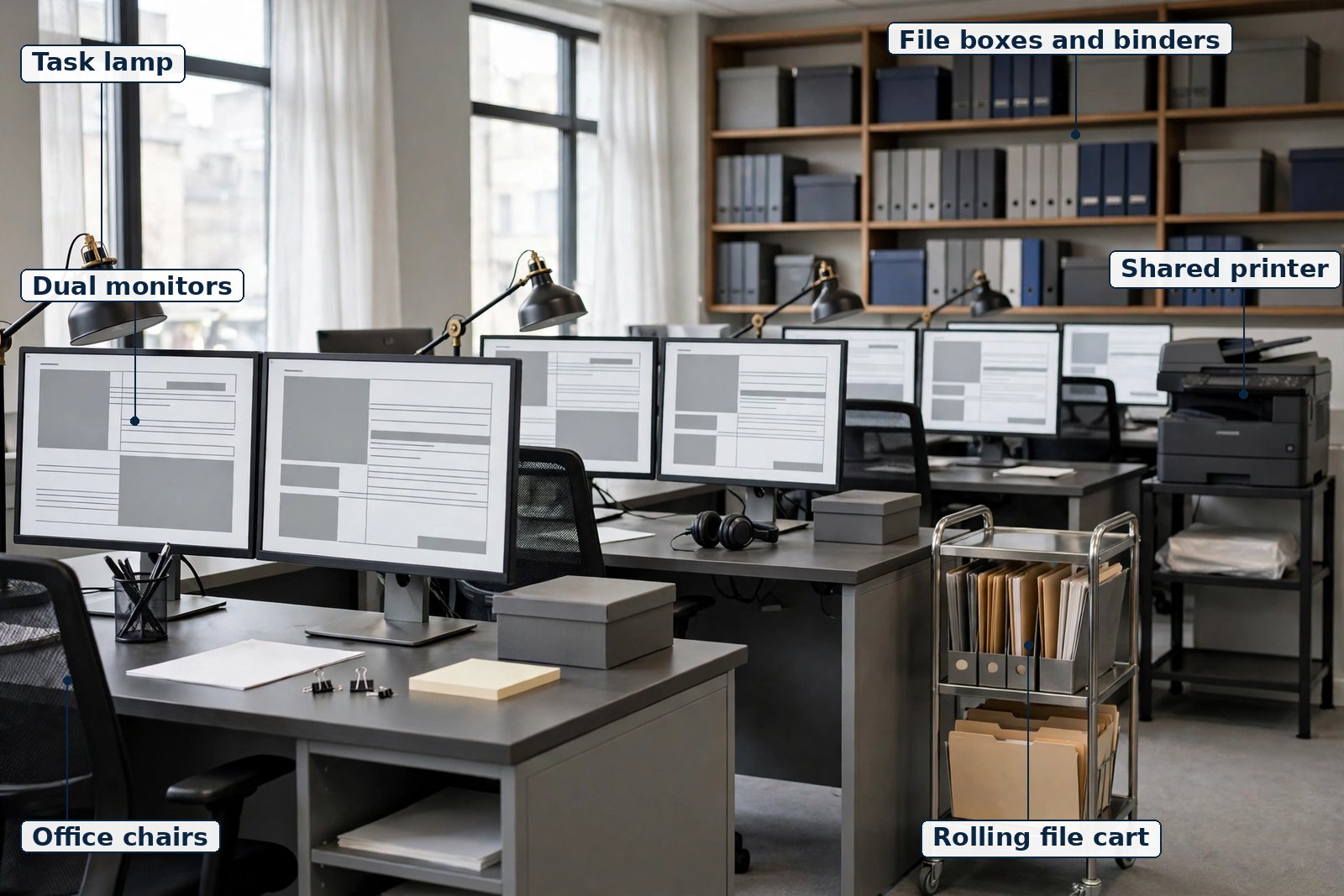
Figure 1.1 — The Calloway & Bright workroom: the paralegal workstations, shared printer, and file shelving of the specimen firm.
Picture the workroom the figure shows. Workstations where research and drafting happen. A shared printer that everyone needs at the worst possible moment — which is why experienced paralegals print early. File shelving where the physical record lives alongside its electronic counterpart. Nothing glamorous, and that is the point: the field's real setting is an office organized around files, deadlines, and review, and competence in that setting is a learnable system, not a personality trait.
The firm's central teaching matter, introduced here and carried through the litigation chapters, is Herrera v. Delgado Freight Lines, Inc., a negligence action over a rear-end collision. The plaintiff is Ana Herrera. On the specimen's record, her special damages include medical expenses and lost wages, and the defendant's liability policy limit on the specimen's record is stated in the chapters that use it. The complaint in the specimen was served on a Tuesday, and the answer deadline that follows from that service date is computed under the federal counting rules in the litigation chapters. You do not need the numbers yet. You need the habit: in this book, every number belongs to a named specimen or a cited rule, and you will always be told which. Numbers that appear from nowhere — in a file, in a memo, in a settlement discussion — are a warning sign in real practice too. Ask where a number came from. If no one can say, do not use it.
Five further specimen matters join the spine as their subjects arrive: an estate with a contested codicil, a contract dispute over manufactured components, a residential purchase, a family matter involving custody and support, and a criminal-defense file. Each is fictional, each is labeled a specimen at first use, and each carries only the figures assigned to it in this book's specimen canon. When later chapters work those files, the figures will match what the canon states — and the exercises will test whether you kept them straight, because keeping figures straight across a long file is itself a paralegal skill.
Why teach on specimens at all? Because real learning needs continuity. A rule about deadlines means little until you watch one deadline govern a file you already know. A rule about damages means little until you compute it on figures you have seen before. The specimens give you that continuity without ever pretending to be real cases. Real cases appear in this book only by name and year, for the settled propositions they stand for — never with invented facts, never dramatized. That discipline protects you twice: it keeps the book honest, and it trains the instinct that, in practice, separates what a source actually says from what someone wishes it said.
Paralegals work wherever lawyers carry responsibility for legal work. Private law firms employ the largest share. Corporate legal departments employ paralegals who support one client's business from inside it. Government offices employ paralegals at the federal, state, and local levels — and note carefully that in this book the word state names a level of government, in the ordinary teaching sense; the book names no individual state and prints no individual state's law as a rule. Courts, legal aid organizations, and other entities round out the settings named in the definition. The work differs by setting — a litigation paralegal's week looks different from an estates paralegal's week — but the structure is constant: delegated substantive work, attorney responsibility, professional standards.
Now the numbers, stated exactly as carefully as the source states them. BLS publishes paralegals and legal assistants as one combined occupation under the Standard Occupational Classification code 23-2011. There is no separate paralegal-only figure, and this book prints none. Any source that offers you a precise paralegal-only national wage is offering you something the national data does not contain. (Source: BLS, Occupational Outlook Handbook.)
For that combined occupation, BLS reports a median annual pay figure for May 2025, with the lowest tenth of earners below a stated figure and the highest tenth above a stated figure. This book prints those figures in their fenced form — whole occupation, May 2025, medians and percentiles as distributions — in the front matter and crosswalks where the apparatus carries them. Here in the teaching prose, what matters is how to read such figures, because misreading them is the classic beginner's error.
Here are those figures, printed whole and in their fenced form. For the combined occupation of paralegals and legal assistants (SOC 23-2011), the median annual wage was $62,890, or $30.24 per hour, in May 2025. The lowest 10 percent earned less than $44,740, and the highest 10 percent earned more than $101,500. The occupation held 404,900 jobs in 2025. For the outlook period from 2025 to 2035, the Bureau projects little or no change in employment overall, at 0 percent, a change of −1,100 jobs, yet it also projects about 40,800 openings each year, most of them arising because workers transfer to other occupations or retire and must be replaced. (Source: BLS, Occupational Outlook Handbook.) Read the set together, because no single figure in it means what a hurried reader wants it to mean: the flat outlook and the steady openings describe the same occupation at the same time, and the wage figures describe its whole spread, from the newest entrants to its most experienced workers, across every setting in which it is practiced. There is no separate paralegal-only figure behind these numbers, and none should be invented from them. These figures describe a national occupation, never a promise about any reader's pay.
A median is the middle value of a distribution: half of the workers in the occupation earned more, and half earned less. A median is not a starting wage. A median is not an offer, a promise, or a prediction about any one reader. A percentile marks a position in the distribution: the lowest tenth earned less than the tenth-percentile figure, which tells you about the spread of earnings across experience levels, settings, and regions — not about what a first job pays. Distributions describe a whole occupation of hundreds of thousands of workers at every stage of their careers. Reading a distribution as a personal forecast is a reasoning error, and this book will not make it on your behalf. No outcome — credential, score, job, or income — is promised anywhere in these pages.
The same care applies to employment counts and outlook. BLS reports the occupation's total jobs for 2025 and projects openings per year driven mostly by replacement — workers transferring or retiring — even in a period of little or no overall growth. BLS also notes that advances in technology, including artificial intelligence, make the occupation more efficient at research and document preparation and thereby limit demand growth. (Source: BLS, Occupational Outlook Handbook.) Read that note the way a professional should: technology changes how the work is done and rewards the workers who master it; it does not repeal the need for judgment, verification, and responsibility. The paralegal who checks the research tool's output against the actual source is practicing exactly the discipline this book teaches.
BLS also describes the typical entry education for the occupation as an associate's degree, while noting that paths vary: some employers prefer a bachelor's degree, and others consider a diploma plus experience. And BLS describes the personal qualities the work rewards: communication skills, being detail oriented, interpersonal skills, organizational skills, and research skills. (Source: BLS, Occupational Outlook Handbook.) None of those qualities is a mystery talent. Each one is trainable, and this book trains them in sequence — communication in the writing chapters, detail in the office-practice chapters, organization in the file chapters, research in Chapters 6 and 7.
One more data habit before leaving this section. Industry matters: BLS publishes separate median figures by employer industry for the combined occupation, and they differ — federal government and finance and insurance medians sit higher than the legal services median, for example. The lesson is not the ranking. The lesson is that a single national number hides real variation by setting, and a careful reader always asks: which population, which date, which measure? Ask those three questions of every statistic anyone shows you about this field, including in job advertisements. It is the same skepticism, applied to numbers, that Chapters 6 and 7 apply to legal sources.
Every profession has a boundary that defines it. For paralegals, the boundary is the line between substantive legal work performed under delegation and the unauthorized practice of law (UPL) — the performance, by a person not licensed as an attorney, of acts the law reserves to attorneys. Crossing that line is not a gray-area shortcut. It can harm the client, expose the firm, and end a career. This section states the boundary in its canonical form; Chapters 34 through 36 teach it in full depth.
NALA's Canon 1 states the prohibitions directly. A paralegal must not engage in, encourage, or contribute to any act that could constitute the unauthorized practice of law. A paralegal must not establish attorney-client relationships, set fees, give legal opinions or advice, or represent a client before a court or agency unless so authorized by that court or agency. And a paralegal must not engage in conduct that would assist or involve the attorney in a violation of professional ethics or give the appearance of professional impropriety. (Source: NALA, Code of Ethics and Professional Responsibility, Canon 1.)
Translate the canon into office behavior, because that is where it will actually govern you.
You do not tell a client what the law means for the client's situation, what the client should do, or what a case is worth. Those are legal opinions and advice, and they belong to the attorney. When a client asks you directly — and clients will, because you are often the person they reach — the professional response explains your role, records the question accurately, and routes it to the supervising attorney. That is not evasion. It is the service itself, performed correctly: the client gets an answer from the person professionally responsible for giving it.
You do not set fees. Fee agreements belong to the attorney and the client. You may gather the information an attorney needs, prepare documents for review, and record time accurately — time in this book's office canon is recorded in tenths of an hour, where one tenth equals six minutes — but the fee decision is never yours.
You do not represent a client before a court or agency unless that court or agency has authorized representation by a non-attorney in that specific setting. Some agencies do authorize non-attorney representatives in defined proceedings, and Chapter 4 teaches that authorization principle carefully. The default rule stands: authorization is specific, never assumed. When in doubt, the answer is to ask the supervising attorney before acting, every time.
You disclose your status. Canon 5 requires a paralegal to disclose status as a paralegal at the outset of any professional relationship with a client, an attorney, a court or agency, or a member of the public. (Source: NALA, Code of Ethics and Professional Responsibility, Canon 5.) Introducing yourself accurately — name, role, firm — is a thirty-second habit that prevents a category of misunderstandings that can take months to repair. A client who believes they have been advised by an attorney, when they were speaking with a paralegal, has been misled even if no one intended it. Disclosure prevents the misleading from ever starting.
You use judgment without replacing the attorney's. Canon 4 asks the paralegal to use discretion and professional judgment commensurate with knowledge and experience — and in the same breath forbids rendering independent legal judgment in place of an attorney. (Source: NALA, Code of Ethics and Professional Responsibility, Canon 4.) Both halves are real. You are expected to think: to spot the missing document, the inconsistent date, the deadline at risk. You are not permitted to decide the legal question yourself and act on the decision as if it were the attorney's. Spot it, document it, escalate it. That rhythm — observe, record, refer — is the heartbeat of safe paralegal practice.
Finally, the mirror-image duty: the attorney's obligations run toward you as well. Under the ABA Model Rules, the lawyer who uses nonlawyer assistance must make reasonable efforts to ensure the assistant's conduct is compatible with the lawyer's own professional obligations, and the supervising framework is what makes delegation legitimate. (Source: ABA Model Rules of Professional Conduct, Rule 5.3.) Supervision is not a formality layered over your work. It is the legal structure that makes your substantive work proper at all. Work that bypasses supervision does not become more efficient. It becomes unauthorized.
Sooner or later every reader asks the question this section answers: if paralegals learn on the job and enter by several roads, what is certification for?
Certification is a voluntary credential granted by a professional body to a person who meets stated eligibility requirements and passes its examinations. Hold the word voluntary. Certification is not a license. A license is government permission required before a person may lawfully practice a regulated occupation; attorneys are licensed. Paralegals, as an occupation, are generally not licensed by government in the same way — they work under attorneys' licenses and responsibility. Certification sits beside that structure as a professional signal: it tells employers, attorneys, and the public that the holder met a national standard, passed a rigorous examination, and accepted a code of ethics and a continuing-education obligation to keep the credential.
The credential at the center of this book is the Certified Paralegal (CP) credential administered by NALA. NALA was founded in 1975, and its certification program was the first and only program of its kind accredited by the National Commission for Certifying Agencies, first accredited in 2014, with the current five-year accreditation period expiring in 2029. Over the program's history the credential has been awarded to more than twenty-one thousand paralegals, and several thousand paralegals currently use the CP designation. (Source: NALA, About the CP Exam.) Those figures describe a mature, established credential — not a weekend certificate — and Chapter 37 teaches the examination itself in full: its two parts, its domains, its eligibility pathways, its fees in their fenced form, and its recertification cycle.
For now, fix the distinctions that examination questions love to blur.
Certification is voluntary; licensure is mandatory permission. A paralegal without certification may still lawfully perform delegated work under an attorney, because the authority for the work flows from the attorney's license and supervision, not from the paralegal's credential. A paralegal with certification may not practice law independently, because certification confers no license. Both directions of that sentence matter, and both are tested.
Certification is granted by the association, not by a book, a course, or a school. This book confers nothing. It teaches the field and prepares you to sit for the examinations with knowledge and method. Any book, course, or website that implies it can grant the credential itself is telling you something false, and you should discount everything else it says accordingly.
Certification must be maintained. The CP credential is valid for a fixed period of years and is renewed by completing continuing legal education hours — including a required portion in legal ethics — submitting a signed affidavit, and paying the renewal fee, all as Chapter 37 and Chapter 40 detail from the register. A credential that lapses is not a technicality; the designation may no longer be used until the holder is reinstated through the process the association provides.
And certification is a floor signal, not a ceiling. It certifies that the holder met the standard at examination. The career built afterward — the files handled well, the attorneys who trust your drafts, the deadlines never missed — is the larger credential, and Chapter 40 closes the book on exactly that road.
Close the chapter by learning how the next thirty-nine chapters will ask you to work, because the method is consistent and knowing it in advance saves effort on every page.
Each chapter teaches one body of knowledge from zero, in the rhythm you met in Section 1.1: simplify, explain, detail, show, do, check. Terms are bolded and defined at first use, and the glossary collects them. Load-bearing claims carry source notes at the point of use, in the style you have already seen, so you can always tell whether a sentence rests on a rule, a specification, or a data source. Figure callouts appear at their teaching points and name the visual program that accompanies the text.
The specimen firm carries the examples. When a later chapter says "on the specimen's record," it means the Calloway & Bright canon introduced in Section 1.4 — fictional, labeled, and consistent. When a chapter states a federal rule, it cites the rule by number. When a chapter teaches something that varies by jurisdiction, it teaches the mainstream pattern, names it a pattern in so many words, and reminds you that your own jurisdiction's rules govern real matters. That standing sentence will recur, deliberately. In practice, checking the local rule is not a disclaimer habit. It is the work.
Every task in this book is framed the same way, and by now you can say why: delegated work, prepared for a supervising attorney's review, inside the boundary Canon 1 draws. If you ever find a worked example in any study material — this book included — that reads as if the paralegal acts alone, decides alone, or advises alone, treat that reading as an error to be corrected, not a model to be followed.
The exercises that follow test this chapter's teaching in fifteen items tagged FIELD. Work them with the chapter open the first time. The key file explains every option — right and wrong — and ties each explanation back to the section that teaches it. That is the pattern for all forty chapters, the diagnostic, the case batteries, and the repair sets: nothing in this book asks you to guess what an answer means. In the office, unexplained answers are how errors survive. In this book, they are not allowed to.
You came to this chapter, perhaps, with a vague picture of the field — someone who helps lawyers, somehow. Leave it with the accurate one: a qualified professional, performing specifically delegated substantive legal work — investigating, researching, organizing, drafting, obtaining, assisting, filing, communicating — for which a lawyer is responsible, inside a boundary that protects the client, the firm, and the paralegal alike. The next chapter goes underneath that picture to its foundation: where law itself comes from, and how a paralegal learns to tell binding law from everything that merely sounds like it.
Tags: FIELD — the paralegal's role, duties, supervised frame, occupation data, and certification. The key, with every option explained, is in this chapter's key file.
Q1. Under the ABA definition adopted by NALA, a paralegal performs — A. Any legal work the paralegal feels qualified to perform B. Specifically delegated substantive legal work for which a lawyer is responsible C. Legal work independently, provided the client consents in writing D. Clerical work only, never substantive legal work
Q2. A client telephones and asks the paralegal whether the client should accept a settlement offer. The correct response is to — A. Give the advice, since the paralegal knows the file best B. Give the advice if the supervising attorney is unavailable that day C. Explain the paralegal's role, record the question, and route it to the supervising attorney D. Refuse to speak with the client at all
Q3. Which statement about BLS occupation data is accurate? A. BLS publishes paralegals and legal assistants as one combined occupation, with no paralegal-only figure B. BLS publishes a separate median wage for paralegals alone C. The median figure is the starting wage for new paralegals D. The median figure is a promise of what a graduate will earn
Q4. Canon 3 of the NALA Code permits a paralegal to perform a task when it is — A. Assigned by the client directly to the paralegal B. A task the paralegal performed at a prior employer C. A task any experienced office worker could perform D. Properly delegated and supervised by an attorney who remains responsible to the client
Q5. Calloway & Bright LLP, as used in this book, is — A. A real firm whose matters are described with permission B. A fictional teaching specimen, labeled as such C. The firm that grants the Certified Paralegal credential D. A government agency that employs paralegals
Q6. Which of the following is one of the duties BLS lists for the occupation? A. Investigate and gather the facts of a case B. Set the fees clients will be charged C. Represent clients before courts and agencies generally D. Give legal opinions on the strength of a case
Q7. Certification as a Certified Paralegal is best described as — A. A government license to practice law independently B. A credential granted automatically on completing this book C. A voluntary credential granted by NALA to those who meet eligibility and pass its examinations D. A requirement before any paralegal may perform delegated work
Q8. A median wage figure for an occupation tells the reader — A. What a first job in the occupation will pay B. What every worker in the occupation earns C. What the occupation's top earners receive D. The middle value of the distribution: half earned more and half earned less
Q9. At the outset of a professional relationship, Canon 5 requires the paralegal to — A. Present the attorney's business card instead of speaking B. Disclose status as a paralegal C. Obtain the client's written waiver of supervision D. State the fee the attorney will charge
Q10. Substantive legal work differs from purely clerical work because it — A. Is always performed in a courtroom B. Takes longer to complete C. Requires knowledge of legal concepts and procedures and is work an attorney would otherwise perform D. Never involves documents or deadlines
Q11. A paralegal notices a deadline in a file that appears to have been computed incorrectly. The professional course is to — A. Document the concern and bring it to the supervising attorney B. Quietly change the deadline and tell no one C. Advise the client that the deadline has moved D. Ignore it, since deadlines are solely the attorney's concern
Q12. Which statement about this book is accurate? A. Completing this book grants the Certified Paralegal credential B. This book is legal advice for the reader's own matters C. This book authorizes the reader to practice law under supervision D. This book teaches knowledge and method for education and examination preparation and confers no credential
Q13. Time in the specimen office canon is recorded — A. In quarter hours only B. Only at the end of each matter C. In tenths of an hour, where one tenth equals six minutes D. Without any unit, as a narrative summary
Q14. The supervising attorney's role in delegated work includes — A. Delegating tasks and then bearing no responsibility for them B. Reviewing the work product and assuming professional responsibility for it C. Signing documents the attorney has not reviewed D. Transferring the attorney-client relationship to the paralegal
Q15. A paralegal is asked by an agency whether the paralegal may represent the firm's client in that agency's proceeding. The correct starting point is — A. Representation is proper only if that court or agency has authorized it for that setting B. Representation is always proper for a certified paralegal C. Representation is proper whenever the client requests it D. Representation is proper whenever the fee has been paid
Tags: FIELD — the paralegal's role, duties, supervised frame, occupation data, and certification. Every rationale explains why the key is right and why each wrong option is wrong.
Q1 — Key: B. Tag: FIELD. B is right because the ABA definition adopted by NALA describes specifically delegated substantive legal work for which a lawyer is responsible (§1.2). A is wrong because qualification alone never authorizes self-assigned work; delegation is required. C is wrong because client consent cannot convert independent practice into delegated work. D is wrong because the definition expressly covers substantive work, not clerical work only. (Source: NALA, Code of Ethics and Professional Responsibility.)
Q2 — Key: C. Tag: FIELD. C is right because giving advice on whether to accept an offer is legal advice reserved to the attorney; the paralegal explains the role, records the question, and routes it to the supervising attorney (§1.6). A is wrong because familiarity with the file does not authorize legal advice under Canon 1. B is wrong because the attorney's absence does not transfer the attorney's authority. D is wrong because paralegals do communicate with clients; the limit is on advice, not on all contact. (Source: NALA, Code of Ethics and Professional Responsibility, Canon 1.)
Q3 — Key: A. Tag: FIELD. A is right because BLS publishes the occupation as one combined category, Paralegals and Legal Assistants, SOC 23-2011, and no paralegal-only figure exists (§1.5). B is wrong because it invents the separate figure the chapter states does not exist. C is wrong because a median is the middle of a distribution, not a starting wage. D is wrong because distribution figures are never a promise to any individual reader. (Source: BLS, Occupational Outlook Handbook.)
Q4 — Key: D. Tag: FIELD. D is right because Canon 3 permits any task properly delegated and supervised by an attorney who remains ultimately responsible to the client (§1.2, §1.6). A is wrong because delegation must come from the attorney, not directly from the client. B is wrong because past practice elsewhere does not delegate a task in this matter. C is wrong because the test is delegation and supervision, not whether the task seems general. (Source: NALA, Code of Ethics and Professional Responsibility, Canon 3.)
Q5 — Key: B. Tag: FIELD. B is right because Calloway & Bright LLP is introduced as a fictional teaching specimen and labeled as such at first use (§1.4). A is wrong because no real firm's matters are described in this book. C is wrong because NALA, not any firm, grants the Certified Paralegal credential. D is wrong because the specimen is a private general-practice firm, not a government agency.
Q6 — Key: A. Tag: FIELD. A is right because investigating and gathering the facts of a case is the first duty on the BLS list (§1.3). B is wrong because setting fees is reserved to the attorney under Canon 1 and is not a BLS duty. C is wrong because general representation is reserved to attorneys and is not listed. D is wrong because giving legal opinions is prohibited advice, not a listed duty. (Source: BLS, Occupational Outlook Handbook.)
Q7 — Key: C. Tag: FIELD. C is right because certification is a voluntary credential granted by NALA to candidates who meet eligibility requirements and pass its examinations (§1.7). A is wrong because certification is not a government license and confers no right to practice law. B is wrong because this book confers nothing; only NALA grants the credential. D is wrong because uncertified paralegals may lawfully perform delegated work under an attorney's responsibility.
Q8 — Key: D. Tag: FIELD. D is right because a median is the middle value of a distribution, with half of workers above it and half below it (§1.5). A is wrong because the median describes all experience levels together, not entry pay. B is wrong because a distribution by definition contains varied earnings. C is wrong because the top of the distribution is described by high percentiles, not by the median.
Q9 — Key: B. Tag: FIELD. B is right because Canon 5 requires disclosure of paralegal status at the outset of any professional relationship (§1.6). A is wrong because handing over another person's card is not disclosure of one's own status. C is wrong because no waiver can remove the supervision structure, and none is required for ordinary contact. D is wrong because stating fees is fee-setting territory reserved to the attorney. (Source: NALA, Code of Ethics and Professional Responsibility, Canon 5.)
Q10 — Key: C. Tag: FIELD. C is right because substantive work requires knowledge of legal concepts and procedures and is work an attorney would otherwise have to perform (§1.2). A is wrong because substantive research, drafting, and analysis are typically office work, not courtroom-only work. B is wrong because duration does not define whether work is substantive. D is wrong because substantive work centrally involves documents and deadlines.
Q11 — Key: A. Tag: FIELD. A is right because Canon 4 expects the paralegal to use professional judgment to spot the problem while referring the legal decision to the attorney: observe, record, refer (§1.6). B is wrong because silently changing a deadline hides the error and bypasses review. C is wrong because telling the client the deadline moved is advice about the matter, reserved to the attorney. D is wrong because deadline vigilance is core paralegal work, even though the attorney remains responsible. (Source: NALA, Code of Ethics and Professional Responsibility, Canon 4.)
Q12 — Key: D. Tag: FIELD. D is right because the book states on its face that it teaches knowledge and method for education and examination preparation, is not legal advice, and confers no credential (§1.1, §1.7). A is wrong because only NALA grants the credential after its examinations. B is wrong because the book expressly disclaims being legal advice. C is wrong because no book authorizes the practice of law, supervised or otherwise.
Q13 — Key: C. Tag: FIELD. C is right because the specimen office canon records time in tenths of an hour, with one tenth equal to six minutes (§1.6). A is wrong because the canon unit is the tenth, not the quarter hour. B is wrong because time is recorded as work is performed, not reconstructed at a matter's end. D is wrong because the canon requires a measured unit, not a narrative alone.
Q14 — Key: B. Tag: FIELD. B is right because under Canon 3 the attorney reviews the work product and assumes professional responsibility for it while maintaining the direct client relationship (§1.2, §1.6). A is wrong because delegation never sheds the attorney's responsibility. C is wrong because signing unreviewed work defeats the supervision the rule requires. D is wrong because the attorney-client relationship remains the attorney's and is never transferred. (Source: NALA, Code of Ethics and Professional Responsibility, Canon 3.)
Q15 — Key: A. Tag: FIELD. A is right because Canon 1 bars representing a client before a court or agency unless so authorized by that court or agency, so specific authorization is the starting inquiry (§1.6). B is wrong because certification alone never authorizes representation. C is wrong because a client's request cannot supply legal authorization. D is wrong because payment of a fee has no bearing on who may represent. (Source: NALA, Code of Ethics and Professional Responsibility, Canon 1.)
End of the free sample. The complete book continues from here — the full A-to-Z course in book form, delivered as an EPUB you can read in Apple Books, Google Play Books, ReadEra, Thorium Reader, Adobe Digital Editions, or Send to Kindle.
Buy this ebook — $11.99 Back to the book page
Payments are securely processed by Payhip.