
Mastering Careers & Skills
Occupational English Test (OET) for Nurses · free sample from the book itself
1. Answer: A. The Handbook states that OET is owned by Cambridge Boxhill Language Assessment Unit Trust (CBLA), a venture between Cambridge English (Aus) and Box Hill Institute.
2. Answer: A. The Handbook lists twelve professions, from Dentistry and Nursing to Veterinary Science.
3. Answer: A. The Handbook states that Listening and Reading are the same for all candidates, regardless of profession, while Writing and Speaking are tailored to the profession.
4. Answer: A. The Writing sub-test has one task: a letter in response to profession-specific case notes — for Nursing candidates, Nursing Writing tasks.
5. Answer: A. The Handbook states that you complete the Speaking sub-test with an interlocutor who plays the role of the patient or the patient's family member or carer.
6. Answer: A. The Handbook states plainly: you will hear each recording once only. First-hearing skill is therefore the whole Listening game.
7. Answer: A. The Handbook fixes Reading at 60 minutes, with Part A completed separately in 15 minutes and Parts B and C in 45 minutes.
8. Answer: A. The Handbook: the four sub-tests are reported on a scale from 0 to 500 in ten-point increments, each mapped to its own letter grade from E to A.
9. Answer: A. The Handbook's Test fees section states that fees vary depending on the country of booking, the delivery mode, and full-test versus individual sub-test booking, and that current fees are published on the OET website. A printed amount would be invented.
10. Answer: A. The Handbook directs candidates to each organization's website for its score requirements, and states that each organization sets its own requirements, including how long results are valid.
11. Answer: A. The Handbook limits OET@Home to candidates with no test venue in their country or with other access needs; it is a computer-based test with remote proctoring.
12. Answer: A. The Handbook states that all delivery modes use the same test format and specifications and are marked to the same standard.
13. Answer: A. Special arrangements cover temporary conditions such as a broken arm as well as permanent ones; they are requested in advance and must be confirmed by OET before the test.
14. Answer: A. The Handbook: re-mark requests must be submitted within 72 hours of results release; fees apply and are refunded if the grade changes.
15. Answer: A. The Handbook states there is no global standard for how long results are valid; each organization sets its own requirements.
16. Answer: A. The Handbook's structure table gives Writing one task and Speaking two tasks (the two role-plays).
17. Answer: A. The Handbook: when results are released, the Statement of Results is issued through the OET Account and shows results for each sub-test as a numerical score and a letter grade.
18. Answer: A. The Handbook gives Computer and OET@Home results as typically from 48 hours, most within 6 calendar days, and warns the timeframes are indicative.
19. Answer: A. Results are shared by giving organizations access through the OET Account; the candidate manages which organizations can view and verify, and can remove access at any time.
20. Answer: A. The seat, the scope and the Handbook agree: Writing and Speaking are profession-specific, so a serious preparation book is version-specific — this one is Nursing throughout.
The Occupational English Test — the OET Test — is an English language test designed specifically for healthcare. It exists to let internationally trained healthcare professionals demonstrate the English communication skills they need to work and study in healthcare settings. That design choice shapes everything in this book: the listening voices are consultations and handovers, the reading texts are workplace documents and health articles, the writing task is a professional letter, and the speaking tasks are the conversations a nurse actually has.
The test is owned by Cambridge Boxhill Language Assessment Unit Trust, known as CBLA — a venture between Cambridge English (Aus) and Box Hill Institute. Cambridge English is a not-for-profit department of the University of Cambridge; Box Hill Institute is an Australian vocational and higher education provider. (Source: OET Test Handbook 2026, About OET.) This book is an independent study guide. It is not published by, affiliated with, endorsed by, or approved by CBLA or OET, and neither body participated in its creation — the full disclosure stands in the front matter and again here, because you should know exactly whose book you are holding: a teacher's book, built from the test owner's own published description of the test.
OET is taken for twelve healthcare professions: Dentistry, Dietetics, Medicine, Nursing, Occupational Therapy, Optometry, Pharmacy, Physiotherapy, Podiatry, Radiography, Speech Pathology and Veterinary Science. (Source: OET Test Handbook 2026, What is the OET Test?) You are preparing for the Nursing version. Two of the four sub-tests — Listening and Reading — are the same for every candidate of every profession. The other two — Writing and Speaking — are tailored to your profession: a nurse writes nursing letters and plays the nurse in nursing role-plays. This book teaches exactly that division, and nothing in it pretends to prepare you for another profession's version.
The test has four sub-tests. Listening takes approximately 40 minutes and has 42 questions in three parts. Reading takes 60 minutes and has 42 questions in three parts. Writing is one task in 45 minutes — a letter written from case notes. Speaking is two tasks in about 20 minutes — two role-plays with an interlocutor. (Source: OET Test Handbook 2026, Test overview.) Chapters 6 to 18 teach each part in turn; this chapter gives you the map before the territory.
Two features of the map matter from day one. First, every recording in Listening is heard once only — there is no replay, so Listening is a skill of first hearing, and Chapter 5 builds it that way. Second, there is no overall score: each sub-test is reported separately, on a scale from 0 to 500, with its own letter grade. A strong Reading result cannot rescue a weak Writing result. Your preparation must therefore be balanced across all four skills, and the diagnostic test in this book scores you by skill area for exactly that reason.
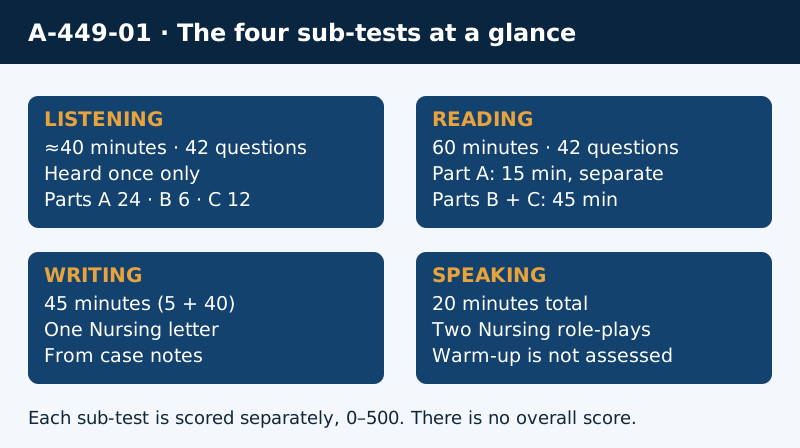
Figure A-449-01. The four OET sub-tests at a glance: Listening (about 40 minutes, 42 questions, heard once), Reading (60 minutes, 42 questions), Writing (45 minutes, one Nursing letter) and Speaking (20 minutes, two Nursing role-plays). Each is scored separately from 0 to 500; there is no overall score.
OET offers three delivery modes. The OET Test on Paper is taken at an approved test center. The OET Test on Computer is taken at an approved test venue. OET@Home is taken on your own computer at home, with remote proctoring — and it is available if there is no OET test venue in your country, or if you have other access needs. All three modes use the same test format and specifications and are marked to the same standard. (Source: OET Test Handbook 2026, Test delivery modes.) Chapter 20 prepares you for the practical craft of each mode; the language work is identical.
If you have a disability or a health condition — permanent, such as a hearing or vision impairment, dyslexia or a speech impairment, or temporary, such as a broken arm — you may be able to request special testing arrangements, including extra time, accessibility support, modified materials, large-print or Braille papers, or lip-reading versions. Arrangements must be applied for in advance and confirmed by OET before your test. (Source: OET Test Handbook 2026, Special testing arrangements.)
Booking is made through OET's online booking platform: you upload your identification document and pay the test fee online when you book. This book prints no fee amount, deliberately: the Handbook states that fees vary by country, delivery mode, and whether you book the full test or individual sub-tests where available, and that current fees are published on the OET website. Check there, at the moment you book. (Source: OET Test Handbook 2026, How to book the OET Test; Test fees.)
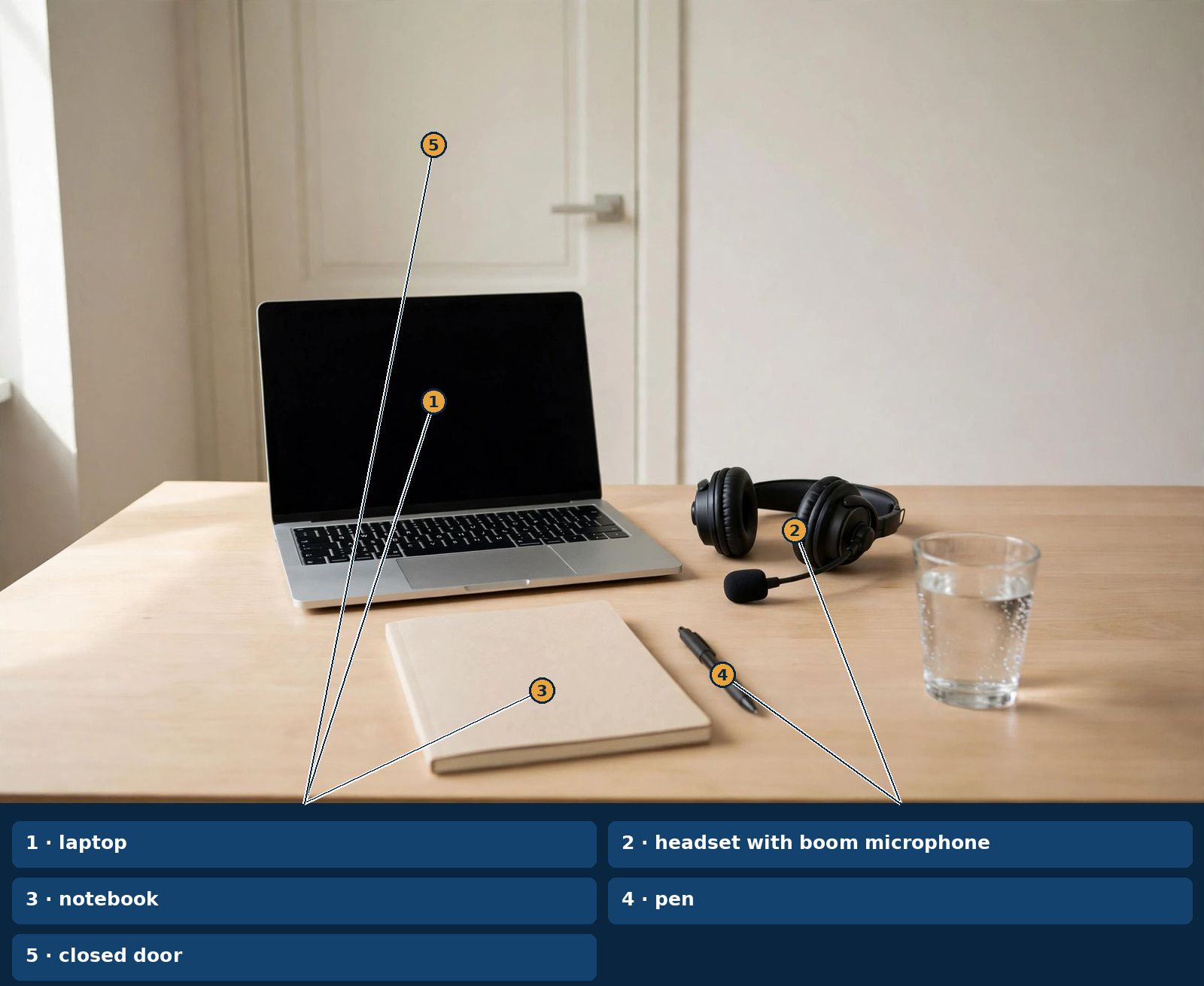
Figure P-449-06. The OET@Home desk: laptop, headset, clear desk.
OET results are used around the world for registration, employment and study. Regulatory authorities, registration boards and councils use the test to help ensure that internationally trained professionals meet the English standard required for safe and effective communication. Employers use results to confirm communication skills for work with patients, carers and colleagues. Education and training institutions may use results for admission and readiness. Results may also be accepted for visa and immigration purposes, depending on the authority. (Source: OET Test Handbook 2026, Benefits of the OET Test; Who recognises the OET Test?)
Here is the discipline this book will hold from its first page to its last: OET sets no pass mark. The score you need is set by the organization you are applying to — your regulator, employer or institution — and that organization also decides how long results remain valid for its purposes; there is no global validity standard. (Source: OET Test Handbook 2026, Sharing your results with organizations; Results validity period.) Chapter 19 teaches you to read your own organization's current published requirement and to plan against it. Any book that prints you a universal 'pass score' for OET is inventing one.
This is a print ebook, and it contains no audio. Listening is taught and practiced through printed transcripts, method, and timed transcript drills — the same way the IELTS and TOEFL books in this series handle it — and the method is stated wherever Listening practice appears, so you are never left wondering where the sound is. Speaking is taught through printed role-play cards and model dialogues. OET's own official sample tests, which do carry recordings, are free to candidates and are the right companion for live listening; the Handbook confirms sample tests exist for all four sub-tests, for every profession, in paper and computer formats, with transcripts and sample answers you can review. (Source: OET Test Handbook 2026, Sample tests.) Use them alongside this book's method, not instead of it.
The book's rhythm is the series rhythm: simplify, explain, detail, show, do, check. Every chapter teaches, shows a worked example or a model, sets you a task, and closes with a 20-question quiz whose key explains the right answer and every wrong answer. A 48-question diagnostic comes first in the spine, scored by skill area, so your study plan is driven by evidence about you — not by habit.
Reading a test fact like an assessor. Take the sentence: 'Speaking lasts about twenty minutes.' The Handbook's own breakdown is more precise and more useful: 20 minutes in total, made up of a warm-up of about 2–3 minutes, 3 minutes of preparation for each role-play, and about 5 minutes for each role-play itself. (Source: OET Test Handbook 2026, Speaking.) The lesson generalises: whenever this book states a timing, a count or a rule, it states the owner's published form of it — and where the owner publishes no figure, as with fees, the book says so instead of filling the gap.
Candidates often prepare as if OET had one pass mark and one overall score. It has neither: four separate sub-test scores, and requirements set by the organization you apply to. Preparing 'for 350' as a superstition, instead of for the published grade descriptors and your own regulator's current requirement, misdirects months of work.
Choose the one best answer. The key follows in the next unit, with an explanation for the right answer and for every wrong answer.
1. Who owns the OET Test?
2. How many healthcare professions have an OET version?
3. Which two sub-tests are the same for candidates of every profession?
4. A nurse's Writing sub-test consists of…
5. In the Speaking sub-test, the interlocutor plays the role of…
6. How many times is each Listening recording played?
7. What is the total time for the Reading sub-test, and how is it divided?
8. How is each sub-test result reported?
9. Why does this book print no OET test fee?
10. A candidate needs to know what OET score her regulator requires. Where does the Handbook direct her?
11. OET@Home is available to a candidate when…
12. Which statement about the three delivery modes is correct?
13. A candidate with a broken arm wants extra support on test day. What does the Handbook provide?
14. If a candidate believes her result does not reflect her performance, the Handbook's re-marking rule is…
15. How long are OET results valid?
16. Which pair correctly matches sub-test and task count?
17. The Statement of Results is issued…
18. Results timing for the OET Test on Computer is described by the Handbook as…
19. A candidate wants her hospital employer to see her results. Under the Handbook, she…
20. This book prepares you for…
Feras Alzubi
Exam Prep Series
© 2026 Feras Alzubi. All rights reserved. No part of this book may be reproduced, distributed, or transmitted in any form or by any means, including photocopying, recording, or other electronic or mechanical methods, without the prior written permission of the copyright holder, except as permitted by law.
This is an original work, written for this book. The practice questions, texts, transcripts, letters and dialogues are original, written against the published structure of the Occupational English Test (OET) as set out in the OET Test Handbook 2026, and are not OET's actual, recalled, paraphrased, or adapted test items.
This book is an independent study guide. It is not published by, affiliated with, endorsed by, or approved by Cambridge Boxhill Language Assessment (CBLA) or OET, and neither CBLA nor OET participated in its creation. Exam names and trademarks belong to their respective owners. Passing any exam also depends on the candidate's own preparation; no book can guarantee a result.
This book prepares you for the Nursing version of the OET Test: the version whose Writing and Speaking tasks are nursing tasks. It does not prepare you for any other profession's version, and it confers nothing — no score, no registration, no visa, no job. What it does is teach, completely: the language foundations of nursing communication, all four sub-tests in their published structure, and the craft of performing in them, with 880 practice questions (every one explained, right and wrong answers alike), a 48-question diagnostic, 4 full timed practice tests built in the test's real shape, 10 writing workshops with model letters, and 12 speaking workshops with model dialogues.
This book contains no audio. It is a print ebook. Listening is taught and practiced through printed transcripts, method, and timed once-through transcript drills; Speaking is taught through printed role-play cards and model dialogues. OET's own official sample tests — which carry recordings, transcripts and sample answers for every profession, in paper and computer formats (OET Test Handbook 2026) — are the right live-audio companion to this book's method. Wherever Listening practice appears, the method is stated again on the page, so the design is never a surprise.
A note on fees and requirements. OET's Handbook publishes no test fee amount: fees vary by country and delivery mode, and current fees are published on the OET website — so this book prints no fee, anywhere. OET likewise sets no pass mark: the score you need is set by the organization you apply to, on its own current published requirement. This book teaches you to read that requirement (Chapter 19) rather than printing you a rumour of one.
Every figure below is from the OET Test Handbook 2026, read in full for this book.
The book teaches in the series rhythm: simplify → explain → detail → show → do → check. Take the diagnostic first (it follows the chapters in this edition's spine; your reading app can take you straight to it) — 48 questions, scored by skill area, pointing you at the chapters your route must weight. Then work the chapters in order: foundations (1–5), the sub-tests part by part (6–18), and the exam layer (19–20). Every chapter closes with a 20-question quiz; every key explains the right answer and every wrong answer. A "practice question" in this book's counts means one scored selected-response or short-answer item with a printed key and a full explanation; writing tasks and speaking role-plays are tasks, counted separately (10 workshops + 12 workshops + 4 test letters + 8 test role-plays).
The two study plans (full day-by-day versions in the back matter): the 4-week standard plan works one part of the test at a time with a practice test each weekend; the 2-week intensive plan assumes the foundations are familiar and drives the part-chapters, workshops and tests in rotation. Both plans timetable mode-mechanics rehearsal (pen-and-paper for the paper test, keyboard for the computer test) in the final week.
For Listening drills: a transcript drill is done once through, at a steady reading pace (or read aloud by a partner), without stopping, completing the tasks as you go — then studied in the key, where answers are located in the transcript and distractors explained. Re-reading mid-drill converts Listening practice into Reading practice; the drills' instructions repeat this because it is the whole point.
Front matter · Chapters 1–20 with keys · Diagnostic test with key and tracker · Timed Practice Tests 1–4 with keys, model letters and model dialogues · Repair Sets 1–4 with keys · Writing & Speaking Workshops with models and commentary · Study plans · Cheat sheets · Glossary · Errata & updates · References · Outline crosswalk appendix
End of the free sample. The complete book continues from here — the full A-to-Z course in book form, delivered as an EPUB you can read in Apple Books, Google Play Books, ReadEra, Thorium Reader, Adobe Digital Editions, or Send to Kindle.
Buy this ebook — $11.99 Back to the book page
Payments are securely processed by Payhip.