
Mastering Careers & Skills
Mortgage Loan Officer Exam (NMLS SAFE) · free sample from the book itself
What this chapter does. This is the first chapter of the book, and it assumes nothing. By the end of it you will be able to explain, in plain words, what a mortgage is, why it exists, who lends and who borrows, who owns what at each moment, and how interest works as the price of borrowed money. You will also follow one complete loan from the first conversation to the last payment, in its simple form. Later chapters add the law, the documents, and the math. This chapter builds the picture all of that hangs on.
Start with a problem almost every family faces.
A home costs far more than most people have saved. A house might cost $400,000. A buyer who saved carefully for years might have $80,000. Without a way to borrow the rest, that buyer would have to keep renting for decades while saving — by which time the price would have moved again.
A mortgage loan solves that problem. It is a loan made to buy, or secured by, a home, in which the home itself stands behind the promise to repay. In plain words:
That last idea is the whole invention. A lender will advance $320,000 to a stranger it met last month for one reason: if the borrower never pays, the lender has a legal claim on a house worth about what was lent. The house makes the loan safe enough to make. Remove the house from the deal, and no lender offers a ordinary family several hundred thousand dollars for thirty years at a household interest rate.
You will sometimes hear "mortgage" used for the loan itself, and sometimes for a specific paper the borrower signs. Chapter 2 separates those papers precisely. In this chapter, "mortgage loan" means the whole arrangement: money advanced, a promise to repay, and a home securing that promise.
Three different ways to live in a home are easy to blur. Keep them apart, because a mortgage borrower is doing two of them at once.
Renting. A renter pays a landlord for the use of a home the landlord owns. The renter builds no ownership. When the renter leaves, the payments stay behind with the landlord.
Owning. An owner holds title — the legal ownership of the property, evidenced by a deed, the document that transfers ownership from one person to another. An owner who bought with cash, or who has finished paying off a loan, owns the home free of any loan claim.
Owing. A borrower who buys with a mortgage loan owns and owes at the same time. This surprises many beginners, so read it twice: the borrower owns the home from the day of purchase. The buyer receives title, lives in the home, can sell it, and benefits if its value rises. The lender does not own the home. The lender owns a claim — a right, described fully in Chapter 2, to be repaid from the property if the borrower defaults. Default means failing to meet the loan's terms, most commonly by not paying.
What the borrower owns, in dollar terms, has its own word. Equity is the part of the home's value that belongs to the owner rather than the lender: the home's current value minus what is still owed on loans against it. If a home is worth $400,000 and the borrower owes $320,000, the borrower's equity is $400,000 − $320,000 = $80,000. Equity grows two ways: the borrower pays the loan down, or the home's value rises. It can also shrink if the value falls — owing does not stop being owing when a price moves.
Meet a first borrower. Ana has saved $80,000 and is buying a home priced at $400,000 from a seller, Mr. Okafor. A lender agrees to lend her the rest.
At the purchase, two payments combine to pay the seller in full: the lender's $320,000 and Ana's $80,000 down payment. The seller is paid and transfers title to Ana. Ana now owns a $400,000 home, owes $320,000, and starts with $80,000 of equity — exactly the cash she put in. Over the years that follow, she sends the lender a payment every month, and the amount she owes falls, slowly at first and faster later (Chapter 4 shows why the fall speeds up).
Figure 1.1 — Buying a Home with Borrowed Money
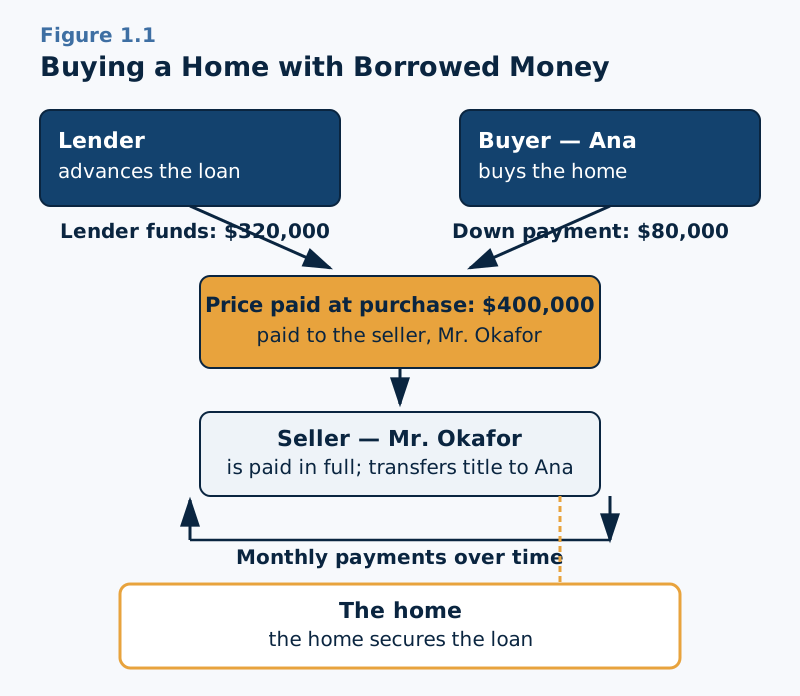
Read the figure slowly, because every later diagram in this book is a zoom-in on one part of it. Money flows down once, at purchase, from lender and buyer to seller. Then money flows back, a month at a time, from borrower to lender, for years. And underneath both flows sits the home, securing the loan the whole time.
Why does Ana repay more than $320,000? Because money over time has a price, and that price is interest.
Interest is rent on money. Just as a renter pays for the use of a home month by month, a borrower pays for the use of the lender's money month by month. The longer Ana keeps the lender's money and the more of it she still holds, the more interest she pays. When she repays part of the loan, she is renting less money, so the interest part of her payment falls.
The price is quoted as an interest rate: a percentage of the amount still owed, charged per year. A rate of 6 percent per year on $320,000 still owed would be $320,000 × 6% = $19,200 of interest over a full year if the balance never fell. In a real loan the balance falls every month, so interest is figured month by month on the balance that month. Chapter 4 takes that calculation apart, and Chapter 15 makes you fluent in it. For now, hold the idea, not the arithmetic: interest is charged on what you still owe, for as long as you still owe it.
That single idea explains the shape of a borrower's choices:
The amount originally borrowed is the principal. Almost everything in this book is, at bottom, a rule about principal, interest, time, or the home that secures them.
Strip away the paperwork (Chapter 2 restores it) and a mortgage loan is an agreement with five working parts:
Show — one verified anchor loan. Throughout this book, one loan returns as a measuring stick: $300,000 borrowed at a fixed rate of 6 percent for 30 years. Its monthly payment of principal and interest is $1,798.65. That figure is not a guess or a rounded teaching number; it is the result of the standard amortization calculation, worked in full in Chapter 15, and every figure built on it in this book is recomputed from it. Notice what the payment does not include: property taxes and homeowner's insurance, which most borrowers pay as part of a larger monthly total. Chapter 4 opens the payment up and shows all of its parts.
Exam trap — principal and interest are not the whole housing cost. A question that gives you a principal-and-interest payment has not yet given you the borrower's full monthly housing expense. Taxes, insurance, and, where it applies, mortgage insurance ride on top. Chapters 4 and 14 build that full figure and test it.
Confusion about ownership causes real errors later — in title work, in insurance, and in ethics questions about whose interest an originator is serving. Walk Ana's loan through time:
Here, in six plain steps, is the whole life of a loan. No deadlines, no rule names, no forms yet — those arrive in later chapters, attached to the step they govern. Chapter 5 will expand this same story into the full working pipeline.
Figure 1.2 — One Loan, One Story (simple life of a loan)
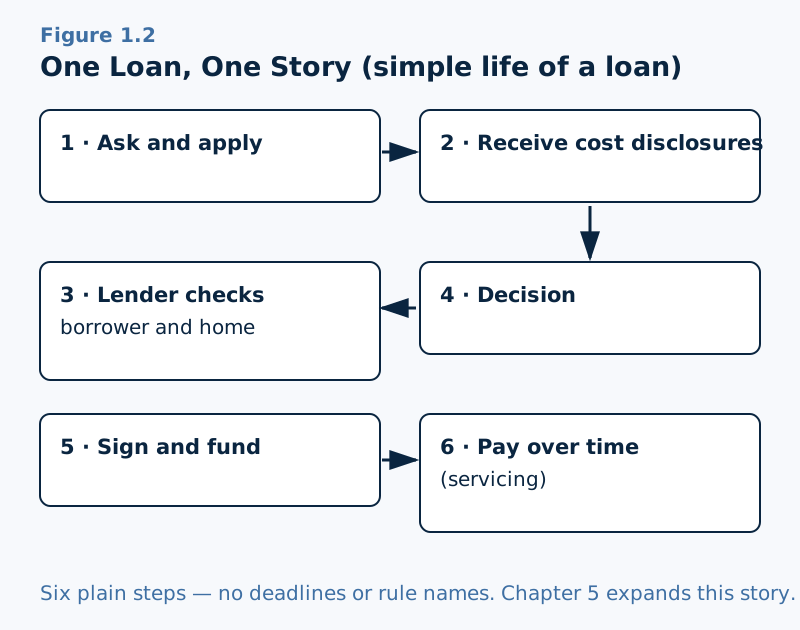
One special case belongs in this first picture. Not every mortgage loan buys a home for the borrower who signs it that day. A refinance is a new loan that pays off and replaces an existing loan on a home the borrower already owns — taken to change the rate, the term, or the amount. Everything in this chapter still applies: new money, a new promise, the same home securing it.
Answer these from the chapter, without looking back if you can.
Answers. 1. $350,000 − $260,000 = $90,000. 2. Loan amount = $300,000 − $50,000 = $250,000; starting equity = $50,000, the cash put in. 3. False. The borrower holds title and owns the home; the lender holds a claim against it, not ownership. 4. The lender requires security because the home gives it a way to be repaid if the promise is broken, which is what makes a large, long loan offerable at all; the borrower accepts because securing the loan with the home is what lets her buy the home now instead of saving its full price first.
1. [Foundations] A mortgage loan is best described as: Domain: General Mortgage Knowledge
2. [Foundations] In a mortgage loan, the home's role as security for the debt is called: Domain: General Mortgage Knowledge
3. [Foundations] On the day of purchase with a mortgage loan, who owns the home? Domain: General Mortgage Knowledge
4. [Foundations] A home is worth $380,000 and the borrower owes $295,000. The borrower's equity is: Domain: General Mortgage Knowledge
5. [Foundations] Interest on a mortgage loan is best understood as: Domain: General Mortgage Knowledge
6. [Foundations] A buyer's home costs $300,000 and the buyer pays $60,000 down. The loan amount is: Domain: General Mortgage Knowledge
7. [Foundations] The document that transfers ownership of a property from one person to another is the: Domain: General Mortgage Knowledge
8. [Foundations] Which statement about a borrower during the loan is correct? Domain: General Mortgage Knowledge
9. [Foundations] Foreclosure is: Domain: General Mortgage Knowledge
10. [Foundations] A new loan that pays off and replaces an existing loan on a home the borrower already owns is a: Domain: General Mortgage Knowledge
11. [Foundations] In the simple life of a loan taught in this chapter, which step comes immediately after the lender checks the borrower and the home? Domain: General Mortgage Knowledge
12. [Foundations] The company that collects monthly payments and administers a loan after closing is the: Domain: General Mortgage Knowledge
13. [Foundations] Which set names the five working parts of a loan's shape as this chapter teaches them? Domain: General Mortgage Knowledge
14. [Foundations] A borrower borrows for a shorter term instead of a longer one, at the same amount and rate. The expected result is: Domain: General Mortgage Knowledge
15. [Foundations] The book's anchor loan is $300,000 at 6 percent fixed for 30 years. Its monthly principal-and-interest payment, as computed in full in Chapter 15, is: Domain: General Mortgage Knowledge
1 [Foundations] — Key: B. A mortgage loan joins a promise to repay with the home as security — that joining is the definition this whole book builds on. D describes a lease arrangement; no lease exists here, and the borrower owns from purchase. A reverses ownership: the lender holds a claim, not the home. C invents a restriction; mortgage loans are made to repeat buyers and through many programs, government and non-government alike.
2 [Foundations] — Key: B. Property pledged to secure a loan is collateral. C: equity is the owner's share of value, the opposite side of the picture. A: a down payment is the buyer's cash at purchase, not the property's security role. D: title is ownership itself, not the pledging of the property.
3 [Foundations] — Key: B. Title passes to the borrower at purchase; the borrower owns while owing. C states the most common beginner error this chapter exists to correct. A: the seller is paid in full at purchase and leaves the picture. D: the lender's claim is not a share of ownership.
4 [Foundations] — Key: A. Equity = value − amount owed = $380,000 − $295,000 = $85,000. D is the debt, not the owner's share. C is the gross value before subtracting the debt. B adds the two figures instead of subtracting.
5 [Foundations] — Key: A. Interest is the price of money over time, figured on the balance still owed — so it falls as the balance falls. B: late charges are separate contract charges, not interest itself. D: the borrower, not the seller, pays interest, and pays it over the loan's life, not at purchase. C: interest is a percentage of a changing balance, so the interest portion changes even when the total payment is fixed.
6 [Foundations] — Key: B. Loan amount = price − down payment = $300,000 − $60,000 = $240,000. C is the price itself. A adds the down payment to the price, lending the buyer money she already paid. D is the down payment, not the loan.
7 [Foundations] — Key: D. The deed is the document that transfers ownership (title) from seller to buyer. C: an appraisal states an opinion of value; it transfers nothing. B: an application asks for a loan. A: a servicing statement reports on an existing loan.
8 [Foundations] — Key: C. The borrower is an owner with obligations: pay as agreed, keep required insurance, and pay property taxes, because the home's value stands behind the loan. D repeats the renter error. A: a borrower may sell during the loan; the loan is normally paid off from the sale proceeds at the sale. B: equity changes whenever the balance or the value changes.
9 [Foundations] — Key: A. Foreclosure is the legal enforcement of the lender's claim after default — a sale of the property to repay the debt. D is an ordinary sale. B: monthly collection is servicing, a friendly process foreclosure is not part of. C describes the release at payoff, foreclosure's opposite.
10 [Foundations] — Key: A. A refinance replaces an existing loan with a new one on the same home. D: a down payment is purchase cash. C: a draw is an advance of funds during, for example, construction (Chapter 9). B: foreclosure enforces a claim after default; nothing here has defaulted.
11 [Foundations] — Key: D. The simple sequence is: ask and apply → receive cost disclosures → lender checks borrower and home → decision → sign and fund → pay over time. C follows the decision. B is the final step. A is the first step.
12 [Foundations] — Key: D. Servicing — collecting payments and administering the loan after closing — is the servicer's work (Chapter 22 teaches it in full). C: the seller exits at purchase. A: an appraiser values the property before the decision. B: the borrower sends the payments; the borrower does not administer the loan.
13 [Foundations] — Key: C. Amount, rate, term, payment, and security are the five parts every later chapter elaborates. D mixes purchase actors and events. B lists borrower qualifying facts (Chapter 10's subject), not parts of the loan agreement. A lists contract-negotiation steps in buying a home, not the loan's shape.
14 [Foundations] — Key: C. Retiring the same debt in fewer payments requires larger payments, and fewer years of interest accrue, so total interest falls. B pairs a smaller payment with a shorter term, which cannot retire the same debt in time. A gets the payment right and the interest backwards. D: term changes both figures by definition.
15 [Foundations] — Key: C. $1,798.65 is the book's verified anchor payment for $300,000 at 6 percent over 30 years (360 payments), recomputed in full in Chapter 15. D would be the interest-only first month on a different structure ($300,000 × 6% ÷ 12 = $1,500) — it never retires principal. B is the payment at a higher rate (6.5 percent) on the same amount and term, recomputed in this book's math workshop. A divides the principal by 100 months, ignoring interest entirely.
Next: Chapter 2 — The Property, the Note, and the Lien: the three objects underneath every loan you just pictured.
© 2026 Feras Alzubi
All rights reserved.
Mastering Careers & Skills
Google Play Books Exam-Prep Line
2026–2027 Edition
© 2026 Feras Alzubi. All rights reserved.
No part of this book may be reproduced, distributed, or transmitted in any form or by any means without the prior written permission of the copyright holder, except as permitted by law.
Edition: 2026–2027 Edition. Built against the NMLS SAFE MLO National Test with Uniform State Test Content Outline and the NMLS MLO Testing Handbook, as checked on October 28, 2026. Exam rules, fees, and law can change. Check the current outline and handbook in the NMLS Resource Center before you schedule your test.
This book is an independent study guide. It is not published by, affiliated with, endorsed by, or approved by NMLS or the Conference of State Bank Supervisors (CSBS), and neither body participated in its creation. Exam names and trademarks belong to their respective owners. Passing any exam also depends on the candidate's own preparation; no book can guarantee a result.
NMLS, SAFE, and related names are used here only to identify the exam this book prepares you for. No NMLS or CSBS logos are used in this book.
The practice questions in this book are original. They were written fresh for this book, against the published NMLS content outline — the SAFE MLO National Test with Uniform State Test Content Outline, published by NMLS in the NMLS Resource Center — and against the primary sources behind that outline: the statutes, regulations, and NMLS publications listed in the References section.
They are not the test's questions. They are not actual, recalled, paraphrased, or adapted exam items, and they were not copied or adapted from any other prep book, course, or question bank.
Every question explains why the correct answer is correct and why each wrong answer is wrong, with a source note where the answer rests on law or a rule.
This book was written for two readers at once, and you may be either one, or both.
If you are learning this field from zero, start at Chapter 1 and do not skip ahead. You do not need a finance background, a real estate background, or any prior license. Part I assumes nothing. It begins with a simple question — what is a mortgage, and why does it exist? — and builds, one defined term at a time, until you can picture a home, a loan, the papers that create it, and the people who work on it. Every term is defined the first time it appears. Every document, process, and object you need to picture is shown in a labeled diagram at the point where the text teaches it. By the time the book reaches federal law, ratios, and underwriting, you will already know what those rules are acting on.
If you are an exam candidate, this book teaches the full published outline of the SAFE Mortgage Loan Originator (MLO) Test — National Test with Uniform State Content — at depth, and then tests you the way the real test will: original practice questions in every chapter, a diagnostic test scored by topic, and full timed practice tests in the back of the book. The Exam Blueprint page that follows gives you every verified fact about the test itself, each with its source, so you can plan around real numbers instead of rumors.
Most readers are both: new to the field and facing the test. That is the normal case, and it is the case this book is built for. Learn the field first, in order, and the exam layer at the end will feel like a review of work you understand — not a list of facts you memorized.
A mortgage loan originator — an MLO — is the person who takes a borrower's application for a home loan, offers or negotiates loan terms, and guides that borrower from the first conversation to closing. It is real work, on real families' largest purchase. This book teaches that work honestly, including where it is careful, where it is regulated, and where it can go wrong.
Learn this page cold. Every figure below comes from NMLS's own publications, checked on October 28, 2026. The source for each figure is named on the same line. This book prints no pass-rate figure and no candidate-volume figure for this test, because no such figure was verified from an NMLS primary source when this edition was checked.
| Fact | Verified value — source |
|---|---|
| Exam (official name) | SAFE Mortgage Loan Originator (MLO) Test — National Test with Uniform State Content, developed by NMLS under the SAFE Act (Title V, Housing and Economic Recovery Act of 2008) — NMLS, SAFE MLO National Test with Uniform State Test Content Outline; SAFE Act, 12 U.S.C. §§5101–5116 |
| Total items | 120 multiple-choice items — NMLS, Content Outline, "Structure of the SAFE MLO Test" |
| Scored items | 115 — Same outline; also NMLS, MLO Testing Handbook §1.2, Table 1 |
| Unscored items | 5 pre-test items, randomly placed and not identified to the candidate; they do not affect the score — Handbook §1.2, note; Outline, Structure section |
| Test length | 190 minutes — Handbook §1.2, Table 1 |
| Appointment length | 225 minutes, including about 30–35 minutes for a tutorial and an optional survey — Handbook §1.2, Table 1 and note 1 |
| Cost | $110 per attempt, paid in NMLS when you create the test enrollment; non-refundable and non-transferable — Handbook §1.2 and §2.5; NMLS, Fee Schedule for the SAFE MLO Test Administration and Education Services |
| Passing score | 75% — Handbook §9.2; NMLS, SAFE MLO Testing FAQ |
| Enrollment window | 180 days from payment to accept the Candidate Agreement, schedule, and take the test — Handbook §2.6 |
| Retake wait — standard | 30 calendar days after a failed attempt — Handbook §10.1, Table 1 (Test Retake Cycle) |
| Retake wait — after every third failure | 180 calendar days; the cycle then repeats. A separate paid enrollment is required for each attempt. Candidates who pass may not retake the test — Handbook §10.1, Table 1 |
| Score validity | If you fail to maintain a valid license for 5 years or longer, you must retake the test. Time as a registered loan originator does not count — NMLS, SAFE MLO Testing FAQ, quoting SAFE Act §1505(d), 12 U.S.C. §5105(d) |
| Score reporting | The printed report at the test center is unofficial until posted in NMLS. Online-proctored results are emailed within 3 business days. The report shows an overall percentage and a performance range for each content section — Handbook §9.2 |
| Pre-licensure education (context) | At least 20 hours of NMLS-approved pre-licensure education is required for licensure. It is not required before you take the test, but NMLS advises you not to schedule the test until it is done — NMLS, SAFE MLO Testing FAQ; NMLS, Passing the SAFE MLO Test |
| Test administrator and scheduling | Enrollment and payment in NMLS; scheduling through the test vendor (Prometric, per the handbook's Resource Center links) — Handbook §2 and Appendix A |
Remember the number — 115 and 5. You will answer 120 questions, but only 115 count. You cannot tell which five are the unscored pre-test items, so treat every question as scored.
Exam trap — the appointment is not the test. The 225 minutes is the whole appointment. The test itself is 190 minutes — about 95 seconds per question. Every timed practice test in this book uses the real 190-minute limit.
The outline divides the test into five content areas. The weights below sum to 100%. The scored-item counts are the outline weights applied to 115 scored items, rounded jointly so the five counts sum to exactly 115.
| Domain | Weight — scored items of 115 |
|---|---|
| IV. Mortgage Loan Origination Activities | 27% — 31 |
| I. Federal Mortgage Related Laws | 24% — 28 |
| III. General Mortgage Knowledge | 20% — 23 |
| V. Ethics | 18% — 21 |
| II. Uniform State Content | 11% — 12 |
(Source: NMLS, SAFE MLO National Test with Uniform State Test Content Outline, Table 1.)
NMLS attaches two honest warnings to its outline, and this book repeats them: legislative changes may be tested whether or not they appear on the outline; and the outline does not list every aspect of a topic, and each topic is not necessarily tested on every form of the test.
Every teaching chapter in this book follows the same six-step rhythm, so you always know where you are:
Two kinds of box appear throughout:
Key terms are defined at first use, in the text, and again in the Glossary. Sequences and deadlines are collected in the Cheat Sheets: a Numbers sheet, a Timelines sheet, and a Definitions sheet.
Once you have read Chapter 1, take the Diagnostic Test cold, and in one sitting of no more than 60 minutes, before you study any of the review chapters. Do not look anything up. Do not skip this step because you feel unready — feeling unready is the point, and a beginner's low cold score is expected. The diagnostic is a measurement, not a judgment.
Then score it by domain, not only in total, using the Score-by-Topic Tracker printed with the test:
Both plans are printed in full in the Study Plans section, day by day, after the practice tests. Each plan has a beginner-path variant and an exam-path variant.
Either way, study your weakest domain first, and re-test it with its chapter quizzes before you attempt a full practice test.
Start one notebook page, or one phone note, for every wrong answer — on the diagnostic, on chapter quizzes, and on practice tests. Write three things: the topic, why you chose what you chose, and the rule that makes the correct answer correct. Most candidates do not miss points at random. They miss the same two or three ideas repeatedly. Your error log finds yours while there is still time to fix them.
This book prepares you for the National Test with Uniform State Content. Passing the test is one step toward a license, not the license itself. Your state regulator issues the license, requires the 20 hours of pre-licensure education, and may add requirements of its own. Do not schedule your test until your pre-licensure education is done, and confirm your state's current requirements in the NMLS Resource Center.
Next: Chapter 1 — What a Mortgage Is — and Why It Exists. Then take the Diagnostic Test, cold.
End of the free sample. The complete book continues from here — the full A-to-Z course in book form, delivered as an EPUB you can read in Apple Books, Google Play Books, ReadEra, Thorium Reader, Adobe Digital Editions, or Send to Kindle.
Buy this ebook — $11.99 Back to the book page
Payments are securely processed by Payhip.