
Mastering Careers & Skills
Fire Protection Certificate (NICET) · free sample from the book itself
Tags: FIELD — the field, its doors, and the shared foundations. Every rationale explains why the key is right and why each wrong option is wrong.
Q1 — Key: B. Tag: FIELD. The field joins fire alarm work and water-based systems work — detection and alarm on one side, water-based control and suppression support on the other (§1.1). A names two neighbouring construction trades; electrical and plumbing work touch the field without being its two crafts. C names emergency response and post-fire investigation, which are fire-service occupations, not the technician field this book teaches. D reduces the field to selling and insurance work, neither of which installs, lays out, tests, or services systems.
Q2 — Key: B. Tag: FIELD. The chapter defines the fire alarm system as the whole arrangement — control unit, initiating devices, notification appliances, circuits, and power supplies — detecting, alerting, and supervising itself (§1.1). A describes two components with no control unit, no supervision, and no system. C confuses the two crafts: a sprinkler system is a water-based system, not an alarm system with a horn added. D names portable extinguishers, which are separate equipment, not an alarm system at all.
Q3 — Key: C. Tag: FIELD. A sprinkler opens on its own when fire heat reaches it — that heat-activated, individual operation is its defining behavior (§1.1). A describes a manually operated valve, the opposite of automatic operation. B describes a fire pump's function, not a sprinkler's. D describes a fitting, a passive connector with no discharge function.
Q4 — Key: A. Tag: FIELD. Section 1.2 places documents first: the day starts from plans and project requirements, read before touching, because the drawing, listing, and code decide what belongs where. B imports the water side's physical material into the alarm day and puts cutting before reading. C names the demonstration duty, which §1.2 places at the end of finished or repaired work, not the start of the day. D names the emergency picture the chapter explicitly corrects — the ordinary day rarely begins with an emergency.
Q5 — Key: D. Tag: FIELD. Section 1.2 states that a large share of alarm technicians spend most of their hours on ITM and service rather than new installation, so a beginner picturing only construction misreads the occupation. A contradicts the definition of ITM as recurring scheduled care across a system's life. B inverts the chapter's stated share of hours. C assigns ITM to the water side only, while the chapter introduces ITM in the alarm craft and Part V teaches it for both crafts.
Q6 — Key: A. Tag: FIELD. The book's water track is layout: plan and detail preparation, hydraulic reasoning, submittal packages, and project correspondence (§1.3). (Source: NICET, Water-Based Systems Layout Candidate Handbook.) B names firefighting, a different occupation. C names manufacturing, which produces devices rather than laying out systems for buildings. D names selling, which the handbook's description does not make the track's center.
Q7 — Key: C. Tag: FIELD. The Harborview is the book's fictional alarm specimen with exactly that schedule — two signaling line circuits and 286 addressable points, as its project documents state (§1.4). A claims a real building and reprinted records; the specimen is fictional and its numbers are its own stated basis. B assigns the specimen to a manufacturer; it is this book's own teaching building. D assigns it to the certifying body, which owns no building in this book.
Q8 — Key: A. Tag: FIELD. The Meridian is the water-based specimen: a fictional 180,000-square-foot warehouse with a wet-pipe system, a standpipe in its stair tower, and a tested city supply (§1.4). B swaps the two specimens — the Harborview is the alarm specimen. C invents a publisher facility the book never claims. D contradicts the specimen's definition, which is built around its protection systems.
Q9 — Key: C. Tag: FIELD. Sections 1.5 and 1.6 fence the BLS account as the combined occupation, SOC 49-2098, joining security and fire alarm work, and the book says so wherever the figures print. (Source: BLS, Occupational Outlook Handbook, Occupation Finder.) A claims a fire-alarm-only occupation the chapter states does not exist in BLS. B claims a sprinkler-layout occupation, which Chapter 2 states plainly does not exist in BLS. D stretches the combined occupation over layout work it never covered.
Q10 — Key: B. Tag: FIELD. The four mapped duties are the BLS list as §1.5 prints it: install, program, maintain, and repair to code; mount and fasten panels, sensors, and devices; test and repair circuits and sensors; demonstrate systems and explain false alarms. A lists firefighting duties, which belong to a different occupation. C lists design, manufacturing, advertising, and insurance acts, none of which the account assigns to this occupation. D lists regulatory acts — permits, fines, approvals — that belong to authorities, not installers.
Q11 — Key: D. Tag: FIELD. The figure prints only as the whole combined occupation's median, May 2025 — the middle of everyone in it, across both halves of the occupation — and §1.6 states it is not a starting wage, an offer, or a promise. A misreads a median as starting pay, the exact misuse the chapter fences against. B converts a statistic into a personal guarantee, which no figure in this book is. C separates fire alarm pay from the combined figure, a separation the source does not publish and the chapter refuses to invent. (Source: BLS, Occupational Outlook Handbook, Occupation Finder.)
Q12 — Key: C. Tag: FIELD. The BLS entry description is a high school diploma or equivalent as the typical education, with moderate-term on-the-job training (§1.6). A raises the education to a degree and deletes the training the source names. B deletes both halves of the source's description. D substitutes a license for the source's education-and-training shape; the chapter's whole honesty point is that no such license stands in this account.
Q13 — Key: B. Tag: FIELD. The standing sentence is that the edition adopted by the learner's authority, and the manufacturer's own instructions, govern (§1.7). A would make an unadopted newer edition rule work it has not been adopted to rule. C promotes this book's teaching over the standard itself, which no summary may do. D promotes employer preference over adoption, reversing the authority the sentence names.
Q14 — Key: D. Tag: FIELD. The AHJ is the organization, office, or individual responsible for approving equipment, materials, and installations in a place (§1.7). A confuses approval authority with certification of people, which belongs to certifying bodies. B confuses it with the manufacturer, whose instructions govern the product but who approves no installation. C names an insurer as universal approver; insurers have their own interests and requirements but are not, in every case, the AHJ the chapter defines.
Q15 — Key: C. Tag: FIELD. The book prepares field knowledge and readiness and states plainly that it satisfies no certification, work-history, performance, or training requirement and promises no job, certification, score, or income (§1.7). A claims official-course status and requirement-satisfying power the book disclaims in its own text. B claims a licensing power no book holds. D promises advancement, one of the outcomes §1.7 lists as never promised.
Walk into almost any occupied building — a hotel, a school, a warehouse, a hospital — and two quiet systems are already at work before you notice either of them. One listens. It watches for smoke, heat, and a hand pulling a station, and it speaks in sound, light, and voice when it finds them. The other waits. It holds water under pressure in pipes above the ceiling, ready to put water on a fire in the first minutes, before that fire becomes the kind no one can stay near. The first craft is fire alarm work: the design support, installation, testing, and servicing of systems that detect fire and alert people. The second craft is water-based systems work: the layout, detailing, installation-side, and servicing support of systems that control or suppress fire with water — sprinklers, standpipes, and the pumps and supplies that feed them. Together, in this book, they are the fire protection field, and the people who do the work are fire protection technicians in the broad sense this chapter uses: trained workers whose job is that buildings detect fire early, warn people clearly, and answer fire with water where water is the answer.
Begin with the plainest definitions the book will offer. A fire alarm system is an arrangement of a control unit, initiating devices, notification appliances, circuits, and power supplies that detects fire conditions, alerts occupants and responders, and supervises itself for faults. A water-based fire protection system is an arrangement of water supply, piping, valves, and discharge devices — above all the sprinkler, a heat-activated discharge device that opens on its own when fire heat reaches it — that delivers water onto or near a fire under a design prepared for that building. Both exist because fire grows faster than people improvise, and both fail in the same quiet way when no one competent installs, checks, and maintains them: they look present and do not perform.
This book teaches both crafts whole, in one cover, for a reason Chapter 3 proves in full: the two crafts stand on the same foundations — fire itself, electricity, water, documents, and codes — and they meet in every real building, where an alarm system monitors sprinkler valves and waterflow. The reader is the same person at two moments: the complete beginner who has never opened a control unit or stood at a riser, and the working entrant preparing toward the field's voluntary certification ladder. This chapter maps the work itself. Chapter 2 maps the doors in. What neither chapter does is hand you a procedure to perform. Installation, wiring, and live testing are taught here as knowledge and reasoning — what the qualified worker does and why, and what each reading means — because the hands are trained in person, under supervision, by employers, schools, and programs. Chapter 4 returns to that boundary as a safety matter.
Ask an alarm technician to describe an ordinary day honestly and the description rarely begins with an emergency. It begins with documents. The day's work — a new installation, a retrofit in an occupied building, a service call on a system that reported a fault overnight — starts from plans, the drawings that show what is to be installed where, and from the project's own requirements. The technician reads before touching, because the drawing, the device listing, and the code together decide what belongs where.
The physical day that follows has a recognizable shape. Devices are mounted where the design places them: the fire alarm control unit, often shortened to FACU — the system's brain, which receives signals, decides what they mean, and commands the response — together with detectors, manual stations, and notification appliances, and the cable and pathways that connect them are run and dressed so the system can be inspected and serviced. Circuits are checked, and the system is programmed — the control unit is told which device is where and what each signal must cause. A system that is installed but never verified is an opinion. So the day includes testing: circuits and sensors checked against specifications, signals proven from device to control unit to notification, and faults corrected while correction is still ordinary work rather than next month's service call.
The third part of the alarm day is people. A finished or repaired system is demonstrated to the customer or the building's representative — what the signals sound and look like, what the panel reports, what to do when it speaks — and false alarms are explained honestly: what can cause them, and why they must never teach occupants to ignore the real signal. Threaded through all of it is inspection, testing, and maintenance, shortened throughout this book to ITM: the recurring, scheduled care that keeps an installed system working across years of dust, renovation, battery aging, and drift. A large share of alarm technicians spend most of their hours on ITM and service rather than new installation, and a beginner who pictures only construction will misread the occupation. The alarm craft, whole, is layout support, equipment selection, installation, acceptance testing, troubleshooting, servicing, and the explanation that makes a system usable by the people it protects. (Source: NICET, Fire Alarm Systems Candidate Handbook.)
The water-based day begins, just as often, at a desk as on a ladder — and that surprises beginners more than anything else in this chapter. The track this book teaches on the water side is layout: the preparation of plans and details that show a sprinkler or standpipe system as it must be built — pipe sizes and routes, sprinkler positions, valve and riser arrangements, and the hydraulic reasoning that proves the water supply can do what the design asks. A layout technician — NICET's water-based program uses the fuller title engineering technician for its certificants — works from contract documents, surveys existing conditions where a building already stands, researches the codes and standards that govern the job, lays out the system, and assembles the submittal package, the bundle of drawings and supporting material sent for review and approval before material is cut. (Source: NICET, Water-Based Systems Layout Candidate Handbook.)
That desk work is engineering work at technician scale, and its decisions are physical. Move a sprinkler and its coverage moves. Enlarge a pipe and the friction the water loses on its way to the farthest head falls. Misread the water supply and every downstream number inherits the error. So the layout day includes calculation — demand against supply, pressure lost against pressure available — of exactly the kind Part IV teaches step by step on this book's water specimen, and correspondence: questions answered, revisions tracked, the record kept straight, because a submittal that cannot be followed cannot be approved or built.
The water-based field is wider than the layout desk, and this book names the rest honestly. Other workers — employed by sprinkler contractors and service firms — install the piping the layout describes, and still others inspect, test, and maintain installed systems across their lives under the maintenance regime Part V teaches as reasoning. This book's water track is the layout track, because that is the certification track it prepares you for; it teaches the installed system's anatomy whole, so the layout technician understands the physical thing the drawings command. A working week on the water side might hold a survey visit to an existing warehouse, two days of layout and calculation on its retrofit, a submittal revision answered, and a site walk to confirm that what was drawn is what the building allows. Paper and pipe are one job seen from two ends.
Both crafts follow buildings, so learn to see buildings the way the field does: by what happens inside them and how fast the people inside can leave. A hotel sleeps strangers who do not know its corridors. A warehouse stores goods in racks under a high ceiling, with few people and much fuel. A hospital holds people who cannot move themselves. The systems differ because the buildings differ, and this book anchors its teaching in two fictional buildings — specimens, worked examples carried through the whole book so that every number you meet has one consistent home. No worked number in this book comes from anywhere else except round numbers labeled illustrative on their faces.
The alarm specimen is the Harborview Hotel, a fictional six-story, 120-guestroom hotel with an addressable system — a system in which each device carries its own identity, so the control unit reports not merely that a circuit is in alarm but which device, in which room, spoke. Its device schedule, as its project documents state it, runs to two signaling line circuits and 286 addressable points, with notification on every floor and voice-capable notification in the lobby and ballroom. When Part III sizes its batteries, drops its circuit voltages, and reasons about its detector coverage, it is the Harborview being reasoned about, on the Harborview's own documents. At the point in a real building where the system is introduced to a newcomer, what they are shown first is the control unit and the smaller panel that repeats its messages where staff actually stand.
Figure 1.1 (Class P) — A fire alarm control unit and its remote annunciator mounted in a building electrical room, conduit entries dressed.
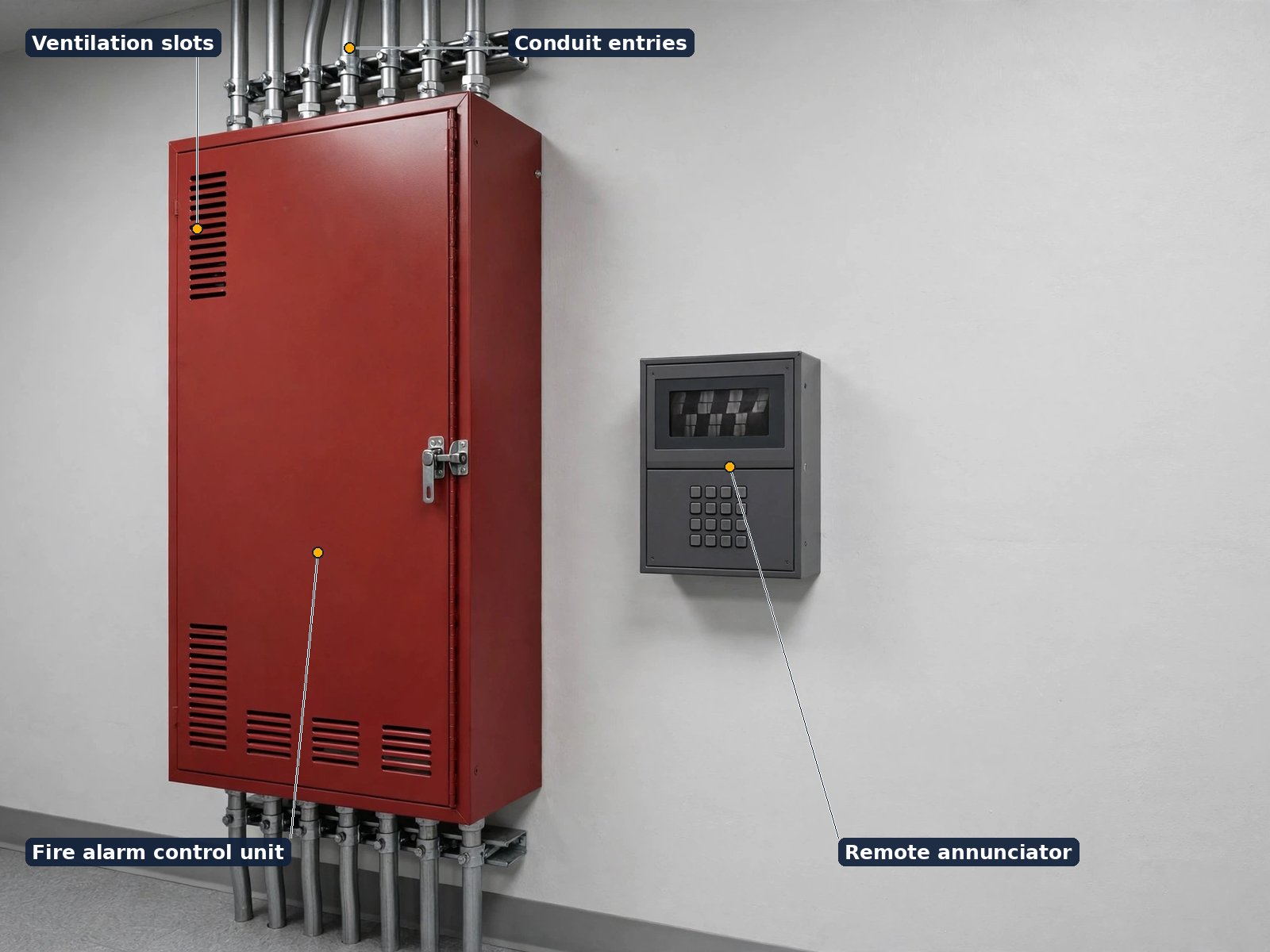
Figure 1.1 — A fire alarm control unit and its remote annunciator mounted in a building electrical room, conduit entries dressed.
The water specimen is the Meridian Cold Storage & Distribution Center, a fictional single-story warehouse of 180,000 square feet, protected by a wet-pipe sprinkler system — wet-pipe meaning, in full here because the word will carry weight later, a system whose pipes hold water at all times, ready at every head — with a standpipe in its stair tower and a city water supply its documents test and record. When Part IV calculates demand, reads a flow test, and walks a hydraulic chain head by head, it is the Meridian being calculated, on the Meridian's own stated basis. Hold both buildings in mind from here on. A technician never meets "systems in general" at work. They meet this panel, in this room, in this building — and the habit of reasoning about a specific system on its specific documents is the first professional habit this book builds.
Where does an honest beginner check what this work actually includes, beyond any one employer's advertisement? One public source describes a large part of it directly: the U.S. Bureau of Labor Statistics, shortened to BLS, which publishes occupational accounts for the United States. Its account for Security and Fire Alarm Systems Installers describes the alarm-side occupation this section maps — and the mapping must be done honestly, starting with the account's own limits, stated here before any duty is quoted. The BLS occupation is a combined occupation: it joins security alarm work and fire alarm work in one set of figures and duties, because that is how the national statistics collect them. It is not a fire-alarm-only occupation, no fire-alarm-only BLS occupation exists to quote instead, and everything in §1.5 and §1.6 is read under that label. The water-based layout craft has no BLS occupation at all — a fact Chapter 2 states plainly in its proper place, because printing a borrowed figure for it would be a small dishonesty this book refuses at the start.
Within that fence, the BLS duty list for the combined occupation maps onto the alarm craft of §1.2 closely, and this book teaches it as four duties. First, workers in the occupation install, program, maintain, and repair security and fire alarm wiring and equipment, ensuring that work accords with relevant codes — four verbs and a condition that together describe the alarm technician's whole arc from first fix to final check, with to code as the condition on all of it. Second, they mount and fasten control panels, sensors, and related devices and attach wiring to connect components — the mounting-and-connecting heart of installation work. Third, they test and repair circuits and sensors against specifications — the verification duty, without which installed work is unproven work. Fourth, they demonstrate systems to customers and explain false alarms — the people duty of §1.2, which the national account lists as core work, not as an extra. (Source: BLS, Occupational Outlook Handbook, Occupation Finder.)
Read the list's shape as carefully as its words. Nothing in it promises design authority the occupation does not hold, nothing in it mentions a license, and nothing in it reduces the work to pulling cable. It is a working occupation's description: install correctly, program correctly, prove by testing, maintain across time, and explain to the people who live with the system. Parts III and V teach the knowledge underneath each duty in turn. Where the BLS account stops — at the water-based craft, at certification, at jurisdiction rules — this book stops quoting it and turns to the sources that own those subjects, which is what honest mapping means.
One set of numbers belongs in this first map, stated exactly as its source states it and never as anything else. The U.S. Bureau of Labor Statistics reports, for the whole combined occupation of Security and Fire Alarm Systems Installers (SOC 49-2098), a median annual wage of $60,070 per year ($28.88 per hour), May 2025. The same source reports the occupation's 10th percentile at $38,800 per year and its 90th percentile at $81,150 per year. It describes the typical entry education as a high school diploma or equivalent, with moderate-term on-the-job training, and it places the occupation's outlook in its band of much faster than average. (Source: BLS, Occupational Outlook Handbook, Occupation Finder; BLS 2025 wage data via ONET.)*
Read that paragraph with the discipline this book will hold you to every time a number appears. A median is the middle of everyone in the occupation — half earn more, half earn less — across veterans and beginners, every region, and both halves of the combined occupation, security and fire together. It is not a starting wage, not an offer, not a figure for fire alarm work alone, and not a promise about any one reader. The percentiles describe the spread of that same whole occupation, not steps anyone is guaranteed to climb. The outlook words are printed only in the source's own band wording, never as a promise of a job. The entry description is the typical shape the source reports, and Chapter 2 builds on it without inflating it into a requirement every employer shares. No other pay figure appears anywhere in this book. Chapters 2 and 40 return to this same fenced set, in this same labeled form — the set is quoted whole or not at all, because a number separated from its fence is a number waiting to mislead.
Close the map by holding its whole shape at once. One field watches buildings through two complementary answers to the same event: detection and alarm, which find fire early and move people; and water-based suppression and control, which act on the fire itself while people move. The alarm craft's center is the control unit and its circuits. The water craft's center, as this book teaches it, is the layout — documents, hydraulics, and detail — standing on a physical system of pipe, valves, and supply that other hands install and still other hands maintain. The shared ground is fire science, basic electricity, water under pressure, the reading of plans, and the discipline of codes, testing, and records, and Part II builds that ground before either track's own part rests on it.
One standing sentence governs every standard named in this book, and it appears here first because it applies everywhere: the edition adopted by the learner's authority, and the manufacturer's own instructions, govern. Standards are written by their owning bodies, adopted by jurisdictions, and enforced by the authority having jurisdiction, shortened to AHJ — the organization, office, or individual responsible for approving equipment, materials, and installations in a place. The book teaches each standard's role, scope, and method; it does not reproduce clause text or table values, because the adopted edition in the reader's own place is the document that rules real work.
What this book promises, finally, is sized to the truth of §1.5 and §1.6. It prepares field knowledge and readiness — the foundations, both tracks whole, the ITM discipline, the judgment layer, and, in Part VII, the exact published shape of the field's voluntary certification ladder. It is not the certifying body's official course or material, it satisfies no certification, work-history, performance, or training requirement, and it promises no job, certification, score, income, or advancement. Certifying bodies examine and certify; jurisdictions and AHJs set the legal doors; schools and employers train the hands. Read in order the first time, and when a later chapter sends you back, go back without embarrassment — working technicians look things up for a living.
Key terms of this chapter. Fire alarm work — the design support, installation, testing, and servicing of fire detection and alarm systems; Water-based systems work — the layout, detailing, and servicing support of sprinkler, standpipe, and related water systems; Fire alarm system — a control unit, initiating devices, notification appliances, circuits, and power supplies that detect fire, alert people, and supervise themselves; Water-based fire protection system — a supply, piping, valves, and discharge devices delivering water onto or near a fire under a prepared design; Sprinkler — a heat-activated discharge device that opens on its own when fire heat reaches it; Fire alarm control unit (FACU) — the system's central unit, which receives signals and commands the response; Plans — the drawings showing what is to be installed where; Inspection, testing, and maintenance (ITM) — the recurring scheduled care that keeps an installed system working across its life; Layout — the preparation of plans and details showing a water-based system as it must be built; Submittal package — the drawings and supporting material sent for review and approval before work proceeds; Addressable system — a system in which each device carries its own identity at the control unit; Signaling line circuit — a circuit carrying device identities and status between devices and the control unit; Wet-pipe system — a sprinkler system whose pipes hold water at all times; Specimen — a fictional worked building carried through the book as the home of its worked numbers; U.S. Bureau of Labor Statistics (BLS) — the federal agency publishing occupational duties, education, outlook, and wage accounts; Combined occupation — a statistical occupation joining two kinds of work, here security and fire alarm work, in one set of figures; Median — the middle value of a whole set, half above and half below, never a starting figure or a promise; Authority having jurisdiction (AHJ) — the organization, office, or individual responsible for approving equipment, materials, and installations in a place.
Tags: FIELD — the field, its doors, and the shared foundations. The key, with every option explained, is in this chapter's key file.
Q1. The fire protection field, as this book defines it, joins two crafts. They are — A. electrical contracting and plumbing contracting B. fire alarm work and water-based systems work C. firefighting and fire investigation D. alarm sales and insurance inspection
Q2. A fire alarm system, in the chapter's definition, is best described as — A. a single bell wired to a single switch B. a control unit, initiating devices, notification appliances, circuits, and power supplies that detect fire, alert people, and supervise themselves C. a sprinkler system with an added horn D. any collection of extinguishers placed in a corridor
Q3. A sprinkler, as the chapter defines it, is — A. a valve opened by hand when a fire is seen B. a pump that raises water pressure C. a heat-activated discharge device that opens on its own when fire heat reaches it D. a pipe fitting that joins two lengths of pipe
Q4. The alarm technician's ordinary day, as §1.2 describes it, begins with — A. documents — the plans and the project's own requirements, read before work starts B. cutting pipe to length C. demonstrating the system to the customer D. responding to an emergency call
Q5. Inspection, testing, and maintenance (ITM) matters to this chapter's picture because — A. it is work done only once, at installation B. most alarm work is new construction, so ITM is a minor sideline C. it applies only to water-based systems D. a large share of alarm technicians spend most of their hours on ITM and service, not only on new installation
Q6. The water-based track this book teaches is centerd on — A. layout — preparing plans and details, with hydraulic reasoning, submittals, and correspondence B. fighting fires with hose lines C. manufacturing sprinkler heads D. selling water-based systems door to door
Q7. The Harborview Hotel serves the book as — A. a real hotel whose records the book reprints B. the manufacturer's test building C. a fictional alarm specimen — six stories, 120 guestrooms, two signaling line circuits, 286 addressable points — home of the book's alarm worked numbers D. the certifying body's headquarters
Q8. The Meridian Cold Storage & Distribution Center is the book's — A. water-based specimen — a fictional warehouse with a wet-pipe system, a standpipe, and a tested city supply B. alarm specimen C. publisher's warehouse D. example of a building with no fire protection
Q9. The BLS occupation quoted in §§1.5–1.6 must be read as — A. a fire-alarm-only occupation B. a sprinkler-layout occupation C. a combined security and fire alarm occupation, SOC 49-2098, stated as combined wherever its figures print D. an occupation covering all fire protection work including layout
Q10. The four duties the chapter maps from the BLS account are — A. fight, overhaul, ventilate, and rescue B. install, program, maintain, and repair to code; mount panels and devices; test circuits and sensors; demonstrate systems and explain false alarms C. design, manufacture, advertise, and insure D. inspect buildings, issue permits, levy fines, and approve plans
Q11. The BLS median of $60,070 per year ($28.88 per hour), May 2025, is printed in this book only as — A. the starting wage a new fire alarm technician should expect B. a promise to readers who finish the book C. the wage for fire alarm work alone, separated from security work D. the whole combined occupation's median — the middle of everyone in it — not a starting wage, an offer, or a promise
Q12. The BLS entry description quoted in §1.6 is — A. a bachelor's degree with no on-the-job training B. no education and no training C. a high school diploma or equivalent, with moderate-term on-the-job training D. a state license issued before employment
Q13. The standing sentence governing every standard named in this book is — A. the newest edition anywhere governs everywhere B. the edition adopted by the learner's authority, and the manufacturer's own instructions, govern C. this book's summary governs over the standard itself D. the employer's preference governs over any adopted edition
Q14. The authority having jurisdiction (AHJ) is — A. the certifying body for technicians B. the manufacturer of the control unit C. the building's insurance company in every case D. the organization, office, or individual responsible for approving equipment, materials, and installations in a place
Q15. This book's own standing is stated honestly as — A. the certifying body's official course, satisfying its requirements B. a license to perform installation work C. a book that prepares field knowledge and readiness, satisfies no certification or training requirement, and promises no job, certification, score, or income D. a guarantee of advancement for working technicians
Feras Alzubi
Exam Prep Series
2026 Edition
Copyright © 2026 Feras Alzubi. All rights reserved.
No part of this book may be reproduced, stored in a retrieval system, or transmitted in any form or by any means — electronic, mechanical, photocopying, recording, or otherwise — without the prior written permission of the author, except for brief quotations in reviews and other uses permitted by copyright law.
Every practice question, explanation, case file, and worked example in this book is original to this book. The practice questions are original, written against the published program frameworks of the National Institute for Certification in Engineering Technologies (NICET); they are not NICET's actual examination items, and no NICET examination item is reproduced, recalled, paraphrased, or adapted anywhere in these pages. No passage of any standard, handbook, or manufacturer's publication is reproduced into usable form. NICET's domain lists and the standards' names are the bodies' own published frameworks, named and cited as frameworks; the teaching built on them is this book's own.
Not-affiliated disclosure. This book is an independent study guide. It is not published by, affiliated with, endorsed by, or approved by the National Institute for Certification in Engineering Technologies (NICET). NICET did not write, review, approve, or sponsor this book. The name Fire Protection Certificate (NICET) is used in this book as a statement of fact about the voluntary certifications this book prepares readers to study for. Certification decisions belong to NICET alone; this book confers no certification, no eligibility, and no authorization of any kind, and it satisfies no NICET requirement — not the work history, not the performance measures, and not any training.
Specimen notice. The two workplaces worked throughout this book — the Harborview Hotel and the Meridian Cold Storage & Distribution Center — are fictional specimen workplaces, labeled specimens on their faces at first use. All specimen facts are fictional and illustrative. No real employer, person, or place is depicted, and every device, tool, and product named is a generic type. Design bases, loads, and figures attached to a specimen are that specimen's own project-document values, labeled as theirs — never code requirements, market rates, benchmarks, or pay figures.
Front Matter
Part I — The Field and Its Doors
Part II — Foundations: Fire, Electricity, Water, and Paper
Part III — Track A: Fire Alarm Systems
Part IV — Track S: Water-Based Systems
Part V — Inspection, Testing, and Maintenance
Part VI — The Whole Craft at Work
Part VII — The Credentials and the Road
Back Matter
This page states the two certifications themselves, from their owner's own publications. Every figure on this page prints in its stamped form, with its source stamp on its face. Sources: NICET, Fire Alarm Systems Candidate Handbook (© NICET, August 2026) and NICET, Water-Based Systems Layout Candidate Handbook (© NICET, August 2026), with NICET's program pages and reference lists for the two programs — as published by NICET (read 2026-11-14). All application fees on this page are effective August 1, 2026. Fees and program details can change; check NICET for the current figures before applying.
What both certifications are. The Fire Alarm Systems (FAS) certification and the Water-Based Systems Layout (WBSL) certification are voluntary professional certifications issued by the National Institute for Certification in Engineering Technologies (NICET), a not-for-profit organization created by the National Society of Professional Engineers (NSPE). Neither of them is a license. No NICET certification licenses any person to practice, to perform any regulated act, or to hold any job title a jurisdiction reserves.
How a certification is built — the machinery shared by both programs. A NICET certification is assembled, never granted by an examination alone: an examination pass, plus documented work history, plus performance measures verified by a supervisor in real work. A personal recommendation joins at Levels III and IV, and a major-project write-up — 2–3 pages, sole-authored, on a project within the last 4 years and complete — joins at Level IV. Higher levels include all lower-level requirements. (Source: NICET, Fire Alarm Systems Candidate Handbook; NICET, Water-Based Systems Layout Candidate Handbook.)
Shared examination machinery. Examinations are computer-based at Pearson VUE proctored centers; Level I examinations in both programs are also available online-proctored through OnVUE. At application the candidate chooses a six-month testing window. A non-disclosure agreement (NDA) must be accepted to begin. Only the examination's built-in calculators may be used; no personal calculators. Examinations are in English only. The result is known immediately as pass or fail; the official score report follows in the Pearson VUE portal within 14 days, and candidates who do not pass receive a scaled score with percent correct per domain. Rescheduling more than 24 hours ahead is free within the same window; later changes cost half the original fee. Reexamination: after a 30-day wait, at most three attempts in any 12-month span. NICET offers practice tests at all levels of both programs, and NICET prescribes and endorses no training course or provider — this book included. (Source: NICET, Fire Alarm Systems Candidate Handbook; NICET, Water-Based Systems Layout Candidate Handbook.)
The passing score, stated plainly. NICET publishes no numeric passing score in its candidate handbooks for either program, so this page records that absence rather than filling the space: no numeric passing score for the FAS or the WBSL prints anywhere in this book, from any source. Candidates learn pass or fail at the session, and those who do not pass receive percent-correct by domain.
Recertification, shared by both programs. A certification is valid for three years. Recertification takes 90 CPD points per certification per period, earned from two or more of five categories: Active Practitioner (up to 72, up to 24 per year) · Additional Education (up to 72) · Advancing the Profession (up to 45) · Certification Activities (up to 90) · Special Exam (up to 45). All of a holder's certifications share the first certification's expiry date. NICET's Code of Ethics binds certificants: public safety first; work only within competence; honesty; no conflicts or bribery; maintain proficiency; no misrepresentation; confidentiality. (Source: NICET, Fire Alarm Systems Candidate Handbook; NICET, Water-Based Systems Layout Candidate Handbook.)
Identity. Fire Alarm Systems (FAS) — a voluntary certification of NICET, designed for technicians doing system layout (plan preparation), equipment selection, installation, acceptance testing, troubleshooting, servicing, and technical sales. Its technical areas are applicable codes and standards, detector and signaling types, supervision requirements, power requirements, building and space structure and occupancy considerations, and basic electricity and electronics. Levels I–IV are accredited by the ANSI National Accreditation Board (ANAB). Not a license. (Source: NICET, Fire Alarm Systems Candidate Handbook.)
Level I — Technician Trainee. Works under supervision. Experience floor: at least 6 months of experience with fire detection and signaling systems. Examination: 85 questions, 110 minutes. Application fee: $235 (effective August 1, 2026). Domains: Installation 44–54% (mount and terminate peripherals; install cabling and associated infrastructure; comply with job site safety requirements) · Maintenance 40–50% (perform periodic testing; repair or replace impaired or deficient devices) · Submittal Preparation and System Layout 1–11% (knowledge of technical documents). Five Level I performance measures apply.
Level II — Associate Engineering Technician. Routine tasks under limited supervision. Experience floor: at least 2 years of fire detection and signaling experience, including at least 12 months of fire alarm systems experience covering alarm and detection, notification, sprinkler monitoring, and interfaces and controls for agent-releasing suppression systems; up to 12 months of related experience may count. Examination: 110 questions, 155 minutes. Application fee: $325 (effective August 1, 2026). Domains: Installation 30–40% · Maintenance 25–35% · Submittal Preparation and System Layout 20–30% · Management and Supervision 5–15%.
Level III — Engineering Technician. Works independently. Experience floor: at least 5 years, including at least 45 months of FAS experience; the added 3 years include field experience, team leadership, and at least 1 year in a technical management role; up to 15 months of related experience may count. A personal recommendation joins at this level. Examination: 115 questions, 170 minutes. Application fee: $380 (effective August 1, 2026). Domains: Installation 25–35% · Maintenance 25–35% · Submittal Preparation and System Layout 20–30% · Management and Supervision 10–20%.
Level IV — Senior Engineering Technician. Experience floor: at least 10 years, including at least 105 months of FAS experience; the added 5 years include at least 2 years overseeing FAS project management; up to 15 months of related experience may count. A personal recommendation and the major-project write-up join at this level. Examination: 120 questions, 290 minutes, with a scheduled 30-minute break outside the answering time. Application fee: $435 (effective August 1, 2026). Domains: Installation, Planning, and Maintenance 35–45% · Submittal Preparation and System Layout 10–20% · Complex Fire Alarm System Operations 40–50%.
Examination basis and references. The current FAS examinations are based on the 2022 edition of NFPA 72, National Fire Alarm and Signaling Code. Permitted into the Level I test center: NFPA 72 (2022), NFPA 70 (2020) — the National Electrical Code — and Ugly's Electrical References (2020), bound or in a three-ring binder with a title page; highlighting and permanently attached tabs are allowed; handwritten notes are not permitted. NFPA 72 and NFPA 70 are also available on-screen in the examination (view-only; the embedded search is rudimentary, and NICET states the on-screen references do not replace the candidate's own knowledge). Study-only titles on NICET's Level I list: OSHA 29 CFR 1910, OSHA 29 CFR 1926, the American Red Cross First Aid/CPR/AED manual, and Bukowski's Fire Alarm Signaling Systems (4th ed.). Announced by NICET: updated FAS examinations reflecting the 2025 edition of NFPA 72 become available April 19, 2027, at the same published sizes — test against the reference list in force at your own sitting. (Source: NICET, Fire Alarm Systems Candidate Handbook; NICET, FAS Level I Content Outline and Selected General References.)
A note on weights, so two different things are never confused. The domain weights above are facts about NICET's examinations. This book's own study apparatus — the diagnostic strands and the Strand Repair Sets — is sized by this book's own design, weighted by the shared foundation's centrality to the book, not derived from, matched to, or claimed to reflect either examination's blueprint weights. No strand proportion in this book is NICET's, and strand performance does not predict examination performance by domain.
Identity. Water-Based Systems Layout (WBSL) — a voluntary certification of NICET, designed for engineering technicians engaged in the layout and detailing of water-based systems that must meet code and statutory requirements: plan and submittal preparation, applications of the system types, equipment selection and application, and technical management of layout projects. Not a license. (Source: NICET, Water-Based Systems Layout Candidate Handbook.)
Level I — Technician Trainee. Experience floor: at least 6 months of technical experience with aspects of plan preparation — CAD drawings, layout of sprinklers, assisting in field surveys. Examination: 105 questions, 150 minutes. Application fee: $235 (effective August 1, 2026). Domains: Safety 1–7% · Contract Documents 5–15% · Survey Existing Conditions 5–15% · Research Codes and Standards 5–15% · System Layout 53–63% · Assemble Submittal Packages 1–10% · Project Correspondences 1–10%. Eight Level I performance measures apply.
Level II — Associate Engineering Technician. Experience floor: at least 2 years of layout core and related experience, including at least 12 months of direct core experience including complete layout of NFPA 13D, 13R, and/or 13 systems. Examination: 120 questions, 225 minutes. Application fee: $325 (effective August 1, 2026). Domains: Safety 1–7% · Contract Documents 1–9% · Survey Existing Conditions 1–9% · Codes and Standards 6–16% · Basic Sprinkler System Layout 40–50% · Basic Standpipe System Layout 4–14% · Basic Fire Pump System Layout 3–13% · Hydraulic Equations 7–17% · Submittal and Approval Process 1–7% · Project Management 1–8%.
Level III — Engineering Technician. Experience floor: at least 5 years; the additional 36 months of direct core experience include complete layout of sprinkler and standpipe systems and hydraulic calculations. A personal recommendation joins at this level. Two examinations, and both must be passed. General Plans Preparation: 70 questions, 175 minutes, application fee $295 (effective August 1, 2026); domains: Contract Documents 1–8% · Survey 1–10% · Codes and Standards 7–17% · Sprinkler System Layout 42–52% · Complex Standpipe System Layout 6–16% · Fire Pump Unit Layout 9–19% · Water Storage Tanks 1–9% · Project Management 1–9%. Hydraulics and Water Supply Planning: 60 questions, 240 minutes including a 15-minute break outside the answering time, application fee $295 (effective August 1, 2026); domains: Calculate Standpipe Systems 5–15% · Calculate Water Supply with Pumps 25–35% · Hydraulic Calculation Principles 55–65%.
Level IV — Senior Engineering Technician. Experience floor: at least 10 years of full-time involvement with layout of water-based systems; the experience must include wet-pipe, dry-pipe, antifreeze, deluge, and pre-action systems. A personal recommendation and the major-project write-up join at this level. Examination: 80 questions, 240 minutes including a 15-minute break. Application fee: $435 (effective August 1, 2026). Domains: Safety and Environmental Compliance 1–11% · Contract Documents 1–9% · Survey Existing Conditions 1–11% · Codes and Standards 29–39% · System Layout 35–45% · Project Management 5–15%.
References. Permitted into the Level III General Plans Preparation test center: NFPA 13 (2022), Standard for the Installation of Sprinkler Systems · NFPA 14 (2019), the standpipe and hose systems standard · NFPA 20 (2022), Standard for the Installation of Stationary Pumps for Fire Protection · NFPA 22 (2018), the water-tanks-for-private-fire-protection standard — under the same binding, tab, and no-handwritten-notes rules as Track A. (Source: NICET, Water-Based Systems Layout Candidate Handbook; NICET, WBSL Level III General Plans Preparation reference list.)
The headline honesty fence. The Fire Alarm Systems and Water-Based Systems Layout certifications are voluntary professional certifications issued by the National Institute for Certification in Engineering Technologies (NICET). Neither of them is a license. No NICET certification licenses any person to practice fire protection, to perform any regulated act, or to hold any job title a jurisdiction reserves; and no book — this one included — confers a certification, eligibility, or the competence the examinations examine. Employers hire, qualify, and authorize fire protection personnel task by task; NICET examines and certifies them; jurisdictions and their authorities having jurisdiction set the legal doors on their own ground; this book teaches the knowledge the two crafts stand on.
What certification is, and what it is not. Certification is a body's attestation, built as the Exam Blueprint page describes — an examination pass joined to documented work history and supervisor-verified performance measures — that a technician's knowledge and experience met a published framework at a published level. It is not permission. Permission to do regulated work, where a jurisdiction regulates it, comes from that jurisdiction's own rules, and several jurisdictions require or recognize NICET certification under their own rules. This book never states a jurisdiction's rule as fact: the discipline it teaches, everywhere, is lookup discipline — verify with your AHJ, the authority having jurisdiction over the work in front of you, and with the jurisdiction itself, before you rely on any requirement.
Two tracks, one profession. The two tracks in this book are siblings, not rivals, and real buildings hold both. Track A, Fire Alarm Systems, is the detection, signaling, and notification craft: the system that senses a fire, decides, and tells people and other systems what is happening. Track S, Water-Based Systems Layout, is the layout and detailing craft for the systems that put water on a fire: sprinklers, standpipes, pumps, and their supplies. They stand on one foundation — fire science, electricity, water, documents, and the code architecture, taught whole in Part II before either track begins — they share one inspection, testing, and maintenance discipline and one records craft in Part V, they meet in every real building at the interfaces taught in Part VI, and they are certified by one body's machinery, taught in Part VII. A reader may climb one ladder or both; Chapter 40 teaches the sequencing judgment.
The sibling doors, named as orientation only. NICET also certifies Inspection and Testing of Fire Alarm Systems, for technicians who specialize in periodic inspection and testing; candidates who have tested above Level I in FAS may hold testing credit toward it. NICET also certifies Inspection and Testing of Water-Based Systems, built on NFPA 25 (2023), Standard for the Inspection, Testing, and Maintenance of Water-Based Fire Protection Systems. This book names both programs' existence and purpose, here and in Chapter 37, as orientation only: it prints neither program's examination panels and presents itself as preparation for neither program's examinations, in any wording.
The standards family, placed once. The crafts stand on a family of standards, each taught in this book by its role, scope, and method — never by clause text or table values: NFPA 72, National Fire Alarm and Signaling Code · NFPA 70, National Electrical Code · NFPA 13, Standard for the Installation of Sprinkler Systems · NFPA 13D and NFPA 13R, the residential sprinkler standards (one- and two-family dwellings; residential occupancies up to and including four stories) · NFPA 14, the standpipe and hose systems standard · NFPA 20, Standard for the Installation of Stationary Pumps for Fire Protection · NFPA 22, the water-tanks-for-private-fire-protection standard · NFPA 25, Standard for the Inspection, Testing, and Maintenance of Water-Based Fire Protection Systems · NFPA 291, Recommended Practice for Water Flow Testing and Marking of Hydrants. The standing sentence, wherever a standard is taught in this book: the edition adopted by the learner's authority, and the manufacturer's own instructions, govern.
Not a manual, not a procedure, not professional advice. This book teaches fire protection knowledge and reasoning for education and examination preparation. It is not an employer's manual, a site procedure, or professional advice, and reading it does not qualify or authorize any reader to perform any installation, wiring, testing, impairment, pump, riser, or height work. Hands-on skill is trained and assessed in person, under supervision, by schools, programs, and employers — NICET's performance measures are themselves verified by a supervisor in real workplaces — and this book prepares the knowledge underneath them. Work in real buildings belongs under the reader's employer's program and qualification, the equipment manufacturer's own instructions, and the standards of the responsible authority, to which readers are directed for their own work.
The rhythm. This book teaches, then tests. Each of the 40 chapters teaches its body whole — terms defined at first use, the simplify → explain → detail → show → do → check rhythm carried concept by concept, the specimen workplaces carrying the worked examples — and closes with 15 practice questions. A separate key explains the correct answer and every wrong option for every question, so a wrong answer teaches as much as a right one. Two Protection Case Batteries then work whole problems end to end as reasoning, and eight Strand Repair Sets give focused extra practice by strand. The planned apparatus totals 820 items: the 50-item diagnostic, 600 chapter items, 50 case files, and 120 repair-set items.
The two readers. This book is written for two readers at once: the complete beginner who has never opened a fire alarm panel or stood at a sprinkler riser, and the working technician preparing for NICET certification on one track or both. The beginner loses nothing: Part II teaches fire, electricity, signals, water, documents, and the code architecture from zero, in dependency order, before any craft chapter rests on them. The working technician loses nothing either: the foundations are the same physics and paper the examinations test, and Parts III and IV teach each track whole, at the depth its own chapters carry.
Two study postures. If you are preparing for one track, study the shared body whole — Parts I, II, V, VI, and VII are one body, and both examinations stand on it — then work your own track's part in full: Part III for the Fire Alarm Systems candidate, Part IV for the Water-Based Systems Layout candidate, gathering your credential layer in Chapter 38 or Chapter 39 respectively. If you are preparing for both tracks, work the book in its printed order: the shared foundations first, Track A whole, Track S whole, then the shared ITM, craft, and credential parts, which will read as one profession rather than two. Either way, do not skip Part II to save time; every later calculation — the battery calculation, voltage drop, detector coverage geometry, and the Hazen–Williams hydraulics chain — lists against it.
Start with the diagnostic. Take the Fire Protection Readiness Diagnostic before Chapter 1. It is this book's own readiness instrument — not any NICET examination, not a replica of one, and not a prediction of its contents. Its 50 items run in five strands, sized by this book's own design: Foundations, 12 items; Fire Alarm, 13 items; Water-Based Systems, 13 items; ITM & Records, 6 items; Credentials & Readiness, 6 items. The foundation strand and the two track strands carry the largest weight because the shared foundation and the two crafts are this book's centerpiece — a design choice of this book, disclosed as such, and not a reflection of either examination's blueprint weights. Score the diagnostic by strand in the Readiness Tracker, study the parts your weakest strands point to, and return to the matching Repair Set when a strand needs more work.
Study rhythms. Read a chapter in one sitting where you can; work its 15 questions closed-book in a second sitting; read the key in a third, including the explanations of the options you did not choose. Worked examples are work episodes — a battery sized for a specimen panel, a branch line calculated head by head at a specimen warehouse, a flow test read at specimen hydrants — and every computation is shown end to end and serves the decision the episode turns on. The Study Plans in the back matter lay out 4-week, 8-week, and 12-week paths, with per-track gatherings for the FAS candidate and the WBSL candidate.
Two specimens, all the way through. Every worked example on the alarm side works on the same fictional workplace, the Harborview Hotel, and every worked example on the water side works on the Meridian Cold Storage & Distribution Center, each introduced whole in its own part. When a number appears in two chapters, it is the same number. Learn the specimens once and every later chapter's arithmetic starts familiar — which is the point: on the job, a technician reads one building deeply, not fifty buildings shallowly.
The safety boundary, stated professionally. Installation, wiring and termination, live testing, impairment handling, riser and pump work, and work at height, in ceiling spaces, or on ladders and lifts are taught in this book as knowledge and reasoning only: what the qualified worker does and in what order of reasoning, what the readings mean, and what decision each reading gates. No chapter gives a sequence a reader could perform on a live system, and no case file's conclusion is instructions for performing a fix — every conclusion is a reasoned judgment with its why. These skills are trained and assessed in person, under supervision, by schools, programs, and employers. Where a chapter reaches the supervised door, it names it and stops there, by design.
What this book will not do. It will not certify you, qualify you, license you, or authorize you to perform any act. It will not substitute for your employer's program, your site's procedures, qualified supervision, the standards themselves, or the manufacturer's own instructions. It promises no job, no certification, no score, no income, and no advancement. NICET examines and certifies; jurisdictions and AHJs regulate their own ground; schools and employers train; this book prepares the field knowledge underneath all of it.
End of the free sample. The complete book continues from here — the full A-to-Z course in book form, delivered as an EPUB you can read in Apple Books, Google Play Books, ReadEra, Thorium Reader, Adobe Digital Editions, or Send to Kindle.
Buy this ebook — $11.99 Back to the book page
Payments are securely processed by Payhip.