
Mastering Careers & Skills
International General Certificate (NEBOSH IGC) · free sample from the book itself
The Complete Health and Safety Course — 900 Practice Questions, Diagnostic & 2 Practice Assessments, Every Answer Explained
Feras Alzubi
Exam Prep Series
Copyright © 2026 Feras Alzubi. All rights reserved.
No part of this book may be reproduced, distributed, or transmitted in any form or by any means — including photocopying, recording, scanning, or any electronic or mechanical method, and including storage in any information storage and retrieval system — without the prior written permission of the author, except in the case of brief quotations embodied in critical reviews and certain other noncommercial uses permitted by copyright law. Unauthorized reproduction or distribution of this book, in whole or in part, is a violation of applicable law.
A note on provenance: every practice question, exercise, case file, and practice assessment in this book is original to this book, written by the author against NEBOSH's published syllabus. None of them is one of NEBOSH's actual examination items, and none is a recalled, paraphrased, or adapted version of one; the practice assessments follow the published shape of the real assessments, with scenarios and tasks created for this book.
A note on the workplaces in this book: Aldergate — the Aldergate Distribution Centre — and all other workplaces, organizations, people, and scenarios used in this book's teaching examples, exercises, practice assessments, case batteries, and specimen practical are fictional teaching examples, created for this book. They do not describe any real employer, site, worker, or event, and any resemblance to a real workplace or person is coincidental.
This book is an independent publication. It is not affiliated with NEBOSH. NEBOSH — the National Examination Board in Occupational Safety and Health — has not reviewed, endorsed, sponsored, or affiliated with this book, and nothing in this book should be read as suggesting otherwise. The name NEBOSH, and the name of the qualification, are used in this book for one purpose only: to identify the qualification this book prepares you for. The syllabus, the assessments, and the qualification itself belong to NEBOSH. This book is a study companion written around the published syllabus — teaching, practice questions, and worked examples in the book's own words — and it is not a NEBOSH publication, a NEBOSH course, or a substitute for either the syllabus or the learning that the qualification requires.
One fact governs everything else in this book, and it is stated here, before any teaching begins, in plain words.
Every learner must register with a NEBOSH accredited Learning Partner and undertake the learning before assessment. NEBOSH states the position in its own words:
"Every learner must register with a NEBOSH accredited Learning Partner and undertake the relevant learning before taking an assessment and gaining a qualification. It is not possible to self-study for a NEBOSH qualification."
That has direct consequences for what this book is and is not. This book is an independent study companion. It can teach you the syllabus, train you in the methods the assessments reward, and give you extensive explained practice in the assessments' real shapes. It cannot register you with a Learning Partner. It cannot enter you for any assessment. It cannot submit your practical risk assessment. It cannot mark anything you write. And it cannot award you the qualification. Only the route NEBOSH itself sets — registration with an accredited Learning Partner, the learning undertaken through that partner, and NEBOSH's own assessments — leads to the qualification.
Used honestly, that is not a limitation on this book's usefulness; it is a description of its proper place. Readers use a companion like this one in two main ways: to build the foundations before and alongside a Learning Partner course, so that taught time is spent deepening understanding rather than meeting ideas for the first time; and to practice — hundreds of explained questions, two full practice assessments, and a complete worked specimen practical — in the weeks when course teaching has finished and the assessment is ahead. Both uses are legitimate. What this book will never do is pretend to be the course, the entry, or the award. If you have not yet registered with a Learning Partner, treat that registration as step one of your plan, and this book as the companion that walks beside it.
The qualification this book prepares you for is the NEBOSH International General Certificate in Occupational Health and Safety, set by NEBOSH — the National Examination Board in Occupational Safety and Health. The facts in these panels are the qualification's published facts, as set out in NEBOSH's syllabus guide for Learning Partners (specification date June 2025) and its qualification guidance: the book prints them exactly as published, and where NEBOSH's own wording carries a qualification of its own — as it does on the pass mark below — the book keeps that wording.
The qualification has two units:
The qualification is set at SCQF Level 6 (equivalent to RQF Level 3) and carries 11 credits in total — 5 credits for GIC1 and 6 credits for GIC2. There are no entry requirements: no prior qualification, experience, or membership is demanded before a learner registers. NEBOSH recommends a minimum standard of English equivalent to IELTS 6.0 or higher, because both assessments require the learner to read scenarios and write reasoned answers in the language of the assessment.
The notional learning hours published for the qualification are:
GIC1 — Taught hours: 24 · Self-study hours: 20 · Assessment hours: 5 · Total: 49 hours
GIC2 — Taught hours: 39 · Self-study hours: 20 · Assessment hours: 4 · Total: 63 hours
Those totals — 49 hours for GIC1 and 63 hours for GIC2 — are the planning figures this book's study plans in the back matter are built on.
GIC1 is assessed by an open book examination. The examination is scenario-based: it presents a workplace scenario and sets tasks on it, and the tasks on the real paper total 100 marks. It is not invigilated, and during it the learner may use any learning resources they have access to. In return, the submission must be entirely the learner's own work.
Learners have 24 hours to access, complete, and submit the examination, starting from 11:00 UK time on the examination date. That window is deliberately much longer than the work requires: NEBOSH's candidate guidance puts the work itself at approximately four hours, including reading and research, and states that learners are not expected to write more than 3,000 words in total. Marks are earned point by point — one mark for each correct technical point clearly demonstrated — and single-word answers or bare lists are unlikely to gain marks. The assessment also includes a closing interview, at which the learner is asked questions about their submission; the interview is part of the assessment, not an optional extra.
The provisional pass mark for GIC1 is 45 percent. The word "provisional" is part of the published fact and is kept wherever this book states the figure. The qualification grade is based on the GIC1 result alone, on these boundaries:
| Grade | GIC1 marks |
|---|---|
| Distinction | 75 marks or higher |
| Credit | 65–74 marks |
| Pass | 45–64 marks |
| Refer | 0–44 marks |
A Refer result is a result below the pass standard; it is not a grade of the qualification. The qualification itself is achieved only when both units have been passed, as the completing panel below explains.
GIC2 is assessed by a practical risk assessment carried out in the learner's own workplace — or, where a learner has no workplace access, in other suitable premises arranged with the Learning Partner. It is based on the Health and Safety Executive's approach to risk assessment, and the learner must have completed study of the whole syllabus, Elements 1 to 11, before starting it. The completed assessment is submitted through the online NEBOSH Assessment Platform, by a deadline 10 working days after the GIC1 assessment.
The practical has four sections, marked out of 100 in total:
| Section | Content | Marks |
|---|---|---|
| Section 1 — Background | A description of the organization, its workers and their roles, and the area or process assessed, together with the sources of information consulted and how the hazards were identified | 10 |
| Section 2 — Risk assessment | The risk assessment itself: hazards drawn from at least five different hazard categories, who might be harmed and how they come into contact with each hazard, how they could be harmed, the controls already in place and the further actions proposed, who will carry each action out, and a time frame for each hazard — Immediate, Medium term, or Long term | 65 |
| Section 3 — Prioritize one hazard to manage | One hazard from Section 2, chosen and argued for on legal, moral, business and financial, and general reasons; how the further actions will reduce the risk; and how their effectiveness will be checked | 17 |
| Section 4 — Communicate, check, review | How the findings and actions will be communicated, and to whom; how completion of the actions will be checked; the review date or time frame; and the reasons for that review period | 8 |
Two practical points from NEBOSH's own guidance are worth fixing now, because candidates lose marks on both. First, the four sections carry very unequal weight: Section 2, the assessment itself, is worth 65 of the 100 marks, and its quality — real hazards, properly described, with people, harm, controls, owners, and time frames all completed — decides the outcome. Second, no photographs or drawings may be included in the risk assessment itself; the assessment is a written document, completed on the prescribed form.
The pass mark for GIC2 is 60 marks out of 100: a result of 60 or higher is a Pass, and 59 or lower is a Refer.
A Pass in each unit is required. The two units must both be passed within a five-year period that starts on the date the first unit was passed — the declaration date. A unit that reaches five years old no longer counts toward the qualification and must be retaken, however well it was passed at the time. Plan your two units as one project, not as two separate ambitions years apart.
Results for both units are issued on the same day, 60 working days after the GIC1 assessment date. The GIC2 result arrives with a mark breakdown, so a learner can see where marks were gained and lost across the four sections. The qualification parchment is issued within 20 working days of the final successful unit.
NEBOSH publishes the following recognition for holders of the qualification, and this book records it exactly as published — as facts about the qualification's standing, not as a promise to any individual reader, whose position will always depend on the body concerned and on their own circumstances.
Holders are entitled to Associate Membership (AIIRSM) of the International Institute of Risk and Safety Management (IIRSM) and to Affiliate Membership (AIOSH) of the Institution of Occupational Safety and Health (IOSH). The qualification also meets the academic requirements for Technical Membership (Tech IOSH) of IOSH, with appropriate experience; NEBOSH states a condition on IOSH eligibility — assessments must be taken in the UK to be eligible for IOSH membership, unless the learner was registered before August 31, 2022. In Abu Dhabi, the Public Health Centre's Qudorat framework aligns the qualification with its Level 4 (General Practitioner) requirement.
This book is built to be worked through in a deliberate order. The order matters, because each layer assumes the layer before it.
Step 1 — Take the Readiness Diagnostic. The diagnostic at the front of the book contains 50 questions in five strands of ten: Manage, People & Risk, Monitor, Health, and Workplace. Score each strand separately, out of ten. There is no combined score, deliberately — a single total would hide the one thing you need to know, which is where you are starting from. The diagnostic's routing table sends each strand to its chapters and to its repair sets, and its guidance tells you what a low strand score means and where to start. A beginner should expect low scores; that is the diagnostic doing its job.
Step 2 — Work through the 40 chapters in order. The chapters follow the syllabus's own logic: the case for managing safety, the management system, people and the craft of risk, checking the system, and then the hazard elements in syllabus order, finishing with a chapter on the two assessments themselves. Every chapter teaches before it tests — concept first, worked through on examples, and only then exercised. Each chapter closes with 15 exercise questions, and every exercise question, right and wrong option alike, is explained in the chapter key. Do the exercises as you finish each chapter, not in a batch at the end; a wrong answer corrected while the teaching is fresh is worth several corrected a month later. Throughout the chapters you will meet Aldergate, the fictional distribution center whose program, people, and numbers carry the book's worked examples — one consistent workplace, so that methods learned in one chapter can be picked up and used again in the next.
Step 3 — Take the two practice assessments. Practice Assessment A and Practice Assessment B each mirror the real GIC1 shape: one fictional workplace scenario, tasks in the published form with bracketed marks, and marks totaling 100. Take each one as the real assessment runs — open book, inside a self-set sitting within a 24-hour window — and write reasoned answers, not lists, because that is what the marking rewards. Each assessment's key gives a model answer for every one of its 45 items and explains what earns marks and what loses them. These are the book's own practice instruments; they are not NEBOSH papers and carry no prediction about any real result.
Step 4 — Study the worked specimen practical. In the back matter you will find a complete GIC2-shape risk assessment of Aldergate, worked end to end in the assessment's own four sections, with examiner-style commentary keyed to the published marks section by section. Read it as a craft lesson: how a background section earns its 10 marks, how a Section 2 hazard row is built so that no column is left thin, how a priority is argued in Section 3, and how communication, checking, and review are closed off in Section 4. It is a worked teaching example on a fictional workplace. It is not a submission, it cannot be submitted, and your own GIC2 must be your own assessment of your own workplace — but every technique it demonstrates is one you can carry into that assessment.
Step 5 — Repair your weak strands. After the chapters and the practice assessments, go back to your diagnostic strands and your exercise record, and work the repair sets for the strands that still run weak: RS1 for management and policy, RS2 for people and risk method, RS3 for monitoring and learning, RS4 for the physical agents, RS5 for the body and substances, RS6 for the workplace, RS7 for equipment, fire, and electricity, and RS8 for assessment craft itself — the GIC1 and GIC2 methods. The book also carries 40 workplace case batteries — guided case files that put a situation, its evidence, and a decision in front of you — a glossary of the field's terms as the chapters teach them, and, in the back matter, two study plans keyed to the published notional hours and a cheat sheet for each part of the book.
If you are a total beginner, follow the five steps exactly as written; nothing in the chapters assumes knowledge you have not been given. If you are already registered with a Learning Partner and partway through your course, you can enter at Step 1, use the diagnostic to find the strands your course has not yet reached or has moved past quickly, and weight your chapter work accordingly — but still take both practice assessments under realistic conditions, because assessment craft, as Step 4 and RS8 teach, is a skill of its own.
This book teaches an international syllabus, and its legal frame is the international one the syllabus itself uses: the conventions and recommendations of the International Labour Organization — above all Convention C155 — and international standards such as ISO 45001. That frame travels. What does not travel is national law. Every reader works under the statutes, regulations, enforcement practice, reporting duties, and exposure limits of their own jurisdiction, and those differ from country to country in both substance and detail. Where a rule belongs to a nation, this book teaches the underlying principle and directs you to your own jurisdiction's regulator and standards for the rule that binds you. Documents and guidance named inside NEBOSH's own publications — the Health and Safety Executive and its guidance among them — are named in this book as those publications' own references, for what they teach about method; they are not presented as your law, and you should not treat them as such.
The same discipline applies to numbers. The book teaches what occupational exposure limits are, why time-weighted averages are used, and how a measured exposure is compared with a recognized standard — the syllabus's own method. It does not print any nation's exposure limit as "the" limit for any agent. Where worked examples need a value to compare against, they use Aldergate's own adopted in-house values, labeled as the specimen's own at every point where they appear. Those values are a fictional employer's internal choices, made so the arithmetic can be taught; they are not any country's limit, and they must never be carried into a real workplace as one.
This chapter sits outside the numbered syllabus elements and before them: it is the book's EXAM and FIELD chapter, placing the qualification itself, its awarding body, its two assessments, and the world of work it serves, so that every later chapter can be read against a clear map. Everything that follows in Elements 1 to 11 assumes what this chapter establishes.
The qualification at the center of this book has a full name, and it deserves to be stated in full at the start: the NEBOSH International General Certificate in Occupational Health and Safety. Each part of that name carries information. "International" tells you the syllabus is written for use across countries rather than for one nation's law. "General" tells you it covers the broad body of workplace health and safety rather than one narrow specialty such as construction alone or process safety alone. "Certificate" tells you its level and its form: a certificate-level qualification made of taught content and formal assessment. "Occupational Health and Safety" names the field: preventing injury and ill health arising from work, and building the systems that keep prevention in place when people, tasks, and pressures change.
This book prepares you to study for that qualification and to be assessed for it. It does not award it, and the distinction matters enough that this chapter returns to it in full in Section 1.6. First, you need to know who does award it, what the current specification contains, and how its two assessments work.
NEBOSH is expanded, at first use, as the National Examination Board in Occupational Safety and Health. NEBOSH is a United Kingdom examining board and a registered charity. Those two descriptions — examining board and charity — explain its role more clearly than any slogan could.
An examining board does a specific job in an education system. It sets the syllabus: the defined body of knowledge and skill that the qualification covers. It sets the assessments: the examination and the practical task by which a learner demonstrates that body of knowledge and skill. It sets the standard against which work is judged. And it accredits the organizations that teach toward its syllabus, checking that they are fit to deliver the learning. What an examining board in this model does not do is equally important. NEBOSH does not teach courses itself. It does not register learners directly. A learner's relationship for teaching and registration runs through an accredited Learning Partner, as Section 1.6 explains in full.
Understanding that division of labor prevents a set of common misunderstandings. If you want to know what must be learned, you read the syllabus NEBOSH publishes. If you want to know how you will be assessed, you read NEBOSH's assessment guidance. If you want to be taught, entered for an assessment, and supported through a course of study, you go to a NEBOSH accredited Learning Partner. If you complete both units successfully, the qualification is awarded under NEBOSH's arrangements and the parchment follows under those arrangements. No book — including this one — sits anywhere in that chain except as a study companion beside it.
NEBOSH's syllabus guide for this qualification is the document titled International General Certificate in Occupational Health and Safety: Syllabus guide for Qualification Learning Partners. The edition this book is built on is Version 2.2, with a specification date of June 2025. When this book states a fact about the qualification — its units, its hours, its pass standards, its grading — it states it as that specification and NEBOSH's other published documents for learners settle it. Where NEBOSH changes a specification in the future, NEBOSH's new document governs, not this book. Learning to work that way, always returning to the owning body's current publication, is itself a professional habit this field rewards, and Chapter 3 develops it for standards and law in general.
The word "international" also needs care. It does not mean the qualification teaches every country's law; no single syllabus could. It means the syllabus is built on principles, conventions, and standards that travel across borders: the duties employers owe in principle, the way risk is assessed, the way a management system is organized, and the controls that reduce harm from common hazards. National law still matters — it matters enormously in real work — but it sits in each reader's own jurisdiction, and this book teaches the principle and routes you to your own regulator for the local rule. That routing discipline runs through the whole book and is stated as a rule in Chapter 3.
Finally in this section, place the qualification in its landscape. It is a general, certificate-level qualification for people who carry health and safety as all of their job or as a serious part of it: supervisors, team leaders, safety representatives, managers with safety duties, and specialists at the start of a safety career. It assumes no prior qualification, as Section 1.3 shows, but it is not a brief awareness course. Its notional hours, its two substantial assessments, and its eleven elements mark it as a full course of study. Readers who treat it with that seriousness — planned study, worked practice, honest self-testing — are the readers this book is written for.
Specifications change over time, and a responsible book states plainly which specification it teaches and what changed, once, so that a reader holding older material is not confused. This is that one account. It appears here and, in summary form, in Chapter 40. Nowhere else in this book is the older specification treated as current practice.
This book teaches the 2025 specification. Under the 2025 specification the two units are Unit GIC1: Management of health and safety and Unit GIC2: Risk assessment. Every new learner now studies GIC1 and GIC2. Those unit codes, those titles, and the assessment arrangements described in Section 1.4 are the current facts for a reader starting now.
The history, stated once, is this. Before the revision there was a 2018 specification, whose units were coded IG1 and IG2. NEBOSH announced the update to the General Certificate in January 2026: the units were renamed from IG1 and IG2 to GIC1 and GIC2 as part of the revised specification. Teaching of the revised syllabus began on 2 February 2026. The first assessments under the revised specification took place on 4 March 2026. The 2018 specification then ran out on a published timetable: its final assessments were held in August 2026. After that point the older specification was history — important history for anyone comparing old course notes, old textbooks, or old forum advice with current documents, but history nonetheless.
Why does this matter to you as a reader today? For three practical reasons. First, unit codes are how Learning Partners, employers, and NEBOSH itself refer to results and registrations; using GIC1 and GIC2 correctly keeps your own records and conversations accurate. Second, older materials may describe assessment mechanics that no longer apply; if a source you find describes the old units as if they were current, that source is out of date for a new learner, however good its general teaching on hazards may still be. Third, the revision did not change the field itself. A hazard is still a hazard, a risk assessment still follows the same logic, and a management system still plans, does, checks, and acts. What changed is the specification's organization and assessment arrangement. This book therefore spends one section on the transition and forty chapters' worth of attention on the enduring body of knowledge, examined in its current form.
One further discipline follows. If you already hold notes or a textbook from the older specification, do not discard its explanations of, for example, noise or manual handling without reading them — the underlying teaching may still help you learn. But never take from an older source any statement about how you will be assessed now, what your units are called now, or what standard you must reach now. For assessment facts, only the current specification and current learner guidance govern. Section 1.4 gives those current facts in overview; Chapter 40 gives them in full working detail at the point where you prepare to be assessed.
A qualification can be described by its level, its credit value, who may enter it, the languages in which it is offered, and the learning time it notionally takes. Each of those facts for this qualification is settled by NEBOSH's specification, and each is given here in that settled form.
Level and credit. The qualification sits at SCQF Level 6, which is equivalent to RQF Level 3. It carries 11 SCQF credit points in total: 5 credits for Unit GIC1 and 6 credits for Unit GIC2. Level language is a way of comparing demand across qualifications: it describes the complexity of the knowledge and the autonomy expected of the learner, not a promise about any job. Credit points describe volume: how much learning the qualification represents at that level. Together they tell an employer or another education provider, in a compact code, roughly how big and how demanding this certificate is. The qualification is accredited and credit rated by Qualifications Scotland Accreditation, as NEBOSH's published update states it.
Entry requirements. There are no entry requirements. No prior qualification, no prior safety job, and no minimum time in employment is demanded before a learner may register through a Learning Partner. That openness is deliberate: the field needs competent people drawn from the workforce itself, including supervisors and representatives who know the work from inside. Open entry does not mean the study is light. It means the starting gate is open and the standard at assessment is the same for everyone who enters.
Language and English recommendation. Because the qualification is international, NEBOSH publishes a recommended minimum standard of English for learners whose study and assessment will be in English: IELTS 6.0 or higher is the recommended minimum. A recommendation is not an entry bar, but it is honest guidance. The GIC1 examination requires extended written answers built from a scenario, and the GIC2 practical requires a written risk assessment; both reward a learner who can read precisely and write clearly. The qualification is offered in English, Arabic, French, Portuguese (European), Russian, Spanish (European), and Turkish. Two qualifications on that list matter in practice, and NEBOSH states both: language options are not available at every sitting, and open book examinations in languages other than English cannot be taken in the United Kingdom. A learner who needs a particular language should confirm availability with their Learning Partner before planning around a date.
Notional learning hours. The specification gives notional hours per unit, divided into taught hours, self-study hours, and assessment time. For Unit GIC1 the figures are 24 taught hours plus 20 self-study hours plus 5 assessment hours, a total of 49 hours. For Unit GIC2 the figures are 39 taught hours plus 20 self-study hours plus 4 assessment hours, a total of 63 hours. Read those numbers as a planning tool. Across the whole qualification they amount to 63 taught hours and 40 hours of private study in the specification's own arithmetic, plus the assessment time. A learner who plans only for the taught hours and leaves the self-study hours unplanned has planned for roughly two-thirds of the qualification. This book is built to serve the self-study hours as well as to support the taught ones: its chapters, exercises, case work, and practice assessments are the material those private hours can be spent on, in the order the syllabus itself follows.
Taken together, this section gives you the qualification's formal shape. The next section gives you its working shape: two units, two very different assessments, one standard to reach in each.
Unit GIC1, Management of health and safety, covers Elements 1 to 4: why we manage health and safety, how management systems work, managing risk through people and processes, and monitoring and measuring performance. It is assessed by an open book examination. Unit GIC2, Risk assessment, covers Elements 5 to 11 — the hazard elements, from physical and psychological health through musculoskeletal health, chemical and biological agents, general workplace issues, work equipment, fire, and electricity. It is assessed by a practical risk assessment. Note one overlap the specification states plainly, because it shapes how you study: Elements 1.1, 1.2, 2, and 3 are also assessed by the practical. The practical is therefore not only about hazards; it also tests whether you can justify priorities and organize action in the management language of the early elements.
The GIC1 open book examination is scenario-based and is not invigilated. NEBOSH presents it this way: the learner is given a scenario — a described workplace situation — and a set of tasks built on that scenario, with marks shown in brackets against each task. Learners have 24 hours to access, complete, and submit the examination, starting from 11:00 (UK time) on the examination date. Inside that window, the work itself takes approximately 4 hours, including reading and research, and learners are not expected to write more than 3,000 words in total. The specification's table gives the unit's assessment time as 5 hours; the candidate guidance gives the approximately-four-hours working figure. Both are printed here in their own forms because they answer different questions: one is the specification's nominal assessment time, the other is practical guidance about the work. The real paper's tasks total 100 marks. Marking follows a principle worth memorizing now: one mark is given for each correct technical point clearly demonstrated, and single-word answers or bare lists are unlikely to gain marks. The examination therefore rewards developed points — a point made, explained, and tied to the scenario — over long lists of unexplained words. The assessment also includes a closing interview, at which the learner is asked questions about their submission. The closing interview is part of the assessment, not an optional extra. And a fence that is absolute: the submission must be entirely the learner's own work. Open book means you may use the learning resources you have access to; it does not mean the work may be anyone else's.
The GIC2 practical risk assessment is carried out in the learner's own workplace — or, where a learner has no workplace access, in other suitable premises arranged with the Learning Partner. NEBOSH's guidance states that the learner must have completed study of the whole syllabus, Elements 1 to 11, before starting it, and recommends around 4 hours for the work, as guidance rather than as a hard limit. The practical is submitted through the online NEBOSH Assessment Platform, by a deadline 10 working days after the GIC1 assessment. It follows the approach to risk assessment associated with the Health and Safety Executive (HSE), as NEBOSH's GIC2 guidance names it — a named reference inside NEBOSH's own document, taught in this book as method, not as any reader's national law. Its form is four sections: background information about the organization and how the hazards were found; the risk assessment itself; a section in which one hazard is prioritized and that choice is justified; and a section on communication, checking, and review. Hazards in the risk assessment must come from at least five different hazard categories, drawn from the published list of 21 categories that Chapter 40 and the specimen practical work through in full. No photographs or drawings may be included in the risk assessment itself — a small rule that costs real candidates real marks when it is missed, and one this book repeats at every relevant point. Chapter 40 teaches the practical's complete mechanics, section by section and mark by mark, and the book's specimen practical works a complete example on the fictional site introduced in Section 1.8.
Pass standards and grading print only as published. For GIC1, the provisional pass mark is 45 percent — the word "provisional" is part of the fact as the specification prints it. The qualification grade is based on the GIC1 result only: Distinction at 75 marks or higher, Credit at 65 to 74 marks, Pass at 45 to 64 marks, and Refer at 0 to 44 marks. For GIC2, each assessment is marked out of 100 and the pass mark is 60 percent — 60 marks out of 100; the result is Pass at 60 percent or higher, or Refer at 59 percent or less. A pass in each unit is required. Both units must be passed within a five-year period starting from the date the first unit was passed — that starting date is called the declaration date — and a unit five or more years old no longer counts and must be retaken. Results for both units are issued on the same day, 60 working days from the GIC1 assessment date, and the qualification parchment is issued within 20 working days of the final successful unit. Re-sits are permitted without a limit on their number within the five-year period, re-sit marks are not capped, and a learner who re-sits and scores lower keeps the original mark; a GIC1 re-sit taken only to improve the grade carries its own written-request timing rule, given in full in Chapter 40. No pass rate is stated anywhere in this book, because NEBOSH publishes none in the sources this book is built on — standards print, rates do not.
Sittings for the examination are held on standard dates through the year, with English-only sittings more frequent than all-language sittings in the published calendar's shape. No specific sitting date is printed in this book, deliberately: dates change, and the reader is directed to NEBOSH's published calendar through their Learning Partner for the dates that will apply to them.
There is a study consequence hidden in that overview, and it is worth drawing out before recognition and registration take your attention elsewhere. The two assessments reward different kinds of preparation, and a study plan that serves only one will strand the other. The examination rewards developed written reasoning under a scenario: reading a described workplace carefully, selecting the relevant knowledge, and building technical points that each earn their mark. That skill is trained by writing — by practicing, throughout this book, the move from a fact you know to a point developed, explained, and tied to a situation. The practical rewards observed, organized fieldwork: walking a real workplace, finding hazards across at least five categories, judging who might be harmed and how, recording existing controls honestly, and justifying a priority in the moral, financial, and general terms this book's early chapters teach as well as in legal terms. That skill is trained by looking — by practicing, on every site you legitimately enter, the habit of seeing hazards, people, and controls as one picture. A candidate who only reads will underperform in the practical; a candidate who only walks sites will underperform in the examination. The book's structure — teaching chapters, written exercises, case batteries, practice assessments in the examination's shape, and a specimen practical in the practical's shape — exists to keep both trainings running in parallel, and Chapter 40 will ask you to audit your own preparation against both before you are assessed.
A qualification's value in the world rests partly on who recognizes it. NEBOSH states the recognition attached to this qualification, and this book prints that recognition exactly as an entitlement fact about the qualification — never as a promise to any individual reader, whose own membership or recognition will always depend on that body's own rules and on the reader's own circumstances and experience.
NEBOSH states that holders of the qualification are entitled to Associate Membership (AIIRSM) of the International Institute of Risk and Safety Management (IIRSM) and to Affiliate Membership (AIOSH) of the Institution of Occupational Safety and Health (IOSH). NEBOSH further states that the qualification meets the academic requirements for Technical Membership (Tech IOSH) of IOSH with appropriate experience, and it states a condition that must not be dropped when this fact is repeated: to be eligible for IOSH membership the assessments must be taken in the United Kingdom, unless the learner was registered before 31 August 2022. A reader outside that condition should read the Tech IOSH line as information about the qualification's academic standing, and should check their own eligibility directly with IOSH rather than assuming it. Beyond the United Kingdom, NEBOSH states that the Abu Dhabi Public Health Centre's Qudorat framework aligns the qualification with its Level 4 (General Practitioner) requirement. That is a framework alignment stated by NEBOSH; it is not a license, and this book does not present it as one.
NEBOSH also publishes the qualification's reach. In NEBOSH's own published figure, over 265,000 people worldwide have passed this qualification, which was launched in 2006. That figure is printed here attributed to NEBOSH, as NEBOSH's own line about its own qualification. It tells you something real — that you are joining a large, established community of holders whose employers, across many countries, have seen this certificate before — and it tells you nothing about any individual's outcome, and must never be read as doing so.
Read recognition evidence the way a safety professional reads any evidence: ask who states it, what exactly they state, and what conditions attach. "Entitled to Associate Membership" is a precise statement. "Meets the academic requirements, with appropriate experience, subject to a stated condition" is a different, more conditional statement. Collapsing the second into the first — in a curriculum vitae, in a job application, or in conversation with an employer — would be inaccurate, and accuracy about your own credentials is part of the professional character this field expects. Chapter 40 returns to recognition at the point where holders plan their next steps.
This section states the most important limit in the book, plainly, in NEBOSH's own words and then in this book's.
NEBOSH states the rule on its qualification page in these terms: "Every learner must register with a NEBOSH accredited Learning Partner and undertake the relevant learning before taking an assessment and gaining a qualification. It is not possible to self-study for a NEBOSH qualification."
That fence is absolute, and this book sits entirely outside it by design. This book is an independent study companion. It prepares you to study and to be assessed. It cannot register you, enter you for any assessment, submit your GIC2 practical, mark anything, or award the qualification. No chapter, exercise, practice assessment, or specimen in this book changes that. If any source — a book, a website, a seller — suggests that buying study material by itself enters you for a NEBOSH qualification, that suggestion is wrong, and NEBOSH's sentence above is the correction.
What, then, is this book for? Used honestly, it does four jobs well. First, it teaches the whole syllabus body from zero, in syllabus order, so that a beginner builds the field in the right sequence and a registered candidate can fill gaps, revisit weak elements, and study between taught sessions. Second, it trains the assessment crafts: developing a technical point so it earns its mark in the GIC1 shape, and building a risk assessment in the GIC2 shape, with practice in both shapes before the real assessments arrive. Third, it tests you honestly as you go: a diagnostic that routes you by strand, fifteen explained exercises closing every chapter, two full practice assessments in the GIC1 shape, guided case batteries, and repair sets for weak strands. Fourth, it shows you a complete worked practical on a fictional workplace, with commentary keyed to the published marks, so the standard expected is visible rather than guessed at.
The recommended way to use the book follows from those jobs. Start with the Readiness Diagnostic and score it by strand, never as one combined number; let the strands tell you where your study time belongs. Then work through the chapters in order — the book's foundations map is deliberate, and later procedures assume earlier foundations. Do every chapter's exercises closed-book first, then read the key and repair the reasoning, not just the answer. Take the practice assessments under honest conditions inside a self-set 24-hour window. Study the specimen practical as a worked example of method. If you are not yet registered, use the book to arrive at your Learning Partner ready to learn; if you are registered, use it alongside your Partner's teaching, and let your Partner — not this book — handle registration, entry, submission arrangements, and dates.
One sentence to carry forward: this book prepares; a Learning Partner registers and enters; NEBOSH sets and awards. Every later chapter assumes you hold those three roles apart.
Step back from the certificate to the work. Occupational health and safety is the field concerned with preventing people from being injured or made ill by their work, and with organizing work so that prevention does not depend on luck, memory, or one careful person being on shift. Its raw material is the ordinary workplace: warehouses and workshops, offices and hospitals, yards and kitchens, vehicles and ladders and chemicals and computers. Its methods are the ones this syllabus teaches — understanding why harm happens, assessing risk before harm occurs, controlling hazards at their source where possible, organizing responsibilities clearly, checking that controls work, investigating when they fail, and improving the system that produced both the success and the failure.
The field needs both practical and organizational knowledge, and the syllabus's shape reflects that balance. Elements 1 to 4 build the management body: the case for managing safety, the management system, people and risk, and monitoring. Elements 5 to 11 build the hazard body: the physical agents, the strains on the body, the chemical and biological agents, the workplace itself, and equipment, fire, and electricity. A holder is expected to move between those bodies without a seam — to see a noisy packaging line simultaneously as a hearing risk, a communication problem, a maintenance question, and a management-system test. That integrated seeing is what the GIC2 practical examines when it asks you to assess a real workplace and then justify, in moral, financial, and general terms as well as legal ones, which hazard you would manage first.
The field is also, unavoidably, a field of judgment under incomplete information. You will rarely know everything about a task before you must decide whether it proceeds, what controls it needs, and what can wait until tomorrow. The qualification does not pretend otherwise. It teaches recognized methods — the risk assessment steps, the hierarchy of control, the Plan-Do-Check-Act cycle — precisely because method is what makes judgment defensible when information is partial and pressure is real. Keep that purpose in mind whenever a chapter's method feels formal: the form exists to protect the decision, the worker, and, not incidentally, the decision-maker.
The field also has a characteristic evidence problem, and meeting it now will make the rest of the book easier to read critically. Much of what matters in health and safety is, at the moment a decision must be made, incompletely measured: the exposure not yet sampled, the near miss not yet reported, the maintenance history not yet checked. Beginners often respond to that incompleteness in one of two wrong ways — by demanding certainty before acting at all, or by treating the absence of data as evidence of the absence of risk. The professional habit this qualification builds is different. Act on the evidence you have, in proportion to the harm that is plausible; record what you assumed and what you did not know; and build the monitoring — Chapters 17 to 20 — that turns today's assumption into next quarter's measurement. Notice how many of the qualification's structures exist precisely to serve that habit: the risk assessment records its reasoning so it can be reviewed; the practical requires its sources of information and its method of hazard identification to be stated, not implied; the examination gives its marks for points clearly demonstrated, because a point a marker cannot see is a point whose evidence was never shown. Evidence discipline is not an examination technique pasted onto the field. It is the field's own way of working, and the assessments simply test whether you have acquired it.
Teaching needs a workplace to work on. Rather than invent a new example for every point — which would leave you with fragments and no sense of how one employer's decisions connect — this book returns throughout to one fictional specimen site, whose standing facts are fixed in the book's specimen canon and never change between chapters.
Figure 1.1 (Class A) — The Aldergate Distribution Centre — the book's fictional specimen site: four areas, one employer.
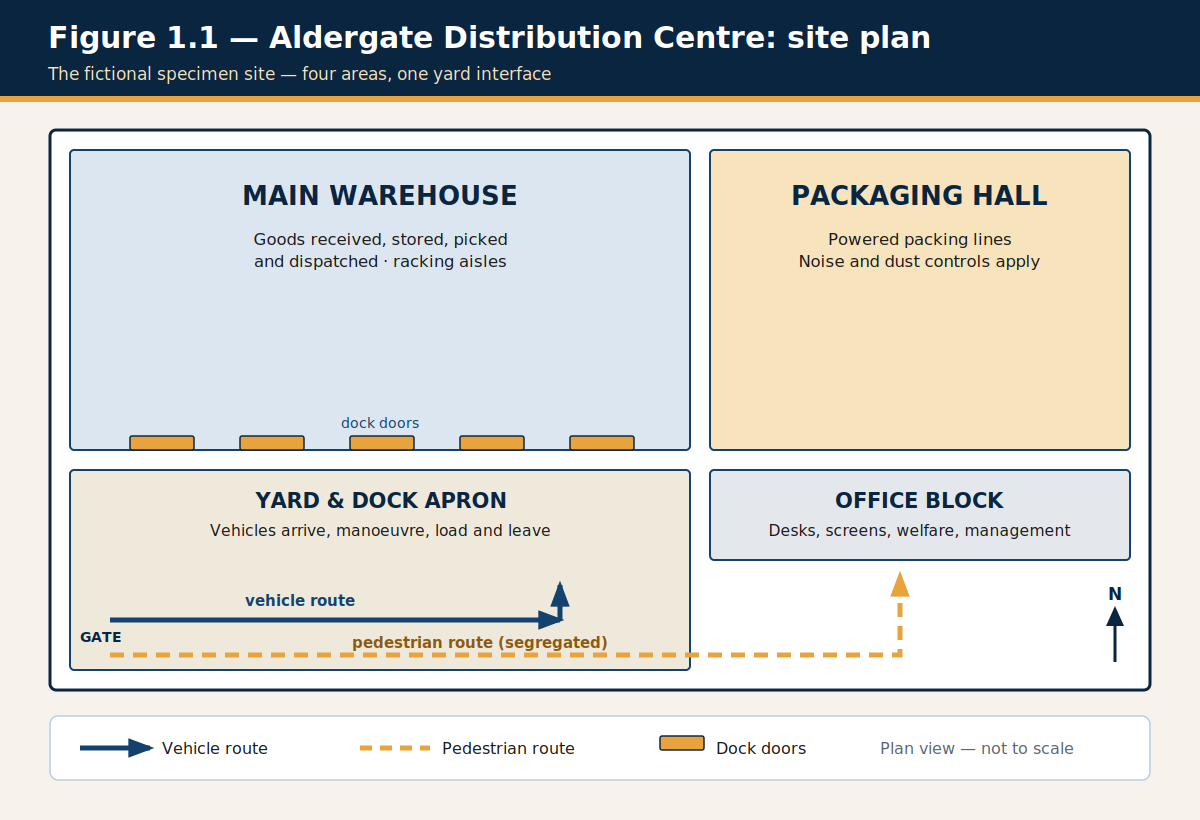
Figure 1.1 — The Aldergate Distribution Centre — the book's fictional specimen site: four areas, one employer.
Figure 1.1 sets out the site in plan form: four areas under one employer, with the flows of people, goods, and vehicles between them that later chapters assess in detail. Keep that plan in mind as the prose below walks the site, because almost every worked example in this book happens somewhere on it.
The specimen employer is the Aldergate Distribution Centre — Aldergate, for short. It is fictional. No real place, city, or country is named or implied for it, and any resemblance to a real depot is the resemblance of one distribution site to another. Aldergate has four areas: the Main Warehouse, where goods are received, stored, picked, and dispatched; the Packaging Hall, where goods are packed on powered lines; the Office Block, where administration, planning, and management work at desks and screens; and the Yard & Dock Apron, where vehicles arrive, maneuver, load, and leave, and where pedestrians and vehicles must share space safely.
Aldergate employs 214 workers, each counted once under a primary role: 96 warehouse operatives, 48 packaging line workers, 30 drivers, 12 maintenance workers, 20 office workers, and 8 in management and supervision — 96 + 48 + 30 + 12 + 20 + 8 = 214. Work runs in three shift patterns: Shift A with 118 workers, Shift B with 78, and a night shift with 18 — 118 + 78 + 18 = 214. Four people carry safety in their defined role: the Site Manager, who holds the site's health and safety lead; the Safety Coordinator; and two Shift Supervisors with defined safety duties. No canon fact states that any Aldergate worker holds any NEBOSH qualification or any other credential, and no chapter will claim otherwise — Aldergate's people are competent or learning, as each case states, never credentialed by implication.
The site is chosen because one depot honestly carries the whole syllabus. The warehouse carries load handling, racking, and vehicle movement. The Packaging Hall carries noise, dust, machinery, and repetitive work. The Office Block carries display screen work, welfare, and the management functions themselves. The Yard carries the classic high-energy interface of pedestrians and reversing vehicles, plus the contractor traffic of a working depot. When a later chapter needs a contractor, a night shift, a committee, an inspection record, or a difficult prioritization decision, it will find them at Aldergate with the same numbers you have just been given. Where a chapter instead needs a one-off anonymous workplace — a bakery, a small workshop — it will say so, give that example no standing figures, and leave Aldergate's canon untouched.
You now hold the map: the qualification, its awarding body, its current specification, its two assessments, its recognition, its fence, its field, and its specimen. Chapter 2 begins the syllabus itself, with Element 1.1 and the question underneath everything else: why work must not harm people, in moral terms first and financial terms second.
Key terms: NEBOSH (National Examination Board in Occupational Safety and Health), International General Certificate in Occupational Health and Safety, 2025 specification, Unit GIC1, Unit GIC2, Learning Partner, open book examination, closing interview, practical risk assessment, provisional pass mark, declaration date, SCQF Level 6, credit point, notional hours, Aldergate Distribution Centre
Q1. Which statement correctly describes NEBOSH's role in this qualification? A. NEBOSH teaches the course and registers learners directly. B. NEBOSH sets the syllabus and assessments and accredits Learning Partners, but does not teach or register learners. C. NEBOSH marks only the practical and leaves the syllabus to Learning Partners. D. NEBOSH awards the qualification to anyone who buys approved study material.
Q2. A learner says: "I will self-study with a book and then claim the qualification." What is the correct position, in NEBOSH's own published terms? A. Self-study is permitted if the book is aligned to the syllabus. B. Self-study is permitted for GIC1 but not for GIC2. C. It is not possible to self-study for a NEBOSH qualification; the learner must register with an accredited Learning Partner. D. Self-study is permitted if the learner later pays an entry fee to NEBOSH directly.
Q3. Under the 2025 specification, what are the two units? A. IG1 and IG2. B. NG1 and NG2. C. GIC1 (Risk assessment) and GIC2 (Management of health and safety). D. GIC1 (Management of health and safety) and GIC2 (Risk assessment).
Q4. At Aldergate, a supervisor finds an old course file labeled "IG1" and asks whether new learners should be entered for it. What should she be told? A. IG1 was the 2018 specification unit; teaching of the revised syllabus began 2 February 2026, first assessments were 4 March 2026, final 2018 assessments were in August 2026, and new learners study GIC1/GIC2. B. Yes — IG1 remains an alternative entry route. C. IG1 and GIC1 run in parallel and learners may choose either. D. IG1 now covers only the practical assessment.
Q5. What level and credit value does the specification give this qualification? A. SCQF Level 5, 9 credits. B. SCQF Level 6 (equivalent to RQF Level 3), 11 credits — GIC1 5 and GIC2 6. C. RQF Level 6, 11 credits. D. SCQF Level 6, 22 credits — GIC1 11 and GIC2 11.
Q6. A warehouse operative with no prior qualifications asks whether she is barred from entering. What is the correct answer on entry and English? A. She is barred until she holds a prior safety certificate. B. There are no entry requirements and no English guidance of any kind. C. She must first complete two years in a safety role. D. There are no entry requirements; IELTS 6.0 or higher is the recommended minimum standard of English.
Q7. A learner plans study time using only the taught hours and makes no time for private study. Using the specification's notional hours, what has he missed? A. Nothing — self-study hours are optional extras. B. Only the 4 assessment hours for GIC2. C. GIC1 is 24 taught + 20 self-study + 5 assessment = 49 hours, and GIC2 is 39 taught + 20 self-study + 4 assessment = 63 hours, so 40 self-study hours across the qualification are unplanned. D. Only the 20 self-study hours for GIC1; GIC2 has no self-study.
Q8. During the GIC1 examination window, a candidate writes long lists of single words for each task, expecting high marks. Why is that approach weak under the published marking principle? A. One mark is given for each correct technical point clearly demonstrated, and single-word answers or lists are unlikely to gain marks; developed points tied to the scenario earn marks. B. Lists are forbidden and score zero automatically. C. Marks are given only for the number of words written. D. The examination rewards handwriting and presentation instead.
Q9. Which set correctly states the published pass standards and grading? A. GIC1 pass 60 percent; GIC2 provisional pass 45 percent. B. GIC1 provisional pass mark 45 percent, with Distinction 75+, Credit 65–74, Pass 45–64, Refer 0–44 on GIC1 marks; GIC2 pass 60 of 100. C. Both units pass at 50 percent with no grading. D. GIC1 Distinction begins at 65 marks and GIC2 passes at 45 of 100.
Q10. A candidate passes GIC1, then lets six years pass before attempting GIC2, and asks whether the GIC1 pass still counts. What is the rule? A. A pass counts forever once achieved. B. The period is three years from registration. C. The period applies only to GIC2, never to GIC1. D. Both units must be passed within a five-year period from the declaration date (the date the first unit was passed); a unit five or more years old no longer counts and must be retaken.
Q11. At Aldergate's Office Block, a manager tells a new holder: "Your certificate automatically makes you a Technical Member of IOSH." Why is that statement inaccurate as NEBOSH presents recognition? A. IOSH has no connection with the qualification at all. B. Tech IOSH requires no experience and no conditions. C. NEBOSH states the qualification meets the academic requirements for Tech IOSH with appropriate experience, subject to the stated UK-assessment condition (unless registered before 31 August 2022); membership is never automatic on the certificate alone. D. Holders are entitled only to Qudorat Level 4 and nothing else.
Q12. A learner needs to take the open book examination in a language other than English and assumes it will be available at every sitting and in the United Kingdom. What should he check, and why? A. Nothing — all languages are available everywhere at every sitting. B. Language options are not available at every sitting, and open book examinations in languages other than English cannot be taken in the UK, so he must confirm availability with his Learning Partner. C. Only Arabic is offered besides English. D. He must take the examination in English because no other languages exist for this qualification.
Q13. Which use of this book is honest and within its stated role? A. Using it as a study companion to learn the syllabus, practice the assessment shapes, and prepare alongside (or before) Learning Partner registration. B. Using it instead of registration and submitting its specimen practical as your GIC2. C. Citing it to an employer as proof that you hold the qualification. D. Using its practice assessments as your real GIC1 submission.
Q14. An Aldergate induction trainer states the site's workforce figures. Which statement matches the specimen canon? A. 180 workers, mostly drivers, on two shifts. B. 214 workers, including 60 office workers and no night shift. C. 250 workers across five areas including a retail shop. D. 214 workers: 96 warehouse operatives, 48 packaging line, 30 drivers, 12 maintenance, 20 office, 8 management and supervision; shifts A 118, B 78, nights 18.
Q15. A candidate asks when her results will arrive and whether the two units are reported separately on different days. What does the published arrangement state? A. Results arrive 20 working days after each unit, on separate days. B. GIC1 results arrive first and GIC2 results a year later. C. Both units' results are issued on the same day, 60 working days from the GIC1 assessment date. D. Results are given at the closing interview.
Q1. Key: B. NEBOSH sets the syllabus and the assessments and accredits Learning Partners; it does not teach courses and does not register learners directly. A is wrong because teaching and direct registration are exactly the functions NEBOSH does not perform. C is wrong because NEBOSH sets the syllabus for the whole qualification, not only one unit's marking. D is wrong because buying study material awards nothing; the qualification follows successful assessment under NEBOSH's arrangements. [EXAM]
Q2. Key: C. NEBOSH's own published words state that it is not possible to self-study for a NEBOSH qualification and that every learner must register with an accredited Learning Partner and undertake the relevant learning. A is wrong because syllabus alignment of a book does not remove the registration rule. B is wrong because the fence applies to the qualification as a whole, not to GIC2 alone. D is wrong because there is no direct-entry route of that kind, and no fee fact of that kind is published. [EXAM]
Q3. Key: D. Under the 2025 specification the units are GIC1, Management of health and safety, and GIC2, Risk assessment. A is wrong because IG1 and IG2 are the 2018 specification codes, now history. B is wrong because NG codes are not the international units taught in this book. C is wrong because it reverses the two unit titles. [EXAM]
Q4. Key: A. IG1 belonged to the 2018 specification; teaching of the revised syllabus began on 2 February 2026, first assessments were on 4 March 2026, final 2018 assessments were in August 2026, and new learners study GIC1 and GIC2. B is wrong because IG1 is not a continuing alternative route. C is wrong because the two specifications do not run in parallel for new learners to choose between. D is wrong because IG1 was not a practical-only unit and is not current in any form. [EXAM]
Q5. Key: B. The specification places the qualification at SCQF Level 6, equivalent to RQF Level 3, with 11 SCQF credit points split as GIC1 5 and GIC2 6. A is wrong on both level and total credit. C is wrong because the RQF equivalence is Level 3, not Level 6. D is wrong because the credits total 11 across the two units, not 11 each. [EXAM]
Q6. Key: D. There are no entry requirements, and IELTS 6.0 or higher is the recommended minimum standard of English for learners. A is wrong because no prior certificate is required. B is wrong because English guidance does exist, in the form of the IELTS recommendation. C is wrong because no period in a safety role is required before entry. [EXAM]
Q7. Key: C. GIC1 totals 49 hours (24 taught + 20 self-study + 5 assessment) and GIC2 totals 63 hours (39 taught + 20 self-study + 4 assessment), so planning only taught hours leaves the 40 self-study hours across the qualification unplanned. A is wrong because self-study hours are part of the specification's notional hours, not optional extras. B is wrong because it names only a small assessment figure and misses the self-study total. D is wrong because GIC2 carries 20 self-study hours as well as GIC1. [EXAM]
Q8. Key: A. Marking gives one mark for each correct technical point clearly demonstrated, and single-word answers or lists are unlikely to gain marks, so developed points tied to the scenario are what earn marks. B is wrong because lists are not stated to be forbidden or to score zero automatically; they are unlikely to gain marks. C is wrong because word count alone earns nothing; technical points earn marks. D is wrong because the examination is a submitted open book examination judged on technical content, not handwriting. [EXAM]
Q9. Key: B. The GIC1 provisional pass mark is 45 percent, grading on GIC1 marks runs Distinction 75 or higher, Credit 65–74, Pass 45–64, Refer 0–44, and the GIC2 pass mark is 60 of 100. A is wrong because it swaps the two units' standards. C is wrong because neither unit uses a flat 50 percent standard and GIC1 is graded. D is wrong because it lowers both the Distinction boundary and the GIC2 pass mark below the published figures. [EXAM]
Q10. Key: D. Both units must be passed within a five-year period starting from the declaration date, the date the first unit was passed, and a unit five or more years old no longer counts and must be retaken, so a six-year-old GIC1 pass no longer counts. A is wrong because a pass is time-limited by the five-year rule. B is wrong because the period is five years, not three. C is wrong because the rule governs achieving both units within the period, not GIC2 alone. [EXAM]
Q11. Key: C. NEBOSH states the qualification meets the academic requirements for Tech IOSH with appropriate experience, subject to the condition that assessments be taken in the UK unless the learner was registered before 31 August 2022, so membership is not automatic on the certificate alone. A is wrong because NEBOSH does state an IOSH connection in its recognition facts. B is wrong because experience and the stated condition are part of the fact. D is wrong because holders are also entitled to AIIRSM and AIOSH as NEBOSH states them, so Qudorat is not the only recognition. [EXAM]
Q12. Key: B. Language options are not available at every sitting and open book examinations in languages other than English cannot be taken in the UK, so availability must be confirmed with the Learning Partner. A is wrong because availability is expressly limited in both ways stated. C is wrong because the offered languages also include French, Portuguese (European), Russian, Spanish (European), and Turkish. D is wrong because languages other than English do exist for this qualification. [EXAM]
Q13. Key: A. Using the book as a study companion — learning the syllabus, practicing the assessment shapes, and preparing alongside or before Learning Partner registration — is exactly its stated role. B is wrong because the book cannot replace registration and its specimen practical is a fictional teaching example that cannot be submitted. C is wrong because reading a companion book is not holding the qualification. D is wrong because practice assessments are practice; a real submission must be the learner's own work in the real assessment. [EXAM]
Q14. Key: D. The canon is 214 workers — 96 warehouse operatives, 48 packaging line, 30 drivers, 12 maintenance, 20 office, and 8 management and supervision — working Shift A 118, Shift B 78, and nights 18. A is wrong because it gives the wrong total, the wrong composition, and only two shifts. B is wrong because it keeps the total but invents 60 office workers and removes the night shift. C is wrong because Aldergate has 214 workers and four areas, with no retail shop. [EXAM]
Q15. Key: C. Both units' results are issued on the same day, 60 working days from the GIC1 assessment date. A is wrong because the results are not issued separately at 20 working days; 20 working days is the parchment timing after the final successful unit. B is wrong because the two units' results are not separated by a year. D is wrong because the closing interview is part of the GIC1 assessment process, not the results mechanism. [EXAM]
End of the free sample. The complete book continues from here — the full A-to-Z course in book form, delivered as an EPUB you can read in Apple Books, Google Play Books, ReadEra, Thorium Reader, Adobe Digital Editions, or Send to Kindle.
Buy this ebook — $11.99 Back to the book page
Payments are securely processed by Payhip.