
Mastering Careers & Skills
Nursing License Exam (NCLEX-RN) · free sample from the book itself
Non-lettered items: 1-5 (multiple response, plus/minus scoring), 1-10 (matrix, 0/1 per row), 1-15 (highlight text, plus/minus scoring) — element keys below; they consume no sequence letter. Calculation items in this quiz (designated): 0 — none. Chapter 1 is an orientation chapter teaching no calculation family; the book's calculation census is carried by Chapters 6 and 29 and the clinical chapters. Case study: No full 6-item case-study set is assigned to this chapter in this book's plan (quiz case-study sets live in Chapters 11, 12, 19–27, and 28). Scenario items: 4 (1-11 through 1-14).
1-1. Key: A. The RN is the licensed professional who assesses, plans, acts, and evaluates, and whose continuous presence makes early recognition possible (§1.1). - B is wrong: UAP are unlicensed and work under delegation; they hold no license and own no nursing judgment (error: delegatee credited with the RN's license). - C is wrong: an NRB regulates licensure; it provides no bedside care (error: regulator mistaken for practitioner). - D is wrong: family members support and partner in care as the client wishes; they are not the licensed practitioner (error: supporter mistaken for practitioner).
1-2. Key: B. Serious, new, or rapidly changing conditions needing round-the-clock care define acute care (§1.5). (Source: setting list, NCSBN, 2026 NCLEX-RN Test Plan, as read October 29, 2026.) - A is wrong: outpatient clients arrive, receive care, and leave the same day (error: same-day setting confused with inpatient setting). - C is wrong: community care happens where people live — homes, schools, workplaces (error: place of living confused with hospital unit). - D is wrong: long-term care serves residents needing daily support over months or years, not round-the-clock acute surveillance (error: chronic setting confused with acute setting).
1-3. Key: D. The RN delegates suitable tasks within the delegatee's scope and competence and keeps accountability for the decision and its supervision (§1.6). - A is wrong: nursing judgment is never delegated, however experienced the delegatee (error: experience treated as a transfer of judgment). - B is wrong: accountability does not transfer with the task (error: task and accountability treated as one thing). - C is wrong: initial assessment is the RN's own work (error: assessment delegated — the classic delegation error this book returns to in Chapter 8).
1-4. Key: B. Only NRBs grant licensure and only NRBs release results (§1.7). (Source: NCSBN, 2026 Candidate Bulletin, Results Reporting, as read October 29, 2026.) - A is wrong: a program educates and graduates; it licenses no one (error: educator mistaken for regulator). - C is wrong: Pearson administers the examination and sends the ATT; it neither licenses nor releases official results (error: administrator mistaken for regulator). - D is wrong: an employer hires and assigns; it holds no licensure authority (error: employer mistaken for regulator).
1-5. Key: A, C, D, E. (Multiple response — plus/minus scoring: +1 per correct selection, −1 per incorrect selection, floor zero; maximum 4 points.) The five baskets are assess and monitor; give and manage therapies; plan, prioritize, and coordinate; teach and promote health; protect and document (§1.2). A, C, D, and E name four of the five. - B is wrong and unsafe as stated: medicines are given against authorized orders within the nurse's scope; blanket independent prescribing is not a nursing basket (error: prescriber's role claimed for the RN). - F is wrong: eligibility requirements are the NRB's to set, not the bedside nurse's work (error: regulator's function listed as a care basket).
1-6. Key: A. Program graduation and NRB application come first; then Pearson registration; then eligibility and the ATT; then the examination; results and licensure come only from the NRB (§1.7). (Source: NCSBN, 2026 Candidate Bulletin, Exam Registration, as read October 29, 2026.) - B is wrong: registering before graduating inverts the first step; eligibility rests on program completion and NRB requirements (error: sequence reversed at the start). - C is wrong: the examination cannot precede eligibility and the ATT, and Pearson never licenses (error: two sequence errors plus wrong licensor). - D is wrong: licensure is the road's end, granted after the examination, not its first step (error: outcome placed before process).
1-7. Key: D. A minimum-length examination contains 52 content-area items, 18 case-study items (three cases of six), and 15 unscored pretest items (§1.7). (Source: NCSBN, 2026 NCLEX-RN Test Plan, Examination Length, as read October 29, 2026.) - A is wrong: it erases the case-study layer that measures clinical judgment explicitly (error: judgment items deleted). - B is wrong: every figure is shifted from the published composition (error: plausible numbers substituted for published numbers). - C is wrong: it inflates case studies to 30 and shrinks pretest items to 3 (error: the two counted layers swapped in weight).
1-8. Key: B. The fee is $200 for registrations completed before February 1, 2027, and $350 on or after that date (§1.7). (Sources: NCSBN, 2026 Candidate Bulletin, Test Fees; NCSBN, NCLEX Fee Changes Feb. 1, August 21, 2026.) - A is wrong: it prints the pre-change figure as permanent, misleading every reader who registers after the change (error: dated fact stripped of its date). - C is wrong: the licensure fee is set by each NRB, not nationally at $200 (error: jurisdiction fee nationalized). - D is wrong: registrations completed before February 1, 2027 are charged $200 (error: later figure applied early).
1-9. Key: D. The code cart is the standardized, sealed, checked emergency cart kept in the same marked place (§1.3; Figure 1.1). - A is wrong: there is no separate "medication cart" named in this chapter's scene; medicines are stored and prepared in the secured medication room (error: room function moved to a cart). - B is wrong: supply carts hold stock, not resuscitation equipment (error: stock mistaken for emergency equipment). - C is wrong: the assessment kit (Figure 1.2) holds measuring instruments, not resuscitation equipment (error: measurement kit mistaken for emergency cart).
1-10. Key: Row 1 — A; Row 2 — B; Row 3 — A; Row 4 — B. (Matrix — 0/1 per row; maximum 4 points.) (§1.6.) - Row 1: initial assessment is nursing judgment — the RN's own work. Delegating it is the classic delegation error. - Row 2: assisting a stable client to ambulate to the bathroom is a suitable delegated task within UAP competence, under supervision. - Row 3: evaluation is a step of the nursing process and of the judgment model — never delegated. - Row 4: routine vital signs on a stable client may be delegated as a task; interpreting them and acting on them remain the RN's.
1-11. Key: C. Cultural and spiritual beliefs in an item are self-reported by the client; the nurse asks and listens (§1.6). (Source: NCSBN, 2026 NCLEX-RN Test Plan, Overview of Content, as read October 29, 2026.) - A is wrong and is the stereotyping error the convention exists to prevent (error: appearance treated as evidence of belief). - B is wrong: the nurse's own knowledge does not determine the client's belief; the client's report does (error: nurse's frame substituted for client's voice). - D is wrong: beliefs shape care decisions, teaching, and comfort; they are clinically relevant (error: relevant data dismissed).
1-12. Key: C. Length indicates nothing; the computer stops at 95 percent certainty in either direction (§1.7). (Source: NCSBN, 2026 NCLEX-RN Test Plan, Passing and Failing, as read October 29, 2026.) - A is wrong: 85 is the published minimum length (error: minimum denied). - B is wrong: early stopping occurs for clearly-below-standard performance as well (error: one direction of the rule kept, the other dropped). - D is wrong: once the stopping rule is met the examination ends; a candidate cannot elect to continue (error: CAT behavior misunderstood).
1-13. Key: C. An unrecorded, uncommunicated, unescalated assessment does no work; recognition must be carried through to action (§1.8). - A is wrong: assessment includes behavior, mentation, and trend, not vital signs alone — this client's change was behavioral (error: one data source absolutized). - B is wrong: new quietness and slowed responses are recognized change findings throughout this book (error: a real cue dismissed). - D is wrong: escalation follows the nurse's recognition and the situation's urgency, not a visiting schedule (error: routine substituted for escalation).
1-14. Key: A. Eligibility requires an approved program and the NRB's determination; a study book prepares a candidate within that process and confers nothing (§1.7). - B is wrong: no book completion satisfies any NRB (error: study mistaken for eligibility). - C is wrong: registration follows eligibility determination in the sequence; registering cannot create eligibility (error: later step treated as a substitute for the first). - D is wrong in its reason: eligibility belongs to the NRB, not to Pearson — the conclusion is right and the authority named is wrong (error: right fence, wrong owner).
1-15. Key: C only. (Highlight text — plus/minus scoring: +1 per correct selection, −1 per incorrect selection, floor zero; maximum 1 point.) (§§1.2, 1.8.) - C is keyed: faster, shallower breathing against this morning's baseline is a change in a vital function and requires follow-up now. - A is not keyed: alert and conversational is the reassuring baseline, stated so it can be trended (error if selected: normal finding treated as deterioration). - B is not keyed: pain rated 2/10, reported and low, is monitored and rechecked, not an immediate follow-up finding on this note (error if selected: low, known finding escalated over a respiratory change). - D is not keyed: eating half of lunch, without more, is ordinary intake data (error if selected: routine data treated as a warning sign). - E is not keyed as immediate follow-up on this note: not yet ambulating is a plan item for the day, addressed in routine care, while the breathing change is the time-sensitive finding (error if selected: schedule item ranked above a respiratory change).
What this chapter does. By the end of it you will be able to say, in plain words, what a registered nurse is and does, who the client is, where care happens, who else works beside the nurse, and how a person travels the road from nursing program to license — with every limit of this book stated where it belongs. No anatomy comes first and no examination framing comes first. The profession itself comes first, because everything else in this book makes sense only after the work itself makes sense.
This chapter teaches in its own original words. Where an examination fact appears, its source is named on the spot. Examination facts in this book were verified from the official documents named in the References on October 29, 2026.
This book teaches the knowledge and clinical judgment the NCLEX-RN examines. It does not teach hands-on psychomotor skills and does not replace nursing education, clinical placements, or your nursing program's requirements.
Simplify. A registered nurse (RN) is a licensed health professional who cares for people — called clients in this book, following the language of the 2026 NCLEX-RN Test Plan — by doing four things again and again: noticing what is happening with a person's health, deciding what it means and what matters most, acting (or arranging action) to help, and checking whether the action worked. That cycle has names you will learn in Chapter 4 — the nursing process and the Clinical Judgment Measurement Model — but the idea needs no jargon: look carefully, think clearly, act safely, check the result.
Three words carry the weight of the definition, so define them now:
A homely picture helps. Think of the nurse as the professional who is continuously present in a way no other team member is. A prescriber may see a client for minutes; a nurse watches trends for hours. The nurse is therefore often the first to see that breathing is a little faster than it was, that a client who was alert is now quiet, that a wound looks different today. Entry-level nursing — the level the NCLEX-RN measures — is built on that presence: the nurse who notices, interprets, and escalates in time. Every chapter that follows trains one part of that sentence.
Exam trap — this book is for the NCLEX-RN only. The NCLEX-RN and the NCLEX-PN are separate examinations, with separate test plans, for two different licenses and scopes of practice. A reader preparing to become a licensed practical or vocational nurse needs the NCLEX-PN book (a separate book in this series). Nothing in this book prepares a reader for the PN examination, and the one contrast in this chapter and in Chapter 30 exists only to keep a reader from studying for the wrong examination.
Detail. Stand at the door of a hospital unit at 7:00 in the morning and watch what nursing looks like before it looks like anything else. Nurses receive handoff — a structured report about each client from the nurse who cared for them through the night. They review orders, laboratory results, and the plan for the day. Then the work fans out across five baskets. Learn these five, because the rest of this book is these five baskets opened up:
If you remember nothing else from this section, remember this: a nurse's product is safe, effective care judged by the client's outcome — in that order. Care that is kind but unsafe is a hazard with good manners. Care that is technically correct but never checked for effect is unfinished. The examination tests all three properties — safety, effectiveness, and evaluation — and experienced nurses judge their own work by all three, every shift.
Notice what the five baskets do not contain: working alone as the whole system. Nursing is team care with individual accountability. The nurse delegates tasks but never delegates accountability for the nursing judgment behind them — a distinction Chapter 8 teaches at full depth and the examination returns to constantly, because confusing doing a task with owning the judgment is one of the most reliable ways new nurses, and examination candidates, go wrong.
Show. Before the cast and the road to licensure, see the place. Care happens in many settings — named in Section 1.5 — but a beginner should be able to picture the most examination-common one first: an acute-care hospital unit, where clients with serious or changing conditions receive round-the-clock care.
Picture the unit from its center. At the middle is the nurses' station: the work hub where nurses document, review results, speak with prescribers and families, and coordinate the day. Around it are client rooms, each with a bed, monitoring equipment, a call system the client can reach, and space for the equipment that client's care requires. Nearby, behind a secured door, is the medication room, where medicines are stored and prepared — a quiet, controlled space because medication preparation interrupted is medication error invited, a principle Chapter 5 develops. Along the corridor are supply and equipment alcoves holding the unit's working stock, and in a marked, instantly reachable place stands the code cart — the emergency cart carrying resuscitation equipment and medicines, kept sealed, checked, and in the same place on every unit so that in an emergency no one hunts for it. The sameness is the point: emergency equipment that must be searched for is emergency equipment that arrives late.
Figure 1.1 — An acute-care nursing unit as a workplace.
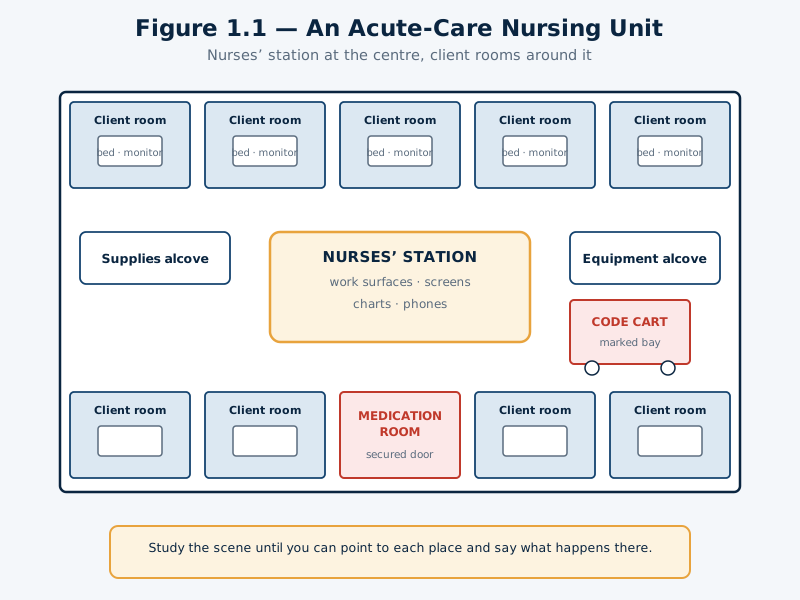
A nursing unit drawn as a workplace: nurses' station at the center, client rooms around it, the secured medication room, supply and equipment alcoves, and the code cart in its marked place.
Study the labeled scene until you can point to each part — nurses' station, client rooms, medication room, supply and equipment alcoves, code cart — and say what happens in each place. Every part named in the paragraph above must appear, labeled, in the figure. If you can read that picture, you can follow every workplace chapter in this book: safety in Chapter 7 happens in these same places, and so do infusions in Chapter 16 and deterioration in Chapter 27.
Show. A nurse's competence is partly carried in a small kit of measuring instruments used on nearly every client, nearly every shift. Picture it laid out at the start of a day. This figure is a map of the kit, named here at survey depth only: Chapter 4 opens each instrument at working depth, with its own figures, before any examination item tests its use.
On the tray: a stethoscope, the instrument with earpieces, tubing, and a chest piece that lets the nurse listen to heart, lung, and bowel sounds and to blood pressure; a blood-pressure cuff with its gauge — an inflatable cuff that wraps the arm, with a dial or display showing pressure; a thermometer, which measures body temperature; a pulse oximeter, a small clip or probe, usually on a finger, that estimates the oxygen saturation of the blood and displays the pulse; a penlight, a small light for examining pupils, mouth, and wounds; and a watch with a second hand (or an equivalent timer), because pulse and respirations are counted against time. Six ordinary objects. Chapter 4 will show that each one is a measurement system with correct technique, common errors, and findings that can change a plan of care.
Figure 1.2 — The nurse's assessment kit laid out.
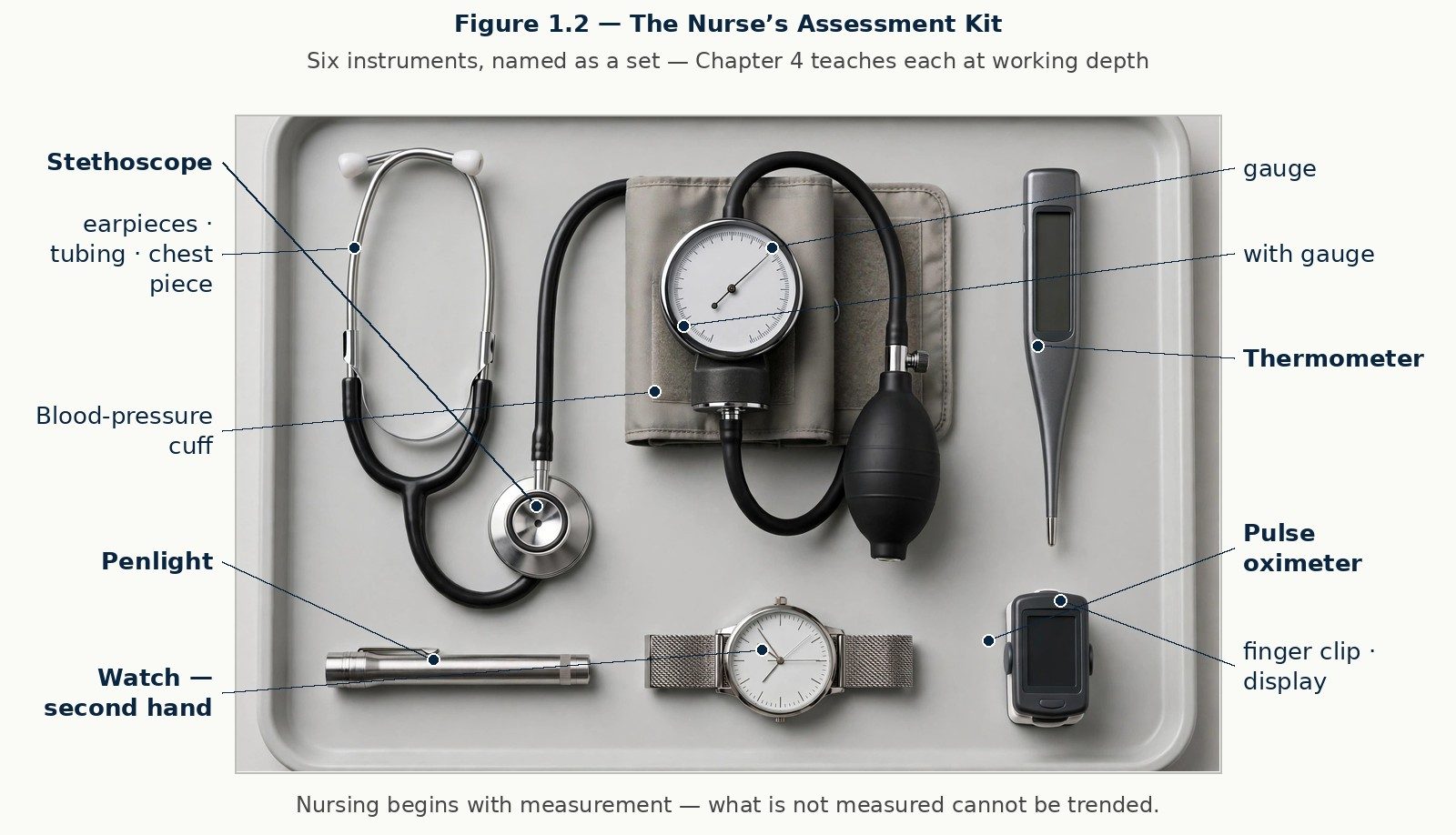
The assessment kit as a named set: stethoscope, blood-pressure cuff with gauge, thermometer, pulse oximeter, penlight, and watch with second hand. Chapter 4 teaches each instrument at working depth.
The figure must label exactly those six items. It adds no instrument this section does not name, because Chapter 4 — not this survey — is where technique is taught. The kit's lesson for a beginner is conceptual before it is technical: nursing begins with measurement. What the nurse does not measure, the nurse cannot trend; what the nurse cannot trend, the nurse will notice late.
Do — a five-minute exercise. Without looking back, list the five baskets of nursing work (Section 1.2) and match each to the place or tool that serves it first: assessing to the kit of this section; therapies to the medication room; protecting to the habits of Chapter 7; planning and teaching to the nurses' station, where coordination and documentation live. If any basket matched nothing, reread Section 1.2; the baskets are this book's table of contents in disguise.
Detail. The 2026 NCLEX-RN Test Plan names the settings its items draw from, and this book teaches to that list: acute care, long-term care, rehabilitation, outpatient care, and community and home care. (Source: NCSBN, 2026 NCLEX-RN Test Plan, Overview of Content, as read October 29, 2026.) Each setting bends the same five baskets differently.
Acute care — the hospital unit of Section 1.3 — serves clients whose conditions are serious, new, or changing quickly. Its nursing skill is surveillance: frequent assessment, rapid recognition of change, and therapies that can change by the hour.
Long-term care serves residents — the word changes because people live there — who need daily nursing support over months or years, often with chronic conditions and gradual change. Its skill is knowing a person so well over time that a small change, invisible to a stranger, is recognized as significant, and protecting dignity and function in what is someone's home.
Rehabilitation serves clients recovering function after injury, surgery, or illness. Its skill is coaching recovery: mobility, self-care retraining, and patience measured in weeks, in partnership with therapy disciplines.
Outpatient care — clinics, offices, procedure and dialysis centers, and similar settings — serves clients who arrive, receive care or teaching, and leave the same day. Its skill is focused assessment and powerful teaching, because most of the care will be carried out by the client at home.
Community and home care takes nursing to where people live: homes, schools, workplaces, and public-health programs. Its skill is assessing not only a person but an environment — stairs, refrigeration for medicines, family support, safety hazards — and building a plan that works in that real setting, not in an imagined one.
The settings share one license, one judgment method, and one safety discipline. That is precisely why a single book can serve a reader headed for any of them — and why examination items move freely among them, expecting the candidate to carry the same principles into each new room.
Detail. No nurse works alone in the structure sense, even when alone in a room. Learn the cast now; Chapter 8 gives the working rules.
The client and family. The client is the center and a participant, not a recipient only. Family and chosen supporters are part of the care picture as the client wishes — sources of history, partners in teaching, and sometimes caregivers themselves after discharge. The test plan's convention is worth fixing now: any ethnicity or cultural or spiritual belief stated in an examination item is self-reported by the client — the nurse asks and listens rather than assuming from appearance. (Source: NCSBN, 2026 NCLEX-RN Test Plan, Overview of Content, as read October 29, 2026.)
The prescriber and the interprofessional team. Medicines and many treatments are ordered — prescribed — by an authorized prescriber (physician, advanced practice registered nurse, physician assistant, and others as jurisdiction and setting allow). Around the client also work pharmacists, who verify and advise on medicines; physical, occupational, and speech therapists; respiratory therapists; dietitians; social workers and case managers; laboratory and imaging professionals; and others. The nurse's distinctive place in that team is coordination at the bedside: the nurse sees the whole day, so the nurse notices when one discipline's plan collides with another's, and raises it.
Licensed practical/vocational nurses (LPNs/VNs) and unlicensed assistive personnel (UAP). LPNs/VNs are licensed nurses with a narrower scope of practice; UAP — nursing assistants and similar roles — are unlicensed and work under delegation. The RN assesses, plans, and evaluates; the RN may delegate suitable tasks to LPNs/VNs and UAP within their scope and competence, and remains accountable for the delegation decision and its supervision. Chapter 8 teaches exactly what may and may not be delegated and why; here, fix the shape: assessment, nursing judgment, planning, evaluation, and client teaching that requires judgment are the RN's own work and are never delegated away.
The nursing regulatory body (NRB). Behind the whole cast stands the regulator: the board that sets eligibility, grants the license, and disciplines it when practice is unsafe. The NRB is not the employer and not the school. Keeping those three apart — educator, employer, regulator — prevents most beginner confusion about who decides what, a confusion Section 1.7 untangles on the road to licensure.
Explain. You are likely reading because you intend to sit the NCLEX-RN. Place the pieces honestly now; Chapter 30 teaches the examination process in full, and the Exam Format page in the front matter carries every figure with its source and date attached.
The verified national sequence is four steps, in this order:
(Source: NCSBN, 2026 NCLEX Examination Candidate Bulletin, Exam Registration, Authorization to Test, and Results Reporting, as read October 29, 2026.)
The examination in one paragraph — the whole of it is Chapter 30. The NCLEX-RN is given only by computerized adaptive testing (CAT): the computer re-estimates your ability after each answer and selects the next item accordingly. An examination runs a minimum of 85 items and a maximum of 150 items, within a five-hour limit that includes the introduction and all breaks. Of a minimum-length examination, 52 items come from the eight content categories, 18 items are three clinical judgment case studies, and 15 are unscored pretest items you cannot identify. Length tells you nothing about passing or failing — a candidate may pass or fail at any length. Once you confirm an answer you cannot return to it, and every item must be answered to proceed. An on-screen calculator is available. (Source: NCSBN, 2026 NCLEX-RN Test Plan, Administration and Examination Length; 2026 Candidate Bulletin, Program Overview, both as read October 29, 2026.)
The fee, printed dated — as it will be at every appearance in this book. The NCLEX registration fee for candidates seeking U.S. licensure is $200 for registrations completed before February 1, 2027, and $350 for registrations completed on or after February 1, 2027, nonrefundable; the licensure fee itself is set by your NRB and is not printed here. (Sources: NCSBN, 2026 Candidate Bulletin, Test Fees and Policies; NCSBN, NCLEX Fee Changes Feb. 1, news post dated August 21, 2026 — both as read October 29, 2026.) A bare "$200" or a bare "$350" anywhere would mislead half this edition's readers; that is why the pair always travels together.
What this book is NOT — the remaining fences, in one place.
Exam trap — “the exam stopped at 85, so I must have failed.” False, and Chapter 30 proves it from NCSBN's published decision rules. The computer stops when it is 95 percent certain your ability is clearly above or clearly below the standard. A short examination means the evidence became clear early — in either direction. Candidates who believe the myth study differently, and worse, after a first attempt; candidates who know the rule read their Candidate Performance Report — the report a candidate who does not pass receives, showing performance by test-plan category — and study the categories it names. This book's tracker accepts that report as an input for exactly that reason.
Show — one ordinary shift. At 7:00 a nurse receives handoff on four clients. At 7:30 she assesses each one — basket 1 — and finds one finding that was not in the night report: a postoperative client whose breathing is faster and shallower than the recorded trend. She does not file it away; she completes a focused assessment, reviews the orders and results, and escalates with organized information — basket 3, coordination, doing its quiet work. At 10:00 she gives the morning medicines — basket 2 — checking each order, each client identity, each allergy, because Chapter 5's discipline is not paperwork around the work; it is the work. At 13:00 she teaches a newly diagnosed client how to manage a medicine at home, checking understanding by having the client explain it back — basket 4. Through the day she washes her hands, prevents a fall she can see coming, and documents so clearly that the evening nurse can act without telephoning her at home — basket 5. Nothing in that shift is dramatic. All of it is nursing.
Detail — the failure that teaches the hierarchy. Now the failure. A nurse notices a client is "a little off" — quieter, slower to answer — but the vital signs are not yet alarming, the shift is busy, and the observation is never quite written down or spoken aloud. Two hours later the client is in crisis. The lesson is not that the nurse lacked knowledge; it is that an uncommunicated, undocumented assessment does no work. Recognition that stays in one head, unrecorded and unescalated, is not yet nursing care. That is why this book treats communication and documentation as clinical acts, not clerical ones — and why the judgment model of Chapter 4 ends, always, in action and evaluation, never in silent noticing.
Do. Take the ordinary shift above and label each event with its basket from Section 1.2. Then write, in one sentence, what the failure case is missing that the ordinary shift has. (In your own words: an assessment carried through — recorded, communicated, escalated, and rechecked — instead of an impression left unacted on.) If that distinction feels natural already, Chapter 4 will still deepen it; if it feels like paperwork, Chapter 4 is the chapter to read twice.
Detail. Two ideas run under all five baskets and deserve naming before the vocabulary list, because the test plan weaves them through every category as integrated processes — caring, communication, culture, and advocacy are not one chapter's topic; they are the medium the other topics travel in. (Source: NCSBN, 2026 NCLEX-RN Test Plan, integrated processes, as read October 29, 2026.)
Advocacy means acting for the client's interests and rights within the care system: ensuring the client understands a proposed treatment well enough to consent or refuse it knowingly (Chapter 8 teaches consent in full), carrying a client's concern to the prescriber completely and promptly, and protecting a client who cannot protect themselves — the sedated, the confused, the very young — with the same diligence the client would bring if they could. Advocacy is not agreement with every client preference; it is the guarantee that the client's voice, values, and safety reach every decision intact.
Caring, in nursing's professional sense, is equally concrete: knowing the client as a person — their baseline, their fears, their family, their culture and spiritual practice as they report them — well enough that care is fitted to that person rather than merely delivered at them. Chapter 13 teaches therapeutic communication and cultural care at depth. Here the foundation is enough: a client who trusts the nurse reports symptoms earlier, learns better, and follows a plan they helped shape. Caring is therefore not decoration on clinical competence; measured by outcomes, it is one of its mechanisms.
Explain. Every license draws a boundary: the scope of practice is the set of acts the license permits, and practicing beyond it — however skillfully — is practicing without legal authority for that act. The RN's scope, in principle, centers on assessment, nursing diagnosis and planning, intervention including medication administration against authorized orders, evaluation, delegation and supervision, and client teaching. The prescriber's scope centers on medical diagnosis and prescription. The boundary cases are where examinations and incidents live: the nurse who notices a pattern and escalates it is practicing at the center of RN scope; a nurse who independently changes a prescribed therapy to match their own diagnosis has crossed into another profession's scope, even when their clinical instinct was right. The safe sentence, used throughout this book, is: assess fully, act within scope, escalate across it — never silently substitute for it. Jurisdiction and facility documents state scope specifics; the principle is national, and it is the principle the examination tests.
Show — walk the need, not the diagnosis. Follow one simple need — a client who must learn to move safely after a period in bed — through the five settings of Section 1.5, and watch the five baskets change weight without changing identity. The client's name is Daniel Osei, a fictional teaching client invented for this walk-through; nothing about him is a test item, and no finding about him is keyed anywhere.
In acute care, Daniel is one day past surgery. The nurse's first basket dominates: assess before moving. How is he breathing when he sits up? Does he become dizzy at the edge of the bed? What do the trend of his measurements, his pain report, and his surgical site say about whether movement today is therapy or risk? The moving itself may be delegated in part — assisting a stable client to walk is a task that can be delegated within scope — but the judgment that he is ready, and the evaluation of how he tolerated it, stay with the RN. That split, task delegated and judgment retained, is the single most examined idea in this chapter, and here it is in its natural habitat: not a rule recited, but a decision made at a bedside at nine in the morning.
In long-term care, Daniel is not Daniel but his older counterpart in spirit: a resident named Ruth Adler who has lived in the facility for two years and whose world has slowly shrunk to her room. The assessment question is no longer "is she ready today?" but "what has she quietly stopped doing over the last month, and who noticed?" Here the nurse's continuous presence works across weeks instead of hours. A resident who used to walk to the dining room and now asks for a tray is giving a cue as real as any measured value, and it is recognized only by someone who holds her baseline. Teaching bends too: the goal is not discharge but preserved function and dignity inside a home that happens to have nurses in it.
In rehabilitation, movement is the treatment itself. The nurse, therapists, and client work from shared goals measured in gained abilities: sitting balance, a transfer performed with less help than last week, a staircase managed before discharge. The nurse's coordination basket dominates — therapy sessions, rest, pain timing, and practice between sessions must fit one day without exhausting the client — and evaluation is written in the client's own progress rather than in a single measurement.
In outpatient care, the same need arrives compressed into a visit. A client named Priya Nair attends a clinic after a knee injury. The nurse has minutes, not a shift: a focused assessment of how she moves now, and then the visit's real product — teaching she can carry home. How to use the stairs she actually has. Which movements to repeat and which to avoid. What change should make her telephone the clinic rather than wait for the next appointment. Outpatient teaching fails when it is a leaflet; it succeeds when it is fitted to the client's staircase, work, and family, and when understanding is checked by having the client explain the plan back in her own words.
In community and home care, the nurse travels to the movement problem. A home-visiting nurse finds that the client, Thomas Reed, practices his exercises in a hallway blocked by a loose rug, on a floor lit by one dim bulb, with the bathroom — the room he most needs to reach safely at night — at the far end. No order set fixes that hallway. The assessment includes the environment itself, the plan includes the rug and the bulb, and the teaching includes the daughter who visits on Sundays and can reinforce the routine. This is why Section 1.5 said home care assesses a setting, not only a person.
The reasoning, made explicit. Notice what did not change across the five rooms: assess first; keep judgment; delegate tasks, not accountability; teach in usable language; protect against the predictable harm — here, a fall — before it happens; document so the next clinician starts from knowledge. Notice also the wrong turn available in every room: treating the setting as the care. A nurse who thinks "rehabilitation is the therapists' work" or "home care is just hospital care in a house" has mistaken the room for the reasoning. Examination items exploit exactly that wrong turn by moving a familiar principle into an unfamiliar setting and offering options that are correct somewhere else. The check that defeats it is the question this section trained: which basket, which judgment, in this room, for this client?
Detail — Map B at working depth. Section 1.6 placed the client at the center of the cast. This section teaches what "center" demands in practice, because Part I owes the zero-background reader this foundation before Chapter 13 teaches psychosocial care in full.
Begin with the plainest bridge. In ordinary language, a person in care is in an unusual position: unwell or frightened, in an unfamiliar place, wearing unfamiliar clothing, dependent on strangers for intimate needs, and often unable to tell a routine question from a dangerous symptom. Every professional behavior in this book is built on that asymmetry. Dignity is the practical answer to it: the client is addressed by their chosen name, their body is exposed only as much as an examination requires and only for as long as it requires, their information is shared only with those who need it for care, and their decisions — including decisions the nurse would not choose — are treated as decisions, not as obstacles. None of this is softness added to competence. A client whose dignity is handled carelessly reports less, trusts less, and cooperates less, and the nurse's assessment — the foundation of everything — becomes thinner as a direct result.
Culture and spirituality, taught the examination's way. The test plan's convention, fixed in Section 1.6, is that a client's ethnicity, culture, and spiritual belief in an item are self-reported. The practice behind the convention is a discipline of asking rather than assuming. Two clients who share a language, a birthplace, or a faith may want entirely different things at the bedside: one wants family present for every decision, the other wants privacy from family; one observes dietary practices that shape the meal tray and the timing of medicines, the other does not. The nurse's skill is not memorizing what "people of a group" believe — that is assumption wearing education's clothing — but asking the individual client what matters to them, listening to the answer, and carrying that answer into the plan and the handoff so the client is not forced to re-teach every new nurse. When a practice and a therapy appear to conflict, the nurse's first move is understanding both sides accurately and involving the client and the team, not silently overriding either.
The first conversation as a clinical instrument. Watch a skilled nurse open a relationship. She introduces herself by name and role — the client should never have to guess which uniform does what. She explains what she is about to do before she does it, in plain words first and technical words second, a habit this book models on every page: plain language first, then the term, then the term used confidently thereafter. She asks what the client already understands and fears, because teaching that ignores existing fear lands nowhere. And she closes the loop: "Tell me what you will watch for tonight, in your own words," so misunderstanding is discovered while it can still be corrected. Chapter 13 names the techniques; Chapter 4 builds the interview's structure. The foundation here is the stance: the conversation is not what happens around the care. For assessment, teaching, consent, and advocacy, the conversation is the care.
A wrong turn, examined. A new nurse, meaning well, tells a frightened client, "Don't worry, everything will be fine." Examine why experienced nurses do not say it. It promises an outcome the nurse cannot guarantee — this book makes no such promise to its readers, and nurses make none to clients. It closes the conversation the client was trying to open: the fear, unspoken now, does not disappear; it simply loses its witness. And it substitutes reassurance for the two things that actually help — accurate information at the client's pace, and a concrete statement of what the nurse will do and watch for. The examination rewards the option that opens, informs, and stays; it punishes the option that soothes and closes. That pattern, learned here in Chapter 1, will still be earning marks in Chapter 14.
Explain — what a Chapter 1 idea looks like wearing an item's clothes. The examination rarely asks, "What is a registered nurse?" It shows a small scene — a nurse, a task, a colleague, a choice — and asks what the RN does. Three transformations turn this chapter's teaching into items, and recognizing them is a learnable skill.
First transformation: principle into assignment. The stem gives several tasks and several people and asks which task stays with the RN. The knowledge tested is Section 1.6's shape: assessment, judgment, planning, evaluation, and teaching that requires judgment are the RN's own; stable, routine tasks within a delegatee's scope may be delegated, with the RN keeping accountability. The wrong options are not random — one offers a task that sounds simple but contains judgment (a first assessment disguised as "checking on" a client), and one offers the reverse error, the RN personally performing a routine task while an unstable client waits for judgment no one else can give. Both directions of the error are tested, so the rule must be held as a shape, not as a slogan about never delegating or always delegating.
Second transformation: sequence into order. The road of Section 1.7 becomes an item by scrambling it. The defense is to hold the road as dependencies, not as a list: eligibility must precede registration's completion because the regulatory body determines it; the authorization must precede scheduling because scheduling spends the authorization's validity; results and licensure come only from the regulatory body because only the regulatory body grants them. A candidate who knows why each step waits for the previous one cannot be scrambled, because the order rebuilds itself from the reasons.
Third transformation: fact into myth. The trap box about examination length is the model. Myths are attractive because they are simple, emotional, and shared by anxious candidates. The examination's published rules are the antidote, which is why this book prints examination facts with their sources and dates attached rather than as lore. When a stem or an option states something about the examination itself — its length, its stopping, its results — the candidate's move is to ask, "Is that the published rule, or is that the story candidates tell each other?" Chapter 30 makes that move a method.
Do — read one stem the slow way. Take any scenario in this chapter's quiz and, before looking at the options, say aloud what the stem is actually asking in plain words, which basket of work it belongs to, and what the safe nurse does first. Then read the options and watch how many of them are true statements that do not answer the question asked. That last phenomenon — the true-but-irrelevant option — is the examination's most durable trap across all thirty chapters. It survives every content change because it exploits reading, not knowledge. The slow habit built here, name the question before grading the options, is worth more across the whole book than any single fact in this chapter.
Detail. Six errors account for most lost marks on this chapter's material, in study and in early practice alike. Each is named with its correction, because an error you can name is an error you can catch.
Recap narrative — Chapter 1 in one walk. Imagine arriving for a first shift with nothing but this chapter. You could name your license and who granted it, find your way around the unit and the kit, say which of the morning's tasks are yours alone and which you may delegate while keeping accountability, introduce yourself to a client in plain words and ask what matters to them, and explain the road that brought you to that bedside — program, regulatory body, registration, authorization, examination, license — without promising anyone an outcome you do not control. You could not yet assess deeply, calculate a dose, or recognize deterioration in detail; those are the next six chapters' gifts. But the frame would be standing, and everything else in this book hangs on this frame.
Show. Section 1.8 followed one ordinary shift in outline. Lay that shift on a clock and read it as a timetable of judgments, because beginners often imagine nursing time as long stretches of tasks punctuated by rare decisions, when the reality is the reverse: short tasks, densely decided.
Before the shift formally begins, the nurse reviews the assignment: how many clients, how acute, what is due, what is likely to change. That review is already prioritization — Chapter 8's whole subject in embryo — because the day's first decision is sequencing: which client is seen first, and the answer is never "the nearest room." It is the client whose condition is newest, least stable, or most likely to declare a change early. Handoff then transfers not just facts but watch items: the two or three findings per client whose movement would matter, stated explicitly so the incoming nurse's attention is pre-aimed. A handoff that lists everything aims nothing; the craft is in the selection, and Chapter 8 teaches its structure while Chapter 4's cue discipline explains why the selection works.
The morning's middle is a braid: assessment rounds, medicines (with Chapter 5's discipline consuming real minutes, not the seconds a television drama allows), treatments, teaching in the gaps, documentation in near-real time because memory decays and the record's value is its contemporaneity. Woven through are the day's unplanned arrivals: a prescriber's round and its new orders, a family member's worry that is also a data source, a laboratory result that re-ranks a client, a colleague who needs a second pair of hands — teamwork as a resource consumed and replenished. The nurse's coordination basket is what keeps the braid from becoming a tangle: resequencing without dropping, communicating changes to everyone they touch, and noticing — the continuous-presence dividend of Section 1.1 — the client whose trend has quietly turned while attention was elsewhere.
The shift's end is not a fade but a second handoff, run to the same standard as the first, plus the evaluation habit: what did today's plan achieve, what is unfinished and why, what should the next nurse watch first. Notice that the timetable contains no hour labeled "thinking." Thinking is not a slot in the day; it is the medium every slot is suspended in. That is why Chapter 4 can claim, without exaggeration, that its method is the profession's operating system.
For the zero-background reader — three workplace words, bridged. Acuity is how sick and how changeable a client is right now — the word assignments and priorities are made of. Rounds are structured visits — by a nurse to assess, or by the team to review a client together — the word means the circuit, not the shape. Orders are a prescriber's directives for a client's care — medicines, tests, treatments — which the nurse evaluates and carries out (Chapter 5), never merely obeys and never silently alters (Section 1.8B). With those three bridges crossed, most workplace sentences in this book can be read at sight, and the vocabulary list below completes the chapter's formal set. The pattern will repeat in every Part I chapter: the technical term is always the second telling of a plain idea, and the plain idea is always available to be thought with when the term is forgotten under pressure — which is exactly when it is needed.
Explain. Close the chapter by inventorying its equipment honestly. You can now walk into any care setting in this book and answer, without notes: Who is licensed here, and by whom? Which of the work in front of me is judgment that stays with the RN, and which is task that may be delegated under supervision? What are this setting's version of the five baskets, and which basket is this moment asking for? Who else is on this client's team, and what does each of them see that I do not? And what can I promise this client — presence, advocacy, honesty, vigilance — and what must I never promise, because outcomes are not mine to guarantee? A reader who can answer those five questions in a strange room is no longer a stranger to the profession; they are a beginner inside it, which is a different and much stronger thing. The six chapters that follow will fill the frame with a body, a chemistry, a method of thinking, a pharmacology, an arithmetic, and a safety discipline. Notice, as they arrive, how each one was already promised by a basket in Section 1.2. That was deliberate: a book that shows its whole skeleton first lets every later fact hang somewhere visible, and a learner who always knows where a fact hangs can retrieve it under examination pressure — which is, in the end, what all this architecture is for.
Each term below was defined at first use above; this list fixes them in one place. The glossary at the back of the book completes the list.
Fifteen items. Foundations quizzes are recognition-first — vocabulary, roles, settings, and sequence — and close with scenario items in the book's voice. Three items use Next Generation formats (multiple response and matrix) and carry no single key letter; the twelve single-key items follow this chapter's planned key sequence. The answer key with full explanations is in the matching key file (ch-01-nursing-from-zero-key.md).
1-1. The professional who is licensed to assess, plan, act, and evaluate nursing care, and whose continuous presence often makes them first to notice a client's change, is the: A. Registered nurse B. Unlicensed assistive personnel member C. Nursing regulatory body D. Client's family member
1-2. A client receives round-the-clock care in a hospital for a serious, rapidly changing condition. This setting is: A. Outpatient care B. Acute care C. Community care D. Long-term care
1-3. Which statement about delegation states this chapter's rule correctly? A. The RN may delegate nursing judgment if the delegatee is experienced B. Accountability transfers fully to whoever performs the task C. UAP may perform the initial assessment of a new client D. The RN may delegate suitable tasks but keeps accountability for the delegation decision and its supervision
1-4. The body that alone grants the nursing license and releases official NCLEX-RN results is the: A. Nursing program B. Nursing regulatory body C. Pearson test center D. Nurse's employer
1-5. (Multiple response — select all that apply.) Which of the following belong to the nurse's five baskets of work taught in this chapter? Select all that apply. A. Assess and monitor clients B. Prescribe medicines independently of any order in all settings C. Plan, prioritize, and coordinate care D. Teach and promote health E. Protect clients and document care F. Set the NRB's eligibility requirements
1-6. The correct order of the road to licensure taught in this chapter is: A. Program graduation and NRB application, then Pearson registration, then eligibility and ATT, then examination, with results and licensure from the NRB B. Pearson registration, then program graduation, then examination, then NRB application C. Examination, then program graduation, then ATT, then licensure from Pearson D. NRB licensure, then program graduation, then registration and examination
1-7. Of a minimum-length NCLEX-RN examination (85 items), the published composition is: A. 85 content-area items and no case studies B. 70 content items, 10 case-study items, and 5 pretest items C. 52 content items, 30 case-study items, and 3 pretest items D. 52 content-area items, 18 clinical judgment case-study items, and 15 unscored pretest items
1-8. The NCLEX registration fee for U.S. licensure, stated correctly with its dates, is: A. $200 at all times, with no scheduled change B. $200 for registrations completed before February 1, 2027, and $350 for registrations completed on or after February 1, 2027 C. $200, plus a separate licensure fee of $200 set nationally D. $350 for all registrations, whenever completed
1-9. The standardized emergency cart kept sealed, checked, and in the same marked place on every unit is the: A. Medication cart B. Supply cart C. Assessment kit D. Code cart
1-10. (Matrix — multiple choice per row.) For each activity, choose whether it is the RN's own work (A) or a task that may be delegated within scope and competence (B). 1. Performing the initial assessment of a newly admitted client — A: RN's own work · B: May be delegated 2. Assisting a stable client to walk to the bathroom — A: RN's own work · B: May be delegated 3. Evaluating whether a care plan is working — A: RN's own work · B: May be delegated 4. Taking routine vital signs on a stable client, as delegated — A: RN's own work · B: May be delegated
1-11. (Scenario.) An examination item describes a client's cultural practice. Under the test plan convention taught in this chapter, that belief is understood to be: A. Inferable from the client's appearance B. Determined by the nurse's own cultural knowledge C. Self-reported by the client D. Irrelevant to nursing care in all cases
1-12. (Scenario.) A candidate's examination stops after 85 items, and the candidate concludes, "It stopped at the minimum, so I failed." The error is that: A. Examinations never stop at 85 items B. Stopping early always means passing C. Length indicates nothing about the result; the computer stops when it is 95 percent certain the ability is clearly above or clearly below the standard D. The candidate should have kept answering past 85 items
1-13. (Scenario.) A nurse notices a client is quieter and slower to answer than earlier, but records nothing and tells no one because the vital signs are not yet alarming. Two hours later the client is in crisis. The failure taught in this chapter is that: A. Vital signs are the only assessment that matters B. Quietness is never a significant finding C. An assessment that is not recorded, communicated, and escalated does no work D. The nurse should have waited for the prescriber's next visit in all cases
1-14. (Scenario.) A pre-nursing reader asks whether finishing this book will make them eligible to sit the NCLEX-RN. The correct answer is: A. No — eligibility requires graduation from an approved program and meeting the NRB's requirements; this book prepares a candidate for the examination within that process B. Yes — completing a study book satisfies NRB eligibility C. Yes — if the reader also registers with Pearson D. No — because only Pearson can determine eligibility
1-15. (Highlight text.) Read the handoff note. Select the findings that require follow-up. "Client is alert and conversational [A], reports pain rated 2/10 [B], is breathing faster and shallower than this morning [C], ate half of lunch [D], and has not yet ambulated today [E]."
Copyright © 2026 Feras Alzubi. All rights reserved.
No part of this book may be reproduced, distributed, or transmitted in any form or by any means without the prior written permission of the copyright holder, except as permitted by law.
Originality statement. This is an original work, written for this book. Every practice question in this book is original. The questions were written fresh for this book, against the 2026 NCLEX-RN Test Plan published by NCSBN (effective April 1, 2026 through March 31, 2029), and everything under them is taught in this book's own words. They are not NCSBN's questions; no NCSBN sample item, test-plan passage, or Candidate Bulletin passage is reproduced, paraphrased, or adapted anywhere in this book, and no real examination item — actual, recalled, paraphrased, or otherwise — appears anywhere in this book.
Not-affiliated disclosure. This book is an independent study guide. It is not published by, affiliated with, endorsed by, or approved by the National Council of State Boards of Nursing (NCSBN) or by Pearson, and neither body participated in its creation. Exam names and trademarks belong to their respective owners. Passing any exam also depends on the candidate's own preparation; no book can guarantee a result.
The author's name. The copyright holder's name appears on this page and in the store metadata, and nowhere else inside this book. The book stands on its sources, which are named wherever they are used and listed in full in the References.
This book is an independent study guide. It is not published by, affiliated with, endorsed by, or approved by the National Council of State Boards of Nursing (NCSBN) or by Pearson, and neither body participated in its creation. Exam names and trademarks belong to their respective owners. "NCLEX," "NCLEX-RN," "NCSBN," and "Next Generation NCLEX" are used in this book nominatively only — to name the examination this book prepares you for. Passing any exam also depends on the candidate's own preparation; no book can guarantee a result.
Five consequences of those sentences are stated here at the front, not buried at the back.
First, this book does not promise that you will pass, earn a license, get work, or earn any particular income. It teaches registered nursing knowledge from the beginning, teaches the whole 2026 NCLEX-RN Test Plan at depth, and drills you with original practice questions whose answers are explained in full — including, for the unfolding case studies, element by element. That is what a study book can honestly do, and it is what this one does. You will find no pass rate anywhere in this book: NCSBN publishes examination statistics separately, in research documents this edition does not reproduce, and no percentage in circulation is printed here in their place.
Second, this book prepares you for one examination only: the NCLEX-RN, the National Council Licensure Examination for Registered Nurses. The NCLEX-PN — the licensure examination for practical and vocational nurses — is a separate examination, with its own test plan, its own content distribution, and its own passing standard, because the two licenses carry different scopes of practice. If you are preparing for the PN examination, this is the wrong book, and this paragraph exists so you find that out on page one rather than on examination day. Registered-nurse candidates will meet PN and vocational-nurse practice in one place only: as something an RN delegates to, supervises, and remains accountable for — which is itself NCLEX-RN test content, taught in Chapter 8.
Third, this book is not a substitute for a nursing program, and reading it does not make anyone eligible to sit the examination. Eligibility is set by the nursing regulatory body (NRB) — the board of nursing or equivalent authority — in the jurisdiction where you seek licensure, and it requires graduation from an approved nursing program. The sequence is fixed and is taught whole in Chapter 30: complete an approved program, apply to your NRB and meet its eligibility requirements, register for the examination, receive your Authorization to Test, and test. This book prepares you for the examination inside that process. It confers nothing by itself.
Fourth, this book is an examination-preparation study text, not clinical practice guidance. It teaches the knowledge, the method, and the recognition the examination tests. At a real bedside, your employer's policies, the provider's current orders, and the current primary clinical references govern — not a study book, including this one. Where this book prints a laboratory or vital-sign reference range, it prints it as teaching apparatus, with this line attached: typical adult reference ranges are shown; ranges vary by laboratory and by client — the stem of every practice item states the range its key uses. A value that is a teaching example here is a decision input there only after you check it against the source that governs your setting.
Fifth, the hands-on fence, printed here and again in Chapters 1 and 30: This book teaches the knowledge and clinical judgment the NCLEX-RN examines. It does not teach hands-on psychomotor skills and does not replace nursing education, clinical placements, or your nursing program's requirements. Procedures are taught the way the examination tests them — indications, steps in principle, complications, and monitoring — with labeled images of the equipment, devices, and setups at every teaching point, so you can recognize what you are reading about. Recognizing a chest-tube drainage system in a labeled image and managing one at a bedside under supervision are different accomplishments, and this book claims only the first.
Provenance note. Every practice question in this book is original. The questions were written fresh for this book, against the 2026 NCLEX-RN Test Plan published by NCSBN (effective April 1, 2026 through March 31, 2029) — the plan's category names, percentages, and activity-statement subjects are named and counted, as a study book must, and everything under them is taught in this book's own words. The questions are not NCSBN's questions; no NCSBN sample item, test-plan passage, or Candidate Bulletin passage is reproduced, paraphrased, or adapted anywhere in this book, and no real examination item — recalled, paraphrased, or otherwise — appears in it. Where a question's key turns on a laboratory value, a dose limit, or a threshold, the question itself prints the reference range or limit its key uses, so no answer silently depends on a value you were never shown. Where a question's explanation rests on an examination fact or a clinical rule, it names the chapter that teaches it.
The edition basis, stated once here and labeled everywhere it matters. This book is built against the 2026 NCLEX-RN Test Plan (effective April 1, 2026 – March 31, 2029) and the 2026 NCLEX Examination Candidate Bulletin (April 2026), both read in full for this edition on October 29, 2026. The 2023 test plan is superseded and is never cited for a current fact. One dated transition is printed with its dates attached wherever it appears: the NCLEX registration fee is $200 for registrations completed before February 1, 2027, and $350 for registrations completed on or after February 1, 2027 (NCSBN, 2026). An edition spanning that change that printed only one of those figures would be wrong for part of its own shelf life, so this book never prints one without the other.
Everything on this page was checked against NCSBN's own publications — the 2026 NCLEX-RN Test Plan and the 2026 NCLEX Examination Candidate Bulletin — on October 29, 2026. Each figure carries its source. Where a figure could not be verified from such a source, this page prints no figure at all — and says so, because the silence is itself information.
The NCLEX-RN is administered only by computerized adaptive testing (CAT), at Pearson VUE test centers. It is not offered in paper-and-pencil or oral formats. CAT means your examination is assembled while you take it, and no two candidates sit the same examination:
(Source: NCSBN, 2026 NCLEX-RN Test Plan, §III; 2026 NCLEX Examination Candidate Bulletin, Program Overview and Psychometrics.)
The examination is a minimum of 85 items and a maximum of 150 items, inside a five-hour limit — and the five hours include the introductory screen and all breaks. Of a minimum-length examination:
Examination length is not an indication of pass or fail. A candidate may pass or fail at any length — at 85, at 150, or anywhere between. A candidate who believes "the exam stopped at 85, so I failed" has misunderstood the machine, and Chapter 30 exists largely to retire that belief with the actual rules. (Source: NCSBN, 2026 NCLEX-RN Test Plan, Examination Length; 2026 Candidate Bulletin, Program Overview.)
There is no percentage-correct score on this examination, and no fixed percentage of candidates who pass or fail. The computer compares your estimated ability with the passing standard, under one of three published rules:
Two practical consequences follow, and both are trained in this book. First, pace is a safety skill: a candidate who spends twenty minutes on early items and runs out of time before the minimum has failed by the clock, whatever they knew. Second, every item counts toward the estimate, including the hard ones the computer serves you precisely because you are doing well.
The passing standard — the mechanism, printed whole. The standard is the minimum level of ability required for safe and effective entry-level nursing practice. The NCSBN Board of Directors reevaluates it every three years, alongside the test-plan review, acting on a criterion-referenced standard-setting exercise by an expert panel of judges working with psychometricians, the historical record of the standard and of candidate performance, a standard-setting survey of educators and employers, and information on the educational readiness of high school graduates interested in nursing. Once set, the standard is applied uniformly to every examination. NCSBN publishes the standard's current value, expressed in its own unit (logits), on its Passing Standard page; consult that page for the value in force for your sitting. Chapter 30 teaches this mechanism again at the point where you will act on it. (Source: NCSBN, 2026 NCLEX-RN Test Plan, The Passing Standard; 2026 Candidate Bulletin, The Passing Standard; NCSBN, Passing Standard page, as read October 29, 2026.)
Every scored content item belongs to one of eight Client Needs categories or subcategories. The percentages below are NCSBN's published ranges for the 2026 test plan, with the plan's own published midpoints. Because examinations are variable-length, an individual examination's distribution may differ by up to ±3% in each category. This book's diagnostic and practice tests are allocated at the midpoints, and say so wherever they appear.
| Client Needs category | Published % | Midpoint |
|---|---|---|
| Management of Care | 15–21% | 18% |
| Safety and Infection Prevention and Control | 10–16% | 13% |
| Health Promotion and Maintenance | 6–12% | 9% |
| Psychosocial Integrity | 6–12% | 9% |
| Basic Care and Comfort | 6–12% | 9% |
| Pharmacological and Parenteral Therapies | 13–19% | 16% |
| Reduction of Risk Potential | 9–15% | 12% |
| Physiological Adaptation | 11–17% | 14% |
Read the table the way Chapter 1 teaches you to read it. The four Physiological Integrity subcategories together — Basic Care and Comfort, Pharmacological and Parenteral Therapies, Reduction of Risk Potential, and Physiological Adaptation — are the examination's center of gravity. Management of Care is the single heaviest subcategory, and it is a judgment category — prioritization, delegation, advocacy — not an administration category. One category was renamed in the 2026 plan: Safety and Infection Prevention and Control (the 2023 plan called it Safety and Infection Control); the name in this book is the current one, everywhere, including the trackers.
Clinical judgment is measured across all eight categories, not inside a ninth one. On every examination, the 18 case-study items measure it explicitly, and approximately 10% of the items are stand-alone clinical judgment items, the exact count depending on examination length. A case study is one client presentation whose six items measure the six steps of the NCSBN Clinical Judgment Measurement Model (NCJMM) in order: recognize cues → analyze cues → prioritize hypotheses → generate solutions → take action → evaluate outcomes. Chapter 4 teaches that model as a working method; every chapter quiz from Chapter 4 onward practices it; Chapter 28 workshops it. (Source: NCSBN, 2026 NCLEX-RN Test Plan, Distribution of Content and Clinical Judgment sections.)
Two test-plan conventions are worth learning now, because items in this book follow them. If an item states no client age, the client is an adult. Any ethnicity or cultural or spiritual belief named in an item is self-reported by the client — it is the client's own stated belief, never a trait the item assigns to a group.
Alongside traditional multiple-choice items, the examination uses the Next Generation NCLEX (NGN) formats: case studies; bow-tie items (two actions, one condition, two parameters to monitor, all chosen from lists); trend items (a client's data across time points); highlight items (select the significant findings inside a note or a table); matrix/grid items (a judgment for each row, or selections down each column); drop-down cloze items (complete a sentence or a table from drop-down lists), including the drop-down rationale form — "the nurse should do X because Y"; multiple-response items in two forms, select all that apply and select a stated number (select N); ordered-response items (put the steps in order); and fill-in-the-blank calculation items (a number, with its unit). Any item may carry exhibits — nurse's notes, history and physical, vital signs, laboratory results, orders — presented behind chart tabs on screen. NCSBN's free Candidate Tutorial, Exam Preview, and Sample Pack on NCLEX.com show the true screen interface; Chapter 30 points you to them, because this book trains the judgment each format measures and states plainly where the screen mechanics differ from the page.
Partial credit is real, and it has three published methods. Single-key items are scored correct or incorrect. Items with more than one key are scored with partial credit by three methods NCSBN names: plus/minus scoring (credit for each correct selection, a deduction for each incorrect one, never below zero on the item), zero/one (0/1) scoring (each element scored right or wrong, independently), and rationale scoring (a paired answer that scores only when both parts are correct). This book scores its own practice items by those same three methods — plus/minus for select-all-that-apply and highlight items, 0/1 per element for bow-tie, matrix, cloze, select-N, and grouping items, and rationale scoring for rationale pairs — and every multi-part answer entry in this book names the rule applied and the item's maximum points, so you learn the rules by being scored under them. (Source: NCSBN, 2026 NCLEX-RN Test Plan, Scoring Items; 2026 Candidate Bulletin, Program Overview.)
The NCLEX registration fee for candidates seeking U.S. licensure is $200 for registrations completed before February 1, 2027, and $350 for registrations completed on or after February 1, 2027 (NCSBN, 2026) — the registration date, not the examination date, decides which fee you pay, the change applies to retakes as well, and the fee is nonrefundable for any reason, including a duplicate registration, a late reschedule or cancellation, and a no-show. The additional fees do not change on February 1, 2027: an international scheduling fee of $150 (plus VAT where applicable) where it applies, a $50 fee to change your nursing regulatory body after registration, and a $50 fee to change your exam type after registration — each also nonrefundable. The licensure or registration fee charged by your nursing regulatory body is a separate fee, set by that body; this book prints no figure for it, because there is no national figure to print. Appointments must be rescheduled or canceled one full business day (24 hours) before the appointment, or the registration fee is forfeited and the Authorization to Test is invalidated. (Sources: NCSBN, 2026 Candidate Bulletin, Test Fees and Policies; NCSBN, "NCLEX Fee Changes Feb. 1," August 2026.)
Arrive at least 30 minutes early; arrival more than 30 minutes late may forfeit the appointment. Check-in requires one acceptable ID whose first and last names match your Authorization to Test exactly, a digital signature, a palm vein scan, and a photograph. Personal items — including electronic devices, sealed in a Pearson-provided bag — go to secure storage and may not be accessed at any time, including breaks. You receive an erasable noteboard; writing on anything else is prohibited. Two preprogrammed optional breaks are offered, after approximately 2 hours and 3½ hours of testing; unscheduled breaks are available by raising your hand. All breaks count against the five hours, and you must leave the testing room for them. Chapter 30 teaches the full day in sequence. (Source: NCSBN, 2026 Candidate Bulletin, Exam Day; Breaks.)
Jurisdiction note, dated October 29, 2026. Licensure is granted by jurisdictions, not by NCSBN and not by Pearson. Your nursing regulatory body (NRB) — your state or territory board of nursing, or the equivalent authority where you seek licensure — sets its own application requirements, its own licensure fee, its own background-check rules, and its own eligibility paperwork, and it alone grants your license and releases your results. Those jurisdiction-set facts are not printed in this book, in this note or anywhere else, because a national book that printed one jurisdiction's rules as general fact would mislead every reader in the other jurisdictions. The same fence covers endorsement (licensure by recognition of another jurisdiction's license) and the Nurse Licensure Compact (NLC): compact membership and endorsement rules are jurisdiction facts that change as jurisdictions act, and this book prints no compact member list and no endorsement rule. What this book prints — whole, and verified — is the national examination process that every candidate in every jurisdiction passes through. For everything your jurisdiction sets, the instruction is the same in Chapter 1, in Chapter 30, and here: confirm it with your NRB.
The national process, in order:
(Source for the whole sequence: NCSBN, 2026 NCLEX Examination Candidate Bulletin — Exam Registration; Authorization to Test; Your Exam Appointment; Results Reporting; Candidate Performance Report; Retake Policy.)
This book serves two readers at the same time, and both of them may be you.
If you are a nursing student or a new graduate preparing for a first attempt, the examination layer is your spine: the diagnostic below routes you, by Client Needs category, to the chapters your program left thin; the chapter quizzes rehearse each category in the examination's own formats, case studies included; and the two practice tests in the back matter rehearse the minimum-length examination whole, under a clock.
If you are a total beginner — a pre-nursing reader, a career changer deciding whether to enter a program, a health-care worker building toward registered nursing — Part I is written for you and assumes nothing: not what a vital sign measures, not what a milligram is, not what an IV line does. Part I teaches the profession, the body, the fluids and chemistry the body runs on, how nurses think, what drugs are, the mathematics of dosage, and the foundations of safety and infection control, each with its labeled images at the teaching point. Do not skip Part I to "get to the exam material." The later chapters assume exactly what Part I teaches. Chapter 1 also tells you plainly, early, what this book cannot do for you: eligibility is a program and NRB matter, and hands-on skill is learned in supervised practice, not from a book.
If you are a repeat candidate, start with your Candidate Performance Report if you have one. Enter its category profile in the diagnostic tracker (the tracker accepts a CPR profile in place of a diagnostic score), then work the chapters it flags — and give Chapter 28 (the judgment workshop) and Chapter 30 (the examination chapter) your full attention whatever the profile says, because the two documented repeat-candidate failure modes live there: clinical-judgment formats met unprepared, and CAT behavior misunderstood.
Every review chapter follows the same rhythm:
Two things about the questions deserve emphasis. First, a wrong answer in this book is never random: each distractor is a named, real error — the assessment delegated that should not have been, the precaution for the wrong transmission route, the calculation step dropped or inverted, the stable client chosen over the deteriorating one. Reading the key teaches even when you answered correctly. Second, for multi-part items the key explains every element — every matrix row, every bow-tie slot, every highlighted and deliberately-not-highlighted finding, every option of a select-all item, keyed or not — because in those formats the unkeyed elements are half the teaching. Nothing is tested before the chapter that teaches it has taught it at working depth.
Figure FM.1 — The study loop.
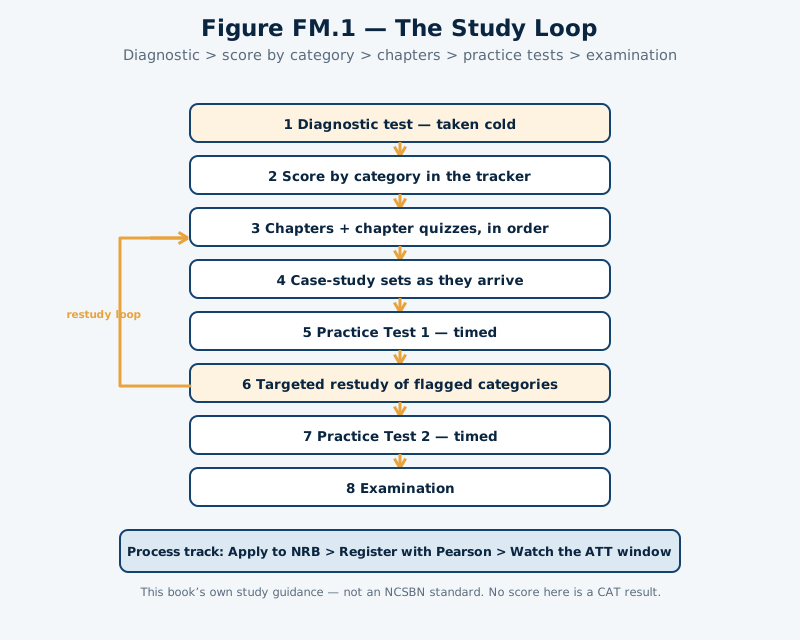
Diagnostic test (taken cold) → score by category in the tracker → chapters and chapter quizzes in order → case-study sets practiced as they arrive → Practice Test 1, timed → targeted restudy of the categories your profile flags → Practice Test 2, timed → examination. A process track (apply to your NRB → register with Pearson → watch the ATT window) runs beside the loop from the first week, because this credential's calendar is part of its difficulty. A caption rule printed under the loop reads: the routing rules in the tracker, the pacing figures, and the readiness guidance in this book are this book's own study guidance, not an NCSBN standard. The real examination's decision is made by CAT under NCSBN's published rules, taught in Chapter 30; no score in this book is a CAT result, a logit estimate, or a prediction of an examination outcome.
The diagnostic test stands in the front matter of the full book, immediately after this section, and both study plans begin with it. It contains 50 original items allocated across the eight Client Needs categories at the test plan's published midpoints as rounded — Management of Care 9 · Pharmacological and Parenteral Therapies 8 · Physiological Adaptation 7 · Safety and Infection Prevention and Control 6 · Reduction of Risk Potential 6 · Health Promotion and Maintenance 5 · Basic Care and Comfort 5 · Psychosocial Integrity 4 — with the rounding disclosed in the test's own notes. It contains two unfolding mini-case studies (twelve items) in place of twelve stand-alone slots; those case items are counted inside the category allocation, and the test's notes say so. Take the diagnostic cold, in no more than 60 minutes, before you study. Its job is to measure what is already in your head, in the examination's formats, before the chapters go to work. It is scored by category, not only in total: the Score-by-Category Tracker at the end of the diagnostic key converts each category result into a study priority and points to the exact chapters that teach that category. A repeat candidate may enter a CPR category profile in the same tracker instead.
The diagnostic is a measuring instrument, not a CAT replica, and it says so in its own notes. The tracker's priority bands are this book's own study guidance, not an NCSBN standard, and they are labeled that way in the tracker itself. No score on this 50-item diagnostic promises or predicts a result on the real examination in either direction. A low diagnostic score costs you nothing today and buys you an honest map; the same gaps discovered on examination day are the expensive version.
The back matter carries both plans day by day, referenced to chapters and tests. Each plan runs two tracks in parallel: the study track below, and a process track — NRB application, Pearson registration, ATT-window discipline — because a candidate whose ATT expires mid-plan has a calendar problem no amount of knowledge fixes.
The standard path (about four weeks). Diagnostic first, cold. Then the chapters in order — Part I without skipping, whatever your background — taking each chapter quiz before moving on and re-reading any section a missed question points back to. In the final week, take Practice Test 1 and Practice Test 2 on separate days, each in one timed sitting of 180 minutes — this book's own pace guidance, derived as arithmetic: the real examination allows 300 minutes for 85–150 items, and 180 minutes for 85 items trains about 2.1 minutes per item, inside the real envelope at minimum length. Review every missed item against the chapter it maps to, and re-read Chapter 30 in the last two days.
The intensive path (about two weeks). Diagnostic first, cold, and let it triage you. Experienced readers may move through Part I at double pace only where the diagnostic shows the foundations are already theirs; the saved time goes to the categories the diagnostic flags, to the case-study sets, and to calculation drills — dosage calculation is a named activity statement of the test plan, and calculation speed under pressure does not fix itself. Every chapter quiz for a flagged category is still taken. Finish with both practice tests, timed, on separate days.
In both paths, treat the practice tests as rehearsals of the whole event, not as question banks: one sitting, the full time, no pausing to look answers up — the discipline of answering every item and never going back is itself one of the skills being trained, because the real examination enforces it absolutely.
Front matter — this page; the Exam Format page; the jurisdiction note and the national process; How to Use This Book; the diagnostic test and the Score-by-Category Tracker. The free sample of this book is Chapter 1 plus the diagnostic test, so a buyer can judge the teaching and see their own score by category before paying.
Part I — Foundations (from zero)
Part II — The Client Needs core
Part III — Body systems integrated
Part IV — Advanced judgment and the exam layer
Back matter — two full timed practice tests (85 items each, 180 minutes each, sized to the real examination's published minimum-length composition, with full answer keys scored by the book's element scoring and reported by category); the 2-week intensive and 4-week standard study plans, each with its process track; cheat sheets (the category and percentages sheet; the numbers sheet, every testable figure with its source and, for the registration fee, its dates; the laboratory-values sheet, typical adult ranges with the vary-by-laboratory line; the conversion sheet); glossary; errata and updates page; References; and the printed outline crosswalk appendix — every 2026 test-plan category and activity-statement subject mapped to its home chapter — so you can verify for yourself that every part of the plan and every part of the field has a home chapter.
Every examination fact in this book traces to an NCSBN primary source named on the Exam Format page. Every clinical fact — every drug statement, laboratory range, threshold, and precaution assignment — is drawn under the book's clinical verification protocol from its named authoritative reference class: FDA-approved labeling for drug facts, CDC and HICPAC guidelines for infection prevention, the American Heart Association's guidelines for resuscitation priorities, the American Diabetes Association's Standards of Care for diabetes targets, CDC schedules and milestone materials for immunization and development, and a named standard laboratory reference for reference ranges. The source class is named where the fact is used, and the References list the editions this book was built against.
Facts that could not be verified from such a source are not printed as facts. You will therefore not find in this book: any nursing regulatory body's application requirement, licensure fee, background-check rule, endorsement rule, or retake limit printed as general fact (jurisdiction facts are yours to confirm with your NRB, full stop); any Nurse Licensure Compact member list or compact rule; any pass rate or candidate volume for the examination; any salary or employment figure; the current passing standard expressed as a number (the mechanism is taught whole on the Exam Format page and in Chapter 30; NCSBN's Passing Standard page is the home of the value); the fee for the Quick Results service (the Candidate Bulletin read for this edition states none); or any promise about passing, licensure, or employment.
Silence, in those places, is deliberate. A study book that guesses at numbers teaches you to guess — and guessing, on an examination built from client situations and calculations with exactly one defensible answer, is the habit this book exists to replace.
End of the free sample. The complete book continues from here — the full A-to-Z course in book form, delivered as an EPUB you can read in Apple Books, Google Play Books, ReadEra, Thorium Reader, Adobe Digital Editions, or Send to Kindle.
Buy this ebook — $11.99 Back to the book page
Payments are securely processed by Payhip.