
Mastering Careers & Skills
Commercial General Building Contractor Exam (NASCLA) · free sample from the book itself
What this chapter does. By the end of it you will be able to say, in plain words, what a commercial general contractor actually does all day, name every major person and company on a project and what each one is responsible for, and walk a commercial building through its whole life — from an idea in an owner's head to the day the owner moves in — naming what is decided, and what can still change, at each stage. No exam framing comes first. The exam comes later in this book, and it will make sense only after the work itself makes sense.
This chapter teaches in its own original words. Where an examination fact appears, its source is named on the spot. The examination this book prepares you for is the NASCLA Accredited Examination for Commercial General Building Contractors. (Source: NASCLA, Apply For NASCLA Exams page, as read October 29, 2026.)
Simplify. Imagine a town needs a new medical clinic. The clinic's owners know medicine. They do not know concrete, steel, wiring, or roofing, and they do not want to hire forty separate trade companies and try to coordinate them. So they hire one company — a general contractor, usually shortened to GC — and sign one contract that says, in effect: build this building, to these drawings, for this price, by this date. The GC then organizes everything that promise requires.
That is the whole job in one sentence. Everything else in this book is detail about how that promise is won, priced, organized, kept, and paid for.
Three words in that sentence carry the weight, so define them now:
Explain — why the GC exists at all. A building is not one job. It is fifty jobs that must happen in the right order, in the same space, without colliding: earth moved before foundations, foundations before steel, steel before deck, deck before roofing, walls closed only after the pipes and wires inside them are inspected. Someone must hold the whole sequence in one head, one schedule, and one bank account. That someone is the GC. The owner buys one accountable throat to choke, one phone number, and one contract — and pays for that accountability in the GC's price.
A homely example helps. Think of a wedding planner. The planner does not bake the cake, play the music, or arrange the flowers. The planner hires the baker, the band, and the florist, tells each when to arrive, makes sure the hall is ready for all of them, solves the problems when the cake van is late, and answers to the couple for the whole day. A GC is a wedding planner for a building — except the "day" lasts a year, the guests are inspectors, and a late cake can cost a fortune. Hold that picture. Every role in this chapter maps onto it.
Exam trap — "general" does not mean "does all the work itself." A GC may perform some work with its own employees — contractors call this self-performed work — but a GC that hires out most trades is still the general contractor, because generality describes responsibility for the whole, not the share of labor. Test items that describe a GC coordinating subcontractors are describing normal GC work, not a lesser kind of contractor.
Detail. Stand at the gate of a mid-size commercial job at 6:30 in the morning and watch what the GC's people do. The GC's field leader is the superintendent — the person who runs the job site day to day, directs the sequence of work, and is the GC's eyes and authority in the field. The superintendent walks the site before the crews arrive, checks what was finished yesterday against the plan for today, confirms which subcontractor crews are expected, and notes problems in the daily report — a dated written record of weather, workers on site by trade, work performed, deliveries, inspections, and delays. Chapter 10 teaches the daily report in full, because it later becomes evidence when money or time is disputed.
Back in the office trailer, the GC's project manager — the person who runs the job's paper, money, and communications from the office side — is answering a question the architect sent back, pricing a change the owner asked for, checking that a material delivery ordered six weeks ago is still on schedule, and preparing this month's request for payment. Notice the split, because it lasts the whole book:
On a small job one person may do both. On a large job there are several of each. The functions never disappear; only the headcount changes.
Across one ordinary week, a GC's work falls into five baskets. Learn these five, because the rest of the book is these five baskets opened up:
If you remember nothing else from this section, remember this: the GC carries the contract, the schedule, the money, and the risk. The owner has a contract with the GC — usually not with the trades. If the building is late, the owner looks to the GC. If a subcontractor is not paid, the subcontractor looks to the GC. If a wall is built wrong, the owner requires the GC to fix it, even if a subcontractor's hands built it. That concentration of responsibility is exactly what the owner is paying for, and it is why contracting is a risk business and not merely a building business.
Remember the number — there is no number yet, and that is the lesson. This chapter deliberately gives you no examination figures. A beginner who memorizes numbers before understanding the work owns trivia, not knowledge. The numbers — and there are many, each with its source named — arrive in the chapters that teach the work they belong to.
Show. Before the cast, see the place. A commercial job site is a temporary small town with one purpose, fenced off from the public, organized so that people, machines, and materials can move without wasting motion or endangering anyone.
Picture it from above. Around the whole site runs a site fence with a gate — the controlled entry where deliveries check in and the public is kept out. Just inside the gate stands the office trailer, the GC's field headquarters, where drawings, meetings, and paperwork live. Nearby is the laydown area — open ground, blocked and organized, where delivered materials wait until the building is ready to receive them; materials stored there sit on blocking, off the ground, so they stay dry and undamaged. At the center, the structure under construction rises floor by floor. Beside it, an excavation — a dug area where earthwork, foundations, or underground utilities are still in progress — is fenced or flagged off from general circulation. A tower crane stands over the structure, lifting loads from the laydown area and delivery trucks to the floors where they are needed. Marked worker circulation routes — the paths people walk — are kept separate from the routes trucks and equipment travel, because most site injuries happen where people and machines meet unexpectedly. Deliveries arrive at the gate in a planned order: a material delivery is not a surprise visit; it is scheduled, checked against its order, inspected, and directed to storage or directly to the work.
Figure 1.1 — A commercial jobsite from above.
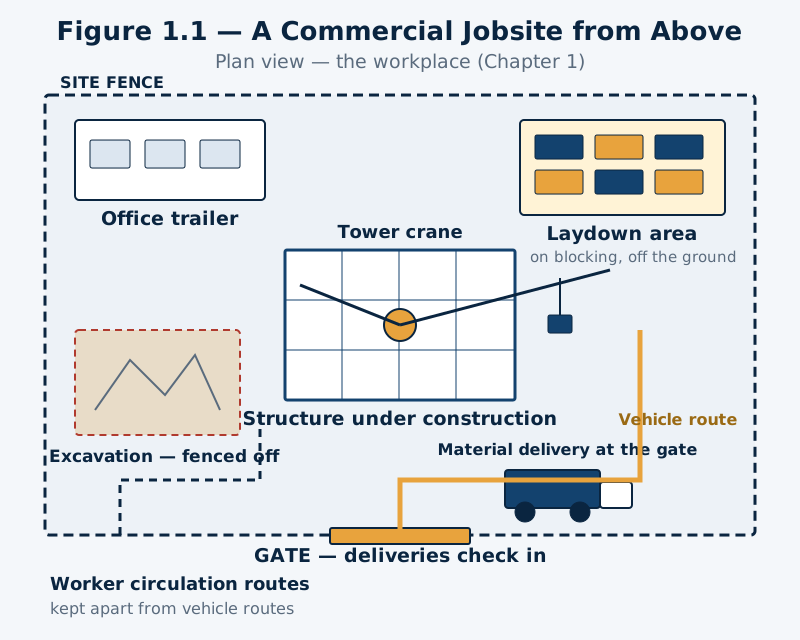
Study the labeled plan until you can point to each part — site fence and gate, office trailer, laydown area, tower crane, structure under construction, excavation, delivery point, and worker circulation routes — and say what happens in each place.
Every part named in that paragraph must appear, labeled, in the figure: site fence, gate, office trailer, laydown area, tower crane, structure under construction, excavation, material deliveries at the gate, and worker circulation routes kept apart from vehicle routes. If you can read that picture, you can follow every site chapter in this book — safety in Chapter 15, site construction in Chapter 17, and environmental controls in Chapter 16 all happen in these same labeled places.
Now look closer at the machine that dominates the picture. A crane is a machine that lifts and moves heavy loads through the air. Commercial work uses several kinds, and a beginner must be able to tell them apart on sight, because each is chosen for different work:
Figure 1.2 — Crane types side by side.
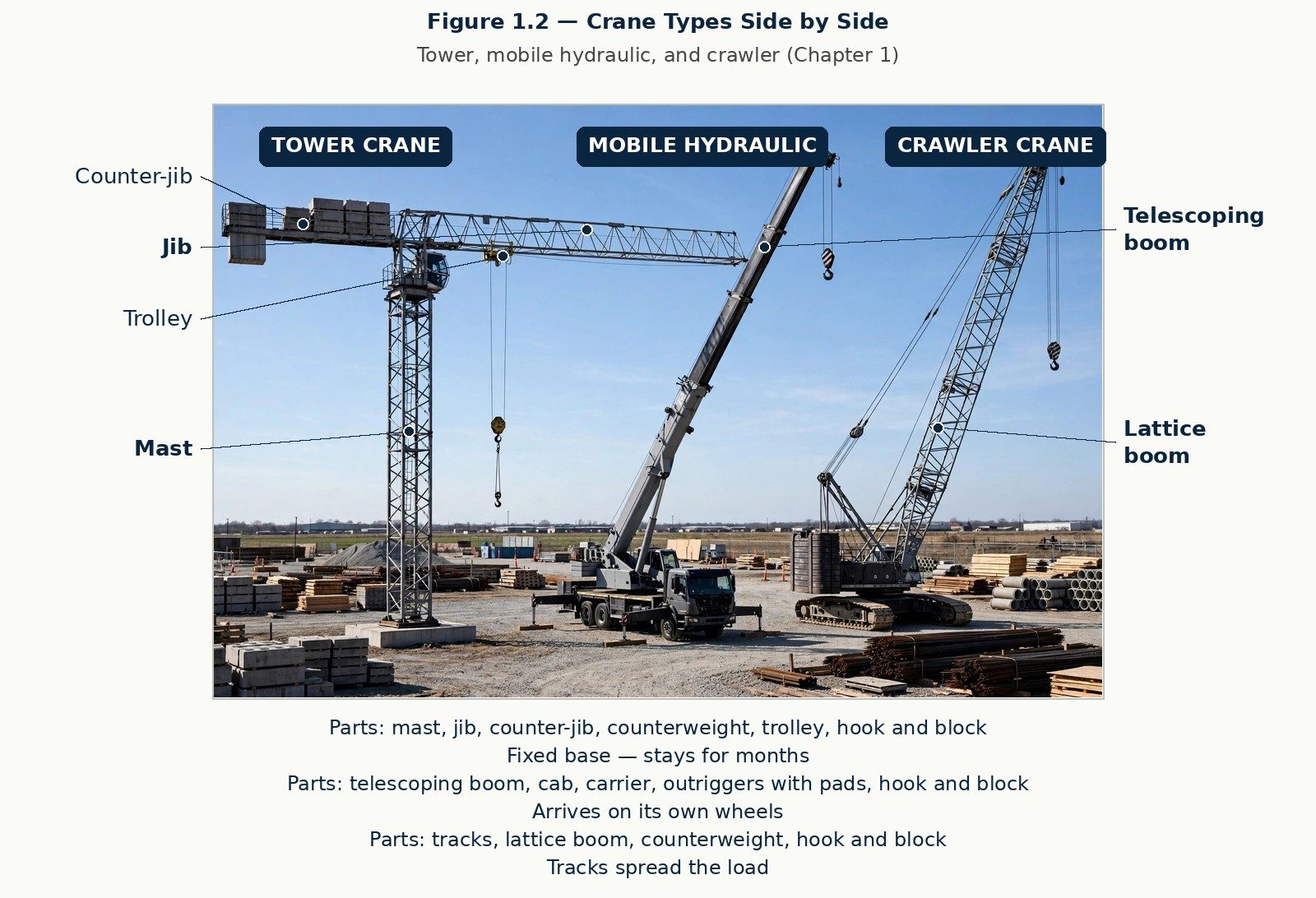
Compare the three cranes part by part — jib or boom, counterweight, hook and block, and, on the mobile crane, its outriggers — until you can name each crane type from its silhouette alone.
The figure must label, on the tower crane: mast, jib, counter-jib, counterweight, trolley, hook and block. On the mobile hydraulic crane: telescoping boom, cab, carrier, outriggers with pads, hook and block. On the crawler crane: tracks, lattice boom, counterweight, hook and block. Chapter 15 returns to cranes as a safety subject; here, simply learn to see them.
Honest limit — what a book cannot do (fence X6). This book teaches the knowledge, sequence, and inspection judgment the examination tests. It does not teach hands — placing concrete, laying masonry, or erecting steel as physical skills — and it does not certify that anyone can do them. That boundary is stated plainly here, at the start, on purpose.
Detail. A commercial project has a small cast with sharply different jobs. Confusing the roles is the beginner's most common error and the examination's favorite trap, so take them one at a time, each with its responsibility stated as a duty, not a job title.
The owner. The owner is the party who wants the building, pays for it, and will own or occupy it when it is done. The owner might be a hospital system, a school district, a developer, or a family business building a headquarters. The owner's duties: define what is needed, hire the design team and the contractor, make decisions when choices cost money or time, and pay as the contract requires. The owner does not direct the trades. An owner who starts giving instructions directly to a subcontractor's crew has stepped outside the structure this chapter is building — and Chapter 10 shows the confusion that follows.
The owner's representative. On larger projects the owner hires an owner's representative (owner's rep) — a person or firm that acts as the owner's eyes, attends meetings, reviews payment requests, and helps the owner make informed decisions. The rep advises and communicates; the rep does not replace the GC's responsibility to build, and does not replace the design team's responsibility to design.
The design team. Buildings must be designed before they can be built. The architect designs the building's form, spaces, appearance, and life-safety arrangement, and produces the architectural drawings. Engineers design the systems inside the architect's form: a structural engineer designs what holds the building up; mechanical, electrical, and plumbing engineers design the systems Chapter 24 introduces. Together they are the design team, and together they produce the two documents Chapter 2 teaches you to read: the drawings (also called plans) and the specifications. During construction the design team answers design questions, reviews certain submissions, and observes the work for conformance with the design — but the design team does not direct the GC's crews or means of building. How to build is the GC's province; what to build is the design team's.
The general contractor. You have met the GC. Add one refinement: the GC signs the prime contract — the main construction contract, between owner and GC — and is therefore often called the prime contractor. Everything the GC owes, it owes under that contract: the whole building, complete, conforming, on time.
Subcontractors. A subcontractor (sub) is a specialist company hired by the GC to perform one portion of the work — excavation, concrete, steel, roofing, electrical, plumbing, and dozens more. The sub has a contract with the GC, called a subcontract, not with the owner. That single fact decides who pays the sub (the GC), who directs the sub (the GC), and who the sub claims against when something goes wrong (the GC). Subs bring their own crews, supervision, tools, and trade knowledge. Much of a GC's skill is choosing subs well, coordinating them tightly, and paying them fairly and on time.
Suppliers. A supplier (also called a vendor or material supplier) sells materials or equipment to the job — concrete, steel, doors, air-handling units — without installing them. The legal instrument is usually a purchase order, a buyer's written order for described goods at an agreed price, rather than a subcontract. The distinction matters: a subcontractor furnishes labor and materials and installs work; a supplier furnishes goods. Some companies do both on different jobs, which is why the contract on this job, not the company's usual trade, decides its role.
The trades, briefly. Subcontractors arrive in an order the building imposes: excavators and utility contractors first; concrete and masonry contractors for foundations and structure; steel erectors; carpenters for framing and rough carpentry; roofers once the deck is ready; plumbers, HVAC (heating, ventilating, and air-conditioning) contractors, fire-protection contractors, and electricians for the systems; then drywall, flooring, painting, and finish trades; and finally specialists for items like elevators, casework, and landscaping. Chapter 2 will show you that this same order is written into the specification's divisions, and Part III of this book gives each major trade family its own chapter. For now, fix the principle: the building's physical order is also the cast's order of appearance, and a superintendent's core skill is having each trade arrive exactly when the building is ready for it — not a week early to stand idle, and not a day late to hold everyone else.
A construction manager — and how the GC differs. A construction manager (CM) is a firm the owner hires to manage the construction process on the owner's behalf — advising on cost and schedule, coordinating designers and contractors. In one common arrangement the CM is an adviser only and the owner still hires a GC to build. In another, called construction-manager-at-risk, the CM itself guarantees a price and holds the subcontracts, functioning much like a GC. For this book's foundations, hold the simple line: a GC holds the construction contract and the risk of building; an advisory CM serves the owner and does not. Later chapters refine the contract forms; the roles never blur into each other by accident.
Inspectors and the authority having jurisdiction. An inspector examines work for conformance — with the drawings, or with the code. Two kinds must never be confused. The GC's own quality checks are the GC's business (Chapter 10). Official inspections are performed for the authority having jurisdiction, abbreviated AHJ — the public body, such as a city or county building department, that has legal authority to enforce the building code in that place, issue permits, perform inspections, and approve work for occupancy. Chapter 2 introduces the AHJ with codes; Chapter 25 gives the AHJ its full treatment. The AHJ is not hired by the owner or the GC, does not work for either, and cannot be overruled by either. Its approval gates the project's legal progress.
The surety. A surety is a company that issues bonds — written guarantees, explored fully in Chapter 13 — promising, in defined circumstances, that the GC's obligations will be fulfilled even if the GC fails. Three bonds recur: a bid bond backs the GC's bid; a performance bond backs completion of the contract; a payment bond backs payment of subs and suppliers. For now, place the surety in the cast as the project's financial backstop: rarely seen on site, decisive the day something goes badly wrong.
The insurer. An insurer sells insurance — contracts that pay for defined losses, such as injuries, property damage, or damage to the building during construction. Chapter 13 separates the insurance families. In the cast list, the insurer's role is to absorb specified losses for a premium; the surety's role is different — a bond is a guarantee of performance, not a loss policy — and Chapter 13 makes that distinction carefully, because beginners and examination items both test it.
The lender. Many owners borrow to build. The lender — usually a bank — finances the project, releases money in stages as work is completed, and protects its loan by reviewing progress before each release. The lender is not a party to the construction contract, but its staged funding shapes the payment rhythm Chapter 11 teaches.
Figure 1.3 — Who contracts with whom.
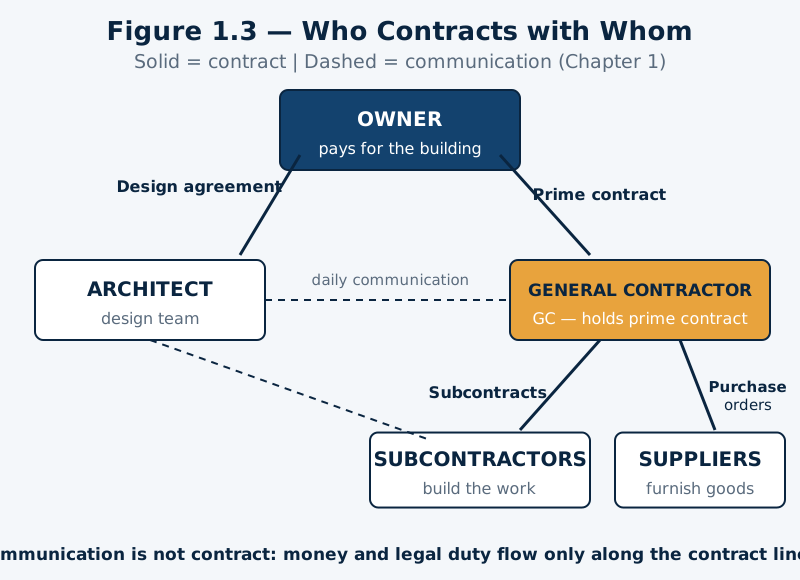
Trace each solid contract line — owner to architect, owner to GC, GC to subcontractors and suppliers — and compare it with the dashed communication lines, until you can explain why a subcontractor's contract runs to the GC and not to the owner.
The figure's contract lines must show exactly these relationships: owner ↔ architect/design team (design agreement), owner ↔ GC (prime contract), GC ↔ subcontractors (subcontracts), GC ↔ suppliers (purchase orders) — with communication lines, drawn differently, showing that all parties talk to each other daily without changing who contracts with whom. Communication is not contract. Everyone on a job talks to everyone; money and legal duty flow only along the contract lines. Half the disputes in Chapter 14 begin when someone mistakes a friendly conversation for a contract direction.
Do — a five-minute exercise. A clinic job has a leaking pipe joint installed by the plumbing sub, using pipe bought from a supplier, in a wall the architect designed. The owner is angry. Using only this section, answer: Whom does the owner hold responsible under the prime contract? Whom does that party, in turn, hold responsible for the installation? What is the supplier's role — and would your answer change if the pipe itself, not the installation, was defective? (Answers in your own words: the GC; the plumbing subcontractor; the supplier furnished goods only — but a defective product is the supplier's problem through the GC's purchase order, which is why the GC stands between the owner and both.)
Show. Now watch the whole story end to end, at walking pace. Later chapters will stop at each stage for chapters at a time. Here, simply learn the road.
Stage 1 — Idea and need. Every building starts as a problem: a clinic too small, a school too crowded, a warehouse in the wrong county. The owner defines the need, tests whether the project is feasible — Is there land? Money? Permission to build this kind of building here? — and assembles the team. What is decided: whether to build at all, roughly what, roughly where, and a first rough budget. What can still change: almost everything.
Stage 2 — Design. The design team turns the need into documents. Early sketches become developed designs; developed designs become the full construction documents — the drawings and specifications from which the building will be priced and built. The owner reviews at each step, because changes are cheapest on paper. What is decided: the building's form, systems, materials, and details. What can still change: anything, at paper prices — until the documents are issued for construction, after which change costs real money (see Stage 7).
Stage 3 — Permitting. Before construction, the design is submitted to the AHJ, which reviews it against the adopted building code and issues a building permit — official permission to build what was submitted. Chapter 2 explains codes and adoption; Chapter 25 explains permits. What is decided: that the design, on paper, satisfies the code as the AHJ reads it. A permit is not a guarantee the design is good, economical, or even buildable — it is a code approval. Beginners who treat a permit as a quality certificate have misunderstood it, and this book will not let that misunderstanding survive Chapter 25.
Stage 4 — Pricing, bid, and award. Contractors price the construction documents. In a bid process, qualified GCs submit prices and the owner awards the work — commonly, though not always, to the responsible low bidder. In a negotiated process, owner and GC agree a price through discussion. Either way, the stage ends in award: one GC is chosen and the prime contract is signed. What is decided: who builds, for what price, under what contract. Chapters 5 and 6 live here. Note the vocabulary: the GC's price, once accepted, becomes the contract sum — the amount the contract promises the GC for the work, before any later changes adjust it.
Stage 5 — Preconstruction. Between signing and digging, the GC plans in earnest: finalizes the schedule, buys out the work (subcontracts signed, long-lead materials ordered), plans site logistics — where the fence, trailer, crane, and laydown of Figure 1.1 will sit — and holds a preconstruction meeting where owner, design team, and GC align on procedures: how questions will be asked, how submissions will flow, how changes will be priced. What is decided: how the job will actually run. Skimped preconstruction is paid for, with interest, in Stage 6.
Stage 6 — Mobilization and construction. Mobilization is the act of setting up the site and moving people, equipment, and temporary facilities onto it — fence, trailer, temporary power and water, the works of Figure 1.1. Then construction proceeds in a physical order that cannot be wished away:
These overlap — systems work starts in one area while structure continues in another — which is precisely why coordination is a profession. Throughout, the AHJ inspects at defined points, and work that must be inspected is not covered up before inspection. What is decided during construction: less and less, at higher and higher prices. A change that cost a pencil line in Stage 2 may cost demolition in Stage 6. That rising price of change is the single most practical idea in this chapter.
Stage 7 — Changes along the way. No set of documents is perfect and no owner resists improving a building mid-flight, so change is a normal, governed process, not a failure. Three chapter-7 words belong in your vocabulary now, defined plainly here and in full later: a change order is a written, signed modification to the contract — scope, price, or time adjusted by agreement; a request for information (RFI) is a written question from the builder to the design team when the documents are unclear or conflict, answered in writing; a submittal is a document, sample, or shop drawing the GC sends to the design team for review before buying or fabricating something, to confirm it matches the design. Work performed on a verbal "go ahead" without a signed change order is the classic way contractors do work they never get paid for — Chapter 7 draws that danger branch in full.
Stage 8 — Closeout and turnover. As the building nears completion, the GC requests a determination of substantial completion — the stage at which the work is sufficiently complete that the owner can occupy and use it for its intended purpose, even though minor items remain. Those remaining minor items are collected on a punch list — a written list of incomplete or corrective items to be finished or fixed. The GC completes the punch list, delivers closeout documents — record drawings showing what was actually built, operating manuals, warranties, and training for the owner's staff — and the project reaches final completion and final payment. Turnover is the handover itself: keys, documents, knowledge, and the building pass from builder to owner. Chapter 26 teaches this stage whole. What is decided: that the promise of Stage 0 — the contract — has been kept.
Read the eight stages again and notice the shape: decisions get more expensive as the project advances, and paper gets more important, not less. Estimating errors are born in Stage 4, coordination errors in Stage 6, payment errors in Stage 8 — but nearly all of them were preventable in the stages before. That is why this book teaches in project order.
Detail. Chapter 2 continues this table; the glossary at the back of the book completes it. Each term below was defined where it first appeared above; this list fixes them in one place, as the series glossary discipline requires. Terms marked with an asterisk are priced or paid concepts whose full treatment is Chapter 11 — defined here so no later sentence uses them cold.
Do. Without looking back, write one sentence each using buyout, retainage, and punch list correctly about the clinic. If a sentence would still make sense with the word deleted, the word is decoration — rewrite until the term carries its meaning. Vocabulary in this trade is not ornament; each of these words moves money.
Show — one ordinary day, hour by hour. At 6:30 the superintendent opens the site, walks yesterday's work, and confirms today's crews. At 7:00 the trades start: concrete finishers in one area, electricians roughing in conduit in another — rough-in means installing the hidden systems inside walls and ceilings before those surfaces are closed. At 9:00 a delivery truck arrives at the gate; the superintendent checks the load against the purchase order — right material, right quantity, no visible damage — before signing, because signing accepts the delivery. At 10:00 an inspector from the AHJ arrives for a scheduled inspection of work that is about to be covered; if the inspection fails, the work waits, and the schedule absorbs the delay. At noon the project manager, in the trailer, prices a change the owner requested, using the same estimating discipline Chapter 5 teaches, and logs an RFI about a dimension that conflicts between two drawings. At 3:00 the weekly coordination meeting gathers the subcontractor foremen: next week's sequence is agreed out loud, conflicts between trades wanting the same space are resolved in the room rather than on the scaffold, and the agreements are written into minutes. At 5:00 the superintendent completes the daily report while the day is still memorable. Nothing in that day is glamorous. All of it is the job.
Explain — why coordination is a trade of its own. Notice what the day did not contain: the GC's own hands building very much. The product a GC sells is, in large part, coordination itself — the right trade, in the right place, with the right material, at the right time, in the right order. A trade crew standing idle because the area was not ready, the material was not there, or the inspection was not called is burning money by the hour, and the GC's price either prevents that waste or absorbs it. When owners ask what a GC's fee buys, the honest answer is in that paragraph: it buys a site where fifty specialists can each do their best work without tripping over the other forty-nine.
Detail — the bad day, and where the risk lives. Now the day everything tests. Rain floods an excavation. A key delivery is a week late. An inspector finds a defect in work already covered. A subcontractor with three areas of the building suddenly cannot meet payroll. Each event lands, contractually, on the GC first: the GC must re-sequence around the flood, expedite or replace the delivery, uncover and correct the work, and — if a sub truly fails — complete that sub's scope with someone else, at whatever the market then charges, while still owing the owner the original date. This is why Chapter 13's bonds and insurance exist, why Chapter 11's cash-flow discipline is survival rather than bookkeeping, and why experienced contractors price risk openly instead of pretending it away. A beginner who understands this paragraph understands why the examination — and this book — spend so much of their length on paper, money, and management rather than on the trades alone: the trades build the building, but management is what makes the building arrive.
Do. Take the bad-day paragraph and, for each of its four events, write which of the GC's five baskets (§1.2) absorbs it first. (Flood: build it — re-sequencing — with money close behind. Late delivery: buy it out — expediting — and build it. Covered defect: build it and carry the paper — the inspection and correction record. Failing sub: all five at once, which is why it is the feared one.) If you can do that mapping without hesitation, the five baskets have become a working tool, not a list.
Explain. You are likely reading because you intend to become licensed. Place the pieces honestly now; Chapter 4 teaches the route in full and Chapter 27 teaches the examination itself.
Passing the NASCLA accredited examination satisfies the trade-examination requirement in the participating agencies NASCLA lists — it is not a license in any state. Every state still requires its own license application and, in the pattern PSI states, a business and law examination and the state's other requirements. (Source: PSI Services LLC, Tennessee Board for Licensing Contractors Candidate Information Bulletin, NASCLA section, © 2026, Revised 4/15/2026; NASCLA, Apply For NASCLA Exams page, as read October 29, 2026.)
That fence — state law, state fees, state deadlines, and state application processes are your state board's subject, not this book's — is printed once here and obeyed everywhere in this book. What this book teaches whole is the national examination's knowledge and the shared business, law, and project-management core that state examinations also draw on. It never reproduces the NASCLA Contractors Guide to Business, Law and Project Management — the examination's published business reference, currently in its Basic 14th Edition — but teaches the same underlying knowledge from governing primary sources, in original words, so that a reader who owns the Guide learns to use it fluently in the open-book examination room, and a reader who does not still learns the knowledge whole. (Source: NASCLA Bookstore, NASCLA Contractors Guide to Business, Law and Project Management, Basic 14th Edition product page, as read October 29, 2026.)
Exam trap — passing is not licensure. Any sentence, advertisement, or study product that treats passing this examination as "getting your license" has skipped the state. This book never does. When you finish it, you will know the route cold — including exactly where the book's knowledge ends and your state board's requirements begin.
Numbers will fill later chapters, but one worked payment belongs here, because it makes four vocabulary words real at once. Suppose the clinic's contract sum is $2,000,000. In the first month the GC completes work worth $100,000, as measured against the contract's breakdown of values. The contract requires retainage of 10%.
Read the story inside the arithmetic. The GC earned $100,000 and received $90,000; the $10,000 difference is not lost — it is held as security and released under the contract's terms at completion — but the GC must still pay its subcontractors and suppliers for that month's work out of money actually received. Month after month, that gap between earned and received is one reason Chapter 11 treats cash flow as a survival discipline. The GC's monthly written request showing these figures is the pay application defined in §1.6; the owner's withheld share is the retainage; neither word should ever again be mere vocabulary to you — each is a line in a calculation you have now done yourself.
A second miniature fixes allowance and contingency, the pair beginners most often merge. The contract carries a $15,000 allowance for door hardware, because the owner has not yet chosen the hardware: that money is earmarked for a known item at an unknown final price, and the contract adjusts when the choice is priced. The owner's budget separately carries a contingency for unknown events — the buried rock nobody predicted, the redesign nobody wanted. Known item, unknown price: allowance. Unknown event: contingency. Items on examinations turn on exactly that distinction, and so, more expensively, do real budgets.
Fifteen items. Foundations quizzes are recognition-first — vocabulary, roles, and sequence — and close with scenario items in the book's voice. The answer key with full explanations is in the matching key file (ch-01-contracting-from-zero-key.md).
1-1. A general contractor's defining responsibility is best stated as: A. Performing most of the hands-on trade labor with its own employees B. Carrying the contract, the schedule, the money, and the risk for the whole building C. Designing the building and then supervising its construction D. Inspecting the work on behalf of the public code authority
1-2. On a commercial job, the superintendent's primary province is: A. The field — sequence, site coordination, and work as it is installed B. The prime contract's pricing and payment terms C. The design team's drawing production schedule D. The owner's financing and loan draws
1-3. A subcontractor's contract on a typical commercial project runs: A. Directly to the owner, who pays the subcontractor B. Directly to the architect, who directs the subcontractor C. To the authority having jurisdiction, which assigns the work D. To the general contractor, who directs and pays the subcontractor
1-4. The authority having jurisdiction (AHJ) is best described as: A. A consultant hired by the owner to check quality B. The GC's senior superintendent on a large project C. The public body with legal authority to enforce the code, issue permits, and inspect D. The lender's project reviewer
1-5. A company that sells concrete and reinforcing steel to the job but installs nothing is, on that job, a: A. Supplier, engaged by purchase order B. Subcontractor, engaged by subcontract C. Construction manager, engaged by the owner D. Surety, engaged by bond
1-6. "Buyout" means: A. The owner purchasing the completed building from the GC B. After award, hiring subcontractors and ordering materials so estimate lines become signed commitments C. The GC purchasing a competitor company D. The lender purchasing the construction loan from another bank
1-7. The correct order of a building's life is: A. Design → idea and need → permitting → award → construction B. Award → design → idea and need → permitting → construction C. Idea and need → design → permitting → pricing and award → preconstruction → construction → closeout and turnover D. Construction → design → permitting → award → closeout and turnover
1-8. Substantial completion is the stage at which: A. The contract is signed and construction may begin B. The punch list has been fully completed and final payment made C. Every item of work, however minor, is finished D. The work is sufficiently complete that the owner can occupy and use it for its intended purpose, though minor items remain
1-9. Retainage is: A. A fee the GC pays the architect for reviewing submittals B. A percentage of each payment withheld until completion as security the work will be finished and corrected C. The GC's profit margin stated as a percentage D. A deposit the owner pays the AHJ for inspections
1-10. A punch list is: A. A list of workers disciplined for safety violations B. A schedule of liquidated damages by day C. The written list of minor incomplete or corrective items remaining after substantial completion D. The list of bidders on a project
1-11. (Scenario.) Mid-project, the owner walks the site and tells the electrical subcontractor's foreman to move a panel location, and the foreman does so. The move later proves wrong. Under the contract structure taught in this chapter, the core problem with how the change was directed is that: A. The owner holds no contract with the subcontractor; direction flows owner → GC → subcontractor, and changes belong in the written change process B. The panel's new location was not inspected by the lender C. Owners may never visit a job site D. Electrical work may only be moved by the AHJ
1-12. (Scenario.) A GC wins a clinic job. Before any digging, it signs subcontracts, orders the long-lead air-handling unit, plans the fence, trailer, and crane positions, and meets the owner and architect to agree how questions and submissions will flow. This stage is: A. Closeout B. Substantial completion C. Mobilization of the punch list D. Preconstruction
1-13. (Scenario.) An owner asks why a design change that would have cost almost nothing two months ago now carries a large price. The best explanation, from this chapter, is that: A. Contractors raise prices on all changes as a matter of policy B. The AHJ adds a fee to every late change C. Decisions grow more expensive as a project advances — a paper change in design can require demolition and rework during construction D. Liquidated damages automatically attach to owner changes
1-14. (Scenario.) A pipe joint installed by the plumbing subcontractor leaks. The owner demands the GC fix it; the GC says the plumbing sub's hands installed it, so the owner should pursue the sub. Under the prime-contract structure, the owner's position is: A. Wrong — the owner must sue the supplier of the pipe B. Correct to reject — the GC owes the owner a conforming whole building under the prime contract, and the GC in turn holds its subcontractor responsible C. Wrong — only the AHJ can require correction of installed work D. Correct to accept — a GC is responsible only for work its own employees install
1-15. (Scenario.) A study product advertises: "Pass the NASCLA accredited examination and you are a licensed contractor in every participating state." The statement fails this book's fence because: A. Passing satisfies a trade-examination requirement; licensure still requires the state's own application, its business and law examination, and its other requirements B. The examination has no participating states C. The examination may only be taken by already-licensed contractors D. NASCLA, not the states, issues all contractor licenses
Copyright © 2026 Feras Alzubi. All rights reserved.
No part of this book may be reproduced, distributed, or transmitted in any form or by any means without the prior written permission of the copyright holder, except as permitted by law.
Originality statement. This is an original work, written for this book. Every practice question in this book is original. The questions were written fresh for this book, against the content areas and item counts PSI publishes for this examination in its Candidate Information Bulletin (NASCLA-accredited-examination section, PSI Services LLC, revised April 15, 2026), and the knowledge they test is taught in this book's own words from governing primary sources. They are not NASCLA's or PSI's questions, they are not copied or adapted from any other preparation book, course, or question bank, and no real examination item — actual, recalled, paraphrased, or otherwise — appears anywhere in this book.
Not-affiliated disclosure. This book is an independent study guide. It is not published by, affiliated with, endorsed by, or approved by the National Association of State Contractors Licensing Agencies (NASCLA) or PSI Services LLC, and neither NASCLA nor PSI Services LLC participated in its creation.
The author's name. The copyright holder's name appears on this page and in the store metadata, and nowhere else inside this book. The book stands on its sources, which are named wherever they are used and listed in full in the References.
This book is an independent study guide. It is not published by, affiliated with, endorsed by, or approved by the National Association of State Contractors Licensing Agencies (NASCLA) or PSI Services LLC, and neither NASCLA nor PSI Services LLC participated in its creation. Exam names and trademarks belong to their respective owners. Passing any exam also depends on the candidate's own preparation; no book can guarantee a result.
Three consequences of those sentences are stated here at the front, not buried at the back.
First, this book does not promise that you will pass, earn a license, get work, or earn any particular income. It teaches the whole field of commercial contracting from the beginning, teaches the whole published examination outline at depth, and drills you with original practice questions whose answers are explained in full. That is what a study book can honestly do, and it is what this one does.
Second, passing this examination is not a license. Passing the NASCLA Accredited Examination for Commercial General Building Contractors satisfies the trade-examination requirement in the participating agencies NASCLA lists. Every state still requires its own license application and, in the pattern PSI's own text states, a business and law examination and the state's other requirements. (Sources: PSI Services LLC, Candidate Information Bulletin, NASCLA-accredited-examination section, revised April 15, 2026; NASCLA, Apply For NASCLA Exams page, read October 29, 2026.) Chapter 4 teaches that road whole, and Chapter 27 walks it again at the point of decision.
Third, this book teaches the national examination and the shared business, law, and project-management core — the knowledge state business-and-law examinations draw on. It does not teach any state's own law, fees, deadlines, or application process, because those are set by each state and differ by state. Where a state fact would normally stand in this book, you will find a fence instead: a plain statement that the fact is your state board's, and where to get it. A national book that printed one state's deadlines as general fact would be wrong everywhere else.
Provenance note. Every practice question in this book is original. The questions were written fresh for this book, against the content areas and item counts PSI publishes for this examination in its Candidate Information Bulletin (NASCLA-accredited-examination section, PSI Services LLC, revised April 15, 2026), and the knowledge they test is taught in this book's own words from governing primary sources — the OSHA construction regulation, IRS publications, and EPA's Construction General Permit framework among them. The questions are not NASCLA's or PSI's questions, they are not copied or adapted from any other preparation book, course, or question bank, and no real examination item — recalled, paraphrased, or otherwise — appears anywhere in this book. This book also never reproduces the text of the NASCLA Contractors Guide to Business, Law and Project Management or of any other reference on the examination's allowed list: it teaches the same underlying knowledge in original words, and teaches you to use those references in the open-book room. Where a question turns on an examination fact or a formula, its explanation names the source that fact or formula comes from.
A note on the marks. "NASCLA" and the examination name are used in this book nominatively only — to name the examination and the association that owns it. This book never claims NASCLA or PSI endorsement, accreditation, or approval.
Everything on this page was checked against NASCLA and PSI primary sources on October 29, 2026. Each figure carries its source on the page, in the way the whole book carries its sources. Where a figure could not be verified from such a source, this page prints no figure at all — and says so, because the silence is itself information.
The examination and its owner. The NASCLA Accredited Examination for Commercial General Building Contractors is owned by the National Association of State Contractors Licensing Agencies (NASCLA) and delivered by PSI Services LLC (PSI). It is one of four classifications in the NASCLA Accredited Examination Program; the electrical classifications (Master/Unlimited, Journeyman, and Residential Electrical) are different examinations and are not this book. (Sources: NASCLA, Apply For NASCLA Exams, read October 29, 2026; PSI Services LLC, Tennessee Board for Licensing Contractors Candidate Information Bulletin, NASCLA-accredited-examination section, © 2026, revised April 15, 2026.)
Items and time. The examination has 115 questions, and you have 330 minutes (5½ hours) in a single sitting as published. The bulletin states no section split, break rule, or no-return rule for this examination, and this book invents none. Simple arithmetic on those two published figures — this book's own arithmetic, not a PSI rule — gives about 2.8 minutes per item on average, and Chapter 27 builds the open-book time budget on it. (Source: PSI, Candidate Information Bulletin, NASCLA section, revised April 15, 2026; corroborated in PSI, South Carolina Contractor's Licensing Board Candidate Information Bulletin, updated September 15, 2026.)
Passing standard — published, so printed. You will need to answer 81 questions correctly of 115 — 70% — in order to pass. Unlike some examinations in this series, this passing standard is published by the test administrator, so this book prints it, with its citation, and its own full practice tests use the same line, labeled as the published standard. (Source: PSI, Candidate Information Bulletin, NASCLA section, revised April 15, 2026.)
Open book — the rule that shapes how you study. This examination is open book. Only the references on PSI's allowed list may be brought. References may be highlighted, underlined, and/or indexed before the session; they may not be written in; no additional papers, loose or attached, are allowed; permanent tabs only — temporary tabs such as sticky notes are not allowed and must be removed before the exam begins. Candidates bring their own references. Scratch paper is provided for calculations. A silent, nonprinting, non-programmable calculator is permitted. (Source: PSI, Candidate Information Bulletin, NASCLA section, revised April 15, 2026.) Read that paragraph twice. It means the examination tests lookup fluency under time pressure as much as it tests memory, and this book is built around that fact: Chapter 27 teaches the open-book method, and both study plans carry a reference-preparation track alongside the reading track.
The allowed references, in families. PSI's allowed list for this examination runs to roughly two dozen references, including: the International Building Code, 2021 or 2024; the ICC A117.1-2017 accessibility standard; ACI 318-14 or ACI 318-19 (2022) for structural concrete; ACI-530 masonry references and masonry trade texts; Code of Federal Regulations — 29 CFR Part 1926 (OSHA), with latest amendments, or PSI's OSHA excerpts; the NASCLA Contractors Guide to Business, Law and Project Management, Basic 14th Edition; Construction Project Management (Gould & Joyce, 4th or 5th edition); Construction Jobsite Management (Mincks & Johnston, 4th or 5th edition); Principles and Practices of Commercial Construction (11th edition, 2024); Carpentry and Building Construction (2016); Modern Masonry (9th edition, 2020); Pipe and Excavation Contracting (2011); Roofing Construction and Estimating; the Gypsum Construction Handbook (7th edition); and steel-joist, steel-deck, precast-erection, post-tensioning, reinforcing-bar, truss (BCSI), green-building, and EPA stormwater (SWPPP) references. Editions rotate: match every edition against the bulletin in force on your test date before you rely on it. (Source: PSI, Candidate Information Bulletin, NASCLA section reference list, as read October 29, 2026.)
Content areas and their published counts. PSI publishes the weight of each area as an item count. These twelve counts are the skeleton of this book — the diagnostic and both practice tests are allocated from them exactly. (Source: PSI, Candidate Information Bulletin, NASCLA section content outline, revised April 15, 2026.)
| Content area | Items on the real examination |
|---|---|
| Procurement and Contracting Requirements | 31 |
| General Requirements | 25 |
| Site Construction | 15 |
| Concrete | 6 |
| Masonry | 4 |
| Metals | 6 |
| Wood | 5 |
| Thermal and Moisture Protection | 5 |
| Doors, Windows, and Glazing | 4 |
| Finishes | 5 |
| Mechanical and Plumbing Systems | 6 |
| Electrical Systems | 3 |
| Total | 115 |
The two largest areas — Procurement and Contracting Requirements (31) and General Requirements (25) — are 56 of the 115 items, just under half the examination. Safety is not a separate area in the published outline: OSHA content is examined inside the areas above, heaviest in General Requirements and Site Construction and inside each trade area. This book therefore teaches safety as its own full chapter (Chapter 15) and cross-references the governing rule inside every trade chapter — a design decision of this book, printed as such.
Experimental items — stated honestly. PSI's bulletins state generally that, in addition to the stated question count, a small number of experimental items — generally approximately 10% of the number of questions — may be administered, are not scored, and count against examination time; candidates cannot identify them. That is a general PSI bulletin statement. The NASCLA section itself states its 115 questions without an experimental-item note of its own, so this book prints no NASCLA-specific pretest count — no "115 plus 10" figure appears anywhere in it. (Source: PSI, South Carolina Contractor's Licensing Board Candidate Information Bulletin, "Experimental Questions" section, updated September 15, 2026.)
Applying through NASCLA. You apply at NASCLA's National Examination Database, ned.nascla.org, with a $65 application fee — NASCLA's own figure, on NASCLA's own page. Applications are typically processed within 7 business days. An approved application is good for 1 year from approval, with up to 3 chances to take and pass in that year. A candidate who uses all 3 attempts or lets the year expire reapplies as a "Re-Applicant" with the same NASCLA Candidate ID and cannot be approved until after the eligibility year has expired. NASCLA's application page states no education or experience prerequisite for applying to sit the accredited examination itself; experience, financial, insurance, and bonding requirements exist, but they are imposed by state licensing boards at licensure, not by NASCLA at examination application. (Source: NASCLA, Apply For NASCLA Exams, read October 29, 2026.)
Scheduling. After approval, you receive an email from PSI ([email protected]) with your candidate ID and the PSI scheduling link, and you schedule through PSI's test-taker site. The examination may be taken at any PSI location that offers it; you do not need to reside in the state where you seek licensure. (Source: NASCLA, Apply For NASCLA Exams, read October 29, 2026.)
The examination fee — fenced, on purpose. The $65 above is the NASCLA application fee only. The separate PSI examination fee is set in your state's candidate bulletin and varies by state — PSI's own bulletins price this same examination differently in different states — so this national book prints no PSI examination fee figure. Find the fee in the fee table of your own state board's current PSI candidate bulletin before you budget or schedule. Any single PSI fee figure printed without a state attached would be wrong somewhere, and this book does not print it.
After passing — score and transcripts. You receive a pass score report at the PSI facility; per NASCLA, that PSI pass report is the only paper proof of passing, and no numerical score or content breakdown is given once the exam is passed. Results are linked to your National Examination Database account (allow up to 72 hours after PSI's upload time). Transcripts are purchased in the database per state agency, $45 each, valid for two (2) years, and are delivered electronically to agencies only — you do not receive your own transcript copy. (Source: NASCLA, Apply For NASCLA Exams, "Passing the Exam" and "Transcripts" sections, read October 29, 2026.)
Participating agencies — printed exactly as NASCLA characterizes them. NASCLA's own page, headed "All states listed below will accept the NASCLA Accredited Examination For Commercial General Building Contractors" — with administering agencies, which offer the choice of the state trade exam or the NASCLA exam, distinguished on the page — lists these 20 agencies: Alabama Home Builders Licensure Board; Alabama Licensing Board for General Contractors; Arizona Registrar of Contractors; Arkansas Contractors Licensing Board; California Contractors State License Board; Florida Construction Industry Licensing Board; Georgia State Licensing Board for Residential and General Contractors; Louisiana State Licensing Board for Contractors; Mississippi State Board of Contractors; Nevada State Contractors Board; New Mexico Construction Industries Division; North Carolina Licensing Board for General Contractors; Oregon Construction Contractors Board; South Carolina Contractors' Licensing Board; South Carolina Residential Builders Commission; Tennessee Board for Licensing Contractors; Utah Division of Occupational & Professional Licensing, Construction Trades Bureau; Virgin Islands Department of Licensing & Consumer Affairs; Virginia Board for Contractors; West Virginia Contractors Licensing Board, Division of Labor. (Source: NASCLA, NASCLA Commercial Exam | Participating State Agencies, read in full October 29, 2026.) This book prints that characterization and no stronger one. Agencies join and conditions change, and two states appear twice because two of their agencies participate — so confirm your classification, the conditions, and the currency of acceptance with your own state board before you rely on the list. Acceptance of the examination is a fact about the examination; it is not a promise of a license, of work, or of income.
The Guide. The NASCLA Contractors Guide to Business, Law and Project Management, Basic 14th Edition (ISBN 978-1-948558-39-6), is listed by NASCLA among the books used for this very examination and appears on PSI's allowed-reference list for it. NASCLA's published description organizes the Guide into three parts: Part 1 — business planning and start-up; Part 2 — operating fundamentals (estimating, contract management, scheduling, project management, safety and environmental responsibilities, relationships with employees, subcontractors, and customers); Part 3 — administrative functions (financial management, tax basics, lien laws). This book teaches that same body of knowledge from governing primary sources in its own words; it does not reproduce the Guide, and no chapter list of the Guide is printed in this book, because only the three-part description above was read from a NASCLA primary source for this edition. (Sources: NASCLA Bookstore, Basic 14th Edition product page, read October 29, 2026; PSI, Candidate Information Bulletin, NASCLA section allowed-reference list.)
Conduct. NASCLA publishes a cheating policy for its Accredited Examination Program: scores invalidated, fees forfeited, a 12-month bar on reapplying, and possible legal action. (Source: NASCLA, Apply For NASCLA Exams, "Cheating Policy," read October 29, 2026.) Chapter 27 covers it as exam-day conduct, in one short passage.
What success on paper looks like. Pass at 81 of 115, receive the pass report, buy a $45 transcript for each agency you will apply to, then complete that state's own application and business-and-law requirements. The examination is the middle of the road to a license, not the end of it — Figure 4.1 in Chapter 4 draws the whole road.
Remember the numbers — with their sources. 115 items. 330 minutes. 81 of 115 (70%) to pass. 12 content areas, 31 and 25 the two largest. $65 NASCLA application fee. About 7 business days to process. 1 year, up to 3 attempts. Transcripts $45 each, valid 2 years. Every one of those figures traces to the NASCLA and PSI sources named on this page, checked October 29, 2026. Two figures are missing on purpose: the PSI examination fee (it varies by state — your state bulletin is its home) and any pass rate (neither NASCLA nor PSI publishes one in any primary source read for this edition, so no percentage in circulation is printed here).
This book serves two readers at the same time, and both of them may be you.
If you are a total beginner, you have never run a contracting business and may never have stood on a commercial job site. That is expected, and the book is ordered for you. Part I (Chapters 1–4) teaches the foundations from zero: what a general contractor actually does all day, how a building gets built and who the people on it are, how to read plans, specifications, and codes, how a company is started and structured, and what a license is — including what this examination does and does not do. Every term is defined the first time it is used. Do not skip Part I to "get to the exam material." The later chapters assume exactly what Part I teaches, and the examination's job-situation questions assume it too.
If you are an experienced contractor preparing for the credential, Part I will move faster for you. Use it as a precision check: the examination uses the trade's words — submittal, retainage, substantial completion, competent person — in their precise senses, which are sometimes narrower than job-site usage. Parts II and III build the working knowledge on top of the foundations — the business of winning, papering, running, and counting the work, then safety, the site, and the building itself — and Part IV builds the judgment layer and the examination craft.
Every review chapter follows the same rhythm:
Two things about the quizzes deserve emphasis. First, a wrong answer in this book is never random: each distractor is a named, common error — a neighboring concept confused with the one tested, a step taken out of order, a markup computed where a margin was asked. Reading the key teaches even when you answered correctly. Second, nothing is tested before the chapter that teaches it has taught it at working depth: foundations quizzes test recognition and first use, and trade-chapter quizzes test judgment inside job situations.
This examination's open-book rule (see the Exam Blueprint page) changes how you prepare, and this book is organized around it.
Figure FM.1 — The study loop.
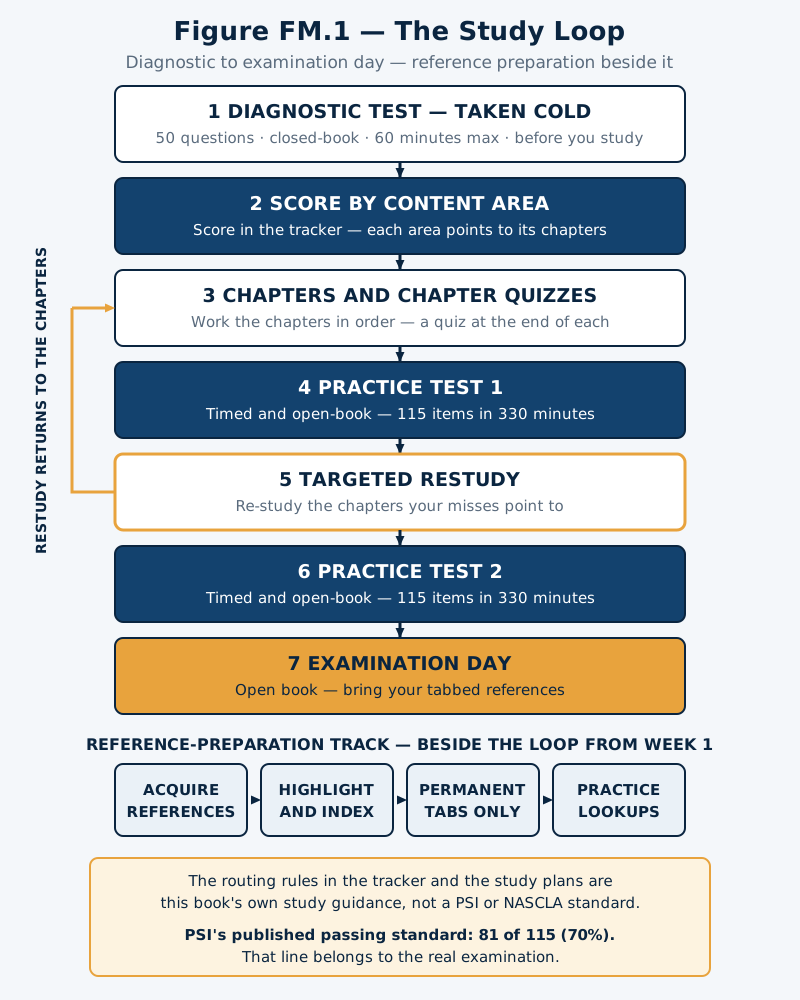
Diagnostic test (taken cold) → score by content area in the tracker → chapters and chapter quizzes in order → Practice Test 1, timed and open-book → targeted restudy of the chapters your misses point to → Practice Test 2, timed and open-book → examination day. A reference-preparation track (acquire → highlight and index → permanent tabs → practice lookups) runs beside the loop from the first week. A caption rule printed under the loop reads: the routing rules in the tracker and the study plans are this book's own study guidance, not a PSI or NASCLA standard. PSI's published passing standard for the real examination is 81 of 115 (70%).
The diagnostic test stands in the front matter of the full book, immediately after this section, and both study plans begin with it. It contains 50 original questions allocated across PSI's 12 published content areas in proportion to their counts on the real examination — Procurement and Contracting Requirements 13, General Requirements 11, Site Construction 6, and the remaining areas in proportion — with one rounding disclosed in the test's own notes (Site Construction's exact share is 6.5 items, rounded down to 6 to hold the total at 50). Take it cold, closed-book, in no more than 60 minutes, before you study — the one closed-book sitting in this book, because its job is to measure what is already in your head before the references and the chapters go to work. It is scored by content area, not only in total: the Score-by-Area Tracker at the end of the diagnostic key converts each area result into a study priority and points to the exact chapters that teach that area.
The tracker's priority bands are this book's own study guidance, not a PSI or NASCLA standard, and they are labeled that way in the tracker itself. PSI's published passing standard — 81 of 115, 70% — belongs to the full examination; no score on this 50-item diagnostic is that line, and no diagnostic score promises or predicts an examination result in either direction. A low diagnostic score costs you nothing today and buys you an honest map. The same gaps discovered on examination day are the expensive version.
The back matter carries both plans day by day, referenced to chapters and tests, and each carries the reference-preparation track beside the reading track.
The standard plan (about four weeks). Diagnostic first, cold. Then the chapters in order — Part I without skipping, whatever your background — taking each chapter quiz before moving on and re-reading any section a missed question points back to. Prepare your references a family at a time as the chapters that use them arrive. In the final week, take Practice Test 1 and Practice Test 2 on separate days, under real conditions (115 items, 330 minutes, open-book with your tabbed references, the permitted calculator, and scratch paper), review every missed item against the chapter it maps to, and re-read Chapter 27 the day before you test.
The intensive plan (about two weeks). Diagnostic first, cold, and let it triage you. Experienced readers may move through Part I at double pace only where the diagnostic shows the foundations are already theirs; the saved time goes to the chapters the diagnostic flags. Every chapter quiz is still taken — the quizzes are where wrong understandings surface while they are still cheap to fix. Compress the reference preparation into the first week: a tabbed, indexed book set is not optional equipment for this examination. Finish with both practice tests, timed and open-book, on separate days.
In both plans, treat the practice tests as rehearsals of the whole event, not as question banks: same timing, same open-book conditions, same two-pass discipline.
Front matter — this page; the Exam Blueprint page; How to Use This Book; the diagnostic test and the Score-by-Area Tracker. The free sample of this book is Chapter 1 plus the diagnostic test, so a buyer can judge the teaching and see their own score by content area before paying.
Part I — Foundations (from zero)
Part II — Core knowledge I: win the work, paper the work, run the work, count the money
Part III — Core knowledge II: safety, site, and the building
Part IV — Advanced material and the exam layer
Back matter — two full timed practice tests (115 items each, 330 minutes, open-book, with full answer keys); the 2-week intensive and 4-week standard study plans, each with its reference-preparation track; cheat sheets (content-area counts sheet; formulas sheet, each formula with a worked mini-example; numbers sheet, every testable figure with its source and, for tax figures, its year; open-book room-rules sheet); glossary; errata and updates page; References; and the printed outline crosswalk appendix, so you can verify for yourself that every PSI content area and every part of the shared business-and-law core has a home chapter.
Every examination fact, fee, deadline, and count in this book traces to a NASCLA or PSI primary source — or, for the knowledge the examination tests, to the governing primary source itself: the OSHA construction regulation (29 CFR Part 1926), IRS publications, and EPA's Construction General Permit framework. The source is named where the fact is used. Facts that could not be verified from such a source are not printed as facts. You will therefore not find in this book: a PSI examination fee figure (it is set by state and varies — your state board's current PSI bulletin is its home); a pass rate or candidate volume (neither NASCLA nor PSI publishes one in any primary source read for this edition); any state's lien deadlines, notice forms, licensing thresholds, fees, or application steps (state law, fenced throughout — the general principles are taught whole, and the fence is printed at the rule itself); a current tax rate, wage base, or threshold printed as permanent fact (federal tax structure is taught whole, and any figure that can change by year is dated at the point of use or supplied inside the question that tests the method); the text of the NASCLA Contractors Guide, the building code, or any other allowed reference (copyrighted works, taught here in original words and used in the room in your own copies); a chapter list of the Guide (only NASCLA's published three-part description was read from a NASCLA source); salary figures or earnings claims of any kind; or any promise about licenses, jobs, or income.
Silence, in those places, is deliberate. A study book that guesses at numbers teaches you to guess — and guessing, on an examination built from job situations with exactly one defensible answer, is the habit this book exists to replace.
End of the free sample. The complete book continues from here — the full A-to-Z course in book form, delivered as an EPUB you can read in Apple Books, Google Play Books, ReadEra, Thorium Reader, Adobe Digital Editions, or Send to Kindle.
Buy this ebook — $11.99 Back to the book page
Payments are securely processed by Payhip.