
Mastering Careers & Skills
Pharmacist Licensure Examination (NAPLEX) · free sample from the book itself
Q1 — Key: B. Tag: D3A. Rationale: Person-Centered Assessment and Treatment Planning (Domain 3) carries 40% of the 200 scored questions, the largest share in the outline. (Source: NABP, NAPLEX Content Outline, effective May 1, 2025.) Wrong A: Foundational Knowledge carries 25%, not the largest share. Wrong C: The Medication Use Process also carries 25%. Wrong D: Professional Practice carries only 5%.
Q2 — Key: D. Tag: D1A1. Rationale: Results are reported as Pass or Fail only; no scaled score is reported to the candidate, although the passing standard is a scaled score of 75 on the 0–150 scale. (Source: NABP, Candidate Application Bulletin.) Wrong A: The candidate receives no scaled score, and 75 is a scaled standard, not 75 percent correct. Wrong B: The scale runs 0–150, not 225, and no score is reported. Wrong C: No count of correct answers is published or reported.
Q3 — Key: A. Tag: D1A1. Rationale: Of 225 questions, 200 are scored and 25 are unscored pretest questions. (Source: NABP, Candidate Application Bulletin.) Wrong B: 225 is the total number of questions, including the unscored pretest items. Wrong C: 175 understates the scored count by 25. Wrong D: 150 is the top of the scaled-score scale, not a question count.
Q4 — Key: C. Tag: D2A1. Rationale: Questions are answered in order and the examination does not permit a return to previous questions, for any item type. (Source: NABP, Candidate Application Bulletin.) Wrong A: No skipping allowance exists. Wrong B: There is no flag-and-review function. Wrong D: The no-return rule applies to all items, not only constructed response items.
Q5 — Key: B. Tag: D5A. Rationale: The eligibility application fee is $100 and the examination purchase fee is $520; $100 + $520 = $620 per attempt in NABP fees. (Source: NABP, Candidate Application Bulletin, fee schedule.) Wrong A: $520 is the examination purchase fee alone. Wrong C: $100 is the eligibility application fee alone. Wrong D: $705 adds the $85 eligibility-processing fee, which applies only in the jurisdictions where NABP confirms eligibility and is not part of the standard per-attempt total.
Q6 — Key: A. Tag: D2A1. Rationale: Licensure is granted by the board of pharmacy of the jurisdiction of licensure; NABP develops and administers the examination boards use, but does not license. Wrong B: NABP administers the examination and confirms eligibility for some jurisdictions; it grants no license. Wrong C: A college confers the degree, not the license. Wrong D: The test center only delivers the examination.
Q7 — Key: D. Tag: D2A1. Rationale: A retake requires at least a 45-day wait (a jurisdiction may require longer), no more than three attempts in any 12-month period, and no more than five attempts in total unless a board decides otherwise; each retake restarts eligibility and both fees. (Source: NABP, Candidate Application Bulletin.) Wrong A: A minimum 45-day wait applies. Wrong B: Attempts are capped at three in 12 months and five in total. Wrong C: Both fees are repaid and eligibility restarts on every retake.
Q8 — Key: C. Tag: D5A. Rationale: Final verification, including the clinical judgment that a therapy is appropriate for the patient, is a pharmacist's non-delegable responsibility; technicians work under pharmacist supervision on preparation and workflow tasks. Wrong A: Counting and preparing a container for verification is a standard technician task. Wrong B: Order entry is a technician task performed under supervision. Wrong D: Insurance processing is an administrative technician task.
Q9 — Key: A. Tag: D3A. Rationale: Checking a dose against an individual patient's kidney function before dispensing is evaluation of therapy for that patient — the person-centered assessment work at the center of the pharmacist's cycle. Wrong B: No inventory decision is involved. Wrong C: Eligibility concerns licensure, not a patient's prescription. Wrong D: Formulary design is a population-level managed care activity, not a check on one patient's order.
Q10 — Key: B. Tag: D5A. Rationale: Evaluating evidence to decide which medicines a plan covers is formulary work within managed care pharmacy, practiced at population level through a pharmacy benefit manager or health plan. Wrong A: Community practice centers on dispensing and direct patient services at a public pharmacy. Wrong C: Hospital practice centers on admitted patients and the care team. Wrong D: Ambulatory care involves scheduled direct care of a patient panel in a clinic.
Q11 — Key: D. Tag: D4D. Rationale: The NAPLEX is one component of licensure; boards commonly also require a pharmacy law examination such as the MPJE, because law varies by jurisdiction. (Source: NABP, NAPLEX program page.) Wrong A: The NAPLEX tests the federal framework, not each jurisdiction's law in full. Wrong B: A separate law examination is commonly required. Wrong C: This book does not prepare the reader for the MPJE and states that boundary plainly.
Q12 — Key: C. Tag: D3A. Rationale: Scheduled clinic care of a continuing patient panel, with therapy adjustment under a collaborative practice agreement, defines ambulatory care practice. Wrong A: Industry medical affairs does not involve scheduled direct patient care. Wrong B: Long-term care consulting reviews regimens in a facility; it is not clinic panel care under a collaborative agreement. Wrong D: Centralized hospital dispensing verifies and prepares orders for inpatients and involves no clinic panel.
Q13 — Key: A. Tag: D3A. Rationale: Domain 3 carries 40% of 200 scored questions: 200 × 0.40 = 80 questions. (Source: NABP, NAPLEX Content Outline, effective May 1, 2025.) Wrong B: About 50 is the count for each 25% domain (Domains 1 and 2). Wrong C: About 10 is the count for each 5% domain (Domains 4 and 5). Wrong D: 100 would be 50% of the scored examination, a weight no domain carries.
Q14 — Key: D. Tag: D5A. Rationale: Wisconsin is one of the fifteen jurisdictions for which NABP confirms eligibility, with an additional $85 eligibility-processing fee. (Source: NABP, NAPLEX program page, "Eligibility to Test.") Wrong A: NABP does confirm eligibility for Wisconsin. Wrong B: The $85 fee is additional; the $520 examination purchase fee still applies. Wrong C: Score transfer is purchased after the examination, up to 89 days after the exam date.
Q15 — Key: B. Tag: D1A1. Rationale: Domain 5, Pharmacy Management and Leadership, covers operations, inventory and supply, quality improvement, and mentorship and preceptorship. (Source: NABP, NAPLEX Content Outline, effective May 1, 2025.) Wrong A: Inventory and preceptorship belong to Domain 5, not Domain 4. Wrong C: Reporting and ethics belong to Domain 4, not Domain 2. Wrong D: Histories and reconciliation belong to Domain 3, and Domain 1 covers far more than that single topic.
Purpose. This chapter orients you to the profession you are preparing to enter: what pharmacists actually do each day, where they do it, how a person becomes licensed to do it, and how the licensure examination at the center of this book is built. It teaches no drug facts yet, because every later chapter assumes you understand the job the facts are for.
Promise. By the end of this chapter you can describe the major practice settings and the pharmacist's role in each, explain licensure as a credential granted by a board of pharmacy with several components, state how the examination is structured and scored, and plan your study time in proportion to the published examination outline.
By the end of this chapter you can:
At 8:55 on a Tuesday morning, five minutes before the doors open, Northgate Community Pharmacy at 4218 Meridian Avenue is already busy. Dr. Lena Ortiz, PharmD, the pharmacist-in-charge — the pharmacist legally responsible for the pharmacy's operation — is reviewing the overnight queue of prescriptions that arrived electronically from prescribers. Marcus Webb, a pharmacy technician, is counting tablets on a tray for the first fill of the day and restocking the shelves where patients will soon be browsing. The first patient of the morning will be T. Brennan, a 67-year-old man who comes in monthly for his blood pressure medicines and always has a question. Behind him in the day's work will be A. Osei, a 54-year-old woman with type 2 diabetes whose laboratory results need explaining in plain language; M. Kowalski, a 78-year-old woman whose reduced kidney function means every new medicine must be checked against that fact; and, by telephone, the parent of D. Abara, an 8-year-old boy whose liquid antibiotic dose depends on his weight of 26 kilograms.
Nothing in that paragraph is exotic. It is an ordinary morning in an ordinary community pharmacy, and it already contains the whole profession in miniature. A pharmacist's work is the meeting point of three things: a body of scientific knowledge about medicines, a set of legal permissions and duties that only a licensed pharmacist holds, and a person — a specific patient, with specific conditions, values, and questions — standing at the counter. This book exists to prepare you for the examination that tests whether you can be trusted with that meeting point. This chapter explains the world the examination belongs to: the settings where pharmacists practice, the education that prepares them, the license that authorizes them, and the examination itself.
Read this chapter for orientation, not memorization of drug facts. Where an examination fact appears — a number of questions, a fee, a waiting period — it is stated exactly as the National Association of Boards of Pharmacy (NABP), the body that develops and administers the examination, publishes it, and a source note follows it. Those are the only kinds of numbers this chapter asks you to hold precisely. Everything else here is framework: the map you will use for the next thirty-nine chapters.
A pharmacist is a licensed health professional whose expertise is medicines: how they act in the body, how they are made and checked, how they should be selected, dosed, monitored, and stopped, and how patients actually use them in real life. Other health professionals know medicines well within their own fields — a prescriber knows the medicines of a specialty, a nurse knows the medicines administered on a unit — but the pharmacist is the one professional whose entire education is organized around the medicine itself, across all diseases and all settings. That is why the pharmacist is so often the final check in the system: the last trained eye between a prescriber's intention and a patient's body.
That expertise is exercised through a repeating cycle of work that this book will return to constantly, because the examination is built around it. First, the pharmacist assesses: gathering the patient's history, conditions, allergies, current medicines, laboratory values, and goals. Second, the pharmacist evaluates therapy: is this the right drug, at the right dose, in the right form, for this patient, with these kidneys, this age, these other medicines? Third, the pharmacist develops and carries out a plan: dispensing accurately, counseling the patient, arranging monitoring, and communicating with prescribers when something needs to change. Fourth, the pharmacist monitors and follows up: did the medicine work, did it harm, is the patient still taking it, and what happens next? Assessment, evaluation, planning, and monitoring are not paperwork phrases. They are the difference between a medicine that helps and a medicine that merely arrives.
Two words in that cycle deserve defining now, because they run through the whole book. Dispensing is the pharmacist's act of preparing, checking, labeling, and providing a medicine to a specific patient under a lawful order, with the professional verification that the order is appropriate for that patient. Dispensing is therefore much more than counting and handing over; the counting can be done by a trained technician, but the verification cannot be delegated. Counseling is the pharmacist's structured conversation with the patient about a medicine: what it is for, how and when to take it, what to expect, what to avoid, and what should prompt a call. Counseling is a clinical act, not a courtesy, and in defined situations the law requires that it be offered or provided.
A third idea frames everything: medication safety. Medicines are powerful, and the same properties that make them useful make errors consequential. A decimal point misplaced, a look-alike name misread, a dose right for an adult given to a child, an allergy overlooked — each can injure. Pharmacists are trained, and examined, as safety professionals: people whose habits of checking, questioning, and documenting prevent harm that no one else in the chain is positioned to catch. When this book teaches you to slow down over a calculation or to ask one more question about a patient, it is teaching the profession's core habit, not examination decoration.
Community pharmacy — practice in a retail pharmacy open to the public — is the setting most patients picture, and it is this book's home setting. Northgate Community Pharmacy is a fictional teaching pharmacy, but its work is real in every detail that matters. In community practice the pharmacist typically works without an appointment system, steps away from the bench to the counter dozens of times a day, and is, for many patients, the most accessible health professional in their lives: no appointment, no copay for a question, open evenings and weekends.
The community pharmacist's day has several interlocking parts. The largest is the dispensing workflow. Prescriptions arrive electronically, by telephone, on paper, or by transfer from another pharmacy. Each one is entered into the patient's profile, checked against that profile for allergies, duplications, interactions, and dose problems — a step called prospective drug utilization review, meaning a review of the therapy for problems before the medicine is dispensed — then prepared, verified by the pharmacist, labeled, and provided with counseling. At Northgate, Marcus Webb prepares; Dr. Ortiz verifies. That division is not a preference. Final verification of a dispensed medicine is a pharmacist's responsibility, and the examination treats it that way.
Around that workflow sits a second layer of work that has grown steadily for decades: direct patient services. Community pharmacists immunize patients against influenza and other vaccine-preventable diseases, a service examined in its own right later in this book. They perform and interpret point-of-care tests — measurements made at the pharmacy, such as blood glucose or blood pressure, rather than sent to a distant laboratory. They help patients manage chronic conditions between prescriber visits: checking a home blood pressure log, noticing that a refill pattern shows a patient is skipping doses, or flagging that an over-the-counter product a patient is about to buy conflicts with a prescription medicine. They advise on self-care: the large territory of minor symptoms, over-the-counter medicines, vitamins, and supplements where the pharmacist is often the only professional consulted at all.
Community practice also carries a business and operations layer that the examination does not ignore. A community pharmacy holds inventory worth a great deal of money, some of it refrigerated, some of it controlled by law, all of it perishable. It manages shortages, recalls, insurance rejections, and prior authorizations — the insurer's requirement that a medicine be approved before it will be paid for. It supervises technicians and support staff, maintains the records the law requires, and answers to inspectors. The pharmacist-in-charge role that Dr. Ortiz holds concentrates that accountability in one named pharmacist. When later chapters teach operations, inventory, and quality improvement, this is the world they are describing.
Consider what community practice demands of judgment in a single ordinary case. M. Kowalski is 78 years old, weighs 59 kilograms, and has a serum creatinine — a blood measurement used to estimate kidney function — of 1.4 mg/dL. Her estimated creatinine clearance, a standard estimate of how well her kidneys clear drugs, is about 31 mL/min, far below that of a healthy young adult. (Canon values for this book's recurring patients are stated where each patient is introduced and used consistently thereafter.) A new prescription for her is never just a prescription; it is a question about whether the dose fits kidneys working at roughly a third of typical capacity. The community pharmacist who catches that is practicing exactly what Domain 3 of the examination — person-centered assessment and treatment planning, its largest domain — exists to test. Community practice is not the simple end of pharmacy. Done properly, it is applied clinical reasoning at walking pace, all day.
The second great setting is institutional practice: hospitals, health systems, and facilities such as long-term care homes and rehabilitation centers, where patients are admitted and medicines are administered by the care team rather than taken home. The hospital pharmacist's patient is usually sicker, the medicines more potent and more often given by injection or infusion, and the pace of change faster — a hospital patient's regimen may change several times in a day as results return and conditions evolve.
Hospital pharmacists work in two broad modes. In centralized work, pharmacists in a central pharmacy verify orders entered by prescribers, oversee preparation of sterile products — medicines prepared under strict aseptic conditions, typically for injection — and manage the automated systems that stock nursing units. In decentralized or clinical work, pharmacists are assigned to units and teams: they round with physicians and nurses, review each patient's medicines daily, recommend doses adjusted to kidney and liver function, monitor drug levels and laboratory results, and intervene when an order needs changing. Many hospital pharmacists specialize further: critical care, emergency medicine, oncology, infectious diseases, pediatrics, cardiology. The hospital is also where sterile compounding reaches its highest stakes, because an intravenous medicine bypasses nearly all of the body's defenses; the chapters on sterile compounding later in this book describe the discipline that setting demands.
Institutional practice sharpens several themes of this book. Doses are calculated constantly and checked under time pressure, which is why the calculations part of this book is substantial. Medicines are monitored with laboratory values — kidney function, electrolytes, drug concentrations — which is why assessment chapters teach you to read a patient profile rather than a prescription alone. And the pharmacist works inside a team with divided responsibilities, which is why communication and documentation are professional skills the examination values: a perfect recommendation that is never communicated, or never recorded, helps no one.
Long-term care and similar institutional settings add their own emphasis: older patients, many medicines at once — a situation called polypharmacy — and regular consultant-pharmacist review of each resident's regimen to find medicines that can be stopped, simplified, or made safer. If community practice tests breadth and accessibility, institutional practice tests depth, precision, and teamwork. The examination draws on both, and a candidate who has only ever imagined the retail counter will misread many of its questions; the profiles in this book therefore move between settings deliberately.
Between the counter and the hospital ward lies ambulatory care: practice in clinics and outpatient settings, where pharmacists see scheduled patients, often under collaborative practice agreements — formal arrangements, authorized by state law, under which a pharmacist may initiate or adjust therapy according to an agreed protocol with a prescriber. Ambulatory care pharmacists run anticoagulation clinics, diabetes clinics, hypertension clinics, and similar services: they see the same patients repeatedly, titrate doses over months, order and interpret laboratory tests within their agreements, and carry a defined panel of patients whose outcomes they own. A. Osei, this book's patient with type 2 diabetes and a hemoglobin A1C — a laboratory measure of average blood glucose over roughly three months — of 8.4%, is exactly the kind of patient an ambulatory care pharmacist follows visit by visit, adjusting therapy toward a target the prescriber and patient have agreed. Ambulatory care is the setting where the assess–evaluate–plan–monitor cycle is most visible as a continuing relationship rather than a single transaction.
Managed care pharmacy works one level up, on populations rather than individuals. Managed care organizations and pharmacy benefit managers — companies that administer prescription drug benefits for insurers and employers — employ pharmacists to design formularies, the lists of medicines a plan covers and on what terms; to evaluate the evidence and cost-effectiveness of new drugs; to build safety and adherence programs; and to review exceptional cases. The managed care pharmacist rarely meets the patient, but decisions made there determine which medicines thousands of patients can obtain and what they pay. This is where the evidence and value chapters of this book — study design, biostatistics, pharmacoeconomic measures — earn their place in the outline: someone must read a trial and decide what it is worth, and the examination expects that someone to be able to be you.
The pharmaceutical industry employs pharmacists in medical affairs, regulatory affairs, drug information, pharmacovigilance — the systematic monitoring of adverse effects after a drug reaches the market — clinical research, and quality roles. Pharmacists also work in government and public health: in regulatory agencies, in poison control centers, in public health departments running immunization and screening programs, in the military and veterans' health systems, and in academia, where they teach the next cohort and conduct research. You do not need detailed knowledge of each of these workplaces for the examination. You do need the awareness this section provides: pharmacy is one profession with a common license and a common scientific core, practiced in settings that emphasize different parts of that core. The examination samples the whole profession, weighted toward the patient-care center of it, and this book is organized the same way.
One more setting deserves a sentence because candidates forget it: the pharmacist as a public health actor in every setting. Pharmacists screen — measuring blood pressure, identifying patients overdue for vaccination, recognizing the warning signs that require referral — and they steward shared resources, above all antimicrobials, whose effectiveness erodes when they are used carelessly. Professional practice of this kind has its own domain in the outline, small in weight but real, and Chapter 38 gives it a full treatment.
No pharmacist practices alone, and the examination expects you to know where your responsibility ends and another team member's begins. The pharmacy technician is a trained support professional who works under a pharmacist's supervision. Technicians such as Marcus Webb receive and enter orders, prepare and label medicines for the pharmacist's verification, manage inventory, operate dispensing technology, process insurance claims, and, with additional training and where the law permits, perform tasks such as immunization support or taking medication histories. What a technician may do is defined by state law and regulation and varies by jurisdiction; what a technician may never do, in any jurisdiction, is exercise the pharmacist's professional judgment: the final verification of a dispensed medicine, the clinical decision that a therapy is appropriate, and patient counseling that requires clinical assessment belong to the pharmacist.
The student pharmacist or pharmacy intern is a pharmacist in formation: enrolled in, or graduated from, a pharmacy program and holding intern status where the jurisdiction requires it, working under a pharmacist preceptor — a pharmacist who supervises and teaches trainees — and permitted to perform many pharmacist functions under supervision as competence grows. Interns are how the profession reproduces its judgment: supervised practice, graded responsibility, feedback. The mentorship and preceptorship content of the outline's fifth domain exists because experienced pharmacists are expected to train others, not merely to practice themselves.
The working rule that organizes the team is simple to state and constant in application: tasks may be delegated; accountability for professional judgment may not. A pharmacist who allows a technician to make a clinical decision has not delegated — the pharmacist has abdicated, and remains responsible for the outcome. Conversely, a pharmacist who insists on personally counting every tablet wastes the scarce resource the team most needs, which is the pharmacist's attention on verification, assessment, and patients. Examination questions about workflow, supervision, and operations are usually testing exactly this balance, and Chapter 39 returns to it in full.
The entry-level degree for pharmacy practice in the United States is the Doctor of Pharmacy, abbreviated PharmD. It is a professional doctorate: a program that combines classroom and laboratory study of the pharmaceutical sciences and therapeutics with extensive supervised practice in real settings. The scientific core of the degree is the same core this book's first part teaches: pharmacology, how drugs act; pharmacokinetics, how the body handles drugs; pharmaceutics, how medicines are formulated and delivered; medicinal chemistry and pharmacogenomics at the level a practitioner needs; and the therapeutics of the major disease states, condition by condition. Alongside the science sit calculations, compounding, pharmacy law, ethics, communication, and the social and economic context of health care.
Woven through the degree, and required for licensure, is experiential education: supervised practice rotations in which the student works in real pharmacies and clinical settings under preceptors. Introductory experiences early in the program place students in community and institutional settings to learn the workflow; advanced experiences in the final year are full-time rotations across required and elective settings — community, hospital, ambulatory care, and others the student chooses. The point of experiential education is the one this chapter has been making from the start: pharmacy judgment cannot be learned from text alone, because it is judgment about particular patients in particular circumstances. Jurisdictions also require internship or experiential hours as a licensure component in their own right, and the number and documentation of those hours are set by each jurisdiction's board. Teach yourself to hold that pattern — a national examination, jurisdiction-set surrounding requirements — because it recurs throughout licensure, and confusing the two levels is a classic candidate error.
Eligibility for the licensure examination rests on that education. The standard path requires a degree from a college of pharmacy accredited by the Accreditation Council for Pharmacy Education (ACPE), the national accrediting body for pharmacy education. Pharmacists educated outside the United States follow a parallel path through Foreign Pharmacy Graduate Examination Committee (FPGEC) certification, which verifies their education and qualifications for examination eligibility. (Source: NABP, NAPLEX program page, application steps.) The details of application are taken up in the licensure section that follows; here, hold the framework: an accredited professional degree, substantial supervised practice within it, and then a licensing process that tests and verifies the result.
A word about what the degree does not do, because candidates sometimes misunderstand it. Graduation confers a degree; it does not confer a license. A new graduate may not practice as a pharmacist — may not perform the acts reserved to pharmacists, under a pharmacist's title — until a board of pharmacy grants the license. The examination you are preparing for sits precisely in that gap between education and authorization, which is why the next section matters.
Licensure is the state's formal permission to practice a profession, granted to individuals who have demonstrated the qualifications the law requires and withheld from everyone else. In pharmacy, licensure is granted by each jurisdiction's board of pharmacy — the state or territorial regulatory body for pharmacy — and it is the board, not a school, not an employer, and not NABP, that issues your license. NABP develops and administers the examination that boards use; the boards decide who is licensed. That distinction is printed in this book's front matter and tested in its questions, because a pharmacist who does not know who grants the license does not understand the system he or she works in.
Licensure has several components, and this examination is only one of them. NABP states the point directly: the NAPLEX is just one component of the licensure process. (Source: NABP, NAPLEX program page.) The components, taken together, ordinarily include: an accredited pharmacy degree, or FPGEC certification for foreign-educated pharmacists; confirmation of eligibility to sit the examination by the board of the jurisdiction of licensure; the NAPLEX itself, passed at the published standard; a pharmacy law examination — most jurisdictions use the Multistate Pharmacy Jurisprudence Examination (MPJE), NABP's law examination — because a pharmacist must know the law of the jurisdiction where he or she practices, and law differs by jurisdiction in a way drug science does not; internship or experiential hours, completed and documented as the jurisdiction requires; and the jurisdiction's application and background processes. The surrounding components vary by jurisdiction; the examination does not. (Source: NABP, NAPLEX program page; Candidate Application Bulletin.)
This book prepares you for the NAPLEX. It teaches the federal legal framework the NAPLEX itself tests, and it does not teach any jurisdiction's pharmacy law or prepare you for the MPJE; the front matter says so plainly, and this chapter repeats it so the boundary is never in doubt. When a question in this book turns on a rule that varies by state, the key will say so and will test the federal or general principle instead — the same discipline the examination itself observes.
Figure 1.1 (Class A) — The road to licensure: degree, eligibility, examination, license. Read the figure as a road with four milestones and a gatekeeper. The road begins with the degree: completion of an ACPE-accredited PharmD program, or FPGEC certification for a pharmacist educated abroad. The second milestone is eligibility: you apply, your official transcript is sent, and the board of pharmacy of your jurisdiction — or NABP acting for the jurisdictions it serves — confirms that you may test. The third milestone is the examination itself, and the figure shows it as one milestone among several, deliberately: alongside it, off the main line, sit the law examination and the experiential-hours and application requirements your jurisdiction imposes. Only when every requirement is satisfied does the road reach its end, the license, granted by the board. Notice what the figure does not show: any arrow from an examination body to the license. The examination informs the board's decision; the board grants the credential. Keep that picture in mind whenever a question asks who does what in this system.
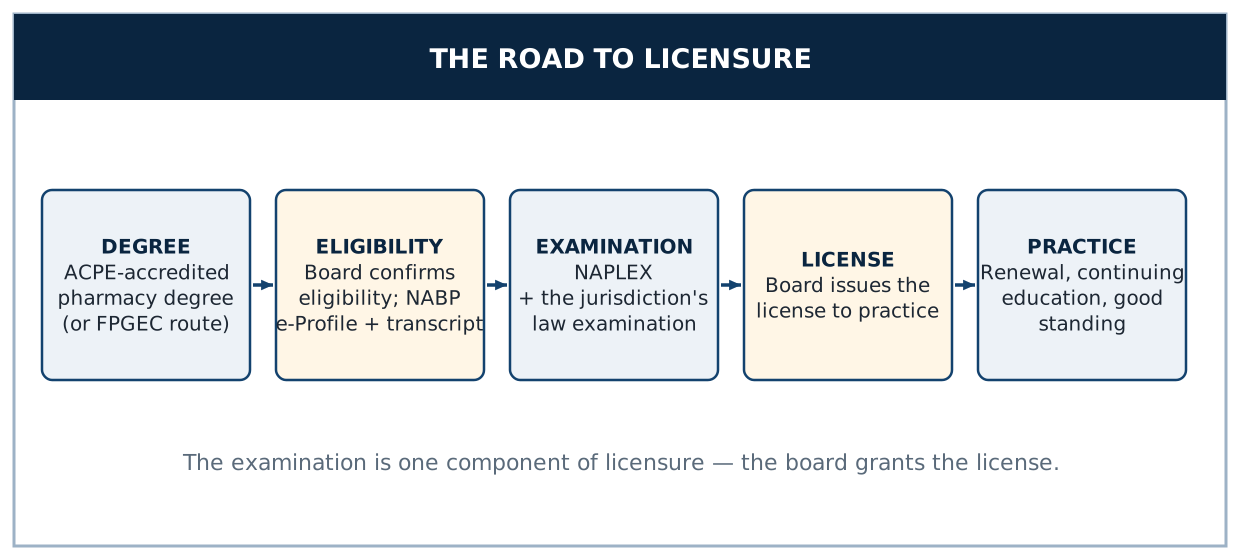
Figure 1.1 — The road to licensure: degree, eligibility, examination, license.
The application mechanics are straightforward and worth learning once, accurately. You apply through an NABP e-Profile, NABP's online account system for candidates. Your official transcript is sent to NABP. The board of your jurisdiction confirms your eligibility; for fifteen jurisdictions NABP itself confirms eligibility and charges an additional eligibility-processing fee, while the other boards run their own processes. Once eligibility is granted and you have purchased the examination, you receive an Authorization to Test, the document that permits you to schedule your sitting, and your eligibility period runs for one year. (Source: NABP, NAPLEX program page, "Eligibility to Test"; Candidate Application Bulletin.) The fifteen jurisdictions for which NABP confirms eligibility are Alaska, Arizona, Colorado, the District of Columbia, Idaho, Kentucky, Louisiana, Maine, Michigan, Nebraska, North Carolina, Oregon, Rhode Island, Utah, and Wisconsin, and the additional fee for that service is $85. (Source: NABP, NAPLEX program page, "Eligibility to Test.") You are unlikely to be asked to recite that list; you are likely to be expected to understand the structure it illustrates — one examination, many boards, and a division of labor between them.
Now to the examination at the center of this book, taught here in narrative; the front matter of this book carries the same facts in formal summary form, and Chapter 40 returns to them as test-day craft. The NAPLEX is a computer-delivered, fixed-form examination: every candidate receives a predetermined form of the examination, delivered by computer at a Pearson VUE test center, rather than an examination that adapts its difficulty question by question. It contains 225 questions and allows 6 hours. Of the 225 questions, 200 are scored and 25 are unscored pretest questions, included so that future items can be evaluated; the pretest questions are mixed in and not identified, so the only workable strategy is to answer every question as if it counts. (Source: NABP, NAPLEX/MPJE Candidate Application Bulletin.)
Two features of the delivery shape how you must prepare. First, questions are answered in order, and the examination does not permit you to return to a previous question once you have moved past it. There is no flagging a hard question for later review, as many school examinations allow; each question must be answered, as well as you can answer it, before the next appears. Preparation must therefore build decision discipline — the ability to reason, choose, and move on — and not merely knowledge. Second, the examination uses several item types, and each makes its own demand. Multiple choice items offer one best answer. Multiple response items ask you to select all options that apply, and are scored as a whole. Ordered response items ask you to place steps or values in the correct sequence. Constructed response items require you to type a numeric answer — the form most calculation questions take, with no options to check your work against. Point-and-click items ask you to select a location on an image or a patient profile, such as the field where an error appears. An on-screen calculator is provided for calculation work; a personal calculator is not permitted. (Source: NABP, Candidate Application Bulletin.) This book's practice items use the multiple choice form throughout, for clean teaching and scoring, and its text teaches you explicitly where the real examination's other forms will demand something different — above all in calculations, where a typed answer forgives no arithmetic slip.
Scoring is widely misunderstood, so learn it exactly. The examination is scored on a scaled-score scale of 0 to 150. A scaled score is a converted score: it places results from different forms of the examination on a common scale, accounting for small differences in form difficulty. The passing standard is a scaled score of 75, established by a formal standard-setting process in which experts judge the performance expected of a minimally competent entry-level pharmacist. A scaled score of 75 is not 75 percent correct, and no number of questions a candidate must answer correctly is published. Results are reported as Pass or Fail only; a candidate does not receive a scaled score. A candidate who does not pass receives a Candidate Performance Report showing performance by content domain, which becomes the map for restudy. (Source: NABP, Candidate Application Bulletin; NABP, "What does the scaled score and domain level information mean?") Two consequences follow for your preparation. You cannot compute a safe raw target from the published standard, so preparation must aim at competence across the outline rather than at gaming a threshold. And if a first attempt does not pass, the domain report — not discouragement, and not random restudy — directs what happens next.
The fees are published and simple. Two NABP fees apply to every attempt: an eligibility application fee of $100, which is nonrefundable and is paid per attempt, including retakes; and an examination purchase fee of $520. The total in NABP fees is therefore $620 per attempt, before any board's own licensure fees and before the $85 eligibility-processing fee in the jurisdictions where NABP confirms eligibility. A candidate who passes and wishes the score sent to an additional jurisdiction may purchase a score transfer at $105 per jurisdiction, up to 89 days after the examination date. (Source: NABP, Candidate Application Bulletin, fee schedule; NABP program page, score transfer terms.) Fees are not clinical knowledge, but they are part of planning a candidacy — particularly because a retake restarts both fees in full.
Retakes are governed by three limits, all of which print exactly as published. A candidate who does not pass must wait at least 45 days before testing again, and a jurisdiction may require a longer wait. No candidate may attempt the examination more than three times in any 12-month period, and no candidate may attempt it more than five times in total, unless a board of pharmacy decides otherwise. Each retake restarts the eligibility process and both fees. (Source: NABP, Candidate Application Bulletin, retake provisions.) Read those limits as the examination's seriousness made concrete: attempts are a finite resource, which is one more reason this book routes you through a diagnostic and a structured plan rather than urging you to test early and hope.
Finally, a fence this book observes without exception, stated here so you can hold the book to it: this book publishes no examination pass rates, and it offers no guarantee of any result. It confers no license, no eligibility, and no authorization to practice. It is a preparation text, not a clinical reference. What it can do — what it is built to do — is teach the published outline completely, with every answer explained, so that your preparation is thorough, honest, and verifiable chapter by chapter.
Every scored question on the examination is classified to one of five content domains in the NAPLEX Content Outline, effective for all examinations beginning May 1, 2025. The domains, with their published weights — each weight a share of the 200 scored questions — are the single most useful planning fact in this chapter. (Source: NABP, NAPLEX Content Outline, effective May 1, 2025.)
Domain 1, Foundational Knowledge for Pharmacy Practice, carries 25 percent of the scored examination, about 50 questions. It holds the science base and the quantitative base: pharmacology; pharmacokinetics, pharmacodynamics, and pharmacogenomics; pharmaceutics; nonsterile and sterile compounding; the full calculations body — patient parameters, quantities, rates, conversions, concentrations, compounding quantities, nutrition, biostatistics and pharmacoeconomic measures, and pharmacokinetic parameters; drug development; research design; and the drug literature and information resources. Domain 1 is the examination's foundation in the literal sense: the later domains assume it, and a weakness here leaks into questions classified elsewhere, because a Domain 3 treatment question often contains a Domain 1 calculation or mechanism inside it.
Domain 2, Medication Use Process, carries 25 percent, about 50 questions. Its full name names the process it covers: prescribing, transcribing and documenting, dispensing, administering, and monitoring. Its content includes drug names and classes, indications and dosing, dosage forms; the regulations governing prescriptions; safety and effectiveness data; therapeutic substitution; immunization services in full — schedules, screening, administration, documentation, and adverse-event handling; and the handling, storage, stability, and disposal of medicines. Domain 2 is the pharmacist's workflow examined step by step: can you read an order, judge it, dispense against it lawfully and accurately, and handle the product correctly at every stage?
Domain 3, Person-Centered Assessment and Treatment Planning, carries 40 percent, about 80 questions — by far the largest domain, and the center of gravity of the whole examination. It covers taking histories and reconciling medicines; screenings and assessments; the conditions themselves and their pathophysiology; the appropriateness of therapy for the individual patient; interactions; errors and omissions; adverse drug reactions; toxicology; adherence; therapeutic goals and endpoints; safety and effectiveness monitoring; lifestyle and education, including medication-use and disease-state education; over-the-counter products and supplements; and administration and self-monitoring devices. Domain 3 questions typically arrive as patient cases: a profile, a set of conditions and medicines, and a decision to make for that person. This is why this book teaches from patient profiles, why its recurring patients matter, and why its two case batteries exist.
Domain 4, Professional Practice, carries 5 percent, about 10 questions: adverse-event and error reporting systems; public health initiatives; social determinants and drivers of health — the conditions of people's lives, such as income, housing, transportation, and access to care, that shape whether a sound plan can actually be followed; and ethics. Domain 5, Pharmacy Management and Leadership, carries 5 percent, about 10 questions: pharmacy operations; inventory and supply management; quality improvement; and mentorship and preceptorship. Together the two small domains are a tenth of the examination. They are not optional — ten questions each is more than enough to matter at a pass/fail boundary — but they must be studied in proportion, and candidates who neglect the two large domains to polish the small ones have inverted the examination's own priorities.
Hold the proportions as a picture: of every ten scored questions, roughly four are person-centered care, two and a half are foundational knowledge, two and a half are the medication use process, and one is divided between professional practice and management. Your study plan, your diagnostic results, and your sense of readiness should all be shaped by that picture. The worked example below turns it into hours.
You have 40 hours available for content study over the next four weeks, after taking the diagnostic examination. Allocate the 40 hours in proportion to the published domain weights, then adjust for your diagnostic results.
Step 1 — Domain 3 at 40 percent: 40 hours × 0.40 = 16.0 hours. Step 2 — Domain 1 at 25 percent: 40 hours × 0.25 = 10.0 hours. Step 3 — Domain 2 at 25 percent: 40 hours × 0.25 = 10.0 hours. Step 4 — Domain 4 at 5 percent: 40 hours × 0.05 = 2.0 hours. Step 5 — Domain 5 at 5 percent: 40 hours × 0.05 = 2.0 hours. Check: 16.0 + 10.0 + 10.0 + 2.0 + 2.0 = 40.0 hours. The allocation accounts for every hour.
Now adjust. The proportional allocation is the starting point, not the final plan: if your diagnostic shows foundational knowledge as your weakest strand, shift hours toward Domain 1 from the domain where you are strongest, because a foundation weakness taxes every other domain. What the weights forbid is the reverse error — a plan that gives the two 5-percent domains the same time as a 40-percent domain, or that studies favorite topics regardless of weight. Weight first, weakness second, preference last.
This book is organized so that its structure is the outline's structure, expanded into teaching order. Part I, Foundations of Pharmacy Science (Chapters 1–7), teaches Domain 1's science: this orientation chapter; pharmacology; pharmacokinetics; pharmacodynamics and pharmacogenomics; pharmaceutics; evidence and biostatistics; and drug development and the literature. Part II, Pharmaceutical Calculations (Chapters 8–12), teaches Domain 1's quantitative body on its own, because calculation skill is built by concentrated practice. Part III, Compounding and the Medication Use Process (Chapters 13–19), covers compounding and then Domain 2 in workflow order, from reading the order through dispensing law, substitution, handling, and immunization services. Part IV, Person-Centered Assessment and Treatment (Chapters 20–35), is the book's largest part, matching Domain 3's weight: the patient workup first, then the therapeutic areas system by system, then interactions and toxicology, and finally errors, adherence, and the patient conversation. Part V, Professional Practice, Operations, and the Examination (Chapters 36–40), covers federal pharmacy law, medication safety and reporting, public health, ethics and operations and leadership, and closes with test-day craft.
Around the chapters sits the practice apparatus. A diagnostic examination at the front routes you to your weakest strands before you read. Each chapter ends with fifteen exercises whose key explains every option, right and wrong, and tags each item with the outline code it tests, so you can see exactly which part of the outline any weakness belongs to. Two case batteries place you inside extended patient profiles. Six repair sets give concentrated extra practice by area. Two timed practice tests, of 100 questions each, are built to the outline's exact domain proportions and paced at the examination's own rate of about 1.6 minutes per question — 225 questions in 360 minutes on the real examination — so a practice sitting runs 160 minutes; they are full forms at the examination's proportions and pace, not at its length, and Chapter 40 teaches the adjustment the longer sitting demands. Study plans, cheat sheets, and a glossary complete the apparatus. In total the book carries 1,020 explained practice items.
Use the book in the order your situation dictates. If you are beginning preparation, take the diagnostic cold, read this chapter and Chapter 2, then work through the parts in order, weakest diagnostic strand first within that order. If you are weeks from a test date, let the diagnostic route you directly to the chapters behind your weakest strands, work the repair sets for those areas, and finish with the timed practice tests under real pacing. In either case, do not skip the foundations to reach the cases: the cases are where foundations are spent, and a candidate who cannot yet read a dose–response curve or estimate kidney function will find Domain 3 questions failing for Domain 1 reasons.
One habit to adopt from this first chapter onward: when a question defeats you, classify the defeat before you remedy it. Was the missing piece a fact, a mechanism, a calculation step, a law rule, or a judgment about a particular patient? The outline code in each key tells you where the piece lives; the chapter behind that code teaches it. Candidates improve fastest when every error becomes a routed lesson rather than a mark of failure — which is, not incidentally, exactly how pharmacists handle errors in practice: report, classify, learn, and redesign the process so the same error becomes harder to make.
The pharmacist is the health professional whose expertise is medicines, exercised through a constant cycle of assessment, evaluation of therapy, planning, and monitoring, in the service of medication safety. That work is done in community pharmacies — accessible, dispensing-centered, and increasingly clinical — in hospitals and institutions, where patients are sicker and teamwork and sterile precision dominate, in ambulatory clinics, where pharmacists follow panels of patients over time, and in managed care, industry, government, and public health, where the same expertise is applied to populations, products, and policy. Technicians and interns extend the pharmacist's capacity, but professional judgment — final verification, clinical decisions, clinical counseling — cannot be delegated.
The road to practice runs from an ACPE-accredited PharmD, with its integrated experiential education, through eligibility confirmed by the board of the jurisdiction of licensure, to licensure itself, which only a board of pharmacy grants. This examination is one component of that licensure; a law examination, experiential hours, and application processes ordinarily stand beside it, varying by jurisdiction. The examination itself is a fixed-form, computer-delivered test of 225 questions in 6 hours — 200 scored, 25 unscored pretest — answered in order with no return, using multiple choice, multiple response, ordered response, constructed response, and point-and-click items, with an on-screen calculator provided. It is scored on a 0–150 scaled scale with a passing standard of 75, which is not 75 percent correct; results are reported as Pass or Fail only. Each attempt costs $620 in NABP fees; retakes require at least 45 days, are limited to three in 12 months and five in total, and restart eligibility and fees.
The outline's five domains weight the examination: foundational knowledge 25 percent, medication use process 25 percent, person-centered assessment and treatment planning 40 percent, professional practice 5 percent, and management and leadership 5 percent. This book's five parts follow that outline in teaching order, surrounded by a diagnostic, chapter exercises, case batteries, repair sets, and two timed practice tests — 1,020 explained items in all. Study by weight first, by diagnosed weakness second, and by preference last.
Q1. Which domain carries the largest share of the scored examination? A. Foundational Knowledge for Pharmacy Practice B. Person-Centered Assessment and Treatment Planning C. Medication Use Process D. Professional Practice
Q2. A candidate completes the examination. Which statement about the result is correct? A. The candidate receives a scaled score and must reach 75 percent correct. B. The candidate receives a scaled score of at least 75 out of 225. C. The candidate is told the number of questions answered correctly. D. The result is reported as Pass or Fail only, with no scaled score reported.
Q3. How many of the 225 questions on the examination are scored? A. 200 B. 225 C. 175 D. 150
Q4. A candidate is answering a difficult calculation question and wants to skip it and return later. What does the examination permit? A. Skipping is permitted up to five times. B. The question may be flagged and reviewed at the end. C. Questions are answered in order, with no return to previous questions. D. Only constructed response questions cannot be revisited.
Q5. What is the total in NABP fees for one attempt, before any board fees? A. $520 B. $620 C. $100 D. $705
Q6. Who grants a pharmacist's license? A. The board of pharmacy of the jurisdiction of licensure B. The National Association of Boards of Pharmacy C. The candidate's college of pharmacy D. The Pearson VUE test center
Q7. A candidate does not pass and asks about testing again. Which statement is correct? A. The candidate may retest the following week. B. The candidate may attempt the examination unlimited times in a year. C. Only the examination purchase fee is repaid on a retake; eligibility is not restarted. D. At least 45 days must pass, with no more than three attempts in 12 months and five in total unless a board decides otherwise.
Q8. At Northgate, Marcus Webb has prepared a prescription and Dr. Ortiz is about to verify it. Which task may NOT be delegated to the technician? A. Counting tablets and preparing the labeled container for verification B. Entering the prescription into the patient's profile C. Making the final clinical verification that the therapy is appropriate for the patient D. Processing the insurance claim
Q9. M. Kowalski, 78 years old with an estimated creatinine clearance of about 31 mL/min, presents a new prescription. The pharmacist's check of the dose against her kidney function is an example of which part of the pharmacist's work cycle? A. Evaluating therapy for the individual patient before dispensing B. Managing pharmacy inventory C. Confirming examination eligibility D. Designing a formulary
Q10. A pharmacist employed by a pharmacy benefit manager spends most of the week evaluating trial evidence to recommend which medicines a health plan will cover. This pharmacist practices primarily in which setting? A. Community practice B. Managed care C. Hospital practice D. Ambulatory care
Q11. Which statement about the law examination component of licensure is correct? A. The NAPLEX itself includes each jurisdiction's pharmacy law in full. B. No jurisdiction requires a separate law examination. C. This book's preparation for the NAPLEX also completes preparation for the MPJE. D. Boards commonly require a separate pharmacy law examination, such as the MPJE, in addition to the NAPLEX.
Q12. A pharmacist sees scheduled patients in a diabetes clinic, adjusts therapy under a collaborative practice agreement, and follows the same panel over months. This describes which setting? A. Industry medical affairs B. Long-term care consulting C. Ambulatory care D. Centralized hospital dispensing
Q13. Approximately how many scored questions fall in Domain 3? A. About 80 B. About 50 C. About 10 D. About 100
Q14. A candidate in Wisconsin applies for eligibility. Which statement is correct? A. Wisconsin's board confirms eligibility with no NABP involvement of any kind. B. The eligibility-processing fee replaces the examination purchase fee. C. Score transfer must be purchased before the examination. D. NABP confirms eligibility for Wisconsin, with an additional $85 eligibility-processing fee.
Q15. Which pairing of domain and content is correct? A. Domain 4 — inventory management and preceptorship B. Domain 5 — pharmacy operations, quality improvement, and mentorship C. Domain 2 — adverse-event reporting and ethics D. Domain 1 — patient histories and reconciliation only
The Complete Pharmacy Course — 1,020 Practice Questions, Diagnostic & 2 Full Timed Practice Tests, Every Answer Explained
Feras Alzubi
Exam Prep Series
2026 Edition
© 2026 Feras Alzubi. All rights reserved.
No part of this book may be reproduced, distributed, or transmitted in any form or by any means without the prior written permission of the copyright holder, except as permitted by law.
All teaching text and all 1,020 practice items in this book are original to this book. They were written for this volume against the published NAPLEX Content Outline named in this front matter, and they are not the National Association of Boards of Pharmacy's actual, recalled, paraphrased, or adapted examination items. Specimen prescriptions, labels, reports, and documents in this book are fictional teaching specimens created for instruction, set at a fictional pharmacy with fictional patients.
This book is an independent study guide. It is not published by, affiliated with, endorsed by, or approved by the National Association of Boards of Pharmacy (NABP), and NABP did not participate in its creation. Exam names and trademarks belong to their respective owners. Passing any exam also depends on the candidate's own preparation; no book can guarantee a result.
This book prepares candidates for an examination. It is not a clinical reference, and it is not a substitute for the approved labeling of any drug, for a board of pharmacy's rules, or for clinical judgment in the care of any patient. Drug information is taught at the level of the published examination outline and the approved labeling it rests on; where a value varies by source, population, or product, the book teaches the principle and the check rather than a single confident number. This book confers no license, no eligibility, and no authorization to practice pharmacy. Licensure is granted by each jurisdiction's board of pharmacy, on that board's terms, and ordinarily requires more than this examination — most jurisdictions also require a pharmacy-law examination (such as the MPJE), internship or experiential hours, and an application and background process. This book teaches the federal framework the NAPLEX tests; it does not teach any jurisdiction's pharmacy law and does not prepare the reader for the MPJE.
Diagnostic Examination
Part I — Foundations of Pharmacy Science
Chapter 1: The Pharmacist's World: Practice, Licensure, and the Road to the Examination
Chapter 2: Pharmacology Foundations: How Drugs Act
Chapter 3: Pharmacokinetics: The Journey of a Drug Through the Body
Chapter 4: Pharmacodynamics, Pharmacogenomics, and Why Patients Differ
Chapter 5: Pharmaceutics: Dosage Forms and Delivery Systems
Chapter 6: Evidence in Numbers: Biostatistics, Study Design, and Value
Chapter 7: From Molecule to Medicine: Drug Development, Approval, and the Literature
Part II — Pharmaceutical Calculations
Chapter 8: Calculation Foundations: Units, Conversions, and Concentration
Chapter 9: Dilution, Mixing, and Alligation
Chapter 10: Dosing the Patient: Weight, Surface Area, Age, and Kidney Function
Chapter 11: Rates of Administration: Infusions, Drips, and Syringes
Chapter 12: Compounding Quantities and Parenteral Nutrition
Part III — Compounding and the Medication Use Process
Chapter 13: Nonsterile Compounding
Chapter 14: Sterile Compounding and Parenteral Products
Chapter 15: Reading the Order: Names, Classes, Indications, and Forms
Chapter 16: Dispensing Lawfully: Requirements, Labels, and Required Counseling
Chapter 17: Substitution, Formularies, Shortages, and Biosimilars
Chapter 18: Handling Medicines: Storage, Stability, Hazardous Drugs, and Disposal
Chapter 19: Immunization Services
Part IV — Person-Centered Assessment and Treatment
Chapter 20: The Patient Workup: Histories, Reconciliation, and Assessment
Chapter 21: Hypertension and Dyslipidemia
Chapter 22: Heart Failure, Coronary Disease, and Arrhythmias
Chapter 23: Anticoagulation, Thromboembolism, and Stroke Prevention
Chapter 24: Diabetes Mellitus and Thyroid Disorders
Chapter 25: Infectious Diseases I: Antibacterial Principles and Everyday Infections
Chapter 26: Infectious Diseases II: Serious Syndromes and Special Hosts
Chapter 27: Asthma, COPD, and Allergic Disorders
Chapter 28: Gastrointestinal, Hepatic, and Nutritional Disorders
Chapter 29: Kidney Disease, Electrolytes, and Acid–Base
Chapter 30: Neurologic Disorders: Seizures, Parkinson Disease, and Headache
Chapter 31: Psychiatric Disorders: Mood, Anxiety, and Psychosis
Chapter 32: Pain, Inflammation, and Bone and Joint Disorders
Chapter 33: Reproductive Health and Care Across the Life Span
Chapter 34: Interactions, Adverse Reactions, and Poisonings
Chapter 35: Errors, Omissions, Adherence, and the Patient Conversation
Part V — Professional Practice, Operations, and the Examination
Chapter 36: Federal Pharmacy Law: The FDA, the DEA, and Controlled Substances
Chapter 37: Medication Safety and the Reporting Systems
Chapter 38: Public Health: Prevention, Screening, and Stewardship
Chapter 39: Ethics, Operations, Quality Improvement, and Leadership
Chapter 40: Test Day: Pacing, Judgment, and the Road After the Result
Case Battery A · Case Battery B · Repair Sets 1–6 · Timed Practice Test 1 · Timed Practice Test 2 · Study Plans · Cheat Sheets · Glossary · Errata & Verification Statement · References · Appendix: Outline Crosswalk
The North American Pharmacist Licensure Examination (NAPLEX) is developed and administered by the National Association of Boards of Pharmacy (NABP) and is used by the boards of pharmacy to assess a candidate's competence for entry-level pharmacy practice. It is one component of licensure, not the whole of it. The facts on this page are taken from NABP's own publications, read for this edition: the NAPLEX Content Outline, effective for all NAPLEX examinations beginning May 1, 2025; the NAPLEX/MPJE Candidate Application Bulletin; and NABP's program pages. (Source: NABP, NAPLEX Content Outline, effective May 1, 2025; NABP, Candidate Application Bulletin.)
What the examination is. The NAPLEX is a computer-delivered, fixed-form examination of 225 questions given over 6 hours at a Pearson VUE test center. Of the 225 questions, 200 are scored and 25 are unscored pretest questions, mixed in and unidentified; answer every question as if it counts. Questions are answered in order: the examination does not let a candidate skip a question and return to it later. Item types include multiple choice, multiple response (select all that apply), ordered response, constructed response (a typed numeric answer — the form most calculation questions take), and point-and-click items built on a patient profile or an image. An on-screen calculator is provided; a personal calculator is not permitted.
What it tests. Every scored question is classified to the NAPLEX Content Outline (effective May 1, 2025), which organizes the examination into five content domains. The weights below are NABP's published shares of the 200 scored questions:
How it is scored. The NAPLEX is scored on a scaled-score scale of 0 to 150. The passing standard is a scaled score of 75, set by a formal standard-setting process; a scaled score of 75 is not 75 percent correct, and NABP publishes no number of questions a candidate must answer correctly. Results are reported as Pass or Fail only — a candidate does not receive a scaled score. A candidate who does not pass receives a Candidate Performance Report showing performance by content domain, which is the map for restudy. (Source: NABP, Candidate Application Bulletin; NABP, "What does the scaled score and domain level information mean?")
Eligibility. Eligibility is confirmed by the board of pharmacy of the jurisdiction where the candidate seeks licensure — NABP itself confirms eligibility for fifteen jurisdictions and charges an additional $85 eligibility-processing fee for them; the other boards run their own processes. The standard path requires a degree from a college of pharmacy accredited by the Accreditation Council for Pharmacy Education (ACPE); pharmacists educated outside the United States qualify through Foreign Pharmacy Graduate Examination Committee (FPGEC) certification. The candidate applies through an NABP e-Profile, has an official transcript sent to NABP, and, once eligibility is granted, purchases the examination and receives an Authorization to Test. The eligibility period is one year.
What it costs. Two NABP fees apply to every attempt: a $100 eligibility application fee (nonrefundable) and a $520 examination purchase fee — $620 per attempt in NABP fees, before any board's own licensure fees. A score transfer to an additional jurisdiction costs $105 per jurisdiction and may be purchased up to 89 days after the examination date. (Source: NABP, Candidate Application Bulletin, fee schedule.)
Retakes. A candidate who does not pass must wait at least 45 days before testing again, and a jurisdiction may impose a longer wait. NABP limits candidates to three attempts in any 12-month period and five attempts in total, unless a board of pharmacy decides otherwise. Every retake restarts the eligibility process and both fees.
This book's practice sittings, stated plainly. The real examination is 225 questions in 6 hours — about 1.6 minutes per question. This book's two Timed Practice Tests are complete sittings of 100 questions each, built to the outline's exact domain proportions (25 / 25 / 40 / 5 / 5) and paced at the examination's own rate, for a sitting of 160 minutes. They are full practice forms at the examination's proportions and pace; they are not the examination's length, and Chapter 40 teaches the pacing adjustment the longer sitting demands.
This book is built in two layers that share one set of chapters. The first layer teaches the field of pharmacy practice from zero: what drugs do, how the body handles them, how medicines are made, calculated, dispensed, and monitored. The second layer is the examination: the published outline taught A to Z, a diagnostic, 1,020 original practice questions with every answer — right and wrong — explained, and two timed practice sittings. A reader who has never worked in a pharmacy can start at Chapter 1; a candidate weeks from a test date can start at the diagnostic and let it route the reading.
Every chapter follows the same rhythm: simplify the idea in plain words, explain why it exists, detail the full rule with its source, show it in a worked example, figure, or patient scenario, set the reader a task to do, and check the work in a fifteen-question chapter exercise set whose key explains every option.
Begin with the Diagnostic Examination that follows this front matter, taken cold, in one sitting of about 80 minutes. Score it by strand, not only in total. The strands route you: FND (foundational knowledge) to Chapters 1–14 and Repair Set 1; MUP (medication use process) to Chapters 15–19 and Repair Set 2; CARE (person-centered assessment and treatment) to Chapters 20–35 and Repair Sets 3–5; PROF (professional practice) to Chapters 37–38 and Repair Set 6; MGMT (management and leadership) to Chapters 36 and 39 and Repair Set 6. Read the weakest strand's chapters first, then work the book in order.
Three study plans in the back matter lay the book out over eight weeks (foundations-first), four weeks (standard), and two weeks (intensive). The case batteries place you inside patient profiles at Northgate Community Pharmacy, this book's fictional teaching pharmacy; its patients recur across chapters and batteries, so their numbers stay consistent and can be learned. The cheat sheets gather the calculation methods, the monitoring numbers, the immunization anchors, and the law numbers onto single pages for the final week.
A word about numbers. Pharmacy is a field of thresholds — a renal cutoff, a therapeutic range, a beyond-use date — and this examination tests them. Every threshold printed in this book is drawn from the source named beside it: the approved labeling of the drug, the guideline of the body that issues it, or the regulation itself. Where authorities differ or a value depends on the patient, the book prints the range or the condition, and teaches you to check the label — because that checking habit, not any memorized figure, is what the examination is really measuring.
End of the free sample. The complete book continues from here — the full A-to-Z course in book form, delivered as an EPUB you can read in Apple Books, Google Play Books, ReadEra, Thorium Reader, Adobe Digital Editions, or Send to Kindle.
Buy this ebook — $11.99 Back to the book page
Payments are securely processed by Payhip.