
Mastering Careers & Skills
Lineworker: Mastering the Craft · free sample from the book itself
Feras Alzubi
The Complete Course Series — Google Play Books
This book teaches the whole field of line work — the poles, conductors, transformers, grounding, protective devices, and safety knowledge of the outdoor electric power network, from the edge of generation to the customer's meter — from absolute zero to working depth, and it teaches, inside that field course, the complete entry path of the trade: how the apprenticeship doors actually work, and the algebra and reading readiness the apprenticeship aptitude battery measures. One honesty fact stands at the front, because the whole book stands on it: there is no national lineman exam and no national licence for this trade. "Journeyman lineman" is a completion status earned inside a registered apprenticeship. This book prepares knowledge and aptitude readiness, honestly and completely; Joint Apprenticeship and Training Committees (JATCs), utilities, and employers select, train, and certify — and the hands-on skills of the trade, from climbing to energized work, are trained and assessed in person, never from a page.
© 2026 Feras Alzubi. All rights reserved.
No part of this book may be reproduced, stored in a retrieval system, or transmitted in any form or by any means — electronic, mechanical, photocopying, recording, or otherwise — without the prior written permission of the author, except for brief quotations in reviews and for the reader's own study use of the practice items printed here.
Originality statement. This book is an original work, written from scratch for this series. Every chapter, practice item, worked example, scenario, and figure in it is original to this book. No other book's text, items, or teaching material appears in it in any form — not copied, not paraphrased, not adapted. The facts it teaches about aptitude testing, apprenticeship programs, standards, and regulations are drawn from the administering programs' and issuing bodies' own publications, which are named in the chapters and collected in the References; those publications' own text is never reproduced here.
Not-affiliated disclosure. This is an independent study guide and field course. It is not published by, affiliated with, endorsed by, or approved by the electrical training ALLIANCE (etA), the International Brotherhood of Electrical Workers (IBEW), the National Electrical Contractors Association (NECA), any Joint Apprenticeship and Training Committee (JATC), the Occupational Safety and Health Administration (OSHA), the U.S. Bureau of Labor Statistics (BLS), or the Federal Motor Carrier Safety Administration (FMCSA), and none of those organizations participated in its creation. "electrical training ALLIANCE," "etA," "IBEW," "NECA," "JATC," "OSHA," "BLS," and "FMCSA" are used in this book nominatively only — to name the battery, organizations, standards, statistics, and rules that are the subjects taught.
Scope note. This book teaches the knowledge of line work — its principles, vocabulary, standards, mathematics, and reasoning order — for learning and for apprenticeship-application readiness. It is knowledge only: climbing, rigging performance, rescue, personal protective grounding application, and all energized work are hands-on skills that are trained and physically assessed in person by line schools, apprenticeship programs, and employers, and this book never presents itself as instruction to perform them. It is not a substitute for OSHA's requirements as your employer applies them, for a program's own application instructions, or for your state's commercial driver's license manual. Nothing in this book promises a job, an apprenticeship place, a test score, selection, or income; it teaches the field and the entry path as they verifiably are, and it says so wherever a reader might be tempted to forget it. This book is not an Entry-Level Driver Training (ELDT) provider and satisfies no part of ELDT.
Edition. 2026 Edition — built on the electrical training ALLIANCE aptitude battery's published format and the administering programs' own published requirements (re-verified against the programs' own pages on 2026-11-08), OSHA 29 CFR 1910.269, the Federal Motor Carrier Safety Administration's commercial driver's license classes at 49 CFR §383.91, and the U.S. Bureau of Labor Statistics' Occupational Outlook Handbook for electrical power-line installers and repairers.
Front matter — Title page · Copyright page · Contents · The Field and Its Gates · How to Use This Book · Diagnostic instructions and readiness tracker · Diagnostic (50 items) with key
Part I — The Trade & the Door
Part II — Electrical Foundations
Part III — Structures
Part IV — Conductors, Services & Underground
Part V — Transformers & Feeder Equipment
Part VI — Grounding, Rigging & Tools
Part VII — Safety Knowledge
Part VIII — Prints, the Application & the Aptitude Battery
Back matter — Practice Battery A (33 algebra + 36 reading) with key · Practice Battery B (33 algebra + 36 reading) with key · Strand Repair Sets (8 × 15 = 120 items) with key · Study Plans (4-week / 8-week / 12-week) · Cheat Sheets · Figure Program · Glossary (440 entries) · Errata & Verification Notes · References & Further Reading · Coverage Crosswalks (field map to chapters; Course 2's 39 lessons to chapters; aptitude subject areas to chapters and apparatus)
This page states, in one place, the facts the whole book stands on — what the field is, how a person actually enters it, and exactly which entry facts the administering programs themselves publish. Everything here traces to the programs' and agencies' own publications, re-verified on 2026-11-08; the chapters carry the full account, and the verification notes in the back matter record the discipline.
The field. Line work is the craft of building, maintaining, and restoring the outdoor electric power network — the chain that runs from generation through transmission lines, substations, and distribution lines to the service at a customer's meter. Lineworkers work on and around poles, conductors, transformers, and protective devices, outdoors, at height, in all weather, and on storm restoration when the network is damaged. Employers include investor-owned utilities, electric cooperatives, municipal utilities, and line-construction contractors. Part I teaches the field's map and the real job; Parts II through VII teach its electrical foundations, structures, conductors, equipment, grounding, rigging and tool knowledge, and safety knowledge; Part VIII teaches prints, the application, and the aptitude battery.
The central fact: there is no national lineman exam. No national test, no national licence, and no national certificate makes a person a journeyman lineman. "Journeyman lineman" is a completion status earned inside a registered apprenticeship. The gates below are the real ones, in the order an applicant meets them.
Gate 1 — Application and documents. The main door is a registered apprenticeship run by a Joint Apprenticeship and Training Committee (JATC) or a utility or contractor program. Programs publish their own requirements. The requirements verified at the New Mexico JATC are typical in shape: at least 18 years old, a high school graduate or GED holder, one year of high school, college, or post-secondary algebra with a passing grade (or the NJATC Online Tech Math Course), and a valid driver's license (Source: NM JATC, Applicants page, checked 2026-11-08.) Application fees, where a program charges one, are local and program-set — there is no national fee; the New Mexico JATC's published application fee is $25, printed here as that one program's figure only. Confirm your own program's current list before you apply; Chapter 34 teaches the pipeline step by step.
Gate 2 — The aptitude battery. Applicants who meet a program's requirements sit the electrical training ALLIANCE (etA) Apprentice Selection Test Battery, administered locally by JATCs. It is a selection test, not a trade exam: it has two sections only — Algebra and Functions: 33 questions in 46 minutes, and Reading Comprehension: 36 questions in 51 minutes, with a short break between sections (Source: NM JATC, Applicants page, checked 2026-11-08.) There is no trade-knowledge section and no mechanical section in the standard battery. Calculators may not be used; pencils and scrap paper are provided (Source: Warren Electrical JATC, Aptitude Test page, checked 2026-11-08.) The battery as a whole takes about two and a half hours. Scores are reported on a scale of 1 through 9, 9 highest. The minimum qualifying score is set by each program: the inside-electrician JATCs checked for this book (New Mexico and Warren) set the minimum at 4; the NW Line JATC (outside-line) sets it at 3. This book trains to a labelled training target of 4 or better, and Chapter 34 teaches you to confirm your own program's minimum — because the program's figure, not any book's, is the one that governs your application. Results arrive in about 2 to 4 weeks (New Mexico states 2–4 weeks; Warren states about two weeks). An applicant who does not qualify waits about 3 months before retesting (Warren states the bar as 90 days, at any JATC in the country). One published exception: applicants with 4,000 or more documented hours of electrical construction experience still take the test at Warren but need no minimum score for an interview (Source: Warren Electrical JATC, Aptitude Test page, checked 2026-11-08.)
What this book therefore never prints, here or anywhere: any conversion of your practice performance into a 1–9 score band, any predicted score, and any promise of passing or selection. The etA publishes the battery's format; it does not publish a practice-to-score conversion, so no honest book can offer one. This book's Practice Batteries A and B reproduce the battery's published shape exactly — 33 algebra items in 46 minutes, 36 reading items in 51 minutes — with original items written to the published subject areas, and the face of each battery says so. They rehearse the real format at full depth; they do not impersonate the real test, and your raw practice counts measure what you have learned, which is the only honest use of them.
Gate 3 — Interview and competitive ranking. A qualifying score earns an interview, not a place. Applicants are ranked competitively on the interview and the whole application, and programs select from the ranking as openings occur. At ALBAT (the American Line Builders Apprenticeship Training program), the standby/ranking list stays valid for one year; re-interview becomes possible after 450 documented industry hours or two or more related post-secondary classes, with a 90-day wait. Chapter 34 teaches interview craft and ranking mechanics in full.
Gate 4 — The CDL door. Line work runs on heavy trucks, so a commercial driver's license (CDL) stands in the doorway — and which version of the door you face is your program's decision, which is the taught fact. Under the Federal Motor Carrier Safety Administration's classes (49 CFR §383.91), Class A covers a combination vehicle with a gross combination weight rating of 26,001 pounds or more where the towed vehicle is rated over 10,000 pounds; Class B covers a single vehicle rated 26,001 pounds or more. ALBAT accepts a Class A licence or a commercial learner's permit (CLP) at application; MSLCAT (Mountain States Line Constructors) and NW Line require the full Class A licence — permits are not accepted. Since February 7, 2022, first-time Class A or Class B applicants must complete Entry-Level Driver Training (ELDT) — theory and behind-the-wheel training from a provider listed on the FMCSA Training Provider Registry — before the skills test. This book is not an ELDT provider and satisfies no part of ELDT; Chapter 37 teaches the door's shape and sequence, and your state's CDL manual governs its own test's questions, fees, and pass marks, which this book deliberately never prints because they are state-set.
Gate 5 — The apprenticeship itself. Selection leads to indenture into a registered apprenticeship: at the major outside-line programs (ALBAT, MSLCAT, NW Line), about 7,000 hours of on-the-job training, roughly three and a half to four years including related instruction, working under journeymen while you learn the trade's hands-on skills in person. The Bureau of Labor Statistics characterizes apprenticeships more generally — "programs may last up to 3 years," with journey level after 3 or 4 years — and this book cites that as BLS's own general statement, never averaged with the program figure (Source: BLS, Occupational Outlook Handbook, Electrical Power-Line Installers and Repairers.)
The physical gates. The Bureau of Labor Statistics names the body's part of the door plainly: lineworkers must be able to work at heights, have the strength and stamina the work demands, and may face a fitness test; color vision matters because conductors are color-coded, and substance abuse screening is part of the gate (Source: BLS, Occupational Outlook Handbook, Electrical Power-Line Installers and Repairers.) Chapter 3 teaches each gate honestly, with a self-assessment you can run before you spend anything on an application.
The one pay figure. This book prints exactly one pay figure, fenced: the Bureau of Labor Statistics reports a median annual wage of $95,320 (May 2025) for electrical power-line installers and repairers (Source: BLS, Occupational Outlook Handbook, Electrical Power-Line Installers and Repairers.) Read it for exactly what it is — the whole-occupation median, the midpoint across everyone in the occupation, weighted toward experienced journey-level workers. It is not starting pay, not apprentice pay, and not a graduate outcome, and no page of this book presents it as one. BLS also projects employment in the occupation to grow 10 percent from 2025 to 2035, with about 10,900 openings per year — printed only as BLS's projection, in BLS's name.
Line school, honestly. Pre-apprenticeship line schools exist and can teach real familiarity — climbing, tools, field vocabulary, physical conditioning for the work. Two honesty rules govern them in this book. First, completing a line school does not guarantee an apprenticeship place: selection stays with the JATC, utility, or employer. Second, whether school training earns advanced standing inside an apprenticeship is always the receiving program's decision — never the school's promise and never this book's. Chapter 4 weighs the doors — apprenticeship direct, line school first, groundman work first — on cost, timing, and competition, with no door oversold.
The rhythm. Every chapter teaches, then tests: simplify → explain → detail → show → do → check. Read the chapter, work its examples with a pencil — every calculation in this book is shown end to end — then take its 15-item quiz closed-book, then read the key. Every key explains the right answer and why each wrong answer is wrong, because the wrong answers are where the field's traps live. Items you miss name the section to re-read, and the back matter's Strand Repair Sets drill exactly the strands your scores flag.
The two readers.
Both readers, one rule: the diagnostic comes first, before Chapter 1. It is a map, not a verdict — its job is to tell the book where to work hardest for you.
Study plans. The back matter carries 4-week, 8-week, and 12-week study plans that pace the routes above — the 8-week and 12-week plans for the full course, the 4-week plan for an applicant whose application window is close. Whichever you choose, keep the rhythm: chapter, quiz, key, repair.
A note on safety knowledge. Parts VI and VII teach safety the way the standard itself is built — principles, vocabulary, the structure of OSHA 29 CFR 1910.269, and the order of reasoning. Minimum approach distances and code clearances are taught as a lookup discipline against the standard's and the Code's own tables, never as a memorised field card: on real work, the current table and your employer's procedures govern, not any book. And the boundary from the copyright page runs through every chapter: the knowledge around climbing, rigging, grounding application, and rescue is taught here; the skills are trained and assessed in person.
A note on numbers. Where this book prints a number — a battery's length, a program's minimum score, a licence class threshold — the number traces to the publication named beside it, and the back matter's verification notes say what was checked and when (the entry facts were re-verified on 2026-11-08). Where a number belongs to someone else — your program's current fee, your state's CDL terms, a table value in a standard — the book teaches the concept and routes the figure to its owner. That discipline is itself part of the trade: line work runs on verified numbers, and so does this book.
Instructions. The diagnostic follows this front matter: 50 items in three strands — Algebra & Functions (items D1–D18), Reading (items D19–D32, two passages), and Trade Foundations (items D33–D50). Answer all 50. Choose the single best answer for each item. A guess on this diagnostic teaches more than a blank, because a miss still names the strand that needs work — but guess honestly, and mark the items you guessed, so your tracker tells the truth.
Untimed — but honest. The diagnostic carries no time limit, because its job is diagnosis, not rehearsal. Work steadily, without a calculator on the algebra strand (the real battery allows none, and these items are written to be solved without one, with clean numbers), and note how long you took: the note is for you, and it becomes useful when you compare it with the timed Practice Batteries in the back matter. On the reading strand, answer from the passage in front of you — every reading item is answerable from its passage alone.
Scoring by strand. When you finish, score yourself with the key that follows the diagnostic. The key tags every item with its strand and explains every option. Enter your score by strand in the tracker below — never as one combined number, because the strands route you to different parts of the book.
Algebra & Functions — Items: D1–D18 · First score: /18 · After repair: /18
Reading — Items: D19–D32 · First score: /14 · After repair: /14
Trade Foundations — Items: D33–D50 · First score: /18 · After repair: /18
How each strand routes you.
Raw counts only. No score in this book — diagnostic, quiz, repair set, or practice battery — converts to a 1–9 score band, predicts a battery result, or promises selection. The electrical training ALLIANCE publishes the battery's format and each program publishes its own minimum; conversions and predictions are published by no one, so this book invents none. The tracker measures what you have learned, which is the only honest use of it.
© 2026 Feras Alzubi
All rights reserved.
Mastering Careers & Skills
A lineworker — also called a lineman, a line installer and repairer, or, in the language of the federal statistics, an electrical power-line installer and repairer — is the craftsperson who builds, maintains, and repairs the outdoor electric power network: the poles, towers, conductors, transformers, and hardware that carry electricity from where it is generated to the meter on the side of a house. Everything in this book follows from that sentence. The network is outdoors, it is overhead and underground, it runs in all weather, and when it fails, the people who put it back are lineworkers.
Notice what the definition does not say. It does not say a lineworker wires buildings. Wiring the inside of a building — panels, outlets, lighting circuits — is the work of the inside electrician, a related but different trade with its own apprenticeship and, in many places, its own licence. The lineworker's world begins where the building's world ends: out on the street, up the pole, across the fields on steel towers, and down into the underground vaults. The two trades share electrical fundamentals — Chapters 5 through 10 of this book — and they respect each other's territory, but they are different crafts, entered through different doors, and Chapter 4 will keep those doors carefully separate.
This book teaches line work whole: the field itself, the structures and equipment, the safety knowledge that governs the work, and the door in — the registered apprenticeship system and the aptitude battery that selects for it. One honesty fact belongs on the first page, because everything else in the book is built around it: there is no national lineman exam and no national licence for this trade. "Journeyman lineman" is a completion status earned inside a registered apprenticeship — roughly 7,000 hours of on-the-job training at the major outside-line programs. This book prepares knowledge and readiness. Programs and employers select, train, and certify. Hold that distinction and nothing in the chapters ahead will mislead you.
The Bureau of Labor Statistics describes the occupation's duties plainly, and its list is the spine of this section. Lineworkers install and maintain the power grid — the network itself, not any single device on it. They install, maintain, or repair electrical transmission and distribution systems, which are the two great halves of the network Chapter 2 will separate: transmission moves bulk power over distance; distribution delivers it street by street. They erect poles and light- or heavy-duty transmission towers — the structures of Part III. They install, maintain, and repair electrical distribution and transmission systems, including conduits, cables, wires, and related equipment such as transformers, circuit breakers, and switches. And the work is physical in the specific ways Chapter 3 will examine: the same source notes that these workers climb poles and transmission towers and work in trenches and underground vaults. (Source: BLS, Occupational Outlook Handbook, Electrical Power-Line Installers and Repairers.)
Read that duties list the way a crew member reads it — as objects. The pole is the wooden, steel, or concrete post that carries distribution lines along streets and alleys. The transmission tower is the large steel structure that carries high-voltage lines across country. The conductor is the wire itself — the metal path the current travels — strung between structures in spans. The crossarm is the horizontal beam near the top of a pole that holds the conductors apart at a safe spacing. The transformer is the can-shaped device, mounted on the pole or sitting on a ground pad, that steps voltage down to the level a house can use. Figure 1.1 shows the working scene whole: a crew's truck at a pole, and the pole carrying conductors, crossarms, and a transformer against the sky.
Figure 1.1 (Class P) — A bucket truck at a distribution pole: conductors, crossarms, and transformer against the sky.
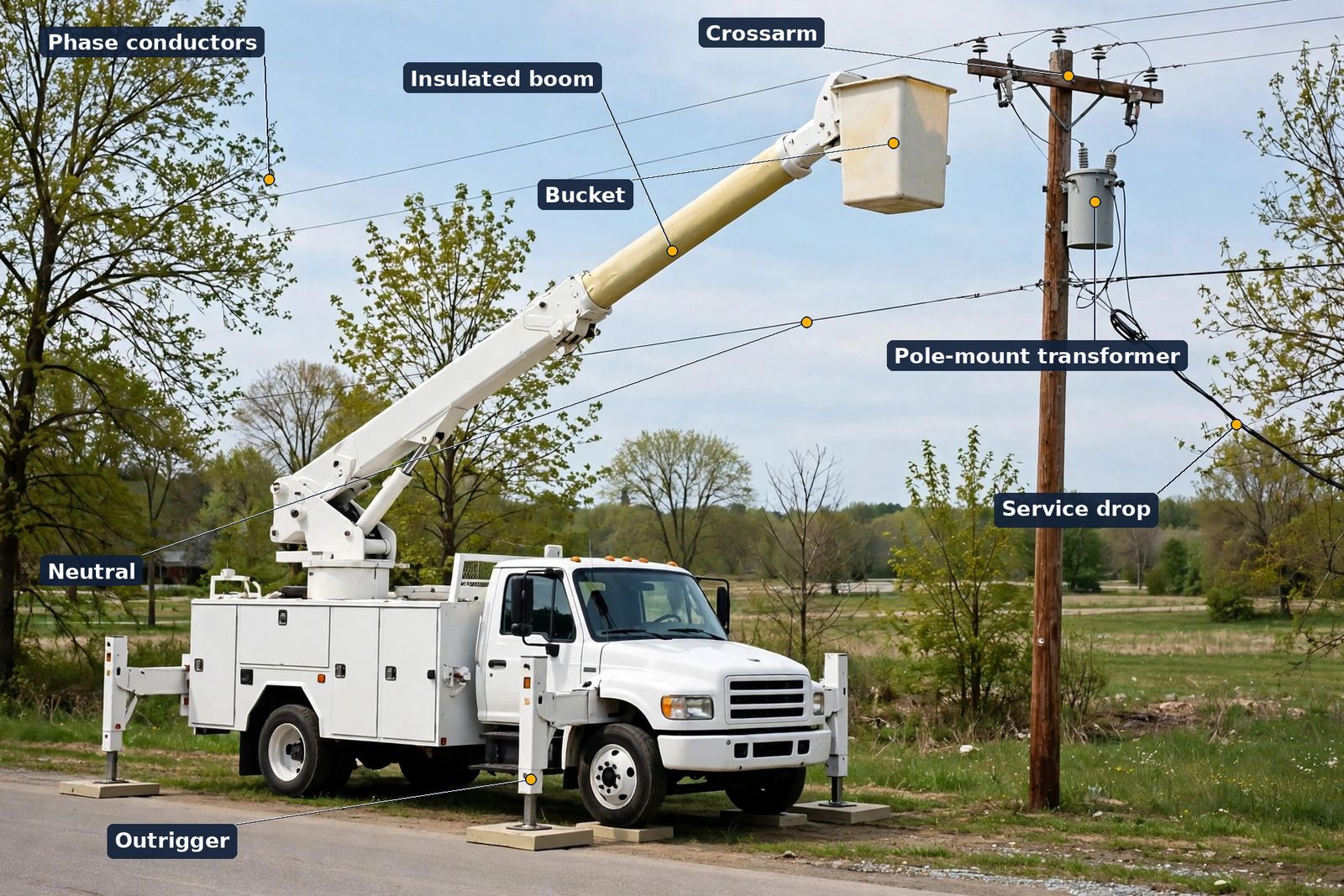
Figure 1.1 — A bucket truck at a distribution pole: conductors, crossarms, and transformer against the sky.
Installation work and repair work feel different, and a lineworker's career contains both. Construction — building new line — is planned work: stakes and prints arrive first, holes are dug, poles are set, conductors are strung, and a new feeder or a rebuilt street goes energized on schedule. Maintenance is the network's continuing care: replacing a rotted pole before it fails, changing out insulators, trimming the work list that inspection produces. Repair is unplanned by definition: something has broken — a car has hit a pole, a fuse has operated, a conductor is down — and the work is diagnosis first and construction second. A beginner should picture all three, because applicants who imagine only storm heroics misunderstand the job: most line work, most weeks, is planned construction and maintenance done in ordinary weather, and that steady work is what the apprenticeship mostly consists of.
Line work is crew work. Electricity at distribution and transmission voltages, loads that weigh hundreds of pounds, and work performed at height are not one-person undertakings, and the trade's basic unit is the crew: a small team with a leader, divided roles, and a shared plan for the day. At the head is the foreman (or crew leader), who owns the job's plan, its paperwork, and its safety. Journeyman lineworkers — those who have completed the apprenticeship — perform and direct the skilled work on the structure. Apprentices work under journeyman direction, doing real work at a level matched to their step of training, and learning the trade by doing it under supervision. Groundmen (the entry role Chapter 4 examines as a door in) work at the base: handling materials, tools, ropes, and the ground end of every lift.
Above the crew sit the people the crew depends on: dispatchers and system operators who control switching and know the state of the whole network, engineers and staking technicians who design jobs and produce the prints of Chapter 33, troubleshooters who patrol faults and take the first look at outages, and the warehouse, fleet, and line-department support that keeps trucks stocked and rolling. A new apprentice who learns the crew's shape early learns something the classroom cannot teach alone: your work is always one link in a chain of other people's work, and the job briefing — the crew's daily conversation about the plan and its hazards — is where that chain is checked link by link. Job briefings return in Chapter 32 as a formal requirement of the standard; here, simply fix the idea that in this trade, nobody works a job they have not first talked through with the crew.
The tools of the scene in Figure 1.1 deserve a first naming, because Chapter 27 will teach them at recognition depth. The bucket truck carries an insulated aerial lift that raises a worker to the pole top in a bucket. The digger derrick is the truck-mounted machine that digs holes and sets poles. Hand tools, hot-line tools, climbing gear, and rigging fill the bins of both trucks. In this chapter they are scenery; by Part VI you will be able to name each one, state its job, and state the one safety property that matters most about it.
The lineworker the public knows is the one who arrives after the storm. Storm restoration is the trade's surge mode: when wind, ice, lightning, or falling trees damage the network across a whole service territory, outages number not in dozens but in thousands, and every available crew — the home utility's own, contractors', and crews lent by other utilities under mutual assistance agreements — works extended hours until the last customer is restored. Restoration follows a disciplined order that the worked example in §1.6 walks through: make the scene safe, repair the large pieces that restore the most customers first — transmission, substations, main distribution feeders — then the laterals that serve streets, then the individual services that serve single houses.
Storm work is real, it is a genuine part of the trade's identity, and applicants should understand both halves of it. The first half is the one in the photographs: skilled crews, working as a system, visibly putting a community back together — deeply satisfying work that many lineworkers name as the best of the job. The second half is Chapter 3's subject: storm hours are long, the weather that caused the damage is often still present, the work happens at night as readily as at noon, and the damage itself — broken poles, conductors on the ground, flooded vaults — is the network at its most hazardous. A book that sold you only the first half would be lying to you. The trade's own gatekeepers do not lie about it, as §1.5 and Chapter 3 will show: the physical and weather reality of the job is printed in the occupation's own descriptions, up front, for anyone considering the door.
Restoration also teaches the beginner the network's most important property: it is a system, and it fails and recovers as a system. A tree through one span can darken a street; a damaged feeder can darken a town; and the repair order is set by that system logic, not by which customer calls first or loudest. The crew on the pole in Figure 1.1 is never just fixing a pole. It is restoring one link of a chain that Chapter 2 now needs to give you whole — but first, the question every applicant asks: who would I actually work for?
Lineworkers work for four broad kinds of employer, and the differences among them shape a career more than most beginners expect.
Investor-owned utilities are the large, stockholder-owned power companies that serve most American customers. They run large line departments, hire apprentices through their own programs or joint programs with the union, and offer the scale that comes with a big system: many crews, specialized departments, storm travel across a wide territory. Electric cooperatives are member-owned utilities, typically rural, formed to bring power to areas the big companies once passed by. A cooperative's line department is smaller; its crews cover long miles of line through open country, and a co-op lineworker often knows every mile of the system personally. Municipal utilities are city-owned: the power department of a town or city government, serving its own citizens, with crews whose territory is the community they live in. Line contractors are companies that build and maintain lines under contract for utilities of all three kinds above. Contractor crews travel — following construction projects and storm restoration wherever the work is — and contracting is a large share of the industry; the major joint apprenticeships of Chapter 4 exist largely to supply this contractor workforce, which is why they are called outside-line programs: outside, on the lines, as opposed to inside a building.
The same craft runs through all four. The poles, conductors, transformers, and safety rules do not change with the employer's logo; what changes is territory, travel, crew size, and the rhythm of the work. A contractor apprentice may sleep in three states in a season answering storms; a municipal journeyman may work the same forty streets for a decade and know every pole by its history. Neither is the "real" line work. Both are. When Chapter 4 compares the doors in, keep this landscape in mind: choosing a door is partly choosing which of these worlds you are applying to enter.
One more employer fact belongs to the honest landscape. The Bureau of Labor Statistics projects employment of electrical power-line installers and repairers to grow 10 percent from 2025 to 2035, with about 10,900 openings projected each year over the decade — a projection, printed here as exactly that: BLS's published outlook for the occupation, not a promise to any individual reader. (Source: BLS, Occupational Outlook Handbook, Electrical Power-Line Installers and Repairers, 2025–35 projections.) Openings are not places reserved for applicants; they are filled competitively, through the doors of Chapter 4. The projection tells you the field is working and hiring across the decade. It tells you nothing about any one application — and any book that blurred that line would be selling you something.
Follow a single outage the way the system experiences it. Every step below is one of the BLS duties of §1.2, in the order the work actually flows.
Step 1 — The failure. A summer thunderstorm crosses a neighborhood at 9:40 p.m. A dead oak, rotted at the base, falls across a distribution lateral — the branch line that serves one street. The conductor parts, one span drops into the street, and a protective device operates to clear the fault. Thirty-eight houses go dark. In one of them, a homeowner finds the utility's number and reports the outage; her neighbors' reports and the utility's own monitoring agree: this is a real outage, on this lateral, affecting this street.
Step 2 — The system responds. The utility's dispatch logs the outage, groups the reports, and assigns a troubleshooter to patrol the lateral. The troubleshooter drives the line, finds the tree, the downed span, and the broken pole top — and does the first and most important work of the night: treating every conductor as energized until proven otherwise, keeping the public away from the downed wire, and reporting a precise picture to dispatch: location, damage, materials needed, crew size needed. No repair has happened yet, and already two BLS duties have been exercised — inspecting and testing the system, and working in the field conditions the storm left behind.
Step 3 — The job is made safe and planned. Dispatch dispatches a crew — foreman, two journeymen, an apprentice, a groundman — with a bucket truck and a digger derrick. The foreman holds the job briefing at the truck: what is de-energized, how it was isolated, where the grounds and protective devices are, who climbs, who works the ground, where the public and traffic are controlled. The damaged section is switched out and isolated so the crew's work area is a known, controlled piece of the network. This reasoning order — isolate, test, protect — is the subject of Chapter 30, taught there as knowledge; here, watch it function as the gate through which all repair work passes.
Step 4 — The structure work. The derrick removes the broken pole top and sets a new pole — erecting poles, in the BLS phrase. The crew frames it on the ground where possible: crossarm mounted, insulators and hardware placed, so the pole goes up already dressed. Climbers and the bucket position workers at the top; the apprentice, at the step-appropriate task, works from the ground end of the hand line and then aloft under direction. Installing and maintaining the components of the distribution system — duty by duty, object by object.
Step 5 — The conductor work. A new span of conductor is pulled up, sagged to its proper tension — the dip Chapter 16 will teach you to reason about — and tied in on the insulators. The service drops to the houses on either side of the break are inspected; one, pulled from its mast by the falling span, is repaired and reattached. The pole-top transformer that serves the far end of the street is inspected, its cutout and arrester checked, before anyone asks the system to re-energize it.
Step 6 — Restoration and proof. The crew clears the work area, removes its grounds in order, accounts for every person, and asks dispatch to re-energize the lateral. The protective device is closed. Down the street, windows light. The troubleshooter and crew confirm the transformer is carrying load, voltage at the far houses is in band, and no second, hidden damage remains — a second patrol of the lateral, because storms rarely damage a line in exactly one place. The homeowner's house is lit at 1:15 a.m. The crew's night is not over: dispatch has the next outage waiting, in the order of the system — larger groups of customers first — and the crew rolls to it.
Six steps, and notice what carried them: not individual heroics, but a chain — report, patrol, isolate, brief, rebuild, prove — executed by a crew whose roles interlock. That chain, and the system it restores, is the subject of this entire book.
A book can teach the knowledge around this work completely: the electrical foundations, the structures and their names, the calculations, the safety standard's logic, the prints, and the full readiness path for the apprenticeship door. That is what the thirty-eight chapters ahead do, in the foundations order of the blueprint: electricity before equipment, the grid chain before any structure, algebra from Chapter 5 onward toward the battery of Part VIII.
A book cannot teach the physical skills themselves, and this one does not pretend to. Climbing, rigging performance, rescue, and all energized work are trained and physically assessed in person, by schools, programs, and employers — that is not a limitation of this book; it is how the trade itself is built, and the apprenticeship of Chapter 4 exists precisely to do that teaching under supervision. What you finish this book knowing is everything that can be known from a book — which is a great deal, and exactly what the door in asks you to bring.
Key terms of this chapter. Lineworker — the craftsperson who builds, maintains, and repairs the outdoor power network. Inside electrician — the separate trade that wires buildings. Conductor — the wire that carries current between structures. Crossarm — the pole-top beam that holds conductors at spacing. Transformer — the device that steps voltage up or down. Crew — the trade's basic working unit, led by a foreman. Groundman — the entry role working the ground end of crew work. Storm restoration — the system's surge repair mode after widespread damage. Mutual assistance — utilities and contractors lending crews across territories in major events. Outside line — the contractor/line side of the trade, as opposed to inside wiring.
Tags: the primary tag names the topic area the item feeds (FIELD = the field's map and vocabulary). The key, with every option explained, is in this chapter's key file.
Q1. A lineworker's defining work is best described as: A. Wiring the interiors of buildings B. Building, maintaining, and repairing the outdoor electric power network — poles, towers, conductors, and transformers C. Designing power plants D. Selling electrical equipment to utilities
Q2. The inside electrician differs from the lineworker chiefly in that the inside electrician: A. Works only at night B. Never uses electricity C. Wires buildings — the interior side of the trade D. Is not a skilled trade
Q3. Which statement about credentials is correct for this trade? A. A national lineman exam and licence govern entry in all states B. A weekend course confers journeyman status C. The trade requires no training of any kind D. There is no national exam or licence; journeyman status is a completion status earned inside a registered apprenticeship
Q4. The metal path that carries current between structures is the: A. Conductor B. Crossarm C. Insulator D. Guy wire
Q5. A transformer's job on the network is to: A. Generate electricity B. Step voltage up or down between levels C. Store energy for outages D. Measure a customer's usage
Q6. In a typical crew, the person who owns the day's plan, paperwork, and safety is the: A. Groundman B. Dispatcher C. Foreman D. Apprentice
Q7. An apprentice on a crew works: A. Alone, on energized equipment B. Under journeyman direction, at tasks matched to their step of training C. Only in the classroom D. As the crew's leader
Q8. Storm restoration repairs are ordered chiefly by: A. Which customer complains the loudest B. The order the calls happened to arrive C. Alphabetical order of streets D. System logic — make safe, then restore the largest pieces and largest customer groups first, down to individual services
Q9. Mutual assistance means: A. Utilities and contractors lending crews across territories during major events B. Customers repairing their own services C. A discount program for storm victims D. Apprentices helping each other study
Q10. A rural, member-owned utility is a: A. Municipal utility B. Electric cooperative C. Line contractor D. Investor-owned utility
Q11. "Outside line" refers to: A. Outdoor sports sponsored by utilities B. The telephone company's field crews C. The line/contractor side of the trade, as opposed to inside building wiring D. Lines located outside a substation fence only
Q12. The BLS duties for this occupation include which of the following? A. Performing surgery B. Auditing utility finances C. Writing utility law D. Erecting poles and transmission towers, and installing and repairing distribution and transmission systems
Q13. In the worked example, the troubleshooter's first work at the damage scene is to: A. Begin re-stringing conductor at once B. Treat conductors as energized, keep the public away from the downed wire, and report a precise picture to dispatch C. Promise the homeowner a restoration time D. Climb the broken pole to inspect the top
Q14. The BLS projection printed in this chapter (10 percent growth, about 10,900 openings a year, 2025–35) is correctly understood as: A. A guarantee of employment for readers B. A promise of an apprenticeship place C. BLS's published outlook for the occupation — openings filled competitively, not reserved for any applicant D. A figure invented by this book
Q15. Which of these can a book legitimately teach for this trade? A. The physical skill of climbing, fully, by reading B. Energized-work performance C. Rescue performance D. The knowledge around the work — foundations, structures, calculations, safety logic, prints, and the readiness path — while physical skills are trained and assessed in person
End of the free sample. The complete book continues from here — the full A-to-Z course in book form, delivered as an EPUB you can read in Apple Books, Google Play Books, ReadEra, Thorium Reader, Adobe Digital Editions, or Send to Kindle.
Buy this ebook — $12.99 Back to the book page
Payments are securely processed by Payhip.