
Mastering Careers & Skills
Leadership Without Authority: Mastering the Craft · free sample from the book itself
The Complete Leadership Course from Fundamentals to Advanced: 168 Exercises, Drills, Checks & Plan Steps, All Explained
The Complete Course Series · Book 478
Feras Alzubi
© 2026 Feras Alzubi
All rights reserved. No part of this book may be reproduced, stored in a retrieval system, or transmitted in any form or by any means — electronic, mechanical, photocopying, recording, or otherwise — without the prior written permission of the author, except for brief quotations in reviews and for your own personal practice notes taken while working through the exercises.
This book is an original work, written for The Complete Course Series. The teaching, the situations, the specimens, and the practice apparatus were created as an original course on leading without formal authority. The author is not affiliated with any employer, organization, or author named in the References. The works listed there are scholarship and practitioner writing, cited as scholarship and as writing — as sources you can read for yourself — and nothing in this book speaks for their authors, their publishers, or their institutions. Where this book narrows their claims to what a peer without rank can actually do, it says so.
A note on the contents. This book teaches one practice, stated plainly: how you lead peers, groups, and small projects from any seat — how you notice what needs doing and start it well, earn the credibility that makes people listen, influence honestly when you cannot instruct, help a group decide and keep its word, and carry a small piece of work from shared idea to finished result in the open. It does not teach managing a team as a manager's job — assigning work as a right, setting pay, hiring, or disciplining. It does not teach managing your manager. It does not teach formal project management as a profession, with its methods, systems, and career structure. Those subjects live in companion volumes in this series, and this book points to them where the boundary matters rather than rebuilding them here. This book also promises you no promotion, no raise, and no particular outcome at work. It teaches a practice, shows you how to work at it, and states its limits honestly — including the moments when the right act is to hand a matter to formal authority and stop. What you do with the practice, and what your workplace makes of it, remains yours and your workplace's. That honesty is part of the teaching, not a hedge around it.
Part I — Foundations: Leading From Any Seat
Part II — Influence Without a Title
Part III — Moving a Group
Part IV — Leading Peers Through Hard Parts
Part V — Running a Small Project Without the Title
Part VI — Limits, Failure Modes, and the Long Game
You are holding a working course, not a collection of advice to admire. I wrote it for the seat you already sit in: the senior technician whose crew looks to her when the line stumbles, the charge nurse who holds a ward together without holding the title, the lead hand, the warehouse regular everyone asks first, the school office coordinator who knows where every form lives, the remote teammate whose careful notes become the group's memory. You do not need a new job to use this book. You need the job you have, looked at closely, and a willingness to practice in small, visible steps.
Start with the Diagnostic Checks, right after Before You Begin. There are 24 checks in four domains: Initiative and Credibility, Influence Without a Title, Moving a Group, and Peers, Projects, and Limits. Each check gives you a short, concrete situation from ordinary work — a plant floor, a ward, a warehouse, a retail floor, a field crew, a school office, a remote team — and asks what you would do. Answer honestly against your last month of work, not against the person you intend to become. Then read the Key and Routing that follows it: the key tells you, check by check, what the strong response looks like and why, and the routing notes tell you which chapters to work first for the pattern your answers show. Let me be plain about what the checks are not: there is no total score, and nothing in them ranks you. They route practice. They do not judge you. Two readers can answer the same check differently for good reasons rooted in different workplaces, and the routing respects that — it points you to the teaching that will strengthen the weaker part of your current habit.
From there, work the chapters. Each of the twenty chapters follows the same shape, so you always know where you stand. A chapter opens with the situation you will meet — the recognizable moment this chapter exists for — then teaches its method in five sections, with a figure placed where the method needs a picture. You then meet two worked specimens. The first is the full treatment: a weak attempt, what it cost, then a strong attempt at the same moment, then notes on why the strong attempt works. The second specimen is compact and set somewhere different, so you see the method travel. Wherever numbers appear, the arithmetic is shown as it is worked, so you can check it and reuse the habit. A short summary restates the method in lines you can return to before a shift. Then come six scenario exercises, each ending in a task for you. Work them in writing, even briefly. The chapter key follows immediately, with six explained answers that show the reasoning — what the method sees, what to do, why, and where the trap or the limit sits — and closing notes that name the pattern the six were training. Reading the key without attempting the exercises first will feel faster and teach you less. Attempt, then compare. That order is the course.
Behind the chapters you will find the rest of the apparatus, built to be used at work, not just read at home. The twelve repair drills take the most common broken moments in this practice — the vague offer, the promise you cannot keep, the meeting with no decision, feedback that became a verdict, the plan nobody could see, and six more — and give you a short broken specimen and a repair task, each with a worked key. The capstone, Your Leadership Practice in Twelve Steps, draws the whole book together into twelve steps that carry you from your seat inventory to a completed small project and a review of your working year. Seven worksheets give you fill-in instruments for the recurring acts: scanning for what needs doing, logging your commitments, taking stock of what you can offer and ask, mapping a room, planning a coalition conversation, chartering a small project on one page, and reviewing the trust you have built and spent. Twenty chapter cheat sheets restate each chapter's method on a single screen. A glossary defines the book's vocabulary in plain words. Three study plans — a four-week start, a twelve-week practice, and a working year — lay out honest routes at different paces. You can also simply read the book straight through. The routing is there when you want to start where your need is sharpest; the straight road is there when you want the whole practice in order. Either way, keep a notebook nearby: this book asks you to write things down — commitments, observations, plans — because the practice itself lives in writing things down where others can see them.
One case runs through the book, and you should know exactly what it is. Elena Vasquez is a senior pack-line technician at Cascade Preserves, a food-processing plant. She supervises no one. Across the chapters you follow her crew of nine operators on two shifts as they take up a stubborn changeover problem, build agreement shift by shift, run a small staging-area project, and review a working year together. Elena's case is fictional and illustrative. I invented the plant, the crew, and the numbers to teach the method in one continuous story, so you can watch cause and effect accumulate the way it does in real work. Her numbers are worked examples — shown with their arithmetic so you can follow and check them — not evidence that a method works. Treat her story as a good training simulation: true to the shape of the work, useful for rehearsal, never a substitute for what happens on your own floor. Where the book claims anything about the world beyond her plant, it rests on published scholarship, not on her story.
That scholarship deserves a word of its own, because how evidence is handled here is part of what you are learning. When this book leans on research, it names the work, states what the work actually found, and states its limits in the same breath. A framework is called a framework. A review of many studies is called a review. A finding that runs through an in-between step is printed with that step intact, not shortened into a stronger claim than the authors made. You will meet, among others, a classic map of the bases of influence, research on when people feel safe enough in a team to ask questions and admit errors, a review of the science of meetings, and a practitioner model of influence as exchange, labeled plainly as a framework from consulting experience. Hold the book to that standard as you read: if a claim matters to a decision you face, follow it to the References and read the source yourself. Employers, for their part, say this practice matters to them. In the World Economic Forum's Future of Jobs Report 2025, leadership and social influence appears as a core skill for 61 percent of employers surveyed, ranked third among core skills. I print that here only as what it is — what employers say they value — not as a forecast about any one reader's future. The reason to learn this practice is nearer at hand: the work in front of you goes better, and the people beside you are better served, when someone in the room knows how to move it without waiting for rank to arrive.
Before the diagnostic, before Chapter 1, do one honest piece of accounting with me. It will take ten unhurried minutes, and everything else in this book will make more sense once you have done it: the seat inventory, a plain naming of what authority you do and do not hold today.
Take a sheet of paper and draw two columns. In the first column, write what you can actually direct. Be specific and be strict. Can you instruct another person to do a task — not ask, not suggest, but instruct, with the expectation that the instruction itself settles the matter? Can you approve spending, even a small amount, from a budget that answers to you? Can you hire, or end someone's employment, or set their hours, or write the evaluation that follows them? For most readers, the honest first column is short, and for many of us it is empty. Write what is true, including small genuine items — perhaps you assign the break rotation by custom, or hold the keys to a supply cabinet. Small real authority counts. Invented authority does not.
In the second column, write what you cannot direct: the instructions you cannot give, the spending you cannot approve, the hiring and scheduling decisions that belong to someone else. Then add the subtler entries we tend to blur. You cannot require attendance at a meeting you call. You cannot make a decision binding on people who did not agree to it. You cannot promise a coworker a shift or an outcome that is not yours to give. Most of us discover that we have been acting on a blurred inventory — assuming a little more authority than we hold when we are frustrated, and a little less than we could use when we are cautious. Both errors cost. The first produces overreach, which Chapter 18 treats at length. The second produces the waiting this book exists to end: good work sitting undone because the person who saw it most clearly believed seeing it was not their place.
Here is the point I most want you to carry into the diagnostic. Holding none of it — no instruction rights, no budget, no say in hiring — is the normal starting condition of this practice, not a defect in you or in your career. Authority, as Chapter 1 will show you, is conferred power to perform a service: handed to a role, it can be handed back, and it answers a real need for coordination and accountability. Leadership is something else: an activity — mobilizing people, including yourself, to face a problem and do the work it requires — and an activity does not wait for a conferral. The charge nurse who steadies a short-staffed ward, the operator who gets two shifts to agree on a better changeover, the warehouse regular who turns a recurring delivery tangle into a visible plan: none of them borrowed authority they did not have. They used what a person in any seat genuinely holds — attention, competence others have watched, a record of kept commitments, the willingness to convene, to ask clearly, to write the plan where everyone can see it, and to stay with the follow-through. Those assets are real, they are buildable, and they are the subject of this book. Your empty first column does not disqualify you from the practice. It defines the practice. If your first column were full, you would need a different book.
Two cautions belong here at the threshold. First, this practice has edges, and respecting them is part of doing it well. Some matters belong to formal authority by right: safety decisions that carry accountability, discipline, pay, staffing, and any question of rights at work. The peer leader's skill includes recognizing those matters early and routing them cleanly to the person whose role carries them — promptly, with the facts in plain language. You will practice that routing in Chapters 10, 14, and 18, because knowing where your practice stops protects your coworkers, your workplace, and you. Second, go slowly at the start. The early chapters ask for small, bounded, visible acts — one commitment logged and kept, one specific offer of help, one meeting run with a clear purpose — because credibility compounds from finished small things. Bring your inventory with you, and keep it honest as your seat changes: it is the ground every later chapter stands on.
Now turn to the Diagnostic Checks. Answer them against the seat you have just described — the real one, with its real limits — and let the routing send you to the chapters your practice most needs. Your starting point is not a verdict. It is where the work begins.
This chapter separates two things that are usually tangled together: the authority a title confers and the activity of leading. Once you can see them apart, you can see which parts of leading were never closed to you. The work starts from the seat you already hold, with the people already around you.
It is twenty minutes into a shift and something has gone wrong in a small, ordinary way. A pallet is in the wrong lane. A form everyone needs has run out. A new colleague stands at a bench with a part in each hand, unsure which way round they go. Nobody is in danger. Nobody has done anything wrong. And nobody moves.
Everyone can see the problem. Everyone is also waiting — for the one person whose job it is, officially, to say what happens next. The waiting feels respectful. It feels safe. It also costs the group twenty minutes, then another ten while the answer travels back, and then the quiet lesson settles in for next time: not my place.
You will meet this moment everywhere. On a plant floor it is a spill with no owner. On a hospital ward it is a supply trolley that has been wrong for a week. In a warehouse it is a scanner fault three people have worked around since Tuesday. In a shop it is a queue forming while two staff members wait for someone senior to open a second till. The details change. The pause is the same.
This book is about that pause, and about what a person with no formal authority — no right to hire, to discipline, to spend, or to order anyone to do anything — can do inside it. The answer is not to seize rights you do not hold. It begins with a distinction. Authority and leadership are two different things. One of them was given to somebody else. The other is an activity, and activities are open to anyone willing to do them well.
A note on the worked case: Elena Vasquez and Cascade Preserves, the food-processing plant where she works, are fictional and illustrative. The case is a teaching instrument, built so the same crew, work, and counted numbers can be followed from chapter to chapter. It is not a report of a real workplace, and its outcomes illustrate method, not proof that the method works.
Authority sounds like a possession, something a person has the way they have a key. Ronald Heifetz, whose work is the spine of this chapter, describes it differently. In Leadership Without Easy Answers (1994), authority is conferred power to perform a service. A group gives power to one person — through a job, an election, a custom, or a habit — because it expects a service in return: direction, protection, order, and answers when the situation is unclear.
Three parts of that definition matter for a reader without a title.
First, authority is conferred. It is given by others, and because it is given, it can be taken away. A supervisor who stops providing direction, protection, and order does not keep the group's trust just because the chart still shows a box.
Second, authority is tied to a service. It is not a general right to be obeyed on any subject. It covers the work the group handed over: safety decisions, staffing, spending, discipline, final calls when views conflict. Outside that service, a title carries much less weight than people assume.
Third, authority comes in two forms. Formal authority arrives with a position: the job description, the budget, the right to assign and to judge. Informal authority arrives with trust: the experienced operator others watch before they decide, the ward clerk everyone checks with because her information is always straight. Informal authority is real, earned rather than appointed, and it is the only kind this book builds — slowly, by the methods in the chapters ahead.
Notice what authority is for. It settles questions. When time is short or risk is high, a group cannot debate everything, so it hands some questions to one seat. That is sensible, and this book does not argue against it. Your supervisor is a legitimate part of your workplace, present in these chapters the way weather is present on a work site: a real condition you plan around, never the subject of the book. The argument here is narrower: settling questions is only one thing a group needs. It also needs someone to notice what nobody has named yet, to gather the people a problem touches, to keep a shared task moving when no order covers it. Those needs do not wait for a title.
Leadership, in the same body of work, is defined as an activity. In The Practice of Adaptive Leadership (2009), Ronald Heifetz, Alexander Grashow, and Marty Linsky describe it as the practice of mobilizing people to tackle tough challenges and thrive. Read that sentence slowly. It names no rank. It names work: mobilizing — bringing people, attention, and effort to bear — on challenges that are tough, meaning they do not yield to a simple instruction.
Because leadership is an activity, it can be exercised with authority or without it. The authors make the point directly in Chapter 2 of that book: exercising leadership is different from holding a position of authority and different from having authoritative expertise. A person can hold high authority and do no leading on a given day — the orders flow, the questions get settled, and the tough challenge sits untouched. A person can hold no authority and lead for ten minutes that change a shift: naming the problem out loud, asking the two people who know most to compare what they see, proposing a first step small enough to try before break.
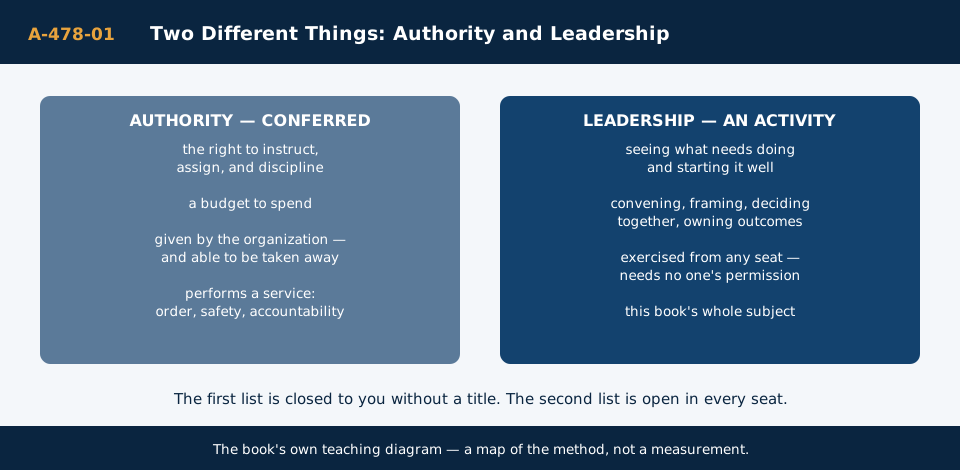
Figure A-01. The authority/activity map — what a title confers, what leading consists of, and why the second list is open to anyone in any seat.
It helps to hold the two lists side by side.
Not one item on the second list requires permission from a chart. Every item on it does require something else: credibility, which is why Chapter 3 comes before any chapter on influence, and care about limits, which is why this book returns to limits in almost every chapter.
There is also a demand context, with its limit attached. The World Economic Forum's Future of Jobs Report 2025 reports that leadership and social influence is a core skill for 61 percent of employers, ranked third among core skills. That is a large employer survey, and it tells you what employers say they value. It does not tell you that any technique works, and it promises nothing to any individual reader. Print it as weather, not as a forecast about yourself: workplaces say they need people who can move work without waiting to be told. This book teaches how that moving is done.
The distinction that does the most work in this chapter is Heifetz's second one. Some problems are technical: the cause is known, the fix is known, and the main need is expertise and correct application. A pump with a worn seal is a technical problem. So is a misprinted label or a schedule gap that a straight swap fills. Technical problems yield to knowledge and authority. The right person applies the known fix, and the problem ends.
Other problems are adaptive challenges: the cause is tangled, the fix is not yet known, and the people with the problem are part of both the cause and the cure. A changeover that has crept slower for a year because each operator quietly developed a private workaround is an adaptive challenge. So is a ward where handovers keep failing because day and evening staff picture the job differently. Nobody can fix these by applying a known procedure, because the procedure is part of what has to change. The people involved have to learn and adjust habits — and that learning cannot be ordered into existence.
Heifetz, Grashow, and Linsky name the most common failure in leadership plainly: treating an adaptive challenge as if it were a technical problem. It is an attractive mistake. Technical treatment is fast, looks decisive, and lets everyone avoid the awkward conversation. A new form is issued for the handover that keeps failing. A poster goes up about the changeover. The problem, being adaptive, absorbs the treatment and continues.
For a reader without authority, this distinction is practical gold, for two reasons. First, it tells you where your effort belongs. Technical problems inside someone else's service — a repair only a qualified trade may do, a staffing call, a spending approval — are not yours to take. Route them cleanly and stop. Adaptive work is full of tasks nobody owns by title: gathering what people actually do, naming the gap between the official way and the real way, holding a conversation long enough for a group to learn. That is your ground.
Second, it tells you how to talk about a problem without overclaiming. You do not announce a solution to an adaptive challenge; you cannot have one yet. You announce an observation and a question: here is what I counted, here is where it puzzles me, who else sees this? Groups can hear the difference.
At some point, usually just before acting, a voice asks: Who am I to do this? It sounds like humility. Often it is something else — a confusion between the two lists from earlier in this chapter.
Ask what the voice is actually protecting you from. If the act you are considering needs a right you do not hold — approving an expense, changing someone's shift, judging a colleague's work — the voice is correct, and the act is not yours. Stop there, every time. Chapters 10, 14, and 18 return to this boundary and teach how to hand such matters over cleanly.
But most first acts of leading need no right at all. Counting how long a changeover actually takes. Writing down the friction you keep meeting. Asking three colleagues whether they see the same thing. Offering to hold a short huddle and keep notes. Saying, in plain words, this part is mine and I will have it done by Thursday. None of that instructs anyone, and none of it spends anyone else's time without their agreement. The permission question, applied to acts like these, misfires: it asks for a license the situation never required.
There is a second confusion inside the question. People often wait to feel like a leader before acting like one, as if confidence were the entry requirement. The activity definition reverses the order. You do the acts — small, bounded, finished — and the standing follows from the finished work. Chapter 3 shows the mechanism: every kept commitment is a deposit, and the account, not the feeling, is what later acts draw on.
A cleaner question to carry is this: Is this act inside what I may do, useful to people I can name, and small enough to finish? If yes three times, the permission question is answered. If any answer is no, shrink the act until it fits, or route it to the seat that owns it.
Nothing about your job changes on Monday. Your title, duties, and supervisor are exactly as they were. What changes is what you count as available to you.
Hold the limits as firmly as the invitation. Leading without authority does not make you a shadow supervisor. It does not entitle you to instruct peers, to judge them, or to carry matters that belong to formal authority. The moment an issue involves safety, discipline, staffing, or someone's rights, your leadership act is a clean, prompt handover to the seat that owns it — and that handover, done well, is itself part of the craft.
The spill nobody owned. Cascade Preserves packs preserved fruit and vegetables. Elena Vasquez is a senior pack-line technician there — senior by experience, not by rank. She supervises nobody. Her crew is nine operators, five on the day shift and four on the evening shift, and her supervisor runs the floor from an office near the line office door.
Halfway through a morning run, a case of jars tips at the end of the pack line. Glass breaks. Syrup spreads across the walkway.
The weak version. Everyone sees it. The nearest operator steps back and calls out, "Something's spilled down here." Two others slow their work to watch. Someone says the supervisor should be told. Someone else goes to find her. The supervisor is with a delivery driver at the goods-in door, dealing with a short shipment — legitimately occupied.
Meanwhile the walkway stays blocked and unmarked. A forklift driver, not knowing, starts toward the staging area and has to brake and reverse. Operators begin stepping around the syrup through a gap beside a running conveyor, which is worse than the spill. Eight minutes pass before the supervisor arrives, and another five while she directs the cleanup. The line loses the better part of fifteen minutes, the near miss with the forklift is luck rather than management, and the crew's lesson is the old one: wait to be organized.
Nothing in the weak version is laziness. Each person behaved as the structure trained them: spills are the supervisor's service, so spills wait for the supervisor. The cost was paid in time, in risk, and in the group's belief about its own capacity.
The strong version. Same spill, same morning, same supervisor at the goods-in door. Elena is two stations away.
Elena: "Stop — nobody walk through that. Tomas, stay at the end there and wave the forklift round the other way, please. Priya, will you bring the cones from the wash station?"
Tomas: "Got it."
Priya: "Cones, and the spill kit?"
Elena: "Cones first. I'll stop our segment — that's mine to stop — and then I'll get the kit."
Elena stops the line segment she is responsible for, which is inside her own authority. She does not stop the whole line; that call is not hers. She asks — by name, for defined tasks — rather than instructing. Tomas and Priya agree out loud; the agreement makes it coordination rather than command. Within two minutes the area is coned, traffic is re-routed by a person rather than by luck, and cleanup is under way. Elena sends the youngest operator to tell the supervisor what has happened and what is already being done — information, delivered early.
When the supervisor arrives, she finds a protected area, a stopped segment, and a cleanup half done. She extends the stop to the full line for the last few minutes, which is her call, and thanks the crew without ceremony. Disruption is shorter, the risky gap beside the conveyor never gets used, and the crew's lesson is different: we can organize the first minutes ourselves.
Notes on why the strong version works.
The question three people could answer. A new hire on a hospital ward, in her second week, is shown three different ways to restock a treatment room by three staff members. Each way is defended as "how we do it." She asks the ward clerk — a colleague with no authority over anyone — which way is right.
The clerk does not pick a winner; that is not hers to do. Instead she convenes: at the quiet point of the afternoon she gathers the three for ten minutes, with the new hire present, and asks one question: "Can we settle on one way, so she learns it once?" They compare methods, discover that two differ only in shelf order and the third exists because of a delivery change two had missed, and agree a single sequence. The clerk writes it on a card inside the treatment-room door. A tiny adaptive challenge — three habits, no villain — was solved by the one act nobody needed rank for: getting the right people into the same ten minutes.
End of the free sample. The complete book continues from here — the full A-to-Z course in book form, delivered as an EPUB you can read in Apple Books, Google Play Books, ReadEra, Thorium Reader, Adobe Digital Editions, or Send to Kindle.
Buy this ebook — $12.99 Back to the book page
Payments are securely processed by Payhip.