
Mastering Careers & Skills
Land Surveyor Fundamentals Exam (FS) · free sample from the book itself
Imagine arriving at a piece of ground before the heat does. The grass is wet. Somewhere under a cedar at the back of the parcel there is supposed to be an iron pipe, set years ago by a surveyor whose name appears in faded ink on an old plat. Your job, if you take up this profession, begins with questions that sound simple and are not. Where exactly does this land end and the neighbour's land begin? How high is this ground above the sea, and will water stand here or run off it? If a road is built across that slope, where precisely will its edges fall? If a family buys this parcel, what document can they rely on when they ask what they actually own?
Surveying is the disciplined craft of answering questions like those with measurements that other people can trust, repeat, and build legal and physical structures upon. It is one of the oldest technical professions in the world, and it is also a thoroughly modern one, practised today with satellites, robotic instruments, laser scanners, and drones. This book teaches that whole field from zero, and it prepares you completely for the first formal gate on the road to practising it in the United States: the Fundamentals of Surveying examination, known everywhere in the profession simply as the FS.
This opening chapter does three things. First, it explains what surveying is and who surveyors are, in plain words, so that everything later in the book has a home. Second, it describes the FS examination exactly as its maker publishes it — how many questions it holds, how long you sit for it, what you may use inside the room, how it is scored, and what it does not do. Third, it maps the longer road of which the FS is only the first gate, and it does so under the single most important structural fact in this entire book, a fact worth memorising before anything else: NCEES examines; state boards license. Those five words will recur throughout this book, because confusing the two gates is the most common and most costly misunderstanding new candidates carry into their preparation.
Key fact: the FS is a national examination developed and scored by NCEES, and passing it confers no title by itself — your state licensing board issues the Surveyor Intern certification and owns every step after the exam.
At its heart, surveying is measurement with consequences. A carpenter measures a board; if the cut is wrong, a board is wasted. A surveyor measures land; if the measurement is wrong, a building may sit across a boundary, a road may drain the wrong way, a family's title may be clouded for a generation, and a court may spend years sorting out the result. That difference in consequence is why surveying is a licensed profession rather than an unregulated trade, and why this book treats careful method — checking, redundancy, documentation — as a moral habit and not merely a technical one.
The surveyor's work divides, roughly, into four great families, and you will meet all four repeatedly in this book. The first family is boundary work: finding, re-establishing, and marking the limits of land ownership, and describing those limits in words and drawings that will still make sense in fifty years. The second family is measurement and positioning work: establishing precisely known points — called control points — and using them to locate everything else, whether by instruments on the ground or by signals from navigation satellites. The third family is mapping work: turning measurements into maps, plats, terrain models, and digital data that engineers, planners, builders, and governments use. The fourth family is construction and development work: laying out designed things — roads, buildings, pipelines, subdivisions — in their correct positions on the ground, and afterwards verifying that what was built matches what was designed.
Notice what unites the four families. Every one of them rests on the same foundations: mathematics, especially geometry and trigonometry; measurement science, especially the honest handling of error; a working knowledge of the Earth itself, its shape and its coordinate systems; the records and the law that govern land; and the professional discipline of writing down what you did so that another surveyor can follow your footsteps. The FS examination is built on exactly those foundations, which is why this book is built on them too, in the same order.
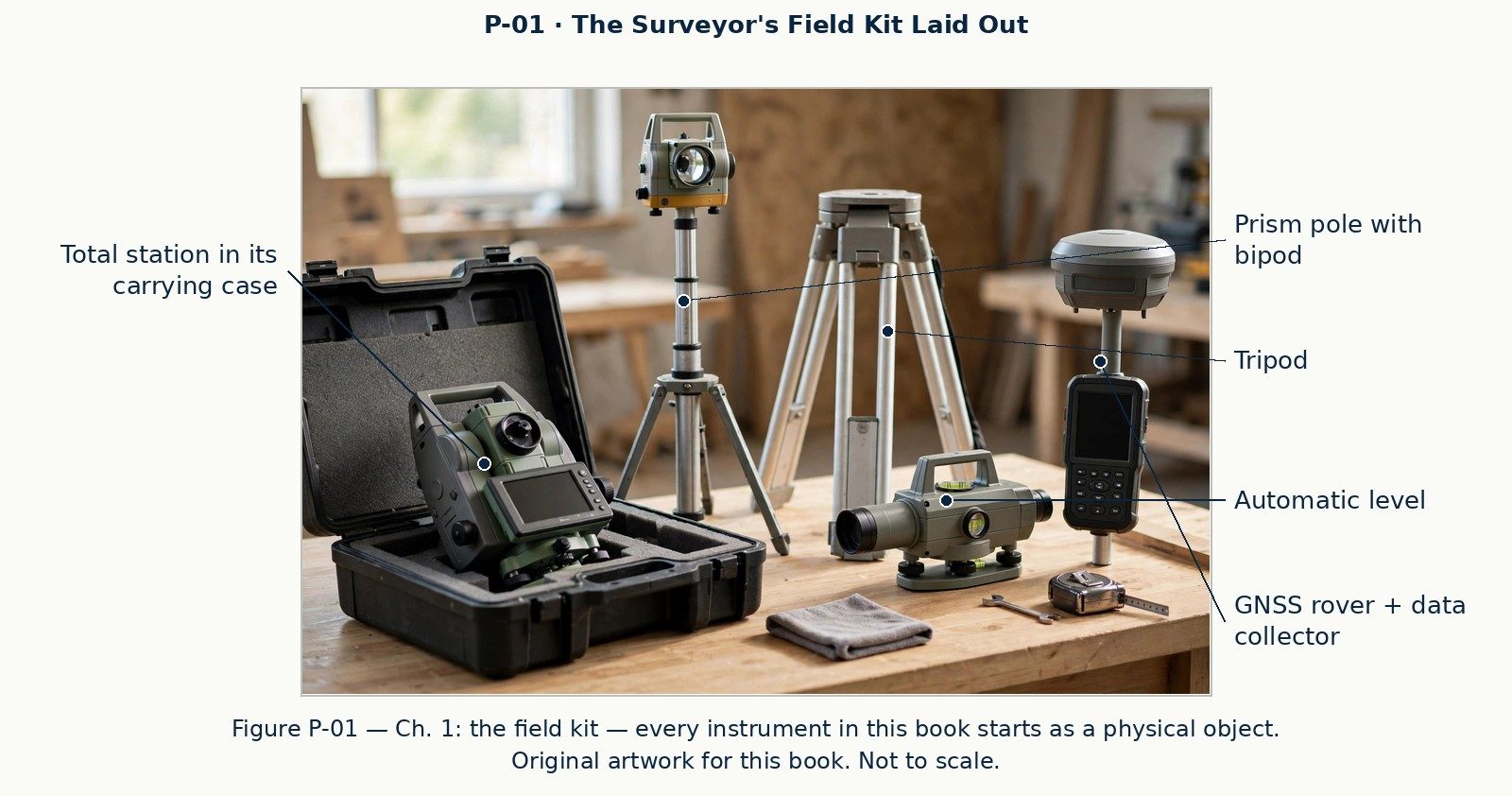
Figure P-01 — The surveyor's field kit laid out — total station in its case, prism pole, tripod, automatic level, and GNSS rover receiver with data collector, each part labeled
A word about the word fundamentals in the examination's name. It does not mean easy, and it does not mean superficial. It means foundational: the knowledge that everything else in surveying practice stands on. The examination expects you to compute a traverse closure by hand-reasoning, to know why a level loop that does not close is telling you something, to understand what a deed's description controls when it conflicts with a measured distance, and to recognise which instrument and method fit which job. Candidates who treat the FS as a trivia test about definitions are routinely surprised by how computational and how judgment-heavy it is. This book will not let you make that mistake: from Chapter 3 onward you will compute constantly, and from Chapter 22 onward you will weigh evidence the way the profession weighs it.
The licensed surveyor in the United States carries a title that varies by state — you will see Professional Surveyor, Professional Land Surveyor, Registered Land Surveyor, and Licensed Surveyor used in different jurisdictions — but the role is the same: a licensed professional who is legally authorised to determine and certify the positions and boundaries of land, and who accepts professional liability for that certification. Under the licensee works a whole team: field crew members who run instruments and cut line, instrument operators, crew chiefs, technicians who reduce data and draft plats in the office, and interns building experience toward their own licences. Many readers of this book already work in one of those roles. Many others are students. Some are career changers who have never held a prism pole. All three readers are welcome here, and Chapter 1 closes with a distinct study plan for each.
NCEES — the National Council of Examiners for Engineering and Surveying — describes the FS in its own words as an examination designed for recent graduates and students who are close to completing an undergraduate degree in surveying, and its exam page adds the detail that the degree contemplated is from an ABET-accredited program. Hold that sentence at exactly the weight NCEES gives it. It is a statement about whom the examination was designed for — its assumed preparation and difficulty — not a national eligibility rule. Eligibility to sit for the FS is determined by each state licensing board, and it varies. Some boards tie eligibility closely to accredited education; others recognise additional routes built on experience or on combinations of education and experience; the details are each board's own. This book therefore never prints one state's education rule as if it were the nation's, and your very first task as a candidate — before you spend serious money or serious months — is to read your own board's published requirements. Chapter 28 returns to that task with a checklist; the plans at the end of this chapter schedule it in week one.
Key fact: NCEES's designed-for description tells you the examination's assumed preparation; your state board's published requirements tell you whether and when you may sit. The second document, not the first, governs your case.
The FS is a computer-based test, delivered exclusively at Pearson VUE test centres, in quarterly testing windows spread across the year. It is a closed-book examination with an electronic reference: you bring no books, no notes, and no papers into the room, but on the screen beside your questions you are supplied with the official reference material described in the next section and in full in Chapter 2. The examination contains 110 questions. Most are traditional multiple-choice questions with one correct answer; the examination also uses alternative item types — questions with multiple correct options, point-and-click questions, drag-and-drop questions, and fill-in-the-blank questions — all scored simply correct or incorrect, with no partial credit. A limited number of the questions are unscored pretest items, placed randomly among the scored ones and not identifiable; NCEES publishes no count of them, and this book invents none.
Your appointment is described by NCEES as a 6-hour appointment, and its published segment table sums to 5 hours 55 minutes of scheduled segments: 2 minutes for the nondisclosure agreement, 8 minutes for the tutorial, 5 hours 20 minutes of examination time, and a scheduled break of 25 minutes. Learn the segments, not just the headline: the number that governs your pacing is the 320 minutes of examination time, which works out — this is this book's arithmetic, offered as arithmetic — to roughly 2.9 minutes per question across the 110 questions. Chapter 27 builds your entire pacing strategy on that figure.
The examination is divided into two sections. You receive the whole examination time at the start; the sections are not separately timed. After approximately half the questions, you are offered the chance to review that first portion and submit it. Once submitted, those questions are locked and cannot be revisited. You may then take the scheduled break. This single mechanic — the submit lock — shapes good strategy more than any other feature of the delivery, and this book rehearses it explicitly in its full practice forms, which are worked in two locked halves for exactly this reason. Breaks you take at any other time are unscheduled breaks, and they deduct from your examination time.
The examination uses both the International System of Units (SI) and the U.S. Customary System (USCS). That sentence, from the official specification, is a study instruction in disguise: you must be fluent in both systems and in converting between them, including the surveying-specific distinctions this book teaches in Chapter 5. Worked examples throughout this book are computed in the unit system of their statement and checked in the other system, and you should build the same habit from your first week.
Key fact: 110 questions, 5 hours 20 minutes of examination time inside a 6-hour appointment, two sections with a submit lock after approximately half, both SI and USCS units, closed book with a supplied electronic reference.
Because the examination is closed book, everything you are allowed to consult is supplied on screen. There are two supplied layers, and Chapter 2 is devoted to them. The first layer is the FS Reference Handbook, published by NCEES: the only handbook allowed in the examination, supplied on screen as a searchable PDF displayed beside the questions on a 24-inch monitor. The second layer is a set of six named professional standards, likewise supplied as searchable PDFs, available for the entire examination, with one document open at a time. Questions that reference a standard of practice are scored against that supplied list and the revision years NCEES names. You will learn each standard's identity, publisher, purpose, and the kind of question that reaches for it — as landmarks you can navigate to under time pressure — in Chapters 2 and 26.
Before the examination, the current handbook is available free of charge through your MyNCEES account, and downloading it and learning to search it is the first practical task this book assigns you. Notice the boundary that comes with that gift, because this book observes it strictly: the handbook may be printed for personal use, but its content may not be copied, reproduced, or distributed, and disclosing reference-handbook content is treated by NCEES as an examination irregularity. Accordingly, this book teaches the surveying mathematics and science itself — as mathematics, in its own derivations and worked examples — and teaches the handbook's existence, role, and search craft. It reproduces none of the handbook's content. That is not a limitation on your preparation; it is the correct shape of it. On examination day you will search the official document. In this book you learn the subject deeply enough that you know what to search for, and you learn the searching itself as a skill.
You bring exactly two categories of things into the testing room. The first is identification and admission material: a government-issued photo ID, and yourself, ready to sign digitally, be photographed, and give a palm-vein scan, as the Examinee Guide describes. The second is one NCEES-approved calculator, without its cover. The approved list lives in NCEES's Calculator Policy, which NCEES reviews; this book names calculator models only in the exact form NCEES names them, and until you verify the current policy yourself, the safe instruction is the posture itself: one approved calculator, no cover. Separately, an on-screen TI-30XS calculator is available during the examination for candidates who want it. Everything else on the ordinary contents of your pockets and bag — phone, watch and other wearables, wallet, bags, coats, books, notes, pens and pencils, food and beverages — is prohibited in the testing room and belongs in the centre's locker. Chapter 27 walks the whole check-in posture slowly; for now, fix the shape: almost nothing goes in with you, and what does go in is specified.
Key fact: you are supplied, on screen, with the FS Reference Handbook and six named standards as searchable PDFs; you bring a government-issued photo ID and one NCEES-approved calculator without its cover; an on-screen TI-30XS is also available.
NCEES publishes the examination's content as seven knowledge areas, each with a published range of questions. The ranges are ranges — NCEES does not publish a fixed count per area — and across the seven areas they sum to 100–152, bracketing the 110 questions. This book's practice forms use one disclosed construction inside those ranges, printed on each form's face as this book's construction; no count in this book is ever presented as an NCEES-published fixed count. Learn the seven areas now, because the whole book — and the specification crosswalk in Appendix A — is organised by them.
Area 1, Surveying Processes and Methods (published range 16–24), covers the instruments of the field — GNSS/GPS equipment, levels, total stations including robotic stations, scanners, and unmanned aerial systems — together with GNSS survey methods, control surveys, cadastral surveys, topographic surveys, construction surveys, land development, and field record keeping. Area 2, Mapping Processes and Methods (14–21), covers basic mapping concepts and cartography, types of maps, computer-aided drafting including building information modelling at survey grain, geographic information systems, digital terrain models, and photogrammetry and remote sensing including LiDAR. Area 3, Boundary Law and Real Property Principles (19–29), is the heaviest area on the examination: public records and land descriptions, common-law principles and controlling elements, easements, simultaneous and sequential conveyances, metes and bounds, the Public Land Survey System, water law, sources of law, encumbrances, and real property law including deeds and chains of title. Area 4, Surveying Principles (13–20), covers basic surveying including historical methods and instruments and magnetic declination, geodesy including spherical trigonometry, and applied geodesy including datums, coordinate transformations, and the state plane coordinate system. Area 5, Survey Computations and Computer Applications (17–26), is the computational engine room: coordinate geometry, traverse closure and adjustment, leveling, least squares adjustments, area, horizontal curves, vertical curves, volume, spreadsheets, and slopes and grades. Area 6, Business Concepts (11–17), covers project planning, safety, liabilities, contracts, supervision, project documentation, ethics, and communication. Area 7, Applied Mathematics and Statistics (10–15), covers college mathematics — trigonometry, analytic geometry and calculus, linear algebra and matrix theory — probability and statistics, measurement science including error analysis and propagation, and quantitative reasoning.
Read that list as a syllabus and as a warning. The examination is not mostly mathematics, and it is not mostly law, and it is not mostly instruments: it is all seven, weighted roughly as the ranges suggest, with boundary law the single heaviest commitment and computations close behind. A preparation that pours everything into the mathematics and starves the law — the most common self-study failure this book is designed to prevent — misreads the published shape of the test. Your diagnostic, described below, exists to show you your own balance across the seven areas before you commit your months.
Key fact: the seven published areas and ranges are — Processes and Methods 16–24; Mapping 14–21; Boundary Law and Real Property 19–29; Surveying Principles 13–20; Computations and Computer Applications 17–26; Business Concepts 11–17; Applied Mathematics and Statistics 10–15.
Scoring deserves its own section, because it is the subject on which the most confident misinformation circulates. Here is the whole of what NCEES publishes, and it is all this book will ever print on the subject. Your result is based on the total number of correct answers; there are no deductions for wrong answers, so an unanswered question is a certain zero and a reasoned guess can only help you. Your correct-answer total is converted to a scaled score, a conversion that adjusts for minor differences in difficulty between examination forms, so that the standard means the same thing from one form to the next. That scaled score is compared with a minimum ability level for the examination, a level determined by subject-matter experts through psychometric statistical methods. If your scaled score meets or exceeds that level, you pass; otherwise, you do not. NCEES applies no predetermined percentage of examinees who should pass or fail, and first-time and repeat takers are graded to the same standard.
And then the sentence that fences everything else: NCEES does not publish the passing score. There is no published percentage, no published raw count, and no published scaled value that this book can give you, because the examination body itself does not give it to anyone. Figures you will encounter elsewhere — confident percentages, folk ranges of correct answers, numbers borrowed from entirely different examinations, including state-specific examinations that have their own standards — are not FS facts, and this book bars every one of them from its pages, from its practice forms, and from its readiness advice. When this book's diagnostic or practice forms report your result, they report a raw count by knowledge area, for your own readiness judgment. No raw count, here or anywhere, converts into the scaled score or predicts your examination result, and every form in this book says so on its face. Treat any source that offers you a conversion as a source that has told you something untrue about how the FS works.
Results are typically available 7–10 days after the examination, by email notification directing you to your MyNCEES account, together with board-specific next steps — a small phrase that carries the two-gate structure even into the results process. If you do not pass, you receive a diagnostic report: your performance in each knowledge area, expressed as a scaled score of 0–15 for that area, with the number of items in the area and a comparison against the average performance of passing examinees in that area. Two cautions are printed with that report's anatomy, and Chapter 28 builds an entire repair method on them: the report cannot be used to determine the passing score, and the number of questions you answered correctly cannot be derived from the scaled scores. The report is a map of relative strength and weakness, nothing more — but used properly, as Chapter 28 teaches, a map is exactly what a retake candidate needs.
Retakes operate inside a published frame: one attempt per testing window, and no more than three attempts in any 12-month period, with some boards more restrictive than the national frame. The examination fee is payable in full at each registration, so a retake is a real budget item, not a shrug. Once you are approved to test, you have 12 months to take the examination or the fee is forfeited. The fee itself is $225 per attempt, payable directly to NCEES, under the fee table effective January 1, 2024, as published in the Examinee Guide; some boards charge a separate application fee of their own, for which NCEES publishes no amount and this book prints none. Cancellation and rescheduling carry their own published administrative fees, which Chapter 27 details; what matters at this chapter's altitude is the shape: registration money is committed money, and scheduling is a decision to make deliberately.
Key fact: scoring is total correct answers, with no deduction for wrong answers, converted to a scaled score and compared with a minimum ability level set by subject-matter experts through psychometric methods — and NCEES does not publish the passing score.
Remember the numbers — this chapter's whitelist: 110 questions · 5 hours 20 minutes of examination time · 2 + 8 + 25 minutes of agreement, tutorial, and break · $225 per attempt, payable to NCEES · one attempt per window, at most three in 12 months · 12 months to test once approved · results typically in 7–10 days · diagnostic performance by area on a 0–15 scale. Every number in that list is traceable to NCEES's own published documents for this book's edition; if a number about this examination cannot be traced that way, it does not belong in your preparation.
Now the structure that gives this chapter its title. Becoming a licensed surveyor in the United States is a two-gate road, and the gates belong to two different authorities. The first gate is examination, and its keeper is NCEES: NCEES develops the FS, delivers it, and scores it, for the state licensing boards that use it. The second gate is licensure, and its keeper is your state licensing board: the board determines your eligibility to sit, receives your result, issues your Surveyor Intern certification when you pass and apply, sets and verifies your qualifying experience, administers any state-specific examination your jurisdiction requires, and finally issues your licence as a Professional Surveyor. Passing the FS, by itself, confers no title, no certificate, and no right to practise. It satisfies one requirement — a large one — inside a process your board owns.
NCEES's own contact guidance draws the line in the same place: questions about surveyor intern certification and about qualifications for licensure go to the licensing board; questions about registration and scoring go to NCEES; questions about the test centre, rescheduling, and accommodations go to Pearson VUE. When you are confused about a step, ask first which gate it belongs to. Most candidate confusion dissolves at that question.
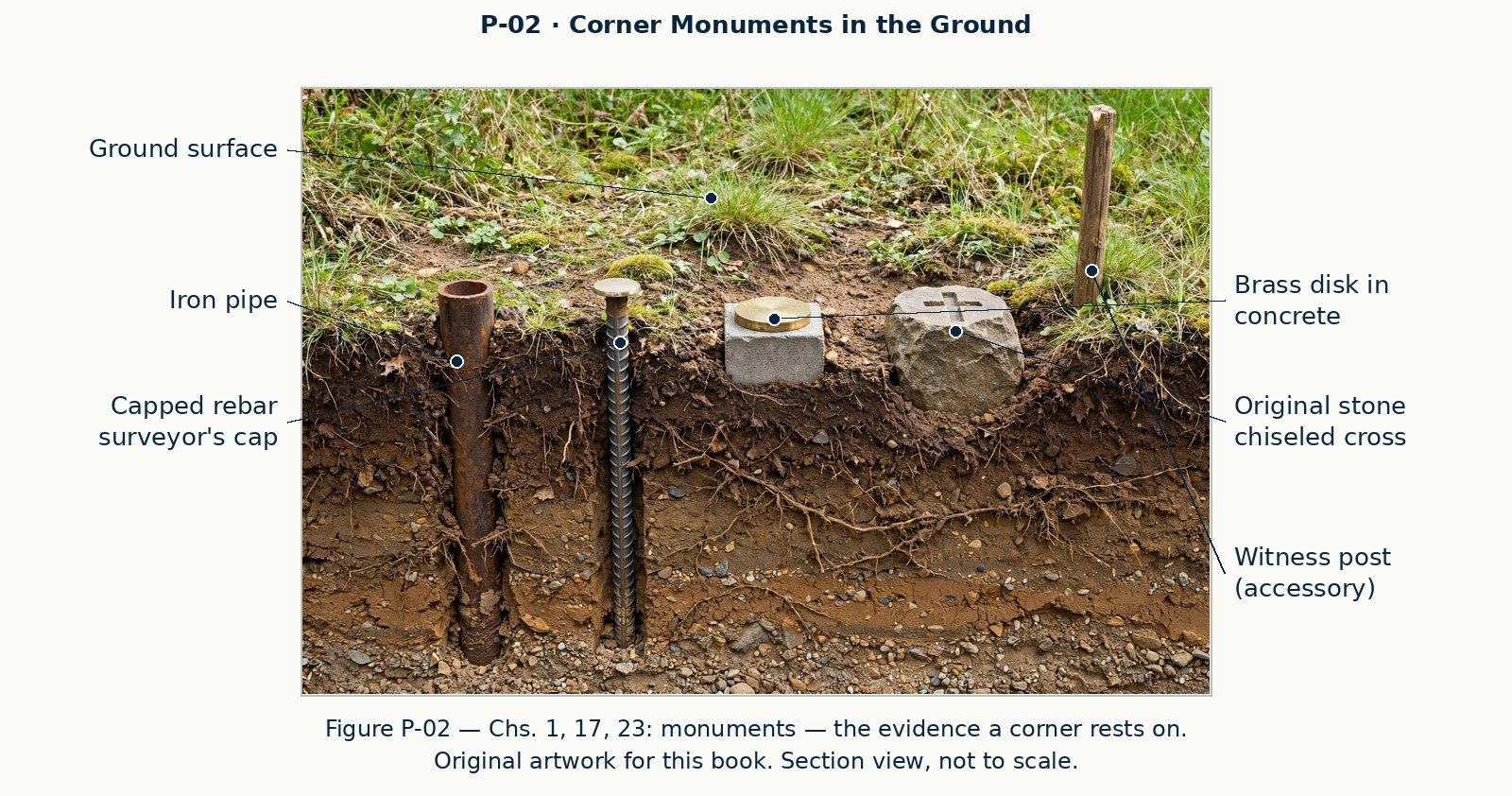
Figure P-02 — A family of corner monuments as set in the ground — iron pipe, capped reinforcing bar, brass disk in concrete, and an original stone — each labeled, with witness accessories beside them
The road, at national grain, runs in this order. First comes education, in the form and amount your board requires; recall that the examination is designed with the ABET-accredited undergraduate surveying degree in view, while the actual requirement in your case is your board's published rule. Second comes the FS examination — this book's subject, NCEES's gate. Third comes Surveyor Intern certification, issued by your state board on application after you pass; NCEES's own usage is Surveyor Intern, abbreviated S.I., and you will also meet the title variants LSIT and SIT in different states — variants of title, not different rungs. Fourth comes qualifying experience: responsible surveying work performed under a licensed surveyor, in the amount and kind your board requires. This book prints no single national figure for that experience, because none exists; boards set it, boards vary, and any book that gives you one number as the national requirement is giving you somebody's state rule dressed as a universal. You will sometimes see a four-year figure attached to this part of the road; in the primary source it describes the candidate the later PS examination is designed for — surveyors who have gained at least four years of work experience, in NCEES's description of that examination's intended audience — and this book quotes it only in that form, as a design frame for the PS, never as your requirement. Fifth comes the PS examination, the Principles and Practice of Surveying sitting, the second NCEES examination, which is a separate future book in this series and is signposted here but not taught here. Alongside it, many states require a state-specific jurisprudence or law examination covering that state's statutes, rules, and recording practice; this book teaches that as a pattern to verify with your board, never as a list of states, because the list and the contents are board matters that change. Sixth and last comes licensure by your board as a Professional Surveyor, under your state's title variant.
Two honest consequences follow. The first is that this book can be, and is, complete for its gate: the FS is one national examination with one published specification, and Chapters 2 through 28 prepare you for all of it. The second is that no book can complete the second gate for you, because the second gate is fifty-plus separate jurisdictions' law and administration. What this book does instead — in this chapter, in Chapter 28, and at every step where the road passes from NCEES's territory into a board's — is tell you exactly which steps belong to your board, what kind of document to ask the board for, and what habits, especially experience documentation, to build from your first week so that the board's steps go smoothly when you reach them.
Exam trap: any sentence of the form "pass the FS and you become an intern" collapses the two gates. The examined sequence is: pass the FS, then apply to your board, which issues the Surveyor Intern certification. Items in Area 6 and questions about the licensure process test precisely this separation.
This book is an independent study guide. It is not published by, affiliated with, endorsed by, or approved by NCEES, and NCEES did not participate in its creation. It teaches the complete subject of surveying at fundamentals depth — the whole field as the coverage map in the front matter enumerates it: measurement science and instrument craft; the mathematics of position; the Earth's figure and its coordinate systems; the mapping sciences; the law of boundaries; and the business of practice — and it prepares you for the FS across all seven published knowledge areas and their fifty-two subtopics, with the crosswalk in Appendix A proving the coverage area by area.
Its practice apparatus is original throughout. You will find a 50-item entry diagnostic, printed entire in the free sample so you can judge this book by its items before you rely on it; a 20-item quiz at the end of every chapter from Chapter 2 onward; two full practice forms of 110 questions each, built inside NCEES's published ranges under a disclosed construction and worked under the real examination's time and two-section lock; and seven area repair sets for targeted rebuilding. Every item is individually written against the published specification, with an explanation of why the keyed answer is right and why each other option is wrong. Nothing in this book is an actual examination item, a recalled item, a paraphrase of one, or an adaptation of NCEES's practice material; disclosing real examination content is an irregularity under NCEES's own rules, and no honest preparation needs it.
NCEES sells its own practice product, and this book routes you to it honestly rather than pretending it does not exist: the FS Interactive Practice Exam, offered through MyNCEES, contains 50 questions and was priced at $50.00 as published when this book's sources were read. Its distinctive value is the maker's own: questions and solutions presented as representative of the computer-based experience, format, and content, with timed and review modes. This book's practice rehearses content, proportion, pacing, and reference use; only the maker's materials reproduce the maker's interface, and Chapter 27 says so in full. Many candidates use both, in the order the study plans suggest.
The fences deserve one plain paragraph, because they are promises. This book prints no numeric passing score in any form, because NCEES publishes none. It prints no pass rates, although NCEES publishes them in its statistics annual, because this series does not print rates in any reader-facing surface. It prints no salary or income figures. It reproduces no content of the FS Reference Handbook and no requirement text or values from the six supplied standards; those documents are taught as landmarks — identity, publisher, purpose, and the questions that reach for them. It states no state's rule as the national rule. And it promises no outcome: no book can guarantee a pass, a certification, a licence, or a job, and this one does not try. What it guarantees is narrower and real: complete coverage of the published specification, mathematics taught from zero and checked twice, and an honest map of the road.
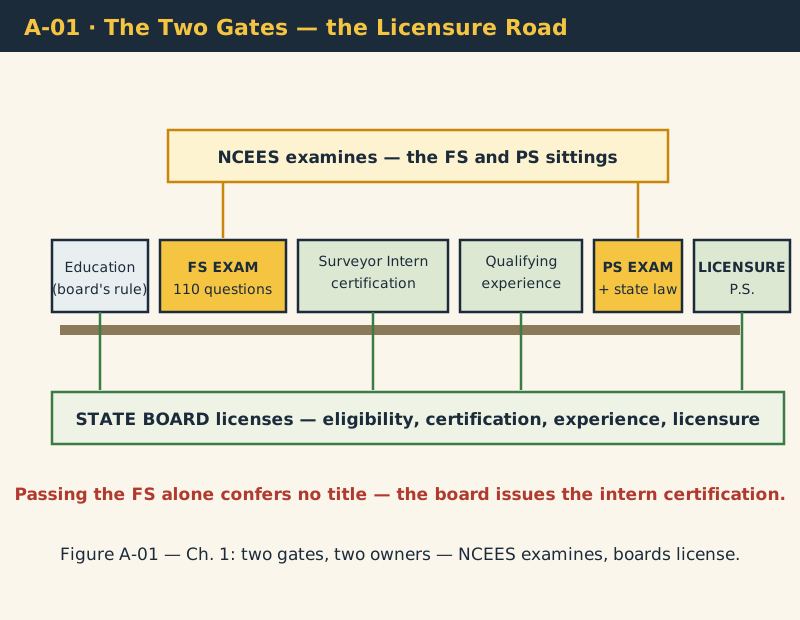
Figure A-01 — The two-gates road diagram — education, the FS examination under NCEES, Surveyor Intern certification, qualifying experience, the PS examination, and licensure under the state board, with the NCEES/board ownership of each step labeled
Every reader, whatever their background, begins the same way: with the entry diagnostic printed in the front matter. Take it untimed in presentation but honestly — it is designed to be completed in about an hour — with no references open, and score it by knowledge area using the tracker that accompanies it. The diagnostic is not a verdict and converts to nothing; it is a routing instrument. Its seven area scores tell you where your preparation months belong, and its results assign your first repair sets if any area starts weak. Then take the plan that matches your situation.
The surveying student plan runs at semester pace. Read Parts II through V alongside the corresponding blocks of your coursework, where the book's derivations will reinforce your lectures and your lectures will give the book's abstractions a laboratory. Take the diagnostic cold in week one anyway: coursework in most programs underweights boundary law and business concepts relative to their examination ranges, and it is better to learn that in week one than in the final month. Schedule the administrative tasks — board requirement check, MyNCEES account, the free handbook download — in the first week, and aim to sit the FS while your mathematics is warm.
The working technician plan starts from the field. If you run instruments for a living, Parts IV and V will read as the formalisation of craft you already hold; read them at speed, but do not skip them, because the examination tests the vocabulary and the standards-consciousness of the craft, not only its motions. Your weight goes where the field does not teach: the Part I mathematics spine rebuilt in full, the Part III computations, and the Part VI law. From day one, keep your experience records in the form boards ask for — task, level of responsibility, supervising licensee — because the intern application will ask, and memory is a poor archive.
The career-changer plan assumes nothing. Read Part I in full and in order; use the labeled plates of the instruments as your first visual vocabulary of the field; treat the foundations map in the front matter as a checklist you will revisit after every part. And hold the eligibility honesty of this chapter in front of you: your first task is your board's published requirements page, because education and experience routes differ by state, and your study plan must be built on the route that is actually open to you.
The retake-recovery plan begins not with this book's diagnostic but with your real one: the diagnostic report from your sitting, read by the method Chapter 28 teaches, area by area on its 0–15 scale. Assign the matching repair sets, rebuild, and re-sit only when the corresponding repair set and one fresh full form both clear this book's readiness bar — a bar this book sets and labels as its own, which is exactly what it is. Budget the full fee for each attempt and schedule inside the one-attempt-per-window, three-in-twelve-months frame.
Whichever plan is yours, the administrative spine is identical and belongs in week one: read your board's requirements; create your MyNCEES account; download your free copy of the FS Reference Handbook and begin learning to search it while you study, not after; and register only when your preparation and your board's approval sequence say you are ready, remembering the 12-month clock that approval starts. Chapter 2 now takes up the examination's supplied references in full — the handbook and the six standards — because the closed-book room is not an empty room, and learning to work in it is a skill this book teaches deliberately, starting next.
It may help, before the mathematics begins, to see the whole profession compressed into one ordinary day — an invented day, but a faithful one. A crew leaves the office before seven with a work order: re-establish the boundary of a parcel being sold, set the missing corner, and pick up the topography of its front field for a drainage design. The crew chief has already done the office half of the job the afternoon before: searching the public records for the deed and the deeds of the neighbours, because boundaries are decided first in the records and only then on the ground; computing the deed's called distances and bearings into coordinates, a piece of pure trigonometry; and checking the control points near the site in the firm's database. On site, the instrument operator sets a total station over a known point, orients it to another known point, and the crew searches for the called-for monuments with a magnetic locator and a spade — finding one pipe leaning, one stone undisturbed, and nothing where the third corner should be. Each find is measured, photographed, and described in the field records, because a monument's condition is evidence and evidence is the boundary surveyor's stock in trade. The missing corner is then set, not where a single measurement says, but where the whole weight of the record and the found evidence says the original corner stood — a legal judgment executed with a hammer and a capped pin. In the afternoon the same crew runs a level loop to carry elevation onto the site and collects the topographic points the designer needs, and in the evening the data are downloaded, checked against the field notes, and archived where another surveyor could reconstruct the entire day without asking anyone a question.
Count the fundamentals inside that single day. Trigonometry and coordinate geometry, twice over. Measurement science: the level loop either closes within tolerance or announces a mistake, and knowing the difference is error theory, not luck. Geodesy in miniature: the control points the crew trusted exist inside a datum and a coordinate system somebody had to understand to build. Mapping: the topographic pickup becomes a surface model an engineer will design against. Law: the corner was set by weighing evidence under common-law principles, and the plat that records it becomes a public document with legal force. Business: the work was estimated, scheduled, documented, and will be billed and defended under a contract, by a firm whose licence and livelihood ride on its records. That is why the fundamentals are fundamental, and why the examination samples all of them: the profession cannot be divided into the parts a surveyor feels like knowing. The FS simply certifies, at the entry gate, that the whole foundation is present.
It is also worth seeing, at the outset, what kind of thinker the examination rewards. It rewards the candidate who computes carefully and checks cheaply — who knows that a traverse whose angles do not close cannot produce trustworthy coordinates, and checks the angles first. It rewards the candidate who reads a deed description asking what each call controls, not merely what each call says. It rewards the candidate who, offered four methods, chooses by fit — accuracy required, terrain, time, and the standard the product must meet — rather than by familiarity. And it rewards the candidate who treats documentation as part of the measurement: in this profession an unrecorded observation is, professionally, an observation that did not happen. Every chapter that follows trains one or more of those habits deliberately, and the practice items are written to catch their absence. If you build those four habits while you learn the content, you will find the examination feels less like an adversary and more like an audit of a craft you have actually acquired — which is, in the end, precisely what a fundamentals examination is for.
One last orientation before you turn the page. Candidates often ask, in the first week, some version of the same question: how hard is this examination, really? This book answers that question without the two dishonest instruments — it quotes no rate at which candidates pass, and it names no score at which passing occurs, because neither belongs in print here. The honest answer is structural. The examination is exactly as hard as its published specification: seven areas, fifty-two subtopics, 110 questions in 320 minutes, closed book, with the mathematics of the field expected at working fluency rather than recognition. That is a substantial but finite body of knowledge, every part of it is taught in this book from its foundations, and finite bodies of knowledge yield to organised study. Measure your readiness the way this book measures it — by area, against the specification, with timed full forms at the end — and let the examination's own published shape, not folklore about it, set both your respect for it and your confidence. The road is long, but it is surveyed: every station on it is marked in the chapters ahead, beginning with the room itself and the two reference layers you will be given inside it.
The Complete Land Surveying Course — 985 Practice Questions, Diagnostic & 2 Full Timed Practice Tests, Every Answer Explained
Feras Alzubi
Exam Prep Series · Book 52
© 2026 Feras Alzubi. All rights reserved.
No part of this book may be reproduced, distributed, or transmitted in any form or by any means without the prior written permission of the copyright holder, except as permitted by law.
This book is an original work. Every explanation, worked example, figure, and practice item in it was written for this book, against the published examination specification named in the References. No examination item — actual, recalled, paraphrased, or adapted — appears in these pages, and no content of the FS Reference Handbook or of any supplied standard is reproduced.
Not-affiliated disclosure. This book is an independent study guide. It is not published by, affiliated with, endorsed by, or approved by NCEES, and NCEES did not participate in its creation. "Fundamentals of Surveying," "FS," and "NCEES" are used as statements of fact about the examination this book prepares you for. The examination itself, its specification, its supplied references, and its scoring belong to NCEES and to the state licensing boards; this book teaches you to meet them and claims no part of them.
Examination facts in this book are drawn from NCEES's own publications as cited in the References (specifications effective beginning with the July 2020 examinations; Examinee Guide, May 2026 edition; scoring and handbook pages as read 2026-11-03) and are re-verified at production, as recorded in the back matter's Errata & Edition Note. Where a fact belongs to a state licensing board, this book says so and prints no state's rule as the nation's.
This book does two jobs, and it does them in one binding: it teaches surveying, complete, from zero — the mathematics, measurement science, instruments, geodesy, mapping, and boundary law of the field — and it teaches complete mastery of the Fundamentals of Surveying (FS) examination: its seven knowledge areas, its two supplied-reference layers, its room, its clock, and its aftermath.
Start with the first task. Before Chapter 3, do the one administrative act the whole book leans on: open your MyNCEES account and download your free copy of the current FS Reference Handbook. The handbook is the only reference the exam supplies besides the six standards; this book teaches its existence, role, and organization and its search craft (Chapters 2, 26, 27) and reproduces none of its content — your fluency must be built on the real document, and it is free.
Then take the entry diagnostic (printed in this front matter's companion section): 50 items, untimed in presentation and designed for about 60 minutes, spanning all seven knowledge areas and scored by area. Your result is a raw count by knowledge area for your own readiness judgment. NCEES converts the real exam's correct answers to a scaled score and compares it to a minimum ability level set by subject-matter experts; NCEES does not publish the passing score, and no raw count — here or anywhere — converts to it or predicts your result. The diagnostic's job is routing: it points you at chapters and, later, at the area repair sets (R-1 through R-7) that match your weakest areas.
Read by your path (the four reader paths of §8, printed in full in Appendix B): the surveying student reads alongside coursework and sits while the mathematics is warm; the working technician formalizes field craft and rebuilds the mathematics and law the field does not teach; the career changer reads Part I in full and in order, using the foundations map below as a checklist; the retake candidate starts from a real diagnostic report (Chapter 28's method) and works the matching repair sets first. Every path shares the spine — foundations → measurement and computations → field and mapping → boundary law → business, standards, and exam craft → timed full forms → repair by area — and every path schedules its administrative tasks (board requirement check, MyNCEES account, handbook download, registration) in week one.
Know the apparatus. Chapter quizzes (20 items each, Chapters 2–28) test the chapter just read; the two full practice forms (110 items each) are built to the exam's published shape — one fixed count inside each of NCEES's published ranges, summing to exactly 110, printed on each form's face as this book's construction — and are worked in two locked halves, timed to the real 5 hours 20 minutes. Every item in the book carries, in its key, an explanation of why the key is right and why each distractor is wrong, and is tagged by knowledge area and subtopic, chapter, item family, and calculation/decision class; the specification crosswalk in Appendix A is generated from those tags. Readiness bars stated anywhere in this book are this book's bars, labeled as such, never NCEES's.
The foundations map — your checklist that nothing later rests on ground the book has not already taught: units and angle systems (Chs. 3, 5) under every computation; algebra, geometry, and trigonometry (Chs. 3–4) under COGO, traverses, curves, and geodesy; analytic geometry (Ch. 4) under all coordinate work; calculus at specification grain (Ch. 4) under vertical curves and volumes; matrices (Ch. 4) under least squares; probability and statistics (Ch. 6) under measurement science and adjustment; error theory (Ch. 5) under every closure in the book; the Earth's figure and datums (Ch. 18) under GNSS heights and state plane reductions; and real property basics (Ch. 22) under all of boundary law.
The examination. One national computer-based test: the Fundamentals of Surveying (FS), developed and scored by NCEES for the state licensing boards — the first step toward licensure as a Professional Surveyor. It is designed for recent graduates and students close to finishing an undergraduate surveying degree from an ABET-accredited program; eligibility itself is determined by each licensing board. Format: closed book with an electronic reference, at Pearson VUE test centers, year-round in quarterly testing windows.
The sitting. 110 questions — mostly traditional multiple-choice, plus alternative item types (multiple correct, point and click, drag and drop, fill in the blank), and a limited number of unscored pretest items, randomly placed and not identifiable. The appointment is the 6-hour appointment (5 hours 55 minutes of scheduled segments): nondisclosure agreement 2 min · tutorial 8 min · exam 5 h 20 min · scheduled break 25 min. The exam runs in two sections; after approximately half the questions, review-and-submit locks them. Unscheduled breaks deduct from exam time. Units: both SI and U.S. Customary.
The seven knowledge areas (published question ranges; the ranges sum to 100–152 across the 110 questions):
| # | Knowledge area | Published range |
|---|---|---|
| 1 | Surveying Processes and Methods | 16–24 |
| 2 | Mapping Processes and Methods | 14–21 |
| 3 | Boundary Law and Real Property Principles | 19–29 |
| 4 | Surveying Principles | 13–20 |
| 5 | Survey Computations and Computer Applications | 17–26 |
| 6 | Business Concepts | 11–17 |
| 7 | Applied Mathematics and Statistics | 10–15 |
The supplied references — two layers. (1) The FS Reference Handbook only, current version, onscreen as a searchable PDF (24-inch monitor), free beforehand through MyNCEES; this book teaches its organization and search craft and reproduces none of its content. (2) Six supplied standards, searchable PDFs, one open at a time, available the entire exam, with standard-referencing questions scored against this list and these revision years: ALTA/NSPS Minimum Standard Detail Requirements (2021) · FEMA Elevation Certificate and Instructions (2023) · FGCS Geodetic Leveling §3.5 (2004) · FGDC Geospatial Positioning Accuracy Standards (Parts 1–3 1998, Part 4 2002, Part 5 2005) · NSPS Model Standards §§A–H (2002) · U.S. National Map Accuracy Standards (1947).
Calculator. One NCEES-approved calculator (without cover) may be brought; a TI-30XS is available on screen. (Calculator model naming follows the production re-verification of NCEES's Calculator Policy, back matter.)
Money and attempts. Fee: $225 per attempt, payable directly to NCEES; the full fee is paid at each registration; some boards charge a separate application fee (no amount is published, and none is printed here). Retakes: one attempt per testing window; no more than three in any 12-month period; some boards are more restrictive; once approved, 12 months to test or the fee is forfeited.
Results and scoring. Results are reported pass/fail, typically 7–10 days after the exam, by email notification to MyNCEES, with board-specific next steps. Scoring, in NCEES's published form: results rest on the total number of correct answers (no deductions for wrong answers), converted to a scaled score and compared to the minimum ability level set by subject-matter experts through psychometric statistical methods; NCEES does not publish the passing score; there is no predetermined pass/fail percentage, and first-time and repeat takers are graded to the same standard. A candidate who does not pass receives a diagnostic report: performance by knowledge area as a scaled score of 0–15, with item counts per area and comparison to passing examinees' average; the report cannot be used to determine the passing score, and correct counts cannot be derived from it.
The two gates. NCEES examines; state boards license. Passing the FS confers no title by itself: your state board issues Surveyor Intern certification (S.I. in NCEES's usage; LSIT/SIT are state title variants), sets the experience requirement, and administers any state jurisprudence examination. This book teaches the national exam completely and routes every post-exam step to your board.
Official practice. NCEES sells its own FS Interactive Practice Exam — 50 questions, $50.00 — through MyNCEES (price as published, re-verified at production). This book's 985 practice items are original and independent; the official product is the one rehearsal that reproduces the real interface and item types, and Chapter 27 explains how the two divide the work.
Currency note. This page rests on: FS CBT Exam Specifications, effective beginning with the July 2020 examinations · NCEES Examinee Guide, May 2026 edition · NCEES Exam Scoring page and FS Interactive Practice Exam product page, read 2026-11-03. Every figure is re-verified before print, as recorded in the back matter's Errata & Edition Note.
The free sample of this book consists of this front matter, the complete 50-item entry diagnostic with its answer key and by-area routing, and Chapter 1, complete — the teaching voice, the figure standard, and the item standard, entire, so a reader can judge all three before purchase. Nothing beyond that boundary is included in the sample: Chapters 2–28, the chapter quizzes and keys, the two full practice forms, the area repair sets, the glossary, and the appendices are the purchased book. The diagnostic's scoring statement travels with it wherever it appears: your result is a raw count, by knowledge area, for your own readiness judgment; it converts to no scaled score and predicts no examination result.
Part I — The Road and the Mathematics Spine (Chs. 1–4) · Part II — Measurement Science (Chs. 5–8) · Part III — Survey Computations (Chs. 9–12) · Part IV — Field Processes and Instruments (Chs. 13–17) · Part V — Coordinates, Datums, and Mapping (Chs. 18–21) · Part VI — Boundary Law and Real Property (Chs. 22–24) · Part VII — Business, the Exam, and the Path (Chs. 25–28) · Back matter: References · Field Knowledge Map · Appendix A, Specification Crosswalk · Appendix B, Study Plans · Appendix C, Cheat Sheets · Errata & Edition Note · Glossary · Index.
The Complete Land Surveying Course — 985 Practice Questions, Diagnostic & 2 Full Timed Practice Tests, Every Answer Explained
Feras Alzubi
Google Play Books Exam Prep Series
End of the free sample. The complete book continues from here — the full A-to-Z course in book form, delivered as an EPUB you can read in Apple Books, Google Play Books, ReadEra, Thorium Reader, Adobe Digital Editions, or Send to Kindle.
Buy this ebook — $9.99 Back to the book page
Payments are securely processed by Payhip.