
Mastering Careers & Skills
Insurance Producer License Exams · free sample from the book itself
Q1 — Key: B. Tag: GEN. Rationale: Paying premium for the insurer's promise to pay for a covered fire loss transfers the financial risk from the family to the insurer, which is the core function of insurance. Wrong A: Retention means keeping the risk oneself; paying for an insurer's promise is the opposite of retaining it in full. Wrong C: A wager creates a new risk for possible gain, while insurance addresses an existing risk and, in property lines, pays no more than the loss. Wrong D: The risk of fire itself remains; only its financial consequence moves.
Q2 — Key: D. Tag: GEN. Rationale: Pooling works because many insureds each pay a small premium into a common fund and the fund pays the relatively few covered losses, making a large promise affordable. Wrong A: Premiums are pooled, not held as individual savings to pay each payer's own loss. Wrong B: The pool exists precisely to pay losses in years when claims do occur. Wrong C: Insurance is funded in advance by premium, not by after-the-fact equal assessments on all insureds in the standard stock and mutual model taught here.
Q3 — Key: A. Tag: GEN. Rationale: Negotiate means conferring directly with a purchaser, or offering advice, about the substantive benefits, terms, or conditions of a particular contract, which is exactly the comparison described. Wrong B: Soliciting is attempting to sell or urging an application; it does not capture the direct advice on substantive terms in this stem. Wrong C: Underwriting is the insurer's selection and classification of risks, not the producer-purchaser conference. Wrong D: Adjusting is investigating and settling claims, which is not occurring here.
Q4 — Key: C. Tag: GEN. Rationale: A mutual insurer is owned by its policyholders, who are its members and may receive policy dividends if declared. Wrong A: Stockholders own a stock insurer, not a mutual. Wrong B: The department of insurance regulates insurers; it does not own a mutual company. Wrong D: Appointed agents distribute the insurer's contracts; appointment confers no ownership.
Q5 — Key: B. Tag: GEN. Rationale: An independent agency represents several insurers and places clients with the insurer that fits, which matches Hartwell & Associates as described. Wrong A: A captive agency represents one insurer or one group, not several different insurers. Wrong C: A reciprocal exchange is a form of insurer organization, not a multi-company agency. Wrong D: A fraternal benefit society is a membership insurer, not an independent agency.
Q6 — Key: A. Tag: GEN. Rationale: The NAIC, the association of state regulators, drafts model laws and supports uniformity but licenses no one; licensing is done by each state. Wrong B: No single state's legislature licenses producers nationally or drafts the national models in this role. Wrong C: Examination vendors administer examinations under contract; they do not draft the model-law framework. Wrong D: There is no federal licensor of producers in the pattern taught here; producer licensing is state-based.
Q7 — Key: D. Tag: GEN. Rationale: Licensing is granted by each jurisdiction for specific lines of authority, and selling in another state requires that state's nonresident license under its own rules. Wrong A: There is no single national producer license earned by one examination. Wrong B: Appointment by an insurer does not substitute for a license in the state where business is transacted. Wrong C: Personal Lines is also jurisdiction-licensed; it is not a national exception.
Q8 — Key: C. Tag: GEN. Rationale: Indemnity is the principle that insurance restores the insured to the pre-loss financial position, no better and no worse. Wrong A: Subrogation is the insurer's right to pursue a responsible third party after paying, a related but different doctrine. Wrong B: Consideration is the value exchanged for the contract — premium for the promise — not the measure of loss payment. Wrong D: Adhesion describes a contract drafted by one party and accepted as written, not the restoration principle.
Q9 — Key: A. Tag: GEN. Rationale: Under the NAIC uniform definitions, Casualty covers insurance against legal liability, including liability for death, injury, or property damage. Wrong B: Property covers direct or consequential loss or damage to property itself, not liability to others as the defining exposure. Wrong C: Life covers insurance on human lives, including endowment and annuity benefits. Wrong D: Personal Lines is property and casualty for individuals and families; it is not the general definition of liability authority and the word only makes it too narrow.
Q10 — Key: B. Tag: GEN. Rationale: A general mailing inviting contact and urging consideration of applying is soliciting — attempting to sell or urging a person to apply. Wrong A: Negotiating requires direct conferring with a purchaser about substantive terms of a particular contract, which a general mailing does not do. Wrong C: Selling is the completed exchange of a contract for money, which has not happened. Wrong D: Binding is committing an insurer to coverage; an invitation mailing binds nothing.
Q11 — Key: D. Tag: GEN. Rationale: The classic distinction is representation: a broker represents the consumer in the transaction, while an agent represents the insurer. Wrong A: Brokers are licensed producers when they perform licensed activities; the role is not an exemption from licensing. Wrong B: Employment by the insurer describes the insurer's side of the transaction, the opposite of the broker's consumer representation. Wrong C: Contracts are issued by insurers, not by brokers.
Q12 — Key: C. Tag: CALC. Rationale: Total premium is 500 × $1,284 = $642,000, the pooled amount collected before losses and expenses. Wrong A: $128,400 is 100 × $1,284, using the wrong number of households. Wrong B: $321,000 is half the correct total, the result of counting only 250 households. Wrong D: $1,284,000 is 1,000 × $1,284, double the number of households in the stem.
Q13 — Key: A. Tag: GEN. Rationale: The book prepares readers for the examinations; each jurisdiction grants the license itself after its own examination and background process, and the book confers no license, eligibility, or appointment. Wrong B: Completing a textbook confers no eligibility to sell; eligibility is determined by the jurisdiction. Wrong C: Appointment is made by insurers under state law, never by a publisher. Wrong D: No reading replaces a state's required background review.
Q14 — Key: D. Tag: GEN. Rationale: A reciprocal exchange is an unincorporated group whose subscribers exchange indemnity agreements through an attorney-in-fact who manages operations. Wrong A: A stock insurer is a corporation owned by stockholders, not subscribers exchanging agreements. Wrong B: A mutual insurer is owned by its policyholders as a corporation, not an exchange of agreements managed by an attorney-in-fact. Wrong C: Lloyd's members assume risks through syndicates in a market structure; the subscriber-and-attorney-in-fact description is the reciprocal form.
Q15 — Key: B. Tag: GEN. Rationale: Personal Lines is property and casualty coverage sold to individuals and families for primarily noncommercial purposes, per the uniform line definitions. Wrong A: Commercial coverage for businesses belongs to the full Property and Casualty lines, not Personal Lines. Wrong C: Life and annuity products sit under the Life and Variable lines, not Personal Lines. Wrong D: Personal Lines is a licensed line of authority, not an unlicensed category.
Purpose. This chapter places you inside the business you are preparing to enter. Every later chapter — property forms, liability, life, health, regulation — assumes you already know what insurance is, who the parties are, and why the work requires a license.
Promise. By the end of this chapter you can explain insurance in one plain sentence, trace a dollar of premium through a risk pool, and name every party to the transaction and what each one does.
By the end of this chapter you can:
Insurance is a contract in which one party, the insurer, agrees for consideration — the premium — to pay for specified financial loss suffered by another party, the insured, if a defined event occurs. Three ideas carry the whole definition, and the examinations return to them constantly.
First, insurance transfers risk. Before the contract, the Alvarez family alone bears the financial consequence if fire destroys their home. After Meridian Mutual Insurance Company issues their homeowners policy, that financial consequence — up to the policy limits and subject to its terms — sits with the insurer. The house can still burn. What moved is who pays.
Second, insurance pools risk. No insurer could promise to rebuild one house from one family's premium alone. It can make the promise because thousands of families pay premiums into a common fund, and only a fraction of them suffer a covered loss in any one year. Chapter 2 develops the mathematics behind that fraction, the law of large numbers.
Third, insurance aims at indemnity in property and casualty lines: it restores the insured, as nearly as money can, to the financial position held before the loss — no better, no worse. That is why insurance is not a wager. A wager creates a new risk in hope of gain where none existed. Insurance addresses a risk that already exists and, in the property and casualty lines, pays no more than the loss. Life insurance is the recognized exception in form — a life cannot be valued and restored the way a building can — but it follows the same transfer-and-pool structure.
Hold the sentence together: insurance is the transfer of pure financial risk from an insured to an insurer, funded by pooling the premiums of many, under a contract. If an examination stem describes gambling on an outcome, a manufacturer's promise to repair its own product, or a savings account, it is describing something else.
Picture the pool before you picture any policy form. Each insured contributes a relatively small, known, affordable cost — the premium — in exchange for protection against a large, uncertain, unaffordable cost — the loss. The insurer collects, invests prudently under regulation, pays covered losses and the expenses of operating, and must price so the fund remains solvent across good years and bad.
Figure 1.1 (Class A) — The risk pool: many small, certain premiums fund the few large, uncertain losses.
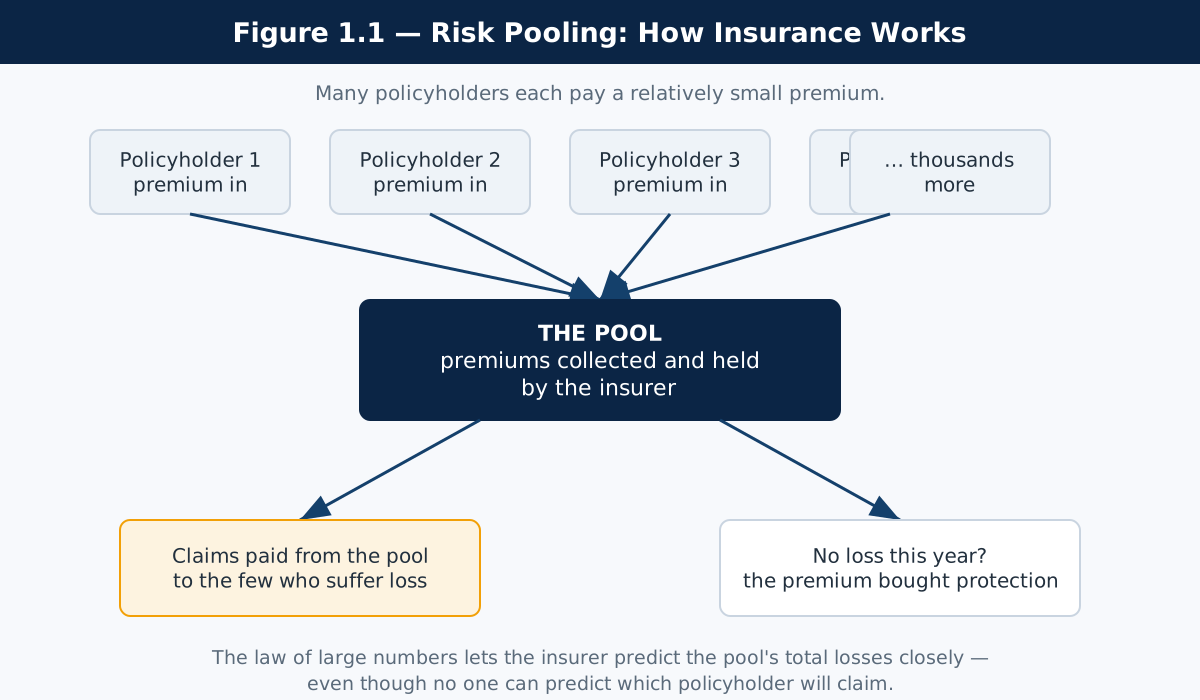
Figure 1.1 — The risk pool: many small, certain premiums fund the few large, uncertain losses.
Read the figure from the edges inward. At the edges stand many households and businesses, each paying its premium into the center. At the center sits the pool — the insurer's collected funds, reserves, and surplus. Arrows leaving the center are few but large: claim payments to the minority who suffer covered losses that year. The teaching point is the asymmetry. Contribution is universal and small; payment is selective and large. A producer who grasps that asymmetry understands why underwriting exists (Chapter 33), why premiums differ by risk (Chapter 34), and why an insurer that pays claims it never priced for will not survive to pay anyone's.
Suppose, illustratively, that 1,000 homeowners each pay the Alvarez homeowners premium of $1,284 per year to the same pool.
Step 1 — Total premium collected: 1,000 × $1,284 = $1,284,000.
Step 2 — Suppose 10 of the 1,000 homes suffer a covered fire loss averaging $90,000. Total losses: 10 × $90,000 = $900,000.
Step 3 — Premium remaining after losses, before expenses: $1,284,000 − $900,000 = $384,000, from which the insurer pays operating expenses, taxes, and adds to reserves for the year when 20 homes burn instead of 10.
No single family could self-fund a $90,000 loss for $1,284. The pool can, because 990 families paid for protection they were glad not to need. Notice what the arithmetic also proves: if the insurer misprices, admits far riskier homes at the same rate, or pays uncovered losses, the $384,000 margin disappears quickly. Sound pooling is the business; the policy is only its paperwork.
The law regulates the transaction, not just the document. Under the uniform definitions in the NAIC Producer Licensing Model Act, three verbs describe what a producer does, and examinations test the distinctions.
To solicit means attempting to sell insurance or urging a person to apply for a particular kind of insurance from a particular insurer — advertising, inviting, and encouraging an application. To negotiate means conferring directly with a purchaser, or offering advice, about the substantive benefits, terms, or conditions of a particular contract — the conversation in which coverages, limits, and deductibles are actually compared. To sell means exchanging a contract of insurance for money, on behalf of an insurer — the completed exchange itself.
Why does the vocabulary matter? Because licensing attaches to the activity. A person who solicits, negotiates, or sells insurance for compensation generally must be licensed for the line involved and, when acting as an agent of an insurer, appointed by that insurer. Unlicensed clerical work — answering phones, filing, taking claim information for referral — is a different matter, and Chapter 30 draws that line precisely. For now, hold the sequence as the shape of your working day at Hartwell & Associates Insurance Agency: you invite the conversation, you advise within it, and you complete the exchange — and each step carries duties that later chapters make specific.
Four groups appear in nearly every insurance story. Learn them as roles, because the same person can occupy different roles in different transactions.
Insurers assume the risk and issue the contract. At concept level, know the forms of organization. A stock insurer is owned by stockholders who provide capital and may receive dividends as investors; its policyholders are not owners. A mutual insurer is owned by its policyholders; there are no stockholders, and policyholders may receive policy dividends if the board declares them — Meridian Mutual, this book's fictional teaching insurer, carries the mutual form in its name. A reciprocal exchange is an unincorporated group in which subscribers exchange indemnity agreements through an attorney-in-fact who manages operations. Lloyd's associations are markets in which individual and corporate members assume portions of risks through syndicates; Lloyd's itself is not an insurance company. Fraternal benefit societies are membership organizations that provide insurance benefits, historically to members sharing a common bond. Examinations ask you to match form to owner and manager, not to master corporate law — Chapter 29 returns to regulation of these entities.
Producers bring insurer and consumer together. Producer is the umbrella licensing term. An agent represents the insurer in the transaction; a broker represents the consumer. An independent agent typically represents several insurers through an agency such as Hartwell & Associates; a captive or exclusive agent represents one insurer or one group. The distinction matters for authority: what a producer may bind, promise, or waive depends on the appointment and agency contract, a theme Chapters 30 and 40 develop.
Regulators set and enforce the rules. Insurance in the United States is regulated primarily by the states. Each state has a department of insurance headed by a commissioner (the title varies by state) who licenses producers and insurers, approves or reviews forms and rates where the state's law requires it, examines market conduct, and disciplines licensees. The National Association of Insurance Commissioners (NAIC) is the association of state regulators that drafts model laws and supports uniformity; it licenses no one. The federal role is limited and specific — flood insurance, federal health programs, anti-money-laundering and privacy overlays — and later chapters mark each federal appearance explicitly.
Consumers are the applicants, insureds, policyowners, and beneficiaries. The vocabulary is precise: an applicant seeks coverage, an insured is the person or entity protected, a policyowner holds the contract rights (in life insurance the owner and the insured are often different people), and a beneficiary receives benefits. Using the right word for the right role is examination craft and professional craft at once.
A producer license is not general permission to sell everything called insurance. It is issued for specific lines of authority. The NAIC model and the Uniform Licensing Standards name six major lines. Life covers insurance on human lives, including endowment and annuity benefits and certain accident and disability benefits tied to life contracts. Accident and Health or Sickness covers sickness, bodily injury, and accidental death, and may include disability income. Property covers direct or consequential loss or damage to property of every kind. Casualty covers legal liability, including liability for death, injury, or property damage. Variable Life and Variable Annuity Products covers contracts whose benefits vary with investment experience and requires securities licensing as well. Personal Lines covers property and casualty insurance sold to individuals and families for primarily noncommercial purposes — a narrower recombination of the property and casualty canon, not a separate body of knowledge.
Limited lines — credit, crop, travel, and car rental among them — authorize a narrow slice only. Treat this section as a map legend, not the map. Chapters 29 through 31 teach how lines are earned, combined on examinations, appointed, renewed, and kept. The point to carry forward is structural: authority is line-specific, and acting outside your licensed lines is not a technicality. It is unlicensed activity.
A license exists because insurance reverses the ordinary bargain. In most purchases the buyer pays and receives goods at once. In insurance the buyer pays now for a promise that will be tested months or years later, at the worst moment of the buyer's life, by fine print the buyer rarely reads fully. That asymmetry — money now, promise later, expertise on one side — is why every state conditions the work on demonstrated competence, background review, and continuing accountability.
Understand what the license is, then, and what it is not. It is a jurisdiction's permission, after its own examination and background process, to solicit, negotiate, and sell the lines named on it, so long as it is maintained and the producer is appointed where appointment is required. It is not a degree, not a guarantee of competence in every product, and not transferable at will between states — nonresident licensing follows its own pattern, taught in Chapter 31. This book prepares you for the examinations that stand in that path. It confers no license, eligibility, or appointment; only your jurisdiction does, and only after its full process. Check your own department of insurance and candidate handbook for the requirements that apply to you — hours, fees, terms, and procedures vary by state and are taught in this book as the pattern, with your regulator as the authority.
The license also protects the honest producer. It gives the public a verifiable credential, gives insurers a regulated distribution force, and gives you a defined scope inside which your advice, your errors-and-omissions exposure, and your livelihood all sit. Chapters that follow will sometimes feel like pure product detail. They are not. Each one fills in what a licensed person is trusted to know.
The most common beginner error is defining insurance by its paperwork — "a policy you buy" — instead of by its function, transfer and pooling. Stems that test function will defeat a paperwork definition every time. A second error confuses the NAIC with a regulator that licenses or disciplines; it does neither — state departments do. A third mixes up solicit, negotiate, and sell, especially treating general advertising as negotiation; negotiation requires direct conferring about substantive terms with a purchaser. A fourth assumes a mutual insurer has stockholders or that a stock insurer is owned by policyholders — reverse them and every ownership question fails. A fifth treats the license as national or all-lines; it is neither. Finally, beginners describe the producer as always representing the buyer. An agent represents the insurer; a broker represents the consumer. Keep the representation straight.
The published Property and Casualty general outline places this material under Insurance Terms and Related Concepts and the opening policy-types work, and the Life and Health outlines presume it in their application and contract-law sections. Expect definition-and-distinction items: match the verb to the activity, the insurer form to its owners, the party to its role. Scenario stems are short — a person urges a neighbor to apply, confers about deductibles, exchanges a contract for a premium — and ask which regulated act occurred. Indiana, for example, publishes a scaled score of 70 as its passing standard in its candidate handbook; that figure is Indiana's, attributed to Indiana, and every other jurisdiction publishes its own standard in its own handbook. Do not carry any state's number into another state's examination room.
Q1. A family pays a premium so that, if fire destroys its home, an insurer will pay to rebuild it. In insurance terms, the family has primarily done which of the following? A. Retained the risk in full B. Transferred the financial risk to the insurer C. Created a wager on the home D. Eliminated the risk of fire
Q2. Which statement best describes how a risk pool makes a large promise affordable? A. Each insured's premium alone is saved to pay that insured's own loss B. The insurer pays losses only in years when no claims occur C. Losses are charged back equally to all insureds after they happen D. Many insureds pay small premiums and the fund pays the few who suffer covered losses
Q3. A producer meets directly with a purchaser and advises her, comparing substantive benefits, deductibles, and conditions of a particular contract. Which regulated act is the producer performing? A. Negotiating B. Soliciting only C. Underwriting D. Adjusting
Q4. Who owns a mutual insurance company? A. Its stockholders B. The state department of insurance C. Its policyholders D. Its appointed agents
Q5. Hartwell & Associates places coverage for clients with several different insurers. Hartwell is best described as which of the following? A. A captive agency for one insurer B. An independent agency C. A reciprocal exchange D. A fraternal benefit society
Q6. Which body drafts model insurance laws and supports uniformity among state regulators but licenses no producers? A. The NAIC B. The state legislature of the largest state C. The examination vendor D. The Federal Insurance Office as licensor
Q7. An applicant asks whether passing a licensing examination in one state authorizes selling insurance in every state. What is the correct response? A. Yes, the license is national once earned B. Yes, if the producer is appointed by a national insurer C. Yes, for personal lines only D. No, licensing is by jurisdiction and lines of authority, with separate nonresident licensing
Q8. In property and casualty insurance, the principle that payment restores the insured to the financial position before the loss, with no gain, is called what? A. Subrogation B. Consideration C. Indemnity D. Adhesion
Q9. Which line of authority covers insurance against legal liability, including liability for bodily injury and property damage to others? A. Casualty B. Property C. Life D. Personal Lines only
Q10. A producer sends a general mailing inviting homeowners to contact the agency for a review and to consider applying for coverage. This activity, without more, is best classified as which of the following? A. Negotiating B. Soliciting C. Selling D. Binding coverage
Q11. In the insurance transaction, a broker is distinguished from an agent primarily by which of the following? A. A broker needs no license in any circumstance B. A broker is always an employee of the insurer C. A broker issues the insurance contract D. A broker represents the consumer, while an agent represents the insurer
Q12. Illustratively, 500 households each pay $1,284 in annual premium. What is the total premium collected by the pool? A. $128,400 B. $321,000 C. $642,000 D. $1,284,000
Q13. Which statement about this textbook's role in licensing is correct? A. The book prepares readers for examinations; the license itself is granted by each jurisdiction after its own process B. Completing the book confers eligibility to sell insurance C. The book's publisher appoints producers to insurers D. Reading the book replaces a state's background review
Q14. A group of subscribers exchanges agreements to indemnify one another, managed by an attorney-in-fact. This describes which form of organization? A. A stock insurer B. A mutual insurer C. A Lloyd's syndicate only D. A reciprocal exchange
Q15. Personal Lines authority is best described as which of the following? A. Authority to sell any commercial coverage to businesses B. Property and casualty coverage sold to individuals and families for primarily noncommercial purposes C. Authority limited to life and annuity products for families D. An unlicensed category of insurance sales
The Complete Insurance Course — 1,020 Practice Questions, Diagnostic & 2 Full Timed Practice Tests, Every Answer Explained
Feras Alzubi
Exam Prep Series
2026 Edition
© 2026 Feras Alzubi. All rights reserved.
All teaching text and all 1,020 practice items in this book are original to this book. They were written for this volume to teach the insurance producer field and to prepare readers for study, and they do not reproduce examination questions, vendor practice-test items, or any insurer's filed policy forms. Specimen policies, forms, and documents in this book are fictional teaching specimens created for instruction.
This book is an independent study text. It is not affiliated with, sponsored by, or endorsed by the National Association of Insurance Commissioners (NAIC), Pearson VUE, PSI, Prometric, or any state department of insurance or other licensing authority. Those names are used only to identify the institutions that publish model laws, administer examinations, and regulate licensing, as a reader needs to know them. This book confers no license, eligibility, appointment, or authority to sell, solicit, or negotiate insurance. Licensing is granted by each jurisdiction after its own examination and background process, on that jurisdiction's terms. Passing a licensing examination, by itself, does not make a person a licensed producer.
Diagnostic Examination
Part I — Foundations
Chapter 1: The Producer's World: Insurance, Risk, and the Business of Protection
Chapter 2: Risk and Insurance Fundamentals: Perils, Hazards, and the Law of Large Numbers
Chapter 3: The Insurance Contract: Elements, Characteristics, and Legal Principles
Chapter 4: Anatomy of a Policy: Declarations, Insuring Agreement, Conditions, Exclusions, Endorsements
Part II — Property
Chapter 5: Property Fundamentals: Valuation, Coinsurance, and Causes of Loss
Chapter 6: Dwelling Policies: DP-1, DP-2, DP-3
Chapter 7: Homeowners Policies: The HO Program Section by Section
Chapter 8: Commercial Property and Causes of Loss Forms
Chapter 9: Inland Marine, Flood, and Specialty Property
Chapter 10: Property Provisions and Endorsements in Practice
Part III — Casualty
Chapter 11: Liability Fundamentals: Negligence, Damages, and Defenses
Chapter 12: The Personal Auto Policy, Part by Part
Chapter 13: Commercial Auto and Garage Coverage
Chapter 14: Commercial General Liability: Occurrence vs. Claims-Made
Chapter 15: Workers' Compensation and Employers Liability
Chapter 16: Umbrella and Excess, Bonds, Crime, and Specialty Casualty
Part IV — Life
Chapter 17: Life Insurance Fundamentals and Term Life
Chapter 18: Permanent Life: Whole Life and Its Variations
Chapter 19: Universal, Variable, and Indexed Life
Chapter 20: Life Policy Provisions, Riders, and Options
Chapter 21: Annuities: Accumulation, Payout, and Suitability
Chapter 22: Group Life, Retirement Concepts, and Business Uses
Part V — Health
Chapter 23: Health Insurance Fundamentals: How Medical Coverage Pays
Chapter 24: Individual Medical Coverage: Major Medical and the Marketplace
Chapter 25: Group Health and Managed Care: HMO, PPO, POS, HDHP/HSA
Chapter 26: Disability Income, Long-Term Care, and Supplemental Health
Chapter 27: Medicare, Medicaid, and Government Health Programs
Chapter 28: Health Policy Provisions and Federal Rules: The UPPL Canon, COBRA, HIPAA
Part VI — Regulation and Licensing
Chapter 29: How Insurance Is Regulated: State Regulation, the Commissioner, and the NAIC Framework
Chapter 30: Becoming Licensed: Lines of Authority, Prelicensing, the Examination, Appointment
Chapter 31: Keeping the License: Renewal, Continuing Education, Nonresident Licensing, Discipline
Chapter 32: Market Conduct and Ethics: Unfair Practices, Privacy, Suitability, and Trust
Part VII — The Producer's Craft
Chapter 33: Underwriting and Risk Classification
Chapter 34: Rating and Premium: How the Price Is Built
Chapter 35: The Application and Policy Delivery
Chapter 36: Claims: First Notice, the Producer's Role, and the Conduct Standard
Chapter 37: Serving the Client: Needs Analysis, Replacement, and Documentation
Part VIII — The Exam Layer
Chapter 38: The Examinations: Formats, Outlines, Vendors, and What Is Actually Tested
Chapter 39: Test Craft and Your Licensing Roadmap
Part IX — After the License
Chapter 40: After the License: Appointments, Agencies, and Building a Compliant Practice
Case Battery A
Case Battery B
Repair Sets
Practice Test 1
Practice Test 2
Study Plans
Cheat Sheets
Glossary
References
Outline Crosswalk
Producer licensing examinations follow a structure the reader will meet in every jurisdiction, with details that belong to each jurisdiction alone. Each examination has two parts: a General Knowledge section, built on national content that is broadly shared across states, and a State-Specific section, headed in the published outlines "State Laws, Rules and Regulations," which tests the law of the licensing state itself. This book teaches the General Knowledge sections whole, teaches the structure and common-topics pattern of the State-Specific sections, and routes the reader to the candidate handbook and content outline of the reader's own state for that state's law. No state's law is taught here as national content, and no detail that varies by state — prelicensing hours, examination fees, license terms, continuing education hours, or specific statutes — is stated as a general rule.
The published General Knowledge outlines used as this book's crosswalk basis are the Pearson VUE outlines effective November 26, 2025. Their shapes, as published, are:
Life — General Knowledge: 50 scored questions plus 5 pretest questions. I. Types of Policies, 15. II. Life Provisions, Riders, Options, and Exclusions, 15. III. Completing the Application, Underwriting, and Delivering the Policy, 12. IV. Retirement and Other Insurance Concepts, 8.
Health — General Knowledge: 50 scored questions plus 5 pretest questions. I. Types of Policies, 16. II. Policy Provisions, Clauses, and Riders, 15. III. Social Insurance, 6. IV. Other Insurance Concepts, 5. V. Field Underwriting Procedures, 8. The Accident and Health outline is published under that name; this book uses Health for the same line.
Property & Casualty — General Knowledge: 100 scored questions plus 10 pretest questions. I. Types of Policies (Property), 22. II. Insurance Terms and Related Concepts (Property), 15. III. Policy Provisions and Contract Law (Property), 13. IV. Types of Policies, Bonds, and Related Terms (Casualty), 23. V. Insurance Terms and Related Concepts (Casualty), 15. VI. Policy Provisions (Casualty), 12.
Personal Lines — General Knowledge: 75 scored questions plus 5 pretest questions. I. Types of Property Policies, 10. II. Types of Casualty Policies, 13. III. Terms and Related Concepts, 28. IV. Policy Provisions and Contract Law, 24.
Pretest questions are unscored and unidentified. They are mixed into the examination and do not count toward the result. A candidate cannot tell them apart from scored questions and should answer every question as if it counts.
Indiana, for example, publishes the combined examination table that follows in its Candidate Handbook. It is given here only as a labeled worked example of how one jurisdiction publishes its examinations, not as the table for any other state. Indiana publishes: Life, 95 questions in 120 minutes; Health, 95 questions in 120 minutes; Life & Health combined, 150 questions in 180 minutes; Property & Casualty combined, 150 questions in 180 minutes; Personal Lines, 115 questions in 120 minutes. Indiana publishes its passing standard as a scaled score of 70. That standard is Indiana's, as published for Indiana. Every other jurisdiction publishes its own standard in its own handbook, and the reader must take the standard, the question counts, the time limits, the fees, and the reservation and retake rules from that handbook and no other source.
The jurisdiction fence, stated plainly: if a fact in this book could be different in the reader's state, the book says so and sends the reader to that state's department of insurance and candidate handbook. Where the book gives an Indiana figure, it names Indiana. Where it teaches a national pattern — for example, the NAIC model framework, the lines of authority, or the appointment requirement — it teaches the pattern, and the reader's state enactment governs.
This book teaches the whole field from zero and then prepares the reader for the examinations. It can be used by three routes. Choose the route that fits the time and the goal, and follow its repair and testing steps in order. In every route, read the jurisdiction fence on the Exam Blueprint page first: obtain the candidate handbook and content outline for the state where licensing is sought before examination study begins, and treat that handbook as controlling for every state-specific matter.
Route one — the full read. Read Chapters 1 through 40 in order, completing the 15 exercises at the end of each chapter before moving on. The order is deliberate: foundations before products, personal lines before commercial forms, and regulation after the products, when the reader knows what a license authorizes. After Chapter 37, work Case Battery A and Case Battery B, then take Practice Test 1 and Practice Test 2 under timed conditions. Finish with Chapter 38, Chapter 39, and Chapter 40, the Study Plans, and the Cheat Sheets.
Route two — single-line focus. A reader preparing for one line still needs the shared core. Read Part I (Chapters 1–4) and Part VI (Chapters 29–32) in every case, then the line part: Property candidates read Part II (Chapters 5–10); Casualty candidates read Part III (Chapters 11–16); Property & Casualty candidates read Parts II and III (Chapters 5–16); Personal Lines candidates read Parts II and III (Chapters 5–16) with emphasis on the homeowners and personal auto chapters; Life candidates read Part IV (Chapters 17–22); Health candidates read Part V (Chapters 23–28); Life & Health candidates read Parts IV and V (Chapters 17–28). Add Part VII (Chapters 33–37) for the craft chapters that every outline presumes, then the matching case battery — Case Battery A for Property & Casualty and Personal Lines, Case Battery B for Life & Health — then the matching practice test, then Chapters 38–40.
Route three — diagnostic-first. Take the Diagnostic Examination before reading any chapter, under the instructions printed with it, and score it with the Diagnostic Examination Key. Use the strand results to set the reading order: begin with the weakest strand's chapters, use the matching repair set after those chapters, and then continue with the full read or the single-line route. Retake no diagnostic item from memory as a measure of progress; progress is measured by the chapter exercises, the repair sets, and the timed practice tests.
How keys and rationales work. No chapter file and no test file in this book prints its answers. Every set of questions has a separate key. Each key entry names the correct letter, gives the strand or topic tag, explains why the key is right in the book's terms, and then explains why each wrong option fails. Read every explanation, including for questions answered correctly. A correct guess and a correct understanding look the same in a score and very different on an examination. When an explanation refers back to a chapter, reread that passage before continuing.
Repair-set routing. The Diagnostic Examination and the chapter exercises route the reader to six repair sets: Repair Set 1, Foundations and Contracts (Chapters 1–4); Repair Set 2, Property (Chapters 5–10); Repair Set 3, Casualty (Chapters 11–16); Repair Set 4, Life (Chapters 17–22); Repair Set 5, Health (Chapters 23–28); Repair Set 6, Regulation and Craft (Chapters 29–37 and 40). A repair set is 20 new questions on one strand, not a repeat of missed questions. Complete the set that matches the weak strand, reread any chapter the key points to, and only then move to the next set or test.
Timed-test instructions, in summary. Practice Test 1 reproduces the Property & Casualty General Knowledge proportions (100 items) and Practice Test 2 reproduces the Life & Health General Knowledge proportions (50 Life items followed by 50 Health items). Each is taken in one sitting of 120 minutes, without notes, without pausing the clock, and without checking any answer until the sitting ends. That pace follows the published Indiana pace for single-line examinations. The tests cover General Knowledge only; no practice test in this book can reproduce the reader's State-Specific section, which must be prepared from the reader's own state outline. Full instructions are printed at the head of each test and govern over this summary.
A note on specimens. Meridian Mutual Insurance Company, Hartwell & Associates Insurance Agency, and every person, policy, form, and document named in this book — including the Alvarez family, Dana Whitfield, Marcus Bell and Bell's Corner Bakery, Priya Nair, Tom and Ellie Ruiz, Grace Okafor, and Sam Delgado and Delgado Machine Works — are fictional teaching specimens and a fictional teaching setting. Meridian Mutual's specimen forms are described as patterns patterned on standard forms; they are not real policies, not filed forms, and not documents of any real insurer or agency. Worked examples use the book's consistent specimen figures so that arithmetic can be followed across chapters; any figure outside that consistent set is labeled illustrative where it appears.
End of the free sample. The complete book continues from here — the full A-to-Z course in book form, delivered as an EPUB you can read in Apple Books, Google Play Books, ReadEra, Thorium Reader, Adobe Digital Editions, or Send to Kindle.
Buy this ebook — $11.99 Back to the book page
Payments are securely processed by Payhip.