
Mastering Careers & Skills
Instrumentation & Process Control: Mastering the Craft · free sample from the book itself
The Complete Course Series
A complete-course series for people entering skilled fields and for working entrants preparing for the credentials their fields actually use. Each book in the series teaches one whole craft from absolute zero to working depth — its foundations in dependency order, its physical plant and tools, its methods of work, its testing and troubleshooting reasoning, and the exact shape of its doors — with original exercises, worked examples, and case work written for that book alone.
Books in this series share one honesty discipline: no national license is invented where none exists, no credential is promised, no outcome is guaranteed, and every hard fact about a credential, a code, or an occupation traces to the publication of the body that owns it, named beside the fact.
Instrumentation & Process Control: Mastering the Craft is the instrumentation and process control volume in the series.
Feras Alzubi
The Complete Course Series — Google Play Books
2026 Edition
This book teaches the whole craft of industrial instrumentation and process control from absolute zero to working depth: what measurement is and how it errs, the physics of pressure, head, flow, and heat, the electricity of the loop, the language of signals, the instruments that sense pressure, level, flow, temperature, and process chemistry, the control loop whole with its controllers and final elements, the working craft of calibration, loop checking, troubleshooting, and maintenance, safety instrumented systems at technician depth, installation practice, the control systems and networks the loops live in, and the project, documentation, and senior layers. Laid over that whole body, in its own part, is one full exam layer at three levels: the Certified Control Systems Technician — CCST — credential of the International Society of Automation, at Level 1, Specialist Level 2, and Master Level 3.
One honesty fact stands at the front, because the whole book stands on it: there is no license and no single national exam that makes an instrumentation technician. The doors are associate-degree and certificate programs, registered apprenticeships, and employer training — and one voluntary professional certification, the CCST. The CCST is not a license; it authorizes no regulated act. This book prepares field knowledge and readiness, honestly and completely; the International Society of Automation examines and certifies, schools, programs, and employers train, and hands-on skill is trained and assessed in person, under supervision, never from a page.
Copyright © 2026 Feras Alzubi. All rights reserved.
First edition, 2026. Published by Feras Alzubi.
No part of this book may be reproduced, stored in a retrieval system, or transmitted in any form or by any means — electronic, mechanical, photocopying, recording, or otherwise — without the prior written permission of the author, except for brief quotations in reviews and for the reader's own study use of the exercises and skills checks printed here.
Originality statement. This book is an original work, written from scratch for this series. Every chapter, exercise, worked example, case, and figure in it is original to this book. Its practice questions are original items written for this book, written against the published domains and task list of the CCST program of the International Society of Automation (ISA). They are not ISA's actual examination items, and they are not recalled, reconstructed, or paraphrased examination items of any kind. No other book's text, items, or teaching material appears in it in any form — not copied, not paraphrased, not adapted. The facts it teaches about credentials, codes, and standards are drawn from the administering bodies' and issuing organizations' own publications, which are named in the chapters and collected in the References; those publications' own text is never reproduced here beyond the short scope statements the chapters identify as such.
Not-affiliated disclosure. This is an independent study guide and field course. It is not published by, affiliated with, endorsed by, or approved by the International Society of Automation (ISA), and ISA did not participate in its creation. The International Society of Automation is an independent body. "ISA" and "Certified Control Systems Technician (CCST)" are used in this book nominatively only — to name the credentialing body and the credential that are among the subjects taught. This book is not ISA's official course or study guide. ISA sells its own review courses and study guides; this book is an independent course that teaches the field whole and prepares the knowledge the CCST examines.
Scope note. This book teaches the knowledge of instrumentation and process control work — its principles, vocabulary, standards, and reasoning order — for learning and for credential readiness. It is knowledge only: calibration on live plant, valve work, energized electrical work, work in hazardous (classified) areas, confined-space and analyzer-house work, and safety instrumented system proof testing are hands-on skills that are trained and physically assessed in person by schools, programs, and employers, and this book never presents itself as instruction to perform them. It is not a substitute for a manufacturer's literature for any product, for a credentialing body's own published requirements, for the code or standard edition adopted by your authority, or for your jurisdiction's own publications. Nothing in this book promises a job, a certification, a score, selection, or income; it teaches the field and its doors as they verifiably are, and it says so wherever a reader might be tempted to forget it. This book is not a certifying organization and satisfies no certification, training, or experience requirement.
Edition. 2026 Edition — built on ISA's published CCST program page, CCST Requirements, CCST Body of Knowledge, and CCST Exam Content Comparison Document for the 2025 Exam Update, ISA's published Certification Testing and Recertification pages, the U.S. Bureau of Labor Statistics' Occupational Outlook Handbook entry for Calibration Technologists and Technicians, the National Institute of Standards and Technology's Technical Note 2156, and the FieldComm Group's published HART technology account, verified against the issuing bodies' own publications at this build's opening gate, 2026-11-14.
Read this note first, because it will save you from the two mistakes that cost entrants in this field the most time and money.
The first mistake is looking for a single national door. There is not one. No national license makes a person an instrumentation technician, and no single national exam admits a person to process instrumentation work in every place. What exists is more useful once you see it clearly: employers who train, schools and programs that teach hands in person, registered apprenticeships, and one voluntary professional certification that examines knowledge at three levels of one craft. This book maps that landscape exactly, and it never calls a certification a license.
The second mistake is learning procedures before principles. Measurement and error come first in this book, before instruments; head and the square-root law come before flow loops; electricity comes before signals; percent of span comes before scaling; and traceability comes before calibration practice — because every later judgment rests on them. If you are new, read in order. If you already work in the field, take the Diagnostic first and let its strands send you where you need to go.
A word on hands. Calibration, valve work, installation, and troubleshooting are physical skills. This book teaches what those skills are, the physics and method underneath them, what each instrument does, what each reading means, and what decision each reading gates. It does not teach you to perform them from a page, because no honest book can. Hands are trained in person, under supervision. Knowing where that supervised door stands is part of knowing the field.
Finally, a word on numbers. Every number in this book that belongs to someone else — a credential's exam shape, an occupation's median, a fee — is printed with its owner named beside it and is fenced to the places where it belongs. Where a body does not publish a number, this book says so plainly instead of guessing. That discipline is itself part of the craft: instrument work runs on verified numbers, and so does this book.
Front matter — Series Page · Title Page · Copyright Page · A Note Before You Begin · Contents · The Field and Its Doors · Exam Blueprint · How to Use This Book · Instrumentation-Readiness Diagnostic (50 items) with key and Readiness Tracker
Part I — The Field and Its Doors
Part II — Foundations: Measurement and the Numbers
Part III — Sensing the Process: The Instruments
Part IV — The Loop at Work
Part V — The Working Craft
Part VI — Systems, Networks, and Analyzers
Part VII — Projects, Records, and the Senior Layer
Part VIII — The Credential and the Road
Back matter — Loop Case Battery A (25 guided case files) with key · Loop Case Battery B (25 guided case files) with key · Strand Repair Sets RS1–RS8 (8 × 15 = 120 items) with key · Study Plans (4-week / 8-week / 12-week) · Cheat Sheets · Figure Program · Errata & Verification Notes · References & Further Reading · Coverage Crosswalks (field map to chapters; ISA's four domains to chapters; ISA's task list by domain to chapters; BLS duty summary to chapters) · Glossary
This section states, in one place, the facts the whole book stands on — what instrumentation technicians do, how a person actually enters the field, and exactly how the credential landscape is laid out. Everything here traces to the issuing bodies' own publications; the chapters carry the full account, and the verification notes in the back matter record the discipline.
The field: the process plant's measurement and control loops. An instrumentation technician — in the language of the field's credential, a control systems technician — works on the instruments that measure and control an industrial process: the sensors, transmitters, controllers, and final elements that report and govern level, temperature, pressure, flow, and other process variables in plants that blend, react, refine, treat, generate, and manufacture. The International Society of Automation describes the holders of its credential in its own words: Certified Control Systems Technicians are technicians who "calibrate, document, troubleshoot and repair/replace instrumentation for systems that measure and control level, temperature, pressure, flow and other process variables," skilled in pneumatic, mechanical, and electronic instrumentation, who understand process control loops and process control systems, including computer-based systems. (Source: ISA, CCST program description.) That sentence is this book's field map in miniature: calibration, documentation, troubleshooting, and repair, over the variables every process plant lives by. This book owns industrial process instrumentation — the process plant's measurement and control loops. Building automation systems and plant-wide general maintenance are neighboring crafts, taught in their own volumes of this series. One boundary is printed plainly here, as it is in the back matter's field map: Motor Fuel Metering & Quality is adjacent to this field and is not covered by this book.
The headline honesty fact: there is no license and no single national exam for this trade. No national test, no national license, and no national certificate makes a person an instrumentation technician licensed to work across the country, and any course or advertisement that implies one should be read with suspicion. What exists instead is a landscape of separate authorities doing separate jobs, and this book's first discipline is never confusing them:
The pay and outlook figures, fenced. This book prints exactly one pay-and-outlook set — and prints it only labeled, as what it is. Honesty note: the U.S. Bureau of Labor Statistics publishes no dedicated instrumentation-technician entry. The figures below are the Bureau's whole-occupation figures for Calibration Technologists and Technicians — the closest published occupation, the people who inspect, adjust, and test measurement devices against standards — printed as labeled whole-occupation figures of that occupation, and as nothing else. They appear only where they belong: here, in Chapters 1 and 2, where the work and the doors are introduced, and in Chapter 40, where the road from here is mapped. They are never a starting wage, an offer, a graduate outcome, or a promise to any reader. No other pay figure appears anywhere in this book.
Read the pairing as it is printed: growth and openings are projections about an occupation, not promises to a person. Openings created when experienced workers leave an occupation are real doors, and they are the doors this occupation's own handbook describes.
The shape of the work, honestly. The work this book teaches is skilled, physical, and consequential: instruments are the plant's senses, and a wrong reading, trusted, can send a whole process in a wrong direction. The craft therefore runs on verification — a reading is checked, a calibration is documented, a loop is proved before the process is trusted to it — and Chapter 4 teaches the hazard map of instrument work whole, before any instrument is taught. A book that hid that shape would not be preparing you for the field; it would be selling you a picture of it.
What this book is, and is not. This book prepares field knowledge and readiness: measurement and its errors, the physics underneath the instruments, the electricity and signal language of the loop, the instrument families, the loop whole, the calibration and troubleshooting crafts as knowledge and reasoning, safety instrumented systems at technician depth, installation practice, systems and networks, the project and senior layers, and the exact shape of the one credential door. It is not a certifying organization, it satisfies no certification, training, or experience requirement, and it promises no job, credential, score, or income. ISA examines and certifies; schools, programs, apprenticeships, and employers train; authorities having jurisdiction regulate the work.
The CCST is one credential at three levels — three depths of one craft, examined on one published body of knowledge and one task list. This page sets the verified panel for all three levels side by side in words, so you can see the road before you choose the level your years qualify you for. Everything in this panel traces to ISA's own publications, read 2026-11-14. Where ISA does not publish a fact, the panel says so plainly. This book never invents an examination fact. Confirm current terms with ISA at registration, because ISA's current page governs.
The levels need not be taken in sequence; a candidate sits the level they qualify for.
Eligibility is a combined total of education, training, and experience. A degree (or equivalent) in a related technology area counts up to a maximum of 4 years; a registered apprenticeship in an instrumentation, measurement and control, electronics, electrical, and/or mechanical program counts; the CST Associate Recognition Program counts as 1 year; training and related work experience count. Education and work-experience periods may not overlap in the total. (Source: ISA, CCST Requirements.)
How a candidate applies. There is no application form. The candidate self-certifies: the candidate meets the criteria, abides by the ISA Conduct and Anti-Harassment Policy, acknowledges a random application verification audit, and agrees to produce supporting documents if audited — and pays the exam fee, which completes the application. Each level's exam window is 12 months; there are three windows a year, with application deadlines, and the scheduling invitation from Meazure Learning arrives about 15 days before the exam window. A candidate who takes an ISA CCST review course receives the examination invitation following the course, with a 12-month eligibility period from the course date, and the corresponding exam fee is included in that course.
The 2025 body of knowledge examines four domains. The weight of each domain shifts with level exactly as the craft itself shifts — bench work dominates Level 1, and administration, supervision, and management dominate Level 3. (Source: ISA, CCST Body of Knowledge.)
An older seven-domain table circulates in pre-2025 material; it is superseded and does not print in this book as current.
Fees as published by ISA and checked in November 2026; ISA's current page governs.
| Fee | Member | Non-member |
|---|---|---|
| Level 1 exam | $331 | $415 |
| Level 2 exam | $315 | $397 |
| Level 3 exam | $331 | $415 |
The member column for recertification by Professional Development Points also covers union members, as ISA publishes it.
| Recertification fee | Member | Non-member |
|---|---|---|
| By Professional Development Points | $210 | $265 |
| By exam | $300 | $375 |
These are the only fee figures printed in this book, and they print only in this stamped form — here, and in the Chapter 3 and Chapter 38 contexts that repeat this table with the same stamp.
Recertification falls due every 3 years, at all levels, on 90 Professional Development Points (PDPs) earned through the activities in ISA's Continuing Professional Development Program. Working more than 1,500 hours in a year earns 30 PDPs. Paying the recertification fee self-certifies the PDPs, the conduct policy, and the audit acknowledgment, in the same shape as the examination application — no forms or documents are submitted unless the holder is audited. A holder who cannot meet the PDP requirement may recertify by exam instead. The fee may be paid as early as 120 days before expiration. A credential not recertified within four months after expiration is lapsed, and the holder must reapply and retest. (Source: ISA, Recertification.)
How to read the panel whole. Level 1 is the working technician's door: five combined years, the bench domains at three-quarters of the exam, and no administration domain at all. Level 2 asks two more combined years and begins to examine the senior layer. Level 3 asks thirteen combined years and examines a master technician whose largest single domain is administration, supervision, and management — over the same craft body the earlier levels examine at the bench. A beginner can prepare the knowledge for all three from this book; no beginner should mistake that preparation for eligibility for any of them. Chapters 3, 38, 39, and 40 teach each level's shape, preparation, and examination craft in full.
The rhythm: teach, then test. Every chapter follows the same rhythm per concept: simplify → explain → detail → show → do → check. A plain statement first, then the explanation, then the working detail, then a worked example with real numbers computed step by step in the text, then your turn in the chapter's exercises, then the check against a key that explains every option. Read the chapter, work its examples with a pencil — every calculation in this book is shown end to end, with no skipped arithmetic — then take its 15-item exercises & skills checks from memory, with the chapter closed, then read the key. Every key explains the right answer and why each wrong answer is wrong, because the wrong answers are where the field's traps live. Items you miss name the strand to repair, and the back matter's Strand Repair Sets drill exactly the strands your scores flag.
The diagnostic comes first. Before Chapter 1, take the Instrumentation-Readiness Diagnostic that follows this front matter: 50 items in five strands. It is this book's own design, disclosed as such on its face — an original field-knowledge diagnostic written for this book, in no other test's form. It is a map, not a verdict: nobody expects a beginner to score well before reading the book, and its job is to tell the book where to work hardest for you. Answer all 50, work its calculations with a pencil, and score yourself by strand — never as one combined number — because the strands route you to different parts of the book.
The Readiness Tracker. The tracker printed with the diagnostic has one row per strand: Foundations (12 items), Sensing & Instruments (12 items), The Loop (10 items), The Working Craft (8 items), and Credential & Readiness (8 items). Enter your first score in the first column. Each strand's row names the chapters that teach it and the repair set that rebuilds it: a weak Foundations strand sends you to Part II first; a weak Sensing & Instruments strand sends you to Part III; The Loop to Part IV; The Working Craft to Part V; Credential & Readiness to Part VIII, with Chapters 2 and 3 read early. After you work the repair sets that serve a strand, re-score that strand and enter the new score in the tracker's after-repair column. Raw counts only: no score in this book — diagnostic, exercises, repair set, or case battery — converts to any other test's score, predicts any credential result, or promises a job, a credential, or a license.
The two readers.
The specimen plant. Every worked example, case, and calculation in this book that needs a plant runs on one plant, introduced here so the chapters can use it without re-introducing it: the Kestrel Point Specialty Chemicals Plant, a fictional blending and reaction plant of three units — blending, reaction, and utilities. Its canon loops are the book's recurring work episodes: LT-101, level on Tank T-101 by differential pressure; FT-201, feed flow by orifice and differential pressure, with its valve FV-201; TT-301, reactor temperature by a platinum resistance thermometer; PT-401, steam-header pressure, the book's five-point test specimen; and AIT-501, pH on the neutralization sump. The numbers of those loops are the specimen's own, stated once in the chapters that teach them and used consistently everywhere afterward, so the arithmetic teaches the method on a plant the reader comes to know — without borrowing any real plant's or any manufacturer's figures.
The case batteries. The back matter carries Loop Case Battery A and Loop Case Battery B — 25 guided case files each: calibration cases, loop-check cases, troubleshooting-evidence cases, start-up and documentation cases, and senior-layer judgment cases, all running on the Kestrel Point specimen plant. Every case file runs in the same order, in full: situation → evidence → reasoning chain → conclusion → why. Work them on paper, as reasoning: a conclusion in this book is a reasoned judgment with its why, never a set of instructions for performing a fix.
The repair sets. The back matter's Strand Repair Sets RS1–RS8 — eight sets of 15 items, each miss routing back to its tagged chapters — rebuild the strands the diagnostic and the chapter checks expose: RS1 foundations, RS2 sensing & instruments, RS3 the loop & final elements, RS4 calibration, RS5 troubleshooting & maintenance, RS6 systems & networks, RS7 projects, records & the senior layer, RS8 whole-craft mixed.
Study plans. The back matter carries 4-week, 8-week, and 12-week study plans that pace the two readers above. Whichever you choose, keep the rhythm: chapter, exercises, key, repair.
Worked numbers. Every worked example in the chapters uses the book's taught engineering canon — the scaling law, the head canon, the square-root law, the resistance-thermometer table, and the specimen plant's own numbers — or round numbers labeled illustrative on their faces, so the arithmetic teaches the method without borrowing any manufacturer's figures. No brand's nameplate is ever a teaching anchor in this book, in text or in figure, and no brand is ever named.
The safety frame. This book teaches knowledge and reasoning. Calibration on live plant, valve work, energized electrical work, work in hazardous (classified) areas, confined-space and analyzer-house work, and safety instrumented system proof testing are taught as what the qualified technician does and in what order of reasoning, what the readings mean, and what decision each reading gates — never as step-by-step procedures a reader performs on a live process from the page. The physical skills of this trade are trained and assessed in person, under supervision, by programs and employers, and the CCST itself is a knowledge examination. That boundary is stated inside the teaching wherever it bites — above all in Chapters 4, 20–24, 27, 28, and 32 — briefly and professionally, as part of the craft itself: knowing where the supervised door stands is part of knowing the field.
A note on numbers. Where this book prints a number — a median, a growth projection, an exam's question count, a fee — the number traces to the publication named beside it, edition-stamped, and the back matter's verification notes say what was checked and when. Where a number belongs to someone else — a body's current fee at registration, a product's rated values in its manufacturer's literature, a value in a standard's own tables — the book teaches the concept and routes the figure to its owner. That discipline is itself part of the field: instrument work runs on verified numbers, and so does this book.
A process plant makes something by holding conditions steady. A reactor must stay at the right temperature, a tank must not overfill, a header must hold its pressure, and a feed stream must arrive at the right rate. The plant cannot hold what it cannot measure, and it cannot control what it cannot measure reliably. The people who keep that measurement honest — who install, calibrate, document, troubleshoot, and repair the instruments that report the plant back to itself — are instrumentation technicians.
Begin with the field's own description of the work, because this book teaches to it from the first page to the last. The International Society of Automation — ISA — describes the technicians its credential serves this way: they "calibrate, document, troubleshoot and repair/replace instrumentation for systems that measure and control level, temperature, pressure, flow and other process variables," they are skilled in pneumatic, mechanical, and electronic instrumentation, and they understand process control loops and process control systems, including computer-based systems. (Source: ISA, Certified Control Systems Technician program.) Unpack that sentence slowly, because every part of this book lives inside it.
The verbs come first: calibrate, document, troubleshoot, repair and replace. This is not a job of watching screens. It is a job of proving that a number the plant believes is a number the plant can trust, writing down the proof, finding why a trusted number went wrong, and restoring it. The nouns come next: level, temperature, pressure, flow, and other process variables. A process variable is a measurable condition of the process itself — how full a tank is, how hot a reactor is, how hard a fluid pushes, how fast a stream moves. Instruments exist to turn those physical conditions into signals people and controllers can use. The last clause names the technician's wider literacy: pneumatic, mechanical, and electronic devices, and the loops and systems they live in. A technician who knows only one generation of that equipment knows only part of the plant.
This book's specimen plant, where every worked example in the chapters ahead takes place, is the Kestrel Point Specialty Chemicals Plant — a fictional blending and reaction plant of three units, blending, reaction, and utilities, invented for this book so that its numbers stay consistent from chapter to chapter. When this book calculates, it calculates at Kestrel Point, on loops you will come to know by tag: a level loop on Tank T-101, a flow loop on a feed line, a temperature loop on a reactor, a pressure loop on a steam header. The plant is fictional. The craft taught on it is not.
Calibration is the comparison of an instrument's reading against a known standard, with adjustment where the comparison shows the reading has drifted, and a record of what was found and what was left. Chapter 9 builds the idea fully and Chapter 23 puts it to work, but the plain shape belongs here: a technician takes a device whose job is to tell the truth, checks its telling against something truer, and closes the gap. Calibration is the field's founding act, and it recurs on a schedule for the plant's whole life, because instruments drift as surely as they measure.
Documentation is the written half of the same act. Every calibration, repair, and finding leaves a record — what device, what standard, what readings before and after, what decision, and who made it. A plant runs on those records: the next technician, the auditor, and the engineer planning a shutdown all reason from what the last technician wrote down. ISA gives documentation its own domain in the credential this book maps in Chapter 3, and that weighting is honest. Work that is not documented is work the plant cannot prove, and in a regulated process, work the plant cannot prove is work that, for practical purposes, was not done.
Troubleshooting is the disciplined search for why a loop misbehaves. A reading freezes, a valve hunts, a level indication disagrees with the sight glass beside it. The technician's craft is not guessing faster than the next person; it is gathering evidence in an order that halves the suspects at each step, until the evidence itself names the fault. Chapter 25 teaches that method as a multistep search. For now, hold its character: troubleshooting is reasoning with instruments in hand, and its conclusions always carry their why.
Repair and replacement close the cycle. Some faults are cured by adjustment, cleaning, or a corrected connection; some condemn the device itself. The technician judges which, restores the loop to honest service, and proves the restoration with the same calibration discipline that found the fault. Notice what the five verbs share: none of them is "operate the plant." Operations runs the process. Instrumentation keeps the process knowable — and a plant that cannot know itself cannot be run safely for long.
Figure 1.1 (Class P) — A process plant's instrument field: a pipe bridge carrying process lines, a cluster of transmitters on their stands, and a control-valve station below.
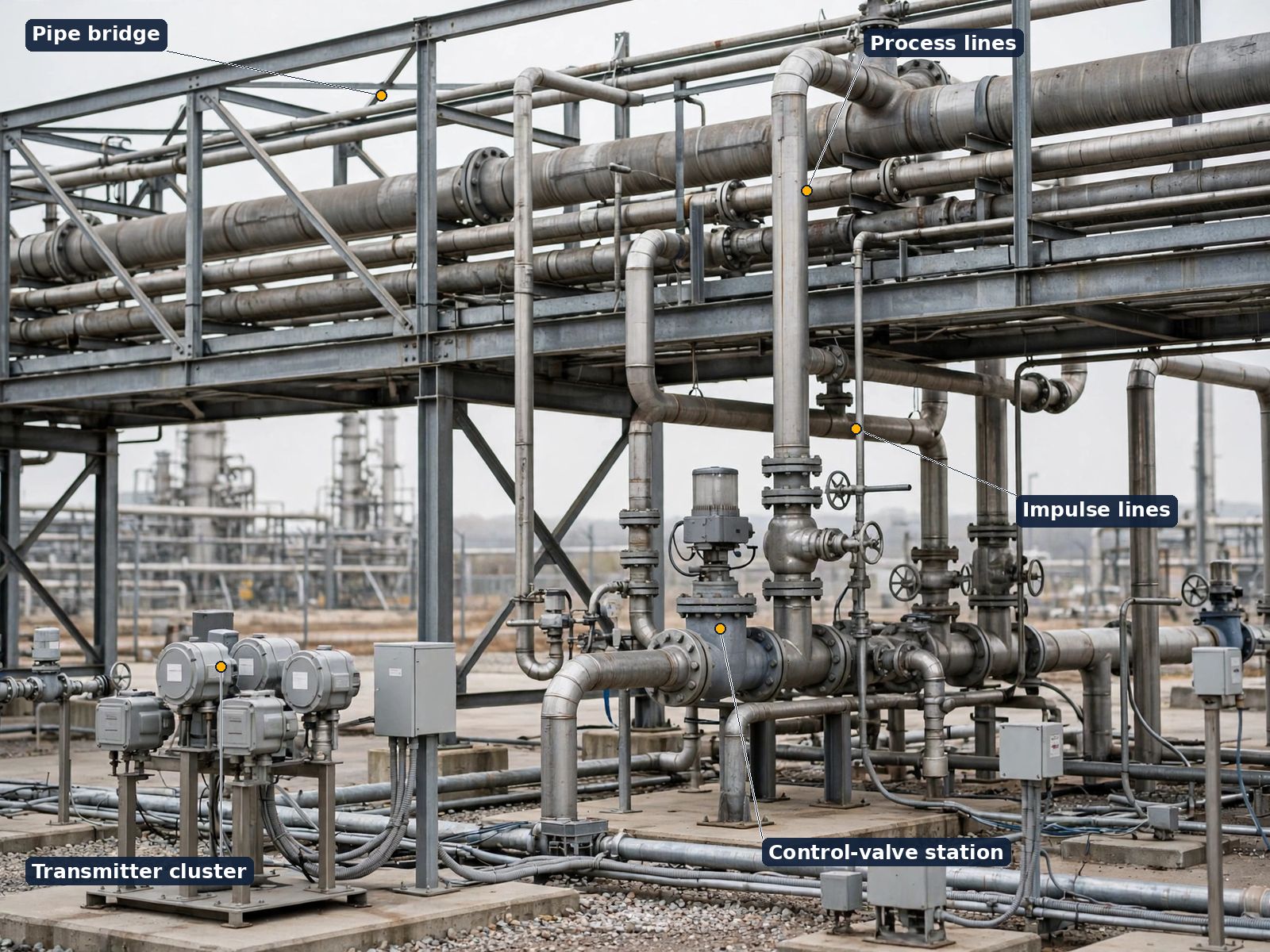
Figure 1.1 — A process plant's instrument field: a pipe bridge carrying process lines, a cluster of transmitters on their stands, and a control-valve station below.
Look at the figure the way a technician learns to look at a plant. The pipe bridge carries the process itself. The transmitters are the plant's senses, each turning a physical condition into a signal. The valve station is a hand the controller moves. Senses, signals, and a final element: that triangle, repeated hundreds of times across a real plant, is this book's terrain.
No single day contains the whole job, but an ordinary day shows its texture. The day begins with paper before it begins with tools: the work order — the plant's authorized statement of what is to be done, where, and under what permit — and the records of the devices named in it. A technician reads the history before touching the hardware, because the last three findings on a device often explain the fourth before a single test is run. Then the field work starts, and its first act is not a wrench but a check: is the area safe to enter, is the energy controlled, is the personal protective equipment, the PPE, matched to the hazards of this task in this place? Chapter 4 gives that hazard map its own full chapter, because in this field safety is not a preface to the skill — it is the first skill.
The middle of the day is the bench and the field in alternation. A pressure transmitter comes in for its scheduled calibration: its readings are taken as found, compared against a standard, adjusted, taken again as left, and recorded — the rhythm Chapter 23 names the as-found, as-left discipline. A level indication in the blending unit has begun to disagree with its tank, so the technician works the evidence: the transmitter, its impulse lines, its signal, the receiving display, in the order the evidence dictates. A newly installed instrument is loop-checked before start-up, its signal proved end to end while the process is still forgiving. None of this is hurried or solitary: the technician coordinates with operations before a loop is disturbed, with maintenance when a device must be isolated, and with supervision when a finding changes the plan.
The day ends as it began, with paper. Findings are written while they are still exact. A device that failed its tolerance is flagged with what the failure means for the measurements it reported since its last good calibration — a judgment Chapter 37 teaches the senior technician to cost and defend. Tomorrow's work is queued by evidence, not by whoever complained loudest. That is the work's day: measure, prove, write, reason, restore — and know, at every step, which decisions are yours and which belong to a permit, a supervisor, or a qualification you do not yet hold.
A beginner meets the plant one device family at a time, and Part III of this book teaches each family whole. Chapter 1 needs only the map. Transmitters are the field's central devices: instruments that sense a process variable and send it onward as a standardized signal — most commonly the 4–20 mA current signal this book teaches in Chapter 8, where 4 milliamps means the bottom of the instrument's range and 20 milliamps means the top. A sensor, sometimes called the primary element, is the part that meets the process itself: the diaphragm that feels pressure, the element whose resistance changes with temperature, the plate across which a flowing stream declares its rate. Some instruments only indicate — a gauge shows a pressure on its dial to whoever stands in front of it. Some only act: a control valve, moved by an actuator, throttles a stream at the controller's command. Between sensing and acting sits the controller, the device — today usually a function inside a larger control system — that compares the measurement with the desired value, the setpoint, and decides the correction.
The whole assembly, sensor to transmitter to controller to final element and back to the process, is a control loop, and the loop — not any single device — is the true unit of this craft. A transmitter can be perfect and the loop still wrong, if the impulse lines are blocked, the wiring is crossed, or the valve cannot move. That is why ISA's description insists that technicians understand loops and systems, not only devices, and why this book is ordered as it is: foundations first, devices next, then the loop whole, then the working craft.
Two older languages still speak in the plant and the beginner will meet both early. Pneumatic instruments signal with air pressure, classically in the 3–15 psi range, the direct ancestor of 4–20 mA, still driving valves through converters in plants everywhere. And digital instruments speak over the same wires that carry their analog signal, adding diagnostics and status to the measurement — the subject of Chapter 16. The field is layered, not replaced: a technician's plant holds all three generations at once, and the credential examines all three because the plant holds all three.
Instrumentation work lives wherever a process must be measured and controlled, a wider map than one industry. Chemical and refining plants are the field's classic home — Kestrel Point is drawn from them — but the same loops run in pharmaceutical and food plants, in pulp and paper mills, in power generation and water and wastewater treatment, in oil and gas production, and in factories of every kind. The employers differ — Chapter 2 walks the families in full — but the craft travels because the physics does: pressure is pressure, and a drifting transmitter lies in the same language everywhere.
The work settings divide, roughly, into three terrains. The field is the plant itself: outdoor pipe racks and indoor process areas, heights and noise and weather, instruments mounted where the process is rather than where comfort is. The bench — the instrument shop or calibration laboratory — is where devices are proved against standards under controlled conditions, and where a large share of calibration work is done on devices brought in from the field. The control room and its systems are the third terrain: the displays operators watch, the controllers that close the loops, and the networks that carry the signals — the technician works there at the level of loops, addresses, and diagnostics, a terrain Part VI teaches. A working technician moves among all three, often in one shift, and the honest beginner should picture all three before picturing a career: this is field-and-bench craft work on live industrial processes, done to a written standard, with the reasoning — not the routine — as its skilled core.
One boundary of the map must be drawn in Chapter 1, because honesty about scope is this book's habit. A neighboring specialty, Motor Fuel Metering & Quality, concerns the metering and quality of motor fuels as its own regulated subject. It is adjacent to this field and it is not this book's subject: nothing in these chapters teaches it or claims it, and the field map in the back matter prints that fence where every reader can find it.
Every field book owes its reader the occupation's published shape, and this book prints it under a discipline it will keep for all forty chapters: figures print only as what they are, from the body that published them, with their limits stated beside them.
The United States Bureau of Labor Statistics — the BLS — publishes no dedicated instrumentation-technician entry in its Occupational Outlook Handbook. Read that sentence again, because it governs everything in this section: BLS publishes no dedicated instrumentation-technician entry; the closest published occupation is Calibration Technologists and Technicians — the people who inspect, adjust, and test measurement devices against standards. The figures that follow are that occupation's figures, printed whole and labeled as that occupation's, and they are the only pay and employment figures this book prints anywhere.
For Calibration Technologists and Technicians (SOC 17-3028), the BLS reports a median annual wage of $67,820 per year ($32.61 per hour), May 2025, and counts 17,000 jobs in 2025. The same source projects the occupation to grow 5 percent from 2025 to 2035 — faster than average — an employment change of +800 jobs, with about 1,500 openings per year, many of them from replacement needs: workers transferring to other occupations or leaving the labor force, such as to retire. (Source: BLS, Occupational Outlook Handbook, Calibration Technologists and Technicians.)
Read those figures the way this book reads every number. A median is the middle of the whole occupation — half earn more, half earn less — across veterans and beginners, every region and every employer. It is not a starting wage, not an offer, and not a promise to any reader. A projection is the Bureau's modeled expectation, printed here in the Bureau's name as a projection, always paired with the openings figure as the source pairs them — never as a guarantee of any hiring. The job count is the occupation's national size, not a count of vacancies. The occupation's work, in the Handbook's own summary, is to inspect, adjust, and test measurement devices against standards, in settings including manufacturing and healthcare, and most in the occupation work full time. Chapter 2 returns to this fenced set's entry shape inside the same discipline, and Chapter 40 closes the book with it. No other pay figure appears anywhere in this book.
The beginner's most natural question — what license do I need? — has an answer that surprises people, and this book states it in Chapter 1 and proves it across Chapters 2 and 3. There is no license for instrumentation work of the kind this book teaches, and there is no single national examination that makes a person an instrumentation technician. No government body issues an "instrumentation technician license," and the field's one widely recognized credential authorizes no regulated act. Any course or advertisement that implies otherwise — that one test, taken once, licenses this work — should be read with suspicion.
What exists instead is a set of doors, and Chapter 2 walks through each. Employers hire technicians trained through associate-degree and certificate programs in instrumentation, measurement and control, electronics, and related technologies; through registered apprenticeships that combine paid work with structured instruction; and through employer training that builds plant-specific skill on a related foundation. Over those doors stands one voluntary professional certification: ISA's Certified Control Systems Technician, the CCST, offered at three levels that mark depth in this one craft. Certification of this kind is a professional body's attestation that a holder met its education, experience, and examination requirements. It is not a license, it is not issued by a government, and it permits nothing the law forbids — its value is that employers and the field recognize what it attests. Chapter 3 teaches the CCST whole: its levels, its eligibility arithmetic, its examinations, and what it does and does not claim.
And beneath every door stands the thing no paper confers: skill. ISA examines knowledge and attested experience; it does not watch a candidate calibrate a transmitter, and it says so by the design of its program — hands-on competence is built and judged in programs, apprenticeships, and workplaces, under supervision, on real equipment. This book's promise is sized to that truth. It teaches the field's knowledge whole — the measurement science, the instruments, the loops, the calibration craft, the troubleshooting method, and the exact published shape of the credential — and it prepares the knowledge underneath the work. It is not ISA's official course or study guide, it satisfies no certification requirement by itself, and it promises no job, no credential, no score, and no income. ISA examines and certifies; schools and apprenticeship programs train; employers hire and supervise; and the authorities that regulate a plant govern the work done in it.
One last boundary runs through every chapter and is stated here once, plainly, in the form this book keeps. Calibration on live plant, valve work, energized electrical work, work in classified areas, and safety-system testing are taught in this book as knowledge and reasoning only — what the qualified technician does, in what order of reasoning, what the readings mean, and what decision each reading gates. The hands are trained in person, under supervision, through the doors Chapter 2 describes. Knowing where that supervised door stands is part of knowing the field — and it is where this chapter hands you to the next.
Key terms of this chapter. Instrumentation technician — the worker who installs, calibrates, documents, troubleshoots, and repairs the instruments that measure and control a process; Process variable — a measurable condition of the process, such as level, temperature, pressure, or flow; Calibration — comparing an instrument's reading against a known standard, adjusting where it has drifted, and recording the result; Documentation — the written record of calibration, repair, and findings that the plant reasons from; Troubleshooting — the disciplined, evidence-ordered search for why a loop misbehaves; Transmitter — an instrument that senses a process variable and sends it onward as a standardized signal; Sensor (primary element) — the part of an instrument that meets the process itself; Control loop — the whole assembly of sensor, transmitter, controller, and final element acting on the process; Setpoint — the desired value the controller compares the measurement against; Work order — the plant's authorized statement of what work is to be done, where, and under what permit; Median — the middle value of a whole set, half above and half below, never a starting figure or a promise; Certification — a professional body's attestation that a holder met its requirements — voluntary, and not a license.
Tags: FIELD — the field, its doors, and the shared foundations. The key, with every option explained, is in this chapter's key file.
Q1. ISA describes the technicians its credential serves as workers who — A. operate production units and set production rates B. design new chemical processes and size reactors C. calibrate, document, troubleshoot, and repair/replace instrumentation for systems that measure and control process variables D. inspect finished products and grade their quality
Q2. In ISA's description, the process variables named include — A. color, taste, and packaging weight only B. level, temperature, pressure, flow, and other process variables C. payroll, scheduling, and shipping volume D. voltage alone, with no process condition
Q3. Calibration, as this chapter defines it, is — A. comparing an instrument's reading against a known standard, adjusting where it has drifted, and recording the result B. cleaning an instrument's exterior on a fixed schedule C. replacing any instrument older than five years D. accepting the control-room display as proof of accuracy
Q4. The specimen plant used for every worked example in this book is — A. a real plant whose permission the book prints B. a rotating set of unrelated plants, one per chapter C. whichever plant the reader works in D. the fictional Kestrel Point Specialty Chemicals Plant, with blending, reaction, and utilities units
Q5. The as-found, as-left discipline refers to — A. taking readings before adjustment and after adjustment, and recording both B. arriving at and leaving a job site on time C. the order in which tools are laid out on a bench D. filing records under the installer's name only
Q6. A control loop, as this book uses the term, is — A. a single transmitter considered on its own B. a length of wire between two terminals C. the whole assembly of sensor, transmitter, controller, and final element acting on the process D. a circular drawing convention with no physical meaning
Q7. The BLS figures printed in this chapter belong to the occupation of — A. instrumentation technicians, as a dedicated BLS entry B. Calibration Technologists and Technicians, the closest published occupation, because BLS publishes no dedicated instrumentation-technician entry C. electricians, borrowed because the work is similar D. all industrial workers combined
Q8. The BLS median printed in this chapter — $67,820 per year, May 2025 — is correctly read as — A. the starting wage a new technician should expect B. a wage the reader is promised on finishing the book C. the wage in one state, presented as a national figure D. the middle of the whole occupation — half above, half below — not a starting wage, an offer, or a promise
Q9. The BLS projection printed in this chapter pairs 5 percent growth for 2025–35 with — A. about 1,500 openings per year, many from replacement needs, stated as a projection and never as a promise B. a guarantee of employment for every graduate C. a count of vacancies currently posted D. a promise that every plant will expand
Q10. The honest landscape of permission in this field is that — A. one national examination licenses instrumentation technicians B. the CCST is a government license authorizing regulated work C. there is no license and no single national door; the doors are training routes and employer hiring, with one voluntary professional certification D. any employer may issue a state license on request
Q11. The CCST is best described as — A. a license issued by a state board B. a voluntary professional certification by ISA attesting education, experience, and examination — not a license C. an apprenticeship completion certificate D. a permit to perform energized work
Q12. Hands-on competence in this field is built and judged — A. by ISA's examination alone, which watches each candidate calibrate B. by this book's exercises alone C. by purchasing the credential at the highest level D. in programs, apprenticeships, and workplaces, under supervision, on real equipment
Q13. Motor Fuel Metering & Quality stands to this book as — A. its central subject, taught in Part III B. a chapter the reader may skip C. an adjacent specialty that is expressly not this book's subject D. a second name for instrumentation work
Q14. The classic pneumatic signal range named in this chapter, the direct ancestor of the 4–20 mA signal, is — A. 3–15 psi B. 0–10 volts C. 1–5 volts D. 0–100 psi
Q15. This book's own standing is stated honestly as — A. ISA's official course, satisfying the CCST requirement by itself B. an independent course that teaches the field's knowledge and prepares the knowledge the CCST examines, promising no job, credential, score, or income C. a licensing authority for instrumentation work D. a guarantee of employment in a process plant
End of the free sample. The complete book continues from here — the full A-to-Z course in book form, delivered as an EPUB you can read in Apple Books, Google Play Books, ReadEra, Thorium Reader, Adobe Digital Editions, or Send to Kindle.
Buy this ebook — $12.99 Back to the book page
Payments are securely processed by Payhip.