
Mastering Careers & Skills
International English Language Testing System (IELTS) · free sample from the book itself
How to use this key: for multiple-choice units, every option is explained. For completion, matching, and short-answer units, the deciding fact or evidence is quoted or stated exactly, so you can see why the answer is the answer and not merely that it is.
1. B — Academic — The partners describe the Academic test as assessing English "especially those skills that are relevant when studying at undergraduate or postgraduate levels" (IELTS partners, IELTS Academic test). A is the module for migration and below-degree training — the wrong destination. C contradicts the chapter's decision rule: organizations name the module, and a postgraduate admissions requirement names Academic. D names a distinct test (a speaking-and-listening test for certain UK visa purposes) that this book does not prepare for and that no degree program accepts as IELTS Academic.
2. D — General Training — The partners describe General Training as the test for applicants who want to migrate to a country where English is spoken or to train or study at below degree level (IELTS partners, IELTS General Training test) — both halves of this candidate's plan match it. A is aimed at degree-level study and professional registration. B is not a module at all: IELTS Online is a delivery mode of the Academic test only. C names a distinct UKVI test family with its own rules, not the General Training module an immigration authority's ordinary IELTS requirement names.
3. A — The partners state it in one sentence: "The Speaking and Listening tests are the same in both the Academic and the General Training tests, but the Reading and Writing tests are different" (IELTS partners, IELTS General Training test) — and within Writing, Task 2 is the same task shape while Task 1 differs, which is exactly option A. B overstates the difference: Listening and Speaking do not differ. C misassigns the shared sections. D understates it: Writing Task 1 (data description vs letter) and the whole of Reading differ, not Reading alone.
4. 40 — The deciding arithmetic is printed in the stem and in §1.4: four parts × ten questions = 40 questions (IELTS partners, IELTS Academic test). No other number is defensible: 4 is the part count, 10 is the per-part count, and 30 is the approximate minute count — the three distractors this completion item is built to catch.
5. C — Option C restates the partners' published figures exactly: Academic texts total 2,150–2,750 words and General Training texts 2,150–2,375 words, and both modules set 40 questions in 60 minutes (IELTS partners, IELTS Academic test; IELTS partners, IELTS General Training test). A is false: the texts themselves are different texts chosen for different readers. B gives General Training the wrong question count. D invents a timing difference that exists in no partner publication.
6. i–c · ii–a · iii–d · iv–b — Listening runs about 30 minutes (c); Reading runs 60 minutes (a); Writing runs 60 minutes (d); Speaking runs 11–14 minutes (b) (IELTS partners, IELTS Academic test; IELTS partners, IELTS General Training test). The item's design point is the shared 60 minutes: Reading and Writing are equal-length sittings, which is why the whole-test budget in Unit 15 sums as it does.
7. B — In the British Council's words: "There is no pass or fail in IELTS. Your success depends on achieving the band score required by your chosen institution, employer or visa authority" (British Council, How is IELTS Assessed?). A and C state pass marks the partners do not set — IDP confirms that each organization "sets its own level" of required scores (IDP IELTS, Understand IELTS scores). D describes norm-referenced scoring, which IELTS is not: your band is measured against the published scale, not against other candidates.
8. D — Scores are reported on the 9-band scale, from 0 to 9, in whole or half bands, for each section and overall (IELTS partners, IELTS scoring in detail). A (percentages), B (letter grades), and C (a 0–120 scale, which belongs to a different test family owned by another organization) are all reporting systems IELTS does not use.
9. Your organizations (the institutions, employers, professional bodies, or authorities you are applying to) — The deciding statement: "Each educational institution or organisation sets its own level of IELTS scores to meet its individual requirements" (IDP IELTS, Understand IELTS scores). Accept any answer naming the candidate's own organizations/authorities as the deciding voice. Answers naming the partners, a teacher, a preparation book, or this book fail: the partners publish the test; organizations publish the requirements.
10. A — IELTS Online is available for the Academic test only, in some countries, with the same format, questions, timing, and marking criteria as the center test, Speaking by online video call, and receiving organizations decide whether to accept its results (IELTS partners, Ways to take IELTS). B fails twice: no General Training, not all countries. C reverses the fact: the Test Report Form does indicate online completion. D contradicts the partners' same-format, same-marking statement.
11. C — a guidance estimate at the published Band 7 average — The deciding text is the partners' own framing, quoted in the stem: these are the "average number of marks scored at different levels," and "the precise number of marks needed to achieve these band scores will vary slightly from test version to test version" (IELTS partners, IELTS scoring in detail). A raw 30 coincides with the published Listening average for Band 7, so the honest statement is an estimate at that average — never a conversion. A converts an average into a guaranteed band: the exact move the partners' warning forbids. B reaches for the Band 8 average (35), which 30 does not meet. D throws away real information: an average is not a cut-off, but it is a legitimate, labeled estimate.
12. B — twice as much — The partners state it on both test pages: "Task 2 contributes twice as much as Task 1 to the Writing score" (IELTS partners, IELTS Academic test; IELTS partners, IELTS General Training test). A (equal weight) is the commonest misremembering of this rule. C inverts it. D is false and dangerous: both tasks must be completed, and Task 1 is fully assessed on the same four criteria.
13. D — 6.0 — Recomputed in full: 6.5 + 6.0 + 5.5 + 6.0 = 24.0; 24.0 ÷ 4 = 6.0, already a whole band, so no rounding step arises and the overall band is 6.0 (rule: the overall band is the average of the four section scores, weighted equally, rounded to the nearest whole or half band — British Council, How is IELTS Assessed?; British Council, IELTS scoring in detail). A copies the lowest section score, which plays no special role. B copies the highest. C (5.75) is not a reportable IELTS score at all: bands move in whole and half steps only.
14. C — The Speaking test is a face-to-face interview between the test taker and an examiner; it has three parts, lasts 11–14 minutes, and is recorded (IELTS partners, IELTS Academic test). A describes no IELTS procedure: a trained examiner conducts and assesses the test (in IELTS Online, by video call — still a human examiner). B gives the wrong part count and duration. D violates the module rule: Speaking is identical in both modules.
15. About 2 hours 45 minutes — Recomputed from the stem's partners-published figures: about 30 + 60 + 60 + 11–14 minutes totals about 161–164 minutes, which this book states as about 2 hours 45 minutes of test time (this book's arithmetic on the partners' section times). Accept "approximately 2 hours 45 minutes" or an equivalent statement of roughly 160–165 minutes. Answers of exactly 2 hours 45 minutes stated as a partners' figure miss the labeling point: the section times are the partners'; the sum is this book's arithmetic on them.
Chapter 1 census: 15 units — multiple choice ×11, sentence completion ×1, matching ×1, short-answer ×2. Key distribution (multiple choice): A ×2, B ×3, C ×3, D ×3 — no letter above 40%, every letter present. Designated units: 3 (Unit 11 SK-2 · Unit 13 SK-1 · Unit 15 SK-3). All units SHARED module address.
Module address: SHARED — this chapter serves Academic and General Training readers equally.
This book defines every term the first time it uses it, in plain words, because some readers are meeting this whole world for the first time. The most important definitions in the book are in this chapter.
Keep these definitions beside you. When a later chapter uses one of these words, it uses it with exactly the meaning given here.
People take IELTS for one practical reason: an organization they want to join needs evidence that their English is strong enough for the life they are applying for. A university needs to know that a student can follow lectures, read textbooks, write essays, and discuss ideas in seminars. A professional body needs to know that a nurse, an engineer, or an accountant can communicate safely and accurately in English at work. An immigration authority needs evidence that a new resident can manage everyday life — housing, work, services, community — in English. IELTS exists to give those organizations a single, trusted measurement, produced under secure conditions, marked to a published standard, and reported on a scale that organizations around the world have learned to read.
That purpose explains the test's shape. IELTS does not examine your knowledge of a subject. It examines your English in use: understanding speech the first and only time you hear it, understanding texts written for real readers, writing that organizes information and argument clearly, and speaking face to face with another person. Everything in the test is a sample of one of those four activities, performed under time pressure, on topics you have not seen before. A candidate who understands that — who sees every task as a sample of real language use, not as a puzzle with a trick — has understood the deepest fact about this test, and the rest of this book is detail added to that frame.
One more foundational fact belongs here, because it disciplines everything else you will read, in this book and everywhere else: the partners publish how this test is built and how it is marked. The task types are published. The timing is published. The assessment criteria for Writing and Speaking are published documents that anyone may read. There are no secret tasks, no hidden criteria, and no insider techniques that this book — or any book, course, or teacher — can sell you. What a good preparation book can do, and what this book is built to do, is teach the published test completely and honestly: every task family, every criterion in the partners' own published words paraphrased carefully into teaching, and the English itself, from the sentence upward, that those criteria reward. When you meet material anywhere that promises examiner secrets or guaranteed bands, you are meeting marketing, not information. Chapter 25 and the fences of this book return to that point; for now, hold the simple rule: if a claim about IELTS cannot be traced to something the partners publish, treat it as unproven.
IELTS is one test family with two modules, and the modules exist because the organizations who use IELTS ask two different questions.
IELTS Academic is for people applying to study at undergraduate or postgraduate level, and for professional registration contexts — the partners describe it as assessing English "especially those skills that are relevant when studying at undergraduate or postgraduate levels" (IELTS partners, IELTS Academic test). Its Reading passages are drawn from books, journals, magazines, newspapers, and online resources, written for a non-specialist audience on topics of general interest to students. Its Writing Task 1 asks you to describe visual information — a graph, a table, a chart, a diagram, or a process. If your future is a degree program or a professional register, Academic is almost certainly your module — but almost certainly is not a decision rule, and the decision rule comes in a moment.
IELTS General Training is for people who want to migrate to a country where English is spoken — the partners' own examples are Australia, Canada, New Zealand, and the United Kingdom — or who want to train or study at below degree level (IELTS partners, IELTS General Training test). Its Reading sections are built from the texts of everyday and working life: notices, advertisements, and timetables; job descriptions, contracts, and training materials; and one longer general-interest text. Its Writing Task 1 asks you to write a letter responding to a situation. If your future is migration, work, or below-degree training, General Training is almost certainly your module.
Now the decision rule, and it overrides every instinct in the two paragraphs above: your organizations name your module. A university's admissions page, a professional body's registration guidance, or an immigration authority's requirements will state which module they accept and what band scores they require. Candidates lose months by preparing the wrong module on a friend's advice, a forum's confidence, or their own guess. So the procedure is fixed, and this book will repeat it until it is a reflex:
Notice what is not in that procedure: any judgment about which module is easier. That judgment is a trap, and Section 1.4 dismantles it with the partners' own numbers. The modules differ because their readers' destinations differ. Choose by destination, verified against your organizations' published requirements — never by reputation.
One sentence organizes this entire book, and it comes from the partners: "The Speaking and Listening tests are the same in both the Academic and the General Training tests, but the Reading and Writing tests are different" (IELTS partners, IELTS General Training test).
Unpack it, because candidates misunderstand it in both directions:
This book is built on that rule. Every chapter, practice set, and practice test carries a module address: SHARED (both modules), AC (Academic), or GT (General Training). Shared chapters are written once and serve both readerships at full depth. Where a chapter branches — Reading and Writing Task 1 above all — each branch is written in full, for its own readers, at equal depth. General Training is never served in this book by "the Academic chapter, but easier," and Academic readers are never asked to mine a General Training chapter for the method they need. Your path through the book is marked at every chapter head; Chapter 1's closing section gives you the whole map.
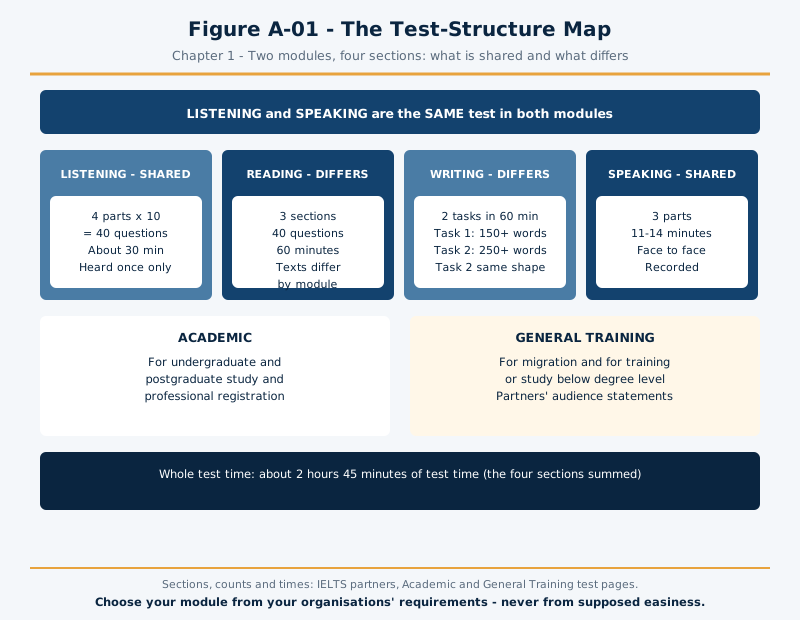
Figure A-01 — The test-structure map: two modules × four sections, with Listening and Speaking marked SHARED, Reading marked MODULE-SPECIFIC, and Writing marked Task 1 module-specific / Task 2 shared-shape.
Here is the whole test on one page. Every figure below is the partners' published figure, with its source named; Chapter 25 gives the scoring system in full, and Parts II–V teach each section at full depth.
| Section | Shape | Time | How it is scored |
|---|---|---|---|
| Listening (shared) | 4 parts × 10 questions = 40 questions; recordings heard once only | about 30 minutes | 1 mark per correct answer, converted to a band |
| Reading (module-specific) | 3 sections, 40 questions | 60 minutes | 1 mark per correct answer, converted to a band |
| Writing (Task 1 module-specific; Task 2 shared shape) | 2 tasks, both must be completed | 60 minutes | Four examiner criteria per task; Task 2 counts double |
| Speaking (shared) | 3 parts, face to face with an examiner, recorded | 11–14 minutes | Four examiner criteria, equally weighted |
Add the section times — about 30 + 60 + 60 + 11–14 — and the whole test contains about 2 hours 45 minutes of test time (this book's arithmetic on the partners' published section times, IELTS partners, IELTS Academic test; IELTS partners, IELTS General Training test). That is the performance you are preparing for: not four separate school exercises, but one sustained act of English, roughly the length of a long film, in which every minute is spent on language you have never seen before. Part VI of this book teaches you to manage yourself across that span; Parts II–V teach the sections themselves.
Listening in detail. The four parts move from everyday life toward academic life (IELTS partners, IELTS Academic test). Part 1 is a conversation between two speakers in an everyday social context — the partners' example is travel arrangements. Part 2 is one main speaker on an everyday social topic — their example is a speech about local facilities. Part 3 is a conversation between two main speakers in an educational or training context — two university students, perhaps guided by a tutor. Part 4 is one speaker on an academic subject: a lecture in miniature. The questions follow the order of the recording, and the accents you will hear include British, Australian, New Zealand, and North American accents. The partners publish six question-type families for Listening: multiple choice · matching · plan/map/diagram labelling · form/note/table/flow-chart completion · sentence completion · short-answer questions. Part II of this book (Chapters 6–9) teaches all six, part by part and then as a whole.
Reading in detail. Academic Reading gives you three long texts totaling 2,150–2,750 words, in narrative, descriptive, and discursive or argumentative styles; at least one text contains detailed logical argument, and technical vocabulary is glossed — given a simple definition — inside the text itself (IELTS partners, IELTS Academic test). The partners publish eleven question-type families for Academic Reading, from matching headings to True/False/Not Given and Yes/No/Not Given. General Training Reading gives you three sections of increasing difficulty, totaling 2,150–2,375 words: Section 1, short everyday texts such as notices, advertisements, and timetables; Section 2, two work-related texts; Section 3, one longer, more complex general-interest text (IELTS partners, IELTS General Training test). The partners publish eight question-type families for General Training Reading — and note carefully: the General Training page, as the partners publish it, does not list a Yes/No/Not Given family. This book follows the partners' lists exactly, module by module, and never imports an Academic family into General Training practice. Chapters 10–14 teach Reading: shared method first, then each module's branch in full.
Writing in detail. You have 60 minutes for two tasks, and both must be completed (IELTS partners, IELTS Academic test; IELTS partners, IELTS General Training test). Task 1 asks for at least 150 words in about 20 minutes. Academic Task 1 is a description of visual information in your own words. General Training Task 1 is a letter responding to a situation, and the task names three points your letter must cover. Task 2, in both modules, is an essay discussing a point of view, an argument, or a problem: at least 250 words in about 40 minutes. Each task is assessed independently by certificated examiners on four criteria, and — a fact that should shape your whole preparation — Task 2 contributes twice as much as Task 1 to your Writing score. Chapters 15–20 teach the criteria first, then each task form, then the whole section under time.
Speaking in detail. The Speaking test is a face-to-face interview with an examiner, and it is recorded (IELTS partners, IELTS Academic test). Part 1 (4–5 minutes): the examiner introduces themselves, checks your identity, and asks general questions on familiar topics — home, family, work, studies, interests. Part 2 (3–4 minutes, including preparation): you receive a task card naming a topic and the points to include; you have 1 minute to prepare and then speak for up to 2 minutes; the examiner may ask one or two follow-up questions. Part 3 (4–5 minutes): a discussion of the Part 2 topic's issues in a more general, abstract way, in greater depth. Four criteria — Fluency and Coherence, Lexical Resource, Grammatical Range and Accuracy, and Pronunciation — are weighted equally, and their average is your Speaking band (IELTS partners, IELTS scoring in detail). Chapters 21–24 teach the three parts and then the whole performance.
Now the trap promised in Section 1.2, dismantled with numbers. Because General Training texts are drawn from everyday and working life, candidates sometimes call General Training "the easier test" and choose it hoping for a kinder route to a band. The partners' own scoring page closes that door: the Academic and General Training Reading tests are graded on the same scale, and "it is usual that a greater number of questions must be answered correctly on a General Training Reading test to secure a given band score" (IELTS partners, IELTS scoring in detail). Their published average marks make it concrete: at Band 7, the published average is 30 marks out of 40 in Academic Reading and 35 out of 40 in General Training Reading. The texts differ in kind; the scale does not differ at all; and the marks demanded of a General Training reader are, at the bands the partners publish, higher. There is no easier module. There is only your module — the one your organizations name.
Your result is reported on the 9-band scale, from 0 to 9, in whole or half bands, for each section and overall (IELTS partners, IELTS scoring in detail). Band 0 means the test was not attempted. The partners publish a skill-level name for each band, which this book teaches in its own paraphrase: Band 9, an expert user, fully operational in the language; Band 8, a very good user; Band 7, a good user; Band 6, a competent user; Band 5, a modest user; Band 4, a limited user; Band 3, an extremely limited user; Band 2, an intermittent user; Band 1, essentially a non-user beyond a few isolated words (British Council, Band Descriptors / IELTS scoring in detail; IDP IELTS, Understand IELTS scores). Chapter 25 teaches the scale in full, including how your overall band is calculated from your four section bands — the average of the four, weighted equally, rounded to the nearest whole or half band, by a rounding rule the partners state in words and illustrate with worked examples.
Two myths die here, on the first pages where you meet the scale, because both of them distort real decisions.
Myth one: there is a pass mark. There is not. In the British Council's words, "There is no pass or fail in IELTS. Your success depends on achieving the band score required by your chosen institution, employer or visa authority" (British Council, How is IELTS Assessed?). IDP says the same thing from the other side: "Each educational institution or organization sets its own level of IELTS scores to meet its individual requirements" (IDP IELTS, Understand IELTS scores). A band that opens one door may not open another; a band that satisfies one organization this year may not satisfy it next year. No chapter, table, or cover line of this book will ever call a band "a pass," "a good score," or "enough" — those judgments belong to your organizations, and Chapter 25 teaches you the verification method for discovering exactly what they ask.
Myth two: wrong answers are punished. They are not. Listening and Reading award one mark per correct answer and no penalty for incorrect answers (British Council, How is IELTS Assessed?). A wrong answer and a blank answer score exactly the same: zero. The strategic consequence is absolute, and Part VI builds on it: never leave a question blank. A managed guess costs nothing and may gain a mark; a blank gains nothing, ever. Whenever you hear preparation advice built on caution — leave it empty if you are not sure — you are hearing advice for a different test.
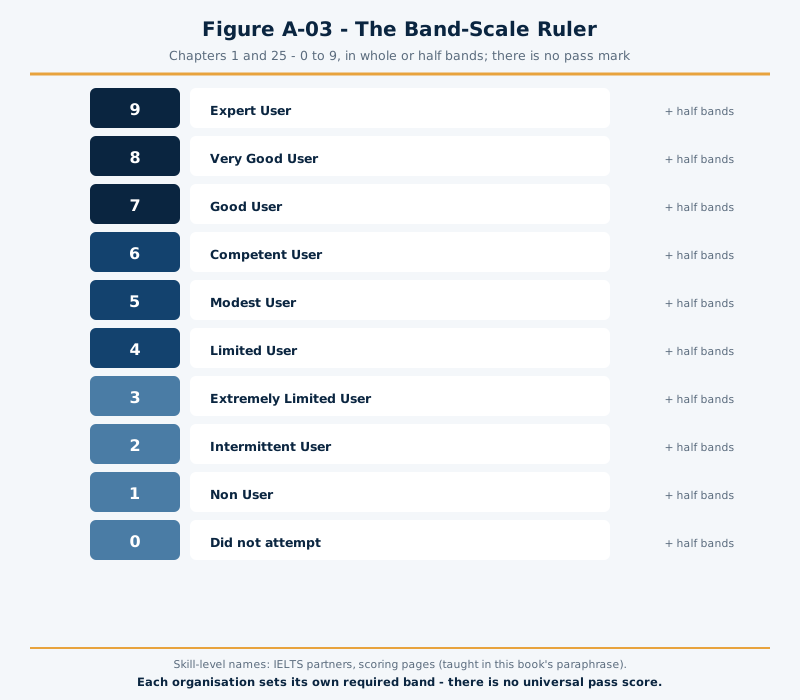
Figure A-03 — The band-scale ruler: bands 0–9 in half-band steps, aligned with the partners' skill-level names from Expert User to Non User, with Band 0 marked "did not attempt the test."
The test's content — its sections, tasks, timings, criteria, and scoring — is one thing. The channel through which you sit it is another, and that channel is in transition. This section gives you the honest map; Chapter 27 teaches it in full, dated, as a decision procedure.
The direction of travel is stated by the partners themselves: from mid-2026, IELTS will no longer be offered as a paper-based test; all IELTS tests will be delivered on computer, with exact timelines varying by market — and, in the same announcement's load-bearing sentence, "this update does not change the IELTS skills assessed, the test construct, or the way results should be interpreted by institutions" (IELTS partners, Updates to IELTS test delivery). Read that twice. The content of your test is not changing. The delivery is completing a move to computer that is already the default experience in most markets. This book therefore teaches one content spine — the test of Sections 1.3–1.5 — and treats delivery as a dated layer on top of it.
The modes you may meet when you book are these (IELTS partners, Ways to take IELTS):
Two disciplines follow. First: fees are local. The partners set fees for each country and test center, detailed policy terms vary according to test center location (IELTS partners, IELTS cancellations, refunds, transfers and re-marks), and no fee amount printed in any book — this one included — can be trusted for your booking. Confirm the current fee for your country and center on the partners' booking pages before you book. Second: availability is local. Which modes your market offers on your date, and whether your center offers the retake option taught in Chapter 26, are facts about your center, not about the test in general. The booking pages, checked close to your booking date, are the authority. This book's job is to make sure you know which questions to ask them.
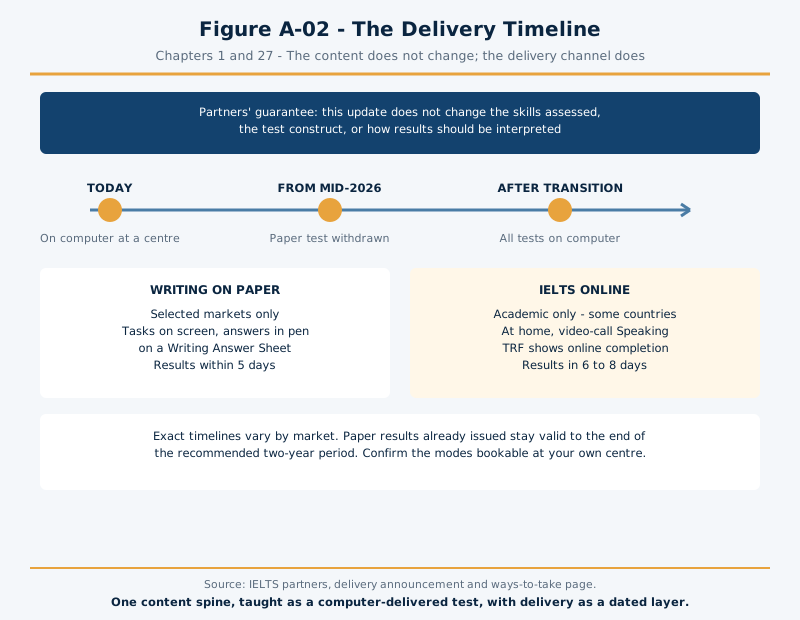
Figure A-02 — The delivery timeline: paper delivery withdrawing from mid-2026 on market-varying timelines; IELTS on computer as the system's standard; Writing on Paper and IELTS Online branching as named options.
The IELTS family contains other tests that this book does not prepare you for, and the distinction protects your money and your applications. The partners also offer IELTS for UKVI (in Academic and General Training forms) for certain United Kingdom visa purposes, and IELTS for UKVI Life Skills, a separate speaking-and-listening test. These are distinct tests with their own rules. The only facts this book prints about them are these, each from the partners: the Secure English Language Test for UK Visas and Immigration purposes is available only in fully digital format (IELTS partners, Updates to IELTS test delivery); all tests taken to secure a UKVI visa must be taken at an official test center (IELTS partners, Ways to take IELTS); and Life Skills — unlike Academic and General Training, which have no pass or fail — is reported as pass/fail (IDP IELTS, Understand IELTS scores). If a UK visa is your destination, your authority's guidance names the exact test it requires; follow that naming exactly, and do not assume this book's test is the one named. Likewise, other English tests owned by other organizations — the TOEFL iBT, for example, prepared for in a companion volume of this series — are different tests again, with different owners, formats, and scales. An organization that names IELTS means IELTS; an organization that names another test means that test. Scores do not convert between test families by any table this book prints, and preparation aimed at one family's tasks is not preparation for another's.
If you have a disability, a health condition, or another circumstance that may require adjusted testing conditions, this paragraph is the most time-sensitive one in the chapter. The partners state that their access arrangement offer continues, and their published list includes large print, braille, hearing-impaired (lip-reading) provision, and One Skill Retake for test takers with access arrangements (IELTS partners, Updates to IELTS test delivery). What this book deliberately does not print is process detail — application routes, lead times, modified materials — because that detail is administered center by center and must come from the center that will actually test you. The actionable teaching is one sentence: contact your test center early, before you book and before your study plan hardens around dates. A reader who raises the question in the week they hoped to sit has lost time through no fault of their own; a reader who raises it now has the whole preparation period to arrange what they need. Chapter 27 returns to access arrangements inside the full delivery map.
This book teaches listening and speaking. It is an ebook. Those two facts require a plain statement, and here it is, in the form in which it also stands in this book's front matter and at the head of its Listening and Speaking parts:
An ebook cannot play you a recording or sit across from you as an examiner. This book teaches listening and speaking through printed transcripts, annotated model answers, and method: you will read every listening text as a transcript after you have worked with it as a listening exercise, study what strong spoken answers look like on the page and why they score, and record your own practice answers on your phone — timed, out loud, every time — to build the fluency the test measures. That is honest preparation for the knowledge and the method. The listening itself, and the speaking itself — with a real voice answering you back — you must practice with real sound and a real partner wherever you can; no book can do those repetitions for you.
Everything in Parts II and V is designed inside that honesty. Every listening text in this book is worked in two passes — first under listening conditions, with a practice partner or a text-to-speech voice reading the printed script while you answer without seeing it; then as a printed, annotated transcript, where every answer's evidence is located and every distractor's failure is named. Every speaking task prints its prompt, its timing, a model answer as an annotated written transcript, and a recording assignment for your phone with a self-check list drawn from the partners' published criteria. What this book will never claim is to have heard you, scored you, or played you anything. Your examiners will do the hearing. This book's job is to make sure that what they hear is ready.
One more honesty note belongs to this chapter, because it concerns the surface of the English itself. This book's own prose uses American spelling, and its model answers do the same, consistently. The test you will sit is broader than any one variety: its recordings use British, Australian, New Zealand, and North American accents, and its reading texts come from publications across the English-speaking world (IELTS partners, IELTS Academic test). In Writing, spelling is a scored surface — the partners' Writing criteria name the density and communicative effect of spelling errors among the things Lexical Resource assesses (IELTS partners, IELTS Writing Key Assessment Criteria). What the partners' published pages, as read for this book, do not state is a rule about which spelling variety Listening and Reading marking accepts in an answer — so this book prints no such rule, and teaches the discipline that is safe under any marking: spell every word exactly, and spell it consistently, in one variety, carefully. Chapter 2 teaches spelling as part of the sentence system; Chapter 9 returns to accents and to why heard English differs from read English. Variety is a fact of this test's world. Carelessness is not excused by it.
Three kinds of reader open this book, and the book is arranged for all three.
The intermediate learner — roughly, a reader who can hold an everyday conversation in English but may never have written a formal letter, described a chart, or spoken to an examiner for two unbroken minutes — should read the book in order. Part I is your foundation and is not optional for you: the grammar system of Chapter 2, the vocabulary method of Chapter 3, the discourse and note-taking system of Chapter 4, and the construction system of Chapter 5 are the ground on which every task chapter stands. The study plans in the front matter include longer plans written for exactly your starting point; the starting levels they name are this book's guidance estimates from this book's diagnostic, labeled as such wherever they appear — they are not certifications, and no plan in this book promises a band. Plans state what they cover. What they deliver depends on the work, and this book will not pretend otherwise.
The advanced learner — a reader whose English is already strong — may move quickly through Part I, but should not skip Chapter 1 (the map and the module rule), Chapter 4 (the note-taking system and the listening method every listening chapter assumes), or the criteria teaching of Chapter 15 whenever you reach it. Use the other Part I chapters as a diagnostic: where a practice set surprises you, that chapter has earned your time.
The booked candidate — a reader with a test date — should begin from the diagnostic in the front matter and the full practice tests, repair what they expose through the task chapters, and read Chapters 25–28 in the final weeks as a rehearsal of scoring, second chances, delivery, and test-day craft.
Whichever reader you are, your path through the branched chapters is fixed by your module. Shared chapters (1–9, 10's core, 15, 19–28) serve everyone. Chapter 10 teaches shared Reading method to both modules. Chapters 11–12 are the Academic Reading branch; Chapters 13–14 are the General Training Reading branch; you take your branch, and the other branch remains in the book for reference — it is not assigned to you, and its practice sets are not yours to count in your plan. Chapter 16–17 teach Academic Task 1; Chapter 18 teaches the General Training letter; Chapters 19–20 teach the shared Task 2 and the whole Writing section. Every practice unit in the book is tagged with its module address, its task or question family, and the teaching concept it tests, so the crosswalk in the back matter can show you — and this book's reviewers — exactly what every unit is for.
Three working habits govern the whole book. First, do the practice where it stands: each chapter's set is printed at the chapter's end because it tests that chapter's teaching while the teaching is fresh, and its key explains not only the right answer but why each wrong answer fails — or, for the test's completion-style items, quotes the deciding evidence. Answer first; check second; re-read where the key surprises you. Surprise is information about what to re-read. Second, keep a word log from Chapter 3 onward: a notebook, physical or digital, where every new word is written with its word family, its meaning in your own words, and a sentence of your own. Third, verify like a candidate: modules against your organizations' pages, modes and fees against the partners' booking pages, dates against the announcements — because the IELTS world rewards the candidate who checks, and quietly punishes the one who assumes.
That is the map. You know what the test is, who owns it, which module is yours and how to prove it, what the four sections contain, how the result is reported, why there is no pass mark and no penalty for a wrong answer, how the test will reach you, what this book can and cannot do for your listening and speaking, and the order in which you will learn all of it. Chapter 2 begins the foundations at the level where every criterion in this test is ultimately spent: inside the sentence.
Abstract rules become real when they meet real applicants. Work through these three cases — all invented for this book, all built on the partners' published audience statements — and notice that in every case the deciding voice is an organization's, never a rumor's.
Candidate one: the nurse. Amara has been offered a route to professional registration as a nurse in an English-speaking country. A well-meaning colleague tells her that General Training is "the practical one" and advises her to prepare it. Amara follows this chapter's procedure instead. She lists her organizations: the nursing regulator and the hospital trust that will employ her. The regulator's registration guidance names IELTS Academic and states an overall band together with a minimum band in each section — including a Writing minimum, the section internationally educated nurses most often underestimate. The colleague's advice, kindly meant, would have cost Amara a full preparation cycle aimed at the wrong Task 1: letters instead of data descriptions, everyday texts instead of academic ones. The lesson is not that colleagues lie; it is that only one voice in this process has authority, and it publishes its requirements in writing. Amara prepares Academic, with Chapter 16's data description and Chapter 25's verification method at the center of her plan, and she checks the regulator's page again in the month she books, in case the requirement has moved.
Candidate two: the migrating family. Daniel and his partner are applying to settle in one of the countries the partners name in their General Training description. The immigration authority's current guidance names IELTS General Training and states the bands it requires. Daniel's situation contains the second great module trap: his old school friend, who emigrated two years earlier, sat IELTS "on paper" and lends Daniel a box of paper-era preparation books. Daniel may accept the gift with thanks — and must use it with Chapter 27's dated guidance in hand. The content of those books, insofar as it teaches English and the test's tasks, still transfers, because the partners guarantee the construct is unchanged. Their delivery advice — answer sheets, transfer routines, handwritten essays as the whole test's mode — describes a sitting that is being withdrawn, on a timeline set by Daniel's market, and may describe nothing he will ever be offered. Daniel books IELTS on computer, prepares his letter writing in Chapter 18 and his everyday and workplace reading in Chapter 13, and treats the borrowed books as English practice, not as a picture of his test day.
Candidate three: the student with two offers. Priya holds offers from two universities. The first names Academic and an overall band with no section minima. The second names Academic and a slightly lower overall band but adds a minimum in Writing. Candidates routinely misread this shape as "the second university is easier." It is not; it is differently strict. Priya's preparation must satisfy the combination: the higher overall figure and the Writing floor beneath it. Her plan, built in Chapter 28's terms, therefore weights Writing practice beyond its natural share — and because Task 2 contributes twice as much as Task 1 to the Writing band, her essay work in Chapters 19–20 carries more consequence than any other single strand of her preparation. Notice, again, what made this plan possible: not a prediction, not a guarantee, but two published requirements, read carefully, on the organizations' own pages, on a recorded date.
Three candidates, one procedure. List the organizations. Read their current requirements, overall and per section. Let the strictest named condition govern. Confirm again before booking. Every later chapter assumes you have done this once; Chapter 25 assumes you will do it again before it matters.
It may seem early to study a results document in Chapter 1. It is not, because the Test Report Form's shape quietly dictates several preparation decisions (British Council, IELTS Result Overview; IELTS partners, Ways to take IELTS). The TRF carries your photograph and personal details, and shows your overall band plus the four section bands — five numbers, each of which an organization may read and condition on. You receive one copy; replacement copies are not issued if you lose or damage it, though the center can send up to five free copies directly to recognizing organizations you name within the validity period. If you sit IELTS on computer or IELTS Online, your result is issued electronically only, as an eTRF you download from the Test Taker Portal. An IELTS Online form indicates that the test was completed online; a Writing on Paper form, by contrast, does not indicate the option. Results arrive on mode-dependent clocks: 1–5 days for IELTS on computer, within 5 days for Writing on Paper, 6–8 days for IELTS Online (IELTS partners, Ways to take IELTS).
Draw the disciplines out. First, because organizations can and do set per-section minima, a preparation plan that chases an overall average while neglecting one section is a plan built on a misreading of the document your result will arrive on; the tracker in this book's diagnostic therefore records your practice by section and by task family, never as a single blended score. Second, because the TRF is a single, unreplacable copy, the administrative details of your booking — your name spelled exactly as on your identity document, your organizations named correctly — deserve the same care as your essay structure; Chapter 27's test-day teaching returns to this. Third, because online completion is indicated on the form, the mode decision of Section 1.6 is not merely a matter of convenience: it is printed on the evidence you will submit, which is why this book insists that acceptance of IELTS Online results is your organizations' decision, to be confirmed before you book, never assumed after. Fourth, validity: the partners' governing formulation is a recommended two-year validity period, and paper results already issued remain valid to the end of that period (IELTS partners, Updates to IELTS test delivery). Organizations decide what they accept and for how long, so an application planned near the two-year boundary is an application to verify early — Chapter 26 teaches the clock arithmetic for exactly that planning.
Finally, hold the scale of the whole enterprise in view. You are preparing for about two hours and forty-five minutes of tested English, reported as five numbers on one form, read by organizations that set their own thresholds, under rules the partners publish in full. Nothing in that sentence is hidden from you, and nothing in this book will be either. The foundations come next: Chapter 2 builds the sentence system every band in every section is ultimately paid for in, Chapter 3 the vocabulary and paraphrase system, Chapter 4 the discourse and note-taking system, and Chapter 5 the construction of whole texts and a spoken voice. Then the sections themselves, one by one, at full depth.
You will have noticed that this chapter names its source at the point where each fact is used — "40 questions, heard once only (IELTS partners, IELTS Academic test)" — rather than gathering its authorities into a single disclaimer at the front. That is a deliberate discipline, and it is worth a section of its own, because the habit it models is one of the most valuable things a candidate can learn. IELTS preparation is a large commercial market, and a candidate moving through it meets claims of wildly different quality wearing very similar clothes: a partner's published rule, a teacher's reasonable inference, a blogger's confident invention, and a marketer's promise can all arrive in the same font on the same afternoon. The defense is not suspicion of everything; it is the habit of asking, of every load-bearing claim, whose claim is this, and where did they publish it?
This book answers that question at the point of use, every time, in three distinct voices, and you should learn to hear the difference between them. The partners' voice states the test's facts: section counts, timings, word minima, criteria, scoring rules, program rules. Those statements are cited to the partners' own pages and documents in words — the Academic and General Training test pages, the scoring page, the key assessment criteria for Writing and Speaking, the delivery announcement, the retake and ways-to-take pages. Where the partners' own pages were found to disagree with one another — as they do, for instance, on a small number of secondary figures — this book builds on the partners' central scoring page, says so in its production record, and never silently copies a discrepant figure. This book's voice states guidance the book itself has designed: starting-band estimates from its diagnostic, pacing budgets built on the partners' published times, study plans, readiness judgments. Those are labeled this book's guidance wherever they appear, because a book that dresses its own inventions in the partners' authority has deceived you exactly where you most need to trust it. Your organizations' voice states requirements: modules, bands, minima, acceptance of a delivery mode. Those are never printed as data in this book at all, because they change and they differ; instead the book teaches the verification method of Sections 1.2 and 1.11 and Chapter 25, and you supply the current facts from the only pages entitled to state them.
Apply the same three-voice test outside this book. A preparation video that says "examiners deduct a band if you use contractions" is making a claim in the partners' voice: ask where the partners publish it. (The partners' published Writing criteria, which Chapter 15 teaches in full, say nothing of the kind; they assess range, accuracy, appropriacy, and the density and effect of errors.) A website that publishes a complete raw-score-to-band conversion table for every band and half band is likewise speaking in the partners' voice — and the partners, as read for this book, publish no such table; they publish average marks for selected bands with an explicit warning that the marks needed vary slightly by test version. A table that contradicts that warning is not a leaked secret; it is an invention, and a candidate who plans against invented cut-offs plans against fiction. A forum post that reports "my center charged this fee" may be perfectly true — of that center, in that country, on that date — and is therefore evidence about exactly one booking, not about yours. Fees, in this book, print as what they verifiably are: set locally, confirmable only on the partners' booking pages for your country and center.
There is a positive side to this discipline, and it matters more than the defensive side. Because the partners genuinely do publish the criteria, the task lists, the scoring rules, and the program rules, a candidate who reads primary sources — or who studies a book built strictly from them — is not guessing at the test from outside. You are preparing for a published examination whose assessors assess against published indicators. The chapters that follow exploit that openness completely: Chapter 15 teaches the Writing criteria in full before a single task is attempted, Chapter 25 works the partners' own rounding examples until the arithmetic is reflexive, and Chapter 26 teaches the retake and enquiry routes exactly as published, conditions and clocks included. Secrecy is the myth the market sells. Publication is the fact the partners supply. Build on the fact.
Before the practice set, fix the chapter as a checklist you can recite. If any line of it is not yet true of you, the section named beside it is your re-reading.
The errors this chapter exists to prevent are worth naming once, plainly, because each of them has cost real candidates real time. Preparing the wrong module because a confident person recommended it. Choosing a module by supposed easiness, against the partners' published averages. Planning toward a pass mark that does not exist, or toward a "good score" defined by marketing instead of by an admissions page. Studying delivery mechanics for a sitting that is being withdrawn while neglecting the computer sitting you will actually be offered. Booking IELTS Online for a General Training purpose it does not serve, or before your organizations have confirmed they accept its indicated results. Leaving questions blank out of a caution borrowed from tests that penalize errors. And underlying all of them: treating an unattributed claim as a fact. The practice set that follows tests the chapter's facts. The rest of the book builds the skills. Both begin from the same ground rule — know whose claim you are relying on, and check it where it was published.
Fifteen units. Units in the test's own forms are labeled with their form; constructed tasks carry a recording or writing instruction. Check every answer in the Chapter 1 key.
1. (Multiple choice — SHARED) A candidate has been admitted to a postgraduate degree program at a university where all teaching is in English. Which module do the partners describe for study at undergraduate or postgraduate level? A. General Training B. Academic C. Either module, at the candidate's free choice in all cases D. IELTS for UKVI Life Skills
2. (Multiple choice — SHARED) A candidate is applying to settle permanently in an English-speaking country and to take a training course below degree level. Which module do the partners describe for migration and for training or study below degree level? A. Academic B. IELTS Online C. IELTS for UKVI D. General Training
3. (Multiple choice — SHARED) Which statement states the module rule correctly? A. Listening and Speaking are the same in both modules; Reading and Writing Task 1 differ. B. All four sections differ between the modules. C. Reading and Speaking are the same in both modules; Listening differs. D. The modules differ only in Reading.
4. (Sentence completion — SHARED) Complete the sentence with the correct number. Listening has four parts of ten questions each, so the Listening section contains ______ questions in total.
5. (Multiple choice — SHARED) Which statement about the two Reading tests is correct, on the partners' published figures? A. Both modules read identical texts; only the questions differ. B. General Training Reading has 30 questions in 60 minutes. C. Academic texts total 2,150–2,750 words; General Training texts total 2,150–2,375 words; both have 40 questions in 60 minutes. D. Academic Reading lasts 45 minutes; General Training Reading lasts 60 minutes.
6. (Matching — SHARED) Match each section (i–iv) to its published time (a–d). i Listening · ii Reading · iii Writing · iv Speaking. a 60 minutes · b 11–14 minutes · c about 30 minutes · d 60 minutes. (Two sections share a time; write both matches.)
7. (Multiple choice — SHARED) A friend tells you: "You need Band 6.5 to pass IELTS." What does this chapter teach you to say? A. Correct — 6.5 is the partners' pass mark. B. There is no pass or fail in IELTS; each organization sets its own required level. C. The pass mark is Band 6.0 for Academic and 5.5 for General Training. D. You pass by beating the average of other candidates.
8. (Multiple choice — SHARED) How are IELTS scores reported? A. As percentages out of 100. B. As letter grades from A to F. C. On a scale of 0–120 in whole points. D. On a 9-band scale, from 0 to 9, in whole or half bands.
9. (Short-answer question — SHARED) In one short phrase: when your university and an immigration authority name different things, whose published requirement decides which module you take and what score you need?
10. (Multiple choice — SHARED) Which statement about IELTS Online is correct, as the partners publish it? A. It is available for the Academic test only, in some countries, with Speaking by video call, and receiving organizations decide whether to accept its results. B. It is available for both modules in all countries. C. Its Test Report Form does not indicate that the test was taken online. D. It uses different timing and marking criteria from the center test.
11. (Multiple choice — SHARED · designated) In this book's practice test, your Listening raw score is 30 marks out of 40. The partners' scoring page publishes average marks for Listening of Band 5 → 16, Band 6 → 23, Band 7 → 30, Band 8 → 35, and warns that the precise marks needed vary slightly from test version to test version. What is the honest conclusion? A. You have scored exactly Band 7.0, guaranteed. B. You have scored Band 8, because 30 is close to 35. C. Your raw score sits at the partners' published average for Band 7 — a guidance estimate only; a real test version may need slightly different marks. D. No conclusion is possible from a raw score.
12. (Multiple choice — SHARED) How does Task 2 contribute to the Writing score, compared with Task 1? A. It contributes the same amount as Task 1. B. It contributes twice as much as Task 1. C. It contributes half as much as Task 1. D. Only Task 2 is scored; Task 1 is a warm-up.
13. (Multiple choice — SHARED · designated) A candidate's four section bands are Listening 6.5, Reading 6.0, Writing 5.5, Speaking 6.0. The overall band is the equally weighted average of the four, rounded to the nearest whole or half band. What is the overall band? A. 5.5 B. 6.5 C. 5.75 D. 6.0
14. (Multiple choice — SHARED) Which statement about the Speaking test is correct? A. You speak to a computer program that scores you automatically. B. It has four parts and lasts 20 minutes. C. It is a face-to-face interview with an examiner, in three parts, lasting 11–14 minutes, and it is recorded. D. It is different in the Academic and General Training modules.
15. (Short-answer question — SHARED · designated) Using the partners' published section times — Listening about 30 minutes, Reading 60 minutes, Writing 60 minutes, Speaking 11–14 minutes — state the total test time this book derives from those figures, as this chapter states it.
End of Chapter 1 practice set — 15 units. Check every answer in the Chapter 1 key before you move to Chapter 2, and record in your study journal the module you are preparing, the organizations you must verify, and the date on which you verified them. That single journal entry — module, organizations, date — is the first artifact of a serious preparation, and Chapter 25 will ask you to renew it before you book. Candidates who keep that entry current never sit the wrong test, never chase a band nobody asked for, and never discover a delivery condition after it has already cost them a sitting.
© 2026 Feras Alzubi
All rights reserved.
From the Mastering Careers & Skills library.
Built against IELTS Academic and General Training as published by the IELTS partners (British Council, IDP IELTS, and Cambridge University Press & Assessment) on ielts.org, checked October 2026; 2026–2027 Edition.
This book is an independent study guide. It is not published by, affiliated with, endorsed by, or approved by the British Council, IDP IELTS, or Cambridge University Press & Assessment, and none of them participated in its creation. IELTS is a registered trademark of the IELTS partners; exam names and trademarks belong to their respective owners. The test's format, rules, fees, and score policies are set by the IELTS partners and change over time — always confirm your module, your delivery mode, the fee for your country and centre, and your organizations' score requirements with the partners and your organizations before you book. Passing any exam also depends on the candidate's own preparation; no book can guarantee a band score, an admission, or a visa, and this book — an ebook, with no audio — teaches listening and speaking through transcripts, models, and method, as its front matter states plainly.
Five consequences of those sentences are stated here at the front, not buried at the back.
First, this book teaches one test in two modules, and names that basis wherever the test's content is claimed. The test is IELTS — the International English Language Testing System — jointly owned by the British Council, IDP IELTS, and Cambridge University Press & Assessment (the partners' own ownership line, printed in their Writing Key Assessment Criteria document). It comes in two modules, Academic and General Training, and choosing between them is your first real decision: Academic is the module for study at undergraduate or postgraduate level and for professional registration contexts; General Training is the module for migration to an English-speaking country — the partners' examples are Australia, Canada, New Zealand, and the UK — or for training or study below degree level (IELTS partners, IELTS Academic test; IELTS partners, IELTS General Training test). Listening and Speaking are the same test in both modules; Reading and Writing differ (IELTS partners, IELTS General Training test). That single rule is this book's structural spine. Chapters that branch between the modules are marked ◆, each branch is written in full at equal depth, and no practice unit in this book is ever blended into a fictional common test that neither module actually sits. Your organizations — your university, your professional body, your visa authority — name the module you need, not this book and not a preference for whichever module sounds easier. General Training Reading is graded on the same scale as Academic Reading, and it is usual that a greater number of questions must be answered correctly on a General Training Reading test to secure a given band score (IELTS partners, IELTS scoring in detail). There is no easier module. There is only the right one.
Second, a change to how IELTS is delivered is coming — and the partners state, in writing, that it is not a change to the test. From mid-2026, IELTS will no longer be offered as a paper-based test; all IELTS tests will be delivered on computer, with exact timelines varying by market. A new Writing on Paper option is being introduced in selected markets, inside an IELTS on computer test. And the partners' announcement says, in its own words, that "this update does not change the IELTS skills assessed, the test construct, or the way results should be interpreted by institutions" (IELTS partners, Updates to IELTS test delivery). This book therefore does the honest thing with that announcement: it teaches one content spine — the four sections, their tasks, counts, timings, criteria, and band scoring exactly as the partners publish them — and it teaches delivery as a dated layer, in Chapter 27, where the computer test, Writing on Paper, IELTS Online, and the closing paper window are set out as they stand, with the standing instruction to confirm which modes are actually bookable at your own center. A book that taught a "paper IELTS" and a "computer IELTS" as two different tests would be inventing a distinction the partners deny. This book does not. If you meet unofficial claims online of a restructured or "new format" IELTS — new sections, new scoring, new tasks — treat them as what they are: unofficial. The partners' own sites govern, and the errata and basis page in the back matter states this edition's currency discipline in full.
Third, there is no pass mark in IELTS, and this book invents none. In the British Council's published words: "There is no pass or fail in IELTS. Your success depends on achieving the band score required by your chosen institution, employer or visa authority." IDP IELTS states the same rule from the other side: each educational institution or organization sets its own level of IELTS scores to meet its individual requirements. You will therefore find no universal "good score," no table of named universities' or countries' requirements presented as fact, and no promise of an admission, a visa, a registration, or a band anywhere in this book. What you will find, in Chapter 25, is a verification method: how to find each of your organizations' current published requirements, how to note per-section minima as well as the overall figure, and how to confirm acceptance of your module, your delivery mode, and any retake route before you book. A band goal is yours and your organizations' to set. This book's job is to make sure the number you aim at is the real one.
Fourth, no IELTS fee amount is printed in this book — not the test fee, not any retake or enquiry fee, in any currency. That is a deliberate fence, not an omission. The partners' own global policy page states that detailed policy terms vary according to test center location, and fees are set for your country and your center, in your currency (IELTS partners, IELTS cancellations, refunds, transfers and re-marks). A fee figure printed in a book sold worldwide would be wrong for most of its readers the day it printed. What prints, everywhere a fee is mentioned, is the honest form: a fee applies; it is set for your country and test center; confirm the current amount on the partners' booking pages before you book.
Fifth, an honest word about the medium, printed here because it governs half of this test. IELTS is a heard and spoken test as much as a read and written one, and this is a printed book with no audio. Listening on test day is heard once only; here, that single hearing is rehearsed through printed transcripts — worked first as listening, under listening conditions, and studied afterward as text. Speaking on test day is a face-to-face conversation with an examiner; here, it is rehearsed through annotated model answers and method, and through your own voice, recorded on your phone. That boundary is real, and this book works inside it openly rather than pretending it away. The full statement of it is printed word for word in How to Use This Book below, again at the head of Part II, again at the head of Part V, and again in Chapter 28. It is not fine print. It is the honest shape of preparation in this medium.
This book does not promise that you will reach any band or gain any outcome. It teaches English from foundations — sentences, vocabulary, paragraphs, and discourse first, for the reader who may never have written a formal letter or described a chart in English — then teaches the complete test for both modules: all four sections, every question-type family the partners publish for your module, the full scoring system, every delivery mode, and the program rules around the test, and it drills you with original practice built at the test's true shape for your module. That is what a study book can honestly do. The assessment criteria examiners use are not secrets, and nothing in this book is marketed as one: the partners publish those criteria, and this book teaches them in full, in the open (IELTS partners, IELTS Writing Key Assessment Criteria; IELTS partners, IELTS Speaking Key Assessment Criteria).
Provenance note. Every passage, transcript, prompt, letter situation, chart, process, map, and cue card in this book is original, written for this book against IELTS Academic and General Training as published by the IELTS partners in their test-type, scoring, and key assessment criteria documents. No real IELTS text is reproduced in this book — no actual or recalled test passage, listening transcript, writing prompt, cue card, chart, or examiner wording from any live or published test, including the partners' own published practice books and sample tests, is copied, closely paraphrased, or adapted. What this book uses from the partners, and says it uses, is their published facts: the task and question-type names, the mechanics, the counts, the times, the word minima, and the assessment criteria, taught in this book's own words with their sources named. They are not the exam's questions, and no page of this book claims "real IELTS questions."
Other tests with similar names are different tests. IELTS for UKVI (Academic and General Training), IELTS for UKVI Life Skills, and every other English test — including the TOEFL iBT, which has different owners — are distinct tests with their own rules. This book prepares you for IELTS Academic and IELTS General Training only. The UKVI tests are named once, in Chapter 1, only so a reader holding the wrong information is corrected: the partners state that the Secure English Language Test (SELT) for UK Visas & Immigration purposes will only be available in the fully digital format (IELTS partners, Updates to IELTS test delivery), that all tests taken to secure a UKVI visa must be taken at an official IELTS test center (IELTS partners, Ways to take IELTS), and that Life Skills is reported pass/fail (IDP IELTS, Understand IELTS scores). No content from any of those tests is taught here, and nothing in this book's title, subtitle, or store copy targets a test it does not prepare for.
A note on spelling and accents. This book's own voice uses American spelling, and its model answers are written in American spellings, consistently. Two IELTS facts belong beside that choice from the first page. The test's recordings use British, Australian, New Zealand, and North American accents (IELTS partners, IELTS Academic test) — you will hear more than one kind of English, and Chapter 9 teaches an exposure method for all four regions, never a caricature of any of them. And spelling is a scored surface in this test: the partners' Writing criteria count the density and effect of spelling errors inside Lexical Resource (IELTS partners, IELTS Writing Key Assessment Criteria). This book's method, taught throughout, is simple: spell exactly, and spell consistently. What marking conventions apply to spelling variants in Listening and Reading answers is not stated in the partner sources this book is built on, so this book prints no acceptance rule for it — careful spelling is taught as method, not promised as a marking policy.
Access arrangements. The partners continue their access arrangement offer, whose published list includes large print, braille, hearing-impaired (lip-reading) provision, and One Skill Retake for test takers with access arrangements (IELTS partners, Updates to IELTS test delivery). If you need any arrangement, start with your test center, and start early: the arrangements exist, the process is your center's to run, and Chapter 1 and Chapter 27 carry this pointer again where the booking decisions are made. This book prints the partners' published list as an early-planning pointer and nothing narrower, because application processes and lead times are set by centers, not by a book.
Copyright © 2026 Feras Alzubi. All rights reserved. No part of this book may be reproduced, distributed, or transmitted in any form or by any means without the prior written permission of the copyright holder, except as permitted by law. The book stands on its sources, which are named wherever they are used and listed in full in the References.
Everything on these pages traces to the IELTS partners' own publications as read in October 2026: the partners' Academic and General Training test pages, their scoring page, their delivery announcement, their One Skill Retake and ways-to-take pages, their cancellations and re-marks page, their Writing and Speaking Key Assessment Criteria documents, and the British Council's and IDP IELTS's candidate scoring pages — each listed in full in the References. Each figure carries its source in words. Where a figure could not be verified from such a source, these pages print no figure at all — and say so, because the silence is itself information.
IELTS assesses the language ability of people who want to study or work where English is the language of communication. Listening and Speaking are the same in both modules; Reading and Writing differ (IELTS partners, IELTS General Training test).
| Section | Shape | Time | Scoring basis |
|---|---|---|---|
| Listening (same in both modules) | 4 parts × 10 questions = 40 questions; recordings heard once only | About 30 minutes | 1 mark per correct answer, converted to a band |
| Reading (different in each module) | 3 sections, 40 questions — Academic: 2,150–2,750 words in total · General Training: 2,150–2,375 words in total | 60 minutes | 1 mark per correct answer, converted to a band; the same scale in both modules |
| Writing (Task 1 different in each module; Task 2 the same task shape) | 2 tasks, both must be completed — Task 1: at least 150 words, about 20 minutes · Task 2: at least 250 words, about 40 minutes | 60 minutes | Four examiner criteria per task; Task 2 contributes twice as much as Task 1 to the Writing score |
| Speaking (same in both modules) | 3 parts, face-to-face with an examiner; the test is recorded | 11–14 minutes | Four examiner criteria, equally weighted |
(Sources for every row: IELTS partners, IELTS Academic test; IELTS partners, IELTS General Training test; IELTS partners, IELTS scoring in detail. The four sections' times sum to about 2 hours 45 minutes of test time — this book's arithmetic on the partners' published figures, labeled as such.)
Listening in detail (IELTS partners, IELTS Academic test; IELTS partners, IELTS General Training test). Part 1: a conversation between two speakers in an everyday social context. Part 2: one main speaker in an everyday social context. Part 3: a conversation between two main speakers, possibly guided by a tutor, in an educational or training context. Part 4: one speaker on an academic subject. The question order follows the recording. Accents include British, Australian, New Zealand, and North American. The six question-type families, as the partners describe them: multiple choice · matching · plan/map/diagram labelling · form/note/table/flow-chart completion · sentence completion · short-answer questions.
Academic Reading in detail (IELTS partners, IELTS Academic test). Three long texts from books, journals, magazines, newspapers, and online resources, written for a non-specialist audience, in narrative, descriptive, and discursive/argumentative styles; at least one text contains detailed logical argument; diagrams, graphs, or illustrations may appear; technical vocabulary is glossed in the text. The eleven question-type families, as the partners describe them: multiple choice · identifying information (True/False/Not Given) · identifying writer's views/claims (Yes/No/Not Given) · matching information · matching headings · matching features · matching sentence endings · sentence completion · summary/note/table/flow-chart completion · diagram label completion · short-answer questions.
General Training Reading in detail (IELTS partners, IELTS General Training test). Three sections of increasing difficulty. Section 1: two or three short texts, or several shorter ones, on everyday topics — notices, advertisements, timetables. Section 2: two work-related texts — job descriptions, contracts, staff development and training materials. Section 3: one longer, more complex general-interest text, descriptive and narrative, from newspapers, magazines, books, and online resources. The eight question-type families, as the partners describe them on the General Training page: multiple choice · identifying information (True/False/Not Given) · matching information · matching headings · matching features · summary/note/table/flow-chart-style completion · diagram label completion · short-answer questions. Read that list carefully: the General Training page as published does not list a Yes/No/Not Given family. This book's General Training teaching follows the page as published and never imports the Academic family list into General Training.
Writing in detail (IELTS partners, IELTS Academic test; IELTS partners, IELTS General Training test; IELTS partners, IELTS Writing Key Assessment Criteria). Academic Task 1: describe visual information — a graph, table, chart, or diagram, or a diagram of an object, device, process, or event — in your own words. The partners' criteria document defines it as an information-transfer task, confined to the factual content of the given visual, "not to speculative explanations that lie outside the given data." General Training Task 1: write a letter responding to a given situation, in a personal, semi-formal, or formal style as the situation requires; the task identifies three points to be covered. Task 2, in both modules: write an essay on a point of view, argument, or problem — academic or semi-formal/neutral in style for Academic, semi-formal/neutral discursive for General Training. Scripts may be penalized if they are partly or wholly plagiarized, or not written as full, connected text — bullet points and note form are not appropriate (IELTS partners, IELTS Writing Key Assessment Criteria).
Speaking in detail (IELTS partners, IELTS Academic test). Part 1 (4–5 minutes): the examiner introduces themselves, checks your identity, and asks general questions on familiar topics — home, family, work, studies, interests. Part 2 (3–4 minutes, including preparation): the cue-card long turn — a task card naming a topic and points to include; 1 minute to prepare; speak for up to 2 minutes; the examiner may then ask one or two questions on the topic. Part 3 (4–5 minutes): a discussion of the Part 2 topic's issues in a more general, abstract way, in greater depth.
| Section | Published average marks, by band |
|---|---|
| Listening | Band 5 → 16 · Band 6 → 23 · Band 7 → 30 · Band 8 → 35 |
| Academic Reading | Band 5 → 15 · Band 6 → 23 · Band 7 → 30 · Band 8 → 35 |
| General Training Reading | Band 4 → 15 · Band 5 → 23 · Band 6 → 30 · Band 7 → 35 |
An average is not a cut-off. The partners publish no complete raw-to-band conversion table, and this book prints none: no ranges are worked out between the rows above, no half-band equivalents are derived, and no General Training Band 8 average is printed, because the partners' central scoring page does not publish one. Where partner pages differ on these rows, this book prints the central scoring page's rows only — the errata and basis page in the back matter says so plainly. Practice-test band estimates in this book are derived only from the rows above and are labeled this book's guidance estimate from the partners' published averages at every appearance; a real test version may shift them. - Writing scoring. Each task is assessed independently by certificated examiners on four criteria, weighted equally (25% each) — Task Achievement (Task 1) / Task Response (Task 2) · Coherence and Cohesion · Lexical Resource · Grammatical Range and Accuracy — and the score on the task is the average of the four criteria. The Writing band then combines the tasks with Task 2 carrying twice the weight of Task 1 (IELTS partners, IELTS scoring in detail; IELTS partners, IELTS Academic test; British Council, How is IELTS Assessed?). - Speaking scoring. The examiner awards a score for each of Fluency and Coherence · Lexical Resource · Grammatical Range and Accuracy · Pronunciation; the criteria carry equal weighting and the overall average gives the IELTS score for Speaking (IELTS partners, IELTS scoring in detail; IELTS partners, IELTS Speaking Key Assessment Criteria). - No pass mark. There is no pass or fail in IELTS; organizations set their own requirements (British Council, How is IELTS Assessed?; IDP IELTS, Understand IELTS scores). See the third consequence at the head of this front matter, and the verification method in Chapter 25. - Results and the Test Report Form. Results timing depends on the mode: IELTS on computer, 1–5 days after test completion · Writing on Paper, within 5 days · IELTS Online, 6–8 days · One Skill Retake, within 3–5 days (IELTS partners, Ways to take IELTS; IELTS partners, IELTS One Skill Retake). The Test Report Form (TRF) is the official confirmation of your result: it carries your photo and personal details and shows the overall band plus the four section bands. You receive one copy — replacements are not issued for loss or damage — and the center can send up to five free copies directly to recognizing organizations named within the validity period. Computer and Online results are issued electronically only, as an eTRF through the Test Taker Portal. An Online TRF indicates the test was completed online; a Writing on Paper TRF does not indicate that the option was chosen (British Council, IELTS Result Overview; IELTS partners, Ways to take IELTS). - Validity. The partners' governing formulation is a recommended two-year validity period (IELTS partners, Updates to IELTS test delivery). This book prints that careful wording, and teaches you to confirm the validity window your own organization actually applies — because organizations, not this book, decide what they accept and for how long.
The content above is one test. How you sit it is changing, and the modes must not be confused with one another — or with different tests.
| Mode | What the partners publish |
|---|---|
| IELTS on computer (test center) | Listening, Reading, and Writing questions on screen, answers entered on the computer; Speaking face-to-face with a trained examiner; results 1–5 days after test completion. From mid-2026 this becomes the only standard delivery, on timelines that vary by market. |
| IELTS on computer, with Writing on Paper (selected markets) | The Writing tasks appear on screen and are completed in pen on an IELTS Writing Answer Sheet; results within 5 days; the TRF does not specify that the option was chosen. A One Skill Retake for a Writing-on-Paper original must be taken in the same delivery mode. |
| IELTS Online (some countries) | Academic only. At home or in another suitable private location, with the same format, questions, timing, and marking criteria as the in-center test; Speaking by online video call with a trained examiner; results 6–8 days; the TRF indicates the test was completed online, and receiving organizations decide whether to accept online results. All UKVI-purpose tests must be taken at an official test center. |
| IELTS on paper (closing window) | Still encountered in some markets during the transition, and in access-arrangement provision, but announced for withdrawal from mid-2026 with timelines varying by market. Paper results already issued are unaffected and remain valid to the end of the recommended two-year period. This book does not teach paper as a co-equal default; Chapter 27 carries its dated status. |
(Sources for every row: IELTS partners, Ways to take IELTS; IELTS partners, Updates to IELTS test delivery. Which modes are bookable in your market, on your date, is not uniform worldwide — confirm the modes your own center offers before you book. Candidate requirements for IELTS Online beyond what is stated here — age, identity, technical requirements — are set for each country on the partners' current Online pages for that country; this book prints the mode as the partners' central page publishes it and directs you there for the rest.)
| Rule | What the partners publish |
|---|---|
| One Skill Retake | Retake any one skill instead of all four; available for both modules. Eligibility requires all of these: you completed a full test at a center that offers One Skill Retake; that full test was an IELTS on computer test; and you sit the retake within 60 days of the full test. Once per original test only. The retake's format and timing equal that skill's in a full test. Results within 3–5 days. A new TRF is issued, combining the retake score with the other three original scores, and you choose which TRF to use. Availability varies by region and center — confirm your center offers it before booking the full test. UKVI acceptance applies in selected locations only. Whether your organization accepts a retake result is your organization's decision. (IELTS partners, IELTS One Skill Retake) |
| Enquiry on Results | A re-mark by senior Examiners/Markers, requested at the test center within six weeks of the test date. A fee applies — confirm the current amount for your country and center on the partners' booking pages — and the fee is fully refunded if the band score changes. The outcome can arrive the same day and up to 21 days after application. A changed score brings a new TRF. (IELTS partners, IELTS cancellations, refunds, transfers and re-marks; IDP IELTS, Understand IELTS scores) |
| Full resits | If you do not get the score you wanted, you can apply to take the test again as soon as you feel ready. No waiting period is stated in the partners' pages this book is built on, and none is printed here. (IELTS partners, IELTS cancellations, refunds, transfers and re-marks) |
| Cancellations and transfers | Cancellation through the test center at any time before the test; the refund depends on timing and exceptional circumstances. One transfer only, to a date within three months of the original. Detailed terms vary by test center location — all money detail is referred to your center. (IELTS partners, IELTS cancellations, refunds, transfers and re-marks) |
| Fees | Fees exist for the test and for optional services. No amount is printed in this book, for any reader, in any currency: amounts are set for your country and center, and the current amounts must be confirmed on the partners' booking pages before you book. |
Two mechanics this book deliberately does not print as facts, because the partner sources it is built on do not state them: any end-of-test answer-transfer or checking time for Listening, by delivery mode, and the administrative scheduling detail of the written sitting and the Speaking session (order, breaks, and how the Speaking session is scheduled relative to the other sections). Chapter 27 and Chapter 28 teach answer-handling and test-day method without those numbers, and instruct you to confirm the administration of your own sitting in your booking confirmation.
An ebook cannot play you a recording or sit across from you as an examiner. This book teaches listening and speaking through printed transcripts, annotated model answers, and method: you will read every listening text as a transcript after you have worked with it as a listening exercise, study what strong spoken answers look like on the page and why they score, and record your own practice answers on your phone — timed, out loud, every time — to build the fluency the test measures. That is honest preparation for the knowledge and the method. The listening itself, and the speaking itself — with a real voice answering you back — you must practice with real sound and a real partner wherever you can; no book can do those repetitions for you.
That statement is this book's contract for the two skills print cannot carry. In practical terms: Listening, heard once on test day, is rehearsed here through transcripts — every listening text is worked first under listening conditions and only then opened as an annotated transcript. Speaking is rehearsed here through models and method — annotated model answers that show what strong spoken answers look like and why they score, a repeatable procedure for each part, and your own recorded voice as the practice instrument. Everything below is the machinery that keeps that contract.
Before you study anything, take the diagnostic that follows this front matter. As designed, it places 50 practice units on your path, to be worked in no more than 60 minutes (the sitting discipline is this book's guidance): Listening, 20 units across the four parts in miniature · Reading, 20 units on your module's path · Writing, 2 tasks — your module's Task 1 and the shared Task 2 · Speaking, 8 units — four Part 1 questions, one Part 2 cue card, and three Part 3 questions, recorded on your phone. Because the book serves both modules, it prints both modules' Reading sets and both Task 1 tasks — 71 printed units in total, of which 50 are on any one reader's path (as designed; the alternate module's printed units are counted separately wherever counts appear in this book, and never inflate your path count).
Score the diagnostic with its key and record the results in its tracker. The tracker does three things: it reports your performance by skill and by task family; it assigns you a starting-band estimate — this book's guidance, derived for Listening and Reading only from the partners' published average marks printed on the Exam Blueprint pages above, and labeled as an estimate at every appearance, because an average is not a cut-off and no diagnostic result is an IELTS score; and it routes each weak family to the chapter that teaches it in your module, and to the study plan in the back matter that fits your starting point, your module, and your calendar. The diagnostic measures your starting point, not your readiness. Its Listening and Speaking parts are print-mediated rehearsals of the real conditions, not simulations of examiner scoring — no book can give you an IELTS score, and this one does not pretend to.
One volume serves two modules by branching, and your path through it is marked from here on. A chapter marked ◆ carries an Academic branch and a General Training branch at equal depth; read your branch in full. Unmarked chapters are shared — written once, used by both paths, because what they teach is genuinely the same test for both modules.
| Part | Chapters | Your path |
|---|---|---|
| Part I — Foundations from Zero | Chapters 1–5 | Shared. Every reader. Chapter 1 ends with your module decision made deliberately, on the partners' audience statements and your organizations' requirements. |
| Part II — Listening | Chapters 6–9 | Shared. Listening is the same test in both modules. |
| Part III — Reading ◆ | Chapter 10 shared core · Chapters 11–12 Academic ◆ · Chapters 13–14 General Training ◆ | Take Chapter 10, then your branch only: Academic readers take Chapters 11–12; General Training readers take Chapters 13–14. The other branch is printed in full for completeness — use it only if your module ever changes, and never blend the two family lists. |
| Part IV — Writing ◆ | Chapter 15 shared · Chapter 16–17 Academic Task 1 ◆ · Chapter 18 General Training Task 1 ◆ · Chapters 19–20 shared | Take Chapter 15, then your Task 1 branch — Academic: Chapters 16–17 (data, processes, maps, diagrams); General Training: Chapter 18 (the letter) — then Chapters 19–20, the shared Task 2 and Writing-as-a-whole chapters. |
| Part V — Speaking | Chapters 21–24 | Shared. Speaking is the same test in both modules. |
| Part VI — Scores, Second Chances, Test Day, and Mastery | Chapters 25–28 | Shared. Chapter 27's delivery map applies to every reader; your mode within it is your center's current offer, confirmed before you book. |
The same discipline runs through every practice unit in the book. Each unit is addressed three ways, and you can read its addresses at a glance: its module address (Shared, Academic, or General Training), its task or question-family address (the partners' published family it practices, named as the partners name it — for example, Listening · Plan/map/diagram labelling, or Academic Reading · Matching headings, or Writing · General Training Task 1 Letter), and its skill address (the teaching concept of its chapter that it tests). A unit serves only the module it is addressed to. The Outline Crosswalk appendix in the back matter is built from these addresses; its headnote explains exactly how.
Each task and question family is taught in the same internal architecture, so once you have learned one family's map you already know every family's map: the task in plain words — what the partners ask, with its published mechanics — then what it measures, in the partners' published purpose restated in this book's words; then the method, a named, repeatable procedure; then a fully worked original example; then the failure catalogue, the specific ways candidates lose marks on that task; then timed practice. Review chapters follow the same teach-then-test rhythm at chapter scale: the idea in plain words, why it exists, the full teaching with its source named, a worked example, a task to do yourself, and a chapter practice set with a full key — for selected-response units, the right answer and why each wrong answer fails; for work you produce, an annotated model answer plus a criteria checklist you score your own attempt against (this book's guidance, built from the partners' published criteria).
As built, the practice apparatus is: 15 practice units per chapter across 28 chapters (420 units); five skill-focused sets of 30 units (150 units); and three full practice tests built for each module, each a complete sitting at the test's true shape for your module — Listening 40 units, Reading 40 units, Writing 2 tasks, Speaking 12 units, 94 units on your path per sitting, 282 across the three sittings, in about 2 hours 45 minutes of test time per sitting (this book's arithmetic on the partners' published section times, labeled as such). With the diagnostic's 50, that is 902 practice units on a reader's path, as built, all of them original to this book. The three full tests share their Listening and Speaking sections — identical in both modules — and carry module-specific Reading sections and Writing Task 1s, so the book prints 135 units per test, 405 across the three tests, of which 94 per sitting are on your path; a further 21 printed diagnostic units belong to the alternate module. Those 144 additional printed alternate-module units are counted separately in every census in this book, never blended into path counts. Of the 902, 107 units are designated skills-practice units, as built — the band, marks, timing, and program-clock arithmetic of Chapter 25's system: overall-band averaging and rounding (16), raw-to-band estimation from the partners' published averages (19), timing and pacing arithmetic (38), Writing and Speaking score composition (21), and program-clock arithmetic (13). (On a General Training path, two of the full tests compose their designated units slightly differently — one fewer timing unit and one more program-clock unit in each — so the family totals read 16, 19, 36, 21, and 15 there; the total is 107 on either path.)
Every full practice test's face states its shape, its timings, the medium note in substance, and the scoring fence in candidate language, in these words: "Your Listening and Reading results here are raw counts out of 40. The partners publish average marks for some bands (Chapter 25) — an average is not a cut-off, and the marks a real test version needs vary slightly. Your Writing and Speaking results here are your own criteria-based judgments from the checklists, not examiner bands. No result in this book is an IELTS score, and no book can give you one."
Every listening worked example and practice set in this book runs under listening conditions first, in three visible steps, without exception:
A listening example that printed its transcript before its questions, or a key without transcript evidence, would fail this book's own standard. You will not find one.
Every speaking task in this book prints its prompt, its real timing, a model answer written out as a transcript with annotations showing what makes it score — under the partners' published criteria, restated in this book's words — and a recording assignment. Work each one the same way:
If you are the intermediate learner — you can hold a conversation in English, roughly in the middle bands in this book's guidance terms, but you may never have written a formal letter or a data description in English, never spoken to an examiner for two unbroken minutes — read in order from Chapter 1 and do not skip Part I. It builds the sentence system, the vocabulary across the test's everyday, workplace, and academic domains, the discourse map, and the writing and speaking foundations from zero, because IELTS examines exactly that span, from everyday notices to academic argument. The 12-week and 8-week study plans in the back matter are written for you.
If you are the advanced learner — your English is strong and what you need is the test itself: its tasks, its timing, its criteria, and its module differences — move at reading speed through Part I, stopping where a chapter's practice exposes a gap, and live in Parts II through VI. Do not skip Chapter 1's module map or Chapter 25's scoring system: readers lose bands to a wrong module choice and to a misunderstood average more cheaply than to any gap in their English. The 4-week plan in the back matter is written for you.
If you are the booked candidate — your test date exists — take the diagnostic first, score it by skill and by task family, and let your weakest families set your order through their chapters in your module; then work the skill-focused sets, sit all three full practice tests under timed conditions, and finish with Chapter 27 (your delivery mode and the transition, dated), Chapter 25 (your scores, your TRF, your organizations' requirements verified), and Chapter 28 (your final weeks). The 2-week plan in the back matter is written for you — with its honest condition printed on its face: it is a test-familiarity plan for a reader whose English is already at or above the band their organizations require, not a language-learning plan. No plan in this book states what band it delivers, because no plan can.
Whichever path is yours, the order of operations never changes: module first, diagnostic second, chapters third, tests last — and before you book anything, confirm your module, your delivery mode, the fee for your country and center, and your organizations' score requirements with the partners and your organizations. Formats, rules, and fees change, and the partners' current pages — not any book, including this one — are your sitting's constitution.
Two label habits run through the whole book, and your time is well spent learning them once. First, every fact about the test or the program carries its source in words at the point of use — "40 questions in about 30 minutes, heard once only (IELTS partners, IELTS Academic test)" — and the References in the back matter are where each of those named sources resolves in full. Second, everything this book invents for your preparation — diagnostic starting-band estimates, practice-test band estimates, routing thresholds, readiness lines, study plans, and pacing targets beyond the partners' published times — carries the words this book's guidance or this book's design where it appears. The partners' published standards — the band scale, the criteria, the average-marks rows, the rounding rule — are never dressed up as this book's inventions, and this book's inventions never wear the partners' authority. No blanket disclaimer substitutes for the label at the point of use.
Every practice unit in this book was written to test named things: a task or question family the partners publish for its module, and a teaching concept from the chapter that owns it. The Outline Crosswalk appendix in the back matter maps the book's practice against both of its completeness floors: the partners' published family lists, per module, and the field knowledge map the foundations are built from. Its headnote explains exactly how its unit-by-unit rows are produced. If you want to verify that this book leaves no published family untaught and unpracticed in the module where the partners publish it, that appendix is where the proof is organized.
As designed, this book carries 31 figures: 7 labeled images of the physical subjects it teaches, and 24 diagrams. The physical subjects of a language test are honestly few — a test-center workstation, the Writing Answer Sheet, a passport presented at check-in, the Speaking room and its recorder, the Part 2 cue card, the Test Report Form as a document, and the IELTS Online home setup — and every one of them is drawn as a recognizable labeled schematic at its teaching point, so a reader who has never entered a test center can recognize the setup. Interface figures are original schematics of the element types the partners describe — a question panel, a timer, navigation — never reproductions of the partners' actual test screens, and the Test Report Form figure is an original layout labeled from the partners' published description of what the form carries, not a copy of a real form. Diagrams — the band-scale ruler, structure maps, genre architectures, timing maps — are additional apparatus; they never substitute for the picture of a physical thing the text teaches. No figure is manufactured to inflate that count, and the legacy paper question booklet and separate answer sheet are deliberately not among the physical subjects: they belong to a delivery mode the partners are withdrawing, and this book does not teach them as apparatus. The Writing Answer Sheet is drawn, because it survives — as the Writing on Paper option's live apparatus, inside a computer test.
The free sample of this book is Chapter 1 plus the diagnostic, so a buyer can judge the teaching quality, make the module decision every IELTS reader must make first, and see their own starting point — scored by skill and by task family, with the chapters each weakness points to — before paying.
Edition line. This edition is built against IELTS Academic and General Training as published by the IELTS partners on ielts.org, checked October 2026. Confirm the current test, your module, and your delivery mode on the partners' sites before your test day: formats, rules, and fees change, and the partners' current pages govern. The errata and basis page in the back matter states this edition's currency discipline in full.
End of the free sample. The complete book continues from here — the full A-to-Z course in book form, delivered as an EPUB you can read in Apple Books, Google Play Books, ReadEra, Thorium Reader, Adobe Digital Editions, or Send to Kindle.
Buy this ebook — $11.99 Back to the book page
Payments are securely processed by Payhip.