
Mastering Careers & Skills
Chinese Proficiency Test (HSK) Level 4 · free sample from the book itself
Q1 — Key: B. Tag: SCALE. Rationale: the HSK is an international standardized test of Chinese language proficiency for non-native speakers, organized by CTI — it measures what a candidate can do with Chinese, wherever and however they learned it. Wrong A: a proficiency test is deliberately independent of any one textbook or course; it does not test memory of a set book. Wrong C: the Level 4 paper has no speaking section at all, and the test is not limited to university applicants. Wrong D: the certificate is awarded by CTI on an examination result, never by a language school for its own course.
Q2 — Key: C. Tag: SCALE. Rationale: CTI Co., Ltd. (Chinese Testing International) organizes the HSK; registration, test dates, and results run through chinesetest.cn and authorized test centres. Wrong A: test centres administer sittings locally, but they do not organize the test independently of each other — the specification, registration, and results are CTI's. Wrong B: the Center for Language Education and Cooperation is a different body; this book is not its publication either, and it is not the HSK's organizer. Wrong D: universities may use HSK results, but using a result does not make an institution the test's organizer.
Q3 — Key: A. Tag: SCALE. Rationale: CTI's published description defines the intended Level 4 candidate by regular study — two to four class hours per week over four semesters (two academic years) — together with mastery of 1,200 commonly used words and the related grammar. Wrong B: residence in China is not part of the definition, and reading a newspaper unaided describes a higher standard than Level 4. Wrong C: no rule requires a Level 3 pass in the previous session, and no score threshold of 200 is part of the candidate definition. Wrong D: a degree in Chinese is far beyond the level's intended candidate and is not required to sit the test.
Q4 — Key: D. Tag: SCALE. Rationale: this is CTI's can-do formulation in its own words — converse in Chinese on a wide range of topics and communicate fluently with native Chinese speakers; the level assesses the application of everyday Chinese. Wrong A: translation of documents is a professional skill the formulation never claims. Wrong B: understanding radio news on any subject without difficulty overstates the claim — the formulation promises conversation on a wide range, not effortless comprehension of all broadcast speech. Wrong C: teaching Chinese is not part of the can-do statement; proficiency at Level 4 certifies the candidate's own communication, not a teaching qualification.
Q5 — Key: B. Tag: SCALE. Rationale: in CTI's own correspondence table, HSK Level IV is the counterpart of CEFR B2 (and of CLPS Level IV); this book reports that mapping as CTI's published correspondence. Wrong A: B1 is the level below B2 in the CEFR scale and corresponds to an earlier HSK step, not Level IV. Wrong C: C1 describes advanced proficiency beyond the Level 4 standard and beyond CTI's formulation for this level. Wrong D: A2 is an elementary level, far below a candidate who converses on a wide range of topics.
Q6 — Key: D. Tag: SCALE. Rationale: the Level 4 paper has exactly three sections — listening comprehension, reading comprehension, and writing — and 100 items in total. Speaking is not among them: under the current system the speaking test, the HSKK, is a separate, independent test. Wrong A: listening is the first section, with 45 items. Wrong B: reading is the second section, with 40 items. Wrong C: writing is the third section, with 15 items.
Q7 — Key: A. Tag: SCALE. Rationale: listening carries 45 items in three parts (10 + 15 + 20), lasts about 30 minutes, and every recording is played only once; a further 5 minutes are allowed afterwards to transfer answers to the answer sheet. Wrong B: 40 items and 40 minutes describe the reading section, and nothing in the listening section is played twice. Wrong C: the item count and time are right, but the "played twice" claim is false — one playing is the rule that Part IV trains you for. Wrong D: the figures are swapped — 45 is the item count, about 30 the number of minutes.
Q8 — Key: C. Tag: SCALE. Rationale: in Listening Part 1 a short passage is read out and an assertion about it is printed on the paper; the candidate judges the assertion true or false against what was heard. Wrong A: choosing a summary from four options is not Part 1's format at any point in the section. Wrong B: a dialogue followed by a third person's question is the format of Listening Part 2, not Part 1. Wrong D: dictation — writing down a sentence exactly — appears nowhere in the Level 4 listening paper.
Q9 — Key: B. Tag: SCALE. Rationale: reading carries 40 items in three parts (10 + 10 + 20) and allows 40 minutes — on average a minute an item. Wrong A: 45 items is the listening count, and reading does not allow 45 minutes. Wrong C: the item count is right, but 25 minutes is the writing section's allowance, not reading's. Wrong D: 30 is not the reading item count; the section has 40 items.
Q10 — Key: A. Tag: SCALE. Rationale: Reading Part 2 presents three sentences to arrange in the correct order so they form a coherent short text; the items test cohesion signals between sentences. Wrong B: filling a blank with the word that fits is Reading Part 1. Wrong C: answering questions about a short passage is Reading Part 3. Wrong D: writing a sentence about a picture with a given word is Writing Part 2 — a production task, not a reading task.
Q11 — Key: D. Tag: SCALE. Rationale: Writing Part 2 gives a picture and a word, and the candidate writes a sentence based on the picture using that word — the word must be used, correctly, and the sentence must fit the picture. Wrong A: no item in the Level 4 writing section asks for an essay of any length; Part 2 asks for one sentence. Wrong B: translation into the candidate's first language is never asked anywhere in the paper. Wrong C: writing the pinyin of the given word is not the task — the word must appear, used in a sentence about the picture.
Q12 — Key: C. Tag: SCALE. Rationale: the test lasts 105 minutes in total, including the 5 minutes for filling in personal information — about 30 minutes of listening, 5 minutes to transfer listening answers, 40 minutes of reading, and 25 minutes of writing, plus those 5 minutes. Wrong A: 90 minutes understates the sitting; the section times alone add to 100 before the personal-information minutes. Wrong B: the total is 105, not 100, and the personal-information time is included in it, not extra. Wrong D: 120 minutes overstates the sitting, and the personal-information allowance is 5 minutes, not 10.
Q13 — Key: B. Tag: SCALE. Rationale: the score report gives Listening, Reading, Writing, and the Total; each section is out of 100, the total out of 300, and the pass mark is a combined total of at least 180, with no per-section minimum published. Wrong A: the figures are right but the added condition is wrong — no rule requires 60 in every section; the published rule judges the total. Wrong C: the three section scores are reported, alongside the total — four results in all. Wrong D: 180 is the pass mark for the total of 300, not a mark inside the listening section, whose own maximum is 100.
Q14 — Key: A. Tag: SCALE. Rationale: HSK results are valid for two years from the test date — the standing validity CTI states for the result's use as a Chinese language certificate for foreign students' entry into Chinese colleges. Wrong B: five years overstates the validity; a candidate planning an application must sit the test inside the two-year window. Wrong C: the clock runs from the test date, not from any printing date, and the period is two years, not one. Wrong D: the result is not a lifetime credential; it expires, and an expired result must be earned again by sitting the test again.
Q15 — Key: D. Tag: SCALE. Rationale: this book prepares candidates — it teaches the level's language scope and trains the paper's shapes — but it confers no qualification; the certificate is CTI's act, awarded on the examination result. Wrong A: completing a book, however thoroughly, awards nothing; only the examination result does. Wrong B: the book is an independent study guide, not a CTI publication, and its practice material is written for the book and modeled on the published structure — nothing is taken from the official sample paper. Wrong C: no book can guarantee a pass or a score, and this one does not; preparation changes what you can do, and the examination measures it.
This chapter tells you exactly what you are preparing for. It explains what the HSK is and who runs it, who Level 4 is designed for, what a candidate who passes Level 4 can actually do in Chinese, how the paper is built, and what the certificate you receive does and does not mean. Everything else in this book — every grammar point, every word list, every practice test — stands on the facts set out here, so this is the chapter to read first and to come back to whenever you need to check what the examination really asks of you.
When you have mastered this chapter, you will never waste study time on the wrong target. You will know the size and shape of the task in front of you — three sections, one hundred items, a published word list, a published pass mark — and you will be able to judge every study decision against it: Is this inside the Level 4 scope? Does this train one of the three tested skills? Does this move my total toward the line I need to cross? That clarity is worth real marks, because candidates who understand their examination study differently from candidates who are simply "learning Chinese and hoping."
HSK stands for 汉语水平考试.
Hànyǔ Shuǐpíng Kǎoshì. The Chinese Proficiency Test.
The HSK is an international standardized test of Chinese language proficiency. Three words in that sentence carry weight, and each one matters to how you prepare.
First, it is a test of proficiency. It does not test what you remember from a particular textbook, and it does not test whether you attended a particular course. It tests what you can do with the Chinese you have: whether you can understand spoken and written Chinese and produce written Chinese of your own, at the level the test defines. That is why this book teaches the language itself, thoroughly, and not only examination technique. Technique helps you show what you know; it cannot replace knowing it.
Second, it is standardized. Every candidate, at every test centre, at every sitting, faces a paper built to the same published specification: the same three sections, the same number of items, the same timings, the same scoring. The specification is not a rumour passed between teachers — it is published by the test's organizer, and this chapter reports it exactly. Standardization is good news for you. It means the examination can be prepared for rationally: the target does not move, and a book like this one can be built to match the target precisely.
Third, it is international, and it is designed for speakers whose first language is not Chinese. The HSK is taken by university applicants, by students studying in China, by working adults who need evidence of their Chinese, and by independent learners who want a recognized measure of what they have achieved. Whatever your reason for sitting it, the paper you face is the same paper.
The test is organized by CTI Co., Ltd. — Chinese Testing International. CTI is the body that administers the HSK worldwide: registration, test dates, results, and certificate verification all run through CTI's website, chinesetest.cn, and through the network of authorized test centres in countries around the world. As displayed on CTI's homepage in November 2026, that network stood at 1,522 test centres in 169 countries. Hold on to what that scale means for you practically: there is very likely a centre within reach of where you live, your registration and your results are handled through one official channel, and the certificate you earn is issued by the same body wherever in the world you sat the test. One practical consequence follows, and this book will repeat it at the right place: anything to do with your own registration — your centre, your date, your fees — is settled at registration on chinesetest.cn, because fees are set locally and differ from place to place. This book therefore prints no fee figures at all; the only honest figure is the one shown to you when you register.
A last point of orientation before we look at the level itself. The HSK has a family of levels, and Level 4 is one step on a ladder, not the whole ladder. Below it sit Levels 1, 2, and 3; above it sit Levels 5 and 6. This book is about Level 4 only. It assumes the ground covered by Levels 1 to 3 — it will remind you of that ground where a Level 4 point stands on it, but it does not re-teach those levels as its subject — and it does not reach up into Level 5. Knowing which rung you are aiming at is the first act of serious preparation.
Every level of the HSK is defined, in part, by the candidate it is designed for, and CTI's description of the Level 4 candidate is precise enough to be useful as a self-check. In CTI's published description, HSK Level IV is intended for students who have studied Chinese for four semesters — two academic years — at a pace of two to four class hours per week, and who have mastered 1,200 commonly used words and the related grammar patterns.
Read that description slowly, because each part of it tells you something about how to judge your own readiness.
The study time — four semesters at two to four hours a week — describes a sustained, regular learner, not a crammer. It is the profile of someone who has kept Chinese in their life week after week for two years. If your own study has been more intensive, you may reach the standard sooner; if it has been broken up, you may need longer. The hours are a guide to the size of the undertaking, not an entry rule: nobody checks your attendance record at the test centre door. What the examination checks is the outcome — the words and grammar you command on the day.
The vocabulary figure — 1,200 commonly used words — is the harder, more measurable part of the definition, and we will return to it in its own section below. For now, notice two things. The figure is cumulative: the 1,200 includes everything from Levels 1 to 3 plus the new words of Level 4. And the words are commonly used words — the working vocabulary of everyday Chinese, not rare or literary items. Level 4 is a test of the language as it is actually used, at a solid intermediate depth.
The grammar phrase — "related grammar patterns" — matters just as much. Words alone do not make sentences. The Level 4 candidate is expected to control the patterns that combine those 1,200 words: the aspect system, the complements, the comparison and connective patterns, and the rest of the level's grammar scope. This book covers the grammar points catalogued for HSK 4 — Part II is devoted to them — because a candidate who knows the words but not the patterns will stall in exactly the places the paper is designed to probe: filling blanks, ordering sentences, and building sentences from given words.
So the honest self-check is threefold. Have you studied regularly over a long period? Do you command, or are you close to commanding, the 1,200 words? Can you use the level's grammar patterns in your own sentences, not merely recognize them in a book? If the answer to any of the three is "not yet," that is not a verdict on you — it is a map of the work, and the rest of this book is organized to do that work with you.
Test organizers describe their levels in "can-do" terms, and CTI's formulation for Level 4 is the sentence around which this whole book is built. Here it is, in CTI's own words:
Test takers who are able to pass the HSK (Level IV) can converse in Chinese on a wide range of topics and are able to communicate fluently with native Chinese speakers.
That is a short sentence with a great deal packed into it. Let us unpack it phrase by phrase, because each phrase sets a standard your preparation has to meet.
"Can converse in Chinese." The claim is about real communication, not about reciting memorized dialogues. To converse is to understand what is said to you, respond to it, ask in return, and keep the exchange going when it takes an unexpected turn. Notice, too, an important fact about how this ability is examined at Level 4: the Level 4 paper itself contains no speaking section. Conversation is the level of ability the certificate points to; the paper tests that ability through its listening, reading, and writing sections. The speaking test in the current system, the HSKK, is a separate, independent test with its own registration and its own result. This book prepares you for the written HSK Level 4 paper — that is its whole job — and nothing in this book should be read as preparation for the HSKK.
"On a wide range of topics." Not one topic. Not your self-introduction and your hobbies, rehearsed to perfection. A wide range: daily life, study, work, travel, health, the weather, the city, money, plans, problems, opinions. This breadth is exactly why the vocabulary is organized the way it is, and why Part III of this book teaches the 600 new Level 4 words in thematic families — home and city, study, work and money, travel, health and feelings, nature and the environment, society and abstract words. A candidate who is strong on campus vocabulary and silent on everything else does not meet this standard, and the paper will find the gap.
Here is the breadth in miniature. A Level 4 speaker can handle exchanges like these, in both directions:
他每天在公司工作,也常常跟中国朋友聊天。 Tā měitiān zài gōngsī gōngzuò, yě chángcháng gēn Zhōngguó péngyou liáotiān. He works at a company every day, and he often chats with Chinese friends.
我想去中国旅游,看看长城,也想了解中国的文化。 Wǒ xiǎng qù Zhōngguó lǚyóu, kànkan Chángchéng, yě xiǎng liǎojiě Zhōngguó de wénhuà. I want to travel in China, see the Great Wall, and get to know Chinese culture.
她在医院工作,是一位护士。 Tā zài yīyuàn gōngzuò, shì yí wèi hùshi. She works at a hospital; she is a nurse.
我们先讨论一下这个问题,然后再做决定。 Wǒmen xiān tǎolùn yíxià zhège wèntí, ránhòu zài zuò juédìng. Let us discuss this question first, and then make a decision.
Work, travel, a profession, a plan being made with other people — four small windows onto the wide range the formulation names. None of these sentences is difficult in itself. The Level 4 standard is that there are hundreds of topics on which you can produce and understand sentences like them, without stopping to search for every word.
"Communicate fluently with native Chinese speakers." Fluently, here, does not mean perfectly, and it does not mean fast at any cost. It means the communication flows: you understand the main current of what is said, you make yourself understood, you repair misunderstandings as they arise, and the conversation does not break down every time a word is missing. Native speakers are the counterpart in the formulation for a reason — they will not slow down to textbook speed, simplify every sentence, or restrict themselves to the phrases in your coursebook. Level 4 certifies that, within the level's range, you can hold your side of a real exchange with them.
Finally, CTI's description adds that the level "assesses test takers' abilities in the application of everyday Chinese." Application is the key word. The examination is interested in Chinese used — in dialogues about real situations, passages about real topics, sentences you build yourself — across daily, academic, and professional contexts. Keep that sentence in mind when you meet the practice material in this book: every item is set in the everyday world, because that is the world the test samples.
Now to the paper itself: what you will actually sit, section by section.
The Level 4 test is made up of three sections — listening comprehension, reading comprehension, and writing — and contains 100 test items in total. That is the whole shape. There is no fourth section, and, as noted above, there is no speaking section in the paper. Everything the examination asks of you arrives through your ears, through your eyes, or from your own pen or keyboard.
Figure 1.1 (Class A) — The exam map: the three sections of the HSK Level 4 paper — Listening, Reading, and Writing — with their parts, their item counts, their time allowances, and the 300 points the paper carries in total.
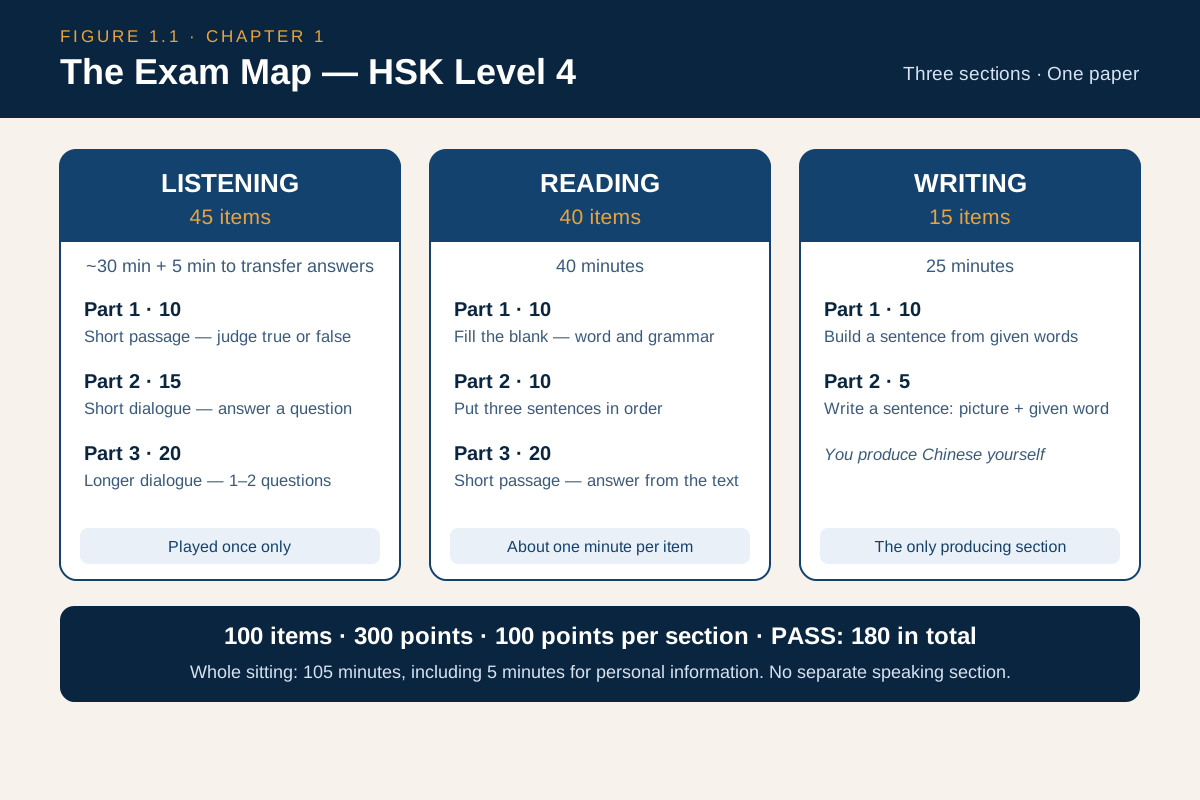
Figure 1.1 — The exam map: the three sections of the HSK Level 4 paper — Listening, Reading, and Writing — with their parts, their item counts, their time allowances, and the 300 points the paper carries in total.
The listening section contains 45 items in three parts, and lasts about 30 minutes. Every recording is played only once — there is no second hearing — and after the listening ends, 5 minutes are given for you to transfer your answers onto the answer sheet.
The listening section is where the "played once" rule bites hardest, and it shapes Part IV of this book: listening at Level 4 is a skill of full attention on a single hearing, and it can be trained as such.
The reading section contains 40 items in three parts, and you have 40 minutes for it — a minute an item, on average, which is comfortable if your character recognition is quick and punishing if it is not.
The writing section contains 15 items in two parts, and you have 25 minutes for it. It is the smallest section by item count and, for many candidates, the most revealing one, because it is the only place where you produce Chinese rather than choose it.
Add the sections together and the test lasts 105 minutes in total, including 5 minutes at the start in which you fill in your personal information. The arithmetic is worth seeing once: about 30 minutes of listening, 5 minutes to transfer listening answers, 40 minutes of reading, 25 minutes of writing, and the 5 personal-information minutes — 105 in all. Chapter 35 walks through test day itself, on both versions of the test, in full.
Those two versions are the last structural fact. The Level 4 test is offered in a paper-based version and an internet-based version, taken on a computer at a test centre. The two versions have identical sections and identical difficulty; they differ in delivery. On the paper test, your writing is handwritten. On the internet-based test, you type your characters using pinyin input. Neither version is easier, and Chapter 35 helps you choose and prepare for the one you will sit.
Before we leave the paper's shape, one piece of honest orientation. CTI publishes an official sample paper for the current Level 4 under the code H41001, with its listening audio. It exists so that candidates can see the real shapes for themselves. The practice material in this book is modeled on the published structure described in this section — the same parts, the same item counts, the same formats — but every dialogue, passage, and item in this book was written for this book. Nothing is reproduced from the official paper, and you should be suspicious of any preparation material that claims to offer you the real questions: learning answers by heart is not proficiency, and it is not what this book is for.
We return now to the number that defines the level's language scope: 1,200 words.
The HSK levels are cumulative. Each level's vocabulary figure includes every word from the levels below it, plus the new words the level adds. The ladder for the first four levels runs like this:
Figure 1.2 (Class A) — The level ladder: the six HSK levels rising in steps, each step labeled with its cumulative word count, with the Level 4 step — 1,200 words — marked as the level this book teaches.
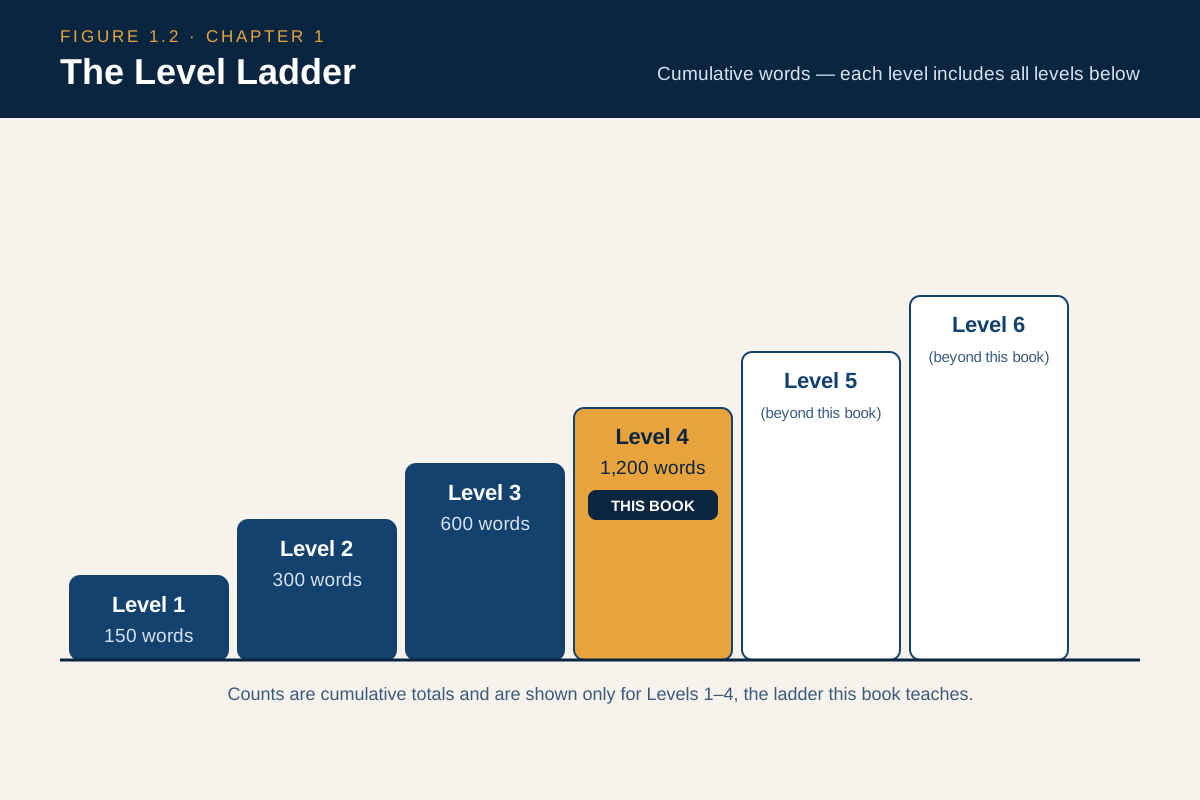
Figure 1.2 — The level ladder: the six HSK levels rising in steps, each step labeled with its cumulative word count, with the Level 4 step — 1,200 words — marked as the level this book teaches.
Two consequences of the ladder deserve your attention.
The first is about where you stand. If you are beginning Level 4 preparation properly, you already command the 600 words of Levels 1 to 3 — that is the base this book assumes, and the base on which everything in Parts II and III stands. If parts of that base are shaky, the examination will expose it, because Level 4 items are built from the full 1,200: a reading passage does not announce which of its words are "Level 3 words," and a listening dialogue mixes old and new freely. Chapter 5 sets out the vocabulary system and the learning method this book uses, and the appendix prints the complete list, so that you can audit your own base word by word rather than guess at it.
The second consequence is about the size of the new task. Level 4 adds 600 new words — as many again as the whole of Levels 1 to 3 put together. That is the largest single vocabulary jump in the first four levels, and it is the main reason Level 4 feels like a different undertaking from Level 3. The new words are also different in character: alongside concrete everyday words, Level 4 brings in the vocabulary of wider life — work and money, society and media, feelings and judgments, and the abstract words that let you discuss, explain, compare, and argue. Part III teaches all 600, in thematic chapters, every word with its characters, its pinyin, its meaning, and a model sentence. There are no shortcuts around this part of the work, but there is a system for it, and Chapter 5 gives you the system before Part III puts it to work.
Teachers and universities often ask how an HSK level lines up with other frameworks, and CTI publishes its own correspondence table. In that table, HSK Level IV is the counterpart of Level IV of the Chinese Language Proficiency Scales for Speakers of Other Languages (CLPS) and of the B2 level of the Common European Framework of Reference for Languages (CEFR).
Read that the right way round. The B2 correspondence is CTI's published mapping — the test organizer's own statement of where its level sits — and this book reports it as exactly that. It is a useful orientation if you already know the CEFR from another language: B2 is the independent-user level at which a speaker can interact with a degree of fluency, handle the main ideas of complex text, and produce clear, detailed writing on a wide range of subjects — which matches, closely, the can-do formulation you read above. What the mapping is not is a promise. It does not guarantee that any particular university, employer, or authority will accept your HSK result for any particular purpose; each institution sets its own requirements, and checking the requirement that applies to you is your responsibility, at the institution itself. The certificate certifies your Chinese. What any given door does with that certification is decided on the other side of the door.
Pass the examination and you receive a score report and, with it, the standing of a certified Level 4 passer. It is worth being exact about what that means, because candidates regularly both over-claim and under-value it.
How the result is reported. Your score report gives four results: Listening, Reading, Writing, and the Total. Each section is scored out of 100, so the total is out of 300. To pass Level 4, you must score at least 180 points in total. Two features of that rule matter. First, the 180 is a combined total across the three sections — it is 60 percent of the whole paper, not 60 percent in each section. Second, no per-section minimum is published in the level description: the published rule is the total. A candidate whose sections are uneven — strong reading carrying a weaker writing score, say — passes if the total reaches 180, and a candidate who is merely adequate everywhere fails if it does not. Chapter 34 is devoted to scores and the score report, and works through specimen figures in full; for now, fix the shape of the rule in your mind, because it should shape your study: marks are marks, wherever in the paper they are earned, and the cheapest marks for you are the ones in the section where you are currently weakest.
How long it lasts. HSK results are valid for two years from the test date — CTI states this for the result's use as a Chinese language certificate for foreign students' entry into Chinese colleges, and the two-year validity is the standing rule for the result. Two years is a real window, not a lifetime. If you need your certificate for a particular application, work backwards from that application's date and sit the test inside the window; a certificate earned too early can expire before the moment you need it. Chapter 36 covers registration, results, and using the certificate in full.
What the certificate is. It is CTI's certification, awarded on your examination result, that your Chinese meets the Level 4 standard described in this chapter — the can-do formulation, at the 1,200-word scope, demonstrated under examination conditions on a particular day. It is evidence, issued by the test's own organizer, in a form that institutions around the world recognize as the HSK.
What the certificate is not. It is not a degree, a diploma, or a professional license. It certifies language proficiency and nothing else — not your knowledge of a subject, not your fitness for a job, not your right to anything. And it is not something this book can give you. This book prepares candidates; it confers no qualification. The certificate is CTI's act, awarded on the examination result, and no book — this one included — can award it, guarantee it, or promise you a pass or a score. Any preparation material that promises you a result is selling you something it does not own. What a book can honestly do is what this one sets out to do: teach you the full language scope of the level, train you in the exact shapes of the paper, and give you enough explained practice — 1,070 keyed items in all — that the candidate who walks into the test centre is genuinely the candidate the can-do formulation describes.
The book follows the logic of the examination itself: foundations first, then the language system, then the three skills, then the sitting, then your study system. It has eight parts and forty chapters.
Part I — The Exam and the Language (Chapters 1–5) sets the foundations: this chapter on the test itself; Chapter 2 on sound — pinyin, tones, and the listening ear; Chapter 3 on characters; Chapter 4 on the sentence and its core patterns; and Chapter 5 on the 1,200 words and how to learn them.
Part II — Grammar in Control (Chapters 6–14) teaches the level's grammar scope systematically: aspect and time; the complement system; the 把 and 被 constructions; comparison, measure, and number; the adverb system; and the connectives that hold complex sentences together.
Part III — Vocabulary in Depth (Chapters 15–21) teaches the 600 new Level 4 words in thematic families, each word with characters, pinyin, meaning, and a model sentence, closing with a chapter on telling near-synonyms apart — a named Level 4 skill, because the paper's blank-filling items turn on it.
Part IV — Listening (Chapters 22–25) trains the listening skill and then each part of the listening paper in turn. One honesty note belongs here, at the start: a printed book cannot play audio. Listening practice in this book therefore runs in two passes — first under listening conditions, with the transcript read aloud by a practice partner or a text-to-speech voice and heard once, as in the examination; then a study pass over the annotated transcript. Chapter 22 explains the method in full.
Part V — Reading (Chapters 26–29) does the same for reading: the skill of reading characters at speed, then blank-filling, sentence ordering, and passage questions, part by part.
Part VI — Writing (Chapters 30–33) covers the two writing tasks — building sentences from given words, and writing a sentence for a picture with a given word — and the character accuracy on which writing marks depend. Because a book cannot print the examination's pictures, the picture task is taught through picture briefs: the picture described in words, so you can practise the exact skill — a sentence that fits a scene and uses the given word correctly.
Part VII — The Sitting and After (Chapters 34–37) turns to the examination as an event: scores and the score report; test day on paper and on computer; registration, results, and using the certificate; and a closing chapter that completes the examination picture from the published record.
Part VIII — Your Study System (Chapters 38–40) closes the book by turning preparation into a plan: building your study system from your diagnostic result, repairing your weak sections by error class, and rehearsing the full sitting in the final weeks.
Around the chapters stands the apparatus: a 50-item diagnostic test to sit before you begin, two skills batteries, six repair sets keyed to the common error classes, and two full timed practice tests that reproduce the sitting — 45 listening items, 40 reading items, 15 writing items, 100 in all — under the examination's own timings. Every item in the book is keyed, and every key explains not only why the right answer is right but why each wrong answer is wrong. That is deliberate. In language learning, the wrong answers are where the teaching is.
Reading Part 1 gives you a sentence with a word missing and four options. Work this one the way Chapter 27 will teach you — grammar first, collocation second.
他把房间打扫得非常______。 Tā bǎ fángjiān dǎsǎo de fēicháng ______. A) 干净 B) 干杯 C) 敢 D) 刚
Step 1 — read the frame. The sentence uses 把 with the verb 打扫 and the particle 得 after the verb. That 得 frame — verb + 得 + description — asks for a word that describes the result or manner of the action: the room was cleaned to what state? The blank needs an adjective of result.
Step 2 — test each option against the frame. 干净 (gānjìng, clean) is an adjective and fits the frame exactly: the room was cleaned very clean. 干杯 (gānbēi, to drink a toast) is a verb phrase; it cannot describe a room and cannot follow 得 in this frame. 敢 (gǎn, to dare) is a verb of attitude that belongs before another verb, not after 得. 刚 (gāng, just) is an adverb; adverbs stand before verbs in Chinese, not in the result slot after 得.
Step 3 — commit. The answer is A. Notice what the item was really testing: not whether you know the word 干净 — most Level 4 candidates do — but whether you can read a grammatical frame and eliminate options that the frame forbids. That is the Level 4 blank-filling skill in one item.
A candidate receives her section scores: Listening 62, Reading 58, Writing 64. Has she passed?
Step 1 — recall the rule. Each section is out of 100; the total is out of 300; the pass mark is a combined total of at least 180, with no published per-section minimum.
Step 2 — do the arithmetic. 62 + 58 = 120; 120 + 64 = 184. Her total is 184.
Step 3 — judge against the rule, not against impressions. 184 is at or above 180, so she has passed — even though one section, Reading at 58, is below 60. The rule judges the total. Two lessons follow. Do not despair over one weak section while you are preparing: the total is what counts, and strength anywhere earns marks. And do not relax about a weak section either: the cheapest marks to gain are usually in your weakest section, and 184 is only four marks above the line. Chapter 34 returns to scores with a full specimen report; Chapter 38 shows you how to turn a profile like this one into a study plan.
Listening — Parts: 3 (10 + 15 + 20) · Items: 45 · Time: about 30 minutes, played once, plus 5 minutes to transfer answers
Reading — Parts: 3 (10 + 10 + 20) · Items: 40 · Time: 40 minutes
Writing — Parts: 2 (10 + 5) · Items: 15 · Time: 25 minutes
Total — Items: 100 · Time: 105 minutes, including 5 minutes for personal information
Q1. The HSK is best described as… A) a test of what candidates remember from one particular Chinese textbook B) an international standardized test of Chinese language proficiency for non-native speakers C) a speaking test for students applying to Chinese universities D) a course certificate awarded by language schools to their own students
Q2. The HSK is organized by… A) the test centres in each country, working independently B) the Center for Language Education and Cooperation, through its local offices C) CTI Co., Ltd. (Chinese Testing International) D) the universities that accept HSK results
Q3. In CTI's published description, HSK Level IV is intended for students who have… A) studied Chinese two to four class hours per week for four semesters and mastered 1,200 commonly used words B) lived in China for at least two years and can read a Chinese newspaper C) passed Level 3 in the previous examination session with a score above 200 D) completed a university degree in Chinese language and literature
Q4. CTI's can-do formulation says that test takers who pass HSK Level IV can… A) translate business documents between Chinese and their first language B) understand Chinese radio news on any subject without difficulty C) teach Chinese to beginners in their own country D) converse in Chinese on a wide range of topics and communicate fluently with native Chinese speakers
Q5. In CTI's own correspondence table, HSK Level IV corresponds to which CEFR level? A) B1 B) B2 C) C1 D) A2
Q6. Which of the following is NOT a section of the HSK Level 4 paper? A) Listening comprehension B) Reading comprehension C) Writing D) Speaking
Q7. The listening section of the Level 4 paper contains… A) 45 items in three parts, heard once, in about 30 minutes B) 40 items in two parts, each heard twice, in 40 minutes C) 45 items in three parts, each heard twice, in about 30 minutes D) 30 items in three parts, heard once, in 45 minutes
Q8. In Listening Part 1, the candidate hears a short passage and must… A) choose the best summary of the passage from four options B) answer a question asked by a third person after the passage C) judge whether a printed assertion about the passage is true or false D) write down the last sentence of the passage exactly as heard
Q9. The reading section of the Level 4 paper contains… A) 45 items and allows 45 minutes B) 40 items and allows 40 minutes C) 40 items and allows 25 minutes D) 30 items and allows 40 minutes
Q10. Reading Part 2 asks the candidate to… A) arrange three sentences in the correct order B) fill one blank in a sentence with the word that fits C) answer one or two questions about a short passage D) write a sentence about a picture, using a given word
Q11. Writing Part 2 gives the candidate a picture and a word, and asks for… A) a short essay of at least 80 characters about the picture B) a translation of the word into the candidate's first language C) the pinyin and tone marks of the given word, written from memory D) a sentence based on the picture, using the given word
Q12. The whole Level 4 test lasts… A) 90 minutes, including 5 minutes for personal information B) 100 minutes, not counting the time for personal information C) 105 minutes, including 5 minutes for personal information D) 120 minutes, including 10 minutes for personal information
Q13. Which statement about Level 4 scores is correct? A) Each section is scored out of 100, the total is out of 300, and a candidate must reach 60 in every section to pass B) Each section is scored out of 100, the total is out of 300, and a combined total of at least 180 is needed to pass C) Only the total is reported; the three section scores are not shown D) The pass mark is 180 in the listening section alone
Q14. An HSK result is valid for… A) two years from the test date B) five years from the test date C) one year from the date the certificate is printed D) the rest of the candidate's life, once earned
Q15. Which statement about this book and the certificate is correct? A) Completing this book gives the reader the HSK Level 4 certificate B) This book is published by CTI and its exercises are taken from the official sample paper C) A reader who finishes every exercise is guaranteed a score of at least 180 D) This book prepares candidates; the certificate is awarded by CTI on the examination result
Feras Alzubi
Exam Prep Series
© 2026 Feras Alzubi. All rights reserved.
No part of this book may be reproduced, stored in a retrieval system, or transmitted in any form or by any means — electronic, mechanical, photocopying, recording, or otherwise — without the prior written permission of the author, except for brief quotations in reviews and for the personal study use of the purchaser.
Originality statement. Every dialogue, passage, transcript, example sentence, practice item, and answer explanation in this book was written for this book. The practice material is modeled on the published structure of the examination — its sections, parts, item counts, timings, and scoring — and on nothing else. No item, passage, transcript, image, or answer from any official examination paper or sample paper is reproduced or paraphrased in these pages.
Not-affiliated disclosure. This book is an independent study guide. It is not a publication of Chinese Testing International (CTI) or of the Center for Language Education and Cooperation (CLEC), and it is not affiliated with, sponsored by, or endorsed by either organization. HSK and Chinese Proficiency Test are the names of the examination administered by CTI. Registration, test dates, fees, and results are handled through chinesetest.cn and authorized test centers; fees are set locally and are shown at registration.
This book prepares you for the HSK Level 4 examination. It teaches the complete language the examination tests — the full cumulative vocabulary of 1,200 words and the grammar of the level — and it trains you, part by part, in the exact shapes in which the examination asks its questions.
This book confers no qualification. The HSK certificate is awarded by CTI on the basis of your examination result, and no book — this one included — can award it, substitute for it, or guarantee a pass or a score. What this book can do, and what it is built to do, is make sure that on test day nothing about the paper is unfamiliar to you, and that the Chinese you have studied is the Chinese the paper actually tests.
A printed book cannot play audio, and this book does not pretend otherwise. Listening practice in this book therefore runs in two passes:
Hear → Answer → Study. That order is the method, and it is never reversed: a transcript read before listening is reading practice, not listening practice.
In the examination, each Writing Part 2 item shows you a picture and gives you a word; you write a sentence based on the picture using the word. This book cannot print the examination's pictures, so Writing Part 2 is taught here through picture briefs — the picture described in words, in two or three English sentences. You read the brief, picture the scene, and write your sentence from it. The skill being trained — look at a scene, find the given word's place in it, and write one correct sentence that carries both — is the same skill the examination tests.
This book prepares candidates for the examination as administered through 2026. Chapter 37 sets out the announced change from the official record. Nothing else in this book describes any other form of the examination, and if you are sitting the examination in its current form, the whole of this book — every word list, every item count, every timing — is written for the paper you will meet.
The book has eight parts and forty chapters, followed by the practice apparatus.
After the chapters comes the apparatus: the Diagnostic (take it first — see below), a Skills Battery in two parts that gives you a complete Listening + Reading sitting and a complete Writing sitting in the real shapes, six Repair Sets keyed to the six commonest error classes, and two full Timed Practice Tests, each a complete sitting of 100 items. In total the book carries 1,070 keyed practice questions, and every key explains not only why the right answer is right but why every wrong answer is wrong.
Every chapter ends with exactly 15 keyed exercises in that chapter's own formats. Work them after the teaching, not instead of it: the teaching shows the pattern in example sentences before you are ever asked to use it.
The HSK Level 4 paper has three sections: Listening, Reading, and Writing. It has no speaking section. Speaking in Chinese is tested by a separate, independent test — the HSKK — which is a different examination with its own registration and its own paper. This book prepares you for the written HSK Level 4 paper only, and it contains no speaking preparation because the paper it prepares you for asks no speaking questions. If you also need the speaking test, prepare for it separately, as the separate test it is.
Before Chapter 1, take the Diagnostic: 50 items in four strands.
Score the diagnostic by strand, not just as a total — the key file opens with the scoring and routing guide. Each strand maps to a part of the book: a weak listening strand routes you to Part IV with extra weight, a weak writing strand to Part VI, and so on. Chapter 38 then shows you how to build a full study plan from your strand profile, and Chapter 39 shows you how to repair the weaknesses the profile exposes. Candidates who already command the HSK 1–3 base (the first 600 words) can move quickly through Part I; candidates who find the diagnostic's easier items hard should work Part I slowly and in full — it is written for exactly that repair work.
A diagnostic score is a map, not a verdict. It is not converted into an examination score, and it predicts nothing by itself. Its only job is to tell you where your study hours will do the most work.
Everything on this page is the published shape of the current HSK Level 4 examination, stated in this book's own words.
The HSK — 汉语水平考试 (Hànyǔ Shuǐpíng Kǎoshì), the Chinese Proficiency Test — is an international standardized test of Chinese language proficiency for non-native speakers, organized by Chinese Testing International (CTI). As displayed on CTI's site in November 2026, the test runs through 1,522 test centers in 169 countries, and registration, test dates, and results run through chinesetest.cn and authorized test centers.
Level 4 is intended for students who have studied Chinese two to four class hours per week for four semesters (two academic years) and have mastered 1,200 commonly used words and related grammar patterns. In CTI's own formulation: "Test takers who are able to pass the HSK (Level IV) can converse in Chinese on a wide range of topics and are able to communicate fluently with native Chinese speakers." The level assesses test takers' abilities in the application of everyday Chinese, across daily, academic, and professional contexts at the level's scope. CTI's published table places Level IV as the counterpart of Level IV of the Chinese Language Proficiency Scales for Speakers of Other Languages and of the B2 level of the Common European Framework of Reference — that correspondence is CTI's own mapping, printed here as CTI publishes it.
The vocabulary ladder of the current examination is cumulative: Level 1 assumes 150 words, Level 2 assumes 300, Level 3 assumes 600, and Level 4 assumes 1,200 — the 600 words of Levels 1–3 carried as your working base, plus 600 new words at this level. This book teaches all 600 new words in Part III and prints the complete 1,200-word list in the Vocabulary Appendix.
| Section | Items | Time |
|---|---|---|
| Listening | 45 | about 30 minutes, plus 5 minutes to transfer answers |
| Reading | 40 | 40 minutes |
| Writing | 15 | 25 minutes |
| Total | 100 | 105 minutes, including 5 minutes for personal information |
Listening — 45 items, about 30 minutes, every recording played once. Part 1 (10 items): a short passage is read out, followed by an assertion that also appears on the paper; you judge the assertion true or false. Part 2 (15 items): a short dialogue between two people, then a question asked by a third person; you choose from four options. Part 3 (20 items): a longer dialogue or passage of four to five sentences, followed by one or two questions; you choose from four options. When the listening ends, 5 minutes are given to transfer your listening answers onto the answer sheet.
Reading — 40 items, 40 minutes. Part 1 (10 items): one or two sentences with one word or phrase missing; you choose the word or phrase that fills the blank. Part 2 (10 items): three sentences to arrange in the correct order. Part 3 (20 items): a short passage with one or two questions; you choose the best of four answers.
Writing — 15 items, 25 minutes. Part 1 (10 items): construct a sentence from the several words given. Part 2 (5 items): each item gives a picture and a word; you write a sentence based on the picture using the word.
The whole test lasts 105 minutes in total, including 5 minutes in which you fill in your personal information.
Your score report gives four results: Listening, Reading, Writing, and the Total. Each section is scored out of 100 — Listening 100, Reading 100, Writing 100 — for a total of 300. To pass HSK Level 4 you must score at least 180 points in total. The 180 is a combined total across the three sections; no separate minimum score for any single section is published in the level description, which is why this book trains all three sections and teaches you to protect your total.
An official sample paper for the current Level 4 circulates under the code H41001. This book's practice material is modeled on the published structure set out above; it is not taken from that paper or from any other official paper.
HSK results are valid for two years from the test date.
The examination is offered in two deliveries with identical sections and difficulty: paper-based, taken with a printed question booklet and answer sheet, where the writing is handwritten; and internet-based, taken on a computer at a test center, where characters in the writing section are typed using pinyin input. Chapter 35 prepares you for the sitting itself in both deliveries, and Chapter 33's handwriting discipline matters most to paper-based candidates — but character accuracy is marked in both.
Level 3 (600 words) is the step below this one; Level 5 (2,500 words) is the step above. This book assumes the Level 1–3 base and teaches to the Level 4 line: it does not re-teach Levels 1–3 as its subject, and it does not reach into Level 5. And to repeat the fence that matters most to candidates planning their registrations: the speaking test (HSKK) is a separate, independent test. The HSK Level 4 paper described on this page contains no speaking section.
Front matter — Copyright and disclosures · What this book does — and what it does not do · How to use this book · The Exam Blueprint
Diagnostic — 50 items in four strands, with the strand-scoring and routing key
End of the free sample. The complete book continues from here — the full A-to-Z course in book form, delivered as an EPUB you can read in Apple Books, Google Play Books, ReadEra, Thorium Reader, Adobe Digital Editions, or Send to Kindle.
Buy this ebook — $11.99 Back to the book page
Payments are securely processed by Payhip.