
Mastering Careers & Skills
General Educational Development Test (GED) · free sample from the book itself
Non-lettered items: 1-5, 1-10, 1-15 — fill-in-the-blank; the exact expected value is stated in each item's answer below. Calculation items in this quiz: 0 — none. Chapter 1 is an orientation chapter teaching no calculation family; its numbers are test facts, each carrying its source.
1-1. Key: D. The jurisdiction awards the credential on the basis of the four passing scores (§1.2, §1.7). - A is wrong: GED Testing Service builds, delivers, and scores the test; it does not issue the credential (error: test maker mistaken for credentialing authority). - B is wrong: this book prepares the candidate and confers nothing (error: preparation mistaken for eligibility or credentialing). - C is wrong: a test center hosts the sitting; it holds no credentialing authority (error: venue mistaken for authority).
1-2. Key: B. RLA is 150 minutes, including 3 minutes of instructions and final review and 45 minutes for the essay (§1.3). (Source: GED Testing Service, Test Subjects (U.S.), as read October 29, 2026.) - A is wrong: 115 minutes is Mathematical Reasoning's limit (error: the two longest tests swapped). - C is wrong: 90 minutes is Science's limit (error: Science's time assigned to RLA). - D is wrong: 70 minutes is Social Studies' limit, the shortest of the four (error: shortest time assigned to longest test).
1-3. Key: B. Each subject is scored independently on its own 100–200 scale, and 145 is required in each; there is no combined or averaged score (§1.1, §1.6). (Source: GED Testing Service, Understanding Your Scores, as read October 29, 2026.) - A is wrong: no averaging exists in the credential's structure — the central trap of this chapter (error: a blended score invented). - C is wrong: no single subject's score, at any level, earns the credential by itself (error: one gate treated as the whole credential). - D is wrong: a passed subject is not retaken because another subject was not passed; retakes apply only to subjects not passed (error: retake scope reversed; §1.10).
1-4. Key: C. The only calculator type for the test is the TI-30XS MultiView, displayed on screen as part of the test (§1.5). (Sources: GED Testing Service, Test Subjects (U.S.); "Can You Use a Calculator on the GED Math Test?" — as read October 29, 2026.) - A is wrong: no other model is permitted; a candidate may bring their own TI-30XS to a test center, not any calculator (error: the one sanctioned model widened to a class). - B is wrong: a phone calculator is not the test's tool (error: a familiar tool substituted for the sanctioned one). - D is wrong: a calculator is provided in Math (Part 2), Science, and Social Studies (error: provision denied outright).
1-5. Key: 145. The passing score is 145 on each subject's independent 100–200 scale (§1.6). (Source: GED Testing Service, Understanding Your Scores, as read October 29, 2026.) Any other value (165, 175, 100) names a different band edge, not the pass mark.
1-6. Key: C. 175–200 is GED College Ready + Credit: the candidate could be eligible to earn college credit — up to 3 credits in Math, 3 in Science, 3 in Social Studies, and 1 in Humanities — depending on the program applied to, and must check with the college's admissions office (§1.6). (Source: GED Testing Service, Understanding Your Scores, as read October 29, 2026.) - A is wrong: "guaranteed at any college" upgrades GED's could be eligible, depending on the program into a promise GED does not make (error: hedged framing replaced with a guarantee). - B is wrong: no score level guarantees admission; admission is each institution's decision (error: score level mistaken for an admission decision). - D is wrong: the credential requires 145 in each subject; 175 is a recognition level, not a requirement (error: a recognition band mistaken for the gate).
1-7. Key: A. GED Ready is $7.99 per subject (§1.8). (Source: GED Testing Service, GED Ready FAQ, as read October 29, 2026.) - B is wrong: $25.99 is the price for all four subjects bought together (error: the bundle price assigned to one subject). - C is wrong: the operational test's price varies by state; GED Ready's price is the nationally published one stated here (error: the two price systems confused — the confusion §1.7 fences). - D is wrong: GED Ready is GED's own product, bought on GED.com; no study book includes it (error: the book credited with another body's product).
1-8. Key: A. GED Ready does not score the extended response; it gives guidance on what a typical response should look like and returns the question and the candidate's response to take to an educator for scoring (§1.8). (Source: GED Testing Service, GED Ready FAQ, as read October 29, 2026.) - B is wrong: no part of GED Ready reports a 100–200 scaled score; it reports a score indicator (error: the practice instrument given the real test's scale). - C is wrong: the writing task is given; it is its scoring that is not provided (error: unscored confused with absent). - D is wrong: there is no automatic ER score feeding the indicator (error: the one unscored element scored).
1-9. Key: A. Online scheduling requires a GED Ready "Green" in that subject within the last 60 days, in a participating state, per subject (§1.9). (Source: GED Testing Service, State Information: Online Testing, as read October 29, 2026.) - B is wrong: the window is 60 days, not a year; a stale Green opens nothing (error: the gateway window widened sixfold). - C is wrong: the gateway is per subject; subjects are scheduled one at a time as their Greens are earned (error: four separate gates fused into one event). - D is wrong: this book's practice tests are the book's own apparatus and substitute for no official requirement (error: the book's guidance dressed as GED's rule).
1-10. Key: 45. The extended response is a separately timed 45-minute section of the RLA test (§1.3, §1.4). (Source: GED Testing Service, Test Subjects (U.S.), as read October 29, 2026.)
1-11. Key: D. The HiSET is a separate equivalency route from a different body, with its own frameworks and scoring; this book's single contrast paragraph exists to keep a HiSET-route reader from buying the wrong book (§1.9 trap box). - A is wrong: the HiSET is not a former name for the GED; the two tests coexist as alternatives adopted by different states (error: two live tests merged into one history). - B is wrong: there is no Social Studies essay at all (§1.4; item 1-13), and the HiSET is a full test, not a GED component (error: a whole credential shrunk to a test part). - C is wrong: the HiSET is an operational credential test, not a practice product — GED Ready is GED's practice test (error: a rival credential mistaken for a practice tool).
1-12. Key: B. GED's United States subject pages state, for each subject, "Price varies by state" (§1.7). (Source: GED Testing Service, Test Subjects (U.S.), as read October 29, 2026.) - A is wrong: no national per-subject or battery price exists to print (error: a jurisdiction variable nationalized). - C is wrong: the book's price and the test's fees are unrelated transactions with unrelated bodies (error: seller and testing authority merged). - D is wrong: no universal first-attempt waiver is published; any waiver or free-retest offer is a state or location matter (error: a local possibility stated as a national rule).
1-13. Key: C. The Social Studies extended response was eliminated from the test (the Assessment Guide's March 2016 note records the elimination); the current Social Studies test has no written essay (§1.4). (Source: GED Testing Service, Assessment Guide for Educators, Social Studies chapter, as read October 29, 2026.) - A is wrong: the 45-minute essay belongs to RLA alone (error: RLA's task transplanted to Social Studies — a dead format). - B is wrong: no optional essay exists at any score level (error: a dead format revived as an option). - D is wrong: the current Social Studies item types, as GED lists them, contain no separately scored short-answer section (error: an unlisted format asserted as current).
1-14. Key: D. Each subject part is a standalone course entered through its own diagnostic, whose tracker routes study inside that part; passed subjects need no re-study, and the official score report for any subject not yet passed names skills to improve (§1.10). - A is wrong: the parts are self-contained by design; no part is a prerequisite for another (error: modular book read as a single sequence). - B is wrong: retakes — and re-study — apply to subjects not passed (error: passed gates re-entered without purpose). - C is wrong: the score report is a routing document that names skills to improve; discarding it destroys evidence the tracker can use (error: a verdict mistaken for the report's whole content).
1-15. Key: 25.99. GED Ready for all four subjects is $25.99 bought together, against $7.99 per subject bought separately (§1.8). (Source: GED Testing Service, GED Ready FAQ, as read October 29, 2026.)
What this chapter does. By the end of it you will be able to say, in plain words, what the GED credential is and what it is not, name the four subject tests that earn it, state how long each test lasts and what each one measures, read the score scale and its three passing levels, and say — accurately — who decides whether you may test and who awards the credential when you pass. No subject knowledge comes first and no test tricks come first. The credential itself comes first, because a reader who misunderstands what they are earning will study wrong no matter how good the subject chapters are.
This chapter teaches in its own original words. Where a test fact appears, its source is named on the spot. Test facts in this book were verified from the official documents named in the References on October 29, 2026.
This book prepares you for the GED test. It is not a school, it does not award the credential, and it cannot make you eligible to test. Your jurisdiction — in most cases your state — sets the eligibility rules and issues the credential.
Simplify. The GED test is a set of four subject tests that together measure whether a person has the knowledge and reasoning skills expected of a high school graduate. Pass all four, and the jurisdiction where you tested awards you a high school equivalency credential — a legal credential that stands in for a high school diploma for the purposes the jurisdiction and the institutions that accept it define. The four tests are:
(Source: GED Testing Service, Test Subjects (U.S.), as read October 29, 2026.)
Three words in that opening carry the whole chapter, so define them now:
The structural fact that governs everything. The four tests are separate exams. You do not have to take all four at once; GED itself says a candidate can space them out and go at their own pace. Each test is scheduled separately, taken separately, and scored separately, on its own scale, with its own passing score. There is no combined score and no averaging: a very high score in one subject does not lift a below-passing score in another. A candidate may pass three subjects and still hold no credential, because the credential is awarded only when all four are passed. (Sources: GED Testing Service, Test Subjects (U.S.); GED Testing Service, Understanding Your Scores — both as read October 29, 2026.)
Say that back in ordinary language, because it is this book's founding idea: the GED is not one gate. It is four gates, and each gate opens only for its own subject. Everything in this book — four subject parts, four separate diagnostics, four separate practice-test pairs, a campaign plan in Chapter 38 that schedules the tests one at a time — is built to match that shape. A book that blended the four subjects into one average picture would be training you for a test that does not exist.
Exam trap — "my strong subject will carry my weak one." It will not, because there is nothing for it to carry it in. There is no total score. A reader who scores at the top of the scale in language arts and below passing in mathematics has passed exactly one of the two. Study time allocated "on average" across four subjects is therefore misallocated by design: the correct unit of planning is always one subject, one gate, one passing score. Chapter 2 builds this book's whole study system on that unit, and Chapter 38 turns it into a schedule.
Explain. Precision here protects you from two opposite errors: undervaluing the credential ("it is just a test-prep certificate") and overvaluing what any book or test alone can do ("once I finish studying, I will be eligible and credentialed"). Take the three "is not" statements one at a time.
It is not a diploma from a school. No school enrolls you, teaches you, or graduates you in this process as this book presents it. You prepare — with this book, with a local adult-education program, with a tutor, or in some combination — you test, and the jurisdiction credentials you on the basis of your scores. Readers who attended high school for some years sometimes ask whether their completed coursework "counts toward" the credential. In the structure GED publishes, the credential rests on the four passing scores; what any particular jurisdiction additionally recognizes or requires is that jurisdiction's business, fenced in Section 1.7's variation note.
It is not awarded by the test maker, and not by this book. The test is administered by GED Testing Service LLC, under license from the American Council on Education (ACE), which owns the GED trademarks. GED Testing Service builds and delivers the tests and reports your scores. The credential itself is awarded by your jurisdiction on the basis of those scores. This book, in turn, is an independent study guide: it is not published by, affiliated with, endorsed by, or approved by GED Testing Service LLC or the American Council on Education, and neither body participated in its creation. The order matters and Chapter 37 states it again at the point of scheduling: the book prepares; the jurisdiction grants.
It is not a promise about what happens next. A credential opens doors that its holders then walk through by their own applications, interviews, and further study. This book makes no claim — here or anywhere — about employment, earnings, or college admission, and it prints no pass rate for the test and no guarantee that any reader will pass. Where GED itself describes benefits attached to its higher score levels, this book prints GED's own cautious wording and nothing stronger (Section 1.6). A study book that promised you an outcome would be selling you something it does not control. What this book controls, and what it does promise, is narrower and real: complete teaching of the four subjects from zero, honest practice in the test's own formats, and a process account that tells you the truth about what is national, what is your jurisdiction's, and what nobody can know in advance.
Detail. Here are the four gates side by side, at the level of fact GED publishes nationally. Times, parts, and breaks are GED's published figures; the item counts beneath the table are handled separately and honestly, because GED's own subject pages do not publish them.
| Test | Time limit | Parts and breaks |
|---|---|---|
| Mathematical Reasoning | 115 minutes | 2 parts; a 3-minute break between parts; the time includes 2 minutes of instructions and final review |
| Reasoning Through Language Arts | 150 minutes | 3 sections; a 10-minute break between parts 2 and 3; includes 45 minutes for the written essay; the time includes 3 minutes of instructions and final review |
| Science | 90 minutes | 1 part; no break; the time includes 2 minutes of instructions and final review |
| Social Studies | 70 minutes | 1 part; no break; the time includes 2 minutes of instructions and final review |
(Source: GED Testing Service, Test Subjects (U.S.), as read October 29, 2026.)
Read the table as a returning learner, not as a statistician. The whole battery, taken together, is 425 minutes — just over seven hours of testing — which is precisely why almost nobody takes it together. Spread across four separate sittings, the longest single demand is the RLA's two and a half hours, and the shortest is Social Studies at seventy minutes. Each sitting is a manageable event. The credential feels enormous only when it is imagined as one event; it is four events, and you will prepare for, schedule, and take them one at a time.
About item counts — a lesson in honest numbers. Many preparation sites state exact question counts for each test as if they were settled public facts. GED's own current subject pages publish no item counts. A set of GED subject flyers — GED's own subject materials as reproduced by a state workforce agency — states about 46 items for Mathematical Reasoning, about 46 items plus one essay for RLA, about 35 for Social Studies, and about 34 for Science. This book therefore prints the counts only in that approximate form, with that basis, and it sizes its own diagnostics and practice tests to those approximate counts as a stated design choice (Chapter 2 and the practice-test introductions say so where it matters). When a number's source is a flyer rather than the test maker's own current page, you deserve to be told. That discipline — print the fact with its strength attached — runs through the whole book, and it is why some numbers other books state flatly appear here with "about" in front of them.
The item types you will meet. The tests are computer-based. Across the subjects, GED lists these item types: multiple choice, fill-in-the-blank, drag-and-drop, select-an-area (hot spot), and drop-down. A print book cannot reproduce a computer screen, and this one does not pretend to: Chapter 2 explains exactly how each computer decision is practiced in print form, and where the free official routes — GED's published calculator tutorial and the official practice test, GED Ready — fit for practicing the on-screen gestures themselves. What a book can train completely is the thinking each item demands, and that is what the subject parts train.
Detail. Each test below is described in GED's own published topic terms, then translated into what it means for a returning learner. These four short accounts are the book's contract with you: Parts II through V teach exactly this, from zero, and the crosswalk appendix at the back of the book lets you verify that claim subject by subject.
Mathematical Reasoning measures Basic Math, Geometry, Basic Algebra, and Graphs and Functions. In practice, GED's published content mix is approximately 45 percent quantitative problem solving — number sense, rational numbers, ratios and percents, measurement, data and probability — and approximately 55 percent algebraic problem solving — expressions, equations and inequalities, quadratics, and functions and their graphs. Two facts soften this for a returning learner and both are GED's own: you do not have to memorize formulas, because a formula sheet is provided during the test; and the arithmetic core is taught in this book before any algebra is allowed to depend on it (Part II opens with place value, not with equations). (Sources: GED Testing Service, Test Subjects (U.S.); GED Testing Service, Assessment Guide for Educators, Mathematical Reasoning chapter — both as read October 29, 2026.)
Reasoning Through Language Arts measures Reading for Meaning; Identifying and Creating Arguments; and Grammar and Language. You read excerpts from informational and literary sources — GED's published mix for reading stimulus passages is about 75 percent informational (science, social studies, and workplace documents among them) and 25 percent literary, with passages generally 400 to 900 words — and you answer questions about what they mean, what they argue, and how their language works. Separately, in its own timed section, you write the extended response: you read two passages presenting positions on one issue, decide which argument is better supported by its evidence, and explain why, citing the texts. That essay is the single highest-stakes writing task in the credential, and it gets its own workshop chapter (Chapter 20) built entirely on GED's published three-trait scoring: creation of arguments and use of evidence; development of ideas and organizational structure; and clarity and command of standard English conventions — each trait scored 0 to 2 points, with the resulting raw score double-weighted so the response represents up to 12 raw score points on the overall RLA test, in the weighting GED itself publishes. (Sources: GED Testing Service, Test Subjects (U.S.); Assessment Guide for Educators, RLA chapter — as read October 29, 2026.)
Science measures Reading for Meaning in Science; Designing and Interpreting Science Experiments; and Using Numbers and Graphics in Science. Its content mix, as GED publishes it, is approximately 40 percent life science, 40 percent physical science, and 20 percent Earth and space science. GED's own reassurance deserves quoting in substance: this is not a memorization test — you will not need to memorize the periodic table, though you should recognize the names and symbols of key elements. What the test rewards is reasoning from a presented experiment, a table, a graph, or a short scientific text — which is why Part IV teaches the investigation method (Chapter 21) and scientific reading (Chapter 22) before it teaches cells, heredity, or energy.
Social Studies measures Reading for Meaning in Social Studies; Analyzing Historical Events and Arguments in Social Studies; and Using Numbers and Graphs in Social Studies. Its published content mix is approximately 50 percent civics and government, 20 percent United States history, 15 percent economics, and 15 percent geography and the world. And again GED's own framing governs: the test is not about memorization — not capitals, not date lists — but about reasoning from given information: a founding document, a speech, a map, a chart of economic data. One format warning belongs here rather than in a later chapter, because old books and old advice still circulate: there is no Social Studies essay. An extended-response task in Social Studies was eliminated from the test years ago (the Assessment Guide's March 2016 note records the elimination). Any resource that trains you to write one is training you for a test that no longer exists. (Sources: GED Testing Service, Test Subjects (U.S.); Assessment Guide for Educators, Social Studies chapter — as read October 29, 2026.)
Remember the shape. Four tests; four different jobs. Math computes and models. RLA reads, judges arguments, edits language, and writes one essay. Science reasons about investigations and data in the living and physical world. Social Studies reasons about documents, events, and numbers in civic and historical material. The transferable core underneath all four — reading a document closely, reasoning from data and graphics, and computing carefully — is why Chapter 2 names those three as this book's common crafts and why every subject part contains reading, data, and number work, not only its own headline skill.
Detail. One tool decision affects three of the four tests, and beginners regularly get it wrong in both directions — assuming no calculator exists, or assuming any calculator will do. GED's published rule is specific:
GED publishes a TI-30XS Calculator Reference Sheet and a GED Test Calculator Tutorial for practice, and Chapter 3 of this book introduces the calculator key by key as the first instrument of the mathematics course. No other calculator model is named anywhere in this book as permitted, because none is. A phone calculator is not the test's tool, and fluency on a phone keypad does not transfer cleanly to the TI-30XS layout — practice on the tool you will actually be given. (Sources: GED Testing Service, Test Subjects (U.S.); GED Testing Service, "Can You Use a Calculator on the GED Math Test?" — both as read October 29, 2026.)
Explain. Each subject test is scored on a scale from 100 to 200, independently of the others. GED publishes four bands on that scale. Learn them as a scale you will see four separate times — once per subject — never as a single report card.
| Score band | GED's level name | What GED says it means |
|---|---|---|
| 100–144 | Below Passing | The score does not pass that subject test |
| 145–164 | GED Passing Score | The candidate has passed that subject; 145 or higher on all four subjects earns the credential |
| 165–174 | GED College Ready | The candidate has demonstrated the skills needed to start college-level courses and may be exempt from placement tests or remedial (non-credit) courses |
| 175–200 | GED College Ready + Credit | The candidate has demonstrated skills taught in college-level courses and could be eligible to earn college credit — up to 3 credits in Math, 3 in Science, 3 in Social Studies, and 1 in Humanities (10 total), depending on the program applied to; the candidate must check with the college's admissions office |
(Source: GED Testing Service, Understanding Your Scores, as read October 29, 2026.)
Three disciplines in reading this table will keep you accurate for the whole book:
First, 145 is the gate; the levels above it are not higher gates. You do not need 165 to earn the credential. The College Ready levels are GED's recognition that a score can certify more than the minimum, and they may matter to a college — but a reader who delays testing for months chasing a higher band when they are ready to pass has misunderstood what the credential requires. Chapter 38 returns to this when it sets this book's readiness rule.
Second, hold GED's own cautious verbs. GED says a College Ready candidate may be exempt from placement tests, and a College Ready + Credit candidate could be eligible for credit depending on the program. Those hedges are not fine print to be upgraded into promises; they are the fact. Whether a given college waives a placement test or awards credit is that college's decision, checked with its admissions office. This book prints the levels only in that framing, and so should you when you describe your own scores.
Third, this book never predicts a score. No exercise, diagnostic, quiz, or practice test in this book returns a number on the 100–200 scale, and none is allowed to. No published source connects a practice-test percentage to that scale, so any book that converts your practice percentage into a "projected GED score" is inventing the conversion. What this book gives instead — per-target-family mastery readouts, practice-test accuracy with error-pattern review, and a plainly labeled readiness rule of its own — is described in Chapter 2 and used in Chapter 38. The one instrument that does report a score indicator on GED's scale-like terms is GED's own practice test, GED Ready, and Section 1.8 introduces it in its proper place: at the end of preparation, per subject, as GED designs it.
Detail. Return to the three authorities and fix who owns each decision, because nearly every process mistake a candidate makes comes from asking the wrong authority the right question.
GED's published candidate materials frame the test for people who have not earned a high school diploma. Every operative rule beyond that framing is jurisdiction-set. That is why the following note — the jurisdiction variation note — stands in this chapter, in Chapter 37, and on this book's Exam Blueprint pages, in the same words each time. It is not a disclaimer to be skimmed; it is an instruction to be acted on before you schedule anything:
Jurisdiction variation note. Eligibility, fees, and retake details are set by your state. Check your state's page on GED.com before you schedule.
Notice what this book therefore refuses to print: no minimum age stated as a national rule, no per-subject or battery price stated as a national fact — GED's own United States subject pages say, for every subject, "Price varies by state" — and no state-by-state table pretending to settle fifty moving sets of rules in a dated book. Prices and rules change; your state's current page on GED.com is the only version that governs you. Chapter 37 teaches the national process whole — register, schedule per subject, test, receive per-subject scores, retake under the published pattern — and fences every step that is your jurisdiction's to set. (Sources: GED Testing Service, Test Subjects (U.S.) — "Price varies by state," stated for each subject; GED Testing Service, State Information: Online Testing — both as read October 29, 2026.)
The honest floor. This book opens every subject at zero, and it assumes you may have left school years ago. But honesty requires one boundary, stated once, here, kindly and plainly: this book assumes you can already read connected English prose — follow a paragraph, a set of instructions, a short document — even if slowly, and even if academic vocabulary is new. A reader who is still building that foundational reading skill is not failed by this book and is certainly not finished as a learner; they are simply at an earlier station on the same road. GED.com itself helps candidates find local adult-education programs, and the right sequence for that reader is to start with such a program — where foundational literacy and numeracy are taught with a teacher present — and to return to this book as their course once connected reading is in place. Every subject part of this book will still be here, opening at its own zero, when they do.
Do — the five-minute jurisdiction check. Before you read another chapter, do the one task this chapter assigns: find your state's page on GED.com and note, in your own hand, four things — the eligibility rules it states, the fee it states, any rule it states about testing while under 18 or still enrolled, and whether it offers the online test described in Section 1.9. Do not record any of those figures in this book's margins as if they were national facts; record them as your jurisdiction's current rules, dated today. Chapter 37 will ask you to check that page again before scheduling, because rules that were true when you began studying may have been revised by the time you finish.
Explain. One official instrument appears throughout this book's study system, so meet it now, exactly as GED publishes it — and notice how deliberately its design matches the credential's structure.
GED Ready is GED Testing Service's own practice test. As GED publishes it: it costs $7.99 per subject, or $25.99 for all four subjects, bought on GED.com; it provides a realistic test-taking experience at half the length of the actual test; it may be paused and resumed; each purchase may be taken once (multiple versions exist, so a repurchase does not repeat the same questions); tests bought on GED.com expire 12 months from purchase, and once launched, you have 120 days to complete it. It returns a score indicator in GED's own three terms: likely to pass (a score of 145 points or higher, in GED's phrasing), too close to call, or not likely to pass. (Sources: GED Testing Service, GED Ready FAQ; GED Testing Service, "What Happens If I Don't Pass the GED Test?" — both as read October 29, 2026.)
Two limits of GED Ready are as important as its powers, and this book's plan is built around both:
GED Ready does not score the extended response. For the RLA practice test, you instead receive guidance on what a typical written response should look like, plus a copy of the question and your response to take to an educator for scoring. This is one reason Chapter 20 of this book teaches you to self-score and partner-score your essays against GED's three published traits long before GED Ready enters the plan: the essay is the one part of the credential where no official practice instrument will give you a score, so the skill of judging your own writing has to be built, not bought.
GED Ready is a check, not a course. It tells you, per subject, where you stand; it does not teach you the subject. This book's order is therefore fixed and is repeated in Chapter 38: learn the subject with this book, prove the learning on this book's diagnostics and full practice tests, and then — per subject, when you believe you are ready — spend on GED Ready as the final official check before scheduling that subject. Taking GED Ready cold, before studying, spends a one-take purchase to learn what this book's free-to-you diagnostics (already paid for with the book) will tell you in finer detail, family by family. The reverse order is the designed one.
Detail. The tests are computer-based in both routes; the difference is where the computer sits and what gate stands in front of scheduling.
The test-center route is the standard route: you schedule a subject, go to an authorized test center at the appointed time, and take the test there on the center's equipment, under the center's supervision. Chapter 37 walks this route step by step, and its figure shows the workstation you will sit at — the computer, the on-screen calculator's place, the erasable noteboard you are given to work on — so that the room holds no surprises. What specific identification you must bring and what personal items may enter the room are matters on which this book prints only what GED publishes nationally and sends you to your scheduling confirmation and your state's page for the rest; Chapter 37 fences them in exactly those terms.
The online route exists in participating states — not every state offers it, which is itself a jurisdiction fact for your state page. Its gateway is verified and specific: before you can schedule an online test, you must score "Green" on the GED Ready practice test for that subject within the last 60 days. The gateway is per subject and it expires: a Green earned four months ago does not open today's online scheduling, and a Green in Science opens nothing in Mathematics. Additional jurisdictional requirements and parental consent apply to test-takers under 18. (Source: GED Testing Service, State Information: Online Testing, as read October 29, 2026.)
Hold the consequence for your planning: an online candidate's campaign has one extra timed dependency that a test-center candidate's does not. The Green must still be fresh — inside its 60 days — when the online test is scheduled. Chapter 38's campaign plan therefore sequences GED Ready and scheduling tightly together for online candidates, subject by subject, rather than banking four Greens in one month and scheduling across the next three.
Exam trap — the other equivalency test. Some states route their equivalency candidates through a different test, the HiSET, instead of or alongside the GED. The HiSET is a genuine alternative credential route — a different test, from a different body, with its own frameworks and scoring — and it is not covered by this book beyond this paragraph. If your state's page directs you to the HiSET, this is the wrong book for that route, and you should learn that here, at the start, rather than after four subjects of study. If your state offers the GED, everything that follows is yours.
Detail. The four-gate structure means this book has two large groups of readers who are not starting from nothing, and both are served by design rather than by afterthought.
If you have already passed one or more subjects, your passed subjects stay passed under the pattern GED publishes — you retake, and re-study, only what is not yet passed (Chapter 37 teaches the retake pattern in full, with its state fence attached). Your route through this book is correspondingly direct: skip to the subject parts you still need. Each part is a complete standalone course with its own diagnostic, chapters, quizzes, and two practice tests, and each opens with its own from-zero foundations, so no part depends on your having read another. Take the diagnostic of your next subject first (Chapter 2's system), let its tracker route you inside that part, and ignore the parts whose gates you have already opened.
If you have not passed a subject, your official score report is a study document, not just a verdict: GED score reporting names the skills to improve in that subject. Bring that report to the same place you would bring this book's diagnostic tracker for that subject — the two describe the same territory in compatible terms, one from the real test and one from this book's cold measurement — and let the combination order your chapters. Chapter 2 shows exactly how a tracker is read; Chapter 37 states the retake pattern that governs your next attempt, including the waiting-period pattern most states apply after three attempts. A below-passing score is information about which families need work. It is not a measure of whether the credential is for you, and this book will never treat it as one.
Show — three returning readers. The readers of this book are adults, and adults returning to study carry specific, predictable burdens that a school pupil does not. Name them, because each has a craft answer, and Chapter 2 is largely those answers worked out in full.
The reader who left in ninth grade, fifteen years ago, opens the mathematics part certain that algebra is a foreign country. What the diagnostic usually shows is more specific and more hopeful: the foundations are patchy, not absent — fractions half-remembered, percents used daily at work without ever being named, measurement fluent in a kitchen or on a job site and rusty only in school notation. The work is reconnection before it is construction, and Part II is paced for exactly that.
The reader who finished twelfth grade but never credentialed, and who reads fluently, often makes the opposite discovery: the reading tests are passable early, while the essay — unpracticed for a decade — and the mathematics have quietly become the campaign. Their risk is not ignorance; it is under-preparation of the two skills that decay, disguised by confidence in the two that did not.
The reader studying around a job and a family, in twenty-minute fragments, carries the burden the other two do not: continuity. Their enemy is the restart — every session spent re-finding the place is a session not spent learning. This book's tracker system, error log, and per-subject campaign exist substantially for this reader: the system holds your place so that a fragment of time still produces a whole step forward.
What is not different. The tests do not know how long you have been away, and they do not ask. They measure the four subjects at the level GED publishes, no more and no less. Time away changes your starting point and your schedule; it does not change the standard, and — this is the part returning adults most need to hear stated plainly — it does not change your ceiling. The skills in Parts II through V are learnable skills, taught here from zero precisely because the book assumes nothing about what school left behind. Anxiety about the return is normal, common, and workable; Chapter 2 treats test anxiety as a craft problem with techniques, not as a character trait.
Do. Write down, before you turn to Chapter 2, which of the three returning readers is closest to you, and the one burden — patchy foundations, decayed skills, or fragmented time — that your plan must be built around. Chapter 2's system has a specific mechanism for each, and you will recognize your own as you read it.
Each term below was defined at first use above; this list fixes them in one place. The glossary at the back of the book completes the list.
Show. Abstractions about "four separate tests" become real when each sitting is pictured on its own terms, with its own clock, its own tool rules, and its own characteristic demand. Walk the four gates as events.
Mathematical Reasoning — 115 minutes, two parts. The sitting opens with the non-calculator part: a short opening in which your arithmetic must stand on its own — the fractions, signed numbers, and mental organization Part II builds first. Then the break, three minutes, and Part 2 opens the on-screen TI-30XS and the long main body of the test: algebra, geometry with the formula sheet at hand, graphs, data. The sitting's characteristic demand is translation — most items arrive as a paragraph or a display and become mathematics only after you have decided what is being asked. Candidates lose this test less often to unknown content than to un-translated content, which is why Part II teaches every family twice over: once as a skill, once as a reading of the situations that skill hides inside.
Reasoning Through Language Arts — 150 minutes, three sections. The longest sitting, and the only one with a composition. Reading sections present passages at the lengths GED publishes — stimulus passages of roughly 400 to 900 words — and ask for meaning, inference, and argument judgment; language work arrives both as questions on the passages and as drop-down editing passages of roughly 350 to 450 words, where a workplace or community document must be repaired choice by choice. Then the break, and then the essay's separate 45 minutes: two source texts, one decision about which is better supported, and a written argument built from their evidence. The sitting's characteristic demand is stamina with discrimination — the ability to keep distinguishing "stated" from "implied" and "supported" from "merely asserted" in the second hour as accurately as in the first. Part III's pacing work assumes exactly that demand.
Science — 90 minutes, one part, no break. A single unbroken run through experiments, data displays, and short scientific texts across life, physical, and Earth and space science, with the on-screen calculator available. The sitting's characteristic demand is method over memory: again and again the item hands you the material — a described investigation, a table of results, a diagram — and asks what follows from it, what was controlled, what would strengthen the conclusion. A candidate who has learned science as a list of facts meets a test that keeps declining to ask for the list; a candidate who has learned it as Part IV teaches it — investigation first, content as the investigations' vocabulary — meets the test on its own ground.
Social Studies — 70 minutes, one part, no break. The shortest sitting and, passage for passage, among the densest: founding documents, speeches, historical accounts, maps, cartoons, and data graphics, with civics and government carrying about half the content weight. Its characteristic demand is source discipline — reading a document as evidence made by someone, at some time, for some purpose, and reasoning about the events and systems it touches without importing a memorized date list the test does not ask for. Seventy minutes rewards the reader who begins each document by asking who made it and what it is trying to do; Part V trains that opening question until it is automatic.
Notice what the four walks share: in every sitting, the material needed is largely in the room — in the passage, the display, the formula sheet, the document — and the tested skill is what you do with it. That is the deepest reason this book can prepare a reader who left school years ago: the credential does not chiefly ask what you retained. It asks what you can reason, now, with the evidence in front of you — and reasoning can be taught, practiced, and measured from a standing start, which is the whole design of Parts II through V.
Show — a worked reading. Consider a fictional candidate — invented for this teaching example, as every person in this book's examples is — who has taken two subjects and holds two score reports. In Reasoning Through Language Arts: 152, GED Passing Score band. In Mathematical Reasoning: 141, Below Passing. Read those two numbers the way this chapter has taught you to read them, in four steps.
Step one: count the gates, not the points. One gate is open (RLA, at or above 145) and one is not (Mathematics, below 145). There is no third fact called "146.5 on average," and the candidate's situation is not "basically passing." It is: one subject complete, one subject to re-campaign, two subjects not yet attempted.
Step two: read each band for what it instructs. The 152 instructs nothing further about RLA — the subject is passed, its campaign is closed, and its study hours are released to the remaining gates. The 141 instructs a great deal: four points below the line is a narrow miss, and the score report's named skills-to-improve, combined with a fresh tracker from this book's mathematics diagnostic or practice-test tags, will show whether those four points live in one family (a single chapter's repair) or are spread thin across many (a broader second campaign). Those are different campaigns, and the report — read properly — is what chooses between them.
Step three: refuse the two emotional misreadings. The first misreading is despair: treating 141 as "I failed mathematics." The retake pattern exists precisely because subjects are re-taken individually (Chapter 37), and a narrow miss with a named skill list is one of the most recoverable positions in the whole credential. The second misreading is compensation: planning to "make it up" with a high Science score later. There is nothing to make it up in — Section 1.1's rule has no exceptions, and the sooner a plan is built on the real structure, the sooner it starts working.
Step four: convert the reading into the next action. For this candidate: schedule nothing yet in mathematics; run the diagnostic, build the tracker, campaign the named families, prove it on a timed practice test, and let Chapter 38's readiness rule — not frustration, and not the calendar — decide when GED Ready and re-scheduling are earned. Meanwhile, the two unattempted gates can be sequenced deliberately rather than anxiously: Chapter 38's order-choosing exists for exactly this moment.
Hold this worked reading in mind. By the time you hold real reports of your own, the four steps should feel less like a method you are applying and more like simply what the numbers say — because, in the credential's own structure, it is what they say.
Detail. Five questions arrive in nearly every returning reader's first week. Each is answered here at exactly the strength of the sources this chapter has used — no stronger.
Do I have to pass all four at the same level of score? No. The requirement is 145 in each subject. The College Ready levels above it are recognitions with institution-facing possibilities (§1.6), not requirements, and a campaign that treats 165 as the gate will take longer than the credential asks and may never start testing at all.
Can I take the subjects in any order? The tests are separately scheduled and separately scored, and GED's framing is that you need not take all four at once and may go at your own pace (§1.1). This book adds strategy to that freedom — Chapter 38's order — but the freedom itself is the credential's own.
What if my state does not use the GED? Then this is the wrong book for your route, and §1.9's HiSET paragraph is the relevant text: states route equivalency through the test they adopt, and the correct first act is always the state page check of §1.7.
Is the book enough by itself? The book is a complete course in the four subjects and a complete preparation system; it is not the only legitimate resource, and §1.7's honest floor names the reader for whom a local adult-education program should come first. Many readers will combine the book with a program, a tutor, or a study partner — Chapter 20's essay scoring, in particular, is built to welcome a second reader — and nothing in the system resents the company.
When will I know I am ready? Not from a feeling and not from this book's percentage on any exercise: from the campaign's assembled evidence, ending in GED Ready's per-subject indicator, under the readiness rule Chapter 38 states in full. Readiness in this book is a conclusion with footnotes, and by the time you need it, you will own all of the footnotes yourself.
Fifteen items. Orientation quizzes are recognition-first — structure, scores, tools, and authorities — and close with scenario items in the book's voice. Twelve items are lettered multiple choice; three items (1-5, 1-10, 1-15) are fill-in-the-blank, the print form of the test's own fill-in type (explained in Chapter 2), and carry no key letter. The answer key with full explanations follows this chapter's quiz.
1-1. When a candidate has passed all four subject tests, the credential itself is awarded by: A. GED Testing Service LLC B. This book, on completion of its final chapter C. The test center where the last test was taken D. The candidate's jurisdiction
1-2. The time limit for the Reasoning Through Language Arts test is: A. 115 minutes B. 150 minutes C. 90 minutes D. 70 minutes
1-3. A candidate scores 178 in Science and 139 in Mathematics. Which statement describes the result correctly? A. The candidate passes Mathematics, because the two scores average above 145 B. The candidate has passed Science and has not passed Mathematics; each subject must reach 145 on its own C. The candidate earns the credential, because one score is above 165 D. The candidate must retake Science, because its score pulled the average down
1-4. The calculator provided for the GED test is: A. Any scientific calculator the candidate brings B. A calculator application on the candidate's phone C. The on-screen Texas Instruments TI-30XS MultiView D. No calculator is provided on any subject test
1-5. (Fill in the blank.) The minimum score that passes any one GED subject test is ______.
1-6. A candidate scores 181 in Social Studies. Stated in GED's own framing, this score means the candidate: A. Is guaranteed 3 college credits at any college B. Is guaranteed admission to a college program C. Could be eligible to earn college credit, depending on the program applied to, and should check with the college's admissions office D. Must score at this level in every subject to earn the credential
1-7. GED Ready, the official practice test, costs, per subject: A. $7.99 B. $25.99 C. The same as the real test in the candidate's state D. Nothing; it is included with this book
1-8. On GED Ready, the extended response is handled this way: A. It is not scored; the candidate receives guidance on what a typical response should look like, plus a copy of the question and their response to take to an educator for scoring B. It is scored on the 100–200 scale like the rest of the test C. It is removed from the practice test entirely, with no writing task given D. It is scored automatically and the score counts toward the score indicator
1-9. Before scheduling an online GED test in a participating state, a candidate must have: A. Scored "Green" on GED Ready in that subject within the last 60 days B. Taken GED Ready in that subject at any time in the past year C. Scored "Green" in all four subjects on the same day D. Completed this book's practice tests, which GED accepts in place of GED Ready
1-10. (Fill in the blank.) The separately timed section for the RLA extended response lasts ______ minutes.
1-11. The HiSET is best described as: A. The GED test under an older name B. A second essay inside the GED Social Studies test C. A practice version of the GED sold to adult-education programs D. A different equivalency test from a different body, with its own frameworks and scoring, which this book does not teach beyond this contrast
1-12. The price of taking a GED subject test is: A. Fixed at one national amount for every state B. Set by the candidate's state — GED's own subject pages state "Price varies by state" C. Included in the purchase price of any study book D. Waived for every candidate on a first attempt
1-13. The Social Studies test's written component is: A. A 45-minute extended response, like the RLA essay B. An optional essay for candidates seeking College Ready scores C. Nonexistent — the Social Studies extended response was eliminated from the test D. A short-answer section scored separately from the rest of the test
1-14. A reader who has already passed two of the four subjects should use this book by: A. Restarting all four subject parts in order, because the parts cannot be separated B. Retaking the two passed subjects as a warm-up before studying further C. Setting their official score reports aside, because past results carry no study information D. Taking the diagnostic for the next subject they still need, and letting its tracker route their study inside that subject's part
1-15. (Fill in the blank.) GED Ready for all four subjects bought together costs $______.
Copyright © 2026 Feras Alzubi. All rights reserved.
No part of this book may be reproduced, distributed, or transmitted in any form or by any means without the prior written permission of the copyright holder, except as permitted by law.
Originality statement. This is an original work, written for this book. Every practice question in this book is original. The questions were written fresh for this book, against the assessment targets GED Testing Service publishes for educators and candidates — the topic lists on GED's subject pages and the assessment targets, indicator families, and published content mixes in its Assessment Guide for Educators — and everything under them is taught in this book's own words. They are not GED Testing Service's questions; no GED test item, GED Ready item, Assessment Guide passage, or rubric document is reproduced, paraphrased, or adapted anywhere in this book, and no real examination item — actual, recalled, paraphrased, or otherwise — appears anywhere in this book.
Not-affiliated disclosure. This book is an independent study guide. It is not published by, affiliated with, endorsed by, or approved by GED Testing Service LLC or the American Council on Education, and neither body participated in its creation. Exam names and trademarks belong to their respective owners. Passing any exam also depends on the candidate's own preparation; no book can guarantee a result.
The author's name. The copyright holder's name appears on this page and in the store metadata, and nowhere else inside this book. The book stands on its sources, which are named wherever they are used and listed in full in the References.
This book is an independent study guide. It is not affiliated with, endorsed by, or approved by GED Testing Service LLC or the American Council on Education. "GED" is a registered trademark of the American Council on Education. The GED test is administered by GED Testing Service LLC under license from the American Council on Education, and neither body participated in the creation of this book. Exam names and trademarks belong to their respective owners, and "GED," "GED Ready," and "GED Testing Service" are used in this book nominatively only — to name the examination this book prepares you for. Passing any exam also depends on the candidate's own preparation; no book can guarantee a result.
Five consequences of those sentences are stated here at the front, not buried at the back.
First, this book does not promise that you will pass any subject test, earn a credential, be admitted to a college, earn college credit, get work, or earn any particular income. It teaches four school subjects from the beginning, teaches the whole published framework of the GED test at depth, and drills you with original practice questions whose answers are explained in full — including, for the extended response, trait by trait. That is what a study book can honestly do, and it is what this one does. You will find no pass rate anywhere in this book, and no score in this book is ever converted into a prediction about the real test. What your practice results give you is a map of what you know and what you do not know yet, subject by subject and topic by topic. The map is the product.
Second, this book prepares you for one credential only: the GED test — its four subject tests, Mathematical Reasoning, Reasoning Through Language Arts, Science, and Social Studies. It is not a book for the HiSET examination, a different high school equivalency test used in some states, with a different testing body, a different framework, and different scoring. If your state routes equivalency candidates through HiSET rather than the GED test, this is the wrong book, and this paragraph — repeated in Chapter 1 — exists so you find that out on page one rather than on test day. One short contrast passage in Chapter 1 and Chapter 37 is all the HiSET material this book contains; it is there to steer the wrong reader away, not to prepare anyone for that test.
Third, this book is not a diploma, a school, or a permission slip. The credential is awarded by your jurisdiction — your state — on the basis of your four passing scores. The rules that decide whether you may test — minimum age, residency, school enrollment or withdrawal status, consent requirements — are set by your jurisdiction, not by this book and not by any national rule this book could print. The order is fixed and is stated plainly here and in Chapters 1 and 37: your jurisdiction's rules govern your eligibility; you study; you schedule and take each subject test; passing scores in all four subjects earn the credential your jurisdiction issues. Reading this book confers nothing by itself.
Fourth, there is no national price for the GED test, and this book prints none. GED's own subject pages state, for every subject, that the price varies by state. Any book, website, or advertisement that quotes you one national per-subject or whole-test price for the United States is quoting a number that does not exist. The only test prices printed in this book are the prices of GED Ready, GED Testing Service's own practice test, which GED publishes nationally; they appear on the Exam Format pages below with their source and date. What your subjects will cost is a fact about your state, and the instruction printed wherever cost arises in this book is the same: check your state's page on GED.com before you schedule.
Fifth, this book teaches four separate gates, because the credential is four separate gates. Each subject test is scored on its own, and a strong score in one subject does not lift a weak score in another. There is no average to hide behind. That single fact shapes everything in this book: there are four diagnostics, not one; four trackers, not one; and the study system in Chapter 2 runs four campaigns — one per subject — which you may run one at a time, exactly as you may take the real tests one at a time.
Provenance note. Every practice question in this book is original. The questions were written fresh for this book, against the assessment targets GED Testing Service publishes for educators and candidates — the topic lists on GED's subject pages and the assessment targets, indicator families, and published content mixes in its Assessment Guide for Educators. Those target names, indicator subjects, published percentages, trait names, and score levels are named and counted in this book, as a study book must, and everything under them is taught in this book's own words, with this book's own passages, documents, and data. The questions are not GED Testing Service's questions; no GED test item, GED Ready item, Assessment Guide passage, or rubric document is reproduced, paraphrased, or adapted anywhere in this book. The scoring guides for the extended response are this book's own teaching instruments, built from the published trait definitions; they are not GED's rubric document and are never presented as official scoring. Where a question's answer turns on a number, a rate, or a value, the question itself prints every figure its answer uses, so no answer silently depends on a value you were never shown.
The edition basis, stated once here and labeled everywhere it matters. This book is built against GED Testing Service's currently published subject pages and policies as read on October 29, 2026, and the Assessment Guide for Educators in its current published form — the combined guide (June 2016 edition) as updated for Science by the October 2020 Science edition, both hosted by GED Testing Service. Where the 2016 guide and a current GED.com page could conflict, this book follows the current page for format and process facts and the guide for assessment targets, and records the conflict rather than blending the two. One such conflict matters enough to name here: the Science guide lists a short-answer item type that GED's current Science subject page does not list. This book's Science practice uses only the item types the current page lists. Short scientific explanation is still taught, in Chapter 22, as this book's own exercise format — never as a current test format.
Everything on these pages was checked against GED Testing Service's own publications — its Test Subjects pages, its scores pages, its GED Ready guidance, its retake guidance, and its state information for online testing — on October 29, 2026. Each figure carries its source. Where a figure could not be verified from such a source, these pages print no figure at all — and say so, because the silence is itself information.
The GED test is made up of 4 subject tests, broken into separate exams: Mathematical Reasoning, Reasoning Through Language Arts, Social Studies, and Science. You do not have to take all four at once: you can space them out and go at your own pace. The test is computer-based. (Source: GED Testing Service, Test Subjects (U.S.), read October 29, 2026.)
| Subject test | Time | Structure |
|---|---|---|
| Mathematical Reasoning | 115 minutes | 2 parts, with a 3-minute break between parts |
| Reasoning Through Language Arts | 150 minutes | 3 sections, with a 10-minute break; includes 45 minutes for the written essay |
| Science | 90 minutes | 1 part, no break |
| Social Studies | 70 minutes | 1 part, no break |
The times include a short period of instructions and final review in each test (2 minutes in Mathematical Reasoning, Science, and Social Studies; 3 minutes in Reasoning Through Language Arts). (Source: GED Testing Service, Test Subjects (U.S.), read October 29, 2026.)
About item counts — read this carefully, because most books get it wrong. GED's own subject pages do not publish how many items each test contains. The counts you will see repeated across the internet — about 46 items in Mathematical Reasoning, about 46 items plus one essay in Reasoning Through Language Arts, about 34 items in Science, and about 35 items in Social Studies — come from GED subject flyers as reproduced by a state workforce agency, not from a count GED publishes on its subject pages. This book therefore prints those counts only as approximate, with that basis named, and it sizes its own diagnostics and practice tests to those approximate counts as a stated design choice. A book that prints "46 questions" as an exact, GED-published fact is claiming a verification it does not have.
Item types. Across the four tests, items appear as multiple choice and, per subject as GED lists them, drag-and-drop, fill-in-the-blank, select-an-area (hot spot), and drop-down items. A print book cannot drag anything; Chapter 2 explains, honestly, how each computer decision is practiced on paper in this book — and where the free official tutorial GED publishes, and GED Ready, are the places to practice the screen gestures themselves. No page of this book pretends to be the testing software.
Each subject test is scored on a 100–200 scale, independently of the others:
| Score range | What GED calls it | What it means |
|---|---|---|
| 100–144 | Below Passing | That subject is not yet passed |
| 145–164 | GED Passing Score | That subject is passed; 145 in all four subjects earns the credential |
| 165–174 | GED College Ready | The skills needed to start college-level courses; you may be exempt from placement tests or remedial (non-credit) courses |
| 175–200 | GED College Ready + Credit | Skills taught in college-level courses; you could be eligible to earn college credit — up to 3 credits in Math, 3 in Science, 3 in Social Studies, and 1 in Humanities, depending on the program — check with the college's admissions office |
Read the may and could in the last two rows as part of the facts, because they are. Those levels are GED's descriptions of what the scores can mean at institutions that choose to honor them; they are not benefits this book delivers, and no college is bound by anything printed here. There is no combined or averaged score: a 180 in Science does not move a 140 in Mathematical Reasoning by one point. (Source: GED Testing Service, Understanding Your Scores, read October 29, 2026.)
(Sources: GED Testing Service, Test Subjects (U.S.); Assessment Guide for Educators, Mathematical Reasoning chapter; "Can You Use a Calculator on the GED Math Test?" — all read October 29, 2026.)
(Sources: GED Testing Service, Test Subjects (U.S.); Assessment Guide for Educators, Reasoning Through Language Arts chapter including the extended-response rubric and passage specifications — read October 29, 2026.)
(Sources: GED Testing Service, Test Subjects (U.S.); Assessment Guide for Educators: Science, October 2020 edition — read October 29, 2026.)
(Sources: GED Testing Service, Test Subjects (U.S.); Assessment Guide for Educators, Social Studies chapter — read October 29, 2026.)
GED Ready is GED Testing Service's own practice test, and this book treats it the way GED designs it: as the final per-subject check before you schedule, not as a substitute for studying. The verified facts:
(Source: GED Testing Service, GED Ready Practice Test FAQ; retake guidance — read October 29, 2026.)
Two routes to the test. You may test at a test center, and — in states that participate — an online proctored test exists. Online testing has a gateway this book's study system is designed around: before you can schedule an online test, you must score "Green" on the GED Ready practice test in that subject within the last 60 days. Additional requirements, and parental consent, apply to test-takers under 18. Whether your state participates, and any further conditions, are state matters. (Source: GED Testing Service, State Information: Online Testing, read October 29, 2026.)
Retakes. If you do not pass a subject, you retake only that subject — passing scores in the others stand. GED states the governing fact first, and this book repeats it every time retakes arise: retake policies and holds are determined by your state. The pattern GED describes is this: most states let you retake a subject test without any waiting period; after three attempts at a subject (including the first), states usually impose a waiting period of 60 days before the fourth attempt; and GED Testing Service states that it does not charge another fee if you need to retake a subject, though test locations may offer free or low-cost retests and your actual cost remains a function of your state's and location's charges. Confirm pricing and every other retake rule in your own state's GED testing policy before you rely on any part of that pattern. (Source: GED Testing Service, "What Happens If I Don't Pass the GED Test?", read October 29, 2026.)
Variation note — printed here, in Chapter 1, in Chapter 37, and on every Exam Format page above in substance:
Eligibility, fees, and retake details are set by your state. Check your state's page on GED.com before you schedule.
That note is not boilerplate. Minimum age, residency, enrollment and withdrawal rules, consent mechanics, per-subject and retake fees, and credential and transcript procedures are all jurisdiction facts. This book prints none of them as national facts, because a national book that printed one state's rules as everyone's rules would mislead most of its readers. Chapter 37's check is a task, not a quiz: you go to your state's page and confirm your own facts, in writing, before you schedule anything.
Accommodations exist and are requested through GED.com and your jurisdiction; Chapter 37 names the route at that level, and your state's page and GED's accommodations pages carry the current process for your situation.
The real tests report scaled scores of 100–200 per subject, with 145 to pass. No primary source connects a practice-test percentage to that scale, and this book never pretends one does. No result in this book is ever rendered as a predicted scaled score, a "likely to pass," or any version of GED Ready's indicator language. What this book gives you instead, labeled everywhere as this book's own guidance:
A low diagnostic result costs you nothing today and buys you an honest map. The same gaps discovered on test day are the expensive version.
This book serves two readers at the same time, and both of them may be you.
If you left school years ago and remember little, you are the reader this book was built around. Every subject part opens at zero: Part II with whole numbers and place value, Part III with how a text works, Part IV with how an investigation works, Part V with how to read a source as evidence. No part assumes you finished any grade, and no chapter uses a term before it defines it. Do not skip a part's opening chapters to "get to the test material." The later chapters assume exactly what the opening chapters teach.
If you have already passed one or more subjects, each subject part is a complete standalone course — its own diagnostic, chapters, quizzes, and two practice tests — usable without reading the other parts. Enter at the part you need.
If you failed one subject, start with that subject's diagnostic, and also bring your GED score report if you have one: it names skills to improve, and the diagnostic's tracker is built to sit beside that profile. Chapter 37 teaches the retake pattern that governs your next attempt.
If your knowledge is fresh but untested in this format, let the diagnostics route you. Where a diagnostic shows a family is already yours, skim its chapter and spend your hours where the profile says you are thin — the target families and the computer item types, which decide scores even for readers who know the content.
Figure FM.1 — The study loop, four-subject edition.
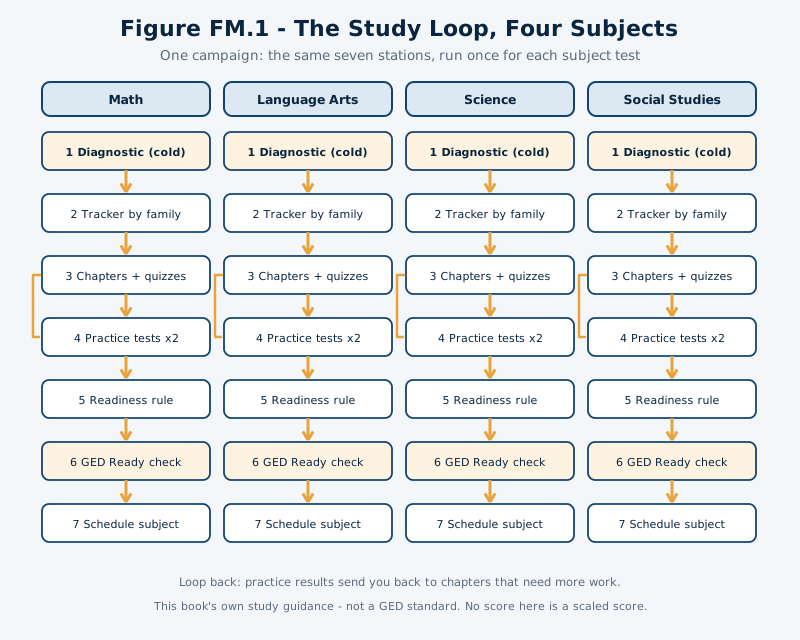
Four identical loops, one per subject test, drawn as one campaign: per-subject diagnostic (cold) → tracker by target family → chapters and quizzes → two timed practice tests → this book's readiness rule → GED Ready as the final per-subject check → schedule that subject. A caption beneath the loops reads: the routing rules, mastery lines, and readiness guidance in this book are this book's own study guidance, not GED standards; no score in this book is a scaled score or a prediction of a test outcome.
Underneath the four subjects, the same three skills decide scores in all of them, and Chapter 2 teaches them as crafts before the subject parts begin: close reading (RLA's passages, Science's presentations, and Social Studies' sources are all documents to be read closely); data and graphics (every test shows you tables, graphs, maps, or diagrams and asks what they support); and careful computation (Mathematical Reasoning openly, Science and Social Studies inside their content). Every subject part contains data-and-graphics work for exactly this reason, and the parts cross-reference each other when the same skill changes clothes — a Punnett square is Chapter 25's heredity and Chapter 8's probability wearing a lab coat.
The free sample of this book is Chapter 1 plus the Mathematical Reasoning diagnostic, so a buyer can judge the teaching and measure the subject returning learners most need to measure cold, before paying. If you are reading the sample: the diagnostic's instructions, its tracker, and its answer key are complete in the front matter, and the summary of the study system above is enough to score the diagnostic and read its tracker honestly. Chapter 2, in the full book, teaches the system whole.
Front matter — this note; the Exam Format pages; How to Use This Book; and the four subject diagnostics with their four trackers: the Mathematical Reasoning Diagnostic, the Reasoning Through Language Arts Diagnostic (with its extended-response task), the Science Diagnostic, and the Social Studies Diagnostic — each followed, in the answer-key section, by its full key and tracker.
Part I — Orientation
Part II — Mathematical Reasoning
Part III — Reasoning Through Language Arts
Part IV — Science
Part V — Social Studies
Part VI — The credential
Back matter — eight full timed practice tests, two per subject, at the real tests' published times, each with a full answer key and an error-pattern review page; the Extended Response Practice Bank (eight further full prompts with paired texts, annotated model responses, and trait scoring guides); the 2-week intensive and 4-week standard study plans, per subject and as a combined campaign; cheat sheets — one per subject (the formula-sheet companion; the conventions sheet; the science data sheet; the social-studies numbers-and-graphs sheet) — and the Numbers Sheet, every testable examination figure with its source; a combined glossary, subject-tagged; the errata and updates page (naming this edition and its basis: GED subject pages and policies as read October 29, 2026, and the Assessment Guide editions named above); References; and the printed outline crosswalk appendix — every published target family of all four subject tests mapped to its home chapter — so you can verify for yourself that every part of every test, and every part of every subject, has a home chapter.
Every examination fact in this book traces to a GED Testing Service primary source named on the Exam Format pages and listed in the References: the Test Subjects pages, the scores pages, the GED Ready guidance, the retake guidance, the online-testing state information, the calculator guidance, and the Assessment Guide for Educators in the editions named in the edition-basis note. Subject-matter facts — the science, history, civics, economics, and geography the chapters teach — are drawn from checkable subject sources and primary documents (the Constitution and the founding documents in their public-domain texts among them), named where they are used and listed in the References; no historical date, scientific value, or economic figure is printed from memory where a source exists.
Facts that could not be verified from such a source are not printed as facts. You will therefore not find in this book: any state's eligibility rule, fee, retake detail, or credentialing procedure printed as a national fact; any exact national item count for any subject test, or any item count at all for Part 1 of Mathematical Reasoning; any raw-point total for any test, or any percentage share for the extended response; any score-band edge for GED Ready's "too close to call" indicator beyond the 145 threshold GED itself states; any claim about whether passing scores expire; any test-center delivery detail beyond what GED's own pages publish; any pass rate; any salary, employment, or college-admission figure; or any promise about passing, credit, or admission.
Silence, in those places, is deliberate. A study book that guesses at numbers teaches you to guess — and guessing, on tests built from documents, data, and calculations with exactly one defensible answer, is the habit this book exists to replace.
End of the free sample. The complete book continues from here — the full A-to-Z course in book form, delivered as an EPUB you can read in Apple Books, Google Play Books, ReadEra, Thorium Reader, Adobe Digital Editions, or Send to Kindle.
Buy this ebook — $11.99 Back to the book page
Payments are securely processed by Payhip.