
Mastering Careers & Skills
Food Truck: Mastering the Craft · free sample from the book itself
A food truck is not a kitchen that happens to have wheels. It is a business premises — a permitted place where food is prepared and served — that must also be a roadworthy vehicle, a self-contained utility system, and a shopfront, all in the same body. This chapter makes the founding decision of the book: which of the three mobile formats you are actually building, and what concept it will carry. Our specimen, the fictional Juniper & Smoke, is a smoked-sandwich truck built in a used step van, and it will carry every number in this book from here to Chapter 20.
Start where an inspector starts. To the health authority, the truck is a mobile food establishment: a food premises that moves. It must hold food at temperature, supply potable water, retain wastewater, give its crew a place to wash hands, and present itself for inspection — the same duties a fixed kitchen carries, discharged from a vehicle. (The FDA Food Code — the model code that state and local codes adopt in their own editions — sets the mobile standard this way, including the rule that a mobile unit's wastewater tank be sized 15 percent larger than its water supply tank.) To the fire authority, the same body is a cooking operation with fuel aboard. To the city, it is a vendor occupying ground. To the customer, it is simply lunch.
That stacking of identities is the business. A restaurant owner manages one premises with one address. A truck owner manages a premises that must be legal in three senses at once — as a kitchen, as a vehicle, and as an occupant of each pitch it serves — and must re-establish the third of those at every new location. Almost every later chapter is one of those identities examined closely: the permit stack in Chapter 4, the working systems in Chapter 8, food safety in Chapter 9, location economics in Chapter 11.
The specimen shows the shape. Juniper & Smoke's truck is a 2019 step van, bought used and converted, carrying a flat-top griddle, a hot-holding unit, a refrigerated prep rail, and undercounter refrigeration. Its fresh-water tank holds 40 gallons; its wastewater tank holds 46 gallons — 40 × 1.15 = 46, the Food Code's mobile sizing rule worked on the specimen's own figures. A crew of three stands on its books: the owner-operator, who works the window and expo; one full-time line cook on the griddle; and part-time prep and window help, two people sharing the hours. In its stabilized teaching month it serves 20 days — weekday lunch anchors at office parks and four brewery evenings — and events and catering are deliberately excluded from that month, because Chapters 12 and 13 teach them as separate lines with their own math.
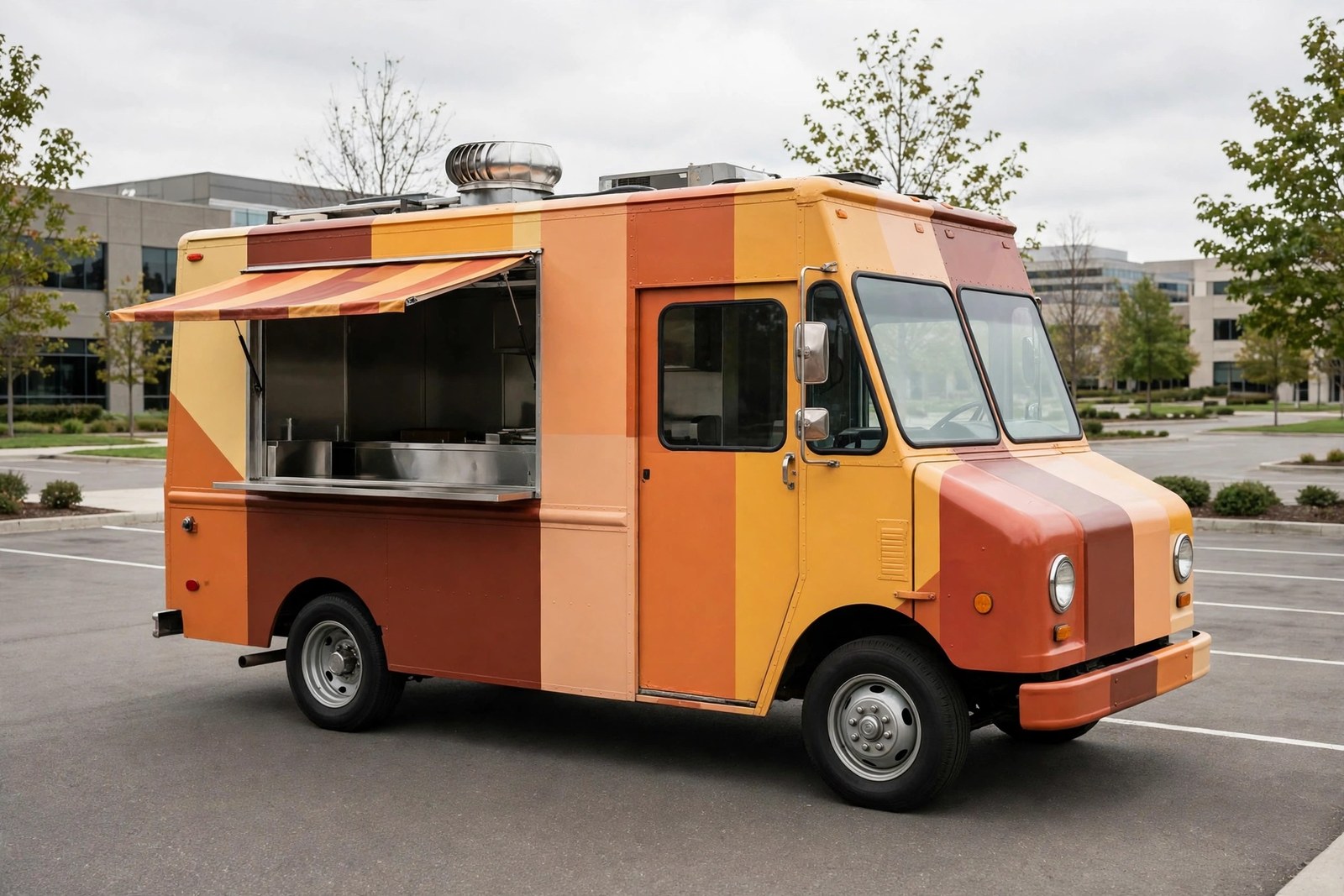
Figure P-01. The specimen-format truck at a pitch, service window open
Notice what the specimen is not. It has no fryer and no second hot line. It has no seating — a food truck serves across a window to ground it does not furnish, and fire-safety guidance for mobile cooking is explicit that there is no public seating within the truck (NFPA's published Food Truck Safety fact sheet states the rule and directs operators to their local authorities for licensing). And it is not a restaurant waiting to grow seats. It is a complete business in its own form, and this book treats it that way until Chapter 20, where the move to a fixed restaurant is evaluated as a decision, not assumed as a destiny.
Format means the physical and operational form the business takes. Mobile food has three, and they are not sizes of one business — they are three different businesses that happen to sell food outdoors.
The food truck is a self-contained motorized kitchen: it drives itself to the pitch, carries its own water, waste, power, and cooking line aboard, and serves from an onboard window. Its strength is independence — one unit, one crew, arrival and departure under its own power. Its cost is that everything must fit, work, and be maintained inside one vehicle: when the truck is down, the whole business is down, and Chapter 15 prices that fact. The specimen is this format, and most of this book is written from inside it.
The concession trailer is a kitchen in a towed body. It has no engine of its own; a separate tow vehicle moves it. Floor space per dollar is usually its argument — a trailer can carry a longer line than a step van of similar cost — and its weakness is the mirror of the truck's strength: moving it is a two-vehicle operation, siting it is slower, and many operators leave a trailer semi-permanently at one pitch, at which point it begins to behave like a small fixed site with a mobile permit history. A trailer that never moves raises the question Chapter 11 asks of every pitch: what is the mobility for?
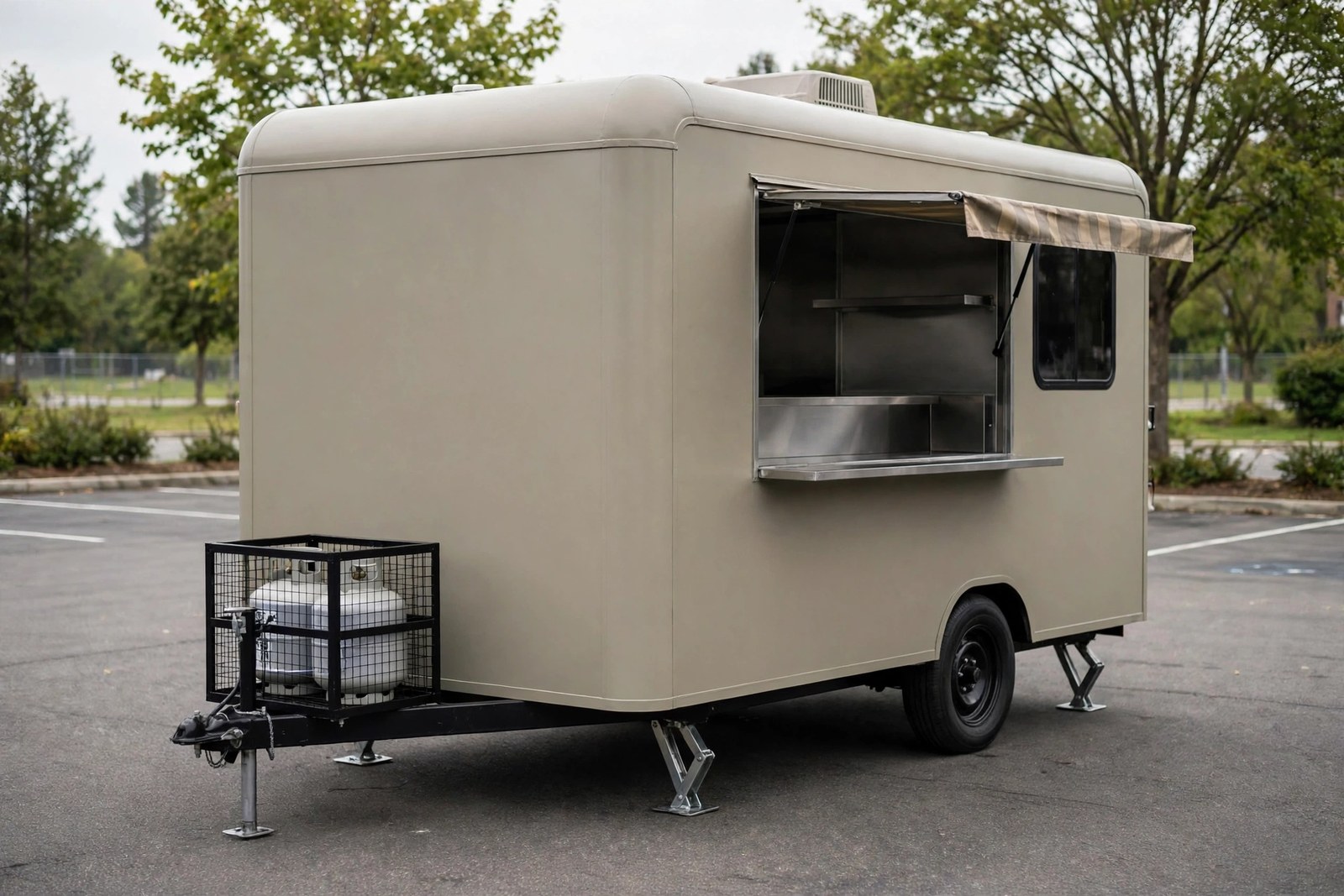
Figure P-02. A concession trailer at a pitch
The cart is the smallest form: a pushcart or compact stand, typically working a narrow menu — often a single product family — from a small footprint, with limited or no onboard cooking, drawing on its base for preparation and storage. Its capital is the lowest of the three and its ceiling is the tightest: the cart's menu, holding capacity, and service speed are all bounded by a body one person can move. What a cart buys is cheap learning. It tests a product, a pitch, and an owner's appetite for the work at the smallest stake — which is a real business purpose, provided the owner reads the results as a cart's results and not as a forecast of a truck's.
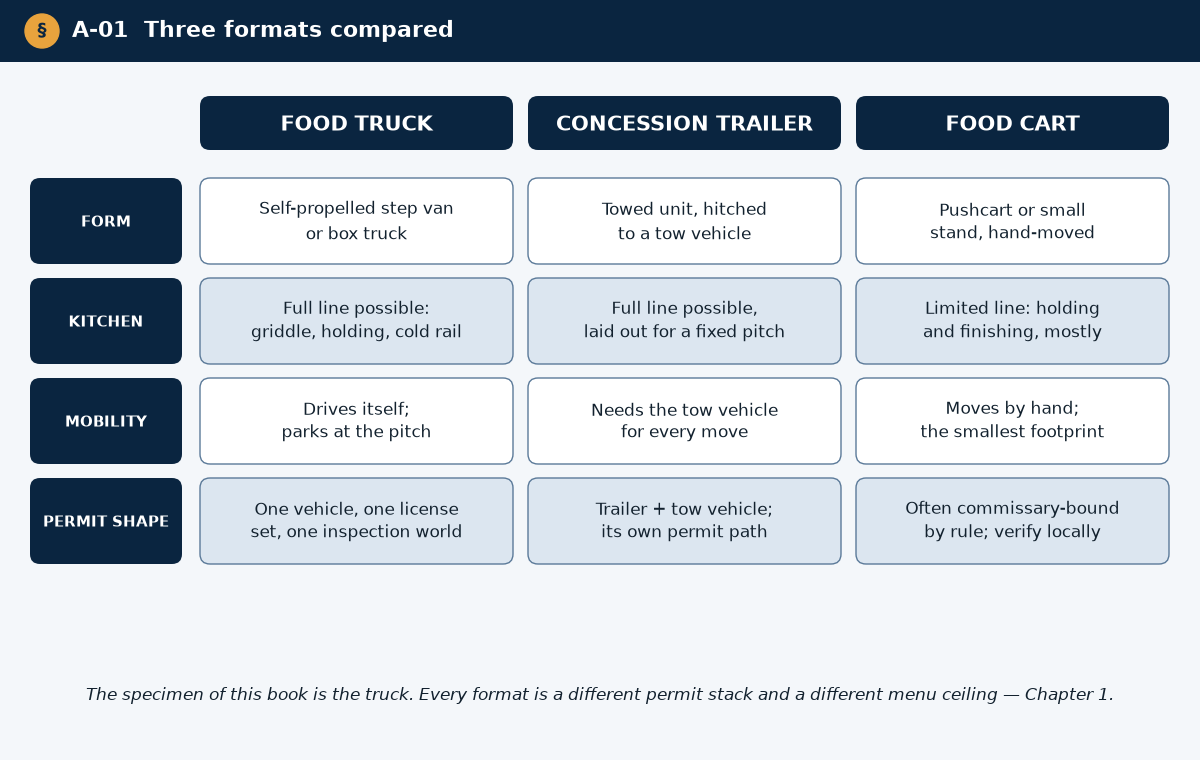
Figure A-01. Three formats compared
Three tests separate the formats honestly. Mobility: how fast, how often, and at what crew cost does the unit change pitches? Capacity: how many tickets can the line produce in a peak hour, and how much can it hold safely through a service? Permit shape: each format presents differently to the health, fire, and vending authorities — what counts as the establishment, where preparation may happen, and what must be shown at inspection differ by format as well as by jurisdiction, which is why Chapter 4 teaches an investigation method rather than a list. Choose the format by which of those three tests binds your concept hardest, not by which vehicle you happen to like the look of.
The specimen's stabilized teaching month, used across the whole book: 95 tickets a day × $16.00 average ticket = $1,520.00 a service day. Across 20 service days: 95 × 20 = 1,900 tickets, and 1,900 × $16.00 = $30,400.00 in revenue. Read the line slowly, because every later computation hangs off it: a daily count, a ticket average, and a count of days. Change any one of the three and the month changes; confuse any one of them with a promise and the planning fails. These are the specimen's own labeled figures — a teaching month for a fictional truck, not a market figure and not a forecast of any reader's month.
Suppose a cart can complete 22 tickets in a peak hour and works a 4-hour pitch with one strong hour and three hours at half that rate. Peak hour: 22 tickets. Three ordinary hours: 3 × 11 = 33 tickets. The pitch yields 22 + 33 = 55 tickets. At the specimen's $16.00 ticket — used here only as a measuring stick — that is 55 × $16.00 = $880.00 of sales capacity for the pitch, before any cost. The arithmetic is trivial; the discipline is not. The cart's ceiling was set by its format before the day began, and no effort at the window raises it. Format choice is ceiling choice, made early and paid for daily.
One phrase follows a mobile operator through permits, inspections, and pitch agreements: readily movable. In plain terms, the unit must be capable of being moved — on its own wheels, without permanent connections to utilities or ground. The specimen's world states it strictly: a vehicle connected permanently to water, sewer, or power at a site has, for regulatory purposes, stopped being mobile and started being an unpermitted fixed site.
The phrase matters for three operational reasons. First, inspection: an authority can require the unit to present itself, complete and operable, where and as it directs — mobility is how the premises comes to the inspector. Second, the pitch bargain: most pitches are licensed, leased, or permitted on the understanding that the unit arrives and leaves; a unit that cannot leave on schedule breaks the bargain its welcome rests on. Third, the commissary relationship: the truck's base — its commissary, the licensed fixed kitchen where it reports for preparation, storage, water, and waste services, taught whole in Chapter 7 — is structured around a vehicle that returns and departs daily. A unit that settles breaks that structure too.
Hold the phrase as a design test, not a slogan. Every build decision in Chapter 6 — tank sizes, generator mounting, equipment fixing — is checked against it: after this change, can the unit still be readied and moved by its own crew, today, without a contractor? If not, the change has quietly traded the format away.
The second founding constraint is the menu's size. Juniper & Smoke sells five core items. That is not modesty; it is engineering, and Chapter 2 does its costing in full. The reasons belong here, at the concept stage, because they shape everything the format must carry.
A two-person line — one cook on the hot line, one operator at window and expo, with part-time help at the edges — can finish only so many distinct builds at window speed. Each added item adds ingredients to a small cold rail, steps to a small space, and seconds to every ticket that touches it. A truck's refrigeration, dry storage, and prep surface are all measured in inches; a menu that fits a restaurant's walk-in will not fit here. Five items also concentrate buying: fewer ingredients, each ordered in workable quantity, each turning over before it spoils. And five items make quality checkable — the owner can taste, cost, and watch five things daily in a way no one watches fifteen.
This book's fence belongs in this section, stated once and plainly: the menu in this book is an operating system — items costed, mixed, and fitted to a line and an equipment set. The book teaches running the truck as a business venue. It does not teach cooking: no recipes, no technique, no dish development. An item appears here as a name, a price, a plate cost, a mix share, and a station on the line — which is everything an operator needs from it on the page, and nothing a cook would.
The specimen's five, with the figures Chapter 2 will build on: a smoked brisket sandwich at $14.00; a smoked chicken sandwich at $12.50; a pulled pork sandwich at $12.50; a smoked mushroom melt at $11.50; and a brisket grilled cheese at $11.00. Each is finished on the griddle, the holding rail, or the cold rail — the whole menu rides on the equipment list of §1.1, with no station the truck does not have. That fit, menu to line to vehicle, is the concept. A menu that needs a sixth station is a different truck asking to be bought.
Chapter 2 works this in full; here is the shape. Weight each price by its share of sales — its mix: brisket 30% at $14.00 contributes $4.20; chicken 25% at $12.50 contributes $3.13 (25% × 12.50 = 3.125); pork 20% at $12.50 contributes $2.50; mushroom 10% at $11.50 contributes $1.15; grilled cheese 15% at $11.00 contributes $1.65. Sum: 4.20 + 3.13 + 2.50 + 1.15 + 1.65 = $12.63, the specimen's blended core price. The menu, for planning, behaves as one $12.63 item sold 1,900 times a month in different costumes — and the average ticket of $16.00 is that core plus $3.37 of drinks and sides. A concept conversation that cannot produce this one blended figure is not yet ready to price a truck.
Complete this canvas before spending anything. It holds the founding decision on one page, in blanks you fill with your own findings — the investigation chapters that follow exist to fill several of them honestly.
WS-1 — Format & Concept Canvas
| Field | Your entry |
|---|---|
| Concept in one sentence (offer, guest, occasion) | ______________________ |
| Format chosen (truck / trailer / cart) | ______________________ |
| The binding test (mobility / capacity / permit shape) and why | ______________________ |
| Core menu items (name each; count them) | ______________________ |
| Stations the menu needs (list; every one must exist on the unit) | ______________________ |
| Crew at peak (roles, not names) | ______________________ |
| Service pattern aimed at (anchors, evenings, events — which, how many days) | ______________________ |
| Blended core price (mix-weighted, from your costing) | ______________________ |
| Average ticket aimed at, and what attaches to reach it | ______________________ |
| Commissary or base identified (name the arrangement, not yet the contract) | ______________________ |
| What this concept will not do (three exclusions) | ______________________ |
| The figure that would make you stop (your own walk-away test) | ______________________ |
A canvas with a blank in the format or menu rows is a finding, not a failure: it names the work. A canvas filled in with borrowed figures — another operator's ticket average, a pitch's best day — is worse than blank, because it will be spent against as if it were true.
The owner-operator of a planned sandwich business talks it through with a commissary manager whose kitchen she hopes to work from. Read for how each format claim is tested against an operation, not a preference.
Owner: I keep going back and forth. The trailer gives me a longer line for the money. Why shouldn't I start there?
Commissary manager: How often do you plan to move it?
Owner: Weekday lunches in two office areas, ideally. Different one each day.
Commissary manager: Then price the move, not the trailer. Hitching, towing, siting, leveling, connecting — twice a day, with your lunch window in the middle. The truck drives in and opens. The trailer's extra line serves a rush you may reach too tired and too late to serve.
Owner: And the cart idea? My investor friend says start with a cart, learn cheap.
Commissary manager: A cart teaches you the product and one pitch. It cannot teach you your truck numbers — different capacity, different permit shape, different day. Learn cheap if the lesson is the one you need. Just don't call the cart's results a forecast.
Owner: So the truck, because the concept is movement itself.
Commissary manager: The truck, because your service pattern is two moves a day and a five-item line one cook can run. The format follows the pattern. It always does.
The dialogue teaches by its method: every format claim was converted into a daily operation — a move, a window, a crew task — and priced in time. Format debates conducted in brochures stay debates. Conducted in Tuesdays, they settle.
Feras Alzubi
The Complete Course Series
Copyright © 2026 Feras Alzubi. All rights reserved.
No part of this book may be reproduced, stored in a retrieval system, or transmitted in any form or by any means — electronic, mechanical, photocopying, recording, or otherwise — without the prior written permission of the copyright holder, except for brief quotations in reviews and other fair use permitted by copyright law.
This book is an original work. It was researched and written for this series; its text, structure, examples, exercises, and figures were created for this book and are not reproduced from any other publication.
This book is an independent educational work. It is not published, endorsed, sponsored, or affiliated with the U.S. Food and Drug Administration, the U.S. Bureau of Labor Statistics, the U.S. Small Business Administration, the Federal Trade Commission, the U.S. Department of Labor, the Centers for Disease Control and Prevention, the Occupational Safety and Health Administration, the U.S. Department of Agriculture, the National Fire Protection Association, the Texas Department of State Health Services, the U.S. Chamber of Commerce Foundation, or any state or local health, fire, or licensing authority. Names of agencies, bodies, and programs appear because the book teaches the public systems an operator works inside; every statement about a program is drawn from that program's own published material, and the program's own publications govern.
The specimen truck in this book, Juniper & Smoke, is fictional. Its prices, costs, fees, and sales figures are invented to teach with, and no figure in this book is a market rate, an average, a promise, or a recommendation. The photographs in this book are photorealistic generated images of unoccupied vehicles, kitchens, and equipment. No person is depicted in any figure in this book, and no real business is shown.
This book teaches the business of opening and running a food truck — the concept and the menu as economics, the permit stack, the commissary, the truck's working systems, food safety, the service day, locations, events, catering, staffing, maintenance, and the money — as one connected operation, carried end to end on one fictional truck. Read it in order the first time: each chapter uses the numbers, the permits, and the decisions of the chapters before it. After that first pass, the book works as a reference — the cheat sheet at the end of every chapter, and the collected worksheets and cheat sheets in the back matter, are built for the truck and the desk, not the armchair.
Three kinds of apparatus do the teaching, and every item is explained. Scenario exercises (120, six at the end of each chapter) put a concrete situation in front of you and ask for the operator's move; the key at the back of each chapter explains the method, the computation where there is one, and the considerations — it teaches how to think, and it never certifies a decision as right for your truck. Repair drills (12, in Chapters 3, 9, 12, and 16) hand you a broken artifact — a capital stack that does not sum, a temperature log with a gap, a fee quoted on the wrong base, a week counted wrong — and ask you to find the fault; the key explains the fault and the repair. The Open-or-Not Check (24 checks, next in this front matter) routes you before you begin: four domains, six checks each, every answer explained, pointing you at the chapters your answers say you need first. It gives no score and no verdict, because readiness is not a number. The capstone (12 plan steps) assembles the whole book into the specimen's opening plan, from concept lock to the first service day.
The specimen. Juniper & Smoke is a fictional smoked-sandwich truck: a used step van converted to a mobile kitchen, based at a commissary, serving a five-item smoked-sandwich menu. Its crew is three people on the books — the owner-operator, one full-time line cook, and part-time help shared between two people. In its stabilized teaching month — the canon month the whole book computes on — the truck works 20 service days, serves 95 tickets a day at a $16.00 average ticket, for 1,900 tickets and $30,400.00 of revenue. Its opening capital stack is $150,000, and it breaks even at 1,533 tickets of the month's 1,900. Wherever Juniper & Smoke's numbers stand in this book, they are the specimen's own, labeled as the specimen's. Yours will differ; the method — cost your own menu, build your own stack, run your break-even on your own figures — is the part that transfers.
One book, deliberately. A food truck is one mobile venue, opened once and run daily: one vehicle, one commissary base, one permit stack, one small menu, one service rhythm, one set of books of account. The three formats — truck, trailer, and cart — are taught as one decision inside this book (Chapter 1), because the operating body they share — commissary, permits, food safety, location economics — is the same body, and their differences are of vehicle and scale, which the chapters name where they bite. The truck-to-restaurant ladder is likewise taught inside (Chapter 20) as a decision to evaluate, not as a second book. Splitting the formats, or the ladder, into separate books would halve each one and duplicate the shared body — so the whole operation is here, in the order an operator meets it.
The fences. Twelve fences govern everything in this book. They are printed here in full because they are part of the teaching.
What this book cannot give you. Your permits, or anyone's approval of your truck. Your jurisdiction's fees, forms, or distance rules. A cooking education (F8). A credential of any kind. A prediction about your truck. A substitute for your health department, your fire authority, your attorney, your accountant, or your insurer.
The survival figures, printed once and plainly. The U.S. Bureau of Labor Statistics follows business establishments over time (Business Employment Dynamics, Table 7, published January 12, 2024). Food trucks sit inside the sector BLS publishes as accommodation and food services; BLS publishes no food-truck-only survival table. Of that sector's establishments born in the year ended March 2013, 82.5% were still operating after one year, 55.3% after five years, and 38.2% after ten years. For context, the total private sector for the same cohort stood at 79.6% after one year, 50.6% after five years, and 34.7% after ten years. An establishment is a location, not a company, and a location that closed was not necessarily a business that failed — owners retire, move, and merge. Those are facts about a population of other people's establishments. They are not your odds, and Chapter 18 teaches what to do with them: build a truck whose break-even you can state, at a volume you can defend, with a reserve that survives a thin month. One correction belongs beside the figures. The claim that "90% of restaurants fail in the first year" circulates widely without a source; it is a myth, and these figures contradict it — 17.5% of the sector's 2013 cohort closed in year one, not 90%. Wherever the myth is named in this book, this correction stands with it.
Front matter — How to Use This Book · The Open-or-Not Check and its key
Part I — Choose the Venue — 1. The Food Truck as a Business: Three Formats and the Small-Menu World · 2. The Menu Is the Machine: Costing and Engineering a Five-Item Line · 3. The Numbers Before Signing · 4. The Permit Stack: An Investigation System
Part II — Open the Truck — 5. Approval Before Purchase: The Sequencing Rule · 6. The Vehicle as a Build-Out: Buying, Converting, and Laying Out the Kitchen · 7. The Commissary System Whole · 8. The Truck's Working Systems: Propane, Power, Water, and Cold
Part III — Run the Days — 9. Food Safety in a Kitchen That Moves · 10. The Service Day: Commissary Prep, Load-Out, and the Window Rhythm · 11. Location Strategy as Economics · 12. Events and Festivals: The Fee Math · 13. Private Catering: The Second Line · 14. People: Staffing a Two-Person Line · 15. Maintenance and Downtime Discipline · 16. The Weekly Numbers
Part IV — Survive and Grow — 17. Marketing a Business That Moves · 18. Failure Modes and the Honest Curve · 19. Growth: The Second Truck and the Second Format · 20. The Truck-to-Restaurant Ladder and the Franchise Question
Capstone — The Opening Plan (12 steps) and its key
Back matter — References and further reading · Action paths · The worksheets collected · The cheat sheets collected · Glossary · Errata and corrections · Coverage statement
End of the free sample. The complete book continues from here — the full A-to-Z course in book form, delivered as an EPUB you can read in Apple Books, Google Play Books, ReadEra, Thorium Reader, Adobe Digital Editions, or Send to Kindle.
Buy this ebook — $12.99 Back to the book page
Payments are securely processed by Payhip.