
Mastering Careers & Skills
Fiber-Optic & Broadband Field Technician: Mastering the Craft · free sample from the book itself
The Complete Course Series
A complete-course series for people entering skilled fields and for working entrants preparing for the credentials their fields actually use. Each book in the series teaches one whole craft from absolute zero to working depth — its foundations in dependency order, its physical plant and tools, its methods of work, its testing and troubleshooting reasoning, and the exact shape of its doors — with original exercises, worked examples, and case work written for that book alone.
Books in this series share one honesty discipline: no national license is invented where none exists, no credential is promised, no outcome is guaranteed, and every hard fact about a credential, a code, or an occupation traces to the publication of the body that owns it, named beside the fact.
Fiber-Optic & Broadband Field Technician: Mastering the Craft is the fiber-optic and broadband volume in the series.
Feras Alzubi
The Complete Course Series — Google Play Books
2026 Edition
This book teaches the whole craft of fiber-optic and broadband field work from absolute zero to working depth: light in glass, the fiber and cable families, the physical plant in the air, underground, and at the premises, the joining crafts of splicing and termination, the architectures the plant carries — passive optical networks and fiber to the home, hybrid fiber-coax, and premises broadband — placement practice, testing and troubleshooting method, restoration, and documentation. Laid over that whole body, in their own chapters, are the field's three installer credentials — ETA International's Fiber Optics Installer, SCTE's Broadband Fiber Installer, and BICSI's Installer 2, Optical Fiber — each taught from its body's own published competencies and exam facts.
One honesty fact stands at the front, because the whole book stands on it: there is no national license and no single national exam for fiber-optic and broadband field technicians. The doors are employer training, certificate programs, and three voluntary industry credentials. None of them is a license; none authorizes any regulated act. This book prepares field knowledge and readiness, honestly and completely; certifying bodies examine and certify, schools and programs and employers train, and hands-on skill is trained and assessed in person, under supervision, never from a page.
Copyright © 2026 Feras Alzubi. All rights reserved.
First edition, 2026. Published by Feras Alzubi.
No part of this book may be reproduced, stored in a retrieval system, or transmitted in any form or by any means — electronic, mechanical, photocopying, recording, or otherwise — without the prior written permission of the author, except for brief quotations in reviews and for the reader's own study use of the exercises and skills checks printed here.
Originality statement. This book is an original work, written from scratch for this series. Every chapter, exercise, worked example, case, and figure in it is original to this book. No other book's text, items, or teaching material appears in it in any form — not copied, not paraphrased, not adapted. The facts it teaches about credentials, codes, and standards are drawn from the administering bodies' and issuing organizations' own publications, which are named in the chapters and collected in the References; those publications' own text is never reproduced here beyond the short scope statements the chapters identify as such.
Not-affiliated disclosure. This is an independent study guide and field course. It is not published by, affiliated with, endorsed by, or approved by ETA International (ETA), the Society of Cable Telecommunications Engineers (SCTE), or BICSI, and none of those organizations participated in its creation. ETA International, the Society of Cable Telecommunications Engineers, and BICSI are independent bodies. "ETA," "SCTE," and "BICSI," and the names of their credentials — Fiber Optics Installer, Broadband Fiber Installer, and Installer 2, Optical Fiber — are used in this book nominatively only — to name the credentialing bodies and the credentials that are among the subjects taught.
Scope note. This book teaches the knowledge of fiber-optic and broadband field work — its principles, vocabulary, standards, and reasoning order — for learning and for entry-path readiness. It is knowledge only: pole work, bucket work, underground and vault work, splicing, termination, and energized testing are hands-on skills that are trained and physically assessed in person by schools, programs, and employers, and this book never presents itself as instruction to perform them. It is not a substitute for a manufacturer's literature for any product, for a credentialing body's own published requirements, for the code or standard edition adopted by your authority, or for your jurisdiction's own publications. Nothing in this book promises a job, a certification, a score, selection, or income; it teaches the field and its doors as they verifiably are, and it says so wherever a reader might be tempted to forget it. This book is not a certifying organization and satisfies no certification, training, or experience requirement — it does not satisfy ETA's approved-school prerequisite, BICSI's IN250 course, or any SCTE curriculum requirement.
Edition. 2026 Edition — built on ETA International's published FOI knowledge competencies and certification listings, SCTE's published BFI examination catalog entry and Certification Program Rules, BICSI's published Installer 2, Optical Fiber certification page, the U.S. Bureau of Labor Statistics' Occupational Outlook Handbook entry for Telecommunications Technicians, the National Telecommunications and Information Administration's BEAD Program publications, and the Fiber Optic Association's Online Reference Guide, verified against the issuing bodies' own publications at this build's opening gate, 2026-11-14.
Read this note first, because it will save you from the two mistakes that cost entrants in this field the most time and money.
The first mistake is looking for a single national door. There is not one. No national license makes a person a fiber-optic technician, and no single national exam admits a person to broadband field work in every place. What exists is more useful once you see it clearly: employers who train, schools and programs that teach hands in person, and three voluntary industry credentials that examine knowledge — and, for two of them, hands-on skill — in person. This book maps that landscape exactly, and it never calls a credential a license.
The second mistake is learning procedures before principles. Light, loss, and the division of light come first in this book, before cable plant, before splicing, and before any budget is run, because every later judgment — whether a splice is good, whether a link should work, where a fault is likely to sit — rests on them. If you are new, read in order. If you already work in the field, take the Diagnostic first and let its strands send you where you need to go.
A word on hands. Splicing, termination, placement, and testing are physical skills. This book teaches what those skills are, the physics and method underneath them, what each tool does, what each reading means, and what decision each reading gates. It does not teach you to perform them from a page, because no honest book can. Hands are trained in person, under supervision — and the ETA and BICSI hands-on examinations are themselves in-person assessments. Knowing where that supervised door stands is part of knowing the field.
Finally, a word on numbers. Every number in this book that belongs to someone else — a credential's exam shape, an occupation's median, a program's funding — is printed with its owner named beside it and is fenced to the places where it belongs. Where a body does not publish a number, this book says so plainly instead of guessing. That discipline is itself part of the craft: field work runs on verified numbers, and so does this book.
Front matter — Series Page · Title Page · Copyright Page · A Note Before You Begin · Contents · The Field and Its Doors · Exam Blueprint · How to Use This Book · Field-Readiness Diagnostic (50 items) with key and Readiness Tracker
Part I — The Field and Its Doors
Part II — Foundations: Light, Fiber, and the Numbers
Part III — The Cable Plant: The Physical Network
Part IV — Joining Fiber: Splicing and Termination
Part V — Architectures: What the Plant Carries
Part VI — Installation Practice
Part VII — Testing, Troubleshooting, and Restoration
Part VIII — The Credentials and the Road
Back matter — Field Case Battery A (25 guided case files) with key · Field Case Battery B (25 guided case files) with key · Strand Repair Sets RS1–RS8 (8 × 15 = 120 items) with key · Study Plans (4-week / 8-week / 12-week) · Cheat Sheets · Figure Program · Errata & Verification Notes · References & Further Reading · Coverage Crosswalks (field map to chapters; ETA's 14 competency sections to chapters; SCTE's six topic areas to chapters; BICSI's exam body to chapters; BLS duty lists to chapters) · Glossary
This section states, in one place, the facts the whole book stands on — what fiber-optic and broadband field technicians do, how a person actually enters the field, and exactly how the credential landscape is laid out. Everything here traces to the issuing bodies' own publications; the chapters carry the full account, and the verification notes in the back matter record the discipline.
The field: the communications plant. A fiber-optic and broadband field technician works on the communications plant — the fiber-optic and broadband cable plant that carries internet, video, and voice services — installing telecommunications lines or equipment, operating, maintaining, or repairing damaged or malfunctioning lines or equipment, testing lines or devices to ensure they work properly, keeping records of maintenance, repairs, and installations, and explaining the use and maintenance of equipment to customers. (Source: BLS, Occupational Outlook Handbook, Telecommunications Technicians.) Those who work with fiber-optic cables must be able to splice and terminate optical cables. This book owns the communications side of the pole and the building only; power-distribution plant is a different craft and a different book.
The headline honesty fact: there is no national license and no single national exam for this trade. No national test, no national license, and no national certificate makes a person a fiber-optic or broadband field technician licensed to work across the country, and any course or advertisement that implies one should be read with suspicion. What exists instead is a landscape of separate authorities doing separate jobs, and this book's first discipline is never confusing them:
The buildout context. The Infrastructure Investment and Jobs Act established the Broadband Equity, Access, and Deployment — BEAD — Program, at $42.45 billion, administered by the National Telecommunications and Information Administration (NTIA) through the states, to ensure broadband availability throughout the United States. (Source: NTIA, BEAD Program.) That program is the public-investment context in which much current fiber construction is planned. It is context only: it is not a hiring promise, a wage, or a guarantee of work in any place, and this book prints no state figure for it.
The shape of the work, honestly. The same Bureau of Labor Statistics entry that lists the duties also names the costs. The occupation group carries among the highest injury and illness rates of any occupation group; common injuries are falls and strains; hardhats and harnesses belong to ladder and elevated work; and night, weekend, and on-call shifts are part of the occupation's shape. Chapter 4 teaches the hazard map whole. A book that hid those facts would not be preparing you for the field; it would be selling you a picture of it.
The pay and outlook figures, fenced. This book prints exactly one pay-and-outlook set — the Bureau of Labor Statistics' whole-occupation figures for Telecommunications Technicians and its two named subgroups — and prints them only where they belong: here, in Chapters 1 and 2, where the work and the doors are introduced, and in Chapter 40, where the road from here is mapped. They are printed as labeled whole-occupation figures, edition-stamped, with the growth figure always paired with the openings figure beside it. They are never a starting wage, an offer, a graduate outcome, or a promise to any reader. No other pay figure appears anywhere in this book.
Read the pairing as it is printed: a shrinking total with substantial yearly openings is not a contradiction. Openings created when experienced workers leave an occupation are real doors, and they are the doors this occupation's own handbook describes.
What this book is, and is not. This book prepares field knowledge and readiness: the physics of light in glass, the fiber and cable families, the physical plant, the joining crafts as knowledge and method, the architectures, placement practice, testing and troubleshooting reasoning, and the exact shape of the three credential doors. It is not a certifying organization, it satisfies no certification, training, or experience requirement, and it promises no job, credential, score, or income. Certifying bodies examine and certify; schools, programs, and employers train; states and jurisdictions regulate their own ground. A book that told you otherwise would be selling you something; this one is teaching you something.
The three credentials are not three versions of one exam. They are three different doors, built by three independent bodies, for three overlapping reaches of the same craft — and this page sets their verified panels side by side so you can see the differences before you choose a road. Everything in each panel traces to that body's own publications, read 2026-11-14. Where a body does not publish a fact on the page this book verified, the panel says so plainly. This book never invents an examination fact, and it never prints any examination fee for any of the three credentials. Confirm current terms, including any fee, with the body itself at registration.
How to read the three panels together. The FOI is the premises-installation door, entered through an approved school, with its knowledge exam and its hands-on skills exam in that order. The BFI is the FTTH door, entered on the foundation of the premises credentials beneath it, examined online under proctoring. The INSTF is the experienced installer's door, gated on verified field experience along any of three published pathways and examined in two parts — hands on the bench and a written part taken in a secure testing room with nothing brought in. A beginner can prepare the knowledge for all three from this book; no beginner should mistake that preparation for eligibility for all three. Chapter 3 and Chapters 38–40 teach each door's shape, preparation, and examination craft in full.
The rhythm: teach, then test. Every chapter follows the same rhythm per concept: simplify → explain → detail → show → do → check. A plain statement first, then the explanation, then the working detail, then a worked example with real numbers computed step by step in the text, then your turn in the chapter's exercises, then the check against a key that explains every option. Read the chapter, work its examples with a pencil — every calculation in this book is shown end to end, with no skipped arithmetic — then take its 15-item exercises & skills checks from memory, with the chapter closed, then read the key. Every key explains the right answer and why each wrong answer is wrong, because the wrong answers are where the field's traps live. Items you miss name the strand to repair, and the back matter's Strand Repair Sets drill exactly the strands your scores flag.
The diagnostic comes first. Before Chapter 1, take the Field-Readiness Diagnostic that follows this front matter: 50 items in five strands. It is this book's own design, disclosed as such on its face — an original field-knowledge diagnostic written for this book, in no other test's form. It is a map, not a verdict: nobody expects a beginner to score well before reading the book, and its job is to tell the book where to work hardest for you. Answer all 50, work its calculations with a pencil, and score yourself by strand — never as one combined number — because the strands route you to different parts of the book. The diagnostic is taken before reading, so it uses general field knowledge and the book's taught canons in general form; it does not use the book's specimen build, which the chapters introduce in their place.
The Readiness Tracker. The tracker printed with the diagnostic has one row per strand: Foundations (12 items), Cable Plant & Joining (12 items), Architectures & Installation (10 items), Testing & Troubleshooting (8 items), and Credentials & Readiness (8 items). Enter your first score in the first column. Each strand's row names the chapters that teach it and the repair set that rebuilds it: a weak Foundations strand sends you to Parts I–II first; a weak Cable Plant & Joining strand sends you to Parts III–IV; Architectures & Installation to Part V and the installation chapters in Part VI; Testing & Troubleshooting to Part VII; Credentials & Readiness to Part VIII. After you work the repair sets that serve a strand, re-score that strand and enter the new score in the tracker's after-repair column. Raw counts only: no score in this book — diagnostic, exercises, repair set, or case battery — converts to any other test's score, predicts any credential result, or promises a job, a credential, or a license.
The two study rhythms.
The case batteries. The back matter carries Field Case Battery A and Field Case Battery B — 25 guided case files each: budget cases, splice-record cases, OTDR-evidence cases, outage and restoration cases, and credential-judgment cases. Every case file runs in the same order, in full: situation → evidence → reasoning chain → conclusion → why. Work them on paper, as reasoning: a conclusion in this book is a reasoned judgment with its why, never a set of instructions for performing a fix.
The repair sets. The back matter's Strand Repair Sets RS1–RS8 — eight sets of 15 items, each miss routing back to its tagged chapters — rebuild the strands the diagnostic and the chapter checks expose: RS1 foundations, RS2 cable plant, RS3 joining, RS4 architectures, RS5 installation, RS6 testing, RS7 troubleshooting & restoration, RS8 whole-craft mixed.
Study plans. The back matter carries 4-week, 8-week, and 12-week study plans that pace the two rhythms above. Whichever you choose, keep the rhythm: chapter, exercises, key, repair.
Worked numbers. Every worked example in the chapters uses the book's taught canons — the loss canon, the splitter canon, the color canon, and the placement canon — or the book's labeled specimen plant, or round numbers labeled illustrative on their faces, so the arithmetic teaches the method without borrowing any manufacturer's figures. No brand's nameplate is ever a teaching anchor in this book, in text or in figure, and no brand is ever named.
The safety frame. This book teaches knowledge and reasoning. Pole work, bucket work, underground and vault work, splicing, termination, and energized testing are taught as what the qualified worker does and in what order of reasoning, what the readings mean, and what decision each reading gates — never as step-by-step procedures a reader performs on a live plant from the page. The physical skills of this trade are trained and assessed in person, under supervision, by schools, programs, and employers. That boundary is stated inside the teaching wherever it bites — above all in Chapters 4, 17–21, 28–30, 31–32, and 35–37 — briefly and professionally, as part of the craft itself: knowing where the supervised door stands is part of knowing the field.
A note on numbers. Where this book prints a number — a median, a growth projection, an exam's question count, a loss value — the number traces to the publication named beside it, edition-stamped, and the back matter's verification notes say what was checked and when. Where a number belongs to someone else — a body's current fee at registration, a product's rated values in its manufacturer's literature, a value in a standard's own tables — the book teaches the concept and routes the figure to its owner. That discipline is itself part of the field: fiber work runs on verified numbers, and so does this book.
Before seven, a technician checks the day's first work order — the written assignment that names the address, the job to be done, and the plant involved — and drives to a street where new houses are still going up. The task is a connection: a home that has never had service needs a path for light from the neighborhood plant to the equipment inside. By midday the same technician is across town at a different kind of call, where an existing neighborhood has lost service and the job is to find out why and restore it. Two calls, two different crafts of attention — building something new and reasoning about something broken — and both belong to the same occupation.
That double character is this book's field. Fiber-optic and broadband field technicians are the workers who build, install, test, and restore the physical networks that carry internet, television, and telephone service over glass fiber and related broadband plant. The networks are invisible in daily life — light inside hair-thin glass, running on poles, underground, and through walls — but the work is entirely physical: cables handled, enclosures opened and closed, readings taken, records written. This chapter maps the field whole: the two great families of plant the technician serves, the duties the occupation's own description names, how a working day is actually structured, and the one specimen build this book returns to from beginning to end.
Read this chapter as a map, not a sales pitch. It states what the work is, where it happens, what the national numbers honestly say, and what no credential does or does not do. Later chapters teach the physics, the plant, the joining craft, and the testing method. The map comes first, so every later detail has a place to sit.
Every job a field technician touches belongs to one of two families, and keeping them straight organizes the whole craft. The first and larger family is outside plant — the network that lives outdoors and in shared infrastructure between the provider's building and the customer's property. Outside plant includes the feeder cable that leaves the provider's central office, the large building where the network's active equipment begins a neighborhood's service; the distribution cables that branch through streets; the poles, ducts, vaults, and handholes that carry and protect them; and the enclosures where cables are joined and split. Outside plant is built to survive weather, digging nearby, traffic vibration, and decades of exposure, and the technician who works on it builds new segments, installs connections, tests what was built, and restores service when something outdoors fails.
The second family is the premises end — everything from the point where the network meets a building to the equipment the customer actually uses. At a house, the premises end includes the drop, the final cable run that brings the network from the street plant to the home; the small enclosure where that drop lands on the wall; and the inside wiring and terminal equipment that turn arriving light into working service. In an office, school, or hospital, the premises end is larger — entrance facilities, risers, racks, and outlets across floors — but the idea is the same: the last, most individual stretch of the network, fitted to one building and one customer's needs.
The two families meet at a boundary the technician respects on every job. Outside plant is shared: one network serves a whole neighborhood, so an error outdoors can affect many households at once. Premises work is individual: it happens in one customer's space, on their schedule. A competent technician thinks in both directions at once — how this home connects to the shared plant behind it, and how work on that plant will show up inside this home. Parts III through VI follow this division: the cable plant, then the architectures it carries, then the installation practice that joins the two families.
Figure 1.1 (Class P) — An aerial fiber plant on a residential street: a lashed fiber cable on its messenger strand along a pole line, a splice closure at the nearest pole, snowshoe brackets storing coiled slack, and a single drop cable running from the span to a house.
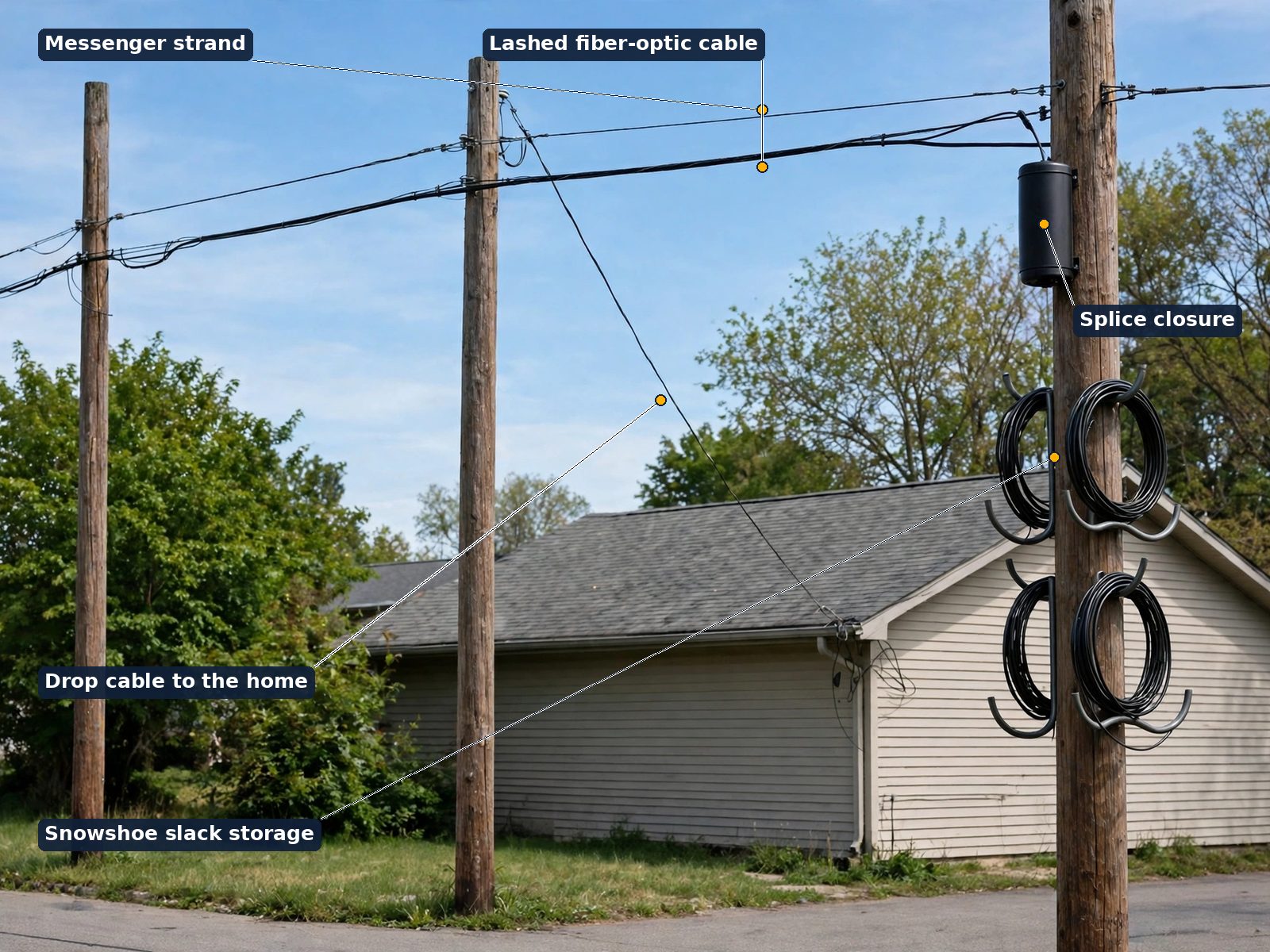
Figure 1.1 — An aerial fiber plant on a residential street: a lashed fiber cable on its messenger strand along a pole line, a splice closure at the nearest pole, snowshoe brackets storing coiled slack, and a single drop cable running from the span to a house.
Look at that figure until its logic is plain, because it shows the two families in one frame. The pole line, the lashed cable, the closure, and the stored slack are outside plant — shared, outdoor, built for the street. The single drop leaving the span for one house is the bridge to the premises family. Nearly every aerial job in this book is some variation on that picture.
When a beginner asks what technicians actually do, the most honest answer is the occupation's own published duty list. The Bureau of Labor Statistics describes telecommunications technicians — the umbrella occupation that covers this field — with five duties, and this book teaches them as the job's own description. Technicians install telecommunications lines or equipment. They operate, maintain, or repair damaged or malfunctioning lines or equipment. They test lines or devices to ensure they work properly. They keep records of maintenance, repairs, and installations. And they explain the use and maintenance of equipment to customers. (Source: BLS, Occupational Outlook Handbook, Telecommunications Technicians.)
Unpack that list slowly, because each line carries a whole part of this book. Installation is not one act but a chain: reading the assignment, placing or connecting plant in the right order, and proving the result. Operation and maintenance are the steady work between failures — inspections, cleaning, measurements taken while things still work, so that drift is caught while it is still cheap. Repair, in this book's discipline, always begins as reasoning: a symptom is gathered, evidence is tested, and only then is a conclusion drawn about what failed. Testing is the occupation's conscience — no installation is finished because it looks finished; it is finished when a measurement says it works. Records are not paperwork after the work; they are part of the work, because the next technician — who may be you, two years later, at midnight — can only reason from what was written down. And explanation is a duty, not a courtesy extra: the customer whose home or business depends on the connection is owed a straight account of what was done and how the equipment is used and cared for.
One line of the related account deserves its own emphasis. The technicians who install and maintain the cables themselves — the line installers and repairers within the umbrella — use specialized tools to test and troubleshoot cables and networking equipment, and, in the source's exact emphasis, those who work with fiber optic cables must be able to splice and terminate optical cables: to join fibers permanently and to fit them with connectors that can be mated and unmated. (Source: BLS, Occupational Outlook Handbook, Telecommunications Technicians.) Splicing and termination are therefore not advanced electives in this craft. They are named duties of the cable side of the occupation, and Parts IV and VII give them the weight the duty list gives them — taught as knowledge, method, and judgment, with the hands themselves trained in person, as Chapter 2 explains.
Field work is rarely self-directed wandering. It arrives as assignments, and the work order is the day's skeleton. A typical day holds a small number of orders of different kinds: a new installation in the morning, a test or turn-up after it, a trouble call whose length nobody can promise in advance, and the records for all of them before the day closes. The mix matters. Installation work is plannable — the route, the materials, and the sequence can be reasoned out before the truck rolls. Trouble work is not plannable in the same way: the technician carries a method instead of a schedule, narrowing a fault from symptom to cause in a disciplined order, and the day bends around what the evidence turns out to be.
Between orders, the unlisted work fills the gaps: driving between sites, which the occupation's entry facts treat as part of the job itself; handling cable, enclosures, and test equipment; coordinating with dispatch, with other crews, and with the customers whose premises the work touches; and writing the record while the facts are still fresh. A reader picturing this field should picture that rhythm honestly — skilled hand work and measurement, yes, but also travel, waiting on evidence, explaining, and writing. Technicians who thrive are the ones who treat all of it as the job, not just the moments with a tool in hand.
The day also follows light and weather. Outdoor work follows daylight and conditions; restoration does not — an outage at night is still an outage, and the occupation's account includes evening, weekend, and on-call time, a shape Chapter 2 states plainly and Chapter 4 connects to safety. What never changes is the order of reasoning: understand the assignment, prove each step with a reading or an inspection, leave a record the next worker can trust.
A craft is learned faster on one job followed whole than on a hundred disconnected fragments, so this book builds its teaching around a single specimen deployment, returned to in chapter after chapter. The Cedar Hollow build is a fictional deployment of fiber to the home, or FTTH — the architecture that carries fiber all the way to each residence — serving 96 homes in a new neighborhood. It is this book's specimen, invented for teaching: its layout is typical of real FTTH work, and every number attached to it is its own specimen number, labeled as such wherever it appears.
Walk its path once now, in words; the numbers arrive in the chapters that teach them. Light begins at the central office, where the provider's optical line terminal, the active equipment that serves many homes from one place, sends it out. A feeder cable carries it 3.6 kilometers to a fiber distribution hub, the street cabinet where one incoming fiber's light is divided among many homes by a passive splitter — a device with no power of its own that shares light according to a fixed arithmetic this book teaches from first principles. From the hub, distribution cable runs 1.2 kilometers through the neighborhood to drop terminals near the homes. A drop of 0.15 kilometers completes the path to each house, where an optical network terminal inside the home converts the light back into the data service the household uses. The whole path, office to home, is 4.95 kilometers of fiber, with five fusion splices and four mated connector pairs along it.
Cedar Hollow is deliberately ordinary. It has aerial spans like the one in Figure 1.1 and buried segments, closures and a hub to be documented, a power budget to be computed before anyone declares it sound, and installations to be tested home by home. When later chapters run a loss budget, read a trace, or reason through an outage, they run it on Cedar Hollow, so the reader watches one plant accumulate a history — built, measured, documented, and eventually troubleshot — exactly as a working technician accumulates knowledge of a real serving area. A second, smaller specimen — a single short premises link inside a building — joins it when the book reaches premises work, and the two specimens together carry every worked example in the book. No worked number in these pages comes from a manufacturer's product; the specimens and the book's taught canons are the only sources of figures, and each is labeled for what it is.
Three sets of national figures belong in this first map, stated exactly as their source states them and never as anything else. The Bureau of Labor Statistics reports, for the whole umbrella occupation of telecommunications technicians, a median annual wage of $66,200 per year, May 2025, and counts 257,800 jobs in 2025. Within that umbrella, it reports telecommunications line installers and repairers at a median of $74,330 per year, May 2025, with 103,400 jobs, and telecommunications equipment installers and repairers, except line installers, at a median of $63,890 per year, May 2025, with 143,100 jobs. (Source: BLS, Occupational Outlook Handbook, Telecommunications Technicians.)
Read those sentences with the discipline this book will require every time a number appears. A median is the middle of everyone in the whole occupation — veterans and beginners, every region, every employer type — not a starting wage, not an offer, and not a promise about any one reader. The job counts are the occupations' national sizes, not counts of vacancies waiting for any individual. The same source's outlook for the umbrella occupation is a projected decline of 3 percent from 2025 to 2035, paired — as this book always pairs it — with about 20,300 openings per year, all arising from replacement needs as workers transfer to other occupations or leave the labor force. (Source: BLS, Occupational Outlook Handbook, Telecommunications Technicians.) A shrinking headcount with tens of thousands of yearly openings is not a contradiction; it is the normal arithmetic of a large occupation with steady turnover, and it is printed here as a projection in its source's name, never as a forecast about any reader's prospects. No other pay figure appears anywhere in this book.
Behind those figures stands one buildout context. The Infrastructure Investment and Jobs Act established the Broadband Equity, Access, and Deployment Program, or BEAD, with $42.45 billion, administered by the National Telecommunications and Information Administration through the states, to ensure broadband availability throughout the United States. (Source: NTIA, BEAD Program.) BEAD is context, not a job promise: it explains why fiber construction is visible in so many places at once, and why employers building those networks need the duties in §1.3 performed well. What it means for any one reader's town, no national figure can say.
Every beginner asks some version of the same question — what do I need to be allowed to do this work? — and the honest answer has a shape that surprises people, so this book states it in Chapter 1 and proves it in Chapter 3. There is no national license and no single national exam for fiber-optic and broadband field technicians. No one test, taken once, authorizes a person to do this work across the whole country, and any advertisement that implies one should be read with suspicion.
What exists instead is a set of distinct doors, each owned by a different party. Employers train. Schools and certificate programs teach. Three voluntary industry credentials — examined in full in Chapter 3 — attest knowledge, and in two cases hands-on skill, but none of them is a license and none authorizes any regulated act. States and jurisdictions regulate their own ground — permits, rights-of-way, and the like — as local matters to be looked up where the work is, never as a single national rule. Skill itself, the thing the duty list actually demands, is built in training and supervised field work and is examined daily by the plant itself: a splice either carries light within budget or it does not.
This book's promise is sized to that truth. It prepares field knowledge and readiness — the physics, the plant, the joining and testing methods as reasoning, the records discipline, and the exact shape of the doors — and it prepares the knowledge underneath the field's three credentials, whose own chapters close the book. It is not any body's official course, it satisfies no body's prerequisite, and it promises no job, credential, score, or income. Certifying bodies examine and certify; employers and schools train; jurisdictions regulate their own ground. Holding those roles apart, clearly and without embarrassment, is the first professional habit this book teaches — and the technician who can say exactly what a paper does and does not prove is already reasoning like the field's best workers.
Part I finishes the entry map: the doors in (Chapter 2), who issues what (Chapter 3), and safety as the first skill (Chapter 4). Part II builds the foundations in the only order that works — light, the fiber itself, and the decibel — before any system rests on them, because no procedure in this book rests on a principle the book has not taught first. Part III teaches the cable plant; Part IV, joining fiber; Part V, the architectures the plant carries, with Cedar Hollow's budget computed in full. Part VI teaches installation practice as planning, physics, and records; Part VII, testing, troubleshooting, and restoration as a reasoning order. Part VIII lays the three credential layers over the whole body and maps the road from here.
Read in order the first time. Every term is defined where it first appears, bolded so you can watch it arrive, and collected again at each chapter's end and in the glossary. One boundary runs through every chapter: pole work, underground work, splicing, termination, and energized testing are taught as knowledge and reasoning only — what the qualified worker does, in what order of reasoning, and what each reading means and decides. The hands are trained in person, under supervision, through the doors Chapter 2 describes.
Key terms of this chapter. Work order — the written assignment naming the address, the job, and the plant involved; Fiber-optic and broadband field technician — the worker who builds, installs, tests, and restores the physical broadband network; Outside plant — the shared outdoor network between the provider's building and the customer's property; Central office — the provider's building where a neighborhood's active equipment begins its service; Feeder — the cable carrying service from the central office toward a neighborhood; Premises — the building-side end of the network, from the property boundary to the customer's equipment; Drop — the final cable run from the street plant to one home or building; Splice — to join fibers permanently; Terminate — to fit a fiber with a connector that can be mated and unmated; Cedar Hollow build — this book's fictional 96-home FTTH specimen deployment, the plant every worked example runs on; Fiber to the home (FTTH) — the architecture carrying fiber all the way to each residence; Optical line terminal — the provider's active equipment serving many homes from one place; Fiber distribution hub — the street cabinet where incoming light is divided among homes; Splitter — the unpowered device that shares light among outputs by a fixed arithmetic; Optical network terminal — the home equipment converting arriving light into usable data service; Median — the middle value of a whole set, half above and half below, never a starting figure or a promise; Broadband Equity, Access, and Deployment Program (BEAD) — the $42.45 billion federal broadband-availability program administered by NTIA through the states.
Tags: FIELD — the field, its doors, and the shared foundations. The key, with every option explained, is in this chapter's key file.
Q1. The two great families of plant a field technician serves are — A. the billing plant and the sales plant B. outside plant and the premises end C. the power plant and the water plant D. the factory plant and the warehouse plant
Q2. Outside plant is best described as — A. the shared outdoor network between the provider's building and the customer's property B. the wiring inside one customer's living room only C. any network equipment kept in a warehouse D. the customer's own computers and televisions
Q3. In the Cedar Hollow specimen, the device that divides one incoming fiber's light among many homes, with no power of its own, is the — A. optical line terminal B. optical network terminal C. splitter D. work order
Q4. Which duty appears in the BLS duty list for telecommunications technicians? A. Designing the provider's advertising B. Setting national broadband policy C. Manufacturing fiber-optic cable D. Keeping records of maintenance, repairs, and installations
Q5. The BLS account states that line installers who work with fiber optic cables must be able to — A. splice and terminate optical cables B. issue licenses to other technicians C. approve building permits for a city D. design the lasers used inside transmitters
Q6. A technician's working day in this field is structured mainly by — A. unscheduled wandering between neighborhoods B. a single task repeated without variation C. work orders of different kinds, with records completed for each D. waiting for customers to assign tasks on arrival
Q7. The Cedar Hollow build serves how many homes, and along what total fiber path from central office to home? A. 32 homes over 1.2 kilometers B. 96 homes over 4.95 kilometers C. 96 homes over 0.15 kilometers D. 500 homes over 3.6 kilometers
Q8. The BLS median of $66,200 per year (May 2025) is printed in this book only as — A. the starting wage a new technician should expect B. a guaranteed outcome for readers who finish the book C. the wage in one state, presented as the national figure D. the whole-occupation median for telecommunications technicians — the middle of everyone in the occupation — not a starting wage, an offer, or a promise
Q9. The BLS outlook for telecommunications technicians is stated in this book as — A. rapid growth with no openings figure attached B. a promise of employment for every entrant C. a projected 3 percent decline from 2025 to 2035, paired with about 20,300 openings per year, all from replacement needs D. a projected doubling of the occupation by 2035
Q10. The BEAD Program is presented in this chapter as — A. $42.45 billion administered by NTIA through the states to ensure broadband availability — buildout context, not a job promise B. a personal grant available to any reader of this book C. an employer's payroll fund for new technicians D. a licensing fund that pays credential fees
Q11. Which statement about permission to do this work is true? A. One national exam licenses fiber technicians for the whole country B. This book itself authorizes a reader to perform the work C. A voluntary credential authorizes any regulated act D. There is no national license and no single national exam for this trade; the doors are employer training, certificate programs, and voluntary credentials
Q12. Testing, in the duty list's discipline, means an installation is finished when — A. it looks finished to the installer B. a measurement shows the line or device works properly C. the customer stops asking questions D. the work order's time slot ends
Q13. The optical network terminal (ONT) in the Cedar Hollow path is located — A. at the central office, serving the whole town B. inside the fiber distribution hub C. inside the home, converting arriving light into usable data service D. on the pole, dividing light among the street
Q14. This book teaches pole work, splicing, and energized testing as — A. knowledge and reasoning only — what the qualified worker does and what each reading means — with hands trained in person under supervision B. performable step-by-step procedures to be carried out from the book alone C. topics omitted entirely from the book D. skills a reader certifies by completing the chapter exercises
Q15. Explaining the use and maintenance of equipment to customers is, in the BLS duty list — A. forbidden for field technicians B. a task belonging only to sales staff C. an optional courtesy outside the occupation's duties D. a listed duty of telecommunications technicians
End of the free sample. The complete book continues from here — the full A-to-Z course in book form, delivered as an EPUB you can read in Apple Books, Google Play Books, ReadEra, Thorium Reader, Adobe Digital Editions, or Send to Kindle.
Buy this ebook — $12.99 Back to the book page
Payments are securely processed by Payhip.