
Mastering Careers & Skills
Engineering Fundamentals Exam (FE) · free sample from the book itself
Imagine you are three years into your first engineering job. Your team is checking a small pumping installation before it is handed to a client, and the calculation package — pressures, flows, a motor size, a support bracket — needs one more thing before it can leave the building: the signature and seal of a licensed professional engineer. Your work is in that package. Your checking is in that package. But your name cannot go in the seal box, because you have not yet walked the road that leads to licensure. That road has a first gate, and the gate is an examination: the Fundamentals of Engineering exam, the FE. This book exists to get you through that gate — completely, for the version of the exam this book is built on, and honestly about the versions it is not.
That last phrase matters, so this chapter begins with it. The FE is not one examination with one syllabus. It is one examination offered in seven discipline versions, and a candidate sits exactly one of them. A book that claimed to prepare you completely for all seven would be claiming to teach seven professions' worth of material in a single volume, and it would be teaching each of them thinly. This book makes a narrower, keepable promise, stated in full in §1.4 below: it teaches the shared core that every FE discipline examines, and it teaches one discipline version — FE Other Disciplines — completely, from its foundations to two full timed practice tests. For the other six versions it gives you complete maps and an honest accounting of what transfers and what remains to study elsewhere. Hold the book to exactly that promise. It is the same promise printed in the front matter and in the store description, and Chapter 18 keeps it in detail.
Read this chapter even if you registered for the exam months ago and feel you know the administrative facts. Most of what follows is short, but three separations in it are the frame for the whole book: eligibility is not passing, passing is not certification, and the body that writes the exam is not the body that licenses you. Candidates lose money, time, and occasionally a testing window by confusing those three things. Engineers, of all people, should start a long project by reading the specification. This chapter is you reading yours.
The Fundamentals of Engineering exam is developed and scored by the National Council of Examiners for Engineering and Surveying — NCEES — for the state licensing boards. NCEES's own FE exam page describes it in one sentence worth memorizing in substance: the FE exam is generally your first step in the process of becoming a licensed professional engineer (P.E.). Notice the modesty of that sentence. The FE is a first step, not the license itself, and it is a step in a process — a process owned, at its decisive points, not by NCEES but by the licensing board of the state (or other jurisdiction) where you seek licensure.
Understand the two bodies and you understand the whole administrative shape of your next several years. NCEES is a national council whose members are the licensing boards themselves. It writes and scores the examinations, maintains the registration system you will use, publishes the specifications that define each exam's content, and supplies the one reference book allowed in the exam room. What NCEES does not do is license anyone. Licensure — and every decision around it, including whether you are eligible to sit the FE in the first place — belongs to the individual licensing boards. The boards set their own requirements, approve their own candidates, certify their own Engineer Interns, and eventually issue their own P.E. licenses. NCEES builds the measuring instrument; the boards decide who may be measured, and what the measurement earns them.
The FE page's bulk makes this division visible before you read a word of it: most of the page is a board-by-board directory, state after state, because NCEES itself routes nearly every practical question — approval, registration particulars, certification after passing — back to the boards. When this book gives you a national fact, it will say so and name its source. When a matter is a board matter, the book will say that instead, and send you to your board. Section 1.3 below draws that line precisely, because it is the single most consequential line in this chapter.
One more foundational fact: this book is an independent preparation. It is not published by, affiliated with, endorsed by, or approved by NCEES, and NCEES did not participate in its creation. The exam's name and the discipline names are used here as factual identifiers of the examination this book prepares you for — the way a map names a mountain it did not build. Everything this book prints about the exam comes from NCEES's own published documents, cited at the point of use: the FE discipline specifications effective with the July 2020 examinations, the NCEES Examinee Guide (November 2024), and NCEES's FE exam and scoring pages, read on October 31, 2026. When the book invents something of its own — a study plan, a practice-test construction, a readiness judgment — it labels that thing as its own. You should never have to guess which kind of statement you are reading.
NCEES frames the FE's intended candidate plainly: the exam is designed for recent graduates and students who are close to finishing an undergraduate engineering degree from an EAC/ABET-accredited program. EAC/ABET is the accreditation designation for engineering programs, and the phrase does real work in that sentence — the exam's content assumes the common core of an accredited engineering education: mathematics through differential equations, the basic sciences, and the engineering sciences this book's Part III teaches.
Print that framing in your mind with its correct label attached: it is NCEES's description of who the exam is designed for. It is not an eligibility rule, and this book does not present it as one. Whether a particular person — a student a semester early, a graduate of a differently accredited program, an engineer educated abroad, a technician with twenty years of experience — may sit the FE is a determination each licensing board makes for its own candidates. The Examinee Guide states this in terms that leave no room for a national summary: eligibility to sit for an NCEES exam varies and is determined by each licensing board, and it is the candidate's responsibility to review their board's requirements before registering. Section 1.5 turns that into a working instruction. For now, hold the distinction: designed for describes the exam; eligible describes you, and only your board can say it.
This book's reader follows from that framing. The book assumes you have met this material before — in lecture halls, across several years of coursework — and it assumes nothing about how much of it you still hold. Knowledge you used daily in a junior-year course and have not touched since is, for most graduates, knowledge that has gone quiet rather than knowledge that was never there. So the book teaches from foundations: the mathematics spine of Chapters 3 and 4 rebuilds algebra, trigonometry, calculus, differential equations, linear algebra, and numerical methods from the ground up before any science chapter is allowed to presume them, and every science chapter defines its terms at first use, derives its relationships, and works its examples step by step before it tests you. If you finished coursework last month, those same chapters work as a fast, structured review — the How to Use This Book front matter gives you the fast path. The text itself does not fork, because the exam does not fork: the rusty graduate and the fresh graduate sit the same 110 questions.
Nearly every administrative mistake an FE candidate can make is a collapse of one of these three separations. Learn them now and the rest of the chapter is detail.
First separation: eligibility is not registration, and neither is NCEES's to grant. Before you can sit the exam, your licensing board must approve you — the Examinee Guide instructs you to review your board's approval and registration process before registering, and warns that some boards require a separate application, with its own application fee, as part of that approval. This book publishes no board's fee, form, or deadline, because boards differ and because a national book that printed one board's particulars would mislead every reader licensed under another. What is national is the sequence: check your board's requirements first; then create a MyNCEES account; then register and pay for the exam through that account; request accommodations at registration if you need them; receive your authorization notice; then schedule your appointment at a Pearson VUE test center. Once you are approved to test, you have 12 months to take the exam or the registration fee is forfeited — a deadline worth writing on a calendar the day your authorization arrives, not the month it expires.
Second separation: passing is NCEES's scaled standard, and it has no published number. Section 1.7 states the scoring standard in full, in the only form NCEES publishes it. The short version, to carry until you get there: your result rests on your total number of correct answers, converted to a scaled score, compared against a minimum ability level set by subject-matter experts. NCEES does not publish the passing score. There is no percentage to aim at, no raw count to clear, and any source — a website, a video, a well-meaning colleague — that offers you one is offering folklore. This book never prints such a figure, in any form, including dressed as an "unofficial estimate," and its practice tests report your results the only honest way print can: as raw counts by knowledge area, for your own readiness judgment, with the standing statement that no practice result converts to a scaled score.
Third separation: passing is not certification, and certification is not licensure. When you pass the FE, nothing is automatically conferred. The step the boards describe is an application to your licensing board for certification as an Engineer Intern (EI) or Engineer in Training (EIT) — which title your board uses, what its application asks, and what it costs are the board's matters. NCEES's FE page demonstrates the pattern in its board sections: passing the exam and being certified are separate acts by separate bodies, and the certification is requested from the board, in the board's form. After certification comes the accumulation of qualifying engineering experience under your board's rules, and after that the second examination, the Principles and Practice of Engineering (PE) exam, on the road to licensure as a P.E. Chapter 20 walks this whole post-exam road at the depth the national frame supports. The point for Chapter 1 is the shape: FE passed → board certification as EI/EIT → qualifying experience → PE exam → licensure, with the board, not NCEES, presiding over every step after the first — and, through eligibility, over the first as well.
Exam trap. The most expensive sentence in FE preparation is "I assumed my state works like the example I read." This book gives you no state's rule as an example, deliberately. Your board's published requirements — for eligibility, approval, certification, and experience — are the only version of those rules that apply to you. Read them on your board's own site before you register, and again before you apply for certification.
NCEES publishes the FE as one exam in seven discipline versions: Civil; Mechanical; Electrical and Computer; Chemical; Industrial and Systems; Environmental; and Other Disciplines. Each version has its own published CBT Exam Specifications — the document that lists its knowledge areas and the question range assigned to each — and every specification in force for this edition carries the same effective line: effective beginning with the July 2020 examinations. All seven share one delivery format: a computer-based test, closed book with an electronic reference, 110 questions, a 6-hour appointment, using both SI and U.S. Customary units. What differs, profoundly, is content. Across the seven specifications there are 104 knowledge-area listings, and most of those areas are a semester's course wearing a two-line entry in a table.
Here is the scope problem stated as an engineering problem. A single book that taught all seven specifications at full depth would need to teach, among other things, structural and geotechnical engineering, machine design, chemical reaction engineering and separations, production and quality systems, water and waste treatment, and digital systems and software — each at the depth a real exam demands — on top of the shared core. No single volume does that honestly. The alternative failure is worse: a book that surveys all seven, teaches each at the depth of a long magazine article, and leaves every candidate underprepared while believing otherwise. This book refuses both failures, and its ruling is the constitution everything after this chapter obeys:
Why Other Disciplines as the anchor? Three reasons, each checkable against the specifications themselves. First, its specification is a complete, sittable exam built from the shared sciences: alongside the core it examines Chemistry, Instrumentation and Controls, Safety, Health, and Environment, Statics, Dynamics, Strength of Materials, Materials, Fluid Mechanics, Basic Electrical Engineering, and Thermodynamics and Heat Transfer — the very sciences the named disciplines draw on in their own general halves. Teaching the anchor teaches the core and the sciences once, at the depth a real exam demands; the anchor is not a watered-down compromise paper but the generalist form of the same test. Second, it is the specification a fundamentals book can cover completely without smuggling in a profession: every other specification's back half is one profession's practice — surveying and transportation for Civil, machine design for Mechanical, separations and reactors for Chemical — and a book anchored there either shortchanges its own anchor candidate or becomes a single-discipline book under a general title, which is precisely the mislabeling this book exists to avoid. Third, its readership is real: every candidate whose degree or career does not map onto the six named disciplines sits this paper, and it is the least served by a market organized around the big named cohorts.
The obvious alternative deserves its paragraph, because you may wonder why a book would not anchor on the largest cohort. FE Civil is the biggest single version of the exam, and the market's gravity pulls toward it. It is rejected here on coverage honesty, not on size: Civil's specification contains no Chemistry, no Thermodynamics, no Electrical, and no Instrumentation area at all, and it gives the majority of its range to civil practice subjects — surveying, water resources, structural, geotechnical, transportation, construction — that no other discipline examines. A Civil-anchored book under a general FE title would teach the least transferable science set of any possible anchor. Civil candidates get, instead, the fullest orientation Chapter 18 gives any discipline, and the whole of the shared core at full depth — with the remainder named, not hidden.
The scope sentence. This book prepares a candidate completely for the FE Other Disciplines exam and teaches the shared core every FE discipline examines. It does not prepare a candidate completely for the Civil, Mechanical, Electrical and Computer, Chemical, Industrial and Systems, or Environmental exam: each of those carries discipline-specific areas this book maps and accounts for in Chapter 18 but does not teach. If you are an anchor candidate, this book is built for your exact exam. If you are headed for another discipline, buy it — if you buy it — for its core teaching and its map of your remainder, with your eyes open.
Because eligibility is a board matter, this section teaches the frame — the sequence every candidate walks, with the board's checkpoints marked as board checkpoints. Work it in order.
Step 1 — Read your board's requirements. Before registering, review your licensing board's approval and registration process. Confirm what your board requires of an FE applicant, whether it requires a separate application and fee of its own, and how its approval reaches NCEES's system. This book prints no board's particulars; your board's own publications are the source, and the FE page's directory will point you to your board.
Step 2 — Create your MyNCEES account and register. Registration runs through a MyNCEES account: you register for the exam and pay the exam fee through it. If you need testing accommodations, the request belongs to this stage — ask as part of registration, not as an afterthought near your appointment date.
Step 3 — Note the money exactly. The exam fee is $225 per attempt, payable directly to NCEES, and the full fee is due at each registration — every attempt, including a retake, is a new registration at the full fee. If you cancel an unscheduled registration, the refund is the fee less a $50 administrative fee. Changing your discipline or your licensing board after registering likewise requires canceling and re-registering; choose both carefully the first time. Those are the only money figures this book prints about the exam itself, because they are the figures NCEES publishes: $225 per attempt, and $50 retained on a canceled unscheduled registration. Board application fees exist in some boards' processes; no amount for any of them is published in the sources this book is built on, and none is printed.
Step 4 — Take authorization seriously. After approval and registration you receive an authorization notice. From approval, you have 12 months to take the exam or forfeit the fee. Twelve months sounds generous in the week the notice arrives; treat it instead as the outer wall of your study plan, and schedule well inside it.
Step 5 — Schedule at Pearson VUE. The exam is administered year-round at Pearson VUE test centers, in quarterly testing windows — January through March, April through June, July through September, and October through December. Appointments are first-come, first-served, and you must schedule at least one business day ahead. Practical translation: the center and the Saturday you want are not guaranteed to exist in the week you finally feel ready, so schedule when your study plan says you will be ready, not when readiness is already behind you. On exam day you will present a government-issued photo ID, verified at the center; the name on it must match your appointment. Bring nothing else on the assumption it will be admitted — §1.6 covers the short, exact list of what the room provides and permits.
Two registration facts belong to planning rather than to the checklist, and both return in Chapter 20. First, the retake frame: you may attempt the exam once per testing window and no more than three times in any 12-month period — and some licensing boards are more restrictive than that national ceiling, which is one more reason your board's page is required reading. Second, changes are expensive in the small way described above: canceling and re-registering is the mechanism for changing discipline or board, so the time to deliberate about which of the seven versions you will sit is before Step 2, with Chapter 18's maps open if you are still choosing.
Every specification's face states the format identically, and the FE page publishes the appointment's anatomy. Learn it now, because Chapter 19 turns each element into strategy.
The appointment is 6 hours long. Inside it, exactly four blocks: a nondisclosure agreement, allotted 2 minutes; a tutorial, allotted 8 minutes; the exam itself, allotted 5 hours 20 minutes; and a scheduled break of 25 minutes. The arithmetic is worth doing once, slowly: 2 + 8 + 320 + 25 = 355 minutes of allotted blocks inside a 360-minute appointment. The exam block — 320 minutes for 110 questions — is the only time in which questions exist, and it prices each question at just under three minutes: 320 ÷ 110 ≈ 2.9 minutes per question. That number, about 2.9 minutes per question, is the metronome of the whole exam and of every timed practice set in this book. Some questions will take you thirty seconds; the price of a ten-minute question is three other questions paid for with time you do not have. Chapter 19 teaches pacing as a skill; Chapter 1 only asks you to respect the exchange rate.
The exam's internal structure has one feature that surprises candidates who learned about it too late: the exam is delivered in two sections. The whole exam time is given to you at the start — the sections are not individually timed — but after approximately half the questions, you review that first set and submit it. Submitted questions are gone: you will no longer have access to them after you submit them, however much time remains. The scheduled break is taken after that submission, between the sections. Unscheduled breaks — leaving for any other reason — do not stop the clock; they deduct from your testing time. The working consequences belong to Chapter 19, but the study consequence belongs here: you must practice deciding finally, section by section, because the room will not let you keep a question warm for a second visit. This book's full practice tests rehearse exactly that: they are worked in two locked halves, the first 55 submitted — closed, in the reader's own discipline — before the second half is opened. The book labels that rehearsal as rehearsal: print can imitate the lock by instruction, but only the real room enforces it, and Chapter 19 names every element of the room that print cannot reproduce.
Item types are the second feature to know early. Most questions are traditional multiple-choice with a single correct answer. The exam also uses alternative item types: questions with multiple correct options, point-and-click questions, drag-and-drop questions, and fill-in-the-blank questions. Every question, of every type, is scored the same way — correct or incorrect, with no partial credit. A multiple-correct question answered half right is answered wrong. This book's practice items are multiple-choice in form, because print is; Chapter 19 teaches the alternative interfaces honestly as named differences with rehearsal strategies, and no sentence in this book claims that a printed item reproduces an alternative item type's behavior. What print can do — and what the 850 items in this book's exam layer are built to do — is test the same knowledge, at the same specification grain, under the same pacing price.
Two more delivery facts complete the picture. A limited number of questions in your exam are pretest items: unscored questions, placed randomly, included so NCEES can evaluate them for future forms. They are not identifiable as pretest items — you cannot tell them from scored questions, and no strategy can find them. Treat every question as scored, because from your chair, every question is. And the room's instruments are fixed: the exam is closed book with an electronic reference — the FE Reference Handbook, supplied onscreen as a searchable PDF, is the only reference material you may use — and you may bring one NCEES-approved calculator, with a TI-30XS calculator also available on screen. The monitor is a 24-inch display, sized so the question and the handbook sit side by side. Chapter 2 is devoted to the handbook as an instrument; for now, fix the headline: the only book in the room is the handbook, and knowing your way around it is examinable skill.
Remember the numbers (the appointment). 110 questions · 6-hour appointment · 2 minutes nondisclosure · 8 minutes tutorial · 5 hours 20 minutes (320 minutes) of exam · 25 minutes scheduled break · about 2.9 minutes per question. Every figure on this line is published by NCEES on its FE exam page and in the specifications effective with the July 2020 examinations.
This section prints the standard exactly as NCEES publishes it on its exam scoring page, because this book prints it in no other form, anywhere — not on its practice tests, not on its cheat sheets, not in its summaries. Read it as the complete statement:
Exam results are based on the total number of correct answers you selected. There are no deductions for wrong answers. The score is then converted to a scaled score, which adjusts for any minor differences in difficulty across the different exam forms. This scaled score represents your ability level and is compared to the minimum ability level for that exam, which has been determined by subject-matter experts through psychometric statistical methods. NCEES does not publish the passing score. NCEES scores each exam with no predetermined percentage of examinees that should pass or fail. All exams are scored the same way; first-time takers and repeat takers are graded to the same standard.
Unpack four consequences, each of which changes how a rational candidate prepares.
Guess freely. With no deductions for wrong answers, a blank answer is a guaranteed zero and a guessed answer is a free chance. There is no scoring reason, ever, to leave a question unanswered. Chapter 19 turns this into an end-of-section routine; the principle is set here, in the standard itself.
There is no target percentage — stop collecting one. Because the passing score is not published and the comparison is to an ability standard rather than to a proportion of questions, statements of the form "you need about X percent" or "about Y correct answers" cannot be derived from anything NCEES publishes. They circulate anyway — in forums, videos, and older prep material — and they are prohibited in this book in every form, including as informal estimates, because a candidate who believes them prepares to a fictional line: either coasting in false confidence above it or despairing in false hopelessness below it. Your preparation target is not a number. It is coverage: every knowledge area of your specification, worked to the depth its range deserves, verified by raw-count practice profiles that show you where you are weak, never a converted prediction of whether you will pass.
Your cohort is not your competition. With no predetermined percentage passing or failing, the standard does not move because the people in the room with you are strong or weak. The same statement holds across attempts: first-time and repeat takers are graded to the same standard, so a retake is measured against the same bar, not a harsher one.
Results are pass/fail — with one valuable asymmetry. Results typically arrive 7 to 10 days after the exam, by email notification to your MyNCEES account, with board-specific next steps. All results are reported as pass or fail; no score is reported. But a candidate who fails receives something a passing candidate does not: a diagnostic report showing performance for each of the major topics — the knowledge areas — covered on the exam. That report is a repair map drawn by the exam itself, and Chapter 20 is built around turning its per-area profile into a retake plan using this book's area repair sets. A passing candidate receives no diagnostic report, and needs none.
The road past the exam is short to describe and long to walk, and it belongs to the boards at every step. This section gives the national frame — the shape that holds generally — and stops, deliberately, at the boundary where board particulars begin.
You pass the FE. As §1.3 established, passing alone confers no title and files no paper. You apply to your licensing board for certification as an Engineer Intern or Engineer in Training — the title your board uses is the board's choice, and its application, in the board's form, is the mechanism. NCEES's FE page states the pattern inside its board sections in just these terms: once you pass, certification is something you request from the board, if you want it, in that board's process; it is not necessary to request certification in a board's jurisdiction if you already hold or seek certification in another. Do not let that step drift. Certification is the credential that makes your FE pass legible to employers and to your own future PE application, and it is the formal start of the supervised portion of the road.
Then comes qualifying engineering experience: a period of engineering work, performed under the conditions and for the duration your board requires, in which the fundamentals the FE measures are exercised as practice. The book prints no year-count, because boards set their own and a printed number would be one board's rule wearing a national costume. What can be said nationally is what the experience is for: licensure certifies to the public that an engineer may practice independently, with the public's safety resting on that practice, and a board reasonably requires evidence that an applicant has done engineering work under responsible charge before it grants that standing.
At the end of that road stands the second examination: the Principles and Practice of Engineering exam, the PE exam, which examines the practice of a discipline rather than its fundamentals. Pass it, satisfy your board's remaining requirements, and the board issues the license: P.E. — the seal in the signature box of this chapter's opening scenario. The figure that opens the book (Figure 1.1, the licensure road map) draws the whole road as you will meet it again in Chapter 20: degree → board approval → FE → EI/EIT certification → qualifying experience → PE exam → licensure, with the line between NCEES's territory and the boards' territory marked on the road itself. Everything in this book serves the third milestone of that road. The rest of the road is yours and your board's — and it is shorter than it looks from where you are standing now.
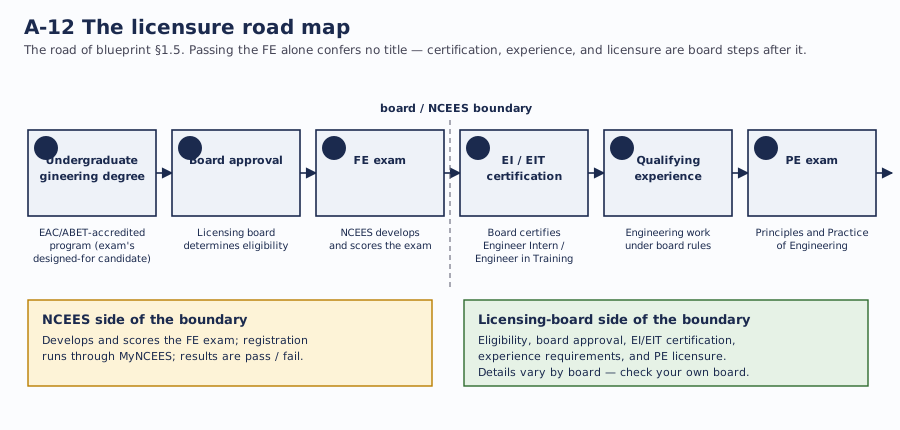
Figure 1.1 — 1.1 Licensure road map from engineering degree through board approval, FE exam, Engineer Intern certification, qualifying experience, to the PE exam, with the board and NCEES boundary marked
The book's architecture follows the exam's own logic. Part I — this chapter, the instrument chapter, and the two mathematics chapters — gives you the road, the reference handbook, and the mathematics spine every later chapter spends. Part II teaches the rest of the shared core and the professional layer: probability and statistics, engineering economics, ethics and societal impacts, and safety, health, and environment. Part III teaches the anchor's sciences in the specification's order: chemistry; instrumentation and controls; statics; dynamics; strength of materials; materials; fluid mechanics; basic electrical engineering; and thermodynamics and heat transfer. Part IV turns outward and forward: Chapter 18's complete maps of the other six disciplines with their transfer accounting, Chapter 19's exam mastery — pacing, handbook search craft, item types, and the two-section room — and Chapter 20's post-exam road.
Every teaching chapter follows one anatomy: an opening scenario from engineering work; exposition taught from foundations; worked examples computed step by step, each closing by naming where the relationship lives in the handbook's organization, so that practice builds your map of the instrument as it builds your knowledge; exam-trap and remember-the-number boxes; a fifteen-item chapter quiz with a full answer key that explains every option; and a one-page summary keyed to the book's cheat sheets. Items are tagged with their knowledge area and subtopic, their chapter, and their register class — CALC for designated calculation items, whose key is the computation, and DEC for decision and concept items — so that a missed item routes you back to the exact section that teaches it.
Your first task is not in this book at all. Before Chapter 2, create or open your MyNCEES account and download your free copy of the current FE Reference Handbook. Chapter 2 teaches that document's organization — never its pages, which are NCEES's and which this book does not reproduce — and the teaching assumes the official document is open beside you, exactly as it will be on exam day.
Exam trap. Candidates routinely spend their preparation learning to solve problems without the handbook, intending to "add it later," and then lose exam minutes to searching an unfamiliar document under time pressure. The handbook is supplied, searchable, and allowed — fluency with it is part of the test. Start with it open from Chapter 2 onward.
If you have not yet registered, one decision precedes all others: which of the seven versions will you sit? Choose by destination, not by rumor. The version that matches the discipline of your degree and the practice you intend is the presumptive choice for candidates in the six named disciplines, because its back half examines the subjects your coursework emphasized. Candidates whose programs or plans do not map cleanly onto a named discipline — the interdisciplinary graduate, the engineer headed for systems, quality, or generalist practice, the candidate still genuinely undecided between fields — are the Other Disciplines paper's natural readership, and this book's primary one. What you should not choose by is perceived easiness. No version is the easy version: each is 110 questions built to the same delivery format and graded against its own minimum ability level, and a version chosen for its reputation rather than its fit trades your strongest coursework for a stranger's anecdote. If your board or your employer cares which version you pass — most care that you pass, but "most" is doing work in that sentence — that, once again, is a board and employer question, answered from their published words, not from preparation folklore. Decide before you register: changing discipline afterward means canceling and re-registering, with the $50 administrative fee retained from the canceled registration.
Whichever version you choose, learn to read its specification the way this book reads the anchor's. A specification is a short document with three working parts. Its face states the delivery facts — computer-based, closed book with an electronic reference, 110 questions, 6 hours, both unit systems — identical across all seven. Its table lists the knowledge areas with a question range for each: Mathematics 8–12 on the anchor paper, for example, means the form you sit will carry somewhere between eight and twelve mathematics questions, and neither NCEES nor anyone else publishes a fixed count inside that range. Ranges are how a specification stays honest across many forms; this book's practice tests use fixed counts chosen inside each published range, summing to exactly 110, and print those counts as this book's construction wherever they appear — never as NCEES's numbers. The third part is the subtopic lists under each area: the grain at which the examiners describe content, and therefore the grain at which this book tags every practice item, so that a weakness found in a quiz is a named subtopic with a named chapter section waiting to repair it. When Chapter 18 maps the other six disciplines, it prints their areas and ranges in exactly this form. Read any specification — your anchor's above all — until you can recite its shape: how many areas, which is largest, where your own history makes you strong. That shape is the terrain. The rest of this book is how to cross it.
The FE is NCEES's fundamentals examination — generally the first step toward licensure as a P.E. — designed for recent graduates and students close to finishing an EAC/ABET-accredited engineering degree. Eligibility is determined by each licensing board, not by NCEES; registration runs through MyNCEES after board approval, at a fee of $225 per attempt payable to NCEES, with 12 months from approval to test, scheduling at Pearson VUE in quarterly windows, and retakes limited to one attempt per window and three per 12 months, with some boards more restrictive. The exam delivers 110 questions in 5 hours 20 minutes inside a 6-hour appointment (2 minutes nondisclosure, 8 minutes tutorial, 25 minutes scheduled break), in two sections with a submit-and-lock boundary, using traditional multiple-choice and alternative item types, all scored correct/incorrect with no partial credit and a limited number of unscored, unidentifiable pretest items; the only reference allowed is the FE Reference Handbook onscreen, and one approved calculator may be brought. Scoring rests on total correct answers — no deductions for wrong answers — converted to a scaled score compared to a minimum ability level set by subject-matter experts; NCEES does not publish the passing score and sets no predetermined pass/fail percentage. Results arrive in 7–10 days as pass/fail, with a per-area diagnostic report on failure. Passing leads, by application to your own board, to Engineer Intern / Engineer in Training certification, then qualifying experience, then the PE exam. This book teaches the shared core of all seven disciplines and the complete FE Other Disciplines exam, with orientation maps — not teaching — for the other six.
1. Eligibility to sit for the FE exam is determined by: A. NCEES, under one national rule B. Each licensing board, for its own candidates C. The candidate's university D. Pearson VUE at the test center
2. The FE exam fee, per attempt, is: A. $50, payable to the licensing board B. $225, payable to the licensing board C. $225, payable directly to NCEES D. Set individually by each test center
3. Within the 6-hour appointment, the time allotted to the exam itself is: A. 6 hours B. 5 hours 45 minutes C. 5 hours 20 minutes D. 5 hours
4. Which statement about the passing standard is correct as NCEES publishes it? A. A candidate must answer a published percentage of the questions correctly, as printed in the Examinee Guide B. The passing score is a published raw count of correct answers C. A fixed percentage of each cohort is passed, and the rest failed D. The scaled score is compared to a minimum ability level set by subject-matter experts, and NCEES does not publish the passing score
5. The retake limits NCEES publishes are: A. One attempt per testing window, and no more than three attempts in any 12-month period B. Unlimited attempts within a single testing window C. One attempt per calendar year D. Two attempts per window, with no annual limit
6. After approval to test, a candidate who does not take the exam within 12 months: A. Receives an automatic extension of 12 more months B. Forfeits the registration fee C. Is barred from registering again D. May transfer the fee to the PE exam
7. A candidate who fails the FE receives a diagnostic report that shows: A. The exact scaled score by which they missed the standard B. The correct answers to the questions they missed C. Their performance for each of the major topics covered on the exam D. A predicted date by which they will pass
8. Which is the only reference material a candidate may use during the FE exam? A. The FE Reference Handbook, supplied onscreen as a searchable PDF B. Any personal notes brought to the center C. This book, in print form D. A textbook of the candidate's choice, if approved at check-in
9. Regarding answers on the FE exam, NCEES's scoring provides that: A. Wrong answers deduct a fraction of a point each B. Blank answers score higher than wrong answers C. Multiple-correct questions earn partial credit for a partly right answer D. There are no deductions for wrong answers, and all questions are scored correct or incorrect
10. Pretest items on the FE exam are: A. Identified on screen so candidates may skip them B. A limited number of unscored items, randomly placed and not identifiable C. Scored at double weight D. Given only to first-time takers
11. After approximately half the questions, the candidate: A. May revisit the first half at any time during the second half B. Reviews and submits the first set, after which those questions cannot be accessed again C. Must take the scheduled break before seeing any questions D. Receives the second half as a paper booklet
12. Which step comes after passing the FE, on the road to licensure? A. Applying to the licensing board for Engineer Intern / Engineer in Training certification B. Retaking the FE at a higher standard C. Receiving a P.E. license automatically from NCEES D. Sitting the FE a second time in another discipline
13. NCEES describes the FE as designed for: A. Licensed engineers renewing a license B. High school students considering engineering C. Technicians with no degree requirement of any kind D. Recent graduates and students close to finishing an undergraduate engineering degree from an EAC/ABET-accredited program
14. This book's stated scope is that it prepares a candidate completely for: A. All seven FE discipline exams B. The FE Other Disciplines exam, and teaches the shared core every discipline examines C. The FE Civil exam only D. The PE exam in all disciplines
15. If a candidate cancels an unscheduled exam registration, the refund is: A. The full $225 in all cases B. Nothing; FE fees are never refunded C. The fee less a $50 administrative fee D. Half the fee, less a $50 administrative fee
All fifteen items are orientation items: they test the licensure frame of §3.1, not a numbered knowledge area, and they are the facts every later chapter's strategy assumes. If you missed the format items (3, 8, 9, 10, 11), re-read §§1.6–1.7 before Chapter 19, where pacing, handbook craft, and the two-section room are built on them. If you missed the administrative items (1, 2, 5, 6, 15), re-read §§1.3 and 1.5 and then read your own board's published requirements — the book's frame plus your board's particulars are the complete picture. If you missed item 4, re-read §1.7 until the published form of the standard is the only form in your head; it is the standard every practice result in this book is reported against. If you missed item 14, re-read §1.4: knowing exactly which exam this book completely prepares you for is the first honest fact of your preparation.
1. Answer: B. The NCEES Examinee Guide (November 2024) states that eligibility to sit for an NCEES exam varies and is determined by each licensing board; the candidate must review their board's requirements before registering. Why the others fail: A — NCEES writes and scores the exam but sets no national eligibility rule; the boards do. C — a university confers the degree; it does not approve exam candidates. D — Pearson VUE administers appointments and verifies identity; it decides nothing about eligibility.
2. Answer: C. Both the NCEES FE exam page and the Examinee Guide's fee table publish the FE fee as $225, payable directly to NCEES, due in full at each registration. Why the others fail: A — $50 is the administrative fee retained when an unscheduled registration is canceled, not the exam fee, and board fees are separate board matters. B — the amount is right and the payee is wrong: the fee is payable directly to NCEES; any board application fee is a separate board matter, and the exam fee is not it. D — test centers collect no exam fee; payment runs through the MyNCEES registration.
3. Answer: C. The 6-hour appointment contains a 2-minute nondisclosure agreement, an 8-minute tutorial, 5 hours 20 minutes of exam, and a 25-minute scheduled break (NCEES FE exam page; every specification's face). Why the others fail: A — 6 hours is the whole appointment, including tutorial and break, not question time. B — no 5-hour-45-minute figure appears in the published appointment anatomy. D — 5 hours understates the exam block by 20 minutes — 110 questions paced at 5 hours would misprice every question in Chapter 19's pacing plan.
4. Answer: D. NCEES's scoring page publishes the standard in exactly this form: correct answers are converted to a scaled score, compared to a minimum ability level determined by subject-matter experts through psychometric statistical methods, and NCEES does not publish the passing score. Why the others fail: A — no percentage is published in any form, in the Guide or anywhere else; percentage figures in circulation are folklore, and repeating one as an estimate does not make it one. B — no raw-count threshold is published; the published comparison is scaled score against ability level. C — NCEES states expressly that it scores with no predetermined percentage of examinees that should pass or fail.
5. Answer: A. NCEES policy, stated identically on the FE page and in the Examinee Guide: one attempt per testing window and no more than three attempts in any 12-month period — with the standing caution that some licensing boards are more restrictive. Why the others fail: B — a window admits exactly one attempt, not several. C — one per year understates the published ceiling of three per 12 months. D — two per window contradicts the one-per-window rule outright.
6. Answer: B. The Examinee Guide provides that once approved to test, the candidate has 12 months to take the exam or forfeit the registration fee. Why the others fail: A — no automatic extension is published; the 12 months is the limit, not a renewable term. C — forfeiture costs the fee, not future eligibility; the candidate may register again (subject to board approval and the attempt limits). D — the FE fee is not transferable to another exam; each registration requires its own full fee.
7. Answer: C. A failing candidate receives a diagnostic report showing performance for each of the major topics covered on the exam, provided to identify the knowledge areas where improvement is needed before retaking (Examinee Guide; FE exam page). Why the others fail: A — results are reported pass/fail only; no scaled score is reported to the candidate in either direction. B — the report shows per-topic performance, never item answers; revealing answers would compromise the item pool. D — the report diagnoses areas, not dates; no readiness prediction is published or computable from it.
8. Answer: A. The FE is closed book with an electronic reference: the current version of the FE Reference Handbook is supplied onscreen as a searchable PDF and is the only reference material usable during the exam (Examinee Guide; Handbook's own About statement). Why the others fail: B — personal notes are prohibited; "closed book" is the exam's stated condition. C — no print material of any kind enters the room; this book says the same of itself. D — there is no check-in approval route for personal textbooks; the supplied handbook is the whole of the permitted reference.
9. Answer: D. NCEES's scoring page: results rest on the total number of correct answers, there are no deductions for wrong answers, and all questions — including alternative item types — are scored correct or incorrect with no partial credit. Why the others fail: A — a deduction scheme is precisely what the published rule excludes; guessing is therefore free. B — a blank and a wrong answer both contribute zero correct answers; the blank is never better, and usually worse in expectation. C — partial credit is expressly not given, even for a multiple-correct item answered partly right.
10. Answer: B. The Examinee Guide: all exams include a limited number of pretest items that will not be scored, randomly placed within the exam and not identifiable as pretest items. Why the others fail: A — unidentifiability is the published design; no on-screen marker exists to exploit. C — pretest items carry no score at all, let alone double weight. D — pretest items are a property of the exam form, not of the candidate's attempt history.
11. Answer: B. The exam is given in two sections with the whole exam time provided at the start; after approximately half the questions the candidate reviews and submits them, and will no longer have access to those questions after submitting them (Examinee Guide). Why the others fail: A — the submit boundary is a lock, not a suggestion; revisit access ends at submission. C — the scheduled break may be taken after the first section is submitted; it is not a precondition to seeing questions. D — the exam is computer-based throughout; no paper booklet exists at any point.
12. Answer: A. Passing and certification are separate acts: after passing, the candidate applies to their licensing board for Engineer Intern / Engineer in Training certification (the board's title and process), then accumulates qualifying experience before the PE exam. Why the others fail: B — the FE is not retaken at a higher standard after a pass; first-time and repeat takers faced the same standard, and a pass ends the matter. C — NCEES licenses no one, and no license follows automatically from passing a fundamentals exam. D — a second FE discipline is not a licensure step; the road runs forward to certification, experience, and the PE.
13. Answer: D. The FE exam page's own framing: the exam is designed for recent graduates and students close to finishing an undergraduate engineering degree from an EAC/ABET-accredited program — printed in this book as NCEES's design framing, not as an eligibility rule (which is each board's). Why the others fail: A — renewal is a post-licensure process with no FE role. B — the exam presumes an engineering degree's coursework; it is not an exploratory test for school students. C — the published framing is degree-based; whatever additional paths a board may allow are that board's rules, not the exam's design.
14. Answer: B. The book's scope ruling (stated at §1.4): complete preparation for FE Other Disciplines — all fourteen of its knowledge areas at full depth — plus the shared core (Mathematics, Probability and Statistics, Ethics and Professional Practice, Engineering Economics) taught in full for every discipline, with orientation maps only for the other six. Why the others fail: A — seven-exam complete coverage is the claim this book's scope rule prohibits; six disciplines carry practice areas this book maps but does not teach. C — Civil is expressly not the anchor; it receives the fullest orientation, not the anchor's depth. D — the PE examines professional practice, a different exam this book does not address beyond naming it as the road's next milestone.
15. Answer: C. The Examinee Guide: cancellation of an unscheduled registration refunds the fee less a $50 administrative fee. Why the others fail: A — the $50 retention applies to every such cancellation; "full refund" is the classic misremembering this item exists to correct. B — refunds exist in exactly the published case (unscheduled registration canceled); "never" overstates it. D — the deduction is a flat $50, not half the fee plus $50; the published mechanism is the fee minus a flat $50.
Google Play Books Exam Prep Series
2026–2027 Edition · Built on NCEES's FE discipline specifications effective July 2020 · Anchor discipline: FE Other Disciplines · The shared core taught in full for every discipline
Feras Alzubi
Engineering Fundamentals Exam (FE) — 2026–2027 Edition.
© 2026 Feras Alzubi
All rights reserved. No part of this book may be reproduced or transmitted in any form or by any means without the publisher's prior written permission, except for brief quotations in reviews and for the reader's own study use of the practice material as directed in How to Use This Book.
This edition is built on:
Checked October 31, 2026.
Every examination figure in this book — the question count, the appointment structure, the fee, the attempt limits, the results path, and each discipline's knowledge areas and published question ranges — comes from those NCEES publications. The engineering science is taught from the standard body of engineering knowledge, in this book's own derivations, notation, and worked examples.
NCEES reviews its exam specifications on a cycle, and a successor revision of the FE specifications is in preparation. Reporting available when this edition was checked projected updated specifications taking effect in July 2027. That projection is not a specification this book teaches from, and this edition makes no claim about the content, ranges, or format of any examination offered under a future specification.
What this means for you, plainly:
Production re-verifies specification currency before upload. The errata note in the back matter carries the standing re-verification duty for this edition.
This book is not published by, affiliated with, endorsed by, or approved by NCEES. NCEES did not participate in its creation.
"Fundamentals of Engineering," "FE," and the FE discipline names are used in this book as factual identifiers of the examination this book prepares for. No NCEES seal, logo, or branding appears anywhere in this book, including its cover.
This book prepares a candidate completely for the FE Other Disciplines exam and teaches the shared core every FE discipline examines — Mathematics, Probability and Statistics, Ethics and Professional Practice, and Engineering Economics — in full.
It does not prepare a candidate completely for the Civil, Mechanical, Electrical and Computer, Chemical, Industrial and Systems, or Environmental exam. Each of those examinations carries discipline-specific knowledge areas that this book maps and accounts for in Chapter 18 but does not teach. Chapter 18 gives each of those six disciplines its complete published specification map, an accounting of which of its areas this book's teaching covers and to what depth, and a naming of the discipline-specific study that remains.
That is the whole promise, and it is the same promise on the title page, in Chapter 1, at the head of Chapter 18, and in the store description. No part of this book implies preparation for seven examinations.
The FE Reference Handbook is NCEES's document. This book reproduces no handbook page, table, chart, or figure, and presents no formula as copied from it.
What this book teaches is the engineering science itself — standard knowledge, derived in the book's own notation with its own worked examples — and the handbook's organization: its section names, their order, and what kind of material each section holds, so that on exam day you can find the official statement of a relationship quickly. The handbook itself is supplied by NCEES: free to candidates through a MyNCEES account before the exam, and onscreen, as a searchable PDF, during the exam. Your first study task, stated in How to Use This Book below, is to download your own official copy.
Eligibility to sit for an NCEES exam varies and is determined by each licensing board. Board approval, registration particulars, any board application step or fee, certification as an Engineer Intern (EI) or Engineer in Training (EIT) after passing, experience requirements, and the road to the Principles and Practice of Engineering (PE) exam are board matters.
This book teaches the national frame — who the exam is designed for, the NCEES registration path, the fee, the attempt limits, and the results path — and directs you to your own licensing board for everything state-specific. It teaches no state's rule and names no state's figures. Do not assume the national frame is your board's rule.
Every examination figure in this book comes from NCEES's published FE discipline specifications (July 2020), the NCEES Examinee Guide, or NCEES's FE exam and scoring pages, checked on October 31, 2026. The engineering science is taught from the standard body of engineering knowledge, in this book's own derivations and worked examples. NCEES publishes its specifications openly; this book is an independent preparation built on them, not an NCEES product.
All practice questions in this book are original. No NCEES examination, practice-examination, or handbook item is reproduced or paraphrased.
Every figure on this page is footnoted to its NCEES source. Figures this book itself constructed are labeled as this book's.
| Exam | Fundamentals of Engineering (FE), developed and scored by the National Council of Examiners for Engineering and Surveying (NCEES) for the state licensing boards — generally the first step in the process of becoming a licensed professional engineer (P.E.) |
| Discipline versions | Seven: Civil; Mechanical; Electrical and Computer; Chemical; Industrial and Systems; Environmental; Other Disciplines. This book's anchor — the discipline it prepares you for completely — is Other Disciplines, marked here and throughout. |
| Questions | 110 questions in the discipline version you choose |
| Appointment | 6 hours in total: nondisclosure agreement (2 minutes) · tutorial (8 minutes) · exam (5 hours 20 minutes) · scheduled break (25 minutes) |
| Structure in the room | Two sections. The whole exam time is given at the start, with no individually timed sections. After about half the questions, you review and submit them; submitted questions cannot be revisited. You may then take the scheduled break. Unscheduled breaks deduct from testing time. |
| Item types | Mostly traditional multiple-choice with a single correct answer, plus alternative item types: multiple correct options, point and click, drag and drop, and fill in the blank. All items are scored correct or incorrect; there is no partial credit. A limited number of pretest items are included, unscored, randomly placed, and not identifiable. |
| Passing | Results are based on the total number of correct answers. There are no deductions for wrong answers. The score is converted to a scaled score, which adjusts for minor differences in difficulty across exam forms, and that scaled score is compared to the minimum ability level for the exam, determined by subject-matter experts through psychometric statistical methods. NCEES does not publish the passing score. NCEES scores each exam with no predetermined percentage of examinees that should pass or fail, and first-time and repeat takers are graded to the same standard. That is the complete published form of the standard; this book prints it in no other form, and no practice result in this book converts to a scaled score. |
| Reference material | The FE Reference Handbook only — the current version, supplied onscreen as a searchable PDF during the exam, and available free through your MyNCEES account before it. The exam is otherwise closed book. |
| Calculator | One NCEES-approved calculator may be brought, from the current NCEES Calculator Policy. A TI-30XS calculator is available on screen during the exam. |
| Units | The exam uses both the International System of Units (SI) and the U.S. Customary System (USCS). This book computes in both, throughout. |
| Fee | $225 per attempt, payable directly to NCEES. The full fee is due at each registration. Cancellation of an unscheduled registration refunds the fee less a $50 administrative fee. |
| Retakes | One attempt per testing window, and no more than three attempts in any 12-month period. Testing windows run quarterly: January–March, April–June, July–September, and October–December. Some licensing boards have a more restrictive policy. |
| Scheduling | Once approved to test, you have 12 months to take the exam or forfeit the fee. Schedule at a Pearson VUE test center, first-come, first-served, at least one business day ahead. Bring government-issued photo ID. |
| Results | Typically 7–10 days after the exam, by email notification to your MyNCEES account, with board-specific next steps. Results are reported as pass or fail only. A candidate who does not pass receives a diagnostic report showing performance by knowledge area, to guide further preparation; a candidate who passes receives no diagnostic report. |
| Who the exam is designed for | In NCEES's framing: recent graduates and students who are close to finishing an undergraduate engineering degree from an EAC/ABET-accredited program. Eligibility itself is each licensing board's determination — see the board notice on the Disclosure and Provenance page. |
| After passing | Passing the exam does not itself confer a title. The general frame is: apply to your licensing board for certification as an Engineer Intern (EI) or Engineer in Training (EIT) — the title, application, and any fee are your board's — then accumulate the qualifying engineering experience your board requires before sitting the PE exam. Chapters 1 and 20 teach this frame; no state's particulars are stated, because boards differ. |
Sources for this page: NCEES, FE exam page; NCEES, Examinee Guide (November 2024); NCEES, Exam Scoring; NCEES, FE Other Disciplines CBT Exam Specifications (effective beginning with the July 2020 examinations) and the companion discipline specifications, each carrying the same exam frame. Checked October 31, 2026.
Download your free official copy of the FE Reference Handbook from your MyNCEES account, and keep it beside this book for every study session from Chapter 2 onward.
The exam is closed book with an electronic reference: the handbook is the only reference material you may use during it, supplied onscreen as a searchable PDF. Every worked example in this book closes by naming where the relationship it used lives in the handbook's organization. If you practice without the handbook open, you are practicing only half the exam. Chapter 2's first task is the download; do not skip it.
You will also need, before exam day: a MyNCEES account, your licensing board's approval and registration requirements (check them in week 1 of either study plan below — boards differ, and some require a separate application), and one calculator approved under the current NCEES Calculator Policy, the same one you intend to bring.
On exam day the handbook is a searchable PDF on a screen beside your question. Knowing the science is necessary; finding the official statement of a relationship, under time pressure, is a separate and trainable skill. This book teaches it as a method, in Chapter 2, and drills it in Chapter 19:
This book is written for one primary reader and two honored guests. Find your path; the chapters themselves do not fork.
Path 1 — The Other Disciplines candidate, building from foundations. You are sitting the FE Other Disciplines exam, and you want the science rebuilt properly — because you are still in your degree, because your coursework is behind you, or because you want no gaps. Read Chapters 1–20 in order. The mathematics spine (Chapters 3–4) comes before every science chapter on purpose. Take each chapter quiz untimed, repair with the chapter before moving on, and reserve the two full timed tests for the end of your study plan.
Path 2 — The Other Disciplines candidate, reviewing after time away. Your degree is years behind you and the knowledge has gone quiet rather than missing. Start with the diagnostic test (see below), let its per-area results choose your order, and read in full any chapter whose area the diagnostic flags — the text assumes your vocabulary exposure, never your retention, so a flagged chapter read whole is faster than a skim that leaves the gap in place. Finish with both full timed tests, under timed, closed-book-with-handbook conditions.
Path 3 — The candidate for one of the other six disciplines. You are sitting the Civil, Mechanical, Electrical and Computer, Chemical, Industrial and Systems, or Environmental exam. Read the shared core in full — Chapters 1, 2, the mathematics spine (Chapters 3–4), Probability and Statistics (Chapter 5), Engineering Economics (Chapter 6), and Ethics (Chapter 7) — together with whichever science chapters Chapter 18's accounting marks as taught here for your discipline. Then read Chapter 18's map for your discipline carefully: it states, area by area, what this book has covered for you and what discipline-specific study remains, which you must get elsewhere. This book does not complete your preparation, and Chapter 18 is written so you can verify that statement line by line rather than take it on trust.
Engineers fresh from coursework may move faster on any path: the fast route is the same chapters, with the worked examples read as checks rather than lessons, and the quizzes taken first in any chapter you believe you already own — a missed quiz item sends you back into that chapter, which is the point of it.
Tags. Every practice question carries a triple address: its knowledge area and specification subtopic, its chapter, and its register class. You will see the area and subtopic on items throughout — they are how you learn to think about your preparation in the specification's own terms, the same terms in which NCEES reports performance by knowledge area on the diagnostic report issued after an unsuccessful attempt.
CALC and DEC. Items tagged CALC are designated-calculation items: their explanations are the computation, step by step, with each wrong option traced to the specific error that produces it — a dropped conversion, a wrong model, a misread diagram, a sign error. Items tagged DEC are decision and concept items: their explanations state the governing principle and name the misconception behind each wrong option. Calculation is this field's native act, and judgment is its second; the register trains both.
Chapter quizzes are untimed repair instruments, one per chapter (Chapters 1–20), each closing with an area map that tells you what to re-read for each kind of miss. Area repair sets (R-01 through R-14, one per knowledge area of the Other Disciplines specification) give you focused volume in a single weak area. The diagnostic test comes first in the apparatus and routes you: taken before you study, its per-area scoring grid points each weakness at its chapter and its repair set.
The two full timed tests are built to the Other Disciplines specification's shape by a disclosed construction explained on each test's face: NCEES publishes a question range for each knowledge area, not a fixed count, so each test uses one fixed count chosen inside each published range, the counts summing to the exam's total, and prints that construction openly. Work each test in two locked halves — submit the first half before opening the second — as this book's rehearsal of the real exam's two-section submit-and-lock structure.
What a practice result means — and does not. Your result on any set in this book is a raw count, by knowledge area, for your own readiness judgment. NCEES converts the real exam's correct answers to a scaled score and compares it to a minimum ability level set by subject-matter experts; NCEES does not publish the passing score, and no raw count — here or anywhere — converts to that scaled score or predicts your result. Use your counts the way they are honest: to find the area that needs another week, not to forecast an outcome no book can forecast.
The room this book cannot build. Print can reproduce the exam's counts, proportions, pacing, and closed-book-with-handbook condition. It cannot reproduce the computer-based testing room: the two-section submit-and-lock interface, the alternative item types' on-screen forms, the searchable handbook on a split display, or the approved calculator in your hand. Chapter 19 teaches each of those as a named difference with a rehearsal strategy, and each full test's face carries the same notice. Only NCEES's own practice materials reproduce the room itself.
The cheat sheets gathered with the front apparatus are study tools for before the exam: a numbers sheet (examination figures only, each with its source), a formulas-of-the-science sheet (the relationships this book teaches, by area, in this book's notation), a handbook-map sheet, and a units sheet for SI/USCS conversion discipline. Nothing on any cheat sheet can be carried into the exam — the exam supplies the official handbook and nothing else — and each sheet says so on its face. No cheat sheet contains a passing percentage, because none is published; none contains a handbook page number, because this book never uses them.
Both plans are this book's apparatus — a study design, not an NCEES requirement. Each ends at a full timed test. Each schedules the administrative tasks in week 1, because a board requirement discovered in the final week is a preventable emergency. Adjust the daily load to your life; do not adjust the order, which follows the book's foundations-first design, and do not move the administrative tasks out of week 1.
Week 1 — The road, the instrument, and the spine. Administrative tasks (above). Chapter 1 (the road) and Chapter 2 (units, conversions, and the handbook — including the first handbook drills). Chapters 3–4 (the mathematics spine). Chapter 3 and Chapter 4 quizzes.
Week 2 — Uncertainty, money, and the professional layer. Chapter 5 (Probability and Statistics), Chapter 6 (Engineering Economics), Chapter 7 (Ethics and Societal Impacts), Chapter 8 (Safety, Health, and Environment), each with its quiz. Handbook drills continue — a short timed set on the days you finish a chapter.
Week 3 — The sciences. Chapter 9 (Chemistry), Chapter 10 (Instrumentation and Controls), Chapter 11 (Statics), Chapter 12 (Dynamics), Chapter 13 (Strength of Materials), Chapter 14 (Materials), each with its quiz. Begin area repair sets for any area whose quiz exposed a weakness, in the evening rather than by displacing the next chapter.
Week 4 — The largest sciences, the room, and the tests. Chapter 15 (Fluid Mechanics — the anchor specification's largest area, given the book's deepest treatment), Chapter 16 (Basic Electrical Engineering), Chapter 17 (Thermodynamics and Heat Transfer), each with its quiz. Chapter 18 if your path calls for it; Chapter 19 (exam mastery — pacing, handbook search craft, item types, the two-section room) in full. Full Practice Test 1, timed, in two locked halves, handbook open, book closed. Score it by area; spend the following day on the repair sets for its two weakest areas. Full Practice Test 2 under the same conditions, at least two days after Test 1. Chapter 20 (results, the diagnostic report, repair, and retakes) in the final days, so the road after the exam is familiar before you walk it.
For the candidate whose coursework is recent or whose diagnostic results are strong across most areas. If the diagnostic flags more than a few areas as weak, use the 4-week plan instead — intensity cannot substitute for a foundation that is not there.
Days 1–2. Administrative tasks (above) on day 1, without exception. Diagnostic test and scoring grid. Chapters 1–2, with the handbook drills begun.
Days 3–5. Chapters 3–4 (mathematics spine) at review pace — worked examples as checks, quizzes taken first, full reading wherever a quiz item is missed. Chapter 5 (Probability and Statistics) and Chapter 6 (Engineering Economics), with quizzes.
Days 6–8. Chapter 7 (Ethics and Societal Impacts) and Chapter 8 (Safety, Health, and Environment), with quizzes. Chapters 9–10 (Chemistry; Instrumentation and Controls), with quizzes. Repair sets for flagged areas in the evenings.
Days 9–11. Chapters 11–14 (Statics; Dynamics; Strength of Materials; Materials), with quizzes. Full Practice Test 1 at the end of day 11, timed, in two locked halves.
Days 12–14. Score Test 1 by area; repair sets for its weakest areas. Chapters 15–17 (Fluid Mechanics; Basic Electrical Engineering; Thermodynamics and Heat Transfer), with quizzes — if time forces a choice, these chapters are read and the repair volume is what yields, never the reverse. Chapter 19 in full. Full Practice Test 2 on day 13 or 14 under full exam conditions. Chapter 20 skimmed before exam day and read properly after it.
| # | Component | Date | Result (per-area notes) |
|---|---|---|---|
| 1 | Chapter 1 | ||
| 2 | Chapter 2 | ||
| 3 | Chapter 3 | ||
| 4 | Chapter 4 | ||
| 5 | Chapter 5 | ||
| 6 | Chapter 6 | ||
| 7 | Chapter 7 | ||
| 8 | Chapter 8 | ||
| 9 | Chapter 9 | ||
| 10 | Chapter 10 | ||
| 11 | Chapter 11 | ||
| 12 | Chapter 12 | ||
| 13 | Chapter 13 | ||
| 14 | Chapter 14 | ||
| 15 | Chapter 15 | ||
| 16 | Chapter 16 | ||
| 17 | Chapter 17 | ||
| 18 | Chapter 18 | ||
| 19 | Chapter 19 | ||
| 20 | Chapter 20 | ||
| 21 | Chapter 1 quiz | ||
| 22 | Chapter 2 quiz | ||
| 23 | Chapter 3 quiz | ||
| 24 | Chapter 4 quiz | ||
| 25 | Chapter 5 quiz | ||
| 26 | Chapter 6 quiz | ||
| 27 | Chapter 7 quiz | ||
| 28 | Chapter 8 quiz | ||
| 29 | Chapter 9 quiz | ||
| 30 | Chapter 10 quiz | ||
| 31 | Chapter 11 quiz | ||
| 32 | Chapter 12 quiz | ||
| 33 | Chapter 13 quiz | ||
| 34 | Chapter 14 quiz | ||
| 35 | Chapter 15 quiz | ||
| 36 | Chapter 16 quiz | ||
| 37 | Chapter 17 quiz | ||
| 38 | Chapter 18 quiz | ||
| 39 | Chapter 19 quiz | ||
| 40 | Chapter 20 quiz | ||
| 41 | Diagnostic test | ||
| 42 | Full Practice Test 1 | ||
| 43 | Full Practice Test 2 | ||
| 44 | Repair set R-01 | ||
| 45 | Repair set R-02 | ||
| 46 | Repair set R-03 | ||
| 47 | Repair set R-04 | ||
| 48 | Repair set R-05 | ||
| 49 | Repair set R-06 | ||
| 50 | Repair set R-07 | ||
| 51 | Repair set R-08 | ||
| 52 | Repair set R-09 | ||
| 53 | Repair set R-10 | ||
| 54 | Repair set R-11 | ||
| 55 | Repair set R-12 | ||
| 56 | Repair set R-13 | ||
| 57 | Repair set R-14 | ||
| 58 | Handbook drills (Chapter 2 set) | ||
| 59 | Handbook drills (Chapter 19 set) |
A tracker is a record, not a verdict. Fill it in as you go; let the per-area pattern — not any single total — decide where the next hour of study goes.
End of front matter. Chapter 1 begins the book proper.
End of the free sample. The complete book continues from here — the full A-to-Z course in book form, delivered as an EPUB you can read in Apple Books, Google Play Books, ReadEra, Thorium Reader, Adobe Digital Editions, or Send to Kindle.
Buy this ebook — $11.99 Back to the book page
Payments are securely processed by Payhip.