
Mastering Careers & Skills
Enrolled Agent Exam (IRS SEE) · free sample from the book itself
Part I — Foundations From Zero · Orientation · Anchors: PSI's Candidate Information Bulletin (rev. October 9, 2026) and the IRS's enrolled agent pages (S-01, S-02, S-03, S-05) · Version lesson: fences X-03, X-07 · Practice-rights frame: §1.5 of the blueprint (S-10)
On a Monday morning in February, a self-employed electrician named Daniel Reyes — an invented taxpayer, like every taxpayer in this book — walks into a small tax office carrying a notice from the Internal Revenue Service. The notice says the return he filed last spring does not match the income records the IRS received, and it proposes additional tax. Daniel prepared that return himself at his kitchen table. He is not in trouble in any dramatic sense; nobody is accusing him of fraud. He is simply out of his depth, and he knows it. What he needs is someone who is allowed to stand between him and the IRS: someone who can read the notice, pull his account transcripts, call the IRS with authority to discuss his case, check the Service's arithmetic against his records, and either agree, correct, or contest — in his name, with his permission, under rules that govern the helper as much as the helped.
The professional Daniel needs is the subject of this book. If you have never prepared a tax return for anyone but yourself, never seen a power of attorney form, and never heard the initials EA spoken aloud, this chapter assumes exactly that starting point and builds from it. By the end of the chapter you will know what an enrolled agent is and does, where the EA sits among the other people who work with taxes, what unlimited and limited representation rights mean, the five published steps from first registration to enrollment, and what the Special Enrollment Examination is as it is actually delivered today — how many questions, how long, how it is scored, what it costs as of the date this book was checked, when it is offered, and what happens after you pass. You will also learn the three separations this field insists on and that careless preparation material collapses: passing the examination is not the same thing as being enrolled, being enrolled is not the same thing as staying enrolled, and holding a preparer number is not the same thing as holding a credential.
One discipline starts here and runs through every page of this book, so learn to recognize its voice early. Where a fact belongs to a published authority — PSI's Candidate Information Bulletin, the IRS's enrolled agent pages, Treasury Department Circular 230, an IRS publication for tax year 2025 — the text names that authority at the point of statement. Where guidance is this book's own — a study method, a practice design, a readiness line — the text labels it as this book's guidance. Exams change vendors, fees are repriced, and tax figures roll every year. A reader who can always tell whose voice is speaking cannot be misled by an old video, a forum thread, a classmate's memory of a different testing regime, or a preparation book — including this one — dressing its own advice up as official doctrine.
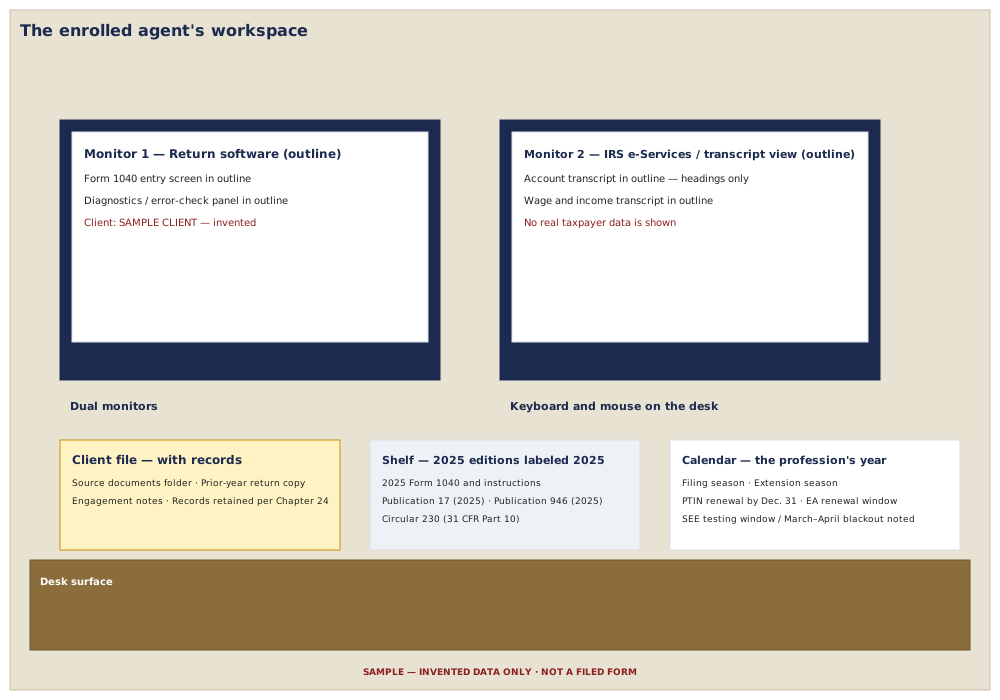
Figure 1.1 — A desk with dual monitors — return software on one screen, an IRS e-Services transcript view in outline on the other — a client file with records, a shelf of the current-year forms and publications (the 2025 editions, labeled as 2025), and a calendar marking the profession's year: filing season, extension season, and the renewal window. This is the physical setup of the job this chapter describes.
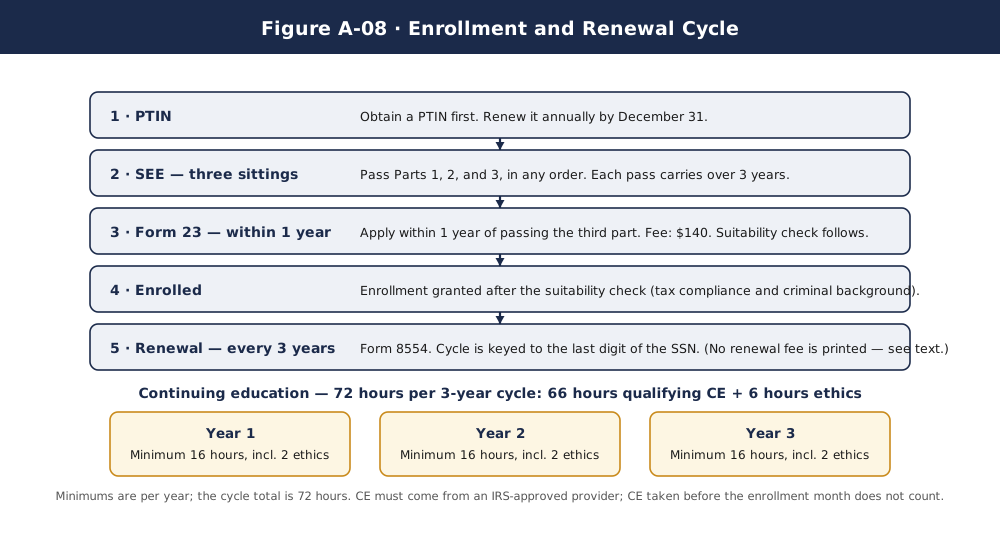
Figure 1.2 — PTIN → three examination sittings (with the three-year carryover clock drawn) → Form 23 within one year → the three-year renewal cycle keyed to the last digit of the Social Security number, with the 72 / 16 / 2 continuing-education stacking drawn year by year. Sections 1.4 and 1.11 walk this cycle in full.
An enrolled agent (EA) is, in the IRS's own words, a person who has "earned the privilege of representing taxpayers before the Internal Revenue Service" (PSI, Candidate Information Bulletin, rev. October 9, 2026; IRS, Enrolled agents: Frequently asked questions). Read that definition slowly, because every word in it does work. Earned: the privilege is not bought, inherited, or conferred by employment — it is won, principally by passing a three-part examination the IRS specifies and by passing a suitability check into the applicant's own tax compliance and background. Privilege: representation before a federal agency is a licensed activity, not a general right of citizenship; anyone may prepare their own return and speak for themselves, but speaking for someone else before the IRS is practice, and practice is regulated. Representing taxpayers: the EA's defining act is standing in the taxpayer's place — receiving notices, explaining records, negotiating payment, contesting proposed changes — with the taxpayer's written authorization. Before the Internal Revenue Service: the jurisdiction is the IRS itself, in all of its offices and functions, which is what makes the credential federal and national rather than a patchwork of state licenses.
The IRS calls the enrolled agent credential "the highest credential the IRS awards" (IRS, Enrolled agents program page). This book quotes that phrase exactly as what it is — the IRS's own statement about its own credential — and builds nothing further on it: no comparison to other professions, no promise about what the credential will earn its holder, and no guarantee about any reader's examination result. What can be said factually is structural. Enrolled agents, like attorneys and certified public accountants, are generally unrestricted as to which taxpayers they can represent, what types of tax matters they can handle, and which IRS offices they can represent clients before (IRS, Enrolled agents: Frequently asked questions). Section 1.3 unpacks that sentence, because the contrast with everyone else who touches tax returns is the single most career-relevant fact in this chapter.
Notice what the definition does not say. It does not say an enrolled agent is an employee of the IRS — EAs are independent practitioners, and the word "agent" in the title has misled many a client into thinking the EA works for the government. It does not say an EA is a tax preparer, full stop: preparation is part of the work, and most EAs prepare returns, but preparation alone does not require enrollment, and enrollment confers something preparation never does — the representation privilege. And it does not say the credential is permanent once earned: enrollment is a status that must be renewed on a three-year cycle with continuing education, as Section 1.11 explains. Hold those three negatives and the positive definition together and you have the shape of the profession: a federally licensed representative, independent of the agency before which they practice, whose license must be maintained to survive.
Ask what an enrolled agent does all day and the honest answer is three kinds of work, in proportions that shift with the calendar. The first is preparation: interviewing clients, gathering documents, and preparing federal tax returns — individual returns, business returns, fiduciary returns — accurately and completely. Preparation is the most visible part of the job and the part a beginner can picture most easily, and Chapters 3 and 4 of this book teach its foundations directly. But preparation is also the part of the work that requires the least of the credential: as Section 1.3 shows, a person with no credential at all may prepare returns for pay, provided they hold a preparer number. What enrollment adds is depth of knowledge, tested and certified — and the second and third kinds of work.
The second kind is planning and advising: helping a taxpayer arrange their affairs, within the law, so that the return that eventually gets filed is the right one. Should a growing side business operate as a sole proprietorship or elect corporate treatment? When should equipment be bought? How does a marriage, a divorce, a retirement, a home sale, or an inheritance change the tax picture, and what should be done before the event rather than discovered after it? Planning is preparation run backwards in time — the same rules, applied while there is still time to act on them — and the examination tests it directly: an entire domain of Part 1 is called Advising the Individual Taxpayer, and advising threads run through Part 2 as well.
The third kind is representation, the work Daniel Reyes needed: standing for the taxpayer before the IRS after the return is filed. A return is selected for examination and the EA gathers substantiation, meets or corresponds with the examiner, and argues the facts and the law. A balance goes unpaid and the EA negotiates an installment agreement, presents an offer in compromise, or shows that the account should be placed in currently-not-collectible status. A proposed change is disputed and the EA takes the case to the IRS's Independent Office of Appeals. Representation is deadline-driven, document-driven work conducted under formal authorization — the power of attorney — and it is governed, down to the level of what fees may be charged and what conflicts must be refused, by Circular 230, the Treasury regulation that is Part 3's spine and this book's Chapters 20 and 21. A useful way to hold the three kinds of work together: preparation looks backward at a finished year, planning looks forward at an unfinished one, and representation defends the past when the government questions it. The enrolled agent is licensed for all three; the examination, in its three parts, is built to test all three.
The IRS publishes the frame of who may do what in two tiers — unlimited and limited representation rights (IRS Fact Sheet FS-2018-5, Choosing a Paid Tax Return Preparer) — and a beginning reader should learn the whole frame at once, because the EA's value is only visible against it.
Unlimited representation rights belong to three credentialed groups: attorneys, certified public accountants (CPAs), and enrolled agents. A practitioner with unlimited rights can represent any taxpayer, on any matter — examinations (audits), payment and collection issues, and appeals — before any IRS office, regardless of who prepared the return in question. Daniel's EA does not need to have prepared Daniel's return to represent him about it; the credential itself carries the authority. Attorneys earn their standing through state bars and law licenses, CPAs through state accountancy boards and the CPA examination; both are state-licensed professions whose federal representation rights ride on the state credential. The enrolled agent is the member of this tier whose license comes from the IRS itself — which is why a single national book can teach the whole credential, and why this book exists in exactly this shape.
Limited representation rights are narrower in both dimensions. A preparer with limited rights may represent only clients whose returns that preparer prepared and signed, and only before revenue agents, customer service representatives, and similar IRS employees, including the Taxpayer Advocate Service — never before Appeals officers or collection functions. The holders of limited rights are participants in the IRS's Annual Filing Season Program (AFSP): preparers who complete 18 hours of continuing education for a tax year, including a six-hour federal tax law refresher course with a test, and receive a Record of Completion for that year. There is a two-year catch the examination loves: an AFSP participant must hold the Record of Completion in both the year the return was prepared and the year of the representation — lapse in either year and the limited right fails for that client.
Below the AFSP sits the non-credentialed preparer: a person who, in the IRS's words, "may prepare and file federal tax returns, but they can't represent clients before the IRS" (FS-2018-5). And beneath every paid preparer, credentialed or not, sits the one universal requirement: a Preparer Tax Identification Number (PTIN). Anyone who prepares or assists in preparing a federal return for compensation must hold a PTIN, sign in the paid-preparer area of the returns they prepare, and give the taxpayer a copy. Learn the PTIN's exact weight now, because confusing it with a credential is the beginner's most common error: a PTIN is a registration and identification number. It confers no representation rights at all, certifies no knowledge, and requires no examination. It is the door key to paid preparation work — and, as the next section shows, the first step on the road to the credential that does certify knowledge.
Two adjacent doors are named here once and not taught, so the map is complete (fence X-04). State preparer licensing, where a state imposes it, is a separate state matter with its own authority; this federal book names it and moves on. And judicial practice — arguing a tax case in court — is a different door from IRS practice altogether: Part 3's own outline assigns "judicial levels of representation beyond the scope of EA representation" as a boundary topic, and Chapter 23 teaches that boundary at outline depth. The EA's unlimited rights are unlimited before the IRS; they are not a law license, and this book will never blur that line.
Exam trap — "unlimited" has an address. Unlimited representation means any taxpayer, any matter, any IRS office. It does not mean any courtroom. An item that moves an enrolled agent into a judicial proceeding as a consequence of enrollment alone has left the published frame (S-10) and is wrong on that ground alone.
The IRS publishes the road to enrollment as a five-step checklist (IRS, Enrolled agents: Frequently asked questions), and this book follows it in the published order, because the order itself is tested knowledge:
Notice what the checklist does not contain. The bulletin publishes no education prerequisite and no experience prerequisite for sitting the examination: no degree, no coursework, no years of preparation work stand between a PTIN holder and a scheduled sitting. Preparation material that invents such a requirement — a degree the IRS never asked for, an experience floor the bulletin never states — is printing false content, and a candidate who believes it may never start. The honest counterpart, which this book prints on its own disclosure page and repeats in Chapter 26, is fence X-05: this book satisfies no IRS requirement. It is not a PTIN, not an exam appointment, not Form 23, and not continuing-education credit; it makes no CE-hour claim of any kind. It prepares you for step 3. Steps 1, 2, 4, and 5 are transactions between you and the IRS, and Chapter 26 walks them in full so you can perform each one correctly and on time.
One boundary route deserves its single naming here. Certain former IRS employees may be exempt from the examination requirement by virtue of past technical experience (IRS, Enrolled agents: Frequently asked questions; Become an enrolled agent). That is an exemption route administered by the IRS on its own criteria — named here so the map is honest, and not taught, because this book prepares readers for the examination route. If you are a former employee, the IRS's pages, not a prep book, are your authority for whether the exemption reaches you.
The Special Enrollment Examination (SEE) — also styled the EA-SEE — is a three-part, comprehensive IRS test (PSI, Candidate Information Bulletin, rev. October 9, 2026). Everything in this section is the examination as PSI and the IRS currently publish it, and the version fence matters: Section 1.9 explains what changed and when, and why older material on your shelf may describe a different exam.
The vendor is PSI Services LLC. In the IRS's own words: "Effective March 1, 2026, the IRS Enrolled Agent Special Enrollment Exam (EA-SEE) is no longer developed and administered by Prometric, LLC. A new vendor, PSI Services, has been selected to develop and administer the exam" (IRS, Become an enrolled agent). This book is built entirely on the PSI bulletin as corroborated by the IRS's own enrolled agent pages (fence X-03). The prior regime is named once, in Section 1.9, as superseded; nothing else in the book follows it (fence X-07).
The three parts are Part 1 — Individuals, Part 2 — Businesses, and Part 3 — Representation, Practices and Procedures. They are three separate sittings, taken in any order — a candidate strong in representation may sit Part 3 first, and many working preparers sit Part 1 first because it matches their daily work; the choice is strategy, not rule, and Chapter 25 treats it as such. Each part is 100 multiple-choice questions, of which 85 are scored and 15 are experimental — unscored questions, distributed throughout the sitting and not identified to the candidate (PSI bulletin; IRS FAQ). Treat every question as scored, because you cannot tell which fifteen are not; Chapter 25 builds pacing on exactly that discipline. Each question offers four options with a single best answer, in three published formats: the direct question, the incomplete sentence, and the all-of-the-following-except form. Every practice item in this book is written in that same form — four options, one key, the three formats all in use (rule D-r2) — because practicing in a different shape than the examination's shape is practicing a different skill.
Time and delivery. Each part allows 3.5 hours of examination time, inside a four-hour appointment that also covers the tutorial and the closing survey (PSI bulletin; IRS FAQ). The examination is computer-delivered, either remotely (within the United States only, at present) or in person at PSI test centers in the United States; international testing is temporarily delayed, and when it resumes it will be remote only (PSI bulletin; IRS FAQ). Appointments are scheduled at least 24 hours in advance. The examination is closed book: no notes, books, reference materials, computers, phones, or other electronic devices are permitted at any time during the test or during the breaks. An on-screen calculator is provided and personal calculators are not permitted; in person, scratch paper and a pencil are provided and collected; remote candidates use an electronic whiteboard. Section 1.7 covers the break structure that divides each sitting — read it as examination architecture, not fine print, because it changes how a sitting must be paced.
The published domain breakdown is this book's practice spine, and it is worth meeting now, in your first chapter, because every quiz, diagnostic, and full practice test in this book is proportioned from it. PSI's bulletin publishes scored-question counts per domain, and they sum to exactly 85 in each part. Part 1: Preliminary Work and Taxpayer Data, 14; Income and Assets, 17; Deductions and Credits, 17; Taxation, 15; Advising the Individual Taxpayer, 11; Specialized Returns for Individuals, 11. Part 2: Business Entities and Considerations, 30; Business Tax Preparation, 37; Specialized Returns and Taxpayers, 18. Part 3: Practices and Procedures, 26; Representation before the IRS, 25; Specific Areas of Representation, 20; Filing Process, 14. Two shapes in those numbers should already inform your respect for the parts: Part 2 is the heaviest content part — Business Tax Preparation alone, at 37 of 85 scored questions, is the largest single domain on the entire examination — and Part 3 is roughly one-third Circular 230 by weight before representation technique is even counted. Chapter space in this book follows both facts (rule D-r8), and Chapter 25 turns the counts into a repair strategy.
Under the PSI regime, SEE results are reported on a scaled score range of 200 to 800, and the IRS has set the scaled passing score at 500 (PSI bulletin; IRS FAQ). The IRS explains the scale's provenance plainly: the scoring methodology was determined following an IRS scoring study, in which a panel of subject-matter experts — enrolled agents and IRS representatives — established the passing score for a candidate who meets the minimum qualifications to be an enrolled agent. The scale converts the count of correctly answered scored questions; the bulletin describes the mechanics as "calculating the number of questions answered correctly from the total number of questions in the examination and converting them to a scale that ranges from 200 to 800" — and publishes nothing further. No raw-to-scaled conversion is published anywhere, by either the vendor or the IRS, and this book invents none: Section 5.3 of the blueprint is the book's standing discipline, stated to you here so you can hold the book to it — practice sets in this book are scored as a raw count on scored items, by domain, and no practice percentage in these pages is ever translated into a predicted scaled score. Anyone — book, course, or forum — who tells you that a given practice percentage "equals about a 500" is publishing a conversion that does not exist.
What you receive after a sitting follows from the scale's purpose. A passing candidate's report shows the passing designation and no score — you passed; the number is neither needed nor given. A failing candidate's report shows a scaled score between 200 and 499 plus diagnostic information by area, so the failure arrives with a map of where it happened. The IRS's own illustration of the scale's feel: a candidate at 495 is very close to passing; a candidate at 245 is far from it. Results arrive as a pass/fail message on screen at the completion of the sitting, with the score report delivered by email and through the PSI portal; scores are confidential, shared only with the candidate and the IRS. That diagnostic report is a professional instrument, and this book is built to receive it: every chapter quiz closes with a domain map in the same logic, and Chapter 26 turns a real failing profile into a repair plan using the domain repair sets. Learn to think in domains from this chapter onward, and a bad result — if one comes — becomes instructions rather than verdict.
Remember the number — 500 on 200–800. Scaled scores run 200 to 800; passing is 500, per part (PSI bulletin; IRS FAQ). A pass report carries no score; a fail report carries a score from 200 to 499 plus diagnostics. There is no published conversion from raw answers to scaled scores, and this book prints none.
PSI's break structure is new with the vendor, and it divides each sitting into three locked sections — the single most consequential piece of examination architecture for how you will actually work a sitting. Each part contains two scheduled 10-minute breaks, with the examination clock stopped, offered after questions 1–34 and again after questions 35–67; questions 68–100 form the final section. When you acknowledge a section complete and take the break, that section cannot be re-entered — the questions behind the lock are finished, for better or worse. If you have not started the next section within 10 minutes, the clock restarts. The closed-book rule runs through the breaks: no devices, no notes, no reference material at any point.
Understand what this structure forbids. The classic candidate strategy — sweep the whole paper, flag the hard questions, return to them at the end with fresh eyes — is available only inside a section. Across a lock, there is no return. The discipline the structure imposes, and which Chapter 25 trains deliberately, is finish-and-review inside each section: work the section's questions, use its remaining minutes to review that section's answers, and cross the lock only when the section is as good as you can make it. This book's full practice part-tests rehearse the locks by instruction — you seal each section before breaking — and say so honestly on their face (fence X-10): the locks in print are rehearsed, not enforced, because paper cannot enforce them. The pacing arithmetic itself is simple and worth fixing now: 3.5 hours across 100 questions is 210 minutes, or about 2.1 minutes per question — but because review must happen inside sections, the working pace is faster than the average suggests, and Chapter 25 budgets it section by section.
The SEE is offered in a testing window that generally runs May 1 through the end of February, followed by a March–April blackout during which testing is not available because the examination is being updated (PSI bulletin; IRS FAQ). The blackout is not administrative trivia — it is the visible edge of the tax-year ruling in Section 1.9: each new window tests a new prior year, and the examination is re-based during the silence. The current window, as both the bulletin and the IRS state it, runs July 1, 2026 through February 28, 2027 for domestic candidates — a later start than the general pattern, in the vendor-transition year. If you will sit in a later window, the dates that govern you are the ones published for that window; Chapter 26's annual-roll note teaches you where to confirm them.
Retakes are governed by three rules. A part may be attempted up to four times in a testing window; after four failed attempts in a window, the candidate waits for the next window before attempting that part again. After a failure, the candidate must wait 24 hours before rescheduling that same part — but may schedule a different part immediately, a rule that rewards candidates who keep a second part warm. And passed parts are banked under the carryover rule: a passed part's credit lasts three years from the date it was passed, with each part expiring on its own date — the bulletin works the example of a Part 1 passed November 15, 2025 carrying credit until November 15, 2028, while a Part 2 passed the following February carries until February 2029. Transitional extensions exist for the vendor-change period — domestic parts expiring May 1 through June 30, 2026 were extended two months, and international candidates received extensions because of the testing delay — and Chapter 25 handles the clock arithmetic in full. For now, fix the strategic shape: three years is generous but not infinite, the Form 23 deadline of Section 1.10 hangs off the third pass, and a candidate who passes parts slowly and late can watch an early part approach expiry while studying for the last one. The carryover clock drawing (Figure 25.1, Chapter 25) exists because candidates lose credentials to calendars more often than to content.
Cancellation and attendance carry fee consequences stated in Section 1.9, but belong to this section's discipline: cancel or reschedule at least 48 hours before the appointment and the fee is preserved; inside 48 hours, the fee is forfeited; a no-show, or arrival 30 minutes or more late, forfeits the fee as well. None of these rules is harsh and all of them are mechanical — which is exactly why they are tested, and exactly why Chapter 25 puts the administrative tasks in week one of every study plan this book offers.
As read on October 31, 2026, both current primary sources publish the same fee: $317 per examination part, paid at scheduling, non-refundable and non-transferable (PSI bulletin; IRS FAQ). Three parts taken once each therefore cost $951 in testing fees — arithmetic this book may show because both of its inputs are verified: $317 × 3 = $951. The enrollment fee after passing is separately verified at $140 for Form 23 (IRS FAQ), and is treated in Section 1.10. Two fees are deliberately not printed with amounts anywhere in this book: the PTIN application and renewal fee and the Form 8554 enrollment-renewal fee are not published in any source in this book's register, so the book teaches those mechanics without amounts until production verification clears them (fence X-06). When a number is missing from these pages, that absence is a discipline, not an oversight — and noticing it should raise, not lower, your trust in the numbers that do appear.
Now the version lesson, taught once here and once again in Chapter 25, and nowhere else built upon (fence X-07). Material in wide circulation — prep pages, association guides, videos, and older books — still describes a different examination: administered by Prometric, priced at $267 per part, scored on a 40–130 scale with passing at 105, with a two-year completion window and a single break. Every element of that description is superseded for the current cycle: the vendor is PSI (since March 1, 2026), the fee is $317, the scale is 200–800 with passing at 500, carryover is three years per part, and the breaks are two scheduled 10-minute section breaks. If your study material says 105, $267, or Prometric, it is describing an examination that no longer exists, and every pacing rule, fee figure, and score interpretation built on it will mislead you. Chapter 25 prints this as a checklist (the blueprint's Judge ruling J-4) because candidates arrive holding old material and identifying it is a service. This book's own version fence (X-03) is printed here in full, so you can hold this book to the same standard: SEE as published in PSI's Candidate Information Bulletin (revised October 9, 2026) and the IRS's enrolled agent pages, read October 31, 2026; tested tax year 2025, law as amended through December 31, 2025. Production re-verifies vendor, fee, window, break structure, scale, and tested year at the book's fact gates; if a later bulletin revision changes any of them, the errata page is where the change is announced.
The tax-year half of that fence is important enough to state in this chapter and develop in Chapter 2. The SEE does not test "tax law" in the abstract; it tests a named year. For examinations taken between July 1, 2026 and February 28, 2027, the bulletin and the IRS state the basis identically: all references are to the Internal Revenue Code, the Code of Federal Regulations, and IRS forms, instructions, and publications as amended through December 31, 2025; unless otherwise stated, all questions relate to calendar year 2025; and the term "current tax year" in an examination question means 2025. Candidates are instructed not to consider legislation, court decisions, or penalty amounts after December 31, 2025. Every year-sensitive figure in this book is therefore a tax year 2025 figure, labeled with its year wherever it prints, and no other year's figures appear anywhere in these pages — the single exception being clearly labeled "years change" notes, like the annual-roll note in Chapter 26, that teach that figures roll and where the next year's figures will be published while carrying no competing numbers (fence X-01). Chapter 2 teaches why 2025, of all years, demands that strictness: its headline figures were changed mid-year by legislation, and the preparer who reaches for the wrong vintage of the right number is wrong all the same.
Passing all three parts earns the right to apply — not the credential itself. The application mechanics are exact, and candidates have lost enrollment momentum by treating them as paperwork that can wait. The candidate must apply for enrollment within one year of the date the third part was passed, using Form 23, filed electronically at Pay.gov or by mail with the form and a check for $140 — the enrollment fee (IRS FAQ). Processing generally takes about 60 days — 90 to 120 days for former IRS employees — during which the IRS conducts the suitability check.
The suitability check has two published halves. The first is tax compliance: the applicant's own house must be in order — all necessary returns filed, and no outstanding tax liabilities, or none without acceptable payment arrangements. An applicant with overdue unfiled returns or unpaid taxes without arrangements should expect the application to be negatively affected; the IRS says so in those terms. The second half is a criminal background review, in which the IRS names the disqualifying shapes: a felony conviction under the federal tax laws, or a felony involving dishonesty or breach of trust less than ten years old — the FAQ cites Circular 230 §§10.5(d)(1) and 10.51 for the complete treatment. There is a professional moral embedded in the mechanics, and Part 3 of this book returns to it: the credential certifies trustworthiness with other people's taxes, and the first return the IRS examines in your file is your own. Chapter 26 walks the application, the timing traps (the one-year deadline runs from the third pass, while each part's three-year carryover runs from its own pass — two different clocks, both running), and the renewal mechanics in full.
Enrollment is maintained, not merely earned, and the maintenance system has three interlocking cycles a beginner should learn as one picture (IRS, Maintain your enrolled agent status). Enrollment renews on a three-year cycle keyed to the last digit of the enrollee's Social Security number, via Form 8554 (at Pay.gov or on paper). The cycle open as this book was checked — October 1, 2026 through January 31, 2027 — covers Social Security numbers ending in 7, 8, or 9, and enrollees with no Social Security number. Continuing education runs on the same three-year cycle: 72 hours per cycle, composed of 66 hours of qualifying continuing education plus 6 hours of ethics, with a minimum of 16 hours in each year, 2 of which must be ethics — all from an IRS-approved CE provider. Two fine rules are worth learning with the headline numbers, because they are exactly the kind of rule the examination tests: continuing education taken before the enrollment month does not count toward the cycle, and excess ethics hours cannot be applied to the tax requirement — the 6 ethics hours and the 66 tax hours are separate buckets, not one pool of 72. Separately, and faster, the PTIN renews annually, by December 31 each year, with the renewal season running from mid-October through December 31. The enrolled agent therefore lives on three clocks at once: the annual PTIN, the annual CE minimums, and the triennial renewal-and-total. Chapter 26 draws them on one calendar (Figure 1.2's working form) and Chapter 4 introduces the record-keeping habits that make the CE clock auditable rather than anxious.
Remember the number — 72 / 16 / 2. Per three-year cycle: 72 CE hours total (66 qualifying + 6 ethics); per year: at least 16 hours, 2 of them ethics; from an IRS-approved provider (IRS, Maintain your enrolled agent status). Ethics overflow does not spill into the tax bucket.
Four fences govern this book's honesty about itself, and they are printed here, in Chapter 1, rather than buried — because a reader who knows what a book cannot do uses it better.
Not affiliated (X-09). This book is not published by, affiliated with, endorsed by, or approved by the Internal Revenue Service or PSI Services LLC; neither participated in its creation. "Enrolled Agent" and "Special Enrollment Examination" are used as factual identifiers of the examination this book prepares you for. No IRS or PSI seal, logo, or branding appears anywhere in it.
No guarantee (X-02). Nothing in this book promises that you will pass the examination, achieve a score, obtain enrollment, or earn any income. The permitted language is the honest language: this book prepares you for the SEE and is aligned to the published SEE content outlines. The IRS's phrase "the highest credential the IRS awards" is quoted in Section 1.1 as an attributed IRS statement about its credential; it is not inflated here into a market comparison or an earnings claim.
No requirement satisfied (X-05). As Section 1.4 stated: this book is not a PTIN, not an examination appointment, not Form 23, not continuing-education credit — it makes no CE-hour claim of any kind — and not an AFSP Record of Completion. Reading it changes your knowledge; it changes no status with the IRS.
Not tax advice (X-11). This book teaches tax law for an examination and for professional formation; it is not tax advice for your own return or for any client's matter. Every taxpayer in its worked examples — Daniel Reyes included — is invented for teaching, realistic in form and fictional in every name, number, and fact. When you are enrolled, Circular 230's own standards (Chapters 20–21) will govern the advice you give; until then, and within these pages, examples are lessons, not instructions for a real filing. Finally, medium honesty (X-10): print cannot be the examination room. The real sittings are closed-book, section-locked, and delivered on the vendor's platform; this book's practice is worked closed-book and its part-tests rehearse the locks by instruction, and they say so on their face. The book also cannot show you a real SEE question — none is reproduced; all 960 practice items in this book are original to it.
Daniel, resolved. Return to the electrician and his notice. What Daniel needed — and found, once a neighbor pointed him to an enrolled agent's office — was the unlimited tier working as designed: the EA took his signed Form 2848 power of attorney (Chapter 22 teaches the form), pulled his transcripts, found that one information return had been counted twice, substantiated the correct figure, and resolved the notice by correspondence — agreeing in part, correcting in part, with no appeal needed. Daniel's own kitchen-table return was never the obstacle to being helped: unlimited representation does not depend on who prepared the return. Keep his case in mind across the next three chapters. Chapter 2 teaches the machine his return ran on — how federal income tax is computed for tax year 2025 — Chapter 3 teaches the document itself, line by line, and Chapter 4 teaches the craft rules that governed the preparer who fixed it.
Check it current: every examination figure in this chapter — the vendor, $317 per part, the 200–800 scale and 500 passing score, the break structure, the window, the $140 Form 23 fee, and the 72 / 16 / 2 CE figures — is PSI's and the IRS's as published in the Candidate Information Bulletin (rev. October 9, 2026) and the IRS's enrolled agent pages, read October 31, 2026 (S-01, S-02, S-03, S-05); the practice-rights frame is IRS Fact Sheet FS-2018-5 (S-10). Re-check the IRS's enrolled agent pages and the current PSI bulletin before you schedule.
Every item has four choices and one correct answer — the SEE's published form (S-01). Every item is tagged with its SEE domain, its chapter, and its register class (LA = law-application, the register every item in this book carries; designated calculation items also carry a CALC family). The key explains the correct answer and why each wrong answer fails, and the quiz closes with a domain map for repair.
1. An enrolled agent is best defined, in the IRS's own formulation, as a person who has: A. Been employed by the Internal Revenue Service in an examination function B. Earned the privilege of representing taxpayers before the Internal Revenue Service C. Completed a state licensing program for tax return preparers D. Registered for a Preparer Tax Identification Number
2. Enrolled agents, like attorneys and CPAs, are generally unrestricted in representation. This means an enrolled agent may represent: A. Only taxpayers whose returns the enrolled agent prepared and signed B. Any taxpayer, but only in examinations conducted by revenue agents C. Any taxpayer, on any tax matter, before any IRS office, regardless of who prepared the return D. Any taxpayer in any federal or state court proceeding
3. A preparer holds an Annual Filing Season Program Record of Completion for the current year. The preparer's representation rights are: A. Limited: only clients whose returns the preparer prepared and signed, and not before Appeals or collection functions B. Unlimited, because the Record of Completion is an IRS credential C. Limited to examinations, but including appearances before the Independent Office of Appeals D. The same as an enrolled agent's, provided the preparer also holds a PTIN
4. Which statement about the Preparer Tax Identification Number (PTIN) is correct? A. A PTIN confers limited representation rights before the IRS B. A PTIN certifies that the holder has passed the Special Enrollment Examination C. A PTIN may be held only by attorneys, CPAs, and enrolled agents D. A PTIN is a registration and identification number required of paid preparers; by itself it confers no representation rights
5. The IRS publishes a five-step path to enrollment. The correct order begins: A. Apply for enrollment on Form 23; then obtain a PTIN; then take the SEE B. Obtain a PTIN; apply to take the SEE; pass all three parts; apply for enrollment; pass a suitability check C. Pass all three parts of the SEE; then obtain a PTIN; then apply for enrollment D. Obtain a PTIN; pass a suitability check; then take the SEE in any order of steps thereafter
6. Effective March 1, 2026, the Special Enrollment Examination is developed and administered by: A. PSI Services LLC B. Prometric, LLC C. The IRS's Office of Professional Responsibility, directly D. Pearson VUE under contract to the IRS
7. Each part of the SEE as currently delivered consists of: A. 85 multiple-choice questions, all of which are scored B. 115 multiple-choice questions, of which 100 are scored C. 100 multiple-choice questions — 85 scored and 15 experimental, unscored and unidentified D. 100 multiple-choice questions, of which the 15 experimental questions are identified on screen
8. Under the current scoring system, a candidate who fails a part of the SEE receives a report showing: A. A scaled score of 105 or below on a 40–130 scale B. Only a pass/fail designation, with no score and no diagnostics C. The number of questions answered correctly out of 100 D. A scaled score between 200 and 499, plus diagnostic information by area
9. During a sitting of the SEE, the two scheduled breaks occur: A. After questions 1–34 and again after questions 35–67; each break is 10 minutes with the clock stopped, and a completed section cannot be re-entered B. At the candidate's discretion at any two points, for 15 minutes each, with the clock running C. Once, at the midpoint of the sitting, for 15 minutes with the clock stopped D. After question 50 only, for 10 minutes, and the candidate may review earlier questions afterward
10. A candidate fails Part 2 of the SEE. Under the current rules, the candidate: A. Must wait until the next testing window before attempting any part again B. Must wait 24 hours before rescheduling Part 2, but may schedule a different part immediately C. May reschedule Part 2 for later the same day D. Loses credit for any part previously passed
11. A candidate passes Part 1 on March 10, 2027. The credit for that passed part lasts: A. Two years from the date passed B. Until the end of the testing window in which it was passed C. Three years from the date passed D. Indefinitely, once any single part is passed
12. As read on October 31, 2026, the fee to sit one part of the SEE is: A. $267, non-refundable and non-transferable B. $140, paid at scheduling C. $951, covering all three parts D. $317 per part, non-refundable and non-transferable
13. After passing all three parts, a candidate must apply for enrollment: A. Within one year of the date the third part was passed, on Form 23, with a $140 fee B. Within three years of the date the first part was passed, on Form 8554 C. Within one year of the date the first part was passed, on Form 23, with a $317 fee D. At the next triennial renewal cycle keyed to the candidate's Social Security number
14. An enrolled agent's continuing education requirement is: A. 72 hours every three years, with no annual minimum B. 72 hours per three-year cycle (66 hours of qualifying CE plus 6 hours of ethics), with a minimum of 16 hours per year, 2 of which must be ethics, from an IRS-approved CE provider C. 18 hours per year, including a six-hour federal tax law refresher D. 36 hours every two years, with excess ethics hours applicable to the tax requirement
15. For examinations taken between July 1, 2026 and February 28, 2027, the term "current tax year" in an SEE question refers to: A. The calendar year in which the candidate happens to sit for the examination B. Tax year 2026, because that is the year of the testing window C. Calendar year 2025, and all questions relate to 2025 law as amended through December 31, 2025 unless otherwise stated D. The most recent year for which returns have been filed, which varies by candidate
Domain map — Chapter 1. Items 1, 4, 5, 6, 7, 8, 9, 10, 11, 12, 13, and 14 are tagged 3.1 Practices and Procedures (the examination apparatus and enrollment mechanics live there for repair purposes): if you missed any of them, re-read §§1.4–1.11 before moving on, and revisit them again in Chapter 25, where the same facts become pacing and scheduling strategy. Items 2 and 3 are tagged 3.2 Representation before the IRS: if you missed either, re-read §1.3 — the unlimited/limited frame returns at full depth in Chapters 20 and 22. Item 15 is tagged 1.1 Preliminary Work and Taxpayer Data as the tax-year anchor for all of Part 1: if you missed it, re-read §1.9 and do not proceed to Chapter 2 until the 2025 basis is fixed — every figure from here on depends on it.
Key to the Chapter 1 quiz. Every entry gives the key, the triple-address tag, why the key is right, and why each wrong option fails.
1. B — B is correct: the IRS defines an enrolled agent as a person who has "earned the privilege of representing taxpayers before the Internal Revenue Service" (PSI bulletin; IRS FAQ; §1.1). A fails because EAs are independent practitioners, not IRS employees — prior IRS employment is a separate, exempting route for some former employees, not the definition. C fails because the credential is federal, issued by the IRS; state preparer licensing, where it exists, is a different matter. D fails because a PTIN is a registration number held by all paid preparers; it neither defines nor confers the EA credential.
2. C — C is correct: attorneys, CPAs, and enrolled agents are "generally unrestricted as to which taxpayers they can represent, what types of tax matters they can handle, and which IRS offices they can represent clients before" (IRS FAQ), and unlimited rights do not depend on who prepared the return (FS-2018-5; §1.3). A states the limited tier's prepared-and-signed restriction. B understates the frame — unlimited rights include collection and appeals, not examinations alone. D overstates it — unlimited rights run before the IRS, not into courtrooms; judicial practice is a separate door (§1.3).
3. A — A is correct: AFSP participants hold limited rights — only clients whose returns they prepared and signed, and only before revenue agents, customer service representatives, and similar employees including the Taxpayer Advocate Service, never Appeals or collection functions (FS-2018-5; §1.3). B fails because the Record of Completion is a program record, not a credential carrying unlimited rights. C fails precisely at Appeals, which the limited tier excludes. D fails because a PTIN adds no representation rights to any status.
4. D — D is correct: a PTIN is the identification number every paid preparer must hold; it is registration, not certification, and by itself confers no representation rights (FS-2018-5; §1.3). A fails because the rights described belong to the AFSP limited tier, not to the PTIN. B fails because no examination stands behind a PTIN. C fails in the opposite direction — PTINs are held by credentialed and non-credentialed preparers alike.
5. B — B is correct: the IRS's published checklist runs PTIN → apply to take the SEE → pass all three parts → apply for enrollment → pass a suitability check (IRS FAQ; §1.4). A puts enrollment first, before the examination it depends on. C moves the PTIN after the examination, but a PTIN is required to schedule the examination (PSI bulletin). D inserts the suitability check before the examination; suitability is evaluated on the enrollment application, after all three parts are passed.
6. A — A is correct: PSI Services LLC develops and administers the SEE effective March 1, 2026 (IRS, Become an enrolled agent; PSI bulletin; §1.5). B names the superseded vendor — Prometric's regime ended February 28, 2026, and material still naming it is out of date (fence X-07). C fails because the IRS owns the examination but contracts its development and delivery to the vendor. D names a testing company with no role in the SEE in any source in this book's register.
7. C — C is correct: each part delivers 100 multiple-choice questions — 85 scored plus 15 experimental that are unscored and unidentified to the candidate (PSI bulletin; IRS FAQ; §1.5). A omits the experimental questions entirely. B inflates both numbers. D gets the counts right and the identification wrong — because the experimental questions are not identified, every question must be worked as if scored.
8. D — D is correct: failing reports show a scaled score between 200 and 499 on the 200–800 scale (passing is 500), plus diagnostic information by area (PSI bulletin; IRS FAQ; §1.6). A states the superseded Prometric-era scale (fence X-07). B describes the passing report, which shows the designation only — and even that carries diagnostics; a failing report always carries the score. C fails because no raw count is reported and no raw-to-scaled conversion is published.
9. A — A is correct: two scheduled 10-minute breaks, clock stopped, fall after questions 1–34 and after questions 35–67, and a section once completed cannot be re-entered (PSI bulletin; IRS FAQ; §1.7). B invents candidate-chosen breaks and a running clock; neither exists. C describes a single-break sitting — the superseded shape. D misplaces the break point and, decisively, permits review across the lock, which the section structure forbids.
10. B — B is correct: after a failure the candidate waits 24 hours before rescheduling that part, and may schedule a different part without waiting (IRS FAQ; §1.8). A overstates the penalty — the window bar applies only after four failed attempts at the same part in one window. C violates the 24-hour rule. D fails because passed parts are banked under the three-year carryover; a failure elsewhere does not strip them.
11. C — C is correct: a passed part's credit lasts three years from the date that part was passed, each part on its own clock (PSI bulletin, with its worked 2025→2028 example; §1.8). A states the superseded two-year window of the old regime. B confuses the testing window with the carryover period. D would make the Form 23 deadline and the carryover clock meaningless; credit expires, which is why Chapter 25 treats the calendar as a study variable.
12. D — D is correct: $317 per part, paid at scheduling, non-refundable and non-transferable, as read October 31, 2026 (PSI bulletin; IRS FAQ; §1.9). A states the superseded Prometric-era fee. B states the enrollment fee ($140, Form 23) in the wrong transaction. C states the correct three-part total ($317 × 3 = $951) as if it were a single bundled charge; fees are paid per part at each scheduling.
13. A — A is correct: enrollment is applied for within one year of the date the third part was passed, on Form 23 at Pay.gov (or by mail), with the $140 fee (IRS FAQ; PSI bulletin; §1.10). B uses the renewal form (Form 8554) and the wrong clock. C runs the deadline from the first pass and charges the per-part exam fee. D confuses initial enrollment with the triennial renewal cycle, which begins only after enrollment is granted.
14. B — B is correct: 72 hours per three-year cycle — 66 qualifying plus 6 ethics — with a 16-hour annual minimum including 2 ethics hours, from an IRS-approved CE provider (IRS, Maintain your enrolled agent status; §1.11). A omits the annual minimum, which is independently required. C states the AFSP's 18-hour program and dresses it as EA maintenance. D halves the cycle and reverses the ethics rule — excess ethics hours cannot be applied to the tax requirement.
15. C — C is correct: for the July 1, 2026–February 28, 2027 window, all questions relate to calendar year 2025, law as amended through December 31, 2025, and "current tax year" means 2025 (PSI bulletin; IRS FAQ; §1.9). A makes the tested year float with the sitting date, which is exactly what the published basis forbids. B confuses the window's calendar year with the tested tax year — the window tests the prior completed year. D invents a candidate-specific basis; the basis is uniform for the window.
Google Play Books Exam Prep Series
2026–2027 Edition · Built on PSI's SEE Candidate Information Bulletin (rev. October 9, 2026) · Tested tax year 2025, as amended through December 31, 2025.
Edition line (basis): Built on PSI's SEE Candidate Information Bulletin (revised October 9, 2026) and the IRS's enrolled agent pages; tested tax year 2025 — law as amended through December 31, 2025; checked October 31, 2026.
Author: Feras Alzubi
Publisher / imprint: Feras Alzubi
Copyright © 2026 Feras Alzubi. All rights reserved, except as permitted by applicable copyright law. No part of this book may be reproduced or transmitted in any form or by any means without the publisher's written permission, except for brief quotations in a review.
Edition: 2026–2027 Edition, for the testing window and tested tax year stated in the box below.
TESTED-YEAR STATEMENT
This edition teaches tax year 2025, and no other year.
For exams taken between July 1, 2026 and February 28, 2027, all references on the examination are to the Internal Revenue Code, the Code of Federal Regulations, IRS forms, instructions, and publications, as amended through December 31, 2025. Unless otherwise stated, all questions relate to the calendar year 2025. Questions that contain the term "current tax year" refer to the calendar year 2025. Candidates should not consider any legislation, court decisions, or penalty amounts after December 31, 2025.
That is the basis stated, in substance, by both PSI's Candidate Information Bulletin for this exam and the IRS's enrolled agent pages. It governs every page of this book:
- Every year-sensitive figure in this book — standard deduction, bracket thresholds, credit amounts and phase-outs, thresholds, mileage rates, retirement limits, section 179 and bonus depreciation figures, the state and local tax limit, and estate and gift amounts — is a tax year 2025 figure, and it is labeled with its year everywhere it prints ("for tax year 2025 …").
- Where this book uses the words "current tax year" in an exam context — in a practice question written in exam form, for example — it means 2025, following the exam's own convention. In its own teaching voice the book says "tax year 2025" in words, so the anchor cannot be mistaken for the calendar year in which you happen to be reading.
- No other year's figures are printed in this book — not in the teaching text, not in tables, not on the cheat sheets, not in the glossary, and not in answer keys. The one exception allowed is a clearly labeled "years change" teaching note that explains that figures roll annually, where the next year's figures will be published, and how the exam is re-based for each new window — and such a note carries no competing numbers. On a closed-book exam taken months after studying, a number from the wrong year is the most expensive error a preparation book could teach, and this edition is built to make that error impossible to learn from it.
SUPERSESSION WARNING — WHY OLDER 2025 FIGURES MAY BE WRONG
Tax year 2025 is unusual: it is a tested year in which legislation enacted during 2025 changed figures that had already been published for that year. The IRS's annual inflation procedure for tax year 2025, Revenue Procedure 2024-40, was issued in October 2024 and set the year's inflation-adjusted figures at that time. Legislation enacted in 2025 — inside this exam's own December 31, 2025 cutoff — then changed some of those 2025 figures, raised some limits, and created new deductions for 2025 that the inflation procedure does not contain at all.
For that reason, a 2025 figure in this book is taken from the IRS's 2025-edition publication or form instruction for its topic — the text that reflects the law as amended through December 31, 2025 — and Revenue Procedure 2024-40 is relied on for a figure only where it has been recorded that no intervening 2025 legislation changed that figure. If a figure you find in older material for tax year 2025 differs from the figure in this book, the older figure may be the pre-legislation figure. Work from the 2025-edition IRS publication for the topic. Chapters that touch a figure the 2025 legislation changed carry a "check the edition" line naming the operative 2025 publication.
The same warning applies to the exam itself. The exam regime described in wide-circulation older preparation material — a different testing vendor, a different fee, a different scoring scale, a different carryover period and a different break structure — has been superseded. Effective March 1, 2026, the exam is developed and administered by PSI Services, not by the former vendor, and this book is built entirely on PSI's bulletin and the IRS's current enrolled agent pages. Where the old regime is named in this book, it is named as superseded, so that a reader holding older material can see that it is out of date. Nothing in this book is built on it.
THE ANNUAL ROLL — WHAT HAPPENS AFTER THIS WINDOW
The SEE is re-based every year. The March–April blackout is when the exam is updated; each new testing window tests the new prior year (the window after this one will test tax year 2026 law). This edition teaches the window that tests tax year 2025. If you will sit in a later window, confirm the tested year on the IRS's enrolled agent pages before you study figures — the methods in this book carry over; the numbers are re-issued every year.
Production re-checks this roll before upload, and the errata page at the back of this book repeats this note. If you are reading this edition after its window has closed, treat its figures as the figures of tax year 2025 — historically correct for that year, and not a substitute for the figures of the year your own sitting will test.
Version basis (printed in full, fence X-03): SEE as published in PSI's Candidate Information Bulletin (revised October 9, 2026) and the IRS's enrolled agent pages, read October 31, 2026; tested tax year 2025, law as amended through December 31, 2025. Before upload, production re-verifies the vendor, the fee, the testing window, the break structure, the scoring scale and the tested year against the then-current bulletin and IRS pages; if any of them has changed, the affected pages are re-based before the edition ships.
This book is not published by, affiliated with, endorsed by, or approved by the Internal Revenue Service or PSI Services LLC; neither participated in its creation. "Enrolled Agent" and "Special Enrollment Examination" are used in this book as factual identifiers of the exam the book prepares for. No IRS or PSI seal, logo or branding appears anywhere in this book, including on its cover.
This book is a study aid. It is not a Preparer Tax Identification Number (PTIN), not an exam appointment, not an application for enrollment on Form 23, not continuing education credit, and not an Annual Filing Season Program Record of Completion. This book makes no continuing-education-hour claim of any kind. The enrollment, renewal and continuing-education mechanics taught in this book are the IRS's mechanics, and this book appears nowhere in them.
Nothing in this book — including its cover and its store description — promises or guarantees that any reader will pass any part of the Special Enrollment Examination, achieve any score, become enrolled, obtain any job, or earn any income. This book prepares you for the exam described in it and is aligned to the published SEE content outlines; the result of any sitting depends on the candidate and on the sitting itself.
This book teaches tax law for an examination and for professional formation. It is not tax advice for any reader's own return or for any client's matter. Every taxpayer, business, return excerpt, notice and representation case in this book is an invented teaching scenario — realistic in form, fictional in every name, number and fact. No real taxpayer's information is used in this book.
Every examination figure in this book comes from PSI's Candidate Information Bulletin for the IRS Special Enrollment Examination, the IRS's enrolled agent pages, Treasury Department Circular 230, or the IRS's tax-year-2025 publications, forms, and notices, checked on October 31, 2026. The IRS publishes its exam outlines openly; this book is an independent preparation built on them, not an IRS or PSI product.
Every figure on this page is footnoted to its source. Sources are abbreviated as: Bulletin — PSI Services LLC, Candidate Information Bulletin, Internal Revenue Service Enrolled Agent Special Enrollment Examination, revised October 9, 2026; FAQ — IRS, "Enrolled agents: Frequently asked questions," as read October 31, 2026.
| Fact | As published |
|---|---|
| Exam | Special Enrollment Examination (SEE, also written EA-SEE), an IRS examination administered by PSI Services LLC, the vendor since March 1, 2026 (Bulletin; IRS, "Become an enrolled agent") |
| Credential | The enrolled agent — in the IRS's words, a person who has "earned the privilege of representing taxpayers before the Internal Revenue Service" (Bulletin; FAQ) |
| Parts | 3 — Part 1, Individuals; Part 2, Businesses; Part 3, Representation, Practices and Procedures. The parts are three separate sittings and may be taken in any order (Bulletin; FAQ) |
| Questions per part | 100 multiple-choice questions — 85 scored and 15 experimental. The experimental questions are unscored and are not identified to the candidate (Bulletin; FAQ) |
| Question form | Four options, one best answer. Three published formats: direct question; incomplete sentence; all-of-the-following-except (Bulletin) |
| Time per part | 3.5 hours of examination time, inside a 4-hour appointment that also carries the tutorial and the survey (Bulletin; FAQ) |
| Breaks and section locks | Two scheduled 10-minute breaks, with the clock stopped, after questions 1–34 and again after questions 35–67. Once a section is completed it cannot be re-entered; questions 68–100 are the final section (Bulletin; FAQ) |
| Passing standard | Scaled score 500 on a scale of 200 to 800, for each part. A passing report shows the passing designation and no score; a failing report shows a scaled score between 200 and 499 together with diagnostic information (Bulletin; FAQ) |
| Book policy | Closed book. No notes, books or devices during the test or the breaks. An on-screen calculator is provided; in-person sittings provide scratch paper and a pencil, which are collected; remote sittings use an electronic whiteboard (Bulletin; FAQ) |
| Delivery | Computer-delivered, remotely (United States only at present) or in person at PSI test centers in the United States. International testing is temporarily delayed (Bulletin; FAQ) |
| Testing window | Generally May 1 to the end of February, with a March–April blackout while the exam is updated. The current window, as stated by both sources, is July 1, 2026 to February 28, 2027 for domestic candidates (Bulletin; FAQ) |
| Tax-law basis | Law as amended through December 31, 2025; all questions relate to calendar year 2025 unless otherwise stated; "current tax year" means 2025. See the boxed tax-year panel below (Bulletin; FAQ) |
| Fee | $317 per part, paid at scheduling; non-refundable and non-transferable — as read October 31, 2026; confirm the fee at scheduling, because fees are set by the vendor and the IRS and can change (Bulletin; FAQ) |
| Retakes | Each part may be attempted up to 4 times in a testing window. After a failure, wait 24 hours before rescheduling that part; a different part may be scheduled without that wait. After four failed attempts in a window, wait for the next window (Bulletin; FAQ) |
| Carryover | A passed part's credit lasts three years from the date that part was passed. Parts may therefore expire on different dates (Bulletin; FAQ) |
| Canceling and rescheduling | Free 48 hours or more before the appointment; canceling inside 48 hours forfeits the fee; a no-show, or arriving 30 minutes or more late, forfeits the fee (Bulletin; FAQ) |
| Results | A pass/fail message appears on screen at completion; the score report follows by email or through the PSI portal. Scores are confidential to the candidate and the IRS (Bulletin) |
| Before you can schedule | You must hold a PTIN issued by the IRS. The bulletin publishes no education or experience prerequisite for the exam, and this book prints none (Bulletin; FAQ) |
| After passing all three parts | Apply for enrollment on Form 23 within one year of the date the third part was passed, through Pay.gov or by mail; the enrollment fee published by the IRS is $140; processing is generally about 60 days; a suitability check — tax compliance and criminal background — is part of the application (Bulletin; FAQ) |
Fees this book does not print. The PTIN application or renewal fee and the enrollment-renewal (Form 8554) fee are not published in the sources on which this edition is built, so this book teaches those mechanics without amounts.
PSI's bulletin publishes the number of scored questions in each domain. The counts below are those published counts; they sum to 85 in each part, matching the scored-question count exactly (Bulletin).
Part 1 — Individuals (85 scored questions)
| Domain | Scored questions, as published |
|---|---|
| 1.1 Preliminary Work and Taxpayer Data | 14 |
| 1.2 Income and Assets | 17 |
| 1.3 Deductions and Credits | 17 |
| 1.4 Taxation | 15 |
| 1.5 Advising the Individual Taxpayer | 11 |
| 1.6 Specialized Returns for Individuals | 11 |
Part 2 — Businesses (85 scored questions)
| Domain | Scored questions, as published |
|---|---|
| 2.1 Business Entities and Considerations | 30 |
| 2.2 Business Tax Preparation | 37 |
| 2.3 Specialized Returns and Taxpayers | 18 |
Part 3 — Representation, Practices and Procedures (85 scored questions)
| Domain | Scored questions, as published |
|---|---|
| 3.1 Practices and Procedures | 26 |
| 3.2 Representation before the IRS | 25 |
| 3.3 Specific Areas of Representation | 20 |
| 3.4 Filing Process | 14 |
Each part also delivers 15 experimental (unscored, unidentified) questions, for 100 questions delivered in the sitting.
THE TAX-YEAR RULING (boxed panel)
The exam tests tax year 2025. All references on the examination are to the Internal Revenue Code, the Code of Federal Regulations, and IRS forms, instructions and publications as amended through December 31, 2025. Unless otherwise stated, all questions relate to calendar year 2025, and "current tax year" means 2025. Do not consider legislation, court decisions or penalty amounts after December 31, 2025.
The annual-roll note for buyers: The SEE is re-based every year. The March–April blackout is when the exam is updated; each new testing window tests the new prior year (the window after this one will test tax year 2026 law). This edition teaches the window that tests tax year 2025. If you will sit in a later window, confirm the tested year on the IRS's enrolled agent pages before you study figures — the methods in this book carry over; the numbers are re-issued every year.
This book serves two readers at once, in the same text. The beginner, who may never have filed anything but a simple Form 1040 and may never have seen a partnership return, a power of attorney form or an IRS notice, is taught the field from zero: how federal taxation works, what a return is made of, what the documents of practice are, and then the law itself. The exam candidate gets every one of the exam's thirteen published domains at depth, plus the exam layer described below. The text does not fork; experienced readers move faster through the same chapters (see the fast path below), they do not read different ones.
The book's parts mirror the exam's parts, so a reader studying for one sitting can live inside one part of the book:
Passing the SEE is not one event; it is three separate sittings, one for each part, taken in any order, inside the testing window. Plan them as three sittings from the start:
Which order should you sit them in? The book offers guidance, labeled as the book's own apparatus rather than as any IRS rule: a beginner usually sits Part 1 first, because Parts 2 and 3 presuppose its ground (income, basis, deductions); a working preparer often sits the part closest to daily work first, while it is freshest; a retest candidate sits the failed part again while its diagnostic profile is current. The order is yours; the exam permits any order, and no order changes what any part contains.
The real exam is closed book: no notes, no books and no devices, in the sitting or on the breaks. The skill it times — 100 questions in 3.5 hours, about two minutes a question — is retained knowledge, organized the way the content outlines organize it, applied at pace. Print cannot be the exam room, and this book does not pretend otherwise. What it can do, it does deliberately:
The counts in this section are this edition's design counts, as designed in the book's blueprint; they describe the practice apparatus built for this edition.
The from-zero beginner. Read Part I in order, then work one exam part at a time in the book's order — Part II, then Part III, then Part IV — taking each part's diagnostic before its chapters and its full part-test after them. Use the 12-week study plan below if you are preparing for all three sittings; use a 4-week plan for a single part. Do not skip the foundations because a diagnostic went well: Parts 2 and 3 of the exam presuppose them in nearly every scenario.
The working preparer certifying. Take the diagnostic for the part you will sit first. Where a domain scores clean, read the chapter's summary and quiz and move on; where it does not, read the chapter in full. Your fast path through Part I is: Chapter 1 in full (the exam regime has changed, and experienced candidates are the readers most likely to be carrying the superseded one), Chapter 2's tax-year and supersession lessons, and then the summaries of Chapters 3–4, with the full chapters held for any ground your diagnostic flags. The text itself does not change for you — only your speed through it does.
The single-part sitter. Read Part I (or take the fast path above if you are experienced), then live inside the one part of the book that matches your sitting: its chapters, its diagnostic first, its full part-test last, and its repair sets in between. Use the 4-week plan below for that part. Keep the carryover clock in view from the day you pass: your credit in that part lasts three years from the date you pass it.
The retest candidate. Start from your failing score report, not from the beginning of the book. Note the scaled score and, above all, the diagnostic information by area; Chapter 26's repair method converts that profile into a plan — the repair sets for the named domains, the chapters behind them, then a timed re-run and a fresh full part-test. Build the attempt rules into the plan on day one: the 24-hour wait before rescheduling the same part, the four-attempt limit per window, and the date your already-passed parts expire.
Study plans fail on logistics as often as on law. Every plan below puts the same tasks in its first week:
One page, kept with the book. Copy it, print it, or rebuild it in a notebook — the discipline is the point. Each row is one week: take the diagnostic first, then work chapter by chapter through the part you are preparing, log every chapter quiz, and close each week with the repair set your missed domains name.
| Week | Focus | Chapters and sets | Practice done | Score / weakest domain |
|---|---|---|---|---|
| 0 | Baseline | Diagnostic for this part (40 items, timed) | ☐ | |
| 1 | Foundations | Chapters 1–3 | ☐ | |
| 2 | Income and adjustments | Chapters 5–8 | ☐ | |
| 3 | Deductions and credits | Chapters 9–10 | ☐ | |
| 4 | Taxation and advising | Chapters 11–12 · Repair R-1, R-2, R-3 as named | ☐ | |
| 5 | Entities | Chapters 13–16 | ☐ | |
| 6 | Business preparation | Chapters 17–19 · Repair R-4, R-5 | ☐ | |
| 7 | Practice and representation | Chapters 20–24 · Repair R-6 | ☐ | |
| 8 | Full simulation | The full Practice Part-Test for this part (100 items, timed, closed book) | ☐ | |
| 9 | Exam mastery | Chapter 25 · Chapter 26 (annual roll) | ☐ |
Readiness rule (Chapter 25): a simulated score at or above this book's readiness bar, twice in a row under exam conditions, is the signal to schedule. Anything less names the domain to repair — shoot the repair set, not the whole book again.
Both plans are this book's own apparatus. They are study designs, not IRS requirements, and finishing a plan is not a prediction of any exam result. Each plan ends at the full timed part-test for the part it prepares; sit the real part when your closed-book, timed practice — scored as a raw count by domain — meets the readiness guidance stated in Chapter 25, which is this book's rule, not an IRS threshold.
For one sitting. Run it once per part, or once for the only part you are taking this window. Week 1 carries the administrative tasks above, in full, before the study weeks begin.
| Week | Work | Close of week |
|---|---|---|
| 1 | Administrative tasks (PTIN, window, fee and tested-year confirmation, scheduling, carryover clock). Take the part's diagnostic, closed-book; score it by domain. Read Part I of the book or take the experienced reader's fast path, as your background requires | A diagnostic profile by domain, and a booked sitting |
| 2 | The chapters for the part's first domains, in book order; chapter quiz after each chapter, untimed, every explanation read; begin the repair sets for any domain the diagnostic flagged | Quizzes complete for the first domains |
| 3 | The chapters for the part's remaining domains, with quizzes as above; repair sets for the newly covered domains; re-run one earlier repair set timed | Every domain of the part covered and quizzed at least once |
| 4 | Weak-domain repair only, routed by your diagnostic for this part and your quiz profile. Then the part's full Practice Part-Test: 3.5 hours, closed-book, section locks rehearsed, scored as a raw count by domain. Final days: the cheat sheets for that part, the numbers sheet's tax year 2025 panel, and logistics — identification, appointment time, travel or remote-testing setup | A full timed result by domain, and a repair list for any domain still short |
If the full part-test exposes a domain that is still short, do not re-read the whole part. Re-read that domain's chapters, work its repair set untimed, re-run it timed, and — if the attempt rules and the window allow — take a further full test before the sitting. That is the same repair loop Chapter 26 applies to a real failing report.
For the whole credential: three sittings, planned as one campaign inside one testing window. Week 1 carries the administrative tasks above for all three parts — PTIN, confirmations, a sitting order chosen deliberately, appointments (or target dates) for all three sittings spaced as the plan below assumes, and the carryover clock drawn for the planned pass dates.
| Weeks | Block | Work and close |
|---|---|---|
| 1 | Foundations | Administrative tasks for all three parts. Part I of the book (Chapters 1–4); the Part 1 diagnostic, closed-book, at the week's end |
| 2–4 | Exam Part 1 — Individuals | Book Part II (Chapters 5–12), chapter by chapter with quizzes; repair sets R-1, R-2 and R-3 as their domains are covered; the full Part 1 Practice Part-Test, timed and closed-book, at the end of week 4, followed by the Part 1 sitting in the plan's scheduling |
| 5–7 | Exam Part 2 — Businesses | Book Part III (Chapters 13–19), with quizzes; repair sets R-4 and R-5; the Part 2 diagnostic may be taken at the start of week 5 if it was not taken earlier. Full Part 2 Practice Part-Test at the end of week 7, followed by the Part 2 sitting |
| 8–10 | Exam Part 3 — Representation, Practices and Procedures | Book Part IV (Chapters 20–24), with quizzes; repair set R-6; the Part 3 diagnostic at the start of week 8 where useful. Full Part 3 Practice Part-Test at the end of week 10, followed by the Part 3 sitting |
| 11 | Repair and margin | Spare week, held deliberately: retest margin under the 24-hour and four-attempt rules for any part not yet passed, targeted repair by domain for any weak result, and a second full part-test for any part being re-sat |
| 12 | Enrollment runway | Chapter 25 re-read for any sitting still to come; Chapter 26 in full — Form 23 within one year of the third pass, the suitability check, and the renewal and continuing-education cycle you are entering.Confirm every date on your carryover clock against your actual pass dates |
A slower reader stretches any block; the order does not change. A faster reader compresses the chapter weeks, never the full part-tests: the timed, closed-book, section-locked rehearsal at the end of each block is the plan's load-bearing element, because it is the closest lawful rehearsal of the sitting itself.
Three and a half hours for 100 questions is about two minutes a question — an average, not a ration. Chapter 25 teaches the pacing discipline in full, including what the section locks change: each of the three sections must be finished and reviewed inside itself, because none of them can be re-entered after its break. The study habit that serves that discipline is built here, in the plans: untimed work for learning, timed work for proof, and no set in this book worked open-book and then counted as evidence of readiness.
The four cheat sheets designed for this edition — the numbers sheet, the forms sheet, the Circular 230 sheet, and the representation sheet — are printed at the back of this book, ahead of the glossary. Every year-sensitive figure on the numbers sheet is printed on its year-headed "Tax Year 2025 Numbers" panel, and every figure on every sheet comes from this edition's verified figure table and carries its year where the figure is year-sensitive.
End of front matter. Chapter 1 follows.
End of the free sample. The complete book continues from here — the full A-to-Z course in book form, delivered as an EPUB you can read in Apple Books, Google Play Books, ReadEra, Thorium Reader, Adobe Digital Editions, or Send to Kindle.
Buy this ebook — $11.99 Back to the book page
Payments are securely processed by Payhip.