
Mastering Careers & Skills
Emergency Medical Technician Exam (EMT) · free sample from the book itself
Every entry mirrors the production tag of its item in the chapter file. For each item, the key states the correct answer and why each wrong answer fails. TEI-format items are scored all-or-nothing, exactly as the real examination scores them.
1. B — B is correct: it is the Scope Model's EMT definition in substance — respond, assess, triage; basic knowledge and skills; patient care and medical transportation. A is the paramedic's focus (advanced care) — out of EMT scope. C is the EMR's focus, word for word in structure: initiating lifesaving care while awaiting resources. D invents a command authority the definition does not grant; the EMT works inside protocols and medical oversight.
2. C — C is correct: initiating immediate lifesaving care while awaiting additional resources is the EMR's defining focus. A is wrong because the EMT's focus adds assessment breadth and medical transportation. B is wrong because the AEMT adds limited advanced care to the EMT base. D is wrong because the paramedic's focus is advanced care for critical and emergent patients, not first-arrival care while awaiting resources.
3. A — A is correct: in the handbook's own substance, certification does not grant the right to practice; a state-issued license does. B blurs certification into licensure — the exact error the handbook warns against. C confuses credentialing (an agency's local authorization) with licensure (the state's legal act); employment cannot substitute for the license. D ignores both licensure and credentialing, the third and fourth doors.
4. D — D is correct: authorization to practice in a specific system under its medical director is credentialing. A is wrong because licensure is the state's act and was already completed. B is wrong because certification is the national competency verification, also already completed. C is wrong because education is the course the EMT completed before certification.
5. B — B is correct: the current Requirements list names the National Registry EMT examination and a State EMS Office approved BLS skills competency requirement (with the state-approved course as the eligibility foundation). A mixes the course with licensure, which is a separate state act after certification. C imports the older edition's wording: the current list states no separate CPR-credential requirement, and there is no National Registry-administered psychomotor examination in the current model. D likewise imports superseded wording and misnames the skills model.
6. C — C is correct: the course must have been completed within the past two years; at 30 months the two-year validity has run, and eligibility must be resolved through the program and the Registry. A and B invent validity periods no source publishes. D reverses the rules: the course carries the two-year limit, and the passed examination and skills results carry 24-month validity.
7. A — A is correct: Primary Assessment is 39–43% of the current examination, roughly double the next domain. B, C, and D state their own domains' published ranges accurately but each is far below Primary Assessment's share — the trap is remembering a range without remembering the ranking.
8. D — D is correct: those five topic domains are the pre-April-2025 examination's; the examination in force since April 7, 2025 uses Scene Size-Up and Safety, Primary Assessment, Secondary Assessment, Patient Treatment and Transport, and Operations. A is wrong because the names are not interchangeable — the structures differ (topics versus encounter phases). B invents a paper form that does not exist. C misassigns them to another level's examination.
9. C — C is correct: the EMT-scope response is to request the higher level early, keep providing EMT-scope care, and assist or anticipate as directed. A and B are out of scope: patient need does not expand an EMT's scope, and attempting advanced care is a scope violation, not initiative. D abandons care the EMT can lawfully give while waiting.
10. B — B is correct: after three failures, remedial education is required before the fourth attempt, satisfied by the 20-credit NCCP National Component, a state- or CAPCE-approved refresher, or the 20 credits through a state-approved program (some states require the traditional refresher). A invents a one-year wait; the published wait between attempts is 15 days. C overstates the rule — full course repetition is not the handbook's stated remedy. D confuses licensure with examination eligibility.
11. A and C — A and C are correct, and both are required for credit: the examination is a CAT, and it includes 10 unidentified, unscored pilot items. B is wrong because CAT length varies (70–120 items) by candidate. D is wrong because an adaptive examination does not offer an end-of-test review-and-change pass over earlier items. E is wrong because every item type is scored dichotomously — full credit or none.
12. Row 1 — Education; Row 2 — Certification; Row 3 — Licensure; Row 4 — Credentialing — The classification is correct as keyed: course completion belongs to education (the program's attestation); competency verification by examination and skills requirement is certification (the National Registry); legal permission to practice in a state is licensure (the state's act); local authorization under a medical director is credentialing. Any other placement fails the item in full — in particular, placing the state-issued permission under certification repeats the certification-equals-licensure error, and placing the medical director's authorization under licensure hands the state an act that belongs to the local system. Scored all-or-nothing.
13. D — D is correct: 120 items presented − 10 unscored pilot items = 110 scored items. A counts the pilot items as scored. B subtracts twenty — double-counting the pilot set. C subtracts thirty, an error with no source in the stem.
14. A — A is correct: the handbook presents the unsuccessful candidate's score on a 100–1500 scale with the passing point indicated by 950; it is a scaled score, and NREMT publishes no raw cut score. B converts the scaled point into a percentage — the conversion the handbook's framing forbids. C converts it into an item count, which on a CAT (variable length and difficulty) could not describe the standard. D invents per-domain minimums, which are not published.
15. Course completion → National Registry certification → State licensure → Local credentialing — The order is correct as keyed: education precedes certification (the course is certification's eligibility foundation); certification precedes licensure in the beginner's path (the state license builds on verified competency); credentialing is last because it authorizes practice in a specific system and presupposes the license. Any other order fails the item in full — most instructively, placing credentialing before licensure asks an agency to authorize practice the state has not yet permitted. Scored all-or-nothing.
Part I — The Profession From Zero · Preparatory: EMS Systems · Test Plan orientation: Operations
You have seen this profession work, even if you have never thought about what you were watching. An ambulance turns into a street with its lights running, and two people step out carrying bags and a monitor. They do not hurry the way actors hurry. They move the way people move who have already decided, before the doors opened, what the first minute is for. One of them kneels beside the person on the ground. The other looks — not at the patient first, but around: at the traffic, at the bystanders, at the doorway they will have to carry someone through. Within minutes the patient is on a cot, inside the ambulance, and gone, and the street is ordinary again, as if the most organized ten minutes of that neighborhood's week had never happened.
This chapter is written for the person who watched that and thought: I want to be one of the people who gets out of the ambulance. It assumes nothing. It does not assume you know what the letters EMT stand for in law rather than in conversation, who says you are allowed to do this work, what an examination has to do with it, why a certificate from a national organization is not the same thing as a license from your state, or why a book about a written examination keeps talking about skills it cannot teach your hands. By the end of this chapter you will know what emergency medical services is as a system, where the EMT stands inside it, what the four levels of EMS practice are, and — most important, because almost every beginner gets it wrong — the four separate doors that stand between a beginner and a working EMT: education, certification, licensure, and credentialing. You will know what the current certification examination is, exactly, with its date and its shape, and you will know which older examination it replaced, so that if your course materials, an older textbook, or a well-meaning graduate describe a different test, you can see the difference and know which one is yours.
One discipline starts here and runs through the whole book, so learn to recognize its voice on the first pages. Where a fact belongs to a published authority — the National Registry of Emergency Medical Technicians (the National Registry, or NREMT), the federal standards published through the National Highway Traffic Safety Administration (NHTSA), your state EMS office — the text names that authority at the point of statement. Where guidance is this book's own — a study method, a way of organizing your preparation, a checklist we built for you — the text labels it as this book's guidance. A reader who can always tell whose voice is speaking cannot be misled by an old video, a forum thread, a classmate's memory of a different examination, or a preparation book — including this one — dressing its own advice up as official doctrine. Examinations are revised. Rules change. This book is a teacher, not an authority, and it will never pretend to be one.
EMS stands for emergency medical services: the organized system that answers when someone calls for medical help outside a hospital. Notice the word system. EMS is not a vehicle and it is not a job title. It is a chain of connected parts — the person who calls, the dispatcher who answers and sends help, the responders who arrive, the medical oversight that stands behind their protocols, the ambulance or other transport, the hospital that receives the patient, and the records and review that follow — organized so that a stranger's worst hour meets a prepared response instead of an improvised one. Later chapters take that chain apart link by link. This chapter's job is simpler: to place you, the future EMT, correctly inside it.
The National EMS Scope of Practice Model — the federal document that describes what each level of EMS clinician is, published by NHTSA and read for this book in its 2019 edition with its 2021 change notices — defines the EMT in one sentence, and the sentence is worth learning whole, because everything in this book is an unpacking of it. An EMT is "a health professional whose primary focus is to respond to, assess and triage emergent, urgent, and nonurgent requests for medical care, apply basic knowledge and skills necessary to provide patient care and medical transportation to/from an emergency or health care facility."
Read that definition the way an examiner would, word by word, because each phrase carries weight. Respond to, assess and triage comes first: the EMT's primary focus begins with arrival and evaluation, not with treatment. Before an EMT treats anything, an EMT assesses — reads the scene, reads the patient, decides what matters most. That is why the current certification examination gives its largest share to assessment, and why this book's architecture does the same. Emergent, urgent, and nonurgent tells you the range: not every call is a catastrophe, and the EMT's judgment includes telling the difference. Basic knowledge and skills is the scope word, and it is honest: the EMT works with basic interventions and, in the Scope Model's phrase, the basic equipment typically found on an ambulance, under defined clinical protocols and medical oversight. Patient care and medical transportation names the two halves of the job together — care and movement — because in EMS, care that never reaches the right destination is unfinished, and transport without care is just a ride.
Hold on to the two ideas in that last paragraph that beginners most often miss. The first is protocols and medical oversight. An EMT does not practice medicine independently, the way a physician does. An EMT practices inside a system of standing medical direction: written protocols that say what to do for the presentations you will meet, and physicians — medical directors — who own those protocols, oversee the system, and stand behind your practice. When later chapters teach you to administer a medication or apply a device, they are always teaching you to do it inside that structure. The second idea is assessment as the core act. A new student imagines the job as a set of procedures. A working EMT will tell you the job is a way of seeing: scene, patient, priorities, change over time. The procedures serve the seeing. This book is built on that order, and so, since April 2025, is the examination.
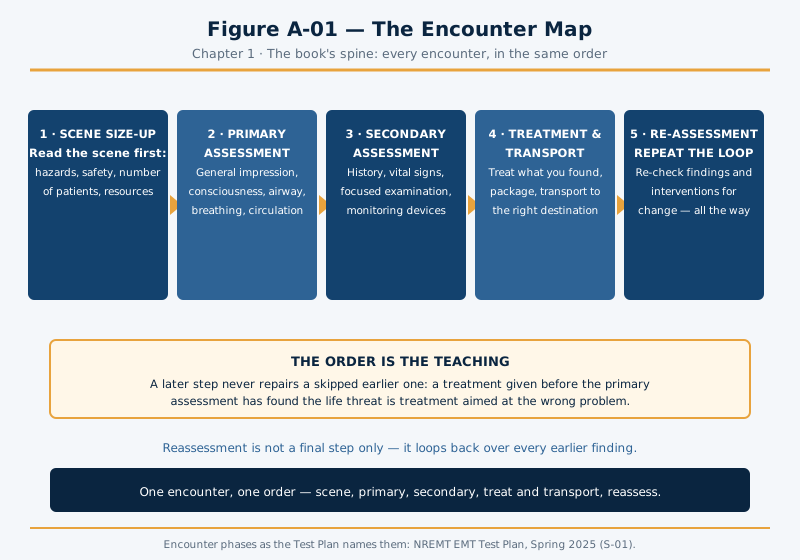
Figure 1.1 — The encounter map: scene size-up → primary assessment → secondary assessment → treatment and transport → reassessment. Every clinical chapter in this book opens inside this sequence; it is the shape of a patient encounter and, since the April 2025 restructure, the shape of the examination itself.
EMS practice in the United States is organized, under the National EMS Scope of Practice Model, into four levels. You need all four in your head from the first chapter — not because this book teaches the other three, but because you will work beside them, hand patients to them, request them, and be confused with them by the public for your entire career. The Scope Model describes each level's focus in the same grammar, so the levels are easiest to learn as a ladder of widening scope built on a shared base.
At the base stands the Emergency Medical Responder (EMR). The EMR's primary focus is to initiate immediate lifesaving care to critical patients while awaiting additional EMS resources. EMRs are often the first trained hands on a scene — firefighters, law-enforcement officers, and other responders whose main job is something else but who are trained and equipped to begin care in the minutes before an ambulance arrives. The EMR's knowledge and skills are immediate and lifesaving: recognize the emergency, begin the interventions that cannot wait, and prepare the handoff to the crew that is coming.
Next stands the Emergency Medical Technician (EMT) — this book's level. The definition above is the EMT's. Compared with the EMR, the EMT's scope widens in every direction at once: a deeper assessment discipline, a broader set of basic interventions and medications administered under protocol, and — the structural difference — medical transportation. The EMT is the level at which patient care and the ambulance come together. When Americans picture "the ambulance crew," they are usually picturing EMTs, alone or paired with a higher level.
Above the EMT stands the Advanced Emergency Medical Technician (AEMT). The AEMT's primary focus, in the Scope Model's framing, is to provide basic and limited advanced emergency medical care and transportation for critical and emergent patients. The word limited matters. The AEMT adds a defined set of advanced skills to the EMT base — but a defined set, bounded by the Scope Model and by state law, not an open door to everything a paramedic does.
At the top of the ladder stands the Paramedic, whose primary focus is to provide advanced emergency medical care for critical and emergent patients. The paramedic's scope is the widest in EMS: advanced assessment, advanced airway management, cardiac monitoring and interpretation, and a broad range of medications and interventions that sit, deliberately, far above this book's level.
Why does a book about the EMT examination spend a full section on levels it does not teach? For three practical reasons, each of which will return in later chapters. First, scope discipline: you must be able to recognize, instantly and without resentment, the line between what an EMT does and what a higher level does, because the examination tests that line constantly — and because on a real scene, attempting care above your scope is not ambition, it is a violation. In this book, interventions that belong to the AEMT or Paramedic levels appear only as things the EMT assists with, anticipates, or requests — never as things the EMT performs. That is this book's scope fence, and the answer explanations in every quiz enforce it by naming out-of-scope options as out of scope, not merely as wrong. Second, the system reason: the single most valuable judgment an EMT makes on many scenes is recognizing early that the patient needs a higher level of care and requesting it while there is still time for it to matter. You cannot request what you cannot picture. Third, the shopping reason: each level has its own education, its own certification examination, and its own book. The Paramedic examination is a different examination with a different test plan. If you are preparing for the EMT examination, this is your book; if your goal changes, your book changes with it.
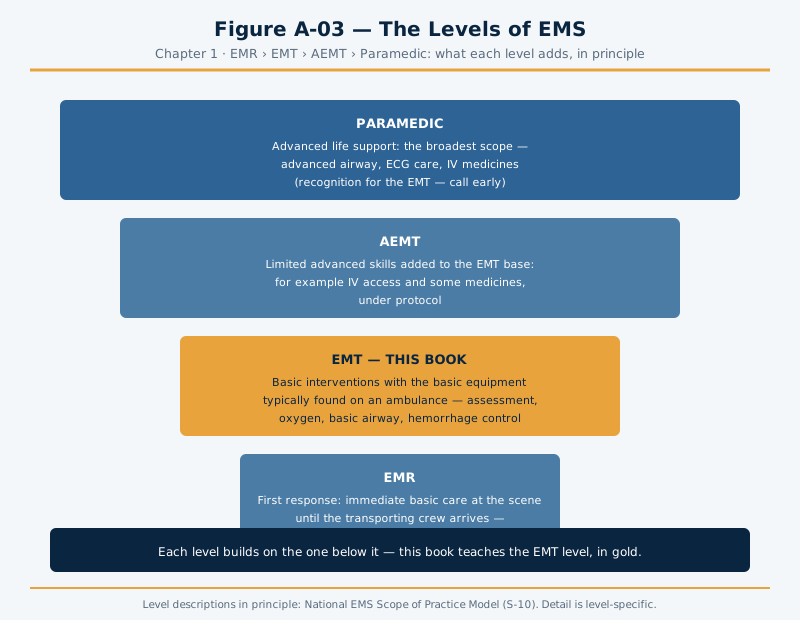
Figure 1.2 — Levels of EMS: EMR → EMT → AEMT → Paramedic — a scope ladder. Each level includes the judgment of the levels below it and adds breadth, depth, or both; no level's scope borrows from the level above it.
Now the framework this chapter exists to teach, and the one the Scope Model itself uses to describe the profession's structure. Between a beginner and a working EMT there are not one or two hurdles. There are four separate acts, performed by four different authorities, and confusing any two of them produces real harm: students who believe a certificate is a license, graduates who believe a license is a job, and candidates who prepare for an examination without arranging the skills verification that must accompany it. The Scope Model frames professional practice as four distinct domains. Learn them as four doors, in order, each with a different keeper.
Door one: Education. Education is learning — the successful completion of a state-approved EMT course. The course is where knowledge and skills are taught and practiced, under instructors, against the National EMS Education Standards, the 2021 federal document that outlines the minimal competencies for entry-level EMS clinicians at each level. Education's keeper is the education program itself: the school or agency that runs your course, and its Program Director, whose role you will meet again in a moment, because the Program Director personally verifies your course completion to the National Registry. Education answers the question: has this person been taught, and has the program attested that they learned?
Door two: Certification. Certification is competency verification by a national certifying body — for EMTs in most states, the National Registry. National Registry certification itself has two requirements, and both halves matter for everything this book does. The first is the National Registry EMT certification examination — the written, computer-adaptive test this book prepares you for. The second is a State EMS Office approved BLS skills competency requirement — an in-person verification that your hands can do what your head knows, administered through your state or your education program's process. Neither half substitutes for the other. A candidate who passes the written examination has satisfied half of certification. Certification answers the question: has this person's competency been verified, in knowledge and in skill, against a national standard? Section 1.7 of this chapter is devoted to the skills half, because it is the half a book can describe but cannot deliver.
Door three: Licensure. Licensure is the state's legal permission to practice. Here is the sentence this book will repeat until it cannot be forgotten, in the National Registry's own words from the EMT Candidate Handbook: "Successfully obtaining National Registry certification does not grant you the right to practice. You must obtain a state-issued license in order to legally practice as an EMT." The examinations are the same across the country; licensure is each state's own act, with each state's own application, its own requirements, and its own renewal rules. That is why this book teaches the national certification whole and teaches licensure as a state shell — a structure you fill in from your own state EMS office, using the checklist in this book's appendix. No state fact — no fee, no step, no hour requirement — is printed in this book as if it were national, because none is. Licensure answers the question: does the law of this state permit this person to practice here?
Door four: Credentialing. Credentialing is the local authorization to practice in a particular system: the ambulance service, fire department, or agency that employs or affiliates you, acting under its medical director, grants you the right to practice under its protocols, on its vehicles, with its equipment. A licensed EMT who moves to a new agency is licensed on day one and credentialed when that agency's process says so — after orientation, protocol review, and whatever local verification the agency and its medical director require. Credentialing answers the question: is this person authorized to practice here, under this medical director, in this system?
A learner who has passed through the first three doors is entry-level: educated, certified, licensed. A learner who has passed through the fourth is job-ready in a specific system. The distinction is not pedantry. It explains why a graduate can be fully certified and licensed and still not be permitted to take a call alone in week one; why a veteran EMT changing services goes through a local process again; and why, when something goes wrong in practice, investigators ask about all four doors separately — what was taught, what was verified, what was permitted, and what was authorized locally.
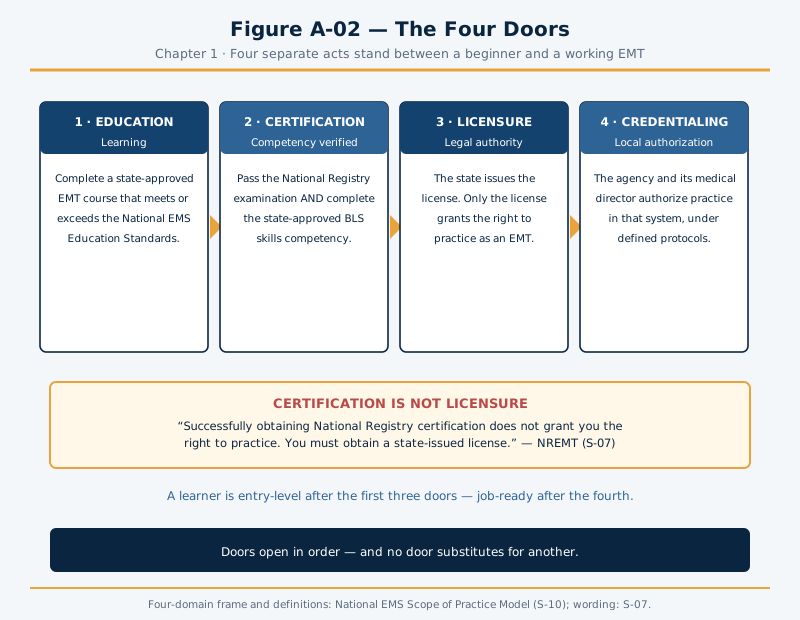
Figure 1.3 — The four doors: education → certification → licensure → credentialing. Four acts, four authorities — the program, the National Registry, the state, and the local agency under its medical director.
Keep the four doors in view for the rest of this chapter, because the examination landscape of the next two sections is simply the second door, described in full.
What, exactly, must a candidate do to become National Registry certified as an EMT? The current source for that answer is the EMT Candidate Handbook (2025), the National Registry's own handbook for candidates, and this book prints its Requirements list as published — because eligibility wording is exactly the kind of fact that drifts between editions, and a candidate is held to the current edition, not to anyone's memory of an older one.
The handbook's Requirements list states two things. First: successful completion of a state-approved EMT course that meets or exceeds the National EMS Education Standards for the EMT, completed within the past two years, with the course Program Director verifying successful completion on the National Registry website. Second: successful completion of the National Registry EMT examination and a State EMS Office approved BLS skills competency requirement — both of which remain valid for 24 months, provided all other eligibility requirements are met.
Everything in that short list repays attention. The course must be state-approved and must meet or exceed the national Education Standards: state approval is the mechanism, the Standards are the content floor. The two-year clock runs from course completion — the handbook's certification-process pages put it precisely: initial courses are valid two years from the month and year of completion. The Program Director's verification is not a formality you can supply yourself; eligibility flows through the program. And the 24-month validity of the passed examination and the verified skills requirement creates the practical deadline inside which the other pieces must be assembled — a pressure Chapter 29 returns to when it teaches the credential shell whole.
Now a finding this book reports plainly, because reporting it plainly protects you. The current handbook's Requirements list, as published, states no minimum age and no separate CPR-BLS credential requirement. Earlier editions of the handbook stated both — candidates who prepared under older editions will remember an age requirement and a current CPR credential for healthcare providers listed among the requirements — and many course catalogs, videos, and older prep books still repeat that older wording as if it were the current list. It is not the list as currently published. What is true, and what you should expect in practice, is this: your education program and your state EMS office set admission and licensure prerequisites, and age and CPR-credential requirements commonly live there — in the program's admission rules and the state's licensing rules — rather than in the National Registry's current certification list. So the practical instruction is twofold and neither half may be dropped: do not quote the old list as the National Registry's current requirement; and do expect your program and your state to impose prerequisites of their own, and check both early, in the state-checklist work this book assigns in its first week. Where a requirement lives determines who can answer your question about it — and "the National Registry requires it" and "my program requires it" send you to different offices with different appeal routes, which is precisely why the distinction is worth a paragraph in Chapter 1.
Two mechanics from the handbook complete the picture of the road to the examination room. When you apply, pay the application fee, and your Program Director verifies your eligibility, the National Registry issues an Authorization to Test (ATT), typically within one to two business days; the ATT is valid 90 days, and scheduling runs through your National Registry account into Pearson, the testing company that delivers the examination. The application fee is $104 per examination attempt — charged for each attempt, a figure the National Registry publishes and this book prints with its basis wherever it appears. Rescheduling or canceling requires at least one business day's notice and carries a $30 fee; failing to appear forfeits the fee. None of this is trivia: candidates lose real money and real weeks every cycle by treating the ATT's 90 days as a suggestion. Chapter 30 teaches the full test-day apparatus; this chapter's point is that the machinery is published, dated, and knowable in advance — the mark of a professional examination, and the reason a preparation book can be built on public documents at all.
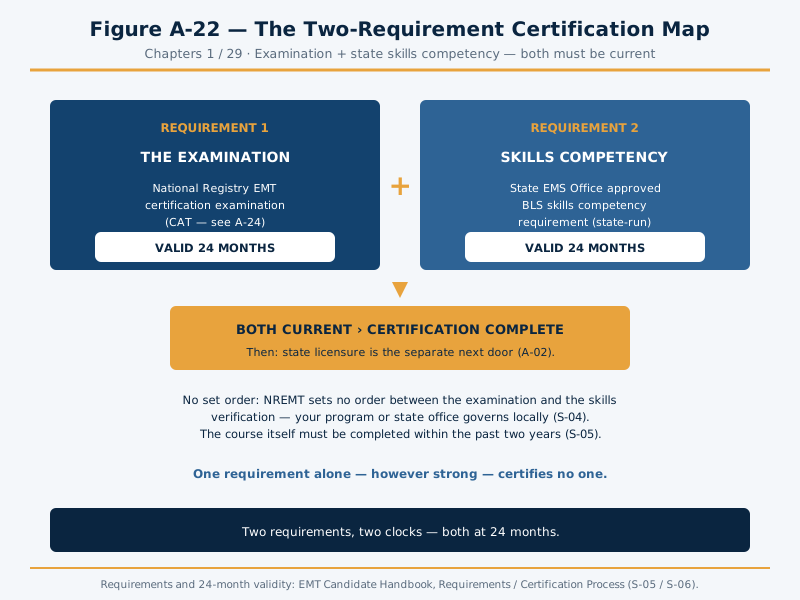
Figure 1.4 — The two-requirement certification map: the certification examination and the State EMS Office approved BLS skills competency requirement, each with its 24-month validity window, inside the two-year course-completion window.
Everything about the written half of certification changed recently enough that the change is this book's founding fact, so learn it as a date before you learn it as a table. The current examination is the updated EMT Certification Examination that went live April 7, 2025, built on the 2023 BLS Practice Analysis — the National Registry's study of what EMTs actually do on the job, from which the test plan's domains and tasks were drawn. The last date of the prior examination was April 4, 2025. This book's version fence — printed on its title page and repeated wherever an examination figure appears — is: EMT Certification Examination, effective April 7, 2025 (2023 BLS Practice Analysis). Any figure in this book that describes the examination traces to that test plan or to the current candidate handbook.
The examination is delivered by Computerized Adaptive Testing (CAT) at a Pearson VUE testing center or by OnVUE remote proctoring from home. Adaptive means the computer selects each next item in light of your answers so far, targeting items at or above your estimated ability, and ends the examination when it can make the pass-or-fail determination at 95% confidence — or when it reaches the maximum items or the maximum time. The examination is 70 to 120 items long and allows 2 hours. Included in every administration are 10 pilot items: real items being tried out for future examinations, unidentified, and unscored — you cannot tell them from scored items, and you are not meant to. The number of items you personally receive indicates nothing by itself: a short examination means the computer reached confidence early, in either direction, and Chapter 30 teaches the CAT's three endings in full. What matters here, at the map stage, is that the examination is variable-length by design, that its length is not a verdict, and that no printed book — this one included — can reproduce the adaptation itself. This book's practice tests are therefore built at the examination's maximum length and say so on their faces; what they rehearse is content, item types, and stamina, not the algorithm.
The test plan organizes the examination into five content domains, and their structure is the restructure's real news. The domains are not topics. They are phases of a patient encounter, in the order an encounter unfolds:
| Content domain (EMT Certification Examination, Spring 2025) | Share of the examination |
|---|---|
| Scene Size-Up and Safety | 15–19% |
| Primary Assessment | 39–43% |
| Secondary Assessment | 5–9% |
| Patient Treatment and Transport | 20–24% |
| Operations | 10–14% |
Each domain is defined by published job tasks, and the tasks read like a call, in sequence. Under Scene Size-Up and Safety: develop a plan of action before arrival; protect yourself, responders, the patient, the public, and the scene from hazards; don appropriate personal protective equipment; investigate the scene to determine potential patients; triage patients; request appropriate resources. Under Primary Assessment: communicate to establish rapport; determine the general impression; assess level of consciousness, airway, breathing, and circulation; determine the chief complaint and life threats; obtain baseline vital signs and diagnostic testing results; identify the need for rapid treatment, rapid transport, or additional resources. Under Secondary Assessment: investigate the current condition and needs through focused physical assessment, interviewing, and past medical history, to develop a continued treatment plan; and reassess previous findings and interventions for change. Under Patient Treatment and Transport: manage airway, ventilation, and oxygenation; manage the cardiovascular and circulatory system; manage motion restriction of the musculoskeletal system; administer medication; manage interventions specific to special populations; manage patient transport; communicate pertinent patient information. Under Operations: ensure equipment is in proper working order; ensure sufficient inventory of medication and supplies; ensure proper documentation is completed; ensure the well-being of yourself and other responders.
Two consequences follow, and both shape this book. First, Primary Assessment is the examination's center of gravity — at roughly two-fifths of the test, it outweighs the next domain by a factor of two. Assessment is not one subject among many; it is the subject, and Part II of this book is built accordingly. Second, because the domains are phases rather than topics, the same knowledge is examined at several phases: oxygenation, for example, is tested when you recognize the threat in the primary assessment, when you measure it in the secondary assessment, when you treat it in treatment and transport, and when you check the equipment in operations. A candidate who studies topics only — who "knows oxygen" as a chapter — can still fail items that ask which phase a decision belongs to. This book's answer to that structural fact is its dual crosswalk: chapters are organized by the Education Standards' knowledge structure, every clinical chapter is internally organized by the encounter phases, and every practice item is tagged to both its test-plan domain and task and its Standards section, so you always know which phase an item is examining.
Item types. Alongside the familiar multiple-choice item (one correct answer of four), the updated examination includes multiple-response items (select two or three correct answers from five or six options), and three Technology Enhanced Items (TEIs) new to the EMT examination in the 2025 update: Options Table (classify or categorize options in a table), Build List (put options in the instructed order), and Drag-and-Drop (position options into categories). A tutorial at the start of the examination demonstrates the TEI mechanics, and it remains available through the examination's Help. One scoring rule governs every type, and it is unforgiving: all items are scored dichotomously — full credit or none. A multiple-response item with two of three correct selections earns exactly what a blank earns. This book's practice items rehearse every published type in honest print form, score TEIs all-or-nothing in their keys, and say so in their explanations, because partial-credit intuition is an examination trap this book trains out deliberately.
Pediatric content is integrated throughout the examination — children appear inside the domains, as they appear inside real calls — and the National Registry publishes no separate pediatric percentage for this examination. Older materials that quote an adult-pediatric split are quoting the superseded examination, which brings us to the predecessor, named once here and once in Chapter 30, and nowhere else as if it were current.
Before April 2025, the EMT examination was organized by topic into five different domains: Airway, Respiration & Ventilation; Cardiology & Resuscitation; Trauma; Medical/Obstetrics/Gynecology; and EMS Operations — with figures attached to them (domain weights, adult and pediatric splits) that belong to that examination alone. Those domains are superseded. They are named in this chapter for one reason only: many candidates still hold textbooks, course handouts, and prep books built on the predecessor, and a candidate who cannot see that their material predates the current examination will study the wrong shape of test with complete sincerity. If a resource organizes the examination by those five topic domains, it was built for the examination that ended April 4, 2025. Thank it for its clinical content where the content is sound — anatomy does not expire — and do not let it tell you what your examination looks like. Yours is the task-based examination of Section 1.5, and every practice item in this book is built on it.
Return now to certification's second requirement — the State EMS Office approved BLS skills competency requirement — because it is the part of your road that a book is most likely to misdescribe, and the part where the description has changed under candidates' feet.
The current model is state-run. The National Registry states it in its own banner language: "State EMS office approved BLS skills competency requirements for EMR and EMT levels will continue in the current format," and, in its answers to candidates, that the skills examination process "is established and approved by each state." In practice — and the handbook's pathway guidance says this too — the verification commonly reaches you through your education program and your state: some states integrate the skills competency examination into the EMT course itself, and the National Registry sets no order between the certification examination and the skills verification; your program or state office governs locally. There is, in the current model, no National Registry-administered EMT psychomotor examination and no national station list published for this requirement. When this book teaches skills — and it teaches them constantly, from Chapter 2 onward — it teaches them as knowledge: what each skill is for, the equipment it uses, when it is indicated, and the decisions it turns on. That knowledge is exactly what the written examination can and does test.
The older form you will hear about. Candidates reading older materials, or listening to clinicians certified under earlier models, will encounter descriptions of a formal, traditional skills examination: a sequence of named stations, each with its own step sheet and pass criteria, administered as a national-style examination event. Treat those descriptions the way Section 1.6 taught you to treat the old topic domains: as a predecessor form, described here as knowledge about the profession's history, not as the requirement you must satisfy. In most states that traditional examination no longer stands as the route; the state and program verification model above is the current structure. The two forms must never be blended: do not prepare for named national stations as if they were your requirement, and do not assume that because no national station list governs you, no in-person verification does. Your verification exists, it is in person, it is hands-on, and its exact administration — who runs it, where, in what format, and how it connects to your course — is set by your state EMS office and your program. That is a "your state decides" fact, and the box at this chapter's end assigns you to confirm it in week one, not in the anxious week before your course ends.
What this book promises about skills, it states in a fence that also appears in its front matter, verbatim: "This book prepares you for the National Registry EMT certification examination — the written, computer-adaptive test. It cannot teach your hands. The State EMS Office approved BLS skills competency requirement is verified in person, in your program or your state process, not by reading. What this book gives you for that requirement is knowledge: what each skill is, the equipment it uses, when it is indicated, and the decisions it turns on." The ten skills-knowledge simulations later in this book — sequenced decision sets over the core skill families the Education Standards name — are built inside that fence: they rehearse the judgment a written examination can test, and each one's face repeats that performance itself is verified in person, in your own process.
Three ideas complete the system picture, each small in this chapter and large in your career.
Medical oversight you have already met: protocols and a medical director stand behind EMT practice. Understand its direction correctly. Oversight is not supervision looking over your shoulder on each call; it is the structure that authorizes your practice in advance (protocols, credentialing), supports it in the moment (the ability to contact medical direction), and reviews it afterward. The Scope Model is explicit that the Scope Model itself grants no legal authority — it is guidance for states — and likewise a protocol book grants you nothing until the state's license and the agency's credentialing put it in your hands. Authority in EMS is always traceable to a source, and tracing it is a professional habit this book practices on every page.
Quality improvement is the system's memory. Calls are documented, records are reviewed, patterns are found, education and protocols are adjusted. The EMT's part in quality improvement begins with the honest, complete patient care report — Chapter 4's subject — because a system cannot improve what it cannot see. When this book insists on documentation discipline, it is not being bureaucratic; it is connecting your pen to the only mechanism by which the next patient's care gets better than this one's.
The continuum of care is the patient's-eye view of the system: the EMT is one link between the bystander who called and the hospital team that receives your handoff, and the quality of the links — the dispatch information you use en route, the report you give at the bedside — determines whether the chain behaves like a chain or like a series of restarts. Your assessment begins before you arrive (the test plan's first task is to develop a plan of action before arrival), and your responsibility ends not at the hospital door but at a complete transfer of information to the receiving team. Chapter 4 teaches that handoff as a skill in its own right.
Results post to your National Registry account — the handbook says generally within two business days — and are not available at the test center or by phone. If you pass, the Registry sends no detail: there is no score report to frame, because on an adaptive examination a passing candidate's item count and path are not a grade. If you do not pass, you receive performance feedback compared against the passing standard, and a score "presented on a scale from 100–1500," with "the passing point indicated by a 950." Learn that sentence in exactly the frame the handbook publishes it in, because it is widely misquoted. The 950 is a point on a scaled score shown to unsuccessful candidates so they can judge their distance from the standard. It is not a raw cut score: it converts to no percentage of items correct, no number of items, and no per-domain minimum — and on a CAT, where item difficulty varies by candidate, no such raw figure could describe the standard anyway. What the National Registry does publish about the standard itself is its method: the passing standard is set through a formal standard-setting study, in which a trained psychometrician facilitates a representative panel of EMS subject-matter experts, whose recommended cut score goes to the National Registry's Board of Directors, is approved and applied uniformly to all candidates, and is reviewed each time new examination specifications are implemented. That is the whole truthful account — method, the scaled-score sentence in its frame, and no raw cut — and it is the account Chapter 30 teaches again at the point where you will need it.
Retesting is published with the same precision: you may reapply as soon as results post, with a 15-day wait from your last examination date, and you have six chances in total to pass. After three failures, remedial education is required before a fourth attempt — satisfied, per the handbook, by the EMT 20-credit National Component of the National Continued Competency Program model, a state- or CAPCE-approved EMT refresher course, or those 20 credits through any state-approved education program, with the handbook's own note that some states require the traditional refresher, so the state office governs. Note what the remedial rule does not do: it does not extend your course-completion date. The two-year course clock keeps running through retesting, which is why Chapter 30 treats a first failure as a scheduling problem to solve immediately, not a verdict to grieve over slowly.
And the promises this book does not make: it does not promise that you will pass, that you will be certified or licensed, that you will be hired, or what you will earn. No honest book can promise the first of those, and the others are not a book's to promise at all. What it promises is narrower and keepable: every examination figure in it traces to the National Registry's own test plan or handbook or to the federal standards, checked on the date printed in its front matter; every practice question is original, written from the published test plan — never copied, recalled, or reconstructed from the real examination, which the candidate agreement you will sign expressly prohibits; and every chapter teaches at the EMT's scope and says so when it touches the edge of it.
A beginner's picture of EMS is usually a single picture — the emergency call — and it is worth widening before you build a career on it, because the Scope Model's definition was written to cover the whole of the work, not only its most dramatic hour. EMTs staff ambulances in municipal fire departments, in third-service municipal EMS agencies, in private ambulance companies, and in hospital-based services. They work in volunteer systems that still carry much of rural America's emergency response. They transfer patients between facilities — the nonurgent and urgent requests of the definition — moving a patient from a small emergency department to a specialty center, or from a hospital to a rehabilitation facility, providing care and monitoring throughout. Some work in industrial settings, at events, in clinics and urgent-care support roles, and in community paramedicine's basic-life-support flank, where EMS clinicians visit patients at home to prevent the emergency rather than answer it. The mix differs by system; the definition does not. In every setting the same four verbs govern: respond, assess, treat within scope, and transport or hand off well.
Notice, too, what a working EMT's hours actually contain, because the examination's Operations domain exists precisely to honor this reality. A shift includes checking the ambulance and its equipment until readiness is a fact rather than an assumption, restocking what the last call consumed, documenting every encounter, cleaning and resetting the unit, training, and — threaded through all of it — the calls themselves, most of which are not catastrophes. The test plan devotes a tenth or more of the examination to Operations, including equipment readiness, inventory, documentation, and responder well-being, because a clinician who is brilliant at assessment and careless at readiness will one day reach for equipment that is not there. This book treats operations as professional work from Chapter 2 onward, not as housekeeping appended to the real job.
Finally, a word about evidence, because the Standards name research awareness as part of the EMT's preparatory foundation. EMS practice changes as evidence accumulates — the April 2025 examination restructure is itself an example, driven by a fresh practice analysis of the job as it is actually done now. The professional habit this asks of you is modest and permanent: hold your practice to the current published sources, expect those sources to be revised, and when a protocol or a guideline changes, learn the change from the document rather than from the rumor of it. That habit, practiced for a career, is what this book's source discipline is training. You are not memorizing a frozen profession. You are entering a living one, at the level where its foundation is laid, on the date printed in this book's front matter — and the four doors of Section 1.3 are how everyone in it, without exception, got in.
Abstract frameworks are learned best on a single concrete road, so follow one beginner — a composite, built by this book to carry the chapter's structure — from first decision to first shift. She begins where you are: interested, unlicensed, holding no qualifications she can prove. Her first act is not to study for an examination; it is to find a state-approved EMT course whose completion will satisfy the first requirement, and to read its admission rules with her eyes open, noting the prerequisites her program sets — because, as Section 1.4 taught, that is where such prerequisites live in the current structure. She enrolls. Education, door one, is now under way: instructors, the Education Standards underneath the curriculum, skills practiced on trainers and classmates under supervision, and a Program Director who will one day attest — personally, on the National Registry's website — that she completed what she claims to have completed.
Inside the course, the second door's two halves come into view, and she learns to hold them apart. The written half has a published shape she can prepare for: an account with the National Registry, an application, the $104 fee, an Authorization to Test valid 90 days, a CAT examination of 70 to 120 items. The skills half has a shape her program and state define: in her case the verification is woven into her program's process, as some states arrange it — her instructors can tell her exactly how, and her state EMS office's page confirms it, because she checked in week one rather than week twelve. She passes the course. Her Program Director verifies her. She sits the examination and passes, and completes the skills requirement inside its window; each passed portion is valid 24 months, and she intends to need none of that margin. She is certified — and, note carefully, not yet permitted to practice anywhere.
Door three is an application to her state: forms, the state's own requirements, the state's own timeline, ending in a state-issued license. Door four is a job: an agency hires her, its medical director's system credentialing her after orientation and protocol review, and only then — educated, certified, licensed, credentialed — does she take her first call as an EMT rather than as a student. Four doors, four keepers, no shortcuts, and no step at which any keeper's act substitutes for another's. Every later chapter of this book serves one of these doors: the knowledge chapters serve education and the examination; the operations and state chapters serve licensure and credentialing; and all of them serve the clinician who walks out the far side of door four and kneels, the first time, beside a stranger who called for help.
Your state decides — Chapter 1. Your state EMS office decides: how licensure is applied for and granted in your state; how the BLS skills competency requirement is administered (including whether it is integrated into your course); and the admission prerequisites your program sets, which is where age and CPR-credential requirements live in the current structure. This week, before you study further, check: (1) your state EMS office's EMT page — find the licensure steps and record them in this book's state-checklist appendix; (2) your program — confirm how and where your skills competency verification will happen; (3) your program's admission requirements, in writing. Record what you find; do not rely on any other state's answer, or on this book, for any of the three.
EMS is a system; the EMT is the level whose primary focus is to respond to, assess, and triage requests for care, apply basic knowledge and skills, and provide patient care and medical transportation, inside protocols and medical oversight. Four levels — EMR, EMT, AEMT, Paramedic — form a scope ladder; the EMT requests and assists with higher-level care and never borrows its scope. Four doors — education, certification, licensure, credentialing, kept by the program, the National Registry, the state, and the local agency — separate a beginner from a working EMT, and certification is not licensure. Certification has two requirements as the current handbook publishes them: the state-approved course within two years behind the examination itself, and the State EMS Office approved BLS skills competency requirement, each passed portion valid 24 months. The examination in force since April 7, 2025 is a CAT of 70–120 items in 2 hours with 10 unscored pilot items, five task-based domains led by Primary Assessment at 39–43%, multiple-choice, multiple-response, and three TEI types, all scored with no partial credit. The skills requirement is state- and program-run in the current model; the traditional station examination older materials describe is a predecessor form, taught here as knowledge and never blended with the current requirement.
Every item is tagged to its Test Plan domain and job task and its Education Standards section. Technology Enhanced Item formats are labeled; on the real examination you manipulate those items on screen, and all items are scored with full credit or none.
1. Which statement states the EMT's primary focus as the National EMS Scope of Practice Model defines it? A. To provide advanced emergency medical care and transportation for critical patients B. To respond to, assess and triage emergent, urgent, and nonurgent requests for medical care, apply basic knowledge and skills, and provide patient care and medical transportation C. To initiate immediate lifesaving care to critical patients while awaiting additional EMS resources D. To direct the medical care of all other responders at an emergency scene
2. A responder whose primary focus is to initiate immediate lifesaving care to critical patients while awaiting additional EMS resources is practicing at which level? A. EMT B. AEMT C. EMR D. Paramedic
3. A graduate has passed the certification examination and completed the skills competency requirement, and holds National Registry certification. Which statement is correct? A. Certification alone does not grant the right to practice; the graduate must obtain a state-issued license to legally practice as an EMT B. Certification is the graduate's license, valid in every state C. The graduate may practice as soon as any agency offers employment, because employment is licensure D. The graduate needs no further authorization of any kind before taking calls
4. A licensed, certified EMT joins a new ambulance service. Before taking calls there, the service's medical director requires protocol orientation and local authorization. That local authorization is: A. Licensure B. Certification C. Education D. Credentialing
5. Which pair makes up the two requirements for National Registry EMT certification as the current Candidate Handbook publishes them? A. A state-approved course alone, and a state license B. The National Registry EMT examination, and a State EMS Office approved BLS skills competency requirement C. A CPR credential, and a national psychomotor examination administered by the National Registry D. An age attestation, and a state practical examination
6. A candidate completed a state-approved EMT course 30 months ago and has not yet tested. Under the handbook's published rules, what is the candidate's position? A. The course remains valid because courses never expire B. The course is valid for five years, so testing may proceed C. The course was required to be completed within the past two years, so the candidate must resolve eligibility with the program and the National Registry before testing D. Only the skills requirement has a time limit; the course does not
7. Which domain carries the largest share of the current EMT Certification Examination? A. Primary Assessment, at 39–43% B. Scene Size-Up and Safety, at 15–19% C. Patient Treatment and Transport, at 20–24% D. Operations, at 10–14%
8. A study guide organizes the EMT examination into Airway, Respiration & Ventilation; Cardiology & Resuscitation; Trauma; Medical/Obstetrics/Gynecology; and EMS Operations. The correct interpretation is: A. These are the current domains under different names B. These domains apply to candidates who test on paper only C. These are the AEMT examination's domains D. These are the superseded pre-April-2025 domains; the current examination uses five task-based domains
9. On a scene, an EMT recognizes that a patient needs an intervention that belongs to the paramedic level. The EMT's correct action is to: A. Perform the intervention, because the patient needs it B. Attempt the intervention once, then request help if it fails C. Request the higher level early, continue EMT-scope care, and assist or anticipate as directed D. Withhold all care until the higher level arrives
10. A candidate fails the examination for the third time. Under the handbook's published retesting rules, before a fourth attempt the candidate must: A. Wait one full year B. Complete remedial education — the EMT 20-credit National Component, a state- or CAPCE-approved refresher, or the 20 credits through a state-approved program C. Repeat the entire EMT course in every case D. Obtain a new state license
11. (Multiple Response — select exactly two. Scored all-or-nothing.) Which two statements about the current examination are correct? A. It is delivered by computerized adaptive testing B. Every candidate receives exactly the same number of items C. It includes 10 unidentified pilot items that do not affect the score D. Candidates may return to earlier items and change answers at the end E. It is scored with partial credit for nearly correct responses
12. (Options Table — for each row, choose the one correct column before checking the key. Scored all-or-nothing.) Classify each act under the door it belongs to: Education / Certification / Licensure / Credentialing. Row 1: A Program Director verifies a student's successful course completion. Row 2: The National Registry verifies competency by examination and skills requirement. Row 3: A state issues legal permission to practice within its borders. Row 4: An agency's medical director authorizes a licensed EMT to practice in that system.
13. A candidate's adaptive examination runs to the published maximum of 120 items. Of those, 10 are unidentified pilot items that do not affect the score. How many items in that sitting were scored? A. 120 B. 100 C. 90 D. 110
14. A candidate who did not pass receives a score presented on a scale from 100–1500, with the passing point indicated by 950. The correct understanding of that 950 is: A. It is a point on a scaled score shown to unsuccessful candidates; it is not a percentage of items correct or any other raw cut score B. It is the percentage of items the candidate must answer correctly, expressed as points C. It is the number of items a candidate must answer correctly D. It is a per-domain minimum that applies to each of the five domains
15. (Build List — place the four steps in the order a beginner passes through them, from first to last. Scored all-or-nothing.) ( ) Obtain a state-issued license ( ) Complete a state-approved EMT course ( ) Receive local credentialing from an agency under its medical director ( ) Earn National Registry certification (examination + state-approved skills competency requirement)
© 2026 Feras Alzubi
All rights reserved.
Mastering Careers & Skills
Google Play Books Exam Prep Series
Edition line: Built on the EMT Certification Examination effective April 7, 2025 (2023 BLS Practice Analysis), the 2021 National EMS Education Standards, and the 2025 AHA Guidelines for CPR and ECC.
Built on the EMT Certification Examination effective April 7, 2025 · 2021 National EMS Education Standards · 2025 AHA Guidelines.
This book is an independent study guide. It is not published by, affiliated with, endorsed by, or approved by the National Registry of Emergency Medical Technicians (NREMT), the National Highway Traffic Safety Administration (NHTSA), the U.S. Department of Transportation, any state EMS office, Pearson VUE or Pearson, the American Heart Association, or the Commission on Accreditation for Prehospital Continuing Education (CAPCE), and none of them participated in its creation. Examination and guideline names are used only to identify what this book prepares readers for, and exam names and trademarks belong to their respective owners. Certification, licensure, course approval, and skills verification requirements are set by the bodies named in this book and change over time — always confirm the current test plan, the current candidate handbook, and your own state's current rules before you test. Passing any exam also depends on the candidate's own preparation; no book can guarantee a result.
Five consequences of that disclosure are stated here at the front, not buried at the back.
First — no guarantee. This book does not promise that you will pass any examination, earn any certification or license, get any job, or earn any income. It teaches emergency medical care at the EMT level from zero and prepares you for the written certification examination named below. That is what a study book can do, and it is all this one claims to do.
Second — certification is not licensure. In the National Registry's own words: "Successfully obtaining National Registry certification does not grant you the right to practice. You must obtain a state-issued license in order to legally practice as an EMT." (Source: NREMT, EMT Candidate Handbook, "Introduction" — S-07 in References.) The examinations are the same across the country; licensure is your state's act. Any sentence anywhere that blurs the two — yours or a seller's — is a sentence to distrust.
Third — the hands-on fence, printed in full, because it governs every page that touches a skill:
This book prepares you for the National Registry EMT certification examination — the written, computer-adaptive test. It cannot teach your hands. The State EMS Office approved BLS skills competency requirement is verified in person, in your program or your state process, not by reading. What this book gives you for that requirement is knowledge: what each skill is, the equipment it uses, when it is indicated, and the decisions it turns on.
Fourth — every question in this book is original. No practice item here copies, paraphrases, or clones a sample item, a recalled examination item, or any "dump" content. That is not only this book's policy; it is the agreement you signed. Candidates are prohibited from "reconstructing examination content using your memory or the memory of others" (Source: NREMT, EMT Candidate Handbook, "About the Examination" — S-04), and the National Registry's Code of Conduct bars disseminating examination materials (Source: NREMT, EMT Candidate Handbook, "Candidate Responsibilities" — S-05). A book built from recalled items would ask you to profit from a breach of that agreement. Relatedly: the National Registry does not recommend any particular examination preparation materials (S-04) — including this one. No sentence in this book claims otherwise.
Fifth — your state decides what is your state's. Licensure steps, state fees, course hours, skills-competency administration, and renewal rules are state facts. No state fact is printed anywhere in this book, because no state source was read for it. What is state-variable is taught as variance itself, and the State-Checklist Appendix in the back matter gives you a blank-by-design worksheet for filling in your own state's facts from your state EMS office's own publications. A state number printed here as if it were universal would be a wrong answer on a delay.
Provenance note. Every examination figure in this book comes from the National Registry's own test plan or handbook, or from the federal standards listed in References, checked on October 30, 2026. The National Registry's sample items (EMT Examination Specifications, Appendix A — S-01) were read for format and difficulty calibration only, and no item in this book reuses or paraphrases one. This book reproduces no textbook's text, tables, or chapter structure; its teaching is original prose built on the public test plan and the federal standards, which no textbook owns.
A note on labels, because labels carry the facts in this subject. Every examination figure in this book carries its basis where it appears: "EMT Certification Examination, effective April 7, 2025 (2023 BLS Practice Analysis)." Resuscitation content carries its basis likewise: "2025 AHA Guidelines." Clinical content names its authority at the point of use — the National EMS Education Standards, the National EMS Scope of Practice Model, or the 2025 AHA Guidelines. State-variable content names its governing authority in the same sentence ("your state EMS office decides…"). Guidance this book itself created — study plans, the CAT Ladder's routing rule, mnemonics such as SAMPLE and OPQRST, readiness judgments, and the repair method — is labeled this book's guidance or this book's apparatus at every appearance. No blanket note substitutes for the label at the point of use.
Copyright © 2026 Feras Alzubi. All rights reserved. No part of this book may be reproduced, distributed, or transmitted in any form or by any means without the prior written permission of the copyright holder, except as permitted by law.
The author's name. The copyright holder's name appears on this page and in the store metadata, and nowhere else inside this book. The book stands on its sources, which are named wherever they are used and listed in full in the References.
This book is built against the EMT cognitive examination as the National Registry published it effective April 2025: the updated EMT Certification Examination that went live April 7, 2025, built on the 2023 BLS Practice Analysis (Sources: NREMT, EMT Certification Examination Test Plan / Examination Specifications, Spring 2025 — S-01; NREMT, EMR and EMT Certification Examinations page — S-02; NREMT launch announcements, December 2024 and April 2025 — S-09). The last date of the prior examination was April 4, 2025. The book's spine — its five task-based content domains, their weights, its computer-adaptive form, and its item types — is that test plan, and the Outline Crosswalk appendix in the back matter maps the book, in both directions, to the test plan's job tasks and to the Education Standards' content, so you can verify the coverage yourself.
The clinical teaching is built against the 2021 National EMS Education Standards and the 2019 National EMS Scope of Practice Model (with 2021 change notices) (Source: NHTSA — S-10) — the two documents the National Registry itself names, with its own Practice Analysis, as guiding examination content development (Source: NREMT, Examinations Content — S-03). Basic life support and resuscitation content is built against the 2025 AHA Guidelines for CPR and Emergency Cardiovascular Care (Source: American Heart Association — S-13), the current guideline year. The National Registry's own preparation direction points the same way: review "the current American Heart Association's Guidelines for Cardiopulmonary Resuscitation and Emergency Cardiovascular Care and the National EMS Education Standards" (S-04).
A version warning that shapes this whole book. The April 2025 examination is a restructure, not a refresh: its domains are phases of a patient encounter — size up the scene, assess primarily, assess secondarily, treat and transport, operate — not the topic list the earlier examination used. Older prep materials teach retired domains; this book teaches the current ones. Chapter 1 names the change, with its date, for exactly the reader who is holding an older textbook or an older prep book alongside this one. The Errata and Basis page in the back matter records the same warning as part of this edition's basis.
Confirm the current information before you test. Test plans are revised, handbooks are reissued, and guideline years turn over. The figures in this book are dated on their face — the examination figures to the examination effective April 7, 2025, the standards to the 2021 Education Standards, the resuscitation teaching to the 2025 AHA Guidelines, and the source check to October 30, 2026 — so the book shows its age openly if a successor document appears. Before your examination date, confirm three things from the primary sources themselves: the EMT test plan and the EMT Candidate Handbook currently in force at nremt.org; the guideline year currently in force at the American Heart Association; and your own state's current requirements with your state EMS office. What those current publications say governs your sitting, not any book, including this one.
Everything on these pages traces to a source read on October 30, 2026: the National Registry's EMT Certification Examination Test Plan (Spring 2025), its EMR and EMT Certification Examinations page, its Examinations Content page, the 2025 EMT Candidate Handbook in its parts, its EMT Full Education Program Pathway page, its launch announcements for the updated BLS examinations, the NHTSA standards and scope documents, its National Continued Competency Program (NCCP) 2025 Model and EMS Recertification Guide, the American Heart Association's 2025 Guidelines release and highlights, and the official Glasgow Coma Scale structured approach. Each figure carries its source in words. Where a figure could not be verified from such a source, these pages print no figure at all — and say so, because the silence is itself information.
| Content domain | Share of the examination | What the domain examines, in the test plan's task substance | Taught principally in |
|---|---|---|---|
| Scene Size-Up and Safety | 15–19% | Develop a plan of action before arrival; protect self, responders, patient, public, and scene from hazards; don appropriate PPE; investigate the scene to determine potential patients; triage patients; request appropriate resources | Chapters 2, 7, 25 |
| Primary Assessment | 39–43% | Communicate to establish rapport; determine general impression; assess level of consciousness, airway, breathing, and circulation; determine chief complaint and life threats; obtain baseline vital signs and diagnostic testing results; identify the need for rapid treatment, rapid transport, or additional resources | Chapters 8, 9 — the book's spine; reused in every clinical chapter |
| Secondary Assessment | 5–9% | Investigate the current condition and needs through focused physical assessment, interviewing, and past medical history, to develop a continued treatment plan; reassess previous findings and interventions for change | Chapter 11 |
| Patient Treatment and Transport | 20–24% | Manage airway, ventilation, and oxygenation; manage the cardiovascular and circulatory system; manage motion restriction of the musculoskeletal system; administer medication; manage interventions specific to special populations; manage patient transport; communicate pertinent patient information | Chapters 10, 18, and Parts III–VI |
| Operations | 10–14% | Ensure equipment is in proper working order; ensure sufficient inventory of medication and supplies; ensure proper documentation is completed; ensure the well-being of self and other responders | Chapters 1, 3, 4, 28 |
Primary Assessment is the largest domain by a factor of two, and this book's architecture obeys that: the assessment sequence is taught as one continuous discipline in Part II and then reused as the organizing frame of every clinical chapter that follows.
The current Candidate Handbook's Requirements list, printed as published:
Supporting mechanics, from the same handbook: initial courses are valid two years from the month and year of completion; an Authorization to Test (ATT) is valid 90 days; scheduling runs through your National Registry account into Pearson; reschedule or cancel at least one business day ahead (a $30 fee applies); failing to appear forfeits the fee; and the National Registry sets no order between the examination and the skills verification — your program or state office governs locally, and some states integrate the skills competency examination into the EMT course itself. (Sources: S-04, S-06, S-08.)
What the current Requirements list does not state — read this carefully. The current (2025) list as published states no minimum age and no separate CPR-BLS credential requirement. Earlier handbook editions stated both. This book prints the current list as published and does not import the older wording as current fact. The reader-protection point is different, and it is a program and state point: expect your program and your state EMS office to set admission and licensure prerequisites, which is where age and CPR-credential requirements live in the current structure. Confirm yours with your program and your state EMS office, and record them in the State-Checklist Appendix — as program and state facts, labeled with their source, never as a quoted current National Registry requirement.
Chapter 30's repair method takes the performance feedback an unsuccessful candidate receives — your standing compared to the passing standard, by content — as its input, and converts it into a domain-by-domain repair plan inside this book.
Certification is maintained on a two-year cycle ending March 31 of the expiration year, by one of two methods: continuing education under the National Continued Competency Program (NCCP), or Recertification by Examination. Under the NCCP 2025 Model an EMT completes 40 credits in total; the National Component is 20 credits — Airway 4 · Cardiology 5 · Trauma 3 · Medical 6 · Operations 2 — and 10% of the National Component credits (2 credits for an EMT) must be pediatric content. The remaining credits sit in the model's Local/State and Individual components. Accepted education must be approved by the state EMS office or CAPCE-accredited and directly related to EMS patient care. Chapter 29 teaches the full apparatus, including active and inactive status, the October 1 opening of continuing-education applications, and the April 1–30 reinstatement window. Your state license renewal is a separate, state act — it is a State-Checklist item, not a National Registry fact.
Start with the diagnostic. Do not start with Chapter 1. The diagnostic test follows this front matter: 50 items, in one sitting of no more than 60 minutes — that sitting length is this book's guidance. Its items are proportioned to the published domain ranges (see the scoring grid below), and its printed grid reports your result by domain and routes each domain score to the chapters that repair it. Taken cold, before any studying, the diagnostic is a map of where you stand. It does not measure readiness, and no score on it predicts any examination result. Work it in pencil, score it the same day, and write the five domain scores into the study tracker below before you open a chapter.
The CAT honesty statement — read it before any practice test in this book:
Your real examination adapts to you: the computer selects each next item for your estimated ability, ends between 70 and 120 items when it is 95% confident, and cannot be printed. These practice tests are fixed at the examination's maximum length (120 items, 2 hours) and proportioned to its published domains — they rehearse the content, the item types, and the pacing. What transfers is knowledge and stamina; what cannot transfer is the adaptation itself, and Chapter 30 teaches that difference explicitly. The CAT Ladder (§5.3) rehearses the feel of adaptive difficulty under this book's own labeled routing rule — it is not NREMT's algorithm, pool, or scoring.
That last sentence governs a named part of this book. The CAT Ladder is a rehearsal mode built over its own 90 items in three labeled difficulty tiers — Entry, Standard, and Stretch — under a routing rule printed on its face as this book's guidance. It claims nothing about the National Registry's algorithm, item pool, calibration, or scoring. Chapter 30 teaches the three published endings of a real CAT sitting — the minimum-items confidence ending, the maximum-items ending, and time expiry — and the discipline an adaptive test demands, including that the number of items you receive indicates nothing by itself: a sitting that stops at 70 items has met the standard early, and a sitting that runs to 120 has not thereby failed.
This book then follows a teach-then-test rhythm in every chapter: the idea in plain words; why it exists; the full teaching with its authority named; a worked example or a patient scenario; a task to do yourself; and a chapter quiz whose key explains why the right answer is right and why each wrong option fails — marking an out-of-scope option as out of scope, not merely as wrong, because recognizing what belongs to a higher level of practice is itself an EMT skill this examination tests. Foundations come before examination framing in every part — a reader who has never seen an ambulance can start at Chapter 1 — and assessment comes before everything it organizes: Part II teaches the encounter sequence whole, and every clinical chapter after it opens inside that sequence.
The skills-knowledge fence, for readers. The hands-on fence on the disclosure page governs here in practical form. This book's ten skills-knowledge simulations rehearse knowledge about skills: what each skill is, the equipment it uses, when it is indicated, the order of its decisions, and why. They are sequenced decision sets about performance, not performance. There is no national station list for the current skills requirement to copy — the requirement is established and approved by each state — so no simulation in this book prints a station list, a step sequence presented as an examination standard, or a pass criterion. Finishing a simulation is not practice for the performance, and it is not sign-off. Your program or your state process verifies your hands, in person; book that time the way the study plans tell you to, in week 1, not in the final week.
Figures. Wherever a chapter teaches a piece of equipment, a device, a document or form, or a physical setup, a labeled illustration of the physical subject itself stands at that teaching point — the suction unit with its catheters named, the bag-valve-mask with its reservoir, the AED trainer labeled as a trainer. Diagrams and charts are additional apparatus, numbered separately, and never substitute for the picture of the thing itself. In this book's design there are 70 figures: 46 labeled illustrations of physical subjects and 24 diagrams and charts. Every figure is an original illustration; no figure in this book depicts an identifiable patient, an injury in graphic clinical detail, or a real person in distress.
The practice program, as designed. Counts in this paragraph are this book's census, as built and verified: one 50-item diagnostic; a 15-item quiz closing each of the 30 chapters (450 items); two full practice tests of 120 items in 2 hours each (240 items); five 30-item domain repair sets, one per content domain (150 items); and the CAT Ladder's own 90 items — 980 practice items in all, every item original, every item explained, and every item tagged as described below. Each full practice test is built at the examination's maximum length for the reason stated on its face, and 10 of its 120 items are designated pilot-rehearsal items — interleaved and unlabeled in the sitting, identified in the answer key — so you rehearse the real experience of never knowing which ten do not count. Counted separately from the 980, because they are knowledge about performance rather than examination-format items, are the 10 skills-knowledge simulations (50 scored parts) described above. Inside the 980, a designated set of 180 measurement items is tagged for the measurement register described next; those 180 are part of the 980, not additional to it.
Measurement: the stem supplies the authority. EMT arithmetic is measurement under authority — a scale's published structure, a device's stated factor, a protocol-style order, a patient's own baseline. This book's rule, introduced here because Chapter 11 will spend it: every decisive number in a measurement item comes from inside the item — a stated order, a stated cylinder factor, a stated baseline — or from a structure the item names as published, the Glasgow Coma Scale being the book's worked example. No item in this book keys a medication dose, a vital-sign range, or a device factor from memory of a universal table, because this book prints no universal dose table and no universal vital-sign range table: the Education Standards require vital-sign assessment and device competency without stating numeric ranges in the sections this book's register read, and medication administration at EMT scope lives inside protocols and medical oversight. Chapters therefore teach method, device use, error sources, trending against the patient's own baseline, and the duty to report change. Where a range enters an item, the item carries the range or the baseline in its stem.
Tags and the crosswalk. Every practice item carries three addresses in its production tag: its test plan domain and job task, its Education Standards section, and its chapter. The Outline Crosswalk appendix in the back matter is generated from those tags, in both directions — Standards section to chapters, and test plan job task to chapters and item counts. That is why the appendix can serve as your own completeness audit: a task or a Standards section with no chapter, or no items, would show there as a hole.
The state-shell method. Wrapped around the national core is a shell only your state can fill, and this book's method starts in week 1 of either study plan because a wrong assumption discovered late is the most expensive kind. First, learn the national core whole — the examination, the Standards, the Scope Model, and the NCCP are Parts I through VII. Second, learn the pattern of variance: what a state decides (licensure, course approval, skills administration, state fees, renewal) and what it does not decide for you (the national examination's shape, the Standards' EMT content, the 2025 AHA resuscitation teaching). Third, fill in your own state's rows in the State-Checklist Appendix from your state EMS office's own current publications, using the where-to-look instructions printed with the worksheet. Every chapter that touches a state-variable fact closes with a "Your state decides" box naming exactly what your state decides there and exactly what to check. Treat those boxes as assignments, not decoration.
Three paths, one book. If you are starting from zero, read in order from Chapter 1; Part I builds the profession, the four doors — education, certification, licensure, credentialing — and the legal frame before any clinical content, and the 4-week standard plan in the back matter fits you as written. If you are an EMT student in a program, let the diagnostic set your order: move at reading speed through domains where you score well, live in the chapters under your weak domains, work the domain repair set after each part, and coordinate the book with your program's own skills schedule — your program, not this book, signs off your hands. If you are a retest candidate, bring your performance feedback from the Registry, take the diagnostic and the first full timed test early, and let Chapter 30's repair method route you by domain profile rather than by chapter order; spend the time you save on the chapters under your weakest domains and on confirming that no state-shell requirement — skills validity, course validity, remedial education — is quietly expiring. All three paths end the same way: a full timed test, a repair pass driven by its domain profile, and a completed state checklist.
A word about the free sample. The free sample of this book is Chapter 1 plus the diagnostic test, so a buyer can judge the teaching quality and see their own starting point — scored by domain, with the chapters each score points to — before paying.
The diagnostic test follows this front matter. Work it under its own headnote — 50 items, one sitting, no more than 60 minutes — then score it with its key and complete the grid below. As designed, the diagnostic's items are proportioned to the published domain ranges using the midpoints of those ranges, with the rounding disclosed here on its face: Scene Size-Up and Safety 9 items, Primary Assessment 20 items, Secondary Assessment 4 items, Patient Treatment and Transport 11 items, Operations 6 items. At least six of its items are in the Technology Enhanced Item formats described on the Exam Blueprint pages.
| Domain (EMT Certification Examination, eff. April 7, 2025) | Items | Your score | Route to |
|---|---|---|---|
| Scene Size-Up and Safety (15–19%) | 9 | ___ / 9 | Chapters 7, 2, 25; repair set: Scene Size-Up and Safety |
| Primary Assessment (39–43%) | 20 | ___ / 20 | Chapters 8, 9, then 10 and 11; repair set: Primary Assessment |
| Secondary Assessment (5–9%) | 4 | ___ / 4 | Chapter 11; repair set: Secondary Assessment |
| Patient Treatment and Transport (20–24%) | 11 | ___ / 11 | Chapter 10, Chapter 18, and Parts III–VI by system; repair set: Patient Treatment and Transport |
| Operations (10–14%) | 6 | ___ / 6 | Chapters 28, 1, 4; repair set: Operations |
| Total | 50 | ___ / 50 | Weakest domain first — see the study plans |
Your weakest domain sets your study order, whichever path you are on. After each full practice test, score it the same way and record the new profile here; Chapter 30's repair method works from these profiles, not from total scores. The full practice tests, as designed, present 120 items each in the published proportions: Scene Size-Up and Safety 20, Primary Assessment 49, Secondary Assessment 9, Patient Treatment and Transport 27, Operations 15 — every share inside its published range.
Record each element as you complete it. A chapter counts as complete when its quiz is taken and every miss has been reviewed against the chapter.
End of front matter. The diagnostic test follows.
End of the free sample. The complete book continues from here — the full A-to-Z course in book form, delivered as an EPUB you can read in Apple Books, Google Play Books, ReadEra, Thorium Reader, Adobe Digital Editions, or Send to Kindle.
Buy this ebook — $11.99 Back to the book page
Payments are securely processed by Payhip.