
Mastering Careers & Skills
Electrician Journeyman License Exam · free sample from the book itself
What this chapter does. By the end of it you will be able to describe, in plain words, what electricians actually do all day, name the places they work and the people they work beside, walk the career ladder from first helper to master and contractor, and explain — honestly, with the limits printed where they belong — how electrician licensing works in the United States, why there is no single national license or national exam, and what this book can and cannot do for you. No electrical theory comes first, and no exam framing comes first. The trade itself comes first, because the theory and the exam will make sense only after the work itself makes sense.
This chapter teaches in its own original words. Where an examination fact appears, its source is named on the spot. Examination facts in this book were verified from the official bulletins and handbooks named in the References on October 29, 2026.
Simplify. Every modern building is two buildings at once. One is the building you can see: walls, roofs, doors, paint. The other is invisible until it fails: a network of wires, conduits, panels, breakers, switches, lights, motors, and controls that carries electrical energy to every place work is done. When you flip a switch and a room lights, when a motor starts on a factory floor, when a hospital keeps its power through a storm — the invisible building is working. Electricians build, maintain, and repair that invisible building.
That is the whole trade in one sentence. Everything else in this book is detail about how that network works, how it is sized and protected, how it is installed so it does not hurt anyone, and how the people who build it prove they know how.
Four words in that sentence carry the weight, so define them now:
A homely picture helps. Think of a building's electrical system the way you think of a town's water system. Somewhere, water is gathered and pressurized; large mains carry it through the town; smaller pipes branch to each building and each faucet; valves control flow; and the whole system only works because pressure, pipe size, and flow were matched to each other by design. Electricity follows the same shape: a source, a distribution network, branch paths, control points, and loads that use the energy at the end. Chapter 2 will make that picture precise with voltage, current, and resistance. For now, hold the shape: source → distribution → control → load, repeated at every scale from a power plant to a single lamp.
Exam trap — “electrician” is not one job title with one meaning everywhere. States license electricians at different levels, under different titles, with different scopes of permitted work. A title that authorizes one scope of work in one state may not exist, or may mean something narrower, in another. This book teaches the journeyman level — defined in Section 1.4 — because that is the level its examinations test, and it prints state differences as state differences, never as a national pattern.
Detail. Stand at the door of an electrical contractor's shop at 6:30 in the morning and watch what the trade looks like before it looks like anything else. Crews collect material for the day: conduit, fittings, boxes, wire, devices. A foreman reviews the day's plan against the drawings. Someone checks that a delivery expected yesterday actually arrived. Then the crews scatter — to a half-built office building, a school renovation, a factory shutdown, a service call at a warehouse — and the real work begins.
Across one ordinary week, a journeyman electrician's work falls into five baskets. Learn these five, because the rest of this book is these five baskets opened up:
If you remember nothing else from this section, remember this: an electrician's product is a system that is safe, compliant, and working — in that order. A system that works but is not safe is a hazard with good performance. A system that is safe but does not work is an unfinished job. Journeyman examinations test all three properties, and experienced electricians judge their own work by all three, every time.
Notice what the five baskets do not contain: working on energized equipment as a routine method. The trade's governing safety rule — taught in full in Chapter 5 — is that work is performed de-energized wherever de-energization is possible, and an electrically safe work condition is established and verified before hands go on conductors. Speed never outranks that rule. A beginner who absorbs that hierarchy now will read every later chapter correctly; a beginner who treats it as paperwork will misunderstand the trade itself.
Show. Before the cast and the career ladder, see the place. Electrical work happens in two broad settings — new construction, where the building is being created around the electrical work, and existing buildings, where the electrical work must fit into a building already in use — and a beginner should be able to picture both.
Picture a commercial jobsite in the middle of a project. The building's structure is up. On an upper floor, a crew is installing the service equipment — the equipment where power enters the building and is first controlled and distributed. You can recognize it as a lineup of gray metal enclosures: a meter socket (the enclosure that holds the utility's meter, which measures energy use), a service disconnect (the switch that can disconnect the building's power at the service), and panelboards (enclosures housing circuit breakers that divide the service into branch circuits) — Chapter 9 and Chapter 16 teach each of these as named equipment, with its own figure, at working depth. Nearby, conduit runs are staged and partly installed: metal or plastic tubes — raceways — that protect conductors on their path through the building, some already bent into shape, some rising vertically through the floor, some laid out along a corridor ceiling where a lift gives the crew access to the work overhead. On the floor below, the material laydown holds the project's electrical material in order: bundles of conduit, reels and boxes of wire, cartons of fittings and devices, each staged near where it will be installed so crews spend their hours installing, not hunting. Against the building's façade — its exterior face — a lift (a mobile elevating work platform) raises a worker to exterior lighting and conduit work. The crew's work areas are marked by the work itself: one crew roughing in conduit in one bay, another pulling wire in another, a third terminating conductors in the electrical room — separated in space and sequence so each crew's work enables the next instead of colliding with it.
Figure 1.1 — An electrical jobsite as a workplace.
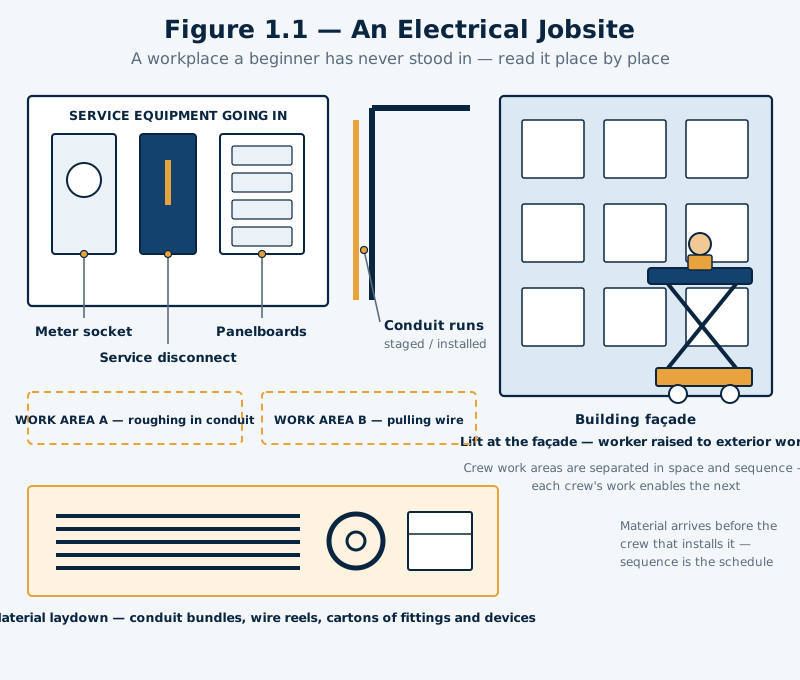
An Electrical Jobsite. A workplace a beginner has never stood in — read it place by place.
Study the labeled scene until you can point to each part — service equipment going in, conduit runs staged and installed, material laydown, lift at the façade, and the crew's work areas — and say what happens in each place.
Every part named in that paragraph must appear, labeled, in the figure: service equipment, conduit runs, material laydown, lift, façade, and the separate crew work areas. If you can read that picture, you can follow every workplace chapter in this book — safety in Chapter 5 happens in these same places, and so do raceways in Chapter 13 and equipment in Chapters 16–17.
Now picture the other setting, because much of the trade lives there. In an existing, occupied building, the same equipment is already installed and the work is surgical: a tenant improvement that reworks one suite's power and lighting, a panel replacement in an electrical room that cannot lose power for long, a troubleshooting call where a motor trips its protection twice a day. The skills are the same family — paths, equipment, conformity, testing, paper — but the constraints invert: instead of a building being built around your work, your work must thread through a building full of people who expect the lights to stay on. Journeyman work includes both settings, and examinations draw scenarios from both.
Detail. Electrical careers climb a ladder whose rungs are defined by supervision and responsibility, not merely by years. The titles below are the shared vocabulary of the trade across the United States. What each rung legally requires — hours, schooling, examination, fees — is set by each state's licensing authority and is deliberately not printed in this book, because it differs by state and changes by state; your board's published requirements are the only version that governs you. What this section teaches is what each rung means — the part that is the same everywhere.
Helper / trainee. The entry rung. A helper works directly under the supervision of a licensed electrician, handles material, learns tools and jobsite habits, and performs only the work their jurisdiction and employer permit an unlicensed person to perform under that supervision. The helper's real job is to become teachable: to learn the names of things, the sequence of work, and the safety discipline of Chapter 5 until those are reflexes.
Apprentice. An apprentice is enrolled in a structured training arrangement — classroom instruction combined with supervised on-the-job work — and is progressing, year by year, through both the knowledge and the hours their jurisdiction requires. Apprentices work under the supervision of journeymen or masters, at supervision ratios their jurisdiction sets. Apprenticeship is where the trade is actually learned: this book can teach an apprentice the knowledge systematically, but it does not replace a single hour of that supervised field experience — a boundary stated in full in Section 1.7.
Journeyman. A journeyman electrician — the reader this book is written for — has completed apprenticeship-level training and passed the licensing examination their jurisdiction requires, and is licensed to perform electrical work without direct supervision of each task, while still working within an employer's or a master's business structure where the jurisdiction requires one. The journeyman is the trade's working backbone: competent to install, maintain, and troubleshoot complete systems; responsible for the conformity of their own work; and the person who supervises and teaches apprentices and helpers day to day. When this book says “you” in its worked examples and scenarios, it is picturing a journeyman — or a candidate about to become one.
Master electrician. A master electrician holds a higher license: more experience, a harder examination with heavier calculation and business weight, and — critically — the authority, in jurisdictions that structure it this way, to pull permits, design or take responsibility for installations at a business level, and employ journeymen and apprentices under the master's license. Master and contractor preparation is a different credential and a different book — a one-paragraph contrast is all this book gives it, deliberately: a reader preparing for a master examination needs material weighted for that examination, and a reader preparing for the journeyman examination should not pay for, or be distracted by, another credential's syllabus.
Electrical contractor. An electrical contractor is the business — the licensed contracting company that contracts with owners and general contractors, carries insurance and business obligations, and employs the masters, journeymen, and apprentices who do the work. In some jurisdictions the contractor business license and the master electrician license are closely linked; in others they are separate instruments. Either way, the distinction that survives every variation is the same one Chapter 1 of the contracting world teaches: the individual license qualifies a person; the contractor license qualifies a business. This book qualifies a person — the journeyman — and says so.
Supervision, stated as a rule of thumb. The ladder's logic can be carried in one sentence: the less experienced the worker, the closer the required supervision; the journeyman is the first rung licensed to work independently and to supervise others' work. Exact ratios, permitted-task lists, and renewal rules are jurisdiction facts, confirmed with your board — the shape of the ladder is the trade's common core; its dimensions are your state's to set.
Exam trap — journeyman does not mean “may open a contracting business.” Examination scenarios that hand a newly licensed journeyman a contract in their own name, a permit application as the responsible licensee, or employees working under their personal license are testing exactly this boundary. In the common structure, contracting with the public and taking responsibility at the business level belong to the master/contractor level. Read scenario stems for which rung is acting before you judge whether the act is proper.
Detail. No electrician works alone in the structure sense, even when working alone in a room. Five relationships govern a journeyman's working life, and confusing them produces both field errors and examination errors.
The foreman. The foreman is the field leader of the electrical crew: assigns work, sequences it against the general schedule, checks conformity as work is installed, coordinates with other trades, and is the journeyman's first route for questions, conflicts, and drawing discrepancies. On small jobs the foreman may also be the working journeyman with the tools on; the function exists either way.
The electrical contractor (your employer). The contractor holds the electrical contract — usually as a subcontractor to a general contractor on new construction, or directly with a building owner on service and renovation work — and carries the business responsibility: estimating, purchasing, payroll, insurance, and the license under which permits are taken. The journeyman's employment duties run to the contractor; the contractor's contract duties run to its customer. Money and legal duty flow along those contract lines, not along the daily conversations that surround them.
The general contractor (GC). On a construction project, the general contractor holds the prime contract with the owner for the whole building and coordinates all trades — including the electrical subcontractor — in sequence and in space. The GC does not direct an electrician's technical work the way a foreman does, but the GC's schedule decides when areas are available, when inspections are called, and when work must be complete. A journeyman who understands that the GC owns coordination while the electrical contractor owns the electrical work will read both jobsites and examination scenarios correctly.
The owner and the owner's team. The owner wants the building, pays for it, and will occupy or operate it. Architects and engineers design its systems; on electrical questions, the design team's electrical engineer is the source of design intent when drawings and reality disagree, reached through the governed question process — the request-for-information route taught in Chapter 6 — never by field improvisation on a design matter.
The inspector and the authority having jurisdiction. An inspector examines installed work for conformity with the adopted code. Official inspections are performed for the authority having jurisdiction (AHJ) — the public body, such as a city or county department, with legal authority to enforce the adopted electrical code in that place, review plans, issue permits, perform inspections, and approve work. The AHJ is not hired by the owner, the GC, or the electrical contractor, and cannot be overruled by any of them. Chapter 7 gives the AHJ its full treatment alongside Article 110 of the Code; here, fix the relationship: the inspector's approval gates the work's legal progress — work that must be inspected is not covered up before inspection, and a failed inspection is corrected and re-inspected, not argued away.
Detail. Section 1.3 pictured two settings; the trade's settings deserve one closer pass, because a journeyman's career is usually spent mostly in one of them, and each setting bends the same five baskets differently.
Residential work — houses and apartments — is the setting most beginners picture first. Its systems are the smallest in this book: one service per dwelling, branch circuits for lighting, receptacles, and appliances, and cable and device work at a scale a small crew completes in days. Its journeyman skill is speed with conformity: the same Code methods govern, applied to the book's dwelling examples in Chapters 8, 9, and 12. Do not mistake “smallest” for “simplest to do well” — a dwelling's occupants live inside the installation, and its inspections are no formality.
Commercial work — offices, stores, schools, hospitals, warehouses built as workplaces — is this chapter's jobsite: larger services, panelboards dividing power floor by floor, raceway systems run in structure and above ceilings, lighting as a designed system, and work coordinated among many trades under a general contractor. Most of this book's scenarios live here, because most sampled examination scenarios do.
Industrial work — factories, plants, and process facilities — adds the trade's heavy machinery: motors and their controls by the dozens (Chapter 18), transformers at plant scale (Chapter 19), and maintenance and troubleshooting as a daily discipline rather than an occasional call (Chapter 24), often inside facilities whose own safety programs add requirements on top of the legal floor. The journeyman knowledge is the same core, weighted toward machines that must not stop.
Service and maintenance work inverts new construction entirely: the building is occupied, the systems are aging, and the job arrives as a symptom — a tripping breaker, a dead receptacle run, a motor that hums and will not start. Its core skill is Chapter 24's method, and its core constraint is the occupied building: tenants, patients, or production lines that experience every shutdown as a cost.
Specialty edges, named so they are not mistaken for the core. Around the journeyman core sit specialties a career may grow toward — low-voltage and communications systems (Chapter 23), fire alarm work (Chapter 22), photovoltaic and storage systems (Chapter 21) — each with its own additional rules inside the Code and, in some jurisdictions, its own limited licenses. This book teaches each at the weight the sampled journeyman examinations give it, no more and no less, and a reader drawn to one specialty should read its chapter's fences as carefully as its methods: specialty licenses are jurisdiction facts, confirmed with the board like everything else in Section 1.7.
The settings share one Code, one theory, and one safety discipline. That is precisely why a single common-core book can serve a residential apprentice and an industrial journeyman at once — and why the examinations built on that core converge the way Section 1.7 describes.
Show. A journeyman's competence is partly carried in a kit that goes everywhere the journeyman goes. Picture it laid out on a bench at the start of a day, in four groups. This figure is a map of the kit, named here at survey depth only: Chapters 4 and 5 open each group at working depth, with its own figures, before any examination item tests it.
First, the tool belt and pouch worn at the waist: the belt that carries the tools the work touches every few minutes, and the pouch that holds fasteners and small fittings at the point of work — worn, not stored, because a tool in the truck does no work. Second, the hand tools in their places inside the kit — the family Chapter 4 teaches tool by tool: strippers, cutters, pliers, screwdrivers, and the bending and pulling gear that lives in the gang box rather than on the belt. Third, the meter case: the protected case carrying the measuring instruments — the multimeter and clamp meter of Chapter 4 — because instruments are precision devices, and a meter that has rattled loose in a toolbox for a month is a measurement you cannot trust. Fourth, the PPE bag: the bag holding the worker's personal protective equipment — the safety gear of Chapter 5, from eye protection and gloves to arc-rated clothing where the work requires it — kept with the kit, inspected as Chapter 5 teaches, and never treated as an optional extra to be fetched after the work starts.
Figure 1.2 — The journeyman's kit laid out.
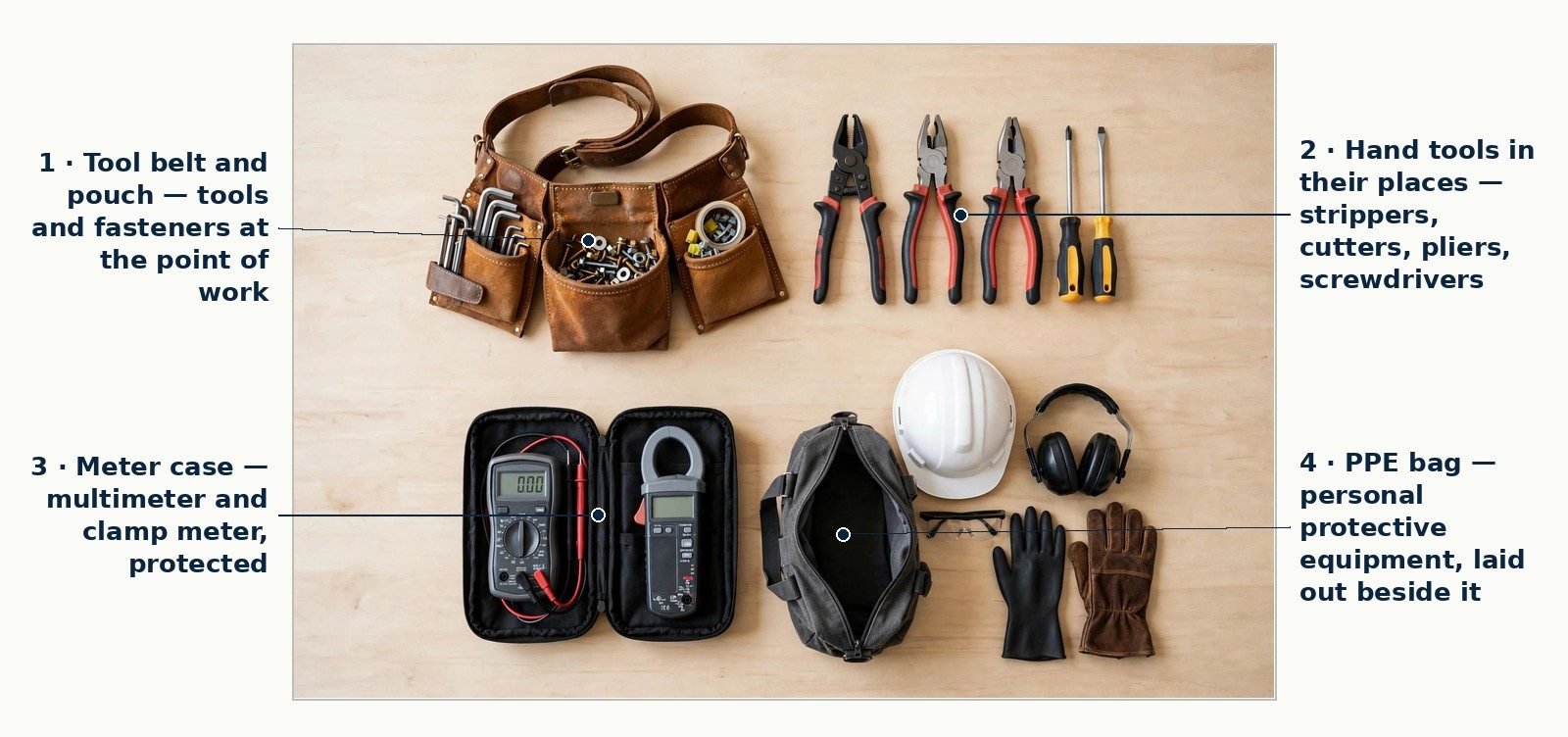
The Journeyman's Kit, Laid Out. Four groups — each taught at working depth in its own chapter.
Study the four groups until you can name each one — tool belt and pouch, hand tools in their places, meter case, and PPE bag — and say which later chapter teaches each group at working depth.
The figure must label exactly those four groups: tool belt and pouch; hand tools in their places; meter case; PPE bag. It adds no tool this section does not name as a group, because Chapter 4 — not this survey — is where individual tools are named and figured. The kit's lesson for a beginner is organizational before it is technical: the trade's tools travel as a system, are cared for as a system, and are checked as a system — and the daily habit of that check is part of what separates a journeyman's kit from a pile of tools.
Do — a five-minute exercise. Without looking back, list the five baskets of a journeyman's work (Section 1.2) and match each one to the kit group or document that serves it first: paths and equipment to the hand tools; testing and proving to the meter case; safety, which governs all five, to the PPE bag; and paper to the plans you have not yet been given — which is the correct answer, because Chapter 6 is where paper gets its own section. If any basket matched nothing, reread Section 1.2; the baskets are the book's table of contents in disguise.
Explain. You are likely reading because you intend to sit a journeyman licensing examination. Place the pieces honestly now; Chapter 26 teaches your state's variation and exam day in full, and the Exam Format page in the front matter carries every figure with its source attached.
There is no national journeyman license and no national journeyman examination. Licensing is administered by state agencies — and, in some places, locally — and each agency sets its own examination and requirements. The national examination program in this field states the point in its own words of structure: its accredited program provides a shared standard for examinations, but it is expressly not intended to create a “National License,” and each regulatory agency maintains its sovereignty and may additionally require its own examinations, experience proof, and application steps. (Source: NASCLA, Accredited Electrical Examination Program document, as read October 29, 2026; NASCLA, Accredited Electrical Examination Program Handbook NA-206, as read October 29, 2026.)
What, then, can one book honestly teach? The answer is the finding this whole book is built on. Six independent official outlines — licensing bulletins and published outlines from different states and from the national accredited program — were read in full for this book, and they weight the same domains in the same order of importance: the National Electrical Code, electrical theory, electrical calculations, and electrical safety. That convergence is the book's scope evidence. This book IS a complete course in the trade from zero, and a complete preparation for that shared common core — the NEC taught as concepts, methods, and calculation procedures in original words, plus the code-lookup craft that open-book examinations actually test. It also teaches, as a named route inside the book, the one genuinely national-standard examination in evidence — the NASCLA Accredited Examination for Journeyman Electricians, covered next — as a route a reader may choose, never as the book's identity.
The NASCLA route, stated exactly. The NASCLA Accredited Examination for Journeyman Electricians is a single standardized trade examination: 100 questions, a minimum passing score of 70, 270 minutes, open book, administered through PSI, with additional nonscored experimental questions that do not count toward the score. Where an agency accepts it, passing it satisfies that agency's trade-examination requirement only — the agency's own application and remaining requirements still apply, and NASCLA publishes its list of administering and accepting agencies with a date attached, because agencies join and leave. This book prints that list, with its date, in Chapter 26, together with the instruction to confirm current acceptance with your own agency. (Source: NASCLA, Accredited Electrical Examination Program Handbook NA-206, Content & Preparation and program sections, as read October 29, 2026 — participating-agency lists current as of July 2023 in the source.)
The sampled state examinations, stated as a range — the only honest “typical.” Across the six official outlines read for this book, the verified range is: 70–100 scored items; 210–270 minutes; a passing standard of 70% in five of the six and 75% in one (Utah's written examination); and an open-book format in every sampled examination — but in two different forms, a book provided at the test center under strict no-marking rules in one state, and a book brought by the candidate with marking permitted within limits in others. Two-part sittings exist — one sampled state examines knowledge and calculations as two separate parts — and a hands-on practical examination exists in another. (Source: PSI Services LLC, Colorado Candidate Information Bulletin 7749, © 2026, updated June 18, 2026; PSI Services LLC, Maryland Master and Journeyperson Electrician Bulletin 8041, © 2024, updated September 1, 2024; PSI Services LLC, Washington Electrical Certification Bulletin 4216, © 2025; Texas Department of Licensing and Regulation, Electrician Exam Information page, as read October 29, 2026; Prov, Inc., Utah Electrical Candidate Information Bulletin, effective October 28, 2026; California Department of Industrial Relations, Electrician Certification Program — Test Taking Information page, as read October 29, 2026; NASCLA Handbook NA-206 — all read in full or at the sections named in this book's References.)
Read that paragraph the way the citation gate will: any single format figure printed without its state attached would be a false national standard. That is why this book never prints one. Chapter 26's state-variation table gives each sampled state its own row — format, passing standard, code edition, and book policy, from that state's bulletin, dated — and tells every other reader, in plain words, to confirm their own format, edition, and book policy with their own board before scheduling.
The code-edition fence, printed here where it first matters. The National Electrical Code is NFPA 70, published by the National Fire Protection Association and revised on a three-year cycle. The examinations sampled for this book do not agree on an edition: the bulletins read examine on the 2020 edition in two states, the 2023 edition in two others, and the 2026 edition in another, with one of the 2023 states moving to the 2026 edition on a published future date. This book therefore teaches on the 2023 NEC as its stated edition basis, labels every edition-dependent value with that basis at its appearance — in the form “2023 NEC basis — your state's adopted edition governs” — and prints the dated transition facts in Chapter 26. A value in this book is a value from its labeled basis; your state's adopted edition governs on your exam and on your job. (Source: the bulletins named in the paragraph above, editions as each bulletin states them, verified October 29, 2026.)
The hands-on fence — the fixed sentence. This book teaches the knowledge and the method of the trade; it does not train or certify hands-on skill, and some states examine hands-on skill separately — supervised field experience is not optional in this trade. The proof that the fence is real and not a disclaimer habit stands in the sampled outlines themselves: one sampled state examines journeymen practically, in a separate timed sitting of hands-on tasks performed with the candidate's own tools, alongside its written examination. (Source: Prov, Inc., Utah Electrical Candidate Information Bulletin, journeyman and practical-examination sections, effective October 28, 2026.) A book — this one included — can teach you the method behind those tasks and the knowledge they presuppose. It cannot put a bender in your hands, and it never claims to.
What this book is NOT — the remaining fences, in one place.
Exam trap — “open book” does not mean “no study needed.” Every sampled examination is open book, and every sampled examination is timed at roughly two to three minutes per item once the full sitting is counted. A candidate who must learn a topic in the room runs out of time; a candidate who must only confirm and locate does not. That is why this book trains lookup as a skill (Chapter 6) instead of treating the code book as a substitute for knowledge.
Show — one ordinary day. At 6:30 a journeyman collects the day's material and the foreman's plan: rough in conduit on the third floor of an office build-out, following the electrical drawings for that floor. At 7:30 the crew is measuring, bending, and installing conduit runs — the paths of basket 1 — checking each run against the drawings before it is secured, because a run installed in the wrong place is installed twice. At 10:00 an inspector arrives for a scheduled inspection of earlier work; one box is set at a depth the inspector will not accept, the correction is made on the spot, noted, and the inspection passes — basket 3, conformity, doing its work quietly. At 13:00 the foreman flags a conflict: a duct, installed by another trade that morning, now occupies the space the next conduit run was drawn through. The journeyman does not improvise a new route through a rated wall on personal authority; the conflict goes to the foreman, and where design intent is affected, through the governed question process — basket 5, paper, preventing a fast error from becoming a permanent one. At 15:00 the crew tests a completed circuit — voltage present where it should be, absent where it should not, protection verified — basket 4. At 16:30 installed work is recorded and tomorrow's material gaps are called in. Nothing in that day is dramatic. All of it is the trade.
Explain — why coordination is part of an electrician's competence, not someone else's job. Notice what the day required beyond electrical knowledge: reading drawings, sequencing against other trades, submitting work to inspection at the right moment, and escalating a conflict through the right channel instead of around it. Examination scenarios test exactly those junctions, because real failures live there: the technically correct installation made in the wrong place, at the wrong time, without the required inspection, is still a failed job. The journeyman standard this book teaches is therefore double: know the electrical rule, and know the working structure the rule lives inside.
Detail — the failure that teaches the hierarchy. Now the day the hierarchy earns its keep. A motor in an operating warehouse trips its protection repeatedly. The pressure is obvious: the warehouse wants its motor back, and every hour of downtime is visible money. The undisciplined responses are all fast — replace the protection with a larger device so it stops tripping, bypass a control, work inside the equipment energized “just to check one thing.” Each converts a symptom (tripping) into a hazard (an unprotected or energized fault). The journeyman response taught in this book is slower in the first ten minutes and faster overall: make the equipment safe under Chapter 5's discipline, measure before replacing anything (Chapter 24's method: symptom → measurement → isolation), find the cause — a failing motor, an overload, a fault — and repair the cause, with protection sized by the Code's methods, not by the customer's impatience. A beginner who understands this paragraph understands why this book refuses to teach any procedure stripped of its safety framing, and why “it works now” is never, by itself, evidence that a repair was correct.
Do. Take the ordinary day above and label each numbered event with its basket from Section 1.2. Then take the warehouse failure and write, in one sentence each, what the undisciplined response risks and what the journeyman response protects. (In your own words: the undisciplined response trades a protection device's warning for an unprotected fault and an energized-work exposure; the journeyman response protects the person first, the equipment second, and the schedule — honestly — third, by fixing the cause once instead of the symptom repeatedly.) If that ordering feels natural already, Chapter 5 will still deepen it; if it feels slow, Chapter 5 is the chapter to read twice.
Each term below was defined at first use above; this list fixes them in one place, as the series glossary discipline requires. The glossary at the back of the book completes the list.
Fifteen items. Foundations quizzes are recognition-first — vocabulary, roles, and sequence — and close with scenario items in the book's voice. The answer key with full explanations is in the matching key file (ch-01-the-trade-and-the-license-key.md).
1-1. The career-ladder rung first licensed to perform electrical work without direct supervision of each task, and to supervise helpers and apprentices day to day, is the: A. Helper B. Apprentice C. Journeyman electrician D. Building inspector
1-2. A journeyman's finished work is judged, in this book's stated order, as a system that is: A. Safe, compliant, and working B. Working, fast, and inexpensive C. Working, compliant, and safe D. Fast, working, and documented
1-3. The public body with legal authority to enforce the adopted electrical code in a place — plan review, permits, inspections, approval — is the: A. General contractor B. Electrical contractor C. Design team D. Authority having jurisdiction (AHJ)
1-4. On a construction project, the general contractor's defining province, as it affects an electrician, is: A. Directing each electrician's technical work task by task B. Coordination of all trades in sequence and in space under the prime contract C. Issuing the electrical permit and performing electrical inspections D. Employing the journeyman and carrying the electrical contract
1-5. The statement that best describes electrician licensing in the United States, as verified for this book, is: A. A single national license is issued to candidates who pass a single national examination B. Licenses are issued by the National Fire Protection Association C. Licensing is administered by states (and in some places locally), each setting its own examination and requirements D. Any journeyman license is automatically valid for contracting with the public in every state
1-6. The NASCLA Accredited Examination for Journeyman Electricians, as published in NASCLA's program handbook, is: A. 70 questions, minimum passing score 75, 210 minutes, closed book B. 90 questions, minimum passing score 70, 240 minutes, closed book C. 100 questions, minimum passing score 75, 300 minutes, open book D. 100 questions, minimum passing score 70, 270 minutes, open book
1-7. Across the official outlines sampled for this book, the verified examination range is best stated as: A. 70–100 scored items, 210–270 minutes, 70% to pass in five of six outlines and 75% in one, open book in every sampled examination B. 50 items and 120 minutes in every state C. A single national standard of 100 items, 270 minutes, and 75% to pass D. No sampled examination is open book
1-8. The edition basis on which this book teaches the National Electrical Code — labeled at every edition-dependent value — is the: A. 2020 NEC B. 2023 NEC C. 2026 NEC D. Whichever edition is newest at the moment the reader opens the book, unlabeled
1-9. In the journeyman's kit as figured in this chapter, measuring instruments travel protected in the: A. Tool belt pouch B. PPE bag C. Gang box with the bending gear D. Meter case
1-10. The crew leader who assigns a journeyman's work, sequences it against the schedule, checks conformity as work is installed, and is the first route for questions and conflicts is the: A. Inspector B. Authority having jurisdiction C. Foreman D. Design team's electrical engineer
1-11. (Scenario.) A newly licensed journeyman is asked by a building owner to sign a contract in the journeyman's own name to rewire the owner's building, take the permit as the responsible licensee, and hire two helpers to work under the journeyman's personal license. Under the ladder structure taught in this chapter, the core problem is that: A. Journeymen may never speak directly with building owners B. Contracting with the public and business-level permit responsibility belong, in the common structure, to the master/contractor level — beyond the journeyman rung's scope C. Helpers may never work on a rewiring job D. Rewiring an existing building requires no license of any kind
1-12. (Scenario.) A journeyman finishes a conduit run that the drawings show in one ceiling bay, but another trade's duct now occupies that bay. The journeyman's correct course, under this chapter, is to: A. Raise the conflict through the foreman, and where design intent is affected, through the governed question process — not by field improvisation on a design matter B. Reroute the conduit through a rated wall on personal authority to keep the schedule C. Leave the run unfinished without telling anyone until inspection D. Remove the other trade's duct so the drawn route is restored
1-13. (Scenario.) A warehouse motor trips its protection twice a day. The customer presses the journeyman to install a larger protective device so the tripping stops. The journeyman response taught in this book is to: A. Install the larger device, because repeated tripping proves the device is undersized B. Bypass the protective device until the next scheduled shutdown C. Make the equipment safe, measure to find the cause of the tripping, and repair the cause — with protection sized by the Code's methods, not by the pressure to stop the symptom D. Work inside the equipment energized to find the fault faster
1-14. (Scenario.) A candidate reasons: “My examination is open book, so I do not need to study — I will look everything up in the room.” The flaw in that reasoning, as taught in this chapter, is that: A. Open-book examinations are untimed, so lookup speed does not matter B. Candidates are forbidden to open the code book during an open-book examination C. Lookup is never needed in an open-book examination D. Sampled examinations are timed at roughly two to three minutes per item, so a candidate who must learn a topic in the room runs out of time; only confirming and locating is fast enough
1-15. (Scenario.) A study product advertises: “Pass one examination with this book and you hold a national journeyman license, valid everywhere, with no further steps.” The statement fails this book's fences because: A. Examinations in this trade have no participating or accepting agencies anywhere B. There is no national journeyman license; passing an accepted trade examination satisfies a trade-examination requirement only, and each agency's own application and remaining requirements still apply C. NASCLA issues licenses directly to candidates in every state D. A journeyman license, once issued by any state, is a national license by reciprocity in all states
This book is an independent study guide. It is not published by, affiliated with, endorsed by, or approved by the National Fire Protection Association (NFPA), the National Association of State Contractors Licensing Agencies (NASCLA), PSI Services LLC, Prov, Inc., Pearson VUE, or any state licensing board, county, or city licensing authority, and none of those bodies participated in its creation. Exam names and trademarks belong to their respective owners. "National Electrical Code," "NEC," and "NFPA 70" are used in this book nominatively only — to name the code this trade works to. Passing any exam also depends on the candidate's own preparation; no book can guarantee a result.
Four consequences of those sentences are stated here at the front, not buried at the back.
First, this book does not promise that you will pass, earn a license, get work, or earn any particular income. It teaches the whole electrical field from the beginning, teaches the shared core of the journeyman examinations at depth, and drills you with original practice questions whose answers are explained in full. That is what a study book can honestly do, and it is what this one does.
Second, there is no single national journeyman electrician examination, and this book does not pretend there is. Electrician licensing in the United States is administered by states — and in some places by counties or cities — and each licensing authority sets its own examination, its own passing standard, its own code edition, and its own process. NASCLA's own program document states the point directly: its accredited examination program "provides a shared standard for examinations, but it is not intended to create a 'National License'," and each regulatory agency maintains its sovereignty. (Source: NASCLA, Accredited Electrical Examination Program document, read October 29, 2026.) What the official bulletins read for this book prove is that those separate examinations are built on a shared common core so consistent that one book can teach it whole: the National Electrical Code (NFPA 70), electrical theory, electrical calculations, and electrical safety. Six independent primary outlines — PSI bulletins for Colorado, Maryland, and Washington; a Prov bulletin for Utah; the California Department of Industrial Relations' published General Electrician outline; and NASCLA's Accredited Journeyman outline — weight the same domains in the same order of importance. That convergence, not a marketing claim, is this book's scope. The Exam Format page below prints the variation honestly, state by state, with each state's own bulletin named.
Third, this book is not a substitute for the NEC itself. The NEC is copyrighted NFPA material. This book never reproduces NEC text, tables, or graphics, and it never reproduces NFPA 70E text or table values either. It teaches the concepts, the methods, the calculation procedures, and the lookup skill in its own words. You still need the code book your examination uses — and this book trains you to navigate it, including the clean, provided copy some examinations hand you instead of your own.
Fourth, this book does not train or certify hands-on skill. This book teaches the knowledge and the method of the trade; it does not train or certify hands-on skill, and some states examine hands-on skill separately — supervised field experience is not optional in this trade. Utah, for example, examines journeymen practically as well as in writing (see the variation table). No chapter in this book describes a procedure as an invitation to perform energized work: the safety chapter's rule — de-energize first, and verify — governs every procedure description in the book.
Provenance note. Every practice question in this book is original. The questions were written fresh for this book, against the content domains synthesized from the published outlines named above — the PSI bulletins for Colorado, Maryland, and Washington, the Prov bulletin for Utah, the California DIR General Electrician outline, and NASCLA's Accredited Journeyman outline, all read October 29, 2026 — and the knowledge they test is taught in this book's own words from governing primary sources, including the OSHA electrical regulations at 29 CFR 1910 Subpart S and 1926 Subpart K. The questions are not any board's, NASCLA's, PSI's, Prov's, or Pearson VUE's questions; they are not copied or adapted from any other preparation book, course, or question bank; and no real examination item — recalled, paraphrased, or otherwise — appears anywhere in this book. Where a question depends on a value that comes from a code table, the value is printed in the question itself as a given, labeled with its edition basis, so no answer silently depends on a table value you were never shown. Where a question's explanation rests on an examination fact or a regulation, it names the source.
The edition basis, stated once here and labeled everywhere it matters. This book teaches on the 2023 NEC as its stated edition basis — the modal examination edition across the primary sample read on October 29, 2026. Every edition-dependent value in the book carries that basis at its appearance, in the form: "2023 NEC basis — your state's adopted edition governs." The sampled bulletins themselves span three editions — 2020, 2023, and 2026 — and the variation table below shows which is which, dated. The newest of the three, the 2026 edition, is published and in distribution. (Source: ICC shop, NFPA 70: National Electrical Code (NEC) Handbook, 2026 Edition — product page, as retrieved October 29, 2026 — Register R12; cited for edition currency only.) A value that is right on this book's basis may differ in the edition your state examines on; the procedures this book teaches are built to survive that difference, and the worked examples say so at the step where your own code book takes over.
Copyright © 2026 Feras Alzubi. All rights reserved. No part of this book may be reproduced, distributed, or transmitted in any form or by any means without the prior written permission of the copyright holder, except as permitted by law.
The author's name. The copyright holder's name appears on this page and in the store metadata, and nowhere else inside this book. The book stands on its sources, which are named wherever they are used and listed in full in the References.
Everything on this page was checked against state-board, NASCLA, and vendor primary sources on October 29, 2026. Each figure carries its source. Where a figure could not be verified from such a source, this page prints no figure at all — and says so, because the silence is itself information.
The honest summary — a range, not a national format. Across the six primary outlines read for this book, the sampled journeyman examinations run 70 to 100 scored items, allow 210 to 270 minutes, and are open book in every sampled case — but in different forms, which the table below separates. The passing standard is 70% in five of the six sampled examinations and 75% in one (Utah's written examination). Any single format figure printed without its state attached would be a false national standard, so this book never prints one. Your state's current bulletin — not this page, and not any other state's row — is the authority for your sitting.
The NASCLA route — one route inside this book, never its identity. There is one genuinely national-standard examination in evidence: the NASCLA Accredited Examination for Journeyman Electricians, accepted in lieu of the state trade examination by the agencies NASCLA lists. NASCLA's Program Handbook (NA-206) lists, current as of July 2023 in the source, administering agencies that administer and accept the Journeyman examination (including Alabama and Missouri) and additional accepting agencies (including the District of Columbia, New Mexico, Tennessee, Utah, and Virginia, in the handbook's lists). Acceptance satisfies the trade-examination requirement at those agencies only; each agency's own application and remaining requirements still apply, and agencies join and leave — so confirm current acceptance with your own agency before you rely on it. This book teaches that route inside its chapters and in Chapter 26. It is a route a reader may choose. It is not a national license — NASCLA's own document disclaims that phrase — and it is not what this book is about: this book is about the shared core every route examines. (Sources: NASCLA, Accredited Electrical Examination Program Handbook NA-206, read in full October 29, 2026; NASCLA, Accredited Electrical Examination Program document, read October 29, 2026.)
Book policy is itself an examination variable. The sampled examinations split into regimes, and the regime changes how you must train:
Chapter 6 trains both navigation modes — index-first and contents routes that work in a clean book, alongside tab-based routes for your own book — and the two practice tests alternate regimes, with each test's instructions declaring which one it simulates. Chapter 26 tells you, from the table below, which regime your state imposes.
Two more variations the table carries. Texas, starting March 11, 2025, examines journeymen in two separate parts — a knowledge portion and a calculations portion — so this book also trains a split sitting (see How to Use). Utah adds a separate practical examination — six timed tasks performed with the candidate's own tools — which no book can sit for you. Washington scores major load calculations as its own section and includes a state laws-and-rules section; Utah's written examination includes a state laws-and-rules block. State-law sections are not taught in this book. They are named in the table so you know they exist, and you are sent to your board for them.
These are the states and the route whose official bulletins were read in full for this book, as of the date printed. Your state — and your state's current bulletin — governs. If your state is not listed, the common core in this book is still your core; confirm your format, edition, and book policy with your board before you schedule. Where a cell reads "see your bulletin," the source read for this book did not state that figure unambiguously, and this book prints no guess in its place.
Colorado — Journeyman Wireman (PSI). Items: 90 scored (up to 10 additional nonscored items may be administered, with 30 additional minutes). Time: 240 minutes. Passing: 70% (63 correct), scored across the job task areas as a whole. NEC edition examined: 2023 — effective August 1, 2026, all questions are consistent with the 2026 NEC, with the 2023 book available on request until December 1, 2026. Book policy: the NEC book and a formula page are provided at the test center and may not be written on, highlighted, underlined, or indexed; no other materials. (Source: PSI Services LLC, Colorado Candidate Information Bulletin 7749, © 2026, updated June 18, 2026, read in full.)
Maryland — Journeyperson Electrician (PSI). Items: 70. Time: 210 minutes. Passing: 70% (49 correct). NEC edition examined: 2020 — the sole reference. Book policy: you bring your own book; it is not provided. It may be indexed and highlighted or underlined but not written in; no additional papers; permanent tabs only. (Source: PSI Services LLC, Master and Journeyperson Electrician Qualification Information Bulletin 8041, © 2024, updated September 1, 2024, read in full.)
Washington — Electrical Certification (PSI). Items: see your bulletin — the outline table in the bulletin read does not map its totals unambiguously, so this book prints no Washington total. Time: see your bulletin. Passing: 70%. NEC edition examined: 2020, per the bulletin read. Book policy: references may carry highlighting, underlining, and permanent index tabs applied before entering the exam area; references may not be written in. Anything else that state does differently: the examinations also test Washington laws and rules (RCW 19.28, WAC 296-46B) — a section this book does not teach — and score major load calculations as a separate section; 10 experimental questions may be administered, unscored. (Source: PSI Services LLC, Electrical Certification Candidate Information Bulletin 4216, © 2025, dated October 30, 2025, read including its content-outline section.)
Texas — Journeyman Electrician (Texas Department of Licensing and Regulation; PSI-delivered). Items: see the PSI Texas bulletin — part-level item counts, times, and the fee appear only there, and that bulletin was not read for this edition, so none of those figures is printed here. Passing: 70% or better; the grade is handed to the candidate at the test center. NEC edition examined: 2026. Book policy: open book; your own soft-bound edition only — loose-leaf, spiral-bound, and ring-bound copies are not allowed. Anything else that state does differently: starting March 11, 2025, the examination consists of 2 separate parts, a knowledge portion and a calculations portion; applicants have 1 year from application receipt to meet all licensing requirements, including passing. (Source: Texas Department of Licensing and Regulation, Electrician Exam Information page, read in full October 29, 2026.)
Utah — Journeyman Electrician (Prov, Inc.). Items: 100 (written examination). Time: 240 minutes. Passing: 75%. NEC edition examined: 2023. Book policy: open book; the references listed in the bulletin are NFPA 70, National Electrical Code 2023; Ugly's Electrical References, 2023; and Utah's licensing acts and rules. Anything else that state does differently: Utah also examines journeymen practically — a separate practical examination of 6 tasks in 130 minutes (torque setting; transformer termination; conduit bending between two fixed boxes, including 3- and 4-point bends; motor control from a ladder diagram; 4-way and 3-way switch wiring; schematic reading and wiring), performed with the candidate's own tools, including a 1/2-inch EMT bender, conduit, and a multimeter or continuity tester, scored pass/fail per task with conduit bending point-scored. The written examination also includes a Utah State Laws & Rules block — a section this book does not teach. (Source: Prov, Inc., Utah Electrical Candidate Information Bulletin, Doc. UT UtahElectrical CIB 2026.10.28, version 1.0, effective/revised October 28, 2026; Journeyman section and practical-examination sections read in full.)
California — General Electrician certification (Department of Industrial Relations / DLSE; CPS HR Consulting; Pearson VUE scheduling). Items: 100. Time: 270 minutes (4 hours 30 minutes). Passing: 70%. NEC edition examined: see your bulletin — the DIR page read for this book does not state the examined edition, so none is printed here. Book policy: see your bulletin — book policy is stated in the CPS HR Consulting Candidate Information Bulletin, which was not read for this edition; a claim circulating in secondary sources about the book being provided is not printed here, because secondary sources do not carry facts in this book. Anything else that state does differently: you must first apply to and be approved by DLSE; for examinations on or after June 1, 2026, scheduling communication comes from CPS HR Consulting and scheduling is through Pearson VUE; results are given immediately at completion; a failed candidate waits 60 days before re-testing. (Source: California Department of Industrial Relations, Electrician Certification Program — Test Taking Information page, including the General Electrician outline, read in full October 29, 2026.)
The NASCLA route — Accredited Examination for Journeyman Electricians (NASCLA; administered through PSI). Items: 100, plus 10 nonscored experimental questions that do not count toward the score. Time: 270 minutes. Passing: minimum passing score 70. NEC edition examined: code questions are based only on the edition of the code book listed in the PSI Candidate Information Bulletin for this examination — the handbook read for this book states that rule and does not itself name the edition, so confirm the edition in the current PSI bulletin before you study to it. Book policy: open book; references must be unmarked except highlighting, underlining, and indexing; permanent tabs only — temporary tabs such as sticky notes are not allowed and must be removed; a silent, nonprinting, nonprogrammable calculator is permitted. Fees for this route only appear in this table, nowhere else in the book: NASCLA application fee $35; PSI testing fee $125 per attempt. (Source: NASCLA, Accredited Electrical Examination Program Handbook NA-206, read in full October 29, 2026.) The companion NASCLA Electrical Contractor examination is a different examination — 100 questions with a passing score of 75 — and it is not this book's subject.
Remember the numbers — as a range, with their sources. 70–100 scored items. 210–270 minutes. 70% in five of the six sampled examinations; 75% in Utah's. Open book everywhere sampled, in three different regimes. Editions examined: 2020, 2023, and 2026, depending on the state and the date. Every one of those statements traces to the bulletins named in the table above, checked October 29, 2026. Three things are missing on purpose: any single "national" format figure (there is none); Texas's part-level counts, times, and fee and California's book policy (their governing bulletins were not read for this edition — your board's current bulletin is their home); and any pass rate (no sampled board, NASCLA, or vendor publishes one in any primary source read for this edition, so no percentage in circulation is printed here).
This book serves two readers at the same time, and both of them may be you.
If you are a total beginner, you have never done electrical work and may never have held a meter or stood in an electrical room. That is expected, and the book is ordered for you. Part I (Chapters 1–6) teaches the foundations from zero: what electricians actually do and how licensing actually works, electricity itself from charge and voltage upward, circuits at work, the tools and meters of the trade, how to work without getting hurt, and how to read plans and navigate the code book. Every term is defined the first time it is used. Do not skip Part I to "get to the exam material." The later chapters assume exactly what Part I teaches, and the examinations' job-situation questions assume it too.
If you are an apprentice or an experienced installer approaching eligibility — or coming back after a failed attempt — Part I will move faster for you. Use it as a precision check: the examinations use the trade's words — grounded conductor, bonding, correction, adjustment — in their precise senses, which are sometimes narrower than job-site usage. Parts II and III build the code core and the systems on top of the foundations, and Part IV builds troubleshooting method, calculation speed, and exam-day craft. The diagnostic below exists precisely so you do not have to guess which parts you can move through quickly: it routes you, by domain, to the chapters that need your time.
Every review chapter follows the same rhythm:
Two things about the quizzes deserve emphasis. First, a wrong answer in this book is never random: each distractor is a named, common error — a neighboring concept confused with the one tested, a correction applied where an adjustment belonged, the round trip forgotten in a voltage-drop run. Reading the key teaches even when you answered correctly. Second, nothing is tested before the chapter that teaches it has taught it at working depth: foundations quizzes test recognition and first use, and code-core quizzes test judgment inside job situations and lookups.
Every sampled examination is open book, but "open book" names three different rooms (see the Exam Format page), and this book trains for all of them.
Figure FM.1 — The study loop.
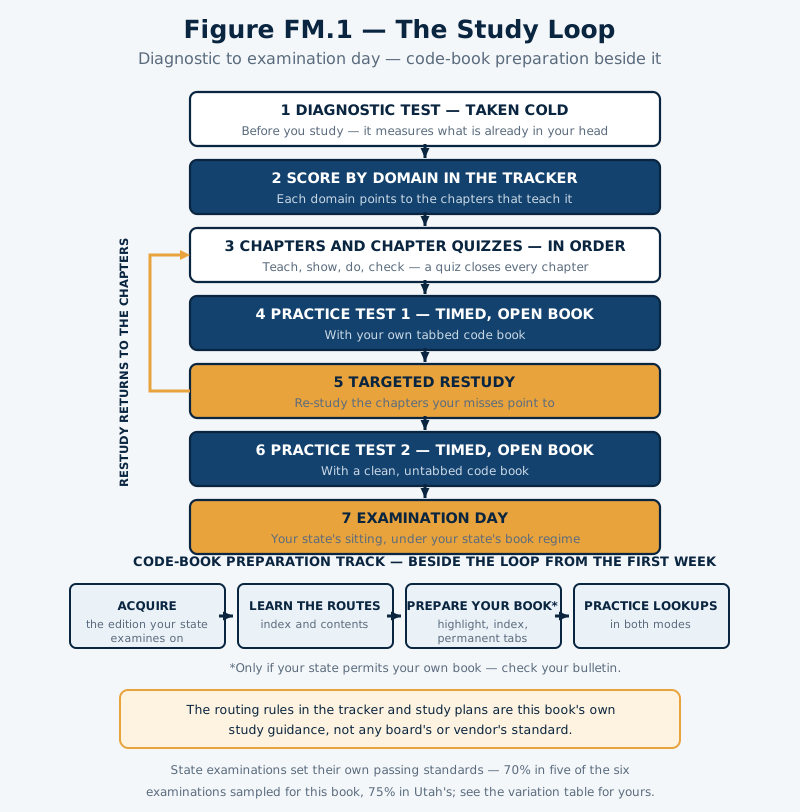
Diagnostic test (taken cold) → score by domain in the tracker → chapters and chapter quizzes in order → Practice Test 1, timed and open-book, with your own tabbed code book → targeted restudy of the chapters your misses point to → Practice Test 2, timed and open-book, with a clean, untabbed code book → examination day. A code-book preparation track (acquire the edition your state examines on → learn the index and contents routes → if your state permits your own book, highlight, index, and fit permanent tabs → practice lookups in both modes) runs beside the loop from the first week. A caption rule printed under the loop reads: the routing rules in the tracker and the study plans are this book's own study guidance, not any board's or vendor's standard. State examinations set their own passing standards — 70% in five of the six examinations sampled for this book, 75% in Utah's — see the variation table for yours.
The diagnostic test stands in the front matter of the full book, immediately after this section, and both study plans begin with it. It contains 50 original questions allocated across this book's sixteen synthesized content domains in proportion to their weights in the book's crosswalk of the six published outlines — theory and principles 5, services, feeders, and load calculations 7, grounding and bonding 5, and the remaining domains in proportion — with the rounding disclosed in the test's own notes. That allocation is this book's synthesis from the published outlines; it is not any single examination's published weights, and it is labeled as this book's wherever it appears. Take the diagnostic cold, closed-book, in no more than 60 minutes, before you study — the one closed-book sitting in this book, because its job is to measure what is already in your head before the code book and the chapters go to work. It is scored by domain, not only in total: the Score-by-Domain Tracker at the end of the diagnostic key converts each domain result into a study priority and points to the exact chapters that teach that domain.
The tracker's priority bands are this book's own study guidance, not any board's or vendor's standard, and they are labeled that way in the tracker itself. State examinations set their own passing standards, and no score on this 50-item diagnostic is any state's line: no diagnostic score promises or predicts an examination result in either direction. A low diagnostic score costs you nothing today and buys you an honest map. The same gaps discovered on examination day are the expensive version.
The back matter carries both plans day by day, referenced to chapters and tests, and each carries the code-book preparation track beside the reading track.
The standard plan (about four weeks). Diagnostic first, cold. Then the chapters in order — Part I without skipping, whatever your background — taking each chapter quiz before moving on and re-reading any section a missed question points back to. Build your code-book skill a chapter at a time as the code core arrives: every Part II chapter ends with lookups in your own copy. In the final week, take Practice Test 1 (your own book) and Practice Test 2 (a clean book) on separate days, under real conditions — 100 items, 270 minutes, open-book under the declared regime, a silent, nonprinting, nonprogrammable calculator where the sitting's regime permits one, and scratch paper — review every missed item against the chapter it maps to, and re-read Chapter 26 the day before you test.
The intensive plan (about two weeks). Diagnostic first, cold, and let it triage you. Experienced readers may move through Part I at double pace only where the diagnostic shows the foundations are already theirs; the saved time goes to the chapters the diagnostic flags, and to calculation drills — calculation speed is the documented failure mode of experienced candidates, and it does not fix itself. Every chapter quiz is still taken. Compress the code-book preparation into the first week, in both navigation modes: whichever room your state gives you, you will navigate a code book under a clock, and that skill is not optional equipment. Finish with both practice tests, timed and open-book under their declared regimes, on separate days. If your state splits its sitting, run at least one practice test in the split-sitting form as well.
In both plans, treat the practice tests as rehearsals of the whole event, not as question banks: same timing, same book regime, same two-pass discipline.
Front matter — this page; the Exam Format page, with the dated state-variation table; How to Use This Book; the diagnostic test and the Score-by-Domain Tracker. The free sample of this book is Chapter 1 plus the diagnostic test, so a buyer can judge the teaching and see their own score by domain before paying.
Part I — Foundations (from zero)
Part II — The code core (in the Code's own order)
Part III — Systems and special work
Part IV — Craft and exam mastery
Back matter — two full timed practice tests (100 items each, 270 minutes, open-book, alternating book regimes, with full answer keys); the 2-week intensive and 4-week standard study plans, each with its code-book preparation track and the split-sitting option; cheat sheets (numbers sheet, every testable figure with its source and its edition basis where it has one; formulas sheet, each formula with a worked mini-example; code-book navigation sheet, both modes); glossary; errata and updates page; References; and the printed outline crosswalk appendix — including the state-variation table — so you can verify for yourself that every domain of the sampled outlines and every part of the field has a home chapter.
Every examination fact and count in this book traces to a state-board, NASCLA, or vendor primary source named in the Exam Format page's table — or, for the knowledge the examinations test, to the governing primary source itself: the OSHA electrical regulations (29 CFR 1910 Subpart S and 1926 Subpart K, read at section level for this edition) and the structure of NFPA 70 itself. The source is named where the fact is used. Facts that could not be verified from such a source are not printed as facts. You will therefore not find in this book: any state's fee, eligibility or experience requirement, renewal rule, or application step printed as general fact (route and state figures live only inside the dated variation table, with their bulletins attached, and eligibility is yours to confirm with your board, full stop); any state's law, rules, or code amendments taught as content (Washington's and Utah's law sections are named and fenced, and you are sent to your board for them); the text, tables, figures, or table structure of the NEC or of NFPA 70E (copyrighted works, taught here in original words and used in the room in the copy your regime provides or permits); any NFPA 70E table value, approach-boundary distance, or PPE-category threshold printed as a requirement (70E is taught at concept level, as the recognized practice an employer's program uses — OSHA's enforceable floor is Subpart S and Subpart K, and OSHA itself states that it does not enforce 70E); Texas's part-level item counts, times, or fee, or California's book policy (their governing bulletins were not read for this edition); a pass rate or candidate volume for any examination (none is published in any primary source read for this edition); salary figures or earnings claims of any kind; or any promise about licenses, jobs, or income.
Silence, in those places, is deliberate. A study book that guesses at numbers teaches you to guess — and guessing, on an examination built from job situations and calculations with exactly one defensible answer, is the habit this book exists to replace.
End of the free sample. The complete book continues from here — the full A-to-Z course in book form, delivered as an EPUB you can read in Apple Books, Google Play Books, ReadEra, Thorium Reader, Adobe Digital Editions, or Send to Kindle.
Buy this ebook — $11.99 Back to the book page
Payments are securely processed by Payhip.