
Mastering Careers & Skills
Airline Transport Pilot Licence (ATPL) Theory: Aircraft, Performance & Planning · free sample from the book itself
Q1. Key: B. Thirteen authority papers are set by the competent authority from the ECQB, and Area 100 KSA is assessed by the ATO — it is not an authority paper (GATE-A1 §1, §6). A is wrong because there is no fourteenth authority paper; the number 14 belongs to the knowledge areas in FCL.515(b), a different layer. C is wrong because there are thirteen papers, not twelve, and EASA does not examine KSA — EASA owns the bank while authorities examine and ATOs assess KSA. D is wrong because, although it has the paper count right, it makes KSA an authority written paper, which contradicts its ATO-assessed status. [FCL.515]
Q2. Key: C. The AMC1 ARA.FCL.300(b) table gives 021 as 80 questions in 120 minutes (GATE-A1 §1, S-24). A is wrong because 60 questions in 90 minutes is the shape of 022 Instrumentation, not 021. B is wrong because 44 questions in 60 minutes is the shape of 010 Air Law. D is wrong because 66 questions in 90 minutes is the shape of 062 Radio Navigation, a companion-volume subject. [EXAM TABLE]
Q3. Key: A. FCL.515(b) lists 14 knowledge areas, naming VFR Communications and IFR Communications separately; since 1 February 2022 the two are examined as the single paper 090 Communications, giving 13 authority papers (fence V-04; GATE-A1 §1). B is wrong because the area count is 14, not 13, and the difference is explained by the Communications merger, not by ATO assessment — the ATO-assessed element is Area 100, which is additional to the 14 areas. C is wrong because the two Communications areas are examined in one authority paper; they are not ATO-assessed. D is wrong because there are 14 areas, not 15, and no area was removed in 2022 — two areas were merged into one paper. [FCL.515]
Q4. Key: D. EASA's own position is that the ECQB is a bank of some 10,000 multiple-choice questions owned by EASA, used by the Member States' competent authorities, which select questions and run the examinations; the bank is confidential and not publicly available (S-25; fence V-03). A is wrong because the bank is expressly not published; every question in preparation material, including this book, is original and written against the published learning objectives. B is wrong because ownership rests with EASA, not with the authorities or ATOs jointly. C is wrong on the size — the bank is some 10,000 questions, not about 1,000 — although its confidentiality, stated there, is correct. [ECQB]
Q5. Key: B. FCL.025(a) requires the whole set to be taken under one Member State's competent authority, and the candidate sits only when recommended by the ATO (or DTO where applicable) after completing the theoretical knowledge course elements to a satisfactory standard (GATE-A1 §5). A is wrong because splitting the set across Member States is exactly what the one-State rule forbids. C is wrong because there is no self-study route into the examinations (fence V-05): a course at an ATO and its recommendation are required. D is wrong because the recommending body is the training organisation, not EASA, and the recommendation governs entry to the examinations generally, not a first sitting only. [FCL.025]
Q6. Key: A. FCL.025(b)(1) awards a pass at at least 75% of the marks allocated to the paper, and there is no penalty marking — a wrong answer scores zero and deducts nothing (GATE-A1 §2). B is wrong because the standard applies paper by paper; there is no aggregate and no compensation between papers. C is wrong on both numbers and mechanism: the standard is 75%, not 70%, and penalty marking does not exist in this system. D is wrong because, although its percentage is right, the one-mark deduction it describes is penalty marking, which FCL.025 does not provide for — hence the rule that a candidate should answer every question. [FCL.025]
Q7. Key: D. FCL.025(b)(2) counts the 18 months from the end of the calendar month in which the first attempt was made, so a first attempt on 12 May 2027 starts the count at 31 May 2027 (GATE-A1 §3). A is wrong because the count does not run from the day of the attempt itself; the remainder of the attempt month falls outside the counted period. B is wrong because the trigger event is the first attempt, not the first pass — a failed first attempt starts the clock just as a passed one does. C is wrong because the recommendation precedes the attempt and is not the counting event the paragraph specifies. [FCL.025]
Q8. Key: C. FCL.025(b)(3) allows a maximum of four attempts at each paper and a maximum of six sittings, all within the 18-month period; breaching any of these limits obliges the applicant to retake the complete set of papers (GATE-A1 §4). A is wrong on both limits (three and four are not the figures) and on the consequence, which is retaking the complete set, not the failed paper. B is wrong because attempts are capped at four per paper; they are not unlimited. D is wrong because sittings are capped at six — the option omits that limit — and the consequence of breach is retaking the complete set, not a waiting period. [FCL.025]
Q9. Key: A. A sitting is a period established by the competent authority; AMC1 FCL.025 states that it should not exceed 10 consecutive days, and a candidate makes one attempt at a paper within a sitting (GATE-A1 §4). B is wrong because the ten-day figure is an AMC "should", not a fixed EU rule — fence V-06 forbids presenting it as a uniform fixed length. C is wrong because the candidate does not choose the sitting and cannot attempt the same paper twice within one sitting. D is wrong because sittings are established by the competent authority, not by the ATO, and are not defined as a calendar month. [FCL.025]
Q10. Key: B. FCL.025(b)(5) requires the applicant, before retaking the complete set, to undertake further training at a DTO or ATO, with the extent of the training determined by the training organisation (GATE-A1 §4). A is wrong because the paragraph imposes training, not a bare waiting period. C is wrong because a medical certificate, whatever its own validity requirements, is not the condition FCL.025(b)(5) attaches to retaking the set. D is wrong because repeating Area 100 assessments is not the stated requirement; the requirement is further training whose extent the DTO/ATO sets. [FCL.025]
Q11. Key: D. The verified course figures are 750 hours of theoretical knowledge instruction on an integrated course, and on a modular course 650 hours for a PPL holder, 400 hours for a CPL holder, 500 hours for an IR holder and 250 hours for a CPL+IR holder (GATE-A1 §5). A is wrong because the modular requirement is not a flat 750 hours — it reduces with prior qualifications held. B is wrong because the integrated figure is 750 hours, not 500. C is wrong because it reverses the architectures: 750 hours is the integrated figure and 650 hours is the modular figure for a PPL holder. [FCL.515]
Q12. Key: A. AMC1 FCL.025(a)(2) requires, before the ATO recommends a first attempt at the final paper, completion at the ATO of the Area 100 summative assessments — at least two summative and at least one formative assessment covering topics 100 02 and 100 03 — and a mental mathematics test passed at the 75% floor or above (GATE-A1 §6). B is wrong because Area 100 is not examined by competent authorities at all; there is no further authority paper in it. C is wrong because the mental mathematics test does carry a pass floor — 75% — and because the KSA assessments are also required, not the test alone. D is wrong on timing: the assessments and test must be complete before the recommendation for the first attempt at the final paper, not after that attempt. [KSA]
Q13. Key: C. Under FCL.025(c), a completed set of theoretical knowledge examinations is valid for CPL, MPL or IR issue for 36 months counted from the day of successful completion of the examinations (GATE-A1 §7; fence V-10). A is wrong because seven years is the ATPL figure, and it does not run from completion in any case. B is wrong because 18 months is the FCL.025(b)(2) period for passing all the papers, not a post-completion validity period. D is wrong because it attaches the IR-validity-date anchor — which belongs to the seven-year ATPL clock — to the 36-month period, whose anchor is the day of successful completion. [FCL.025]
Q14. Key: B. For ATPL issue, the seven-year period runs from the last validity date of an Instrument Rating entered in the licence (FCL.025(c); GATE-A1 §7). A is wrong because the seven years are expressly not counted from the examination completion date — that anchor belongs to the 36-month CPL/MPL/IR clock, and fence V-10 forbids the "7 years from passing" formulation. C is wrong because the first-attempt date starts the 18-month completion clock under (b)(2), not any validity period. D is wrong because the skill test date is not the anchor the paragraph specifies; the anchor is the IR's last validity date in the licence. [FCL.025]
Q15. Key: D. Fees, booking arrangements and sitting calendars are set by each competent authority and vary between Member States; the book teaches them as variation and prints no fee figures (fences V-01 and V-06). A is wrong because the 75% pass standard is a uniform EU rule in FCL.025(b)(1), not a national matter. B is wrong because the 18-month completion period is a uniform EU rule in FCL.025(b)(2). C is wrong because the maximum of four attempts per paper is a uniform EU rule in FCL.025(b)(3). [TRAP]
The Airline Transport Pilot Licence (aeroplane) — ATPL(A) — theoretical knowledge examinations are a set of papers, not a single examination. Each paper belongs to one subject, carries a published number of multiple-choice questions, and is allowed a published duration. The table that governs this book is the examination table in AMC1 ARA.FCL.300(b), as published by a competent authority: thirteen authority papers, 671 questions in total, and 1,245 minutes of examination time in total. Learn the shape of your own set now, because every study plan, every sitting plan, and every rehearsal in this book is built on these numbers.
The thirteen papers are these. Subject 010, Air Law: 44 questions in 60 minutes. Subject 021, Aircraft General Knowledge — Airframe, Systems and Powerplant: 80 questions in 120 minutes. Subject 022, Aircraft General Knowledge — Instrumentation: 60 questions in 90 minutes. Subject 031, Mass and Balance: 25 questions in 75 minutes. Subject 032, Performance: 45 questions in 120 minutes. Subject 033, Flight Planning and Monitoring: 42 questions in 120 minutes. Subject 040, Human Performance: 48 questions in 90 minutes. Subject 050, Meteorology: 84 questions in 120 minutes. Subject 061, General Navigation: 55 questions in 135 minutes. Subject 062, Radio Navigation: 66 questions in 90 minutes. Subject 070, Operational Procedures: 42 questions in 75 minutes. Subject 081, Principles of Flight (aeroplane): 46 questions in 90 minutes. Subject 090, Communications: 34 questions in 60 minutes.
This volume teaches seven of those subjects — 010, 021, 022, 031, 032, 033 and 070 — and replicates their seven papers in full timed batteries at the back of the book. The remaining six subjects — 040 Human Performance, 050 Meteorology, 061 General Navigation, 062 Radio Navigation, 081 Principles of Flight and 090 Communications — are the subjects of the companion volume, and are named as companion-volume subjects wherever they appear in this chapter. Area 100, Knowledge, Skills and Attitudes (KSA), completes the picture but is not an authority paper at all: it is assessed by your approved training organisation (ATO), as section 1.9 explains. Its teaching, too, belongs to the companion volume; what this chapter gives you is the rule that governs when it must be complete, because that rule affects the order in which you may sit your final paper in this volume as much as in the other.
Two features of the table deserve attention before any other detail. First, the time allowance per question varies widely between papers, and it varies for a reason. A paper such as 010 Air Law allows a little over a minute per question because its questions are, in the main, questions of knowledge and understanding: you know the rule or you do not. A paper such as 031 Mass and Balance allows three minutes per question because most of its questions are calculations that must be set up, worked and checked. A paper such as 061 General Navigation allows the longest total time in the set, 135 minutes, for the same reason. When you rehearse, rehearse at the published pace of the paper in front of you, not at a single pace for all papers. Second, the set is large. Six hundred and seventy-one questions is not a hurdle you clear in a weekend of revision at the end of a course; it is the examined output of a course measured in hundreds of hours, and the system described in the rest of this chapter — the recommendation gate, the eighteen-month clock, the limits on attempts and sittings — is designed around that scale.
Worked example 1.1 — Checking the totals. Add the question counts in groups. The seven papers in this volume: 44 + 80 + 60 + 25 + 45 + 42 + 42 = 338 questions. The six companion-volume papers: 48 + 84 + 55 + 66 + 46 + 34 = 333 questions. Total: 338 + 333 = 671 questions. Now the durations. This volume: 60 + 120 + 90 + 75 + 120 + 120 + 75 = 660 minutes. The companion volume: 90 + 120 + 135 + 90 + 90 + 60 = 585 minutes. Total: 660 + 585 = 1,245 minutes — twenty hours and forty-five minutes of examination time, before a single break, briefing or identity check is counted. That is the size of the task the rest of this chapter organises.
Candidates meeting this system for the first time often ask why one document speaks of fourteen subjects and another of thirteen examinations. Both numbers are correct, and they belong to two different layers of the system, which this book prints together whenever the point arises. FCL.515(b) lists the knowledge areas in which an ATPL applicant must have demonstrated a level of theoretical knowledge: fourteen areas. The examination system, however, sets thirteen authority papers. The difference lies in one subject, Communications.
In the FCL.515(b) list, Communications appears as two knowledge areas: VFR Communications and IFR Communications. That split reflects the way the knowledge itself is organised — the procedures, phraseology and rules for visual flight differ from those for instrument flight, and the syllabus treats them as distinct areas of knowledge. Since 1 February 2022, however, the two areas have been examined together as a single authority paper: subject 090, Communications, 34 questions in 60 minutes. The knowledge areas remain two in the regulation's list; the paper that examines them is one. So the correct statement of the system, in both layers, is this: fourteen knowledge areas in FCL.515(b); thirteen authority papers set by the competent authority; plus Area 100 KSA, assessed by the ATO rather than examined by the authority.
Getting this layering right matters beyond pedantry, and it will matter again in Chapter 2. Certain credit arrangements in the regulations were drafted against the FCL.515(b) split — they speak of a credit in VFR Communications or a credit in IFR Communications as separate things. Those credits are real, and Chapter 2 states them exactly as they are drafted. What you must not do is convert a credit expressed against the knowledge-area layer into a claim about the paper layer — for example, by concluding that a holder of one communications credit "need not sit" part of a merged paper. The papers are set by the competent authority under the current examination structure, and the authority's current structure has one Communications paper. Wherever this book meets a provision drafted in the older, split language, it says so, and leaves the two layers side by side rather than merging them into a claim neither layer supports.
A second numbering point belongs in this section, because it causes the same kind of confusion. Principles of Flight for the aeroplane is subject 081 in the current coding. The code 080 was the legacy umbrella code under which principles of flight for different aircraft categories once sat; it is not the code of the current aeroplane paper, and this book never uses it as such. Similarly, inside subject 070, Operational Procedures, the topics themselves are coded 071 — you will meet topic codes such as 071 01 in Chapter 39. Subject code and topic code are, once again, two layers, and the book keeps them distinct.
Every question in every one of the thirteen papers, in every Member State, is drawn from a single source: the European Central Question Bank, the ECQB. The ECQB is owned by the European Union Aviation Safety Agency (EASA). It contains some 10,000 multiple-choice questions. It is confidential examination material: it is not publicly available, and no candidate, school or book — including this one — can show you its questions. The competent authority of the Member State under which you take the examinations selects the questions for your papers from the bank and runs the examinations themselves. EASA owns the bank and publishes the syllabus and learning objectives against which the bank is written; the national competent authorities select and administer; your ATO teaches and recommends. Those are three different functions, held by three different bodies, and much confusion about this system dissolves once they are kept apart.
The syllabus side of the system is public, and it is what this book is built on. The theoretical knowledge syllabus and its learning objectives (LOs) are published in the Acceptable Means of Compliance and Guidance Material to Part-FCL — the AMC and GM — as last amended by ED Decision 2020/018/R at the time the gate for this book was passed. The LOs state, topic by topic, what a candidate must know, understand, be able to calculate or be able to apply. Examination charts and planning material used in the papers derive from the General Student Pilot Route Manual (GSPRM) specification in the syllabus — a provider-neutral specification, a point Chapter 35 takes up in detail.
Because the bank is confidential, a discipline follows for any preparation material you use, and this book states its own position plainly. Every question in this book is an original practice question, written for this book against the published learning objectives. Practice questions teach and test the same knowledge the real papers test, in the same published shapes; they are not the real papers, and any product that claims to offer you the real bank is claiming something the bank's confidential status makes impossible to offer honestly. Treat such claims as a warning about the product, not as an opportunity.
One practical consequence of a single European bank deserves emphasis. Because the questions come from one bank against one syllabus, the knowledge required is the same whichever Member State examines you. What differs between States is administration — how you book, when sittings are held, how the examination session is run, in what language arrangements the examination is administered, and what fees are charged. Section 1.11 teaches that variation as variation. The knowledge, the pass standard, the clocks and the attempt limits in sections 1.4 to 1.10 are the European rules, and they are the same for every candidate.
FCL.025(a) sets two conditions at the entrance to the system, and both are absolute. First, the whole set of examinations is taken under one Member State. An applicant for the theoretical knowledge examinations takes all of the papers under the responsibility of a single competent authority. You cannot sit some papers in one State and the remainder in another, assembling a set across borders; the set is a set precisely because one authority holds your record, counts your attempts and sittings, and watches your eighteen-month clock. Choose the State before you begin, with your ATO's guidance, because the choice governs the whole attempt.
Second, you sit only when recommended. An applicant sits the examinations only when recommended by the approved training organisation — or, where the rules provide, a declared training organisation (DTO) — at which the applicant completed the theoretical knowledge course, and only after completing the relevant elements of that course to a satisfactory standard. The recommendation is the authority's assurance that a structured course stands behind the candidate: that the syllabus has been taught, in sequence, by an organisation approved to teach it, and that the organisation judges the candidate ready. FCL.515(a) carries the matching course requirement on the licence side: the applicant must have completed the theoretical knowledge instruction at an ATO in accordance with the applicable course requirements.
This is the point at which to be exact about what this book is. The book is preparation material to study alongside the ATO course. It is not the course, it cannot recommend you, and no amount of success in its exercises substitutes for the course elements your ATO must sign off. That is not a disclaimer added for form's sake; it is the structure of the regulation, and a candidate who treats any book as a self-study route into the examination room will meet the recommendation gate as an immovable obstacle. Used as it is meant to be used — the same syllabus, in the same topic order, worked at greater length than classroom time allows — the book and the course reinforce each other. That is the only relationship between a book and an ATO course that the system recognises, and it is a genuinely useful one.
The recommendation also has a timing consequence that section 1.9 develops: there is a further gate, specific to your final paper, at which the ATO must confirm that your Area 100 KSA assessments and mental mathematics test are complete before it recommends you for a first attempt at that paper. Keep that in mind from the start. The recommendation is not a single event at the beginning of your examination period; the system asks your ATO to stand behind you at entry, and asks again, with an additional condition, at the end.
FCL.025(b)(1) states the pass standard in one sentence, and it repays slow reading. A pass in a theoretical knowledge examination paper is awarded to an applicant achieving at least 75 per cent of the marks allocated to that paper. Three consequences follow, each of which shapes how you should prepare.
First, the standard applies paper by paper. There is no aggregate across the set, no compensation between papers, and no averaging. A candidate who scores very highly in 021 does not thereby need less than 75 per cent in 033; each of the thirteen papers must individually be passed at 75 per cent or above. Your study plan must therefore be a plan for thirteen separate passes (with KSA assessed separately), and a subject you dislike needs the same threshold as a subject you enjoy. This is why the diagnostic at the front of this book is scored by subject strand: it shows you, before you begin, where a sub-threshold strand is hiding.
Second, the standard is 75 per cent of the marks allocated to the paper. Papers differ in length, so the number of marks that constitutes a pass differs with them, but the proportion never does. On a 44-question paper, 75 per cent is 33 marks. On an 80-question paper, it is 60 marks. Learn to think in proportions during rehearsal: when you mark a practice battery, record the percentage, not only the raw score, because the percentage is the number the regulation cares about and the only number comparable across papers of different lengths.
Third, there is no penalty marking. A wrong answer scores zero for that question; it does not subtract marks earned elsewhere. FCL.025 contains no provision for negative marking, and the gate for this book verified the point expressly. The examination consequence is decisive and section 1.12 builds your sitting strategy on it: an unanswered question is a certain zero, while an attempted question is a zero or a mark. There is never a scoring reason to leave a question blank. If you meet advice, in older material or from other examination systems, telling you to leave questions unanswered rather than risk a penalty, that advice belongs to a different system. In this one, you answer everything.
Worked example 1.2 — The pass mark on two papers. Paper 021 carries 80 questions. 75 per cent of 80 is 0.75 × 80 = 60 marks: a candidate needs at least 60 of the 80 marks to pass. Paper 031 carries 25 questions. 75 per cent of 25 is 18.75 marks; since marks are whole, the candidate needs at least 19 marks — the first whole number of marks that reaches at least 75 per cent. Notice the small-paper effect: on a 25-question paper each question carries 4 per cent of the paper, so a single careless error costs more, proportionally, than one error on an 80-question paper, where each question carries 1.25 per cent. Short papers are not easier papers; they are papers with less room for carelessness.
FCL.025(b)(2) sets the period within which the whole set must be completed: an applicant must have passed all of the required examination papers within a period of 18 months counted from the end of the calendar month of the first attempt. Read the counting rule carefully, because it is more generous — and more precise — than the phrase "eighteen months from your first exam" suggests.
The clock does not start on the day of your first attempt. It starts at the end of the calendar month in which that first attempt falls. If your first attempt at any paper takes place on, say, 10 March, the eighteen months are counted from 31 March, and the period therefore ends eighteen months after that month-end. Every day of the month of the first attempt is, in effect, free: a first attempt on 2 March and a first attempt on 30 March start the same clock. The practical lesson is the mirror image of the rule. Your first attempt at any paper — even a single paper taken early, almost experimentally — starts the clock for the entire set. There is no such thing as a harmless early try. Candidates sometimes sit one paper early "to see how it feels"; under FCL.025(b)(2), that sitting commits them to completing all thirteen papers within eighteen months of the end of that month, and it consumes one of the sittings and one of the attempts counted in section 1.7. Enter the system when your course progress says you are ready to run the whole set inside the window, and not before.
Note also what the clock governs. It is the period for passing all the papers. It is distinct from the validity periods that begin after the set is complete, which section 1.10 covers: the eighteen-month period is a completion deadline, not a validity period, and confusing the two produces bad plans. While the eighteen-month clock is running, your task is to convert attempts into passes inside it. Only when the last paper is passed does the set become "completed theoretical knowledge" whose validity, for licence issue, the clocks of section 1.10 then measure.
Worked example 1.3 — Counting the window. A candidate makes a first attempt at a paper on 14 October 2026. The eighteen months are counted from the end of that calendar month: 31 October 2026. Eighteen months counted from the end of October 2026 ends at the end of April 2028. Every paper in the set must therefore be passed within that period — by the end of April 2028 on this counting. Observe what the rule did: the attempt on 14 October bought the candidate the remainder of October outside the counted period, and the deadline fell on a month-end, not on an anniversary of the attempt date. When your own first attempt is booked, perform exactly this count — attempt month, month-end, plus eighteen months — and write the resulting deadline where you will see it every week of your course.
Figure 1.1 (Class A) — The FCL.025 clocks: the 18-month completion period, six sittings, four attempts per paper, and the validity periods that follow completion.
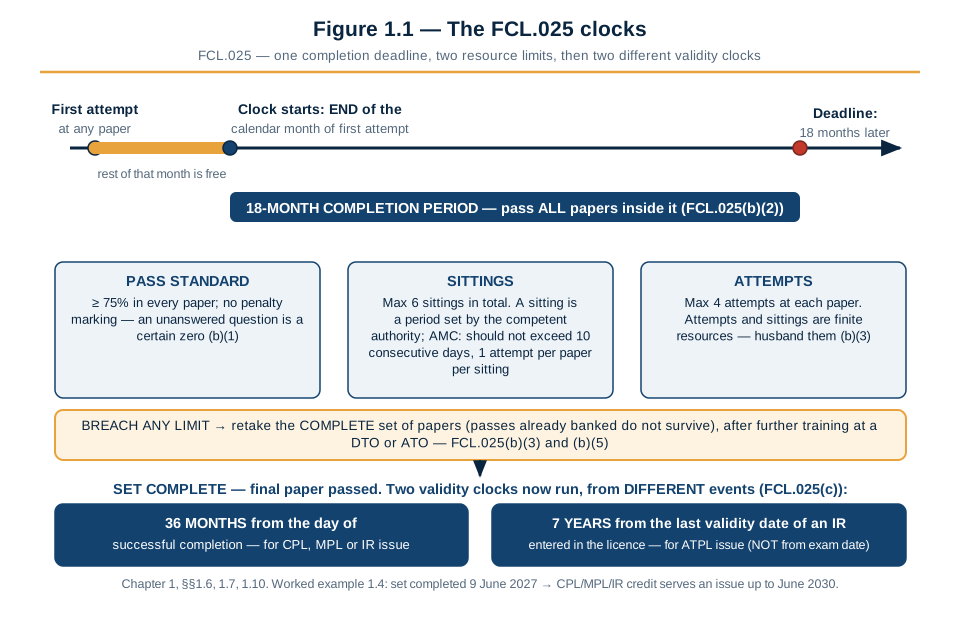
Figure 1.1 — The FCL.025 clocks: the 18-month completion period, six sittings, four attempts per paper, and the validity periods that follow completion.
FCL.025(b)(3), in its current text, limits both the number of attempts at each paper and the number of sittings you may use, and it attaches the system's most severe consequence to breaching either limit. An applicant may make no more than four attempts at each examination paper, and may use no more than six sittings in total, and all of this must happen within the eighteen-month period of FCL.025(b)(2). If the applicant fails to pass all the papers within those limits — a fifth attempt at any one paper would be needed, or a seventh sitting, or the eighteen months expire — the consequence is that the applicant must retake the complete set of examination papers. Not the failed paper alone: the complete set, including every paper already passed. Passes banked inside a failed campaign do not survive it.
That consequence is the single most important planning fact in this chapter, and it should change how you behave from your first sitting. Attempts are a finite resource: four per paper sounds ample until a candidate spends two attempts on a paper entered too early, under-prepared, "to see the standard". Sittings are likewise finite: six sittings in which to pass thirteen papers means the average sitting must clear more than two papers, and a sitting used on a single speculative paper is a sitting unavailable later, when the eighteen-month clock is pressing. The strategy sections at the end of this chapter (sections 1.12 and 1.13) are built entirely on husbanding these two resources.
Two definitions complete the picture. A "sitting" is a period established by the competent authority during which a candidate may attempt papers. It is the authority, not the candidate, that establishes the period — which is why sitting calendars are national variation (section 1.11). The Acceptable Means of Compliance, AMC1 FCL.025, says a sitting should not exceed 10 consecutive days, and that within a sitting a candidate makes one attempt at a paper — you cannot attempt the same paper twice inside one sitting. Note the status of that ten-day figure: it is an AMC "should", guidance on how authorities should establish sittings, not a fixed European rule that every sitting lasts ten days. This book teaches it at exactly that strength. Your authority's actual sitting periods are what they publish; the AMC figure tells you the scale to expect, no more.
The retake rule has a second half, in FCL.025(b)(5). Before retaking the complete set of papers after a breach of the limits, the applicant must undertake further training at a DTO or ATO, with the extent of that training determined by the training organisation. The logic is consistent with the recommendation gate of section 1.4: the system does not permit a candidate simply to re-enter and try the identical campaign again. A failed campaign is evidence that the preparation was insufficient, and the regulation requires structured training — its amount assessed by the organisation that knows the candidate — before a new campaign begins. A new campaign, when it begins, starts the machinery afresh: a new first attempt, a new eighteen-month count, new attempt and sitting allowances, and all thirteen papers to pass again.
Behind the recommendation gate stands a course of theoretical knowledge instruction, and its size is specified. The figures verified for this book are the course-hour requirements for the ATPL(A) theoretical knowledge course in its two architectures. On an integrated course — the full-time course that carries a student from the beginning through to the commercial licence with instrument rating and ATPL theory in one continuous programme — the theoretical knowledge instruction is at least 750 hours. On a modular course, where the student assembles the qualifications in stages and studies ATPL theory as its own block, the requirement depends on what the student already holds: 650 hours for the holder of a Private Pilot Licence, PPL(A); 400 hours for the holder of a Commercial Pilot Licence, CPL(A); 500 hours for the holder of an Instrument Rating, IR; and 250 hours for the holder of both a CPL(A) and an IR.
The pattern in the modular figures is itself instructive. The hours reduce as prior qualifications rise, because prior licences carry prior theoretical knowledge with them: a CPL holder has already studied and passed commercial-level theory in overlapping subjects, and an IR holder has studied instrument-flight knowledge, so the ATPL course for such students builds on examined foundations rather than starting from bare ground. The smallest figure, 250 hours, belongs to the candidate who holds both. When you read your own position in that table, read it as a statement about assumed prior knowledge — and test the assumption honestly. If your CPL theory was passed years ago and little retained, the 400-hour course will move at the pace its hours imply, and the gap between the assumed foundation and your actual foundation is yours to close, with this book among the tools for closing it.
These are minima for the instruction element — the structured course your ATO delivers and against which it recommends you. They are not predictions of the total study time a successful candidate spends, which for most candidates is considerably larger once private study, question practice and revision are counted. Nor are they a promise that completing the hours completes the learning: the recommendation gate requires the course elements completed to a satisfactory standard, a judgement about attainment, not attendance. Plan your life around the course hours as the skeleton of your preparation, and expect the flesh on that skeleton — your own worked hours — to be at least as much again.
Area 100, Knowledge, Skills and Attitudes, is the part of the ATPL theoretical knowledge syllabus that is not examined by the competent authority at all. The authority does not set a paper for it. Instead, Area 100 is assessed by the ATO during the course, through assessments designed to show that the candidate can apply knowledge and demonstrate the competencies the area names. Its structure, in outline: topic 100 01 frames the ICAO core competencies; topic 100 02 sets out learning objectives for core competencies — communication; leadership and teamwork; problem-solving and decision-making; situation awareness; and workload management; topic 100 03 covers threat and error management (TEM)-related objectives, including the application of knowledge and, within it, upright and resilience material (UPRT and resilience); and topic 100 04 is Mental Maths — a defined family of calculation skills, which Chapter 3 of this book introduces as a working skill because every calculation subject in this volume draws on it.
The rule that makes Area 100 this chapter's business — even though its teaching belongs to the companion volume — is a timing rule in AMC1 FCL.025(a)(2), and it is a gate on your examination campaign. Before the ATO recommends a candidate for a first attempt at the candidate's final examination paper, the candidate must have completed, at the ATO: the Area 100 summative assessments — at least two summative assessments and at least one formative assessment covering topics 100 02 and 100 03 — and a mental mathematics test, passed at the same 75 per cent floor the authority papers use. Until those are done, the ATO may not recommend the first attempt at the final paper. The earlier papers are unaffected: you may sit paper after paper on the ATO's recommendation in the ordinary way. But the last paper of your set is held behind this gate.
The planning consequence is simple and frequently missed. Candidates who leave KSA assessments and the mental maths test until late in the course can find themselves ready for their final paper — with the eighteen-month clock running and sittings remaining — yet unable to be recommended for it until assessment slots are completed. Build the KSA elements into the middle of your campaign, not its end. Your ATO schedules them; your job is to know, from the start, that they exist, that they are assessed rather than examined, that the mental maths test carries a 75 per cent pass floor, and that all of them must be complete before the first attempt at whichever paper turns out to be your last.
When the final paper is passed, the set is complete, and a different set of clocks starts: the validity periods of FCL.025(c), which measure how long completed theoretical knowledge remains usable for the issue of a licence or rating. There are two, and they run from different events. Precision here is not pedantry; candidates lose real opportunities by misremembering which clock runs from what.
For the issue of a Commercial Pilot Licence (CPL), a Multi-Crew Pilot Licence (MPL) or an Instrument Rating (IR), the completed theoretical knowledge is valid for 36 months, counted from the day of successful completion of the theoretical knowledge examinations — the day the set was completed by passing the final paper. A candidate who completes the set and intends to take a CPL or an IR must therefore reach licence or rating issue within three years of that day, or the theory credit expires for that purpose and the examinations must be retaken to restore it.
For the issue of the ATPL itself, the period is seven years — but the seven years are not counted from the day you passed the examinations. Under FCL.025(c), the seven-year period runs from the last validity date of an Instrument Rating entered in the licence. The distinction is the whole point of the provision's design. The typical ATPL candidate completes the theory, takes a CPL and a multi-engine IR, and flies for years building the experience Chapter 2 describes before the ATPL can be issued. A seven-year clock running from the examination pass date would expire during exactly the experience-building years the licence requires. Instead, the clock is anchored to the currency of the holder's instrument rating: as long as the IR entered in the licence remains valid and is renewed, the anchor moves with it, and the seven years run from the IR's last validity date. The theory credit is thus kept alive by keeping the instrument rating alive — a connection Chapter 2 returns to when it explains the "frozen ATPL" in full.
Worked example 1.4 — Two clocks, two starting events. A candidate passes the final paper on 9 June 2027; the set is successfully completed that day. For CPL, MPL or IR issue, the 36-month clock runs from 9 June 2027, so the credit serves an issue up to 36 months later — June 2030. For ATPL issue, no seven-year period has even begun to run on these facts: that clock will run from the last validity date of an IR entered in the candidate's licence, an event that lies in the future and moves as the IR is renewed. A candidate who says "my ATPL theory expires seven years after I passed, in June 2034" has merged the two clocks into a statement neither of them makes. Keep them separate: 36 months from completion for CPL/MPL/IR; seven years from the last IR validity date for the ATPL.
Everything in sections 1.4 to 1.10 is European rule: one bank, one syllabus, one pass standard, fixed clocks and limits, stated in Part-FCL and its AMC. Around that uniform core sits a ring of matters the European rules leave to the Member States, and this book's discipline is to teach those matters as variation — to tell you that they vary, and what they vary between — and never to print one State's arrangements as if they were the European rule.
The variable matters include these. How examinations are booked: the booking channel, the notice required and the process for changing a booking are set by each competent authority. Sitting calendars: since a sitting is a period established by the competent authority (section 1.7), when sittings occur, how long each authority's sittings in fact run, and which papers are offered in which sitting, are national arrangements, guided — not fixed — by the AMC's statement that a sitting should not exceed ten consecutive days. Fees: examination fees are charged nationally and differ between States; this book prints no fee figures at all, because no fee figure is an EASA or EU figure, and any figure printed would be one State's, at one date, wearing the false appearance of a European fact. Language arrangements for the administration of the examinations — the language of instructions, of the examination environment and of any permitted support — are likewise matters for the examining authority. The syllabus itself records the matching boundary from the other side: for examination purposes, air law and ATC procedures are based on ICAO documentation and EU regulations, and national law is not taken into account in the examinations. The knowledge is European; the administration is national.
The practical method is straightforward. Learn the European rules from this book and your course, at the pinpoints given. Learn your own authority's arrangements from that authority's current published notices, at the time you book, and treat anything you are told about another State's arrangements — however confidently — as information about that State only. If a fellow student's account of "how the exams work" contradicts FCL.025 as this chapter states it, what you are hearing is almost always a national procedure, or an outdated one, being described as a rule. The regulation is the arbiter, and you now know where its moving parts are.
The rules of sections 1.5 to 1.7 define a game with finite resources: thirteen papers to pass, at 75 per cent each, inside eighteen months, using no more than six sittings and no more than four attempts at any paper, with total forfeiture — retaking the complete set — as the price of exhausting any resource. Sitting strategy is the art of spending those resources well. None of what follows is regulation; it is craft, taught here because the blueprint of this book places the exam-craft material in this chapter, and it is craft disciplined at every point by the rules above.
Group papers by readiness, not by hope. A sitting should contain the papers you are genuinely ready to pass — ready in the tested sense: timed rehearsal batteries at or above the pass standard, with margin, under examination conditions. Because one sitting can hold several papers (the authority establishes the period; within it you attempt each paper at most once), a well-prepared block of three or four papers in one sitting converts one sitting-resource into three or four passes. The opposite pattern — one paper per sitting, entered speculatively — exhausts six sittings before the set is half done. Your ATO will advise on grouping; many courses sequence the set in blocks that reflect teaching order, and there is sense in sitting a subject soon after its teaching completes, while the knowledge is worked-in rather than merely read.
Protect the attempt budget by refusing premature attempts. Four attempts per paper is a generous allowance for a prepared candidate and a trap for an unprepared one, because every failed attempt also consumes sitting capacity and calendar time, and because the retake-the-complete-set rule makes late-campaign failures expensive beyond their paper. The discipline is: do not attempt a paper you have not already passed, repeatedly, in rehearsal. The batteries in this book exist to make that test objective — same question counts, same durations as the real papers. A rehearsal pass is not a guarantee; it is the minimum evidence that an attempt is a reasonable spend of the budget.
Inside the examination room, the no-penalty-marking rule (section 1.5) dictates method. Answer every question. Work the paper in passes: answer first the questions you know outright; mark and move past questions that need calculation or thought, rather than letting one hard item consume the time of five easy ones; return to the marked items with the time remaining; and in the final minutes, ensure no item stands unanswered — an educated choice between two surviving options is worth, in expectation, half a mark, and an unanswered item is worth nothing with certainty. Manage the clock by the paper's own arithmetic: divide the duration by the question count early in your rehearsal life until the pace per question is instinctive for each subject — roughly a minute and a quarter on 021, three minutes on 031, and so on — and check your progress against it at the quarter, half and three-quarter points of the paper.
Finally, plan backwards from the clocks. Fix your eighteen-month deadline (Worked example 1.3) and your intended final sitting, and place the KSA and mental-maths gate (section 1.9) comfortably before that final sitting, not in the same week. Leave at least one sitting of slack between your planned completion and the exhaustion of your resources: a plan that needs all six sittings and succeeds only if nothing ever goes wrong is not a plan but a hope, and the retake rule punishes hopes.
A failed paper is a normal event in this system — the rules themselves, with their four attempts per paper, are written in the expectation that some candidates will need more than one attempt at some papers. What matters is what a fail does to your position, and what you do next. Work through the position first, in the cold arithmetic of FCL.025. The failed attempt consumes one of your four attempts at that paper, and the sitting in which it occurred is spent. Your eighteen-month clock is unchanged — it runs from the end of the month of your first attempt regardless of outcomes — so a fail costs time as well as attempts. Your passes in other papers stand, and continue to stand, unless and until a limit is breached; a single fail, or a fail at one paper among several passes, breaches nothing by itself. Panic is therefore not only unpleasant but factually unwarranted. What is warranted is analysis.
Analyse the fail by topic, not by feeling. Your memory of the paper, written down immediately afterwards while it is fresh — which topic areas the questions you struggled with came from, which calculations defeated you, whether time or knowledge ran out first — is the most valuable revision document you will ever produce, and it is perishable within hours. Your ATO debriefs against the syllabus topics; this book's repair sets are organised by failure type — calculation discipline, chart and table reading, systems reasoning, law traps, performance and planning traps, cross-subject judgement — precisely so that a diagnosed weakness can be drilled in the form in which it presented. A fail caused by running out of time is treated differently from a fail caused by not knowing: the first is cured by pacing rehearsal at full paper length, the second by returning to the teaching chapter before any further question practice.
Then re-enter deliberately. The next attempt at the paper must wait for a later sitting — one attempt per paper per sitting — so use the interval for the diagnosed repair, and re-test in rehearsal before spending the attempt. Guard the two hard edges: never let a paper drift towards a fourth attempt without your ATO's active involvement in the preparation, because beyond a fourth attempt there is no fifth — the complete set falls; and watch the sitting count and the calendar together, since a campaign can be lost to the sixth sitting or the eighteenth month with attempts still unused. If the worst does happen and a limit is breached, you already know the shape of the consequence and its remedy: further training at a DTO or ATO, its extent set by the organisation (FCL.025(b)(5)), then a fresh campaign for the complete set with fresh allowances. It is a severe outcome and a recoverable one. Candidates have rebuilt from it; the ones who do so are the ones who treat the first campaign's failure as diagnostic information at full strength, not as a verdict on their ability to hold the licence.
That is the system whole: one bank, thirteen papers, fourteen knowledge areas, a recommendation gate at the entrance, a 75 per cent standard with no penalty marking, eighteen months, six sittings, four attempts per paper, a KSA gate before the final paper, and two validity clocks after completion. Chapter 2 now follows the road beyond the examinations — what the theory credit is for, and everything else the licence additionally requires.
Q1. How many authority examination papers are set for the ATPL(A) theoretical knowledge examinations, and how is Area 100 KSA dealt with? A. 14 papers; KSA is the fourteenth paper B. 13 papers; KSA is assessed by the ATO, not examined by the authority C. 12 papers; KSA is examined by EASA itself D. 13 papers; KSA is examined by the competent authority as a written paper
Q2. Subject 021 (Airframe, Systems and Powerplant) carries which published question count and duration? A. 60 questions in 90 minutes B. 44 questions in 60 minutes C. 80 questions in 120 minutes D. 66 questions in 90 minutes
Q3. FCL.515(b) lists how many knowledge areas, and what accounts for the difference from the number of papers? A. 14 areas; VFR and IFR Communications are listed separately but examined since 1 February 2022 as the single paper 090 Communications B. 13 areas; one area is assessed by the ATO instead of examined C. 14 areas; two areas share one paper because both are assessed by the ATO D. 15 areas; one area was removed from the examinations in 2022
Q4. Which statement about the European Central Question Bank (ECQB) is correct? A. It is published by EASA so that candidates can practise the actual questions B. It is owned by each Member State's competent authority jointly with its ATOs C. It contains about 1,000 questions and is confidential D. It is owned by EASA, contains some 10,000 multiple-choice questions, is confidential, and the national competent authorities select questions from it and run the examinations
Q5. Under FCL.025(a), which conditions govern entry to the examinations? A. The candidate may take papers under different Member States provided the total set is completed B. The candidate takes the whole set under one Member State's competent authority and sits only when recommended by the ATO/DTO after completing the course elements to a satisfactory standard C. The candidate may enter directly on the basis of self-study once the course hours have been logged privately D. The candidate needs the recommendation of EASA before the first sitting only
Q6. The pass standard under FCL.025(b)(1) is: A. At least 75% of the marks allocated to the paper, with no penalty marking B. At least 75% across all papers taken together, with compensation between papers C. At least 70% of the marks allocated to the paper, with penalty marking for wrong answers D. At least 75% of the marks allocated to the paper, with one mark deducted for each wrong answer
Q7. A candidate makes a first attempt at a paper on 12 May 2027. Under FCL.025(b)(2), the 18-month period for passing all papers is counted from: A. 12 May 2027 B. The date of the candidate's first pass C. The date of the ATO's recommendation D. The end of the calendar month of the first attempt — 31 May 2027
Q8. Under FCL.025(b)(3), the attempt and sitting limits, and the consequence of breaching them, are: A. 3 attempts per paper and 4 sittings; breach means retaking the failed paper after further training B. Unlimited attempts within 6 sittings; breach means retaking the complete set C. A maximum of 4 attempts per paper and a maximum of 6 sittings, all within the 18-month period; breach of any limit means retaking the complete set of papers D. A maximum of 4 attempts per paper with no limit on sittings; breach means a 12-month wait
Q9. Which statement about a "sitting" is correct? A. A sitting is a period established by the competent authority; AMC1 FCL.025 says it should not exceed 10 consecutive days, with one attempt per paper per sitting B. A sitting is fixed by EU rule at exactly 10 consecutive days in every Member State C. A sitting is a single day chosen by the candidate, during which a paper may be attempted twice D. A sitting is established by the candidate's ATO and lasts one calendar month
Q10. Before retaking the complete set of papers after breaching the FCL.025(b)(3) limits, FCL.025(b)(5) requires: A. A 6-month period with no examinations B. Further training at a DTO or ATO, with the extent of the training determined by the training organisation C. A new medical certificate only D. Repetition of the Area 100 assessments only
Q11. The theoretical knowledge instruction hours for the ATPL(A) course are: A. 750 hours integrated; modular 750 hours regardless of licences held B. 500 hours integrated; modular 650 hours for a PPL holder C. 750 hours modular; integrated 650 hours D. 750 hours integrated; modular 650 hours (PPL holder), 400 hours (CPL), 500 hours (IR), 250 hours (CPL+IR)
Q12. Before an ATO recommends a candidate for a first attempt at the candidate's final examination paper, AMC1 FCL.025(a)(2) requires completion of: A. The Area 100 summative assessments (at least two summative and at least one formative covering topics 100 02/03) and a mental mathematics test passed at at least 75%, all at the ATO B. A further authority paper in Area 100 set by the competent authority C. Only a mental mathematics test, with no pass floor D. The Area 100 assessments after the final paper has been attempted
Q13. The completed theoretical knowledge examinations are valid for the issue of a CPL, MPL or IR for: A. 7 years from the day of successful completion B. 18 months from the end of the month of the first attempt C. 36 months from the day of successful completion of the examinations D. 36 months from the last validity date of an IR entered in the licence
Q14. For the issue of an ATPL, the 7-year validity period of the completed theoretical knowledge runs from: A. The day of successful completion of the examinations B. The last validity date of an Instrument Rating entered in the licence C. The date of the first attempt at any paper D. The date of the ATPL skill test
Q15. Which of the following is a matter of national variation rather than a uniform EU rule in this system? A. The 75% pass standard for each paper B. The 18-month completion period C. The maximum of four attempts per paper D. Examination fees, booking arrangements and sitting calendars, which are set by each competent authority
Feras Alzubi
Exam Prep Series
© Feras Alzubi. All rights reserved.
No part of this book may be reproduced, stored in a retrieval system, or transmitted in any form or by any means — electronic, mechanical, photocopying, recording, or otherwise — without the prior written permission of the author, except for brief quotations in reviews and other non-commercial uses permitted by copyright law.
Every question, worked example, explanation, figure and specimen document in this book is original material written for this book against the published theoretical knowledge syllabus and learning objectives. Any resemblance to actual examination questions is the natural result of two authors — this book and the examination syllabus — addressing the same published learning objectives.
This book is an independent study publication. It is not a publication of the European Union Aviation Safety Agency (EASA), of the European Commission, of ICAO, or of any national competent authority, and it is not endorsed by any of them. EASA, ICAO and the names of chart and data providers mentioned in the text are used nominatively only, to identify the regulations, syllabus and documents the book teaches about. The European Central Question Bank (ECQB) is confidential examination material owned by EASA and is not publicly available; no question in this book is, or is represented as, an ECQB question.
This book is preparation material. It does not replace the theoretical knowledge course at an approved training organisation (ATO) that the regulations require before a candidate may be recommended for the examinations, and passing practice questions in this book confers no licence, rating, credit or examination entry. Licensing decisions rest solely with the competent authority of the Member State concerned.
The fictional operator Kestrel Air and its fictional aeroplane, the K-320, are teaching specimens invented for this book. Their masses, limits and performance data are exercise data, not the data of any real operator or aircraft type.
Front matter — How to Use This Book · Conventions Used in This Book
Diagnostic — 50 questions, scored by subject strand
Part I — The Examinations and the Foundations
Part II — Air Law (Subject 010)
Part III — Aircraft General Knowledge: Airframe, Systems and Powerplant (Subject 021)
Part IV — Aircraft General Knowledge: Instrumentation (Subject 022)
Part V — Mass and Balance (Subject 031)
Part VI — Performance (Subject 032)
Part VII — Flight Planning and Monitoring (Subject 033)
Part VIII — Operational Procedures (Subject 070)
Subject Batteries — seven timed papers in the published shapes: 010 (44 questions) · 021 (80) · 022 (60) · 031 (25) · 032 (45) · 033 (42) · 070 (42)
Repair Sets — RS1 Calculation Discipline · RS2 Charts, Tables and Annex Reading · RS3 Systems Reasoning · RS4 Law and Regulation Traps · RS5 Performance and Planning Traps · RS6 Cross-Subject Operational Judgment
Back matter — Study Plans · Sources and Pinpoints · A Note on the Companion Volume
Glossary — 350 terms
This book teaches the theoretical knowledge for the Airline Transport Pilot Licence (aeroplane) — ATPL(A) — as the European syllabus defines it, and prepares you for the examinations that test it. It is the first of two volumes. This volume covers the aircraft and its operation: Air Law (010), Aircraft General Knowledge — Airframe, Systems and Powerplant (021), Aircraft General Knowledge — Instrumentation (022), Mass and Balance (031), Performance (032), Flight Planning and Monitoring (033), and Operational Procedures (070). The companion volume covers the flight environment and the pilot: Human Performance (040), Meteorology (050), General Navigation (061), Radio Navigation (062), Principles of Flight (081), Communications (090), and Area 100 Knowledge, Skills and Attitudes (KSA). Each volume is complete for the subjects it names: everything this volume's subjects require is taught inside this volume, including the foundations in Chapter 3 and the short bridge sections in Chapters 31 and 35. Nothing in this volume's questions assumes knowledge that only the companion teaches.
Three honest statements before you begin, because a professional pilot's first instrument is the truth:
First, this book is not the course. The regulations require applicants for the ATPL to complete a theoretical knowledge course at an approved training organisation and to be recommended by that organisation before sitting the examinations (Part-FCL, FCL.515(a) and FCL.025(a)). This book is preparation material to study alongside that course — it teaches the same published syllabus, in the same topic structure, so that course time and book time reinforce each other. It cannot enrol you, recommend you, or enter you for an examination.
Second, the examinations are real, and their rules are exact. The competent authority of one Member State sets thirteen examination papers from the European Central Question Bank, covering the fourteen knowledge areas that FCL.515(b) lists — Communications' two areas, VFR and IFR, being examined as the single paper 090. A paper is passed at 75 per cent of its marks, with no penalty marking. Area 100 KSA is not an authority paper at all: your ATO assesses it, and those assessments — together with a mental mathematics test — must be complete before the ATO recommends you for your first attempt at your final paper. Chapter 1 sets out the whole system with its rules and clocks. Where the rules leave a matter to national authorities — how sittings are scheduled, how examinations are booked, in what language an examination is administered, what fees are charged — this book says so and teaches the variation as variation. No single State's arrangements are presented as the European rule.
Third, every question in this book is a practice question. The ECQB itself is confidential and is not published. The 1,108 questions here — diagnostic, chapter exercises, subject batteries and repair sets — were written for this book against the published learning objectives, in the published paper shapes. They teach and test the same knowledge the real papers test; they are not the real papers, and no honest book could offer you those.
Work through the book in order the first time: the foundations chapter and the two bridge sections exist because the calculation subjects use their contents without apology. Use the diagnostic first if you are returning to study after a break — it is scored by subject strand and will tell you where your hours belong. Sit each subject battery under time, in one sitting, when you finish its part of the book: the batteries reproduce the published question counts and durations of the real papers, and rehearsing at full length is a skill in itself. When a battery exposes a weakness, the repair sets are organised by failure type rather than by subject, because that is how weaknesses actually present.
Mass and weight. The syllabus uses mass for a quantity of matter (kilograms) and weight for the force it exerts under gravity (newtons) — while noting that aviation uses "weight" colloquially for mass. This book follows the syllabus: masses are in kilograms, and where the word "weight" appears in a quoted operational term (for example, a load-sheet heading), the units tell you which meaning is in play.
The specimen aeroplane. Worked examples throughout the calculation and systems chapters use one fictional aeroplane — Kestrel Air's K-320 — and one canon flight, KA214 from Frankfurt to Rome, so that the numbers you meet in Mass and Balance are the same numbers whose performance you compute in Performance and whose fuel you plan in Flight Planning. The canon data are printed in full in Chapter 28 and used unchanged thereafter. Where an exercise needs different data, the data are given inside the exercise and labelled as exercise data.
Syllabus references. Each chapter names the syllabus topics it teaches, by their published codes (for example, 021 03 for Hydraulics), in the first paragraph of the relevant section. Regulation references give the pinpoint — FCL.025(b)(3), CAT.OP.MPA.181 — so that you can read the source yourself; the back matter lists the sources at the precision this book relies on them.
Units. SI units are used throughout, with the aviation conventions the syllabus itself uses: knots, nautical miles, feet, flight levels, hectopascals. Conversions the examinations expect you to know are taught where they are first needed and collected in Chapter 3.
End of the free sample. The complete book continues from here — the full A-to-Z course in book form, delivered as an EPUB you can read in Apple Books, Google Play Books, ReadEra, Thorium Reader, Adobe Digital Editions, or Send to Kindle.
Buy this ebook — $11.99 Back to the book page
Payments are securely processed by Payhip.