
Mastering Careers & Skills
Duolingo English Test · free sample from the book itself
Q1 — Key: B. Tag: ADAPT-DEF. Rationale: Adaptive means the test responds to performance while it is running, raising or lowering difficulty to locate the candidate's level. Wrong A: A fixed order for every candidate is the opposite of adaptive. Wrong C: The engine, not the candidate, controls difficulty. Wrong D: Many non-adaptive tests are also taken on a computer; computer delivery alone is not adaptation. Q2 — Key: D. Tag: SESSION-TIME. Rationale: A sitting needs about one hour of uninterrupted time for onboarding, the adaptive test, and the two samples. Wrong A: Thirty minutes is shorter than the published sitting length. Wrong B: Forty-five minutes is the length of the free practice test, not the real sitting. Wrong C: Two hours doubles the published length and confuses sitting length with the two-day results window. Q3 — Key: A. Tag: SESSION-ORDER. Rationale: The session opens with Introduction and onboarding, before any scored English. Wrong B: The Writing Sample and Speaking Sample close the session, in Part 3. Wrong C: The adaptive test is Part 2, after onboarding. Wrong D: Score reporting happens after the sitting, not as a part of it. Q4 — Key: C. Tag: SESSION-SAMPLES. Rationale: Part 3 is Writing and Speaking — the Writing Sample and the Speaking Sample, both shared with institutions. Wrong A: The equipment check and rules review belong to onboarding in Part 1. Wrong B: Choosing institutions for score sending happens after results are certified, not during the session. Wrong D: The engine does not explain its calculation to the candidate during the test. Q5 — Key: B. Tag: ADAPT-COUNT. Rationale: The test stops when the grading engine is confident about the candidate's level, and the amount of evidence needed varies by candidate. Wrong A: Candidates cannot end the adaptive test at will and still receive a measured result. Wrong C: Bundles change purchase timing, not the number of questions in a test. Wrong D: Extra questions are evidence-gathering, not a penalty. Q6 — Key: A. Tag: ADAPT-POOL. Rationale: Questions are selected from an extremely large pool, which makes a repeat highly unlikely. Wrong B: Questions are not deleted after a single use. Wrong C: Candidate agreements govern behavior, not the statistical chance of a repeat. Wrong D: The pool exists before test day; questions are not written fresh that day. Q7 — Key: D. Tag: FENCE-FIXED. Rationale: Printed sets are fixed — the same items in the same order — so they train the question types and the English behind them but cannot simulate an algorithm that reacts to answers. Wrong A: Print cannot reproduce an engine that changes difficulty in response to performance. Wrong B: No practice set can guarantee a future score. Wrong C: The extremely large question pool makes meeting the same questions highly unlikely. Q8 — Key: C. Tag: PRACTICE-TEST. Rationale: The free practice test takes 45 minutes and returns an unofficial score estimate for guidance only. Wrong A: An unofficial estimate is not certified and cannot be sent as a result. Wrong B: The two-year validity applies to certified test results, not to a practice estimate. Wrong D: The test has no pass mark, so no pass certificate exists. Q9 — Key: A. Tag: PURCHASE-WINDOW. Rationale: A purchased test must be taken within 21 days of purchase, so candidates should buy when they are nearly ready. Wrong B: Thirty days is the period in the purchase limit, not the window for taking a purchased test. Wrong C: Two days is the results release time, not the purchase window. Wrong D: One year far exceeds the published 21-day window. Q10 — Key: B. Tag: PURCHASE-LIMIT. Rationale: A candidate may purchase up to three tests in any 30-day period. Wrong A: One test is below the published maximum. Wrong C: Five tests exceeds the published maximum. Wrong D: A limit exists and is published: three purchases in 30 days. Q11 — Key: C. Tag: RETAKE-WAIT. Rationale: After submitting a test, the candidate must wait for the results before taking a new one. Wrong A: Two years is the validity period of a result, not a waiting period between tests. Wrong B: Sending scores is optional and is not a condition for testing again. Wrong D: The free practice test is a preparation tool, not a requirement before a retake. Q12 — Key: D. Tag: ACCEPTANCE. Rationale: Duolingo reports acceptance by over 6,500 education programs around the world. Wrong A: 650 understates the published figure by a factor of ten. Wrong B: 1,600 is not the published figure. Wrong C: 16,500 overstates the published figure. Q13 — Key: A. Tag: ONBOARDING. Rationale: Onboarding consists of the equipment check, the government-issued photo ID, the phone-camera setup, and the rules review. Wrong B: The Writing Sample and Speaking Sample belong to Part 3, not onboarding. Wrong C: There are no test centers, seat bookings, or examiner interviews in this test. Wrong D: The practice test and institution selection are not onboarding steps. Q14 — Key: C. Tag: ADAPT-MINDSET. Rationale: On an adaptive test, harder questions after strong answers are the engine probing the upper edge of the candidate's ability — information, not failure. Wrong A: A harder question does not signal failure or an early ending. Wrong B: A difficulty rise is the design working, not an error to ignore. Wrong D: Every answer still contributes evidence, so careful answering still matters. Q15 — Key: B. Tag: INSTR-UPTO. Rationale: "Up to" sets a maximum, not a target: the answer must fit inside 90 seconds but may finish earlier if it is complete. Wrong A: Exactly 90 seconds is not required, and padding a finished answer weakens it. Wrong C: Preparation time is stated separately where a type provides it. Wrong D: The phrase controls answer length, not replay rights.
This chapter introduces the Duolingo English Test — what it is, how a single sitting is organized, and what the word adaptive actually means in practice. By the end of the chapter you will understand the shape of the test well enough to plan your preparation sensibly: you will know what happens first, what happens next, why two test takers can receive different questions and even a different number of questions, and why honest preparation for this test means practicing question types and building real English skill, not trying to copy a machine you cannot see.
This chapter makes three promises. First, every fact about the test in these pages is stated exactly as Duolingo publishes it: the length of a sitting, the parts of the session, the way difficulty moves, and the rules that surround the test. Second, this chapter will be completely plain about what a printed book can and cannot do for an adaptive test. A book cannot adapt. What it can do — and what this book does — is teach the English the test measures and train you in every current question type until the tasks themselves feel familiar. Third, you will leave this chapter with working English, not just test information: the vocabulary of testing, the instruction verbs the test uses again and again, and the reading habit of checking exactly what a task asks before you answer it.
Start with the simplest true sentence about this test: the Duolingo English Test is a computer-adaptive English proficiency test that you take online, at home, on demand. Every part of that sentence matters, so take it word by word.
It is an English proficiency test. Proficiency means how well you can actually use a language — not how much you know about it in the abstract, but whether you can read a passage and understand it, hear a conversation and follow it, write a clear paragraph, and speak so that a listener understands you. A proficiency test does not ask you to recite grammar rules. It asks you to perform tasks in English, and it judges the English you produce and the English you understand.
It is taken online, at home. There are no test centers for this test and there are no appointments in the usual sense. You do not travel to a testing hall, sit in a numbered seat, and wait for an examiner to call your name. You sit at your own computer, in your own room, and the test comes to you through Duolingo's test application. That convenience is real, and it changes how you should prepare. Your preparation room and your test room can be the same room. The chair, the lighting, the keyboard, and the quiet you practice in can be the chair, the lighting, the keyboard, and the quiet you test in.
It is available on demand. On demand means when you need it, rather than on a fixed calendar of a few dates a year. When you are ready — and when you have satisfied the purchase and setup rules covered later in this book — you begin. That flexibility rewards candidates who prepare steadily and then choose their moment, instead of candidates who cram for a single distant date and hope.
Finally, it is accepted widely. Duolingo reports that the test is accepted as proof of English proficiency by over 6,500 education programs around the world. Notice the careful wording. Acceptance belongs to institutions, and each institution decides for itself whether to accept the test and what score it requires. Chapter 2 explains that score system in full, including the essential fact that the test itself has no pass mark.
The word adaptive is the most important word in this chapter, and it is also the word most often misunderstood. An adaptive test changes as you take it. The test responds to your performance: the difficulty of what you meet changes dynamically, while you are still sitting the test, based on how you are doing.
Think of a staircase. On a fixed, non-adaptive test, every candidate climbs the same staircase in the same order — the same questions, from the first to the last, whether those questions are far too easy or far too hard for that particular candidate. On an adaptive test, the staircase moves. Answer well, and the next step is higher: you meet a harder question. Struggle, and the next step is lower: you meet an easier question. The test keeps adjusting, step by step, until it has located the level at which your English actually performs. That locating work — finding your level by testing around it, above it, and below it — is the whole point of the design.
Figure 1.1 (Class A) — The adaptive staircase: difficulty rises after strong answers and falls after weak ones until the test locates your level.
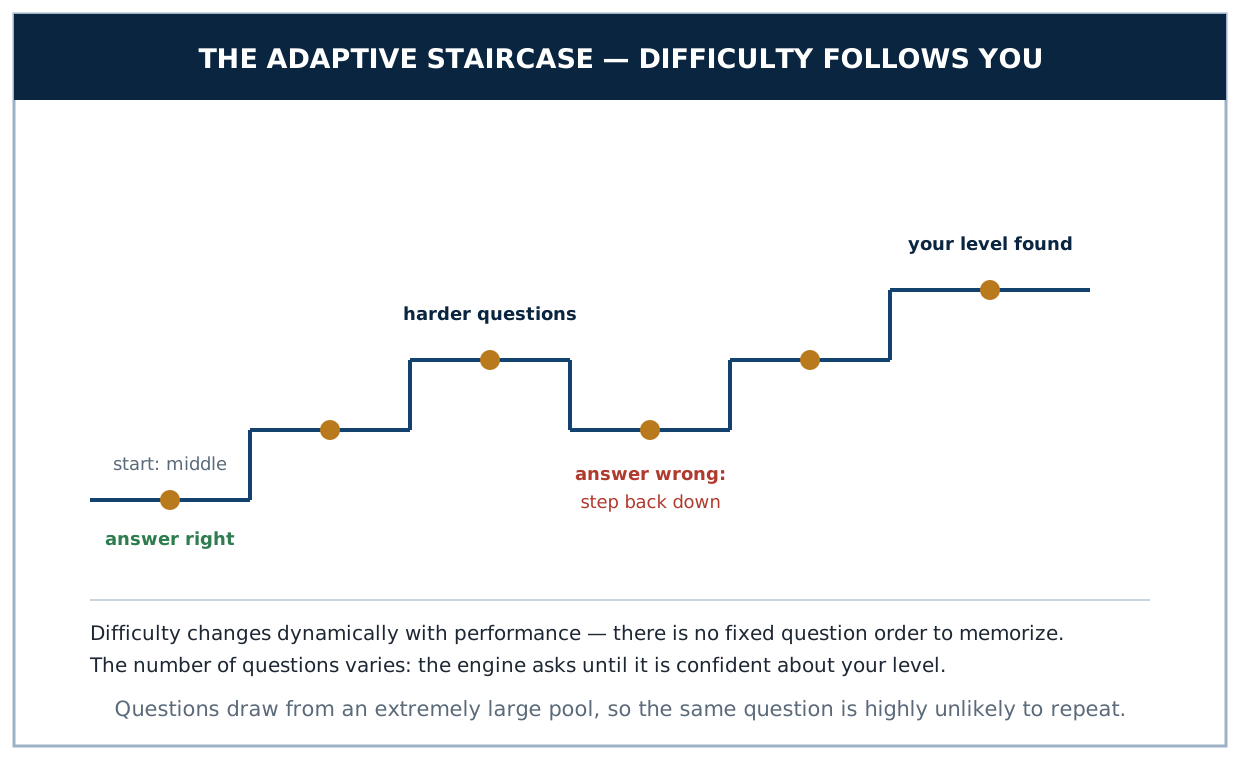
Figure 1.1 — The adaptive staircase: difficulty rises after strong answers and falls after weak ones until the test locates your level.
Three consequences follow from this design, and each one changes how you should think and prepare.
First, difficulty changes dynamically with performance. This is not a slogan; it is the mechanism. A strong start does not guarantee an easy test — it guarantees a harder one, because the test now needs to find out how far your ability extends. A difficult question in the middle of your test is therefore not bad news. Very often it is evidence that you have been doing well enough for the test to push you. Candidates who understand this stay calm when the questions harden. Candidates who expect every question to feel comfortable often panic at exactly the moment the test is telling them they are succeeding. Learn to read a hard question as information, not as failure.
Second, the number of questions varies. The test does not stop at a fixed count the way a printed paper stops at question forty. It stops when the grading engine is confident enough about your level. One candidate may need more questions before the engine is confident; another candidate's level may become clear sooner. If a friend tells you, "My test had more questions than yours," that difference, by itself, tells you nothing about who scored higher. It tells you only that the engine needed a different amount of evidence in each case. Never compare question counts as if they were scores.
Third, questions draw from an extremely large pool. Duolingo builds the test from a very large bank of questions, and the adaptive engine selects from that pool as it works. Because the pool is so large, the same question is highly unlikely to repeat — for you, if you sit the test again, and between one candidate and another. This has a direct preparation consequence: memorizing specific questions is a wasted strategy, even if someone offers to sell you "real questions." The durable strategy is the opposite one. Learn the question types until their demands are automatic, and build the underlying English — vocabulary, grammar, listening, reading, writing, speaking — that every question in the pool will draw on, whichever items the engine happens to select for you.
Hold those three consequences together and a healthy test-day mindset appears. You cannot control which questions the engine selects. You can control whether you answer each question in front of you carefully, whether you attempt every question rather than leaving blanks, and whether you stay composed when difficulty moves. On an adaptive test, composure is a skill, because difficulty movement is guaranteed.
A sitting of the Duolingo English Test needs about one hour of uninterrupted time. Protect that hour completely: no interruptions, no pauses to answer the door, no messages. Inside that hour, the session has three parts, always in the same order.
Figure 1.2 (Class A) — The session timeline: onboarding first, then the adaptive test, then the Writing Sample and Speaking Sample.
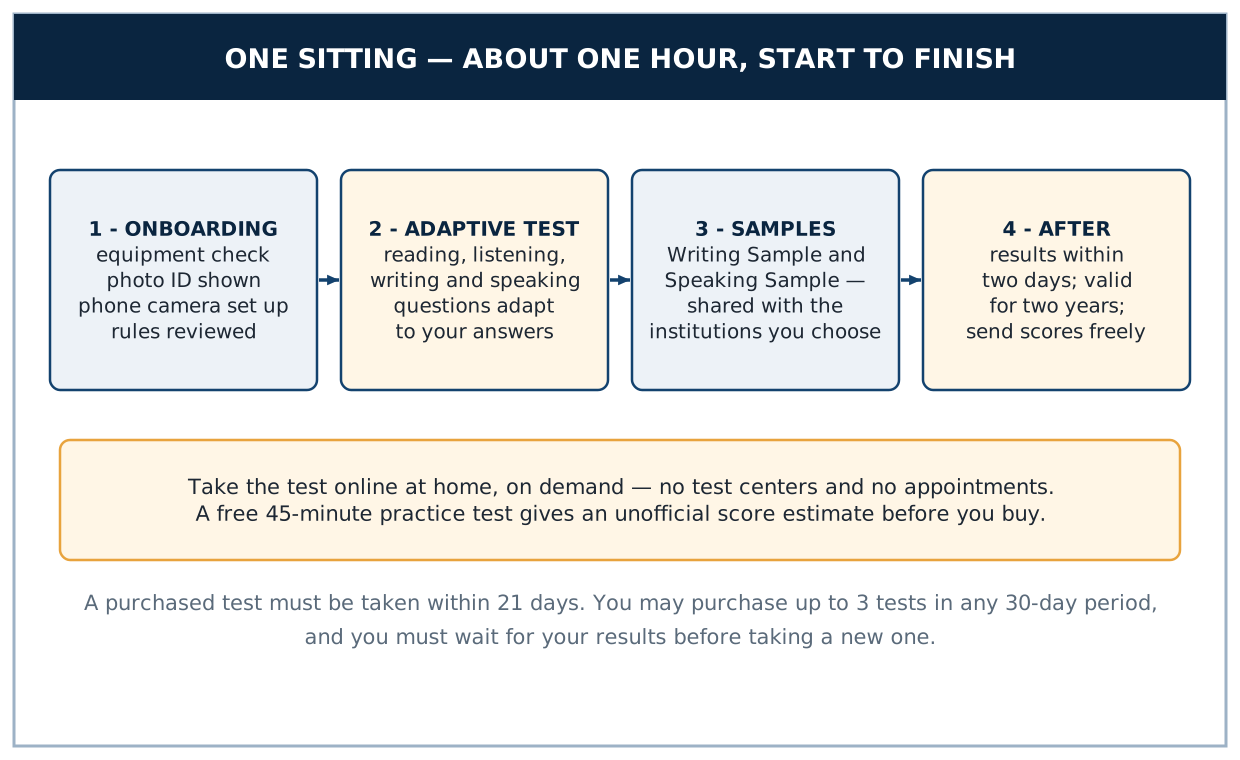
Figure 1.2 — The session timeline: onboarding first, then the adaptive test, then the Writing Sample and Speaking Sample.
Before any scored English appears, the test onboards you. Onboarding is the setup and checking stage, and it has four elements: an equipment check, your government-issued photo ID, a phone-camera setup, and a review of the rules.
The equipment check confirms that your computer, camera, microphone, and speakers work with the test. The ID step confirms that you are who you say you are, using a valid physical government-issued photo ID. The phone-camera setup connects your smartphone as a secondary camera, so the test can see you and your workspace from a second angle during the sitting. The rules review makes sure you have read and understood what is and is not allowed before the scored test begins. Chapter 3 teaches this whole setup in operational detail — the room scan, the ear scan, the position of the phone, and the workspace rules — so for now, fix only the idea: Part 1 proves that the conditions are fair and secure before a single point is at stake.
Do not rush onboarding, and do not treat it as dead time. A calm, correct setup protects your result. A careless setup can end a sitting before your English is ever measured.
Part 2 is the adaptive test itself: the long central section in which the engine presents question after question, adjusting difficulty as it goes, across reading, listening, writing, and speaking. The question types you will meet are listed in the next section of this chapter, and Parts 2 through 7 of this book teach each skill area in depth.
Two practical truths belong here. The first is pacing: because the engine adapts, you cannot use the fixed-paper strategy of skipping a hard question and returning to it later in a calmer moment. The question in front of you is the question that matters; answer it as well as you can and move forward. The second truth is stamina: about an hour of concentrated English, much of it timed in short bursts, is tiring in a way that untimed study is not. That is why this book ends with two full timed practice tests — not to copy the algorithm, which no printed test can do, but to build the concentration the real hour demands.
The session closes with two longer production tasks: the Writing Sample and the Speaking Sample. These are part of your test, they are scored, and — this is the point students most often miss — they are shared with institutions. When you send your scores to a university or school, that institution receives the same score report you see, plus your Writing Sample and a video recording of your Speaking Sample.
That sharing changes how you should treat these two tasks. A multiple-choice answer is a private signal between you and the grading engine. Your samples are different: a human admissions reader may read your actual paragraphs and watch you actually speaking. So the samples reward the qualities a human reader values — a direct answer to the prompt, organized ideas, clear sentences, and a natural, intelligible delivery. Chapters 30 and 36 teach each sample task in full, with model responses and explained score reasoning. For now, remember the shape: onboarding, adaptive test, samples. Setup, measurement, showcase.
You do not need to master any question type yet — each one gets its own teaching later in this book. What you need from this chapter is a map: the complete list of current types, the skill each one measures, and roughly how often each appears in a test. Read the map once now, and return to it whenever a later chapter names a type and you want to place it.
Reading types. Read and Select shows you one word at a time and gives you five seconds to decide whether it is a real English word; a test presents up to eighteen words in a row, and across a whole test this type appears fifteen to eighteen times. Fill in the Blanks gives you one sentence with one unfinished word and twenty seconds to type the missing letters; it appears six to nine times. Read and Complete gives you a passage in which the second half of several words is missing and three minutes to type the missing letters; it appears three to six times. Interactive Reading presents two sets, each of six questions over one passage in seven to eight minutes — completing sentences, completing the passage, highlighting the answer, identifying the idea, and titling the passage.
Listening types. Listen and Type plays a statement — you may hear it up to three times — and gives you one minute to type exactly what you heard; it appears six to nine times. Interactive Listening presents two conversations. In each conversation you first listen to a scenario, with unlimited replays, and answer three to four fill-in-the-blank questions about it; then you hear five to six turns and select the best response to each turn, hearing each turn once only. Those two stages share one timer of six minutes thirty seconds per conversation. Finally you write a summary of the conversation in seventy-five seconds.
Writing types. Write About the Photo asks you to describe a photo in one minute while the photo stays visible; it appears three times. Interactive Writing is one set of two questions: you write for up to five minutes on an initial prompt, then for up to three minutes on a follow-up question that is based on the content of your first answer. The Writing Sample, from Part 3 of the session, gives you thirty seconds to read the prompt and plan, then up to five minutes to write.
Speaking types. Speak About the Photo gives you twenty seconds to look at a photo, then up to ninety seconds to speak about it. Read, Then Speak gives you twenty seconds to read a written prompt, then up to ninety seconds to speak, with the topic staying visible while you speak. Interactive Speaking is one set of six to eight questions in a simulated conversation with an animated character: you hear each question once, you have no preparation time, and you have thirty-five seconds to record each answer, with follow-up questions selected in real time based on your previous answers. The Speaking Sample, from Part 3, gives you thirty seconds to plan and up to three minutes to speak — the longest speaking question on the test.
Count the map and two patterns emerge. First, the test is balanced: no single skill carries the result, which is why this book teaches grammar and vocabulary foundations before it drills individual types. Second, almost every type is short and timed in seconds or a few minutes. Speed of understanding — reading the instruction, recognizing the task, starting promptly — is itself part of what the test measures in practice, and it is trainable.
A note on change, because honest maps show their date. This test evolves. Some question types that older materials describe — Read Aloud, Listen, Then Speak, Listen and Select, and Read, Then Write — are not current test types, and this book does not teach them as if they were. If you meet them in an old video or an outdated course, treat that material as history, not as a description of the test you will sit.
This section states the most important agreement between you and this book, and it states it without qualification.
The real Duolingo English Test is computer-adaptive. Nothing in this book simulates that algorithm. The practice sets in this book — the chapter exercises, the question-type batteries, the repair sets, and the two timed practice tests — are fixed printed sets. The same questions appear in the same order for every reader. No answer you give in this book makes the next printed question harder or easier, because print cannot do that.
What these fixed sets are is practice in the question types. They teach you what each task demands, they build the English each task draws on, they train your timing against the published time limits, and their answer keys explain every answer so that each practice item teaches something whether you answered it correctly or not. That is real, valuable preparation — the same kind of preparation a musician gets from scales and exercises before a performance. Scales are not the concert, and nobody sensible claims they are. They are how you get ready for it.
So when you work through the two timed practice tests near the end of this book, work through them under timed, test-like conditions to build stamina and pacing — and remember, as their introductions also state plainly, that they are practice in the question types, not a simulation of the adaptive test. Any book, course, or website that promises to reproduce the adaptive engine itself is promising something print and fixed video cannot deliver. Judge preparation materials by whether they teach English and teach the types honestly. That is the standard this book sets for itself, and it is the standard you should apply to everything else you use.
There is one more honest consequence. Because the real engine adapts and this book cannot, your practice scores in this book are learning information, not predictions. A strong set here means your English and your technique are improving on those types. It does not convert into a promised score on the real test, and this book makes no score guarantee of any kind. Use practice results the way Chapter 38 teaches: to find your weakest skill and fix it.
Every question type arrives with an instruction, and instructions are written in a small, repeated vocabulary. Learn that vocabulary now and you will never waste timed seconds decoding what you are being asked to do. Six verbs carry most of the test.
Select means choose from options that are shown to you. "Select the real English words" and "select the best response" both ask for a choice, not a production: the answer already exists on the screen, and your job is judgment. Complete means finish something that is partly given. In Read and Complete you complete words; in Interactive Reading you complete sentences and a passage; in Interactive Listening you complete answers about a scenario you have heard. The given part is your evidence — complete from what is there, not from what you wish were there. Type means produce the exact text requested on the keyboard, as in Listen and Type, where closeness to the statement you heard is what is scored. Describe means give the details of something visible, in organized language: Write About the Photo and Speak About the Photo both test whether you can turn looking into language. Respond means answer a speaker or a prompt appropriately, as each turn of Listen and Respond requires — the best response is the one that fits what was just said, not the most impressive sentence on the list. Summarize means state the main content briefly in your own words, as Summarize the Conversation requires after Interactive Listening: shorter than the original, complete on the main points, and without added opinion.
Notice also the language of time. Instructions use phrases such as up to ninety seconds, in one minute, and you will have thirty seconds to prepare. Up to sets a maximum, not a target: speaking for up to ninety seconds means ninety seconds is the ceiling, and a complete, well-organized answer that finishes earlier is better than a padded answer that fills the clock. Prepare time is for looking, reading, and planning only — in Speak About the Photo your twenty seconds are for studying the photo and choosing what to say first, not for starting your answer early.
Build a small habit from this section: before you answer any practice item in this book, name its verb silently — select, complete, type, describe, respond, summarize — and let the verb tell you what kind of work your brain should do. Students lose more points to misread tasks than to missing knowledge. The verb check takes one second and prevents the most avoidable error on the test.
Four practical facts complete your map, and each one affects how you schedule the coming weeks.
First, Duolingo offers a free practice test at its website. It takes forty-five minutes and gives you an unofficial score estimate. Unofficial is the key word: it is a useful starting gauge and a safe way to meet the question types on a screen, but it is not a certified result and no institution receives it. Many students use it exactly as this book's diagnostic is used — to find out where they stand before serious study begins.
Second, a purchased test must be taken within twenty-one days of purchase. Do not buy the test months in advance as a motivational gesture; the window will close. Buy when your preparation is nearly complete and your schedule can protect an uninterrupted hour inside the window. Related purchase rules also apply: if you buy a two-test bundle, the second test must be taken within twenty-one days of receiving the first result; you may purchase up to three tests in any thirty-day period; and after submitting a test, you must wait for your results before taking a new one.
Third, results are released within two days of completing the test, and an optional Faster Results upgrade exists for candidates who need their scores sooner. Chapter 2 covers results, validity, and score sending in full.
Fourth, plan backward from your application deadlines, not forward from today. If an institution needs your score by a fixed date, count back: allow the two days for results, allow time for a possible retake inside the purchase rules, and allow the twenty-one-day purchase window. Students who plan backward rarely panic. Students who plan forward discover the calendar all at once, at the end.
Students often ask how to prepare for a test whose questions cannot be listed in advance. The answer follows directly from everything this chapter has established, and it has three parts.
First, study types, not items. Because the pool is extremely large and repeats are highly unlikely, the unit of preparation is the question type: its instruction verb, its timing, its scoring logic, and the English skill underneath it. When you finish a chapter of this book, you should be able to say, for its type, exactly what you will see, exactly what you must do, and exactly how much time you will have. That knowledge transfers to every item the engine can select, because every item of a type makes the same demand.
Second, study skills, not only types. Underneath Read and Complete sits vocabulary knowledge and spelling; underneath Listen and Type sits sound discrimination and sentence memory; underneath every speaking type sits pronunciation, fluency, and organized thought. The adaptive engine will find the true level of those skills wherever it probes, which is why Parts 2 and 3 of this book — grammar foundations and vocabulary — come before the skill parts. Technique without language fools no adaptive engine for long; language without technique wastes points on tasks you could have answered. You need both, in that order of honesty.
Third, study under time. Almost every type on this test is timed in seconds or a few minutes, and untimed excellence does not automatically survive a five-second decision window or a one-minute description task. From the first week of your preparation, mix two kinds of practice: slow, careful work when you are learning a type, in which you may pause, check the key, and understand every explanation; and timed work once the type is familiar, in which you observe the published limits strictly and review afterward. The chapter exercises in this book serve the first kind. The batteries and the two timed practice tests serve the second. Use each kind for its purpose, and remember the fence from the previous section as you do: timed work in this book builds stamina, pacing, and type fluency — practice in the question types — while the real test's adaptation remains something only the real engine performs.
One final habit ties the three parts together: keep a simple study log. After each practice session, write down the type you practiced, the errors you made, and the English point each error taught you — a word family, a tense choice, a sound you misheard. On an adaptive test your weaknesses are exactly what the engine will find, so a log that makes your weaknesses visible to you first is the closest thing preparation has to a strategy. Chapter 38 formalizes this into a results-reading and repair method; the log you start now becomes its raw material.
Amira sits the test. Her first reading questions feel moderate. She answers three in a row confidently and correctly. The next question is a noticeably harder vocabulary judgment, and the passage work that follows is denser than what she met at the start. Halfway through the test she misses two difficult items in a row, and the questions that follow feel slightly more manageable. Near the end, the questions harden again. Amira leaves the test worried: "The questions kept changing difficulty. Did I do badly?"
Work through her experience step by step. Step 1: identify the mechanism. Difficulty on this test changes dynamically with performance, so movement in difficulty is the design working normally, not a sign of a problem. Step 2: interpret the rise. After three strong answers, harder questions are exactly what the engine should produce — it is testing how far her ability extends. Step 3: interpret the fall. After two misses at a hard level, slightly easier questions are the engine checking whether the level just below is secure; that is locating work, not punishment. Step 4: interpret the second rise. Once her level is roughly located, harder questions again test the upper edge of it. Step 5: draw the conclusion Amira should draw. Nothing in the pattern of rising and falling difficulty, by itself, tells her whether her final score is high or low. The engine's confidence and her pattern of answers across the whole test determine the score, and she cannot reconstruct that score from how the test felt. The correct lesson for her next sitting — and for yours — is behavioral: answer each question on its merits, attempt everything, and refuse to spend emotional energy decoding the staircase while you are still climbing it.
Jonas has booked nothing, because there is nothing to book — the test is taken on demand — but he has set aside Saturday morning. Walk through his sitting as a timeline and check it against the three-part structure. At 9:00 he closes every other program, sits in a quiet, private, well-lit room, and begins Part 1, Introduction and onboarding: the equipment check confirms his camera, microphone, and speakers; he presents his government-issued photo ID; he completes the phone-camera setup so his smartphone can act as the secondary camera; and he reviews the rules. At about 9:10 he enters Part 2, the adaptive test: Read and Select words appear one at a time under five-second decisions, dictation statements play for Listen and Type, an Interactive Reading set opens over a passage, a conversation begins an Interactive Listening set, photo tasks and speaking tasks follow, and throughout, the difficulty of what he meets adjusts to his performance while the number of questions he receives reflects how much evidence the grading engine needs. At about 9:50 he reaches Part 3, Writing and Speaking: he reads a Writing Sample prompt, plans for thirty seconds, and writes for up to five minutes; then he plans a Speaking Sample for thirty seconds and speaks for up to three minutes, on camera. By about 10:00 the sitting is complete — roughly one uninterrupted hour, in the order onboarding, adaptive test, samples. Check the map: every stage Jonas passed through belongs to one of the three published parts, nothing appeared that the structure does not predict, and the two tasks at the end are precisely the two pieces of work that institutions will later read and watch alongside his scores. If you can narrate a sitting this way before you sit it, no part of the real hour will surprise you.
The Duolingo English Test is a computer-adaptive English proficiency test taken online at home, on demand, with no test centers and no appointments, and it is accepted by over 6,500 education programs around the world. Adaptive means the test responds to you: difficulty changes dynamically with your performance, the number of questions varies with the grading engine's confidence, and questions draw from an extremely large pool, so the same question is highly unlikely to repeat. A sitting needs about one hour of uninterrupted time and has three parts in order: Introduction and onboarding (equipment check, government-issued photo ID, phone-camera setup, rules review); the Adaptive Test itself; and Writing and Speaking — the Writing Sample and Speaking Sample that are shared with institutions. The current question types span reading, listening, writing, and speaking, each with published timings this book teaches type by type. This book's fixed printed sets are practice in those question types, not a simulation of the adaptive algorithm, and practice results are learning information, not score predictions. Around the test: a free forty-five-minute practice test gives an unofficial estimate; a purchased test must be taken within twenty-one days; you may purchase up to three tests in any thirty-day period and must wait for results before taking a new one; results arrive within two days. Master the instruction verbs — select, complete, type, describe, respond, summarize — and you have the map. The next chapter explains the score that comes out of the hour.
Q1. What does it mean that the Duolingo English Test is computer-adaptive? A) Every candidate receives the same questions in the same order. B) The difficulty of the questions changes during the test in response to the candidate's performance. C) Candidates may choose the difficulty level of each question before answering it. D) The test is taken on a computer rather than on paper.
Q2. How much uninterrupted time does one sitting of the test need? A) About 30 minutes B) About 45 minutes C) About 2 hours D) About 1 hour
Q3. What is the first part of a test session? A) Introduction and onboarding B) The Writing Sample and Speaking Sample C) The adaptive test D) Score reporting and sending
Q4. What happens in the third part of the session? A) The equipment check and the rules review B) The candidate chooses which institutions will receive the scores. C) The candidate completes the Writing Sample and the Speaking Sample, which are shared with institutions. D) The grading engine explains how the score was calculated.
Q5. Why can two candidates receive a different number of questions? A) Because candidates may stop the test whenever they feel ready. B) Because the test continues until the grading engine is confident about the candidate's level, and that takes a different amount of evidence for different candidates. C) Because candidates who pay for a bundle receive extra questions. D) Because the test adds questions as a penalty for incorrect answers.
Q6. Why is the same question highly unlikely to appear twice? A) Because questions are drawn from an extremely large pool of questions. B) Because the test deletes each question after one candidate sees it. C) Because candidates sign an agreement not to repeat questions. D) Because each test uses only questions written on the day of the test.
Q7. Which statement about this book's practice sets is correct? A) They reproduce the adaptive algorithm in printed form. B) They guarantee the score a candidate will achieve on the real test. C) They present the same questions the candidate will meet on the real test. D) They are fixed sets that give practice in the question types; they do not simulate the adaptive test.
Q8. What does the free practice test on Duolingo's website provide? A) A certified score that institutions can receive B) A score that is valid for two years C) An unofficial score estimate, in a practice test that takes 45 minutes D) A pass certificate for candidates who reach the required level
Q9. Within how many days must a purchased test be taken? A) Within 21 days B) Within 30 days C) Within 2 days D) Within 1 year
Q10. What is the maximum number of tests a candidate may purchase in any 30-day period? A) 1 B) 3 C) 5 D) There is no limit.
Q11. After submitting a test, what must a candidate do before taking a new one? A) Wait two years for the result to expire B) Send the scores to at least one institution C) Wait for the results of the submitted test D) Complete the free practice test again
Q12. According to Duolingo, by how many education programs is the test accepted as proof of English proficiency? A) Over 650 programs B) Over 1,600 programs C) Over 16,500 programs D) Over 6,500 programs
Q13. Which list gives the elements of Introduction and onboarding? A) Equipment check, government-issued photo ID, phone-camera setup, and rules review B) Writing Sample, Speaking Sample, equipment check, and score review C) Room payment, seat booking, examiner interview, and rules review D) Practice test, score estimate, ID photograph, and institution selection
Q14. A candidate answers several questions correctly and then meets a noticeably harder question. What is the best interpretation? A) The candidate has failed and the test is ending early. B) The harder question is a technical error and should be ignored. C) The engine is testing how far the candidate's ability extends, which is the normal adaptive response to strong performance. D) The candidate should stop answering carefully, because the score is already decided.
Q15. In an instruction, what does the phrase "up to 90 seconds" mean? A) The candidate must speak for exactly 90 seconds, without stopping earlier. B) Ninety seconds is the maximum allowed; a complete answer may finish earlier. C) The candidate receives 90 seconds of preparation before speaking. D) The candidate may replay the question for 90 seconds.
The Complete Duolingo English Course — 1,016 Practice Questions, Diagnostic & 2 Full Timed Practice Tests, Every Answer Explained
Feras Alzubi
Exam Prep Series
© 2026 Feras Alzubi. All rights reserved.
No part of this book may be reproduced, stored in a retrieval system, or transmitted in any form or by any means — electronic, mechanical, photocopying, recording, or otherwise — without the prior written permission of the author, except for short quotations in a review.
Every text, transcript, task, question, explanation, model response, and worked example in this book is original to this book. The reading passages, listening transcripts, writing tasks, and speaking tasks were written for this book to teach the English and the test skills that the Duolingo English Test measures. They follow the test's published formats, but they are not copied from, and they do not reproduce, any actual test questions.
This book is an independent study guide. It is not published, endorsed, or affiliated with Duolingo. "Duolingo" and "Duolingo English Test" name the test this book prepares candidates for.
This book is plain about what it can and cannot do. Five limits govern everything that follows, and the first one matters most, so it comes first.
This book cannot reproduce the adaptive test — and it does not pretend to. The real Duolingo English Test is computer-adaptive. As you take it, the test adjusts to your answers as you go: the difficulty of the questions changes in response to how you are performing, and the number of questions changes too, because the test stops when it has gathered enough evidence about your level. No printed book can reproduce that. A book is fixed — every reader meets the same questions in the same order at the same difficulty. The fixed sets in this book are therefore practice in the published question types, nothing more and nothing less. They train the tasks, the timings, and the English underneath them. They are not a simulation of the adaptive algorithm, and no result in this book — not the Diagnostic, not a battery, not a timed practice test — converts to a score on the 10–160 scale or predicts the score you will receive on the real test.
No score is guaranteed. This book can teach you English, train you in every current question type, and show you exactly where your work is weak. It cannot promise you a score, an improvement of a set number of points, or any other outcome. Your score on the real test is decided by your performance on that test, on that day, and by nothing else.
The test has no pass mark. The Duolingo English Test does not pass or fail anyone. Institutions set their own requirements: each university, school, or program that accepts the test decides for itself what score it requires, and those requirements differ from one institution to another. This book names no institution's requirement. Check the requirement that applies to you on the institution's own pages, and check it again before you sit the test, because requirements change.
Sample responses are teaching illustrations, not official scores. The model writing and speaking responses in this book carry explained reasoning tied to Duolingo's published grading criteria. For speaking, those criteria are Content, Discourse coherence, Fluency, Grammar, Lexis, and Pronunciation. For writing, they are Content, Discourse coherence, Grammar, and Lexis. The reasoning explains, in the manner of Duolingo's own published sample commentary, what gives a response its strength and what holds it back, so that you can judge and improve your own work. It is teaching. It is not an official score, and no response in this book has been scored by Duolingo.
The test changes, so confirm the current details. Duolingo changes the test's format from time to time, and the details in this book state the test as Duolingo publishes it at the time of writing. Before you buy a test or sit one, confirm the current format, rules, and requirements at englishtest.duolingo.com.
This book is a course, not a question bank to graze in. Its shape has two layers. The first layer is teaching: 40 chapters in 8 parts that teach the whole English skill body the test measures. Part 1 introduces the test itself. Parts 2 and 3 build the foundations — grammar first, then vocabulary. Parts 4 through 7 teach the four skills in turn — reading, listening, writing, and speaking — with each skill's question types taught inside the part where they belong. Part 8 is test craft: working with an adaptive test, reading your results, rehearsing for test day, and handling everything that comes after it. The second layer is the exam layer, built on top of the teaching: a 50-item Diagnostic, exercises at the end of every chapter, two batteries, six repair sets, and two full timed practice tests — 1,016 practice questions in all, every one with an explained answer. Used in the order below, each stage does a different job, and the jobs build on one another.
Step 1: Take the Diagnostic first, cold. Before you study a single chapter, take the 50-item Diagnostic in one sitting, without notes and without looking anything up. Its key scores you by strand — reading, listening, writing, and speaking — and gives you a strand profile: a picture of where your English is strong and where it is not, before you have done any work. The key routes each weak strand to the chapters and sets that repair it. The Diagnostic is not a verdict on you, and its profile is not a test score; remember the first fence — nothing in this book converts to the 10–160 scale. It is a map. Keep the scored sheet. Everything that follows is measured against it.
Step 2: Work the chapters in order. Study Chapters 1 to 40 in sequence. The order is the course: sentence control comes before complex sentences, the tense system comes before perfect and progressive forms, word families come before collocations, and the paragraph comes before the timed writing tasks. Read the teaching text fully, and work the examples as you meet them rather than reading past them. Every rule is shown in English you can see before you are asked to produce English of your own. At the end of each chapter, answer all 15 exercises before you open the key — 600 chapter exercises in all.
Step 3: Study the keys, do not just check them. Read every key the way you read the chapter — as teaching. Each key explains why the correct answer is right and why each wrong answer is wrong: the tense signal you missed, the collocation that does not exist, the detail the recording stated differently. The wrong-answer explanations are where much of the learning lives, because the test's wrong options are built from the same confusions. When a key surprises you, reread the section of the chapter it points back to before you move on. For writing and speaking tasks, the key gives a model response or a model transcript, followed by explained score reasoning tied to the published criteria named in the fences above.
Step 4: Take the two batteries. When the chapters are done, take Battery A and Battery B. Battery A is the receptive battery — 52 items of Read and Select, Fill in the Blanks, Read and Complete, and Listen and Type — and it trains speed and accuracy across the question types that are answered right or wrong. Battery B is the production battery — 30 writing and speaking tasks, every one with a model response and explained score reasoning — and it trains the sustained, timed production that no single chapter exercise can. Score both batteries, and note which question types, not just which questions, cost you.
Step 5: Repair before you test again. Work the repair sets that match your error pattern. The six sets rebuild the six error classes that cost candidates the most: (1) verb forms, (2) word choice and collocation, (3) sentence structure, (4) spelling and word completion, (5) listening detail, and (6) coherence and development. Each set has 20 items — 120 in all. Do the sets your results name, restudy the chapter sections behind every repeated error, and redo the chapter exercises you missed. A timed test taken over unrepaired gaps only measures the same gaps again.
Step 6: Finish with the two timed practice tests, each in a single sitting. Take Timed Practice Test 1, then — after further repair — Timed Practice Test 2. Sit each test whole, in one sitting, under its printed timing instructions, with no phone, no notes, and no dictionary. Each test opens with its own statement of the first fence, and it is true there too: a fixed printed test is practice in the question types at their published frequencies, not a simulation of the adaptive test, and its result does not convert to a 10–160 score. What a single honest sitting does build is the stamina, pacing, and composure the real hour of testing demands. Score each test by question type, read the full key for every item you missed and every item you guessed, and let the pattern — not a converted score — tell you what to repair next.
One candidate threads the book. Daniel R., a graduate-school applicant, is this book's specimen candidate, and he is fictional. His scores appear first as a worked example in Chapter 2, where his full score report is built up step by step. Chapter 38 works through the reading of his results: how his report is read, where his weakest skill is located, and how that reading becomes a repair plan. His Writing Sample is the teaching specimen of Chapter 30, and a transcript of his Speaking Sample is the teaching specimen of Chapter 36, each with criterion-by-criterion explained reasoning. His retake closes the book in Chapter 40. Follow him. His samples, his scores, and his retake are in this book so that you can learn each task and each decision on a complete example before your own results ask the same questions of you.
Listening, in print — hear it first, then read it. A printed book cannot play audio, so this book handles listening honestly. No transcript ever appears with its questions. Every transcript lives in the key, and every listening item prints an Audio direction line in place of the recording: it tells you exactly how many times the audio is heard in the real test, and you follow that number exactly. Work it in one of two ways. A study partner reads the transcript aloud to you from the key, the published number of times, while you listen and answer without seeing a word of it. Or record yourself reading the transcript aloud, then play the recording back the published number of times and answer from the recording. The published numbers differ by type, and the direction line states each one: a Listen and Type statement may be heard up to three times; the scenario in Interactive Listening may be replayed without limit; each turn in Listen and Respond is heard once only. Only after you have answered do you open the transcript in the key and study it: check each answer against the words that carried it, and mark what you heard but did not catch. Hearing, answering, then studying — in that order — is what turns a printed transcript into listening training.
Speaking, in print — prompts, timings, and model transcripts. Speaking practice works the same honest way. Every speaking task prints its prompt together with its published timings — the preparation time and the speaking time the real test allows — so set a timer and keep to it. Plan for the published preparation time, then record yourself on your phone and speak for the full published time without stopping to restart. In the key you will find a model transcript of a strong response, with explained score reasoning tied to the published speaking criteria. Review your recording against that transcript and reasoning: listen for whether your answer stayed on the task and developed, whether your ideas hung together, whether you kept speaking without long breakdowns, and whether your grammar, vocabulary, and pronunciation carried your meaning. Where a task is a conversation, work with a partner when you can; where you cannot, record your side turn by turn, exactly as each prompt arrives.
Choose a study plan from the back of the book — two weeks intensive or four weeks standard — and fit the steps above into it. Whatever your timeline, keep the order: Diagnostic first, chapters in order, keys studied, batteries, repair, and the timed tests taken whole and honestly.
This page states what the test is, as Duolingo publishes it. Learn these facts early, because your preparation — and test day itself — runs on them.
What the test is. The Duolingo English Test is a computer-adaptive English proficiency test that you take online, at home, on demand. There are no test centers and no appointments: you sit the test at your own computer when you are ready. Duolingo publishes that the test is accepted as proof of English proficiency by over 6,500 education programs around the world. Acceptance belongs to each institution, and each institution sets its own score requirement; the test itself has no pass mark.
Shape of a sitting. A sitting needs about one hour of uninterrupted time, and it has three parts, always in the same order.
| Part | What happens |
|---|---|
| 1. Introduction and onboarding | An equipment check, your government-issued photo ID, a phone-camera setup, and a review of the rules |
| 2. The Adaptive Test | Questions across reading, listening, writing, and speaking, with difficulty adjusting as you answer |
| 3. Writing and Speaking | The Writing Sample and the Speaking Sample, which are shared with institutions along with your scores |
Because the test is adaptive, three things follow. The difficulty of your questions changes dynamically with your performance: answer well and the questions grow harder, struggle and they grow easier, until the test has located your level. The number of questions varies from one test taker to another, because the test stops when it has enough evidence about that candidate's level — a longer test is not a better or a worse one. And the questions are drawn from an extremely large pool, so the same question is highly unlikely to appear twice.
The question types. These are the current question types, with the frequency of each in a test and the timing each one allows, as Duolingo publishes them.
Scores. Your overall score runs from 10 to 160, in 5-point increments. You also receive four individual subscores — Listening, Reading, Speaking, and Writing — and your overall score is the average of those four individual subscores. Alongside them, the report gives four integrated subscores, each of which combines two skills:
Each integrated subscore is the average of its two individual subscores, rounded to the nearest five. So a candidate with Reading 130 and Writing 120 has a Literacy subscore of 125, and a candidate with Speaking 110 and Listening 120 has a Conversation subscore of 115.
Duolingo publishes comparison guidance that places scores on this scale alongside two other tests. Treat the table below as Duolingo's published comparison guidance — a way to locate a score, not a conversion and not a promise.
| Duolingo English Test | IELTS | TOEFL iBT |
|---|---|---|
| 160 | 8.5–9 | 120 |
| 130 | 7 | 98–103 |
| 120 | 6.5 | 87–92 |
| 100 | 5.5 | 65–69 |
Session rules and setup. The test is taken under security rules, and a sitting can fail on setup before your English is ever measured. The essentials are these:
Results and sending scores. Results are released within two days of completing the test. A result stays valid for two years. Once your result is certified, you can send your scores to an unlimited number of institutions at no cost, electronically. Each institution receives the same score report you see, together with your Writing Sample and the video recording of your Speaking Sample. This book prints no fee figure, because fees change: check the current price at englishtest.duolingo.com before you buy.
A closing note on change. The test changed format in July 2025: Interactive Speaking was added, and some older question types were retired. This book teaches the current format only — every question type listed on this page, and no other. Formats change again in time, so confirm the current details at englishtest.duolingo.com before you sit the test. This page describes the test; it does not change what this book is — an independent study guide that prepares you thoroughly and guarantees no result.
End of the free sample. The complete book continues from here — the full A-to-Z course in book form, delivered as an EPUB you can read in Apple Books, Google Play Books, ReadEra, Thorium Reader, Adobe Digital Editions, or Send to Kindle.
Buy this ebook — $11.99 Back to the book page
Payments are securely processed by Payhip.