
Mastering Careers & Skills
Drone Pilot License (FAA Part 107) · free sample from the book itself
Every entry mirrors the production tag of its item in the chapter file. For each item, the key states the correct answer and why each wrong answer fails.
1. B — B is correct: the credential Part 107, Subpart C creates is the Remote Pilot Certificate with a small UAS rating. A fails twice — conversation's word "license" is not the credential's name, and no state issues it; it is a federal certificate. C fails because a Part 61 pilot certificate is a different certificate under a different part; Part 61 holders use it as an alternative path to this same remote pilot certificate, not as the certificate itself.
2. A — A is correct: §107.3 measures the aircraft on takeoff, including everything on board or otherwise attached — 56 lb at takeoff is not less than 55 lb, so the aircraft falls outside Part 107's definition. B uses empty weight, a figure the definition never uses. C contradicts the definition's express inclusion of everything attached; payload counts.
3. C — C is correct: the FAA states it is not correct to assume a lack of compensation makes a flight recreational; flying as part of any business, even unpaid, is not recreational. A applies the payment test the FAA rejects. B invents a friendship exception that exists in neither the statute nor the FAA's presentation of it.
4. A — A is correct: Part 107 registration is $5 per drone, valid three years, each aircraft registered separately. B states the recreational rule — $5 per inventory — across the boundary; the two registrations are not interchangeable, and a recreationally registered drone cannot be flown under Part 107 (S-12). C collapses registration into certification, the first of the three-acts errors §1.3 warns against.
5. B — B is correct: §107.65's routes are the regulation's own — an initial test or the FAA's recurrent training (ALC-677, or ALC-515 for Part 61 holders) within the previous 24 calendar months; no study book is among them, and this book claims no part in recency. A asserts exactly the training claim fence X-04 forbids any book to make. C invents pro-rating; the 24-calendar-month window is a window, not a balance.
6. C — C is correct: §107.61(a) sets eligibility at at least 16 years of age. A is the age to test, offered here as the classic two-ages confusion. B imports an 18-year threshold that Part 107 does not contain.
7. A — A is correct: the Testing Matrix and the ACS set the minimum test age at 14, and §107.67's identification rule expressly contemplates an applicant who will meet the certificate age before the AKTR's 24-calendar-month validity expires. B is the certificate age, not the test age. C appears in neither source.
8. B — B is correct: the matrix and bulletin require no endorsement or authorization to test or retest, and the AIM states in terms that no documented pre-test training is required under Part 107 for the initial test. A describes the endorsement culture of other airman tests, imported here in error. C invents an IACRA filing that is no part of the process — IACRA's role before the test is the profile and FTN (item 9).
9. C — C is correct: the FAA's candidate page directs applicants to create an IACRA profile and obtain the FTN before registering for the test; the FTN then prints on the AKTR. A reverses the order — the AKTR carries the FTN because the FTN already existed. B misassigns the FTN to PSI; PSI delivers the test, IACRA issues the tracking number.
10. A — A is correct: the AKTR prints ACS codes for questions answered incorrectly — the coded diagnosis on which this book's quiz tags and Chapter 26's repair method are built. B would breach test security and contradict §107.69's protection of test content; the report gives codes, not questions. C invents a ranking the FAA does not publish to candidates (and no pass-rate or comparative figure prints in this book, fence X-12).
11. B — B is correct: LAANC is the working implementation of §107.41's prior-authorization requirement — near-real-time authorizations at or below UAS Facility Map grid ceilings — and the FAA states expressly that a LAANC grant is airspace authorization only, with NOTAMs, weather, and all other restrictions still applying. A commits the category error this book forbids: LAANC is a system, not a regulation, and it replaces nothing. C misstates both the instrument (an authorization, not a waiver) and its effect (silence from ATC authorizes nothing).
12. C — C is correct: 70% × 60 scored questions = 42.0 — 42 correct answers pass, 41 do not; the 5 validation questions are unscored and move the line in neither direction. A confuses the percentage with a count. B is 75% of 60 — the product of a passing standard the UAG does not use.
13. A — A is correct: October 3 + 14 calendar days = October 17; §107.71's wait runs in calendar days, and the failed AKTR must be presented at the retest. B is 7 days after failure — half the required wait. C is 31 days after failure — a full month, roughly double what the regulation requires; waiting longer is permitted but is not the earliest date the item asks for.
14. B — B is correct: 48% × 60 = 28.8, which composes to 29 whole questions — the Regulations count in this book's full practice tests, with the rounding disclosed on the test's face. A proportions the set to the ACS Appendix 1 ranges the FAA's August 2025 advisory calls obsolete — the exact error fence X-03 exists to prevent. C reads the percentage itself as a question count.
15. C — C is correct: the September 2026 ATCA states that the printed supplement is still supplied and its removal date has not been set, and that from October 26, 2026 the UAG includes image-based questions, drawn from the latest sectional charts, that are not in the supplements. A announces a withdrawal the FAA has expressly not scheduled. B states the pre-October 2026 picture as if the dated change had not happened — the supplement-memorization error §1.8 warns against. (Do not confuse the supplement with the FAA's free study guide, FAA-G-8082-22 of August 2016: the supplement is a test-day reference supplied in the room; the guide is a 2016 preparation text that predates Operations Over People, Remote ID, and the current night rule.)
Code map — Chapter 1. Missed items coded UA.I.C.K1 (items 6–7): re-read §1.4 — the two ages. UA.I.C.K3/K4 (items 5, 9, 10, 12, 13, 15): re-read §§1.3, 1.6, and 1.7 — process, AKTR, and test shape. UA.I.A.K1–K3 (items 1–4, 14): re-read §§1.1, 1.2, and 1.7 — scope, boundary, and the current blueprint. UA.I.B.K16 (item 11): LAANC's full treatment is Chapter 12; §1.12 is this chapter's statement.
Part I — Foundations From Zero · Orientation · Anchors: 14 CFR §§107.1, 107.61 · Test apparatus: FAA Testing Matrix (S-04), PSI UAG Applicant Information Bulletin (S-05), FAA Become a Certificated Remote Pilot (S-08)
On a clear morning in late spring, a real estate photographer arrives at a house that goes on the market next week. The seller wants aerial photographs: the roof line, the lot, the way the street curves away toward the park. The photographer unpacks a small quadcopter from a foam-lined case, unfolds its arms, sets it on the driveway, and checks a phone screen clipped above a controller. A neighbor watching from a porch sees a hobby toy. The law sees something else entirely. The moment that aircraft lifts off to make photographs someone will use to sell a house, the flight is commercial work, and the person holding the controller needs a federal certificate, a registered aircraft, and current knowledge — whether money changed hands that morning or not.
This chapter is written for the person holding that controller for the first time, and it assumes nothing. It does not assume you know what a drone is in law rather than in conversation, what Part 107 means, who issues the certificate, what the test is called, how long it lasts, what score passes, what book you will be handed in the testing room, or why a study guide published by the Federal Aviation Administration itself in 2016 cannot, by itself, prepare you for the test as it is delivered today. By the end of this chapter you will know all of that. You will also know the shape of the road ahead: three separate acts stand between a beginner and a legal commercial flight, and confusing any one of them for another is the first error this book exists to prevent.
One discipline starts here and runs through every chapter, so learn to recognize its voice on the first pages. Where a fact belongs to a published authority — the regulation itself in Title 14 of the Code of Federal Regulations, the FAA's Airman Certification Standards, the FAA's testing matrix, or the testing vendor's applicant bulletin — the text names that authority at the point of statement. Where guidance is this book's own — a study method, a way of organizing your preparation, a routing rule for practice questions — the text labels it as this book's guidance. A reader who can always tell whose voice is speaking cannot be misled by an old video, a forum thread, a classmate's memory of a different test, or a preparation book, including this one, dressing its own advice up as official doctrine. Tests are revised. Rules are amended. This book is a teacher, not an authority, and it will never pretend to be one.
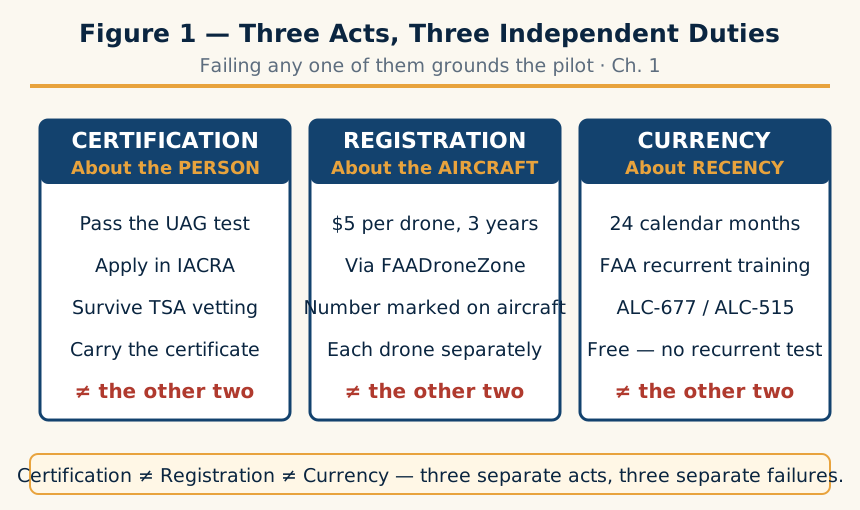
Figure 1.1 — The three acts.. Certification, registration, and currency drawn as three separate gates on one road; a pilot must pass all three, and passing one does not pass the others.
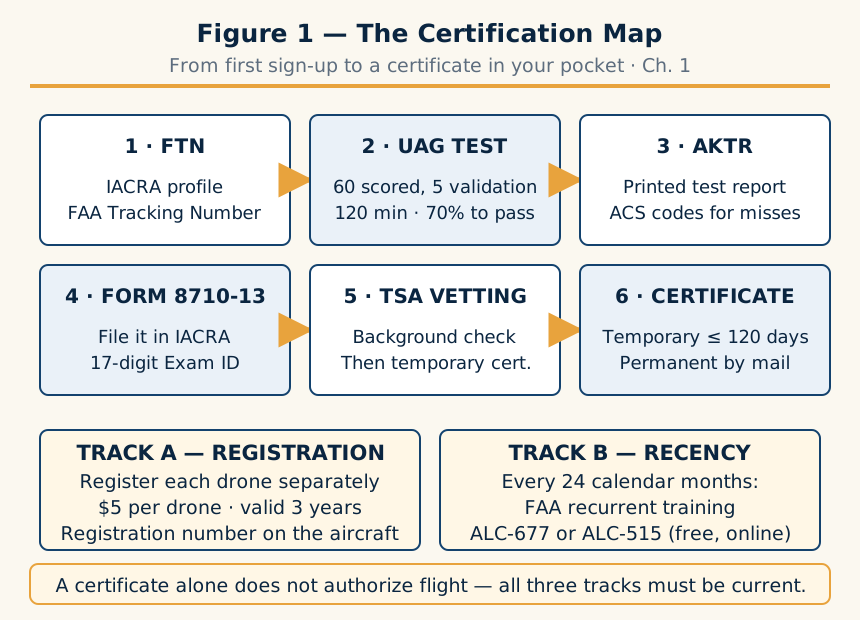
Figure 1.2 — The certification map.. FTN, then the UAG test, then the AKTR, then the IACRA Form 8710-13 application, then TSA vetting, then the temporary certificate, then the permanent certificate — with registration and recency drawn as parallel tracks.
Part 107 is a part of the federal aviation regulations: Title 14 of the Code of Federal Regulations, Part 107, titled Small Unmanned Aircraft Systems (14 CFR Part 107, S-02). A "part" in this system is not a chapter of advice. It is law, written in numbered sections — §107.1, §107.29, §107.51, and so on — and when this book cites a section number, it is pointing you at the actual legal text you could read yourself on the Electronic Code of Federal Regulations. Learning to think in section numbers is part of learning this field, because the test, the certificate, and your working life as a pilot all speak that language.
Part 107 does two jobs at once. First, it sets the operating rules for small unmanned aircraft: how high, how fast, in what weather, in what airspace, over whom, at what hours, and under whose responsibility a small drone may fly. Second, in its Subpart C, it creates a certificate — the Remote Pilot Certificate with a small UAS rating — and sets who may hold it and what they must demonstrate to earn it. When people in conversation say "Part 107 license," "drone license," or "commercial drone permit," they are all reaching for this same certificate. This book uses the certificate's real name, because the test and the FAA's application system use it, and because a candidate searching official pages for a "license" will sometimes miss the page that matters.
The aircraft at the center of the system has a precise legal definition. A small unmanned aircraft is an unmanned aircraft weighing less than 55 pounds on takeoff, including everything on board or otherwise attached (§107.3, S-02). A small unmanned aircraft system, abbreviated small UAS or sUAS, is that aircraft plus its associated elements — the control station, the command link, and the other components that make the aircraft fly as a system. Chapter 2 takes that system apart piece by piece. For now, hold the number and the logic of it: 55 pounds is measured at takeoff, with the battery in, the camera on, and the payload attached. An aircraft that weighs 54 pounds empty and lifts a 2-pound payload is not a small unmanned aircraft under Part 107 at all, and no certificate issued under this part authorizes its operation. Weight is not a detail of this field. It is one of its boundaries.
The certificate, once earned, does not authorize every flight a pilot can imagine. Part 107 itself names where it does not apply (§107.1(b), S-02). It does not apply to air carrier operations. It does not apply to aircraft flown under the limited recreational exception in federal statute, 49 U.S.C. §44809 — the boundary Chapter 24 teaches in full. It does not apply to operations a holder of a special exemption under 49 U.S.C. §44807 elects to conduct under that exemption. And it does not apply to operations conducted under Part 91 with a small UAS that holds an airworthiness certificate. Those four edges are named here, at the start, for one reason: a competent pilot knows not only what their certificate covers, but where it stops. Chapter 24 returns to each edge and routes a reader who needs one of those other regimes toward its own authority, because a Part 107 answer to a non-Part 107 question is a wrong answer, however confidently given.
Exam trap — "License." Conversation says "drone license." The regulation, the test, and the application say Remote Pilot Certificate with a small UAS rating. Items on the real test use the regulation's language; learn the certificate by its real name from page one.
Remember the number — 55 pounds. Less than 55 pounds on takeoff, including everything on board or otherwise attached, is the weight boundary of a small unmanned aircraft (§107.3, S-02).
Start with the default, because the FAA states it as a default. For a drone weighing less than 55 pounds, Part 107 is the default rule, and purely recreational flying is a limited statutory exception that is available only while every one of its conditions holds (FAA Recreational Flyers page, S-11). The FAA's own guidance for anyone standing on the boundary is short enough to memorize, and this book prints it as the rule it is: "When in doubt, assume Part 107" (S-11, S-13).
That default matters because the most common beginner error is to classify a flight by whether money moved. The FAA corrects that error in terms. It is, in the FAA's own framing, not correct to assume that a lack of compensation makes a flight recreational; flying for work, for payment, or as part of any business — even if the flight itself is unpaid — is not recreational flying (S-11, S-13). Purpose, not payment, classifies the flight. A roof inspector who flies a neighbor's roof free of charge as part of building an inspection business is not flying recreationally. A photographer who shoots a listing for a relative's agency without an invoice that day is not flying recreationally. A farmer checking their own commercial crop, a contractor documenting their own job site, a volunteer flying search support as part of an organization's work — each flight must be classified by its purpose, and in each case the purpose points away from recreation and toward Part 107.
Recreation, by contrast, is narrow and conditional. The exception in 49 U.S.C. §44809 is available only while the flyer flies strictly for recreational purposes, follows the safety guidelines of an FAA-recognized community-based organization, keeps the aircraft within visual line of sight or uses a co-located visual observer in direct communication, gives way to other aircraft, flies only at or below FAA-authorized altitudes in controlled airspace and only with prior authorization there, stays at or below 400 feet in uncontrolled airspace, has taken the recreational safety test called TRUST and carries proof of passage, has registered and marked the aircraft and carries proof of registration, and never endangers the National Airspace System (S-11). If any condition fails, the exception fails with it, and the flight needs Part 107. Chapter 24 teaches that boundary in full, including what TRUST is and is not. What Chapter 1 requires you to carry forward is simpler: recreation is not the absence of payment, and it is not a mood. It is a list of conditions, all of which must hold at once.
Who, then, needs this certificate? Anyone who will fly a small unmanned aircraft for any purpose other than that limited recreational exception: the real estate photographer and the roof inspector, the surveyor and the tower inspector, the wedding videographer and the news gatherer, the agricultural pilot and the public-facing creator whose channel is a business. The certificate is also the road for a recreational flyer who wants the wider privileges Part 107 offers, including operations that recreation cannot authorize at all. If that description includes the flying you intend to do, the rest of this book is your preparation — and the next section separates the three things you must actually obtain, because candidates who merge them routinely arrive at a first commercial job missing one.
Three separate acts stand between a beginner and a legal commercial flight. They are administered differently, they expire differently, and none of them substitutes for another.
The first act is certification: the subject of this book. A person demonstrates aeronautical knowledge, applies through the FAA's application system, passes a federal security vetting, and receives the Remote Pilot Certificate with a small UAS rating (§§107.61–107.67, S-02; process at S-08). Certification is about the person. It answers the question: has this pilot demonstrated the knowledge the law requires?
The second act is registration: each aircraft flown under Part 107 must be registered under Part 48 through FAADroneZone, at $5 per drone, valid for three years (FAA How to Register Your Drone, S-12). Registration is about the aircraft. It answers a different question: is this specific drone, with this serial number, entered in the federal registry under its owner's name, marked with its registration number, and flown with proof of registration available? Note the contrast across the recreational boundary, because candidates reliably get it wrong and the test knows it: recreational registration is $5 covering the flyer's whole inventory for three years, while Part 107 registration is $5 per drone — and a drone registered under the recreational exception cannot be flown under Part 107 (S-12). A pilot who owns three aircraft and flies all three commercially registers three aircraft, not one inventory.
The third act is currency, called aeronautical knowledge recency in the regulation (§107.65, S-02). The certificate itself does not expire. The privilege to act as remote pilot in command does, unless within the previous 24 calendar months the pilot has passed an initial knowledge test, completed the FAA's recurrent training, or — for pilots who also hold a Part 61 pilot certificate with a current flight review — completed the corresponding training (§107.65; §1.4 of the blueprint record at S-08). Chapter 25 teaches those mechanics in full, including the free FAA courses that satisfy them and the warning, printed here for the first time and repeated there, that this book is not one of them: reading or completing a study book satisfies no FAA requirement of any kind. Currency is about time. It answers the question: is this pilot's knowledge current now, within the window the regulation sets?
Hold the three apart with a single test case. A certificated pilot, fully current, who borrows an unregistered drone for a paid shoot is not legal — registration is missing. A pilot whose drone is properly registered, but whose 24-calendar-month recency window closed last month, is not legal — currency is missing. A current, registered owner who never took the knowledge test is not a pilot at all in law — certification is missing. Each defect independently grounds the flight. Material that collapses the three into a single phrase like "get licensed" mis-teaches all three, and this book will keep them separate every time they appear, starting with the figure at the head of this chapter and ending with the career chapter at the back of the book.
Remember the numbers — $5 and three years, 24 calendar months. Registration: $5 per drone under Part 107, valid three years (S-12). Recency: the previous 24 calendar months (§107.65, S-02). Different clocks, different acts.
Eligibility is set by §107.61, and this book states it exactly as the regulation states it (S-02; FAA candidate page, S-08). To be eligible for a Remote Pilot Certificate with a small UAS rating, a person must:
The demonstration in item 4 is where the two roads divide. The first road — this book's road — is passing an initial aeronautical knowledge test covering the areas listed in §107.73. The second road is for people who already hold a pilot certificate: holding a pilot certificate (other than a student pilot certificate) issued under Part 61, meeting the flight-review requirement of §61.56, and completing training covering the areas in §107.74. The FAA delivers that Part 61 training free as its online course ALC-451 (S-08). Both roads are real, and the test knows both — certification and recency questions reach the Part 61 path as process knowledge — but they are not interchangeable, and a beginner without a Part 61 certificate has exactly one road: the knowledge test in §1.6 below.
Two further eligibility facts belong in this first statement, because they surprise candidates who meet them late. Subject to §§107.57 and 107.59, certain alcohol- and drug-related offenses, and refusal to submit to a test the regulation specifies, are grounds for denial of a certificate for up to one year, or for suspension or revocation of a certificate already held (S-02). And there is no medical certificate in this list. Part 107 does not send its applicants to an aviation medical examiner. What it requires instead is the self-knowledge standard in item 3: a pilot who knows, or has reason to know, of a condition that would interfere with safe operation is not eligible to act on the certificate while that is true. Chapter 22 teaches the physiology behind that standard; Chapter 1 records that the standard exists and that it is the pilot's own continuing duty, not a form signed once.
Now the two ages, because confusing them is a standing candidate error and this book kills it in Chapter 1. The minimum age to hold the certificate is 16 (§107.61(a), S-02). The minimum age to take the knowledge test is 14 (FAA Testing Matrix, S-04; Remote Pilot ACS Appendix 1, S-01). Both numbers are correct; they answer different questions. A 14- or 15-year-old may sit the test, and the system is built to allow exactly that: the identification rules require that an applicant's identification show the applicant meets, or will meet, the age requirements of the part before the knowledge test report expires (§107.67(b)(3), S-02), and a passing Airman Knowledge Test Report, or AKTR, is valid for 24 calendar months (ACS Appendix 3, S-01). In other words, a young candidate can test at 15, hold a valid passing report, and apply for the certificate when the age requirement is met, provided the report has not expired. An older candidate needs the same arithmetic in the other direction: a passing score is not a permanent asset. Apply within its 24-calendar-month validity, or the test must be taken again.
Exam trap — 14 versus 16. 14 is the age to test. 16 is the age to hold the certificate. An item that asks one question and offers the other age as a choice is testing whether you kept the two apart.
The next fact is stated exactly, because an entire industry benefits from blurring it. Part 107 prescribes no course, no instructor endorsement, and no written authorization before the initial knowledge test (Testing Matrix, S-04; PSI UAG Bulletin, S-05). The FAA's Aeronautical Information Manual states the point in a single sentence this book adopts as its own fence: "No documented pre-test training is required under part 107 to take the Initial Aeronautical Knowledge Test" (AIM Chapter 11, Section 5, S-20). Any person who is eligible may self-study and sit the test. No school needs to sign anything. No instructor needs to approve anything.
That sentence cuts in two directions, and a trustworthy book follows both. In one direction, it protects you from anyone who claims their course is an FAA prerequisite: it is not, whoever sells it. In the other direction, it binds this book. This book satisfies no FAA requirement. It is one way to prepare — a complete one, built to the published standards — but owning it, reading it, or finishing its exercises confers nothing, completes nothing, and files nothing. The one genuine training requirement in this field comes later in a pilot's life, at the recency stage of §1.3, and even that requirement is satisfied only by the FAA's own free online recurrent courses, never by a study book (Chapter 25). A preparation that claims more than preparation is misrepresenting itself, and the front matter of this book says so in print for exactly that reason.
The process, as the FAA presents it to applicants (S-08; ACS Appendix 3, S-01), runs in this order:
Step 1 — Create an IACRA profile and get your FTN, before you test. IACRA is the FAA's Integrated Airman Certification and Rating Application system. In it you create a profile and obtain an FAA Tracking Number, or FTN. Do this first. The FTN follows you through the system and prints on your test report; candidates who arrive at scheduling without one create avoidable friction at exactly the wrong moment.
Step 2 — Schedule the UAG through PSI. The knowledge test is delivered by PSI Services LLC, the FAA's Airman Certificate Testing Service vendor, at FAA-approved Knowledge Testing Centers (S-04, S-05). You schedule the Unmanned Aircraft General – Small test, code UAG, through PSI, and you pay the testing center's fee at scheduling — printed in §1.8 below exactly as the FAA publishes it.
Step 3 — Bring the right identification. Bring government-issued photo identification meeting §107.67(b): it must bear your photo, your signature, your date of birth, and your permanent mailing address — and if your mailing address is a post office box, you must also be able to show your residential address (S-02, S-05). Identification is not a formality the center can waive for a familiar face; the matrix and the regulation treat it as part of the test's integrity.
Step 4 — Sit the test. Section 1.7 gives the test's full shape. What the room provides matters here: the center supplies the testing supplement book, scratch paper, and a writing instrument, and the testing software includes a built-in four-function calculator; applicants may also bring their own scales, straightedges, protractors, plotters, and simple calculators under the published conditions (S-05; ACS Appendix 2, S-01). You bring knowledge and identification. The room brings the rest.
Step 5 — Receive your AKTR at the center. When you finish, the center prints your Airman Knowledge Test Report immediately. It shows your score, and — hold this fact, because Chapter 26 and this book's whole quiz system are built on it — it prints ACS codes for the questions you answered incorrectly (S-01, S-04). The AKTR is not merely a verdict. It is a diagnosis, coded to the same standards this book uses to tag every practice question.
Step 6 — Apply in IACRA on Form 8710-13. Enter the 17-digit Knowledge Test Exam ID from your AKTR. The FAA warns that the test may take up to 48 hours to appear in IACRA (S-08); a candidate who tests on Friday and applies in a panic on Friday night because the record is not yet visible is solving a problem that time solves by itself.
Step 7 — TSA vetting, the temporary certificate, and the permanent certificate. After you apply, the Transportation Security Administration conducts a security vetting. A confirmation email arrives when that check is complete, with instructions to print your temporary certificate from IACRA (S-08). The temporary certificate is issued for up to 120 calendar days (§107.64, S-02); the permanent certificate follows by mail. From the moment you hold the certificate, one duty travels with it: it must be in your physical possession and readily accessible when you operate, and you must present it on request to the FAA, the National Transportation Safety Board, the TSA, or any federal, state, or local law enforcement officer (§107.7, S-02). "It is at home" is not possession. Build the habit — certificate with the flight kit — from your first commercial flight.
One more process fact belongs in this chapter rather than in a whisper at the back. The test protects its own integrity by law. Under §107.69, copying, removing, exchanging, or assisting on a knowledge test is prohibited, and a person found to have committed a prohibited act is barred for one year from applying for any certificate, rating, or authorization and from taking any test — and any certificate already held may be suspended or revoked (S-02; ACS Appendix 2, S-01). That is why this book's practice questions are all original, written from the published standards rather than collected from anywhere near a real test: a book built from real test content would not merely be dishonest preparation, it would endanger its reader's own certificate. Your exposure and this book's originality rule are the same rule, seen from two sides.
Here is the test, with every figure traced to the FAA's testing matrix (S-04) or PSI's applicant bulletin (S-05). The test is the Unmanned Aircraft General – Small, code UAG. It presents 60 scored questions, and inside the same sitting it also presents 5 unscored validation questions, which are not identified to you and for which the allotted time already accounts. You have 120 minutes — 2.0 hours. The passing score is 70 percent of the scored questions. Each question offers three answer choices, one of them correct — the three-choice form is visible in the FAA's own published sample questions (S-07), and every practice item in this book is built in that same form, so the shape of a question on test day is a shape you have already handled hundreds of times. The minimum age to test is 14. No endorsement or authorization is required to test, or to retest. If you fail, you may retest after a 14-calendar-day wait, and at the retest you present your failed AKTR (S-04, S-05; the wait itself is regulatory, §107.71, S-02).
Work the passing arithmetic once, slowly, because candidates misjudge it in the room. Seventy percent of 60 scored questions is 42 questions. A candidate who answers 42 of the 60 scored questions correctly passes; 41 does not. The 5 validation questions do not move that line in either direction — they are the testing program's own quality control, presented inside your sitting, and because you cannot tell which five they are, the only sound strategy is the obvious one: answer every question as if it counts, because from your seat, any of them might. Chapter 26 turns that discipline into test-day craft. Chapter 1 records it as a fact of the test's design.
What does the test cover? At the statutory level, the thirteen knowledge areas of §107.73(a) through (m) — the regulation's own list, which this book's crosswalk checks independently. At the working level, the content is organized by the Remote Pilot Airman Certification Standards, FAA-S-ACS-10B (April 2021, effective April 6, 2021; still the current listing on the FAA's ACS page when checked on October 30, 2026, S-16). The ACS divides the knowledge into five Areas of Operation and seventeen Tasks, and within each Task, a list of coded knowledge elements — codes like UA.I.A.K1 through UA.V.F.K7. The first part of each code names the Area: UA.I is Regulations, UA.II is Airspace Classification and Operating Requirements, UA.III is Weather, UA.IV is Loading and Performance, and UA.V is Operations. When your AKTR prints codes for missed questions, it is printing addresses in this document. That is why every practice item in this book carries its ACS code as part of its tag: you are not just answering questions here, you are learning to read the map the FAA will use to describe your own result.
Now the fact that separates a current preparation from an obsolete one, stated plainly because your score may depend on it. The ACS document also contains, in its Appendix 1, a set of percentage ranges describing how the test was once weighted. Those ranges are obsolete — the FAA's own word. In its August 2025 Airman Testing Community Advisory, the FAA recorded that PSI's scientific assessment of the UAG, built on an industry-wide job task analysis completed in 2025, was implemented on September 29, 2025, that the implementation "will make the current testing blueprint found in [FAA-S-ACS-10B] obsolete," and that applicants must use PSI's UAG Applicant Information Bulletin for the current weighting until the ACS can be updated (S-06). The bulletin's current blueprint (S-05) is: Regulations (UA.I), 48 percent; Operations (UA.V), 25 percent; Airspace (UA.II), 20 percent; Weather (UA.III), 5 percent; Loading and Performance (UA.IV), 2 percent. The FAA is equally clear about what did not change: the topics and subject matter did not change (S-06). The ACS knowledge elements remain the content floor — everything in them can still be tested. What changed is proportion. Regulations is now very nearly half the test.
Understand what that means practically, because it is the single most consequential fact in this chapter. A study book proportioned to the old ACS ranges would teach Regulations at roughly a fifth of the test and Operations at roughly two-fifths — almost exactly backwards against the current blueprint, under-teaching the test's heaviest area by a factor of about two. Such a book could be accurate in every sentence and still prepare you for a test that no longer exists. This book is built on the dual spine the FAA's own documents describe: the ACS for content, the PSI bulletin for proportion. Its largest part, Part II, is the Regulations part, because Regulations is both the test's heavyweight and the substance of the field itself. Its diagnostic, its full practice tests, and its repair sets are composed to the bulletin's percentages, with the rounding disclosed on each set's face. And in this chapter and in Chapter 26 — only there — the old ranges are named once as what they are: a superseded blueprint, so that if you are holding older preparation material, you can see that it is out of date rather than discover it from your AKTR.
Remember the numbers — the UAG. 60 scored questions, plus 5 unscored validation questions in the same sitting · 120 minutes · 70 percent to pass · 3 choices per question · age 14 to test · 14-calendar-day wait to retest (Testing Matrix, S-04; PSI UAG Bulletin, S-05).
Remember the weights — the current blueprint. Regulations 48% · Operations 25% · Airspace 20% · Weather 5% · Loading and Performance 2% (PSI UAG Bulletin, effective September 29, 2025, S-05). The ACS Appendix 1 ranges are obsolete (FAA ATCA, August 2025, S-06).
On test day, the center supplies a printed book along with your scratch paper: the testing supplement, FAA-CT-8080-2H, the Remote Pilot — Small Unmanned Aircraft Systems Testing Supplement (2018) (FAA supplement listing, S-15). Treat its role as a test-day fact, stated exactly: the supplement is supplied by the center; you do not bring your own copy, buy one for the room, or mark one up in advance and carry it in. It contains reference figures — chart excerpts, legends, and performance material — that some questions direct you to, and learning to work from a supplied reference, quickly and without panic, is itself a testable skill. Chapters 14 and 26 teach that skill directly, and this book's Chart Lab trains it on original excerpts made for this book.
But the supplement's role changed on a dated day, and a candidate who does not know the date walks in with a false picture of the test. Effective October 26, 2026, the UAG includes image-based questions not found in the test supplements, using clearer, up-to-date images from the latest sectional charts (FAA ATCA, September 2026 Special Edition, S-07). Read that sentence with care. The printed supplement is still supplied at testing centers; the FAA has stated that its removal date "has not yet been set" and that the public will receive "ample notice" when it is (S-07). Both things are true at once: the book is still in the room, and some questions now carry their own embedded images, drawn from current charts you have never seen, which no supplement and no preparation book can show you in advance. A preparation built on memorizing the supplement's figures is therefore structurally out of date — not because the supplement vanished, but because the test stopped being only the supplement.
The honest preparation for questions whose images are, by design, unpublished is to learn the sectional chart as a system: its legend, its symbology, its airspace geometry, so that a chart excerpt you have never seen reads the same way as one you have practiced on. That is the work of Part III of this book, and of its Chart Lab — six original excerpts of invented places, shown in sectional style, each with questions that can be answered from the excerpt and the legend alone. Nobody can show you the test's images. What transfers is the skill. Chapter 26 says the same thing from the test-day side, and points you to PSI's free sample test for the one thing print genuinely cannot reproduce: the feel of the delivery software itself.
The FAA publishes its own free study guide, and an honest book names it rather than hiding it. The Remote Pilot — Small Unmanned Aircraft Systems Study Guide, FAA-G-8082-22, is an August 2016 document (S-17). Its twelve chapters track the knowledge areas of §107.73, and for the foundations it covers — the original regulation, basic airspace, basic weather — it remains a legitimate FAA resource, written by the authority itself, at no cost. Download it. Read the parts of it that describe the system as it was founded. There is no reason not to.
There is, however, a reason not to stop there, and the reason is a calendar. The guide predates the three largest changes in this field's short history: Operations Over People (the four-category system of Subpart D, effective 2021), Remote ID (Part 89, with its operating requirement effective September 16, 2023), and the amended night rule (§107.29 as rebuilt in 2021, replacing the old waiver-only system with routine night operations under training and lighting conditions). None of those subjects can be in a 2016 book, and all of them are in the current regulation and the current ACS — which means all of them are testable, and two of them sit inside the Regulations area that is now 48 percent of your test. A candidate whose preparation is the 2016 guide alone is preparing, faithfully and for free, for the field as it existed before its biggest rebuild. This book treats the guide exactly as that description suggests: a respected foundation with a known edge, named at the point where a reader would meet it, never disparaged and never mistaken for complete.
The same dated-document discipline applies to this book, and its edition line practices it: UAG knowledge test as delivered under the PSI Applicant Information Bulletin effective September 29, 2025; content per FAA-S-ACS-10B (April 2021); regulations per 14 CFR Parts 107 and 89 as read October 30, 2026. If the FAA publishes a successor ACS, a new bulletin weighting, a supplement-removal date, or a rule amendment, those facts — not loyalty to any book, including this one — govern what you should study. Check current facts against their own authorities before you test; Chapter 26 builds that check into your final week.
One figure remains, and it prints only in the FAA's own form. The FAA's UAS FAQ states: "Knowledge Testing Centers charge approximately $175 to people seeking to take the initial aeronautical knowledge test" (S-13). This book therefore prints the fee as approximately $175, paid to the testing center at scheduling — with the FAA's "approximately" intact, because the fee is the vendor's, testing centers are businesses, and a candidate who arrives expecting an exact figure the FAA itself hedged has been mis-served by whoever removed the hedge. Confirm the fee when you book. Registration, by contrast, is an exact figure: $5 per drone for three years, paid to the FAA through FAADroneZone (S-12). And the training courses this book names — the Part 61 path's ALC-451 and the recurrent courses of Chapter 25 — are the FAA's own and are offered at no cost (S-08). No other fee, fine amount, or price appears in this book as a fact of the system, and no state or local fee of any kind is stated as any reader's rule: state and local law in this field is a frame and a checklist, taught in Chapter 24, never a table of other jurisdictions' charges.
You now hold the test's facts. This final section explains the instrument in your hands, in the same spirit: whose voice is whose.
The book is built for three readers at once, and you may be more than one of them. The from-zero beginner — perhaps you have never seen a sectional chart, a weather report in aviation code, or the inside of a lithium battery's specification label — starts at Chapter 1 and reads forward; foundations precede exam framing in every part, by design. The recreational flyer crossing over already flies, and already knows more than they think and a few things that are wrong for commercial work; Chapters 1, 24, and the Regulations part will do the heaviest work there. The retest candidate holds a failed AKTR printed with ACS codes; Chapter 26 turns those codes into a repair plan using this book's area repair sets, and every chapter quiz closes with a code map for the same purpose.
The mechanics are uniform. Each chapter opens with a scenario from commercial work, teaches from zero, states the rule in full with its citation, works its examples in the open, flags known confusions in Exam trap boxes and testable figures in Remember the number boxes, and closes with a 15-item quiz and a one-page summary. Every quiz item has exactly three choices, is tagged with its ACS code, its blueprint area, and its chapter, and its key explains why the correct answer is correct and why each wrong answer fails — because on a three-choice test, learning to kill distractors is half the skill. Designated calculation items, tagged CALC, state every value their solution needs inside the item itself, so that any answer can be recomputed from the printed page. The Chart Lab trains the unseen-chart skill of §1.8. The two full practice tests reproduce the UAG's shape exactly — 60 scored questions plus 5 unlabeled validation questions, in 120 minutes, composed to the current blueprint — and Chapter 26 states, on their faces and here, what a practice result is: a raw count, by area, for your own readiness judgment. Nothing in this book converts a practice result into a prediction, and nothing in this book promises that you will pass, earn a certificate, find work, or earn income. That is not modesty. It is the same discipline as the fee's "approximately": say exactly what a thing is, and nothing more.
Two disclosures complete the orientation. First, this book is not published by, affiliated with, endorsed by, or approved by the Federal Aviation Administration or PSI Services LLC, and neither participated in its creation; "Part 107," "Remote Pilot," and the ACS codes are used as factual identifiers of the test this book prepares you for. Second, the book's questions are original — every one — written from the ACS knowledge elements and the primary sources behind them. The FAA has published two sample questions in the new image-based format (S-07); this book's writers read them for format calibration only, and they are neither reproduced nor paraphrased anywhere in these pages. What you practice on here will therefore test whether you learned the system, which is the only preparation that survives contact with questions nobody has seen.
One last orientation habit is worth forming today, on the first day: whenever a number in this field surprises you — a weight, a distance, a number of days — ask which of the three acts, or which section of the rule, it belongs to. Numbers in Part 107 are never decoration. Each one is attached to a duty, a boundary, or a clock, and the test's questions are built by attaching a number to the wrong one and waiting to see whether you notice.
The road from here is ordered the way the field itself is ordered. Part I finishes the foundations: Chapter 2 meets the aircraft itself — what a small UAS is made of, and how flight works, at a register that assumes you have never thought about either — and Chapter 3 primes the three languages the rest of the book speaks: air, airspace, and charts. Then Part II teaches the rulebook, the 48 percent area, as the substance it is. Bring this chapter's distinctions with you: certificate, registration, currency; 14 to test, 16 to hold; ACS for content, bulletin for proportion; supplement in the room, images beyond it. Every later chapter assumes them, and the test, in its own coded way, assumes them too.
It helps, before the rulebook part of this book opens, to stand back and see the operating world the certificate admits you to — not its details, which occupy Parts II through VI, but its outline, so that each later rule lands in a structure you already hold.
The center of that world is a person: the remote pilot in command, or remote PIC, who has final authority over, and responsibility for, the operation and safety of the flight (§107.19, S-02). Around that person the rules arrange a small crew — a person manipulating the flight controls under the remote PIC's supervision, and, when the crew uses one, a visual observer — each with defined duties the test examines separately. Around the crew, the rules arrange the flight itself: the aircraft must remain within visual line of sight; it must stay at or below 400 feet above ground level, with a defined exception near structures; it must not exceed 87 knots — 100 miles per hour — groundspeed; it must fly only when visibility and distance from clouds meet the stated minima of 3 statute miles and 500 feet below, 2,000 feet horizontal from clouds; and it must yield the right-of-way to other aircraft (§107.51 and the operating rules of Subpart B, S-02). Above that flight sits the airspace system: in controlled airspace at an airport — Classes B, C, and D, and certain surface-area Class E — the flight needs prior authorization from air traffic control before it begins, obtained in practice through the system Chapter 12 teaches (§107.41, S-02). And across the whole picture, two 2021 systems overlay everything: Remote ID, the broadcast identification of Part 89, and the Operations Over People categories of Subpart D, which decide when a flight may pass over a person at all.
Notice what kind of list that is. It is not a list of tricks. Every element of it — the responsible person, the sight line, the altitude, the speed, the weather minima, the authorization, the identification, the people below — is a control on a real failure mode of a real aircraft operating in shared airspace over real neighborhoods. That is why Regulations can honestly carry 48 percent of the current test: the job task analysis behind the 2025 weighting (S-05) asked what the work actually consists of, and the work, mostly, is judgment inside rules. A candidate who learns those rules as the field's substance — who can say not only what §107.51 requires but why a system would require it — is not merely likelier to recognize the correct choice on a screen. That candidate is becoming the pilot the certificate describes. This book teaches toward both outcomes at once, and makes no apology for the overlap: on this test, unusually, the honest preparation and the useful preparation are the same preparation.
Check it current: test shape, weighting, and process facts in this chapter are published by the FAA Testing Matrix (S-04), PSI's UAG Applicant Information Bulletin (S-05), and the FAA's Become a Certificated Remote Pilot page (S-08); eligibility and process law is 14 CFR Part 107, Subpart C (S-02). Re-check those authorities before you book.
Every item has three choices, as the UAG does. Every item carries its chapter, its blueprint area (UA.I–UA.V), and its ACS code, printed in its key entry. The chapter key, next in this book, explains the correct answer and why each wrong answer fails, and closes with a code map for repair.
1. A person who passes the UAG and completes the application process receives which credential? A. A commercial drone license issued by the state B. The Remote Pilot Certificate with a small UAS rating C. A Part 61 pilot certificate with a drone category rating
2. An aircraft weighs 53 pounds empty. Fitted with its battery, camera, and a payload, its takeoff weight is 56 pounds. Under Part 107, this aircraft is: A. Not a small unmanned aircraft, because small means less than 55 pounds on takeoff including everything on board or attached B. A small unmanned aircraft, because its empty weight is under 55 pounds C. A small unmanned aircraft, because payload does not count toward takeoff weight
3. A pilot flies a roof inspection for a friend's business and charges nothing. Which classification is correct? A. Recreational, because no money changed hands B. Recreational, because favors for friends are personal flying C. Not recreational, because purpose — not payment — classifies the flight; flying as part of any business, even unpaid, falls under Part 107
4. A Part 107 pilot owns three drones and flies all three commercially. Registration requires: A. $5 per drone, each valid for three years, registered separately through FAADroneZone B. One $5 registration covering the pilot's whole inventory for three years C. No registration, because the pilot's certificate covers the aircraft
5. A remote pilot's certificate never expires, but the privilege to act as remote PIC requires, within the previous 24 calendar months, passing an initial test or completing the FAA's recurrent training. A pilot who finished this study book last month, but has done neither of those within the window: A. Is current, because completing a commercial study book renews the privilege B. Is not current; a study book satisfies no FAA requirement, and only the regulation's own routes — including the FAA's free recurrent training — restore the privilege C. Is current for 12 of the 24 months, on a pro-rated basis
6. The minimum age to hold a Remote Pilot Certificate with a small UAS rating is: A. 14 years B. 18 years C. 16 years
7. The minimum age to take the UAG knowledge test is: A. 14 years B. 16 years C. 18 years
8. Before sitting the initial UAG test, an applicant must present: A. An instructor endorsement certifying completion of a ground school B. No endorsement or written authorization; no documented pre-test training is required under Part 107 to take the initial test C. A training provider's written authorization filed through IACRA
9. In the certification process, the FAA Tracking Number (FTN) is obtained: A. From the printed AKTR, after passing the test B. From PSI, at the moment the test is scheduled C. From an IACRA profile, created before registering for the test
10. The printed AKTR a candidate receives at the testing center shows the score and: A. ACS codes for the questions answered incorrectly B. The text of every question answered incorrectly C. A percentile ranking against other candidates
11. LAANC is best described as: A. A regulation that replaces §107.41 for pilots who use the app B. An implementation system for obtaining the prior ATC authorization §107.41 requires — it grants airspace authorization only, and NOTAMs, weather, and all other restrictions still apply C. A waiver that authorizes any operation ATC has not expressly forbidden
12. The UAG has 60 scored questions and a passing score of 70%. How many scored questions must a candidate answer correctly to pass? A. 70 B. 45 C. 42
13. A candidate fails the UAG on October 3. The regulation requires a 14-calendar-day wait before retesting, with the failed AKTR presented at the retest. The earliest retest date is: A. October 17 B. October 10 C. November 3
14. A full practice test composed to the current PSI blueprint assigns Regulations a 48% share of its 60 scored questions. That is approximately how many questions? A. 12 questions, per the ACS Appendix 1 ranges B. 29 questions C. 48 questions
15. Since October 26, 2026, the UAG's use of reference material is best stated as: A. The printed supplement was withdrawn, and no reference is supplied B. Every question's figure appears in the printed supplement the center supplies C. The center still supplies the printed supplement FAA-CT-8080-2H, and some image-based questions now use current sectional-chart images that are not in the supplement
© 2026 Feras Alzubi
All rights reserved.
Mastering Careers & Skills
Google Play Books Exam Prep Series
2026–2027 Edition · Built on the PSI UAG blueprint effective September 29, 2025 · FAA-S-ACS-10B · 14 CFR parts 107 and 89.
Edition line: Built on the UAG knowledge test as delivered under the PSI Applicant Information Bulletin effective September 29, 2025, the Remote Pilot ACS (FAA-S-ACS-10B), and 14 CFR parts 107 and 89 as read October 30, 2026.
This book is an independent study guide. It is not published by, affiliated with, endorsed by, or approved by the Federal Aviation Administration or PSI Services LLC, and the Federal Aviation Administration and PSI Services LLC did not participate in its creation. Exam names and trademarks belong to their respective owners. Passing any exam also depends on the candidate's own preparation; no book can guarantee a result.
That disclosure is this book's contract with you, and five consequences of it are stated here at the front, not buried at the back.
First — no guarantee. This book does not promise that you will pass any test, earn any certificate, get any work or clients, or earn any income. It teaches commercial small drone flying from zero and prepares you for the knowledge test named below. That is what a study book can do, and it is all this one claims to do.
Second — this book satisfies no FAA requirement. Part 107 prescribes no course, no instructor endorsement, and no written authorization before the initial knowledge test — in the Aeronautical Information Manual's own words, "No documented pre-test training is required under part 107 to take the Initial Aeronautical Knowledge Test" (Source: FAA, Aeronautical Information Manual, Chapter 11, Section 5 — S-20 in References). You may self-study and sit, and this book is one way to prepare; it is never a requirement. Nor does reading, completing, or owning this book satisfy anything else: it is not the Part 61 path's free FAA course ALC-451, and it is not the recurrent training that keeps a certificate current under §107.65 — that training is the FAA's own free online course (ALC-677, or ALC-515 for remote pilots who also hold a Part 61 certificate with a current flight review), taken on FAASafety.gov (Source: FAA, Become a Certificated Remote Pilot — S-08). Chapter 25 teaches that distinction in full, because material that implies a study book keeps you current is mis-teaching you.
Third — every question in this book is original, and that protects you as well as us. No practice item here copies, paraphrases, or clones an actual test item, a recalled item, a dump-site item, or a PSI sample-test item. The two UAG sample questions the FAA itself published in September 2026 were read for format calibration only and are neither reproduced nor paraphrased here; this book's chart items test the same skills on original excerpts of invented places. The originality rule is also your own legal exposure, stated plainly: §107.69 prohibits copying, removing, exchanging, or assisting on a knowledge test, and a person found to have committed a prohibited act is barred for one year from applying for any certificate, rating, or authorization and from taking any test, and any certificate held may be suspended or revoked (Source: 14 CFR §107.69 — S-02). A book built from real test content would endanger the reader's own certificate.
Fourth — federal frame, plainly bounded. This book teaches the federal system whole: 14 CFR part 107, 14 CFR part 89, and the process the FAA publishes for candidates. State and local law appears only as the FAA's own preemption picture states it, plus the lesson that it varies (Chapter 24). No state's or city's drone law, fee, or process is stated anywhere in this book as general or as your rule. The State-Checklist Appendix in the back matter is a blank-by-design worksheet for recording your own state's and locality's facts from their own publications.
Fifth — where the figures come from, and when they were checked. Every examination figure in this book comes from the FAA's Airman Knowledge Testing Matrix, PSI's UAG Applicant Information Bulletin, the Remote Pilot ACS, or the text of 14 CFR parts 107 and 89, checked on October 30, 2026. The FAA publishes its own free study guide (FAA-G-8082-22) and PSI offers a free sample test; this book is an independent preparation, not a replacement for the regulation itself. The FAA's study guide is a legitimate foundation resource, and this book points you to it — with one limit, named in the Basis section below: it is dated August 2016, and it predates Operations Over People, Remote ID, and the current night rule, so it cannot by itself be complete preparation for the test as delivered today (Source: FAA-G-8082-22 — S-17).
Provenance note. Questions are original, written against the published Airman Certification Standards (FAA-S-ACS-10B) and the primary sources behind them, and are not the FAA's or PSI's questions. Every practice item carries three addresses in its production tag — its ACS code to the knowledge element, its blueprint area, and its chapter — and the Outline Crosswalk appendix in the back matter is generated from those tags, so you can audit this book's coverage yourself. No FAA seal and no PSI branding appears anywhere in this book, including the cover. "Part 107," "Remote Pilot," and the ACS codes are used as factual identifiers of the test this book prepares you for.
Copyright © 2026 Feras Alzubi. All rights reserved. No part of this book may be reproduced, distributed, or transmitted in any form or by any means without the prior written permission of the copyright holder, except as permitted by law. The book stands on its sources, which are named wherever they are used and listed in full in the References.
This book is built against the Remote Pilot — Small Unmanned Aircraft Systems Airman Certification Standards, FAA-S-ACS-10B (April 2021, effective April 6, 2021) — the document that still stood as the current Remote Pilot ACS on the FAA's Airman Certification Standards listing page when it was checked on October 30, 2026 (Sources: FAA-S-ACS-10B — S-01; FAA, Airman Certification Standards listing page — S-16) — and against the operating rules as published in 14 CFR part 107, subparts A–E, and 14 CFR part 89, read in full on eCFR (Sources: S-02, S-03). The ACS supplies the content spine: five Areas of Operation and seventeen Tasks, every Task a list of coded knowledge elements. It is also the coding system on your result: the Airman Knowledge Test Report (AKTR) you receive prints ACS codes for the questions you missed, and this book tags every practice item with its ACS code so you can repair by code, the way a real AKTR instructs.
Proportion — how much of the test each area is — is governed by a different, newer document, and the difference matters enough to print here. The percentage ranges printed in Appendix 1 of the ACS are obsolete — the FAA's own word. The FAA's August 2025 Airman Testing Community Advisory records that PSI's scientific assessment of the UAG test, built on an industry-wide job task analysis completed in 2025, was implemented September 29, 2025, that it makes the ACS's testing blueprint obsolete, and that applicants must use PSI's UAG Applicant Information Bulletin for current weighting until the ACS can be updated; the topics and subject matter tested did not change (Sources: FAA, Airman Testing Community Advisory, August 2025 — S-06; PSI, UAG Applicant Information Bulletin — S-05). This book follows that dual spine exactly: ACS knowledge elements for completeness, the PSI bulletin for proportion. A book proportioned to the old ACS ranges would under-teach Regulations — now nearly half the test — by a factor of two. The Exam Blueprint pages below print the current weights.
One more dated change shapes this book. Since October 26, 2026, the UAG test includes image-based questions that are not found in the test supplements, using clearer, up-to-date images from the latest sectional charts (Source: FAA, Airman Testing Community Advisory, September 2026 Special Edition — S-07). Chart reading can therefore no longer be prepared by memorizing a supplement's figures. Chapter 14 teaches the sectional chart as a system — legend, symbology, airspace geometry — and the Chart Lab — six original plates taught in Chapters 14 and 15 — drills that system on original excerpts you have never seen, which is the only honest preparation for questions whose images are, by design, unpublished. The Lab has no separate section or item set: the items that drill its plates are distributed across the chapter quizzes and the exam banks.
Confirm the current information before you test. Standards are updated, bulletins are reissued, and regulations are amended. The figures in this book are dated on their face — test shape and weights to the PSI bulletin effective September 29, 2025, content to FAA-S-ACS-10B, regulations to 14 CFR parts 107 and 89 as read October 30, 2026, and the image change to October 26, 2026 — so the book shows its age openly if a successor document appears. Before your test date, confirm four things from the primary sources themselves: the current ACS listing on the FAA's Airman Certification Standards page; the current UAG Applicant Information Bulletin and testing facts through PSI and the FAA's testing pages; the current text of 14 CFR parts 107 and 89 on eCFR; and the current candidate process on the FAA's Become a Certificated Remote Pilot page. What those current publications say governs your sitting, not any book, including this one. If the FAA has by then published a successor ACS, a successor bulletin, or a successor testing supplement, the successor governs — this edition names the current documents so you can tell a successor when you see one.
Everything on these pages traces to a source read on October 30, 2026: the FAA's Airman Knowledge Testing Matrix, PSI's UAG Applicant Information Bulletin, the Remote Pilot ACS, the two Airman Testing Community Advisories named in the Basis section, the text of 14 CFR parts 107 and 89, and the FAA's candidate pages. Each figure carries its source in words. Where a figure could not be verified from such a source, these pages print no figure at all — and say so, because the silence is itself information. No pass-rate or test-volume figure prints anywhere in this book: the FAA publishes knowledge test statistics, but no statistics document was read for this edition, so no such figure is claimed.
Source: PSI, UAG Applicant Information Bulletin, blueprint effective September 29, 2025 — S-05. The percentages were determined by the industry-wide job task analysis study completed in 2025 (S-05). Content completeness in this book is governed by the ACS knowledge elements (S-01); proportion is governed by this table.
| Content area | ACS Area | Weight | Taught principally in |
|---|---|---|---|
| Regulations | UA.I | 48% | Part II, Chapters 4–12 |
| Operations | UA.V | 25% | Part VI, Chapters 19–23 |
| Airspace Classification and Operating Requirements | UA.II | 20% | Part III, Chapters 13–15 |
| Weather | UA.III | 5% | Part IV, Chapters 16–17 |
| Loading and Performance | UA.IV | 2% | Part V, Chapter 18 |
The weights are a study strategy, never a permission to skip an area. Weather and Loading keep full from-zero teaching in this book at 5 percent and 2 percent, because a commercial pilot who cannot read a METAR or judge density altitude is unsafe at any weighting. Chapter 26 makes the strategy argument once, in full.
Source: FAA, Become a Certificated Remote Pilot — S-08; process mechanics from S-01, Appendix 3, and 14 CFR subpart C (S-02).
A certificate alone does not make a flight legal. Three separate acts stand between a beginner and legal commercial flight, and this book teaches all three by name:
An unregistered drone, or a lapsed recency, grounds you just as completely as having no certificate.
Start with the diagnostic. Do not start with Chapter 1. The diagnostic test follows this front matter: 50 items, in one sitting of no more than 60 minutes — that sitting length is this book's guidance. Its items are proportioned to the current blueprint with the rounding disclosed on its face (see the scoring grid below), and its printed grid reports your result by area and routes each area score to the chapters and repair sets that repair it. Taken cold, before any studying, the diagnostic is a map of where you stand. It does not measure readiness, and no score on it predicts any test result. Work it, score it the same day, and write the five area scores into the study tracker below before you open a chapter.
The medium-honesty statement — read it before any practice test in this book:
Print cannot be the PSI testing software. The real test presents some figures embedded in the question — since October 26, 2026 including sectional images not in the supplement and not previewable. This book's Chart Lab is labeled book apparatus: original excerpts, unseen by design, testing the transferable skill. For the delivery format itself, PSI offers a free sample test; take it as well, so the screen, the timing, and the built-in calculator are familiar before your sitting.
The testing supplement, taught plainly. On test day the center supplies the printed testing supplement — currently Remote Pilot — Small Unmanned Aircraft Systems Testing Supplement, FAA-CT-8080-2H (2018) — together with scratch paper and a writing instrument (Sources: S-05, S-15). You do not need to buy a copy in order to test, and you do not bring your own copy into the room. What you do bring is your government-issued photo identification (step 2, above) — and, if you wish, your own scales, straightedges, protractors, plotters, and simple calculators, under the conditions PSI publishes (Source: S-05). Learn the supplement for what it is: a book of figures and a chart legend that some questions refer to. Do not learn it as a picture bank to memorize, for two reasons this book repeats until they are habits. First, since October 26, 2026, some image-based questions draw on current sectional charts that are not in the supplement at all (Source: S-07). Second, the FAA has stated a plan to remove the printed supplements, and as of the check behind this edition its removal date "has not yet been set" and the public will receive "ample notice" (Source: S-07). As of this edition, no successor supplement edition has been named; if the FAA names one — or sets a removal date — the FAA's current supplements listing and its Airman Testing Community Advisories govern, and the successor edition, when named, is the one to learn. Chapter 14 and the Chart Lab are built so that either event leaves your preparation intact: they teach the chart system, not the supplement's pages. For more unseen-chart practice beyond this book, the FAA's current sectional charts are free from the FAA's VFR chart downloads.
This book then follows a teach-then-test rhythm in every chapter: an opening scenario from commercial work; the idea taught from zero, with a labeled photographic plate of the physical subject itself standing at its teaching point wherever a chapter teaches a piece of equipment, an instrument, a document, or a physical setup; the rule in full, with its citation; worked examples, with every calculation worked in the text; "Exam trap" and "Remember the number" boxes; a 15-item chapter quiz whose key explains why the right answer is right and why each wrong option fails, and prints the item's ACS code; and a one-page summary keyed to the cheat sheets in the back matter. Diagrams and charts are additional apparatus, numbered separately, and never substitute for the picture of the thing itself. In this book there are 43 figures: 26 labeled photographic plates of physical subjects — including the Chart Lab's six original plates — and 17 diagrams and charts. Every chart excerpt in this book is an original plate of invented geography in sectional-chart style: a real place name never appears on a book excerpt, so no excerpt can be memorized as a real place's airspace.
The practice program, as built. Counts in this paragraph are this book's built census, as gate-verified: one 50-item diagnostic; a 15-item quiz closing each of the 26 chapters (390 items); two full practice tests, each presenting 60 scored items plus 5 validation items (65 presented) in 120 minutes (130 presented items in all, 120 of them scored); and five 30-item area repair sets, one per content area (150 items) — 720 practice items in all, every item original, every item in the real test's three-option form, every item explained, and every item tagged as described below. The Chart Lab adds no separate item count: its six original plates are taught in Chapters 14 and 15, and the items that drill them are distributed across the chapter quizzes and the exam banks already counted in the 720. The 5 validation items in each full test are interleaved and unlabeled in the sitting and identified in the key, so you rehearse the real discipline of never knowing which five do not count. Inside the 720, a designated set of 135 calculation and measurement items is tagged for the register described next; those 135 are part of the 720, not additional to it. Each full test's face carries this book's readiness language in full: "Your result here is a raw count, by area, for your own readiness judgment. The FAA scores the real test as a percentage of its 60 scored questions against the 70% standard; nothing in this book converts a practice result into a prediction."
Calculation and measurement: the stem supplies the value. Part 107 arithmetic is determination arithmetic — reading a value off a chart, converting a unit, applying a stated method to stated figures. This book's rule: every designated calculation item prints every value its solution needs in its stem or its exhibit; every constant or method it requires is taught in its chapter and printed on the cheat sheets before the item can appear; and every solution can be recomputed from the printed page. The 135 designated items sit in five families: airspace determination and chart measurement; pressure and density altitude, by the FAA-published methods; loading, balance, and load factor; units, energy, and the rule's own geometry, including the kinetic-energy determinations for Operations Over People Categories 2 and 3; and time, dates, and windows — civil twilight, the 24-calendar-month recency deadline, the 10-day accident-report clock, the 14-day retest wait, and the 30-day address-change duty.
Tags and the crosswalk. Every practice item carries three addresses in its production tag: its ACS code to the knowledge element (for example, UA.II.A.K1d), its blueprint area (UA.I–UA.V), and its chapter. Calculation items additionally carry their family tag, and chart items their excerpt ID. The Outline Crosswalk appendix in the back matter is generated from those tags, in two directions — ACS knowledge elements to chapters and item counts, and the thirteen statutory knowledge areas of §107.73 to chapters and items. That is why the appendix can serve as your own completeness audit: an element with no chapter, or no items, would show there as a hole.
Three paths, one book. If you are starting from zero, read in order from Chapter 1; Part I builds the aircraft, the airspace, and the chart from nothing before any rule is examined, and the 4-week standard plan in the back matter fits you as written. If you are a recreational flyer crossing to commercial work, take the diagnostic first, move at reading speed through what flying has already taught you, live in Part II — the rulebook is where recreational habit and commercial duty most often differ — and read Chapter 24 early: it teaches the recreational exception's conditions in full, why compensation is not the test of recreation, and exactly where that exception ends. This book prepares you for Part 107; it does not prepare you for TRUST, the recreational test, which is a different, free, online test that confers no commercial privilege. If you are a retest candidate holding a failed AKTR, bring the AKTR with you: its ACS codes are the input to Chapter 26's repair method, which routes you by code to the chapters and the area repair sets rather than by chapter order. Take the diagnostic and the first full timed test early, spend the time you save on the codes your AKTR actually names — and count the 14-calendar-day retest wait and the 24-calendar-month validity of any earlier passing report before you book. All three paths end the same way: a full timed test, a repair pass driven by its area and ACS-code profile, and the administrative tasks — IACRA and FTN, booking, registration — already completed in week 1, not discovered in the final week.
Where the FAA's own free resources fit. Alongside this book, not instead of the regulation: the FAA's free study guide (FAA-G-8082-22) for the foundations it covers, with the 2016 limit named in the Basis section; PSI's free sample test for the delivery format; the FAA's current sectional charts for extra unseen-chart practice; and, when the time comes, the FAA's own free courses — ALC-451 on the Part 61 path, ALC-677 or ALC-515 for recurrent training. This book claims no part in any of them.
A word about the free sample. The free sample of this book is Chapter 1 plus the diagnostic test, so a buyer can judge the teaching quality and see their own starting point — scored by area, with the chapters each score points to — before paying.
The diagnostic test follows this front matter. Work it under its own headnote — 50 items, one sitting, no more than 60 minutes — then score it with its key and complete the grid below. As designed, the diagnostic's items are proportioned to the current blueprint (Regulations 48% · Operations 25% · Airspace 20% · Weather 5% · Loading and Performance 2%), rounded to whole items with the rounding disclosed here on its face: Regulations 24 items, Operations 12, Airspace 10, Weather 3, Loading and Performance 1 — shares of 48 / 24 / 20 / 6 / 2 percent as rounded. At least six of its items are chart items, worked from original excerpts.
| Content area (PSI blueprint, eff. September 29, 2025) | Items | Your score | Route to |
|---|---|---|---|
| Regulations (UA.I · 48%) | 24 | ___ / 24 | Chapters 4–12; repair set: Regulations |
| Operations (UA.V · 25%) | 12 | ___ / 12 | Chapters 19–23; repair set: Operations |
| Airspace Classification and Operating Requirements (UA.II · 20%) | 10 | ___ / 10 | Chapters 13–15 and the Chart Lab; repair set: Airspace |
| Weather (UA.III · 5%) | 3 | ___ / 3 | Chapters 16–17; repair set: Weather |
| Loading and Performance (UA.IV · 2%) | 1 | ___ / 1 | Chapter 18; repair set: Loading and Performance |
| Total | 50 | ___ / 50 | Weakest area first — see the study plans |
Your weakest area sets your study order, whichever path you are on. After each full practice test, score it the same way and record the new profile here; Chapter 26's repair method works from these profiles and from ACS codes, not from total scores alone. The full practice tests, as designed, each present 60 scored items in the current proportions — Regulations 29, Operations 15, Airspace 12, Weather 3, Loading and Performance 1 — plus 5 unlabeled validation items.
Record each element as you complete it. A chapter counts as complete when its quiz is taken and every miss has been reviewed against the chapter.
End of front matter. The diagnostic test follows.
End of the free sample. The complete book continues from here — the full A-to-Z course in book form, delivered as an EPUB you can read in Apple Books, Google Play Books, ReadEra, Thorium Reader, Adobe Digital Editions, or Send to Kindle.
Buy this ebook — $11.99 Back to the book page
Payments are securely processed by Payhip.