
Mastering Careers & Skills
Driver's License Written Test · free sample from the book itself
Q1. Key: B. Driver licensing is a state function: each state grants licenses under its own law through its own agency, so each state writes its own test from its own handbook (Source: derived core — see the Derivation Crosswalk, Appendix). A is wrong because the absence of a national test is structural, not a delay — no federal test is pending or planned in the system this chapter teaches. C is wrong because the sign system is the one genuinely national layer, fixed by the MUTCD; states do not each invent one. D is wrong because the test is administered by the state's licensing agency, not by driving schools. [Tag: Ch. 1 · §D row 1 — handbook as test source; licensing as a state function]
Q2. Key: C. Sign shapes, colors, and meanings, signal indications, and pavement markings are the national device layer, fixed by the MUTCD and taught whole as fact (Source: FHWA, MUTCD 11th Edition, Part 2). A is wrong because passing scores and question counts are state-variable and are never printed as national fact. B is wrong because permit ages and licensing stages are state-set at every measurement. D is wrong because speed limits by road class are a textbook example of state-variable matter, handled by the worksheet. [Tag: Ch. 1 · MUTCD Part 2 — national device layer]
Q3. Key: B. The state writes its test from its current driver handbook, so the handbook defines what correct means on test day. A is wrong because this book is a teacher and drill partner built around the handbook's authority, and says so plainly. C is wrong because no practice test, however large, is the source a state's test is written from. D is wrong because a video made without a state attached may carry another state's figures with no label. [Tag: Ch. 1 · §D row 1 — handbook as test source; licensing as a state function]
Q4. Key: D. A figure stated with no state attached can only be settled against the reader's own current handbook; what the handbook states is what gets recorded in the worksheet. A is wrong because confidence is not a source, and an unlabeled figure may belong to another state entirely. B is wrong because the figure might be correct for her own state — the defect is the missing label, not necessarily the number. C is wrong because averaging state figures produces a figure that is no state's figure at all. [Tag: Ch. 1 · §D row 3 — test structure in hedged form]
Q5. Key: A. The test is written from the current edition, so Daniel's correction was to obtain the current edition his agency publishes. B is wrong because this book never replaces the handbook; it teaches around the handbook's authority. C is wrong because an older edition is not a stricter edition — it is a superseded one, and its licensing details may simply be out of date. D is wrong because one state cannot confirm another state's rules; only the new state's own handbook and agency carry them. [Tag: Ch. 1 · §D row 1 — handbook as test source; licensing as a state function]
Q6. Key: C. Vision screening is conducted as part of licensing, alongside the knowledge test rather than inside its score, and an applicant who uses corrective lenses should bring them (Source: derived core — see the Derivation Crosswalk, Appendix). A is wrong because the screening is not scored as part of the knowledge test. B is wrong because the screening is an eyesight check against the state's standard, not a medical examination. D is wrong because screening is part of licensing generally, not a renewal-only step. [Tag: Ch. 1 · §D row 2 — vision screening as part of licensing]
Q7. Key: B. The taught outline runs handbook and knowledge test, then a learner permit or its state-named equivalent, then supervised practice, then the behind-the-wheel road test, then the license — a shape whose every measurement is state-set. A is wrong because the knowledge test alone does not produce a full license in the shape any sampled handbook teaches. C is wrong because a commercial application belongs to the separate CDL system named in Section 1.6, not to this road. D is wrong because a motorcycle endorsement is likewise a separate state test, not a stage of the car road. [Tag: Ch. 1 · §D row 4 — license as conditional privilege; classes and documents]
Q8. Key: D. A permit age and a stage's restrictions are set by each state and printed in this book only as variation and worksheet matter. A is wrong because a stop sign's shape and meaning belong to the national MUTCD device layer. B is wrong because impairment mechanisms are national safety concepts that do not change at a state line. C is wrong because the all-way-stop duty in its common substance is shared core, derived from the handbook sample. [Tag: Ch. 1 · §D row 52 — permit age as state-variable]
Q9. Key: B. The State Numbers Worksheet is a fill-in table the reader completes from their own handbook, with each row naming the handbook section to copy the figure from. A is wrong because the book prints no table of national figures — none exists to print. C is wrong because the book never converts practice performance into a state score or result. D is wrong because the book never assembles a fifty-state figure list; the reader records one state's figures — their own. [Tag: Ch. 1 · §D row 3 — test structure in hedged form]
Q10. Key: C. The timed tests are this book's model form — a teaching instrument with the book's own timing discipline, labeled as such on every face — and the reader's state figures come from their worksheet. A is wrong because no state's test is copied, and the book's items are original. B is wrong because there is no national test form for the practice tests to be. D is wrong because no licensing agency approves or endorses this book, as the front-matter disclosure states. [Tag: Ch. 1 · §D row 3 — test structure in hedged form]
Q11. Key: D. An item asking why the handbook is the authority tests the chapter's concept — the duty and the method — without depending on any state figure. A is wrong because a question count is a state number, and no item in this book tests a state number as core. B is wrong for the same reason: a permit fee is state-set and fenced to the worksheet. C is wrong for the same reason: a passing score is state-set, and the one labeled example in this chapter's prose lives in variation teaching only, never in an item or a key. [Tag: Ch. 1 · §D row 1 — handbook as test source; licensing as a state function]
Q12. Key: A. At the point of use, the box names exactly what to confirm, where in a handbook it usually lives, and what depends on it — an assignment, not a footnote. B is wrong because the box never supplies a provisional national figure; there is none to supply. C is wrong because the box directs the reader to the handbook; it does not stand in for it. D is wrong because the book never prints a side-by-side of every state's figures. [Tag: Ch. 1 · §D row 1 — handbook as test source; licensing as a state function]
Q13. Key: B. The CDL is a different license for commercial vehicles, with its own tests and federally standardized content; this book names it once in this chapter and teaches none of it. A is wrong because the boundary is load-bearing: nothing here prepares a reader for a commercial test. C is wrong because a commercial license is not a stage on the road to an ordinary car license. D is wrong because no item in this book tests CDL content; Chapter 11 teaches trucks only as sharing-the-road awareness. [Tag: Ch. 1 · §D row 4 — license as conditional privilege; classes and documents]
Q14. Key: C. Trucks appear once as teaching, in Chapter 11, as road users a car driver must share the road with — blind spots, wide turns, and longer stopping distances are car-test knowledge. A is wrong because commercial-driving instruction is CDL preparation, which this book fences out. B is wrong because endorsements belong to the commercial system and are never taught here. D is wrong because trucks do appear — in the awareness form this answer states, and only in that form. [Tag: Ch. 1 · §D row 4 — license as conditional privilege; classes and documents]
Q15. Key: B. The X-9 fence: the book teaches the knowledge the tests examine — what controls do, what checks look for, what rules require — while skill is built behind the wheel under the state's supervised-practice rules. A is wrong because reading about controls is knowledge, and no reading substitutes for supervised practice. C is wrong because the road test is a behind-the-wheel test of driving skill, not a written test in a car. D is wrong because the book's practice tests rehearse knowledge and test craft, never maneuvers. [Tag: Ch. 1 · §D row 61 — driver-education and supervised-practice structure]
Q16. Key: D. The habit illustrates the vision-screening teaching: screening is part of licensing, and an applicant who uses corrective lenses should bring them rather than fail a screening corrected eyesight would meet. A is wrong because arrival time has nothing to do with the screening's standard. B is wrong because nothing in the chapter bars corrective lenses at the knowledge test, and the point concerns the screening step. C is wrong because renewal includes the licensing steps his state requires, screening among them as this chapter teaches. [Tag: Ch. 1 · §D row 2 — vision screening as part of licensing]
Q17. Key: A. The handbook is published free by the state's licensing agency, typically as a download from the agency's own site; a charge for the handbook itself is the sign of a commercial wrapper, not the authority. B is wrong because currency is established by the edition date on the agency's own publication, not by a price. C is wrong because the agency publishes the handbook itself; commercial sites sell their own material around it. D is wrong because a second paid copy cures nothing — the check that matters is the edition date on the agency's current edition. [Tag: Ch. 1 · §D row 1 — handbook as test source; licensing as a state function]
Q18. Key: C. How a phone divides attention is a mechanism — a national safety concept, taught in Chapter 14 without any state's penalty attached (Source: NHTSA, Distracted Driving — register S-04(b)). A is wrong because state-variable matter is figures and details states set differently; a mechanism does not vary by state. B is wrong because the device layer is signs, signals, and markings under the MUTCD, not in-car behavior. D is wrong because the worksheet records state figures copied from a handbook, not safety mechanisms. [Tag: Ch. 1 · §D row 49 — distraction mechanism]
Q19. Key: B. The hedged structure allows the signs and rules content to be administered as one test or as two parts depending on the state; the knowledge sampled is the same either way. A is wrong because two parts does not mean a missing part — both content areas are covered in either form. C is wrong because the chapter attaches no difficulty ranking to the forms, and a reader does not shop among states for a sitting. D is wrong because the form is set by the reader's own state, not chosen by the candidate. [Tag: Ch. 1 · §D row 3 — test structure in hedged form]
Q20. Key: D. The sentence states the concept and the verification method without any range, pattern, or "most states" claim — the only form the book's quantifier discipline allows for state figures. A is wrong because it asserts an underived sameness and directs the reader to memorize an unnamed state's score. B is wrong because a published national range of passing scores is exactly the kind of pattern claim that does not print without derivation from primaries. C is wrong because "tests usually have…" is the same defect in question-count form. [Tag: Ch. 1 · §D row 3 — test structure in hedged form]
Simplify first. There is no national driver's license test in the United States, and there is no national driver's license. Driver licensing is the system by which a state grants a person legal permission to drive on public roads, and it is a state function — a power exercised by each state under its own law, through its own licensing agency, using its own rules. A knowledge test — the written test this book prepares you for — is the examination of road signs, rules of the road, and safe-driving knowledge that a state requires before it licenses a new driver. A driver handbook is the official book your state publishes to teach the material its test examines. Those four terms — licensing, state function, knowledge test, handbook — organize everything in this book, so learn them now and the rest will read easily.
Explain next. Because licensing is a state function, your test was written by your state, from your state's handbook, and it is scored by your state's standard. A friend in another state is preparing for a different test: different handbook, different test design, different details. That sounds like a complication. It is actually the reason this book can help you at all. Underneath the differences, the states teach a large shared body of knowledge — the same sign system, the same core rules about who yields to whom, the same safe-driving practices. This book teaches that shared body whole, teaches you to recognize exactly where the states part company, and gives you a method for finding and verifying your own state's figures in your own handbook. You do the national learning here. You do the state checking with a free book your state already wrote for you.
Meet the three readers who will study alongside you. Maya, 16, is preparing for her first permit test. She has never held a license in any state, and everything in this chapter is new to her. Daniel, 24, is her older brother. He was licensed in one state, moved to another state, and had to learn his new state's system — his move is this book's running demonstration that the core travels and the numbers do not. Their grandfather is renewing his license late in life and is relearning a handbook that has changed since he first read one. None of them is given a promised result in this book, because no book can promise a test outcome. Their progress, when this book reports it, is reported the way yours will be: in items answered, accuracy by topic family, and pacing — never as a prediction about a state's test.
Detail. This book prepares you for one sitting family only: your own state's written knowledge test for an ordinary car driver's license — the non-commercial license class that most car drivers hold, whatever letters or name your state gives it. It does not prepare you for a commercial license or a motorcycle test, and Section 1.6 draws those boundaries plainly. It also prepares you for the knowledge test only, not for driving itself. The fence is stated in full in Section 1.7, and it matters enough to say once here: this book's job ends at the knowledge the tests examine; skill is built behind the wheel, under your state's rules for supervised practice.
Every fact in this book belongs to one of three layers. Learning to tell the layers apart is the single most valuable skill in this chapter, because a fact used in the wrong layer is a wrong answer waiting to happen.
The first layer is national devices: the shapes, colors, and meanings of road signs; the meanings of traffic signal indications; and the system of pavement markings. This layer is genuinely national. It is fixed by the Manual on Uniform Traffic Control Devices — the MUTCD — the federal standard for traffic control devices on roads open to public travel, published by the Federal Highway Administration (Source: FHWA, MUTCD 11th Edition, Part 2). A stop sign means stop in every state because the MUTCD says what a stop sign is, and the states adopt that standard. This book teaches the device layer whole, as fact, cited to the MUTCD, and never hedges it. Part II of this book — Chapters 4, 5, and 6 — is devoted to it.
The second layer is national safety concepts: the mechanisms by which alcohol and other drugs impair a driver, by which a phone divides attention, by which speed multiplies stopping distance, and by which a seat belt protects an occupant. Mechanisms do not change at a state line. Daniel's new state and his old state describe impairment differently in their penalty sections, but alcohol slows perception and reaction in exactly the same way in both. This book teaches safety concepts as concepts and mechanisms, drawn from federal safety teaching and from the shared core below. No state penalty, limit, or figure ever attaches itself to a mechanism in this book.
The third layer needs the most care, because it contains two kinds of material that look alike. The shared core is the body of rules and practices that state handbooks teach in common — right-of-way duties, lane and turning discipline, space management, sharing the road, conduct in hard conditions, duties after a crash, and vehicle readiness — in the substance all five handbooks in this book's derivation sample teach alike (Source: derived core — see the Derivation Crosswalk, Appendix). This book teaches the shared core as core, but only in its common substance. Inside that same layer sits state-variable matter: every figure, stage, and rule detail that states set differently. Question counts, passing scores, fees, permit ages, speed limits by road class, and dozens of other specifics live here. State-variable matter is never printed in this book as universal fact. It is taught as variation: the concept, the fact that it varies, and the method for finding your own state's version.
Show the layers working. Maya asks: "What does a yellow diamond sign mean?" That is layer one — a national device question, answered whole in Chapter 5. Daniel asks: "Why does looking at a phone make a crash more likely even at low speed?" That is layer two — a mechanism, answered in Chapter 14 without any state's penalty attached. Their grandfather asks: "What score do I need to pass?" That is layer three, state-variable — and the honest answer is not a number from this book. It is a direction: your handbook states your state's passing standard, and Section 1.5 teaches you to find it and record it. Three questions, three layers, three different kinds of answer. Keep asking which layer a question lives in, and you will never mistake a state figure for a national rule.
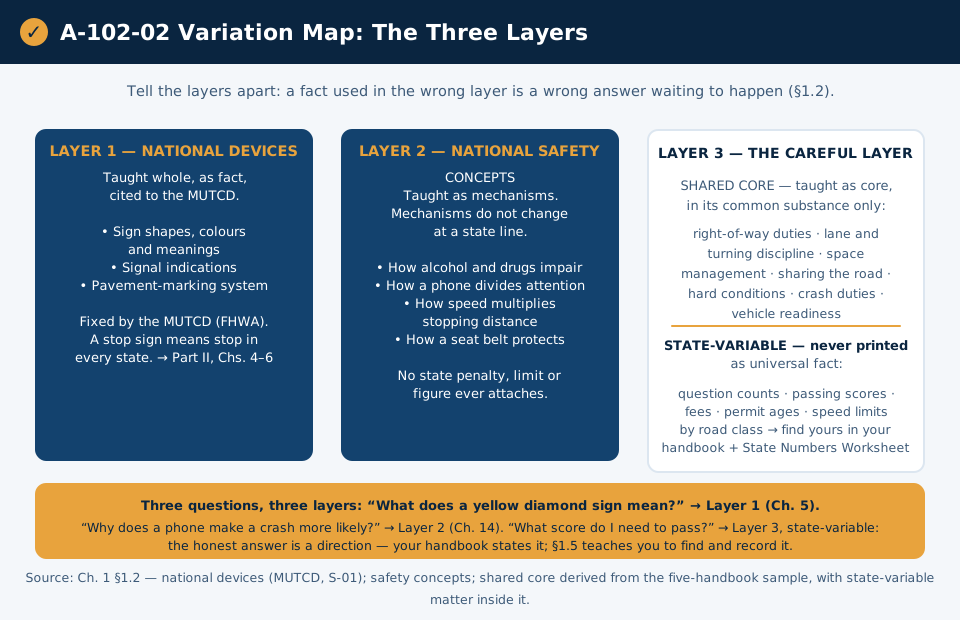
Figure 1.1. Variation map: the three layers — national devices, national safety concepts and shared core, and state-variable matter.
Your state decides
Almost every number attached to your test is set by your state. Before you rely on any figure, confirm these in your own handbook: your test's name and its passing standard — usually in the handbook's opening chapter on licensing or testing; what your test covers and how it is given — usually in the same opening material; and what your state's licensing agency is called and where its current handbook is published — usually on the handbook's cover and opening pages. What depends on it: everything in this book that points you to your handbook assumes you have found the right agency, the right handbook, and the right edition.
Simplify. Your state's driver handbook is the authority for your test. Not this book, not a video, not a practice app — the handbook. Your state writes its test from its handbook, so the handbook defines what correct means on test day. This book is a teacher and a drill partner built around that authority. It explains the shared core in teaching order, drills you on it with explained practice, and sends you back to your handbook for every fact your state sets itself. A study book that pretended to replace the authority would be doing you a disservice, and this one says so plainly.
Explain how to get it. Your handbook is published free by your state's licensing agency. In most states you can download the current edition from the agency's website at no cost, and many licensing offices also provide printed copies. The method matters more than any single website address, because addresses change: start from your state's official government presence, find the agency that issues driver licenses — its name differs by state, which is itself state-variable matter — and follow that agency's own link to its driver handbook. If a site asks you to pay for the handbook itself, you are almost certainly not on your agency's own site. The handbook is free; what commercial sites sell is their own material wrapped around it.
Detail: check the edition. Handbooks are revised, and an old edition teaches old details. When you obtain your handbook, check its date before you study from it: look for an edition year, a revision date, or a version note on its cover, its opening pages, or its publication information. Then check once more before test day, because a handbook can be revised while you are studying. Daniel learned this the practical way. The copy of his new state's handbook he first downloaded had been saved by a friend the year before; the agency's site carried a newer edition. The core rules matched — the core usually travels well across editions — but the licensing details he needed lived in the current edition, and the current edition is what his test would be written from. Maya now keeps one habit from his mistake: she wrote her handbook's edition date on the first page of her study notes, next to the date she downloaded it.
Show the authority at work. Suppose this book and your handbook ever appear to disagree about a device. Chapter 4 teaches the MUTCD meaning of sign devices, and it also carries an edition note for exactly this situation: handbooks can lag an edition transition in the national standard. For your test, your handbook governs — it is the document your test was written from. For your understanding of the national system, the MUTCD governs. Section 1.2's layers tell you which authority answers which question, and Chapter 4 returns to the point at the first device where you could check it yourself. Suppose instead that this book and your handbook appear to disagree about a number. There is no contest at all: numbers are state-variable, this book prints no state number as a rule, and your handbook's figure is the one to learn and record.
Do it now, before Chapter 2. Get your handbook. Confirm it is the current edition. Find the chapter or section where it describes its own test. You do not need to memorize anything in it yet — Chapters 2 and 3 build the foundations first — but from this point forward, every "Your state decides" box in this book assumes the book is within reach.
This book describes the test sitting in one generic form only, because that is the only form the evidence supports: the test is based on your state's driver handbook; it is administered by your state's licensing agency, in most states on a computer at a licensing office; its questions cover road signs and the rules of the road, in some states as one test and in some as two parts; you are also screened for vision as part of licensing (Source: derived core — see the Derivation Crosswalk, Appendix). Read that sentence as a shape, not a specification. Every clause in it is deliberately general, and each general clause hides state detail you must get from your own handbook.
Unpack the shape clause by clause. Based on your handbook means the test samples what the handbook teaches — signs and rules above all — which is why this book's organization mirrors the handbook-test's own content families. Administered by your licensing agency means the sitting happens under that agency's procedures, at its offices or through its arrangements, not under any national procedure. In most states on a computer means you should expect a screen, while remembering that "most" is doing real work in that sentence: your state's method is stated in your handbook. In some states as one test and in some as two parts means the sign material and the rules material may reach you together or separately; either way, the knowledge is the same knowledge, and this book teaches it whole. Screened for vision gets its own section next, because it surprises many first-time applicants.
What this section deliberately does not give you is just as important. It does not give you a number of questions, because states set their own counts and no national count exists. It does not give you a passing score, a time limit, a fee, or a retake rule, for the same reason. Any book, site, or video that states one of those figures without naming a state is stating a figure that will be wrong for most readers. This book's own practice tests, later in the volume, are labeled on their faces as this book's model form — a teaching instrument with this book's own timing discipline — precisely so that no practice number of ours is ever mistaken for your state's figure. Your state's figures go in one place only: your State Numbers Worksheet, in your own hand, copied from your own handbook. Section 1.5 introduces it.
Worked scenario. Maya's classmate tells her, confidently, how many questions "the test" has and what score "you need." Maya now has the training to hear the problem: the classmate has stated state figures with no state attached. If the classmate is preparing in Maya's own state, from the current handbook, the figures might be right for that state — and Maya can verify them in minutes in her handbook's testing section. If the classmate learned them from a video made for another state, they are another state's figures wearing no label. Maya's move is the book's move: thank the classmate, open the handbook, check, and record only what the handbook states. That is not distrust. That is the variation skill, and it will protect her on every state-set fact she meets from here to test day.
Vision screening is a check, conducted as part of licensing, that an applicant's eyesight meets the standard the state requires for licensure, with corrective lenses where the applicant uses them. It is not part of the knowledge test's score, and it is not a medical examination; it is a licensing step that sits alongside the knowledge test in the application process (Source: derived core — see the Derivation Crosswalk, Appendix). Two practical points follow. First, if you wear glasses or contact lenses for distance, bring them — an applicant who leaves corrective lenses at home can fail a screening their corrected eyesight would meet, and the screening then records a restriction or a return visit instead of a pass. Second, an applicant whose screening shows eyesight below the state's standard may be directed to an eye-care professional and a follow-up process; the details of that process, like the standard itself, are your state's to state. Their grandfather treats the screening as the part of renewal he prepares for most deliberately: his glasses go into his jacket pocket the night before, not searched for in the morning.
Now the road itself. After the knowledge test, licensing follows a shape with variation, and learning the shape helps you plan even though every measurement on it is your state's. In outline, the shape runs like this: the applicant studies the handbook and passes the knowledge test; the state issues a learner permit or its state-named equivalent — a restricted permission to practice driving under supervision; the new driver completes a period of supervised practice, and in many cases a driver-education requirement, under the state's rules; the applicant then takes a behind-the-wheel road test of driving skill; and the state issues the license, in many systems through stages that relax restrictions over time. That staged structure — early restriction giving way to fuller privilege as the driver gains experience — is called graduated licensing where a state uses it, and the stage structure exists across the sampled handbooks as a shape (Source: derived core — see the Derivation Crosswalk, Appendix). What does not travel is every particular: the age at which each stage begins, the hours of practice required, the passengers and hours a young driver may carry, and the names of the stages themselves are all state-set.
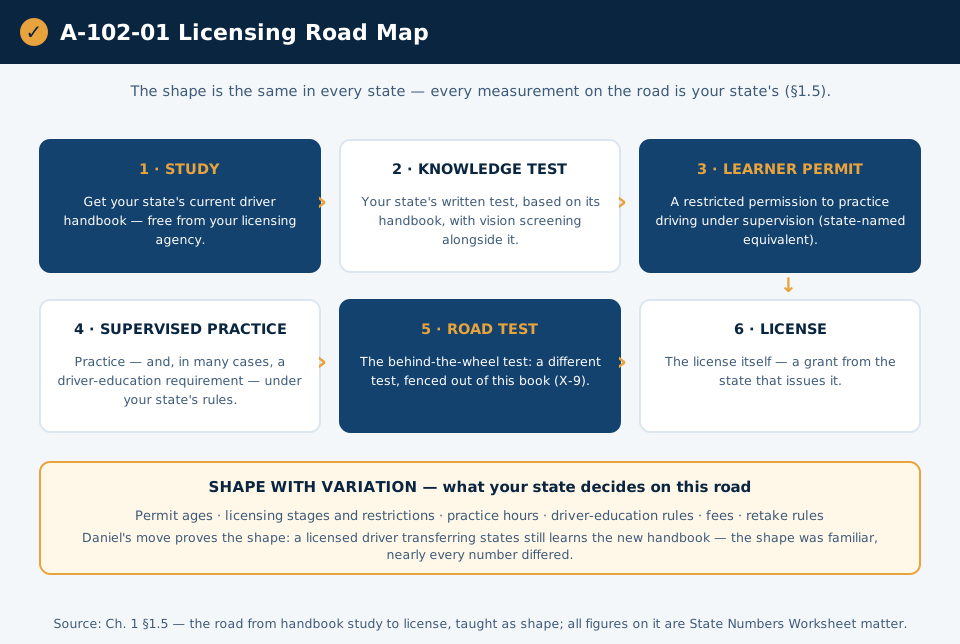
Figure 1.2. Licensing road map: the shape-with-variation road from handbook study through the knowledge test, permit, supervised practice, and road test to the license.
This is why Daniel's move is instructive. He arrived in his new state already licensed, so his path was a transfer path, not a first-license path — and even so, his new state required him to learn its handbook and meet its requirements, because a license is a grant from the state that issues it. Had he been starting fresh, the shape of his road would have been familiar from his first state — handbook, knowledge test, permit, supervised practice, road test, license — while nearly every number on that road differed. Maya's road is the first-license road in her state, walked at her state's ages and stages. Their grandfather's road is different again: a renewal road, in which an experienced licensee re-establishes eligibility under his state's renewal rules. One shape, three walks, no shared numbers. The State Numbers Worksheet in the back matter is where your walk gets its numbers: a fill-in table with a row for each state-set figure — your test's question count and passing standard, your permit age and licensing stages, your speed limits by road class, your following-distance rule, your parking distances, your impairment figures, your fees and retake rule — each row naming the handbook section to copy it from. Chapter 18 walks you through completing it, section by section, before your final practice test. From this chapter on, start filling rows as you find them; a worksheet completed a row at a time costs minutes and is worth more on test morning than any figure memorized from the wrong state.
Your state decides
The road from test to license is state-shaped at every measurement. Confirm in your own handbook: your permit age and your licensing stages, with their restrictions — usually in the opening licensing chapter; any driver-education course requirement and any supervised-practice requirement that applies to you — usually in the same chapter or a section on new drivers; and your renewal requirements, if you are renewing — usually in a chapter on keeping or renewing a license. What depends on it: which stage you are applying for, what you may do on a permit, and what must happen between your knowledge test and your license.
Two neighboring tests sit close to yours, and this book names each once, here, so that its scope is never confused.
A commercial driver's license — a CDL — is the license required to drive commercial vehicles, and it is earned through its own knowledge and skills tests, with federally standardized content that this book does not teach. If your goal is to drive commercially, the CDL is the license you need, and it has its own preparation; nothing in this book prepares you for a commercial test, and no item in this book tests commercial content. Large trucks appear in this book exactly once as teaching, in Chapter 11, and there they appear the way a car driver meets them: as vehicles to share the road with safely — their blind spots, their wide turns, their longer stopping distances. That is car-test knowledge. It is not commercial training wearing a different cover.
A motorcycle test is likewise a separate state test: operating a motorcycle requires its own knowledge, its own on-cycle skill, and in a state's system typically its own endorsement or license class, earned separately from a car license. This book names that test here and does not teach it. Motorcycles appear in Chapter 11 the way trucks do — as road users a car driver must learn to see and give room to — which is, again, car-test knowledge about sharing the road, not instruction for riding.
Why draw the boundaries in Chapter 1 rather than on the cover alone? Because scope confusion produces real study waste. A reader who drills commercial content for a car test, or car content for a commercial test, is spending scarce study time outside the sitting they will actually take. Your sitting is the car knowledge test. Everything in this book — every chapter, every quiz, every practice test — serves that sitting and no other.
One fence remains to print in full, because Chapters 2 and 18 repeat it and your whole study plan stands inside it. This book prepares the knowledge the written test examines. It teaches what controls do, what checks look for, and what rules require — as knowledge. It does not teach anyone to drive, and it cannot rehearse driving skill. Skill is built behind the wheel, under your state's rules for supervised practice — this book's job ends at the knowledge the tests examine. When Chapter 2 walks you around a car, it is building the knowledge a test item can ask about: what the parking brake is for, what a warning lamp means, what a pre-drive check looks for. Reading it well will help you answer test items. Only supervised practice will make you a driver, and your handbook states your state's rules for that practice.
The "Your state decides" convention is now yours to use. Wherever teaching touches a state-set fact, you will meet a box in the standing form used twice already in this chapter: it names the figure to confirm, where in a handbook it usually lives, and what depends on it. Treat each box as an assignment, not a footnote. When you meet one, pause, find the figure in your handbook, and write it in your State Numbers Worksheet. A reader who works the boxes finishes this book knowing two things at once: the shared core, from the teaching — and their own state's numbers, from the only authority that can give them. A reader who skips the boxes finishes knowing the core and guessing the numbers, which is exactly the failure this book was designed to prevent.
Close by checking the chapter against its own method — simplify, explain, detail, show, do, check. You can simplify: no national test; licensing is a state function. You can explain: three layers, and why each is answered differently. You have the detail: the hedged shape of the sitting, vision screening, the shape-with-variation road to a license, and the two boundaries. You have seen it shown: Maya checking a classmate's unlabeled figures, Daniel working from a superseded edition, their grandfather pocketing his glasses the night before. You have done the first task: your handbook, current edition, within reach. The check is the quiz that follows — twenty items on this chapter's teaching, none of them testing a state number, because no item in this book ever does. After it, Chapter 2 takes you to the car itself — still on paper, still as knowledge — and Chapter 3 teaches you to see the road the way every later chapter will assume you can.
Key terms. Driver licensing — the state system that grants legal permission to drive on public roads. State function — a power exercised by each state under its own law. Knowledge test — the written examination of signs, rules, and safe-driving knowledge required before licensure. Driver handbook — the official state publication that teaches the material its test examines. Ordinary car driver's license — the non-commercial license class most car drivers hold. Manual on Uniform Traffic Control Devices (MUTCD) — the federal standard fixing sign shapes, colors, and meanings, signal indications, and pavement markings nationally. National devices — the MUTCD layer of signs, signals, and markings. National safety concepts — impairment, distraction, speed, and restraint mechanisms that do not change at a state line. Shared core — rules and practices the sampled state handbooks teach in common substance. State-variable matter — figures and details states set differently, never printed here as universal fact. Vision screening — the eyesight check conducted as part of licensing. Learner permit — restricted permission to practice driving under supervision after the knowledge test. Supervised practice — practice driving under a qualified supervisor, under state rules. Graduated licensing — a staged structure in which restrictions relax as a new driver gains experience. State Numbers Worksheet — the back-matter table the reader completes from their own handbook. Commercial driver's license (CDL) — the separate license, with its own tests, required to drive commercial vehicles.
Labeled example — read it in its fence. In Texas, a grade of 70 percent or better passes the state's knowledge exams (Source: Texas Driver Handbook (DL-7), revised January 2026; the passing grade is also set by rule at 37 TAC §15.52). This figure is printed here only as an example of variation teaching: it is Texas's figure, from Texas's source, and it states nothing about any other state's passing standard — including yours. No question count is attached to it, because the cited source publishes the percentage and this book attaches nothing its source does not state. Your passing standard is the one in your handbook, recorded in your worksheet.
Q1. Why is there no single national written test for a car driver's license? A. Because the federal government has not yet written one B. Because driver licensing is a state function, exercised by each state under its own law C. Because each state uses a different sign system D. Because the test is given only by driving schools
Q2. Which layer of this book is genuinely national and taught whole, without hedging? A. Passing scores and question counts B. Permit ages and licensing stages C. Sign shapes, colors, and meanings; signal indications; and pavement markings D. Speed limits by road class
Q3. What is the authority for your state's test? A. This book B. Your state's current driver handbook C. The practice test with the most questions D. A video made for drivers in any state
Q4. Maya's classmate states how many questions "the test" has, naming no state. What is the book's trained response? A. Memorize the figure, since classmates usually know B. Reject the figure outright as certainly false C. Average it with figures from other sources D. Verify it in her own state's current handbook, and record only what the handbook states
Q5. Daniel first studied from a superseded edition of his new state's handbook. What was his correction? A. He obtained the current edition, because the test is written from the current handbook B. He stopped using the handbook and used only this book C. He studied the older edition harder, since older rules are stricter D. He asked his old state to confirm his new state's rules
Q6. Which statement about vision screening is correct? A. It is scored as part of the knowledge test B. It is a full medical examination C. It is a licensing step alongside the knowledge test, and applicants should bring the corrective lenses they use D. It applies only to drivers renewing late in life
Q7. In the shape-with-variation road to a license, what follows the knowledge test in the outline this chapter teaches? A. The full license, with no further step B. A learner permit or its state-named equivalent, then supervised practice, then a road test, then the license C. A commercial license application D. A motorcycle endorsement
Q8. Which of the following is state-variable matter? A. The meaning of a stop sign's shape B. The mechanism by which alcohol slows reaction C. The right-of-way duty at an all-way stop, in its common substance D. A permit age and a licensing stage's restrictions
Q9. What is the State Numbers Worksheet? A. A table of national figures printed for memorization B. A fill-in table the reader completes from their own handbook, each row naming the handbook section to copy from C. A score-conversion chart for practice tests D. A list of every state's passing score
Q10. How does this book treat its own timed practice tests? A. As exact copies of a state's test B. As the national test form C. As this book's model form, labeled as such on every face, with the reader's own state figures taken from their worksheet D. As official tests approved by a licensing agency
Q11. Which item could a chapter quiz in this book properly ask? A. The number of questions on your state's test B. Your state's fee for a learner permit C. Your state's passing score D. Why licensing being a state function means your handbook is your test's authority
Q12. What does the "Your state decides" box do at the point of use? A. It names the figure to confirm, where in a handbook it usually lives, and what depends on it B. It gives a national figure to use until the reader checks C. It replaces the handbook for state facts D. It lists every state's figure side by side
Q13. Which statement about the commercial driver's license is correct? A. This book prepares readers for its tests as well as the car test B. It is a separate license with its own tests and federally standardized content, named once here and not taught in this book C. It is a stage on the way to an ordinary car license D. Its content is tested inside this book's Chapter 11
Q14. How do large trucks appear in this book? A. As commercial-driving instruction B. As endorsement training C. As sharing-the-road awareness for a car driver — blind spots, wide turns, and longer stopping distances D. They do not appear at all
Q15. What is the correct statement of this book's fence about driving skill? A. Careful reading of Chapter 2 can substitute for supervised practice B. This book teaches the knowledge the tests examine; skill is built behind the wheel under the state's supervised-practice rules C. The road test is a written test given in the car D. Practice tests in this book rehearse driving maneuvers
Q16. Their grandfather pockets his glasses the night before his appointment. Which teaching does his habit illustrate? A. Vision screening rewards applicants who arrive early B. The knowledge test is taken without corrective lenses C. Renewal requires no screening D. An applicant who uses corrective lenses should bring them to vision screening
Q17. A website offers to sell Maya her state's handbook as a download. What does this chapter teach? A. The handbook is published free by the state's licensing agency; a charge for the handbook itself signals she is likely not on the agency's own site B. Paid handbook downloads are the current editions; free ones are outdated C. She should pay, because agencies sell through commercial sites D. She should buy two copies in case one is revised
Q18. In this book's three layers, the mechanism by which a phone divides a driver's attention belongs to which layer? A. State-variable matter B. National devices C. National safety concepts D. The State Numbers Worksheet
Q19. What does "in some states as one test and in some as two parts" teach about the sitting? A. That half the states give no sign test B. That the sign and rules material may reach the candidate together or separately, while the knowledge required is the same C. That two-part tests are harder and should be avoided D. That the reader may choose which form to take
Q20. Which sentence follows this book's quantifier discipline? A. Most states set the same passing score, so learn that score B. Passing scores run across a published national range C. Tests usually have the same number of questions everywhere D. States set passing standards differently — find yours in your handbook and record it in your worksheet
Feras Alzubi
This book prepares you to sit your own state's written knowledge test for an ordinary car driver's license. There is no national test. Each state writes its test from its own driver handbook, and your state's handbook is the authority for your test.
The book teaches three things. First, the national layer: the sign, signal, and pavement-marking system published in the Manual on Uniform Traffic Control Devices (MUTCD). Second, the shared core: the rules of the road and safe-driving knowledge that published state driver handbooks teach in common. Third, the variation skill: what your state sets for itself, and how to find and verify your own state's figures in your own handbook before test day.
This book is an independent study book. It is not published by, affiliated with, endorsed by, or approved by any state's department of motor vehicles, department of public safety, or licensing agency, and no state agency participated in its creation. Driver licensing is administered by each state under its own law, and your state's current driver handbook is the authority for your test.
The practice questions in this book are original, written for this book against the MUTCD and the published state-handbook core. They are not any state's actual test questions. No item in this book reproduces, recalls, paraphrases, or adapts any state's actual, recalled, or published test questions, and no item is copied or adapted from any handbook's printed practice set or from any other preparation book, course, or question bank. Every item is explained: why the key is right, and why each wrong option is wrong.
© 2026 Feras Alzubi. All rights reserved.
No part of this book may be reproduced, distributed, or transmitted in any form or by any means — electronic, mechanical, photocopying, recording, or otherwise — without the prior written permission of the copyright holder, except as permitted by law and except for brief quotations in reviews and the buyer's own study notes.
This is an original work, written for this book. The teaching, the worked examples and scenarios, and the practice questions were all created for this book. The practice questions are original, written against the MUTCD and the published state-handbook core named in this book, and are not any state's actual, recalled, paraphrased, or adapted test items.
This book is an independent study book. It is not published by, affiliated with, endorsed by, or approved by any state's department of motor vehicles, department of public safety, or licensing agency, and no state agency participated in its creation. Driver licensing is administered by each state under its own law, and your state's current driver handbook is the authority for your test.
This page describes the test in its generic form only — the form every part of this book is built on. Anything more specific is your state's to set, and this book teaches you to find it in your own handbook rather than printing a figure here that would be wrong for most readers.
The test is based on your state's driver handbook. It is administered by your state's licensing agency, in most states on a computer at a licensing office. Its questions cover road signs and the rules of the road, in some states as one test and in some as two parts. You are also screened for vision as part of licensing.
That is the whole national description, because there is no more. This book states no national question count, no national passing score, no national time limit, no national fee, and no national retake rule, because none exists. Your state sets each of those figures for its own test. The State Numbers Worksheet in the back matter walks you through finding every one of them in your own handbook.
The sign, signal, and marking system is national. Sign shapes, colors, and meanings, signal indications, and pavement markings follow the MUTCD, and Chapters 4 to 6 teach that system whole, as fact.
The rules core is shared. Right-of-way, lane and turning discipline, space management, sharing the road, hard conditions, and the duties of a licensed driver are taught in the substance that published state handbooks hold in common. Where a number inside that core differs from state to state, the number is not taught as a rule. The concept is taught, and the number becomes worksheet work.
Everything else is variation. Question counts, passing scores, time limits, fees, permit ages and licensing stages, speed limits by road class, following-distance and parking-distance figures, alcohol limits, fines and points, and retake and renewal rules are set by your state. The variation promise of this book is plain: you will finish it knowing those numbers for your state because you looked them up in your own handbook, with this book showing you what to look for and where it matters.
A commercial driver license is a different license, for commercial driving, with its own tests and its own preparation. This book does not teach it and does not prepare you for it. A motorcycle endorsement or license is likewise a separate state test, with its own preparation. This book names it here only to mark the boundary and does not teach it.
This book prepares the knowledge test: the signs, rules, and safe-driving knowledge the written test examines. It teaches vehicle controls, checks, and maneuvers as knowledge — what a control does, what a check looks for, what a rule requires.
It does not teach anyone to drive. Skill is built behind the wheel, under your state's rules for supervised practice — this book's job ends at the knowledge the tests examine.
This book is an independent study book. It is not published by, affiliated with, endorsed by, or approved by any state's department of motor vehicles, department of public safety, or licensing agency, and no state agency participated in its creation. Driver licensing is administered by each state under its own law, and your state's current driver handbook is the authority for your test.
This book serves two readers at once. The first is the total beginner, learning driving knowledge from zero: no prior knowledge is assumed, and every foundation is taught from the ground up in plain language. The second is the test candidate, preparing to sit a specific sitting of their own state's knowledge test on a date they book with their state's licensing agency.
Readers arrive in three starting situations, and the book serves all three by routing rather than by separate tracks. A first-time teen reader is preparing for a first permit test. An adult first-time applicant is preparing for a first license test later in life. A new-state mover already drives, or has tested before, and must sit a new state's test whose numbers differ from the ones they learned. The diagnostic at the front of the book measures where you stand, and its routing sends each reader to the chapters they need.
Three invented people recur through the book's scenarios, and their progress is reported in this book's practice terms only — items, family accuracy, and pacing.
Their town, Millers Crossing, is fictional. It has a four-way stop, a signalized arterial, a school crossing, a railroad grade crossing, a freeway entrance, and a circular intersection, so the book's intersection and sign scenarios build on one coherent place. All three people and the town are invented; every scenario is this book's own teaching material.
Every chapter runs the same rhythm: simplify → explain → detail → show → do → check. A chapter opens with the idea in plain words, explains why it exists, gives the full rule, shows a worked example or scenario, gives you work to do, and closes with a chapter quiz.
Worked examples always come before items. Nothing is tested before it is taught. The first use of every technical term is bolded and defined in place, each chapter closes by collecting its terms in a Key terms paragraph, and the Glossary in the back matter gathers them all.
The book is built in five parts. Part I, Chapters 1 to 3, starts from zero: the handbook system, the car before it moves, and seeing the road. Part II, Chapters 4 to 6, teaches the language of the road: signs, signals, and markings. Part III, Chapters 7 to 12, teaches the rules of the road. Part IV, Chapters 13 to 15, teaches the driver: impairment, distraction, and defensive driving as a system. Part V, Chapters 16 to 18, teaches the license and the test itself, ending with test craft and test day.
One item = one scored question as the reader meets it: one multiple-choice question, or one sign-identification task. Chapter-quiz, diagnostic, timed-test and repair items each count once, in their own families. Worked examples inside chapter prose are teaching, not counted items. No book item is ever described as a state's actual test item, an official item, or score-converting.
| Apparatus family | Derivation | Items |
|---|---|---|
| Diagnostic | Fixed design | 50 |
| Chapter quizzes | 18 chapters × 20 | 360 |
| Full timed practice tests | 6 tests × 50 (this book's model form) | 300 |
| Repair sets | 8 families × 15 | 120 |
| Total practice questions | 830 |
Every item has four options. Every key explains why the key is right and why each wrong option is wrong, individually.
Wherever teaching touches a fact your state sets, the chapter carries a box in exactly this standing form. The box names the figure you must confirm, where in a handbook to look for it, and what depends on it. No general disclaimer in the front matter takes the place of the box at the point of use. Here is the form, shown once as a specimen:
Your state decides
Confirm in your own handbook: your test's question count and passing score.
Look for it in your handbook's licensing and testing section, where your state describes its knowledge test.
What depends on it: how you pace a sitting, and how you re-sit this book's final practice test against your own state's figures on your State Numbers Worksheet.
When you meet this box in a chapter, stop and note the figure. Chapter 18 shows you how to work through your handbook and complete the worksheet in full.
The State Numbers Worksheet is printed in the back matter. It is a fill-in table you complete from your own handbook. Each row names one figure your state sets and the handbook section to copy it from:
You first meet the worksheet in Chapter 1, and Chapter 18 works it with you, section by section, against your own handbook. Your completed worksheet is personal apparatus: this book's practice tests are re-read against it, and the final practice test is re-sat against your own state's count and limit from it.
Before Chapter 2, take the Diagnostic that follows this front matter, cold. Do not study for it. Its job is to measure the knowledge you bring, family by family, so the book can route you.
The Diagnostic holds 50 items and is taken at about 45 minutes. That timing is this book's own discipline, not any state's test condition. Its family proportions — Signs, signals and markings 18; Rules and right-of-way 17; Safe driving and sharing the road 10; Impairment, distraction and responsibility 5 — are this book's own design.
Score the Diagnostic by family, not only in total, and follow its routing:
No Diagnostic item tests a state number. A diagnostic that marked you down for a figure your state sets differently would teach this book's central lesson backward.
After Part III, take the re-diagnostic checkpoint: work the repair sets for the families your Diagnostic and chapter quizzes flagged. The eight repair sets hold 15 items each, one set per failure family, and they are the book's re-diagnostic instruments as well as its repair drills.
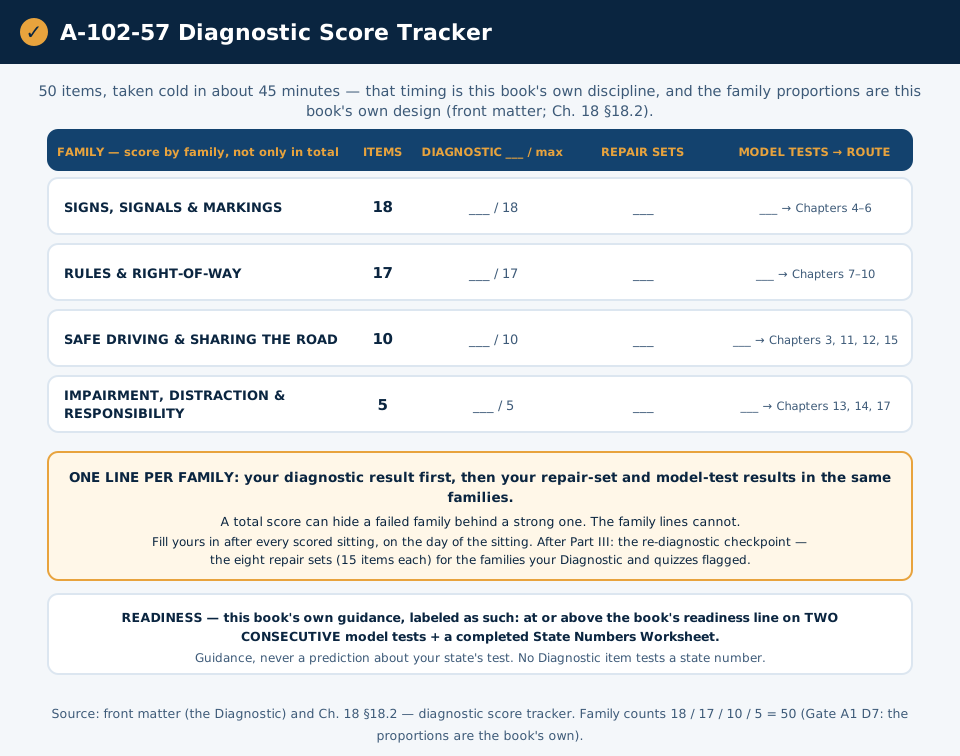
Figure 0.1. Diagnostic score tracker.
The six timed practice tests are this book's model form: 50 items each, in the Diagnostic's family proportions, sat at 60 minutes. That form and that timing are this book's own discipline. They are not any state's test form, and no result on them converts into a predicted result on any state's test.
The first two tests teach the model form and expose family weaknesses. The middle two build pacing and sign speed. The final two are dress rehearsals, and the last one is re-sat against your own state's question count and time limit from your completed worksheet.
Readiness language in this book is this book's own guidance, labeled as such wherever it appears. On that guidance, you are test-ready when you score at or above this book's readiness line on two consecutive model tests and you have completed your State Numbers Worksheet. That is a study judgment by this book's standard. It is not a prediction about your state's test, and no book can promise a test result.
Both plans are set out in full in the back matter. In outline:
The 1-week intensive plan. Diagnostic → Parts II and III → Tests 1 to 3 → repair sets for the families those tests exposed → Tests 4 and 5 → State Numbers Worksheet completed → Test 6, the final test, re-sat against it.
The 3-week standard plan. The parts in order, from Part I through Part V, at a steady pace, with one timed practice test per half-week once the teaching parts are under way, and the State Numbers Worksheet completed in week 2, so the later tests are read against your own state's figures.
Choose by your Diagnostic, not by the calendar alone. A reader whose weak families are the signs needs Part II at full depth on either plan; a reader whose Diagnostic is already strong in a family can move through that family's chapters at review pace and spend the saved time on repair.
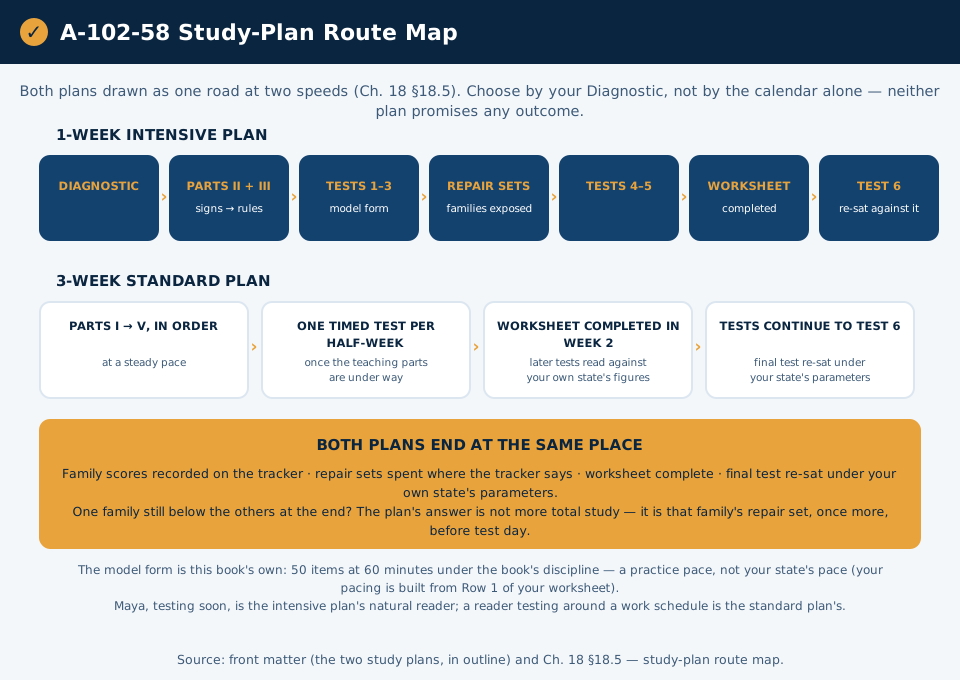
Figure 0.2. Study-plan route map.
This book's job ends at the knowledge the tests examine. It prepares the written knowledge test, and it teaches the car, its controls, and its maneuvers only as knowledge. Skill is built behind the wheel, under your state's rules for supervised practice. Get your state's current driver handbook from your licensing agency before you begin Chapter 1, keep it beside this book, and let it settle every question this book marks as your state's to decide.
End of the free sample. The complete book continues from here — the full A-to-Z course in book form, delivered as an EPUB you can read in Apple Books, Google Play Books, ReadEra, Thorium Reader, Adobe Digital Editions, or Send to Kindle.
Buy this ebook — $11.99 Back to the book page
Payments are securely processed by Payhip.